KỲ THI THỬ THPT QUỐC GIA NĂM 2019 MÔN TIẾNG ANH(P17)
64 câu hỏi
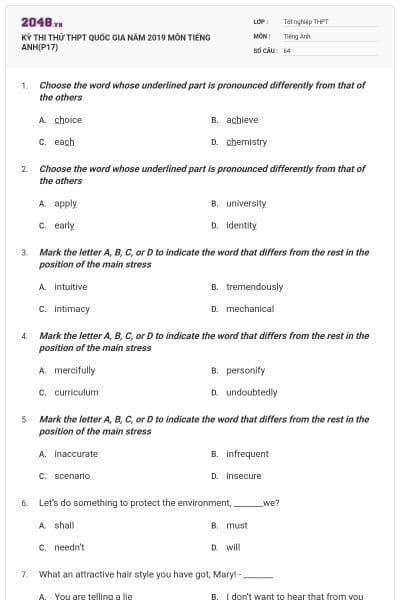
Choose the word whose underlined part is pronounced differently from that of the others
choice
achieve
each
chemistry
D
“ch” trong “chemistry” phát âm là /k/, trong các từ còn lại phát âm
Choose the word whose underlined part is pronounced differently from that of the others
apply
university
early
identity
A
“y” trong “apply” phát âm là /ai/, trong các từ còn lại phát âm là /i/
Mark the letter A, B, C, or D to indicate the word that differs from the rest in the position of the main stress
intuitive
tremendously
intimacy
mechanical
C
Trọng âm của từ này rơi vào âm tiết thứ 1, các từ còn lại rơi vào âm tiết thứ 2
Mark the letter A, B, C, or D to indicate the word that differs from the rest in the position of the main stress
mercifully
personify
curriculum
undoubtedly
A
Trọng âm của từ này rơi vào âm tiết thứ 1, các từ còn lại rơi vào âm tiết thứ 2
Mark the letter A, B, C, or D to indicate the word that differs from the rest in the position of the main stress
inaccurate
infrequent
scenario
insecure
D
Trọng âm của từ này rơi vào âm tiết thứ 3, các từ còn lại rơi vào âm tiết thứ 2
Let’s do something to protect the environment, _______we?
shall
must
needn’t
will
A
Câu hỏi đuôi của cấu trúc Let’s V là: shall we?
What an attractive hair style you have got, Mary! - _______
You are telling a lie
I don’t want to hear that from you
Thank you for your compliment
I don't like your sayings
C
Cấu trúc câu cảm thán: What + a/an + adj + N! = thật là một …! Ở đây mang ý khen ngợi một kiểu tóc cuốn hút; trước lời khen người đáp cám ơn
_________he was good at physics in lower grade, he was terrible at it in grade 12
While
Although
When
Except that
A
While = trong khi. Although = mặc dù. When = khi. Except that…= trừ trường hợp là… Dịch: trong khi cậu ấy học tốt vật lí ở lớp dưới, cậu ấy lại học rất kém ở lớp 12
Body language is a potent form of _______ communication
verbal
oral
tongue
non-verbal
D
Non- verbal = không dùng lời nói. Ngôn ngữ cơ thể là một hình thức giao tiếp không dùng lời quan trọng
Don’t worry. I have _________tire at the back of my car
other
another
others
the other
B
Another = một cái khác (không xác định rõ là cái nào). Other (adj) = khác. Others = những đối tượng khác. The other = cái còn lại (trừ cái đã được nói đến). Dịch: đừng lo; tôi còn một cái lốp ở khác cuối ô tô của tôi
Six novels a year, you say? He’s certainly a _________writer
prolific
virile
fertile
fruitful
Đáp án: A
Giải thích:
Kiến thức: Từ vựng
prolific (adj): năng suất, tạo ra nhiều sản phẩm, sáng tác
fertile (adj): màu mỡ, phì nhiêu
virile (adj): sung mãn (nam tính)
fruitful (adj): nhiều trái, sai quả
Dịch: Bạn nói sáu cuốn tiểu thuyết một năm? Anh ấy chắc chắn là một nhà văn năng suất.
_________an emergency arise , call 911
Should
Will
Can
Does
A
Câu điều kiện loại 1 dạng đảo: Should + S + V không chia, S + will/can + V = If + S +Vs/es, S + will/can + V
After a _______ hesitation, she began to speak with such a convincing voice
rude
small
slight
impolite
C
Slight (adj) = nhẹ nhàng, chút ít, thoáng qua. Rude = thô lỗ. small = nhỏ. Impolite = bất lịch sự. A slight hesitation = sự lưỡng lự một chút
Jack made me _______ him next week
promise calling
to promise calling
to promise to call
promise to call
D
Make somebody do something = bắt ai làm gì
Either of my parents or my brother ________.
has coming
have come
are coming
is coming
D
Either + S1 + or + S2 = hoặc là S1 hoặc S2 -> V chia theo S1; ở đây là chia theo either of my parents-> số ít (một trong 2 người: bố hoặc mẹ)
His job is ….
driving a bus
a bus driver
bus driving
a driver of a bus
C
Bus driving (danh động từ) = việc lái xe buýt. Công việc của anh ấy là lái xe buýt; không phải công việc của anh ấy là người lái xe buýt -> loại B, D. Loại A vì “is driving a bus” = đang lái xe buýt
Do you like pop music or jazz?
- I don’t like _______of them. I prefer classical music
any
either
both
neither
B
Either of N = một trong số 2 đối tượng -> thường dùng trong câu phủ định hoặc nghi vấn. Not…either of Ns = neither of Ns = không một ai trong số 2 đối tượng
Had she worked harder last summer, she _________.
wouldn’t sack
wouldn’t have been sacked
wouldn’t have sacked
wouldn’t be sacked
B
Câu điều kiện loại 3 dạng đảo, chỉ một việc trái với quá khứ: Had + S + past participle, S + would/could + have past participle
The meaning from touch is dependent _______ the context, the relationship between communicators, and the manner of touch
in
from
with
upon
Đáp án: D
Giải thích:
Kiến thức: Giới từ
dependent on/upon something: phụ thuộc vào cái gì
Dịch: Ý nghĩa của sự chạm phụ thuộc vào bối cảnh, mối quan hệ giữa những người giao tiếp và cách thức chạm.
Those trousers are far too big. Why don’t you have them_________?
taken out
taken in
taken over
taken on
B
Take in something = làm ngắn lại trang phục, chịu trách nhiệm cái gì. Have something past participle = thu xếp cho cái gì của mình được ai làm
Mark the letter A, B, C or D on your answer sheet to show the underlined part that needs correction from:
A galaxy, where (A) may include billions of (B) stars, is (C) held together (D) by gravitation attraction
where
of
is
together
Đáp án: A
Giải thích:
Kiến thức: Mệnh đề quan hệ
Cần đại từ quan hệ để chỉ vật “galaxy”, đứng làm chủ ngữ trong mệnh đề quan hệ, dùng “which”.
Sửa: where → which
Dịch: Một thiên hà có thể bao gồm hàng tỷ ngôi sao được giữ lại với nhau nhờ lực hấp dẫn.
Mark the letter A, B, C or D on your answer sheet to show the underlined part that needs correction from:
The tongue is the principle (A) organ of taste (B) and is (C) crucial for chewing, swallowed (D) and speaking
principle
of taste
is
swallowed
D
Các hành động đang được liệt kê ( nhai, nuốt và nói chuyện) thì động từ liệt kê sau phải cùng dạng với động từ liệt kê trước, sau cùng : Ving (chewing, speaking). D -> swallowing
Mark the letter A, B, C or D on your answer sheet to show the underlined part that needs correction from:
I believe that only very (A) self-confident, knowledge (B) and attentive students will prefer (C ) 100% of eye contact time. (D)
only very
knowledge
will prefer
eye contact time
B
Các từ đang phải liệt kê phải cùng dạng: tự tin (confident), hiểu biết và tập trung (attentive) -> cùng dạng tính từ -> B: knowledgeable
Mark the letter A, B, C or D on your answer sheet to show the underlined part that needs correction from:
Bacteria are one of the most abundant (A) life forms (B) on earth, growing on and inside another (C) living things, in every type of environment (D).
abundant
forms
another
environment
C
Another = một đối tượng khác (không xác định rõ). Living things = những vật sống -> số nhiều -> sửa C : other (=khác)
Mark the letter A, B, C or D on your answer sheet to show the underlined part that needs correction from:
Professor Layton was equally (A) fond of the two children, but he had to admit that he found (B) the youngest (C) an easier (D) child to handle
equally
found
youngest
easier
C
So sánh 2 đối tượng chỉ có so sánh hơn, không có so sánh cao nhất. C -> the better. Dịch: giáo sư Layton thích cả 2 đứa trẻ như nhau, nhưng ông ấy phải thấy rằng đứa nhỏ hơn là đứa dễ quản lí hơn.
Mark the letter A, B, C or D on your answer sheet to indicate the word or phrase that is CLOSEST in meaning to the underlined part in each of the following questions.
There were so many members of the political party who had gone against the leader that he resigned.
apposed
insisted
invited
Opposed
D
Go against = đi ngược lại, chống đối lại ≈ oppose
Mark the letter A, B, C or D on your answer sheet to indicate the word or phrase that is CLOSEST in meaning to the underlined part in each of the following questions.
The most important thing is to keep yourself occupied
free
busy
relaxed
comfortable
B
Occupied (adj) = bận rộn = busy
Mark the letter A, B, C or D on your answer sheet to indicate the word or phrase that is CLOSEST in meaning to the underlined part in each of the following questions.
She was brought up in a well-off family. She can’t understand the problems we are facing
wealthy
kind
poor
broke
A
Well –off = khá giả ≈ wealthy = giàu có
Mark the letter A, B, C or D on your answer sheet to indicate the word(s) opposite in meaning to the underlined word(s) in each of the following questions
During the five-decade history the Asian Games have been advancing in all aspects
holding back
holding by
holding to
holding at
A
Advance (v) = tiến lên, phát triển đi lên. Hold back = trì trệ, cản trở
Mark the letter A, B, C or D on your answer sheet to indicate the word(s) opposite in meaning to the underlined word(s) in each of the following questions
She decided to remain celibate and devote her life to helping the homeless and orphans
separated
single
Married
divorced
C
Celibate (adj) = độc thân. Married (adj) = (đã) kết hôn, lập gia đình. Divorce = ly dị. separate = tách rời; li thân
Mark the letter A, B, C or D on your answer sheet to indicate the sentence that is closest in meaning to each of the following questions.
She has lost her appetite recently
Her appetite has been very good
She has gone off food recently
She hasn’t eaten a lot of food recently
She hasn’t had any food recently
B
Lose one’s appetite = mất cảm giác ngon miệng. Go off something = không còn thích nữa
Mark the letter A, B, C or D on your answer sheet to indicate the sentence that is closest in meaning to each of the following questions.
Tom regrets to say that he has left his tickets at home
Tom wishes he hadn’t left the ticket at home
Tom regrets leaving the tickets at home
Tom was sorry that he has left the tickets at home
Tom regrets to leave the ticket at home
B.
Regret to V = rất tiếc khi phải nói rằng (anh ấy đã để quên những chiếc vé ở nhà). Regret Ving = hối hận khi đã làm gì. Be sorry that = rất tiếc rằng… (không chọn C vì thời quá khứ, không đúng với đề bài)
Mark the letter A, B, C or D on your answer sheet to indicate the sentence that is closest in meaning to each of the following questions.
Don’t let her treat you like that
You are not let be treated like that by her
Don’t allow you to be treated like that
She doesn’t treat you like that
Don’t let yourself be treated like that by her
D
Let somebody do something = để ai làm gì. Đừng để cô ấy đối xử với bạn như thế = đừng để bản thân bị đối xử như thế bởi cô ấy. -> Chuyển từ chủ động sang bị động
Mark the letter A, B, C or D on your answer sheet to indicate the sentence that is closest in meaning to each of the following questions.
“ Can I see your ticket please””
The inspector offered to see my ticket
The inspector asked to see my ticket
The inspector expected to see my ticket
The inspector asked for my ticket
B
Dịch: Làm ơn cho tôi xem vé của bạn -> một yêu cầu. Ask somebody to V = yêu cầu ai làm gì. Ask for something = yêu cầu có cái gì. Offer to V = ngỏ ý làm gì. Expect to V = mong đợi việc làm gì
Choose the word or phrase - A, B, C or D - that best completes the passage.
The most dominant and reliable features of facial expressions provide a constant channel of communication. They can be shifty and evasive; convey hate, fear, and guilt; or (35) _____ confidence, love, and support.
Referred to as "mirrors of the soul" our eyes serve as the major decisive factor in (36) _____ the spoken words. The eyes of the man converse as (37) _____ as their tongues, with the advantage that the ocular dialect needs (38) _____ dictionary, but it is understood all over the world. When the eyes say one thing, and the tongue another, a practiced man relies on eyes. Except (39) _____ extremely shy individuals, most people look for social acceptance by studying the eyes of others. Eyes also can (40) _____ indicate a positive or a negative relationship. People tend to look longer and more often at the people whom they trust, respect and care about than at those whom they doubt or (41) _____. Normal eye dilation is not under control of the individual. Personally characteristics such as introversion and extroversion also influence eye behavior. Eye behavior seems (42) ____ particular importance and is generally used to indicate whether one is open to communication. This can be observed when a teacher asks the class a question: students who think they know the answer will generally (43) ____ at the teacher, (44) ____ students who do not know the answer will usually try to avoid eye contact
Điền vào ô 35
report
replace
express
consider
C
Express something = thể hiện, bộc lộ cái gì. Report = báo cáo. Replace = thay thế. Consider = xem xét, cân nhắc
Choose the word or phrase - A, B, C or D - that best completes the passage.
The most dominant and reliable features of facial expressions provide a constant channel of communication. They can be shifty and evasive; convey hate, fear, and guilt; or (35) _____ confidence, love, and support.
Referred to as "mirrors of the soul" our eyes serve as the major decisive factor in (36) _____ the spoken words. The eyes of the man converse as (37) _____ as their tongues, with the advantage that the ocular dialect needs (38) _____ dictionary, but it is understood all over the world. When the eyes say one thing, and the tongue another, a practiced man relies on eyes. Except (39) _____ extremely shy individuals, most people look for social acceptance by studying the eyes of others. Eyes also can (40) _____ indicate a positive or a negative relationship. People tend to look longer and more often at the people whom they trust, respect and care about than at those whom they doubt or (41) _____. Normal eye dilation is not under control of the individual. Personally characteristics such as introversion and extroversion also influence eye behavior. Eye behavior seems (42) ____ particular importance and is generally used to indicate whether one is open to communication. This can be observed when a teacher asks the class a question: students who think they know the answer will generally (43) ____ at the teacher, (44) ____ students who do not know the answer will usually try to avoid eye contact
Điền vào ô 36
exchanging
transporting
changing
interpreting
D
Interpret = giải nghĩa, dịch nghĩa. Exchange = trao đổi. transport = vận chuyển, đi lại. change = thay đổi
Choose the word or phrase - A, B, C or D - that best completes the passage.
The most dominant and reliable features of facial expressions provide a constant channel of communication. They can be shifty and evasive; convey hate, fear, and guilt; or (35) _____ confidence, love, and support.
Referred to as "mirrors of the soul" our eyes serve as the major decisive factor in (36) _____ the spoken words. The eyes of the man converse as (37) _____ as their tongues, with the advantage that the ocular dialect needs (38) _____ dictionary, but it is understood all over the world. When the eyes say one thing, and the tongue another, a practiced man relies on eyes. Except (39) _____ extremely shy individuals, most people look for social acceptance by studying the eyes of others. Eyes also can (40) _____ indicate a positive or a negative relationship. People tend to look longer and more often at the people whom they trust, respect and care about than at those whom they doubt or (41) _____. Normal eye dilation is not under control of the individual. Personally characteristics such as introversion and extroversion also influence eye behavior. Eye behavior seems (42) ____ particular importance and is generally used to indicate whether one is open to communication. This can be observed when a teacher asks the class a question: students who think they know the answer will generally (43) ____ at the teacher, (44) ____ students who do not know the answer will usually try to avoid eye contact
Điền vào ô 37
much
more
many
a lot
A
As much as = cũng nhiều như là...
Choose the word or phrase - A, B, C or D - that best completes the passage.
The most dominant and reliable features of facial expressions provide a constant channel of communication. They can be shifty and evasive; convey hate, fear, and guilt; or (35) _____ confidence, love, and support.
Referred to as "mirrors of the soul" our eyes serve as the major decisive factor in (36) _____ the spoken words. The eyes of the man converse as (37) _____ as their tongues, with the advantage that the ocular dialect needs (38) _____ dictionary, but it is understood all over the world. When the eyes say one thing, and the tongue another, a practiced man relies on eyes. Except (39) _____ extremely shy individuals, most people look for social acceptance by studying the eyes of others. Eyes also can (40) _____ indicate a positive or a negative relationship. People tend to look longer and more often at the people whom they trust, respect and care about than at those whom they doubt or (41) _____. Normal eye dilation is not under control of the individual. Personally characteristics such as introversion and extroversion also influence eye behavior. Eye behavior seems (42) ____ particular importance and is generally used to indicate whether one is open to communication. This can be observed when a teacher asks the class a question: students who think they know the answer will generally (43) ____ at the teacher, (44) ____ students who do not know the answer will usually try to avoid eye contact
Điền vào ô 38
no
nor
none
not
A
Needs no dictionary = doesn’t need any dictionary = không cần từ điển. (neither) … nor = cũng không phải… None = No + N = không đối tượng nào.
Choose the word or phrase - A, B, C or D - that best completes the passage.
The most dominant and reliable features of facial expressions provide a constant channel of communication. They can be shifty and evasive; convey hate, fear, and guilt; or (35) _____ confidence, love, and support.
Referred to as "mirrors of the soul" our eyes serve as the major decisive factor in (36) _____ the spoken words. The eyes of the man converse as (37) _____ as their tongues, with the advantage that the ocular dialect needs (38) _____ dictionary, but it is understood all over the world. When the eyes say one thing, and the tongue another, a practiced man relies on eyes. Except (39) _____ extremely shy individuals, most people look for social acceptance by studying the eyes of others. Eyes also can (40) _____ indicate a positive or a negative relationship. People tend to look longer and more often at the people whom they trust, respect and care about than at those whom they doubt or (41) _____. Normal eye dilation is not under control of the individual. Personally characteristics such as introversion and extroversion also influence eye behavior. Eye behavior seems (42) ____ particular importance and is generally used to indicate whether one is open to communication. This can be observed when a teacher asks the class a question: students who think they know the answer will generally (43) ____ at the teacher, (44) ____ students who do not know the answer will usually try to avoid eye contact
Điền vào ô 39
for
in
with
of
A
Except for something = trừ cái gì ra
Choose the word or phrase - A, B, C or D - that best completes the passage.
The most dominant and reliable features of facial expressions provide a constant channel of communication. They can be shifty and evasive; convey hate, fear, and guilt; or (35) _____ confidence, love, and support.
Referred to as "mirrors of the soul" our eyes serve as the major decisive factor in (36) _____ the spoken words. The eyes of the man converse as (37) _____ as their tongues, with the advantage that the ocular dialect needs (38) _____ dictionary, but it is understood all over the world. When the eyes say one thing, and the tongue another, a practiced man relies on eyes. Except (39) _____ extremely shy individuals, most people look for social acceptance by studying the eyes of others. Eyes also can (40) _____ indicate a positive or a negative relationship. People tend to look longer and more often at the people whom they trust, respect and care about than at those whom they doubt or (41) _____. Normal eye dilation is not under control of the individual. Personally characteristics such as introversion and extroversion also influence eye behavior. Eye behavior seems (42) ____ particular importance and is generally used to indicate whether one is open to communication. This can be observed when a teacher asks the class a question: students who think they know the answer will generally (43) ____ at the teacher, (44) ____ students who do not know the answer will usually try to avoid eye contact
Điền vào ô 40
accuracy
accurate
accurately
inaccurate
C
Accurately (adv) = một cách chính xác. Trạng từ đứng trước động từ để bổ nghĩa cho động từ ấy. Accurately indicate = biểu thị một cách chính xác
Choose the word or phrase - A, B, C or D - that best completes the passage.
The most dominant and reliable features of facial expressions provide a constant channel of communication. They can be shifty and evasive; convey hate, fear, and guilt; or (35) _____ confidence, love, and support.
Referred to as "mirrors of the soul" our eyes serve as the major decisive factor in (36) _____ the spoken words. The eyes of the man converse as (37) _____ as their tongues, with the advantage that the ocular dialect needs (38) _____ dictionary, but it is understood all over the world. When the eyes say one thing, and the tongue another, a practiced man relies on eyes. Except (39) _____ extremely shy individuals, most people look for social acceptance by studying the eyes of others. Eyes also can (40) _____ indicate a positive or a negative relationship. People tend to look longer and more often at the people whom they trust, respect and care about than at those whom they doubt or (41) _____. Normal eye dilation is not under control of the individual. Personally characteristics such as introversion and extroversion also influence eye behavior. Eye behavior seems (42) ____ particular importance and is generally used to indicate whether one is open to communication. This can be observed when a teacher asks the class a question: students who think they know the answer will generally (43) ____ at the teacher, (44) ____ students who do not know the answer will usually try to avoid eye contact
Điền vào ô 41
dislike
wait
love
long
A
Dislike = không thích. Wait = đợi. love = yêu. Long (v) = mong đợi. Whom they doubt or dislike = người họ nghi ngờ hoặc không thích
Choose the word or phrase - A, B, C or D - that best completes the passage.
The most dominant and reliable features of facial expressions provide a constant channel of communication. They can be shifty and evasive; convey hate, fear, and guilt; or (35) _____ confidence, love, and support.
Referred to as "mirrors of the soul" our eyes serve as the major decisive factor in (36) _____ the spoken words. The eyes of the man converse as (37) _____ as their tongues, with the advantage that the ocular dialect needs (38) _____ dictionary, but it is understood all over the world. When the eyes say one thing, and the tongue another, a practiced man relies on eyes. Except (39) _____ extremely shy individuals, most people look for social acceptance by studying the eyes of others. Eyes also can (40) _____ indicate a positive or a negative relationship. People tend to look longer and more often at the people whom they trust, respect and care about than at those whom they doubt or (41) _____. Normal eye dilation is not under control of the individual. Personally characteristics such as introversion and extroversion also influence eye behavior. Eye behavior seems (42) ____ particular importance and is generally used to indicate whether one is open to communication. This can be observed when a teacher asks the class a question: students who think they know the answer will generally (43) ____ at the teacher, (44) ____ students who do not know the answer will usually try to avoid eye contact
Điền vào ô 42
been
being
be
to be
D
Seem to V = dường như làm việc gì. Seem to be = dường như là gì
Choose the word or phrase - A, B, C or D - that best completes the passage.
The most dominant and reliable features of facial expressions provide a constant channel of communication. They can be shifty and evasive; convey hate, fear, and guilt; or (35) _____ confidence, love, and support.
Referred to as "mirrors of the soul" our eyes serve as the major decisive factor in (36) _____ the spoken words. The eyes of the man converse as (37) _____ as their tongues, with the advantage that the ocular dialect needs (38) _____ dictionary, but it is understood all over the world. When the eyes say one thing, and the tongue another, a practiced man relies on eyes. Except (39) _____ extremely shy individuals, most people look for social acceptance by studying the eyes of others. Eyes also can (40) _____ indicate a positive or a negative relationship. People tend to look longer and more often at the people whom they trust, respect and care about than at those whom they doubt or (41) _____. Normal eye dilation is not under control of the individual. Personally characteristics such as introversion and extroversion also influence eye behavior. Eye behavior seems (42) ____ particular importance and is generally used to indicate whether one is open to communication. This can be observed when a teacher asks the class a question: students who think they know the answer will generally (43) ____ at the teacher, (44) ____ students who do not know the answer will usually try to avoid eye contact
Điền vào ô 43
notice
think
aim
look
D
Look at N = nhìn vào ai/cái gì. Notice = chú ý. Think = nghĩ. Aim = hướng tới
Choose the word or phrase - A, B, C or D - that best completes the passage.
The most dominant and reliable features of facial expressions provide a constant channel of communication. They can be shifty and evasive; convey hate, fear, and guilt; or (35) _____ confidence, love, and support.
Referred to as "mirrors of the soul" our eyes serve as the major decisive factor in (36) _____ the spoken words. The eyes of the man converse as (37) _____ as their tongues, with the advantage that the ocular dialect needs (38) _____ dictionary, but it is understood all over the world. When the eyes say one thing, and the tongue another, a practiced man relies on eyes. Except (39) _____ extremely shy individuals, most people look for social acceptance by studying the eyes of others. Eyes also can (40) _____ indicate a positive or a negative relationship. People tend to look longer and more often at the people whom they trust, respect and care about than at those whom they doubt or (41) _____. Normal eye dilation is not under control of the individual. Personally characteristics such as introversion and extroversion also influence eye behavior. Eye behavior seems (42) ____ particular importance and is generally used to indicate whether one is open to communication. This can be observed when a teacher asks the class a question: students who think they know the answer will generally (43) ____ at the teacher, (44) ____ students who do not know the answer will usually try to avoid eye contact
Điền vào ô 44
as
while
so
Because
B
While = trong khi. As = khi. So = vì thế. Because = bởi gì. Dịch: những học sinh mà nghĩ mình biết câu trả lời thường sẽ nhìn vào giáo viên, trong khi những học sinh không biết sẽ thường tránh giao tiếp bằng mắt
Read the following passage carefully and then choose the best answer to each question.
As heart disease continues to be the number-one killer in the United States, researchers have become increasingly interested in identifying the potential risk factors that trigger heart attacks. High-fat diets and "life in the fast lane" have long been known to contribute to the high incidence of heart failure. But according to new studies, the list of risk factors may be significantly longer and quite surprising.
Heart failure, for example, appears to have seasonal and temporal patterns. A higher percentage of heart attacks occur in cold weather, and more people experience heart failure on Monday than on any other day of the week. In addition, people are more susceptible to heart attacks in the first few hours after waking. Cardiologists first observed this morning phenomenon in the mid-1980, and have since discovered a number of possible causes. An early-morning rise in blood pressure, heart rate, and concentration of heart stimulating hormones, plus a reduction of blood flow to the heart, may all contribute to the higher incidence of heart attacks between the hours of 8:00 A.M. and 10:00 A.M.
In other studies, both birthdays and bachelorhood have been implicated as risk factors. Statistics reveal that heart attack rates increase significantly for both females and males in the few days immediately preceding and following their birthdays. And unmarried men are more at risk for heart attacks than their married counterparts. Though stress is thought to be linked in some way to all of the aforementioned risk factors, intense research continues in the hope of further comprehending why and how heart failure is triggered.
What does the passage mainly discuss?
seasonal and temporal patterns of heart attacks
cardiology in the 1980s
risk factors in heart attacks
diet and stress as factors in heart attacks
C
Ngay từ trong câu đầu đã đề cập tới những yếu tố tiềm tàng gây đau tim: researchers have become increasingly interested in identifying the potential risk factors that trigger heart attacks. Và các đoạn sau đó đi sâu hơn về bệnh đau tim
Read the following passage carefully and then choose the best answer to each question.
As heart disease continues to be the number-one killer in the United States, researchers have become increasingly interested in identifying the potential risk factors that trigger heart attacks. High-fat diets and "life in the fast lane" have long been known to contribute to the high incidence of heart failure. But according to new studies, the list of risk factors may be significantly longer and quite surprising.
Heart failure, for example, appears to have seasonal and temporal patterns. A higher percentage of heart attacks occur in cold weather, and more people experience heart failure on Monday than on any other day of the week. In addition, people are more susceptible to heart attacks in the first few hours after waking. Cardiologists first observed this morning phenomenon in the mid-1980, and have since discovered a number of possible causes. An early-morning rise in blood pressure, heart rate, and concentration of heart stimulating hormones, plus a reduction of blood flow to the heart, may all contribute to the higher incidence of heart attacks between the hours of 8:00 A.M. and 10:00 A.M.
In other studies, both birthdays and bachelorhood have been implicated as risk factors. Statistics reveal that heart attack rates increase significantly for both females and males in the few days immediately preceding and following their birthdays. And unmarried men are more at risk for heart attacks than their married counterparts. Though stress is thought to be linked in some way to all of the aforementioned risk factors, intense research continues in the hope of further comprehending why and how heart failure is triggered.
In line 2, the word "potential" could best be re-placed by which of the following?
possible
harmful
unknown
primary
A
Potential = tiềm tàng. Possible = có thể có, có thể xảy ra. Harmful = có hại. Unknown = không được biết tới. primary = chính, chủ yếu, quan trọng
Read the following passage carefully and then choose the best answer to each question.
As heart disease continues to be the number-one killer in the United States, researchers have become increasingly interested in identifying the potential risk factors that trigger heart attacks. High-fat diets and "life in the fast lane" have long been known to contribute to the high incidence of heart failure. But according to new studies, the list of risk factors may be significantly longer and quite surprising.
Heart failure, for example, appears to have seasonal and temporal patterns. A higher percentage of heart attacks occur in cold weather, and more people experience heart failure on Monday than on any other day of the week. In addition, people are more susceptible to heart attacks in the first few hours after waking. Cardiologists first observed this morning phenomenon in the mid-1980, and have since discovered a number of possible causes. An early-morning rise in blood pressure, heart rate, and concentration of heart stimulating hormones, plus a reduction of blood flow to the heart, may all contribute to the higher incidence of heart attacks between the hours of 8:00 A.M. and 10:00 A.M.
In other studies, both birthdays and bachelorhood have been implicated as risk factors. Statistics reveal that heart attack rates increase significantly for both females and males in the few days immediately preceding and following their birthdays. And unmarried men are more at risk for heart attacks than their married counterparts. Though stress is thought to be linked in some way to all of the aforementioned risk factors, intense research continues in the hope of further comprehending why and how heart failure is triggered.
The word "trigger" as used in line 2 is closest in meaning to which of the following?
affect
cause
encounter
involve
B
Trigger = gây ra, kích thích, khiêu khích. Cause = gây ra. Affect = ảnh hưởng. Encounter = chạm trán, đối mặt. involve = bao gồm
Read the following passage carefully and then choose the best answer to each question.
As heart disease continues to be the number-one killer in the United States, researchers have become increasingly interested in identifying the potential risk factors that trigger heart attacks. High-fat diets and "life in the fast lane" have long been known to contribute to the high incidence of heart failure. But according to new studies, the list of risk factors may be significantly longer and quite surprising.
Heart failure, for example, appears to have seasonal and temporal patterns. A higher percentage of heart attacks occur in cold weather, and more people experience heart failure on Monday than on any other day of the week. In addition, people are more susceptible to heart attacks in the first few hours after waking. Cardiologists first observed this morning phenomenon in the mid-1980, and have since discovered a number of possible causes. An early-morning rise in blood pressure, heart rate, and concentration of heart stimulating hormones, plus a reduction of blood flow to the heart, may all contribute to the higher incidence of heart attacks between the hours of 8:00 A.M. and 10:00 A.M.
In other studies, both birthdays and bachelorhood have been implicated as risk factors. Statistics reveal that heart attack rates increase significantly for both females and males in the few days immediately preceding and following their birthdays. And unmarried men are more at risk for heart attacks than their married counterparts. Though stress is thought to be linked in some way to all of the aforementioned risk factors, intense research continues in the hope of further comprehending why and how heart failure is triggered.
Which of the following could best replace the word "incidence" as used in line 3?
factor
rate
chance
increase
B
Incidence = sự tác động vào; tỉ lệ. rate = tỉ lệ. factor = yếu tố. chance = cơ hội. increase = sự gia tăng
Read the following passage carefully and then choose the best answer to each question.
As heart disease continues to be the number-one killer in the United States, researchers have become increasingly interested in identifying the potential risk factors that trigger heart attacks. High-fat diets and "life in the fast lane" have long been known to contribute to the high incidence of heart failure. But according to new studies, the list of risk factors may be significantly longer and quite surprising.
Heart failure, for example, appears to have seasonal and temporal patterns. A higher percentage of heart attacks occur in cold weather, and more people experience heart failure on Monday than on any other day of the week. In addition, people are more susceptible to heart attacks in the first few hours after waking. Cardiologists first observed this morning phenomenon in the mid-1980, and have since discovered a number of possible causes. An early-morning rise in blood pressure, heart rate, and concentration of heart stimulating hormones, plus a reduction of blood flow to the heart, may all contribute to the higher incidence of heart attacks between the hours of 8:00 A.M. and 10:00 A.M.
In other studies, both birthdays and bachelorhood have been implicated as risk factors. Statistics reveal that heart attack rates increase significantly for both females and males in the few days immediately preceding and following their birthdays. And unmarried men are more at risk for heart attacks than their married counterparts. Though stress is thought to be linked in some way to all of the aforementioned risk factors, intense research continues in the hope of further comprehending why and how heart failure is triggered.
The author uses the word "temporal" in line 6 to mean
of a certain date
regularly
affected by
expected
C
Temporal = thuộc thái dương, ảnh hưởng bởi thời gian
Read the following passage carefully and then choose the best answer to each question.
As heart disease continues to be the number-one killer in the United States, researchers have become increasingly interested in identifying the potential risk factors that trigger heart attacks. High-fat diets and "life in the fast lane" have long been known to contribute to the high incidence of heart failure. But according to new studies, the list of risk factors may be significantly longer and quite surprising.
Heart failure, for example, appears to have seasonal and temporal patterns. A higher percentage of heart attacks occur in cold weather, and more people experience heart failure on Monday than on any other day of the week. In addition, people are more susceptible to heart attacks in the first few hours after waking. Cardiologists first observed this morning phenomenon in the mid-1980, and have since discovered a number of possible causes. An early-morning rise in blood pressure, heart rate, and concentration of heart stimulating hormones, plus a reduction of blood flow to the heart, may all contribute to the higher incidence of heart attacks between the hours of 8:00 A.M. and 10:00 A.M.
In other studies, both birthdays and bachelorhood have been implicated as risk factors. Statistics reveal that heart attack rates increase significantly for both females and males in the few days immediately preceding and following their birthdays. And unmarried men are more at risk for heart attacks than their married counterparts. Though stress is thought to be linked in some way to all of the aforementioned risk factors, intense research continues in the hope of further comprehending why and how heart failure is triggered.
The phrase "susceptible to" in line 8 could best be replaced by
affected by
prone to
aware of
accustomed
B
susceptible to something = dễ bị ảnh hưởng , dễ bị mắc cái gì. Prone to something = dễ có xu hướng gì
Read the following passage carefully and then choose the best answer to each question.
As heart disease continues to be the number-one killer in the United States, researchers have become increasingly interested in identifying the potential risk factors that trigger heart attacks. High-fat diets and "life in the fast lane" have long been known to contribute to the high incidence of heart failure. But according to new studies, the list of risk factors may be significantly longer and quite surprising.
Heart failure, for example, appears to have seasonal and temporal patterns. A higher percentage of heart attacks occur in cold weather, and more people experience heart failure on Monday than on any other day of the week. In addition, people are more susceptible to heart attacks in the first few hours after waking. Cardiologists first observed this morning phenomenon in the mid-1980, and have since discovered a number of possible causes. An early-morning rise in blood pressure, heart rate, and concentration of heart stimulating hormones, plus a reduction of blood flow to the heart, may all contribute to the higher incidence of heart attacks between the hours of 8:00 A.M. and 10:00 A.M.
In other studies, both birthdays and bachelorhood have been implicated as risk factors. Statistics reveal that heart attack rates increase significantly for both females and males in the few days immediately preceding and following their birthdays. And unmarried men are more at risk for heart attacks than their married counterparts. Though stress is thought to be linked in some way to all of the aforementioned risk factors, intense research continues in the hope of further comprehending why and how heart failure is triggered.
According to the passage, which of the following is NOT a possible cause of many heart attacks?
decreased blood flow to the heart
increased blood pressure
increase in hormones
lower heart rate
D
Từ dòng 5 đoạn 2: An early-morning rise in blood pressure, heart rate, and concentration of heart stimulating hormones, plus a reduction of blood flow to the heart, may all contribute to the higher incidence of heart attacks -> sự tăng huyết áp vào sáng sớm dễ gây đau tim hơn -> huyết áp thấp ít nguy cơ đau tim hơn -> D sai
Read the following passage carefully and then choose the best answer to each question.
As heart disease continues to be the number-one killer in the United States, researchers have become increasingly interested in identifying the potential risk factors that trigger heart attacks. High-fat diets and "life in the fast lane" have long been known to contribute to the high incidence of heart failure. But according to new studies, the list of risk factors may be significantly longer and quite surprising.
Heart failure, for example, appears to have seasonal and temporal patterns. A higher percentage of heart attacks occur in cold weather, and more people experience heart failure on Monday than on any other day of the week. In addition, people are more susceptible to heart attacks in the first few hours after waking. Cardiologists first observed this morning phenomenon in the mid-1980, and have since discovered a number of possible causes. An early-morning rise in blood pressure, heart rate, and concentration of heart stimulating hormones, plus a reduction of blood flow to the heart, may all contribute to the higher incidence of heart attacks between the hours of 8:00 A.M. and 10:00 A.M.
In other studies, both birthdays and bachelorhood have been implicated as risk factors. Statistics reveal that heart attack rates increase significantly for both females and males in the few days immediately preceding and following their birthdays. And unmarried men are more at risk for heart attacks than their married counterparts. Though stress is thought to be linked in some way to all of the aforementioned risk factors, intense research continues in the hope of further comprehending why and how heart failure is triggered.
The word "phenomenon" in line 9 refers to which of the following?
activity
occurrence
habit
illness
B
Phenomenon = hiện tượng. occurrence = việc xảy ra, sự việc. activity = hoạt động. habit = thói quen. Illness = bệnh
Read the following passage carefully and then choose the best answer to each question.
As heart disease continues to be the number-one killer in the United States, researchers have become increasingly interested in identifying the potential risk factors that trigger heart attacks. High-fat diets and "life in the fast lane" have long been known to contribute to the high incidence of heart failure. But according to new studies, the list of risk factors may be significantly longer and quite surprising.
Heart failure, for example, appears to have seasonal and temporal patterns. A higher percentage of heart attacks occur in cold weather, and more people experience heart failure on Monday than on any other day of the week. In addition, people are more susceptible to heart attacks in the first few hours after waking. Cardiologists first observed this morning phenomenon in the mid-1980, and have since discovered a number of possible causes. An early-morning rise in blood pressure, heart rate, and concentration of heart stimulating hormones, plus a reduction of blood flow to the heart, may all contribute to the higher incidence of heart attacks between the hours of 8:00 A.M. and 10:00 A.M.
In other studies, both birthdays and bachelorhood have been implicated as risk factors. Statistics reveal that heart attack rates increase significantly for both females and males in the few days immediately preceding and following their birthdays. And unmarried men are more at risk for heart attacks than their married counterparts. Though stress is thought to be linked in some way to all of the aforementioned risk factors, intense research continues in the hope of further comprehending why and how heart failure is triggered.
Which of the following is NOT cited as a possible risk factor?
having a birthday
being under stress
getting married
eating fatty foods
C
Dòng 3 đoạn 3: unmarried men are more at risk for heart attacks than their married counterparts -> những người không kết hôn dễ bị đau tim hơn -> việc kết hôn không phải là yếu tố gây đau tim
Read the following passage carefully and then choose the best answer to each question.
As heart disease continues to be the number-one killer in the United States, researchers have become increasingly interested in identifying the potential risk factors that trigger heart attacks. High-fat diets and "life in the fast lane" have long been known to contribute to the high incidence of heart failure. But according to new studies, the list of risk factors may be significantly longer and quite surprising.
Heart failure, for example, appears to have seasonal and temporal patterns. A higher percentage of heart attacks occur in cold weather, and more people experience heart failure on Monday than on any other day of the week. In addition, people are more susceptible to heart attacks in the first few hours after waking. Cardiologists first observed this morning phenomenon in the mid-1980, and have since discovered a number of possible causes. An early-morning rise in blood pressure, heart rate, and concentration of heart stimulating hormones, plus a reduction of blood flow to the heart, may all contribute to the higher incidence of heart attacks between the hours of 8:00 A.M. and 10:00 A.M.
In other studies, both birthdays and bachelorhood have been implicated as risk factors. Statistics reveal that heart attack rates increase significantly for both females and males in the few days immediately preceding and following their birthdays. And unmarried men are more at risk for heart attacks than their married counterparts. Though stress is thought to be linked in some way to all of the aforementioned risk factors, intense research continues in the hope of further comprehending why and how heart failure is triggered.
Which of the following does the passage infer?
We have not identified many risk factors associated with heart attacks.
We now fully understand how risk factors trigger heart attacks.
We do not fully understand how risk factors trigger heart attacks
We recently began to study how risk factors trigger heart attacks.
C
Trong câu cuối: intense research continues in the hope of further comprehending why and how heart failure is triggered -> những cuộc nghiên cứu mở rộng vẫn tiếp tục trong hi vọng hiểu hơn lí do và cách thức gây ra suy tim -> vẫn còn cần nghiên cứu -> vẫn chưa hiểu đầy đủ
Read the following passage carefully and then choose the best answer to each question.
In most discussions of cultural diversity, attention has focused on visible, explicit aspects of culture, such as language, dress, food, religion, music, and social rituals. Although they are important, these visible expressions of culture, which are taught deliberately and learned consciously, are only the tip of the iceberg of culture. Much of culture is taught and learned implicitly, or outside awareness. Thus, neither cultural insiders nor cultural outsiders are aware that certain “invisible” aspects of their culture exist.
Invisible elements of culture are important to us. For example, how long we can be late before being impolite, what topics we should avoid in a conversation, how we show interest or attention through listening behavior, what we consider beautiful or ugly- these are all aspects of culture that we learn and use without being aware of it. When we meet other people whose invisible cultural assumptions differ from those we have learned implicitly, we usually do not recognize their behaviour as cultural in origin.
Differences in invisible culture can cause problems in cross-cultural relations. Conflicts may arise when we are unable to recognize others’ behavioral differences as cultural rather than personal. We tend to misinterpret other people’s behaviour, blame them, or judge their intentions or competence without realizing that we are experiencing cultural rather than individual differences.
Formal organizations and institutions, such as schools, hospitals, workplaces, governments, and the legal system are collection sites for invisible cultural differences. If the differences were more visible, we might have less misunderstanding. For example, if we met a man in a courthouse who was wearing exotic clothes, speaking a language other than ours, and carrying food that looked strange, we would not assume that we understood his thoughts and feelings or that he understood ours. Yet when such a man is dressed similarly to us, speaks our language, and does not differ from us in other obvious ways, we may fail to recognize the invisible cultural differences between us. As a result, mutual misunderstanding may arise
What is the main purpose of the passage?
To describe cultural diversity.
To point out that much of culture is learned consciously
To explain why cross-cultural conflict occurs
To explain the importance of invisible aspects of culture
D
Đoạn đầu nhấn mạnh tầm vai trò của những giá trị văn hóa hữu hình (visible, explicit aspects of culture), nhưng đó mới là một phần bề nổi (only the tip of the iceberg of culture), phần quan trọng hơn là những khía cạnh vô hình của văn hóa (invisible” aspects of their culture)
Read the following passage carefully and then choose the best answer to each question.
In most discussions of cultural diversity, attention has focused on visible, explicit aspects of culture, such as language, dress, food, religion, music, and social rituals. Although they are important, these visible expressions of culture, which are taught deliberately and learned consciously, are only the tip of the iceberg of culture. Much of culture is taught and learned implicitly, or outside awareness. Thus, neither cultural insiders nor cultural outsiders are aware that certain “invisible” aspects of their culture exist.
Invisible elements of culture are important to us. For example, how long we can be late before being impolite, what topics we should avoid in a conversation, how we show interest or attention through listening behavior, what we consider beautiful or ugly- these are all aspects of culture that we learn and use without being aware of it. When we meet other people whose invisible cultural assumptions differ from those we have learned implicitly, we usually do not recognize their behaviour as cultural in origin.
Differences in invisible culture can cause problems in cross-cultural relations. Conflicts may arise when we are unable to recognize others’ behavioral differences as cultural rather than personal. We tend to misinterpret other people’s behaviour, blame them, or judge their intentions or competence without realizing that we are experiencing cultural rather than individual differences.
Formal organizations and institutions, such as schools, hospitals, workplaces, governments, and the legal system are collection sites for invisible cultural differences. If the differences were more visible, we might have less misunderstanding. For example, if we met a man in a courthouse who was wearing exotic clothes, speaking a language other than ours, and carrying food that looked strange, we would not assume that we understood his thoughts and feelings or that he understood ours. Yet when such a man is dressed similarly to us, speaks our language, and does not differ from us in other obvious ways, we may fail to recognize the invisible cultural differences between us. As a result, mutual misunderstanding may arise
The word “rituals” in paragraph 1 is closest in meaning to __________.
cultures
formalities
assumptions
aspects
B
Ritual = lễ nghi. Formality = quy cách, nghi thức
Read the following passage carefully and then choose the best answer to each question.
In most discussions of cultural diversity, attention has focused on visible, explicit aspects of culture, such as language, dress, food, religion, music, and social rituals. Although they are important, these visible expressions of culture, which are taught deliberately and learned consciously, are only the tip of the iceberg of culture. Much of culture is taught and learned implicitly, or outside awareness. Thus, neither cultural insiders nor cultural outsiders are aware that certain “invisible” aspects of their culture exist.
Invisible elements of culture are important to us. For example, how long we can be late before being impolite, what topics we should avoid in a conversation, how we show interest or attention through listening behavior, what we consider beautiful or ugly- these are all aspects of culture that we learn and use without being aware of it. When we meet other people whose invisible cultural assumptions differ from those we have learned implicitly, we usually do not recognize their behaviour as cultural in origin.
Differences in invisible culture can cause problems in cross-cultural relations. Conflicts may arise when we are unable to recognize others’ behavioral differences as cultural rather than personal. We tend to misinterpret other people’s behaviour, blame them, or judge their intentions or competence without realizing that we are experiencing cultural rather than individual differences.
Formal organizations and institutions, such as schools, hospitals, workplaces, governments, and the legal system are collection sites for invisible cultural differences. If the differences were more visible, we might have less misunderstanding. For example, if we met a man in a courthouse who was wearing exotic clothes, speaking a language other than ours, and carrying food that looked strange, we would not assume that we understood his thoughts and feelings or that he understood ours. Yet when such a man is dressed similarly to us, speaks our language, and does not differ from us in other obvious ways, we may fail to recognize the invisible cultural differences between us. As a result, mutual misunderstanding may arise
The phrase “the tip of the iceberg” in paragraph 1 means that __________
visible aspects of culture are learned in formal institutions
most aspects of culture cannot be seen
other cultures seem cold to us
we usually focus on the highest forms of culture
B
the tip of the iceberg = bề nổi của tảng băng chìm, ba nổi bảy chìm
Read the following passage carefully and then choose the best answer to each question.
In most discussions of cultural diversity, attention has focused on visible, explicit aspects of culture, such as language, dress, food, religion, music, and social rituals. Although they are important, these visible expressions of culture, which are taught deliberately and learned consciously, are only the tip of the iceberg of culture. Much of culture is taught and learned implicitly, or outside awareness. Thus, neither cultural insiders nor cultural outsiders are aware that certain “invisible” aspects of their culture exist.
Invisible elements of culture are important to us. For example, how long we can be late before being impolite, what topics we should avoid in a conversation, how we show interest or attention through listening behavior, what we consider beautiful or ugly- these are all aspects of culture that we learn and use without being aware of it. When we meet other people whose invisible cultural assumptions differ from those we have learned implicitly, we usually do not recognize their behaviour as cultural in origin.
Differences in invisible culture can cause problems in cross-cultural relations. Conflicts may arise when we are unable to recognize others’ behavioral differences as cultural rather than personal. We tend to misinterpret other people’s behaviour, blame them, or judge their intentions or competence without realizing that we are experiencing cultural rather than individual differences.
Formal organizations and institutions, such as schools, hospitals, workplaces, governments, and the legal system are collection sites for invisible cultural differences. If the differences were more visible, we might have less misunderstanding. For example, if we met a man in a courthouse who was wearing exotic clothes, speaking a language other than ours, and carrying food that looked strange, we would not assume that we understood his thoughts and feelings or that he understood ours. Yet when such a man is dressed similarly to us, speaks our language, and does not differ from us in other obvious ways, we may fail to recognize the invisible cultural differences between us. As a result, mutual misunderstanding may arise
Which of the following was NOT mentioned as an example of invisible culture?
What topics to avoid in conversation.
How late is considered impolite
What food to eat in a courthouse
How people express interest in what others are saying
C
Trong câu 2 đoạn 2: For example, how long we can be late before being impolite, what topics we should avoid in a conversation, how we show interest or attention through listening behavior, what we consider beautiful or ugly- -> các đáp án B, A ,D đều lần lượt được nhắc tới -> C không được nhắc tới
Read the following passage carefully and then choose the best answer to each question.
In most discussions of cultural diversity, attention has focused on visible, explicit aspects of culture, such as language, dress, food, religion, music, and social rituals. Although they are important, these visible expressions of culture, which are taught deliberately and learned consciously, are only the tip of the iceberg of culture. Much of culture is taught and learned implicitly, or outside awareness. Thus, neither cultural insiders nor cultural outsiders are aware that certain “invisible” aspects of their culture exist.
Invisible elements of culture are important to us. For example, how long we can be late before being impolite, what topics we should avoid in a conversation, how we show interest or attention through listening behavior, what we consider beautiful or ugly- these are all aspects of culture that we learn and use without being aware of it. When we meet other people whose invisible cultural assumptions differ from those we have learned implicitly, we usually do not recognize their behaviour as cultural in origin.
Differences in invisible culture can cause problems in cross-cultural relations. Conflicts may arise when we are unable to recognize others’ behavioral differences as cultural rather than personal. We tend to misinterpret other people’s behaviour, blame them, or judge their intentions or competence without realizing that we are experiencing cultural rather than individual differences.
Formal organizations and institutions, such as schools, hospitals, workplaces, governments, and the legal system are collection sites for invisible cultural differences. If the differences were more visible, we might have less misunderstanding. For example, if we met a man in a courthouse who was wearing exotic clothes, speaking a language other than ours, and carrying food that looked strange, we would not assume that we understood his thoughts and feelings or that he understood ours. Yet when such a man is dressed similarly to us, speaks our language, and does not differ from us in other obvious ways, we may fail to recognize the invisible cultural differences between us. As a result, mutual misunderstanding may arise
The word “those” in paragraph 2 refers to__________.
people who speak a different language
people from a different culture
topics that should be avoided in conversation
invisible cultural assumptions
D
Cả câu: When we meet other people whose invisible cultural assumptions differ from those we have learned implicitly, …= khi ta gặp những người khác mà những giả định về văn hóa vô hình khác với những giả định mà chúng ta học được trong vô thức => those = những giả định về văn hóa vô hình = invisible cultural assumptions
Read the following passage carefully and then choose the best answer to each question.
In most discussions of cultural diversity, attention has focused on visible, explicit aspects of culture, such as language, dress, food, religion, music, and social rituals. Although they are important, these visible expressions of culture, which are taught deliberately and learned consciously, are only the tip of the iceberg of culture. Much of culture is taught and learned implicitly, or outside awareness. Thus, neither cultural insiders nor cultural outsiders are aware that certain “invisible” aspects of their culture exist.
Invisible elements of culture are important to us. For example, how long we can be late before being impolite, what topics we should avoid in a conversation, how we show interest or attention through listening behavior, what we consider beautiful or ugly- these are all aspects of culture that we learn and use without being aware of it. When we meet other people whose invisible cultural assumptions differ from those we have learned implicitly, we usually do not recognize their behaviour as cultural in origin.
Differences in invisible culture can cause problems in cross-cultural relations. Conflicts may arise when we are unable to recognize others’ behavioral differences as cultural rather than personal. We tend to misinterpret other people’s behaviour, blame them, or judge their intentions or competence without realizing that we are experiencing cultural rather than individual differences.
Formal organizations and institutions, such as schools, hospitals, workplaces, governments, and the legal system are collection sites for invisible cultural differences. If the differences were more visible, we might have less misunderstanding. For example, if we met a man in a courthouse who was wearing exotic clothes, speaking a language other than ours, and carrying food that looked strange, we would not assume that we understood his thoughts and feelings or that he understood ours. Yet when such a man is dressed similarly to us, speaks our language, and does not differ from us in other obvious ways, we may fail to recognize the invisible cultural differences between us. As a result, mutual misunderstanding may arise
It can be inferred from paragraph 3 that conflict results when ___________.
people think cultural differences are personal
people compete with those from other cultures
one culture is more invisible than another culture.
some people recognize more cultural differences than others.
D
Cả câu: When we meet other people whose invisible cultural assumptions differ from those we have learned implicitly, …= khi ta gặp những người khác mà những giả định về văn hóa vô hình khác với những giả định mà chúng ta học được trong vô thức => those = những giả định về văn hóa vô hình = invisible cultural assumptions
Read the following passage carefully and then choose the best answer to each question.
In most discussions of cultural diversity, attention has focused on visible, explicit aspects of culture, such as language, dress, food, religion, music, and social rituals. Although they are important, these visible expressions of culture, which are taught deliberately and learned consciously, are only the tip of the iceberg of culture. Much of culture is taught and learned implicitly, or outside awareness. Thus, neither cultural insiders nor cultural outsiders are aware that certain “invisible” aspects of their culture exist.
Invisible elements of culture are important to us. For example, how long we can be late before being impolite, what topics we should avoid in a conversation, how we show interest or attention through listening behavior, what we consider beautiful or ugly- these are all aspects of culture that we learn and use without being aware of it. When we meet other people whose invisible cultural assumptions differ from those we have learned implicitly, we usually do not recognize their behaviour as cultural in origin.
Differences in invisible culture can cause problems in cross-cultural relations. Conflicts may arise when we are unable to recognize others’ behavioral differences as cultural rather than personal. We tend to misinterpret other people’s behaviour, blame them, or judge their intentions or competence without realizing that we are experiencing cultural rather than individual differences.
Formal organizations and institutions, such as schools, hospitals, workplaces, governments, and the legal system are collection sites for invisible cultural differences. If the differences were more visible, we might have less misunderstanding. For example, if we met a man in a courthouse who was wearing exotic clothes, speaking a language other than ours, and carrying food that looked strange, we would not assume that we understood his thoughts and feelings or that he understood ours. Yet when such a man is dressed similarly to us, speaks our language, and does not differ from us in other obvious ways, we may fail to recognize the invisible cultural differences between us. As a result, mutual misunderstanding may arise
The author implies that institutions such as schools and workplaces ________.
are aware of cultural differences
teach their employees about cultural differences
share a common culture.
reinforce invisible cultural differences
D
Đầu đoạn 4: Formal organizations and institutions, such as schools, hospitals, workplaces, governments, and the legal system are collection sites for invisible cultural differences -> trường học, nơi làm việc là nơi tập hợp các khác biệt văn hóa vô hình ≈ nơi tạo điều kiện cho các khác biệt về giá trị văn hóa vô hình
Read the following passage carefully and then choose the best answer to each question.
In most discussions of cultural diversity, attention has focused on visible, explicit aspects of culture, such as language, dress, food, religion, music, and social rituals. Although they are important, these visible expressions of culture, which are taught deliberately and learned consciously, are only the tip of the iceberg of culture. Much of culture is taught and learned implicitly, or outside awareness. Thus, neither cultural insiders nor cultural outsiders are aware that certain “invisible” aspects of their culture exist.
Invisible elements of culture are important to us. For example, how long we can be late before being impolite, what topics we should avoid in a conversation, how we show interest or attention through listening behavior, what we consider beautiful or ugly- these are all aspects of culture that we learn and use without being aware of it. When we meet other people whose invisible cultural assumptions differ from those we have learned implicitly, we usually do not recognize their behaviour as cultural in origin.
Differences in invisible culture can cause problems in cross-cultural relations. Conflicts may arise when we are unable to recognize others’ behavioral differences as cultural rather than personal. We tend to misinterpret other people’s behaviour, blame them, or judge their intentions or competence without realizing that we are experiencing cultural rather than individual differences.
Formal organizations and institutions, such as schools, hospitals, workplaces, governments, and the legal system are collection sites for invisible cultural differences. If the differences were more visible, we might have less misunderstanding. For example, if we met a man in a courthouse who was wearing exotic clothes, speaking a language other than ours, and carrying food that looked strange, we would not assume that we understood his thoughts and feelings or that he understood ours. Yet when such a man is dressed similarly to us, speaks our language, and does not differ from us in other obvious ways, we may fail to recognize the invisible cultural differences between us. As a result, mutual misunderstanding may arise
Which of the following would most likely result in misunderstanding?
Unusual food being cooked by foreign visitors
Strange behaviour from someone speaking a foreign language.
Strange behaviour from someone speaking our language.
Learning about our own culture in school
C
Từ dòng 6 đoạn cuối: when such a man is dressed similarly to us, speaks our language, and does not differ from us in other obvious ways, we may fail to recognize the invisible cultural differences between us. As a result, mutual misunderstanding may arise. -> người nói cùng ngôn ngữ với chúng ta, không khác biệt với ta ở bề ngoài, thì chúng ta khó nhận ra sự khác biệt trong văn hóa vô hình, nên dễ gây hiểu nhầm
Read the following passage carefully and then choose the best answer to each question.
In most discussions of cultural diversity, attention has focused on visible, explicit aspects of culture, such as language, dress, food, religion, music, and social rituals. Although they are important, these visible expressions of culture, which are taught deliberately and learned consciously, are only the tip of the iceberg of culture. Much of culture is taught and learned implicitly, or outside awareness. Thus, neither cultural insiders nor cultural outsiders are aware that certain “invisible” aspects of their culture exist.
Invisible elements of culture are important to us. For example, how long we can be late before being impolite, what topics we should avoid in a conversation, how we show interest or attention through listening behavior, what we consider beautiful or ugly- these are all aspects of culture that we learn and use without being aware of it. When we meet other people whose invisible cultural assumptions differ from those we have learned implicitly, we usually do not recognize their behaviour as cultural in origin.
Differences in invisible culture can cause problems in cross-cultural relations. Conflicts may arise when we are unable to recognize others’ behavioral differences as cultural rather than personal. We tend to misinterpret other people’s behaviour, blame them, or judge their intentions or competence without realizing that we are experiencing cultural rather than individual differences.
Formal organizations and institutions, such as schools, hospitals, workplaces, governments, and the legal system are collection sites for invisible cultural differences. If the differences were more visible, we might have less misunderstanding. For example, if we met a man in a courthouse who was wearing exotic clothes, speaking a language other than ours, and carrying food that looked strange, we would not assume that we understood his thoughts and feelings or that he understood ours. Yet when such a man is dressed similarly to us, speaks our language, and does not differ from us in other obvious ways, we may fail to recognize the invisible cultural differences between us. As a result, mutual misunderstanding may arise
The word “exotic” in paragraph 4 could best be replaced by__________.
foreign
informal
formal
expensive
A
Exotic = ngoại nhập, lạ. foreign = thuộc nước ngoài
Read the following passage carefully and then choose the best answer to each question.
In most discussions of cultural diversity, attention has focused on visible, explicit aspects of culture, such as language, dress, food, religion, music, and social rituals. Although they are important, these visible expressions of culture, which are taught deliberately and learned consciously, are only the tip of the iceberg of culture. Much of culture is taught and learned implicitly, or outside awareness. Thus, neither cultural insiders nor cultural outsiders are aware that certain “invisible” aspects of their culture exist.
Invisible elements of culture are important to us. For example, how long we can be late before being impolite, what topics we should avoid in a conversation, how we show interest or attention through listening behavior, what we consider beautiful or ugly- these are all aspects of culture that we learn and use without being aware of it. When we meet other people whose invisible cultural assumptions differ from those we have learned implicitly, we usually do not recognize their behaviour as cultural in origin.
Differences in invisible culture can cause problems in cross-cultural relations. Conflicts may arise when we are unable to recognize others’ behavioral differences as cultural rather than personal. We tend to misinterpret other people’s behaviour, blame them, or judge their intentions or competence without realizing that we are experiencing cultural rather than individual differences.
Formal organizations and institutions, such as schools, hospitals, workplaces, governments, and the legal system are collection sites for invisible cultural differences. If the differences were more visible, we might have less misunderstanding. For example, if we met a man in a courthouse who was wearing exotic clothes, speaking a language other than ours, and carrying food that looked strange, we would not assume that we understood his thoughts and feelings or that he understood ours. Yet when such a man is dressed similarly to us, speaks our language, and does not differ from us in other obvious ways, we may fail to recognize the invisible cultural differences between us. As a result, mutual misunderstanding may arise
The following sentence can be added to paragraph 2 of the passage. Rather, we see them as rude or uncooperative, and we may apply labels to them, such as “passive aggressive.” Where would it best fit in the paragraph? Choose A, B, C or D
……Invisible elements of culture are important to us.
…….. When we meet other people whose invisible cultural assumptions differ from those we have learned implicitly, we usually do not recognize their behaviour as cultural in origin.
………….
…… For example, how long we can be late before being impolite, what topics we should avoid in a conversation, how we show interest or attention through listening behaviour, what we consider beautiful or ugly- these are all aspects of culture that we learn and use without being aware of it.
C
Dịch: thay vào đó, ta coi họ là thô lỗ hoặc thiếu cộng tác, và ta có thể gắn cho họ những cái mác, như là “xung hấn thụ động” . không hợp với A vì A nhấn mạnh vai trò của giá trị văn hóa vô hình. Không hợp B để đặt trước B, hợp để sau B hơn, vì B giải thích việc những tư duy về văn hóa vô hình khác biệt làm ra không nhận ra hành vi của người khác là do văn hóa. Không hợp D, vì D đưa ra ví dụ về những giá trị văn hóa vô hình