KỲ THI THỬ THPT QUỐC GIA NĂM 2019 MÔN TIẾNG ANH(P16)
64 câu hỏi
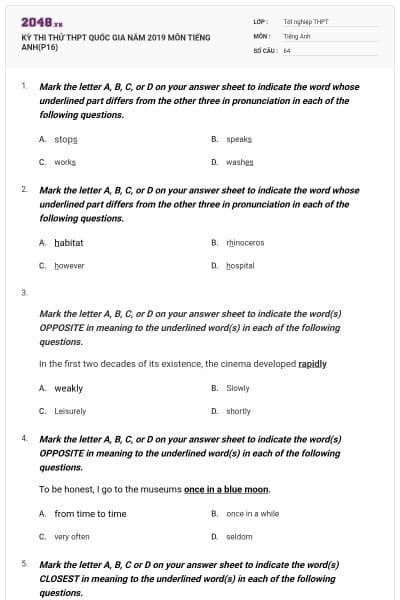
Mark the letter A, B, C, or D on your answer sheet to indicate the word whose underlined part differs from the other three in pronunciation in each of the following questions.
stops
speaks
works
washes
D
A./s/ B./s/ C./s/ D./ɪz/
Mark the letter A, B, C, or D on your answer sheet to indicate the word whose underlined part differs from the other three in pronunciation in each of the following questions.
habitat
rhinoceros
however
hospital
B
A./h/ B. ‘h’là âm câm-không phát âm C./h/ D./h/
Mark the letter A, B, C, or D on your answer sheet to indicate the word(s) OPPOSITE in meaning to the underlined word(s) in each of the following questions.
In the first two decades of its existence, the cinema developed rapidly
weakly
Slowly
Leisurely
shortly
B
“rapidly”: một cách nhanh chóng
Trái nghĩa là “slowly”: chậm chạp, chậm rãi
Mark the letter A, B, C, or D on your answer sheet to indicate the word(s) OPPOSITE in meaning to the underlined word(s) in each of the following questions.
To be honest, I go to the museums once in a blue moon.
from time to time
once in a while
very often
seldom
C
“once in a blue moon”: rất hiếm, hiếm khi
Trái nghĩa là “very often”: rất thường xuyên
Mark the letter A, B, C or D on your answer sheet to indicate the word(s) CLOSEST in meaning to the underlined word(s) in each of the following questions.
Life on Earth is disappearing fast and will continue to do so unless urgent action is taken.
damaging
polluting
vanishing
destroying
C
“disappear” = “vanish”: biến mất, tan biến, tiêu tan
Mark the letter A, B, C or D on your answer sheet to indicate the word(s) CLOSEST in meaning to the underlined word(s) in each of the following questions.
Currently, there are more deer in the United States than at any other time in our history.
Before long
At present
Up to now
At once
B
“currently” = “at present”: gần đây, hiện nay
Mark the letter A, B, C or D on your answer sheet to indicate the word(s) CLOSEST in meaning to the underlined word(s) in each of the following questions.
He was asked to account for his presence at the scene of the crime.
exchange
arrange
explain
complain
C
“account for” = “explain”: giải thích lý do cho việc gì
Mark the letter A, B, C, or D on your answer sheet to indicate the underlined part that needs correction in each of the following questions.(D)
Of the two lectures, the first (A)was by far the best(B), partly because the person who (C)delivered it had such a (D)dynamic style.
the first
the best
who
such a
A
“the best” -> “the better”
Ở đây là so sánh giữa 2 vật, nên chỉ dùng so sánh hơn mà không cần dùng so sánh nhất. “the” đóng vai trò là mạo từ (trong the lecture) chứ không phải the trong cấu trúc so sánh nhất (the most hay the adj+est)
Mark the letter A, B, C, or D on your answer sheet to indicate the underlined part that needs correction in each of the following questions.(D)
Although his family was (A)very poor(B), but (C)he had a good education. (D)
was
poor
but
education
C
Bỏ “but”. Vế sau của Although không có từ but
Mark the letter A, B, C, or D on your answer sheet to indicate the underlined part that needs correction in each of the following questions.(D)
The minister (A)blamed lower production figures for (B)a severe shortage (C)of raw material and frequent strikes (D)by workers.
minister
for
severe shortage
frequent strikes
B
“for” -> “on”
“blame on st/sb”: đổ lỗi cho ai/cái gì
Còn “blame for st”: có lỗi về việc gì
Mark the letter A, B, C, or D on your answer sheet to indicate the underlined part that needs correction in each of the following questions.(D)
A basic (A)knowledge of social studies, such as history(B)and geography, are (C)considered a basic part of the education of every child(D).
basic
history
are
child
A
“are” -> “is”
Chủ ngữ là A basic knowledge – số ít, nên động từ to be đúng là is
Mark the letter A, B, C, or D on your answer sheet to indicate the underlined part that needs correction in each of the following questions.(D)
Around (A)75 percents(B)of the earth's surface (C)is covered by water. (D)
Around
percents
earth's surface
wate
C
“percents” -> “percent”
Số chỉ % không chia số nhiều, giống như million hay billion
Read the following passage and mark the letter A, B, C or D on your answer sheet to indicate the correct answer to each of the questions.
Although most universities in the United States are on a semester system, which offers classes in the fall and spring, some schools observe a quarter system comprised of fall, winter, spring, and summer quarters. The academic year, September to June, is divided into three quarters of eleven weeks each beginning in September, January, and March: the summer quarter, June to August, is composed of shorter sessions of varied lengths.
There are several advantages and disadvantages to the quarter system. On the plus side, students who wish to complete their degrees in less than the customary four years may take advantage of the opportunity to study year round by enrolling in all four quarters. In addition, although most students begin their programs in the fall quarter, they may enter at the beginning of any other quarters. Finally, since the physical facilities are kept in operation year round, the resources are used effectively to serve the greatest number of students. But there are several disadvantages as well. Many faculties complain that the eleven- week term is simply not enough for them to cover the material required by most college courses. Students also find it difficult to complete the assignments in such a short period of time.
In order to combine the advantages of the quarter system with those of the semester system some colleges and universities have instituted a three-term trimester system. In fourteen weeks, faculty and students have more time to cover material and finish course requirements, but the additional term provides options for admission during the year and accelerates the degree programs for those students who wish to graduate early.
The word "customary" in paragraph 2 could best be replaced by________.
long
Default
traditional
limited
C
"customary" = “traditional”: theo thường lệ, theo truyền thống
Read the following passage and mark the letter A, B, C or D on your answer sheet to indicate the correct answer to each of the questions.
Although most universities in the United States are on a semester system, which offers classes in the fall and spring, some schools observe a quarter system comprised of fall, winter, spring, and summer quarters. The academic year, September to June, is divided into three quarters of eleven weeks each beginning in September, January, and March: the summer quarter, June to August, is composed of shorter sessions of varied lengths.
There are several advantages and disadvantages to the quarter system. On the plus side, students who wish to complete their degrees in less than the customary four years may take advantage of the opportunity to study year round by enrolling in all four quarters. In addition, although most students begin their programs in the fall quarter, they may enter at the beginning of any other quarters. Finally, since the physical facilities are kept in operation year round, the resources are used effectively to serve the greatest number of students. But there are several disadvantages as well. Many faculties complain that the eleven- week term is simply not enough for them to cover the material required by most college courses. Students also find it difficult to complete the assignments in such a short period of time.
In order to combine the advantages of the quarter system with those of the semester system some colleges and universities have instituted a three-term trimester system. In fourteen weeks, faculty and students have more time to cover material and finish course requirements, but the additional term provides options for admission during the year and accelerates the degree programs for those students who wish to graduate early.
When is the academic year?
August to June
June to August
September to July
September to June
D
Thông tin ở câu thứ 2 của đoạn 1: “The academic year, September to June”
Read the following passage and mark the letter A, B, C or D on your answer sheet to indicate the correct answer to each of the questions.
Although most universities in the United States are on a semester system, which offers classes in the fall and spring, some schools observe a quarter system comprised of fall, winter, spring, and summer quarters. The academic year, September to June, is divided into three quarters of eleven weeks each beginning in September, January, and March: the summer quarter, June to August, is composed of shorter sessions of varied lengths.
There are several advantages and disadvantages to the quarter system. On the plus side, students who wish to complete their degrees in less than the customary four years may take advantage of the opportunity to study year round by enrolling in all four quarters. In addition, although most students begin their programs in the fall quarter, they may enter at the beginning of any other quarters. Finally, since the physical facilities are kept in operation year round, the resources are used effectively to serve the greatest number of students. But there are several disadvantages as well. Many faculties complain that the eleven- week term is simply not enough for them to cover the material required by most college courses. Students also find it difficult to complete the assignments in such a short period of time.
In order to combine the advantages of the quarter system with those of the semester system some colleges and universities have instituted a three-term trimester system. In fourteen weeks, faculty and students have more time to cover material and finish course requirements, but the additional term provides options for admission during the year and accelerates the degree programs for those students who wish to graduate early.
Where would this passage most probably be found?
In a American newspaper
In a dictionary published in the United States
In a general guide to colleges and universities in the United States
In a college catalog for a university in the United States
C
Bài viết này có thể tìm thấy ở sách hướng dẫn chung về đại học và cao đẳng ở Mỹ. Bài viết cung cấp những kiến thức chung về đại học, về ưu nhược điểm và cách kết hợp nhiều ưu điểm,…
Read the following passage and mark the letter A, B, C or D on your answer sheet to indicate the correct answer to each of the questions.
Although most universities in the United States are on a semester system, which offers classes in the fall and spring, some schools observe a quarter system comprised of fall, winter, spring, and summer quarters. The academic year, September to June, is divided into three quarters of eleven weeks each beginning in September, January, and March: the summer quarter, June to August, is composed of shorter sessions of varied lengths.
There are several advantages and disadvantages to the quarter system. On the plus side, students who wish to complete their degrees in less than the customary four years may take advantage of the opportunity to study year round by enrolling in all four quarters. In addition, although most students begin their programs in the fall quarter, they may enter at the beginning of any other quarters. Finally, since the physical facilities are kept in operation year round, the resources are used effectively to serve the greatest number of students. But there are several disadvantages as well. Many faculties complain that the eleven- week term is simply not enough for them to cover the material required by most college courses. Students also find it difficult to complete the assignments in such a short period of time.
In order to combine the advantages of the quarter system with those of the semester system some colleges and universities have instituted a three-term trimester system. In fourteen weeks, faculty and students have more time to cover material and finish course requirements, but the additional term provides options for admission during the year and accelerates the degree programs for those students who wish to graduate early.
A semester system______________.
has eleven-week sessions
isn't very popular in the United States
has two major sessions a year
gives students the opportunity to study year round
C
A semester system has two major sessions a year (hệ thống học kỳ có 2 kỳ mỗi năm) đó là: September to June và June to August
Read the following passage and mark the letter A, B, C or D on your answer sheet to indicate the correct answer to each of the questions.
Although most universities in the United States are on a semester system, which offers classes in the fall and spring, some schools observe a quarter system comprised of fall, winter, spring, and summer quarters. The academic year, September to June, is divided into three quarters of eleven weeks each beginning in September, January, and March: the summer quarter, June to August, is composed of shorter sessions of varied lengths.
There are several advantages and disadvantages to the quarter system. On the plus side, students who wish to complete their degrees in less than the customary four years may take advantage of the opportunity to study year round by enrolling in all four quarters. In addition, although most students begin their programs in the fall quarter, they may enter at the beginning of any other quarters. Finally, since the physical facilities are kept in operation year round, the resources are used effectively to serve the greatest number of students. But there are several disadvantages as well. Many faculties complain that the eleven- week term is simply not enough for them to cover the material required by most college courses. Students also find it difficult to complete the assignments in such a short period of time.
In order to combine the advantages of the quarter system with those of the semester system some colleges and universities have instituted a three-term trimester system. In fourteen weeks, faculty and students have more time to cover material and finish course requirements, but the additional term provides options for admission during the year and accelerates the degree programs for those students who wish to graduate early.
The word "instituted" in paragraph 3 is closest in meaning to_______.
attracted
established
considered
familiarized
B
"instituted" = “established”: thành lập, mở, tiến hành
Read the following passage and mark the letter A, B, C or D on your answer sheet to indicate the correct answer to each of the questions.
Although most universities in the United States are on a semester system, which offers classes in the fall and spring, some schools observe a quarter system comprised of fall, winter, spring, and summer quarters. The academic year, September to June, is divided into three quarters of eleven weeks each beginning in September, January, and March: the summer quarter, June to August, is composed of shorter sessions of varied lengths.
There are several advantages and disadvantages to the quarter system. On the plus side, students who wish to complete their degrees in less than the customary four years may take advantage of the opportunity to study year round by enrolling in all four quarters. In addition, although most students begin their programs in the fall quarter, they may enter at the beginning of any other quarters. Finally, since the physical facilities are kept in operation year round, the resources are used effectively to serve the greatest number of students. But there are several disadvantages as well. Many faculties complain that the eleven- week term is simply not enough for them to cover the material required by most college courses. Students also find it difficult to complete the assignments in such a short period of time.
In order to combine the advantages of the quarter system with those of the semester system some colleges and universities have instituted a three-term trimester system. In fourteen weeks, faculty and students have more time to cover material and finish course requirements, but the additional term provides options for admission during the year and accelerates the degree programs for those students who wish to graduate early.
How many terms are there in a quarter system?
four regular terms and one summer term
two regular terms and two summer terms
one regular term and four summer terms
three regular terms and one summer term
D
Thông tin ở câu cuối đoạn 1: “The academic year, September to June, is divided into three quarters of eleven weeks each beginning in September, January, and March: the summer quarter, June to August, is composed of shorter sessions of varied lengths.”
=> có three regular terms and one summer term trong hệ thống quarter system
Read the following passage and mark the letter A, B, C or D on your answer sheet to indicate the correct answer to each of the questions.
Although most universities in the United States are on a semester system, which offers classes in the fall and spring, some schools observe a quarter system comprised of fall, winter, spring, and summer quarters. The academic year, September to June, is divided into three quarters of eleven weeks each beginning in September, January, and March: the summer quarter, June to August, is composed of shorter sessions of varied lengths.
There are several advantages and disadvantages to the quarter system. On the plus side, students who wish to complete their degrees in less than the customary four years may take advantage of the opportunity to study year round by enrolling in all four quarters. In addition, although most students begin their programs in the fall quarter, they may enter at the beginning of any other quarters. Finally, since the physical facilities are kept in operation year round, the resources are used effectively to serve the greatest number of students. But there are several disadvantages as well. Many faculties complain that the eleven- week term is simply not enough for them to cover the material required by most college courses. Students also find it difficult to complete the assignments in such a short period of time.
In order to combine the advantages of the quarter system with those of the semester system some colleges and universities have instituted a three-term trimester system. In fourteen weeks, faculty and students have more time to cover material and finish course requirements, but the additional term provides options for admission during the year and accelerates the degree programs for those students who wish to graduate early.
Which of the following characteristics does NOT apply to trimesters?
They are long enough to cover the course material.
They last eleven weeks.
They provide more options for admission.
They allow students to graduate early.
B
Thông tin ở đoạn cuối: “system some colleges and universities have instituted a three-term trimester system. In fourteen weeks…”
Tức là trimester system có 14 weeks chứ không phải là 11 weeks
Read the following passage and mark the letter A, B, C or D on your answer sheet to indicate the correct answer to each of the questions.
Although most universities in the United States are on a semester system, which offers classes in the fall and spring, some schools observe a quarter system comprised of fall, winter, spring, and summer quarters. The academic year, September to June, is divided into three quarters of eleven weeks each beginning in September, January, and March: the summer quarter, June to August, is composed of shorter sessions of varied lengths.
There are several advantages and disadvantages to the quarter system. On the plus side, students who wish to complete their degrees in less than the customary four years may take advantage of the opportunity to study year round by enrolling in all four quarters. In addition, although most students begin their programs in the fall quarter, they may enter at the beginning of any other quarters. Finally, since the physical facilities are kept in operation year round, the resources are used effectively to serve the greatest number of students. But there are several disadvantages as well. Many faculties complain that the eleven- week term is simply not enough for them to cover the material required by most college courses. Students also find it difficult to complete the assignments in such a short period of time.
In order to combine the advantages of the quarter system with those of the semester system some colleges and universities have instituted a three-term trimester system. In fourteen weeks, faculty and students have more time to cover material and finish course requirements, but the additional term provides options for admission during the year and accelerates the degree programs for those students who wish to graduate early.
Which of the following would be the best title for this passage?
The Semester System
Universities in the United States
The Academic Year
The Quarter System
D
Thông tin ở những câu đầu tiên của các đoạn:
- Although most universities in the United States are on a semester system, which offers classes in the fall and spring, some schools observe a quarter system comprised of fall, winter, spring, and summer quarters.
- There are several advantages and disadvantages to the quarter system.
- In order to combine the advantages of the quarter system with those of the semester system…
Tiêu đề phù hợp nhất cho bài đọc là the quarter system
Read the following passage and mark the letter A, B, C or D on your answer sheet to indicate the correct answer to each of the questions.
Although most universities in the United States are on a semester system, which offers classes in the fall and spring, some schools observe a quarter system comprised of fall, winter, spring, and summer quarters. The academic year, September to June, is divided into three quarters of eleven weeks each beginning in September, January, and March: the summer quarter, June to August, is composed of shorter sessions of varied lengths.
There are several advantages and disadvantages to the quarter system. On the plus side, students who wish to complete their degrees in less than the customary four years may take advantage of the opportunity to study year round by enrolling in all four quarters. In addition, although most students begin their programs in the fall quarter, they may enter at the beginning of any other quarters. Finally, since the physical facilities are kept in operation year round, the resources are used effectively to serve the greatest number of students. But there are several disadvantages as well. Many faculties complain that the eleven- week term is simply not enough for them to cover the material required by most college courses. Students also find it difficult to complete the assignments in such a short period of time.
In order to combine the advantages of the quarter system with those of the semester system some colleges and universities have instituted a three-term trimester system. In fourteen weeks, faculty and students have more time to cover material and finish course requirements, but the additional term provides options for admission during the year and accelerates the degree programs for those students who wish to graduate early.
When may students begin studying in a school that uses a quarter system?
Summer semester only
At the beginning of any quarter
September
At the beginning of the academic year
B
Thông tin: “In addition, although most students begin their programs in the fall quarter, they may enter at the beginning of any other quarters.” (B. At the beginning of any quarter)
Read the following passage and mark the letter A, B, C or D on your answer sheet to indicate the correct answer to each of the questions.
Although most universities in the United States are on a semester system, which offers classes in the fall and spring, some schools observe a quarter system comprised of fall, winter, spring, and summer quarters. The academic year, September to June, is divided into three quarters of eleven weeks each beginning in September, January, and March: the summer quarter, June to August, is composed of shorter sessions of varied lengths.
There are several advantages and disadvantages to the quarter system. On the plus side, students who wish to complete their degrees in less than the customary four years may take advantage of the opportunity to study year round by enrolling in all four quarters. In addition, although most students begin their programs in the fall quarter, they may enter at the beginning of any other quarters. Finally, since the physical facilities are kept in operation year round, the resources are used effectively to serve the greatest number of students. But there are several disadvantages as well. Many faculties complain that the eleven- week term is simply not enough for them to cover the material required by most college courses. Students also find it difficult to complete the assignments in such a short period of time.
In order to combine the advantages of the quarter system with those of the semester system some colleges and universities have instituted a three-term trimester system. In fourteen weeks, faculty and students have more time to cover material and finish course requirements, but the additional term provides options for admission during the year and accelerates the degree programs for those students who wish to graduate early.
The word "them" in paragraph 2 refers to___________.
material
faculties
courses
weeks
B
“them” được thay thế cho faculties trong cụm phía trước đó: “Many faculties complain that the eleven- week term is simply not enough for them to cover the material required by most college courses.”
Mark the letter A, B, C, or D on your answer sheet to indicate the word whose stress differs from the other three in pronunciation in each of the following questions.
continent
elephant
However
tropical
C
Phần C trọng âm rơi vào âm tiết thứ 2, còn lại là thứ nhất
Mark the letter A, B, C, or D on your answer sheet to indicate the word whose stress differs from the other three in pronunciation in each of the following questions.
A. commodity B. Difficulty C. Simplicity D. discovery
commodity
Difficulty
Simplicity
discovery
B
Phần B trọng âm rơi vào âm tiết thứ nhất, còn lại là thứ 2
Mark the letter A, B, C, or D on your answer sheet to indicate the word whose stress differs from the other three in pronunciation in each of the following questions.
digest
Comic
Swallow
knowledge
A
Phần A trọng âm rơi vào âm tiết thứ 2, còn lại là thứ nhất
Read the following passage and mark the letter A, B, C or D on your answer sheet to indicate the correct answer to each of the following questions.
THE BOOK IN THE 21st CENTURY
How many times in the last hundred years or so have people talked of the imminent death of the book? Films were an early threat because they were so effective at telling stories in a visual way. Next there was radio, (26) stepped into the mid-twentieth century and provided such an alternative to books as drama, documentaries and discussions. When television arrived, many people believed that it would finish the book off. Nowadays, (27) the threat by TV, the book is thought to be endangered by computers and the Internet, and by other technological attractions (28) the CD and the video game, too.
Surely there are now reasons why (29) book ought to be dead, or at least very badly injured. If so, why does it not show proper respect for these reportedly less literate times (30) die out? There is clearly more than a single answer to this question. Firstly, we have more leisure time than we (31) to, and people are generally living longer, which means there is more time to do more (including reading books). As (32) as this, there is the strength of the book as a tradition. We are all too dismissive of traditions in our modern world, but they can have very strong pull (33) us.
Added to this, the book is such a practical tool: it doesn't cost too (34) , it is usually small enough to carry around, and it can easily be (35) . We will never go without books, because they have served us so well for so long.
Điền vào ô 26
where
Which
why
that
B
“which” là mệnh đề quan hệ, thay thế cho radio ở phía trước dấu phảy
Read the following passage and mark the letter A, B, C or D on your answer sheet to indicate the correct answer to each of the following questions.
THE BOOK IN THE 21st CENTURY
How many times in the last hundred years or so have people talked of the imminent death of the book? Films were an early threat because they were so effective at telling stories in a visual way. Next there was radio, (26) stepped into the mid-twentieth century and provided such an alternative to books as drama, documentaries and discussions. When television arrived, many people believed that it would finish the book off. Nowadays, (27) the threat by TV, the book is thought to be endangered by computers and the Internet, and by other technological attractions (28) the CD and the video game, too.
Surely there are now reasons why (29) book ought to be dead, or at least very badly injured. If so, why does it not show proper respect for these reportedly less literate times (30) die out? There is clearly more than a single answer to this question. Firstly, we have more leisure time than we (31) to, and people are generally living longer, which means there is more time to do more (including reading books). As (32) as this, there is the strength of the book as a tradition. We are all too dismissive of traditions in our modern world, but they can have very strong pull (33) us.
Added to this, the book is such a practical tool: it doesn't cost too (34) , it is usually small enough to carry around, and it can easily be (35) . We will never go without books, because they have served us so well for so long.
Điền vào ô 27
near
Besides
with
next
B
“besides” = moreover, in addtion to: thêm vào đó, bên cạnh đó.
Khác với “beside”: bên cạnh (vị trí)
Read the following passage and mark the letter A, B, C or D on your answer sheet to indicate the correct answer to each of the following questions.
THE BOOK IN THE 21st CENTURY
How many times in the last hundred years or so have people talked of the imminent death of the book? Films were an early threat because they were so effective at telling stories in a visual way. Next there was radio, (26) stepped into the mid-twentieth century and provided such an alternative to books as drama, documentaries and discussions. When television arrived, many people believed that it would finish the book off. Nowadays, (27) the threat by TV, the book is thought to be endangered by computers and the Internet, and by other technological attractions (28) the CD and the video game, too.
Surely there are now reasons why (29) book ought to be dead, or at least very badly injured. If so, why does it not show proper respect for these reportedly less literate times (30) die out? There is clearly more than a single answer to this question. Firstly, we have more leisure time than we (31) to, and people are generally living longer, which means there is more time to do more (including reading books). As (32) as this, there is the strength of the book as a tradition. We are all too dismissive of traditions in our modern world, but they can have very strong pull (33) us.
Added to this, the book is such a practical tool: it doesn't cost too (34) , it is usually small enough to carry around, and it can easily be (35) . We will never go without books, because they have served us so well for so long.
Điền vào ô 28
for
As
To
like
D
“like”: như là…(liệt kê) = such as
Read the following passage and mark the letter A, B, C or D on your answer sheet to indicate the correct answer to each of the following questions.
THE BOOK IN THE 21st CENTURY
How many times in the last hundred years or so have people talked of the imminent death of the book? Films were an early threat because they were so effective at telling stories in a visual way. Next there was radio, (26) stepped into the mid-twentieth century and provided such an alternative to books as drama, documentaries and discussions. When television arrived, many people believed that it would finish the book off. Nowadays, (27) the threat by TV, the book is thought to be endangered by computers and the Internet, and by other technological attractions (28) the CD and the video game, too.
Surely there are now reasons why (29) book ought to be dead, or at least very badly injured. If so, why does it not show proper respect for these reportedly less literate times (30) die out? There is clearly more than a single answer to this question. Firstly, we have more leisure time than we (31) to, and people are generally living longer, which means there is more time to do more (including reading books). As (32) as this, there is the strength of the book as a tradition. We are all too dismissive of traditions in our modern world, but they can have very strong pull (33) us.
Added to this, the book is such a practical tool: it doesn't cost too (34) , it is usually small enough to carry around, and it can easily be (35) . We will never go without books, because they have served us so well for so long.
Điền vào ô 29
that
this
the
a
C
“that” và “this” đều không phù hợp, vì không phải nói đến một loại sách cụ thể nào đó. Giữa mạo từ the và a thì the book là đúng hơn cả
Read the following passage and mark the letter A, B, C or D on your answer sheet to indicate the correct answer to each of the following questions.
THE BOOK IN THE 21st CENTURY
How many times in the last hundred years or so have people talked of the imminent death of the book? Films were an early threat because they were so effective at telling stories in a visual way. Next there was radio, (26) stepped into the mid-twentieth century and provided such an alternative to books as drama, documentaries and discussions. When television arrived, many people believed that it would finish the book off. Nowadays, (27) the threat by TV, the book is thought to be endangered by computers and the Internet, and by other technological attractions (28) the CD and the video game, too.
Surely there are now reasons why (29) book ought to be dead, or at least very badly injured. If so, why does it not show proper respect for these reportedly less literate times (30) die out? There is clearly more than a single answer to this question. Firstly, we have more leisure time than we (31) to, and people are generally living longer, which means there is more time to do more (including reading books). As (32) as this, there is the strength of the book as a tradition. We are all too dismissive of traditions in our modern world, but they can have very strong pull (33) us.
Added to this, the book is such a practical tool: it doesn't cost too (34) , it is usually small enough to carry around, and it can easily be (35) . We will never go without books, because they have served us so well for so long.
Điền vào ô 30
so
and
But
since
B
Liên kết giữa 2 vế của câu, và 2 vế có sự giống nhau về chức năng trong câu, nên dùng liên từ and
Read the following passage and mark the letter A, B, C or D on your answer sheet to indicate the correct answer to each of the following questions.
THE BOOK IN THE 21st CENTURY
How many times in the last hundred years or so have people talked of the imminent death of the book? Films were an early threat because they were so effective at telling stories in a visual way. Next there was radio, (26) stepped into the mid-twentieth century and provided such an alternative to books as drama, documentaries and discussions. When television arrived, many people believed that it would finish the book off. Nowadays, (27) the threat by TV, the book is thought to be endangered by computers and the Internet, and by other technological attractions (28) the CD and the video game, too.
Surely there are now reasons why (29) book ought to be dead, or at least very badly injured. If so, why does it not show proper respect for these reportedly less literate times (30) die out? There is clearly more than a single answer to this question. Firstly, we have more leisure time than we (31) to, and people are generally living longer, which means there is more time to do more (including reading books). As (32) as this, there is the strength of the book as a tradition. We are all too dismissive of traditions in our modern world, but they can have very strong pull (33) us.
Added to this, the book is such a practical tool: it doesn't cost too (34) , it is usually small enough to carry around, and it can easily be (35) . We will never go without books, because they have served us so well for so long.
Điền vào ô 31
got
liked
used
had
C
“used to”: đã từng
“used to” + V nguyên thể
Read the following passage and mark the letter A, B, C or D on your answer sheet to indicate the correct answer to each of the following questions.
THE BOOK IN THE 21st CENTURY
How many times in the last hundred years or so have people talked of the imminent death of the book? Films were an early threat because they were so effective at telling stories in a visual way. Next there was radio, (26) stepped into the mid-twentieth century and provided such an alternative to books as drama, documentaries and discussions. When television arrived, many people believed that it would finish the book off. Nowadays, (27) the threat by TV, the book is thought to be endangered by computers and the Internet, and by other technological attractions (28) the CD and the video game, too.
Surely there are now reasons why (29) book ought to be dead, or at least very badly injured. If so, why does it not show proper respect for these reportedly less literate times (30) die out? There is clearly more than a single answer to this question. Firstly, we have more leisure time than we (31) to, and people are generally living longer, which means there is more time to do more (including reading books). As (32) as this, there is the strength of the book as a tradition. We are all too dismissive of traditions in our modern world, but they can have very strong pull (33) us.
Added to this, the book is such a practical tool: it doesn't cost too (34) , it is usually small enough to carry around, and it can easily be (35) . We will never go without books, because they have served us so well for so long.
Điền vào ô 32
well
long
soon
good
A
Cụm “as soon as”: ngay khi…
Read the following passage and mark the letter A, B, C or D on your answer sheet to indicate the correct answer to each of the following questions.
THE BOOK IN THE 21st CENTURY
How many times in the last hundred years or so have people talked of the imminent death of the book? Films were an early threat because they were so effective at telling stories in a visual way. Next there was radio, (26) stepped into the mid-twentieth century and provided such an alternative to books as drama, documentaries and discussions. When television arrived, many people believed that it would finish the book off. Nowadays, (27) the threat by TV, the book is thought to be endangered by computers and the Internet, and by other technological attractions (28) the CD and the video game, too.
Surely there are now reasons why (29) book ought to be dead, or at least very badly injured. If so, why does it not show proper respect for these reportedly less literate times (30) die out? There is clearly more than a single answer to this question. Firstly, we have more leisure time than we (31) to, and people are generally living longer, which means there is more time to do more (including reading books). As (32) as this, there is the strength of the book as a tradition. We are all too dismissive of traditions in our modern world, but they can have very strong pull (33) us.
Added to this, the book is such a practical tool: it doesn't cost too (34) , it is usually small enough to carry around, and it can easily be (35) . We will never go without books, because they have served us so well for so long.
Điền vào ô 33
of
On
In
by
B
“they have very strong pull on us”: chúng có sức hút/sức lôi kéo lớn đối với chúng ta
Read the following passage and mark the letter A, B, C or D on your answer sheet to indicate the correct answer to each of the following questions.
THE BOOK IN THE 21st CENTURY
How many times in the last hundred years or so have people talked of the imminent death of the book? Films were an early threat because they were so effective at telling stories in a visual way. Next there was radio, (26) stepped into the mid-twentieth century and provided such an alternative to books as drama, documentaries and discussions. When television arrived, many people believed that it would finish the book off. Nowadays, (27) the threat by TV, the book is thought to be endangered by computers and the Internet, and by other technological attractions (28) the CD and the video game, too.
Surely there are now reasons why (29) book ought to be dead, or at least very badly injured. If so, why does it not show proper respect for these reportedly less literate times (30) die out? There is clearly more than a single answer to this question. Firstly, we have more leisure time than we (31) to, and people are generally living longer, which means there is more time to do more (including reading books). As (32) as this, there is the strength of the book as a tradition. We are all too dismissive of traditions in our modern world, but they can have very strong pull (33) us.
Added to this, the book is such a practical tool: it doesn't cost too (34) , it is usually small enough to carry around, and it can easily be (35) . We will never go without books, because they have served us so well for so long.
Điền vào ô 34
many
More
Less
much
D
“too much”: quá nhiều
Khi đi cùng giá cả thì dùng much chứ không dùng many, more hay less
Read the following passage and mark the letter A, B, C or D on your answer sheet to indicate the correct answer to each of the following questions.
THE BOOK IN THE 21st CENTURY
How many times in the last hundred years or so have people talked of the imminent death of the book? Films were an early threat because they were so effective at telling stories in a visual way. Next there was radio, (26) stepped into the mid-twentieth century and provided such an alternative to books as drama, documentaries and discussions. When television arrived, many people believed that it would finish the book off. Nowadays, (27) the threat by TV, the book is thought to be endangered by computers and the Internet, and by other technological attractions (28) the CD and the video game, too.
Surely there are now reasons why (29) book ought to be dead, or at least very badly injured. If so, why does it not show proper respect for these reportedly less literate times (30) die out? There is clearly more than a single answer to this question. Firstly, we have more leisure time than we (31) to, and people are generally living longer, which means there is more time to do more (including reading books). As (32) as this, there is the strength of the book as a tradition. We are all too dismissive of traditions in our modern world, but they can have very strong pull (33) us.
Added to this, the book is such a practical tool: it doesn't cost too (34) , it is usually small enough to carry around, and it can easily be (35) . We will never go without books, because they have served us so well for so long.
Điền vào ô 35
repaid
Rewritten
retold
revisited
D
“revisit”: nhìn lại/thăm lại
Trong ngữ cảnh này có thể dịch là đọc lại cuốn sách nào đó
__________students in our class is 45.
A number of
The number of
The amount of
A large amount of
B
“The number of…” được tính là danh từ số ít, phù hợp với động từ to be là is
Còn “a number of…” là danh từ số nhiều
I have only had time to___________ the report before going to the meeting.
chew
dip into
taste
swallow
B
Cụm “dip into” trong ngữ cảnh“water polo” là một môn thể thao đồng đội
Vì thế chọn đáp án là team này được dịch là đọc một phần (của cái gì) một cách nhanh chóng, lướt qua
Water polo was the first____________sport to be added to the Olympic program in 1900
pair
Adventure
individual
team
D
“water polo” là một môn thể thao đồng đội
Vì thế chọn đáp án là team
The government____________the flood victims with food, clothes and money.
offered
gave
provided
presented
Đáp án: C
Giải thích:
Ta có các cấu trúc sau:
offer somebody something: đề nghị, cho ai cái gì
give somebody something: đưa cho ai cái gì
provide somebody with something: cung cấp cho ai cái gì
present somebody with something: trao tặng cho ai cái gì (thường là ở một lễ kỉ niệm trang trọng)
Dựa vào nghĩa và cấu trúc câu, chọn C.
Dịch: Chính phủ đã cung cấp cho nạn nhân lũ lụt thực phẩm, quần áo và tiền bạc.
By the year 2020, many people currently employed_______their jobs.
will have been lost
will have lost
should have lost
had better not lose
B Có cụm By the year 2020 nên sẽ dùng thì tương lai hoàn thành
Chủ ngữ là người nên câu được chia ở dạng chủ động, do đó đáp án A sai. Đáp án là will have lost
There is a very clear relationship ________education and academic success.
between
for
in
on
A
“between…and…”: giữa cái này với cái kia (chỉ so sánh giữa 2 sự vật)
Nancy said she__________come over right after work, so she________be here by 6.00.
can - will
will - can
would - must
would - have to
C
Câu gián tiếp lùi 1 thì, will -> would
“must” trong câu có thể diễn tả nhận định khá chắc chắn
Bill and Bob are in a coffee shop. Bill is asking Bob for his opinion about the coffee there. Choose the most suitable response to fill in the blank in the following exchange. Bill: "How's the coffee there?" Bob: "__________."
It's a little better now that I've got a car
As a matter of fact, it's not interested.
No, I don't think so
It's a little bitter, to tell the truth
D
- cà phê ở đây thế nào?
- nói thật là nó hơi đắng một chút
The passengers had to wait because the plane________off one hour late.
turned
made
cut
took
D
Cụm “take off”: cất cánh (máy bay)
There are several means of mass communication. The newspaper is one. Television is_______
the another
the other
Other
another
D
“another”: một cái khác
Không có the another
“the other” và “other” đều phải đi kèm thêm một danh từ phía sau
The computer has had an enormous_________on the way we work.
influence
change
impression
alteration
A
Cấu trúc “have influence on…”: có ảnh hưởng đến…
A woman can never have a happy married life without__________her husband.
agreeing
demanding
determining
trusting
Đáp án: D
Giải thích:
A. demand (v): yêu cầu
B. determine (v): xác định
C. trust (v): tin tưởng
D. agree (v): đồng ý
Ta có: without + N/V-ing: nếu không có…
Dịch: Một người phụ nữ không bao giờ có thể có một cuộc sống hôn nhân hạnh phúc nếu không tin tưởng chồng của mình.
"You've saved my life. I thank you from the_________of my heart."
centre
bottom
Top
depths
B
Cụm thường gặp “from bottom of one’s heart”: từ tận đáy lòng
More and more people_________of food poisoning nowadays.
survive
starve
exist
die
D
Cấu trúc “die of st”: chết vì…(nguyên do gì)
_________he would be there, I would have never agreed to come.
Known had I
Had known I
I had known
Had I known
D
“Had I known” = “If I had known”
The raw sewage needs to be___________treated.
chemically
chemist
chemical
chemistry
A
Ở đây cần một trạng từ bổ sung ý nghĩa cho động từ treat
“chemically”: về mặt hoá chất
The activities of the international marketing researcher are frequently much broader than______.
that which has the domestic marketer
those of the domestic marketer
the domestic marketer does
the domestic marketer has
Đáp án: B
Giải thích:
Đối tượng so sánh trong câu này là “the activities” của “the international marketing researcher” với “the activities” của “the domestic marketer”. Danh từ này ở dạng số nhiều, nên sẽ thay bằng “those”.
Chọn đáp án B
Dịch: Hoạt động của nhà nghiên cứu tiếp thị quốc tế thường rộng hơn nhiều so với hoạt động của nhà tiếp thị trong nước.
John lost the________bicycle he bought last week and his parents were very angry with him because of his carelessness.
new beautiful blue Japanese
Japanese beautiful new blue
beautiful new blue Japanese
beautiful Japanese blue new
C
Vị trí của tính từ trong câu:
Opinion (beautiful) + Age (new) + Color (blue) + Origin (Japanese) +noun
Mike's inviting Sue to go dancing. Choose the most suitable response to fill in the blank in the following exchange. Mike: "Shall we go dancing tonight?" Sue: "________."
I can't agree with you
Never mind
Yes, let's
Not a little bit
C
Câu trả lời cho câu hỏi mời/gợi ý Shall we…? Là let’s
Đáp án là Yes, let’s
Read the following passage and mark the letter A, B, C or D on your answer sheet to indicate the correct answer to each of the questions.
When the first white men came to America, they found vast amounts of natural resources of tremendous value. Forests covered a large part of the nation; later gas, oil and minerals were found in unbelievable amounts. There was a great abundance of very fertile soil. Forests, prairies, streams and rivers abounded with wildlife. So vast were these resources that it seemed that they could never be used up. So forests were destroyed to make way for farmland. Grasslands and prairies were ploughed and harrowed. Minerals and oil were used in great quantities to supply a young industrial nation. Almost every river became the scene of factories, mills and power companies. Mammals and birds were slaughtered for food and sport.
Within a short time, the results were obvious. Floods caused millions of dollars worth of damage yearly. The very fertile soil was washed away or blown up in great clouds. The seemingly inexhaustible oil and minerals showed signs of depletion. Rivers were filled with silt from eroding farms and wastes from factories. Many of the rivers were made unfit for fish. Several species of birds disappeared, and some mammals seemed on the verge of going. Future timber shortages were predicted. In short, Americans soon became to realize that some sort of conservation program must be set up, if future as well as present Americans were to share in the resources that are the heritage of every American.
According to the passage, all the following are true EXCEPT_____-
They plowed ;and harrowed grasslands and prairies
They killed animals for food and sport
The early American settlers used a lot of minerals and oil
They grew different kinds of plants in prairies
D.
Thông tin:
- Grasslands and prairies were ploughed and harrowed. (=A. They plowed ;and harrowed grasslands and prairies) : Các đồng cỏ đã bị cày bừa
- Mammals and birds were slaughtered for food and sport. ( B. They killed animals for food and sport)
- Minerals and oil were used in great quantities (Khoáng chất và dầu được dùng với số lượng lớn = C. The early American settlers used a lot of minerals and oil)
Chỉ có D. They grew different kinds of plants in prairies là không đúng
Read the following passage and mark the letter A, B, C or D on your answer sheet to indicate the correct answer to each of the questions.
When the first white men came to America, they found vast amounts of natural resources of tremendous value. Forests covered a large part of the nation; later gas, oil and minerals were found in unbelievable amounts. There was a great abundance of very fertile soil. Forests, prairies, streams and rivers abounded with wildlife. So vast were these resources that it seemed that they could never be used up. So forests were destroyed to make way for farmland. Grasslands and prairies were ploughed and harrowed. Minerals and oil were used in great quantities to supply a young industrial nation. Almost every river became the scene of factories, mills and power companies. Mammals and birds were slaughtered for food and sport.
Within a short time, the results were obvious. Floods caused millions of dollars worth of damage yearly. The very fertile soil was washed away or blown up in great clouds. The seemingly inexhaustible oil and minerals showed signs of depletion. Rivers were filled with silt from eroding farms and wastes from factories. Many of the rivers were made unfit for fish. Several species of birds disappeared, and some mammals seemed on the verge of going. Future timber shortages were predicted. In short, Americans soon became to realize that some sort of conservation program must be set up, if future as well as present Americans were to share in the resources that are the heritage of every American.
One reason why many of our rivers are no longer suitable living places for fish is that_________
factories have dumped waste into the rivers
too many fish have been caught
a conservation program has been set up
floods have caused much damage
A
Thông tin ở đoạn thứ 2: “Rivers were filled with silt from eroding farms and wastes from factories. Many of the rivers were made unfit for fish.” Sông chứa đựng bùn, rác từ các nhà máy. Nhiều dòng sông không phù hợp cho cá sống
Read the following passage and mark the letter A, B, C or D on your answer sheet to indicate the correct answer to each of the questions.
When the first white men came to America, they found vast amounts of natural resources of tremendous value. Forests covered a large part of the nation; later gas, oil and minerals were found in unbelievable amounts. There was a great abundance of very fertile soil. Forests, prairies, streams and rivers abounded with wildlife. So vast were these resources that it seemed that they could never be used up. So forests were destroyed to make way for farmland. Grasslands and prairies were ploughed and harrowed. Minerals and oil were used in great quantities to supply a young industrial nation. Almost every river became the scene of factories, mills and power companies. Mammals and birds were slaughtered for food and sport.
Within a short time, the results were obvious. Floods caused millions of dollars worth of damage yearly. The very fertile soil was washed away or blown up in great clouds. The seemingly inexhaustible oil and minerals showed signs of depletion. Rivers were filled with silt from eroding farms and wastes from factories. Many of the rivers were made unfit for fish. Several species of birds disappeared, and some mammals seemed on the verge of going. Future timber shortages were predicted. In short, Americans soon became to realize that some sort of conservation program must be set up, if future as well as present Americans were to share in the resources that are the heritage of every American.
Americans soon came to realize that _______
they can not give up exploiting minerals
they should not reclaim the land
they should not stop killing animals for food
they must establish a conservation program
D
Thông tin ở câu cuối của bài: “In short, Americans soon became to realize that some sort of conservation program must be set up…” = they must establish a conservation program
Read the following passage and mark the letter A, B, C or D on your answer sheet to indicate the correct answer to each of the questions.
When the first white men came to America, they found vast amounts of natural resources of tremendous value. Forests covered a large part of the nation; later gas, oil and minerals were found in unbelievable amounts. There was a great abundance of very fertile soil. Forests, prairies, streams and rivers abounded with wildlife. So vast were these resources that it seemed that they could never be used up. So forests were destroyed to make way for farmland. Grasslands and prairies were ploughed and harrowed. Minerals and oil were used in great quantities to supply a young industrial nation. Almost every river became the scene of factories, mills and power companies. Mammals and birds were slaughtered for food and sport.
Within a short time, the results were obvious. Floods caused millions of dollars worth of damage yearly. The very fertile soil was washed away or blown up in great clouds. The seemingly inexhaustible oil and minerals showed signs of depletion. Rivers were filled with silt from eroding farms and wastes from factories. Many of the rivers were made unfit for fish. Several species of birds disappeared, and some mammals seemed on the verge of going. Future timber shortages were predicted. In short, Americans soon became to realize that some sort of conservation program must be set up, if future as well as present Americans were to share in the resources that are the heritage of every American.
Some species of birds and mammals seemed___________.
to become extinct
to be on the verge
to be killed
to be slaughtered
A
Mammals and birds were slaughtered for food and sport. Nhiều động vật và chim bị giết hại để lấy thực phẩm và phục vụ thể thao. Vì thế, một số loài chim và động vật dường như đã bị tuyệt chủng (to become extinct)
Read the following passage and mark the letter A, B, C or D on your answer sheet to indicate the correct answer to each of the questions.
When the first white men came to America, they found vast amounts of natural resources of tremendous value. Forests covered a large part of the nation; later gas, oil and minerals were found in unbelievable amounts. There was a great abundance of very fertile soil. Forests, prairies, streams and rivers abounded with wildlife. So vast were these resources that it seemed that they could never be used up. So forests were destroyed to make way for farmland. Grasslands and prairies were ploughed and harrowed. Minerals and oil were used in great quantities to supply a young industrial nation. Almost every river became the scene of factories, mills and power companies. Mammals and birds were slaughtered for food and sport.
Within a short time, the results were obvious. Floods caused millions of dollars worth of damage yearly. The very fertile soil was washed away or blown up in great clouds. The seemingly inexhaustible oil and minerals showed signs of depletion. Rivers were filled with silt from eroding farms and wastes from factories. Many of the rivers were made unfit for fish. Several species of birds disappeared, and some mammals seemed on the verge of going. Future timber shortages were predicted. In short, Americans soon became to realize that some sort of conservation program must be set up, if future as well as present Americans were to share in the resources that are the heritage of every American.
The word "silt" in paragraph 2 is closest in meaning to_____________
dust
earth
Land
mud
D
“silt” = “mud”: bùn
Read the following passage and mark the letter A, B, C or D on your answer sheet to indicate the correct answer to each of the questions.
When the first white men came to America, they found vast amounts of natural resources of tremendous value. Forests covered a large part of the nation; later gas, oil and minerals were found in unbelievable amounts. There was a great abundance of very fertile soil. Forests, prairies, streams and rivers abounded with wildlife. So vast were these resources that it seemed that they could never be used up. So forests were destroyed to make way for farmland. Grasslands and prairies were ploughed and harrowed. Minerals and oil were used in great quantities to supply a young industrial nation. Almost every river became the scene of factories, mills and power companies. Mammals and birds were slaughtered for food and sport.
Within a short time, the results were obvious. Floods caused millions of dollars worth of damage yearly. The very fertile soil was washed away or blown up in great clouds. The seemingly inexhaustible oil and minerals showed signs of depletion. Rivers were filled with silt from eroding farms and wastes from factories. Many of the rivers were made unfit for fish. Several species of birds disappeared, and some mammals seemed on the verge of going. Future timber shortages were predicted. In short, Americans soon became to realize that some sort of conservation program must be set up, if future as well as present Americans were to share in the resources that are the heritage of every American.
The use of America's natural resources by the early settlers was___________.
scientific
Believable
predicted
careless
D
Sự sử dụng tài nguyên của những người định cư Mỹ đầu tiên là cẩu thả, không cẩn trọng, khi mà họ sử dụng quá nhiều và tàn phá tài nguyên trầm trọng
Read the following passage and mark the letter A, B, C or D on your answer sheet to indicate the correct answer to each of the questions.
When the first white men came to America, they found vast amounts of natural resources of tremendous value. Forests covered a large part of the nation; later gas, oil and minerals were found in unbelievable amounts. There was a great abundance of very fertile soil. Forests, prairies, streams and rivers abounded with wildlife. So vast were these resources that it seemed that they could never be used up. So forests were destroyed to make way for farmland. Grasslands and prairies were ploughed and harrowed. Minerals and oil were used in great quantities to supply a young industrial nation. Almost every river became the scene of factories, mills and power companies. Mammals and birds were slaughtered for food and sport.
Within a short time, the results were obvious. Floods caused millions of dollars worth of damage yearly. The very fertile soil was washed away or blown up in great clouds. The seemingly inexhaustible oil and minerals showed signs of depletion. Rivers were filled with silt from eroding farms and wastes from factories. Many of the rivers were made unfit for fish. Several species of birds disappeared, and some mammals seemed on the verge of going. Future timber shortages were predicted. In short, Americans soon became to realize that some sort of conservation program must be set up, if future as well as present Americans were to share in the resources that are the heritage of every American.
Which of the following would be the best title for this passage?
The story of America's natural resources
The cause of timber shortages
What the first white men found in America
The loss of topsoil
A
Tiêu đề cho bài đọc là The story of America's natural resources, đề cập đến câu chuyện của những người định cư đầu tiên và câu chuyện về tài nguyên môi trường ở nước Mỹ hiện tại
Read the following passage and mark the letter A, B, C or D on your answer sheet to indicate the correct answer to each of the questions.
When the first white men came to America, they found vast amounts of natural resources of tremendous value. Forests covered a large part of the nation; later gas, oil and minerals were found in unbelievable amounts. There was a great abundance of very fertile soil. Forests, prairies, streams and rivers abounded with wildlife. So vast were these resources that it seemed that they could never be used up. So forests were destroyed to make way for farmland. Grasslands and prairies were ploughed and harrowed. Minerals and oil were used in great quantities to supply a young industrial nation. Almost every river became the scene of factories, mills and power companies. Mammals and birds were slaughtered for food and sport.
Within a short time, the results were obvious. Floods caused millions of dollars worth of damage yearly. The very fertile soil was washed away or blown up in great clouds. The seemingly inexhaustible oil and minerals showed signs of depletion. Rivers were filled with silt from eroding farms and wastes from factories. Many of the rivers were made unfit for fish. Several species of birds disappeared, and some mammals seemed on the verge of going. Future timber shortages were predicted. In short, Americans soon became to realize that some sort of conservation program must be set up, if future as well as present Americans were to share in the resources that are the heritage of every American.
It seemed to the early American settlers that _________.
the natural resources were inexhaustible
there was a shortage of minerals
fertile soil was scarce
forests should not have been cut
A
Thông tin ở đoạn đầu: “So vast were these resources that it seemed that they could never be used up.” Nhiều tài nguyên đến nỗi mà họ nghĩ không bao giờ có thể dùng hết được = the natural resources were inexhaustible (cho rằng tài nguyên là không thể cạn kiệt, là vô tận)
Read the following passage and mark the letter A, B, C or D on your answer sheet to indicate the correct answer to each of the questions.
When the first white men came to America, they found vast amounts of natural resources of tremendous value. Forests covered a large part of the nation; later gas, oil and minerals were found in unbelievable amounts. There was a great abundance of very fertile soil. Forests, prairies, streams and rivers abounded with wildlife. So vast were these resources that it seemed that they could never be used up. So forests were destroyed to make way for farmland. Grasslands and prairies were ploughed and harrowed. Minerals and oil were used in great quantities to supply a young industrial nation. Almost every river became the scene of factories, mills and power companies. Mammals and birds were slaughtered for food and sport.
Within a short time, the results were obvious. Floods caused millions of dollars worth of damage yearly. The very fertile soil was washed away or blown up in great clouds. The seemingly inexhaustible oil and minerals showed signs of depletion. Rivers were filled with silt from eroding farms and wastes from factories. Many of the rivers were made unfit for fish. Several species of birds disappeared, and some mammals seemed on the verge of going. Future timber shortages were predicted. In short, Americans soon became to realize that some sort of conservation program must be set up, if future as well as present Americans were to share in the resources that are the heritage of every American.
Much of the fertile soil of America ha__________.
sunk deep into the earth
become the scene of factories
been covered by lakes
been eroded by wind and water
D
Thông tin ở đoạn 2: “The very fertile soil was washed away or blown up in great clouds.” Đất màu mỡ bị rửa trôi hoặc bị thổi đi bởi gió = Much of the fertile soil of America has been eroded by wind and water
Read the following passage and mark the letter A, B, C or D on your answer sheet to indicate the correct answer to each of the questions.
When the first white men came to America, they found vast amounts of natural resources of tremendous value. Forests covered a large part of the nation; later gas, oil and minerals were found in unbelievable amounts. There was a great abundance of very fertile soil. Forests, prairies, streams and rivers abounded with wildlife. So vast were these resources that it seemed that they could never be used up. So forests were destroyed to make way for farmland. Grasslands and prairies were ploughed and harrowed. Minerals and oil were used in great quantities to supply a young industrial nation. Almost every river became the scene of factories, mills and power companies. Mammals and birds were slaughtered for food and sport.
Within a short time, the results were obvious. Floods caused millions of dollars worth of damage yearly. The very fertile soil was washed away or blown up in great clouds. The seemingly inexhaustible oil and minerals showed signs of depletion. Rivers were filled with silt from eroding farms and wastes from factories. Many of the rivers were made unfit for fish. Several species of birds disappeared, and some mammals seemed on the verge of going. Future timber shortages were predicted. In short, Americans soon became to realize that some sort of conservation program must be set up, if future as well as present Americans were to share in the resources that are the heritage of every American.
The word "abounded with" could best replaced by___________.
were plentiful of
were crowded by
were abundant in
were limited to
C
"abounded with" = “were abundant in”: có rất nhiều