KỲ THI THỬ THPT QUỐC GIA NĂM 2019 MÔN TIẾNG ANH(P13)
64 câu hỏi
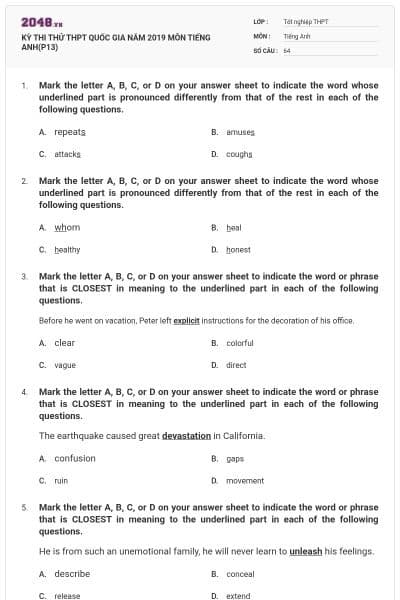
Mark the letter A, B, C, or D on your answer sheet to indicate the word whose underlined part is pronounced differently from that of the rest in each of the following questions.
repeats
amuses
attacks
coughs
B
A./s/ B./z/ C./s/ D./s/
Mark the letter A, B, C, or D on your answer sheet to indicate the word whose underlined part is pronounced differently from that of the rest in each of the following questions.
whom
heal
healthy
honest
D
A./h/ B./h/ C./h/ D. ‘h’ ở đây là âm câm – không phát âm
Mark the letter A, B, C, or D on your answer sheet to indicate the word or phrase that is CLOSEST in meaning to the underlined part in each of the following questions.
Before he went on vacation, Peter left explicit instructions for the decoration of his office.
clear
colorful
vague
direct
A
“explicit” = “clear” (adj): rõ ràng, rành mạch
Mark the letter A, B, C, or D on your answer sheet to indicate the word or phrase that is CLOSEST in meaning to the underlined part in each of the following questions.
The earthquake caused great devastation in California.
confusion
gaps
ruin
movement
C
“devastation” = “ruin” (n): sự tàn phá, sự phá hoại
Mark the letter A, B, C, or D on your answer sheet to indicate the word or phrase that is CLOSEST in meaning to the underlined part in each of the following questions.
He is from such an unemotional family, he will never learn to unleash his feelings.
describe
conceal
release
extend
C
unleash” = “release” (v): thả ra, bộc lộ ra
Read the following passage and mark the letter A, B, C or D on your answer sheet to indicate the correct answer to each of the following questions.
American humor and American popular heroes were born together. The first popular heroes of the new nation were comic heroes, and the first popular humor of the new nation was the antics of its hero-clowns.
The heroic and the comic were combined in novel American proportions in popular literature. The heroic themes are obvious enough and not much different from those in the legends of other times and places: Achilles, Beowulf, Siegfried, Roland, and King Arthur. The American Davy Crockett legends repeat the familiar pattern of the old world heroic story: the pre-eminence of a mighty hero whose fame in myth has a tenuous basis in fact; the remarkable birth and precocious strength of the hero; single combats in which he distinguished himself against antagonists, both man and beast; vows and boasts; pride of the hero in his weapons, his dog, and his woman.
Davy Crockett conquered man and beast with a swaggering nonchalance. He overcame animals by force of body and will. He killed four wolves at the age of six. He hugged a bear to death; he killed a rattlesnake with his teeth. He mastered the forces of nature. Crockett’s most famous natural exploit was saving the earth on the coldest day in history. First, he climbed a mountain to determine the trouble. Then he rescued all creation by squeezing bear-grease on the earth’s frozen axis and over the sun’s icy face. He whistled, “Push along, keep moving!” The earth gave a grunt and began moving.
Neither the fearlessness nor the bold huntsman’s prowess was peculiarly American. Far more distinctive was the comic quality, all heroes are heroic; few are also clowns. What made the American popular hero heroic also made him comic. “May be”, said Crockett, “you’ll laugh at me and not at my book”. The ambiguity of American life and the vagueness which laid the continent open to adventure, which made the land a rich storehouse of the unexpected, which kept vocabulary ungoverned and the language fluid----this same ambiguity suffused both the Crockett legends were never quite certain whether to laugh or to applaud, or whether what they saw and heard was wonderful, awful or ridiculous.
What is the main point the author makes in the passage?
Davy Crockett wrote humorous stories about mastering the nature.
American popular heroes were characteristically comic.
The Davy Crockett stories reflected the adventurous spirit of early America.
American popular literature was based on the legends of other times and places.
B
Thông tin ở đoạn 1 và một số câu đầu tiên của đoạn 2: “American humor and American popular heroes were born together. The first popular heroes of the new nation were comic heroes, and the first popular humor of the new nation was the antics of its hero-clowns.
The heroic and the comic were combined in novel American proportions in popular literature. The heroic themes are obvious enough and not much different from those in the legends of other times and places:…”
Read the following passage and mark the letter A, B, C or D on your answer sheet to indicate the correct answer to each of the following questions.
American humor and American popular heroes were born together. The first popular heroes of the new nation were comic heroes, and the first popular humor of the new nation was the antics of its hero-clowns.
The heroic and the comic were combined in novel American proportions in popular literature. The heroic themes are obvious enough and not much different from those in the legends of other times and places: Achilles, Beowulf, Siegfried, Roland, and King Arthur. The American Davy Crockett legends repeat the familiar pattern of the old world heroic story: the pre-eminence of a mighty hero whose fame in myth has a tenuous basis in fact; the remarkable birth and precocious strength of the hero; single combats in which he distinguished himself against antagonists, both man and beast; vows and boasts; pride of the hero in his weapons, his dog, and his woman.
Davy Crockett conquered man and beast with a swaggering nonchalance. He overcame animals by force of body and will. He killed four wolves at the age of six. He hugged a bear to death; he killed a rattlesnake with his teeth. He mastered the forces of nature. Crockett’s most famous natural exploit was saving the earth on the coldest day in history. First, he climbed a mountain to determine the trouble. Then he rescued all creation by squeezing bear-grease on the earth’s frozen axis and over the sun’s icy face. He whistled, “Push along, keep moving!” The earth gave a grunt and began moving.
Neither the fearlessness nor the bold huntsman’s prowess was peculiarly American. Far more distinctive was the comic quality, all heroes are heroic; few are also clowns. What made the American popular hero heroic also made him comic. “May be”, said Crockett, “you’ll laugh at me and not at my book”. The ambiguity of American life and the vagueness which laid the continent open to adventure, which made the land a rich storehouse of the unexpected, which kept vocabulary ungoverned and the language fluid----this same ambiguity suffused both the Crockett legends were never quite certain whether to laugh or to applaud, or whether what they saw and heard was wonderful, awful or ridiculous.
Achilles, Beowulf, and other heroes are mentioned in paragraph 2 to_________.
show their similar heroic nature with the American heroes.
show the role they play in the world legend history.
compare their popularity with that of the American heroes.
conclude heroic deeds described in old world heroic legends.
C
Thông tin ở những câu đầu tiên đoạn 2: “The heroic and the comic were combined in novel American proportions in popular literature. The heroic themes are obvious enough and not much different from those in the legends of other times and places: Achilles, Beowulf, Siegfried, Roland, and King Arthur.”
Read the following passage and mark the letter A, B, C or D on your answer sheet to indicate the correct answer to each of the following questions.
American humor and American popular heroes were born together. The first popular heroes of the new nation were comic heroes, and the first popular humor of the new nation was the antics of its hero-clowns.
The heroic and the comic were combined in novel American proportions in popular literature. The heroic themes are obvious enough and not much different from those in the legends of other times and places: Achilles, Beowulf, Siegfried, Roland, and King Arthur. The American Davy Crockett legends repeat the familiar pattern of the old world heroic story: the pre-eminence of a mighty hero whose fame in myth has a tenuous basis in fact; the remarkable birth and precocious strength of the hero; single combats in which he distinguished himself against antagonists, both man and beast; vows and boasts; pride of the hero in his weapons, his dog, and his woman.
Davy Crockett conquered man and beast with a swaggering nonchalance. He overcame animals by force of body and will. He killed four wolves at the age of six. He hugged a bear to death; he killed a rattlesnake with his teeth. He mastered the forces of nature. Crockett’s most famous natural exploit was saving the earth on the coldest day in history. First, he climbed a mountain to determine the trouble. Then he rescued all creation by squeezing bear-grease on the earth’s frozen axis and over the sun’s icy face. He whistled, “Push along, keep moving!” The earth gave a grunt and began moving.
Neither the fearlessness nor the bold huntsman’s prowess was peculiarly American. Far more distinctive was the comic quality, all heroes are heroic; few are also clowns. What made the American popular hero heroic also made him comic. “May be”, said Crockett, “you’ll laugh at me and not at my book”. The ambiguity of American life and the vagueness which laid the continent open to adventure, which made the land a rich storehouse of the unexpected, which kept vocabulary ungoverned and the language fluid----this same ambiguity suffused both the Crockett legends were never quite certain whether to laugh or to applaud, or whether what they saw and heard was wonderful, awful or ridiculous.
Which of the following is NOT mentioned as a heroic theme?
Superior physical strength
Pride in the hero woman
Fluid use of language
Boasting by the hero
C
Thông tin ở những câu cuối đoạn 2: “the pre-eminence of a mighty hero whose fame in myth has a tenuous basis in fact; the remarkable birth and precocious strength of the hero; single combats in which he distinguished himself against antagonists, both man and beast; vows and boasts; pride of the hero in his weapons, his dog, and his woman.”
Chỉ có phần C. Fluid use of language là không được nhắc đến
Read the following passage and mark the letter A, B, C or D on your answer sheet to indicate the correct answer to each of the following questions.
American humor and American popular heroes were born together. The first popular heroes of the new nation were comic heroes, and the first popular humor of the new nation was the antics of its hero-clowns.
The heroic and the comic were combined in novel American proportions in popular literature. The heroic themes are obvious enough and not much different from those in the legends of other times and places: Achilles, Beowulf, Siegfried, Roland, and King Arthur. The American Davy Crockett legends repeat the familiar pattern of the old world heroic story: the pre-eminence of a mighty hero whose fame in myth has a tenuous basis in fact; the remarkable birth and precocious strength of the hero; single combats in which he distinguished himself against antagonists, both man and beast; vows and boasts; pride of the hero in his weapons, his dog, and his woman.
Davy Crockett conquered man and beast with a swaggering nonchalance. He overcame animals by force of body and will. He killed four wolves at the age of six. He hugged a bear to death; he killed a rattlesnake with his teeth. He mastered the forces of nature. Crockett’s most famous natural exploit was saving the earth on the coldest day in history. First, he climbed a mountain to determine the trouble. Then he rescued all creation by squeezing bear-grease on the earth’s frozen axis and over the sun’s icy face. He whistled, “Push along, keep moving!” The earth gave a grunt and began moving.
Neither the fearlessness nor the bold huntsman’s prowess was peculiarly American. Far more distinctive was the comic quality, all heroes are heroic; few are also clowns. What made the American popular hero heroic also made him comic. “May be”, said Crockett, “you’ll laugh at me and not at my book”. The ambiguity of American life and the vagueness which laid the continent open to adventure, which made the land a rich storehouse of the unexpected, which kept vocabulary ungoverned and the language fluid----this same ambiguity suffused both the Crockett legends were never quite certain whether to laugh or to applaud, or whether what they saw and heard was wonderful, awful or ridiculous.
The word “antagonists” could be best replaced by_________.
wild animals
heroes
forces
opponents
D
“antagonists” = “opponents”: địch thủ, đối thủ
Read the following passage and mark the letter A, B, C or D on your answer sheet to indicate the correct answer to each of the following questions.
American humor and American popular heroes were born together. The first popular heroes of the new nation were comic heroes, and the first popular humor of the new nation was the antics of its hero-clowns.
The heroic and the comic were combined in novel American proportions in popular literature. The heroic themes are obvious enough and not much different from those in the legends of other times and places: Achilles, Beowulf, Siegfried, Roland, and King Arthur. The American Davy Crockett legends repeat the familiar pattern of the old world heroic story: the pre-eminence of a mighty hero whose fame in myth has a tenuous basis in fact; the remarkable birth and precocious strength of the hero; single combats in which he distinguished himself against antagonists, both man and beast; vows and boasts; pride of the hero in his weapons, his dog, and his woman.
Davy Crockett conquered man and beast with a swaggering nonchalance. He overcame animals by force of body and will. He killed four wolves at the age of six. He hugged a bear to death; he killed a rattlesnake with his teeth. He mastered the forces of nature. Crockett’s most famous natural exploit was saving the earth on the coldest day in history. First, he climbed a mountain to determine the trouble. Then he rescued all creation by squeezing bear-grease on the earth’s frozen axis and over the sun’s icy face. He whistled, “Push along, keep moving!” The earth gave a grunt and began moving.
Neither the fearlessness nor the bold huntsman’s prowess was peculiarly American. Far more distinctive was the comic quality, all heroes are heroic; few are also clowns. What made the American popular hero heroic also made him comic. “May be”, said Crockett, “you’ll laugh at me and not at my book”. The ambiguity of American life and the vagueness which laid the continent open to adventure, which made the land a rich storehouse of the unexpected, which kept vocabulary ungoverned and the language fluid----this same ambiguity suffused both the Crockett legends were never quite certain whether to laugh or to applaud, or whether what they saw and heard was wonderful, awful or ridiculous.
Davy Crockett is an example of_________.
a popular writer
a heroic theme
an old world hero
a hero-clown
Đáp án D
Câu cuối đoạn 1 đã bắt đầu giới thiệu sơ lược về nội dung bài: “the first popular humor of the new nation was the antics of its hero-clowns.”
Sau đó là thông tin ở đoạn 4: “Far more distinctive was the comic quality, all heroes are heroic; few are also clowns. What made the American popular hero heroic also made him comic. “May be”, said Crockett, “you’ll laugh at me and not at my book”.”
Read the following passage and mark the letter A, B, C or D on your answer sheet to indicate the correct answer to each of the following questions.
American humor and American popular heroes were born together. The first popular heroes of the new nation were comic heroes, and the first popular humor of the new nation was the antics of its hero-clowns.
The heroic and the comic were combined in novel American proportions in popular literature. The heroic themes are obvious enough and not much different from those in the legends of other times and places: Achilles, Beowulf, Siegfried, Roland, and King Arthur. The American Davy Crockett legends repeat the familiar pattern of the old world heroic story: the pre-eminence of a mighty hero whose fame in myth has a tenuous basis in fact; the remarkable birth and precocious strength of the hero; single combats in which he distinguished himself against antagonists, both man and beast; vows and boasts; pride of the hero in his weapons, his dog, and his woman.
Davy Crockett conquered man and beast with a swaggering nonchalance. He overcame animals by force of body and will. He killed four wolves at the age of six. He hugged a bear to death; he killed a rattlesnake with his teeth. He mastered the forces of nature. Crockett’s most famous natural exploit was saving the earth on the coldest day in history. First, he climbed a mountain to determine the trouble. Then he rescued all creation by squeezing bear-grease on the earth’s frozen axis and over the sun’s icy face. He whistled, “Push along, keep moving!” The earth gave a grunt and began moving.
Neither the fearlessness nor the bold huntsman’s prowess was peculiarly American. Far more distinctive was the comic quality, all heroes are heroic; few are also clowns. What made the American popular hero heroic also made him comic. “May be”, said Crockett, “you’ll laugh at me and not at my book”. The ambiguity of American life and the vagueness which laid the continent open to adventure, which made the land a rich storehouse of the unexpected, which kept vocabulary ungoverned and the language fluid----this same ambiguity suffused both the Crockett legends were never quite certain whether to laugh or to applaud, or whether what they saw and heard was wonderful, awful or ridiculous.
In paragraph 3, the author mentions a story in which Davy Crockett_________.
killed a wild boar
saved a bear
saved the earth
ate a rattlesnake
Đáp án C
Thông tin ở đoạn 3: “Crockett’s most famous natural exploit was saving the earth on the coldest day in history.”
Read the following passage and mark the letter A, B, C or D on your answer sheet to indicate the correct answer to each of the following questions.
American humor and American popular heroes were born together. The first popular heroes of the new nation were comic heroes, and the first popular humor of the new nation was the antics of its hero-clowns.
The heroic and the comic were combined in novel American proportions in popular literature. The heroic themes are obvious enough and not much different from those in the legends of other times and places: Achilles, Beowulf, Siegfried, Roland, and King Arthur. The American Davy Crockett legends repeat the familiar pattern of the old world heroic story: the pre-eminence of a mighty hero whose fame in myth has a tenuous basis in fact; the remarkable birth and precocious strength of the hero; single combats in which he distinguished himself against antagonists, both man and beast; vows and boasts; pride of the hero in his weapons, his dog, and his woman.
Davy Crockett conquered man and beast with a swaggering nonchalance. He overcame animals by force of body and will. He killed four wolves at the age of six. He hugged a bear to death; he killed a rattlesnake with his teeth. He mastered the forces of nature. Crockett’s most famous natural exploit was saving the earth on the coldest day in history. First, he climbed a mountain to determine the trouble. Then he rescued all creation by squeezing bear-grease on the earth’s frozen axis and over the sun’s icy face. He whistled, “Push along, keep moving!” The earth gave a grunt and began moving.
Neither the fearlessness nor the bold huntsman’s prowess was peculiarly American. Far more distinctive was the comic quality, all heroes are heroic; few are also clowns. What made the American popular hero heroic also made him comic. “May be”, said Crockett, “you’ll laugh at me and not at my book”. The ambiguity of American life and the vagueness which laid the continent open to adventure, which made the land a rich storehouse of the unexpected, which kept vocabulary ungoverned and the language fluid----this same ambiguity suffused both the Crockett legends were never quite certain whether to laugh or to applaud, or whether what they saw and heard was wonderful, awful or ridiculous.
The word “exploit” in paragraph 3 is closest meaning to_________.
resource
heroic act
skill
character trait
Đáp án B
“exploit” là kỳ công, kỳ tích (an exciting act or action), trong văn cảnh thì có thể hiểu là heroic act
Read the following passage and mark the letter A, B, C or D on your answer sheet to indicate the correct answer to each of the following questions.
American humor and American popular heroes were born together. The first popular heroes of the new nation were comic heroes, and the first popular humor of the new nation was the antics of its hero-clowns.
The heroic and the comic were combined in novel American proportions in popular literature. The heroic themes are obvious enough and not much different from those in the legends of other times and places: Achilles, Beowulf, Siegfried, Roland, and King Arthur. The American Davy Crockett legends repeat the familiar pattern of the old world heroic story: the pre-eminence of a mighty hero whose fame in myth has a tenuous basis in fact; the remarkable birth and precocious strength of the hero; single combats in which he distinguished himself against antagonists, both man and beast; vows and boasts; pride of the hero in his weapons, his dog, and his woman.
Davy Crockett conquered man and beast with a swaggering nonchalance. He overcame animals by force of body and will. He killed four wolves at the age of six. He hugged a bear to death; he killed a rattlesnake with his teeth. He mastered the forces of nature. Crockett’s most famous natural exploit was saving the earth on the coldest day in history. First, he climbed a mountain to determine the trouble. Then he rescued all creation by squeezing bear-grease on the earth’s frozen axis and over the sun’s icy face. He whistled, “Push along, keep moving!” The earth gave a grunt and began moving.
Neither the fearlessness nor the bold huntsman’s prowess was peculiarly American. Far more distinctive was the comic quality, all heroes are heroic; few are also clowns. What made the American popular hero heroic also made him comic. “May be”, said Crockett, “you’ll laugh at me and not at my book”. The ambiguity of American life and the vagueness which laid the continent open to adventure, which made the land a rich storehouse of the unexpected, which kept vocabulary ungoverned and the language fluid----this same ambiguity suffused both the Crockett legends were never quite certain whether to laugh or to applaud, or whether what they saw and heard was wonderful, awful or ridiculous.
The word “prowess” in paragraph 4 is closest meaning to_________.
goal
weapon
bravery
caution
Đáp án C
“prowess”: great ability or skill, trong văn cảnh này nó đồng nghĩa với bravery (lòng anh dũng, quả cảm)
Read the following passage and mark the letter A, B, C or D on your answer sheet to indicate the correct answer to each of the following questions.
American humor and American popular heroes were born together. The first popular heroes of the new nation were comic heroes, and the first popular humor of the new nation was the antics of its hero-clowns.
The heroic and the comic were combined in novel American proportions in popular literature. The heroic themes are obvious enough and not much different from those in the legends of other times and places: Achilles, Beowulf, Siegfried, Roland, and King Arthur. The American Davy Crockett legends repeat the familiar pattern of the old world heroic story: the pre-eminence of a mighty hero whose fame in myth has a tenuous basis in fact; the remarkable birth and precocious strength of the hero; single combats in which he distinguished himself against antagonists, both man and beast; vows and boasts; pride of the hero in his weapons, his dog, and his woman.
Davy Crockett conquered man and beast with a swaggering nonchalance. He overcame animals by force of body and will. He killed four wolves at the age of six. He hugged a bear to death; he killed a rattlesnake with his teeth. He mastered the forces of nature. Crockett’s most famous natural exploit was saving the earth on the coldest day in history. First, he climbed a mountain to determine the trouble. Then he rescued all creation by squeezing bear-grease on the earth’s frozen axis and over the sun’s icy face. He whistled, “Push along, keep moving!” The earth gave a grunt and began moving.
Neither the fearlessness nor the bold huntsman’s prowess was peculiarly American. Far more distinctive was the comic quality, all heroes are heroic; few are also clowns. What made the American popular hero heroic also made him comic. “May be”, said Crockett, “you’ll laugh at me and not at my book”. The ambiguity of American life and the vagueness which laid the continent open to adventure, which made the land a rich storehouse of the unexpected, which kept vocabulary ungoverned and the language fluid----this same ambiguity suffused both the Crockett legends were never quite certain whether to laugh or to applaud, or whether what they saw and heard was wonderful, awful or ridiculous.
In paragraph 4, the author makes the point that_________.
American enjoyed laughing at other people.
American writers strove to create a distinctively American literature.
American life was open to adventure and full of the unexpected.
Americans valued comic qualities more than heroic qualities.
Đáp án C
Thông tin ở đoạn 4: “The ambiguity of American life and the vagueness which laid the continent open to adventure, which made the land a rich storehouse of the unexpected…”
Read the following passage and mark the letter A, B, C or D on your answer sheet to indicate the correct answer to each of the following questions.
American humor and American popular heroes were born together. The first popular heroes of the new nation were comic heroes, and the first popular humor of the new nation was the antics of its hero-clowns.
The heroic and the comic were combined in novel American proportions in popular literature. The heroic themes are obvious enough and not much different from those in the legends of other times and places: Achilles, Beowulf, Siegfried, Roland, and King Arthur. The American Davy Crockett legends repeat the familiar pattern of the old world heroic story: the pre-eminence of a mighty hero whose fame in myth has a tenuous basis in fact; the remarkable birth and precocious strength of the hero; single combats in which he distinguished himself against antagonists, both man and beast; vows and boasts; pride of the hero in his weapons, his dog, and his woman.
Davy Crockett conquered man and beast with a swaggering nonchalance. He overcame animals by force of body and will. He killed four wolves at the age of six. He hugged a bear to death; he killed a rattlesnake with his teeth. He mastered the forces of nature. Crockett’s most famous natural exploit was saving the earth on the coldest day in history. First, he climbed a mountain to determine the trouble. Then he rescued all creation by squeezing bear-grease on the earth’s frozen axis and over the sun’s icy face. He whistled, “Push along, keep moving!” The earth gave a grunt and began moving.
Neither the fearlessness nor the bold huntsman’s prowess was peculiarly American. Far more distinctive was the comic quality, all heroes are heroic; few are also clowns. What made the American popular hero heroic also made him comic. “May be”, said Crockett, “you’ll laugh at me and not at my book”. The ambiguity of American life and the vagueness which laid the continent open to adventure, which made the land a rich storehouse of the unexpected, which kept vocabulary ungoverned and the language fluid----this same ambiguity suffused both the Crockett legends were never quite certain whether to laugh or to applaud, or whether what they saw and heard was wonderful, awful or ridiculous.
The word “ambiguity” in the last paragraph is closest meaning to_________.
ridiculous
richness
uncertainty
quality
Đáp án C
“ambiguity” = “uncertainty”: không rõ, không chắc chắn, không rõ nghĩa,…
Mark the letter A, B, C, or D on your answer sheet to indicate the word that differs from the rest in the position of the main stress in each of the following questions.
enjoyment
extension
fashionable
facilitate
Đáp án C
Phần C trọng âm rơi vào âm tiết thứ nhất, còn lại là thứ 2
Mark the letter A, B, C, or D on your answer sheet to indicate the word that differs from the rest in the position of the main stress in each of the following questions.
apprehensive
residential
emergency
resolution
Đáp án C
Phần C trọng âm rơi vào âm tiết thứ 2, còn lại là thứ 3
Mark the letter A, B, C, or D on your answer sheet to indicate the word that differs from the rest in the position of the main stress in each of the following questions.
threaten
mosquito
comfortable
interesting
Đáp án B
Phần B trọng âm rơi vào âm tiết thứ 2, còn lại là thứ nhất
Read the following passage and mark the letter A, B, C, or D on your answer sheet to indicate the correct word(s) for each of the following blanks.
KEEPING FIT
Bodies are made to move! They are not (19) _________for sitting around in front of the television or reading magazines. Keeping fit doesn’t (20) _________you have to be a super-athlete, and even (21) ______exercise can give you a lot of fun. When you are fit and healthy, you will find you look better and feel better. You will develop more energy and self-confidence.
Every time you move, you are exercising. The human body is designed to bend, stretch, run, jump and climb. (22) _________it does, the stronger and fitter it will become. Best of all, exercise is fun. It’s what your body likes doing most-keeping on the (23) _________.
Physical exercise is not only good for your body. People who take regular exercise are usually happier, more relaxed and more alert (24) _________people who sit around all day. Try an experiment-next time you are (25) _________a bad mood, go for a walk or play a ball game in the park. See how much better you feel after an hour.
A good (26) _________of achievement is yet another benefit of exercise. People feel good about themselves when they know they have (27) _________their fitness. People who exercise regularly will tell you that they find they have more energy to enjoy life. So have (28) _________-you’ll soon see and feel the benefits.
Điền vào ô 19
planned
designed
programmed
caused
Đáp án B
“design” (v): thiết kế
“design for st/doing st”: chỉ định, dành cho cái gì/làm cái gì
Read the following passage and mark the letter A, B, C, or D on your answer sheet to indicate the correct word(s) for each of the following blanks.
KEEPING FIT
Bodies are made to move! They are not (19) _________for sitting around in front of the television or reading magazines. Keeping fit doesn’t (20) _________you have to be a super-athlete, and even (21) ______exercise can give you a lot of fun. When you are fit and healthy, you will find you look better and feel better. You will develop more energy and self-confidence.
Every time you move, you are exercising. The human body is designed to bend, stretch, run, jump and climb. (22) _________it does, the stronger and fitter it will become. Best of all, exercise is fun. It’s what your body likes doing most-keeping on the (23) _________.
Physical exercise is not only good for your body. People who take regular exercise are usually happier, more relaxed and more alert (24) _________people who sit around all day. Try an experiment-next time you are (25) _________a bad mood, go for a walk or play a ball game in the park. See how much better you feel after an hour.
A good (26) _________of achievement is yet another benefit of exercise. People feel good about themselves when they know they have (27) _________their fitness. People who exercise regularly will tell you that they find they have more energy to enjoy life. So have (28) _________-you’ll soon see and feel the benefits.
Điền vào ô 20
involve
require
reveal
mean
Đáp án D
“mean” (v): có nghĩa là…
Keeping fit doesn’t mean: Giữ cân đối không có nghĩa là….
Read the following passage and mark the letter A, B, C, or D on your answer sheet to indicate the correct word(s) for each of the following blanks.
KEEPING FIT
Bodies are made to move! They are not (19) _________for sitting around in front of the television or reading magazines. Keeping fit doesn’t (20) _________you have to be a super-athlete, and even (21) ______exercise can give you a lot of fun. When you are fit and healthy, you will find you look better and feel better. You will develop more energy and self-confidence.
Every time you move, you are exercising. The human body is designed to bend, stretch, run, jump and climb. (22) _________it does, the stronger and fitter it will become. Best of all, exercise is fun. It’s what your body likes doing most-keeping on the (23) _________.
Physical exercise is not only good for your body. People who take regular exercise are usually happier, more relaxed and more alert (24) _________people who sit around all day. Try an experiment-next time you are (25) _________a bad mood, go for a walk or play a ball game in the park. See how much better you feel after an hour.
A good (26) _________of achievement is yet another benefit of exercise. People feel good about themselves when they know they have (27) _________their fitness. People who exercise regularly will tell you that they find they have more energy to enjoy life. So have (28) _________-you’ll soon see and feel the benefits.
Điền vào ô 21
a little
a few
little
few
Đáp án A
“a little”: một ít (dùng với danh từ không đếm được)
“a little” và “little” đều có nghĩa là ít, nhưng “little” mang nghĩa rất ít, dường như không đủ
Read the following passage and mark the letter A, B, C, or D on your answer sheet to indicate the correct word(s) for each of the following blanks.
KEEPING FIT
Bodies are made to move! They are not (19) _________for sitting around in front of the television or reading magazines. Keeping fit doesn’t (20) _________you have to be a super-athlete, and even (21) ______exercise can give you a lot of fun. When you are fit and healthy, you will find you look better and feel better. You will develop more energy and self-confidence.
Every time you move, you are exercising. The human body is designed to bend, stretch, run, jump and climb. (22) _________it does, the stronger and fitter it will become. Best of all, exercise is fun. It’s what your body likes doing most-keeping on the (23) _________.
Physical exercise is not only good for your body. People who take regular exercise are usually happier, more relaxed and more alert (24) _________people who sit around all day. Try an experiment-next time you are (25) _________a bad mood, go for a walk or play a ball game in the park. See how much better you feel after an hour.
A good (26) _________of achievement is yet another benefit of exercise. People feel good about themselves when they know they have (27) _________their fitness. People who exercise regularly will tell you that they find they have more energy to enjoy life. So have (28) _________-you’ll soon see and feel the benefits.
Điền vào ô 22
More and more
The more
More
Moreover
Đáp án B
Cấu trúc so sánh càng…càng…: “the more (adj+er)…, the more(adj+er)…”
Read the following passage and mark the letter A, B, C, or D on your answer sheet to indicate the correct word(s) for each of the following blanks.
KEEPING FIT
Bodies are made to move! They are not (19) _________for sitting around in front of the television or reading magazines. Keeping fit doesn’t (20) _________you have to be a super-athlete, and even (21) ______exercise can give you a lot of fun. When you are fit and healthy, you will find you look better and feel better. You will develop more energy and self-confidence.
Every time you move, you are exercising. The human body is designed to bend, stretch, run, jump and climb. (22) _________it does, the stronger and fitter it will become. Best of all, exercise is fun. It’s what your body likes doing most-keeping on the (23) _________.
Physical exercise is not only good for your body. People who take regular exercise are usually happier, more relaxed and more alert (24) _________people who sit around all day. Try an experiment-next time you are (25) _________a bad mood, go for a walk or play a ball game in the park. See how much better you feel after an hour.
A good (26) _________of achievement is yet another benefit of exercise. People feel good about themselves when they know they have (27) _________their fitness. People who exercise regularly will tell you that they find they have more energy to enjoy life. So have (28) _________-you’ll soon see and feel the benefits.
Điền vào ô 23
increase
move
develop
decrease
Đáp án B
“on the move”: đang di chuyển
Read the following passage and mark the letter A, B, C, or D on your answer sheet to indicate the correct word(s) for each of the following blanks.
KEEPING FIT
Bodies are made to move! They are not (19) _________for sitting around in front of the television or reading magazines. Keeping fit doesn’t (20) _________you have to be a super-athlete, and even (21) ______exercise can give you a lot of fun. When you are fit and healthy, you will find you look better and feel better. You will develop more energy and self-confidence.
Every time you move, you are exercising. The human body is designed to bend, stretch, run, jump and climb. (22) _________it does, the stronger and fitter it will become. Best of all, exercise is fun. It’s what your body likes doing most-keeping on the (23) _________.
Physical exercise is not only good for your body. People who take regular exercise are usually happier, more relaxed and more alert (24) _________people who sit around all day. Try an experiment-next time you are (25) _________a bad mood, go for a walk or play a ball game in the park. See how much better you feel after an hour.
A good (26) _________of achievement is yet another benefit of exercise. People feel good about themselves when they know they have (27) _________their fitness. People who exercise regularly will tell you that they find they have more energy to enjoy life. So have (28) _________-you’ll soon see and feel the benefits.
Điền vào ô 24
then
about
than
with
Đáp án C
“than”: hơn
Phía trước có sự so sánh adj+er và more, vì thế phải dùng từ than
Read the following passage and mark the letter A, B, C, or D on your answer sheet to indicate the correct word(s) for each of the following blanks.
KEEPING FIT
Bodies are made to move! They are not (19) _________for sitting around in front of the television or reading magazines. Keeping fit doesn’t (20) _________you have to be a super-athlete, and even (21) ______exercise can give you a lot of fun. When you are fit and healthy, you will find you look better and feel better. You will develop more energy and self-confidence.
Every time you move, you are exercising. The human body is designed to bend, stretch, run, jump and climb. (22) _________it does, the stronger and fitter it will become. Best of all, exercise is fun. It’s what your body likes doing most-keeping on the (23) _________.
Physical exercise is not only good for your body. People who take regular exercise are usually happier, more relaxed and more alert (24) _________people who sit around all day. Try an experiment-next time you are (25) _________a bad mood, go for a walk or play a ball game in the park. See how much better you feel after an hour.
A good (26) _________of achievement is yet another benefit of exercise. People feel good about themselves when they know they have (27) _________their fitness. People who exercise regularly will tell you that they find they have more energy to enjoy life. So have (28) _________-you’ll soon see and feel the benefits.
Điền vào ô 25
in
on
at
under
Đáp án A
“in a bad mood”: đang trong tâm trạng không vui/không tốt, “mood” chia cùng giới từ in
Read the following passage and mark the letter A, B, C, or D on your answer sheet to indicate the correct word(s) for each of the following blanks.
KEEPING FIT
Bodies are made to move! They are not (19) _________for sitting around in front of the television or reading magazines. Keeping fit doesn’t (20) _________you have to be a super-athlete, and even (21) ______exercise can give you a lot of fun. When you are fit and healthy, you will find you look better and feel better. You will develop more energy and self-confidence.
Every time you move, you are exercising. The human body is designed to bend, stretch, run, jump and climb. (22) _________it does, the stronger and fitter it will become. Best of all, exercise is fun. It’s what your body likes doing most-keeping on the (23) _________.
Physical exercise is not only good for your body. People who take regular exercise are usually happier, more relaxed and more alert (24) _________people who sit around all day. Try an experiment-next time you are (25) _________a bad mood, go for a walk or play a ball game in the park. See how much better you feel after an hour.
A good (26) _________of achievement is yet another benefit of exercise. People feel good about themselves when they know they have (27) _________their fitness. People who exercise regularly will tell you that they find they have more energy to enjoy life. So have (28) _________-you’ll soon see and feel the benefits.
Điền vào ô 26
sense
feel
lot
piece
Đáp án A
“A good sense of achievement”: Một cảm giác/ý thức về sự thành tựu
“sense” có nghĩa là khả năng nhận thức ý thức, cũng có nghĩa khác là lý do mục đích (của việc làm gì)
Read the following passage and mark the letter A, B, C, or D on your answer sheet to indicate the correct word(s) for each of the following blanks.
KEEPING FIT
Bodies are made to move! They are not (19) _________for sitting around in front of the television or reading magazines. Keeping fit doesn’t (20) _________you have to be a super-athlete, and even (21) ______exercise can give you a lot of fun. When you are fit and healthy, you will find you look better and feel better. You will develop more energy and self-confidence.
Every time you move, you are exercising. The human body is designed to bend, stretch, run, jump and climb. (22) _________it does, the stronger and fitter it will become. Best of all, exercise is fun. It’s what your body likes doing most-keeping on the (23) _________.
Physical exercise is not only good for your body. People who take regular exercise are usually happier, more relaxed and more alert (24) _________people who sit around all day. Try an experiment-next time you are (25) _________a bad mood, go for a walk or play a ball game in the park. See how much better you feel after an hour.
A good (26) _________of achievement is yet another benefit of exercise. People feel good about themselves when they know they have (27) _________their fitness. People who exercise regularly will tell you that they find they have more energy to enjoy life. So have (28) _________-you’ll soon see and feel the benefits.
Điền vào ô 27
experienced
improved
carried out
grown
Đáp án B
“improve”: cải thiện, tiến bộ
“experience”: trải nghiệm, có kinh nghiệm
“carry out”: tiến hành
“grow”: trồng, lớn lên..
Read the following passage and mark the letter A, B, C, or D on your answer sheet to indicate the correct word(s) for each of the following blanks.
KEEPING FIT
Bodies are made to move! They are not (19) _________for sitting around in front of the television or reading magazines. Keeping fit doesn’t (20) _________you have to be a super-athlete, and even (21) ______exercise can give you a lot of fun. When you are fit and healthy, you will find you look better and feel better. You will develop more energy and self-confidence.
Every time you move, you are exercising. The human body is designed to bend, stretch, run, jump and climb. (22) _________it does, the stronger and fitter it will become. Best of all, exercise is fun. It’s what your body likes doing most-keeping on the (23) _________.
Physical exercise is not only good for your body. People who take regular exercise are usually happier, more relaxed and more alert (24) _________people who sit around all day. Try an experiment-next time you are (25) _________a bad mood, go for a walk or play a ball game in the park. See how much better you feel after an hour.
A good (26) _________of achievement is yet another benefit of exercise. People feel good about themselves when they know they have (27) _________their fitness. People who exercise regularly will tell you that they find they have more energy to enjoy life. So have (28) _________-you’ll soon see and feel the benefits.
Điền vào ô 28
a run
a trial
a go
a start
Đáp án C
Cụm “have a go at st/doing st”: cố hết sức về cái gì/về làm việc gì
The phone _________suddenly while Jane was doing the gardening.
is ringing
had rung
was ringing
rang
Đáp án D
Diễn tả một hành động đang xảy ra trong quá khứ thì một hành động khác chen vào, hành động đó được chia ở thì quá khứ đơn
Nam never comes to class on time and _________.
neither doesn’t Huy
so doesn’t Huy
so does Huy
neither does Huy
Đáp án D
“neither” có nghĩa là cũng nhưng dùng trong câu bị động, khi dùng neither không có not (neither bản thân nó đã là phủ định rồi)
Sorry, I’m late, but my car_________ on the way here, and I had to call the garage.
was broke
not working
out of order
broke down
Đáp án D
“break down”: hỏng hóc
_________ it with my own eyes, I would never have believed it.
Had I not seen
Unless I had not seen
If I had seen
Provided I had seen
Đáp án: A
Giải thích:
Kiến thức: Câu điều kiện loại 3
Xét các đáp án:
A. Đảo ngữ với câu điều kiện loại 3
Had + S + (not) + VpII = If + S + had (not) VpII
Đúng nghĩa và cấu trúc
B. If + S + had not VpII = Unless + S + VpII
Thừa phủ định “not” vì “unless” đã mang nghĩa phủ định rồi
C. Đúng cấu trúc câu điều kiện loại 3 nhưng không phù hợp về nghĩa
D. Đúng cấu trúc câu điều kiện loại 3 nhưng không phù hợp về nghĩa
Dịch: Nếu không tận mắt chứng kiến, tôi sẽ không bao giờ tin được.
Marie Curie was the first and only woman_________two Nobel prizes.
that win
to be won
who win
to have won
Đáp án: D
Giải thích:
Cấu trúc the first / the only + to V diễn tả người đầu tiên hoặc duy nhất làm điều gì đó.
Ở đây, Marie Curie was the first and only woman → cần động từ nguyên mẫu hoàn thành (to have won) để diễn tả hành động đã xảy ra trong quá khứ.
Dịch: Marie Curie là người phụ nữ đầu tiên và duy nhất giành hai giải Nobel.
It was in 1989_________ the Berlin Wall collapsed.
which
that
when
what
Đáp án B
Cấu trúc nhấn mạnh “It is…that…”, bỏ thành phần này, nội dung câu không có gì thay đổi, nó chỉ giúp nhấn mạnh một số chỗ mà thôi
The robbers were_________two years in jail.
put
sent
ordered
sentenced
Đáp án: D
Giải thích:
put (v): đặt
send (v): gửi
order (v): yêu cầu
sentence (v): kết án
Ta có: to be sentenced to jail/ … years in jail: bị kết án tù/ bao nhiêu năm trong tù
Dịch: Những tên cướp bị kết án hai năm tù.
The death of Tran Lap, the leader of a Vietnamese famous rock band called Buc Tuong, is a great_________to his fans.
losing
loss
lose
lost
Đáp án B
Ở đây ta cần một danh từ, vì phía trước đã có tính từ great
“loss” (n): sự mất mát
I asked her _________she understood what I was saying.
if not
if
if only
even if
Đáp án B
“if” ở đây không có nghĩa là nếu, mà nó đồng nghĩa với whether (liệu, không biết liệu có…)
I_____an old friend of mine in the street this morning. We haven’t seen each other for ages.
ran into
ran out
came over
came round
Đáp án A
“run into”: gặp tình cờ
Tom is_________ with his teacher because he didn’t do any assignments.
in danger
in the dark
in hot water
under control
Đáp án C
Cấu trúc “be in (get into) hot water”: gặp khó khăn, rắc rối
We can decrease the amount of waste produced at home by___ used paper, plastic and metal.
retaining
reducing
remaining
recycling
Đáp án D
“recycle”: tái chế, tái sử dụng
It was _________ furniture that I didn’t buy it.
so expensive
such expensive
such an expensive
a so expensive
Đáp án: B
Giải thích:
Giải thích:
Kiến thức: Cấu trúc "such ... that"
Công thức: Such + (a/an) + adj + danh từ + that + mệnh đề
Furniture là danh từ không đếm được, nên không dùng a/an.
Chọn B.
Dịch: Đó là đồ nội thất quá đắt đến nỗi tôi không mua nó.
Charles was wearing ___________at the party.
a tie yellow silk funny
very funny wide yellow silk tie
a yellow silk funny tie
a funny wide yellow silk tie
Đáp án D
Vị trí đúng của tính từ:
Mạo từ (a,an,the) + Opinion (funny) + Size (wide) + Color (yellow) + Material (silk) + noun (tie)
_________ , Mr. Jean takes pleasure in doing charity and other social work.
Having retired
Retiring
He has retired
Although retired
Đáp án A
Đây là một loại gerund – động danh từ, tức là lấy động từ làm chủ ngữ, đơn giản bằng cách thêm –ing. Ở đây mang ý nghĩa trong quá khứ nên dùng thêm have ở phía trước động từ chính
___________ Michelle tried hard, she didn’t manage to win the competition.
No matter how
Even though
In spite of
Nevertheless
Đáp án B
Even though/Although/Though (mặc dù) +một mệnh đề
My phone is out of order, _________is a nuisance.
that
which
this
it
Đáp án B
“which” là mệnh đề quan hệ, thay thế cho toàn bộ vế phía trước dấu phảy
Lan :“She seems_________for the job”. Hoa: “Yes. Everybody thinks she’s perfectly suited for it.”
ready-made
home-made
tailor-made
self-made
Đáp án C
“tailor-made” (adj): rất thích hợp
Mai and Lan are friends. Lan asks Mai about Mai’s plan. Select the most suitable response to fill in the blank. Lan: “Are you going to see the live show by Son Tung today?” Mai: “_________”.
Yes, I enjoyed it very much
Maybe I’ll be out
Yes, I’m going to stay in
I think so
Đáp án D
Trong câu này: “I think so” = “I think I’m going”
Read the following passage and mark the letter A, B, C or D on your answer sheet to indicate the correct answer to each of the following questions.
The technology of the North American colonies did not differ strikingly from that of Europe, but in one respect, the colonists enjoyed a great advantage. Especially by comparison with Britain, Americans had a wonderfully plentiful supply of wood.
The first colonists did not, as many people imagine, find an entire continent covered by a climax forest. Even along the Atlantic seaboard, the forest was broken at many points. Nevertheless, all sorts of fine trees abounded, and through the early colonial period, those who pushed westward encountered new forests. By the end of the colonial era, the price of wood had risen slightly in eastern cities, but wood was still extremely abundant.
The availability of wood brought advantages that have seldom been appreciated. Wood was a foundation of the economy. Houses and all manner of buildings were made of wood to a degree unknown in Britain. Secondly, wood was used as fuel for heating and cooking. Thirdly, it was used as the source of important industrial compounds, such as potash, an industrial alkali; charcoal, a component of gunpowder; and tannic acid, used for tanning leather.
The supply of wood conferred advantages but had some negative aspects as well. Iron at that time was produced by heating iron ore with charcoal. Because Britain was so stripped of trees, she was unable to exploit her rich iron mines. But the American colonies had both iron ore and wood; iron production was encouraged and became successful. However, when Britain developed coke smelting, the Colonies did not follow suit because they had plenty of wood and besides, charcoal iron was stronger than coke iron. Coke smelting led to technologic innovations and was linked to the emergence of the Industrial Revolution. In the early nineteenth century, the former colonies lagged behind Britain in industrial development because their supply of wood led them to cling to charcoal iron.
What does the passage mainly discuss?
The advantages of using wood in the colonies
The effects of an abundance of wood on the colonies
The roots of the Industrial Revolution
The difference between charcoal iron and coke iron
Đáp án B
Thông tin ở:
- in one respect, the colonists enjoyed a great advantage. (đoạn 1)
- The availability of wood brought advantages that have seldom been appreciated.(đoạn 3)
- The supply of wood conferred advantages but had some negative aspects as well. (đoạn cuối)
Bài nói về những ảnh hưởng (cả tốt lẫn xấu) của gỗ
Read the following passage and mark the letter A, B, C or D on your answer sheet to indicate the correct answer to each of the following questions.
The technology of the North American colonies did not differ strikingly from that of Europe, but in one respect, the colonists enjoyed a great advantage. Especially by comparison with Britain, Americans had a wonderfully plentiful supply of wood.
The first colonists did not, as many people imagine, find an entire continent covered by a climax forest. Even along the Atlantic seaboard, the forest was broken at many points. Nevertheless, all sorts of fine trees abounded, and through the early colonial period, those who pushed westward encountered new forests. By the end of the colonial era, the price of wood had risen slightly in eastern cities, but wood was still extremely abundant.
The availability of wood brought advantages that have seldom been appreciated. Wood was a foundation of the economy. Houses and all manner of buildings were made of wood to a degree unknown in Britain. Secondly, wood was used as fuel for heating and cooking. Thirdly, it was used as the source of important industrial compounds, such as potash, an industrial alkali; charcoal, a component of gunpowder; and tannic acid, used for tanning leather.
The supply of wood conferred advantages but had some negative aspects as well. Iron at that time was produced by heating iron ore with charcoal. Because Britain was so stripped of trees, she was unable to exploit her rich iron mines. But the American colonies had both iron ore and wood; iron production was encouraged and became successful. However, when Britain developed coke smelting, the Colonies did not follow suit because they had plenty of wood and besides, charcoal iron was stronger than coke iron. Coke smelting led to technologic innovations and was linked to the emergence of the Industrial Revolution. In the early nineteenth century, the former colonies lagged behind Britain in industrial development because their supply of wood led them to cling to charcoal iron.
The word strikingly in the first paragraph is closest in meaning to__________.
realistically
dramatically
completely
immediately
Đáp án B
“strikingly” = “dramatically”: một cách nổi bật, gây ấn tượng mạnh mẽ
Read the following passage and mark the letter A, B, C or D on your answer sheet to indicate the correct answer to each of the following questions.
The technology of the North American colonies did not differ strikingly from that of Europe, but in one respect, the colonists enjoyed a great advantage. Especially by comparison with Britain, Americans had a wonderfully plentiful supply of wood.
The first colonists did not, as many people imagine, find an entire continent covered by a climax forest. Even along the Atlantic seaboard, the forest was broken at many points. Nevertheless, all sorts of fine trees abounded, and through the early colonial period, those who pushed westward encountered new forests. By the end of the colonial era, the price of wood had risen slightly in eastern cities, but wood was still extremely abundant.
The availability of wood brought advantages that have seldom been appreciated. Wood was a foundation of the economy. Houses and all manner of buildings were made of wood to a degree unknown in Britain. Secondly, wood was used as fuel for heating and cooking. Thirdly, it was used as the source of important industrial compounds, such as potash, an industrial alkali; charcoal, a component of gunpowder; and tannic acid, used for tanning leather.
The supply of wood conferred advantages but had some negative aspects as well. Iron at that time was produced by heating iron ore with charcoal. Because Britain was so stripped of trees, she was unable to exploit her rich iron mines. But the American colonies had both iron ore and wood; iron production was encouraged and became successful. However, when Britain developed coke smelting, the Colonies did not follow suit because they had plenty of wood and besides, charcoal iron was stronger than coke iron. Coke smelting led to technologic innovations and was linked to the emergence of the Industrial Revolution. In the early nineteenth century, the former colonies lagged behind Britain in industrial development because their supply of wood led them to cling to charcoal iron.
Which of the following is a common assumption about the forests of North America during the colonial period?
They contained only a few types of trees.
They existed only along the Atlantic seaboard.
They had little or no economic value.
They covered the entire continent.
Đáp án D
Thông tin ở câu đầu tiên đoạn 2: “The first colonists did not, as many people imagine, find an entire continent covered by a climax forest.”
Read the following passage and mark the letter A, B, C or D on your answer sheet to indicate the correct answer to each of the following questions.
The technology of the North American colonies did not differ strikingly from that of Europe, but in one respect, the colonists enjoyed a great advantage. Especially by comparison with Britain, Americans had a wonderfully plentiful supply of wood.
The first colonists did not, as many people imagine, find an entire continent covered by a climax forest. Even along the Atlantic seaboard, the forest was broken at many points. Nevertheless, all sorts of fine trees abounded, and through the early colonial period, those who pushed westward encountered new forests. By the end of the colonial era, the price of wood had risen slightly in eastern cities, but wood was still extremely abundant.
The availability of wood brought advantages that have seldom been appreciated. Wood was a foundation of the economy. Houses and all manner of buildings were made of wood to a degree unknown in Britain. Secondly, wood was used as fuel for heating and cooking. Thirdly, it was used as the source of important industrial compounds, such as potash, an industrial alkali; charcoal, a component of gunpowder; and tannic acid, used for tanning leather.
The supply of wood conferred advantages but had some negative aspects as well. Iron at that time was produced by heating iron ore with charcoal. Because Britain was so stripped of trees, she was unable to exploit her rich iron mines. But the American colonies had both iron ore and wood; iron production was encouraged and became successful. However, when Britain developed coke smelting, the Colonies did not follow suit because they had plenty of wood and besides, charcoal iron was stronger than coke iron. Coke smelting led to technologic innovations and was linked to the emergence of the Industrial Revolution. In the early nineteenth century, the former colonies lagged behind Britain in industrial development because their supply of wood led them to cling to charcoal iron.
The word “abundant” in paragraph 3 is closest meaning to_________.
redundant
sufficient
insufficient
plentiful
Đáp án D
“abundant” = “plentiful”: nhiều, số lượng lớn
Read the following passage and mark the letter A, B, C or D on your answer sheet to indicate the correct answer to each of the following questions.
The technology of the North American colonies did not differ strikingly from that of Europe, but in one respect, the colonists enjoyed a great advantage. Especially by comparison with Britain, Americans had a wonderfully plentiful supply of wood.
The first colonists did not, as many people imagine, find an entire continent covered by a climax forest. Even along the Atlantic seaboard, the forest was broken at many points. Nevertheless, all sorts of fine trees abounded, and through the early colonial period, those who pushed westward encountered new forests. By the end of the colonial era, the price of wood had risen slightly in eastern cities, but wood was still extremely abundant.
The availability of wood brought advantages that have seldom been appreciated. Wood was a foundation of the economy. Houses and all manner of buildings were made of wood to a degree unknown in Britain. Secondly, wood was used as fuel for heating and cooking. Thirdly, it was used as the source of important industrial compounds, such as potash, an industrial alkali; charcoal, a component of gunpowder; and tannic acid, used for tanning leather.
The supply of wood conferred advantages but had some negative aspects as well. Iron at that time was produced by heating iron ore with charcoal. Because Britain was so stripped of trees, she was unable to exploit her rich iron mines. But the American colonies had both iron ore and wood; iron production was encouraged and became successful. However, when Britain developed coke smelting, the Colonies did not follow suit because they had plenty of wood and besides, charcoal iron was stronger than coke iron. Coke smelting led to technologic innovations and was linked to the emergence of the Industrial Revolution. In the early nineteenth century, the former colonies lagged behind Britain in industrial development because their supply of wood led them to cling to charcoal iron.
According to the passage, by the end of the colonial period, the price of wood in Eastern cities__________.
rose quickly because wood was becoming so scarce.
was much higher than it was in Britain.
was slightly higher than in previous years.
decreased rapidly because of lower demand for wood.
Đáp án C
Thông tin ở câu cuối đoạn 2: “By the end of the colonial era, the price of wood had risen slightly in eastern cities…”
Read the following passage and mark the letter A, B, C or D on your answer sheet to indicate the correct answer to each of the following questions.
The technology of the North American colonies did not differ strikingly from that of Europe, but in one respect, the colonists enjoyed a great advantage. Especially by comparison with Britain, Americans had a wonderfully plentiful supply of wood.
The first colonists did not, as many people imagine, find an entire continent covered by a climax forest. Even along the Atlantic seaboard, the forest was broken at many points. Nevertheless, all sorts of fine trees abounded, and through the early colonial period, those who pushed westward encountered new forests. By the end of the colonial era, the price of wood had risen slightly in eastern cities, but wood was still extremely abundant.
The availability of wood brought advantages that have seldom been appreciated. Wood was a foundation of the economy. Houses and all manner of buildings were made of wood to a degree unknown in Britain. Secondly, wood was used as fuel for heating and cooking. Thirdly, it was used as the source of important industrial compounds, such as potash, an industrial alkali; charcoal, a component of gunpowder; and tannic acid, used for tanning leather.
The supply of wood conferred advantages but had some negative aspects as well. Iron at that time was produced by heating iron ore with charcoal. Because Britain was so stripped of trees, she was unable to exploit her rich iron mines. But the American colonies had both iron ore and wood; iron production was encouraged and became successful. However, when Britain developed coke smelting, the Colonies did not follow suit because they had plenty of wood and besides, charcoal iron was stronger than coke iron. Coke smelting led to technologic innovations and was linked to the emergence of the Industrial Revolution. In the early nineteenth century, the former colonies lagged behind Britain in industrial development because their supply of wood led them to cling to charcoal iron.
What can be inferred about houses in Britain during the period written about in the passage?
They were more expensive than American houses.
They were generally built with imported materials.
They were typically smaller than homes in North America.
They were usually built from materials other than wood.
Đáp án D
D thông tin ở câu cuối bài: “the former colonies lagged behind Britain in industrial development because their supply of wood led them to cling to charcoal iron.”
Read the following passage and mark the letter A, B, C or D on your answer sheet to indicate the correct answer to each of the following questions.
The technology of the North American colonies did not differ strikingly from that of Europe, but in one respect, the colonists enjoyed a great advantage. Especially by comparison with Britain, Americans had a wonderfully plentiful supply of wood.
The first colonists did not, as many people imagine, find an entire continent covered by a climax forest. Even along the Atlantic seaboard, the forest was broken at many points. Nevertheless, all sorts of fine trees abounded, and through the early colonial period, those who pushed westward encountered new forests. By the end of the colonial era, the price of wood had risen slightly in eastern cities, but wood was still extremely abundant.
The availability of wood brought advantages that have seldom been appreciated. Wood was a foundation of the economy. Houses and all manner of buildings were made of wood to a degree unknown in Britain. Secondly, wood was used as fuel for heating and cooking. Thirdly, it was used as the source of important industrial compounds, such as potash, an industrial alkali; charcoal, a component of gunpowder; and tannic acid, used for tanning leather.
The supply of wood conferred advantages but had some negative aspects as well. Iron at that time was produced by heating iron ore with charcoal. Because Britain was so stripped of trees, she was unable to exploit her rich iron mines. But the American colonies had both iron ore and wood; iron production was encouraged and became successful. However, when Britain developed coke smelting, the Colonies did not follow suit because they had plenty of wood and besides, charcoal iron was stronger than coke iron. Coke smelting led to technologic innovations and was linked to the emergence of the Industrial Revolution. In the early nineteenth century, the former colonies lagged behind Britain in industrial development because their supply of wood led them to cling to charcoal iron.
Which of the following is NOT mentioned as a source of industrial compounds?
potash
charcoal
gunpowder
tannic acid
Đáp án C
“gunpowder” không phải là một hợp chất, mà chỉ là một bộ phận cấu thành charcoal.
Read the following passage and mark the letter A, B, C or D on your answer sheet to indicate the correct answer to each of the following questions.
The technology of the North American colonies did not differ strikingly from that of Europe, but in one respect, the colonists enjoyed a great advantage. Especially by comparison with Britain, Americans had a wonderfully plentiful supply of wood.
The first colonists did not, as many people imagine, find an entire continent covered by a climax forest. Even along the Atlantic seaboard, the forest was broken at many points. Nevertheless, all sorts of fine trees abounded, and through the early colonial period, those who pushed westward encountered new forests. By the end of the colonial era, the price of wood had risen slightly in eastern cities, but wood was still extremely abundant.
The availability of wood brought advantages that have seldom been appreciated. Wood was a foundation of the economy. Houses and all manner of buildings were made of wood to a degree unknown in Britain. Secondly, wood was used as fuel for heating and cooking. Thirdly, it was used as the source of important industrial compounds, such as potash, an industrial alkali; charcoal, a component of gunpowder; and tannic acid, used for tanning leather.
The supply of wood conferred advantages but had some negative aspects as well. Iron at that time was produced by heating iron ore with charcoal. Because Britain was so stripped of trees, she was unable to exploit her rich iron mines. But the American colonies had both iron ore and wood; iron production was encouraged and became successful. However, when Britain developed coke smelting, the Colonies did not follow suit because they had plenty of wood and besides, charcoal iron was stronger than coke iron. Coke smelting led to technologic innovations and was linked to the emergence of the Industrial Revolution. In the early nineteenth century, the former colonies lagged behind Britain in industrial development because their supply of wood led them to cling to charcoal iron.
Why does the author mention gunpowder in paragraph 3?
To illustrate the negative aspects of some industrial processes
To remind readers that the colonial era ended in warfare
To give an example of a product made with wood compounds
To suggest that wood was not the only important product of the colonies
Đáp án C
Thông tin: “it was used as the source of important industrial compounds, such as potash, an industrial alkali; charcoal, a component of gunpowder; and tannic acid, used for tanning leather.”
Tác giả đưa ra các ví dụ để minh hoạ cho sản phẩm được làm từ hợp chất của gỗ
Read the following passage and mark the letter A, B, C or D on your answer sheet to indicate the correct answer to each of the following questions.
The technology of the North American colonies did not differ strikingly from that of Europe, but in one respect, the colonists enjoyed a great advantage. Especially by comparison with Britain, Americans had a wonderfully plentiful supply of wood.
The first colonists did not, as many people imagine, find an entire continent covered by a climax forest. Even along the Atlantic seaboard, the forest was broken at many points. Nevertheless, all sorts of fine trees abounded, and through the early colonial period, those who pushed westward encountered new forests. By the end of the colonial era, the price of wood had risen slightly in eastern cities, but wood was still extremely abundant.
The availability of wood brought advantages that have seldom been appreciated. Wood was a foundation of the economy. Houses and all manner of buildings were made of wood to a degree unknown in Britain. Secondly, wood was used as fuel for heating and cooking. Thirdly, it was used as the source of important industrial compounds, such as potash, an industrial alkali; charcoal, a component of gunpowder; and tannic acid, used for tanning leather.
The supply of wood conferred advantages but had some negative aspects as well. Iron at that time was produced by heating iron ore with charcoal. Because Britain was so stripped of trees, she was unable to exploit her rich iron mines. But the American colonies had both iron ore and wood; iron production was encouraged and became successful. However, when Britain developed coke smelting, the Colonies did not follow suit because they had plenty of wood and besides, charcoal iron was stronger than coke iron. Coke smelting led to technologic innovations and was linked to the emergence of the Industrial Revolution. In the early nineteenth century, the former colonies lagged behind Britain in industrial development because their supply of wood led them to cling to charcoal iron.
The phrase follow suit in paragraph 4 means__________.
do the same thing
make an attempt
have the opportunity
take a risk
Đáp án A
“follow suit” = “do the same thing”: xử sự/làm như người trước đã làm
Read the following passage and mark the letter A, B, C or D on your answer sheet to indicate the correct answer to each of the following questions.
The technology of the North American colonies did not differ strikingly from that of Europe, but in one respect, the colonists enjoyed a great advantage. Especially by comparison with Britain, Americans had a wonderfully plentiful supply of wood.
The first colonists did not, as many people imagine, find an entire continent covered by a climax forest. Even along the Atlantic seaboard, the forest was broken at many points. Nevertheless, all sorts of fine trees abounded, and through the early colonial period, those who pushed westward encountered new forests. By the end of the colonial era, the price of wood had risen slightly in eastern cities, but wood was still extremely abundant.
The availability of wood brought advantages that have seldom been appreciated. Wood was a foundation of the economy. Houses and all manner of buildings were made of wood to a degree unknown in Britain. Secondly, wood was used as fuel for heating and cooking. Thirdly, it was used as the source of important industrial compounds, such as potash, an industrial alkali; charcoal, a component of gunpowder; and tannic acid, used for tanning leather.
The supply of wood conferred advantages but had some negative aspects as well. Iron at that time was produced by heating iron ore with charcoal. Because Britain was so stripped of trees, she was unable to exploit her rich iron mines. But the American colonies had both iron ore and wood; iron production was encouraged and became successful. However, when Britain developed coke smelting, the Colonies did not follow suit because they had plenty of wood and besides, charcoal iron was stronger than coke iron. Coke smelting led to technologic innovations and was linked to the emergence of the Industrial Revolution. In the early nineteenth century, the former colonies lagged behind Britain in industrial development because their supply of wood led them to cling to charcoal iron.
According to the passage, why was the use of coke smelting advantageous?
It led to advances in technology.
It was less expensive than wood smelting.
It produced a stronger type of iron than wood smelting.
It stimulated the demand for wood.
Đáp án A
Thông tin: “Coke smelting led to technologic innovations and was linked to the emergence of the Industrial Revolution.” (=It led to advances in technology)
Mark the letter A, B, C, or D on your answer sheet to show the underlined part that needs correction in each of the following questions.
My mother prefers(A) cooking(B) at home than (C) eating (D) out
prefers
cooking
than
eating
Đáp án C
“than” -> “to”. Cấu trúc “prefer doing st to doing st”: thích làm gì hơn làm gì
Mark the letter A, B, C, or D on your answer sheet to show the underlined part that needs correction in each of the following questions.
They were all (A) looking forward to spend (B) their holiday at (C) the seaside the following year.(D)
They were all
to spend
at
the following year
Đáp án B
“to spend” -> “spending”. Cấu trúc “look forward to doing st”: mong đợi, mong chờ làm việc gì
Mark the letter A, B, C, or D on your answer sheet to show the underlined part that needs correction in each of the following questions.
In a critical review of an experiment, a researcher should question (A) the validity,(B) the reliable,(C) and the importance (D) of any test results
question
validity
the reliable
importance
Đáp án C
“reliable” -> “reliability”, Ở đây ta cần một danh từ, vì phía trước phía sau luôn sử dụng danh từ (validity, importance)
Mark the letter A, B, C, or D on your answer sheet to show the underlined part that needs correction in each of the following questions.
Until the invention (A) of the telephone, skyscrapers (B) were not consider (C) very practical.(D)
invention
skyscrapers
consider
practical
Đáp án C
“consider” -> “considered”. Câu được chia ở dạng bị động, động từ chuyển thành dạng phân từ II
Mark the letter A, B, C, or D on your answer sheet to show the underlined part that needs correction in each of the following questions.
She must lose (A) her way; otherwise,(B) she would (C) have arrived by now.(D)
must lose
otherwise
would
by now
Đáp án A
“must lose” -> “must have lost”, đây là cấu trúc thể hiện sự nhận định về một việc xảy ra mang tính chắc chắn
Mark the letter A, B, C, or D on your answer sheet to indicate the word or phrase that is OPPOSITE in meaning to the underlined part in each of the following questions.
He was arrested for his illicit drug trade in the police raid yesterday.
legal
irregular
elicited
secret
Đáp án: A
Giải thích:
illicit (adj): trái phép
Xét các đáp án:
A. legal (adj): hợp pháp
B. irregular (adj): không thường xuyên
C. elicited (adj): bị moi ra
D. secret (adj): bí mật
→ illicit >< legal
Dịch: Anh ta đã bị bắt vì tội buôn bán ma túy trái phép trong cuộc đột kích của cảnh sát ngày hôm qua.
Mark the letter A, B, C, or D on your answer sheet to indicate the word or phrase that is OPPOSITE in meaning to the underlined part in each of the following questions.
I eat lunch with a convivial group of my friends.
unsociable
large
old
lively
Đáp án A
“convival”: thân tình, hoà đồng, vui vẻ