KỲ THI THỬ THPT QUỐC GIA NĂM 2019 MÔN TIẾNG ANH(P11)
64 câu hỏi
Read the following passage and mark the letter A, B, C, or D on your answer sheet to indicate the correct answer to each of the questions.
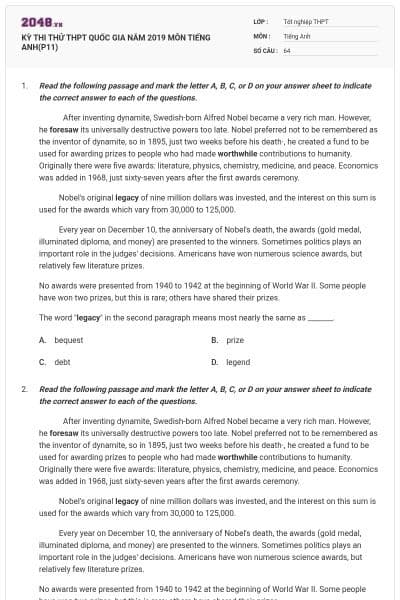
After inventing dynamite, Swedish-born Alfred Nobel became a very rich man. However, he foresaw its universally destructive powers too late. Nobel preferred not to be remembered as the inventor of dynamite, so in 1895, just two weeks before his death·, he created a fund to be used for awarding prizes to people who had made worthwhile contributions to humanity. Originally there were five awards: literature, physics, chemistry, medicine, and peace. Economics was added in 1968, just sixty-seven years after the first awards ceremony.
Nobel's original legacy of nine million dollars was invested, and the interest on this sum is used for the awards which vary from 30,000 to 125,000.
Every year on December 10, the anniversary of Nobel's death, the awards (gold medal, illuminated diploma, and money) are presented to the winners. Sometimes politics plays an important role in the judges' decisions. Americans have won numerous science awards, but relatively few literature prizes.
No awards were presented from 1940 to 1942 at the beginning of World War II. Some people have won two prizes, but this is rare; others have shared their prizes.
The word "legacy" in the second paragraph means most nearly the same as _______.
bequest
prize
debt
legend
Đáp án A
“legacy” = “bequest”: di sản, vật để lại
Read the following passage and mark the letter A, B, C, or D on your answer sheet to indicate the correct answer to each of the questions.
After inventing dynamite, Swedish-born Alfred Nobel became a very rich man. However, he foresaw its universally destructive powers too late. Nobel preferred not to be remembered as the inventor of dynamite, so in 1895, just two weeks before his death·, he created a fund to be used for awarding prizes to people who had made worthwhile contributions to humanity. Originally there were five awards: literature, physics, chemistry, medicine, and peace. Economics was added in 1968, just sixty-seven years after the first awards ceremony.
Nobel's original legacy of nine million dollars was invested, and the interest on this sum is used for the awards which vary from 30,000 to 125,000.
Every year on December 10, the anniversary of Nobel's death, the awards (gold medal, illuminated diploma, and money) are presented to the winners. Sometimes politics plays an important role in the judges' decisions. Americans have won numerous science awards, but relatively few literature prizes.
No awards were presented from 1940 to 1942 at the beginning of World War II. Some people have won two prizes, but this is rare; others have shared their prizes.
In how many fields are prizes bestowed?
6
5
2
10
Đáp án A
Thông tin ở câu cuối đoạn 1: “Originally there were five awards: literature, physics, chemistry, medicine, and peace. Economics was added in 1968…”. Ban đầu có 5 lĩnh vực, về sau Kinh tế được thêm vào, do đó có tất cả 6 lĩnh vực
Read the following passage and mark the letter A, B, C, or D on your answer sheet to indicate the correct answer to each of the questions.
After inventing dynamite, Swedish-born Alfred Nobel became a very rich man. However, he foresaw its universally destructive powers too late. Nobel preferred not to be remembered as the inventor of dynamite, so in 1895, just two weeks before his death·, he created a fund to be used for awarding prizes to people who had made worthwhile contributions to humanity. Originally there were five awards: literature, physics, chemistry, medicine, and peace. Economics was added in 1968, just sixty-seven years after the first awards ceremony.
Nobel's original legacy of nine million dollars was invested, and the interest on this sum is used for the awards which vary from 30,000 to 125,000.
Every year on December 10, the anniversary of Nobel's death, the awards (gold medal, illuminated diploma, and money) are presented to the winners. Sometimes politics plays an important role in the judges' decisions. Americans have won numerous science awards, but relatively few literature prizes.
No awards were presented from 1940 to 1942 at the beginning of World War II. Some people have won two prizes, but this is rare; others have shared their prizes.
All of the following statements are true EXCEPT
ceremonies are held on December 10 to commemorate Nobel's invention
Politics plays an important role in selecting the winners
A few individuals have won two awards
Awards vary in monetary value
Đáp án A
Thông tin:
- the interest on this sum is used for the awards which vary from 30,000TO125,000. (đoạn 2 - D Awards vary in monetary value)
- Sometimes politics plays an important role in the judges' decisions. (đoạn 3 - B Politics plays an important role in selecting the winners)
- Some people have won two prizes, but this is rare (đoạn 3 - C A few individuals have won two awards)
Chỉ có câu A là không đúng
Read the following passage and mark the letter A, B, C, or D on your answer sheet to indicate the correct answer to each of the questions.
After inventing dynamite, Swedish-born Alfred Nobel became a very rich man. However, he foresaw its universally destructive powers too late. Nobel preferred not to be remembered as the inventor of dynamite, so in 1895, just two weeks before his death·, he created a fund to be used for awarding prizes to people who had made worthwhile contributions to humanity. Originally there were five awards: literature, physics, chemistry, medicine, and peace. Economics was added in 1968, just sixty-seven years after the first awards ceremony.
Nobel's original legacy of nine million dollars was invested, and the interest on this sum is used for the awards which vary from 30,000 to 125,000.
Every year on December 10, the anniversary of Nobel's death, the awards (gold medal, illuminated diploma, and money) are presented to the winners. Sometimes politics plays an important role in the judges' decisions. Americans have won numerous science awards, but relatively few literature prizes.
No awards were presented from 1940 to 1942 at the beginning of World War II. Some people have won two prizes, but this is rare; others have shared their prizes.
How much money did Nobel leaves for the prizes?
$9,000,000
$155,000
$125,000
$30,000
Đáp án A
Thông tin ở câu đầu tiên đoạn 2: “Nobel's original legacy of nine million dollars was invested”
Read the following passage and mark the letter A, B, C, or D on your answer sheet to indicate the correct answer to each of the questions.
After inventing dynamite, Swedish-born Alfred Nobel became a very rich man. However, he foresaw its universally destructive powers too late. Nobel preferred not to be remembered as the inventor of dynamite, so in 1895, just two weeks before his death·, he created a fund to be used for awarding prizes to people who had made worthwhile contributions to humanity. Originally there were five awards: literature, physics, chemistry, medicine, and peace. Economics was added in 1968, just sixty-seven years after the first awards ceremony.
Nobel's original legacy of nine million dollars was invested, and the interest on this sum is used for the awards which vary from 30,000 to 125,000.
Every year on December 10, the anniversary of Nobel's death, the awards (gold medal, illuminated diploma, and money) are presented to the winners. Sometimes politics plays an important role in the judges' decisions. Americans have won numerous science awards, but relatively few literature prizes.
No awards were presented from 1940 to 1942 at the beginning of World War II. Some people have won two prizes, but this is rare; others have shared their prizes.
The Nobel prize was established in order to _________.
recognize worthwhile contributions to humanity
spend money
resolve political differences
honor the inventor of dynamite
Đáp án A
Thông tin ở đoạn đầu tiên: “he created a fund to be used for awarding prizes to people who had made worthwhile contributions to humanity.”
Read the following passage and mark the letter A, B, C, or D on your answer sheet to indicate the correct answer to each of the questions.
After inventing dynamite, Swedish-born Alfred Nobel became a very rich man. However, he foresaw its universally destructive powers too late. Nobel preferred not to be remembered as the inventor of dynamite, so in 1895, just two weeks before his death·, he created a fund to be used for awarding prizes to people who had made worthwhile contributions to humanity. Originally there were five awards: literature, physics, chemistry, medicine, and peace. Economics was added in 1968, just sixty-seven years after the first awards ceremony.
Nobel's original legacy of nine million dollars was invested, and the interest on this sum is used for the awards which vary from 30,000 to 125,000.
Every year on December 10, the anniversary of Nobel's death, the awards (gold medal, illuminated diploma, and money) are presented to the winners. Sometimes politics plays an important role in the judges' decisions. Americans have won numerous science awards, but relatively few literature prizes.
No awards were presented from 1940 to 1942 at the beginning of World War II. Some people have won two prizes, but this is rare; others have shared their prizes.
In the first paragraph, "worthwhile" is closest in meaning to _________ .
valuable
trivial
economic
prestigious
Đáp án A
“worthwhile” = “valuable”: đáng giá, có giá trị cao
Read the following passage and mark the letter A, B, C, or D on your answer sheet to indicate the correct answer to each of the questions.
After inventing dynamite, Swedish-born Alfred Nobel became a very rich man. However, he foresaw its universally destructive powers too late. Nobel preferred not to be remembered as the inventor of dynamite, so in 1895, just two weeks before his death·, he created a fund to be used for awarding prizes to people who had made worthwhile contributions to humanity. Originally there were five awards: literature, physics, chemistry, medicine, and peace. Economics was added in 1968, just sixty-seven years after the first awards ceremony.
Nobel's original legacy of nine million dollars was invested, and the interest on this sum is used for the awards which vary from 30,000 to 125,000.
Every year on December 10, the anniversary of Nobel's death, the awards (gold medal, illuminated diploma, and money) are presented to the winners. Sometimes politics plays an important role in the judges' decisions. Americans have won numerous science awards, but relatively few literature prizes.
No awards were presented from 1940 to 1942 at the beginning of World War II. Some people have won two prizes, but this is rare; others have shared their prizes.
The word "foresaw" in the first paragraph is nearest in meaning to ________.
postponed
predicted
prevailed
prevented
Đáp án B
“foresee” = “predict”: đoán trước, thấy trước (tương lai)
Read the following passage and mark the letter A, B, C, or D on your answer sheet to indicate the correct answer to each of the questions.
After inventing dynamite, Swedish-born Alfred Nobel became a very rich man. However, he foresaw its universally destructive powers too late. Nobel preferred not to be remembered as the inventor of dynamite, so in 1895, just two weeks before his death·, he created a fund to be used for awarding prizes to people who had made worthwhile contributions to humanity. Originally there were five awards: literature, physics, chemistry, medicine, and peace. Economics was added in 1968, just sixty-seven years after the first awards ceremony.
Nobel's original legacy of nine million dollars was invested, and the interest on this sum is used for the awards which vary from 30,000 to 125,000.
Every year on December 10, the anniversary of Nobel's death, the awards (gold medal, illuminated diploma, and money) are presented to the winners. Sometimes politics plays an important role in the judges' decisions. Americans have won numerous science awards, but relatively few literature prizes.
No awards were presented from 1940 to 1942 at the beginning of World War II. Some people have won two prizes, but this is rare; others have shared their prizes.
According to the passage, Nobel's profession was in _________ .
literature
economics
medicine
science
D
Thông tin: “Nobel preferred not to be remembered as the inventor of dynamite”. Lĩnh vực chuyên ngành của Nobel là khoa học (Science)
Read the following passage and mark the letter A, B, C, or D on your answer sheet to indicate the correct answer to each of the questions.
After inventing dynamite, Swedish-born Alfred Nobel became a very rich man. However, he foresaw its universally destructive powers too late. Nobel preferred not to be remembered as the inventor of dynamite, so in 1895, just two weeks before his death·, he created a fund to be used for awarding prizes to people who had made worthwhile contributions to humanity. Originally there were five awards: literature, physics, chemistry, medicine, and peace. Economics was added in 1968, just sixty-seven years after the first awards ceremony.
Nobel's original legacy of nine million dollars was invested, and the interest on this sum is used for the awards which vary from 30,000 to 125,000.
Every year on December 10, the anniversary of Nobel's death, the awards (gold medal, illuminated diploma, and money) are presented to the winners. Sometimes politics plays an important role in the judges' decisions. Americans have won numerous science awards, but relatively few literature prizes.
No awards were presented from 1940 to 1942 at the beginning of World War II. Some people have won two prizes, but this is rare; others have shared their prizes.
What is the main idea of this passage?
Alfred Nobel created awards in six categories for contributions to humanity.
Alfred Nobel left all of his money to science.
Alfred Nobel became very rich when he invented dynamite
Alfred Nobel made a lasting contribution to humanity
D
he created a fund to be used for awarding prizes to people who had made worthwhile contributions to humanity.
Nobel tạo nên đóng góp lớn cho nhân loại (giải Nobel)
Read the following passage and mark the letter A, B, C, or D on your answer sheet to indicate the correct answer to each of the questions.
After inventing dynamite, Swedish-born Alfred Nobel became a very rich man. However, he foresaw its universally destructive powers too late. Nobel preferred not to be remembered as the inventor of dynamite, so in 1895, just two weeks before his death·, he created a fund to be used for awarding prizes to people who had made worthwhile contributions to humanity. Originally there were five awards: literature, physics, chemistry, medicine, and peace. Economics was added in 1968, just sixty-seven years after the first awards ceremony.
Nobel's original legacy of nine million dollars was invested, and the interest on this sum is used for the awards which vary from 30,000 to 125,000.
Every year on December 10, the anniversary of Nobel's death, the awards (gold medal, illuminated diploma, and money) are presented to the winners. Sometimes politics plays an important role in the judges' decisions. Americans have won numerous science awards, but relatively few literature prizes.
No awards were presented from 1940 to 1942 at the beginning of World War II. Some people have won two prizes, but this is rare; others have shared their prizes.
In which area have Americans received the least awards?
Economics
Science
Peace
Literature
D
Thông tin ở đoạn 3: “Americans have won numerous science awards, but relatively few literature prizes.”
Choose the option A, B, C or D to indicate which of the following words has the bold, italic part pronounced differently from others.
killed
crashed
waved
cured
B
A./d/ B./t/ C./d/ D./d/
Choose the option A, B, C or D to indicate which of the following words has the bold, italic part pronounced differently from others.
stays
tells
talks
steals
C
A./z/ B./z/ C./s/ D./z/
Choose the option A, B, C or D to indicate which of the following words has the bold, italic part pronounced differently from others.
church
machine
changeable
cheese
B
A./tʃ/ B./ʃ/ C. /tʃ/ D. /tʃ/
Mark the letter A, B, C, or D on your answer sheet to indicate the word whose stress is placed differently from that of the others in each of the following questions.
primary
employee
difference
recognize
B
Phần B trọng âm rơi vào âm tiết thứ 3, còn lại là thứ nhất
Mark the letter A, B, C, or D on your answer sheet to indicate the word whose stress is placed differently from that of the others in each of the following questions.
predict
patient
police
attract
B
Phần B trọng âm rơi vào âm tiết thứ nhất, còn lại là thứ 2
Mark the letter A, b, C, or D to identify the underlined part that is not correct.
Looking (A) from afar, the village resembles (B) a small green spot (C) dotted with (D) tiny fireballs.
Looking
resembles
green spot
with
“Looking” -> “Looked”, chủ ngữ là “the village” nên không thể chia động từ ở dạng chủ động, mà phải chuyển thành dạng bị động
Mark the letter A, b, C, or D to identify the underlined part that is not correct.
The more frequently (A) you B(B) , the greatest (C) physical endurance you will have(D) .
frequently
exercise
greatest
will have
A
“greatest” -> “greater”, cấu trúc so sánh hơn “càng …càng”: “the more (adj+er)…, the more (adj+er)…”
Mark the letter A, b, C, or D to identify the underlined part that is not correct.
The doctor advised him (A) to avoid eating(B) fatty foods, having(C) more vegetables and drink much (D) water.
advised him
eating
having
much
B
“having” -> “have”, cấu trúc “advise sb to do st”: khuyên ai làm gì, động từ have ở đây không đi kèm với avoid mà đi kèm với advise
Mark the letter A, b, C, or D to identify the underlined part that is not correct.
The number of (A) homeless people in Nepal have(B) increased sharply due to(C) that severe earthquake(D) .
of
have
due to
severe earthquake
Đáp án: B
Giải thích:
A number of + N (số nhiều) + động từ chia dạng số nhiều. (chủ ngữ chính là danh từ)
The number of + N (số nhiều) + động từ chia ngôi thứ 3 số ít. (chủ ngữ chính là “the number”, nói về con số)
Sửa: have increased → has increased.
Dịch: Số lượng người vô gia cư ở Nepal đã tăng chóng mặt do trận động đất nghiêm trọng gần đây.
Mark the letter A, b, C, or D to identify the underlined part that is not correct.
Since poaching (A) is becoming more seriously(B) , the government has imposed stricter (C) laws to prevent it(D) .
poaching
seriously
stricte
it
B
“seriously” -> “serious”, sau động từ become không dùng trạng từ mà sử dụng tính từ
Mark the letter A, B, C, or D on your answer sheet to indicate the word(s) OPPOSITE in meaning to the underlined word(s) in each of the following questions.
Schooling is compulsory for all Vietnamese children from the age of 6 to 14.
obeyed
required
obligatory
optional
D
“compulsory”: tính bắt buộc, trái nghĩa là “optional”: tự chọn, không bắt buộc
Mark the letter A, B, C, or D on your answer sheet to indicate the word(s) OPPOSITE in meaning to the underlined word(s) in each of the following questions.
An optimistic person always sees things on the bright sides.
intelligent
pesimistic
comfortable
difficult
B
“optimistic”: lạc quan, trái nghĩa là “pesimistic”: bi quan
Anne: " Make yourself at home". - John: "_______"
Thanks! Same to you.
Not at all. Don't mention it.
Yes, Can I help you?
That's very kind. Thank you.
D
“Make yourself at home”: tự nhiên như ở nhà nhé
Lời đáp là “That's very kind. Thank you.”: Thật tốt, cám ơn bạn
Books and magazines ______ around made his room very untidy.
that lie
laying
which lied
lying
Đáp án: D
Giải thích:
Rút gọn mệnh đề quan hệ ở dạng chủ động: bỏ đại từ quan hệ, bỏ “tobe” nếu có và chuyển động từ trong mệnh đề quan hệ về dạng V-ing.
Câu đầy đủ: Books and magazines which are lying around made his room very untidy.
Tránh nhầm lẫn với từ “lay” (đặt, để). Ở đây ta dùng “lie” (nằm, rải rác).
Dịch: Những quyển sách và tạp chí nằm xung quanh khiến căn phòng của cậu ta rất bừa bộn.
He agreed to sign the contract _______.
so he didn’t know much about that company
in spite he knew much about that company
although he didn’t know much about that company.
because he didn’t know much about that company’s director.
C
Although + mệnh đề (mặc dù)
Câu B sai, in spite thiếu giới từ of, và in spite of + danh từ/cụm danh từ
I can _____ with most things but I cannot stand noisy children.
put aside
put on
put off
put up
D
“put up with”: chịu đựng
The passengers had to wait because the plane ______ off an hour late.
cut
turned
took
mad
C
“take off”: cất cánh (máy bay)
No sooner _____ at the bus stop ______ the bus came.
he had arrived/ when
he had arrived/ than
had he arrived/ than
had he arrived/ when
C
Cấu trúc đảo ngữ với “No sooner”: “No sooner + had +S+V phân từ II+…+than+mệnh đề quá khứ đơn”
______ arrived earlier, we could have finished the task.
Had we
If we hadn’t
Unless we had
If we have
A
Câu điều kiện loại 3: “Had we arrived earlier” = “If we had arrived earlier”
The manager had his brother ______ the report for him.
to typed
typing
type
typed
C
“have sb do st”: có ai đó làm gì (cho mình)
My uncle ______ a very beautiful house in town last year.
buy
bought
will buy
is building
B
Có trạng từ chỉ thời gian “last year” nên động từ sẽ được chia ở thì quá khứ đơn
You can _____ the meaning of the new words in the dictionary.
look after
look at
look up
look for
C
“look up”: tra, tìm kiếm (từ, câu)
Chú ý không nhầm lẫn với look for
I said that I had met her ______.
yesterday
the day
the before day
the previous day
D
Trong câu gián tiếp, “yesterday” được chuyển thành “the previous day” hoặc “the day before”
If I _____ you, I would give Mary a lift.
would be
am
had been
were
D
“If I were you…” là một cách thường gặp để đưa ra lời khuyên
There were two small rooms in the beach house, _____ served as a kitchen
the smaller of which
the smaller of them
the smallest of which
smallest of that
A
“the smaller of which” = “the smaller of the two small rooms” (which thay thế cho two small rooms). Ở đây so sánh giữa 2 vật nên chỉ cần dùng so sánh hơn chỉ không cần dùng so sánh nhất
After having used the new technique, the factory produced ____ cars in 2014 as the year before.
as twice many
as many twice
twice many as
twicD
Cấu trúc so sánh gấp bao nhiêu lần: “twice as…as”e as many
D
Cấu trúc so sánh gấp bao nhiêu lần: “twice as…as”
John asked me ______ interested in.
what kind of sports I was
what kind of sports was I
what kind of sports I am
what kind of sports am I
A
Câu gián tiếp nên thì hiện tại lùi về thì quá khứ
They are very happy because a new school for their children _____ in their village now.
has been built
is being built
is building
has build
B
“now” là trạng từ chỉ thời gian được sử dụng ở thì hiện tại tiếp diễn. Chủ ngữ là a new school nên động từ được chia ở dạng bị động. Đáp án là “is being built”
______ from outer space, our earth looks like a “blue planet”
Be seen
Seeing
Seen
Having seen
C
Chủ ngữ là our earth nên động từ được chia ở dạng bị động. Đáp án là C. seen (=being seen)
The girls and flowers __________ he painted were vivid.
that
who
which
whose
A
“that” được thay thế cho “The girls and flowers”. Lưu ý không dùng “which” vì có danh từ chỉ người là The girls, cũng không dùng “who” vì có danh từ chỉ vật là flowers
__________he missed the first bus, he came ten minutes late.
Although
Because
However
Therefore
B
Câu khẳng định chỉ nguyên nhân, kết quả, vế trước chỉ ra nguyên nhân, nên ta chọn từ Because
Mark the letter A, B, C, or D on your answer sheet to indicate the word(s) CLOSEST in meaning to the underlined word(s) in each of the following questions.
Magma is the primary source of all the earth’s rocks.
cheapest
nearest
worst
first
D
“primary” = “first”: cơ bản, đầu tiên
Mark the letter A, B, C, or D on your answer sheet to indicate the word(s) CLOSEST in meaning to the underlined word(s) in each of the following questions.
The organization was established in 1950 in the USA.
come around
made out
put on
set up
Đáp án: D
Kiến thức: Từ vựng – Cụm từ đồng nghĩa
establish (v): thành lập
Xét các đáp án:
A. come around: tỉnh lại
B. make out: xoay sở được
C. put on: mặc
D. set up: thành lập, sắp xếp
=> established = set up
Dịch: Tổ chức này được thành lập năm 1950 tại Hoa Kì.
Mark the letter A, B, C, or D on your answer sheet to indicate the word(s) CLOSEST in meaning to the underlined word(s) in each of the following questions.
The ASEAN Para-Games are hosted by the same country where the SEA Games took place.
defended
impressed
participated
organized
Đáp án: D
Giải thích:
Kiến thức: Từ vựng – Từ đồng nghĩa
host (v): làm chủ nhà, tổ chức, đăng cai
Xét các đáp án:
A. defend (v): bảo vệ
B. impress (v): gây ấn tượng
C. participate (v): tham gia
D. organize (v): tổ chức
=> hosted = organized
Dịch: ASEAN Para Games được tổ chức tại chính quốc gia nơi diễn ra SEA Games.
Read the following passage and mark the letter A, B, C, or D on your answer sheet to indicate the correct answer to each of the questions.
An air pollutant is defined as a compound added directly or indirectly by humans to the atmosphere in such quantities as to affect humans, animals, vegetation, or materials adversely. Air pollution requires a very flexible definition that permits continuous change. When the first air pollution laws were established in England in the fourteenth century, air pollutants were limited to compounds that could be seen or smelled - a far cry from the extensive list of harmful substances known today. As technology has developed and knowledge of the health aspects of various chemicals has increased, the list of air pollutants has lengthened. In the future, even water vapor might be considered an air pollutant under certain conditions.
Many of the more important air pollutants, such as sulfur oxides, carbon monoxide, and nitrogen oxides, are found in nature. As the Earth developed, the concentration of these pollutants was altered by various chemical reactions; they became components in biogeochemical cycles. These serve as an air purification scheme by allowing the compounds to move from the air to the water or soil. On a global basis, nature's output of these compounds dwarfs that resulting from human activities.
However, human production usually occurs in a localized area, such as a city. In such a region, human output may be dominant and may temporarily overload the natural purification scheme of the cycles. The result is an increased concentration of noxious chemicals in the air. The concentrations at which the adverse effects appear will be greater than the concentrations that the pollutants would have in the absence of human activities. The actual concentration need not be large for a substance to be a pollutant; in fact, the numerical value tells us little until we know how much of an increase this represents over the concentration that would occur naturally in the area. For example, sulfur dioxide has detectable health effects at 0.08 parts per million (ppm), which is about 400 times its natural level. Carbon monoxide, however, has a natural level of 0.1 ppm and is not usually a pollutant until its level reaches about 15 ppm.
It can be inferred from the first paragraph that _________.
water vapor is an air pollutant in localized areas
the definition of air pollution will continue to change
most air pollutants today can be seen or smelled
a substance becomes an air pollutant only in cities
B
Thông tin ở câu thứ 2 đoạn đầu tiên: “Air pollution requires a very flexible definition that permits continuous change.”
Read the following passage and mark the letter A, B, C, or D on your answer sheet to indicate the correct answer to each of the questions.
An air pollutant is defined as a compound added directly or indirectly by humans to the atmosphere in such quantities as to affect humans, animals, vegetation, or materials adversely. Air pollution requires a very flexible definition that permits continuous change. When the first air pollution laws were established in England in the fourteenth century, air pollutants were limited to compounds that could be seen or smelled - a far cry from the extensive list of harmful substances known today. As technology has developed and knowledge of the health aspects of various chemicals has increased, the list of air pollutants has lengthened. In the future, even water vapor might be considered an air pollutant under certain conditions.
Many of the more important air pollutants, such as sulfur oxides, carbon monoxide, and nitrogen oxides, are found in nature. As the Earth developed, the concentration of these pollutants was altered by various chemical reactions; they became components in biogeochemical cycles. These serve as an air purification scheme by allowing the compounds to move from the air to the water or soil. On a global basis, nature's output of these compounds dwarfs that resulting from human activities.
However, human production usually occurs in a localized area, such as a city. In such a region, human output may be dominant and may temporarily overload the natural purification scheme of the cycles. The result is an increased concentration of noxious chemicals in the air. The concentrations at which the adverse effects appear will be greater than the concentrations that the pollutants would have in the absence of human activities. The actual concentration need not be large for a substance to be a pollutant; in fact, the numerical value tells us little until we know how much of an increase this represents over the concentration that would occur naturally in the area. For example, sulfur dioxide has detectable health effects at 0.08 parts per million (ppm), which is about 400 times its natural level. Carbon monoxide, however, has a natural level of 0.1 ppm and is not usually a pollutant until its level reaches about 15 ppm.
Which of the following is best supported by the passage?
One of the most important steps in preserving natural lands is to better enforce air pollution laws.
Scientists should be consulted in order to establish uniform limits for all air pollutants.
Human activities have been effective in reducing air pollution.
To effectively control pollution, local government should regularly review their air pollution laws.
THông tin ở đoạn đầu tiên: “When the first air pollution laws were established in England in the fourteenth century, air pollutants were limited to compounds that could be seen or smelled - a far cry from the extensive list of harmful substances known today.” (=Human activities have been effective in reducing air pollution
Read the following passage and mark the letter A, B, C, or D on your answer sheet to indicate the correct answer to each of the questions.
An air pollutant is defined as a compound added directly or indirectly by humans to the atmosphere in such quantities as to affect humans, animals, vegetation, or materials adversely. Air pollution requires a very flexible definition that permits continuous change. When the first air pollution laws were established in England in the fourteenth century, air pollutants were limited to compounds that could be seen or smelled - a far cry from the extensive list of harmful substances known today. As technology has developed and knowledge of the health aspects of various chemicals has increased, the list of air pollutants has lengthened. In the future, even water vapor might be considered an air pollutant under certain conditions.
Many of the more important air pollutants, such as sulfur oxides, carbon monoxide, and nitrogen oxides, are found in nature. As the Earth developed, the concentration of these pollutants was altered by various chemical reactions; they became components in biogeochemical cycles. These serve as an air purification scheme by allowing the compounds to move from the air to the water or soil. On a global basis, nature's output of these compounds dwarfs that resulting from human activities.
However, human production usually occurs in a localized area, such as a city. In such a region, human output may be dominant and may temporarily overload the natural purification scheme of the cycles. The result is an increased concentration of noxious chemicals in the air. The concentrations at which the adverse effects appear will be greater than the concentrations that the pollutants would have in the absence of human activities. The actual concentration need not be large for a substance to be a pollutant; in fact, the numerical value tells us little until we know how much of an increase this represents over the concentration that would occur naturally in the area. For example, sulfur dioxide has detectable health effects at 0.08 parts per million (ppm), which is about 400 times its natural level. Carbon monoxide, however, has a natural level of 0.1 ppm and is not usually a pollutant until its level reaches about 15 ppm.
The word "detectable" in the third paragraph is closest in meaning to _________ .
measurable
beneficial
special
separable
A
"detectable" = “measurable”: có thể nhận thấy, có thể đo lường được
Read the following passage and mark the letter A, B, C, or D on your answer sheet to indicate the correct answer to each of the questions.
An air pollutant is defined as a compound added directly or indirectly by humans to the atmosphere in such quantities as to affect humans, animals, vegetation, or materials adversely. Air pollution requires a very flexible definition that permits continuous change. When the first air pollution laws were established in England in the fourteenth century, air pollutants were limited to compounds that could be seen or smelled - a far cry from the extensive list of harmful substances known today. As technology has developed and knowledge of the health aspects of various chemicals has increased, the list of air pollutants has lengthened. In the future, even water vapor might be considered an air pollutant under certain conditions.
Many of the more important air pollutants, such as sulfur oxides, carbon monoxide, and nitrogen oxides, are found in nature. As the Earth developed, the concentration of these pollutants was altered by various chemical reactions; they became components in biogeochemical cycles. These serve as an air purification scheme by allowing the compounds to move from the air to the water or soil. On a global basis, nature's output of these compounds dwarfs that resulting from human activities.
However, human production usually occurs in a localized area, such as a city. In such a region, human output may be dominant and may temporarily overload the natural purification scheme of the cycles. The result is an increased concentration of noxious chemicals in the air. The concentrations at which the adverse effects appear will be greater than the concentrations that the pollutants would have in the absence of human activities. The actual concentration need not be large for a substance to be a pollutant; in fact, the numerical value tells us little until we know how much of an increase this represents over the concentration that would occur naturally in the area. For example, sulfur dioxide has detectable health effects at 0.08 parts per million (ppm), which is about 400 times its natural level. Carbon monoxide, however, has a natural level of 0.1 ppm and is not usually a pollutant until its level reaches about 15 ppm.
The word "These" in the second paragraph is closest in meaning to _________.
the pollutants from the developing Earth
the components in biogeochemical cycles
the compounds moved to the water or soil
the various chemical reactions
Đáp án B
“these” được thay thế cho “the components in biogeochemical cycles” trong câu phía trước: “As the Earth developed, the concentration of these pollutants was altered by various chemical reactions; they became components in biogeochemical cycles.”
Read the following passage and mark the letter A, B, C, or D on your answer sheet to indicate the correct answer to each of the questions.
An air pollutant is defined as a compound added directly or indirectly by humans to the atmosphere in such quantities as to affect humans, animals, vegetation, or materials adversely. Air pollution requires a very flexible definition that permits continuous change. When the first air pollution laws were established in England in the fourteenth century, air pollutants were limited to compounds that could be seen or smelled - a far cry from the extensive list of harmful substances known today. As technology has developed and knowledge of the health aspects of various chemicals has increased, the list of air pollutants has lengthened. In the future, even water vapor might be considered an air pollutant under certain conditions.
Many of the more important air pollutants, such as sulfur oxides, carbon monoxide, and nitrogen oxides, are found in nature. As the Earth developed, the concentration of these pollutants was altered by various chemical reactions; they became components in biogeochemical cycles. These serve as an air purification scheme by allowing the compounds to move from the air to the water or soil. On a global basis, nature's output of these compounds dwarfs that resulting from human activities.
However, human production usually occurs in a localized area, such as a city. In such a region, human output may be dominant and may temporarily overload the natural purification scheme of the cycles. The result is an increased concentration of noxious chemicals in the air. The concentrations at which the adverse effects appear will be greater than the concentrations that the pollutants would have in the absence of human activities. The actual concentration need not be large for a substance to be a pollutant; in fact, the numerical value tells us little until we know how much of an increase this represents over the concentration that would occur naturally in the area. For example, sulfur dioxide has detectable health effects at 0.08 parts per million (ppm), which is about 400 times its natural level. Carbon monoxide, however, has a natural level of 0.1 ppm and is not usually a pollutant until its level reaches about 15 ppm.
According to the passage, the numerical value of the concentration level of a substance is only useful if _______.
it is in a localized area
the other substances in the area are known
it can be calculated quickly
the natural level is also known
Đáp án D
Thông tin ở đoạn cuối: “The actual concentration need not be large for a substance to be a pollutant; in fact, the numerical value tells us little until we know how much of an increase this represents over the concentration that would occur naturally in the area.” (=the numerical value of the concentration level of a substance is only useful if the natural level is also known)
Read the following passage and mark the letter A, B, C, or D on your answer sheet to indicate the correct answer to each of the questions.
An air pollutant is defined as a compound added directly or indirectly by humans to the atmosphere in such quantities as to affect humans, animals, vegetation, or materials adversely. Air pollution requires a very flexible definition that permits continuous change. When the first air pollution laws were established in England in the fourteenth century, air pollutants were limited to compounds that could be seen or smelled - a far cry from the extensive list of harmful substances known today. As technology has developed and knowledge of the health aspects of various chemicals has increased, the list of air pollutants has lengthened. In the future, even water vapor might be considered an air pollutant under certain conditions.
Many of the more important air pollutants, such as sulfur oxides, carbon monoxide, and nitrogen oxides, are found in nature. As the Earth developed, the concentration of these pollutants was altered by various chemical reactions; they became components in biogeochemical cycles. These serve as an air purification scheme by allowing the compounds to move from the air to the water or soil. On a global basis, nature's output of these compounds dwarfs that resulting from human activities.
However, human production usually occurs in a localized area, such as a city. In such a region, human output may be dominant and may temporarily overload the natural purification scheme of the cycles. The result is an increased concentration of noxious chemicals in the air. The concentrations at which the adverse effects appear will be greater than the concentrations that the pollutants would have in the absence of human activities. The actual concentration need not be large for a substance to be a pollutant; in fact, the numerical value tells us little until we know how much of an increase this represents over the concentration that would occur naturally in the area. For example, sulfur dioxide has detectable health effects at 0.08 parts per million (ppm), which is about 400 times its natural level. Carbon monoxide, however, has a natural level of 0.1 ppm and is not usually a pollutant until its level reaches about 15 ppm.
The word "localized" in the third paragraph is closest in meaning to _________.
specified
surrounded
encircled
circled.
Đáp án A
“localized” = “specified”: được định xứ, được định theo lý thuyết
Read the following passage and mark the letter A, B, C, or D on your answer sheet to indicate the correct answer to each of the questions.
An air pollutant is defined as a compound added directly or indirectly by humans to the atmosphere in such quantities as to affect humans, animals, vegetation, or materials adversely. Air pollution requires a very flexible definition that permits continuous change. When the first air pollution laws were established in England in the fourteenth century, air pollutants were limited to compounds that could be seen or smelled - a far cry from the extensive list of harmful substances known today. As technology has developed and knowledge of the health aspects of various chemicals has increased, the list of air pollutants has lengthened. In the future, even water vapor might be considered an air pollutant under certain conditions.
Many of the more important air pollutants, such as sulfur oxides, carbon monoxide, and nitrogen oxides, are found in nature. As the Earth developed, the concentration of these pollutants was altered by various chemical reactions; they became components in biogeochemical cycles. These serve as an air purification scheme by allowing the compounds to move from the air to the water or soil. On a global basis, nature's output of these compounds dwarfs that resulting from human activities.
However, human production usually occurs in a localized area, such as a city. In such a region, human output may be dominant and may temporarily overload the natural purification scheme of the cycles. The result is an increased concentration of noxious chemicals in the air. The concentrations at which the adverse effects appear will be greater than the concentrations that the pollutants would have in the absence of human activities. The actual concentration need not be large for a substance to be a pollutant; in fact, the numerical value tells us little until we know how much of an increase this represents over the concentration that would occur naturally in the area. For example, sulfur dioxide has detectable health effects at 0.08 parts per million (ppm), which is about 400 times its natural level. Carbon monoxide, however, has a natural level of 0.1 ppm and is not usually a pollutant until its level reaches about 15 ppm.
According to the passage, human-generated air pollution in localized regions _______.
will damage areas outside of the localized regions
will react harmfully with natural pollutants
can overwhelm the natural system that removes pollutants
can be dwarfed by nature's output of pollutants
Đáp án C
Thông tin ở đoạn cuối: “In such a region, human output may be dominant and may temporarily overload the natural purification scheme of the cycles.” (human-generated air pollution in localized regions can overwhelm the natural system that removes pollutants)
Read the following passage and mark the letter A, B, C, or D on your answer sheet to indicate the correct answer to each of the questions.
An air pollutant is defined as a compound added directly or indirectly by humans to the atmosphere in such quantities as to affect humans, animals, vegetation, or materials adversely. Air pollution requires a very flexible definition that permits continuous change. When the first air pollution laws were established in England in the fourteenth century, air pollutants were limited to compounds that could be seen or smelled - a far cry from the extensive list of harmful substances known today. As technology has developed and knowledge of the health aspects of various chemicals has increased, the list of air pollutants has lengthened. In the future, even water vapor might be considered an air pollutant under certain conditions.
Many of the more important air pollutants, such as sulfur oxides, carbon monoxide, and nitrogen oxides, are found in nature. As the Earth developed, the concentration of these pollutants was altered by various chemical reactions; they became components in biogeochemical cycles. These serve as an air purification scheme by allowing the compounds to move from the air to the water or soil. On a global basis, nature's output of these compounds dwarfs that resulting from human activities.
However, human production usually occurs in a localized area, such as a city. In such a region, human output may be dominant and may temporarily overload the natural purification scheme of the cycles. The result is an increased concentration of noxious chemicals in the air. The concentrations at which the adverse effects appear will be greater than the concentrations that the pollutants would have in the absence of human activities. The actual concentration need not be large for a substance to be a pollutant; in fact, the numerical value tells us little until we know how much of an increase this represents over the concentration that would occur naturally in the area. For example, sulfur dioxide has detectable health effects at 0.08 parts per million (ppm), which is about 400 times its natural level. Carbon monoxide, however, has a natural level of 0.1 ppm and is not usually a pollutant until its level reaches about 15 ppm.
What does the passage mainly discuss?
The economic impact of air pollution.
The effects of compounds added to the atmosphere.
How much harm air pollutants can cause.
What constitutes an air pollutant.
Đáp án D
Bài văn nói về “Cái gì cấu thành nên ô nhiễm môi trường” với những ý được nêu lên trong bài như: “Many of the more important air pollutants, such as sulfur oxides, carbon monoxide, and nitrogen oxides, are found in nature.” Hay như ở câu cuối của bài: “For example, sulfur dioxide has detectable health effects at 0.08 parts per million (ppm), which is about 400 times its natural level. Carbon monoxide, however, has a natural level of 0.1 ppm and is not usually a pollutant until its level reaches about 15 ppm.”
Read the following passage and mark the letter A, B, C, or D on your answer sheet to indicate the correct answer to each of the questions.
An air pollutant is defined as a compound added directly or indirectly by humans to the atmosphere in such quantities as to affect humans, animals, vegetation, or materials adversely. Air pollution requires a very flexible definition that permits continuous change. When the first air pollution laws were established in England in the fourteenth century, air pollutants were limited to compounds that could be seen or smelled - a far cry from the extensive list of harmful substances known today. As technology has developed and knowledge of the health aspects of various chemicals has increased, the list of air pollutants has lengthened. In the future, even water vapor might be considered an air pollutant under certain conditions.
Many of the more important air pollutants, such as sulfur oxides, carbon monoxide, and nitrogen oxides, are found in nature. As the Earth developed, the concentration of these pollutants was altered by various chemical reactions; they became components in biogeochemical cycles. These serve as an air purification scheme by allowing the compounds to move from the air to the water or soil. On a global basis, nature's output of these compounds dwarfs that resulting from human activities.
However, human production usually occurs in a localized area, such as a city. In such a region, human output may be dominant and may temporarily overload the natural purification scheme of the cycles. The result is an increased concentration of noxious chemicals in the air. The concentrations at which the adverse effects appear will be greater than the concentrations that the pollutants would have in the absence of human activities. The actual concentration need not be large for a substance to be a pollutant; in fact, the numerical value tells us little until we know how much of an increase this represents over the concentration that would occur naturally in the area. For example, sulfur dioxide has detectable health effects at 0.08 parts per million (ppm), which is about 400 times its natural level. Carbon monoxide, however, has a natural level of 0.1 ppm and is not usually a pollutant until its level reaches about 15 ppm.
For which of the following reasons can natural pollutants play an important role in controlling air pollution?
They occur in greater quantities than other pollutants.
They function as part of a purification process.
They are less harmful to living beings than other pollutants.
They have existed since the Earth developed.
Đáp án B
Thông tin ở đoạn 2: “As the Earth developed, the concentration of these pollutants was altered by various chemical reactions; they became components in biogeochemical cycles. These serve as an air purification scheme by allowing the compounds to move from the air to the water or soil.”
Read the following passage and mark the letter A, B, C, or D on your answer sheet to indicate the correct answer to each of the questions.
An air pollutant is defined as a compound added directly or indirectly by humans to the atmosphere in such quantities as to affect humans, animals, vegetation, or materials adversely. Air pollution requires a very flexible definition that permits continuous change. When the first air pollution laws were established in England in the fourteenth century, air pollutants were limited to compounds that could be seen or smelled - a far cry from the extensive list of harmful substances known today. As technology has developed and knowledge of the health aspects of various chemicals has increased, the list of air pollutants has lengthened. In the future, even water vapor might be considered an air pollutant under certain conditions.
Many of the more important air pollutants, such as sulfur oxides, carbon monoxide, and nitrogen oxides, are found in nature. As the Earth developed, the concentration of these pollutants was altered by various chemical reactions; they became components in biogeochemical cycles. These serve as an air purification scheme by allowing the compounds to move from the air to the water or soil. On a global basis, nature's output of these compounds dwarfs that resulting from human activities.
However, human production usually occurs in a localized area, such as a city. In such a region, human output may be dominant and may temporarily overload the natural purification scheme of the cycles. The result is an increased concentration of noxious chemicals in the air. The concentrations at which the adverse effects appear will be greater than the concentrations that the pollutants would have in the absence of human activities. The actual concentration need not be large for a substance to be a pollutant; in fact, the numerical value tells us little until we know how much of an increase this represents over the concentration that would occur naturally in the area. For example, sulfur dioxide has detectable health effects at 0.08 parts per million (ppm), which is about 400 times its natural level. Carbon monoxide, however, has a natural level of 0.1 ppm and is not usually a pollutant until its level reaches about 15 ppm.
The word "adversely" in the first paragraph is closest in meaning to _________ .
negatively
admittedly
considerably
quickly
Đáp án A
“Adversely” = “negatively”: một cách có hại, không tốt
Read the following passage and mark the letter A, B, C or D on your answer sheet to indicate the correct answer to each of the following questions.
Speech is one of the most important (55) _________ of communicating. It consists of far more than just making noises. To talk and also to (56) _________ by other people, we have to speak a language, that is, we have to use combinations of (57)_________ that everyone agrees to stand for a particular object or idea. Communication would be impossible if everyone made up their own language. Learning a language properly is very (58)_________ . The basic (59) _________ of English is not very large, and not only about 2,000 words are needed to speak it quite (60) _________. But the more idea you can (61) _________ the more precise you can be about their exact meaning. Words are the (62)_________ thing we use in communicating what we want to say. The way we (63) _________ the words is also very important. Our tone of voice can express many emotions and (64) _________ whether we are pleased or angry, for instance.
Điền vào ô 55
rules
reason
ways
tests
C
“way”: cách
Speech is one of the most important ways of communicating: Phát biểu là một trong những cách quan trọng nhất của giao tiếp
Read the following passage and mark the letter A, B, C or D on your answer sheet to indicate the correct answer to each of the following questions.
Speech is one of the most important (55) _________ of communicating. It consists of far more than just making noises. To talk and also to (56) _________ by other people, we have to speak a language, that is, we have to use combinations of (57)_________ that everyone agrees to stand for a particular object or idea. Communication would be impossible if everyone made up their own language. Learning a language properly is very (58)_________ . The basic (59) _________ of English is not very large, and not only about 2,000 words are needed to speak it quite (60) _________. But the more idea you can (61) _________ the more precise you can be about their exact meaning. Words are the (62)_________ thing we use in communicating what we want to say. The way we (63) _________ the words is also very important. Our tone of voice can express many emotions and (64) _________ whether we are pleased or angry, for instance.
Điền vào ô 56
be spoken
be examined
be understood
be talked
C
“to be understood”: được hiểu
Read the following passage and mark the letter A, B, C or D on your answer sheet to indicate the correct answer to each of the following questions.
Speech is one of the most important (55) _________ of communicating. It consists of far more than just making noises. To talk and also to (56) _________ by other people, we have to speak a language, that is, we have to use combinations of (57)_________ that everyone agrees to stand for a particular object or idea. Communication would be impossible if everyone made up their own language. Learning a language properly is very (58)_________ . The basic (59) _________ of English is not very large, and not only about 2,000 words are needed to speak it quite (60) _________. But the more idea you can (61) _________ the more precise you can be about their exact meaning. Words are the (62)_________ thing we use in communicating what we want to say. The way we (63) _________ the words is also very important. Our tone of voice can express many emotions and (64) _________ whether we are pleased or angry, for instance.
Điền vào ô 57
systems
talks
sounds
languages
C
“combinations of sounds”: sự kết hợp của âm thanh, tiếng
Read the following passage and mark the letter A, B, C or D on your answer sheet to indicate the correct answer to each of the following questions.
Speech is one of the most important (55) _________ of communicating. It consists of far more than just making noises. To talk and also to (56) _________ by other people, we have to speak a language, that is, we have to use combinations of (57)_________ that everyone agrees to stand for a particular object or idea. Communication would be impossible if everyone made up their own language. Learning a language properly is very (58)_________ . The basic (59) _________ of English is not very large, and not only about 2,000 words are needed to speak it quite (60) _________. But the more idea you can (61) _________ the more precise you can be about their exact meaning. Words are the (62)_________ thing we use in communicating what we want to say. The way we (63) _________ the words is also very important. Our tone of voice can express many emotions and (64) _________ whether we are pleased or angry, for instance.
Điền vào vào ô 58
simple
important
expensive
easy
B
Learning a language properly is very important: Học một ngôn ngữ một cách thích hợp là rất quan trọng
Read the following passage and mark the letter A, B, C or D on your answer sheet to indicate the correct answer to each of the following questions.
Speech is one of the most important (55) _________ of communicating. It consists of far more than just making noises. To talk and also to (56) _________ by other people, we have to speak a language, that is, we have to use combinations of (57)_________ that everyone agrees to stand for a particular object or idea. Communication would be impossible if everyone made up their own language. Learning a language properly is very (58)_________ . The basic (59) _________ of English is not very large, and not only about 2,000 words are needed to speak it quite (60) _________. But the more idea you can (61) _________ the more precise you can be about their exact meaning. Words are the (62)_________ thing we use in communicating what we want to say. The way we (63) _________ the words is also very important. Our tone of voice can express many emotions and (64) _________ whether we are pleased or angry, for instance.
Điền vào ô 59
vocabulary
grammar
structure
word
A
Ở đây ta dùng “vocabulary”: từ vựng, vì phía sau có đề cập đến about 2,000 words
Read the following passage and mark the letter A, B, C or D on your answer sheet to indicate the correct answer to each of the following questions.
Speech is one of the most important (55) _________ of communicating. It consists of far more than just making noises. To talk and also to (56) _________ by other people, we have to speak a language, that is, we have to use combinations of (57)_________ that everyone agrees to stand for a particular object or idea. Communication would be impossible if everyone made up their own language. Learning a language properly is very (58)_________ . The basic (59) _________ of English is not very large, and not only about 2,000 words are needed to speak it quite (60) _________. But the more idea you can (61) _________ the more precise you can be about their exact meaning. Words are the (62)_________ thing we use in communicating what we want to say. The way we (63) _________ the words is also very important. Our tone of voice can express many emotions and (64) _________ whether we are pleased or angry, for instance.
Điền vào ô 60
fluent
perfect
well
good
C
Ở đây ta cần một trạng từ để bổ sung ý nghĩa cho động từ speak, trong 4 đáp án chỉ có well là trạng từ
Read the following passage and mark the letter A, B, C or D on your answer sheet to indicate the correct answer to each of the following questions.
Speech is one of the most important (55) _________ of communicating. It consists of far more than just making noises. To talk and also to (56) _________ by other people, we have to speak a language, that is, we have to use combinations of (57)_________ that everyone agrees to stand for a particular object or idea. Communication would be impossible if everyone made up their own language. Learning a language properly is very (58)_________ . The basic (59) _________ of English is not very large, and not only about 2,000 words are needed to speak it quite (60) _________. But the more idea you can (61) _________ the more precise you can be about their exact meaning. Words are the (62)_________ thing we use in communicating what we want to say. The way we (63) _________ the words is also very important. Our tone of voice can express many emotions and (64) _________ whether we are pleased or angry, for instance.
Điền vào ô 61
pass
express
grow
nee
B
“express idea”: diễn đạt ý kiến
Read the following passage and mark the letter A, B, C or D on your answer sheet to indicate the correct answer to each of the following questions.
Speech is one of the most important (55) _________ of communicating. It consists of far more than just making noises. To talk and also to (56) _________ by other people, we have to speak a language, that is, we have to use combinations of (57)_________ that everyone agrees to stand for a particular object or idea. Communication would be impossible if everyone made up their own language. Learning a language properly is very (58)_________ . The basic (59) _________ of English is not very large, and not only about 2,000 words are needed to speak it quite (60) _________. But the more idea you can (61) _________ the more precise you can be about their exact meaning. Words are the (62)_________ thing we use in communicating what we want to say. The way we (63) _________ the words is also very important. Our tone of voice can express many emotions and (64) _________ whether we are pleased or angry, for instance.
Điền vào ô 62
most
certain
main
full
C
“the main”: chính,hầu hết
Read the following passage and mark the letter A, B, C or D on your answer sheet to indicate the correct answer to each of the following questions.
Speech is one of the most important (55) _________ of communicating. It consists of far more than just making noises. To talk and also to (56) _________ by other people, we have to speak a language, that is, we have to use combinations of (57)_________ that everyone agrees to stand for a particular object or idea. Communication would be impossible if everyone made up their own language. Learning a language properly is very (58)_________ . The basic (59) _________ of English is not very large, and not only about 2,000 words are needed to speak it quite (60) _________. But the more idea you can (61) _________ the more precise you can be about their exact meaning. Words are the (62)_________ thing we use in communicating what we want to say. The way we (63) _________ the words is also very important. Our tone of voice can express many emotions and (64) _________ whether we are pleased or angry, for instance.
Điền vào ô 63
send
talk
say
pass
C
“say the words”: nói
Không sử dụng những từ như send, talk hay pass the words
Read the following passage and mark the letter A, B, C or D on your answer sheet to indicate the correct answer to each of the following questions.
Speech is one of the most important (55) _________ of communicating. It consists of far more than just making noises. To talk and also to (56) _________ by other people, we have to speak a language, that is, we have to use combinations of (57)_________ that everyone agrees to stand for a particular object or idea. Communication would be impossible if everyone made up their own language. Learning a language properly is very (58)_________ . The basic (59) _________ of English is not very large, and not only about 2,000 words are needed to speak it quite (60) _________. But the more idea you can (61) _________ the more precise you can be about their exact meaning. Words are the (62)_________ thing we use in communicating what we want to say. The way we (63) _________ the words is also very important. Our tone of voice can express many emotions and (64) _________ whether we are pleased or angry, for instance.
Điền vào ô 64
understand
ask
show
know
C
“show” (v): diễn tả, diễn đạt, bộc lộ