KỲ THI THỬ THPT QUỐC GIA NĂM 2019 MÔN TIẾNG ANH(P10)
59 câu hỏi
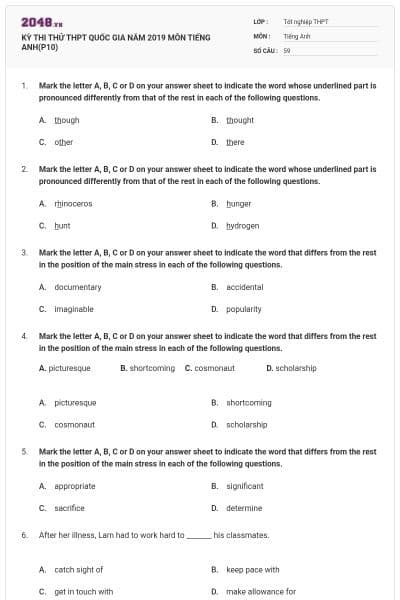
Mark the letter A, B, C or D on your answer sheet to indicate the word whose underlined part is pronounced differently from that of the rest in each of the following questions.
though
thought
other
there
Đáp án: B
“th” trong từ “thought” phát âm là /θ/, các từ còn lại là /ð/.
Mark the letter A, B, C or D on your answer sheet to indicate the word whose underlined part is pronounced differently from that of the rest in each of the following questions.
rhinoceros
hunger
hunt
hydrogen
Đáp án: A
“h” trong từ “rhinoceros” là âm câm, các từ còn lại pháp âm là /h/.
Mark the letter A, B, C or D on your answer sheet to indicate the word that differs from the rest in the position of the main stress in each of the following questions.
documentary
accidental
imaginable
popularity
Đáp án: C Trọng âm của từ này rơi vào âm tiết thứ 2, các từ còn lại rơi vào âm tiết thứ 3.
Mark the letter A, B, C or D on your answer sheet to indicate the word that differs from the rest in the position of the main stress in each of the following questions.
A. picturesque B. shortcoming C. cosmonaut D. scholarship
picturesque
shortcoming
cosmonaut
scholarship
Đáp án: A Trọng âm của từ này rơi vào âm tiết thứ 3, các từ còn lại rơi vào âm tiết thứ 1.
Mark the letter A, B, C or D on your answer sheet to indicate the word that differs from the rest in the position of the main stress in each of the following questions.
appropriate
significant
sacrifice
determine
Đáp án: C Trọng âm của từ này rơi vào âm tiết thứ 1, các từ còn lại rơi vào âm tiết thứ 2.
After her illness, Lam had to work hard to _______ his classmates.
catch sight of
keep pace with
get in touch with
make allowance for
Đáp án: B
Catch sight of= thoáng thấy, keep pace with= bắt kịp, get in touch with= giữ liên lạc với, make allowance for= xem xét.
Since the reform, the country has undergone _______changes.
large
sizeable
substantial
favourable
Đáp án: C
Dịch: Sau cuộc cải cách, đất nước đã xảy ra những thay đổi….Substantial= đáng kể, sizeable=rất lớn, large = rộng, favourable= yêu thích.
They were fortune ___ from the fire before the building collapsed.
to rescue
to have rescued
rescuing
to have been rescued
Đáp án: D Dịch: họ đã rất may mắn khi được cứu khỏi hỏa hoạn trước khi tòa nhà đổ sập. -> được cứu thoát ->bị động: to +have +been +PP.
Jim ______ care of himself. He left home when he was 16 and has been on his own since then.
used to take
is used to take
is used to taking
used to be taken
Đáp án: C Cấu trúc: get/tobe+ used to + V_ing: quen với việc làm gì.
He tends to forget things very quickly and behaves more and more like the typical ______ professor.
cool-minded
clear-minded
well-minded
absent-minded
Đáp án: D Dịch: anh ấy có vẻ như quên mọi thứ rất nhanh chóng là cư xử ngày càng giống vị giáo sư ___điển hình-> absent-minded= đãng trí.
Patient: "Can I make an appointment to see the doctor, please?" Receptionist: "_________."
OK, let me just check the diary.
Ok. He can't be disturbed.
OK, you will need to check my diary.
Have a seat and I'll be with you in an hour
Đáp án: A Patient: tôi có thể đặt lịch với bác sĩ được không? – Receptionist: OK, tôi sẽ kiểm tra lịch làm việc. Các đáp án còn lại: B- Ok, ông ấy không thể bị bối rối. C- OK, tôi sẽ kiểm tra lại lịch của tôi. D- Ngồi xuống và tôi sẽ tiếp ông trong 1 giờ.
-“Do you mind if I take a seat?” - “_____________ .“
Yes, I don’t mind
No, do as you please
No, I mind
Yes, do as you please
Đáp án: B - bạn có phiền không nếu tôi ngồi đây? -> B- không, bạn cứ tự nhiên. Với câu hỏi “do/would you mind.” thì câu trả lời “yes” là không đồng ý, còn “no” là đồng ý.
______, "Alice in the Wonderland" appeals to many adult readers, too.
Though for children written
Though written for children
Though it written for children
It was written for children
Đáp án: B Dịch: dù được viết cho trẻ em, “Alice ở xứ sở thần tiên” vẫn cuốn hút rất nhiều người đọc lớn. Rút gọn mệnh đề quan hệ dạng bị động: S+ tobe+ PP-> PP.
When his alarm went off, he shut it off and slept for ………..15 minutes.
other
others
another
the others
Đáp án: C
“15 phút nữa”-> thời gian là danh từ không đếm được, và 15 phút này được nhắc đến lần đầu-> another.
- Thanh: “Lan’s the best singer in our school.” - Nadia: “_____”
Yes, you tell me about it!
I can’t agree with you more!
That’s OK!
Yes, please.
Đáp án: B
Thanh: Lan là người hát hay nhất trong trường chúng ta. -> đồng ý hoặc không. -> đáp án B: tôi không thể đồng ý hơn (rất đồng ý).
- Cashier: “All right. Keep your receipt. If something comes up, you can show it to us and you can get a refund.” - John: “_____”
OK, I won’t use it.
Thank you. I’ll keep it for you.
You’re welcome. See you.
Thanks. I’ll put it in a safe place.
Đáp án: D Nhân viên thủ quỹ: Ổn rồi. Giữ biên lai của bạn. Nếu có gì xảy ra, bạn có thể đưa chúng tôi xem và bạn có thể nhận hoàn trả. -> John: cảm ơn. Tôi sẽ giữ nó ở nơi an toàn. Đáp án A- tôi sẽ không dùng nó đâu; B- cảm ơn, tôi sẽ giữ nó cho bạn. C- không có gì. Tạm biệt.
_____ the weather, I arrived somewhat late.
On account of
Because
In spite of
For
Đáp án: A On account of+ N= because of+ N= because+ clause =bởi vì, in spite of+ N= mặc dù.
He spent part of_____afternoon telling them_____news he could not tell
them by_____telephone.
the/ the/ __
an/__/ the
an/ the/ the
the/__/the
Đáp án: A Chỗ trống thứ nhất: the+ buổi trong ngày, the news= tin tức-> chọn đáp án A. Dịch: anh ấy dùng một phần của buổi chiều nói với họ cái tin tức anh không thể nói qua điện thoại.
Mary lost one of her running shoes, but won the race despite this ______
disaster
feat
Awkwardness
handicap
Đáp án: D Dịch: Mary đánh rơi 1 chiếc giày, nhưng vẫn thắng cuộc đua dù... -> handicap= điều bất lợi, awkwardness= sự bất tiện, feat= kỳ công, disaster= thất bại.
Jane's very modest, always ________ her success.
playing down
turning around
keeping down
pushing back
Đáp án: A Dịch: Jane rất khiêm tốn, luôn luôn … thành công của cô ấy. ->play down= hạ thấp tầm quan trọng. turn around= thay đổi hoàn toàn, keep down= cúi xuống, push back= trì hoãn.
I feel ________ to inform the committee that a number of members are very unhappy with the decision.
my duty
it my duty
this my duty
that my duty
Đáp án: B Dịch: tôi cảm thấy đó là nhiệm vụ của tôi là thông báo cho ủy ban rằng có lượng lớn người không đồng tình với quyết định này.
When a fire broke out in the Louvre, at least twenty _________ paintings were destroyed, including two by Picasso.
worthless
priceless
valueless
worthy
Đáp án: B Priceless= vô giá, worthless= valueless= vô giá trị, worthy= đáng giá.
Tony didn’t study hard for the test. His answers ________ from someone else
should have copied
must have been copied
can have copied
would have copied
Đáp án: B Must + have+ PP: phỏng đoán điều chắc chắn xảy ra trong quá khứ
Should + have + PP= điều không nên làm nhưng đã làm rồi. Dịch: Tony đã không học chăm cho bài kiểm tra. Câu trả lời của anh ấy hẳn được sao chép từ người khác.
Although thunder and lightening are produced at the same time, light waves travel faster _____, so we see the lightening before we hear thunder.
the same as sound waves
than sound waves are
than sound waves seem
than do sound waves
Đáp án: D
Cấu trúc so sánh hơn với trạng từ ngắn: S1+ V+ adv_er+ than+ S2. “do sound waves” là đảo ngữ của câu so sánh cho: trợ động từ len trước danh từ.
Mark the letter A, B, C or D on your answer sheet to indicate the word or phrase
that is OPPOSITE in meaning to the underlined part in each of the following questions
He had never experienced such discourtesy towards the president as it occurred at the annual meeting in May.
politeness
rudeness
measurement
encouragement
Đáp án: A Discourtesy= sự khiếm nhã, politeness= sự lịch sự, rudeness= vô lễ, measurement= sự đo lường, encouragement= sự khuyến khích.
Mark the letter A, B, C or D on your answer sheet to indicate the word or phrase
that is OPPOSITE in meaning to the underlined part in each of the following questions
Polluted water and increased water temperatures have driven many species to the verge of extinction
enriched
Contaminated
purified
strengthened
Đáp án: C Polluted= contaminated= ô nhiễm, enriched= làm giàu lên, purified = làm sạch, strengthened=được gia cố.
Mark the letter A, B, C or D on your answer sheet to indicate the word or phrase that is CLOSEST in meaning to the underlined part in each of the following questions
Roget's Thesaurus, a collection of English words and phrases, was originally arranged by the ideas they express rather than by alphabetical order.
restricted
as well as
unless
instead of
Đáp án: D
Rather than= hơn là, instead of= thay vì, unless= nếu không thì, restricted= bị hạn chế, as well as= cũng như.
Mark the letter A, B, C or D on your answer sheet to indicate the word or phrase that is CLOSEST in meaning to the underlined part in each of the following questions
In English, the subject precedes the verb.
comes first
comes before
be in front
comes after
Đáp án: B
Precede = come before= đi trước, come first= đến đầu tiên, come after= đi trước, be in frond of= ở trước.
Mark the letter A, B, C or D on your answer sheet to indicate the word or phrase that is CLOSEST in meaning to the underlined part in each of the following questions
To prepare for a job interview, you should jot down your qualifications, work experience as well as some important information about yourself.
what you have experienced
your bio data and special qualities
your own qualities in real life
what you have earned through study
Đáp án: D
Giải thích:
Kiến thức: Từ vựng
qualification (n): bằng cấp
Xét các đáp án:
A. what you have experienced: những thứ bạn đã trải nghiệm
B. your bio data and special qualities: dữ liệu sinh học và phẩm chất đặc biệt của bạn
C. your ow qualities in real life: phẩm chất của bạn trong cuộc sống thực
D. what you have earned through study: những gì bạn đã đạt được thông qua học tập
=> qualification = what you have earned through study
Dịch: Để chuẩn bị cho buổi phỏng vấn xin việc, bạn nên ghi lại bằng cấp, kinh nghiệm làm việc cũng như một số thông tin quan trọng về bản thân.
Read the following passage and mark the letter A, B, C, or D on your answer sheet to indicate the correct word for each of the blanks from 35 to 44.
Why did you decide to read, and will you keep reading to the end? Do you expect to understand every single part of it and will you remember anything about it in a fortnight’s ..35….? Common sense ..36… that the answers to these questions depend on “readability”- whether the ..37… matter is interesting, and the argument clear and the …38….attractive. But psychologists are trying to …39… why people read – and often don’t read certain things, for example technical information. They also have examined so much the writing as the readers.
Even the most technically confident people often 40… instructions for the video or home computer in favor of hands- on experience. And people frequently take little notice of consumer information, whether on nutritional labels or in the small print of contracts. Psychologists researching reading …41…. to assume that both beginners and competent readers read everything put in front of them from start to finish. There are ….42….among them about the role of eyes, memory and brain during the process. Some people believe that fluent readers take in very letter or word they see; others …43….that reader rely on memory or context to carry them from one phrase to another. But they have always assumed that the reading process is the same: reading starts, comprehension ….44……, then reading stops.
Điền vào ô 35
time
period
term
gap
Đáp án: A Time= khoảng thời gian, period= thời kỳ, term= kỳ hạn, gap= khoảng cách-> Dịch: trong khoảng 2 tuần.
Read the following passage and mark the letter A, B, C, or D on your answer sheet to indicate the correct word for each of the blanks from 35 to 44.
Why did you decide to read, and will you keep reading to the end? Do you expect to understand every single part of it and will you remember anything about it in a fortnight’s ..35….? Common sense ..36… that the answers to these questions depend on “readability”- whether the ..37… matter is interesting, and the argument clear and the …38….attractive. But psychologists are trying to …39… why people read – and often don’t read certain things, for example technical information. They also have examined so much the writing as the readers.
Even the most technically confident people often 40… instructions for the video or home computer in favor of hands- on experience. And people frequently take little notice of consumer information, whether on nutritional labels or in the small print of contracts. Psychologists researching reading …41…. to assume that both beginners and competent readers read everything put in front of them from start to finish. There are ….42….among them about the role of eyes, memory and brain during the process. Some people believe that fluent readers take in very letter or word they see; others …43….that reader rely on memory or context to carry them from one phrase to another. But they have always assumed that the reading process is the same: reading starts, comprehension ….44……, then reading stops.
Điền vào ô 36
transmits
suggests
informs
advises
Đáp án: B Khả năng thông thường … rằng câu trả lời phụ thuộc vào tính dễ đọc.-> suggest= gợi ý. Transmit= truyền, inform= thông báo, advise= khuyên.
Read the following passage and mark the letter A, B, C, or D on your answer sheet to indicate the correct word for each of the blanks from 35 to 44.
Why did you decide to read, and will you keep reading to the end? Do you expect to understand every single part of it and will you remember anything about it in a fortnight’s ..35….? Common sense ..36… that the answers to these questions depend on “readability”- whether the ..37… matter is interesting, and the argument clear and the …38….attractive. But psychologists are trying to …39… why people read – and often don’t read certain things, for example technical information. They also have examined so much the writing as the readers.
Even the most technically confident people often 40… instructions for the video or home computer in favor of hands- on experience. And people frequently take little notice of consumer information, whether on nutritional labels or in the small print of contracts. Psychologists researching reading …41…. to assume that both beginners and competent readers read everything put in front of them from start to finish. There are ….42….among them about the role of eyes, memory and brain during the process. Some people believe that fluent readers take in very letter or word they see; others …43….that reader rely on memory or context to carry them from one phrase to another. But they have always assumed that the reading process is the same: reading starts, comprehension ….44……, then reading stops.
Điền vào ô 37
content
text
subject
topic
Đáp án: C Subject= đối tượng, content= nội dung, text= văn bản, topic= đề tài. -> bất cứ chủ thể vấn đề nào mà thú vị, …
Read the following passage and mark the letter A, B, C, or D on your answer sheet to indicate the correct word for each of the blanks from 35 to 44.
Why did you decide to read, and will you keep reading to the end? Do you expect to understand every single part of it and will you remember anything about it in a fortnight’s ..35….? Common sense ..36… that the answers to these questions depend on “readability”- whether the ..37… matter is interesting, and the argument clear and the …38….attractive. But psychologists are trying to …39… why people read – and often don’t read certain things, for example technical information. They also have examined so much the writing as the readers.
Even the most technically confident people often 40… instructions for the video or home computer in favor of hands- on experience. And people frequently take little notice of consumer information, whether on nutritional labels or in the small print of contracts. Psychologists researching reading …41…. to assume that both beginners and competent readers read everything put in front of them from start to finish. There are ….42….among them about the role of eyes, memory and brain during the process. Some people believe that fluent readers take in very letter or word they see; others …43….that reader rely on memory or context to carry them from one phrase to another. But they have always assumed that the reading process is the same: reading starts, comprehension ….44……, then reading stops.
Điền vào ô 38
information
pattern
layout
assembly
Đáp án: C
… lý lẽ rõ ràng và … thu hút. -> layout= bố cục. pattern = hàng mẫu, assembly= cuộc họp.
Read the following passage and mark the letter A, B, C, or D on your answer sheet to indicate the correct word for each of the blanks from 35 to 44.
Why did you decide to read, and will you keep reading to the end? Do you expect to understand every single part of it and will you remember anything about it in a fortnight’s ..35….? Common sense ..36… that the answers to these questions depend on “readability”- whether the ..37… matter is interesting, and the argument clear and the …38….attractive. But psychologists are trying to …39… why people read – and often don’t read certain things, for example technical information. They also have examined so much the writing as the readers.
Even the most technically confident people often 40… instructions for the video or home computer in favor of hands- on experience. And people frequently take little notice of consumer information, whether on nutritional labels or in the small print of contracts. Psychologists researching reading …41…. to assume that both beginners and competent readers read everything put in front of them from start to finish. There are ….42….among them about the role of eyes, memory and brain during the process. Some people believe that fluent readers take in very letter or word they see; others …43….that reader rely on memory or context to carry them from one phrase to another. But they have always assumed that the reading process is the same: reading starts, comprehension ….44……, then reading stops.
Điền vào ô 39
rate
value
determine
ensure
Đáp án: C Dịch: các nhà tâm lý học đang cố gắng (xác định) tại sao đọc - và thường không đọc những thứ nhất định. -> từ “determind” = xác định, rate= ước lượng, value= định giá, ensure = đảm bảo.
Read the following passage and mark the letter A, B, C, or D on your answer sheet to indicate the correct word for each of the blanks from 35 to 44.
Why did you decide to read, and will you keep reading to the end? Do you expect to understand every single part of it and will you remember anything about it in a fortnight’s ..35….? Common sense ..36… that the answers to these questions depend on “readability”- whether the ..37… matter is interesting, and the argument clear and the …38….attractive. But psychologists are trying to …39… why people read – and often don’t read certain things, for example technical information. They also have examined so much the writing as the readers.
Even the most technically confident people often 40… instructions for the video or home computer in favor of hands- on experience. And people frequently take little notice of consumer information, whether on nutritional labels or in the small print of contracts. Psychologists researching reading …41…. to assume that both beginners and competent readers read everything put in front of them from start to finish. There are ….42….among them about the role of eyes, memory and brain during the process. Some people believe that fluent readers take in very letter or word they see; others …43….that reader rely on memory or context to carry them from one phrase to another. But they have always assumed that the reading process is the same: reading starts, comprehension ….44……, then reading stops.
Điền vào ô 40
ignore
pass
miss
omit
Đáp án: A Dịch: kể cả những người tự tin nhất về công nghệ cũng thường… hướng dẫ sự dụng cho video hay máy tính tại nhà. -> ignore= bỏ qua.
Read the following passage and mark the letter A, B, C, or D on your answer sheet to indicate the correct word for each of the blanks from 35 to 44.
Why did you decide to read, and will you keep reading to the end? Do you expect to understand every single part of it and will you remember anything about it in a fortnight’s ..35….? Common sense ..36… that the answers to these questions depend on “readability”- whether the ..37… matter is interesting, and the argument clear and the …38….attractive. But psychologists are trying to …39… why people read – and often don’t read certain things, for example technical information. They also have examined so much the writing as the readers.
Even the most technically confident people often 40… instructions for the video or home computer in favor of hands- on experience. And people frequently take little notice of consumer information, whether on nutritional labels or in the small print of contracts. Psychologists researching reading …41…. to assume that both beginners and competent readers read everything put in front of them from start to finish. There are ….42….among them about the role of eyes, memory and brain during the process. Some people believe that fluent readers take in very letter or word they see; others …43….that reader rely on memory or context to carry them from one phrase to another. But they have always assumed that the reading process is the same: reading starts, comprehension ….44……, then reading stops.
Điền vào ô 41
lead
tend
undertake
consent
Đáp án: B Dịch dòng 4: các nhà tâm lý học nghiên cứu việc đọc … giả định rằng cả người đọc ban đầu và người đối chiếu đều đọc từ đầu đến cuối những thứ được đặt trước mặt họ. tend=xu hướng, lead= dẫn dắt, undertake= cam kết, consent= đồng ý.
Read the following passage and mark the letter A, B, C, or D on your answer sheet to indicate the correct word for each of the blanks from 35 to 44.
Why did you decide to read, and will you keep reading to the end? Do you expect to understand every single part of it and will you remember anything about it in a fortnight’s ..35….? Common sense ..36… that the answers to these questions depend on “readability”- whether the ..37… matter is interesting, and the argument clear and the …38….attractive. But psychologists are trying to …39… why people read – and often don’t read certain things, for example technical information. They also have examined so much the writing as the readers.
Even the most technically confident people often 40… instructions for the video or home computer in favor of hands- on experience. And people frequently take little notice of consumer information, whether on nutritional labels or in the small print of contracts. Psychologists researching reading …41…. to assume that both beginners and competent readers read everything put in front of them from start to finish. There are ….42….among them about the role of eyes, memory and brain during the process. Some people believe that fluent readers take in very letter or word they see; others …43….that reader rely on memory or context to carry them from one phrase to another. But they have always assumed that the reading process is the same: reading starts, comprehension ….44……, then reading stops.
Điền vào ô 42
contests
objections
separations
arguments
Đáp án: D Objection = sự phản đối, contest= cuộc tranh tài, separation = sự tách ra, argument= tranh cãi.
Dựa vào câu sau “Some people believe that fluent readers take in very letter or word they see; others…” vài người tin rằng … những người khác…->có 2 luồng ý kiến trái chiều -> objection.
Read the following passage and mark the letter A, B, C, or D on your answer sheet to indicate the correct word for each of the blanks from 35 to 44.
Why did you decide to read, and will you keep reading to the end? Do you expect to understand every single part of it and will you remember anything about it in a fortnight’s ..35….? Common sense ..36… that the answers to these questions depend on “readability”- whether the ..37… matter is interesting, and the argument clear and the …38….attractive. But psychologists are trying to …39… why people read – and often don’t read certain things, for example technical information. They also have examined so much the writing as the readers.
Even the most technically confident people often 40… instructions for the video or home computer in favor of hands- on experience. And people frequently take little notice of consumer information, whether on nutritional labels or in the small print of contracts. Psychologists researching reading …41…. to assume that both beginners and competent readers read everything put in front of them from start to finish. There are ….42….among them about the role of eyes, memory and brain during the process. Some people believe that fluent readers take in very letter or word they see; others …43….that reader rely on memory or context to carry them from one phrase to another. But they have always assumed that the reading process is the same: reading starts, comprehension ….44……, then reading stops.
Điền vào ô 43
direct
press
insist
urge
Đáp án: C
Direct= nhằm vào, press= nhấn vào, insist= khăng khăng, urge= thúc giục. Như câu 42, “vài người tin rằng … những người khác…” -> insist= khăng khăng.
Read the following passage and mark the letter A, B, C, or D on your answer sheet to indicate the correct word for each of the blanks from 35 to 44.
Why did you decide to read, and will you keep reading to the end? Do you expect to understand every single part of it and will you remember anything about it in a fortnight’s ..35….? Common sense ..36… that the answers to these questions depend on “readability”- whether the ..37… matter is interesting, and the argument clear and the …38….attractive. But psychologists are trying to …39… why people read – and often don’t read certain things, for example technical information. They also have examined so much the writing as the readers.
Even the most technically confident people often 40… instructions for the video or home computer in favor of hands- on experience. And people frequently take little notice of consumer information, whether on nutritional labels or in the small print of contracts. Psychologists researching reading …41…. to assume that both beginners and competent readers read everything put in front of them from start to finish. There are ….42….among them about the role of eyes, memory and brain during the process. Some people believe that fluent readers take in very letter or word they see; others …43….that reader rely on memory or context to carry them from one phrase to another. But they have always assumed that the reading process is the same: reading starts, comprehension ….44……, then reading stops.
Điền vào ô 44
occurs
establishes
issues
sets
Đáp án: A Occur= xảy ra, establish= thiết lập, issue= công bố, set= đặt. “reading starts, comprehension occurs, then reading stops” bắt đầu đọc, hiểu những gì xảy ra, rồi đọc đến kết thúc.
Read the following passage and mark the letter A, B, C, or D on your answer sheet to indicate the correct answer to each of the questions from 45to 54.
Researchers in the field of psychology have found that one of the best ways to make an important decision, such as choosing a university to attend or a business to invest in, involves he utilization of a decision worksheet. Psychologists who study optimization compare the actual decisions made by people to theoretical ideal decisions to see how similar they are. Proponents of the worksheet procedure believe that it will yield optimal, that is, the best decisions. Although there are several variations on the exact format that worksheets can take, they are all similar in their essential aspects.
Worksheets require defining the problem in a clear and concise way and then listing all possible solutions to the problem. Next, the pertinent considerations that will be affected by each decision are listed, and the relative importance of each consideration or consequence is determined. Each consideration is assigned a numerical value to reflect its relative importance. A decision is mathematically calculated by adding these values together. The alternative with the highest number of points emerges as the best decision.
Since most important problems are multifaceted, there are several alternatives to choose from, each with unique advantages and disadvantages. One of the benefits of a pencil and paper decision-making procedure is that it permits people to deal with more variables than their minds can generally comprehend and remember. On the average, people can keep about seven ideas in their minds at once. A worksheet can be especially useful when the decision involves a large number of variables with complex relationships. A realistic example for many college students is the question "What will I do after graduation?" A graduate might seek a position that offers specialized training, pursue an advanced degree, or travel abroad for a year.
A decision-making worksheet begins with a succinct statement of the problem that will also help to narrow it. It is important to be clear about the distinction between long-range and immediate goals because long-range goals often involve a different decision from short-range ones. Focusing on long-range goals, a graduating student might revise the question above to "What will I do after graduation that will lead to a successful career?"
What does the passage mainly discuss?
A tool to assist in making complex decisions.
A comparison of actual decisions and ideal decisions
Research on how people make decisions
Differences between long-range and short-range decision making
Đáp án: A
Dòng 1 đoạn 1 “Researchers in the field of psychology have found that one of the best way to make an important decision”: những nghiên cứu trên lĩnh vực tâm lý học đã tìm ra một trong những cách tốt nhất để ra một quyết định.-> công cụ để giúp đưa ra quyết định phức tạp.
Read the following passage and mark the letter A, B, C, or D on your answer sheet to indicate the correct answer to each of the questions from 45to 54.
Researchers in the field of psychology have found that one of the best ways to make an important decision, such as choosing a university to attend or a business to invest in, involves he utilization of a decision worksheet. Psychologists who study optimization compare the actual decisions made by people to theoretical ideal decisions to see how similar they are. Proponents of the worksheet procedure believe that it will yield optimal, that is, the best decisions. Although there are several variations on the exact format that worksheets can take, they are all similar in their essential aspects.
Worksheets require defining the problem in a clear and concise way and then listing all possible solutions to the problem. Next, the pertinent considerations that will be affected by each decision are listed, and the relative importance of each consideration or consequence is determined. Each consideration is assigned a numerical value to reflect its relative importance. A decision is mathematically calculated by adding these values together. The alternative with the highest number of points emerges as the best decision.
Since most important problems are multifaceted, there are several alternatives to choose from, each with unique advantages and disadvantages. One of the benefits of a pencil and paper decision-making procedure is that it permits people to deal with more variables than their minds can generally comprehend and remember. On the average, people can keep about seven ideas in their minds at once. A worksheet can be especially useful when the decision involves a large number of variables with complex relationships. A realistic example for many college students is the question "What will I do after graduation?" A graduate might seek a position that offers specialized training, pursue an advanced degree, or travel abroad for a year.
A decision-making worksheet begins with a succinct statement of the problem that will also help to narrow it. It is important to be clear about the distinction between long-range and immediate goals because long-range goals often involve a different decision from short-range ones. Focusing on long-range goals, a graduating student might revise the question above to "What will I do after graduation that will lead to a successful career?"
The word "essential" in paragraph 1 is closest in meaning to
introductory
changeable
beneficial
fundamental
Đáp án: D Essential= thiết yếu, fundamental=cơ bản, introductory= mở đầu, changeable= có thể thay đổi, beneficial = có lợi.
Read the following passage and mark the letter A, B, C, or D on your answer sheet to indicate the correct answer to each of the questions from 45to 54.
Researchers in the field of psychology have found that one of the best ways to make an important decision, such as choosing a university to attend or a business to invest in, involves he utilization of a decision worksheet. Psychologists who study optimization compare the actual decisions made by people to theoretical ideal decisions to see how similar they are. Proponents of the worksheet procedure believe that it will yield optimal, that is, the best decisions. Although there are several variations on the exact format that worksheets can take, they are all similar in their essential aspects.
Worksheets require defining the problem in a clear and concise way and then listing all possible solutions to the problem. Next, the pertinent considerations that will be affected by each decision are listed, and the relative importance of each consideration or consequence is determined. Each consideration is assigned a numerical value to reflect its relative importance. A decision is mathematically calculated by adding these values together. The alternative with the highest number of points emerges as the best decision.
Since most important problems are multifaceted, there are several alternatives to choose from, each with unique advantages and disadvantages. One of the benefits of a pencil and paper decision-making procedure is that it permits people to deal with more variables than their minds can generally comprehend and remember. On the average, people can keep about seven ideas in their minds at once. A worksheet can be especially useful when the decision involves a large number of variables with complex relationships. A realistic example for many college students is the question "What will I do after graduation?" A graduate might seek a position that offers specialized training, pursue an advanced degree, or travel abroad for a year.
A decision-making worksheet begins with a succinct statement of the problem that will also help to narrow it. It is important to be clear about the distinction between long-range and immediate goals because long-range goals often involve a different decision from short-range ones. Focusing on long-range goals, a graduating student might revise the question above to "What will I do after graduation that will lead to a successful career?"
Of the following steps, which occurs before the others in making a decision worksheet?
Listing the consequences of each solution
Calculating a numerical summary of each solution
Deciding which consequences are most important
Writing down all possible solutions
Đáp án: D Cuối câu 1 đoạn 2 “listing all possible solutions to the problem”: lên danh sách các giải pháp cho vấn đề.
Read the following passage and mark the letter A, B, C, or D on your answer sheet to indicate the correct answer to each of the questions from 45to 54.
Researchers in the field of psychology have found that one of the best ways to make an important decision, such as choosing a university to attend or a business to invest in, involves he utilization of a decision worksheet. Psychologists who study optimization compare the actual decisions made by people to theoretical ideal decisions to see how similar they are. Proponents of the worksheet procedure believe that it will yield optimal, that is, the best decisions. Although there are several variations on the exact format that worksheets can take, they are all similar in their essential aspects.
Worksheets require defining the problem in a clear and concise way and then listing all possible solutions to the problem. Next, the pertinent considerations that will be affected by each decision are listed, and the relative importance of each consideration or consequence is determined. Each consideration is assigned a numerical value to reflect its relative importance. A decision is mathematically calculated by adding these values together. The alternative with the highest number of points emerges as the best decision.
Since most important problems are multifaceted, there are several alternatives to choose from, each with unique advantages and disadvantages. One of the benefits of a pencil and paper decision-making procedure is that it permits people to deal with more variables than their minds can generally comprehend and remember. On the average, people can keep about seven ideas in their minds at once. A worksheet can be especially useful when the decision involves a large number of variables with complex relationships. A realistic example for many college students is the question "What will I do after graduation?" A graduate might seek a position that offers specialized training, pursue an advanced degree, or travel abroad for a year.
A decision-making worksheet begins with a succinct statement of the problem that will also help to narrow it. It is important to be clear about the distinction between long-range and immediate goals because long-range goals often involve a different decision from short-range ones. Focusing on long-range goals, a graduating student might revise the question above to "What will I do after graduation that will lead to a successful career?"
According to decision-worksheet theory, an optimal decision is defined as one that
has the fewest variables to consider
uses the most decision worksheets
has the most points assigned to it
is agreed to by the greatest number of people
Đáp án: C Câu cuối đoạn 2 “The alternative with the highest number of points emerges as the best decision.” Sự lựa chọn có số điểm cao nhất hiện ra như giải pháp tốt nhất.
Read the following passage and mark the letter A, B, C, or D on your answer sheet to indicate the correct answer to each of the questions from 45to 54.
Researchers in the field of psychology have found that one of the best ways to make an important decision, such as choosing a university to attend or a business to invest in, involves he utilization of a decision worksheet. Psychologists who study optimization compare the actual decisions made by people to theoretical ideal decisions to see how similar they are. Proponents of the worksheet procedure believe that it will yield optimal, that is, the best decisions. Although there are several variations on the exact format that worksheets can take, they are all similar in their essential aspects.
Worksheets require defining the problem in a clear and concise way and then listing all possible solutions to the problem. Next, the pertinent considerations that will be affected by each decision are listed, and the relative importance of each consideration or consequence is determined. Each consideration is assigned a numerical value to reflect its relative importance. A decision is mathematically calculated by adding these values together. The alternative with the highest number of points emerges as the best decision.
Since most important problems are multifaceted, there are several alternatives to choose from, each with unique advantages and disadvantages. One of the benefits of a pencil and paper decision-making procedure is that it permits people to deal with more variables than their minds can generally comprehend and remember. On the average, people can keep about seven ideas in their minds at once. A worksheet can be especially useful when the decision involves a large number of variables with complex relationships. A realistic example for many college students is the question "What will I do after graduation?" A graduate might seek a position that offers specialized training, pursue an advanced degree, or travel abroad for a year.
A decision-making worksheet begins with a succinct statement of the problem that will also help to narrow it. It is important to be clear about the distinction between long-range and immediate goals because long-range goals often involve a different decision from short-range ones. Focusing on long-range goals, a graduating student might revise the question above to "What will I do after graduation that will lead to a successful career?"
The author organizes paragraph 2 by
describing a process
classifying types of worksheets
providing historical background
explaining a theory
Đáp án: A
Đoạn 2 mô tả quá trình đưa ra 1 quyết định với bảng hỏi với từ nối như “next”. Đầu tiên là xác định vấn đề 1 cách rõ ràng, lên danh sách giải pháp, lý do cho sự khả thi của giải pháp và kết quả có hể xảy ra, mỗi lý do sẽ được cho điểm, tính tổng số điểm cho mỗi giải pháp, lựa chọn giải pháp có điểm cao nhất.
Read the following passage and mark the letter A, B, C, or D on your answer sheet to indicate the correct answer to each of the questions from 45to 54.
Researchers in the field of psychology have found that one of the best ways to make an important decision, such as choosing a university to attend or a business to invest in, involves he utilization of a decision worksheet. Psychologists who study optimization compare the actual decisions made by people to theoretical ideal decisions to see how similar they are. Proponents of the worksheet procedure believe that it will yield optimal, that is, the best decisions. Although there are several variations on the exact format that worksheets can take, they are all similar in their essential aspects.
Worksheets require defining the problem in a clear and concise way and then listing all possible solutions to the problem. Next, the pertinent considerations that will be affected by each decision are listed, and the relative importance of each consideration or consequence is determined. Each consideration is assigned a numerical value to reflect its relative importance. A decision is mathematically calculated by adding these values together. The alternative with the highest number of points emerges as the best decision.
Since most important problems are multifaceted, there are several alternatives to choose from, each with unique advantages and disadvantages. One of the benefits of a pencil and paper decision-making procedure is that it permits people to deal with more variables than their minds can generally comprehend and remember. On the average, people can keep about seven ideas in their minds at once. A worksheet can be especially useful when the decision involves a large number of variables with complex relationships. A realistic example for many college students is the question "What will I do after graduation?" A graduate might seek a position that offers specialized training, pursue an advanced degree, or travel abroad for a year.
A decision-making worksheet begins with a succinct statement of the problem that will also help to narrow it. It is important to be clear about the distinction between long-range and immediate goals because long-range goals often involve a different decision from short-range ones. Focusing on long-range goals, a graduating student might revise the question above to "What will I do after graduation that will lead to a successful career?"
The author states that "On the average, people can keep about seven ideas in their minds at once" (paragraph 3) to explain that
most decisions involve seven steps
human mental capacity has limitations
some people have difficulty making minor as well as major decision
people can learn to keep more than seven ideas in their minds with practice
Đáp án: B
Câu này nghĩa là: trung bình, mỗi người giữ được 7 suy nghĩ cùng 1 lúc.-> khả năng thần kinh của con người rất hạn chế, không chứa được nhiều thông tin bằng worksheet.
Read the following passage and mark the letter A, B, C, or D on your answer sheet to indicate the correct answer to each of the questions from 45to 54.
Researchers in the field of psychology have found that one of the best ways to make an important decision, such as choosing a university to attend or a business to invest in, involves he utilization of a decision worksheet. Psychologists who study optimization compare the actual decisions made by people to theoretical ideal decisions to see how similar they are. Proponents of the worksheet procedure believe that it will yield optimal, that is, the best decisions. Although there are several variations on the exact format that worksheets can take, they are all similar in their essential aspects.
Worksheets require defining the problem in a clear and concise way and then listing all possible solutions to the problem. Next, the pertinent considerations that will be affected by each decision are listed, and the relative importance of each consideration or consequence is determined. Each consideration is assigned a numerical value to reflect its relative importance. A decision is mathematically calculated by adding these values together. The alternative with the highest number of points emerges as the best decision.
Since most important problems are multifaceted, there are several alternatives to choose from, each with unique advantages and disadvantages. One of the benefits of a pencil and paper decision-making procedure is that it permits people to deal with more variables than their minds can generally comprehend and remember. On the average, people can keep about seven ideas in their minds at once. A worksheet can be especially useful when the decision involves a large number of variables with complex relationships. A realistic example for many college students is the question "What will I do after graduation?" A graduate might seek a position that offers specialized training, pursue an advanced degree, or travel abroad for a year.
A decision-making worksheet begins with a succinct statement of the problem that will also help to narrow it. It is important to be clear about the distinction between long-range and immediate goals because long-range goals often involve a different decision from short-range ones. Focusing on long-range goals, a graduating student might revise the question above to "What will I do after graduation that will lead to a successful career?"
The word "succinct" in paragraph 4 is closest in meaning to
creative
satisfactory
personal
concise
Đáp án: D Succinct= concise= ngắn gọn, creative = sáng tạo, satisfactory= hài lòng, personal= cá nhân.
Read the following passage and mark the letter A, B, C, or D on your answer sheet to indicate the correct answer to each of the questions from 45to 54.
Researchers in the field of psychology have found that one of the best ways to make an important decision, such as choosing a university to attend or a business to invest in, involves he utilization of a decision worksheet. Psychologists who study optimization compare the actual decisions made by people to theoretical ideal decisions to see how similar they are. Proponents of the worksheet procedure believe that it will yield optimal, that is, the best decisions. Although there are several variations on the exact format that worksheets can take, they are all similar in their essential aspects.
Worksheets require defining the problem in a clear and concise way and then listing all possible solutions to the problem. Next, the pertinent considerations that will be affected by each decision are listed, and the relative importance of each consideration or consequence is determined. Each consideration is assigned a numerical value to reflect its relative importance. A decision is mathematically calculated by adding these values together. The alternative with the highest number of points emerges as the best decision.
Since most important problems are multifaceted, there are several alternatives to choose from, each with unique advantages and disadvantages. One of the benefits of a pencil and paper decision-making procedure is that it permits people to deal with more variables than their minds can generally comprehend and remember. On the average, people can keep about seven ideas in their minds at once. A worksheet can be especially useful when the decision involves a large number of variables with complex relationships. A realistic example for many college students is the question "What will I do after graduation?" A graduate might seek a position that offers specialized training, pursue an advanced degree, or travel abroad for a year.
A decision-making worksheet begins with a succinct statement of the problem that will also help to narrow it. It is important to be clear about the distinction between long-range and immediate goals because long-range goals often involve a different decision from short-range ones. Focusing on long-range goals, a graduating student might revise the question above to "What will I do after graduation that will lead to a successful career?"
Which of the following terms is defined in the passage?
Proponents (paragraph 1)
Optimal (paragraph 1)
variables (paragraph 3)
Long-range goals (paragraph 4)
Đáp án: B
Dòng 5 đoạn 4 “it will yield optimal, that is, the best decisions” nó sẽ mang đến optimal, cái là quyết định tốt nhất.
Read the following passage and mark the letter A, B, C, or D on your answer sheet to indicate the correct answer to each of the questions from 45to 54.
Researchers in the field of psychology have found that one of the best ways to make an important decision, such as choosing a university to attend or a business to invest in, involves he utilization of a decision worksheet. Psychologists who study optimization compare the actual decisions made by people to theoretical ideal decisions to see how similar they are. Proponents of the worksheet procedure believe that it will yield optimal, that is, the best decisions. Although there are several variations on the exact format that worksheets can take, they are all similar in their essential aspects.
Worksheets require defining the problem in a clear and concise way and then listing all possible solutions to the problem. Next, the pertinent considerations that will be affected by each decision are listed, and the relative importance of each consideration or consequence is determined. Each consideration is assigned a numerical value to reflect its relative importance. A decision is mathematically calculated by adding these values together. The alternative with the highest number of points emerges as the best decision.
Since most important problems are multifaceted, there are several alternatives to choose from, each with unique advantages and disadvantages. One of the benefits of a pencil and paper decision-making procedure is that it permits people to deal with more variables than their minds can generally comprehend and remember. On the average, people can keep about seven ideas in their minds at once. A worksheet can be especially useful when the decision involves a large number of variables with complex relationships. A realistic example for many college students is the question "What will I do after graduation?" A graduate might seek a position that offers specialized training, pursue an advanced degree, or travel abroad for a year.
A decision-making worksheet begins with a succinct statement of the problem that will also help to narrow it. It is important to be clear about the distinction between long-range and immediate goals because long-range goals often involve a different decision from short-range ones. Focusing on long-range goals, a graduating student might revise the question above to "What will I do after graduation that will lead to a successful career?"
The word "it" in paragraph 4 refers to
worksheet
problem
distinction
decision
Đáp án: B
Câu 1 đoạn 4 “A decision-making worksheet begins with a succinct statement of the problem that will also help to narrow it” một mẫu hỏi ra quyết định bắt đầu với 1 tiêu đề ngắn gọn của vấn đề sẽ giúp thu hẹp nó-> “it” là vấn đề.
Read the following passage and mark the letter A, B, C, or D on your answer sheet to indicate the correct answer to each of the questions from 45to 54.
Researchers in the field of psychology have found that one of the best ways to make an important decision, such as choosing a university to attend or a business to invest in, involves he utilization of a decision worksheet. Psychologists who study optimization compare the actual decisions made by people to theoretical ideal decisions to see how similar they are. Proponents of the worksheet procedure believe that it will yield optimal, that is, the best decisions. Although there are several variations on the exact format that worksheets can take, they are all similar in their essential aspects.
Worksheets require defining the problem in a clear and concise way and then listing all possible solutions to the problem. Next, the pertinent considerations that will be affected by each decision are listed, and the relative importance of each consideration or consequence is determined. Each consideration is assigned a numerical value to reflect its relative importance. A decision is mathematically calculated by adding these values together. The alternative with the highest number of points emerges as the best decision.
Since most important problems are multifaceted, there are several alternatives to choose from, each with unique advantages and disadvantages. One of the benefits of a pencil and paper decision-making procedure is that it permits people to deal with more variables than their minds can generally comprehend and remember. On the average, people can keep about seven ideas in their minds at once. A worksheet can be especially useful when the decision involves a large number of variables with complex relationships. A realistic example for many college students is the question "What will I do after graduation?" A graduate might seek a position that offers specialized training, pursue an advanced degree, or travel abroad for a year.
A decision-making worksheet begins with a succinct statement of the problem that will also help to narrow it. It is important to be clear about the distinction between long-range and immediate goals because long-range goals often involve a different decision from short-range ones. Focusing on long-range goals, a graduating student might revise the question above to "What will I do after graduation that will lead to a successful career?"
The word "revise" in paragraph 4 is closest in meaning to
ask
explain
change
predict
Đáp án: C Revise= xem xét lại, change= thay đổi, ask= hỏi, explain = giải thích, predict= đoán trước.
Read the following passage and mark the letter A, B, C, or D on your answer sheet to indicate the correct answer to each of the questions from 55 to 64.
You can usually tell when your friends are happy or angry by the looks on their faces or by their actions. This is useful because reading their emotional expressions helps you to know how to respond to them. Emotions have evolved to help us respond to important situations and to convey our intentions to others. But does raising the eyebrows and rounding the mouth say the same thing in Minneapolis as it does in Madagascar? Much research on emotional expressions has centered on such questions.
According to Paul Ekman, the leading researcher in this area, people speak and
understand substantially the same “facial language”. Studies by Ekman’s group have demonstrated that humans share a set of universal emotional expressions that testify to the common biological heritage of the human species. Smiles, for example, signal happiness and frowns indicate sadness on the faces of people in such far- flung places as Argentina, Japan, Spain, Hungary, Poland , Sumatra ,the United States, Vietnam, the jungles of New Guinea, and the Eskimo villages north of Artic Circle. Ekman and his colleagues claim that people everywhere can recognize at least seven basic emotions: sadness, fear, anger, disgust, contempt, happiness, and surprise. There are, however, huge differences across cultures in both the context and intensity of emotional displays – the so called display rules. In many Asian cultures, for example, children are taught to control emotional responses – especially negative ones- while many American children are encouraged to express their feelings more openly. Regardless of culture, however, emotions usually show themselves, to some degree , in
people’s behavior. From their first days of life, babies produce facial expressions that communicate their feelings.
The ability to read facial expressions develops early, too. Very young children pay close attention to facial expressions, and by age five, they nearly equal adults in their skill at reading emotions on people’s faces. This evidence all points to a biological underpinning for our abilities to express and interpret a basic set of human emotions. Moreover, as Charles Darwin pointed out over a century ago, some emotional expressions seem to appear across species boundaries. Cross - cultural psychologists tell us that certain emotional responses carry different meanings in different cultures. For example, what emotion do you suppose might be conveyed by sticking out your tongue? For Americans, this might indicate disgust, while in China it can signify surprise. Likewise, a grin on an American face may indicate joy, while on a Japanese face it may just as easily mean embarrassment. Clearly, culture influences emotional expressions.
According to the passage, we respond to others by _________.
observing their looks
watching their actions
observing their emotional expressions
looking at their faces
Đáp án: C
Câu đầu tiên của bài “You can usually tell when your friends are happy or angry by the looks on their faces or by their actions” bạn thường có thể biết được bạn của mình vui vẻ hay giận giữ bằng việc nhìn vào gương mặt hay hành động của họ. ->có thể quan sát sự biểu lộ cảm xúc.
Read the following passage and mark the letter A, B, C, or D on your answer sheet to indicate the correct answer to each of the questions from 55 to 64.
You can usually tell when your friends are happy or angry by the looks on their faces or by their actions. This is useful because reading their emotional expressions helps you to know how to respond to them. Emotions have evolved to help us respond to important situations and to convey our intentions to others. But does raising the eyebrows and rounding the mouth say the same thing in Minneapolis as it does in Madagascar? Much research on emotional expressions has centered on such questions.
According to Paul Ekman, the leading researcher in this area, people speak and
understand substantially the same “facial language”. Studies by Ekman’s group have demonstrated that humans share a set of universal emotional expressions that testify to the common biological heritage of the human species. Smiles, for example, signal happiness and frowns indicate sadness on the faces of people in such far- flung places as Argentina, Japan, Spain, Hungary, Poland , Sumatra ,the United States, Vietnam, the jungles of New Guinea, and the Eskimo villages north of Artic Circle. Ekman and his colleagues claim that people everywhere can recognize at least seven basic emotions: sadness, fear, anger, disgust, contempt, happiness, and surprise. There are, however, huge differences across cultures in both the context and intensity of emotional displays – the so called display rules. In many Asian cultures, for example, children are taught to control emotional responses – especially negative ones- while many American children are encouraged to express their feelings more openly. Regardless of culture, however, emotions usually show themselves, to some degree , in
people’s behavior. From their first days of life, babies produce facial expressions that communicate their feelings.
The ability to read facial expressions develops early, too. Very young children pay close attention to facial expressions, and by age five, they nearly equal adults in their skill at reading emotions on people’s faces. This evidence all points to a biological underpinning for our abilities to express and interpret a basic set of human emotions. Moreover, as Charles Darwin pointed out over a century ago, some emotional expressions seem to appear across species boundaries. Cross - cultural psychologists tell us that certain emotional responses carry different meanings in different cultures. For example, what emotion do you suppose might be conveyed by sticking out your tongue? For Americans, this might indicate disgust, while in China it can signify surprise. Likewise, a grin on an American face may indicate joy, while on a Japanese face it may just as easily mean embarrassment. Clearly, culture influences emotional expressions.
Many studies on emotional expressions try to answer the question whether______.
different cultures have similar emotional expressions.
eyebrow raising means the same in Minneapolis and Madagascar.
raising the eyebrows has similar meaning to rounding the mouth.
rounding the mouth has the same meaning in Minneapolis and Madagascar.
Đáp án: A Hai câu cuối đoạn 1 “But does raising the eyebrows and rounding the mouth say the same thing in Minneapolis as it does in Madagascar? Much research on emotional expressions has
centered on such questions.” -> nghiên cứu ý nghĩa của hành động biểu lộ cảm xúc giữa các văn hóa khác nhau.
Read the following passage and mark the letter A, B, C, or D on your answer sheet to indicate the correct answer to each of the questions from 55 to 64.
You can usually tell when your friends are happy or angry by the looks on their faces or by their actions. This is useful because reading their emotional expressions helps you to know how to respond to them. Emotions have evolved to help us respond to important situations and to convey our intentions to others. But does raising the eyebrows and rounding the mouth say the same thing in Minneapolis as it does in Madagascar? Much research on emotional expressions has centered on such questions.
According to Paul Ekman, the leading researcher in this area, people speak and
understand substantially the same “facial language”. Studies by Ekman’s group have demonstrated that humans share a set of universal emotional expressions that testify to the common biological heritage of the human species. Smiles, for example, signal happiness and frowns indicate sadness on the faces of people in such far- flung places as Argentina, Japan, Spain, Hungary, Poland , Sumatra ,the United States, Vietnam, the jungles of New Guinea, and the Eskimo villages north of Artic Circle. Ekman and his colleagues claim that people everywhere can recognize at least seven basic emotions: sadness, fear, anger, disgust, contempt, happiness, and surprise. There are, however, huge differences across cultures in both the context and intensity of emotional displays – the so called display rules. In many Asian cultures, for example, children are taught to control emotional responses – especially negative ones- while many American children are encouraged to express their feelings more openly. Regardless of culture, however, emotions usually show themselves, to some degree , in
people’s behavior. From their first days of life, babies produce facial expressions that communicate their feelings.
The ability to read facial expressions develops early, too. Very young children pay close attention to facial expressions, and by age five, they nearly equal adults in their skill at reading emotions on people’s faces. This evidence all points to a biological underpinning for our abilities to express and interpret a basic set of human emotions. Moreover, as Charles Darwin pointed out over a century ago, some emotional expressions seem to appear across species boundaries. Cross - cultural psychologists tell us that certain emotional responses carry different meanings in different cultures. For example, what emotion do you suppose might be conveyed by sticking out your tongue? For Americans, this might indicate disgust, while in China it can signify surprise. Likewise, a grin on an American face may indicate joy, while on a Japanese face it may just as easily mean embarrassment. Clearly, culture influences emotional expressions.
The word “ evolved” in line 3 is closest in meaning to __________.
reduced
increased
simplified
developed
Đáp án: D Evolve=develop= phát triển, reduce = giảm xuống, increase= tăng lên, simplify= đơn giản hóa.
Read the following passage and mark the letter A, B, C, or D on your answer sheet to indicate the correct answer to each of the questions from 55 to 64.
You can usually tell when your friends are happy or angry by the looks on their faces or by their actions. This is useful because reading their emotional expressions helps you to know how to respond to them. Emotions have evolved to help us respond to important situations and to convey our intentions to others. But does raising the eyebrows and rounding the mouth say the same thing in Minneapolis as it does in Madagascar? Much research on emotional expressions has centered on such questions.
According to Paul Ekman, the leading researcher in this area, people speak and
understand substantially the same “facial language”. Studies by Ekman’s group have demonstrated that humans share a set of universal emotional expressions that testify to the common biological heritage of the human species. Smiles, for example, signal happiness and frowns indicate sadness on the faces of people in such far- flung places as Argentina, Japan, Spain, Hungary, Poland , Sumatra ,the United States, Vietnam, the jungles of New Guinea, and the Eskimo villages north of Artic Circle. Ekman and his colleagues claim that people everywhere can recognize at least seven basic emotions: sadness, fear, anger, disgust, contempt, happiness, and surprise. There are, however, huge differences across cultures in both the context and intensity of emotional displays – the so called display rules. In many Asian cultures, for example, children are taught to control emotional responses – especially negative ones- while many American children are encouraged to express their feelings more openly. Regardless of culture, however, emotions usually show themselves, to some degree , in
people’s behavior. From their first days of life, babies produce facial expressions that communicate their feelings.
The ability to read facial expressions develops early, too. Very young children pay close attention to facial expressions, and by age five, they nearly equal adults in their skill at reading emotions on people’s faces. This evidence all points to a biological underpinning for our abilities to express and interpret a basic set of human emotions. Moreover, as Charles Darwin pointed out over a century ago, some emotional expressions seem to appear across species boundaries. Cross - cultural psychologists tell us that certain emotional responses carry different meanings in different cultures. For example, what emotion do you suppose might be conveyed by sticking out your tongue? For Americans, this might indicate disgust, while in China it can signify surprise. Likewise, a grin on an American face may indicate joy, while on a Japanese face it may just as easily mean embarrassment. Clearly, culture influences emotional expressions.
Paul Ekman is mentioned in the passage as an example of ____________.
lacked many main ingredients
researchers on universal language
researchers who can speak and understand many languages
investigators on universal emotional expressions
Đáp án: D
Câu 2 đoạn 2 “Studies by Ekman’s group have demonstrated that humans share a set of universal emotional expressions” các cuộc nghiên cứu của nhóm Ekman đã chứng minh loài người có chung một tập hợp các biểu lộ cảm xúc phổng biến.
Read the following passage and mark the letter A, B, C, or D on your answer sheet to indicate the correct answer to each of the questions from 55 to 64.
You can usually tell when your friends are happy or angry by the looks on their faces or by their actions. This is useful because reading their emotional expressions helps you to know how to respond to them. Emotions have evolved to help us respond to important situations and to convey our intentions to others. But does raising the eyebrows and rounding the mouth say the same thing in Minneapolis as it does in Madagascar? Much research on emotional expressions has centered on such questions.
According to Paul Ekman, the leading researcher in this area, people speak and
understand substantially the same “facial language”. Studies by Ekman’s group have demonstrated that humans share a set of universal emotional expressions that testify to the common biological heritage of the human species. Smiles, for example, signal happiness and frowns indicate sadness on the faces of people in such far- flung places as Argentina, Japan, Spain, Hungary, Poland , Sumatra ,the United States, Vietnam, the jungles of New Guinea, and the Eskimo villages north of Artic Circle. Ekman and his colleagues claim that people everywhere can recognize at least seven basic emotions: sadness, fear, anger, disgust, contempt, happiness, and surprise. There are, however, huge differences across cultures in both the context and intensity of emotional displays – the so called display rules. In many Asian cultures, for example, children are taught to control emotional responses – especially negative ones- while many American children are encouraged to express their feelings more openly. Regardless of culture, however, emotions usually show themselves, to some degree , in
people’s behavior. From their first days of life, babies produce facial expressions that communicate their feelings.
The ability to read facial expressions develops early, too. Very young children pay close attention to facial expressions, and by age five, they nearly equal adults in their skill at reading emotions on people’s faces. This evidence all points to a biological underpinning for our abilities to express and interpret a basic set of human emotions. Moreover, as Charles Darwin pointed out over a century ago, some emotional expressions seem to appear across species boundaries. Cross - cultural psychologists tell us that certain emotional responses carry different meanings in different cultures. For example, what emotion do you suppose might be conveyed by sticking out your tongue? For Americans, this might indicate disgust, while in China it can signify surprise. Likewise, a grin on an American face may indicate joy, while on a Japanese face it may just as easily mean embarrassment. Clearly, culture influences emotional expressions.
Smiles and frowns __________.
are universal expressions across cultures
do not convey the same emotions in various cultures
are not popular everywhere
have different meanings in different cultures
Đáp án: A
Câu 3 đoạn 2 “Smiles, for example, signal happiness and frowns indicate sadness on the faces of people in such far- flung places as Argentina, Japan,…”- ví dụ cười là tín hiệu của hạnh phúc và cau mày được hiểu là nỗi buồn trên gương mặt vươn xa ở nhiều vùng đất như Argentina, Japan…-> smiles and frown là biểu hiện cảm xúc phổ biến của các văn hóa.
Read the following passage and mark the letter A, B, C, or D on your answer sheet to indicate the correct answer to each of the questions from 55 to 64.
You can usually tell when your friends are happy or angry by the looks on their faces or by their actions. This is useful because reading their emotional expressions helps you to know how to respond to them. Emotions have evolved to help us respond to important situations and to convey our intentions to others. But does raising the eyebrows and rounding the mouth say the same thing in Minneapolis as it does in Madagascar? Much research on emotional expressions has centered on such questions.
According to Paul Ekman, the leading researcher in this area, people speak and
understand substantially the same “facial language”. Studies by Ekman’s group have demonstrated that humans share a set of universal emotional expressions that testify to the common biological heritage of the human species. Smiles, for example, signal happiness and frowns indicate sadness on the faces of people in such far- flung places as Argentina, Japan, Spain, Hungary, Poland , Sumatra ,the United States, Vietnam, the jungles of New Guinea, and the Eskimo villages north of Artic Circle. Ekman and his colleagues claim that people everywhere can recognize at least seven basic emotions: sadness, fear, anger, disgust, contempt, happiness, and surprise. There are, however, huge differences across cultures in both the context and intensity of emotional displays – the so called display rules. In many Asian cultures, for example, children are taught to control emotional responses – especially negative ones- while many American children are encouraged to express their feelings more openly. Regardless of culture, however, emotions usually show themselves, to some degree , in
people’s behavior. From their first days of life, babies produce facial expressions that communicate their feelings.
The ability to read facial expressions develops early, too. Very young children pay close attention to facial expressions, and by age five, they nearly equal adults in their skill at reading emotions on people’s faces. This evidence all points to a biological underpinning for our abilities to express and interpret a basic set of human emotions. Moreover, as Charles Darwin pointed out over a century ago, some emotional expressions seem to appear across species boundaries. Cross - cultural psychologists tell us that certain emotional responses carry different meanings in different cultures. For example, what emotion do you suppose might be conveyed by sticking out your tongue? For Americans, this might indicate disgust, while in China it can signify surprise. Likewise, a grin on an American face may indicate joy, while on a Japanese face it may just as easily mean embarrassment. Clearly, culture influences emotional expressions.
The biggest difference lies in __________.
how long negative emotions are displayed
how intensive emotions are expressed
how emotional responses are controlled
how often positive emotions are shown
Đáp án: B
Câu 5 đoạn 2 “huge differences across cultures in both the context and intensity of emotional displays” khác biệt lớn nhất giữa các văn hóa nằm ở ngữ cảnh và cường độ thể hiện cảm xúc.
Read the following passage and mark the letter A, B, C, or D on your answer sheet to indicate the correct answer to each of the questions from 55 to 64.
You can usually tell when your friends are happy or angry by the looks on their faces or by their actions. This is useful because reading their emotional expressions helps you to know how to respond to them. Emotions have evolved to help us respond to important situations and to convey our intentions to others. But does raising the eyebrows and rounding the mouth say the same thing in Minneapolis as it does in Madagascar? Much research on emotional expressions has centered on such questions.
According to Paul Ekman, the leading researcher in this area, people speak and
understand substantially the same “facial language”. Studies by Ekman’s group have demonstrated that humans share a set of universal emotional expressions that testify to the common biological heritage of the human species. Smiles, for example, signal happiness and frowns indicate sadness on the faces of people in such far- flung places as Argentina, Japan, Spain, Hungary, Poland , Sumatra ,the United States, Vietnam, the jungles of New Guinea, and the Eskimo villages north of Artic Circle. Ekman and his colleagues claim that people everywhere can recognize at least seven basic emotions: sadness, fear, anger, disgust, contempt, happiness, and surprise. There are, however, huge differences across cultures in both the context and intensity of emotional displays – the so called display rules. In many Asian cultures, for example, children are taught to control emotional responses – especially negative ones- while many American children are encouraged to express their feelings more openly. Regardless of culture, however, emotions usually show themselves, to some degree , in
people’s behavior. From their first days of life, babies produce facial expressions that communicate their feelings.
The ability to read facial expressions develops early, too. Very young children pay close attention to facial expressions, and by age five, they nearly equal adults in their skill at reading emotions on people’s faces. This evidence all points to a biological underpinning for our abilities to express and interpret a basic set of human emotions. Moreover, as Charles Darwin pointed out over a century ago, some emotional expressions seem to appear across species boundaries. Cross - cultural psychologists tell us that certain emotional responses carry different meanings in different cultures. For example, what emotion do you suppose might be conveyed by sticking out your tongue? For Americans, this might indicate disgust, while in China it can signify surprise. Likewise, a grin on an American face may indicate joy, while on a Japanese face it may just as easily mean embarrassment. Clearly, culture influences emotional expressions.
Unlike American children, Asian children are encouraged to _______.
control their emotions
display their emotions openly
conceal their positive emotions
change their behaviour
Đáp án: A
Câu 6 đoạn 2 “In many Asian cultures, for example, children are taught to control emotional responses – especially negative ones” ở nhiều nền văn hóa Á Đông, trẻ con thường được dạy điều khiển cảm xúc của mình, đặc biệt là sự từ chối.
Read the following passage and mark the letter A, B, C, or D on your answer sheet to indicate the correct answer to each of the questions from 55 to 64.
You can usually tell when your friends are happy or angry by the looks on their faces or by their actions. This is useful because reading their emotional expressions helps you to know how to respond to them. Emotions have evolved to help us respond to important situations and to convey our intentions to others. But does raising the eyebrows and rounding the mouth say the same thing in Minneapolis as it does in Madagascar? Much research on emotional expressions has centered on such questions.
According to Paul Ekman, the leading researcher in this area, people speak and
understand substantially the same “facial language”. Studies by Ekman’s group have demonstrated that humans share a set of universal emotional expressions that testify to the common biological heritage of the human species. Smiles, for example, signal happiness and frowns indicate sadness on the faces of people in such far- flung places as Argentina, Japan, Spain, Hungary, Poland , Sumatra ,the United States, Vietnam, the jungles of New Guinea, and the Eskimo villages north of Artic Circle. Ekman and his colleagues claim that people everywhere can recognize at least seven basic emotions: sadness, fear, anger, disgust, contempt, happiness, and surprise. There are, however, huge differences across cultures in both the context and intensity of emotional displays – the so called display rules. In many Asian cultures, for example, children are taught to control emotional responses – especially negative ones- while many American children are encouraged to express their feelings more openly. Regardless of culture, however, emotions usually show themselves, to some degree , in
people’s behavior. From their first days of life, babies produce facial expressions that communicate their feelings.
The ability to read facial expressions develops early, too. Very young children pay close attention to facial expressions, and by age five, they nearly equal adults in their skill at reading emotions on people’s faces. This evidence all points to a biological underpinning for our abilities to express and interpret a basic set of human emotions. Moreover, as Charles Darwin pointed out over a century ago, some emotional expressions seem to appear across species boundaries. Cross - cultural psychologists tell us that certain emotional responses carry different meanings in different cultures. For example, what emotion do you suppose might be conveyed by sticking out your tongue? For Americans, this might indicate disgust, while in China it can signify surprise. Likewise, a grin on an American face may indicate joy, while on a Japanese face it may just as easily mean embarrassment. Clearly, culture influences emotional expressions.
Young children _______.
spend a long time learning to read others’ emotions
are sensitive towards others’ emotions
make amazing progress in controlling their emotions
take time to control their facial expressions
Đáp án: B
Câu 2 đoạn 3 “Very young children pay close attention to facial expressions” trẻ nhỏ thường rất chủ ý đến biểu cảm gương mặt.
Read the following passage and mark the letter A, B, C, or D on your answer sheet to indicate the correct answer to each of the questions from 55 to 64.
You can usually tell when your friends are happy or angry by the looks on their faces or by their actions. This is useful because reading their emotional expressions helps you to know how to respond to them. Emotions have evolved to help us respond to important situations and to convey our intentions to others. But does raising the eyebrows and rounding the mouth say the same thing in Minneapolis as it does in Madagascar? Much research on emotional expressions has centered on such questions.
According to Paul Ekman, the leading researcher in this area, people speak and
understand substantially the same “facial language”. Studies by Ekman’s group have demonstrated that humans share a set of universal emotional expressions that testify to the common biological heritage of the human species. Smiles, for example, signal happiness and frowns indicate sadness on the faces of people in such far- flung places as Argentina, Japan, Spain, Hungary, Poland , Sumatra ,the United States, Vietnam, the jungles of New Guinea, and the Eskimo villages north of Artic Circle. Ekman and his colleagues claim that people everywhere can recognize at least seven basic emotions: sadness, fear, anger, disgust, contempt, happiness, and surprise. There are, however, huge differences across cultures in both the context and intensity of emotional displays – the so called display rules. In many Asian cultures, for example, children are taught to control emotional responses – especially negative ones- while many American children are encouraged to express their feelings more openly. Regardless of culture, however, emotions usually show themselves, to some degree , in
people’s behavior. From their first days of life, babies produce facial expressions that communicate their feelings.
The ability to read facial expressions develops early, too. Very young children pay close attention to facial expressions, and by age five, they nearly equal adults in their skill at reading emotions on people’s faces. This evidence all points to a biological underpinning for our abilities to express and interpret a basic set of human emotions. Moreover, as Charles Darwin pointed out over a century ago, some emotional expressions seem to appear across species boundaries. Cross - cultural psychologists tell us that certain emotional responses carry different meanings in different cultures. For example, what emotion do you suppose might be conveyed by sticking out your tongue? For Americans, this might indicate disgust, while in China it can signify surprise. Likewise, a grin on an American face may indicate joy, while on a Japanese face it may just as easily mean embarrassment. Clearly, culture influences emotional expressions.
The phrase “ this evidence” in line 24 refers to _________.
the fact that children are good at recognizing others’ emotions
human facial expressions
a biological underpinning for humans to express emotions
the fact that children can control their feelings
Đáp án: A
Câu 2 đoạn 3 “This evidence all points to a biological underpinning for our abilities to express…” tất cả bằng chứng này cho thấy cấu trúc sinh học về khả năng biểu lộ ... -> cái chứng cứ ở đây chính là khả năng nhận biết cảm xúc tốt của trẻ con.
Read the following passage and mark the letter A, B, C, or D on your answer sheet to indicate the correct answer to each of the questions from 55 to 64.
You can usually tell when your friends are happy or angry by the looks on their faces or by their actions. This is useful because reading their emotional expressions helps you to know how to respond to them. Emotions have evolved to help us respond to important situations and to convey our intentions to others. But does raising the eyebrows and rounding the mouth say the same thing in Minneapolis as it does in Madagascar? Much research on emotional expressions has centered on such questions.
According to Paul Ekman, the leading researcher in this area, people speak and
understand substantially the same “facial language”. Studies by Ekman’s group have demonstrated that humans share a set of universal emotional expressions that testify to the common biological heritage of the human species. Smiles, for example, signal happiness and frowns indicate sadness on the faces of people in such far- flung places as Argentina, Japan, Spain, Hungary, Poland , Sumatra ,the United States, Vietnam, the jungles of New Guinea, and the Eskimo villages north of Artic Circle. Ekman and his colleagues claim that people everywhere can recognize at least seven basic emotions: sadness, fear, anger, disgust, contempt, happiness, and surprise. There are, however, huge differences across cultures in both the context and intensity of emotional displays – the so called display rules. In many Asian cultures, for example, children are taught to control emotional responses – especially negative ones- while many American children are encouraged to express their feelings more openly. Regardless of culture, however, emotions usually show themselves, to some degree , in
people’s behavior. From their first days of life, babies produce facial expressions that communicate their feelings.
The ability to read facial expressions develops early, too. Very young children pay close attention to facial expressions, and by age five, they nearly equal adults in their skill at reading emotions on people’s faces. This evidence all points to a biological underpinning for our abilities to express and interpret a basic set of human emotions. Moreover, as Charles Darwin pointed out over a century ago, some emotional expressions seem to appear across species boundaries. Cross - cultural psychologists tell us that certain emotional responses carry different meanings in different cultures. For example, what emotion do you suppose might be conveyed by sticking out your tongue? For Americans, this might indicate disgust, while in China it can signify surprise. Likewise, a grin on an American face may indicate joy, while on a Japanese face it may just as easily mean embarrassment. Clearly, culture influences emotional expressions.
The best title for the passage is ________________.
cultural universals in emotional expressions
ways to control emotional expressions
review of research on emotional expressions
Human habit of displaying emotions
Đáp án: A
Đáp án A: những cách thể hiện cảm xúc phổ biến. Đáp án B:cách điều khiển việc thể hiện cảm xúc, C- nhận xét về các nghiên cứu trên biểu lộ cảm xúc, D- thói quen của con người trong việc thể hiện cảm xúc-> đáp án A mang nghĩa khái quát nhất.