KỲ THI THỬ THPT QUỐC GIA NĂM 2019 MÔN TIẾNG ANH(P1)
59 câu hỏi
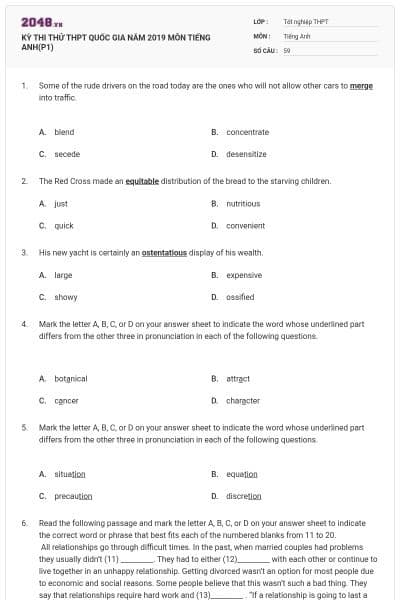
Some of the rude drivers on the road today are the ones who will not allow other cars to merge into traffic.
blend
concentrate
secede
desensitize
Chọn A Blend (v) hòa vào, lẫn vào Concentrate (v) tập trung Secede (v) rút ra, ly khai Desensitize(v) gây tê Dịch câu: ngày nay trên đường nhiều lái xe thô lỗ không cho xe khác tham gia giao thông
The Red Cross made an equitable distribution of the bread to the starving children.
just
nutritious
quick
convenient
Chọn A Equitable = just (a) công bằng , hợp lý
His new yacht is certainly an ostentatious display of his wealth.
large
expensive
showy
ossified
Chọn C Ostentatious = showy (a) khoe khoang Dịch câu: chiếc du thuyền mới thể hiện cái sự khoe mẽ tài sản của anh ta.
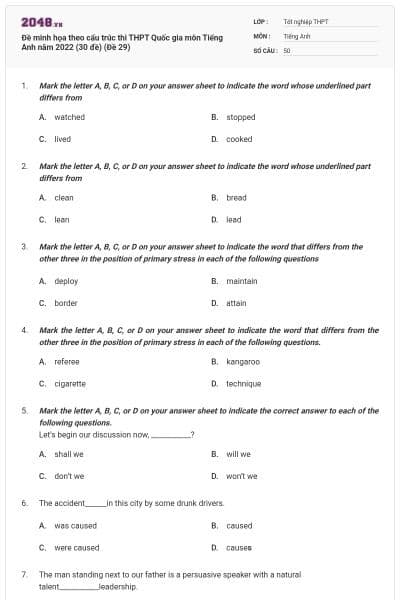
Mark the letter A, B, C, or D on your answer sheet to indicate the word whose underlined part differs from the other three in pronunciation in each of the following questions.
botanical
attract
cancer
character
Chọn D 3 đáp án A, B và C đều phát âm là /æ/, đáp án D đọc là /i/
Mark the letter A, B, C, or D on your answer sheet to indicate the word whose underlined part differs from the other three in pronunciation in each of the following questions.
situation
equation
precaution
discretion
Chọn B 3 đáp án A, C và D đều phát âm là /∫n/, đáp án B đọc là /ʒən/
Read the following passage and mark the letter A, B, C, or D on your answer sheet to indicate the correct word or phrase that best fits each of the numbered blanks from 11 to 20.
All relationships go through difficult times. In the past, when married couples had problems they usually didn’t (11) _________. They had to either (12)_________ with each other or continue to live together in an unhappy relationship. Getting divorced wasn’t an option for most people due to economic and social reasons. Some people believe that this wasn’t such a bad thing. They say that relationships require hard work and (13)_________ . “If a relationship is going to last a lifetime, you have to keep working at it,” says Doreen, who is celebrating her fiftieth wedding anniversary this year. “It isn’t all roses and romance. (14)_________ perfect all of the time.
These days young people give up when there’s the (15)_________ argument.” Experts agree that communication is key. The most important thing is to (16) _________talking. How many times have you heard yourself say to (17)_________ , “If only you’d listen!” or “ I wish you (18)_________ do that!” The truth is, the (19)_________ couples talk, the better their relationship (20) _________be.
Điền vào ô 11
grow up
split up
chat up
make up
Chọn B “In the past, when married couples had problems they usually didn’t split up”: trong quá khứ, khi mà những cặp vợ chồng có vấn đề, họ thường không li dị” Split up ;li dị, tan rã Không chọn các phương án còn lại do không hợp về nghĩa Chat up: ve vãn Grow up: lớn lên Make up: trang điểm
Read the following passage and mark the letter A, B, C, or D on your answer sheet to indicate the correct word or phrase that best fits each of the numbered blanks from 11 to 20.
All relationships go through difficult times. In the past, when married couples had problems they usually didn’t (11) _________. They had to either (12)_________ with each other or continue to live together in an unhappy relationship. Getting divorced wasn’t an option for most people due to economic and social reasons. Some people believe that this wasn’t such a bad thing. They say that relationships require hard work and (13)_________ . “If a relationship is going to last a lifetime, you have to keep working at it,” says Doreen, who is celebrating her fiftieth wedding anniversary this year. “It isn’t all roses and romance. (14)_________ perfect all of the time.
These days young people give up when there’s the (15)_________ argument.” Experts agree that communication is key. The most important thing is to (16) _________talking. How many times have you heard yourself say to (17)_________ , “If only you’d listen!” or “ I wish you (18)_________ do that!” The truth is, the (19)_________ couples talk, the better their relationship (20) _________be.
Điền vào ô 12
get on
go out
get back
fall out
Chọn A Get on with sb: sống hòa thuận với nhau
“They had to either get on with each other or continue to live together in an unhappy relationship”: hoặc là họ phải hòa
Chú ý: fall out with : cãi nhau với… ( không hợp về nghĩa)
Read the following passage and mark the letter A, B, C, or D on your answer sheet to indicate the correct word or phrase that best fits each of the numbered blanks from 11 to 20.
All relationships go through difficult times. In the past, when married couples had problems they usually didn’t (11) _________. They had to either (12)_________ with each other or continue to live together in an unhappy relationship. Getting divorced wasn’t an option for most people due to economic and social reasons. Some people believe that this wasn’t such a bad thing. They say that relationships require hard work and (13)_________ . “If a relationship is going to last a lifetime, you have to keep working at it,” says Doreen, who is celebrating her fiftieth wedding anniversary this year. “It isn’t all roses and romance. (14)_________ perfect all of the time.
These days young people give up when there’s the (15)_________ argument.” Experts agree that communication is key. The most important thing is to (16) _________talking. How many times have you heard yourself say to (17)_________ , “If only you’d listen!” or “ I wish you (18)_________ do that!” The truth is, the (19)_________ couples talk, the better their relationship (20) _________be.
Điền vào ô 13
agreement
argument
achievement
commitment
Chọn D
“They say that relationships require hard work and commitment”; họ nói rằng các mối quan hệ cần sự cố gắng nỗ
lực và trách nhiệm”
Achievement n) sự đạt được
Read the following passage and mark the letter A, B, C, or D on your answer sheet to indicate the correct word or phrase that best fits each of the numbered blanks from 11 to 20.
All relationships go through difficult times. In the past, when married couples had problems they usually didn’t (11) _________. They had to either (12)_________ with each other or continue to live together in an unhappy relationship. Getting divorced wasn’t an option for most people due to economic and social reasons. Some people believe that this wasn’t such a bad thing. They say that relationships require hard work and (13)_________ . “If a relationship is going to last a lifetime, you have to keep working at it,” says Doreen, who is celebrating her fiftieth wedding anniversary this year. “It isn’t all roses and romance. (14)_________ perfect all of the time.
These days young people give up when there’s the (15)_________ argument.” Experts agree that communication is key. The most important thing is to (16) _________talking. How many times have you heard yourself say to (17)_________ , “If only you’d listen!” or “ I wish you (18)_________ do that!” The truth is, the (19)_________ couples talk, the better their relationship (20) _________be.
Điền vào ô 14
No one
Someone
Anyone
Everyone
Chọn A
“ No one perfect all of the time”: không ai là hoàn hảo mọi lúc cả.
Read the following passage and mark the letter A, B, C, or D on your answer sheet to indicate the correct word or phrase that best fits each of the numbered blanks from 11 to 20.
All relationships go through difficult times. In the past, when married couples had problems they usually didn’t (11) _________. They had to either (12)_________ with each other or continue to live together in an unhappy relationship. Getting divorced wasn’t an option for most people due to economic and social reasons. Some people believe that this wasn’t such a bad thing. They say that relationships require hard work and (13)_________ . “If a relationship is going to last a lifetime, you have to keep working at it,” says Doreen, who is celebrating her fiftieth wedding anniversary this year. “It isn’t all roses and romance. (14)_________ perfect all of the time.
These days young people give up when there’s the (15)_________ argument.” Experts agree that communication is key. The most important thing is to (16) _________talking. How many times have you heard yourself say to (17)_________ , “If only you’d listen!” or “ I wish you (18)_________ do that!” The truth is, the (19)_________ couples talk, the better their relationship (20) _________be.
Điền vào ô 15
smallest
slightest
most violent
most controversial
Chọn B
“these days young people give up when there’s the slightest argument” : ngày nay, giới trẻ từ bỏ ngay khi có một cuộc cãi vã nhỏ nhất”
Ở đây ta không dùng “smallest” (thiên về kích cỡ của đối tượng hữu hình)
Read the following passage and mark the letter A, B, C, or D on your answer sheet to indicate the correct word or phrase that best fits each of the numbered blanks from 11 to 20.
All relationships go through difficult times. In the past, when married couples had problems they usually didn’t (11) _________. They had to either (12)_________ with each other or continue to live together in an unhappy relationship. Getting divorced wasn’t an option for most people due to economic and social reasons. Some people believe that this wasn’t such a bad thing. They say that relationships require hard work and (13)_________ . “If a relationship is going to last a lifetime, you have to keep working at it,” says Doreen, who is celebrating her fiftieth wedding anniversary this year. “It isn’t all roses and romance. (14)_________ perfect all of the time.
These days young people give up when there’s the (15)_________ argument.” Experts agree that communication is key. The most important thing is to (16) _________talking. How many times have you heard yourself say to (17)_________ , “If only you’d listen!” or “ I wish you (18)_________ do that!” The truth is, the (19)_________ couples talk, the better their relationship (20) _________be.
Điền vào ô 16
raise
control
stop
keep
Chọn D
Keep + Ving: liên tục làm gì
Read the following passage and mark the letter A, B, C, or D on your answer sheet to indicate the correct word or phrase that best fits each of the numbered blanks from 11 to 20.
All relationships go through difficult times. In the past, when married couples had problems they usually didn’t (11) _________. They had to either (12)_________ with each other or continue to live together in an unhappy relationship. Getting divorced wasn’t an option for most people due to economic and social reasons. Some people believe that this wasn’t such a bad thing. They say that relationships require hard work and (13)_________ . “If a relationship is going to last a lifetime, you have to keep working at it,” says Doreen, who is celebrating her fiftieth wedding anniversary this year. “It isn’t all roses and romance. (14)_________ perfect all of the time.
These days young people give up when there’s the (15)_________ argument.” Experts agree that communication is key. The most important thing is to (16) _________talking. How many times have you heard yourself say to (17)_________ , “If only you’d listen!” or “ I wish you (18)_________ do that!” The truth is, the (19)_________ couples talk, the better their relationship (20) _________be.
Điền vào ô 17
anybody
everyone
somebody
nobod
Chọn C
“how many times have you heard yourself say to somebody”: bao nhiêu lần bạn vừa nghe tự bản thân nói chuyện với ai đó”
Read the following passage and mark the letter A, B, C, or D on your answer sheet to indicate the correct word or phrase that best fits each of the numbered blanks from 11 to 20.
All relationships go through difficult times. In the past, when married couples had problems they usually didn’t (11) _________. They had to either (12)_________ with each other or continue to live together in an unhappy relationship. Getting divorced wasn’t an option for most people due to economic and social reasons. Some people believe that this wasn’t such a bad thing. They say that relationships require hard work and (13)_________ . “If a relationship is going to last a lifetime, you have to keep working at it,” says Doreen, who is celebrating her fiftieth wedding anniversary this year. “It isn’t all roses and romance. (14)_________ perfect all of the time.
These days young people give up when there’s the (15)_________ argument.” Experts agree that communication is key. The most important thing is to (16) _________talking. How many times have you heard yourself say to (17)_________ , “If only you’d listen!” or “ I wish you (18)_________ do that!” The truth is, the (19)_________ couples talk, the better their relationship (20) _________be.
Điền vào ô 18
wouldn’t
couldn’t
shouldn’t
didn’t
Chọn A
Ta có cấu trúc dùng để diễn tả ước muốn một điều gì đó xảy ra ở hiện tại:
I wish S + would (not) V…
Read the following passage and mark the letter A, B, C, or D on your answer sheet to indicate the correct word or phrase that best fits each of the numbered blanks from 11 to 20.
All relationships go through difficult times. In the past, when married couples had problems they usually didn’t (11) _________. They had to either (12)_________ with each other or continue to live together in an unhappy relationship. Getting divorced wasn’t an option for most people due to economic and social reasons. Some people believe that this wasn’t such a bad thing. They say that relationships require hard work and (13)_________ . “If a relationship is going to last a lifetime, you have to keep working at it,” says Doreen, who is celebrating her fiftieth wedding anniversary this year. “It isn’t all roses and romance. (14)_________ perfect all of the time.
These days young people give up when there’s the (15)_________ argument.” Experts agree that communication is key. The most important thing is to (16) _________talking. How many times have you heard yourself say to (17)_________ , “If only you’d listen!” or “ I wish you (18)_________ do that!” The truth is, the (19)_________ couples talk, the better their relationship (20) _________be.
Điền vào ô 19
more
fewer
less
least
Chọn A
Dịch câu cuối bài: sự thật là, các cặp đôi càng nói chuyện thì mối quan hệ càng trở nên tốt đẹp”
Cấu trúc: The + So sánh hơn… , The + So sánh hơn…: càng… càng
Không chọn D do “least” là so sánh hơn nhất, không chọn B và C do không hợp nghĩa.
Read the following passage and mark the letter A, B, C, or D on your answer sheet to indicate the correct word or phrase that best fits each of the numbered blanks from 11 to 20.
All relationships go through difficult times. In the past, when married couples had problems they usually didn’t (11) _________. They had to either (12)_________ with each other or continue to live together in an unhappy relationship. Getting divorced wasn’t an option for most people due to economic and social reasons. Some people believe that this wasn’t such a bad thing. They say that relationships require hard work and (13)_________ . “If a relationship is going to last a lifetime, you have to keep working at it,” says Doreen, who is celebrating her fiftieth wedding anniversary this year. “It isn’t all roses and romance. (14)_________ perfect all of the time.
These days young people give up when there’s the (15)_________ argument.” Experts agree that communication is key. The most important thing is to (16) _________talking. How many times have you heard yourself say to (17)_________ , “If only you’d listen!” or “ I wish you (18)_________ do that!” The truth is, the (19)_________ couples talk, the better their relationship (20) _________be.
Điền vào ô 20
would
could
will
can
Chọn D
Không chọn A và B do câu đang nói về vấn đề ở hiện tại, không phải trong quá khứ
Không chọn C do “can” dùng để diễ tả khả năng xảy ra của hành động.
Everyone expects Johnson to__________ Smith in today's final.
beat
win
score
champion
Chọn A
Beat sb: đánh bại ai
Champion (v): bênh vực, đấu tranh cho
Win: chiến thắng
Let's face__________we are destroying the environment and we need to do something now.
truth.
facts
things
information
Chọn B
Dịch câu: hãy cùng đối mặt với sự thật là chúng ta đang phá hủy môi trường vầ ta cẫn phải làm một cái gì đó.
Không chọn A do thiếu mạo từ, không chọn C và D do không hợp nghĩ
Many lives were saved__________ the introduction of antibiotics.
into
at
with
in
Chọn C
“Many lives were saved with the introduction of antibiotics.”: Nhiều sự sống được cứu nhờ sự ra đời của thuốc kháng
sinh.
A: "What is it?" B: “We don't know until __________at it under a microscope.
we're going to lock
we'll have looked
we'll be looking
we've looked
Chọn D
Chú ý cấu trúc mệnh đề chỉ thời gian( when, while, until,… ) ở hiện tại
When/while/ until/… S + V( động từ chia thì hiện tại), S will/can/should + V : khi/trong khi/ đến tận khi mà… thì…
( mệnh đề chứa các từ chỉ thời gian có thể chia thì hiện tại hoàn thành để nhấn mạnh hành động
Ten million text messages are sent on__________ every minute.
normal
general
common
average
ĐÁP ÁN D
White phosphorus, a substance__________ in matches, is so flammable that it burst into flame upon contact with the air.
is common
common
which being common
being common, is
Chọn B
Ta cần một cụm danh từ bổ sung nghĩa cho chủ ngữ của câu nên không chọn A và D do sai về ngữ pháp
Không chọn C do sau “which” phải là 1 mệnh đề.
More than one student __________to do those mathematic puzzles which __________by the teacher last week.
has tried / was given
have tried / were given
has tried / were given
have tried / was given
Chọn C
Với chủ ngữ “more than one student”, ta sẽ chia động từ sau đó là số ít => “has tried”
Do “those mathematic puzzles” là số nhiều => were give
Haven't you put an ad in the paper yet?" - "__________ "
I will, first thing in the morning.
I can get a paper for you.
I'm not sure.
I'm with you there.
Chọn A
"Haven't you put an ad in the paper yet?": cậu đã đưa mẩu quảng cáo vào tờ báo chưa vậy ?
“I will, first thing in the morning.” Mình sẽ làm ngay đầu buổi sáng.
Susan’s doctor insists__________ for a few days.
that she is resting
her resting
that she rest
her to rest
Chọn C
Ta có cấu trúc khuyên nhủ, yêu cầu, nài nỉ ai đó làm gì:
Insist that S + (should) + V …( chú ý ở đây nếu không có “should” động từ vẫn ở dạng nguyên thể)
=insist on st/ Ving
Không chọn B do thiếu giới từ “on”
Feeling tired after a long day of hard work,__________
the housework was of no interest to me.
my mother helped me with the housework.
I asked my mother to help me with the housework.
the housework was too much for me.
Chọn C
Ở đây dùng Ving để nối 2 mệnh đề cùng chủ ngữ. Ta cần xác định chủ thể của 2 hành động ở cả 2 mệnh đề đều là một.
=> không chọn A và D
Theo nghĩa dịch ta thấy C hợp lý hơn B
"You've really changed." - "__________ "
Yes, I am.
I'll never change my mind.
Have I?
Oh, sorry,I can't.
Chọn C
“You've really changed." : cậu thực sự thay đổi rồi đấy
ð “Have I?” : thật chứ ?
Không chọn A do “You've really changed." Không phải là câu hỏi cần câu trả lời Yes/ No
Không chọn B và D do không hợp nghĩa dịch
She must have been sleepless last night. Otherwise, her eyes__________ so bloodynow.
won’t look
wouldn’t look
wouldn’t have looked
looked
Chọn B
Dịch câu: cô ấy hẳn là đã mất ngủ tối qua. Nếu không thì bây giờ mắt cô ấy đã không đỏ như thế.
Ở đây ta dùng “would +V” để diễn tả kết quả hiện tại của 1 hành động xảy ra trong quá khứ ( tương tự như câu điều kiện 2 và 3 kết hợp)
The use of computers aids in teaching,__________ the role of teachers is still veryimportant.
although
yet
so that
because
Chọn B
Yet = but
Dịch câu: sử dụng máy tính thì giúp ích nhiều trong việc giảng dạy nhưng vai trò của những người thầy vẫn rất quan trọng.
You’ve got to be__________ certain before you decide.
deadly
deathly
dead
death
Chọn C
Dead certain : hoàn toàn chắc chắn
She had just enough time to __________the report before the meeting.
dip into
go into
turn round
get through
Chọn A
Dịch câu: cô ấy chỉ đủ thời gian xem lướt qua bài báo cáo trước cuộc họp
dip into: xem lướt qua
get through: đi qua, làm xong
turn around: ngoảnh lại
go into: đi vào, xem xét
"Well, could you call the airline and reconfirm my flight? I'm kind of busy right now." - "__________
Not at all.
I'll try. Let me have the details.
What are you doing?
What do you think I should do?
Chọn B
“I'll try. Let me have the details.” : tôi sẽ cố gắng. Hãy cho tôi chút thông tin( đưa ra lời đồng ý giúp đỡ)
Don't worry! By the time you arrive tomorrow, we __________the work
have completed
had completed
will have completed
would have completed
Chọn C
Ta có cấu trúc diễn tả hành động diễn ra trước khi hành động khác xảy ra trong tương lai.
By the time, S + V(hiện tại đơn), S will have VpII.
Dịch nghĩa: Đừng lo lắng! Khi bạn đến vào ngày mai, chúng tôi sẽ hoàn thành công việc rồi.
It was announced that neither the passengers nor the driver in the car crash__________
have been injured
were injured
are injured
was injured
Đáp án: D
Giải thích:
Kiến thức: Sự hòa hợp giữa chủ ngữ và động từ
Neither A nor B: động từ chia theo chủ ngữ B
“driver” là danh từ số ít, loại A, B và C.
Dịch: Có thông báo rằng cả hành khách và tài xế đều không bị thương trong vụ tai nạn.
__________that he had no choice but to leave early.
In such a situation did he find himself
In such a situation he found himself
He found himself in a situation where
He found himself in a so embarrassing situation
Chọn A
Đảo ngữ của mênh đề chứa cấu trúc: …such …that…: quá đến nỗi mà …
ð . In such a situation did he find himself that he had no choice but to leave early.
Read the following passage and mark the letter A, B, C, or D on your answer sheet to indicate the correct answer to each of the questions from 40 to 49.
On 26th May 1828, the people of Nuremberg in Germany found a teenage boy who waswandering alone through the streets. When they came across him, he had no possessions except for two old letters. Because of his behavior and appearance, they took him to the police station. Kaspar spent the next two months in prison, where he hardly spoke and refused all food except for bread and water. Some people assumed that Kaspar had grown up alone in the forest, like a wild animal. But gradually, a different picture emerged.
Kaspar said he had spent his whole childhood in a small dark cell. He had never seen the world outside or left his cell. He had never met or spoken to another human being. The cell was empty apart from a small bed and one toy-a wooden horse. He claimed that he had found bread and water in his cell every morning. According to Kaspar’s account, a mysterious man had begun to call on him shortly before his release. The man never showed his face.
Kaspar became well-known throughout Germany and in other countries too, and people found his ascinating. Some suggested that Kaspar was the son of a rich and powerful man-a prince perhaps-who wanted to keep his identity secret. A schoolteacher called Friedrich Daumer met Kaspar and agreed to look after him. Daumer taught him various subjects and encouraged Kaspar’s talent for drawing.
One day in 1829, Kaspar was found with a knife wound to his head. He claimed that a man with a hood over his face had attacked him-the same man who had brought him to Nuremberg. It wasn’t a serious injury, and Kaspar got over it. But in 1833, Hauser came home with a deep knife wound in his chest, saying someone had attacked him in a garden. Three days later, Kaspar died from the wound. Just before he died, Kaspar told the police that his attacker had given him a bag, so the police went to the garden and looked for it. They found it, with a note inside. The note was in mirror writing and said in German: “I want to tell you about myself. I come from the Bavarian border, on the river.”
Over the years, books have been written about Kaspar’s stories and various historians have looked into them. Most have concluded that the stories were untrue and that Kaspar Hauser was a liar who killed himself (possibly by mistake). But for some people, Kaspar Hauser’s life and death remain one of the most mysterious stories in history.
People in Nuremberg took Kaspar Hauser to the police station because .
he was carrying two letters
he said he wanted to be a soldier
he was acting strangely
he had no possessions
Chọn C
“was wandering alone through the streets”: .”: đi bộ một mình trên phố
“When they came across him, he had no possessions except for two old letters.”: khi họ bắt gặp anh ấy, anh ta không có
gì ngoài 2 lá thư cũ.
ð Anh ta có những hành động lạ
Read the following passage and mark the letter A, B, C, or D on your answer sheet to indicate the correct answer to each of the questions from 40 to 49.
On 26th May 1828, the people of Nuremberg in Germany found a teenage boy who waswandering alone through the streets. When they came across him, he had no possessions except for two old letters. Because of his behavior and appearance, they took him to the police station. Kaspar spent the next two months in prison, where he hardly spoke and refused all food except for bread and water. Some people assumed that Kaspar had grown up alone in the forest, like a wild animal. But gradually, a different picture emerged.
Kaspar said he had spent his whole childhood in a small dark cell. He had never seen the world outside or left his cell. He had never met or spoken to another human being. The cell was empty apart from a small bed and one toy-a wooden horse. He claimed that he had found bread and water in his cell every morning. According to Kaspar’s account, a mysterious man had begun to call on him shortly before his release. The man never showed his face.
Kaspar became well-known throughout Germany and in other countries too, and people found his ascinating. Some suggested that Kaspar was the son of a rich and powerful man-a prince perhaps-who wanted to keep his identity secret. A schoolteacher called Friedrich Daumer met Kaspar and agreed to look after him. Daumer taught him various subjects and encouraged Kaspar’s talent for drawing.
One day in 1829, Kaspar was found with a knife wound to his head. He claimed that a man with a hood over his face had attacked him-the same man who had brought him to Nuremberg. It wasn’t a serious injury, and Kaspar got over it. But in 1833, Hauser came home with a deep knife wound in his chest, saying someone had attacked him in a garden. Three days later, Kaspar died from the wound. Just before he died, Kaspar told the police that his attacker had given him a bag, so the police went to the garden and looked for it. They found it, with a note inside. The note was in mirror writing and said in German: “I want to tell you about myself. I come from the Bavarian border, on the river.”
Over the years, books have been written about Kaspar’s stories and various historians have looked into them. Most have concluded that the stories were untrue and that Kaspar Hauser was a liar who killed himself (possibly by mistake). But for some people, Kaspar Hauser’s life and death remain one of the most mysterious stories in history.
Before Kaspar told his story, some people believed that he had grown up ?
in prison
with his father, in a forest
without any people around him
in a normal home
Chọn C
“Some people assumed that Kaspar had grown up alone in the forest” nhiều người cho rằng Kaspar đã lớn lên một mình ở rừng => lớn lên mà không có người xung quanh
Read the following passage and mark the letter A, B, C, or D on your answer sheet to indicate the correct answer to each of the questions from 40 to 49.
On 26th May 1828, the people of Nuremberg in Germany found a teenage boy who waswandering alone through the streets. When they came across him, he had no possessions except for two old letters. Because of his behavior and appearance, they took him to the police station. Kaspar spent the next two months in prison, where he hardly spoke and refused all food except for bread and water. Some people assumed that Kaspar had grown up alone in the forest, like a wild animal. But gradually, a different picture emerged.
Kaspar said he had spent his whole childhood in a small dark cell. He had never seen the world outside or left his cell. He had never met or spoken to another human being. The cell was empty apart from a small bed and one toy-a wooden horse. He claimed that he had found bread and water in his cell every morning. According to Kaspar’s account, a mysterious man had begun to call on him shortly before his release. The man never showed his face.
Kaspar became well-known throughout Germany and in other countries too, and people found his ascinating. Some suggested that Kaspar was the son of a rich and powerful man-a prince perhaps-who wanted to keep his identity secret. A schoolteacher called Friedrich Daumer met Kaspar and agreed to look after him. Daumer taught him various subjects and encouraged Kaspar’s talent for drawing.
One day in 1829, Kaspar was found with a knife wound to his head. He claimed that a man with a hood over his face had attacked him-the same man who had brought him to Nuremberg. It wasn’t a serious injury, and Kaspar got over it. But in 1833, Hauser came home with a deep knife wound in his chest, saying someone had attacked him in a garden. Three days later, Kaspar died from the wound. Just before he died, Kaspar told the police that his attacker had given him a bag, so the police went to the garden and looked for it. They found it, with a note inside. The note was in mirror writing and said in German: “I want to tell you about myself. I come from the Bavarian border, on the river.”
Over the years, books have been written about Kaspar’s stories and various historians have looked into them. Most have concluded that the stories were untrue and that Kaspar Hauser was a liar who killed himself (possibly by mistake). But for some people, Kaspar Hauser’s life and death remain one of the most mysterious stories in history.
According to this passage, the word “possessions” is closest in meaning to
belongings
valuable
worth
savings
Chọn A
Possessions = belongings : đồ dùng cá nhân
Read the following passage and mark the letter A, B, C, or D on your answer sheet to indicate the correct answer to each of the questions from 40 to 49.
On 26th May 1828, the people of Nuremberg in Germany found a teenage boy who waswandering alone through the streets. When they came across him, he had no possessions except for two old letters. Because of his behavior and appearance, they took him to the police station. Kaspar spent the next two months in prison, where he hardly spoke and refused all food except for bread and water. Some people assumed that Kaspar had grown up alone in the forest, like a wild animal. But gradually, a different picture emerged.
Kaspar said he had spent his whole childhood in a small dark cell. He had never seen the world outside or left his cell. He had never met or spoken to another human being. The cell was empty apart from a small bed and one toy-a wooden horse. He claimed that he had found bread and water in his cell every morning. According to Kaspar’s account, a mysterious man had begun to call on him shortly before his release. The man never showed his face.
Kaspar became well-known throughout Germany and in other countries too, and people found his ascinating. Some suggested that Kaspar was the son of a rich and powerful man-a prince perhaps-who wanted to keep his identity secret. A schoolteacher called Friedrich Daumer met Kaspar and agreed to look after him. Daumer taught him various subjects and encouraged Kaspar’s talent for drawing.
One day in 1829, Kaspar was found with a knife wound to his head. He claimed that a man with a hood over his face had attacked him-the same man who had brought him to Nuremberg. It wasn’t a serious injury, and Kaspar got over it. But in 1833, Hauser came home with a deep knife wound in his chest, saying someone had attacked him in a garden. Three days later, Kaspar died from the wound. Just before he died, Kaspar told the police that his attacker had given him a bag, so the police went to the garden and looked for it. They found it, with a note inside. The note was in mirror writing and said in German: “I want to tell you about myself. I come from the Bavarian border, on the river.”
Over the years, books have been written about Kaspar’s stories and various historians have looked into them. Most have concluded that the stories were untrue and that Kaspar Hauser was a liar who killed himself (possibly by mistake). But for some people, Kaspar Hauser’s life and death remain one of the most mysterious stories in history.
According to his story, Kaspar spent the first years of his life .
in a dark cell with a mysterious man
in a dark cell with absolutely nothing in it
in the garden of a mysterious stranger
alone and always indoors
Chọn D
Dựa vào thông tin:” . He had never seen the world outside or left his cell. He had never met or spoken to another human
being”
Read the following passage and mark the letter A, B, C, or D on your answer sheet to indicate the correct answer to each of the questions from 40 to 49.
On 26th May 1828, the people of Nuremberg in Germany found a teenage boy who waswandering alone through the streets. When they came across him, he had no possessions except for two old letters. Because of his behavior and appearance, they took him to the police station. Kaspar spent the next two months in prison, where he hardly spoke and refused all food except for bread and water. Some people assumed that Kaspar had grown up alone in the forest, like a wild animal. But gradually, a different picture emerged.
Kaspar said he had spent his whole childhood in a small dark cell. He had never seen the world outside or left his cell. He had never met or spoken to another human being. The cell was empty apart from a small bed and one toy-a wooden horse. He claimed that he had found bread and water in his cell every morning. According to Kaspar’s account, a mysterious man had begun to call on him shortly before his release. The man never showed his face.
Kaspar became well-known throughout Germany and in other countries too, and people found his ascinating. Some suggested that Kaspar was the son of a rich and powerful man-a prince perhaps-who wanted to keep his identity secret. A schoolteacher called Friedrich Daumer met Kaspar and agreed to look after him. Daumer taught him various subjects and encouraged Kaspar’s talent for drawing.
One day in 1829, Kaspar was found with a knife wound to his head. He claimed that a man with a hood over his face had attacked him-the same man who had brought him to Nuremberg. It wasn’t a serious injury, and Kaspar got over it. But in 1833, Hauser came home with a deep knife wound in his chest, saying someone had attacked him in a garden. Three days later, Kaspar died from the wound. Just before he died, Kaspar told the police that his attacker had given him a bag, so the police went to the garden and looked for it. They found it, with a note inside. The note was in mirror writing and said in German: “I want to tell you about myself. I come from the Bavarian border, on the river.”
Over the years, books have been written about Kaspar’s stories and various historians have looked into them. Most have concluded that the stories were untrue and that Kaspar Hauser was a liar who killed himself (possibly by mistake). But for some people, Kaspar Hauser’s life and death remain one of the most mysterious stories in history
According to this passage, the phrase “call on” refers to .
speak to
visit
invite
ask
Chọn B
Call on = visit (v): ghé thăm
Read the following passage and mark the letter A, B, C, or D on your answer sheet to indicate the correct answer to each of the questions from 40 to 49.
On 26th May 1828, the people of Nuremberg in Germany found a teenage boy who waswandering alone through the streets. When they came across him, he had no possessions except for two old letters. Because of his behavior and appearance, they took him to the police station. Kaspar spent the next two months in prison, where he hardly spoke and refused all food except for bread and water. Some people assumed that Kaspar had grown up alone in the forest, like a wild animal. But gradually, a different picture emerged.
Kaspar said he had spent his whole childhood in a small dark cell. He had never seen the world outside or left his cell. He had never met or spoken to another human being. The cell was empty apart from a small bed and one toy-a wooden horse. He claimed that he had found bread and water in his cell every morning. According to Kaspar’s account, a mysterious man had begun to call on him shortly before his release. The man never showed his face.
Kaspar became well-known throughout Germany and in other countries too, and people found his ascinating. Some suggested that Kaspar was the son of a rich and powerful man-a prince perhaps-who wanted to keep his identity secret. A schoolteacher called Friedrich Daumer met Kaspar and agreed to look after him. Daumer taught him various subjects and encouraged Kaspar’s talent for drawing.
One day in 1829, Kaspar was found with a knife wound to his head. He claimed that a man with a hood over his face had attacked him-the same man who had brought him to Nuremberg. It wasn’t a serious injury, and Kaspar got over it. But in 1833, Hauser came home with a deep knife wound in his chest, saying someone had attacked him in a garden. Three days later, Kaspar died from the wound. Just before he died, Kaspar told the police that his attacker had given him a bag, so the police went to the garden and looked for it. They found it, with a note inside. The note was in mirror writing and said in German: “I want to tell you about myself. I come from the Bavarian border, on the river.”
Over the years, books have been written about Kaspar’s stories and various historians have looked into them. Most have concluded that the stories were untrue and that Kaspar Hauser was a liar who killed himself (possibly by mistake). But for some people, Kaspar Hauser’s life and death remain one of the most mysterious stories in history.
Some people suggested that Kaspar Hauser was
from another country
really an artist
the son of a schoolteacher
from a wealthy family
Chọn D
“Some suggested that Kaspar was the son of a rich and powerful man-a prince perhaps-who wanted to keep his identity
secret” => Kaspar đến từ 1 gia đình giàu có
Read the following passage and mark the letter A, B, C, or D on your answer sheet to indicate the correct answer to each of the questions from 40 to 49.On 26th May 1828, the people of Nuremberg in Germany found a teenage boy who waswandering alone through the streets. When they came across him, he had no possessions except for two old letters. Because of his behavior and appearance, they took him to the police station. Kaspar spent t
he next two months in prison, where he hardly spoke and refused all food except for bread and water. Some people assumed that Kaspar had grown up alone in the forest, like a wild animal. But gradually, a different picture emerged.
Kaspar said he had spent his whole childhood in a small dark cell. He had never seen the world outside or left his cell. He had never met or spoken to another human being. The cell was empty apart from a small bed and one toy-a wooden horse. He claimed that he had found bread and water in his cell every morning. According to Kaspar’s account, a mysterious man had begun to call on him shortly before his release. The man never showed his face.
Kaspar became well-known throughout Germany and in other countries too, and people found his ascinating. Some suggested that Kaspar was the son of a rich and powerful man-a prince perhaps-who wanted to keep his identity secret. A schoolteacher called Friedrich Daumer met Kaspar and agreed to look after him. Daumer taught him various subjects and encouraged Kaspar’s talent for drawing.
One day in 1829, Kaspar was found with a knife wound to his head. He claimed that a man with a hood over his face had attacked him-the same man who had brought him to Nuremberg. It wasn’t a serious injury, and Kaspar got over it. But in 1833, Hauser came home with a deep knife wound in his chest, saying someone had attacked him in a garden. Three days later, Kaspar died from the wound. Just before he died, Kaspar told the police that his attacker had given him a bag, so the police went to the garden and looked for it. They found it, with a note inside. The note was in mirror writing and said in German: “I want to tell you about myself. I come from the Bavarian border, on the river.”
Over the years, books have been written about Kaspar’s stories and various historians have looked into them. Most have concluded that the stories were untrue and that Kaspar Hauser was a liar who killed himself (possibly by mistake). But for some people, Kaspar Hauser’s life and death remain one of the most mysterious stories in history.
Between 1829 and 1833, Kaspar Hauser suffered .
two knife wounds, but they weren’t serious
two knife wounds, one small and one fatal
two very serious knife wounds
two knife wound on the same occasion
Chọn B
Đọc đoạn 4 ta có thể thấy Kapar bị 2 vết thương (1 vết nhẹ, 1 vết chí tử)
Read the following passage and mark the letter A, B, C, or D on your answer sheet to indicate the correct answer to each of the questions from 40 to 49.
On 26th May 1828, the people of Nuremberg in Germany found a teenage boy who waswandering alone through the streets. When they came across him, he had no possessions except for two old letters. Because of his behavior and appearance, they took him to the police station. Kaspar spent the next two months in prison, where he hardly spoke and refused all food except for bread and water. Some people assumed that Kaspar had grown up alone in the forest, like a wild animal. But gradually, a different picture emerged.
Kaspar said he had spent his whole childhood in a small dark cell. He had never seen the world outside or left his cell. He had never met or spoken to another human being. The cell was empty apart from a small bed and one toy-a wooden horse. He claimed that he had found bread and water in his cell every morning. According to Kaspar’s account, a mysterious man had begun to call on him shortly before his release. The man never showed his face.
Kaspar became well-known throughout Germany and in other countries too, and people found his ascinating. Some suggested that Kaspar was the son of a rich and powerful man-a prince perhaps-who wanted to keep his identity secret. A schoolteacher called Friedrich Daumer met Kaspar and agreed to look after him. Daumer taught him various subjects and encouraged Kaspar’s talent for drawing.
One day in 1829, Kaspar was found with a knife wound to his head. He claimed that a man with a hood over his face had attacked him-the same man who had brought him to Nuremberg. It wasn’t a serious injury, and Kaspar got over it. But in 1833, Hauser came home with a deep knife wound in his chest, saying someone had attacked him in a garden. Three days later, Kaspar died from the wound. Just before he died, Kaspar told the police that his attacker had given him a bag, so the police went to the garden and looked for it. They found it, with a note inside. The note was in mirror writing and said in German: “I want to tell you about myself. I come from the Bavarian border, on the river.”
Over the years, books have been written about Kaspar’s stories and various historians have looked into them. Most have concluded that the stories were untrue and that Kaspar Hauser was a liar who killed himself (possibly by mistake). But for some people, Kaspar Hauser’s life and death remain one of the most mysterious stories in history.
According to this passage, the word “hood” is closest in meaning to .
mask
stocking cap
bonnet
top hat
Chọn A
Hood = mask (n) mũ trùm qua đầu
Read the following passage and mark the letter A, B, C, or D on your answer sheet to indicate the correct answer to each of the questions from 40 to 49.
On 26th May 1828, the people of Nuremberg in Germany found a teenage boy who waswandering alone through the streets. When they came across him, he had no possessions except for two old letters. Because of his behavior and appearance, they took him to the police station. Kaspar spent the next two months in prison, where he hardly spoke and refused all food except for bread and water. Some people assumed that Kaspar had grown up alone in the forest, like a wild animal. But gradually, a different picture emerged.
Kaspar said he had spent his whole childhood in a small dark cell. He had never seen the world outside or left his cell. He had never met or spoken to another human being. The cell was empty apart from a small bed and one toy-a wooden horse. He claimed that he had found bread and water in his cell every morning. According to Kaspar’s account, a mysterious man had begun to call on him shortly before his release. The man never showed his face.
Kaspar became well-known throughout Germany and in other countries too, and people found his ascinating. Some suggested that Kaspar was the son of a rich and powerful man-a prince perhaps-who wanted to keep his identity secret. A schoolteacher called Friedrich Daumer met Kaspar and agreed to look after him. Daumer taught him various subjects and encouraged Kaspar’s talent for drawing.
One day in 1829, Kaspar was found with a knife wound to his head. He claimed that a man with a hood over his face had attacked him-the same man who had brought him to Nuremberg. It wasn’t a serious injury, and Kaspar got over it. But in 1833, Hauser came home with a deep knife wound in his chest, saying someone had attacked him in a garden. Three days later, Kaspar died from the wound. Just before he died, Kaspar told the police that his attacker had given him a bag, so the police went to the garden and looked for it. They found it, with a note inside. The note was in mirror writing and said in German: “I want to tell you about myself. I come from the Bavarian border, on the river.”
Over the years, books have been written about Kaspar’s stories and various historians have looked into them. Most have concluded that the stories were untrue and that Kaspar Hauser was a liar who killed himself (possibly by mistake). But for some people, Kaspar Hauser’s life and death remain one of the most mysterious stories in history.
Police found a mysterious letter inside a bag .
in Kaspar Hauser’s room, after his death
in the place where Kaspar Hauser died
near a river in Baravia
in the place where Kaspar Hauser was attacked
Chọn D
“Just before he died, Kaspar told the police that his attacker had given him a bag, so the police went to the garden and
looked for it.” : ngay trước khi chết, Kaspar đã bảo cảnh sát rằng kẻ tấn công đưa cho anh ta 1 cái túi, vì thế cảnh sát đã
tới vườn và tìm nó.
ð Cảnh sát đã tìm thấy bức thư bí mật bên trong cái túi ở ngay tại nơi Kaspar bị tấn công
Read the following passage and mark the letter A, B, C, or D on your answer sheet to indicate the correct answer to each of the questions from 40 to 49.
On 26th May 1828, the people of Nuremberg in Germany found a teenage boy who waswandering alone through the streets. When they came across him, he had no possessions except for two old letters. Because of his behavior and appearance, they took him to the police station. Kaspar spent the next two months in prison, where he hardly spoke and refused all food except for bread and water. Some people assumed that Kaspar had grown up alone in the forest, like a wild animal. But gradually, a different picture emerged.
Kaspar said he had spent his whole childhood in a small dark cell. He had never seen the world outside or left his cell. He had never met or spoken to another human being. The cell was empty apart from a small bed and one toy-a wooden horse. He claimed that he had found bread and water in his cell every morning. According to Kaspar’s account, a mysterious man had begun to call on him shortly before his release. The man never showed his face.
Kaspar became well-known throughout Germany and in other countries too, and people found his ascinating. Some suggested that Kaspar was the son of a rich and powerful man-a prince perhaps-who wanted to keep his identity secret. A schoolteacher called Friedrich Daumer met Kaspar and agreed to look after him. Daumer taught him various subjects and encouraged Kaspar’s talent for drawing.
One day in 1829, Kaspar was found with a knife wound to his head. He claimed that a man with a hood over his face had attacked him-the same man who had brought him to Nuremberg. It wasn’t a serious injury, and Kaspar got over it. But in 1833, Hauser came home with a deep knife wound in his chest, saying someone had attacked him in a garden. Three days later, Kaspar died from the wound. Just before he died, Kaspar told the police that his attacker had given him a bag, so the police went to the garden and looked for it. They found it, with a note inside. The note was in mirror writing and said in German: “I want to tell you about myself. I come from the Bavarian border, on the river.”
Over the years, books have been written about Kaspar’s stories and various historians have looked into them. Most have concluded that the stories were untrue and that Kaspar Hauser was a liar who killed himself (possibly by mistake). But for some people, Kaspar Hauser’s life and death remain one of the most mysterious stories in history.
Most historians today believed that Kaspar Hauser .
was the son of a Baravian prince
was one of the most mysterious poeple in history
invented the story of his life
did not really die from the knife wound
Chọn C
“Most have concluded that the stories were untrue and that Kaspar Hauser was a liar who killed himself”: hầu hết kết luận
rằng câu chuyện là không có thật và Kaspar Hauser người mà đã tự sát thì thực chất là kẻ nói dối
ð Đáp án C( Kaspar đã bịa chuyện về cuộc đời mình)
Mark the letter A, B, C or D on your answer sheet to indicate the word that differs from the other three in the position of primary stress in each of the following questions
magnificent
eliminate
archaeology
stability
Chọn C
Do đáp án C có trọng âm vào âm tiết thứ 3, các đáp án còn lại rơi vào âm thứ 2
Mark the letter A, B, C or D on your answer sheet to indicate the word that differs from the other three in the position of primary stress in each of the following questions
enthusiast
voluntarily
picturesque
underlined
Chọn A do A trọng âm vào âm thứ 2, các từ còn lại rơi vào âm tiết thứ 1
Chú ý từ “picturesque” trọng âm chính rơi vào âm thứ 3, trọng âm phụ rơi vào âm thứ 1. Trong trường hợp này ta coi như
trọng âm của từ rơi vào âm thứ 1.
Mark the letter A, B, C or D on your answer sheet to indicate the word that differs from the other three in the position of primary stress in each of the following questions
misadventure
misbehavior
misconception
mischievously
Chọn D
Các đáp án A B hay C đều có trọng âm rơi vào âm thứ 3 trong khi đáp án D rơi vào âm tiết thứ 1.
Read the following passage and mark the letter A, B, C or D on your answer sheet to indicate the correct answer to each of the questions from 53 to 62.
History books recorded that the first film with sound was The Jazz Singer in 1927. But sound films, or talkies, did not suddenly appear after years of silent screenings. From the earliest public performances in 1896, films were accompanied by music and sound effects. These were produced by a single pianist, a small band, or a full-scale orchestra; large movie theatres could buy sound-effect machines. Research into sound that was reproduced at exactly at the same time as the pictures – called “synchronized sound” – began soon after the very first films were shown. With synchronized sound, characters on the movie screen could sing and speak. As early as 1896, the newly invented gramophone, which played a large disc carrying music and dialogue, was used as a sound system. The biggest disadvantage was that the sound and pictures could become unsynchronized if, for example, the gramophone needle jumped or if the speed of the projector changed. This system was only effective for a single song or dialogue sequence.
In the “sound-on-film” system, sound was recorded as a series of marks on celluloid which could be read by an optical sensor. These signals would be placed on the film alongside the image, guaranteeing synchronization. Short feature films were produced in this way as early as 1922. This system eventually brought us “talking pictures”.
The passage is mainly about the _________.
history of silent movies
disadvantages of synchronized sound
development of sound with movies
research into sound reproduction
Chọn C
Dựa vào nội dung ở toàn bài để trả lời câu hỏi ( nên làm câu hỏi khái quát này sau cùng)
Read the following passage and mark the letter A, B, C or D on your answer sheet to indicate the correct answer to each of the questions from 53 to 62.
History books recorded that the first film with sound was The Jazz Singer in 1927. But sound films, or talkies, did not suddenly appear after years of silent screenings. From the earliest public performances in 1896, films were accompanied by music and sound effects. These were produced by a single pianist, a small band, or a full-scale orchestra; large movie theatres could buy sound-effect machines. Research into sound that was reproduced at exactly at the same time as the pictures – called “synchronized sound” – began soon after the very first films were shown. With synchronized sound, characters on the movie screen could sing and speak. As early as 1896, the newly invented gramophone, which played a large disc carrying music and dialogue, was used as a sound system. The biggest disadvantage was that the sound and pictures could become unsynchronized if, for example, the gramophone needle jumped or if the speed of the projector changed. This system was only effective for a single song or dialogue sequence.
In the “sound-on-film” system, sound was recorded as a series of marks on celluloid which could be read by an optical sensor. These signals would be placed on the film alongside the image, guaranteeing synchronization. Short feature films were produced in this way as early as 1922. This system eventually brought us “talking pictures”.
According to the passage, films using sound effects were screened_________ .
before 1896
as early as 1896
as early as 1922
in 1927
Chọn B
Dựa vào thông tin; “From the earliest public performances in 1896, films were accompanied by music and sound effects”.
Read the following passage and mark the letter A, B, C or D on your answer sheet to indicate the correct answer to each of the questions from 53 to 62.
History books recorded that the first film with sound was The Jazz Singer in 1927. But sound films, or talkies, did not suddenly appear after years of silent screenings. From the earliest public performances in 1896, films were accompanied by music and sound effects. These were produced by a single pianist, a small band, or a full-scale orchestra; large movie theatres could buy sound-effect machines. Research into sound that was reproduced at exactly at the same time as the pictures – called “synchronized sound” – began soon after the very first films were shown. With synchronized sound, characters on the movie screen could sing and speak. As early as 1896, the newly invented gramophone, which played a large disc carrying music and dialogue, was used as a sound system. The biggest disadvantage was that the sound and pictures could become unsynchronized if, for example, the gramophone needle jumped or if the speed of the projector changed. This system was only effective for a single song or dialogue sequence.
In the “sound-on-film” system, sound was recorded as a series of marks on celluloid which could be read by an optical sensor. These signals would be placed on the film alongside the image, guaranteeing synchronization. Short feature films were produced in this way as early as 1922. This system eventually brought us “talking pictures”.
The word “screenings” in is closest in meaning to _________.
projections
revelations
demonstrations
diversions
Chọn A
Screening = projection(n) chiếu phim
Read the following passage and mark the letter A, B, C or D on your answer sheet to indicate the correct answer to each of the questions from 53 to 62.
History books recorded that the first film with sound was The Jazz Singer in 1927. But sound films, or talkies, did not suddenly appear after years of silent screenings. From the earliest public performances in 1896, films were accompanied by music and sound effects. These were produced by a single pianist, a small band, or a full-scale orchestra; large movie theatres could buy sound-effect machines. Research into sound that was reproduced at exactly at the same time as the pictures – called “synchronized sound” – began soon after the very first films were shown. With synchronized sound, characters on the movie screen could sing and speak. As early as 1896, the newly invented gramophone, which played a large disc carrying music and dialogue, was used as a sound system. The biggest disadvantage was that the sound and pictures could become unsynchronized if, for example, the gramophone needle jumped or if the speed of the projector changed. This system was only effective for a single song or dialogue sequence.
In the “sound-on-film” system, sound was recorded as a series of marks on celluloid which could be read by an optical sensor. These signals would be placed on the film alongside the image, guaranteeing synchronization. Short feature films were produced in this way as early as 1922. This system eventually brought us “talking pictures”.
Which of the following is not mentioned as a producer of sound to accompany movies?
a jazz singer
single pianist
a small band
a gramophone
Chọn A
“These were produced by a single pianist, a small band, or a full-scale orchestra” => có xuất hiện đáp án B và C
“gramophone” có ở những câu phía dưới cùng đoạn.
Vậy chỉ có đáp án A không xuất hiên. Chọn A
Read the following passage and mark the letter A, B, C or D on your answer sheet to indicate the correct answer to each of the questions from 53 to 62.
History books recorded that the first film with sound was The Jazz Singer in 1927. But sound films, or talkies, did not suddenly appear after years of silent screenings. From the earliest public performances in 1896, films were accompanied by music and sound effects. These were produced by a single pianist, a small band, or a full-scale orchestra; large movie theatres could buy sound-effect machines. Research into sound that was reproduced at exactly at the same time as the pictures – called “synchronized sound” – began soon after the very first films were shown. With synchronized sound, characters on the movie screen could sing and speak. As early as 1896, the newly invented gramophone, which played a large disc carrying music and dialogue, was used as a sound system. The biggest disadvantage was that the sound and pictures could become unsynchronized if, for example, the gramophone needle jumped or if the speed of the projector changed. This system was only effective for a single song or dialogue sequence.
In the “sound-on-film” system, sound was recorded as a series of marks on celluloid which could be read by an optical sensor. These signals would be placed on the film alongside the image, guaranteeing synchronization. Short feature films were produced in this way as early as 1922. This system eventually brought us “talking pictures”.
It can be inferred that_________ .
most movie theaters had a pianist
sound-effects machines were not common because they were expensive
orchestras couldn't synchronize sound with the pictures
gramophones were developed about the same time as moving pictures.
Chọn D
Ta có thông tin: “Research into sound that was reproduced at exactly at the same time as the pictures - called
“synchronized sound” – began soon after the very first films were shown”. Chú ý cụm từ “at the same time” nghĩa là cùng 1 thời điểm.
Read the following passage and mark the letter A, B, C or D on your answer sheet to indicate the correct answer to each of the questions from 53 to 62.
History books recorded that the first film with sound was The Jazz Singer in 1927. But sound films, or talkies, did not suddenly appear after years of silent screenings. From the earliest public performances in 1896, films were accompanied by music and sound effects. These were produced by a single pianist, a small band, or a full-scale orchestra; large movie theatres could buy sound-effect machines. Research into sound that was reproduced at exactly at the same time as the pictures – called “synchronized sound” – began soon after the very first films were shown. With synchronized sound, characters on the movie screen could sing and speak. As early as 1896, the newly invented gramophone, which played a large disc carrying music and dialogue, was used as a sound system. The biggest disadvantage was that the sound and pictures could become unsynchronized if, for example, the gramophone needle jumped or if the speed of the projector changed. This system was only effective for a single song or dialogue sequence.
In the “sound-on-film” system, sound was recorded as a series of marks on celluloid which could be read by an optical sensor. These signals would be placed on the film alongside the image, guaranteeing synchronization. Short feature films were produced in this way as early as 1922. This system eventually brought us “talking pictures”.
According to the passage, gramophones were ineffective because they _________.
got out of synchronization with the pictures.
were too large for most movie theaters.
were newly invented and still had imperfections
changed speeds when the needle jumped.
Chọn C
Thông tin về sự không hiệu quả của “gramophone” là “newly invented” và “The biggest disadvantage was that the sound
and pictures could become unsynchronized”
ð“gramophone” vẫn còn non trẻ và thiếu sót. Chọn C
Read the following passage and mark the letter A, B, C or D on your answer sheet to indicate the correct answer to each of the questions from 53 to 62.
History books recorded that the first film with sound was The Jazz Singer in 1927. But sound films, or talkies, did not suddenly appear after years of silent screenings. From the earliest public performances in 1896, films were accompanied by music and sound effects. These were produced by a single pianist, a small band, or a full-scale orchestra; large movie theatres could buy sound-effect machines. Research into sound that was reproduced at exactly at the same time as the pictures – called “synchronized sound” – began soon after the very first films were shown. With synchronized sound, characters on the movie screen could sing and speak. As early as 1896, the newly invented gramophone, which played a large disc carrying music and dialogue, was used as a sound system. The biggest disadvantage was that the sound and pictures could become unsynchronized if, for example, the gramophone needle jumped or if the speed of the projector changed. This system was only effective for a single song or dialogue sequence.
In the “sound-on-film” system, sound was recorded as a series of marks on celluloid which could be read by an optical sensor. These signals would be placed on the film alongside the image, guaranteeing synchronization. Short feature films were produced in this way as early as 1922. This system eventually brought us “talking pictures”.
According to the passage, the word “sequence” is closest in meaning to_________.
interpretation
progression
distribution
organization
Chọn B
Sequence = progression (n) chuỗi, sự tiếp nối
Read the following passage and mark the letter A, B, C or D on your answer sheet to indicate the correct answer to each of the questions from 53 to 62.
History books recorded that the first film with sound was The Jazz Singer in 1927. But sound films, or talkies, did not suddenly appear after years of silent screenings. From the earliest public performances in 1896, films were accompanied by music and sound effects. These were produced by a single pianist, a small band, or a full-scale orchestra; large movie theatres could buy sound-effect machines. Research into sound that was reproduced at exactly at the same time as the pictures – called “synchronized sound” – began soon after the very first films were shown. With synchronized sound, characters on the movie screen could sing and speak. As early as 1896, the newly invented gramophone, which played a large disc carrying music and dialogue, was used as a sound system. The biggest disadvantage was that the sound and pictures could become unsynchronized if, for example, the gramophone needle jumped or if the speed of the projector changed. This system was only effective for a single song or dialogue sequence.
In the “sound-on-film” system, sound was recorded as a series of marks on celluloid which could be read by an optical sensor. These signals would be placed on the film alongside the image, guaranteeing synchronization. Short feature films were produced in this way as early as 1922. This system eventually brought us “talking pictures”.
According to the passage, the phrase “these signals” refers to _________.
sounds
series
marks
sensors
Chọn C
Dựa vào câu đầu đoạn 2 “In the “sound-on-film” system, sound was recorded as a series of marks on celluloid which
could be read by an optical sensor”
Read the following passage and mark the letter A, B, C or D on your answer sheet to indicate the correct answer to each of the questions from 53 to 62.
History books recorded that the first film with sound was The Jazz Singer in 1927. But sound films, or talkies, did not suddenly appear after years of silent screenings. From the earliest public performances in 1896, films were accompanied by music and sound effects. These were produced by a single pianist, a small band, or a full-scale orchestra; large movie theatres could buy sound-effect machines. Research into sound that was reproduced at exactly at the same time as the pictures – called “synchronized sound” – began soon after the very first films were shown. With synchronized sound, characters on the movie screen could sing and speak. As early as 1896, the newly invented gramophone, which played a large disc carrying music and dialogue, was used as a sound system. The biggest disadvantage was that the sound and pictures could become unsynchronized if, for example, the gramophone needle jumped or if the speed of the projector changed. This system was only effective for a single song or dialogue sequence.
In the “sound-on-film” system, sound was recorded as a series of marks on celluloid which could be read by an optical sensor. These signals would be placed on the film alongside the image, guaranteeing synchronization. Short feature films were produced in this way as early as 1922. This system eventually brought us “talking pictures”.
According to the passage, the phrase “these signals” refers to _________.
sounds
series
marks
sensors
Chọn C
Dựa vào thông tin: “These signals would be placed on the film alongside the image, guaranteeing synchronization”
:những tín hiều này được đặt trên phim dọc theo hình ảnh, đảm bảo sự đồng bộ hóa.
Read the following passage and mark the letter A, B, C or D on your answer sheet to indicate the correct answer to each of the questions from 53 to 62.
History books recorded that the first film with sound was The Jazz Singer in 1927. But sound films, or talkies, did not suddenly appear after years of silent screenings. From the earliest public performances in 1896, films were accompanied by music and sound effects. These were produced by a single pianist, a small band, or a full-scale orchestra; large movie theatres could buy sound-effect machines. Research into sound that was reproduced at exactly at the same time as the pictures – called “synchronized sound” – began soon after the very first films were shown. With synchronized sound, characters on the movie screen could sing and speak. As early as 1896, the newly invented gramophone, which played a large disc carrying music and dialogue, was used as a sound system. The biggest disadvantage was that the sound and pictures could become unsynchronized if, for example, the gramophone needle jumped or if the speed of the projector changed. This system was only effective for a single song or dialogue sequence.
In the “sound-on-film” system, sound was recorded as a series of marks on celluloid which could be read by an optical sensor. These signals would be placed on the film alongside the image, guaranteeing synchronization. Short feature films were produced in this way as early as 1922. This system eventually brought us “talking pictures”.
Short feature films produced as early as 1922 _________.
were recorded by optical sensors
put musicians out of work
were only effective for dialogue sequences
preceding talking pictures
Chọn D
Short feature films were produced in this way as early as 1922. This system eventually brought us “talking pictures” =>
“Short feature films” có trước “talking pictures”
Mark the letter A, B, C, or D on your answer sheet to indicate the word(s) OPPOSITE in meaning to the underlined word(s) in each of the following questions.
Names of people in the book were changed to preserve anonymity
reveal
conserve
cover
presume
Chọn A
Dịch câu: tên của các nhân vật trong cuốn sách đã được thay đổi để bảo toàn danh tính
Preserve: giữ, bảo vệ
Trái nghĩa với “reveal” (tiết lộ)
Mark the letter A, B, C, or D on your answer sheet to indicate the word(s) OPPOSITE in meaning to the underlined word(s) in each of the following questions.
Doctors have been criticized for their indiscriminate use of antibiotics.
disciplined
selective
wholesale
unconscious
Chọn B
Dịch câu: Bác sĩ vừa bị chỉ trích do sử dụng kháng sinh bừa bãi
Indiscriminate(a): bừa bãi
>< selective(a) có chọn lọc