Giải SBT Toán 10 CD Bài 4. Tổng và hiệu của hai vectơ có đáp án
19 câu hỏi
Cho ba điểm M, N, P phân biệt. Phát biểu nào sau đây là đúng?
A. \(\overrightarrow {MN} - \overrightarrow {NP} = \overrightarrow {MP} \).
B. \( - \overrightarrow {MN} + \overrightarrow {NP} = \overrightarrow {MP} \).
C. \(\overrightarrow {MN} + \overrightarrow {NP} = \overrightarrow {MP} \).
D. \(\overrightarrow {MN} + \overrightarrow {NP} = - \overrightarrow {MP} \).
Lời giải
Đáp án đúng là C
Ta có: \(\overrightarrow {MN} - \overrightarrow {NP} = \overrightarrow {MN} + \overrightarrow {PN} = \overrightarrow {MN} + \overrightarrow {MK} = \overrightarrow {MH} \ne \overrightarrow {MP} \) (H, K là điểm thỏa mãn MKHN là hình bình hành). Do đó A sai.
Ta có: \( - \overrightarrow {MN} + \overrightarrow {NP} = \overrightarrow {NM} + \overrightarrow {NP} = \overrightarrow {NT} \ne \overrightarrow {MP} \)(T là điểm MNPT là hình bình hành). Do đó B sai
Ta có: \(\overrightarrow {MN} + \overrightarrow {NP} = \overrightarrow {MP} \) (quy tắc ba điểm). Do đó C đúng.
Ta có: \(\overrightarrow {MN} + \overrightarrow {NP} = \overrightarrow {MP} \ne - \overrightarrow {MP} \). Do đó D sai.
Cho tứ giác ABCD là hình bình hành. Khẳng định nào sau đây đúng?
A. \(\overrightarrow {BA} + \overrightarrow {DA} = \overrightarrow {CA} \).
B. \(\overrightarrow {AB} + \overrightarrow {BC} = \overrightarrow {AD} \).
C. \(\overrightarrow {AB} + \overrightarrow {AD} = \overrightarrow {CA} \).
D. \(\overrightarrow {AB} + \overrightarrow {BC} = - \overrightarrow {AC} \).
Lời giải
Đáp án đúng là A
Ta có: \(\overrightarrow {BA} + \overrightarrow {DA} = \overrightarrow {BA} + \overrightarrow {CB} = \overrightarrow {CB} + \overrightarrow {BA} = \overrightarrow {CA} \). Do đó A đúng.
Ta có: \(\overrightarrow {AB} + \overrightarrow {BC} = \overrightarrow {AC} \ne \overrightarrow {AD} \). Do đó B sai.
Ta có: \(\overrightarrow {AB} + \overrightarrow {AD} = \overrightarrow {AC} \ne \overrightarrow {CA} \). Do đó C sai.
Ta có: \(\overrightarrow {AB} + \overrightarrow {BC} = \overrightarrow {AC} \ne - \overrightarrow {AC} \). Do đó D sai.
A. \(\overrightarrow {AB} = \overrightarrow {OA} - \overrightarrow {OB} \).
B. \(\overrightarrow {AB} = \overrightarrow {OB} - \overrightarrow {OA} \).
C. \(\overrightarrow {AB} = \overrightarrow {OA} + \overrightarrow {OB} \).
D. \(\overrightarrow {AB} = \overrightarrow {OB} + \overrightarrow {OA} \).
Lời giải
Đáp án đúng là B
Cho các điểm A, B, O. Khẳng định nào sau đây đúng?
Ta có: \(\overrightarrow {OA} - \overrightarrow {OB} = \overrightarrow {OA} + \overrightarrow {BO} = \overrightarrow {BO} + \overrightarrow {OA} = \overrightarrow {BA} \ne \overrightarrow {AB} \). Do đó A sai.
Ta có: \(\overrightarrow {OB} - \overrightarrow {OA} = \overrightarrow {OB} + \overrightarrow {AO} = \overrightarrow {AO} + \overrightarrow {OB} = \overrightarrow {AB} \). Do đó B đúng.
Ta có: \(\overrightarrow {OA} + \overrightarrow {OB} = \overrightarrow {OC} \ne \overrightarrow {AB} \) (C là điểm thỏa mãn OBCA là hình bình hành). Do đó C sai.
Ta có: \(\overrightarrow {OB} + \overrightarrow {OA} = \overrightarrow {OC} \ne \overrightarrow {AB} \)(C là điểm thỏa mãn OBCA là hình bình hành). Do đó D sai.
Cho ba điểm A, B, M phân biệt. Điều kiện cần và đủ để M là trung điểm của đoạn thẳng AB là:
A. \(\overrightarrow {MA} = \overrightarrow {MB} \).
B. \(\left| {\overrightarrow {MA} } \right| = \left| {\overrightarrow {MB} } \right|\).
C. \(\overrightarrow {MA} ,\overrightarrow {MB} \) ngược hướng.
D. \(\overrightarrow {MA} + \overrightarrow {MB} = \overrightarrow 0 \).
Lời giải
Đáp án đúng là D
M là trung điểm của đoạn thẳng AB thì MA = MB và \(\overrightarrow {MA} ,\overrightarrow {MB} \) ngược hướng.
⇒ \(\overrightarrow {MA} = - \overrightarrow {MB} \) hay \(\overrightarrow {MA} + \overrightarrow {MB} = \overrightarrow 0 .\)
Vậy điều kiện đủ đề M là trung điểm của đoạn thẳng AB là \(\overrightarrow {MA} + \overrightarrow {MB} = \overrightarrow 0 .\)
Cho tam giác ABC. Điều kiện cần và đủ để G là trọng tâm của tam giác ABC là:
A. \(\overrightarrow {GA} + \overrightarrow {GB} = \overrightarrow {GC} \).
B. \(\overrightarrow {GB} + \overrightarrow {GC} = \overrightarrow {AG} \).
C. \(\overrightarrow {GC} + \overrightarrow {GB} = \overrightarrow {GA} \).
D. \(\overrightarrow {GA} + \overrightarrow {GB} - \overrightarrow {GC} = \overrightarrow 0 \).
Lời giải
Đáp án đúng là B
Điều kiện cần và đủ để G là trọng tâm của tam giác ABC là \(\overrightarrow {GA} + \overrightarrow {GB} + \overrightarrow {GC} = \overrightarrow 0 \)
⇔ \(\overrightarrow {GB} + \overrightarrow {GC} = - \overrightarrow {GA} \)
⇔ \(\overrightarrow {GB} + \overrightarrow {GC} = \overrightarrow {AG} \)
Lời giải
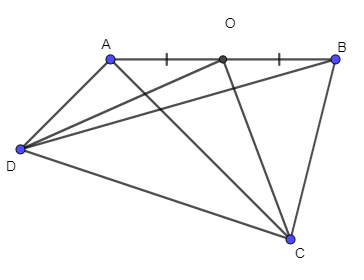
Ta có: \(\overrightarrow {AC} + \overrightarrow {BD} \)
\( = \left( {\overrightarrow {AO} + \overrightarrow {OC} } \right) + \left( {\overrightarrow {BO} + \overrightarrow {OD} } \right)\)
\( = \left( {\overrightarrow {AO} + \overrightarrow {BO} } \right) + \left( {\overrightarrow {OC} + \overrightarrow {OD} } \right)\)
\( = \overrightarrow 0 + \left( {\overrightarrow {OC} + \overrightarrow {OD} } \right)\)
\( = \overrightarrow {OC} + \overrightarrow {OD} \).
Cho tam giác ABC vuông tại A, AB = 4a, AC = 5a. Tính:
\(\left| {\overrightarrow {AB} - \overrightarrow {AC} } \right|\);
Lời giải
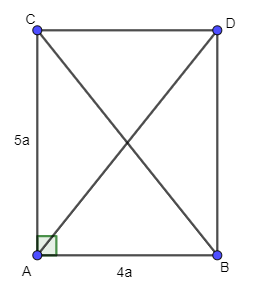
Xét tam giác ABC vuông tại A, có:
BC2 = AB2 + AC2 (định lí pythagoras)
⇔ BC2 = (4a)2 + (5a)2 = 41a2
⇔ BC = \(\sqrt {41} \)a.
Ta có: \(\overrightarrow {AB} - \overrightarrow {AC} = \overrightarrow {AB} + \overrightarrow {CA} = \overrightarrow {CA} + \overrightarrow {AB} = \overrightarrow {CB} \)
⇒ \(\left| {\overrightarrow {AB} - \overrightarrow {AC} } \right| = \left| {\overrightarrow {CB} } \right| = \sqrt {41} a\).
Vậy \(\left| {\overrightarrow {AB} - \overrightarrow {AC} } \right| = \sqrt {41} a\).
Lời giải
Lấy điểm D là điểm thỏa mãn ABDC là hình chữ nhật nên AD = BC (tính chất hình hình chữ nhật).
Ta có: \(\overrightarrow {AB} + \overrightarrow {AC} = \overrightarrow {AD} \) (quy tắc hình bình hành)
⇒ \(\left| {\overrightarrow {AB} + \overrightarrow {AC} } \right| = \left| {\overrightarrow {AD} } \right| = \left| {\overrightarrow {CB} } \right| = \sqrt {41} a\).
Vậy \(\left| {\overrightarrow {AB} + \overrightarrow {AC} } \right| = \sqrt {41} a.\)
Cho tam giác đều ABC cạnh a. Tính:
\(\left| {\overrightarrow {AB} + \overrightarrow {BC} } \right|\);
Lời giải
Ta có: \(\overrightarrow {AB} + \overrightarrow {BC} = \overrightarrow {AC} \) (quy tắc 3 điểm)
⇒ \(\left| {\overrightarrow {AB} + \overrightarrow {BC} } \right| = \left| {\overrightarrow {AC} } \right| = AC = a\)
Vậy \(\left| {\overrightarrow {AB} + \overrightarrow {BC} } \right| = a\).
Lời giải
Ta có: \(\overrightarrow {AB} - \overrightarrow {AC} = \overrightarrow {AB} + \overrightarrow {CA} = \overrightarrow {CA} + \overrightarrow {AB} = \overrightarrow {CB} \)
⇒ \(\left| {\overrightarrow {AB} - \overrightarrow {AC} } \right| = \left| {\overrightarrow {CB} } \right| = CB = a\).
Vậy \(\left| {\overrightarrow {AB} - \overrightarrow {AC} } \right| = a\).
Lời giải
Gọi D là điểm thỏa mãn ABDC là hình bình hành, M là trung điểm của BC.
Khi đó: \(\overrightarrow {AB} + \overrightarrow {AC} = \overrightarrow {AD} \)
⇒ \(\left| {\overrightarrow {AB} + \overrightarrow {AC} } \right| = \left| {\overrightarrow {AD} } \right|\).
Xét tam giác ABC, có AM là đường trung tuyến nên AM là đường cao
⇒ AM = \(\frac{{a\sqrt 3 }}{2}\)
⇒ AD = 2AM = 2.\(\frac{{a\sqrt 3 }}{2} = a\sqrt 3 \).
⇒ \(\left| {\overrightarrow {AB} + \overrightarrow {AC} } \right| = \left| {\overrightarrow {AD} } \right| = a\sqrt 3 \).
Vậy \(\left| {\overrightarrow {AB} + \overrightarrow {AC} } \right| = a\sqrt 3 \).
Lời giải
Gọi D là điểm thỏa mãn ABDC là hình bình hành.
Khi đó, ta có: \(\overrightarrow {AB} + \overrightarrow {AC} = \overrightarrow {AD} \)
⇒ \(\left| {\overrightarrow {AB} + \overrightarrow {AC} } \right| = \left| {\overrightarrow {AD} } \right| = AD\)
Ta lại có: \(\overrightarrow {AB} - \overrightarrow {AC} = \overrightarrow {AB} + \overrightarrow {CA} = \overrightarrow {CB} \)
⇒ \(\left| {\overrightarrow {AB} - \overrightarrow {AC} } \right| = \left| {\overrightarrow {CB} } \right| = CB\)
Mà \(\left| {\overrightarrow {AB} + \overrightarrow {AC} } \right| = \left| {\overrightarrow {AB} - \overrightarrow {AC} } \right|\) nên AD = CB.
Hình bình hành ABCD có AB = CB nên ABCD là hình chữ nhật. Do đó tam giác ABC vuông tại A.
Lời giải
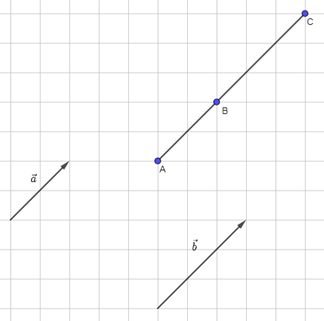
Không mất tính tổng quát ta lấy một điểm A bất kì, vẽ \(\overrightarrow {AB} = \overrightarrow a \), \(\overrightarrow {BC} = \overrightarrow b \)
Vì hai vectơ \(\overrightarrow a ,\overrightarrow b \) cùng hướng nên A, B, C thẳng hàng, B nằm giữa A và C.
Ta có: \(\left| {\overrightarrow a } \right| = \left| {\overrightarrow {AB} } \right| = AB,\left| {\overrightarrow b } \right| = \left| {\overrightarrow {BC} } \right| = BC\)
⇒ \(\left| {\overrightarrow a } \right| + \left| {\overrightarrow b } \right| = AB + BC = AC\)
\( \Rightarrow \left| {\overrightarrow a + \overrightarrow b } \right| = \left| {\overrightarrow {AB} + \overrightarrow {BC} } \right| = \overrightarrow {AC} \).
Vậy \(\left| {\overrightarrow a } \right| + \left| {\overrightarrow b } \right| = \left| {\overrightarrow a + \overrightarrow b } \right|\).
Lời giải
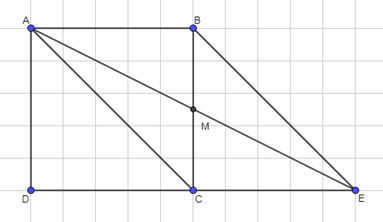
Lấy E là điểm thỏa mãn ABEC là hình bình hành, gọi M là trung điểm của BC.
Khi đó ta có:
\(\overrightarrow {AB} + \overrightarrow {AC} = \overrightarrow {AE} \)
⇒\(\left| {\overrightarrow {AB} + \overrightarrow {AC} } \right| = \left| {\overrightarrow {AE} } \right| = AE\)
Vì M là trung điểm của BC nên M là trung điểm của AE
⇒ AE = 2AM.
Xét tam giác ABM vuông tại B, có:
AM2 = AB2 + BM2 (định lí pythagoras)
⇔ AM2 = a2 + \({\left( {\frac{a}{2}} \right)^2}\)= a2 + \(\frac{{{a^2}}}{4}\) = \(\frac{{5{a^2}}}{4}\)
⇔ AM = \(\frac{{\sqrt 5 a}}{2}\)
⇒ AE = 2AM = \(2.\frac{{\sqrt 5 a}}{2} = \sqrt 5 a\)
Vậy AE = \(\sqrt 5 a\).
Cho tứ giác ABCD là hình bình hành. Gọi O là giao điểm của hai đường chéo, E là trung điểm của AD, G là giao điểm của BE và AC. Tính:
\(\overrightarrow {OA} + \overrightarrow {OB} + \overrightarrow {OC} + \overrightarrow {OD} \);
Lời giải
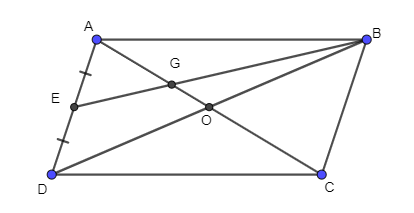
Xét hình bình hành ABCD, có O là giao điểm của AC và BD nên O là trung điểm của AC và O là trung điểm của BD.
⇒ \(\overrightarrow {OA} + \overrightarrow {OC} = \overrightarrow 0 \) và \(\overrightarrow {OB} + \overrightarrow {OD} = \overrightarrow 0 \)
Ta có: \(\overrightarrow {OA} + \overrightarrow {OB} + \overrightarrow {OC} + \overrightarrow {OD} \)
\( = \left( {\overrightarrow {OA} + \overrightarrow {OC} } \right) + \left( {\overrightarrow {OB} + \overrightarrow {OD} } \right)\)
\( = \overrightarrow 0 + \overrightarrow 0 \)
\( = \overrightarrow 0 \).
Vậy \(\overrightarrow {OA} + \overrightarrow {OB} + \overrightarrow {OC} + \overrightarrow {OD} = \overrightarrow 0 \).
Lời giải
Xét tam giác ABD, có:
AO là trung tuyến, BE là đường trung tuyến
Mà AO giao với BE tại G nên G là trọng tâm tam giác ABD
⇒\(\overrightarrow {GA} + \overrightarrow {GB} + \overrightarrow {GD} = \overrightarrow 0 \)
Vậy \(\overrightarrow {GA} + \overrightarrow {GB} + \overrightarrow {GD} = \overrightarrow 0 \).
Lời giải
Ta có: \(\overrightarrow {AB} + \overrightarrow {BM} = \overrightarrow {AM} \)
⇒ \(\left| {\overrightarrow {AB} + \overrightarrow {BM} } \right| = \left| {\overrightarrow {AM} } \right| = AM\)
Ta lại có: \(\overrightarrow {AC} - \overrightarrow {AM} = \overrightarrow {AC} + \overrightarrow {MA} = \overrightarrow {MC} \)
⇒\(\left| {\overrightarrow {AC} - \overrightarrow {AM} } \right| = \left| {\overrightarrow {MC} } \right| = MC\)
Vì \(\left| {\overrightarrow {AB} + \overrightarrow {BM} } \right| = \left| {\overrightarrow {AC} - \overrightarrow {AM} } \right|\) nên AM = MC
Tập hợp điểm M thỏa mãn AM = MC là đường trung trực của đoạn thẳng AC.
Vậy tập hợp điểm M thỏa mãn điều kiện đầu bài là đường trung trực của đoạn thẳng AC.
Lời giải
Ta có: \[\overrightarrow {{\rm{AA}}'} + \overrightarrow {BB'} + \overrightarrow {CC'} = \overrightarrow {{\rm{AG}}} + \overrightarrow {GA'} + \overrightarrow {BG} + \overrightarrow {GB'} + \overrightarrow {CG} + \overrightarrow {GC'} \]
\[ = \left( {\overrightarrow {{\rm{AG}}} + \overrightarrow {BG} + \overrightarrow {CG} } \right) + \left( {\overrightarrow {GA'} + \overrightarrow {GB'} + \overrightarrow {GC'} } \right)\]
\[ = \left( { - \overrightarrow {{\rm{GA}}} - \overrightarrow {GB} - \overrightarrow {GC} } \right) + \left( {\overrightarrow {GA'} + \overrightarrow {GB'} + \overrightarrow {GC'} } \right)\]
\[ = - \left( {\overrightarrow {{\rm{GA}}} + \overrightarrow {GB} + \overrightarrow {GC} } \right) + \left( {\overrightarrow {GA'} + \overrightarrow {GB'} + \overrightarrow {GC'} } \right)\]
\( = \overrightarrow 0 + \overrightarrow 0 \)
\( = \overrightarrow 0 \)
Lời giải
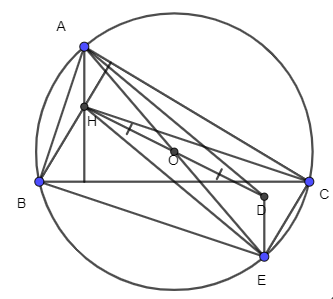
Vẽ đường kính AE
Ta có: \(\widehat {ACE} = 90^\circ \) nên AC ⊥ EC
Mà BH ⊥ EC
⇒ BH // AC (1)
Ta lại có:\(\widehat {ABE} = 90^\circ \) và AB ⊥ BE
Mà CH ⊥ AB
⇒ BE // CH (2)
Từ (1) và (2) suy ra BHEC là hình bình hành
Xét tứ giác AHDE, có:
O là trung điểm của HD (gt)
O là trung điểm của AE
Do đó AHDE là hình bình hành
Khi đó, ta có:
\(\overrightarrow {HA} + \overrightarrow {HB} + \overrightarrow {HC} = \overrightarrow {HA} + \left( {\overrightarrow {HB} + \overrightarrow {HC} } \right) = \overrightarrow {HA} + \overrightarrow {HE} = \overrightarrow {HD} \).