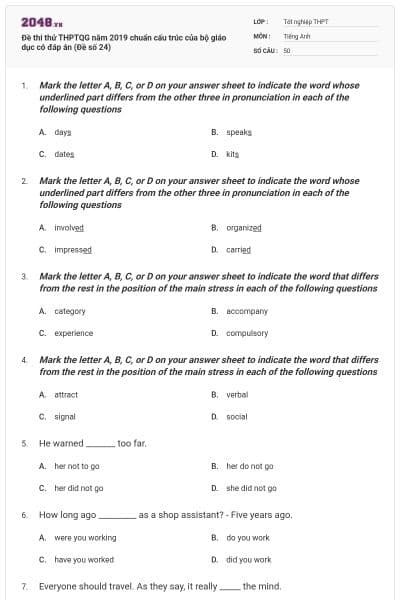
Đề thi thử THPTQG năm 2019 chuẩn cấu trúc của bộ giáo dục có đáp án (Đề số 24)
50 câu hỏi
Mark the letter A, B, C, or D on your answer sheet to indicate the word whose underlined part differs from the other three in pronunciation in each of the following questions
days
speaks
dates
kits
Đáp án A
Phần được gạch chân ở câu A phát âm là /z/, còn lại là /s/
Cách phát âm đuôi “s/es”
- Phát âm là /s/ khi từ có tận cùng bằng các phụ âm vô thanh: /ð/, /p/, /k/, /f/, /t/.
- Phát âm là /iz/ khi từ có tận cùng là các âm: /s/, /z/, /ʃ/, /tʃ/, /ʒ/, /dʒ/.
- Phát âm là /z/ khi các từ có tận cùng là nguyên âm và các phụ âm hữu thanh còn lại
Mark the letter A, B, C, or D on your answer sheet to indicate the word whose underlined part differs from the other three in pronunciation in each of the following questions
involved
organized
impressed
carried
Đáp án C
Phần được gạch chân ở câu C phát âm là /t/, còn lại là /d/
Cách phát âm “ed”
- Đuôi “ed” được phát âm là /id/: khi động từ có phát âm kết thúc là /t/ hay /d/.
- Đuôi ed được phát âm là /t/: Khi động từ có phát âm kết thúc là: /ch/, /p/, /f/, /s/, /k/, /th/, /ʃ/, /t ʃ/.
- Đuôi ed được phát âm là /d/ trong các trường hợp còn lại
Mark the letter A, B, C, or D on your answer sheet to indicate the word that differs from the rest in the position of the main stress in each of the following questions
category
accompany
experience
compulsory
Đáp án A
A. category /ˈkætəɡəri/: hạng, loại
B. accompany /əˈkʌmpəni /: đi cùng, hộ tống
C. experience /ɪkˈspɪriəns /: kinh nghiệm, trải nghiệm
D. compulsory /kəmˈpʌlsəri /: bắt buộc
Mark the letter A, B, C, or D on your answer sheet to indicate the word that differs from the rest in the position of the main stress in each of the following questions
attract
verbal
signal
social
Đáp án A
A. attract /əˈtrækt /: thu hút, hấp dẫn
B. verbal /ˈvз:bl/: bằng lời nói
C. signal /ˈsɪɡnəl /: dấu hiệu, hiệu lệnh
D. social /ˈsoʊʃəl /: có tính xã hội
He warned _______ too far.
her not to go
her do not go
her did not go
she did not go
Đáp án A
(to) warn someone (not) to do something: khuyên ai nên/không nên làm gì.
Dịch: Anh ta khuyên cô ấy không nên đi quá xa
How long ago _________ as a shop assistant? - Five years ago.
were you working
do you work
have you worked
did you work
Đáp án D
“ago” là từ giúp ta xác định thì. Trong câu, nếu có “time period + ago” ta xác định thì quá khứ đơn.
Dịch: Cậu làm nhân viên bán hàng hồi nào nhỉ? – 5 năm trước.
Everyone should travel. As they say, it really _____ the mind.
widens
opens
broadens
develops
Đáp án C
(to) broaden(v): mở rộng (tri thức, tầm hiểu biết)
Các đáp án còn lại:
A. (to) widen(v): nới rộng ra (về địa lý, vật chất)
B. (to) open(v): mở ra
D. (to) develop(v): phát triển
Dịch: Ai cũng nên đi phượt. Như người ta vẫn nói, nó giúp mở rộng tầm hiểu biết

Học thông minh hơn mỗi ngày
Xem toàn bộ 50 câu hỏi và nhiều hơn nữa với tài khoản miễn phí
He will take the dog out for a walk as soon as he ______ dinner.
finishes
finish
will finish
shall have finished
Đáp án A
Giải thích
Cấu trúc: S+ will+ Vnt as soon as+ S+ Vs/es
( Ai đó sẽ làm gì ngày khi ….)
Dịch: Anh ta sẽ dắt chó đi dạo ngay sau khi ăn xong
Why don’t you make it bigger and more careful to ______ people’s attention?
raise
attract
make
keep
Đáp án B
(to) attract one’s attention: thu hút sự chú ý của ai
Dịch: Sao cậu không làm nó lớn và tỉ mỉ hơn để người ta chú ý?
Yesterday when I _____ at the station, the train _______ for 15 minutes.
arrived/ left
had arrived/ left
arrives/ has left
arrived/ had left
Đáp án D
Cấu trúc chỉ một sự việc đã diễn ra trước một thời điểm trong quá khứ.
Trong câu này, tại thời điểm tôi đến hôm qua, thì đoàn tàu đã rời đi.
Dịch: Hôm qua lúc tôi đến ga thì tàu đã khởi hành trước đó 15 phút
I remember ____________ to that place once.
being taken
taking
to take
to be taken
Đáp án A
Cấu trúc cần chú ý ở đây là
(1) remember + to V: nhớ làm việc gì
Eg: Fortunately, I remembered to finish my homework last night.
= Thật may đêm qua tôi nhớ làm bài tập.
(2) remember + Ving: nhớ đã làm gì
Eg: I remember having locked the door.
= Tôi nhớ là đã khoá cửa.
Ở đây ta dùng cấu trúc (2) vì nhân vật nhớ là mình đã từng được đến địa điểm đó.
Dịch: Tôi nhớ mình từng được đưa đến đây một lần
Small children are often told that it is rude _______ at other people.
to point
points
pointed
point
Đáp án A
Tính từ thường được theo sau bởi “to V”
It is + adj +to V
Dịch: Trẻ nhỏ thường được dạy rằng chỉ tay vào người khác là vô lễ.
My husband wants me _______ this letter before afternoon.
post
to post
posting
posts
Đáp án B
(to) want somebody to do something: muốn ai đó làm gì
Dịch: Chồng tôi muốn tôi gửi lá thư này trước buổi chiều
My Dad is always willing to give a hand ______________ cleaning the house.
in
with
of
about
Đáp án B
(to) give a hand with = (to) help with: giúp đỡ việc gì
Dịch: Bố tôi luôn sẵn sàng giúp việc dọn nhà
Body language is a potent form of ______ communication.
verbal
non - verbal
tongue
oral
Đáp án B
Non – verbal: không bằng lời
Các đáp án còn lại:
A. verbal: bằng lời
C. tongue: tiếng, ngôn ngữ
D. oral: bằng miệng, bằng lời
Dịch: Ngôn ngữ cơ thể là một hình thức hiệu quả của giao tiếp không bằng lời.
These children often share their ______________ secrets with their mother.
personally
person
personal
personable
Đáp án C
Personal: thuộc về cá nhân, riêng tư
Các đáp án còn lại:
A. personally(adv): với tư cách cá nhân
B. person(n): một người
D. personable(a): xinh đẹp, duyên dáng
Dịch: Bọn trẻ thường kể bí mật của mình cho mẹ chúng.
- “What an attractive hair style you have got, Mary!” - “_______”
Thank you very much. I am afraid
I don't like your sayings
You are telling a lie
Thank you for your compliment
Đáp án D
- “Tóc cậu đẹp quá, Mary!” - “Cảm ơn cậu đã khen”
Đây là một cách đáp lại lời khen. Các đáp án khác không phù hợp
A. Cảm ơn rất nhiều. Tôi thấy lo.
B. Tôi không thích bạn nói vậy.
C. Bạn đang nói dối đấy.
John: “Can you tell me the way to the nearest post office?” Nam: “_______”.
It opens at nine o'clock
Turn left and then right
You can walk or go there by taxi
It's about two kilometers
Đáp án B
John: “Bạn có thể chỉ tôi đường đến bưu điện gần nhất không?”
Nam: “Rẽ trái sau đó rẽ phải.”
Các đáp án còn lại không phù hợp
A. Nó mở cửa vào 9 giờ.
C. Bạn có thể đi bộ hoặc bắt taxi đến đó.
D. Nó cách đây tầm 2km
Mark the letter A, B, C, or D on your answer sheet to indicate the word(s) CLOSEST in meaning to the underlined word(s) in each of the following questions.
We do not whistle or clap our hands to get the person’s attention. That is considered impolite and even rude.
offensive
polite
informal
terrific
Đáp án: A
Giải thích:
Kiến thức: Từ vựng – Từ đồng nghĩa
impolite (adj): bất lịch sự
Xét các đáp án:
A. offensive (adj): xúc phạm
B. polite (adj): lịch sự
C. informal (adj): không trang trọng
D. terrific (adj): tuyệt vời
=> impolite = offensive
Dịch: Chúng ta không huýt sáo hoặc vỗ tay để thu hút sự chú ý của người khác. Điều đó được coi là bất lịch sự và thậm chí là thô lỗ.
Mark the letter A, B, C, or D on your answer sheet to indicate the word(s) CLOSEST in meaning to the underlined word(s) in each of the following questions.
Could you take care of our children while I go away?
look like
look after
look for
look at
Đáp án B
Giải nghĩa: (to) take care of = (to) look after: quan tâm, chăm sóc
Các đáp án còn lại:
A. look like: trông giống
C. look for: tìm kiếm
D. look at: nhìn vào
Dịch nghĩa: Cậu có thể giúp tôi chăm bọn nhỏ trong thời gian tôi đi được không?
Mark the letter A, B, C, or D on your answer sheet to indicate the word(s) OPPOSITE in meaning to the underlined word(s) in each of the following questions.
When being interviewed, you should focus on what the interviewer is saying or asking you.
to pay no attention to
be interested in
be related
express interested in
Đáp án A
Giải nghĩa: (to) focus on: tập trung, chăm chú vào cái gì
>< (to) pay no attention to: không chú ý đến cái gì
Các đáp án còn lại:
B. be interested in: thích thú cái gì
C. be related: liên quan đến
D. express interested in (ngữ pháp đúng phải là: express interest in): thể hiện sự thích thú
Dịch nghĩa: Trong khi được phỏng vấn, bạn nên chú tâm vào vấn đề nhà tuyển dụng đang nói đến hoặc đang hỏi.
Mark the letter A, B, C, or D on your answer sheet to indicate the word(s) OPPOSITE in meaning to the underlined word(s) in each of the following questions.
They've always encouraged me in everything I've wanted to do.
unpardoned
misconstrue
discouraged
impaired
Đáp án C
Giải nghĩa: (to) encourage: khích lệ, động viên >< (to) discourage: làm nhụt chí
Các đáp án còn lại:
A. unpardoned(a): không được tha thứ
B. (to) misconstrue(v): hiểu sai, giải thích sai (ý, lời…)
D. (to) impair(v): làm suy yếu, hư hại
Dịch nghĩa: Họ luôn khích lệ tôi làm mọi việc tôi muốn
Read the following passage and mark the letter A, B, C, or D on your answer sheet to indicate the correct answer to each of the questions.
A recent study shows that an unequal share of household chores is still the norm in many households, despite the fact that many more women now have jobs. In a survey of 1,256 people ages between 18 and 65, men said they contributed an average of 37% of the total housework, while the women estimated their share to be nearly double that, at 70%. This ratio was not affected by whether the woman was working or not.
When they were asked what they thought was a fair division of labour, women with jobs felt that housework should be shared equally between male and female partners. Women who did not work outside the home were satisfied to perform 80% - the majority of the household work - if their husbands did remainder. Research has shown that, if levels increase beyond these percentages, women become unhappy and anxious, and feel they are unimportant.
After marriage, a woman is reported to increase her household workload by 14 hours per week, but for men the amount is just 90 minutes. So the division of labour becomes unbalanced, as a man's share increases much less than the woman's. It is the inequality and loss of respect, not the actual number of hours, which leads to anxiety and depression. The research describes housework as thankless and unfulfilling. Activities included in the study were cooking, cleaning, shopping, doing laundry, washing up and childcare. Women who have jobs report that they feel overworked by these chores in addition to their professional duties. In contrast, full-time homemakers frequently anticipate going back to work when the children grow up. Distress for this group is caused by losing the teamwork in the marriage.
According to the passage, a fair division of labour is that________
women do 14 hours of housework
men do more housework than women
women do more than 80 percent of the housework
women and men share the housework equally
Đáp án D
Theo như đoạn văn, lượng phân chia công việc công bằng là_____
A. phụ nữ làm việc nhà trong 14 giờ
B. đàn ông làm nhiều việc hơn phụ nữ
C. phụ nữ làm hơn 80% lượng việc nhà
D. phụ nữ và đàn ông chia đều việc
“A fair division of labour” được nhắc đến ở đầu đoạn 2, với quan niệm “housework should be shared equally between male and female partners”. Tức là phụ nữ và đàn ông nên chia đều việc với nhau (đáp án D)
Dịch bài
Một nghiên cứu gần đây chỉ ra rằng lượng phân chia bất bình đẳng việc nhà vẫn là một lẽ dĩ nhiên đối với nhiều gia đình, dù cho rất nhiều phụ nữ ngày nay có công việc. Trong một cuộc khảo sát với 1,256 người độ tuổi từ 18 đến 65, đàn ông cho biết họ đóng góp khaongr 37% tổng lượng việc nhà, trong khi phụ nữ dự tính phần của họ gần gấp đôi lượng đó, khoảng 70%. Tỉ lệ này không bị tác động bất kể ngừoi phụ nữ có nghề nghiệp hay không.
Khi được hỏi về quan niệm phân chia công bằng trong công việc, phụ nữ có nghề nghiệp cho rằng việc nhà nên được chia đều cho cả hai bên. Những bà nội trợ lại sẵn lòng gánh 80% - đa số công việc nhà – chỉ cần chồng họ làm phần còn lại. Nghiên cứu cho thấy, nếu số phần trăm này tăng lên, phụ nữ sẽ rầu rĩ và bất an, và cảm thấy rằng mình không được coi trọng.
Sau khi kết hôn, báo cáo cho thấy phụ nữ tăng lượng làm việc nhà lên 14 giờ mỗi tuần, còn đàn ông chỉ 90 phút. Phân chia công việc trở nên mất cân đối, khi phần việc của đàn ông tăng ít hơn nhiều so với phụ nữ. Chính sự bất bình đẳng và sự thiếu tôn trọng, chứ không phải số giờ làm việc thực tế, đã đưa lại sự bất an và lo lắng cho phụ nữ. Theo nghiên cứu, việc nhà được coi là không lợi lộc gì và không khiến người ta thoả mãn. Các hoạt động được khảo sát bao gồm nấu ăn, dọn dẹp, mua sắm, giặt giũ, rửa bát và chăm con. Phụ nữ có nghề nghiệp nói rằng họ cảm thấy quá sức khi vừa phải làm việc nhà vừa phải làm việc công ty. Ngược lại, những bà nội trợ thường định trước sẽ trở lại đi làm sau khi con lớn. Nhóm đối ượng này lo sẽ mất kĩ năng làm việc nhóm sau khi kết hôn.
Read the following passage and mark the letter A, B, C, or D on your answer sheet to indicate the correct answer to each of the questions.
A recent study shows that an unequal share of household chores is still the norm in many households, despite the fact that many more women now have jobs. In a survey of 1,256 people ages between 18 and 65, men said they contributed an average of 37% of the total housework, while the women estimated their share to be nearly double that, at 70%. This ratio was not affected by whether the woman was working or not.
When they were asked what they thought was a fair division of labour, women with jobs felt that housework should be shared equally between male and female partners. Women who did not work outside the home were satisfied to perform 80% - the majority of the household work - if their husbands did remainder. Research has shown that, if levels increase beyond these percentages, women become unhappy and anxious, and feel they are unimportant.
After marriage, a woman is reported to increase her household workload by 14 hours per week, but for men the amount is just 90 minutes. So the division of labour becomes unbalanced, as a man's share increases much less than the woman's. It is the inequality and loss of respect, not the actual number of hours, which leads to anxiety and depression. The research describes housework as thankless and unfulfilling. Activities included in the study were cooking, cleaning, shopping, doing laundry, washing up and childcare. Women who have jobs report that they feel overworked by these chores in addition to their professional duties. In contrast, full-time homemakers frequently anticipate going back to work when the children grow up. Distress for this group is caused by losing the teamwork in the marriage.
All activities mentioned in the passage are household chores EXCEPT_______
childcaring
washing-up
shopping
taking care of old-aged parents
Đáp án D
Những hoạt động sau đây đều được đề cập trong đoạn như một phần việc nhà, ngoại trừ:
A. chăm con
B. dọn rửa
C. đi mua đồ
D. chăm cha mẹ già
Đoạn cuối có đề cập “Activities included in the study were cooking, cleaning, shopping, doing laundry, washing up and childcare.” Ta thấy chỉ có ý “taking care of old-aged parents” không xuất hiện.
Read the following passage and mark the letter A, B, C, or D on your answer sheet to indicate the correct answer to each of the questions.
A recent study shows that an unequal share of household chores is still the norm in many households, despite the fact that many more women now have jobs. In a survey of 1,256 people ages between 18 and 65, men said they contributed an average of 37% of the total housework, while the women estimated their share to be nearly double that, at 70%. This ratio was not affected by whether the woman was working or not.
When they were asked what they thought was a fair division of labour, women with jobs felt that housework should be shared equally between male and female partners. Women who did not work outside the home were satisfied to perform 80% - the majority of the household work - if their husbands did remainder. Research has shown that, if levels increase beyond these percentages, women become unhappy and anxious, and feel they are unimportant.
After marriage, a woman is reported to increase her household workload by 14 hours per week, but for men the amount is just 90 minutes. So the division of labour becomes unbalanced, as a man's share increases much less than the woman's. It is the inequality and loss of respect, not the actual number of hours, which leads to anxiety and depression. The research describes housework as thankless and unfulfilling. Activities included in the study were cooking, cleaning, shopping, doing laundry, washing up and childcare. Women who have jobs report that they feel overworked by these chores in addition to their professional duties. In contrast, full-time homemakers frequently anticipate going back to work when the children grow up. Distress for this group is caused by losing the teamwork in the marriage.
The word "remainder" in paragraph 2 is closest in meaning to________
what is shared
what is fulfilled
what is done
what is left
Đáp án D
Từ “remainder” ở đoạn 2 gần nghĩ nhất với____
A. phần được chia
B. phần được bù vào
C. phần đã làm
D. phần còn lại
Remainder: phần còn lại = what is left
Read the following passage and mark the letter A, B, C, or D on your answer sheet to indicate the correct answer to each of the questions.
A recent study shows that an unequal share of household chores is still the norm in many households, despite the fact that many more women now have jobs. In a survey of 1,256 people ages between 18 and 65, men said they contributed an average of 37% of the total housework, while the women estimated their share to be nearly double that, at 70%. This ratio was not affected by whether the woman was working or not.
When they were asked what they thought was a fair division of labour, women with jobs felt that housework should be shared equally between male and female partners. Women who did not work outside the home were satisfied to perform 80% - the majority of the household work - if their husbands did remainder. Research has shown that, if levels increase beyond these percentages, women become unhappy and anxious, and feel they are unimportant.
After marriage, a woman is reported to increase her household workload by 14 hours per week, but for men the amount is just 90 minutes. So the division of labour becomes unbalanced, as a man's share increases much less than the woman's. It is the inequality and loss of respect, not the actual number of hours, which leads to anxiety and depression. The research describes housework as thankless and unfulfilling. Activities included in the study were cooking, cleaning, shopping, doing laundry, washing up and childcare. Women who have jobs report that they feel overworked by these chores in addition to their professional duties. In contrast, full-time homemakers frequently anticipate going back to work when the children grow up. Distress for this group is caused by losing the teamwork in the marriage.
The word "norm" in paragraph 1 is closest in meaning to________
strange thing
unequal thing
changing thing
usual thing
Đáp án D
Từ “norm” ở đoạn 1 gần nghĩa nhất với____
A. điều kì lạ
B. điều bất bình đẳng
C. điều thay đổi
D. điều bình thường
Norm(n): lẽ bình thường, dĩ nhiên = usual thing
Read the following passage and mark the letter A, B, C, or D on your answer sheet to indicate the correct answer to each of the questions.
A recent study shows that an unequal share of household chores is still the norm in many households, despite the fact that many more women now have jobs. In a survey of 1,256 people ages between 18 and 65, men said they contributed an average of 37% of the total housework, while the women estimated their share to be nearly double that, at 70%. This ratio was not affected by whether the woman was working or not.
When they were asked what they thought was a fair division of labour, women with jobs felt that housework should be shared equally between male and female partners. Women who did not work outside the home were satisfied to perform 80% - the majority of the household work - if their husbands did remainder. Research has shown that, if levels increase beyond these percentages, women become unhappy and anxious, and feel they are unimportant.
After marriage, a woman is reported to increase her household workload by 14 hours per week, but for men the amount is just 90 minutes. So the division of labour becomes unbalanced, as a man's share increases much less than the woman's. It is the inequality and loss of respect, not the actual number of hours, which leads to anxiety and depression. The research describes housework as thankless and unfulfilling. Activities included in the study were cooking, cleaning, shopping, doing laundry, washing up and childcare. Women who have jobs report that they feel overworked by these chores in addition to their professional duties. In contrast, full-time homemakers frequently anticipate going back to work when the children grow up. Distress for this group is caused by losing the teamwork in the marriage.
Although women think men should share the housework, those who don't have paid job agree to share ____ of the chores
14 percent
37 percent
80 percent
70 percent
Đáp án C
Tuy phụ nữ cho rằng đàn ông nên chia sẻ công việc, những người không có nghề nghiệp sẵn lòng gánh _____ việc nhà.
A. 14%
B. 37%
C. 80%
D. 70%
Câu 2 đoạn 2: “Women who did not work outside the home were satisfied to perform 80%”
Read the following passage and mark the letter A, B, C, or D on your answer sheet to indicate the correct answer to each of the questions.
A recent study shows that an unequal share of household chores is still the norm in many households, despite the fact that many more women now have jobs. In a survey of 1,256 people ages between 18 and 65, men said they contributed an average of 37% of the total housework, while the women estimated their share to be nearly double that, at 70%. This ratio was not affected by whether the woman was working or not.
When they were asked what they thought was a fair division of labour, women with jobs felt that housework should be shared equally between male and female partners. Women who did not work outside the home were satisfied to perform 80% - the majority of the household work - if their husbands did remainder. Research has shown that, if levels increase beyond these percentages, women become unhappy and anxious, and feel they are unimportant.
After marriage, a woman is reported to increase her household workload by 14 hours per week, but for men the amount is just 90 minutes. So the division of labour becomes unbalanced, as a man's share increases much less than the woman's. It is the inequality and loss of respect, not the actual number of hours, which leads to anxiety and depression. The research describes housework as thankless and unfulfilling. Activities included in the study were cooking, cleaning, shopping, doing laundry, washing up and childcare. Women who have jobs report that they feel overworked by these chores in addition to their professional duties. In contrast, full-time homemakers frequently anticipate going back to work when the children grow up. Distress for this group is caused by losing the teamwork in the marriage.
It can be inferred from the passage that after getting married, ________
women do twice as much housework as men
women do less and less housework
men spend much less time doing housework than women
men do more housework than women
Đáp án C
Có thể suy ra từ đoạn văn rằng sau khi kết hôn, _______
A. phụ nữ làm việc nhà gấp đôi đàn ông
B. phụ nữ ngày càng làm việc nhà ít đi
C. đàn ông dành ít thời gian làm việc nhà hơn phụ nữ
D. đàn ông làm nhiều việc nhà hơn phụ nữ
Câu đầu đoạn 3: “After marriage, a woman is reported to increase her household workload by 14 hours per week, but for men the amount is just 90 minutes.”
Từ đây ta thấy phụ nữ làm 14 giờ và đàn ông làm chỉ 90 phút. Rõ ràng, đàn ông dành ít thời gian làm việc nhà hơn phụ nữ.
Read the following passage and mark the letter A, B, C, or D on your answer sheet to indicate the correct answer to each of the questions.
A recent study shows that an unequal share of household chores is still the norm in many households, despite the fact that many more women now have jobs. In a survey of 1,256 people ages between 18 and 65, men said they contributed an average of 37% of the total housework, while the women estimated their share to be nearly double that, at 70%. This ratio was not affected by whether the woman was working or not.
When they were asked what they thought was a fair division of labour, women with jobs felt that housework should be shared equally between male and female partners. Women who did not work outside the home were satisfied to perform 80% - the majority of the household work - if their husbands did remainder. Research has shown that, if levels increase beyond these percentages, women become unhappy and anxious, and feel they are unimportant.
After marriage, a woman is reported to increase her household workload by 14 hours per week, but for men the amount is just 90 minutes. So the division of labour becomes unbalanced, as a man's share increases much less than the woman's. It is the inequality and loss of respect, not the actual number of hours, which leads to anxiety and depression. The research describes housework as thankless and unfulfilling. Activities included in the study were cooking, cleaning, shopping, doing laundry, washing up and childcare. Women who have jobs report that they feel overworked by these chores in addition to their professional duties. In contrast, full-time homemakers frequently anticipate going back to work when the children grow up. Distress for this group is caused by losing the teamwork in the marriage.
The word "they" in paragraph 2 refers to________
men
labour
jobs
women
Đáp án D
Từ "they" ở đoạn 2 nói đến
A. đàn ông
B. công việc
C. nghề nghiệp
D. phụ nữ
Read the following passage, and mark the letter A, B, C, or D on your answer sheet to indicate the correct answer to each of the questions.
Dịch bài
Ở Mỹ, người ta rất quan trọng việc đúng giờ trong một cuộc hẹn, cho giờ học hay một buổi họp mặt, v.v… Tuy nhiên, điều này không hẳn đúng tại một vài quốc gia khác. Một vị giáo sư người Mỹ đã nhận ra sụw khác biệt này trong thời gian giảng dạy tại một đại học của Brazil. Tiết học dài 2 giờ được lên lịch bắt đầu từ 10 giờ sáng và kết thúc vào 12 giờ trưa. Ngày đầu tiên, vị giáo sư lên lớp đúng giờ, và lúc đó không có ai trong phòng học. Rất nhiều sinh viên đến sau 11 giờ. Dù tất cả họ đều chào giáo sư khi vào lớp, rất ít người xin lỗi vì đến muộn. Liệu có phải những sinh viên này có chút bất nhã? Ông quyết định nghiên cứu hành vi của các sinh viên.
Tại đại học Mỹ, sinh viên phải đến lớp đúng giờ. Ngược lại, tại Brazil, cả giảng viên và sinh viên đều không đến đúng giờ. Tại Mỹ, các tiết học bắt đầu đúng giờ và kết thúc theo thời gian quy định. Tại các lớp ở Brazil, rất ít sinh viên rời lớp giữa trưa, phần đông ở lại tới hơn 12:30 để thảo luận và đặt câu hỏi. Việc đến muộn không quá quan trọng tại Brazil, việc ở lại lớp muộn cũng tương tự.
Theo kết quả nghiên cứu, vị giáo sư nghiệm ra rằng các sinh viên Brazil không hề thiếu tôn trọng ông. Thay vì vậy, họ chỉ đơn giản là đang cư xử đúng kiểu Brazil. Cuối cùng thì vị giáo sư đã có thể thích ứng và thoải mái với nền văn hoá mới
Read the following passage, and mark the letter A, B, C, or D on your answer sheet to indicate the correct answer to each of the questions.
In the United States, it is important to be on time, or punctual, for an appointment, a class, a meeting, etc... This may not be true in some other countries, however. An American professor discovered this difference while teaching a class in a Brazilian university. The two-hour class was scheduled to begin at 10 a.m, and end at 12 a.m. On the first day, when the professor arrived on time, no one was in the classroom. Many students came after 11 a.m. Although all of the students greeted the professor as they arrived, few apologised for their lateness. Were these students being rude? He decided to study the students’ behavior.
In American university, students are expected to arrive at the appointed hour. On the other hand, in Brazil, neither the teacher nor the students always arrive at the appointed hour. Classes not only begin at the scheduled time in the United States, but they also end at the scheduled time. In the Brazilian class, only a few students left the class at noon, many remained past 12:30 to discuss the class and ask more questions. While arriving late may not be important in Brazil, neither is staying late.
The explanation for these differences is complicated. People from Brazilian and North American cultures have different feelings about lateness. In Brazil, the students believe that a person who usually arrives late is probably more successful than a person who is always on time. In fact, Brazilians expect a person with status or prestige to arrive late, while in the United States, lateness is usually considered to be disrespectful and unacceptable. Consequently, if a Brazilian is late for an appointment with a North America, the American may misinterpret the reason for the lateness and become angry.
As a result for his study, the professor learned that the Brazilian students were not being disrespectful to him. Instead, they were simply behaving the appropriate way for a Brazilian student in Brazil. Eventually, the professor was able to adapt his own behavior to feel comfortable in the new culture.
What is the main idea of this passage?
It is not important to be on time in Brazil
People learn the importance of time when they are children
It is important to be on time for class in the United States
The importance of being on time differs among different countries
Đáp án D
Ý chính của đoạn văn là?
A. Ở Brazil, việc đúng giờ không quan trọng
B. Người ta được học về tầm quan trọng của thời gian từ khi còn nhỏ.
C. Ở USA, việc đến lớp đúng giờ là rất quan trọng.
D. Tầm quan trọng của việc đúng giờ tuỳ thuộc vào từng quốc gia khác nhau.
Ở ngay câu chủ đề đoạn 1, ý chính đã được khái quát rất rõ ràng: “In the United States, it is important to be on time, or punctual, for an appointment, a class, a meeting, etc... This may not be true in some other countries, however.”
“Ở Mỹ, điều thiết yếu là phải đúng giờ, trong cuộc hẹn, giờ học, buổi họp mặt,… Tuy nhiên, điều này không hẳn đúng tại các nước khác.” Và suốt phần sau, tác giả nêu lên dẫn chứng cụ thể của việc trễ giờ tại Brazil để chứng minh mỗi nơi có một cách nhìn khác nhau về việc đúng giờ
Read the following passage, and mark the letter A, B, C, or D on your answer sheet to indicate the correct answer to each of the questions.
In the United States, it is important to be on time, or punctual, for an appointment, a class, a meeting, etc... This may not be true in some other countries, however. An American professor discovered this difference while teaching a class in a Brazilian university. The two-hour class was scheduled to begin at 10 a.m, and end at 12 a.m. On the first day, when the professor arrived on time, no one was in the classroom. Many students came after 11 a.m. Although all of the students greeted the professor as they arrived, few apologised for their lateness. Were these students being rude? He decided to study the students’ behavior.
In American university, students are expected to arrive at the appointed hour. On the other hand, in Brazil, neither the teacher nor the students always arrive at the appointed hour. Classes not only begin at the scheduled time in the United States, but they also end at the scheduled time. In the Brazilian class, only a few students left the class at noon, many remained past 12:30 to discuss the class and ask more questions. While arriving late may not be important in Brazil, neither is staying late.
The explanation for these differences is complicated. People from Brazilian and North American cultures have different feelings about lateness. In Brazil, the students believe that a person who usually arrives late is probably more successful than a person who is always on time. In fact, Brazilians expect a person with status or prestige to arrive late, while in the United States, lateness is usually considered to be disrespectful and unacceptable. Consequently, if a Brazilian is late for an appointment with a North America, the American may misinterpret the reason for the lateness and become angry.
As a result for his study, the professor learned that the Brazilian students were not being disrespectful to him. Instead, they were simply behaving the appropriate way for a Brazilian student in Brazil. Eventually, the professor was able to adapt his own behavior to feel comfortable in the new culture.
All of these following sentences are true for the first day of the professor in Brazil EXCEPT________
Many students came after 11 a.m
He was late for the class
The class was scheduled to begin at 10 a.m and end at 12 a.m
All of the students greeted him when they arrived
Đáp án B
Tất cả các ý sau là đúng khi nói về ngày đầu làm việc của vị giáo sư ở Brazil, ngoại trừ______
A. Rất nhiều học sinh đến sau 11 giờ.
B. Ông ấy đến lớp muộn.
C. Giờ học theo lịch bắt đầu từ 10 giờ sáng và kết thúc vào 12 giờ trưa.
D. Tất cả học sinh chào ông ấy khi họ đến lớp.
Các ý được đề cập về ngày đầu đứng lớp tại Brazil của vị giáo sư:
“Many students came after 11 a.m” >< A
“the professor arrived on time” >< B
“The two-hour class was scheduled to begin at 10 a.m, and end at 12 a.m” >< C
“all of the students greeted the professor as they arrived” >< D
Theo đó ta thấy, B là đáp án sai khi nói về ngày đầu làm việc của giáo sư
Read the following passage, and mark the letter A, B, C, or D on your answer sheet to indicate the correct answer to each of the questions.
In the United States, it is important to be on time, or punctual, for an appointment, a class, a meeting, etc... This may not be true in some other countries, however. An American professor discovered this difference while teaching a class in a Brazilian university. The two-hour class was scheduled to begin at 10 a.m, and end at 12 a.m. On the first day, when the professor arrived on time, no one was in the classroom. Many students came after 11 a.m. Although all of the students greeted the professor as they arrived, few apologised for their lateness. Were these students being rude? He decided to study the students’ behavior.
In American university, students are expected to arrive at the appointed hour. On the other hand, in Brazil, neither the teacher nor the students always arrive at the appointed hour. Classes not only begin at the scheduled time in the United States, but they also end at the scheduled time. In the Brazilian class, only a few students left the class at noon, many remained past 12:30 to discuss the class and ask more questions. While arriving late may not be important in Brazil, neither is staying late.
The explanation for these differences is complicated. People from Brazilian and North American cultures have different feelings about lateness. In Brazil, the students believe that a person who usually arrives late is probably more successful than a person who is always on time. In fact, Brazilians expect a person with status or prestige to arrive late, while in the United States, lateness is usually considered to be disrespectful and unacceptable. Consequently, if a Brazilian is late for an appointment with a North America, the American may misinterpret the reason for the lateness and become angry.
As a result for his study, the professor learned that the Brazilian students were not being disrespectful to him. Instead, they were simply behaving the appropriate way for a Brazilian student in Brazil. Eventually, the professor was able to adapt his own behavior to feel comfortable in the new culture.
Why did the professor study the Brazilian students’ behaviour?
None of the students apologized for their lateness
He wanted to understand why the students came late
He wanted to make the students come to class on time
The students seemed very rude to him
Đáp án B
Tại sao vị giáo sư nghiên cứu hành vi của sinh viên Brazil?
A. Không một sinh viên nào xin lỗi vì đến muộn.
B. Ông ấy muốn hiểu lí do sinh viên đến muộn.
C. Ông ấy muốn sinh viên đến lớp đúng giờ.
D. Sinh viên có vẻ vô lễ với ông ấy.
Ý chính của đoạn văn là tầm quan trọng của việc đúng giờ tuỳ thuộc vào mỗi quốc gia. Và một vị giáo sư qua thời gian dạy học tại Brazil đã nghiệm ra điều này. Khi ông đến lớp đúng giờ, sinh viên chưa đến. Họ đến muộn và chào thầy, nhưng lại có vẻ như không thấy có lỗi và ít ai xin lỗi. Ông băn khoăn liệu điều này có phải bất nhã và ông quyết định nghiên cứu hành vi của sinh viên. Và đoạn cuối kết lại bằng việc vị giáo sư nghiệm ra rằng không phải sinh viên thiếu tôn trọng mình, mà họ chỉ cư xử theo lẽ thường ở Brazil.
Từ đó, ta thấy, việc nghiên cứu hành vi của sinh viên Brazil là do vị giáo sư muốn hiểu lí do họ đến muộn, từ đó rút ra sự khác biệt về quan điểm của các quốc gia, không phải do ông thấy sinh viên có vẻ bất nhã, vô lễ. Như vậy, ta chọn B. Với các đáp án khác:
Đáp án A sai vì “few apologised for their lateness”, không phải “none of the students apologised”
Đáp án C không được đề cập
Read the following passage, and mark the letter A, B, C, or D on your answer sheet to indicate the correct answer to each of the questions.
In the United States, it is important to be on time, or punctual, for an appointment, a class, a meeting, etc... This may not be true in some other countries, however. An American professor discovered this difference while teaching a class in a Brazilian university. The two-hour class was scheduled to begin at 10 a.m, and end at 12 a.m. On the first day, when the professor arrived on time, no one was in the classroom. Many students came after 11 a.m. Although all of the students greeted the professor as they arrived, few apologised for their lateness. Were these students being rude? He decided to study the students’ behavior.
In American university, students are expected to arrive at the appointed hour. On the other hand, in Brazil, neither the teacher nor the students always arrive at the appointed hour. Classes not only begin at the scheduled time in the United States, but they also end at the scheduled time. In the Brazilian class, only a few students left the class at noon, many remained past 12:30 to discuss the class and ask more questions. While arriving late may not be important in Brazil, neither is staying late.
The explanation for these differences is complicated. People from Brazilian and North American cultures have different feelings about lateness. In Brazil, the students believe that a person who usually arrives late is probably more successful than a person who is always on time. In fact, Brazilians expect a person with status or prestige to arrive late, while in the United States, lateness is usually considered to be disrespectful and unacceptable. Consequently, if a Brazilian is late for an appointment with a North America, the American may misinterpret the reason for the lateness and become angry.
As a result for his study, the professor learned that the Brazilian students were not being disrespectful to him. Instead, they were simply behaving the appropriate way for a Brazilian student in Brazil. Eventually, the professor was able to adapt his own behavior to feel comfortable in the new culture.
The word "rude" is closest in meaning to _______.
respectful
polite
noisy
impolite
Đáp án D
(to) be rude = (to) be impolite: thiếu lịch sự, bất nhã
Read the following passage, and mark the letter A, B, C, or D on your answer sheet to indicate the correct answer to each of the questions.
In the United States, it is important to be on time, or punctual, for an appointment, a class, a meeting, etc... This may not be true in some other countries, however. An American professor discovered this difference while teaching a class in a Brazilian university. The two-hour class was scheduled to begin at 10 a.m, and end at 12 a.m. On the first day, when the professor arrived on time, no one was in the classroom. Many students came after 11 a.m. Although all of the students greeted the professor as they arrived, few apologised for their lateness. Were these students being rude? He decided to study the students’ behavior.
In American university, students are expected to arrive at the appointed hour. On the other hand, in Brazil, neither the teacher nor the students always arrive at the appointed hour. Classes not only begin at the scheduled time in the United States, but they also end at the scheduled time. In the Brazilian class, only a few students left the class at noon, many remained past 12:30 to discuss the class and ask more questions. While arriving late may not be important in Brazil, neither is staying late.
The explanation for these differences is complicated. People from Brazilian and North American cultures have different feelings about lateness. In Brazil, the students believe that a person who usually arrives late is probably more successful than a person who is always on time. In fact, Brazilians expect a person with status or prestige to arrive late, while in the United States, lateness is usually considered to be disrespectful and unacceptable. Consequently, if a Brazilian is late for an appointment with a North America, the American may misinterpret the reason for the lateness and become angry.
As a result for his study, the professor learned that the Brazilian students were not being disrespectful to him. Instead, they were simply behaving the appropriate way for a Brazilian student in Brazil. Eventually, the professor was able to adapt his own behavior to feel comfortable in the new culture.
In general, what did the Brazilian students think about people who are late?
They are disrespectful people
They are rude people
They are successful people
They are important people
Đáp án C
Nhìn chung, sinh viên Brazil nghĩ gì về những người hay trễ giờ?
A. Họ thiếu tôn trọng người khác.
B. Họ là người thiếu văn hoá.
C. Họ là người thành công.
D. Họ là người quan trọng.
Câu 3 đoạn 3 có đề cập: “In Brazil, the students believe that a person who usually arrives late is probably more successful than a person who is always on time.”
“Ở Brazil, sinh viên tin rằng những người hay trễ giờ thường thành công hơn những người đúng giờ.”
Read the following passage, and mark the letter A, B, C, or D on your answer sheet to indicate the correct answer to each of the questions.
In the United States, it is important to be on time, or punctual, for an appointment, a class, a meeting, etc... This may not be true in some other countries, however. An American professor discovered this difference while teaching a class in a Brazilian university. The two-hour class was scheduled to begin at 10 a.m, and end at 12 a.m. On the first day, when the professor arrived on time, no one was in the classroom. Many students came after 11 a.m. Although all of the students greeted the professor as they arrived, few apologised for their lateness. Were these students being rude? He decided to study the students’ behavior.
In American university, students are expected to arrive at the appointed hour. On the other hand, in Brazil, neither the teacher nor the students always arrive at the appointed hour. Classes not only begin at the scheduled time in the United States, but they also end at the scheduled time. In the Brazilian class, only a few students left the class at noon, many remained past 12:30 to discuss the class and ask more questions. While arriving late may not be important in Brazil, neither is staying late.
The explanation for these differences is complicated. People from Brazilian and North American cultures have different feelings about lateness. In Brazil, the students believe that a person who usually arrives late is probably more successful than a person who is always on time. In fact, Brazilians expect a person with status or prestige to arrive late, while in the United States, lateness is usually considered to be disrespectful and unacceptable. Consequently, if a Brazilian is late for an appointment with a North America, the American may misinterpret the reason for the lateness and become angry.
As a result for his study, the professor learned that the Brazilian students were not being disrespectful to him. Instead, they were simply behaving the appropriate way for a Brazilian student in Brazil. Eventually, the professor was able to adapt his own behavior to feel comfortable in the new culture.
It can be inferred from the passage that__________.
Most American students arrive after the class has begun
Most Brazilian students leave immediately when the class is finished
Brazilian students often come late and leave early
For most Americans, being late is unacceptable
Đáp án D
Ta có thể suy ra từ đoạn văn rằng_______
A. Phần lớn sinh viên Mỹ đến lớp sau khi giờ học đã bắt đầu.
B. Phần lớn sinh viên Brazil rời lớp ngay khi hết tiết.
C. Sinh viên Brazil thường đến trễ về sớm.
D. Đối với đa số người Mỹ, trễ giờ là việc không thể chấp nhận.
Câu gần cuối đoạn 3 có ý: “in the United States, lateness is usually considered to be disrespectful and unacceptable.”
“tại Mỹ, việc trễ giờ được đánh giá là thiếu tôn trọng và không thể chấp nhận được.”
Như vậy chọn D.
Các đáp án còn lại:
A sai vì sinh viên Mỹ coi trọng sự đúng giờ.
B, C sai vì sinh viên Brazil thường đến muộn và ở lại muộn sau khi hết tiết.
Read the following passage, and mark the letter A, B, C, or D on your answer sheet to indicate the correct answer to each of the questions.
In the United States, it is important to be on time, or punctual, for an appointment, a class, a meeting, etc... This may not be true in some other countries, however. An American professor discovered this difference while teaching a class in a Brazilian university. The two-hour class was scheduled to begin at 10 a.m, and end at 12 a.m. On the first day, when the professor arrived on time, no one was in the classroom. Many students came after 11 a.m. Although all of the students greeted the professor as they arrived, few apologised for their lateness. Were these students being rude? He decided to study the students’ behavior.
In American university, students are expected to arrive at the appointed hour. On the other hand, in Brazil, neither the teacher nor the students always arrive at the appointed hour. Classes not only begin at the scheduled time in the United States, but they also end at the scheduled time. In the Brazilian class, only a few students left the class at noon, many remained past 12:30 to discuss the class and ask more questions. While arriving late may not be important in Brazil, neither is staying late.
The explanation for these differences is complicated. People from Brazilian and North American cultures have different feelings about lateness. In Brazil, the students believe that a person who usually arrives late is probably more successful than a person who is always on time. In fact, Brazilians expect a person with status or prestige to arrive late, while in the United States, lateness is usually considered to be disrespectful and unacceptable. Consequently, if a Brazilian is late for an appointment with a North America, the American may misinterpret the reason for the lateness and become angry.
As a result for his study, the professor learned that the Brazilian students were not being disrespectful to him. Instead, they were simply behaving the appropriate way for a Brazilian student in Brazil. Eventually, the professor was able to adapt his own behavior to feel comfortable in the new culture.
What did the professor learn from the study?
It’s normal to arrive late for class in Brazil
Brazilian students are disrespectful to him
Brazilian students never apologize for their behavior
Brazilian students are very rude
Đáp án A
Đoạn cuối: “As a result for his study, the professor learned that the Brazilian students were not being disrespectful to him. Instead, they were simply behaving the appropriate way for a Brazilian student in Brazil.”
“Theo như kết quả nghiên cứu, giáo sư nghiệm ra rằng sinh viên Brazil không phải thiếu tôn trọng mình. Thay vào đó, họ chỉ cư xử theo lẽ thường tại Brazil.”
Do đó, việc đến muộn là rất bình thường, không hẳn do thiếu tôn trọng hay vô lễ
Read the following passage, and mark the letter A, B, C, or D on your answer sheet to indicate the correct answer to each of the questions.
In the United States, it is important to be on time, or punctual, for an appointment, a class, a meeting, etc... This may not be true in some other countries, however. An American professor discovered this difference while teaching a class in a Brazilian university. The two-hour class was scheduled to begin at 10 a.m, and end at 12 a.m. On the first day, when the professor arrived on time, no one was in the classroom. Many students came after 11 a.m. Although all of the students greeted the professor as they arrived, few apologised for their lateness. Were these students being rude? He decided to study the students’ behavior.
In American university, students are expected to arrive at the appointed hour. On the other hand, in Brazil, neither the teacher nor the students always arrive at the appointed hour. Classes not only begin at the scheduled time in the United States, but they also end at the scheduled time. In the Brazilian class, only a few students left the class at noon, many remained past 12:30 to discuss the class and ask more questions. While arriving late may not be important in Brazil, neither is staying late.
The explanation for these differences is complicated. People from Brazilian and North American cultures have different feelings about lateness. In Brazil, the students believe that a person who usually arrives late is probably more successful than a person who is always on time. In fact, Brazilians expect a person with status or prestige to arrive late, while in the United States, lateness is usually considered to be disrespectful and unacceptable. Consequently, if a Brazilian is late for an appointment with a North America, the American may misinterpret the reason for the lateness and become angry.
As a result for his study, the professor learned that the Brazilian students were not being disrespectful to him. Instead, they were simply behaving the appropriate way for a Brazilian student in Brazil. Eventually, the professor was able to adapt his own behavior to feel comfortable in the new culture.
The word "misinterpret" is closest in meaning to _______.
mismanage
misread
misunderstand
misreport
Đáp án C
(to) misinterpret = (to) misunderstand: hiểu sai ý
Read the following passage and mark the letter A, B, C or D on your answer sheet to indicate the correct word(s) for each of the blanks from 38 to 42
Dịch bài
Mỹ có rất nhều kiểu gia đình. Trong khi phần lớn là các gia đình truyền thống, gồm bố, mẹ cùng một hoặc nhiều con, thì lại có 22% các gia đình theo thống kê năm 1998 chỉ có một phụ huynh, thường là người mẹ. Một số ít khác là các gia đình không con. Những cặp đôi còn non trẻ cho rằng họ không phải bố mẹ tốt; họ muốn tránh trách nhiệm sinh dưỡng con cái; hoặc cũng có lẽ do thể chất không thể sinh. Các gia đình khác thì có một người lớn là cha (mẹ) kế. Mẹ kế hay cha dượng là người gia nhập qua việc kết hôn cùng bố hoặc mẹ.
Người Mỹ chấp nhận những kiểu gia đình này. Tại Mỹ, mọi người có quyền riêng tư và không ai có tư cách buộc người khác phải có kiểu gia đình thế này hay thế kia. Họ tôn trọng sự lựa chọn của nhau trong cách quyết định kiểu gia đình của mình. Gia đình rất quan trọng đối với người Mỹ.
Read the following passage and mark the letter A, B, C or D on your answer sheet to indicate the correct word(s) for each of the blanks from 38 to 42
The United States has many different types of families. While most American families are traditional, (38) _____ a father, mother and one or more children, 22 percent of all American families in 1998 were headed by one parent, usually a woman. In a few families in the United States, there are no children. These childish couples may believe that they would not make good parents; they may want freedom from the (39) _____ of childbearing; or, perhaps they (40) _____ physically able to have children. Other families in the United States have one adult (41) _____ a stepparent. A stepmother or stepfather is a person who joins a family by marrying a father or mother.
Americans tolerate and accept these different types of families. In the United States, people have the right to privacy and Americans do not believe in telling other Americans what type of family group they must belong to. They respect each other’s (42) _____ regarding family groups. Families are very important to Americans.
Điền vào ô 38
consisting
consisting of
consist of
including of
Đáp án B
Đây là mệnh đề quan hệ rút gọn thể chủ động, ta cần Ving nên loại C
Consist đi với giới từ of, include đi với giới từ in nên ta loại A và D.
Read the following passage and mark the letter A, B, C or D on your answer sheet to indicate the correct word(s) for each of the blanks from 38 to 42
The United States has many different types of families. While most American families are traditional, (38) _____ a father, mother and one or more children, 22 percent of all American families in 1998 were headed by one parent, usually a woman. In a few families in the United States, there are no children. These childish couples may believe that they would not make good parents; they may want freedom from the (39) _____ of childbearing; or, perhaps they (40) _____ physically able to have children. Other families in the United States have one adult (41) _____ a stepparent. A stepmother or stepfather is a person who joins a family by marrying a father or mother.
Americans tolerate and accept these different types of families. In the United States, people have the right to privacy and Americans do not believe in telling other Americans what type of family group they must belong to. They respect each other’s (42) _____ regarding family groups. Families are very important to Americans.
Điền vào ô 39
respond
responsibilities
responsible
responsibility
Đáp án B
Ta cần danh từ nên đáp án có thể là B hoặc D.
Việc sinh và chăm con cái bao gồm nhiều trách nhiệm, nên ta dùng dạng số nhiều ở đây
Read the following passage and mark the letter A, B, C or D on your answer sheet to indicate the correct word(s) for each of the blanks from 38 to 42
The United States has many different types of families. While most American families are traditional, (38) _____ a father, mother and one or more children, 22 percent of all American families in 1998 were headed by one parent, usually a woman. In a few families in the United States, there are no children. These childish couples may believe that they would not make good parents; they may want freedom from the (39) _____ of childbearing; or, perhaps they (40) _____ physically able to have children. Other families in the United States have one adult (41) _____ a stepparent. A stepmother or stepfather is a person who joins a family by marrying a father or mother.
Americans tolerate and accept these different types of families. In the United States, people have the right to privacy and Americans do not believe in telling other Americans what type of family group they must belong to. They respect each other’s (42) _____ regarding family groups. Families are very important to Americans.
Điền vào ô 40
couldn’t
weren’t
are not
can’t
Đáp án C
Bài đọc dùng thì hiện tại đơn, loại A, B.
Do able là tính từ, ta cần động từ to be đi trước nó, nên loại D
Read the following passage and mark the letter A, B, C or D on your answer sheet to indicate the correct word(s) for each of the blanks from 38 to 42
The United States has many different types of families. While most American families are traditional, (38) _____ a father, mother and one or more children, 22 percent of all American families in 1998 were headed by one parent, usually a woman. In a few families in the United States, there are no children. These childish couples may believe that they would not make good parents; they may want freedom from the (39) _____ of childbearing; or, perhaps they (40) _____ physically able to have children. Other families in the United States have one adult (41) _____ a stepparent. A stepmother or stepfather is a person who joins a family by marrying a father or mother.
Americans tolerate and accept these different types of families. In the United States, people have the right to privacy and Americans do not believe in telling other Americans what type of family group they must belong to. They respect each other’s (42) _____ regarding family groups. Families are very important to Americans.
Điền vào ô 41
whom
which is
who is
is
Đáp án C
Mệnh đề quan hệ chỉ người, dùng cho chủ từ nên ta dùng who is.
Whom được dùng cho tân ngữ trong câu.
Read the following passage and mark the letter A, B, C or D on your answer sheet to indicate the correct word(s) for each of the blanks from 38 to 42
The United States has many different types of families. While most American families are traditional, (38) _____ a father, mother and one or more children, 22 percent of all American families in 1998 were headed by one parent, usually a woman. In a few families in the United States, there are no children. These childish couples may believe that they would not make good parents; they may want freedom from the (39) _____ of childbearing; or, perhaps they (40) _____ physically able to have children. Other families in the United States have one adult (41) _____ a stepparent. A stepmother or stepfather is a person who joins a family by marrying a father or mother.
Americans tolerate and accept these different types of families. In the United States, people have the right to privacy and Americans do not believe in telling other Americans what type of family group they must belong to. They respect each other’s (42) _____ regarding family groups. Families are very important to Americans.
Điền vào ô 42
ideal
choices
feeling
chance
Đáp án B
Câu này cần danh từ, ý muốn nói mọi người tôn trọng sự chọn lựa của nhau. Ta dùng choices
You must find a more efficiently way of organizing your time.
efficiently
must
a more
organizing
Đáp án A
Ở đây ta cần tính từ, bổ nghĩa cho động từ organize.
Efficiently => efficient
We were advised not drinking the water in the bottle.
in
the water
drinking
advised
Đáp án C
(to) be advised (not) to do something: được khuyên nên/không nên làm gì.
Drinking => to drink
After John eaten dinner, he wrote several letters and went to bed.
eaten
went
letters
he wrote
Đáp án A
Thì quá khứ hoàn thành.
Hành động ăn đã diễn ra trước thời điểm viết thư trong quá khứ.
Eaten => had eaten
Mark the letter A, B, C, or D on your answer sheet to indicate the sentence that is closest in meaning to each of the following questions.
“Could you wait a second while I get dressed, Tom?” Jane said.
Jane said to Tom to wait a second while she got dressed
Jane asked Tom to get her dressed for a while waiting
Jane asked Tom to wait a second while she got dressed
Jane said to Tom he should wait a second while she got dressed
Đáp án C
“Cậu có thể đợi tôi thay đồ một lát được không, Tom?” Jane nói.
= Jane bảo Tom đợi cô ấy thay đồ một lát.
Đây là câu yêu cầu, đề nghị gián tiếp. Cấu trúc: to ask/tell someone to do something.
Ta không dùng say trong câu đề nghị nên loại trước A và D. Câu B cấu trúc và ngữ pháp đều sai
Mark the letter A, B, C, or D on your answer sheet to indicate the sentence that is closest in meaning to each of the following questions.
“How beautiful is the dress you have just bought!” Peter said to Mary.
Peter complimented Mary on her beautiful dress
Peter said thanks to Mary for her beautiful dress
Peter promised to say thanks to Mary for her beautiful dress
Peter asked Mary how she had just bought her beautiful dress
Đáp án A
“Chiếc váy cậu mới mua đẹp thật đấy!” Peter nói với Mary.
= Peter khen chiếc váy đẹp của Mary.
Câu gốc là một lời khen, và ta thấy động từ compliment được dùng trong câu gián tiếp cho lời khen
Say được dùng cho câu trần thuật, promise cho lời hứa hẹn và ask cho câu yêu cầu, đề nghị nên ta loại B, C, D
Mark the letter A, B, C, or D on your answer sheet to indicate the sentence that is closest in meaning to each of the following questions.
The last time I saw Rose was three years ago.
I haven’t seen Rose since three years
I haven’t seen Rose three years ago
I didn’t see Rose for three years
I haven’t seen Rose for three years
Đáp án: D
Giải thích:
Dịch: Lần cuối tôi nhìn thấy Rose là ba năm trước.
Xét các đáp án:
A. Sai vì “for + khoảng thời gian”, “since + mốc thời gian”
“two years” (hai năm) là khoảng thời gian, không dùng với “since”
B. Sai vì: “thời gian + ago”: cách đây bao lâu → chỉ dùng trong thì quá khứ đơn
C. Sai thì, không dùng thì quá khứ đơn, cần dùng thì hiện tại hoàn thành.
D. Tôi đã không nhìn thấy Rose trong được ba năm rồi.
Đúng nghĩa và cấu trúc thì hiện tại hoàn thành, cách dùng “for + khoảng thời gian”.
Mark the letter A, B, C or D on your answer sheet to indicate the sentence that best combines each pair of sentences in the following questions.
The doctor told me ________________________
to not stay in bed for a few days
to stay in bed for a few days
I stay in bed for a few days
I have to stay in bed for a few days
Đáp án B
To tell someone (not) to do something: bảo ai làm/ không làm điều gì
Các câu đều có ý nhưng chỉ có câu B đúng cấu trúc ngữ pháp.
Dịch: Bác sĩ khuyên tôi nên nghỉ ngơi trên giường thêm vài ngày
Mark the letter A, B, C or D on your answer sheet to indicate the sentence that best combines each pair of sentences in the following questions.
John doesn't play basketball. Jack doesn't play basketball.
Neither John nor Jack plays basketball
Not either John or Jack plays basketball
Not only John but also Jack plays basketball
Both John and Jack doesn't play basketball
Đáp án A
John không chơi bóng rổ. Jack không chơi bóng rổ.
= John và Jack không ai chơi bóng rổ.
Cấu trúc Neither S1 nor S2 + V(chia theo S2): Không ai trong số S1 và S2 làm gì.
Các đáp án còn lại:
B cấu trúc sai.
C sai về nghĩa: Không chỉ mình John mà cả Jack cũng chơi bóng rổ.
D sai về ngữ pháp, chủ ngữ là both John and Jack thì động từ phải là don’t.
Bạn có thích hoạt động này không?
Ý kiến của bạn sẽ giúp chúng tôi đề xuất nội dung phù hợp hơn.
Gợi ý cho bạn
![[Năm 2022] Đề thi thử môn Vật lí THPT Quốc gia có lời giải - Đề số 21](/_next/image?url=https%3A%2F%2Fvideo.vietjack.com%2Fupload%2Fimages%2Fvj-image%2Fimage-3izficdefgfoel0s9j8s-1786772791.jpg&w=3840&q=75)
![[Năm 2022] Đề thi thử môn Vật lí THPT Quốc gia có lời giải - Đề số 20](/_next/image?url=https%3A%2F%2Fvideo.vietjack.com%2Fupload%2Fimages%2Fvj-image%2Fimage-emy0gtcksawvorajezvv-1786772460.jpg&w=3840&q=75)
Tài liệu phổ biến Tốt nghiệp THPT
Tài liệu phổ biến Tiếng Anh