Đề thi thử THPT Quốc Gia môn Tiếng anh năm 2020 (Đề số 24)
50 câu hỏi
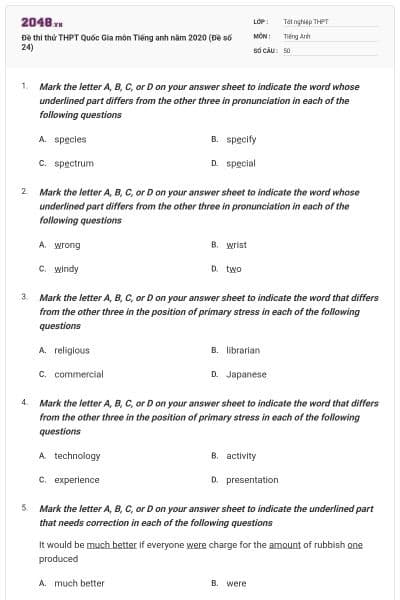
Mark the letter A, B, C, or D on your answer sheet to indicate the word whose underlined part differs from the other three in pronunciation in each of the following questions
species
specify
spectrum
special
Đáp án A
species /ˈspiːʃiːz/
specify /ˈspesɪfaɪ/
spectrum /ˈspektrəm/
special /ˈspeʃl/
Câu A phát âm là /iː/ còn lại phát âm là /e/
Mark the letter A, B, C, or D on your answer sheet to indicate the word whose underlined part differs from the other three in pronunciation in each of the following questions
wrong
wrist
windy
two
Đáp án C
wrong /rɒŋ/
wrist /rɪst/
windy /ˈwɪndi/
two /tuː/
Câu C phát âm là /w/ còn lại âm w câm
Mark the letter A, B, C, or D on your answer sheet to indicate the word that differs from the other three in the position of primary stress in each of the following questions
religious
librarian
commercial
Japanese
Đáp án D
religious /rɪˈlɪdʒəs/
librarian /laɪˈbreəriən/
commercial /kəˈmɜːʃl/ J
apanese /ˌdʒæpəˈniːz/
Câu D trọng âm 3 còn lại trọng âm 2
Mark the letter A, B, C, or D on your answer sheet to indicate the word that differs from the other three in the position of primary stress in each of the following questions
technology
activity
experience
presentation
Đáp án D
technology /tekˈnɒlədʒi/
activity /ækˈtɪvəti/
experience /ɪkˈspɪəriəns/
presentation /ˌpreznˈteɪʃn/
Câu D trọng âm 3 còn lại trọng âm 2
Mark the letter A, B, C, or D on your answer sheet to indicate the underlined part that needs correction in each of the following questions
It would be much better if everyone were charge for the amount of rubbish one produced
much better
were
amount
one
Đáp án D
One => they
Vì khi chủ ngữ phía trước là everyone vế phía sau phải thay thế bằng đại từ “they” để thay thế.
Câu này dịch như sau: Sẽ tốt hơn nhiều nếu mọi người bị tính phí cho lượng rác thải mà họ thải ra
Mark the letter A, B, C, or D on your answer sheet to indicate the underlined part that needs correction in each of the following questions
Finished her household chores, Mary decided to do some shopping
finished
household chores
to do
shopping
Đáp án A
Finished => having finished
Câu rút gọn 2 mệnh đề cùng chủ ngữ:
- khi câu mang nghĩa chủ động rút gọn thành Ving [ khi hai hành động cùng thì] ; rút gọn thành Having Ved [ khi hai hành động xảy ra theo thứ tự trước sau],
- khi câu mang nghĩa bị động dùng Ved.
Câu này dịch như sau: Sau khi làm xong việc nhà, Mary đã quyết định đi mua sắm.
Mark the letter A, B, C, or D on your answer sheet to indicate the underlined part that needs correction in each of the following questions
Not long after Galileo’s time, Sir Isaac Newton invented another kind of telescope which he used mirrors instead of lenses
not long after
another kind of
which he used
intead
Đáp án C
Which he => which
Vì đại từ quan hệ which thay thế cho danh từ telescope đóng vai trò chủ ngữ trong mệnh đề quan hệ nên phải bỏ “he”.
Vì cái dùng gương là kính thiên văn không phải Issac Newton.
Câu này dịch như sau: Không lâu sau thời đại của Galileo, ông Issac Newton đã phát minh ra một kính thiên văn khác cái mà dùng gương thay vì dùng thấu kính
Mark the letter A, B, C, or D on your answer sheet to indicate the correct answer to each of the following questions
This surface________rough but it________smooth
feels/touches
appears/tastes
sees/smells
looks/feels
Đáp án D
Feel: cảm nhận
Touch: chạm vào
Appear: có vẻ như/ xuất hiện
Taste: nếm
Smell: ngửi
See: nhìn thấy
Câu này dịch như sau: Bề mặt này trông có vẻ thô ráp nhưng sờ vào rất mịn
Mark the letter A, B, C, or D on your answer sheet to indicate the correct answer to each of the following questions
________with the size of the whole Earth, the highest mountains do not seem high at all
Compare them
If you compare
When compared
A comparison
Đáp án C
Rút gọn hai mệnh đề cùng chủ ngữ khi mệnh đề mang nghĩa bị động dùng Ved
Câu đầy đủ: When the highest mountains are compared with the size of the whole Earth,... =>Rút gọn: When compared with the size of the whole Earth Câu này dịch như sau: Khi được so sánh với kích thước của cả Trái Đất, những ngọn núi cao nhất thế giới không có vẻ cao chút nào
Mark the letter A, B, C, or D on your answer sheet to indicate the correct answer to each of the following questions
I’m sure that you can recognize her at the station; she________a red raincoat
will be wearing
will have been wearing
is going to wear
will have worn
Đáp án A
Dùng thì tương lai tiếp diễn [ will be Ving] để diễn tả hành động đang diễn ra ở một thời điểm trong tương lai.
Câu này dịch như sau:Tôi chắc chắn bạn có thể nhận ra cô ấy ở nhà ga; cô ấy sẽ đang mặc chiếc áo mưa màu đỏ
Mark the letter A, B, C, or D on your answer sheet to indicate the correct answer to each of the following questions
This________dictionary includes a few animations
electricity
electric
electronic
electrical
Đáp án C
Electricity(n): điện
Electric (adj) : điện tử [ + danh từ: chỉ về vật dụng điện hoặc sản xuất ra điện năng]
Electronic(adj): điện tử
Electrical (adj): thuộc về điện
Cụm danh từ: electonic mail / electronic dictionary
Câu này dịch như sau: Từ điển điện tử bao gồm một vài hình ảnh động
Mark the letter A, B, C, or D on your answer sheet to indicate the correct answer to each of the following questions
When exactly did the war________between two countries?
go off
set in
call off
break out
Đáp án D
Go off: nổ [ dùng cho bom], reo/ đổ chuông [ dùng cho đồng hồ báo thức]
Set in = begin: bắt đầu
Call off = cancel: hủy bỏ
Breal out: bùng nổ/ xảy ra
Câu này dịch như sau: Chính xác là chiến tranh giữa hai nước đã xảy ra khi nào
Mark the letter A, B, C, or D on your answer sheet to indicate the correct answer to each of the following questions
Maria Sharapova became the first Russian________a Wimbledon single title
to win
that was winning
who wins
which won
Đáp án A
Rút gọn mệnh đề quan hệ khi cụm danh từ là the first/ second/ last...
=> to Vo
Câu này dịch như sau: Maria Sharapova đã trở thành người Nga đầu tiên đạt danh hiệu vô địch banh nỉ đơn nữ Wimbledon
Mark the letter A, B, C, or D on your answer sheet to indicate the correct answer to each of the following questions
His________of safety regulations really can’t be ignored any longer
inattention
disregard
carelessness
unfamiliarity
Đáp án B
Inattetion: lơ là/ xao lãng
Disregard of sth / for sth: coi nhẹ/ xem thường [ cái gì ]
Carelessness: sự bất cẩn
Unfamiliarity: sự không quen biết
Câu này dịch như sau: Sự xem thường những quy định an toàn của anh ấy thật sự không thể bỏ qua được nữa
Mark the letter A, B, C, or D on your answer sheet to indicate the correct answer to each of the following questions
________the first time I met Tom was at college
As much as I remember
As far as I remember
As well as I remember
As soon as I remember
Đáp án B
As much as: nhiều như
As far as: theo như
As well as: cũng như
As soon as: ngay khi
Câu này dịch như sau: Theo như tôi nhớ , lần đầu tiên tôi gặp Tom là ở đại học
Mark the letter A, B, C, or D on your answer sheet to indicate the correct answer to each of the following questions
Very________people went to the show but it still started on time
much
a few
little
few
Đáp án D
Much + danh từ không đếm được [ nhiều]
A few + danh từ số nhiều [ một vài ] => Only a few [ chỉ một vài]
Little + danh từ không đếm được: một ít / một chút
Few+ danh từ số nhiều [ một ít] => very few [ rất ít]
Câu này dịch như sau: Rất ít người đến buổi biểu diễn nhưng nó vẫn bắt đầu đúng giờ.
Mark the letter A, B, C, or D on your answer sheet to indicate the correct answer to each of the following questions
“I would rather you________me the truth right now.”
told
tell
said
say
Đáp án A
Cấu trúc: S + would rather + Vo: muốn [ làm gì ]
S+ would rather + sb + Ved: muốn ai làm gì
Tell + sb: nói [ ai nghe] Say to sb: nói với [ai]
Câu này dịch như sau: Tôi muốn bạn kể tôi nghe sự thật ngay bây giờ
Mark the letter A, B, C, or D on your answer sheet to indicate the correct answer to each of the following questions
Do you know that wine is made ________ grapes?
out of
of
from
with
Đáp án C
Be made of : được làm từ [ khi sản phẩm tạo ra không khác về bản chất so với nguyên liệu ban đầu ]
Be made from : được làm từ [ khi sản phẩm tạo ra được biến chất so với chất liệu ban đầu ] Câu này dịch như sau: Bạn có biết rằng rượu vang được làm từ nho không? Rượu khác hẳn về bản chất so với nho. => Chọn be made from
Mark the letter A, B, C, or D on your answer sheet to indicate the correct answer to each of the following questions
Heavy snowfalls made________planes to land or take off
it impossible
impossible for
impossible
it impossible for
Đáp án D
Cấu trúc: make it + tính từ + for sth + to Vo
Make + tính từ + danh từ [ Ví dụ: The Internet makes impossible faster communication.
Câu này dịch như sau: Mưa tuyết nặng hạt làm cho máy bay không thể cất cánh và hạ cánh.
Mark the letter A, B, C, or D on your answer sheet to indicate the most suitable response to complete each of the following exchanges
“Make yourself at home.”
“________________________”
Not at all. Don’t mention it
Yes. Can I help you?
That’s very kind. Thank you
Thanks! Same to you
Đáp án C
“ Cứ tự nhiên như ở nhà.”
A. Không có sao. Đừng đề cập đến nó.
B. Vâng. Mình có thể giúp gì cho bạn?
C. Bạn thật tử tế. Cảm ơn.
D. Cảm ơn! Bạn cũng vậy nhé
Mark the letter A, B, C, or D on your answer sheet to indicate the most suitable response to complete each of the following exchanges
“I got 8.0/9.0 for the IELTS test!” “ .”
Good for you. Thank you
It’s OK. I’m proud of you
You can do it
Well done, son! I’m very proud of you
Đáp án D
“ Con được 8.0 / 9.0 điểm thi IELTS”
A. Tốt thôi. Cảm ơn.
B. Con có thể làm được điều đó.
C. Được rồi. Bố tụa hào về con.
D. Làm tốt lắm con trai. Bố rất tự hào về con
Mark the letter A, B, C, or D on your answer sheet to indicate the word(s) CLOSEST in meaning to the under lined word(s) in each of the following questions.
I could see the finish line and thought I was home and dry
hopeless
hopeful
unsuccessful
successful
Đáp án D
Home and dry: thành công
Hopeless: vô vọng
Hopeful: đầy hi vọng
Unsuccessful: không thành công
Successful: thành công =>home and dry = Successful
Câu này dịch như sau: Tôi có thể nhìn thấy vạch đích và nghĩ rằng tôi đã thành công.
Mark the letter A, B, C, or D on your answer sheet to indicate the word(s) CLOSEST in meaning to the under lined word(s) in each of the following questions.
Tourists today flock to see the two falls that actually constitute Niagara falls
come without knowing what they will see
come in large numbers
come out of boredom
come by plane
Đáp án B
Câu này dịch như sau: Các du khách đổ xô / ồ ạt để ngắm hai thác nước thật sự tạo nên thác nước Niagara.
A. đến mà không biết họ sẽ thấy cái gì
B. đến với số lượng lớn
C. hết chán nản
D. đến bằng máy bay =>flock = come in large number
Mark the letter A, B, C, or D on your answer sheet to indicate the word(s) OPPOSITE in meaning to the underlined word(s) in each of the following questions
Her father likes the cabbage rare
over-boiled
precious
scarce
scare
Đáp án A
Rare: tái
Over- boiled: đun chín quá
Precious: quý giá
Scarce: khan hiếm
Scare: làm cho ai đó sợ hãi =>rare >< over-boiled
Câu này dịch như sau: Bố cô ấy muốn bắp cải được nấu tái
Mark the letter A, B, C, or D on your answer sheet to indicate the word(s) OPPOSITE in meaning to the underlined word(s) in each of the following questions
My cousin tends to look on the bright side in any circumstance
be optimistic
be pessimistic
be confident
be smart
Đáp án B
Look on the bright side: lạc quan
Optimistic: lạc quan
Pessimistic: bi quan
Confident: tự tin
Smart: thông minh
Câu này dịch như sau: Anh họ của tôi có xu hướng nhìn về mặt tươi sáng/ lạc quan trong bất cứ tình huống nào. =>look on the bright side >< pessimistic
Mark the letter A, B, C, or D on your answer sheet to indicate the sentence that is closest in meaning to each of the following questions
My cousin was named after his grandfather
They named his grandfather before they named him
My cousin’s grandfather gave him a name
My cousin has the same name as his grandfather’s
My cousin was renamed as requested by his grandfather
Đáp án C
Anh họ của tôi được đặt tên theo tên ông nội của anh ấy. [ Tên anh họ tôi giống tên ông nội của anh ấy.]
A. Họ đã đặt tên ông nội của anh ấy trước khi họ đặt tên anh ấy.
B. Ông nội của anh họ tôi đã đặt tên cho anh ấy.
C. Anh họ của tôi có cùng tên với ông nội của anh ấy.
D. Anh họ của tôi đã được đặt tên lại do ông nội yêu cầu
Mark the letter A, B, C, or D on your answer sheet to indicate the sentence that is closest in meaning to each of the following questions
To some people, the sinking of the Titanic was the captain's fault
To some people, the captain was to blame for the sinking of the Titanic
Some people were blamed for the sinking of the Titanic
The Titanic sank due to the captain’s fault
Some people put the blame to the captain about the sinking of the Titanic
Đáp án A
Theo một số người, vụ chìm tàu Titanic là do lỗi của thuyền trưởng.
A. Theo một số người, thuyền trưởng sắp đổ lỗi trong vụ chìm tàu Titanic.
B. Một số người bị đổ lỗi cho vụ chìm tàu Titanic.
C. Titanic đã chìm do lỗi của thuyền trưởng.
D. Một số người đỗ lỗi cho đội trưởng về vụ chìm tàu Titanic. Cấu trúc bị động: S+ be to blame for sth = be responsible for [ chịu trách nhiệm/ bị đổ lỗi cho] Cấu trúc chủ ộng: blame sth on sb
Cụm từ “put the blame for st on sb” : đổ lỗi gì cho ai
Mark the letter A, B, C, or D on your answer sheet to indicate the sentence that is closest in meaning to each of the following questions
It’s likely that John will be late for the meeting.
John likes the meeting although he can be late
John is probably late for the meeting
The meeting is likely to be late because of John
John is often late for the meeting, so we don’t like it
Đáp án B
Có vẻ như là John sẽ muộn cuộc họp.
A. John thích cuộc họp mặc dù anh ấy có thể muộn.
B. John có thể muộn cuộc họp.
C. Cuộc họp có thể muộn vì John.
D. John thường muộn cuộc họp, vì vậy chúng tôi không thích nó
Mark the letter A, B, C, or D on your answer sheet to indicate the sentence that best combines each pair of sentences in the following questions
Most scientists know him well. However, very few ordinary people have heard of him
He is the only scientist that is not known to the general public
Not only scientists but also the general public know him as a big name
Although he is well known to scientists, he is little known to the general public
Many ordinary people know him better than most scientists do
Đáp án C
Hầu hết các nhà khoa học biết về ông ấy rất rõ. Tuy nhiên, rất ít người bình thường nghe về ông ấy.
A. Ông ấy là nhà khoa học duy nhất không được cộng đồng biết đến.
B. Không chỉ các nhà khoa học mà công chúng cũng biết về tên tuổi của ông ấy.
C. Mặc dù ông ấy rất nổi tiếng trong giới khoa học nhưng rất ít được biết đến trong công chúng.
D. Nhiều người bình thường biết về ông ấy rõ hơn các nhà khoa học
Mark the letter A, B, C, or D on your answer sheet to indicate the sentence that best combines each pair of sentences in the following questions
I think my hair looks fine. My mother believes it needs a little more brushing
Not only do I think my hair looks fine, but my mother also believes it needs a little more brushing
I think my hair looks so fine that my mother believes it needs a little more brushing
I think my hair looks fine, but my mother believes it needs a little more brushing
Either my mother believes it needs a little more brushing or I think my hair looks fine
Đáp án C
Tôi nghĩ rằng tốc tôi trông đẹp rồi. Mẹ tôi tin rằng nó cần được chải chuốt thêm chút nữa.
A. Không những tôi nghĩ rằng tóc mình đẹp mà mẹ tôi cũng tin rằng nó cần được chải chuốt thêm chút nữa.
B. Tôi nghĩ tóc tôi trông quá đẹp đến nỗi mà mẹ tôi tin rằng nó cần được chải chuốt thêm chút nữa.
C. Tôi nghĩ tóc tôi đẹp nhưng mẹ tôi tin rằng nó cần được chải chuốt thêm chút nữa.
D. Hoặc là mẹ tôi tin rằng tóc tôi cần được chải chuốt thêm chút nữa hoặc là tôi nghĩ tóc tôi đẹp
Read the following passage and mark the letter A, B, C, or D on your answer sheet to indicate the correct word or phrase that best fits each of the numbered blanks from 31 to 35.
The first question we might ask is: What can you learn in college that will help you in being an employee? The schools teach a (31) __________ many things of value to the future accountant, doctor or electrician. Do they also teach anything of value to the future employee? The answer is: “Yes - they teach the one thing that it is perhaps most valuable for the future employee to know. But very few students bother (32)___________ it. This one basic skill is the ability to organize and express ideas in writing and in speaking. This means that your success as an employee will depend on your ability to communicate with people and to (33)___________ your own thoughts and ideas to them so they will (34)___________ understand what you are driving at and be persuaded.
Of course, skill in expression is not enough (35)___________ itself. You must have something to say in the first place. The effectiveness of your job depends as much on your ability to make other people understand your work as it does on the quality of the work itself.
Điền vào ô số 31
large
great
far
lots
Đáp án B
A large number of: một số lượng lớn
A great many things of : nhiều thứ
The first question we might ask is: What can you learn in college that will help you in being an employee? The schools teach a (31) _________ many things of value to the future accountant, doctor or electrician.
[ Câu hỏi đầu tiên chúng ta có thể hỏi: Bạn có thể học gì ở trường đại học cái mà sẽ giúp bạn trở thành một nhân viên. Trường học dạy nhiều thứ có giá trị đối với một kế toán, bác sĩ hay thợ điện.]
Read the following passage and mark the letter A, B, C, or D on your answer sheet to indicate the correct word or phrase that best fits each of the numbered blanks from 31 to 35.
The first question we might ask is: What can you learn in college that will help you in being an employee? The schools teach a (31) __________ many things of value to the future accountant, doctor or electrician. Do they also teach anything of value to the future employee? The answer is: “Yes - they teach the one thing that it is perhaps most valuable for the future employee to know. But very few students bother (32)___________ it. This one basic skill is the ability to organize and express ideas in writing and in speaking. This means that your success as an employee will depend on your ability to communicate with people and to (33)___________ your own thoughts and ideas to them so they will (34)___________ understand what you are driving at and be persuaded.
Of course, skill in expression is not enough (35)___________ itself. You must have something to say in the first place. The effectiveness of your job depends as much on your ability to make other people understand your work as it does on the quality of the work itself.
Điền vào ô số 32
to learning
with learning
to learn
learn
Đáp án C
Bother + to Vo = make an effort to Vo: nỗ lực để làm gì
Do they also teach anything of value to the future employee? The answer is: “Yes - they teach the one thing that it is perhaps most valuable for the future employee to know. But very few students bother (32)_________ it.
[ Họ cũng dạy bất cứ thứ gì có giá trị cho một nhân viên trong tương lai hay không? Câu trả lời là “ Có - họ dạy một thứ mà có lẽ giá trị nhất cho một nhân viên trong tương lai cần biết. Nhưng rất ít học sinh nỗ lực để học.]
Read the following passage and mark the letter A, B, C, or D on your answer sheet to indicate the correct word or phrase that best fits each of the numbered blanks from 31 to 35.
The first question we might ask is: What can you learn in college that will help you in being an employee? The schools teach a (31) __________ many things of value to the future accountant, doctor or electrician. Do they also teach anything of value to the future employee? The answer is: “Yes - they teach the one thing that it is perhaps most valuable for the future employee to know. But very few students bother (32)___________ it. This one basic skill is the ability to organize and express ideas in writing and in speaking. This means that your success as an employee will depend on your ability to communicate with people and to (33)___________ your own thoughts and ideas to them so they will (34)___________ understand what you are driving at and be persuaded.
Of course, skill in expression is not enough (35)___________ itself. You must have something to say in the first place. The effectiveness of your job depends as much on your ability to make other people understand your work as it does on the quality of the work itself.
Điền vào ô số 33
interpret
give out
transfer
present
Đáp án D
Interpret: phiên dịch/ diễn giải
Give out = distribute: phân phát
Transfer: chuyển [ tiền/ vị trí]
Present: trình bày
This one basic skill is the ability to organize and express ideas in writing and in speaking. This means that your success as an employee will depend on your ability to communicate with people and to (33)________ your own thoughts and ideas to them
[ Một kỹ năng cơ bản là khả năng tổ chức và trình bày ý kiến trong văn nói và viết. Điều này có nghĩa là thành công của bạn khi là một nhân viên sẽ phụ thuộc vào kar năng giao tiếp với người khác và trình bày những suy nghĩ của bạn và ý kiến của bạn với họ.]
Read the following passage and mark the letter A, B, C, or D on your answer sheet to indicate the correct word or phrase that best fits each of the numbered blanks from 31 to 35.
The first question we might ask is: What can you learn in college that will help you in being an employee? The schools teach a (31) __________ many things of value to the future accountant, doctor or electrician. Do they also teach anything of value to the future employee? The answer is: “Yes - they teach the one thing that it is perhaps most valuable for the future employee to know. But very few students bother (32)___________ it. This one basic skill is the ability to organize and express ideas in writing and in speaking. This means that your success as an employee will depend on your ability to communicate with people and to (33)___________ your own thoughts and ideas to them so they will (34)___________ understand what you are driving at and be persuaded.
Of course, skill in expression is not enough (35)___________ itself. You must have something to say in the first place. The effectiveness of your job depends as much on your ability to make other people understand your work as it does on the quality of the work itself.
Điền vào ô số 34
both
not
as well
either
Đáp án A
Both...and...: cả ...và Cụm từ: drive at = try to say [ cố gắng truyền đạt]
so they will (34)________ understand what you are driving at and be persuaded. [Vì vậy họ sẽ hiểu cái mà bạn cố gắng diễn đạt và bị thuyết phục.]
Read the following passage and mark the letter A, B, C, or D on your answer sheet to indicate the correct word or phrase that best fits each of the numbered blanks from 31 to 35.
The first question we might ask is: What can you learn in college that will help you in being an employee? The schools teach a (31) __________ many things of value to the future accountant, doctor or electrician. Do they also teach anything of value to the future employee? The answer is: “Yes - they teach the one thing that it is perhaps most valuable for the future employee to know. But very few students bother (32)___________ it. This one basic skill is the ability to organize and express ideas in writing and in speaking. This means that your success as an employee will depend on your ability to communicate with people and to (33)___________ your own thoughts and ideas to them so they will (34)___________ understand what you are driving at and be persuaded.
Of course, skill in expression is not enough (35)___________ itself. You must have something to say in the first place. The effectiveness of your job depends as much on your ability to make other people understand your work as it does on the quality of the work itself.
Điền vào ô số 35
on
for
by
in
Đáp án C
By + đại từ phản thân = alone
Of course, skill in expression is not enough (35)________itself. You must have something to say in the first place. The effectiveness of your job depends as much on your ability to make other people understand your work as it does on the quality of the work itself.
[Dĩ nhiên, mỗi kỹ năng diễn đạt vẫn không đủ. Bạn phải cái gì đó để nói trước. Tính hiệu quả trong công việc phụ thuộc nhiều vào khả năng của bạn để làm cho người khác hiểu công việc của bạn cũng như chất lượng công việc.]
Read the following passage and mark the letter A, B, C, or D on your answer sheet to indicate the correct answer to each of the questions from 36 to 42.
The Census Counts!
Every ten years there is a national census to count the number of people. The census counts the number of people in each area, the number of men and women, their ages, their profession, their family size and status. The census is the only way to count everyone. Its results are used by a great many people and are available to everyone. The census is useful; it helps to work out present and future needs for housing by seeing how many people are housed now, or the sizes and ages of their families. In addition, the size of annual grants made by the Government to public services depends largely on the numbers and needs of people in the area provided by the census. Furthermore, the census shows how many people have moved from one area to another and how the number of the local work force is changing.
The census is taken in order to provide the figures about the nation as a whole. It does not give information about any named person, family or household. Therefore, names and addresses are needed on the forms but they are not fed into the computer. After the census, the forms with the names on are locked away and will not be released to anyone outside the Census Office for 100 years. The answers people give on their census forms will be treated in strict confidence. Everyone working on the census is sworn to secrecy and can be sued if he or she improperly reveals information
Which of the following does the census not take interest in?
How many houses you have
How old you are
What your job is
How big your family is
Đáp án A
Cái nào sau đây mà cục điều tra dân số không quan tâm?
A. Có bao nhiêu hộ gia đình
B. Bạn bao nhiêu tuổi
C. Công việc của bạn là gì
D. Gia đình của bạn có bao nhiêu người Dẫn chứng: The census counts the number of people in each area, the number of men and women, their ages, their profession, their family size and status
Read the following passage and mark the letter A, B, C, or D on your answer sheet to indicate the correct answer to each of the questions from 36 to 42.
The Census Counts!
Every ten years there is a national census to count the number of people. The census counts the number of people in each area, the number of men and women, their ages, their profession, their family size and status. The census is the only way to count everyone. Its results are used by a great many people and are available to everyone. The census is useful; it helps to work out present and future needs for housing by seeing how many people are housed now, or the sizes and ages of their families. In addition, the size of annual grants made by the Government to public services depends largely on the numbers and needs of people in the area provided by the census. Furthermore, the census shows how many people have moved from one area to another and how the number of the local work force is changing.
The census is taken in order to provide the figures about the nation as a whole. It does not give information about any named person, family or household. Therefore, names and addresses are needed on the forms but they are not fed into the computer. After the census, the forms with the names on are locked away and will not be released to anyone outside the Census Office for 100 years. The answers people give on their census forms will be treated in strict confidence. Everyone working on the census is sworn to secrecy and can be sued if he or she improperly reveals information
Census results________
are not used for anyone
are kept in secret forever
can be used for everyone
are used by no one
Đáp án C
Kết quả của cuộc điều tra dân số
A. Không được dùng cho mọi người
B. được giữ bí mật mãi mãi
C. có thể được sử dụng bởi mọi người
D. không được ai sử dụng cả
Dẫn chứng: Its results are used by a great many
Read the following passage and mark the letter A, B, C, or D on your answer sheet to indicate the correct answer to each of the questions from 36 to 42.
The Census Counts!
Every ten years there is a national census to count the number of people. The census counts the number of people in each area, the number of men and women, their ages, their profession, their family size and status. The census is the only way to count everyone. Its results are used by a great many people and are available to everyone. The census is useful; it helps to work out present and future needs for housing by seeing how many people are housed now, or the sizes and ages of their families. In addition, the size of annual grants made by the Government to public services depends largely on the numbers and needs of people in the area provided by the census. Furthermore, the census shows how many people have moved from one area to another and how the number of the local work force is changing.
The census is taken in order to provide the figures about the nation as a whole. It does not give information about any named person, family or household. Therefore, names and addresses are needed on the forms but they are not fed into the computer. After the census, the forms with the names on are locked away and will not be released to anyone outside the Census Office for 100 years. The answers people give on their census forms will be treated in strict confidence. Everyone working on the census is sworn to secrecy and can be sued if he or she improperly reveals information
How the size of grants to local services is based on information from the census?
completely
very much
a little
not at all
Đáp án B
Quy mô trợ cấp của chính phủ cho các dịch vụ địa phương được dựa trên thông tin từ điều tra dân số như thế nào?
Completely: hoàn toàn
Very much: rất nhiều
A little: một chút
Not at all: không chút nào cả
Dẫn chứng: In addition, the size of annual grants made by the Government to public services depends largely on the numbers and needs of people in the area provided by the census
Read the following passage and mark the letter A, B, C, or D on your answer sheet to indicate the correct answer to each of the questions from 36 to 42.
The Census Counts!
Every ten years there is a national census to count the number of people. The census counts the number of people in each area, the number of men and women, their ages, their profession, their family size and status. The census is the only way to count everyone. Its results are used by a great many people and are available to everyone. The census is useful; it helps to work out present and future needs for housing by seeing how many people are housed now, or the sizes and ages of their families. In addition, the size of annual grants made by the Government to public services depends largely on the numbers and needs of people in the area provided by the census. Furthermore, the census shows how many people have moved from one area to another and how the number of the local work force is changing.
The census is taken in order to provide the figures about the nation as a whole. It does not give information about any named person, family or household. Therefore, names and addresses are needed on the forms but they are not fed into the computer. After the census, the forms with the names on are locked away and will not be released to anyone outside the Census Office for 100 years. The answers people give on their census forms will be treated in strict confidence. Everyone working on the census is sworn to secrecy and can be sued if he or she improperly reveals information
Which of the following statement is NOT true?
There are names and age on the census forms
The census reveals everyone’s personal information
People must supply personal information
The census information is stored in a computer
Đáp án B
Câu nào sau đây không đúng?
A. Có tên và tuổi trong bảng điều tra dân số
B. Điều tra dân số tiết lộ thông tin cá nhân của mọi người
C. Mọi người phải cung cấp thông tin cá nhân.
D. Thông tin điều tra dân số được lưu trữ trong một chiếc máy tính.
Dẫn chứng: It does not give information about any named person, family or household. Therefore, names and addresses are needed on the forms but they are not fed into the computer. After the census, the forms with the names on are locked away and will not be released to anyone outside the Census Office for 100 years.
Read the following passage and mark the letter A, B, C, or D on your answer sheet to indicate the correct answer to each of the questions from 36 to 42.
The Census Counts!
Every ten years there is a national census to count the number of people. The census counts the number of people in each area, the number of men and women, their ages, their profession, their family size and status. The census is the only way to count everyone. Its results are used by a great many people and are available to everyone. The census is useful; it helps to work out present and future needs for housing by seeing how many people are housed now, or the sizes and ages of their families. In addition, the size of annual grants made by the Government to public services depends largely on the numbers and needs of people in the area provided by the census. Furthermore, the census shows how many people have moved from one area to another and how the number of the local work force is changing.
The census is taken in order to provide the figures about the nation as a whole. It does not give information about any named person, family or household. Therefore, names and addresses are needed on the forms but they are not fed into the computer. After the census, the forms with the names on are locked away and will not be released to anyone outside the Census Office for 100 years. The answers people give on their census forms will be treated in strict confidence. Everyone working on the census is sworn to secrecy and can be sued if he or she improperly reveals information
Which of the following is true about the information of names and addresses in the census?
It is stored in the computer for 100 years
It is not usually correct
It will not be seen by anyone
It will be made public after 100 years
Đáp án D
Câu nào sau đây đúng về thông tin tên và địa chỉ trong điều tra dân số?
A. Nó được lưu trữ trong máy tính khoản 100 năm
B. Nó thường không đúng.
C. Nó không được mọi người xem.
D. Nó được công khai sau 100 năm.
Dẫn chứng: After the census, the forms with the names on are locked away and will not be released to anyone outside the Census Office for 100 years
Read the following passage and mark the letter A, B, C, or D on your answer sheet to indicate the correct answer to each of the questions from 36 to 42.
The Census Counts!
Every ten years there is a national census to count the number of people. The census counts the number of people in each area, the number of men and women, their ages, their profession, their family size and status. The census is the only way to count everyone. Its results are used by a great many people and are available to everyone. The census is useful; it helps to work out present and future needs for housing by seeing how many people are housed now, or the sizes and ages of their families. In addition, the size of annual grants made by the Government to public services depends largely on the numbers and needs of people in the area provided by the census. Furthermore, the census shows how many people have moved from one area to another and how the number of the local work force is changing.
The census is taken in order to provide the figures about the nation as a whole. It does not give information about any named person, family or household. Therefore, names and addresses are needed on the forms but they are not fed into the computer. After the census, the forms with the names on are locked away and will not be released to anyone outside the Census Office for 100 years. The answers people give on their census forms will be treated in strict confidence. Everyone working on the census is sworn to secrecy and can be sued if he or she improperly reveals information
The word “sued” in the last sentence is closest in meaning to________
legally sewn
legally sound
legally punished
legally fine
Đáp án C
Từ “sued” trong câu cuối gần nghĩa nhất với
Sue: kiện tụng
A. được khâu một cách hợp pháp
B. phát biểu/ thăm dò một cách hợp pháp
C. bị trừng phạt một cách hợp pháp
D. phạt tiền một cách hợp pháp
=>sue = legally punished
Read the following passage and mark the letter A, B, C, or D on your answer sheet to indicate the correct answer to each of the questions from 36 to 42.
The Census Counts!
Every ten years there is a national census to count the number of people. The census counts the number of people in each area, the number of men and women, their ages, their profession, their family size and status. The census is the only way to count everyone. Its results are used by a great many people and are available to everyone. The census is useful; it helps to work out present and future needs for housing by seeing how many people are housed now, or the sizes and ages of their families. In addition, the size of annual grants made by the Government to public services depends largely on the numbers and needs of people in the area provided by the census. Furthermore, the census shows how many people have moved from one area to another and how the number of the local work force is changing.
The census is taken in order to provide the figures about the nation as a whole. It does not give information about any named person, family or household. Therefore, names and addresses are needed on the forms but they are not fed into the computer. After the census, the forms with the names on are locked away and will not be released to anyone outside the Census Office for 100 years. The answers people give on their census forms will be treated in strict confidence. Everyone working on the census is sworn to secrecy and can be sued if he or she improperly reveals information
The word “counts” in the title means________
is important
the counting
accounting
to count people
Đáp án A
Từ “counts” trong tiêu đề có nghĩa là
A. quan trọng
B. sự đo lường/ đếm
C. đếm/ kiểm toán
D. đếm người
counts = matters = important
Read the following passage and mark the letter A, B, C, or D on your answer sheet to indicate the correct answer to each of the questions from 43 to 50.
Quite different from storm surges are the giant sea waves called tsunamis, which derive their name from the Japanese expression for “high water in a harbor.” These waves are also referred to by the general public as tidal waves, although they have relatively little to do with tides. Scientists often referred to them as seismic sea waves, far more appropriate in that they do result from undersea seismic activity.
Tsunamis are caused when the sea bottom suddenly moves, during an underwater earthquake or volcano for example, and the water above the moving earth is suddenly displaced. This sudden shift of water sets off a series of waves. These waves can travel great distances at speeds close to 700 kilometers per hour. In the open ocean, tsunamis have little noticeable amplitude, often no more than one or two meters. It is when they hit the shallow waters near the coast that they increase in height, possibly up to 40 meters.
Tsunamis often occur in the Pacific because the Pacific is an area of heavy seismic activity. Two areas of the Pacific well accustomed to the threat of tsunamis are Japan and Hawaii. Because the seismic activity that causes tsunamis in Japan often occurs on the ocean bottom quite close to the islands, the tsunamis that hit Japan often come with little warning and can, therefore, prove disastrous. Most of the tsunamis that hit the Hawaiian Islands, however, originate thousands of miles away near the coast of Alaska, so these tsunamis have a much greater distance to travel and the inhabitants of Hawaii generally have time for warning of their imminent arrival.
Tsunamis are certainly not limited to Japan and Hawaii. In 1755, Europe experienced a calamitous tsunami, when movement along the fault lines near the Azores caused a massive tsunami to sweep onto the Portuguese coast and flood the heavily populated area around Lisbon. The greatest tsunami on record occurred on the other side of the world in 1883 when the Krakatoa volcano underwent a massive explosion, sending waves more than 30 meters high onto nearby Indonesian islands; the tsunami from this volcano actually traveled around the world and was witnessed as far away as the English Channel
The paragraph preceding this passage most probably discusses?
underwater earthquakes
storm surges
tides
tidal waves
Đáp án B
Đoạn văn trước bài đọc này có thể thảo luận về?
A. những trận động đất dưới đáy đại dương
B. những cơn sóng cuồn
C. thủy triều
D. sóng thủy triều
Dẫn chứng: Quite different from storm surges are the giant sea waves called tsunamis, which derive their name from the Japanese expression for “high water in a harbor.”
Read the following passage and mark the letter A, B, C, or D on your answer sheet to indicate the correct answer to each of the questions from 43 to 50.
Quite different from storm surges are the giant sea waves called tsunamis, which derive their name from the Japanese expression for “high water in a harbor.” These waves are also referred to by the general public as tidal waves, although they have relatively little to do with tides. Scientists often referred to them as seismic sea waves, far more appropriate in that they do result from undersea seismic activity.
Tsunamis are caused when the sea bottom suddenly moves, during an underwater earthquake or volcano for example, and the water above the moving earth is suddenly displaced. This sudden shift of water sets off a series of waves. These waves can travel great distances at speeds close to 700 kilometers per hour. In the open ocean, tsunamis have little noticeable amplitude, often no more than one or two meters. It is when they hit the shallow waters near the coast that they increase in height, possibly up to 40 meters.
Tsunamis often occur in the Pacific because the Pacific is an area of heavy seismic activity. Two areas of the Pacific well accustomed to the threat of tsunamis are Japan and Hawaii. Because the seismic activity that causes tsunamis in Japan often occurs on the ocean bottom quite close to the islands, the tsunamis that hit Japan often come with little warning and can, therefore, prove disastrous. Most of the tsunamis that hit the Hawaiian Islands, however, originate thousands of miles away near the coast of Alaska, so these tsunamis have a much greater distance to travel and the inhabitants of Hawaii generally have time for warning of their imminent arrival.
Tsunamis are certainly not limited to Japan and Hawaii. In 1755, Europe experienced a calamitous tsunami, when movement along the fault lines near the Azores caused a massive tsunami to sweep onto the Portuguese coast and flood the heavily populated area around Lisbon. The greatest tsunami on record occurred on the other side of the world in 1883 when the Krakatoa volcano underwent a massive explosion, sending waves more than 30 meters high onto nearby Indonesian islands; the tsunami from this volcano actually traveled around the world and was witnessed as far away as the English Channel
According to the passage, all of the following are true about tidal waves EXCEPT that________
they are caused by sudden changes in high and low tides
this terminology is not used by the scientific community
they are the same as tsunamis
they refer to the same phenomenon as seismic sea waves
Đáp án A
Theo bài đọc, tất cả những câu sau đây đúng về sóng thủy triều NGOẠI TRỪ
A. chúng được gây ra bởi sự thay đổi đột ngột thủy triều cao và thấp
B. thuật ngữ này không được dùng bởi cộng đồng khoa học.
C. chúng giống như sóng thần
D. chúng ám chỉ đến cùng một hiện tượng như những con sóng địa chấn
Dẫn chứng: Tsunamis are caused when the sea bottom suddenly moves, during an underwater earthquake or volcano for example, and the water above the moving earth is suddenly displaced
Read the following passage and mark the letter A, B, C, or D on your answer sheet to indicate the correct answer to each of the questions from 43 to 50.
Quite different from storm surges are the giant sea waves called tsunamis, which derive their name from the Japanese expression for “high water in a harbor.” These waves are also referred to by the general public as tidal waves, although they have relatively little to do with tides. Scientists often referred to them as seismic sea waves, far more appropriate in that they do result from undersea seismic activity.
Tsunamis are caused when the sea bottom suddenly moves, during an underwater earthquake or volcano for example, and the water above the moving earth is suddenly displaced. This sudden shift of water sets off a series of waves. These waves can travel great distances at speeds close to 700 kilometers per hour. In the open ocean, tsunamis have little noticeable amplitude, often no more than one or two meters. It is when they hit the shallow waters near the coast that they increase in height, possibly up to 40 meters.
Tsunamis often occur in the Pacific because the Pacific is an area of heavy seismic activity. Two areas of the Pacific well accustomed to the threat of tsunamis are Japan and Hawaii. Because the seismic activity that causes tsunamis in Japan often occurs on the ocean bottom quite close to the islands, the tsunamis that hit Japan often come with little warning and can, therefore, prove disastrous. Most of the tsunamis that hit the Hawaiian Islands, however, originate thousands of miles away near the coast of Alaska, so these tsunamis have a much greater distance to travel and the inhabitants of Hawaii generally have time for warning of their imminent arrival.
Tsunamis are certainly not limited to Japan and Hawaii. In 1755, Europe experienced a calamitous tsunami, when movement along the fault lines near the Azores caused a massive tsunami to sweep onto the Portuguese coast and flood the heavily populated area around Lisbon. The greatest tsunami on record occurred on the other side of the world in 1883 when the Krakatoa volcano underwent a massive explosion, sending waves more than 30 meters high onto nearby Indonesian islands; the tsunami from this volcano actually traveled around the world and was witnessed as far away as the English Channel
It can be inferred from the passage that tsunamis________
cause severe damage in the middle of the ocean
generally reach heights greater than 40 meters
are far more dangerous on the coast than in the open ocean
are often identified by ships on the ocean
Đáp án C
Có thể suy ra từ bài đọc rằng sóng thần
A. gây ra thiệt hại nghiêm trọng giữa biển
B. thường cao hơn 40 m
C. nguy hiểm hơn ở vùng ven biển so với ở ngoài đại dương
D. thường được xác định bởi những con tàu trên đại dương.
Dẫn chứng: In the open ocean, tsunamis have little noticeable amplitude, often no more than one or two meters. It is when they hit the shallow waters near the coast that they increase in height, possibly up to 40 meters
Read the following passage and mark the letter A, B, C, or D on your answer sheet to indicate the correct answer to each of the questions from 43 to 50.
Quite different from storm surges are the giant sea waves called tsunamis, which derive their name from the Japanese expression for “high water in a harbor.” These waves are also referred to by the general public as tidal waves, although they have relatively little to do with tides. Scientists often referred to them as seismic sea waves, far more appropriate in that they do result from undersea seismic activity.
Tsunamis are caused when the sea bottom suddenly moves, during an underwater earthquake or volcano for example, and the water above the moving earth is suddenly displaced. This sudden shift of water sets off a series of waves. These waves can travel great distances at speeds close to 700 kilometers per hour. In the open ocean, tsunamis have little noticeable amplitude, often no more than one or two meters. It is when they hit the shallow waters near the coast that they increase in height, possibly up to 40 meters.
Tsunamis often occur in the Pacific because the Pacific is an area of heavy seismic activity. Two areas of the Pacific well accustomed to the threat of tsunamis are Japan and Hawaii. Because the seismic activity that causes tsunamis in Japan often occurs on the ocean bottom quite close to the islands, the tsunamis that hit Japan often come with little warning and can, therefore, prove disastrous. Most of the tsunamis that hit the Hawaiian Islands, however, originate thousands of miles away near the coast of Alaska, so these tsunamis have a much greater distance to travel and the inhabitants of Hawaii generally have time for warning of their imminent arrival.
Tsunamis are certainly not limited to Japan and Hawaii. In 1755, Europe experienced a calamitous tsunami, when movement along the fault lines near the Azores caused a massive tsunami to sweep onto the Portuguese coast and flood the heavily populated area around Lisbon. The greatest tsunami on record occurred on the other side of the world in 1883 when the Krakatoa volcano underwent a massive explosion, sending waves more than 30 meters high onto nearby Indonesian islands; the tsunami from this volcano actually traveled around the world and was witnessed as far away as the English Channel
A main difference between tsunamis in Japan and in Hawaii is that tsunamis in Japan are more likely to________
come from greater distances
originate in Alaska
be less of a problem
arrive without warning
Đáp án D
Sự khác biệt lớn giữa sóng thần ở Nhật Bản và sóng thần ở Hawaii là sóng thần ở Nhật Bản thì
A. đến từ khoảng cách xa
B. có nguồn gốc từ Alaska
C. là vấn đề nhỏ hơn
D. đến mà không cảnh báo trước
Dẫn chứng: the tsunamis that hit Japan often come with little warning and can, therefore, prove disastrous.
Read the following passage and mark the letter A, B, C, or D on your answer sheet to indicate the correct answer to each of the questions from 43 to 50.
Quite different from storm surges are the giant sea waves called tsunamis, which derive their name from the Japanese expression for “high water in a harbor.” These waves are also referred to by the general public as tidal waves, although they have relatively little to do with tides. Scientists often referred to them as seismic sea waves, far more appropriate in that they do result from undersea seismic activity.
Tsunamis are caused when the sea bottom suddenly moves, during an underwater earthquake or volcano for example, and the water above the moving earth is suddenly displaced. This sudden shift of water sets off a series of waves. These waves can travel great distances at speeds close to 700 kilometers per hour. In the open ocean, tsunamis have little noticeable amplitude, often no more than one or two meters. It is when they hit the shallow waters near the coast that they increase in height, possibly up to 40 meters.
Tsunamis often occur in the Pacific because the Pacific is an area of heavy seismic activity. Two areas of the Pacific well accustomed to the threat of tsunamis are Japan and Hawaii. Because the seismic activity that causes tsunamis in Japan often occurs on the ocean bottom quite close to the islands, the tsunamis that hit Japan often come with little warning and can, therefore, prove disastrous. Most of the tsunamis that hit the Hawaiian Islands, however, originate thousands of miles away near the coast of Alaska, so these tsunamis have a much greater distance to travel and the inhabitants of Hawaii generally have time for warning of their imminent arrival.
Tsunamis are certainly not limited to Japan and Hawaii. In 1755, Europe experienced a calamitous tsunami, when movement along the fault lines near the Azores caused a massive tsunami to sweep onto the Portuguese coast and flood the heavily populated area around Lisbon. The greatest tsunami on record occurred on the other side of the world in 1883 when the Krakatoa volcano underwent a massive explosion, sending waves more than 30 meters high onto nearby Indonesian islands; the tsunami from this volcano actually traveled around the world and was witnessed as far away as the English Channel
The possessive “their” in paragraph 3 refers to________
the Hawaiian Islands
thousands of miles
these tsunamis
the inhabitants of Hawaii
Đáp án C
Tính từ sở hữu “their” ở đoạn 3 ám chỉ đến
A. các đảo Hawaii
B. hàng nghìn dặm
C. những cơn sóng thần này
D. những người dân của Hawaii Dẫn chứng: so these tsunamis have a much greater distance to travel and the inhabitants of Hawaii generally have time for warning of their imminent arrival
Read the following passage and mark the letter A, B, C, or D on your answer sheet to indicate the correct answer to each of the questions from 43 to 50.
Quite different from storm surges are the giant sea waves called tsunamis, which derive their name from the Japanese expression for “high water in a harbor.” These waves are also referred to by the general public as tidal waves, although they have relatively little to do with tides. Scientists often referred to them as seismic sea waves, far more appropriate in that they do result from undersea seismic activity.
Tsunamis are caused when the sea bottom suddenly moves, during an underwater earthquake or volcano for example, and the water above the moving earth is suddenly displaced. This sudden shift of water sets off a series of waves. These waves can travel great distances at speeds close to 700 kilometers per hour. In the open ocean, tsunamis have little noticeable amplitude, often no more than one or two meters. It is when they hit the shallow waters near the coast that they increase in height, possibly up to 40 meters.
Tsunamis often occur in the Pacific because the Pacific is an area of heavy seismic activity. Two areas of the Pacific well accustomed to the threat of tsunamis are Japan and Hawaii. Because the seismic activity that causes tsunamis in Japan often occurs on the ocean bottom quite close to the islands, the tsunamis that hit Japan often come with little warning and can, therefore, prove disastrous. Most of the tsunamis that hit the Hawaiian Islands, however, originate thousands of miles away near the coast of Alaska, so these tsunamis have a much greater distance to travel and the inhabitants of Hawaii generally have time for warning of their imminent arrival.
Tsunamis are certainly not limited to Japan and Hawaii. In 1755, Europe experienced a calamitous tsunami, when movement along the fault lines near the Azores caused a massive tsunami to sweep onto the Portuguese coast and flood the heavily populated area around Lisbon. The greatest tsunami on record occurred on the other side of the world in 1883 when the Krakatoa volcano underwent a massive explosion, sending waves more than 30 meters high onto nearby Indonesian islands; the tsunami from this volcano actually traveled around the world and was witnessed as far away as the English Channel
A “calamitous” tsunami, in paragraph 4, is one that is________
at fault
disastrous
extremely calm
expected
Đáp án B
Một cơn són thân hủy diệt ở đoạn 4 là cơn sóng thần mà At fault = responsible: chịu trách nhiệm về việc gì
Disastrous: thảm họa/ hủy diệt
Extremely calm: cực kỳ tĩnh lặng
Expected: được mong đợi =>calamitous = Disastrous
Read the following passage and mark the letter A, B, C, or D on your answer sheet to indicate the correct answer to each of the questions from 43 to 50.
Quite different from storm surges are the giant sea waves called tsunamis, which derive their name from the Japanese expression for “high water in a harbor.” These waves are also referred to by the general public as tidal waves, although they have relatively little to do with tides. Scientists often referred to them as seismic sea waves, far more appropriate in that they do result from undersea seismic activity.
Tsunamis are caused when the sea bottom suddenly moves, during an underwater earthquake or volcano for example, and the water above the moving earth is suddenly displaced. This sudden shift of water sets off a series of waves. These waves can travel great distances at speeds close to 700 kilometers per hour. In the open ocean, tsunamis have little noticeable amplitude, often no more than one or two meters. It is when they hit the shallow waters near the coast that they increase in height, possibly up to 40 meters.
Tsunamis often occur in the Pacific because the Pacific is an area of heavy seismic activity. Two areas of the Pacific well accustomed to the threat of tsunamis are Japan and Hawaii. Because the seismic activity that causes tsunamis in Japan often occurs on the ocean bottom quite close to the islands, the tsunamis that hit Japan often come with little warning and can, therefore, prove disastrous. Most of the tsunamis that hit the Hawaiian Islands, however, originate thousands of miles away near the coast of Alaska, so these tsunamis have a much greater distance to travel and the inhabitants of Hawaii generally have time for warning of their imminent arrival.
Tsunamis are certainly not limited to Japan and Hawaii. In 1755, Europe experienced a calamitous tsunami, when movement along the fault lines near the Azores caused a massive tsunami to sweep onto the Portuguese coast and flood the heavily populated area around Lisbon. The greatest tsunami on record occurred on the other side of the world in 1883 when the Krakatoa volcano underwent a massive explosion, sending waves more than 30 meters high onto nearby Indonesian islands; the tsunami from this volcano actually traveled around the world and was witnessed as far away as the English Channel
From the expression “on record” in the last paragraph, it can be inferred that the tsunami that accompanied the Krakatoa volcano________
was not as strong as the tsunami in Lisbon
might not be the greatest tsunami ever
was filmed as it was happening
occurred before efficient records were kept
Đáp án B
Từ cụm từ “ được ghi chép lại” ở đoạn cuối, có thể suy ra rằng sóng thần được gây ra bởi núi lửa Krakatoa
A. nó không mạnh như sóng thần ở Liston
B. có thể không phải là sóng thần lớn nhất
C. đã được quay hình lại khi nó đang diễn ra
D. xảy ra trước khi những ghi chép hữu hiệu được lưu lại.
Dẫn chứng: The greatest tsunami on record occurred on the other side of the world in 1883 when the Krakatoa volcano underwent a massive explosion, sending waves more than 30 meters high onto nearby Indonesian islands; the tsunami from this volcano actually traveled around the world and was witnessed as far away as the English Channel
Read the following passage and mark the letter A, B, C, or D on your answer sheet to indicate the correct answer to each of the questions from 43 to 50.
Quite different from storm surges are the giant sea waves called tsunamis, which derive their name from the Japanese expression for “high water in a harbor.” These waves are also referred to by the general public as tidal waves, although they have relatively little to do with tides. Scientists often referred to them as seismic sea waves, far more appropriate in that they do result from undersea seismic activity.
Tsunamis are caused when the sea bottom suddenly moves, during an underwater earthquake or volcano for example, and the water above the moving earth is suddenly displaced. This sudden shift of water sets off a series of waves. These waves can travel great distances at speeds close to 700 kilometers per hour. In the open ocean, tsunamis have little noticeable amplitude, often no more than one or two meters. It is when they hit the shallow waters near the coast that they increase in height, possibly up to 40 meters.
Tsunamis often occur in the Pacific because the Pacific is an area of heavy seismic activity. Two areas of the Pacific well accustomed to the threat of tsunamis are Japan and Hawaii. Because the seismic activity that causes tsunamis in Japan often occurs on the ocean bottom quite close to the islands, the tsunamis that hit Japan often come with little warning and can, therefore, prove disastrous. Most of the tsunamis that hit the Hawaiian Islands, however, originate thousands of miles away near the coast of Alaska, so these tsunamis have a much greater distance to travel and the inhabitants of Hawaii generally have time for warning of their imminent arrival.
Tsunamis are certainly not limited to Japan and Hawaii. In 1755, Europe experienced a calamitous tsunami, when movement along the fault lines near the Azores caused a massive tsunami to sweep onto the Portuguese coast and flood the heavily populated area around Lisbon. The greatest tsunami on record occurred on the other side of the world in 1883 when the Krakatoa volcano underwent a massive explosion, sending waves more than 30 meters high onto nearby Indonesian islands; the tsunami from this volcano actually traveled around the world and was witnessed as far away as the English Channel
The passage suggests that the tsunami resulting from the Krakatoa volcano
was far more destructive close to the source than far away
resulted in little damage
was unobserved outside of the Indonesian islands
caused volcanic explosions in the English Channel
Đáp án A
Bài đọc cho thấy rằng sóng thần gây ra bởi núi lửa Krakatoa
A. có tính hủy diệt hơn gần nguồn hơn là xa nguồn
B. gây ra ít thiệt hại
C. không thể quan sát được bên ngoài các đảo của Indonesia
D. gây ra các vụ phun trào núi lửa ở English Channel
Dẫn chứng: when the Krakatoa volcano underwent a massive explosion, sending waves more than 30 meters high onto nearby Indonesian islands; the tsunami from this volcano actually traveled around the world and was witnessed as far away as the English Channel