Đề thi thử thpt quốc gia 2019 môn tiếng anh (Đề số 9)
50 câu hỏi
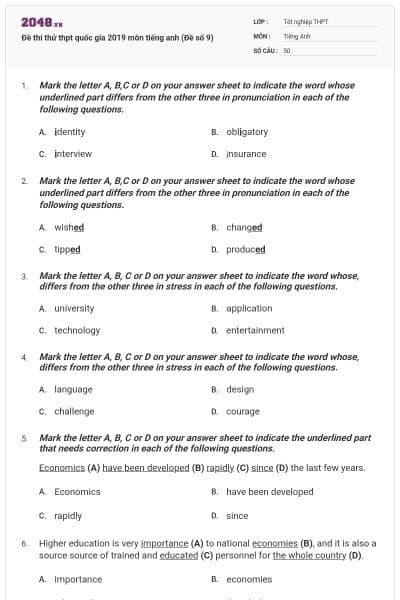
Mark the letter A, B,C or D on your answer sheet to indicate the word whose underlined part differs from the other three in pronunciation in each of the following questions.
identity
obligatory
interview
insurance
Đáp án A
Giải thích:
A. / ai'dentəti/
B. /ə'bligətri/
C. /'intəvju:/
D. /in'ʃʊərəns/
Đáp án B, C, D đọc là /i/; đáp án A đọc là /ai/
Mark the letter A, B,C or D on your answer sheet to indicate the word whose underlined part differs from the other three in pronunciation in each of the following questions.
wished
changed
tipped
produced
Đáp án B
Giải thích:
A./wiʃt/
B./tʃeindʒd/
C./tipt/
D. /prə'dju:st/
Đáp án B đọc là /d/, đáp án A. C, D đọc là /t/
Cách phát âm đuôi “-ed”
+/id/: trước -ed là các âm /t/ hoặc /d/. Ví dụ: needed, wanted...
+/t/: trước -ed là các âm vô thanh /k/, /p/, /f/, /s/, /ʃ/, /tʃ/, /ɵ/. Ví dụ pack, laughed, washed...
+/d/: trước -ed là phụ âm còn lại và các nguyên âm. Ví dụ described, called...
Mark the letter A, B, C or D on your answer sheet to indicate the word whose, differs from the other three in stress in each of the following questions.
university
application
technology
entertainment
Đáp án C
Giải thích:
A. /ju:ni'vɜ:səti/
B. /aepli'keiʃn/
C. /tek'nɒ1ədʒi/
D. /entə'teinmənt/
Từ 3 âm tiết trở lên tận cùng là -ity, -tion, -logy, -ment thì trọng âm rơi vào âm tiết ngay trước nó.
Đáp án A, B, D trọng âm rơi vào âm tiết số 3; đáp án C trọng âm rơi vào âm tiết số 2
Mark the letter A, B, C or D on your answer sheet to indicate the word whose, differs from the other three in stress in each of the following questions.
language
design
challenge
courage
Đáp án B
Giải thích:
A./læŋgwidʒ/
B. /di'zain/
C./'tʃælindʒ/
D./'kʌridʒ/
Với từ 2 âm tiết: đa số trọng âm rơi vào âm tiết số 1 nếu là danh từ hoặc tính từ. Trọng âm rơi vào âm tiết số 2 nếu là động từ.
Đáp án A, C, D trọng âm rơi vào âm tiết số 1; Đáp án B trọng âm rơi vào âm tiết số 2.
Mark the letter A, B, C or D on your answer sheet to indicate the underlined part that needs correction in each of the following questions.
Economics (A) have been developed (B) rapidly (C) since (D) the last few years.
Economics
have been developed
rapidly
since
Đáp án B
Giải thích:
Sau danh từ chỉ tên môn học, ví dụ: economics, physics, history... dùng động
từ số ít.
Dịch nghĩa: Môn kinh tế học phát triển nhanh chóng trong vài năm vừa qua.
—» has been developed
Higher education is very importance (A) to national economies (B), and it is also a source source of trained and educated (C) personnel for the whole country (D).
importance
economies
educated
the whole country
Đáp án A
Giải thích: S + be + very + adj; sau động từ “to be’ và “very” cần một tính từ
nhưng “importance” là danh từ. (-ance là đuôi của danh từ).
Dịch nghĩa: Giáo dục đại học rất quan trọng với nền kinh tế quốc gia, và nó
cũng là một nguồn nhân lực được đào tạo và giáo dục cho cả nước.
—» important
Mark the letter A, B, C or D on your answer sheet to indicate the underlined part that needs correction in each of the following questions.
Higher vocational (A) education and training that combines (B) teaching of both practical (C) skills and theoretical (D) expertise.
vocational
that combines
practical
theoretical
Đáp án B
Giải thích: Phân tích câu này ta có: “Higher vocational cducation and training” là chủ ngữ, nếu theo sau là mệnh đề quan hệ "that combines” thì câu sẽ thiếu động từ chính. Ta không thể thêm động từ cho câu. Vì thế, ta phải sửa lại mệnh đề quan hệ thành động từ chính của câu bằng cách bỏ đi đại từ quan hệ “that” Như vậy, cấu trúc câu sẽ hoàn toàn đúng. Higher vocational education and traininst (S) combine (V) teaching of both practical skills and theoretical expertise (O).
Dịch nghĩa: Giáo dục và đào tạo nghề ở đại học kết hợp việc dạy cả những kĩ năng thực hành và lí thuyết chuyên ngành.
—» combine

Học thông minh hơn mỗi ngày
Xem toàn bộ 50 câu hỏi và nhiều hơn nữa với tài khoản miễn phí
Mark the letter A, B, C or D on your answer sheet to indicate the correct answer to each of the following questions.
I made my .................. to that company for a job a month ago but I haven’t received any reply yet.
form
application
requirement
letter
Đáp án B
Giải thích: cụm từ: to make an application to Sb for st: gửi đơn cho ai để xin việc gì
Dịch nghĩa: Tôi đã gửi đơn đến công ti đó xin việc cách đây một tháng nhưng chưa nhận được phản hồi.
Mark the letter A, B, C or D on your answer sheet to indicate the correct answer to each of the following questions.
Taking part in the Advanced Engineering Project gave me a chance to use my .................. to help society.
creativity
creature
create
creative
Đáp án A
Giải thích: sau tính từ sở hữu cần danh từ.
Đáp án C có đuôi -ate là đuôi động từ và đáp án D có đuôi -ive là đuôi của tính từ nên loại.
Đáp án A. creativity (n) tính sáng tạo; và B (n) sinh vật đều là danh từ nhưng
xét về nghĩa đáp án A phù hợp hơn.
Dịch nghĩa: Tham gia vào Dự án kĩ sư tiên tiến cho tôi cơ hội sử dụng tính sáng tạo của tôi.
Mark the letter A, B, C or D on your answer sheet to indicate the correct answer to each of the following questions.
You can meet Mr. Pike, who is .................. behalf .................. the university to solve the problems of foreign students.
on/ of
in/ for
with/ at
for/ at
Đáp án A
Giải thích: cụm từ: to be on be half of: đại diện cho...
Dịch nghĩa: Bạn có thể gặp ông Pike, người đại diện cho trường đại học giải quyết các vấn đề của các sinh viên nước ngoài.
Mark the letter A, B, C or D on your answer sheet to indicate the correct answer to each of the following questions.
He was the only .................. that was offered the job.
apply
application
applying
applicant
Đáp án D
Giải thích: Đáp án cần điền phải là danh từ chỉ người vì chủ ngữ là “he”. Ta có: apply (v) áp dụng
+ apply for: nộp đơn xin việc
+ application (n) sự ứng dụng; đơn xin việc
+ applicant (n) người nộp đơn xin việc (đuôi -ant là đuôi danh từ chỉ người)
Dịch nghĩa: Anh ấy là người xin việc duy nhất được trao công việc đó.
Mark the letter A, B, C or D on your answer sheet to indicate the correct answer to each of the following questions.
Most .................. are at senior level, requiring appropriate qualifications.
degrees
grades
colleges
vacancies
Đáp án D
Giải thích:
A. degree (n): bằng cấp
B. grade (n) cấp độ
C. college (n) trường cao đẳng
D. vacancy (n) vị trí tuyển dụng
Dịch nghĩa: Hầu hết những vị trí tuyển dụng đều là cấp cao đòi hỏi trình độ phù hợp.
Mark the letter A, B, C or D on your answer sheet to indicate the correct answer to each of the following questions.
He had been expected to cope well with examinations and good results.
achieve
last
consider
object
Đáp án A
Giải thích:
A. achieve (v) đạt được
B. last (v) kéo dài
C. consider (v) cân nhắc
D. object (v) phản đối.
Dịch nghĩa: Anh ấy được mong đợi là làm bài thi tốt và đạt kết quả cao.
Mark the letter A, B, C or D on your answer sheet to indicate the correct answer to each of the following questions.
She was the first in her family .................. a college education.
get
getting
gotten
to get
Đáp án D
Giải thích: sau số thứ tự the first/ second/ third.../ only/ last + to
Dịch nghĩa: Cô ấy là người đầu tiên trong gia đình đỗ vào trường cao đẳng sư phạm.
Mark the letter A, B, C or D on your answer sheet to indicate the correct answer to each of the following questions.
A .................. is an official document that you receive when you have completed a course of study or training.
vocation
certificate
grade
subject
Đáp án: B
Giải thích:
A. vocation (n): nghề nghiệp
B. certificate (n): chứng chỉ
C. grade (n): cấp độ
D. subject (n): môn học
Dịch: Chứng chỉ là một văn bản chính thức mà bạn nhận được khi hoàn thành một khóa học hay đào tạo.
Mark the letter A, B, C or D on your answer sheet to indicate the correct answer to each of the following questions.
I would like to invite you to participate in the .................. ceremony.
graduation
graduate
graduated
graduating
Đáp án A
Giải thích:
graduation (n) sự tốt nghiệp;
graduate (v) tốt nghiệp
cụm từ graduation ceremony:
Lễ tốt nghiệp
Dịch nghĩa:
Tôi muốn mời bạn đến tham dự lễ tốt nghiệp.
Mark the letter A, B, C or D on your answer sheet to indicate the correct answer to each of the following questions.
The A-level (short for Advanced Level) is a General Certificate of Education set of exams in the UK.
indicated
met
spent
taken
Đáp án D
Giải thích:
A. indicate (v) chỉ ra
B. meet (v) gặp, đáp ứng
C. spend (v) tiêu sài, sử dụng
D. take (v) cầm, nắm, giữ.
Cụm từ take an exam: dự thi
Dịch nghĩa: cấp độ A (viết tắt cho cấp độ tiên tiến) là hệ thống chứng chỉ sư phạm phổ thông cho các kì thi ở Anh.
Mark the letter A, B, C or D on your answer sheet to indicate the correct answer to each of the following questions.
It is very important for a film or a company to keep .................. the changes in the market.
pace of
track about
touch with
up with
Đáp án D
Keep up with st: bắt kịp, theo kịp với cái gì
Dịch: Nó là rất quan trọng đối với một bộ phim hay một công ti để theo kịp với những thay đổi trên thị trường.
Mark the letter A, B, C or D on your answer sheet to indicate the correct answer to each of the following questions.
Students also have the opportunity to choose from a wide range of .................. courses in the university.
compulsory
limited
optional
required
Đáp án C
Giải thích:
A. compulsory (adj) bắt buộc
B. limited (adj) có hạn
C. optional (adj) tùy chọn
D. required (adj) được đòi hỏi, yêu cầu
Dịch nghĩa: Sinh viên có cơ hội lựa chọn từ một phạm vi rất rộng các khóa học tự chọn ở đại học.
Mark the letter A, B, C, or D on your answer sheet to indicate the most suitable response to complete each of the following exchanges.
- John: “I’ve passed my final exam.” - Tom: “ .................. ”
Good luck.
Congratulations!
That’s a good idea.
It’s nice of you to say so.
Đáp án B
Giải thích: John thông báo rằng anh ấy vừa đỗ kì thi cuối cùng và Tom chúc mừng anh ta.
Đáp án
A. Chúc may mắn
B. Chúc mừng
C. Đó là ý kiến hay
D. Bạn thật tốt khi nói vậy.
Mark the letter A, B, C, or D on your answer sheet to indicate the most suitable response to complete each of the following exchanges.
- Peter: “Thanks a lot for your wonderful gift.” - Mary: “ .................. ”
You are welcome
Thank you
Cheers
Have a good day
Đáp án A
Giải thích: Đáp lại lời cảm ơn ta dùng cụm từ “You are welcome” mang nghĩa “không có gì.”
Dịch nghĩa: Peter: “Cảm ơn rất nhiều vì món quà tuyệt vời của bạn.” - Mary: “Không có gì.”
Mark the letter A, B, C, or D on your answer sheet to indicate the sentence that is CLOSET in meaning to the underlined word(s) in each of the following questions.
We are very anxious about the result of the exam.
careful
excited
careless
worried
Đáp án D
Giải thích: anxious mang nghĩa “lo lắng”.
A. careful (adj) cẩn thận
B. excited (adj) háo hức
C. careless (adj) bất cẩn;
D. worried (adj) lo lắng về;
Mark the letter A, B, C, or D on your answer sheet to indicate the sentence that is CLOSET in meaning to the underlined word(s) in each of the following questions.
The choice of a particular career is influenced by a number of factors.
usefulness
success
desire
selection
Đáp án D
Giải thích: Từ “choice” mang nghĩa “lựa chọn’’.
A. usefulness (n) sự hữu ích
B. success (n) sự thành công
C. desire (n) khát khao
D. selection (n) sự lựa chọn
Dịch nghĩa: Sự lựa chọn một nghề cụ thể bị ảnh hưởng bởi một số yếu tố.
Mark the tetter A, B, C, or D on your answer sheet to indicate the sentence that is OPPOSITE in meaning to the underlined word(s) in each of the following questions.
We offer a speedy and secure service of transferring money in less than 24 hours.
uninterested
open
unsure
slow
Đáp án C
Giải thích: Từ “secure” mang nghĩa “an toàn”,
A. uninterested (adj) không quan tâm
B. open (adj) cởi mở
C. unsure (adj) không chắc chắn
D. slow (adj) chậm
Dịch nghĩa: Chúng tôi cung cấp một dịch vụ chuyển tiền nhanh và an toàn trong vòng chưa đầy 24 tiếng.
Mark the tetter A, B, C, or D on your answer sheet to indicate the sentence that is OPPOSITE in meaning to the underlined word(s) in each of the following questions.
A surprising percentage of the population in remote areas is illiterate.
able to speak fluently
unable to speak fluently
unable to read and write
able to read and write
Đáp án D
Giải thích: Từ “illiterate” mang nghĩa “mù chữ”.
A. có thể nói trôi chảy
B. không thể nói trôi chảy
C. không thể đọc và viết
D. có thể đọc và viết
Dịch nghĩa: Một tỉ lệ đáng ngạc nhiên về dân số ở vùng hẻo lánh bị mù chữ.
Mark the letter A, B, C, or D on your answer sheet to indicate the sentence that is closest in meaning to each of the following questions.
She said, “I’ll call the police if you don’t leave immediately!”
She frightened to call the police if he didn’t leave immediately.
She said to call the police if he didn’t leave immediately.
She scared to call the police if he didn’t leave immediately.
She threatened to call the police if he didn’t leave immediately.
Đáp án D
Giải thích: Cô ấy nói: “Tôi sẽ gọi cảnh sát nếu anh không đi ngay lập tức!”
A. Cô ấy sợ hãi gọi cảnh sát nếu anh ta không đi ngay lập tức.
B. Cô ấy nói gọi cảnh sát nếu anh ta không đi ngay lập tức.
C. Cô ấy sợ gọi cảnh sát nếu anh ta không đi ngay lập tức.
D. Cô ấy đe dọa gọi cảnh sát nếu anh ta không đi ngay lập tức.
(Câu trực tiếp mang nghĩa đe dọa.)
Mark the letter A, B, C, or D on your answer sheet to indicate the sentence that is closest in meaning to each of the following questions.
My sister said to me, “You are going to do the washing up, don’t forget.”
My sister told me to do the washing up.
My sister reminded me not to forget to do the washing up.
My sister reminded me to do the washing up.
My sister ordered me to do the washing up.
Đáp án C
Giải thích: Chị tôi nói với tôi, “Em sẽ phải rửa bát đấy, đừng quên nhé.”
Câu trực tiếp mang nghĩa nhắc nhở nên sang câu gián tiếp phải dùng cấu trúc:
S remined Sb to V: nhắc nhở ai làm gì
A. Chị tôi bảo tôi rửa bát.
B. Chị tôi nhắc tôi không được quên rửa bát. (không dùng remind và forget trong cùng câu)
C. Chị tôi nhắc tôi rửa bát.
D. Chị tôi ra lệnh cho tôi rửa bát
Mark the letter A, B, C, or D on your answer sheet to indicate the sentence that is closest in meaning to each of the following questions.
The hag was heavy, so we could not take it with us.
If the bag were not heavy, we would take it with us.
Unless the bag had not been heavy, we would have taken it with us.
If had the bag not been heavy, we would have taken it with us.
Had the bag not been heavy, we would have taken it with us.
Đáp án D
Giải thích: Cái túi nặng, vì vậy chúng tôi không thể mang nó theo.
Câu gốc là mệnh đề nguyên nhân, kết quả có động từ ở quá khứ đơn nên khi chuyển sang câu điều kiện phải là điều kiện loại 3 (không có thật trong quá khứ)
If S had PII, S would have PII.
Đáp án A loại vì là câu điều kiện loại 2
Đáp án B cũng loại vì sau Unless không dùng động từ phủ định
Đáp án C cũng loại vì không đúng cấu trúc câu điều kiện 3.
Dịch nghĩa: D. Nếu cái túi không nặng thì chúng tôi đã mang nó theo.
Mark the letter A, B, C or D on your answer sheet to indicate the sentence that best combines each pair of sentences in the following questions.
Sue lives in a house. The house is opposite my house.
Sue lives in a house where is opposite my house.
Sue lives in a house which is opposite my house.
Sue lives in a house who is opposite my house.
Sue lives in a house and which is opposite my house.
Đáp án B
Sue lives in a house. The house is opposite my house.
Sue ở trong một ngôi nhà. Ngôi nhà đối diện nhà tôi.
= Sue lives in a house which is opposite my house,
Sue ở trong một ngôi nhà, cái (nhà) đối diện nhà tôi
Ở đây ta dùng mệnh đề quan hệ which để thay thế cho a house
Mark the letter A, B, C or D on your answer sheet to indicate the sentence that best combines each pair of sentences in the following questions.
She turned the radio on at 7.30. She was still listening to it when her mother came home at 9.00.
She has been listening to the radio at 7.30.
She had been listening to the radio since 7.30.
She has been listening to the radio after 7.30.
She had been listening to the radio by 7.30.
Đáp án B
Ở đây đang dùng thì quá khứ —» thì hiện tại ở đáp án A và C loại
7.30 là một thời điểm trong quá khứ, một mốc thời gian trong quá khứ —» sử dụng since
Đáp án là B: Cô ấy đã nghe đài suốt từ 7.30
Read the following passage and mark the letter A, B, C, or D on your answer sheet to indicate the correct word or phrase that best fits each of the numbered blanks from 31 to 35.
Education is more important today than ever before. It helps people (31) .................. the skills they need for such everyday (32) .................. as reading a newspaper or managing their money. It also gives them the specialized training they may need to prepare for a job or career. For example, a person must (33) .................. certain educational requirements and obtain a (34) .................. or certificate before he can practice law or medicine. Many fields, like computer operation or police work, require satisfactory completion of special training courses.
Education also helps people adjust to change. This habit has become necessary because social changes today take place with increasing speed and affect the lives of more and more people. Education can help a person understand these changes and provide him (35) .................. the skills for adjusting to them.
Điền vào ô 31
require
acquire
get
have
Đáp án B
Giải thích:
A. require (v) đòi hỏi, yêu cầu
B. acquire (v) thu được, đạt được
C. get (v) nhận được
D. have (v) có.
Cụm từ acquire the skills: đạt được những kĩ năng
Read the following passage and mark the letter A, B, C, or D on your answer sheet to indicate the correct word or phrase that best fits each of the numbered blanks from 31 to 35.
Education is more important today than ever before. It helps people (31) .................. the skills they need for such everyday (32) .................. as reading a newspaper or managing their money. It also gives them the specialized training they may need to prepare for a job or career. For example, a person must (33) .................. certain educational requirements and obtain a (34) .................. or certificate before he can practice law or medicine. Many fields, like computer operation or police work, require satisfactory completion of special training courses.
Education also helps people adjust to change. This habit has become necessary because social changes today take place with increasing speed and affect the lives of more and more people. Education can help a person understand these changes and provide him (35) .................. the skills for adjusting to them.
Điền vào ô 32
works
jobs
actions
activities
Đáp án D
Giải thích
A. works (n) tác phẩm
B. jobs (n) công việc
C. actions (n) hành động
D. activities (n) hoạt động
Cụm từ daily/ every day activities: các hoạt động hàng ngày.
Read the following passage and mark the letter A, B, C, or D on your answer sheet to indicate the correct word or phrase that best fits each of the numbered blanks from 31 to 35.
Education is more important today than ever before. It helps people (31) .................. the skills they need for such everyday (32) .................. as reading a newspaper or managing their money. It also gives them the specialized training they may need to prepare for a job or career. For example, a person must (33) .................. certain educational requirements and obtain a (34) .................. or certificate before he can practice law or medicine. Many fields, like computer operation or police work, require satisfactory completion of special training courses.
Education also helps people adjust to change. This habit has become necessary because social changes today take place with increasing speed and affect the lives of more and more people. Education can help a person understand these changes and provide him (35) .................. the skills for adjusting to them.
Điền vào ô 33
meet
provide
make
show
Đáp án A
Giải thích:
A. meet (v) gặp, đáp ứng
B. provide (v) cung cấp
C. make (v) tạo ra
D. show (v) chỉ dẫn.
Cụm từ meet the requirements: đáp ứng được yêu cầu
Read the following passage and mark the letter A, B, C, or D on your answer sheet to indicate the correct word or phrase that best fits each of the numbered blanks from 31 to 35.
Education is more important today than ever before. It helps people (31) .................. the skills they need for such everyday (32) .................. as reading a newspaper or managing their money. It also gives them the specialized training they may need to prepare for a job or career. For example, a person must (33) .................. certain educational requirements and obtain a (34) .................. or certificate before he can practice law or medicine. Many fields, like computer operation or police work, require satisfactory completion of special training courses.
Education also helps people adjust to change. This habit has become necessary because social changes today take place with increasing speed and affect the lives of more and more people. Education can help a person understand these changes and provide him (35) .................. the skills for adjusting to them.
Điền vào ô 34
license
card
diploma
paper
Đáp án C
Giải thích:
A. license (n) giấy phép
B. card (n) thẻ
C. diploma (n) bằng cấp
D. paper (n) giấy, báo
Read the following passage and mark the letter A, B, C, or D on your answer sheet to indicate the correct word or phrase that best fits each of the numbered blanks from 31 to 35.
Education is more important today than ever before. It helps people (31) .................. the skills they need for such everyday (32) .................. as reading a newspaper or managing their money. It also gives them the specialized training they may need to prepare for a job or career. For example, a person must (33) .................. certain educational requirements and obtain a (34) .................. or certificate before he can practice law or medicine. Many fields, like computer operation or police work, require satisfactory completion of special training courses.
Education also helps people adjust to change. This habit has become necessary because social changes today take place with increasing speed and affect the lives of more and more people. Education can help a person understand these changes and provide him (35) .................. the skills for adjusting to them.
Điền vào ô 35
in
for
with
to
Đáp án C
Giải thích: cấu trúc provide sb with st: cung cấp cho ai cái gì
Dịch nghĩa: Giáo dục ngày nay quan trọng hơn so với trước đây. Nó giúp con người đạt được những kĩ năng mà họ cần cho các hoạt động hàng ngày như đọc báo hoặc quản lí tiền. Nó còn cho họ sự đào tạo mang tính chuyên môn mà họ cần để chuẩn bị cho công việc hay sự nghiệp. Ví dụ một người phải đáp ứng được những yêu cầu giáo dục nhất định và có được một giấy phép hay giấy chứng nhận trước khi anh ta có thể hành nghề luật hay y. Nhiều lĩnh vực, như vận hành máy tính hay công việc của cảnh sát đòi hỏi phài hoàn thành những khóa học chuyên ngành đặc biệt một cách thỏa đáng.
Giáo dục còn giúp con người thích nghi với những thay đổi. Thói quen này trở nên quan trọng vì những thay đổi của xã hộị ngày nay xảy ra với tốc độ nhanh chóng và ảnh hưởng tới cuộc sống của ngày càng nhiều người hơn. Giáo dục có thể giúp một người hiểu về những thay đổi này và cung cấp cho anh ta những kĩ năng để thích nghi với chúng.
Read the following passage and mark the letter A, B, C, or D on your answer sheet to indicate the correct answer to each of the questions from 36 to 42.
Although most universities in the United States are on a semester system, which offers classes in the fall and spring, some schools observe a quarter system comprised of fall, winter, spring, and summer quarters. The academic year, September to June, is divided into three quarters of eleven weeks each, beginning in September, January, and March; the summer quarter, June to August, is composed of shorter sessions of varying length.
There are several advantages and disadvantages to the quarter system. On the plus side, students who wish to complete their degrees in less than the customary four years may take advantage of the opportunity to study year round by enrolling in all four quarters. In addition, although most students begin their programs in the fall quarter, they may enter at the beginning of any other quarters. Finally, since the physical facilities are kept in operation year round, the resources are used effectively to serve the greatest number of students. But there are several disadvantages as well. Many faculties complain that eleven-week term is simply not enough for them to cover the material required by most college courses. Students also find it difficult to complete the assignments in such a short period of time.
In order to combine the advantages of the quarter system with those of the semester system some colleges and universities have instituted a three-term trimester system. In fourteen weeks, faculty and students have more time to cover material and finish course requirements, but the additional term provides options for admission during the year and accelerates the degree programs for those students who wish to graduate early.
Which of the following would be the best title for this passage?
The Semester System
The Academic Year
Universities in the United States
The Quarter System
Đáp án D
Giải thích: Lựa chọn nào sau đây phù hợp nhất để làm tiêu đề cho đoạn văn?
A. Hệ thống kì học
B. Năm học
C. Các trường đại học ở Mĩ
D. Hệ thống học theo quý (3 tháng một)
Đoạn văn này giới thiệu về chương trình học tam cá nguyệt (theo quý) và những ưu nhược điểm của nó. Ngay đoạn văn đầu ta đã thấy thông tin: “Hầu hết mọi trường học ở Mĩ đều theo hệ thống học kì, chương trình học vào mùa thu và mùa xuân, một số trường lại thực hiện hệ thống học 3 tháng một bao gồm mùa thu, mùa đông, mùa xuân và các tháng hè. Một năm học, bắt đầu từ tháng 9 đến tháng 6, được chia thành 3 quý gồm 11 tuần mỗi quý và bắt đầu vào tháng 9, tháng 1 và tháng 3. Ba tháng hè, từ tháng 6 đến tháng 8 bao gồm những khoảng thời gian ngắn hơn với những độ dài ngắn khác nhau.”
Read the following passage and mark the letter A, B, C, or D on your answer sheet to indicate the correct answer to each of the questions from 36 to 42.
Although most universities in the United States are on a semester system, which offers classes in the fall and spring, some schools observe a quarter system comprised of fall, winter, spring, and summer quarters. The academic year, September to June, is divided into three quarters of eleven weeks each, beginning in September, January, and March; the summer quarter, June to August, is composed of shorter sessions of varying length.
There are several advantages and disadvantages to the quarter system. On the plus side, students who wish to complete their degrees in less than the customary four years may take advantage of the opportunity to study year round by enrolling in all four quarters. In addition, although most students begin their programs in the fall quarter, they may enter at the beginning of any other quarters. Finally, since the physical facilities are kept in operation year round, the resources are used effectively to serve the greatest number of students. But there are several disadvantages as well. Many faculties complain that eleven-week term is simply not enough for them to cover the material required by most college courses. Students also find it difficult to complete the assignments in such a short period of time.
In order to combine the advantages of the quarter system with those of the semester system some colleges and universities have instituted a three-term trimester system. In fourteen weeks, faculty and students have more time to cover material and finish course requirements, but the additional term provides options for admission during the year and accelerates the degree programs for those students who wish to graduate early.
A semester system..................
has two major sessions a year
isn’t very popular in the United States
gives students the opportunity to study year round
has eleven-week sessions
Đáp án A
Giải thích: Một hệ thống kì học
A. có 2 kì mỗi năm
B. không phổ biến ở Mĩ
C. cho học sinh cơ hội học quanh năm
D. có mỗi kì 11 tuần
Thông tin: “a semester system, which offers classes in the fall and spring”
Read the following passage and mark the letter A, B, C, or D on your answer sheet to indicate the correct answer to each of the questions from 36 to 42.
Although most universities in the United States are on a semester system, which offers classes in the fall and spring, some schools observe a quarter system comprised of fall, winter, spring, and summer quarters. The academic year, September to June, is divided into three quarters of eleven weeks each, beginning in September, January, and March; the summer quarter, June to August, is composed of shorter sessions of varying length.
There are several advantages and disadvantages to the quarter system. On the plus side, students who wish to complete their degrees in less than the customary four years may take advantage of the opportunity to study year round by enrolling in all four quarters. In addition, although most students begin their programs in the fall quarter, they may enter at the beginning of any other quarters. Finally, since the physical facilities are kept in operation year round, the resources are used effectively to serve the greatest number of students. But there are several disadvantages as well. Many faculties complain that eleven-week term is simply not enough for them to cover the material required by most college courses. Students also find it difficult to complete the assignments in such a short period of time.
In order to combine the advantages of the quarter system with those of the semester system some colleges and universities have instituted a three-term trimester system. In fourteen weeks, faculty and students have more time to cover material and finish course requirements, but the additional term provides options for admission during the year and accelerates the degree programs for those students who wish to graduate early.
How many terms are there in a quarter system?
Three regular terms and one summer term.
One regular term and four summer terms.
Two regular terms and two summer terms.
Four regular terms and one summer term.
Đáp án A
Giải thích: có bao nhiêu học kì trong hệ thống học tam cá nguyệt?
A. 3 học kì chính thức và 1 kì nghỉ hè
B. một học kì chính và 4 kì nghi hè
C. 2 học kì chính và 2 kì nghỉ hè
D. 4 học kì chính và 1 kì nghỉ hè
Thông tin: “a quarter system comprised of fall, winter, spring, and summer quarters.”
Read the following passage and mark the letter A, B, C, or D on your answer sheet to indicate the correct answer to each of the questions from 36 to 42.
Although most universities in the United States are on a semester system, which offers classes in the fall and spring, some schools observe a quarter system comprised of fall, winter, spring, and summer quarters. The academic year, September to June, is divided into three quarters of eleven weeks each, beginning in September, January, and March; the summer quarter, June to August, is composed of shorter sessions of varying length.
There are several advantages and disadvantages to the quarter system. On the plus side, students who wish to complete their degrees in less than the customary four years may take advantage of the opportunity to study year round by enrolling in all four quarters. In addition, although most students begin their programs in the fall quarter, they may enter at the beginning of any other quarters. Finally, since the physical facilities are kept in operation year round, the resources are used effectively to serve the greatest number of students. But there are several disadvantages as well. Many faculties complain that eleven-week term is simply not enough for them to cover the material required by most college courses. Students also find it difficult to complete the assignments in such a short period of time.
In order to combine the advantages of the quarter system with those of the semester system some colleges and universities have instituted a three-term trimester system. In fourteen weeks, faculty and students have more time to cover material and finish course requirements, but the additional term provides options for admission during the year and accelerates the degree programs for those students who wish to graduate early.
The word “customary” in paragraph 2 could best be replaced by...................
agreeable
limited
traditional
length
Đáp án C
Giải thích: Từ “ customary” mang nghĩa “truyền thống”.
A. có thể đồng ý
B. có hạn
C. truyền thống
D. chiều dài
Read the following passage and mark the letter A, B, C, or D on your answer sheet to indicate the correct answer to each of the questions from 36 to 42.
Although most universities in the United States are on a semester system, which offers classes in the fall and spring, some schools observe a quarter system comprised of fall, winter, spring, and summer quarters. The academic year, September to June, is divided into three quarters of eleven weeks each, beginning in September, January, and March; the summer quarter, June to August, is composed of shorter sessions of varying length.
There are several advantages and disadvantages to the quarter system. On the plus side, students who wish to complete their degrees in less than the customary four years may take advantage of the opportunity to study year round by enrolling in all four quarters. In addition, although most students begin their programs in the fall quarter, they may enter at the beginning of any other quarters. Finally, since the physical facilities are kept in operation year round, the resources are used effectively to serve the greatest number of students. But there are several disadvantages as well. Many faculties complain that eleven-week term is simply not enough for them to cover the material required by most college courses. Students also find it difficult to complete the assignments in such a short period of time.
In order to combine the advantages of the quarter system with those of the semester system some colleges and universities have instituted a three-term trimester system. In fourteen weeks, faculty and students have more time to cover material and finish course requirements, but the additional term provides options for admission during the year and accelerates the degree programs for those students who wish to graduate early.
The word “them” in paragraph 2 refers to..................
materials
courses
faculties
weeks
Đáp án C
Giải thích: Từ “ them” ở đoạn 2 chỉ về ___________
A. tài liệu
B. khóa học
C. khoa
D. tuần
“Many faculties complain that eleven-week term is simply not enough for them to cover the material required by most college courses.”
Dich: Nhiều khoa phàn nàn rằng học kì 11 tuần đơn giản không đủ cho họ truyền tải hết những tài liệu hầu hết các khóa học yêu cầu.
Read the following passage and mark the letter A, B, C, or D on your answer sheet to indicate the correct answer to each of the questions from 36 to 42.
Although most universities in the United States are on a semester system, which offers classes in the fall and spring, some schools observe a quarter system comprised of fall, winter, spring, and summer quarters. The academic year, September to June, is divided into three quarters of eleven weeks each, beginning in September, January, and March; the summer quarter, June to August, is composed of shorter sessions of varying length.
There are several advantages and disadvantages to the quarter system. On the plus side, students who wish to complete their degrees in less than the customary four years may take advantage of the opportunity to study year round by enrolling in all four quarters. In addition, although most students begin their programs in the fall quarter, they may enter at the beginning of any other quarters. Finally, since the physical facilities are kept in operation year round, the resources are used effectively to serve the greatest number of students. But there are several disadvantages as well. Many faculties complain that eleven-week term is simply not enough for them to cover the material required by most college courses. Students also find it difficult to complete the assignments in such a short period of time.
In order to combine the advantages of the quarter system with those of the semester system some colleges and universities have instituted a three-term trimester system. In fourteen weeks, faculty and students have more time to cover material and finish course requirements, but the additional term provides options for admission during the year and accelerates the degree programs for those students who wish to graduate early.
The word “instituted” in paragraph 3 is closest in meaning to..................
recommended
established
attempted
considered
Đáp án B
Giải thích: Từ “ instituted” ở đoạn 3 mang nghĩa “xây dựng”
A. recommended (v) giới thiệu
B. established (v) thành lập
C. attempted (v) nỗ lực
D. considered (v) coi như, cân nhắc
Read the following passage and mark the letter A, B, C, or D on your answer sheet to indicate the correct answer to each of the questions from 36 to 42.
Although most universities in the United States are on a semester system, which offers classes in the fall and spring, some schools observe a quarter system comprised of fall, winter, spring, and summer quarters. The academic year, September to June, is divided into three quarters of eleven weeks each, beginning in September, January, and March; the summer quarter, June to August, is composed of shorter sessions of varying length.
There are several advantages and disadvantages to the quarter system. On the plus side, students who wish to complete their degrees in less than the customary four years may take advantage of the opportunity to study year round by enrolling in all four quarters. In addition, although most students begin their programs in the fall quarter, they may enter at the beginning of any other quarters. Finally, since the physical facilities are kept in operation year round, the resources are used effectively to serve the greatest number of students. But there are several disadvantages as well. Many faculties complain that eleven-week term is simply not enough for them to cover the material required by most college courses. Students also find it difficult to complete the assignments in such a short period of time.
In order to combine the advantages of the quarter system with those of the semester system some colleges and universities have instituted a three-term trimester system. In fourteen weeks, faculty and students have more time to cover material and finish course requirements, but the additional term provides options for admission during the year and accelerates the degree programs for those students who wish to graduate early.
Which of the following characteristics does NOT apply to trimesters?
They provide more options for admission
They allow students to graduate early.
They last eleven weeks.
They are long enough to cover the course materials.
Đáp án C
Giải thích: Đặc điểm nào sau đây không áp dụng cho học kì 3 tháng?
A. Chúng cung cấp nhiều sự lựa chọn hơn cho việc thừa nhận.
B. Chúng cho phép sinh viên tốt nghiệp sớm hơn.
C. Chúng kéo dài 11 tuần.
D. Chúng đủ dài để học hết được tài liệu của khóa học.
Thông tin: “In fourteen weeks, faculty and students have more time to cover material and finish course requirements, but the additional term provides options for admission during the year and accelerates the degree programs for those students who wish to graduate early.”
Dịch: Trong 14 tuần, khoa và sinh viên có thêm nhiều thời gian hơn để học và hoàn thành các yêu cầu của khóa học, nhưng kì bổ sung sẽ cung cấp thêm lựa chọn cho việc thừa nhận kết quả suốt cả năm và đẩy nhanh chương trình lấy bằng cho những sinh viên muốn tốt nghiệp sớm.”
Read the following passage and mark the letter A, B, C, or D on your answer sheet to indicate the correct answer to each of the questions from 43 to 50
In the exploration of the linguistic life cycle, it is apparent that it is much more difficult to learn a second language in adulthood than a first language in childhood. Most adults never completely master foreign language, especially in phonology - hence the ubiquitous foreign accent. Their development often "fossilizes" into permanent error patterns that no teaching or correction can do. Of course, there are great individual differences, which depend on effort, attitudes, amount of exposure, quality of teaching and plain talent, but there seems to be a cap for the best adults in the best circumstances.
Many explanations have been advanced for children's superiority: they exploit Motherless (the simplified, repetitive conversation between parents and children), make errors oneself- consciously, are more motivated to communicate, like to conform, are not set in their ways, and have no first language to interfere. But some of these accounts are unlikely, based on what is known about how language acquisition works. Recent evidence is calling these social and motivation explanations into doubt. Holding every other factor constant, a key factor stands out: sheer age.
Systematic evidence comes from the psychologist Elisa Newport and her colleagues. They tested Korean and Chinese-born students at the University of Illinois who had spent at least ten years in the United States. The immigrants were given a list of 276 simple English sentences, half of them containing some grammatical errors. The immigrants who came to the United States between the ages of 3 and 7 performed identically to American bom students. Those who arrived between the ages of 8 and 15 did worse the later they arrived, and those who arrived between 17 and 39 did the worst of all, and showed huge variability unrelated to their age of arrival.
The passage is mainly about...................
how adults are different from children in learning languages
how language acquisition works among children
how the age factor is related to language learning
how research into language rules was done
Đáp án C
Giải thích: Đoạn văn chủ yếu nói về _______________
A. người lớn khác với trẻ em trong việc học ngôn ngữ như thế nào
B. việc học được ngôn ngữ diễn ra như thế nào giữa bọn trẻ
C. nhân tố tuổi tác có liên quan thế nào đến việc học ngôn ngữ
D. nghiên cứu về các quy tắc ngôn ngữ được thực hiện như thế nào
Thông tin:
+ “it is apparent that it is much more difficult to leam a second language in adulthood than a fírst language in childhood.” (đoạn 1)
+ “Holding every other factor constant, a key factor stands out: sheer age.” (đoạn 2)
Dịch: Rõ ràng rằng sẽ khó hơn để học ngôn ngữ thứ hai khi ở tuổi trưởng thành so với ngôn ngữ đầu tiên khi thơ ấu.
Không tính đến các yếu tố khác, một yếu tố chính nổi bật lên đó hoàn toàn là do tuổi tác.
Read the following passage and mark the letter A, B, C, or D on your answer sheet to indicate the correct answer to each of the questions from 43 to 50
In the exploration of the linguistic life cycle, it is apparent that it is much more difficult to learn a second language in adulthood than a first language in childhood. Most adults never completely master foreign language, especially in phonology - hence the ubiquitous foreign accent. Their development often "fossilizes" into permanent error patterns that no teaching or correction can do. Of course, there are great individual differences, which depend on effort, attitudes, amount of exposure, quality of teaching and plain talent, but there seems to be a cap for the best adults in the best circumstances.
Many explanations have been advanced for children's superiority: they exploit Motherless (the simplified, repetitive conversation between parents and children), make errors oneself- consciously, are more motivated to communicate, like to conform, are not set in their ways, and have no first language to interfere. But some of these accounts are unlikely, based on what is known about how language acquisition works. Recent evidence is calling these social and motivation explanations into doubt. Holding every other factor constant, a key factor stands out: sheer age.
Systematic evidence comes from the psychologist Elisa Newport and her colleagues. They tested Korean and Chinese-born students at the University of Illinois who had spent at least ten years in the United States. The immigrants were given a list of 276 simple English sentences, half of them containing some grammatical errors. The immigrants who came to the United States between the ages of 3 and 7 performed identically to American bom students. Those who arrived between the ages of 8 and 15 did worse the later they arrived, and those who arrived between 17 and 39 did the worst of all, and showed huge variability unrelated to their age of arrival.
It can be inferred from the passage that "phonology" is the study of the.................. of a language.
grammar
vocabulary
sound system
native speakers
Đáp án C
Giải thích: Có thể suy ra từ đoạn văn rẳng “ngữ âm học” là sự nghiên cứu về __________ của một ngôn ngữ.
A. ngữ pháp;
B. từ vựng;
C. hệ thống âm thanh;
D. người bản địa
“Most adults never completely master foreign language, especially in phonology - hence the ubiquitous foreign accent.”
Dich: Hầu hết người lớn không bao giờ hoàn toàn nắm bắt được một ngoại ngữ, đặc biệt về ngữ âm - vì vậy xuất hiện các âm điệu nước ngoài ở mọi nơi.
Read the following passage and mark the letter A, B, C, or D on your answer sheet to indicate the correct answer to each of the questions from 43 to 50
In the exploration of the linguistic life cycle, it is apparent that it is much more difficult to learn a second language in adulthood than a first language in childhood. Most adults never completely master foreign language, especially in phonology - hence the ubiquitous foreign accent. Their development often "fossilizes" into permanent error patterns that no teaching or correction can do. Of course, there are great individual differences, which depend on effort, attitudes, amount of exposure, quality of teaching and plain talent, but there seems to be a cap for the best adults in the best circumstances.
Many explanations have been advanced for children's superiority: they exploit Motherless (the simplified, repetitive conversation between parents and children), make errors oneself- consciously, are more motivated to communicate, like to conform, are not set in their ways, and have no first language to interfere. But some of these accounts are unlikely, based on what is known about how language acquisition works. Recent evidence is calling these social and motivation explanations into doubt. Holding every other factor constant, a key factor stands out: sheer age.
Systematic evidence comes from the psychologist Elisa Newport and her colleagues. They tested Korean and Chinese-born students at the University of Illinois who had spent at least ten years in the United States. The immigrants were given a list of 276 simple English sentences, half of them containing some grammatical errors. The immigrants who came to the United States between the ages of 3 and 7 performed identically to American bom students. Those who arrived between the ages of 8 and 15 did worse the later they arrived, and those who arrived between 17 and 39 did the worst of all, and showed huge variability unrelated to their age of arrival.
According to the first paragraph, what is TRUE about adults' learning another language?
Many of them can really master it.
Their accent is similar to that of native speakers.
Their errors in language use are short-term.
Their learning is affected by many factors.
Đáp án D
Giải thích: Theo như đoạn văn đầu, điều nào đúng về việc người lớn học ngôn ngữ mới?
A. Nhiều người trong số họ thực sự có thể nắm vững được nó.
B. Giọng của họ giống giọng người bản địa.
C. Những lỗi sai trong việc sử dụng ngôn ngữ của họ chỉ trong thời gian ngắn.
D. Việc học ngoại ngữ của họ bị ảnh hưởng bởi nhiều yếu tố.
Dịch đoạn 1: Trong việc nghiên cứu về ngôn ngữ trong đời sống hàng ngày, rõ ràng là việc học ngôn ngữ thứ hai ở độ tuổi trưởng thành khó hơn nhiều so với việc học ngôn ngữ đầu tiên khi còn thơ ấu. Hầu hết mọi người lớn đều không nắm bắt được hoàn toàn ngoại ngữ đó, đặc biệt về ngữ âm - vì vậy xuất hiện âm điệu nước ngoài ở mọi nơi. Sự phát triển của họ thường bị “hóa thạch” trở thành những hệ thống lỗi cố định mà không việc dạy hay sửa chữa nào có thể sửa được. Tất nhiên, cũng có những sự khác biệt giữa các cá thể, mà nó phụ thuộc nhiều vào sự nỗ lực, thái độ, mức độ thực hành, chất lượng của việc dạy học và tài năng có sẵn, nhưng dường như vẫn có một sự hạn chế cho dù với những học sinh giỏi nhất trong những hoàn cảnh tốt nhất.
The word "conversation" in the passage is closest in meaning to which of the following?
argument
talk
lesson
discussion
Đáp án B
Giài thích:
A. argument (n): cuộc hội thoại, trò chuyện
B. talk (n) cuộc nói chuyện
C. lesson (n) bài học
D. discussion (n) thảo luận
Read the following passage and mark the letter A, B, C, or D on your answer sheet to indicate the correct answer to each of the questions from 43 to 50
In the exploration of the linguistic life cycle, it is apparent that it is much more difficult to learn a second language in adulthood than a first language in childhood. Most adults never completely master foreign language, especially in phonology - hence the ubiquitous foreign accent. Their development often "fossilizes" into permanent error patterns that no teaching or correction can do. Of course, there are great individual differences, which depend on effort, attitudes, amount of exposure, quality of teaching and plain talent, but there seems to be a cap for the best adults in the best circumstances.
Many explanations have been advanced for children's superiority: they exploit Motherless (the simplified, repetitive conversation between parents and children), make errors oneself- consciously, are more motivated to communicate, like to conform, are not set in their ways, and have no first language to interfere. But some of these accounts are unlikely, based on what is known about how language acquisition works. Recent evidence is calling these social and motivation explanations into doubt. Holding every other factor constant, a key factor stands out: sheer age.
Systematic evidence comes from the psychologist Elisa Newport and her colleagues. They tested Korean and Chinese-born students at the University of Illinois who had spent at least ten years in the United States. The immigrants were given a list of 276 simple English sentences, half of them containing some grammatical errors. The immigrants who came to the United States between the ages of 3 and 7 performed identically to American bom students. Those who arrived between the ages of 8 and 15 did worse the later they arrived, and those who arrived between 17 and 39 did the worst of all, and showed huge variability unrelated to their age of arrival.
According to the second paragraph, children learn languages better than adults because of the following reasons EXCEPT.................
They repeat after their parents
They have had no languages
They don't love talking
They don't have a fixed method
Đáp án C
Giải thích: Theo như đoạn văn thứ hai, trẻ con học ngôn ngữ nhanh hơn người lớn vì những lí do sau NGOẠI TRỪ _____________.
A. Chúng nói theo bố mẹ
B. Chúng không có ngôn ngữ
C. Chúng không thích nói
D. Chúng không có một phương pháp cố định
“Many explanations have been advanced for children's superiority: they exploit Motherless (the simplified, repetitive conversation between parents and children), make errors oneself-consciously, are more motivated to communicate, like to conform, are not set in their ways, and have no first language to interfere.” But some of these accounts are unlikely, based on what is known about how language acquisition works.
Dich: Nhiều lời giải thích đã được đưa ra về khả năng vượt trội trong việc học ngôn ngữ của trẻ: chúng khai thác tiếng mẹ đẻ (qua những cuộc đối thoại đơn giản, lặp đi lặp lại giữa bố mẹ và con cái), mắc lỗi một cách vô thức, được khích lệ giao tiếp, muốn bắt chước, không bị gò bó theo cách của chúng, và không bị cản trở bởi ngôn ngữ đầu tiên. Nhưng một vài lời giải thích này có vẻ như không dựa trên cái mà mọi người biết về cách mà lĩnh hội một ngôn ngữ
Read the following passage and mark the letter A, B, C, or D on your answer sheet to indicate the correct answer to each of the questions from 43 to 50
In the exploration of the linguistic life cycle, it is apparent that it is much more difficult to learn a second language in adulthood than a first language in childhood. Most adults never completely master foreign language, especially in phonology - hence the ubiquitous foreign accent. Their development often "fossilizes" into permanent error patterns that no teaching or correction can do. Of course, there are great individual differences, which depend on effort, attitudes, amount of exposure, quality of teaching and plain talent, but there seems to be a cap for the best adults in the best circumstances.
Many explanations have been advanced for children's superiority: they exploit Motherless (the simplified, repetitive conversation between parents and children), make errors oneself- consciously, are more motivated to communicate, like to conform, are not set in their ways, and have no first language to interfere. But some of these accounts are unlikely, based on what is known about how language acquisition works. Recent evidence is calling these social and motivation explanations into doubt. Holding every other factor constant, a key factor stands out: sheer age.
Systematic evidence comes from the psychologist Elisa Newport and her colleagues. They tested Korean and Chinese-born students at the University of Illinois who had spent at least ten years in the United States. The immigrants were given a list of 276 simple English sentences, half of them containing some grammatical errors. The immigrants who came to the United States between the ages of 3 and 7 performed identically to American bom students. Those who arrived between the ages of 8 and 15 did worse the later they arrived, and those who arrived between 17 and 39 did the worst of all, and showed huge variability unrelated to their age of arrival.
Which of the following is TRUE about the research mentioned in the passage?
The participants spoke English as their first language.
The participants had just started living in the United States.
It was done by a group of people.
All items in the test were erroneous.
Đáp án C
Giải thích: Điều nào sau đây là đúng về bài nghiên cứu được đề cập đến trong đoạn văn?
A. Những người tham gia nói tiếng Anh như tiếng mẹ đẻ.
B. Những người tham gia đã bắt đầu sống ở Mĩ.
C. Nó được thực hiện bởi một nhóm người.
D. Mọi mục trong bài kiểm tra đều bị sai sót.
Dịch đoạn 3: Những bằng chứng có hệ thống bắt nguồn từ nhà tâm lí học Elisa Newport và đồng nghiệp của bà. Họ đã thử nghiệm trên những học sinh được sinh ra ở Trung Quốc và Hàn Quốc của trường đại học Illinois, những học sinh mà đã sống ở Mĩ ít nhất 10 năm. Những người nhập cư này được đưa một danh sách gồm 276 câu hỏi tiếng Anh đơn giản, một nửa trong số chúng có vài lỗi ngữ pháp. Những người nhập cư này đến Mĩ ở độ tuổi 3-7 thể hiện giống như những học sinh được sinh ra ở Mĩ. Những người đến ở độ tuổi 8 - 15 làm tệ hơn vì họ đến sau, và những người đến ở độ tuổi 17-39 làm tệ nhất, và thể hiện sự khác biệt lớn không liên quan đến độ tuổi nhập cư của họ.
Read the following passage and mark the letter A, B, C, or D on your answer sheet to indicate the correct answer to each of the questions from 43 to 50
In the exploration of the linguistic life cycle, it is apparent that it is much more difficult to learn a second language in adulthood than a first language in childhood. Most adults never completely master foreign language, especially in phonology - hence the ubiquitous foreign accent. Their development often "fossilizes" into permanent error patterns that no teaching or correction can do. Of course, there are great individual differences, which depend on effort, attitudes, amount of exposure, quality of teaching and plain talent, but there seems to be a cap for the best adults in the best circumstances.
Many explanations have been advanced for children's superiority: they exploit Motherless (the simplified, repetitive conversation between parents and children), make errors oneself- consciously, are more motivated to communicate, like to conform, are not set in their ways, and have no first language to interfere. But some of these accounts are unlikely, based on what is known about how language acquisition works. Recent evidence is calling these social and motivation explanations into doubt. Holding every other factor constant, a key factor stands out: sheer age.
Systematic evidence comes from the psychologist Elisa Newport and her colleagues. They tested Korean and Chinese-born students at the University of Illinois who had spent at least ten years in the United States. The immigrants were given a list of 276 simple English sentences, half of them containing some grammatical errors. The immigrants who came to the United States between the ages of 3 and 7 performed identically to American bom students. Those who arrived between the ages of 8 and 15 did worse the later they arrived, and those who arrived between 17 and 39 did the worst of all, and showed huge variability unrelated to their age of arrival.
What does the word "Those'' in the last paragraph refer to?
Korean and Chinese-born students
American-born students
different age groups
English sentences
Đáp án A
Giải thích: Từ “those” trong đoạn cuối thay thế cho _____________
A. Những học sinh được sinh ra ở Trung Quốc và Hàn Quốc
B. Những học sinh được sinh ra ở Mĩ
C. những nhóm tuổi khác nhau
D. các câu tiếng Anh
“The immigrants who came to the United States between the ages of 3 and 7 performed identically to American born students. Those who arrived between the ages of 8 and 15 did worse the later they arrived, and those who arrived between 17 and 39 did the worst of all”
Read the following passage and mark the letter A, B, C, or D on your answer sheet to indicate the correct answer to each of the questions from 43 to 50
In the exploration of the linguistic life cycle, it is apparent that it is much more difficult to learn a second language in adulthood than a first language in childhood. Most adults never completely master foreign language, especially in phonology - hence the ubiquitous foreign accent. Their development often "fossilizes" into permanent error patterns that no teaching or correction can do. Of course, there are great individual differences, which depend on effort, attitudes, amount of exposure, quality of teaching and plain talent, but there seems to be a cap for the best adults in the best circumstances.
Many explanations have been advanced for children's superiority: they exploit Motherless (the simplified, repetitive conversation between parents and children), make errors oneself- consciously, are more motivated to communicate, like to conform, are not set in their ways, and have no first language to interfere. But some of these accounts are unlikely, based on what is known about how language acquisition works. Recent evidence is calling these social and motivation explanations into doubt. Holding every other factor constant, a key factor stands out: sheer age.
Systematic evidence comes from the psychologist Elisa Newport and her colleagues. They tested Korean and Chinese-born students at the University of Illinois who had spent at least ten years in the United States. The immigrants were given a list of 276 simple English sentences, half of them containing some grammatical errors. The immigrants who came to the United States between the ages of 3 and 7 performed identically to American bom students. Those who arrived between the ages of 8 and 15 did worse the later they arrived, and those who arrived between 17 and 39 did the worst of all, and showed huge variability unrelated to their age of arrival.
Which of the following is closest in meaning to the word "huge" in the passage?
wide
strong
weak
small
Đáp án A
Giải thích: Từ “huge”: rộng lớn.
A. wide: rộng
B. strong: khỏe
C. weak: yếu
D. small: nhỏ
Bạn có thích hoạt động này không?
Ý kiến của bạn sẽ giúp chúng tôi đề xuất nội dung phù hợp hơn.
Gợi ý cho bạn
![[Năm 2022] Đề thi thử môn Vật lí THPT Quốc gia có lời giải - Đề số 21](/_next/image?url=https%3A%2F%2Fvideo.vietjack.com%2Fupload%2Fimages%2Fvj-image%2Fimage-3izficdefgfoel0s9j8s-1786772791.jpg&w=3840&q=75)
![[Năm 2022] Đề thi thử môn Vật lí THPT Quốc gia có lời giải - Đề số 20](/_next/image?url=https%3A%2F%2Fvideo.vietjack.com%2Fupload%2Fimages%2Fvj-image%2Fimage-emy0gtcksawvorajezvv-1786772460.jpg&w=3840&q=75)
Tài liệu phổ biến Tốt nghiệp THPT
Tài liệu phổ biến Tiếng Anh