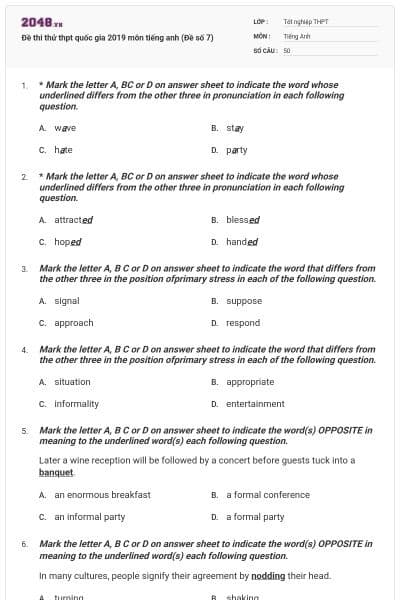
Đề thi thử thpt quốc gia 2019 môn tiếng anh (Đề số 7)
50 câu hỏi
* Mark the letter A, BC or D on answer sheet to indicate the word whose underlined differs from the other three in pronunciation in each following question.
wave
stay
hate
party
Đáp án D
A. wave /weiv/ (v) vẫy, phất, vung vẩy
B. stay /stei/ (v) ở lại, lưu lại
C. hate /heit/ (v) ghét, không thích
D. party /'pa:ti / (n) bữa tiệc
* Mark the letter A, BC or D on answer sheet to indicate the word whose underlined differs from the other three in pronunciation in each following question.
attracted
blessed
hoped
handed
Đáp án B
A. attracted/ ə'træktid/ (v) thu hút
B. blessed / ‘blesid/(a) linh thiêng
C. hoped/ həʊpt/ (v) hy vọng
D. handed /'heəndid/ (a) thuận tay
Mark the letter A, B C or D on answer sheet to indicate the word that differs from the other three in the position ofprimary stress in each of the following question.
signal
suppose
approach
respond
Đáp án A
signal /'sig.nəl/ (n) dấu hiệu, tín hiệu
B. suppose /sə'pəʊz/ (v) cho rằng
C. approach /ə'prəʊtʃ/ (v) đến, tiếp cận
D. respond /ri’spɒnd/ (v) trả lời, phản hồi
Đáp án A trọng âm rơi vào âm tiết 1, còn lại rơi vào âm tiết 2
Mark the letter A, B C or D on answer sheet to indicate the word that differs from the other three in the position ofprimary stress in each of the following question.
situation
appropriate
informality
entertainment
Đáp án B
A. situation/,sit.ju’ei.ʃən/ (n) tình hình, hoàn cảnh, trạng thái
B. appropriate /ə’prəʊ.pri.ət/ (a) thích hợp
C. informality /in.fɔ:‘mæl.ə.ti/ (n) tính không nghi thức, thân mật
D. entertainment /en.tə'tein.mənt/ (n) sự giải trí
Đáp án B trọng âm rơi vào âm tiết 2, còn lại rơi vào âm tiết 3
Mark the letter A, B C or D on answer sheet to indicate the word(s) OPPOSITE in meaning to the underlined word(s) each following question.
Later a wine reception will be followed by a concert before guests tuck into a banquet.
an enormous breakfast
a formal conference
an informal party
a formal party
Đáp án C
C. an informal party # banquet: bữa tiệc thân mật # bữa tiệc lớn
A. an enormous breakfast (np) bữa sáng lớn, thịnh soạn
B. a formal conference (np) cuộc hội thảo trang trọng
D. an formal party (np) bữa tiệc trang trọng
Mark the letter A, B C or D on answer sheet to indicate the word(s) OPPOSITE in meaning to the underlined word(s) each following question.
In many cultures, people signify their agreement by nodding their head.
turning
shaking
pointing
waving
Đáp án B
B. shaking # nodding: lắc đầu # gật đầu
Mark the letter A, B C or D on answer sheet to indicate the word(s) CLOSEST in meaning to the underlined word(s) each following question.
You shouldn't point at people when you are talking to them. It is very impolite.
smart
rude
informal
honest
Đáp án B
B. rude = impolite: thô lỗ, bất lịch sự
A. smart (a) lịch sự
C. informal (a) thân mật, gần gũi
D. honest (a) trung thực

Học thông minh hơn mỗi ngày
Xem toàn bộ 50 câu hỏi và nhiều hơn nữa với tài khoản miễn phí
Mark the letter A, B C or D on answer sheet to indicate the word(s) CLOSEST in meaning to the underlined word(s) each following question.
I didn't think his comments were very appropriate at the time.
correct
rude
exact
suitable
Đáp án D
D. suitable = appropriate: hợp lí
Mark the letter A, B C or D on answer sheet to indicate the answer to each of the following question
He bent toward the candle and .................. gently.
blow
blew
blowing
blown
Đáp án B
Ngữ pháp: sự tương ứng về thì giữa hai động từ chính trong một câu, cùng ở thì quá khứ đơn.
Dịch nghĩa: Anh ấy cúi xuống cây nến và thổi nhẹ.
Mark the letter A, B C or D on answer sheet to indicate the answer to each of the following question
They held a concert to mark the .................. of Mozart's death.
occasion
situation
anniversary
remembrance
Đáp án C
A. occasion (n) sự kiện
B. situation (n) tình hình, hoàn cảnh, trạng thái
C. anniversary (n): ngày kỉ niệm, lễ kỉ niệm
D. remembrance (n) lễ tưởng nhớ
Từ vựng: Họ đã tổ chức một buổi hòa nhạc để kỉ niệm ngày mất của nhạc sĩ Mozart.
Mark the letter A, B C or D on answer sheet to indicate the answer to each of the following question
The manager is good at .................. difficult customers.
relying on
dealing with
showing off
wiping off
Đáp án B
Ngữ pháp: cụm động từ
A. relying on (vp) dựa vào, phụ thuộc vào
B. dealing with (vp) đối phó, đối đãi
C. showing off (vp) khoe khoang
D. wiping off (vp) lau sạch, xóa sạch
Dịch nghĩa: Giám đốc rất giỏi xử trí với những khách hàng khó tính
Mark the letter A, B C or D on answer sheet to indicate the answer to each of the following question
The party starts at 9 o'clock so I’ll .................. at 8.30.
look for you
pick you up
bring you along
bring up
Đáp án B
A. look for: tìm kiếm
B. pick sb up: đón ai đó
C. bring along: mang theo
D. bring up: nuôi dưỡng, đề cập tới
Dịch nghĩa: Bữa tiệc bắt đầu lúc 9 giờ, vì vậy tôi sẽ đón em lúc 8.30.
Mark the letter A, B C or D on answer sheet to indicate the answer to each of the following question
My parents are going to hit the roof if they find out we had a party here.
become angry
become sad
become worried
become nervous
Đáp án A
HIT THE ROOF = GO THROUGH THE ROOF = HIT THE CEILING: to suddenly become angry (giận dữ)
You can use non-verbal forms of communication, such as gestures or body languages to get the waiter's .................. . When you are in a restaurant.
attract
attractive
attractively
attraction
Đáp án D
Sau(‘s) + N
A. attract(v): thu hút, cuốn hút
B. attractive(a): hấp dẫn, lôi cuốn
C. attractively(adv): một cách hấp dẫn
D. attraction(n): sự hấp dẫn, sự cuốn hút
Mark the letter A, B C or D on answer sheet to indicate the answer to each of the following question
Alice didn't expect .................. to Tom's party.
asking
being asked
to ask
to be asked
Đáp án D
Giải thích
Expect sb to do st: Kì vọng ai đó làm gì
Cấu trúc câu bị động
Expect to be P2: Kì vọng, hy vọng được làm gì
Dịch: Alice không mong đợi được bảo tới bữa tiệc của Tom.
Mark the letter A, B C or D on answer sheet to indicate the answer to each of the following question.
Mr. Peter is the big .................. in the company as he has just been promoted to the position of Managing Director.
bread
meat
cheese
apple
Đáp án C
- bread (n): bánh mì
- meat (n): thịt
- cheese (n): pho mát - apple (n): quà táo
à the/ a big cheese: người quan trọng nhất hay quyền lực nhất trong một nhóm hoặc tổ chức.
E.g: The big cheese is coming to visit our offìce today.
Dịch nghĩa: Ông Peter là người quyền lực nhất trong công ti vì ông ấy vừa mới được thăng chức lên vị trí giám đốc điều hành.
Mark the letter A, B C or D on answer sheet to indicate the answer to each of the following question
When he realized the police had spotted him, the man .................. the exit as quickly as possible.
made off
made for
made out
made up
Đáp án B
A. make off: bỏ trốn
B. make for: chạy đến, hướng đến
C. make out: hiểu được, hiểu ra
D. make up: dựng lên, bịa chuyện
Make off có nghĩa là bỏ trốn nhưng sau make off không có tân ngữ đi kèm à
make for : chạy tới đâu
Dịch nghĩa: Khi anh ta nhận ra cảnh sát đã phát hiện ra mình, người đàn ông hướng đến lối thoát hiểm càng nhanh càng tốt
Mark the letter A, B C or D on answer sheet to indicate the answer to each of the following question.
He .................. not having finished the project.
reproached his secretary for
allowed his secretary to
resented his secretary of
was furious with his secretary at
Đáp án A
A. reproach sb for (not) doing sth: mắng ai vì (không) làm gì
B. allow sb to do sth: cho phép ai làm gì
C. resent sb of doing sth: không bằng lòng khi ai đó làm gì
D. be furious with sb at sth: tức giận ai vì cái gì
Dịch nghĩa: Ông ấy mắng thư kí của ông ấy vì đã không hoàn thành dự án.
Mark the letter A, B C or D on answer sheet to indicate the answer to each of the following question
These activities are considered as a chance for new comers to .................. with their colleagues in company.
suppose
socialize
attend
discuss
Đáp án B
A. supposes (v) cho rằng
B. socializes (v) hòa nhập, thích nghi với xã hội
C. attends (v) tham dự
D. discusses (v) thảo luận
Dịch nghĩa: Những hoạt động này được xem như là cơ hội dành cho những người mới đến hòa nhập cùng với đồng nghiệp trong công ti.
Mark the letter A, B C or D on answer sheet to indicate the answer to each of the following question
On my birthday my father gave me some money, so that I could buy a hat for myself, which made me .................. excited.
extremely
perfectly
lonely
correctly
Đáp án A
be extremely excited: cực kì vui sướng
Dịch nghĩa: Vào ngày sinh nhật của tôi, bố tôi cho tôi một ít tiền để mà tôi có thể tự mình mua được một cái mũ, điều ấy làm tôi vô cùng sung sướng.
Mark the letter A, B, C, or D on your answer sheet to indicate the most suitable response to complete each of the following exchanges.
Alice meets Mary at their class after Mary has had her hair cut.
Alice: "What an attractive hair style you have got, Mary!"
Mary: “ .................................................................... ”
Thank you very much. I am afraid
You are telling a lie
Thank you for your compliment
I don't like your sayings
Đáp án C
Câu hội thoại ngắn về sử dụng ngôn ngữ lời nói: Kiểu tóc mới của cậu thật là thu hút đấy Mary ạ! Cảm ơn lời khen của cậu. (Những phương án còn lại không phù hợp nghĩa và ngữ cảnh)
Mark the letter A, B, C, or D on your answer sheet to indicate the most suitable response to complete each of the following exchanges.
Peter and Jack are playing tennis
Peter: "How well you are playing!" “Jack: .................. ”
Say it again. I like to hear your words
I think so. I am proud of myself
Thank you too much
Many thanks. That is a nice compliment
Đáp án D
Câu hội thoại ngắn về sử dụng ngôn ngữ lời nói:
Peter: Cậu chơi rất hay!
- Jack: Cảm ơn nhiều. Đó là lời khen rất tuyệt. (Những phương án còn lại không phù hợp nghĩa và ngữ cảnh)
Mark the letter A, B, C, or D on your answer sheet to indicate the underlined part that needs correction in each of the following questions.
His teacher encouraged (A) him taking (B) part in the international (C) piano competition (D).
encouraged
taking
the international
competition
Đáp án B
- to take
Cấu trúc câu: encourage sb to do sth - khuyến khích ai làm gì
Mark the letter A, B, C, or D on your answer sheet to indicate the underlined part that needs correction in each of the following questions.
So far this term, the students in writing class have learned (A) how to write (B) thesis statements, organize (C) their material, and summarizing (D) their conclusion.
have learned
write
organize
summarizing
Đáp án D
D - summarize
Cấu trúc câu: sự tương đồng về từ loại trong câu, các động từ write, organize, summarizing đều phải đề nguyên mẫu vì đứng sau "to".
Mark the letter A, B, C, or D on your answer sheet to indicate the underlined part that needs correction in each of the following questions.
Body language (A) is quiet and secret (B), but most (C) powerful language
(D) of all.
Body language
secret
most
of all
Đáp án C
C - the most
Ngữ pháp: so sánh hơn nhất với tính từ dài: the most + adj
Read the following passage and mark the letter A, B, C, or D on your answer sheet to indicate the correct word or phrase that bestfits each of the numbered blanks from 26 to 30.
In summary, for most visitors, the Japanese are (26) .................. and difficult to understand. The graceful act of (27) .................. , is the traditional greeting. However, they have also adopted the western custom of shaking hands, but with a light grip. Meanwhile, to show respect for their customs, it would flatter them to offer a slight bow when being introduced. Avoid hugging and kissing when greeting. It is considered rude to stare. Prolonged direct eye contact is considered to be (28) .................. or even intimidating. It is rude to stand with your hand or hands in your pockets, especially when greeting someone or when addressing a group of people. The seemingly simple act of exchanging business cards is more complex in Japan (29) .................. the business card represents not only one's identity but also his status in life. Yours should be printed in your own language and in Japanese. The Japanese are not a touch-oriented society; so avoid open displays of affection, touching or any prolonged form of body contact. Queues are generally respected; especially in crowded train and subway stations (30) .................. the huge volume of people causes touching and pushing.
Điền vào ô 26
complex
easy
simply
cheap
Đáp án A
A. complex (a) phức tạp, rắc rối
B. easy (a) dễ dàng
C. simply (a) đơn giản
D. cheap (a) rẻ
In summary, for most visitors, the Japanese are (26) _________ and difficult to understand.
(Nói tóm lại, đối với hầu hết các du khách thì người Nhật Bản khá phức tạp và khó hiểu.)
Read the following passage and mark the letter A, B, C, or D on your answer sheet to indicate the correct word or phrase that bestfits each of the numbered blanks from 26 to 30.
In summary, for most visitors, the Japanese are (26) .................. and difficult to understand. The graceful act of (27) .................. , is the traditional greeting. However, they have also adopted the western custom of shaking hands, but with a light grip. Meanwhile, to show respect for their customs, it would flatter them to offer a slight bow when being introduced. Avoid hugging and kissing when greeting. It is considered rude to stare. Prolonged direct eye contact is considered to be (28) .................. or even intimidating. It is rude to stand with your hand or hands in your pockets, especially when greeting someone or when addressing a group of people. The seemingly simple act of exchanging business cards is more complex in Japan (29) .................. the business card represents not only one's identity but also his status in life. Yours should be printed in your own language and in Japanese. The Japanese are not a touch-oriented society; so avoid open displays of affection, touching or any prolonged form of body contact. Queues are generally respected; especially in crowded train and subway stations (30) .................. the huge volume of people causes touching and pushing.
Điền vào ô 27
shaking
hugging
bowing
looking
Đáp án C
A. shaking (v) lắc
B. hugging (v) ôm
C. bowing (v) cúi
D. looking (v) nhìn
The graceful act of (27) _________ , is the traditional greeting.
(Cách cư xử cúi người thanh nhã là cách chào truyền thống.)
Read the following passage and mark the letter A, B, C, or D on your answer sheet to indicate the correct word or phrase that bestfits each of the numbered blanks from 26 to 30.
In summary, for most visitors, the Japanese are (26) .................. and difficult to understand. The graceful act of (27) .................. , is the traditional greeting. However, they have also adopted the western custom of shaking hands, but with a light grip. Meanwhile, to show respect for their customs, it would flatter them to offer a slight bow when being introduced. Avoid hugging and kissing when greeting. It is considered rude to stare. Prolonged direct eye contact is considered to be (28) .................. or even intimidating. It is rude to stand with your hand or hands in your pockets, especially when greeting someone or when addressing a group of people. The seemingly simple act of exchanging business cards is more complex in Japan (29) .................. the business card represents not only one's identity but also his status in life. Yours should be printed in your own language and in Japanese. The Japanese are not a touch-oriented society; so avoid open displays of affection, touching or any prolonged form of body contact. Queues are generally respected; especially in crowded train and subway stations (30) .................. the huge volume of people causes touching and pushing.
Điền vào ô 28
politely
impoliteness
impolitely
impolite
Đáp án D
A. politely (adv) : một cách lịch sự
B. impoliteness (n): sự lịch sự
C. impolitely (adv): một cách không lịch sự
D. impolite (a): bất lịch sự
Prolonged direct eve contact is considered to be (28)____ or even intimidating. (Việc nhìn vào mắt người khác quá lâu được xem như là không lịch sự, thậm chí là đáng sợ)
Read the following passage and mark the letter A, B, C, or D on your answer sheet to indicate the correct word or phrase that bestfits each of the numbered blanks from 26 to 30.
In summary, for most visitors, the Japanese are (26) .................. and difficult to understand. The graceful act of (27) .................. , is the traditional greeting. However, they have also adopted the western custom of shaking hands, but with a light grip. Meanwhile, to show respect for their customs, it would flatter them to offer a slight bow when being introduced. Avoid hugging and kissing when greeting. It is considered rude to stare. Prolonged direct eye contact is considered to be (28) .................. or even intimidating. It is rude to stand with your hand or hands in your pockets, especially when greeting someone or when addressing a group of people. The seemingly simple act of exchanging business cards is more complex in Japan (29) .................. the business card represents not only one's identity but also his status in life. Yours should be printed in your own language and in Japanese. The Japanese are not a touch-oriented society; so avoid open displays of affection, touching or any prolonged form of body contact. Queues are generally respected; especially in crowded train and subway stations (30) .................. the huge volume of people causes touching and pushing.
Điền vào ô 29
because
even if
unless
though
Đáp án A
A. because – bởi vì
B. even if - nếu như
C. unless - trừ khi
D. though - mặc dù
The seemingly simple act of exchanging busincss cards is more complex in Japan (29) _________ the business card represents not only one's identity but also his status in life.
(Hành động có vẻ đơn giản như trao đổi danh thiếp ở Nhật Bản cũng trở nên rắc rối hơn bởi vì danh thiếp không chỉ thể hiện người đó là ai mà còn thể hiện địa vị của họ.)
Read the following passage and mark the letter A, B, C, or D on your answer sheet to indicate the correct word or phrase that bestfits each of the numbered blanks from 26 to 30.
In summary, for most visitors, the Japanese are (26) .................. and difficult to understand. The graceful act of (27) .................. , is the traditional greeting. However, they have also adopted the western custom of shaking hands, but with a light grip. Meanwhile, to show respect for their customs, it would flatter them to offer a slight bow when being introduced. Avoid hugging and kissing when greeting. It is considered rude to stare. Prolonged direct eye contact is considered to be (28) .................. or even intimidating. It is rude to stand with your hand or hands in your pockets, especially when greeting someone or when addressing a group of people. The seemingly simple act of exchanging business cards is more complex in Japan (29) .................. the business card represents not only one's identity but also his status in life. Yours should be printed in your own language and in Japanese. The Japanese are not a touch-oriented society; so avoid open displays of affection, touching or any prolonged form of body contact. Queues are generally respected; especially in crowded train and subway stations (30) .................. the huge volume of people causes touching and pushing.
Điền vào ô 30
that
when
which
where
Đáp án D
A. that - cái mà
B. when - khi mà
C. which - cái mà
D. where - nơi mà
Queues are generally respected; especially in crovvded train and subway stations (30)____ the huge volume of people causes touching and pushing.
(Việc xếp hàng thường được chú ý, đặc biệt trên những chuyến tàu đông đúc và ở ga tàu điện nơi mà đám đông thường gây nên việc động chạm và xô đẩy.)
Read the following passage and mark the letter A, B, C, or D on your answer sheet to indicate the correct answer to each of the questions from 31 to 37.
A gesture is an action that sends a message from one person to another without using words. We use gestures to communicate with others. There are some gestures that have completely different meaning depending on when and where they are used.
When an American wants to show that something is OK. or good, he raises his hand and makes a circle with his thumb and foreigners. The circle sign has only one meaning for him. He might be surprised to learn that in other countries it can mean something different. In Japan, for instance, it is the gesture for money. In France, it means 'zero' or 'worthless'. Such differences can lead to all kinds of misunderstanding when foreigners meet. But why is it that the same gesture has so many different meanings?
When some people want to show that something is exact or precise, they make a sign to show that they are holding something between the tips of their thumb and forefinger. Many people from all over the world do this when they want to make a specific point as they are speaking. People later started using this signal to mean 'exactly right' or 'perfect'. This was how the famous OK was bom.
In Japan, money means coins and coins are around. Therefore, making a round hand sign came to represent money. It is simple as that. The French sign for 'nothing' or 'worthless' also has a simple origin. This time the circle doesn't represent a coin, but nought. Nought equals zero, zero equals nothing, nothing equals worthless.
What is the difference between gesture and speech
Speech use words while gestures don't.
Gestures use words whole speech doesn't
Gestures are used to communicate with others but speech isn't.
Gestures convey meanings that are different from speech.
Đáp án A
A. Speech use words while gestures don't.
Câu trong bài: A gesture is an action that sends a message from one person to another without using words
Read the following passage and mark the letter A, B, C, or D on your answer sheet to indicate the correct answer to each of the questions from 31 to 37.
A gesture is an action that sends a message from one person to another without using words. We use gestures to communicate with others. There are some gestures that have completely different meaning depending on when and where they are used.
When an American wants to show that something is OK. or good, he raises his hand and makes a circle with his thumb and foreigners. The circle sign has only one meaning for him. He might be surprised to learn that in other countries it can mean something different. In Japan, for instance, it is the gesture for money. In France, it means 'zero' or 'worthless'. Such differences can lead to all kinds of misunderstanding when foreigners meet. But why is it that the same gesture has so many different meanings?
When some people want to show that something is exact or precise, they make a sign to show that they are holding something between the tips of their thumb and forefinger. Many people from all over the world do this when they want to make a specific point as they are speaking. People later started using this signal to mean 'exactly right' or 'perfect'. This was how the famous OK was bom.
In Japan, money means coins and coins are around. Therefore, making a round hand sign came to represent money. It is simple as that. The French sign for 'nothing' or 'worthless' also has a simple origin. This time the circle doesn't represent a coin, but nought. Nought equals zero, zero equals nothing, nothing equals worthless.
When does an American raise his hand and make a circle sign?
When he means that he has no money.
When he wants to show that something is OK.
When he wants to send a message that he is not well.
When he plays with his thumb and foreigner.
Đáp án B
B. When he wants to show that something is OK.
Câu trong bài: When an American wants to show that something is OK or good, he raises his hand and makes a circle with his thumb and foreigners.
Read the following passage and mark the letter A, B, C, or D on your answer sheet to indicate the correct answer to each of the questions from 31 to 37.
A gesture is an action that sends a message from one person to another without using words. We use gestures to communicate with others. There are some gestures that have completely different meaning depending on when and where they are used.
When an American wants to show that something is OK. or good, he raises his hand and makes a circle with his thumb and foreigners. The circle sign has only one meaning for him. He might be surprised to learn that in other countries it can mean something different. In Japan, for instance, it is the gesture for money. In France, it means 'zero' or 'worthless'. Such differences can lead to all kinds of misunderstanding when foreigners meet. But why is it that the same gesture has so many different meanings?
When some people want to show that something is exact or precise, they make a sign to show that they are holding something between the tips of their thumb and forefinger. Many people from all over the world do this when they want to make a specific point as they are speaking. People later started using this signal to mean 'exactly right' or 'perfect'. This was how the famous OK was bom.
In Japan, money means coins and coins are around. Therefore, making a round hand sign came to represent money. It is simple as that. The French sign for 'nothing' or 'worthless' also has a simple origin. This time the circle doesn't represent a coin, but nought. Nought equals zero, zero equals nothing, nothing equals worthless.
The word "they" in paragraph 3 refers to ..................
gestures
signs
people
something
Đáp án C
C. people
Câu trong bài: When some people want to show that something is exact or precise, they make a sign to show that they are holding something between the tips of their thumb and forefinger believed that the spirits of the dead would visit the earth on Hallovveen.
Read the following passage and mark the letter A, B, C, or D on your answer sheet to indicate the correct answer to each of the questions from 31 to 37.
A gesture is an action that sends a message from one person to another without using words. We use gestures to communicate with others. There are some gestures that have completely different meaning depending on when and where they are used.
When an American wants to show that something is OK. or good, he raises his hand and makes a circle with his thumb and foreigners. The circle sign has only one meaning for him. He might be surprised to learn that in other countries it can mean something different. In Japan, for instance, it is the gesture for money. In France, it means 'zero' or 'worthless'. Such differences can lead to all kinds of misunderstanding when foreigners meet. But why is it that the same gesture has so many different meanings?
When some people want to show that something is exact or precise, they make a sign to show that they are holding something between the tips of their thumb and forefinger. Many people from all over the world do this when they want to make a specific point as they are speaking. People later started using this signal to mean 'exactly right' or 'perfect'. This was how the famous OK was bom.
In Japan, money means coins and coins are around. Therefore, making a round hand sign came to represent money. It is simple as that. The French sign for 'nothing' or 'worthless' also has a simple origin. This time the circle doesn't represent a coin, but nought. Nought equals zero, zero equals nothing, nothing equals worthless.
Which of the following statements is true?
A gesture with a circle means zero in America
In France and Japan, a circle sign made with a thumb and a forefinger means the same.
Body language hardly meads to misunderstanding.
A gesture may mean different things in different cultures.
Đáp án D
D. A gesture may mean different things in different cultures.
Câu trong bài: The circle sign has only one meaning for him. He might be surprised to leam that in other countries it can mean something different.
Read the following passage and mark the letter A, B, C, or D on your answer sheet to indicate the correct answer to each of the questions from 31 to 37.
A gesture is an action that sends a message from one person to another without using words. We use gestures to communicate with others. There are some gestures that have completely different meaning depending on when and where they are used.
When an American wants to show that something is OK. or good, he raises his hand and makes a circle with his thumb and foreigners. The circle sign has only one meaning for him. He might be surprised to learn that in other countries it can mean something different. In Japan, for instance, it is the gesture for money. In France, it means 'zero' or 'worthless'. Such differences can lead to all kinds of misunderstanding when foreigners meet. But why is it that the same gesture has so many different meanings?
When some people want to show that something is exact or precise, they make a sign to show that they are holding something between the tips of their thumb and forefinger. Many people from all over the world do this when they want to make a specific point as they are speaking. People later started using this signal to mean 'exactly right' or 'perfect'. This was how the famous OK was bom.
In Japan, money means coins and coins are around. Therefore, making a round hand sign came to represent money. It is simple as that. The French sign for 'nothing' or 'worthless' also has a simple origin. This time the circle doesn't represent a coin, but nought. Nought equals zero, zero equals nothing, nothing equals worthless.
Where does the famous sign OK come from?
It comes from the specific point.
It comes from the way people hold things in their hands.
It comes from the sign made by the tip of the thumb and forefinger.
It comes from the idea that a coin is round.
Đáp án C
C. It comes from the sign made by the tip of the thumb and forefinger.
Câu trong bài: They make a sign to show that they are holding something between the tips of their thumb and forefinger.
Read the following passage and mark the letter A, B, C, or D on your answer sheet to indicate the correct answer to each of the questions from 31 to 37.
A gesture is an action that sends a message from one person to another without using words. We use gestures to communicate with others. There are some gestures that have completely different meaning depending on when and where they are used.
When an American wants to show that something is OK. or good, he raises his hand and makes a circle with his thumb and foreigners. The circle sign has only one meaning for him. He might be surprised to learn that in other countries it can mean something different. In Japan, for instance, it is the gesture for money. In France, it means 'zero' or 'worthless'. Such differences can lead to all kinds of misunderstanding when foreigners meet. But why is it that the same gesture has so many different meanings?
When some people want to show that something is exact or precise, they make a sign to show that they are holding something between the tips of their thumb and forefinger. Many people from all over the world do this when they want to make a specific point as they are speaking. People later started using this signal to mean 'exactly right' or 'perfect'. This was how the famous OK was bom.
In Japan, money means coins and coins are around. Therefore, making a round hand sign came to represent money. It is simple as that. The French sign for 'nothing' or 'worthless' also has a simple origin. This time the circle doesn't represent a coin, but nought. Nought equals zero, zero equals nothing, nothing equals worthless.
What does the circle sign represent in France?
It means money.
It means coins
It means something exact.
It means useless
Đáp án D
D. It means useless.
Câu trong bài: In France, it means 'zero' or 'worthless’
Read the following passage and mark the letter A, B, C, or D on your answer sheet to indicate the correct answer to each of the questions from 31 to 37.
A gesture is an action that sends a message from one person to another without using words. We use gestures to communicate with others. There are some gestures that have completely different meaning depending on when and where they are used.
When an American wants to show that something is OK. or good, he raises his hand and makes a circle with his thumb and foreigners. The circle sign has only one meaning for him. He might be surprised to learn that in other countries it can mean something different. In Japan, for instance, it is the gesture for money. In France, it means 'zero' or 'worthless'. Such differences can lead to all kinds of misunderstanding when foreigners meet. But why is it that the same gesture has so many different meanings?
When some people want to show that something is exact or precise, they make a sign to show that they are holding something between the tips of their thumb and forefinger. Many people from all over the world do this when they want to make a specific point as they are speaking. People later started using this signal to mean 'exactly right' or 'perfect'. This was how the famous OK was bom.
In Japan, money means coins and coins are around. Therefore, making a round hand sign came to represent money. It is simple as that. The French sign for 'nothing' or 'worthless' also has a simple origin. This time the circle doesn't represent a coin, but nought. Nought equals zero, zero equals nothing, nothing equals worthless.
Which of the following can be inferred from the passage?
the different meaning of showing OK sign in America. Japan and France.
using gestures may lead to misunderstanding.
people from different cultures may understand a gesture in different ways.
people shouldn't use gestures because they can make mistake.
Đáp án C
C. people from different cultures may understand a gesture in different ways.
Câu trong bài: Such differences can lead to all kinds of misunderstanding when foreigners meet. But why is it that the same gesture has so many different meanings?
Read the following passage and mark the letter A, B, C, or D on your answer sheet to indicate the correct answer to each of the questions from 38 to 45.
Halloween falls on October 31 each year in North America and other part of the world. What do you know about Halloween? Do you celebrate it in your country? Here is a little history about it?
Like other holidays, Halloween has evolved and changed throughout history. Over 2,000 years ago people called the Celts lived in what is now Ireland, the UK, and parts of Northern France. November 1 was their New Year's Day. They believed that the night before the New Year (October 31) was a time when the living and the dead came together.
More than a thousand years ago the Christian church named November 1 All Saints Day (also called All Hallows). This was a special holy day to honor the saints and other people who died for their religion. The night before All Hallows was called Hallows Eve. Later the name was changed to Halloween.
Like the Celts, the Europeans of that time also believed that the spirits of the dead would visit the earth on Halloween. They worried that evil spirits would cause problems or hurt them. So on that night people wore costumes that looked like ghosts or other evil creatures. They thought if they dressed like that, the spirits would think they were also dead and not harm them.
The tradition of Halloween was carried to America by the immigrating Europeans. Some of the traditions changed a little, though. For example, on Halloween in Europe some people would carry lanterns made from turnips. In America, pumpkins were more common. So people began putting candles inside them and using them as lanterns. That is why you see Jack 'o lanterns today.
These days Halloween is not usually considered a religious holiday. It primarily a fun for children. Children dress up in costumes like people did a thousand years ago. But instead of worrying about evil spirits, they go from house to house. They knock on door and say "trick or treat". The owner of each house give candy or something special to each trick and treat.
The Celts thought .................. on October 31.
the dead would revive
the spirits of dead people returned to the earth
they would have a party to welcome the dead
the spirits of dead people would never come back to the earth
Đáp án A
B. the spirits ofdead people returned to the earth
Câu trong bài: Like the Celts, the Europeans of that time also
Read the following passage and mark the letter A, B, C, or D on your answer sheet to indicate the correct answer to each of the questions from 38 to 45.
Halloween falls on October 31 each year in North America and other part of the world. What do you know about Halloween? Do you celebrate it in your country? Here is a little history about it?
Like other holidays, Halloween has evolved and changed throughout history. Over 2,000 years ago people called the Celts lived in what is now Ireland, the UK, and parts of Northern France. November 1 was their New Year's Day. They believed that the night before the New Year (October 31) was a time when the living and the dead came together.
More than a thousand years ago the Christian church named November 1 All Saints Day (also called All Hallows). This was a special holy day to honor the saints and other people who died for their religion. The night before All Hallows was called Hallows Eve. Later the name was changed to Halloween.
Like the Celts, the Europeans of that time also believed that the spirits of the dead would visit the earth on Halloween. They worried that evil spirits would cause problems or hurt them. So on that night people wore costumes that looked like ghosts or other evil creatures. They thought if they dressed like that, the spirits would think they were also dead and not harm them.
The tradition of Halloween was carried to America by the immigrating Europeans. Some of the traditions changed a little, though. For example, on Halloween in Europe some people would carry lanterns made from turnips. In America, pumpkins were more common. So people began putting candles inside them and using them as lanterns. That is why you see Jack 'o lanterns today.
These days Halloween is not usually considered a religious holiday. It primarily a fun for children. Children dress up in costumes like people did a thousand years ago. But instead of worrying about evil spirits, they go from house to house. They knock on door and say "trick or treat". The owner of each house give candy or something special to each trick and treat.
According to the passage, which of the following statements is NOT true?
The Celts created All Hallows
The name Halloween originated from the word Hallows Eve.
Halloween falls on October 31 each year.
Halloween is a special holy day to honor the saints and people who died for their religion.
Đáp án A
A. The Celts created AU Hallows
Câu trong bài: More than a thousand years ago the Christian church named November 1 All Saints Day (also called All Hallows).
Đáp án D
D. a Halloween custom for children in many countries.
Câu trong bài: It primarily a fun for childrcn. Children dress up in costumes like people did a thousand years ago. But instead of worrying about evil spirits, they go from house to house. They knock on door and say "trick or treat".
The word "trick or treat" in paragraph 6 is closest in meaning to ..................
cheat and joke
worrying about evil spirits
a religious holiday in some countries.
a Halloween custom for children in many countries.
Đáp án D
D. a Halloween custom for children in many countries.
Câu trong bài: It primarily a fun for childrcn. Children dress up in costumes like people did a thousand years ago. But instead of worrying about evil spirits, they go from house to house. They knock on door and say "trick or treat".
Đáp án D
D. a Halloween custom for children in many countries.
Câu trong bài: It primarily a fun for childrcn. Children dress up in costumes like people did a thousand years ago. But instead of worrying about evil spirits, they go from house to house. They knock on door and say "trick or treat".
The word "they" in paragraph 4 refers to ..................
the Celts
evil spirits
the Europeans
ghosts
C. the Europeans
Đáp án C
Câu trong bài: Like the Celts, the Europeans of that time also believed that the spirits of the dead would visit the earth on Hallovveen. They worried that evil spirits would cause problems or hurt them.
Đáp án D
D. a Halloween custom for children in many countries.
Câu trong bài: It primarily a fun for childrcn. Children dress up in costumes like people did a thousand years ago. But instead of worrying about evil spirits, they go from house to house. They knock on door and say "trick or treat".
According to the passage, which of the following can result from the carrying Halloween to America?
People don't wear costumes like ghosts or other evil creature any more.
The Americans carry lanterns made from pumpkins instead of turnips.
People go from house to house for drinking tea.
Halloween is not on October 31 any longer.
Đáp án B
B. The Americans carry lanterm made from pumpkins instead of turnips.
Câu trong bài: For example, on Halloween in Europe some people vvould carry lantems made from turnips. In America, pumpkins were more common. So people began putting candles inside them and using them as lantems.
Đáp án D
D. a Halloween custom for children in many countries.
Câu trong bài: It primarily a fun for childrcn. Children dress up in costumes like people did a thousand years ago. But instead of worrying about evil spirits, they go from house to house. They knock on door and say "trick or treat".
The word "immigrating" in paragraph 5 is opposite in meaning to ..................
emigrating
migrating
settling
transmigrating
Đáp án C
Từ “ immigrating” trong đoạn văn số 5 trái nghĩa với từ nào dưới đây?
+ immigrating: nhập cư
+ emigrating: di cư
+ settling: ổn định
+ transmigrating: di cư, di trú
Đáp án D
D. a Halloween custom for children in many countries.
Câu trong bài: It primarily a fun for childrcn. Children dress up in costumes like people did a thousand years ago. But instead of worrying about evil spirits, they go from house to house. They knock on door and say "trick or treat".
The passage is mainly about?
The Celts and Halloween.
Halloween today and in the past.
History of Halloween.
The difference of Halloween in Europe and in America.
Đáp án C
Đoạn văn chủ yếu thảo luận về vấn đề gì?
A. Người Xen-tơ và lễ hội Halloween
B. Le hội Halloween ngày nay và ngày xưa
C. Lịch sử của Halloween
D. Sự khác nhau giữa Halloween ở Châu Âu và ở Mĩ
Đáp án D
D. a Halloween custom for children in many countries.
Câu trong bài: It primarily a fun for childrcn. Children dress up in costumes like people did a thousand years ago. But instead of worrying about evil spirits, they go from house to house. They knock on door and say "trick or treat".
Why the old Europeans wore costumes like ghosts and other evil creatures?
Because they wanted the spirits not to harm them.
Because they wanted to get candy.
They wore costumes to go to parties.
They wore costumes to go house from house.
Đáp án A
A. Because they wanted the spirits not to harm them.
Câu trong bài: So on that night people wore costumes that looked like ghosts or other evil creatures. They thought if they dressed like that, the spirits would think they were also dead and not harm them.
Mark the letter A, B, C, or D on your answer sheet to indicate the sentence that is closest in meaning to each of the following questions.
"How beautiful is the dress you have just bought!" Peter said to Mary.
Peter promised to buy Mary a beautiful dress.
Peter said thanks to Mary for her beautiful dress.
Peter complimented Mary on her beautiful dress.
Peter asked Mary how she had just bought her beautiful dress.
Đáp án C
C. Peter complimented Mary on her beautiful dress.
Câu trực tiếp là một lời khen nên khi chuyển sang câu gián tiếp phải sử dụng động từ gián tiếp "complement sb on sth: khen ai đó cái gì”
Mark the letter A, B, C, or D on your answer sheet to indicate the sentence that is closest in meaning to each of the following questions.
"Why don't you ask the teacher for help?" Peter asked me.
Peter advised me to ask the teacher for help.
Peter recommended me not to ask the teacher for help.
Peter told me the reason why I did not ask the teacher for help.
Peter suggested that he should ask the teacher for help.
Đáp án A
A. Peter advised me to ask the teacher for help.
Cấu trúc gián tiếp: advised sb to do sth - khuyên ai làm gì
Mark the letter A, B, C, or D on your answer sheet to indicate the sentence that is closest in meaning to each of the following questions.
As soon as he arrived at the airport, he called home.
No sooner had he arrived at the airport than he called home.
He arrived at the airport sooner than he had expected.
Calling home, he said that he had arrived the airport.
Immediately after he called home, he arrived the airport.
Đáp án A
A. No sooner had he arrived at the airport than he called home.
Đảo ngữ " No sooner had + S + Vpp + than + clause (past simple)
= Hardly/scarely + had + S + Vpp+ when+ clause (past simple)
Mark the letter A, B, C, or D on your answer sheet to indicate the sentence that best combines each pair of sentences in the following questions.
She tried very hard to pass the driving test. She could hardly pass it.
Although she didn’t try hard to pass pass the driving test, she could pass it.
Despite being able to pass the driving test, she didn’t pass it.
Hard as she tried, she could hardly hard pass the driving test
She tried very hard, so she passed the driving test satisfactorily
Đáp án C
Cô ấy đã rất cố gắng vượt qua kì thi lái xe. Cô ấy khó mà có thể vượt qua nó.
= C. Cố gắng như vậy, nhưng cô ấy khó mà có thể vượt qua kì thi lái xe.
A. Dù không cố gắng trong kì thi lái xe, cô ấy vượt qua nó
B. Mặc dù có thể vượt qua kì thi lái xe, cô ấy đã ko qua
D. Cô ấy rất cố gắng, cho nên đã vượt qua kì thi lái xe
Mark the letter A, B, C, or D on your answer sheet to indicate the sentence that best combines each pair of sentences in the following questions.
We didn’t want to spend a lot of money. We stayed in a cheap hotel
Instead of spending a lot of money, we stayed in a cheap hotel.
In spite of spending a lot of money, we stayed in a cheap hotel
We stayed in a cheap hotel, but we had to spend a lot of money.
We didn’t want to spend a lot of money. We stayed in the cheap hotel
Đáp án A
Chúng tôi không muốn tốn nhiều tiền. Chúng tôi ở trong một khách sạn rẻ.
= A. Thay vì tốn nhiều tiền, chúng tôi ở trong một khách sạn rẻ.
B. Mặc dù tốn nhiều tiền, chúng tôi ở trong 1 khách sạn rẻ
C. chúng tôi ở trong 1 khách sạn rẻ, nhưng phải trả rất nhiều tiền
D. chúng tôi không ở trong 1 khách sạn rẻ bởi chúng tôi phải tiêu rất nhiều tiền
Bạn có thích hoạt động này không?
Ý kiến của bạn sẽ giúp chúng tôi đề xuất nội dung phù hợp hơn.
Gợi ý cho bạn
![[Năm 2022] Đề thi thử môn Vật lí THPT Quốc gia có lời giải - Đề số 21](/_next/image?url=https%3A%2F%2Fvideo.vietjack.com%2Fupload%2Fimages%2Fvj-image%2Fimage-3izficdefgfoel0s9j8s-1786772791.jpg&w=3840&q=75)
![[Năm 2022] Đề thi thử môn Vật lí THPT Quốc gia có lời giải - Đề số 20](/_next/image?url=https%3A%2F%2Fvideo.vietjack.com%2Fupload%2Fimages%2Fvj-image%2Fimage-emy0gtcksawvorajezvv-1786772460.jpg&w=3840&q=75)
Tài liệu phổ biến Tốt nghiệp THPT
Tài liệu phổ biến Tiếng Anh