Đề thi thử thpt quốc gia 2019 môn tiếng anh (Đề số 3)
50 câu hỏi
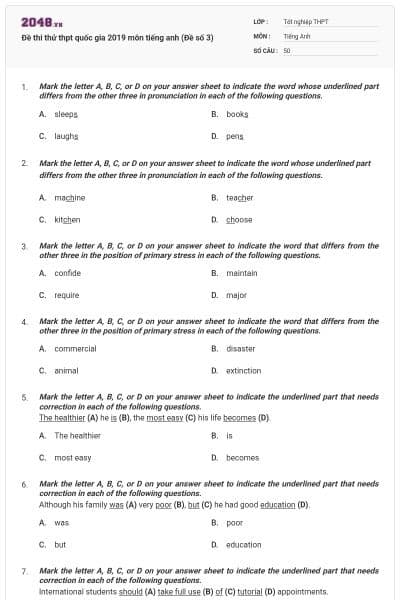
Mark the letter A, B, C, or D on your answer sheet to indicate the word whose underlined part differs from the other three in pronunciation in each of the following questions.
sleeps
books
laughs
pens
Đáp án D
Kiến thức: Phát âm đuôi “-s”
Giải thích:
Cách phát âm đuôi “s”:
+ phát âm là /s/ khi từ tận cùng bằng các phụ âm vô thanh KHÔNG rung: /θ/, /f/, /k/, /p/, /t/
+ phát âm là /z/ khi tận cùng bằng các âm còn lại
A. sleeps /sliːps/
B. books /bʊks/
C. laughs /lɑːfs/
D. pens /penz/
Phần gạch chân đáp án D phát âm là /z/, còn lại là /s/.
Mark the letter A, B, C, or D on your answer sheet to indicate the word whose underlined part differs from the other three in pronunciation in each of the following questions.
machine
teacher
kitchen
choose
Đáp án A
Kiến thức: Phát âm “ch”
Giải thích:
A. machine /məˈʃiːn/
B. teacher /ˈtiːtʃə(r)/
C. kitchen /ˈkɪtʃɪn/
D. choose /tʃuːz/
Phần gạch chân đáp án phát âm là /ʃ/, còn lại là /tʃ/.
Mark the letter A, B, C, or D on your answer sheet to indicate the word that differs from the other three in the position of primary stress in each of the following questions.
confide
maintain
require
major
Đáp án D
Kiến thức: Trọng âm
Giải thích:
A. confide /kənˈfaɪd/
B. maintain /meɪnˈteɪn/
C. require /rɪˈkwaɪə(r)/
D. major /ˈmeɪdʒə(r)/
Trọng âm đáp án D vào âm tiết thứ nhất, còn lại âm tiết thứ hai
Mark the letter A, B, C, or D on your answer sheet to indicate the word that differs from the other three in the position of primary stress in each of the following questions.
commercial
disaster
animal
extinction
Đáp án C
Kiến thức: Trọng âm từ có 3 âm tiết
Giải thích:
A. commercial /kəˈmɜːʃl/
B. disaster /dɪˈzɑːstə(r)/
C. animal /ˈænɪml/
D. extinction /ɪkˈstɪŋkʃn/
Trọng âm đáp án C vào âm tiết thứ nhất, còn lại vào âm tiết thứ hai.
Mark the letter A, B, C, or D on your answer sheet to indicate the underlined part that needs correction in each of the following questions.
The healthier (A) he is (B), the most easy (C) his life becomes (D).
The healthier
is
most easy
becomes
Đáp án C
Kiến thức: Cấu trúc “càng… càng…”
Giải thích:
Cấu trúc: The + so sánh hơn + S + V, the + so sánh hơn + S + V
Sửa: C. most easy => easier
Tạm dịch: Anh ấy càng khoẻ thì cuộc sống của anh ta càng nhẹ nhàng.
Mark the letter A, B, C, or D on your answer sheet to indicate the underlined part that needs correction in each of the following questions.
Although his family was (A) very poor (B), but (C) he had good education (D).
was
poor
but
education
Đáp án C
Kiến thức: Mệnh đề nhượng bộ
Giải thích:
although: mặc dù
but: nhưng
Do “although” và “but” mang nét nghĩa như nhau nên ta chỉ cần dùng 1 trong hai từ này.
Sửa: but => Ø
Tạm dịch: Mặc dù gia đình anh ấy từng rất nghèo, nhưng anh ấy đã có một nền giáo dục tốt.
Mark the letter A, B, C, or D on your answer sheet to indicate the underlined part that needs correction in each of the following questions.
International students should (A) take full use (B) of (C) tutorial (D) appointments.
should
take full use
of
tutorial
Đáp án B
Kiến thức: Sự kết hợp từ với “use”
Giải thích:
make use of: tận dụng
Sửa: take full use => make full use
Tạm dịch: Các học sinh quốc tế nên tận dụng các cuộc hẹn hướng dẫn.

Học thông minh hơn mỗi ngày
Xem toàn bộ 50 câu hỏi và nhiều hơn nữa với tài khoản miễn phí
Mark the letter A, B, C, or D on your answer sheet to indicate the correct answer to each of the following questions.
The pool should not be made so deep ______ small children can be safe there.
if
so as to
though
so that
Đáp án D
Kiến thức: Liên từ
Giải thích:
A. if: nếu
B. so as to (+ V): để
C. though (+ mệnh đề): mặc dù
D. so that (+ mệnh đề): để
Tạm dịch: Bể bởi không nên được làm quá sâu để cho trẻ nhỏ có thể an toàn ở đó.
Mark the letter A, B, C, or D on your answer sheet to indicate the correct answer to each of the following questions.
We all agree that she is ______ student in our class.
the cleverest
a more clever
most clever
cleverest
Đáp án A
Kiến thức: So sánh nhất
Giải thích:
Cấu trúc so sánh nhất:
- Với tính từ ngắn: S + to be/ V + the + adj/ adv + -est + Noun/ Pronoun
- Với tính từ dài: S + to be/ V + the most + adj/ adv + Noun/ Pronoun
Tính từ “clever” là tính từ đặc biệt khi dùng so sánh nhất có thể dùng là “the cleverest” hoặc “the most clever”.
Tạm dịch: Chúng tôi đều đồng ý rằng cô ấy là học sinh thông minh nhất trong lớp.
Mark the letter A, B, C, or D on your answer sheet to indicate the correct answer to each of the following questions.
There has been a great increase in retail sales, ______?
hasn’t there
isn’t there
isn’t it
doesn’t it
Đáp án A
Kiến thức: Câu hỏi đuôi
Giải thích: Câu giới thiệu khẳng định, phần hỏi đuôi phủ định. Câu giới thiệu phủ định, phần hỏi đuôi khẳng định.
There has been..., hasn’t there?
Tạm dịch: Doanh số bán lẻ đã tăng có phải không?
Mark the letter A, B, C, or D on your answer sheet to indicate the correct answer to each of the following questions.
Long ago, women were ______ to vote in political elections.
prevented
stopped
forbidden
banned
Đáp án C
Kiến thức: Từ vựng
Giải thích:
A. prevented (v-ed): ngăn
B. stopped (v-ed): dừng
C. forbidden (v-ed): cấm
D. banned (v-ed): cấm
“ban” nghĩa là cấm hoàn toàn bằng luật pháp. Có nghĩa là nếu một từ bị banned, thì nó bị loại bỏ hoàn toàn bởi hệ thống pháp luật.
“forbid” là ngăn cấm - không cho phép, mang nghĩa chung chung. Là sự ngăn cấm do pháp những người cấp cao hơn ban hành như là xếp, tôn giáo, chúa,... Nó cũng không nhất thiết là luật.
Tạm dịch: Rất lâu về trước phụ nữ bị cấm bầu cử ở các cuộc bầu cử chính trị.
Mark the letter A, B, C, or D on your answer sheet to indicate the correct answer to each of the following questions.
In spite of her abilities, Laura has been ______ overlooked for promotion.
repeat
repeatedly
repetitive
repetition
Đáp án B
Kiến thức: Từ loại
Giải thích:
A. repeat (v): lặp lại
B. repeatedly (adv): một cách lặp lại
C. repetitive (adj): lặp lại
D. repetition (n): sự lặp lại
Trước động từ “overlooked” ta cần một trạng từ để bổ nghĩa.
Tạm dịch: Mặc cho khả năng của mình, Laura liên tục bị bỏ qua việc thăng chức.
Mark the letter A, B, C, or D on your answer sheet to indicate the correct answer to each of the following questions.
Only one of our gifted students _____ to participate in the final competition.
has been chosen
have been chosen
were choosing
chosen
Đáp án A
Kiến thức: Chia động từ
Giải thích: One of + N (số nhiều) + V (số ít)
Tạm dịch: Chỉ có một trong những học sinh xuất sắc của chúng ta tham gia vào chung kết.
The Lake District, ______ was made a national park in 1951, attracts a large number of tourists every year.
that
where
what
which
Đáp án D
Kiến thức: Mệnh đề quan hệ
Giải thích: Trong mệnh đề quan hệ, ta sử dụng “which” để thay thế cho danh từ chỉ vật.
Tạm dịch: Lake District, một công viên quốc gia được lập vào năm 1951, thu hút một lượng lớn các khách du lịch mỗi năm.
Mark the letter A, B, C, or D on your answer sheet to indicate the correct answer to each of the following questions.
I wonder who drank all the milk yesterday. It ______ have been Jane because she was out all day.
can’t
must
could
needn’t
Đáp án A
Kiến thức: Cấu trúc sử dụng động từ khuyết thiếu
Giải thích:
A. can’t have P2: không thể nào là (chắc chắn 99%)
B. must have P2: chắc hẳn là
C. could have P2: hẳn đã là
D. needn’t have P2: không cần làm gì
Tạm dịch: Tôi tự hỏi không biết hôm qua ai đã uống hết sữa. Chắc chắn không thể là Jane bởi cô ấy đã ra ngoài cả ngày.
Mark the letter A, B, C, or D on your answer sheet to indicate the correct answer to each of the following questions.
It is no use ______ over split milk.
crying
to cry
to be crying
cried
Đáp án A
Kiến thức: Dạng của động từ
Giải thích: It’s no use + V-ing: Vô ích khi làm gì
Tạm dịch: Hối tiếc về những gì đã mất là vô ích.
Mark the letter A, B, C, or D on your answer sheet to indicate the correct answer to each of the following questions.
He succeeded _______ getting a scholarship.
in
about
for
on
Đáp án A
Kiến thức: Giới từ đi với “succeed”
Giải thích: succeed in + V-ing: thành công làm việc gì
Tạm dịch: Anh ấy đã thành công kiếm được học bổng.
Mark the letter A, B, C, or D on your answer sheet to indicate the correct answer to each of the following questions.
Five thousand dollars _______ big sum of money. It’s worth trying.
are too
is not
aren’t
be
Đáp án B
Kiến thức: Sự hòa hợp giữa chủ ngữ - động từ
Giải thích: Tất cả các danh từ tập thể chỉ thời gian, tiền bạc, số đo, … khi được đề cập đến như một thể thống nhất thì đều được xem là một danh từ số ít. Do đó các động từ và đại từ theo sau chúng phải ở ngôi thứ 3 số ít.
Tạm dịch: Năm ngàn đô la không phải là một khoản tiền lớn. Nó rất đáng để thử.
Mark the letter A, B, C, or D on your answer sheet to indicate the correct answer to each of the following questions.
It is not _______ the bounds of possibility that we'll all meet again one day.
beyond
in
under
over
Đáp án A
Kiến thức: Giới từ
Giải thích: beyond the bounds: nằm ngoài giới hạn
Tạm dịch: Không ngoài khả năng rằng chúng ta sẽ gặp lại nhau một ngày nào đó.
Mark the letter A, B, C, or D on your answer sheet to indicate the correct answer to each of the following questions.
A small _____ of this medicine should be enough to lessen the pain.
part
dose
size
ration
Đáp án B
Kiến thức: Từ vựng
Giải thích:
A. part (n): phần
B. dose (n): liều
C. size (n): cỡ
D. ration (n): khẩu phần
Tạm dịch: Một liều thuốc nhỏ là đủ để giảm cơn đau.
Mark the letter A, B, C, or D on your answer sheet to indicate the correct answer to each of the following questions.
This test is _______ easy! I didn’t even study, but I will get a high score.
ridiculously
highly
deeply
strongly
Đáp án A
Kiến thức: Từ vựng
Giải thích:
A. ridiculously (adv): một cách nực cười
B. highly (adv): cực kì
C. deeply (adv): một cách sâu sắc
D. strongly (adv): một cách mạnh mẽ
ridiculously easy: dễ một cách khó tin
Tạm dịch: Bài kiểm tra này dễ một cách khó tin. Tôi thậm chí đã không học, nhưng tôi sẽ đạt điểm cao.
Mark the letter A, B, C, or D on your answer sheet to indicate the most suitable response to complete each of the following exchanges.
Stephanie: “Oh, no! I left my book at home. Can I share yours?” - Scott: “_______________.”
No, thanks.
No, not at all!
Yes, I do too.
Yes, sure!
Đáp án D
Kiến thức: Ngôn ngữ giao tiếp
Giải thích:
Stephanie: “Ôi không! Tôi đã để quên sách ở nhà. Tôi có thể dùng chung với bạn không?”
Scott: “_____________”
A. Không, cảm ơn
B. Không, không một chút nào cả
C. Ừ, tôi cũng làm thế
D. Ừ, tất nhiên rồi
Mark the letter A, B, C, or D on your answer sheet to indicate the most suitable response to complete each of the following exchanges.
Tom: “________.” - Mike: “I won’t say no!”
How are things with you, Mike?
What about playing badminton this afternoon?
Mike, do you know where the scissors are
What’s your favourite, tea or coffee?
Đáp án B
Kiến thức: Ngôn ngữ giao tiếp
Giải thích:
Tom: “___________”
Mike: “Tôi sẽ không nói “không””
A. Mọi việc thế nào rồi Mike?
B. Bạn có muốn chơi cầu lông vào chiều nay không?
C. Mike, bạn có biết kéo ở đâu không?
D. Bạn thích cái gì, trà hay cà phê?
Mark the letter A, B, C, or D on your answer sheet to indicate the word(s) CLOSEST in meaning to the underlined word(s) in each of the following questions.
I will not stand for your bad attitude any longer.
like
mean
tolerate
care
Đáp án C
Kiến thức: Từ đồng nghĩa
Giải thích:
stand for: chịu đựng
A. like (v): thích
B. mean (v): cố ý
C. tolerate (v): chịu đựng
D. care (v): quan tâm
=> stand for = tolerate
Tạm dịch: Tôi sẽ không chịu đựng thái độ xấu của bạn nữa.
Mark the letter A, B, C, or D on your answer sheet to indicate the word(s) CLOSEST in meaning to the underlined word(s) in each of the following questions.
The works of such men as the English philosophers John Locke and Thomas Hobbes helped pave the way for academic freedom in the modern sense.
terminate
prevent
initiate
lighten
Đáp án C
Kiến thức: Từ đồng nghĩa
Giải thích:
pave the way for: mở đường cho ai làm gì
A. terminate (v): chấm dứt
B. prevent (v): ngăn
C. initiate (v): khởi xướng, bắt đầu
D. lighten (v): làm sáng lên
=> pave the way for = initiate
Tạm dịch: Các tác phẩm của những người như triết gia người Anh John Locke và Thomas Hobbes đã giúp mở đường cho tự do học thuật theo nghĩa hiện đại.
Mark the letter A, B, C, or D on your answer sheet to indicate the word(s) OPPOSITE in meaning to the underlined word(s) in each of the following questions.
In some countries, the disease burden could be prevented through environmental improvements.
something to suffer
something enjoyable
something sad
something to entertain
Đáp án B
Kiến thức: Từ trái nghĩa
Giải thích:
burden (n): gánh nặng
A. something to suffer: cái phải trải qua
B. something enjoyable: cái gì đó để hưởng thụ
C. something sad: cái gì đó buồn
D. something to entertain: cái gì đó để giải trí
=> burden >< something enjoyable
Tạm dịch: Ở một vài nước, gánh nặng bệnh tật có thể được ngăn chặn nhờ cải thiện môi trường.
Mark the letter A, B, C, or D on your answer sheet to indicate the word(s) OPPOSITE in meaning to the underlined word(s) in each of the following questions.
For decoration, people mount animal heads on walls. They buy furs to make rooms more lavish.
warm
desirable
luxurious
modest
Đáp án D
Kiến thức: Từ trái nghĩa
Giải thích:
lavish (adj): lãng phí, phong phú
A. warm (adj): ấm
B. desirable (adj): khát khao
C. luxurious (adj): xa hoa, hào nhoáng
D. modest (adj): khiêm tốn
=> lavish >< modest
Tạm dịch: Nhiều người gắn đầu động vật lên tường để trang trí. Họ mua lông động vật để khiến căn phòng trông xa hoa hơn.
Mark the letter A, B, C, or D on your answer sheet to indicate the sentence that is closest in meaning to each of the following questions.
Someone stole Jim’s bike yesterday.
Jim’s bike has been stolen yesterday.
Jim had someone steal his bike yesterday.
Jim’s bike is stolen
Jim had his bike stolen yesterday.
Đáp án D
Kiến thức: Câu đồng nghĩa
Giải thích:
A. Dạng bị động trong thì quá khứ đơn: was/were + P2 => Đáp án A sai
B. have sb do sth: ra lệnh cho ai làm gì => sai nghĩa
C. “is stolen” => sai thì
Tạm dịch: Jim đã bị trộm xe đạp vào hôm qua.
Mark the letter A, B, C, or D on your answer sheet to indicate the sentence that is closest in meaning to each of the following questions.
Susan hasn’t driven a car before.
It is the first time Susan goes by car.
It is the first time Susan has driven a car.
It is the first time Susan goes in a car.
It is the first time Susan is driving a car.
Đáp án B
Kiến thức: Câu đồng nghĩa
Giải thích: S + have/has not + P2 + before = It is the first time + S + have/ has + P2
Tạm dịch: Đây là lần đầu Susan lái xe ô tô.
Mark the letter A, B, C, or D on your answer sheet to indicate the sentence that is closest in meaning to each of the following questions.
He never suspected that she was a witch.
At no time did he suspect that she was a witch.
Never did he suspect that a witch she was.
Never a witch did he suspect that she was
No before did he suspect was she a witch.
Đáp án A
Kiến thức: Câu đồng nghĩa
Giải thích:
At no time = Never: không bao giờ
Đáp án B, C, D vị trí của các thành phần câu không đúng => chọn A
Tạm dịch: Anh ấy không bao giờ nghi ngờ rằng cô ấy là một phù thuỷ.
Mark the letter A, B, C, or D on your answer sheet to indicate the sentence that best combines each pair of sentences in the following questions.
I did not arrive in time. I was not able to see her off.
She had left because I was not on time.
I did not go there, so I could not see her off.
I was not early enough to see her off.
I arrived very late to say goodbye to her.
Đáp án C
Kiến thức: Kết hợp câu
Giải thích:
Tôi không đến kịp. Tôi đã không thể tiễn cô ấy.
A. Cô ấy đã rời đi vì tôi không đúng giờ.
B. Tôi không đến đó, vì vậy tôi không thể tiễn cô ấy.
C. Tôi không tới đủ sớm để tiễn cô ấy.
D. Tôi đến rất muộn để nói lời tạm biệt với cô ấy.
Mark the letter A, B, C, or D on your answer sheet to indicate the sentence that best combines each pair of sentences in the following questions.
He was successful because he was determined to pursue personal goals. He was not talented.
His success lay in his natural ability, not in his determination to pursue personal goals.
In addition to his determination, his talent ensured his success in pursuing his goals.
His determination to pursue personal goals made him successful and talented.
It was his determination to pursue personal goals, not talent, that contributed to his success
Đáp án D
Kiến thức: Kết hợp câu
Tạm dịch: Anh ấy đã thành công vì anh ấy quyết tâm theo đuổi mục tiêu cá nhân. Anh ta không tài giỏi.
A. Thành công của anh ấy nằm ở khả năng tự nhiên của anh ấy chứ không phải ở quyết tâm theo đuổi mục tiêu cá nhân.
B. Ngoài quyết tâm, tài năng của anh ấy đảm bảo thành công trong việc theo đuổi mục tiêu của mình.
C. Quyết tâm theo đuổi mục tiêu cá nhân khiến anh ấy thành công và tài năng.
D. Chính sự quyết tâm theo đuổi mục tiêu cá nhân chứ không phải tài năng đã góp phần vào thành công của anh ấy.
Read the following passage and mark the letter A, B, C, or D on your answer sheet to indicate the correct word or phrase that best fits each of the numbered blanks from 33 to 37.
Library is a collection of books and other informational materials made available to people for reading, study, or reference. The word library comes from liber, the Latin word for “book”. (33)______, library collections have almost always contained a variety of materials. Contemporary libraries maintain collections that include not only printed materials such as manuscripts, books, newspapers, and magazines, but also audio-visual and online databases. In addition to maintaining collections within library buildings, modern libraries often feature telecommunications links that provide users with access to information at remote sites.
The central mission of a library is to collect, organize, preserve, and provide access to knowledge and information. In fulfilling this mission, libraries preserve a valuable record of culture that can be passed down to (34) ______ generations. Libraries are an essential link in this communication between the past, present, and future. Whether the cultural record is contained in books or in electronic formats, libraries ensure (35) ______ the record is preserved and made available for later use.
People use library resources to gain information about personal interests or to obtain recreational materials such as films and novels. Students use libraries to supplement and enhance their classroom experiences, to learn (36) ______ in locating sources of information, and to develop good reading and study habits. Public officials use libraries to research legislation and public policy issues. One of the most valued of all cultural institutions, the library (37) ______ information and services that are essential to learning and progress.
Điền vào ô 33
Despite
However
Therefore
Instead
Đáp án B
Kiến thức: Liên từ
Giải thích:
A. Despite: mặc dù
B. However: tuy nhiên
C. Therefore: vậy nên
D. Instead: thay vì
(33) However, library collections have almost always contained a variety of materials.
Tạm dịch: Tuy nhiên, các bộ sưu tập thư viện hầu như luôn chứa nhiều loại tài liệu.
Read the following passage and mark the letter A, B, C, or D on your answer sheet to indicate the correct word or phrase that best fits each of the numbered blanks from 33 to 37.
Library is a collection of books and other informational materials made available to people for reading, study, or reference. The word library comes from liber, the Latin word for “book”. (33)______, library collections have almost always contained a variety of materials. Contemporary libraries maintain collections that include not only printed materials such as manuscripts, books, newspapers, and magazines, but also audio-visual and online databases. In addition to maintaining collections within library buildings, modern libraries often feature telecommunications links that provide users with access to information at remote sites.
The central mission of a library is to collect, organize, preserve, and provide access to knowledge and information. In fulfilling this mission, libraries preserve a valuable record of culture that can be passed down to (34) ______ generations. Libraries are an essential link in this communication between the past, present, and future. Whether the cultural record is contained in books or in electronic formats, libraries ensure (35) ______ the record is preserved and made available for later use.
People use library resources to gain information about personal interests or to obtain recreational materials such as films and novels. Students use libraries to supplement and enhance their classroom experiences, to learn (36) ______ in locating sources of information, and to develop good reading and study habits. Public officials use libraries to research legislation and public policy issues. One of the most valued of all cultural institutions, the library (37) ______ information and services that are essential to learning and progress.
Điền vào ô 34
succeeding
succeed
successful
success
Đáp án C
Kiến thức: Từ loại
Giải thích:
A. succeeding (v-ing): kế tiếp
B. succeed (v): thành công
C. successful (adj): thành công
D. success (n): sự thành công
In fulfilling this mission, libraries preserve a valuable record of culture that can be passed down to (34) ______ generations.
Tạm dịch: Khi hoàn thành sứ mệnh này, các thư viện lưu giữ một hồ sơ văn hóa có giá trị có thể được truyền lại cho các thế hệ tiếp theo.
Read the following passage and mark the letter A, B, C, or D on your answer sheet to indicate the correct word or phrase that best fits each of the numbered blanks from 33 to 37.
Library is a collection of books and other informational materials made available to people for reading, study, or reference. The word library comes from liber, the Latin word for “book”. (33)______, library collections have almost always contained a variety of materials. Contemporary libraries maintain collections that include not only printed materials such as manuscripts, books, newspapers, and magazines, but also audio-visual and online databases. In addition to maintaining collections within library buildings, modern libraries often feature telecommunications links that provide users with access to information at remote sites.
The central mission of a library is to collect, organize, preserve, and provide access to knowledge and information. In fulfilling this mission, libraries preserve a valuable record of culture that can be passed down to (34) ______ generations. Libraries are an essential link in this communication between the past, present, and future. Whether the cultural record is contained in books or in electronic formats, libraries ensure (35) ______ the record is preserved and made available for later use.
People use library resources to gain information about personal interests or to obtain recreational materials such as films and novels. Students use libraries to supplement and enhance their classroom experiences, to learn (36) ______ in locating sources of information, and to develop good reading and study habits. Public officials use libraries to research legislation and public policy issues. One of the most valued of all cultural institutions, the library (37) ______ information and services that are essential to learning and progress.
Điền vào ô 35
what
which
who
that
Đáp án D
Kiến thức: liên từ
Giải thích:
ensure + that + mệnh đề: bảo đảm rằng
Whether the cultural record is contained in books or in electronic formats, libraries ensure (35) that the record is preserved and made available for later use.
Tạm dịch: Cho dù hồ sơ văn hóa được chứa trong sách hoặc ở định dạng điện tử, thư viện đảm bảo rằng hồ sơ được lưu giữ và cung cấp để sử dụng sau này.
Read the following passage and mark the letter A, B, C, or D on your answer sheet to indicate the correct word or phrase that best fits each of the numbered blanks from 33 to 37.
Library is a collection of books and other informational materials made available to people for reading, study, or reference. The word library comes from liber, the Latin word for “book”. (33)______, library collections have almost always contained a variety of materials. Contemporary libraries maintain collections that include not only printed materials such as manuscripts, books, newspapers, and magazines, but also audio-visual and online databases. In addition to maintaining collections within library buildings, modern libraries often feature telecommunications links that provide users with access to information at remote sites.
The central mission of a library is to collect, organize, preserve, and provide access to knowledge and information. In fulfilling this mission, libraries preserve a valuable record of culture that can be passed down to (34) ______ generations. Libraries are an essential link in this communication between the past, present, and future. Whether the cultural record is contained in books or in electronic formats, libraries ensure (35) ______ the record is preserved and made available for later use.
People use library resources to gain information about personal interests or to obtain recreational materials such as films and novels. Students use libraries to supplement and enhance their classroom experiences, to learn (36) ______ in locating sources of information, and to develop good reading and study habits. Public officials use libraries to research legislation and public policy issues. One of the most valued of all cultural institutions, the library (37) ______ information and services that are essential to learning and progress.
Điền vào ô 36
abilities
skills
talents
capacities
Đáp án B
Kiến thức: Từ vựng
Giải thích:
A. abilities (n): khả năng
B. skills (n): các kĩ năng
C. talents (n): các tài năng
D. capacities (n): sức chứa
Students use libraries to supplement and enhance their classroom experiences, to learn (36) skills in locating sources of information, and to develop good reading and study habits.
Tạm dịch: Học sinh sử dụng các thư viện để bổ sung và nâng cao kinh nghiệm trong lớp học, để học các kỹ năng xác định nguồn thông tin và phát triển thói quen đọc và học tốt.
Read the following passage and mark the letter A, B, C, or D on your answer sheet to indicate the correct word or phrase that best fits each of the numbered blanks from 33 to 37.
Library is a collection of books and other informational materials made available to people for reading, study, or reference. The word library comes from liber, the Latin word for “book”. (33)______, library collections have almost always contained a variety of materials. Contemporary libraries maintain collections that include not only printed materials such as manuscripts, books, newspapers, and magazines, but also audio-visual and online databases. In addition to maintaining collections within library buildings, modern libraries often feature telecommunications links that provide users with access to information at remote sites.
The central mission of a library is to collect, organize, preserve, and provide access to knowledge and information. In fulfilling this mission, libraries preserve a valuable record of culture that can be passed down to (34) ______ generations. Libraries are an essential link in this communication between the past, present, and future. Whether the cultural record is contained in books or in electronic formats, libraries ensure (35) ______ the record is preserved and made available for later use.
People use library resources to gain information about personal interests or to obtain recreational materials such as films and novels. Students use libraries to supplement and enhance their classroom experiences, to learn (36) ______ in locating sources of information, and to develop good reading and study habits. Public officials use libraries to research legislation and public policy issues. One of the most valued of all cultural institutions, the library (37) ______ information and services that are essential to learning and progress.
Điền vào ô 37
relates
applies
supplies
digests
Đáp án C
Kiến thức: Từ vựng
Giải thích:
A. relates (v): liên quan
B. applies (v): áp dụng
C. supplies (v): cung cấp
D. digests (v): tiêu hoá
One of the most valued of all cultural institutions, the library (37) supplies information and services that are essential to learning and progress.
Tạm dịch: Một trong những giá trị nhất của tất cả các tổ chức văn hóa, thư viện cung cấp thông tin và dịch vụ rất cần thiết cho việc học tập và tiến bộ.
Read the following passage and mark the letter A, B, C, or D on your answer sheet to indicate the correct answer to each of the questions from 38 to 42.
Some people think that a spider is an insect, but it is an arachnid. Arachnids have two main body parts and eight walking legs while insects have three main body parts and six legs. Many insects can fly, but spiders cannot fly.
There are many different kinds of spiders around the world. They come in different colors, such as black, brown, white, yellow, and orange. Spiders usually live for one year but a spider called the Tarantula lives as long as 20 years. Some spiders are very small but some are so large they can fit a dinner plate.
The most unusual thing is that a spider can spin a web. Spiders have silk in their stomach and they use the silk to make a web. The web is the spider's home. But the spider does not stick to its own web because its legs have oil them. It is very strong and sticky. The web is used to catch insects. When an insect is trapped on a spider's web, the spider wraps the insect in silk. It eats the insect at a later time. However, the spider does not really eat it. Since it has no teeth, it puts venom in the insect to make it a liquid.
What is the main topic of the passage?
Facts about spiders
The parts of a spider's body
How a spider makes its home
The eating habits of spiders
Đáp án A
Kiến thức: Đọc hiểu
Giải thích:
Chủ đề chính của đoạn văn là gì
A. Thông tin về nhện
B. Các bộ phận của cơ thể nhện
C. Cách một con nhện làm nhà của nó
D. Thói quen ăn thịt của nhện
Read the following passage and mark the letter A, B, C, or D on your answer sheet to indicate the correct answer to each of the questions from 38 to 42
Some people think that a spider is an insect, but it is an arachnid. Arachnids have two main body parts and eight walking legs while insects have three main body parts and six legs. Many insects can fly, but spiders cannot fly.
There are many different kinds of spiders around the world. They come in different colors, such as black, brown, white, yellow, and orange. Spiders usually live for one year but a spider called the Tarantula lives as long as 20 years. Some spiders are very small but some are so large they can fit a dinner plate.
The most unusual thing is that a spider can spin a web. Spiders have silk in their stomach and they use the silk to make a web. The web is the spider's home. But the spider does not stick to its own web because its legs have oil them. It is very strong and sticky. The web is used to catch insects. When an insect is trapped on a spider's web, the spider wraps the insect in silk. It eats the insect at a later time. However, the spider does not really eat it. Since it has no teeth, it puts venom in the insect to make it a liquid.
Why does the author mention a dinner plate in paragraph 2?
To suggest that spiders can be eaten
To show a way to measure spider size
To give an example how big some spiders are
To point out that the larger spiders are safe
Đáp án B
Kiến thức: Đọc hiểu
Giải thích:
Tại sao tác giả đề cập đến “một đĩa ăn tối” trong đoạn 2?
A. Để gợi ý rằng nhện có thể ăn được
B. Để chỉ ra cách đo kích thước nhện
C. Để cho một ví dụ về một số con nhện lớn như thế nào
D. Để chỉ ra rằng những con nhện lớn hơn là an toàn
Thông tin: Some spiders are very small but some are so large they can fit a dinner plate.
Tạm dịch: Một số con nhện rất nhỏ nhưng một số con rất lớn, chúng có thể vừa với một đĩa ăn tối.
Read the following passage and mark the letter A, B, C, or D on your answer sheet to indicate the correct answer to each of the questions from 38 to 42.
Some people think that a spider is an insect, but it is an arachnid. Arachnids have two main body parts and eight walking legs while insects have three main body parts and six legs. Many insects can fly, but spiders cannot fly.
There are many different kinds of spiders around the world. They come in different colors, such as black, brown, white, yellow, and orange. Spiders usually live for one year but a spider called the Tarantula lives as long as 20 years. Some spiders are very small but some are so large they can fit a dinner plate.
The most unusual thing is that a spider can spin a web. Spiders have silk in their stomach and they use the silk to make a web. The web is the spider's home. But the spider does not stick to its own web because its legs have oil them. It is very strong and sticky. The web is used to catch insects. When an insect is trapped on a spider's web, the spider wraps the insect in silk. It eats the insect at a later time. However, the spider does not really eat it. Since it has no teeth, it puts venom in the insect to make it a liquid.
The word “it” in paragraph 3 refers to _______.
a spider
the web
their stomach
an insect
Đáp án B
Kiến thức: Đọc hiểu
Giải thích:
Từ “it” ở đoạn 3 nói tới _________:
A. một con nhện
B. mạng nhện
C. dạ dày của chúng
D. một con côn trùng
Thông tin: It is very strong and sticky.
Tạm dịch: Nó rất mạnh và dính.
Read the following passage and mark the letter A, B, C, or D on your answer sheet to indicate the correct answer to each of the questions from 38 to 42.
Some people think that a spider is an insect, but it is an arachnid. Arachnids have two main body parts and eight walking legs while insects have three main body parts and six legs. Many insects can fly, but spiders cannot fly.
There are many different kinds of spiders around the world. They come in different colors, such as black, brown, white, yellow, and orange. Spiders usually live for one year but a spider called the Tarantula lives as long as 20 years. Some spiders are very small but some are so large they can fit a dinner plate.
The most unusual thing is that a spider can spin a web. Spiders have silk in their stomach and they use the silk to make a web. The web is the spider's home. But the spider does not stick to its own web because its legs have oil them. It is very strong and sticky. The web is used to catch insects. When an insect is trapped on a spider's web, the spider wraps the insect in silk. It eats the insect at a later time. However, the spider does not really eat it. Since it has no teeth, it puts venom in the insect to make it a liquid.
The word “wraps” in paragraph 3 is closest in meaning to _____.
folds
binds
drinks
bites
Đáp án B
Kiến thức: Đọc hiểu
Giải thích:
Từ “wraps” ở đoạn 3 gần nghĩa nhất với:
A. quây
B. trói, buộc
C. uống
D. cắn
Thông tin: When an insect is trapped on a spider's web, the spider wraps the insect in silk.
Tạm dịch: Khi một con côn trùng bị mắc kẹt trên mạng nhện, con nhện quấn con côn trùng bằng lụa.
Read the following passage and mark the letter A, B, C, or D on your answer sheet to indicate the correct answer to each of the questions from 38 to 42.
Some people think that a spider is an insect, but it is an arachnid. Arachnids have two main body parts and eight walking legs while insects have three main body parts and six legs. Many insects can fly, but spiders cannot fly.
There are many different kinds of spiders around the world. They come in different colors, such as black, brown, white, yellow, and orange. Spiders usually live for one year but a spider called the Tarantula lives as long as 20 years. Some spiders are very small but some are so large they can fit a dinner plate.
The most unusual thing is that a spider can spin a web. Spiders have silk in their stomach and they use the silk to make a web. The web is the spider's home. But the spider does not stick to its own web because its legs have oil them. It is very strong and sticky. The web is used to catch insects. When an insect is trapped on a spider's web, the spider wraps the insect in silk. It eats the insect at a later time. However, the spider does not really eat it. Since it has no teeth, it puts venom in the insect to make it a liquid.
All of the following are true EXCEPT that _________.
spiders have a different body structure from that of insects.
spiders have various colors and mostly live for a year.
special spiders can spin a web and catch insects by it.
spiders use poisons to make their food into a liquid.
Đáp án C
Kiến thức: Đọc hiểu
Giải thích:
Tất cả những điều sau đây là đúng NGOẠI TRỪ _________.
A. nhện có cấu trúc cơ thể khác với côn trùng.
B. nhện có nhiều màu sắc khác nhau và chủ yếu sống trong một năm.
C. nhện đặc biệt có thể quay một mạng nhện và bắt côn trùng bằng nó.
D. nhện sử dụng chất độc để biến thức ăn của chúng thành chất lỏng.
Thông tin: Some people think that a spider is an insect, but it is an arachnid.
Tạm dịch: Một số người nghĩ rằng một con nhện là một loài côn trùng, nhưng nó là một loài nhện.
Read the following passage and mark the letter A, B, C, or D on your answer sheet to indicate the correct answer to each of the questions from 43 to 50.
Plants and animals will find it difficult to escape from or adjust to the effects of global warming. Scientists have already observed shifts in the lifecycles of many plants and animals, such as flowers blooming earlier and birds hatching earlier in the spring. Many species have begun shifting where they live or their annual migration patterns due to warmer temperatures.
With further warming, animals will tend to migrate toward the poles and up mountainsides toward higher elevations. Plants will also attempt to shift their ranges, seeking new areas as old habitats grow too warm. In many places, however, human development will prevent these shifts. Species that find cities or farmland blocking their way north or south may become extinct. Species living in unique ecosystems, such as those found in polar and mountaintop regions, are especially at risk because migration to new habitats is not possible. For example, polar bears and marine mammals in the Arctic are already threatened by dwindling sea ice but have nowhere farther north to go.
Projecting species extinction due to global warming is extremely difficult. Some scientists have estimated that 20 to 50 percent of species could be committed to extinction with 2 to 3 Celsius degrees of further warming. The rate of warming, not just the magnitude, is extremely important for plants and animals. Some species and even entire ecosystems, such as certain types of forest, may not be able to adjust quickly enough and may disappear.
Ocean ecosystems, especially fragile ones like coral reefs, will also be affected by global warming. Warmer ocean temperatures can cause coral to “bleach”, a state which if prolonged will lead to the death of the coral. Scientists estimate that even 1 Celsius degree of additional warming could lead to widespread bleaching and death of coral reefs around the world. Also, increasing carbon dioxide in the atmosphere enters the ocean and increases the acidity of ocean waters. This acidification further stresses ocean ecosystems.
Scientists have observed that warmer temperatures in the spring cause flowers to ______.
die instantly
bloom earlier
become lighter
lose color
Đáp án B
Kiến thức: Đọc hiểu
Giải thích:
Các nhà khoa học đã quan sát thấy rằng nhiệt độ ấm hơn vào mùa xuân khiến hoa ______.
A. chết ngay lập tức
B. nở sớm
C. trở nên nhạt hơn
D. mất màu
Thông tin: Scientists have already observed shifts in the lifecycles of many plants and animals, such as flowers blooming earlier and birds hatching earlier in the spring.
Tạm dịch: Các nhà khoa học đã quan sát sự thay đổi trong vòng đời của nhiều loài thực vật và động vật, chẳng hạn như hoa nở sớm hơn và chim nở sớm hơn vào mùa xuân.
Read the following passage and mark the letter A, B, C, or D on your answer sheet to indicate the correct answer to each of the questions from 43 to 50.
Plants and animals will find it difficult to escape from or adjust to the effects of global warming. Scientists have already observed shifts in the lifecycles of many plants and animals, such as flowers blooming earlier and birds hatching earlier in the spring. Many species have begun shifting where they live or their annual migration patterns due to warmer temperatures.
With further warming, animals will tend to migrate toward the poles and up mountainsides toward higher elevations. Plants will also attempt to shift their ranges, seeking new areas as old habitats grow too warm. In many places, however, human development will prevent these shifts. Species that find cities or farmland blocking their way north or south may become extinct. Species living in unique ecosystems, such as those found in polar and mountaintop regions, are especially at risk because migration to new habitats is not possible. For example, polar bears and marine mammals in the Arctic are already threatened by dwindling sea ice but have nowhere farther north to go.
Projecting species extinction due to global warming is extremely difficult. Some scientists have estimated that 20 to 50 percent of species could be committed to extinction with 2 to 3 Celsius degrees of further warming. The rate of warming, not just the magnitude, is extremely important for plants and animals. Some species and even entire ecosystems, such as certain types of forest, may not be able to adjust quickly enough and may disappear.
Ocean ecosystems, especially fragile ones like coral reefs, will also be affected by global warming. Warmer ocean temperatures can cause coral to “bleach”, a state which if prolonged will lead to the death of the coral. Scientists estimate that even 1 Celsius degree of additional warming could lead to widespread bleaching and death of coral reefs around the world. Also, increasing carbon dioxide in the atmosphere enters the ocean and increases the acidity of ocean waters. This acidification further stresses ocean ecosystems.
According to paragraph 2, when their habitats grow warmer, animals tend to move ______.
south-eastwards and down mountainsides toward lower elevations
north-westwards and up mountainsides toward higher elevations
toward the North Pole and down mountainsides toward lower elevations
toward the poles and up mountainsides toward higher elevations
Đáp án D
Kiến thức: Đọc hiểu
Giải thích:
Theo đoạn 2, khi môi trường sống của chúng phát triển ấm hơn, động vật có xu hướng di chuyển ______.
A. phía đông nam và xuống sườn núi về phía thấp hơn
B. phía tây bắc và lên sườn núi về phía cao hơn
C. về phía Bắc Cực và xuống sườn núi về phía cao hơn
D. về phía cực và lên sườn núi về phía cao hơn
Thông tin: With further warming, animals will tend to migrate toward the poles and up mountainsides toward higher elevations.
Tạm dịch: Với việc ngày càng ấm dần lên, động vật sẽ có khuynh hướng di cư về các cực và từ các vùng núi về các vùng có độ cao hơn.
Read the following passage and mark the letter A, B, C, or D on your answer sheet to indicate the correct answer to each of the questions from 43 to 50.
Plants and animals will find it difficult to escape from or adjust to the effects of global warming. Scientists have already observed shifts in the lifecycles of many plants and animals, such as flowers blooming earlier and birds hatching earlier in the spring. Many species have begun shifting where they live or their annual migration patterns due to warmer temperatures.
With further warming, animals will tend to migrate toward the poles and up mountainsides toward higher elevations. Plants will also attempt to shift their ranges, seeking new areas as old habitats grow too warm. In many places, however, human development will prevent these shifts. Species that find cities or farmland blocking their way north or south may become extinct. Species living in unique ecosystems, such as those found in polar and mountaintop regions, are especially at risk because migration to new habitats is not possible. For example, polar bears and marine mammals in the Arctic are already threatened by dwindling sea ice but have nowhere farther north to go.
Projecting species extinction due to global warming is extremely difficult. Some scientists have estimated that 20 to 50 percent of species could be committed to extinction with 2 to 3 Celsius degrees of further warming. The rate of warming, not just the magnitude, is extremely important for plants and animals. Some species and even entire ecosystems, such as certain types of forest, may not be able to adjust quickly enough and may disappear.
Ocean ecosystems, especially fragile ones like coral reefs, will also be affected by global warming. Warmer ocean temperatures can cause coral to “bleach”, a state which if prolonged will lead to the death of the coral. Scientists estimate that even 1 Celsius degree of additional warming could lead to widespread bleaching and death of coral reefs around the world. Also, increasing carbon dioxide in the atmosphere enters the ocean and increases the acidity of ocean waters. This acidification further stresses ocean ecosystems.
The pronoun “those” in paragraph 2 refers to ______.
species
ecosystems
habitats
areas
Đáp án A
Kiến thức: Đọc hiểu
Giải thích:
Từ “those” trong đoạn 2 nói tới ____:
A. loài
B. hệ sinh thái
C. môi trường sống
D. khu vực
Thông tin: Species living in unique ecosystems, such as those found in polar and mountaintop regions, are especially at risk because migration to new habitats is not possible.
Tạm dịch: Các loài sống trong các hệ sinh thái độc đáo, chẳng hạn như các loài được tìm thấy ở vùng cực và đỉnh núi, đặc biệt có nguy cơ rủi ro vì di cư đến môi trường sống mới là không thể.
Read the following passage and mark the letter A, B, C, or D on your answer sheet to indicate the correct answer to each of the questions from 43 to 50.
Plants and animals will find it difficult to escape from or adjust to the effects of global warming. Scientists have already observed shifts in the lifecycles of many plants and animals, such as flowers blooming earlier and birds hatching earlier in the spring. Many species have begun shifting where they live or their annual migration patterns due to warmer temperatures.
With further warming, animals will tend to migrate toward the poles and up mountainsides toward higher elevations. Plants will also attempt to shift their ranges, seeking new areas as old habitats grow too warm. In many places, however, human development will prevent these shifts. Species that find cities or farmland blocking their way north or south may become extinct. Species living in unique ecosystems, such as those found in polar and mountaintop regions, are especially at risk because migration to new habitats is not possible. For example, polar bears and marine mammals in the Arctic are already threatened by dwindling sea ice but have nowhere farther north to go.
Projecting species extinction due to global warming is extremely difficult. Some scientists have estimated that 20 to 50 percent of species could be committed to extinction with 2 to 3 Celsius degrees of further warming. The rate of warming, not just the magnitude, is extremely important for plants and animals. Some species and even entire ecosystems, such as certain types of forest, may not be able to adjust quickly enough and may disappear.
Ocean ecosystems, especially fragile ones like coral reefs, will also be affected by global warming. Warmer ocean temperatures can cause coral to “bleach”, a state which if prolonged will lead to the death of the coral. Scientists estimate that even 1 Celsius degree of additional warming could lead to widespread bleaching and death of coral reefs around the world. Also, increasing carbon dioxide in the atmosphere enters the ocean and increases the acidity of ocean waters. This acidification further stresses ocean ecosystems.
It is mentioned in the passage that if the global temperature rose by 2 or 3 Celsius degrees, ______.
half of the earth’s surface would be flooded
the sea level would rise by 20 centimeters
water supply would decrease by 50 percent
20 to 50 percent of species could become extinct
Đáp án D
Kiến thức: Đọc hiểu
Giải thích:
Trong đoạn văn đã đề cập rằng nếu nhiệt độ toàn cầu tăng 2 hoặc 3 độ C, thì hãy ___.
A. một nửa bề mặt trái đất sẽ bị ngập lụt
B. mực nước biển sẽ tăng thêm 20 cm
C. cung cấp nước sẽ giảm 50%
D. 20% đến 50% các loài có thể bị tuyệt chủng
Thông tin: Some scientist have estimated that 20 to 50 percent of species could be committed to extinction with 2 to 3 Celsius degrees of further warming.
Tạm dịch: Một vài nhà khoa học đã dự đoán rằng từ 20 đến 50 phần trăm loài có thể bị đẩy đến sự tuyệt chủng với sự nóng lên từ 2 đến 3 độ C.
Read the following passage and mark the letter A, B, C, or D on your answer sheet to indicate the correct answer to each of the questions from 43 to 50.
Plants and animals will find it difficult to escape from or adjust to the effects of global warming. Scientists have already observed shifts in the lifecycles of many plants and animals, such as flowers blooming earlier and birds hatching earlier in the spring. Many species have begun shifting where they live or their annual migration patterns due to warmer temperatures.
With further warming, animals will tend to migrate toward the poles and up mountainsides toward higher elevations. Plants will also attempt to shift their ranges, seeking new areas as old habitats grow too warm. In many places, however, human development will prevent these shifts. Species that find cities or farmland blocking their way north or south may become extinct. Species living in unique ecosystems, such as those found in polar and mountaintop regions, are especially at risk because migration to new habitats is not possible. For example, polar bears and marine mammals in the Arctic are already threatened by dwindling sea ice but have nowhere farther north to go.
Projecting species extinction due to global warming is extremely difficult. Some scientists have estimated that 20 to 50 percent of species could be committed to extinction with 2 to 3 Celsius degrees of further warming. The rate of warming, not just the magnitude, is extremely important for plants and animals. Some species and even entire ecosystems, such as certain types of forest, may not be able to adjust quickly enough and may disappear.
Ocean ecosystems, especially fragile ones like coral reefs, will also be affected by global warming. Warmer ocean temperatures can cause coral to “bleach”, a state which if prolonged will lead to the death of the coral. Scientists estimate that even 1 Celsius degree of additional warming could lead to widespread bleaching and death of coral reefs around the world. Also, increasing carbon dioxide in the atmosphere enters the ocean and increases the acidity of ocean waters. This acidification further stresses ocean ecosystems.
According to the passage, if some species are not able to adjust quickly to warmer temperatures, ______.
they may be endangered
they can begin to develop
they will certainly need water
they move to tropical forests
Đáp án A
Kiến thức: Đọc hiểu
Giải thích:
Theo đoạn văn, nếu một số loài không thể thích ứng nhanh với nhiệt độ ấm hơn, thì ___.
A. chúng có thể có nguy cơ tuyệt chủng
B. chúng có thể bắt đầu phát triển
C. họ chắc chắn sẽ cần nước
D. chúng di chuyển đến rừng nhiệt đới
Thông tin: Some species and even entire ecosystems, such as certain types of forest, may not be able to adjust quickly enough and may disappear.
Tạm dịch: Một số loài và thậm chí toàn bộ hệ sinh thái, chẳng hạn như một số loại rừng, có thể không thể thích ứng đủ nhanh và có thể biến mất.
Read the following passage and mark the letter A, B, C, or D on your answer sheet to indicate the correct answer to each of the questions from 43 to 50.
Plants and animals will find it difficult to escape from or adjust to the effects of global warming. Scientists have already observed shifts in the lifecycles of many plants and animals, such as flowers blooming earlier and birds hatching earlier in the spring. Many species have begun shifting where they live or their annual migration patterns due to warmer temperatures.
With further warming, animals will tend to migrate toward the poles and up mountainsides toward higher elevations. Plants will also attempt to shift their ranges, seeking new areas as old habitats grow too warm. In many places, however, human development will prevent these shifts. Species that find cities or farmland blocking their way north or south may become extinct. Species living in unique ecosystems, such as those found in polar and mountaintop regions, are especially at risk because migration to new habitats is not possible. For example, polar bears and marine mammals in the Arctic are already threatened by dwindling sea ice but have nowhere farther north to go.
Projecting species extinction due to global warming is extremely difficult. Some scientists have estimated that 20 to 50 percent of species could be committed to extinction with 2 to 3 Celsius degrees of further warming. The rate of warming, not just the magnitude, is extremely important for plants and animals. Some species and even entire ecosystems, such as certain types of forest, may not be able to adjust quickly enough and may disappear.
Ocean ecosystems, especially fragile ones like coral reefs, will also be affected by global warming. Warmer ocean temperatures can cause coral to “bleach”, a state which if prolonged will lead to the death of the coral. Scientists estimate that even 1 Celsius degree of additional warming could lead to widespread bleaching and death of coral reefs around the world. Also, increasing carbon dioxide in the atmosphere enters the ocean and increases the acidity of ocean waters. This acidification further stresses ocean ecosystems.
The word “fragile” in paragraph 4 most probably means ______.
very large
easily damaged
rather strong
pretty hard
Đáp án B
Kiến thức: Đọc hiểu
Giải thích:
Từ “fragile” ở đoạn 4 có nghĩa là:
A. rất lớn
B. dễ bị hư hỏng
C. khá mạnh
D. khá cứng
Read the following passage and mark the letter A, B, C, or D on your answer sheet to indicate the correct answer to each of the questions from 43 to 50.
Plants and animals will find it difficult to escape from or adjust to the effects of global warming. Scientists have already observed shifts in the lifecycles of many plants and animals, such as flowers blooming earlier and birds hatching earlier in the spring. Many species have begun shifting where they live or their annual migration patterns due to warmer temperatures.
With further warming, animals will tend to migrate toward the poles and up mountainsides toward higher elevations. Plants will also attempt to shift their ranges, seeking new areas as old habitats grow too warm. In many places, however, human development will prevent these shifts. Species that find cities or farmland blocking their way north or south may become extinct. Species living in unique ecosystems, such as those found in polar and mountaintop regions, are especially at risk because migration to new habitats is not possible. For example, polar bears and marine mammals in the Arctic are already threatened by dwindling sea ice but have nowhere farther north to go.
Projecting species extinction due to global warming is extremely difficult. Some scientists have estimated that 20 to 50 percent of species could be committed to extinction with 2 to 3 Celsius degrees of further warming. The rate of warming, not just the magnitude, is extremely important for plants and animals. Some species and even entire ecosystems, such as certain types of forest, may not be able to adjust quickly enough and may disappear.
Ocean ecosystems, especially fragile ones like coral reefs, will also be affected by global warming. Warmer ocean temperatures can cause coral to “bleach”, a state which if prolonged will lead to the death of the coral. Scientists estimate that even 1 Celsius degree of additional warming could lead to widespread bleaching and death of coral reefs around the world. Also, increasing carbon dioxide in the atmosphere enters the ocean and increases the acidity of ocean waters. This acidification further stresses ocean ecosystems.
The bleaching of coral reefs as mentioned in paragraph 4 indicates ______.
the water absorption of coral reefs
the quick growth of marine mammals
the blooming phase of sea weeds
the slow death of coral reefs
Đáp án D
Kiến thức: Đọc hiểu
Giải thích:
Việc tẩy trắng các rạn san hô như được đề cập trong đoạn 4 chỉ ra ______.
A. sự hấp thụ nước của các rạn san hô
B. sự phát triển nhanh chóng của động vật có vú biển
C. giai đoạn nở hoa của cỏ dại
D. sự chết chậm của các rạn san hô
Thông tin: Warmer ocean temperatures can cause coral to “bleach”, a state which if prolonged will lead to the death of the coral.
Tạm dịch: Các nhà khoa học ước tính rằng thậm chí 1 độ C của sự nóng lên thêm có thể dẫn đến tẩy trắng và tử vong trên các rạn san hô trên khắp thế giới.
Read the following passage and mark the letter A, B, C, or D on your answer sheet to indicate the correct answer to each of the questions from 43 to 50.
Plants and animals will find it difficult to escape from or adjust to the effects of global warming. Scientists have already observed shifts in the lifecycles of many plants and animals, such as flowers blooming earlier and birds hatching earlier in the spring. Many species have begun shifting where they live or their annual migration patterns due to warmer temperatures.
With further warming, animals will tend to migrate toward the poles and up mountainsides toward higher elevations. Plants will also attempt to shift their ranges, seeking new areas as old habitats grow too warm. In many places, however, human development will prevent these shifts. Species that find cities or farmland blocking their way north or south may become extinct. Species living in unique ecosystems, such as those found in polar and mountaintop regions, are especially at risk because migration to new habitats is not possible. For example, polar bears and marine mammals in the Arctic are already threatened by dwindling sea ice but have nowhere farther north to go.
Projecting species extinction due to global warming is extremely difficult. Some scientists have estimated that 20 to 50 percent of species could be committed to extinction with 2 to 3 Celsius degrees of further warming. The rate of warming, not just the magnitude, is extremely important for plants and animals. Some species and even entire ecosystems, such as certain types of forest, may not be able to adjust quickly enough and may disappear.
Ocean ecosystems, especially fragile ones like coral reefs, will also be affected by global warming. Warmer ocean temperatures can cause coral to “bleach”, a state which if prolonged will lead to the death of the coral. Scientists estimate that even 1 Celsius degree of additional warming could lead to widespread bleaching and death of coral reefs around the world. Also, increasing carbon dioxide in the atmosphere enters the ocean and increases the acidity of ocean waters. This acidification further stresses ocean ecosystems.
What does the passage mainly discuss?
Influence of climate changes on human lifestyles
Effects of global warming on animals and plants
Global warming and possible solutions
Global warming and species migration
Đáp án B
Kiến thức: Đọc hiểu
Giải thích:
Đoạn văn chủ yếu nói về điều gì?
A. Ảnh hưởng của biến đổi khí hậu đến lối sống của con người
B. Ảnh hưởng của sự nóng lên toàn cầu đối với động vật và thực vật
C. Sự nóng lên toàn cầu và các giải pháp khả thi
D. Sự nóng lên toàn cầu và sự di cư của các loài
Bạn có thích hoạt động này không?
Ý kiến của bạn sẽ giúp chúng tôi đề xuất nội dung phù hợp hơn.
Gợi ý cho bạn
![[Năm 2022] Đề thi thử môn Vật lí THPT Quốc gia có lời giải - Đề số 21](/_next/image?url=https%3A%2F%2Fvideo.vietjack.com%2Fupload%2Fimages%2Fvj-image%2Fimage-3izficdefgfoel0s9j8s-1786772791.jpg&w=3840&q=75)
![[Năm 2022] Đề thi thử môn Vật lí THPT Quốc gia có lời giải - Đề số 20](/_next/image?url=https%3A%2F%2Fvideo.vietjack.com%2Fupload%2Fimages%2Fvj-image%2Fimage-emy0gtcksawvorajezvv-1786772460.jpg&w=3840&q=75)
Tài liệu phổ biến Tốt nghiệp THPT
Tài liệu phổ biến Tiếng Anh