Đề thi thử thpt quốc gia 2019 môn tiếng anh (Đề số 1)
50 câu hỏi
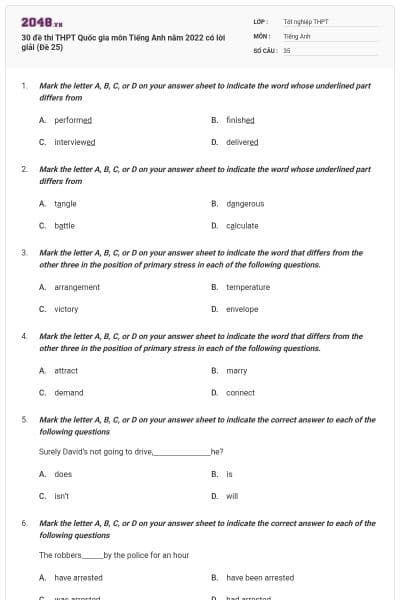
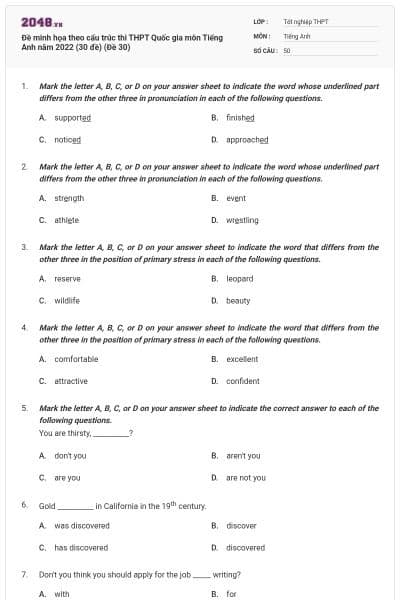
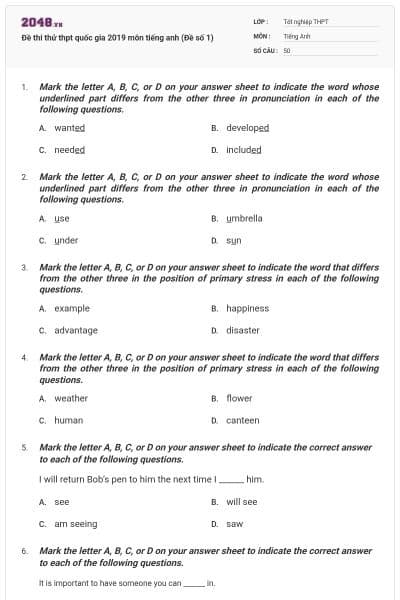
Mark the letter A, B, C, or D on your answer sheet to indicate the word whose underlined part differs from the other three in pronunciation in each of the following questions.
wanted
developed
needed
included
Đáp án B
Kiến thức: Phát âm “-ed”
Giải thích:
wanted /ˈwɒntɪd/
developed /dɪˈveləpt/
needed /ˈniːdɪd/
included /ɪnˈkluːdɪd/
Phần gạch chân câu B được phát âm là /t/ còn lại là /id/
Cách phát âm đuôi “-ed” trong tiếng Anh
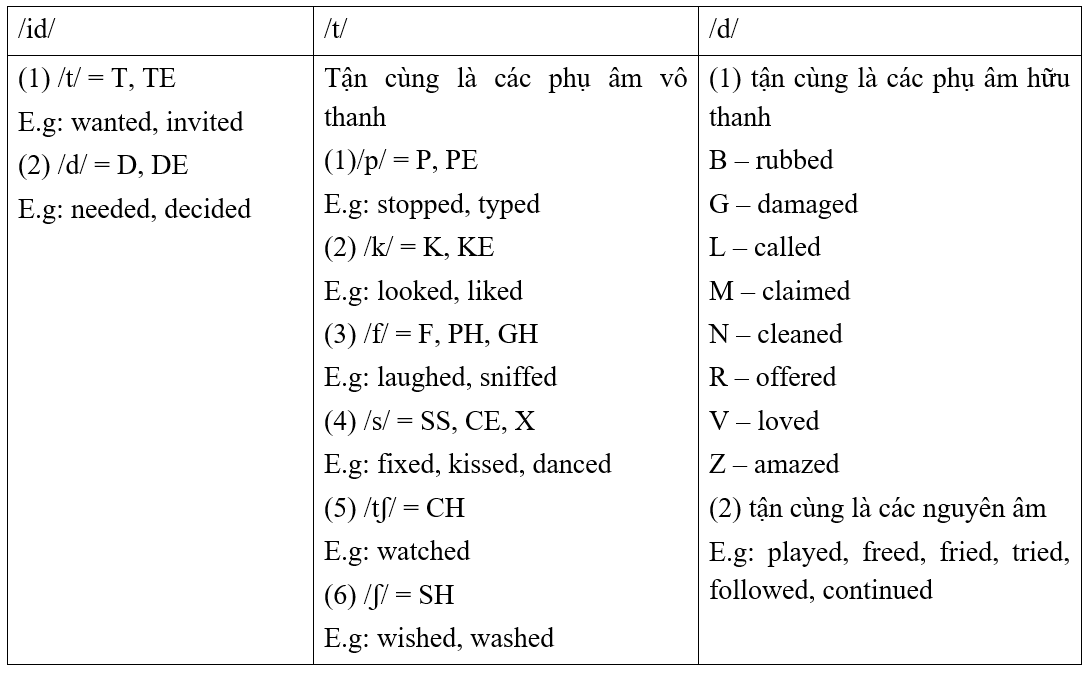
Mark the letter A, B, C, or D on your answer sheet to indicate the word whose underlined part differs from the other three in pronunciation in each of the following questions.
use
umbrella
under
sun
Đáp án A
Kiến thức: Phát âm “-u”
Giải thích:
use /ju:z/
umbrella /ʌm'brelə/
under /'ʌndə[r]/
sun /sʌn/
Phần gạch chân câu A được phát âm là /ju:/ còn lại là /ʌ/
Mark the letter A, B, C, or D on your answer sheet to indicate the word that differs from the other three in the position of primary stress in each of the following questions.
example
happiness
advantage
disaster
Đáp án B
Kiến thức:
Trọng âm của từ có 3 âm tiết
Giải thích:
example /ig'zɑ:mpl/
happiness /'hæpinis/
advantage /əd'vɑ:ntidʒ/
disaster /di'zɑ:stə[r]/
Câu B trọng âm rơi vào âm tiết thứ nhất, còn lại là thứ 2
Mark the letter A, B, C, or D on your answer sheet to indicate the word that differs from the other three in the position of primary stress in each of the following questions.
weather
flower
human
canteen
Đáp án D
Kiến thức: Trọng âm của từ có 2 âm tiết
Giải thích:
weather /'weðə[r]/
flower /'flaʊə[r]/
human /'hju:mən/
canteen /kæn'ti:n/
Câu D trọng âm rơi vào âm tiết thứ 2, còn lại là thứ nhất
Mark the letter A, B, C, or D on your answer sheet to indicate the correct answer to each of the following questions.
I will return Bob’s pen to him the next time I ______ him.
see
will see
am seeing
saw
Đáp án A
Kiến thức: Thì trong tiếng Anh
Giải thích:
Ta dùng thì hiện tại đơn thay vì thì tương lai trong những mệnh đề thời gian trong tương lai
Công thức: S + will + V + Liên từ chỉ thời gian (when/ once/ before/ after/ as soon as/ the next time) + S + V (hiện tại đơn) => sự việc sẽ xảy ra ở tương lai
Tạm dịch: Tôi sẽ trả lại bút của Bob cho anh ấy lần tới khi tôi gặp anh ấy.
Mark the letter A, B, C, or D on your answer sheet to indicate the correct answer to each of the following questions.
It is important to have someone you can ______ in.
talk
speak
know
confide
Đáp án D
Kiến thức: Từ vựng
Giải thích:
talk + to (v): nói chuyện
speak + to (v): nói
know (v): biết
confide + in (v): tâm sự
Tạm dịch: Rất quan trọng khi bạn có ai đó để tin tưởng.
Mark the letter A, B, C, or D on your answer sheet to indicate the correct answer to each of the following questions.
He was lucky to escape from the accident with only ______ injuries.
minor
serious
important
major
Đáp án A
Kiến thức: Từ vựng
Giải thích:
minor (a): nhỏ, không quan trọng
serious (a): nghiêm trọng
important (a): quan trọng
major (a): chính, chủ yếu
Cấu trúc mở rộng:
minor (a): nhỏ, không quan trọng
- a minor road
- minor injuries
- to undergo minor surgery
- youths imprisoned for minor offences
- There may be some minor changes to the schedule.
- Women played a relatively minor role in the organization.
major (a): chính, chủ yếu
- a major road
- major international companies
- to play a major role in something
- We have encountered major problems.
- There were calls for major changes to the welfare system.
serious (a): nghiêm trọng
- a serious illness/ problem/ offence
- to cause serious injury/ damage
- They pose a serious threat to security.
- The consequences could be serious.
Tạm dịch: Anh may mắn thoát khỏi vụ tai nạn với chấn thương nhẹ.
Mark the letter A, B, C, or D on your answer sheet to indicate the correct answer to each of the following questions.
You ______ clean the windows. The window-cleaner is coming tomorrow.
don’t have
must
mustn’t
needn’t
Đáp án D
Kiến thức: Modal verb
Giải thích:
don’t have to: không cần, không phải
must: phải, bắt buộc
mustn’t: không được, không phải
needn’t = don’t have to = don’t need to: không cần
Tạm dịch: Bạn không cần phải lau các cửa sổ. Người lau cửa sổ sẽ đến vào ngày mai.
Mark the letter A, B, C, or D on your answer sheet to indicate the correct answer to each of the following questions.
Would you rather live in ________ town or in ________ country?
a – a
a – the
the – a
the – the
Đáp án B
Kiến thức: Mạo từ
Giải thích:
town (thị trấn) là danh từ số ít và xuất hiện lần đầu trong câu nên chưa xác định => dùng mạo từ “a”
“country” được hiểu là vùng nông thôn nên xác định => dùng cụm từ “in the country”
Tạm dịch: Bạn thích sống ở thị trấn hay nông thôn?
Mark the letter A, B, C, or D on your answer sheet to indicate the correct answer to each of the following questions.
Our teacher would like ______ ____________.
that we practicing our pronunciation
we to practice our pronunciation
us to practice our pronunciation
us practicing our pronunciation
Đáp án C
Kiến thức: to V/ V-ing
Giải thích:
Ta có cấu trúc: would like sb to V = want sb to V: muốn ai làm gì
Câu B không phù hợp vì dùng đại từ “we”, ở đây ta phải dùng tân ngữ. Do đó đáp án phù hợp là C.
Tạm dịch: Giáo viên của chúng tôi muốn chúng tôi thực hành phát âm
Mark the letter A, B, C, or D on your answer sheet to indicate the correct answer to each of the following questions.
Jane often remembered ______ to her mother before she died.
to talk
talk
talked
talking
Đáp án D
Kiến thức: Cấu trúc với remember
Giải thích:
Có 2 cấu trúc với remember:
- remember V-ing: nhớ đã làm gì
- remember to V: nhớ phải làm gì
Trong câu này về nghĩa ta dùng cấu trúc “remember V-ing”.
Tạm dịch: Jane thường nhớ đã nói chuyện với mẹ trước khi bà mất.
Mark the letter A, B, C, or D on your answer sheet to indicate the correct answer to each of the following questions.
They will be able to walk across the river ______.
Đáp án C
Kiến thức: Câu điều kiện
Giải thích:
Ta dùng câu điều kiện loại 1 diễn tả hành động có thể xảy ra trong tương lai.
Cấu trúc câu điều kiện loại 1: S + will/can… + V +…if + mệnh đề hiện tại đơn
=> Đáp án A, D loại
Về nghĩa, đáp án B không phù hợp (unless = if not), do đó đáp án phù hợp là C.
Tạm dịch: Họ sẽ có thể đi bộ qua sông nếu băng đủ dày.
Mark the letter A, B, C, or D on your answer sheet to indicate the correct answer to each of the following questions.
I don’t care ______ money. Money can’t buy happiness.
about
with
in
at
Đáp án A
Kiến thức: Giới từ
Giải thích: Ta có cụm “to care about sth” (v): quan tâm về cái gì đó
Tạm dịch: Tôi không quan tâm đến tiền. Tiền không thể mua được hạnh phúc.
Mark the letter A, B, C, or D on your answer sheet to indicate the correct answer to each of the following questions.
The Giant Panda has been on the ______ of extinction for many years.
border
verge
margin
rim
Đáp án B
Kiến thức: Từ vựng
Giải thích:
Ta có cụm “to be on the verge of extiction”: trên bờ vực tuyệt chủng
border (n): biên giới
margin (n): lề (giấy)
rim (n): cạp, vành
Tạm dịch: Gấu trúc khổng lồ đã đứng trước bờ vực tuyệt chủng trong nhiều năm.
Mark the letter A, B, C, or D on your answer sheet to indicate the correct answer to each of the following questions.
What I like best of him is his ______.
dependence
dependable
independence
dependency
Đáp án C
Kiến thức: Từ loại
Giải thích:
dependence (n): sự phụ thuộc
dependable (a) = reliable: có thể tin cậy được
independence (n): sự độc lập
dependency (n): sự lệ phụ thuộc
Vị trí này ta cần một danh từ, vì phía trước có tính từ sở hữu “his”
Về nghĩa, danh từ “independence” là phù hợp nhất
Tạm dịch: Điều tôi thích nhất ở anh ấy là sự độc lập
Mark the letter A, B, C, or D on your answer sheet to indicate the correct answer to each of the following questions.
“What if the earth stopped moving?”
happened
would happen
happens
will happen
Đáp án B
Kiến thức: Câu điều kiện loại 2
Giải thích:
Câu điều kiện loại 2: diễn tả sự việc trái ngược với hiện tại, không thể xảy ra ở hiện tại.
Cấu trúc: S + would + V + if + S + Ved/ V2 (quá khứ đơn)
Tạm dịch: “Chuyện gì sẽ xảy ra nếu Trái Đất ngừng quay?”
Mark the letter A, B, C, or D on your answer sheet to indicate the correct answer to each of the following questions.
The sky was grey and cloudy. _______, we went to the beach.
Consequently
Nevertheless
Even though
In spite of
Đáp án B
Kiến thức: Liên từ
Giải thích:
Consequently: do đó, bởi thế
Nevertheless = However: tuy nhiên, mặc dù vậy
Even though + mệnh đề: dù cho, mặc dù; đứng đầu không có dấu phẩy hoặc giữa câu
In spite of + danh từ/V-ing: dù cho, mặc dù
Tạm dịch: Bầu trời xám xịt và nhiều mây. Tuy nhiên, chúng tôi đã đi đến bãi biển.
Mark the letter A, B, C, or D on your answer sheet to indicate the correct answer to each of the following questions.
It is _____ appreciated that the rail network needs a complete overhaul.
widely
badly
regularly
equally
Đáp án A
Kiến thức: Từ vựng
Giải thích:
appreciated (v) = understood: đánh giá cao/ cảm kích/ hiểu
widely (adv) = generally: một cách rộng rãi, rộng khắp
badly (adv): một cách tồi tệ
regularly (adv): một cách đều đặn
equally (adv): một cách đều, như nhau
Tạm dịch: Nhiều người hiểu rằng mạng lưới đường sắt cần một cuộc đại tu hoàn chỉnh.
“Hello, I’d like to speak to Mr. Green, please.”
“______ _____________________.”
I’m afraid I don’t know.
I’m sorry. I’ll call again later.
Sorry. Can you take a message?
Sure, I’ll put you through.
Đáp án D
Kiến thức: Văn hoá giao tiếp
Tạm dịch:
“Xin chào, tôi muốn nói chuyện với ông Green, làm ơn.”
“_____________________.”
A. Tôi sợ rằng tôi không biết.
B. Tôi xin lỗi. Tôi sẽ gọi lại sau.
C. Xin lỗi. Bạn có thể nhận một tin nhắn không?
D. Chắc chắn, tôi sẽ kết nối cho bạn.
Các phương án A, B, C không phù hợp.
“Do you mind if I use your phone?” “____________”.
Not at all. Help yourself.
No, thanks.
Sorry, I have no idea.
Certainly, it’s true.
Đáp án A
Kiến thức: Văn hoá giao tiếp
Tạm dịch:
“Bạn có phiền nếu tôi sử dụng điện thoại của bạn?” “____________”.
A. Không phiền đâu. Cứ tự nhiên.
B. Không, cảm ơn. (dùng khi được mời đồ ăn/ thức uống)
C. Xin lỗi, tôi không có ý kiến.
D. Chắc chắn rồi, nó đúng.
Các phương án B, C, D không phù hợp.
Alzheimer’s disease impairs a person’s ability to recall memories.
enhances
affects
destroys
diminishes
Đáp án B
Kiến thức: Từ đồng nghĩa
Giải thích:
impair (v): làm nguy hại, làm suy yếu
enhance (v): làm tăng, nâng cao
affect (v): ảnh hưởng đến, làm nhiễm phải, làm mắc (bệnh)
destroy (v): phá hoại, phá hủy
diminish (v) = reduce: làm giảm, hạ bớt
=> impair = affect
Tạm dịch: Bệnh Alzheimer làm ảnh hưởng khả năng nhớ lại ký ức của một người.
The US Congress office is adjacent to the Capitol building.
far from
behind
next to
within
Đáp án C
Kiến thức: Từ đồng nghĩa
Giải thích:
adjacent to (prep): liền kề với
far from (prep): cách xa
behind (prep): đằng sau
next to (prep): gần sát
within (prep): ở trong
Tạm dịch: Văn phòng Quốc hội Hoa Kỳ liền kề với tòa nhà Quốc hội.
“I’m sorry, madam. This is the fixed price and there is no discount.”
negotiable
discounted
unchanged
discussed
Đáp án A
Kiến thức: Từ trái nghĩa
Giải thích:
fixed (a): cố định
negotiable (a): có thể điều chỉnh, có thể thương lượng
discounted (a): giảm giá
unchanged (a): không thay đổi, như cũ
discussed (discuss, discussed, discussed) (v): thương lượng
=> fixed >< negotiable
Tạm dịch: Tôi xin lỗi, thưa bà. Đây là giá cố định và không có giảm giá.
"Is your house far from here?" "No, it's only a stone's throw away."
a very short distance
a very long distance
a very deep space
the shallow end
Đáp án B
Kiến thức: Từ trái nghĩa
Giải thích:
a stone's throw (away): một khoảng cách rất ngắn
a very short distance: một khoảng cách rất ngắn
a very long distance: một khoảng cách rất dài
a very deep space: một không gian rất sâu
the shallow end: một đầu nông
=> a stone's throw >< a very long distance
Tạm dịch: "Nhà của bạn có xa đây không?" "Không, chỉ là một khoảng cách rất ngắn."
Scuba diving is a sport in (25) ______ you swim underwater for extended (26) ________ using special equipment. The word Scuba is actually an acronym for self-contained underwater breathing apparatus.
Scuba diving is an excellent way to see some very beautiful sites: coral diving sites with their colorful sea life are the most famous but other scuba diving (27) ______ include shipwrecks and caverns.
Scuba diving can also be a very relaxing sport and in many places it’s very beginner friendly. Many dive sites are (28) ______ (under the care of an instructor) after a short briefing and training dive. You can learn to dive far more quickly than you learn snow sports, for example. It’s also suitable for people with a number of physical disabilities. (29)_____you can use the breathing equipment and are able to successfully propel yourself underwater you may be able to dive.
Điền vào ô 25
which
where
that
what
Đáp án A
Kiến thức: Mệnh đề quan hệ
Giải thích:
Giới từ + whom/ which
Giới từ + what + S + V
Ta dùng mệnh đề quan hệ “in which” thay thế cho nơi chốn, địa điểm,… và được dịch là “trong đó”
Scuba diving is a sport in (25) which you swim underwater…
Tạm dịch: Lặn bằng bình khí là một môn thể thao trong đó bạn bơi dưới nước
Scuba diving is a sport in (25) ______ you swim underwater for extended (26) ________ using special equipment. The word Scuba is actually an acronym for self-contained underwater breathing apparatus.
Scuba diving is an excellent way to see some very beautiful sites: coral diving sites with their colorful sea life are the most famous but other scuba diving (27) ______ include shipwrecks and caverns.
Scuba diving can also be a very relaxing sport and in many places it’s very beginner friendly. Many dive sites are (28) ______ (under the care of an instructor) after a short briefing and training dive. You can learn to dive far more quickly than you learn snow sports, for example. It’s also suitable for people with a number of physical disabilities. (29)_____you can use the breathing equipment and are able to successfully propel yourself underwater you may be able to dive.
Điền vào ô 26
stages
rounds
periods
terms
Đáp án C
Kiến thức: Từ vựng
Giải thích:
stage (n): chặng, giai đoạn
round (n): hiệp, vòng đấu
period (n): thời kỳ, thời gian
term (n): hạn, kỳ hạn
Scuba diving is a sport in which you swim underwater for extended (26) periods using special equipment.
Tạm dịch: Lặn bằng bình khí là một môn thể thao trong đó bạn bơi dưới nước trong thời gian dài bằng cách sử dụng thiết bị đặc biệt.
Scuba diving is a sport in (25) ______ you swim underwater for extended (26) ________ using special equipment. The word Scuba is actually an acronym for self-contained underwater breathing apparatus.
Scuba diving is an excellent way to see some very beautiful sites: coral diving sites with their colorful sea life are the most famous but other scuba diving (27) ______ include shipwrecks and caverns.
Scuba diving can also be a very relaxing sport and in many places it’s very beginner friendly. Many dive sites are (28) ______ (under the care of an instructor) after a short briefing and training dive. You can learn to dive far more quickly than you learn snow sports, for example. It’s also suitable for people with a number of physical disabilities. (29)_____you can use the breathing equipment and are able to successfully propel yourself underwater you may be able to dive.
Điền vào ô 27
impressions
amusements
recreations
attractions
Đáp án D
Kiến thức: Từ vựng
Giải thích:
impression (n): ấn tượng
amusement (n): sự vui chơi; trò giải trí
recreation (n): sự giải lao, sự tiêu khiển
attraction (n): sự lôi cuốn, sự hấp dẫn, địa điểm thu hút
Scuba diving is an excellent way to see some very beautiful sites: coral diving sites with their colorful sea life are the most famous but other scuba diving (27) attractions include shipwrecks and caverns.
Tạm dịch: Lặn bằng bình khí là một cách tuyệt vời để ngắm một số địa điểm rất đẹp: các địa điểm lặn san hô với cuộc sống biển đầy màu sắc của chúng là nổi tiếng nhất ngoài các điểm lặn khác bao gồm xác tàu đắm và hang động.
Scuba diving is a sport in (25) ______ you swim underwater for extended (26) ________ using special equipment. The word Scuba is actually an acronym for self-contained underwater breathing apparatus.
Scuba diving is an excellent way to see some very beautiful sites: coral diving sites with their colorful sea life are the most famous but other scuba diving (27) ______ include shipwrecks and caverns.
Scuba diving can also be a very relaxing sport and in many places it’s very beginner friendly. Many dive sites are (28) ______ (under the care of an instructor) after a short briefing and training dive. You can learn to dive far more quickly than you learn snow sports, for example. It’s also suitable for people with a number of physical disabilities. (29)_____you can use the breathing equipment and are able to successfully propel yourself underwater you may be able to dive.
Điền vào ô 28
available
approaching
accessible
manageable
Đáp án C
Kiến thức: Từ vựng
Giải thích:
available (a): có sẵn
approaching (V-ing): tiếp cận
accessible (a): dễ tiếp cận
manageable (a): có thể quản lý
Many dive sites are (28) accessible (under the care of an instructor) after a short briefing and training dive.
Tạm dịch: Nhiều địa điểm lặn có thể tới được (dưới sự quan tâm của một người hướng dẫn) sau một cuộc đào tạo lặn ngắn.
Scuba diving is a sport in (25) ______ you swim underwater for extended (26) ________ using special equipment. The word Scuba is actually an acronym for self-contained underwater breathing apparatus.
Scuba diving is an excellent way to see some very beautiful sites: coral diving sites with their colorful sea life are the most famous but other scuba diving (27) ______ include shipwrecks and caverns.
Scuba diving can also be a very relaxing sport and in many places it’s very beginner friendly. Many dive sites are (28) ______ (under the care of an instructor) after a short briefing and training dive. You can learn to dive far more quickly than you learn snow sports, for example. It’s also suitable for people with a number of physical disabilities. (29)_____you can use the breathing equipment and are able to successfully propel yourself underwater you may be able to dive.
Điền vào ô 29
Because
When
As long as
Although
Đáp án C
Kiến thức: Liên từ
Giải thích:
Because: bởi vì
When: khi
As long as: miễn là
Although: mặc dù
(29) As long as you can use the breathing equipment and are able to successfully propel yourself underwater you may be able to dive.
Tạm dịch: Miễn là bạn có thể sử dụng thiết bị thở và có thể tự đẩy mình thành công dưới nước, bạn có thể lặn.
Dịch bài đọc:
Lặn bằng bình khí là một môn thể thao trong đó bạn bơi dưới nước trong thời gian dài bằng cách sử dụng thiết bị đặc biệt. Từ Scuba thực ra là một từ viết tắt của thiết bị thở dưới nước khép kín. Lặn bằng bình khí là một cách tuyệt vời để ngắm một số địa điểm rất đẹp: các địa điểm lặn san hô với cuộc sống biển đầy màu sắc của chúng là nổi tiếng nhất ngoài các điểm lặn khác bao gồm xác tàu đắm và hang động.
Lặn bằng bình khí cũng có thể là một môn thể thao rất thư giãn và ở nhiều nơi, nó rất thân thiện với người mới bắt đầu. Nhiều địa điểm lặn có thể tới được (dưới sự quan tâm của một người hướng dẫn) sau một cuộc đào tạo lặn ngắn. Bạn có thể học cách lặn nhanh hơn nhiều so với bạn có thể học các môn thể thao ví dụ như tuyết. Nó cũng thích hợp cho những người có một số khuyết tật về thể chất. Miễn là bạn có thể sử dụng thiết bị thở và có thể tự đẩy mình thành công dưới nước, bạn có thể lặn.
Many scientists believe our love of sugar may actually be an addiction. When we eat or drink sugary foods, the sugar enters our blood and affects parts of our brain that make us feel good. Then the good feeling goes away, leaving us wanting more. All tasty foods do this, but sugar has a particularly strong effect. In this way, it is in fact an addictive drug, one that doctors recommend we all cut down on.
"It seems like every time I study an illness and trace a path to the first cause, I find my way back to sugar," says scientist Richard Johnson. One- third of adults worldwide have high blood pressure, and up to 347 million have diabetes. Why? "Sugar, we believe, is one of the culprits, if not the major culprit," says Johnson.
Our bodies are designed to survive on very little sugar. Early humans often had very little food, so our bodies learned to be very efficient in storing sugar as fat. In this way, we had energy stored for when there was no food. But today, most people have more than enough. So the very thing that once saved us may now be killing us.
So what is the solution? It's obvious that we need to eat less sugar. The trouble is, in today's world, it's extremely difficult to avoid. From breakfast cereals to after-dinner desserts, our foods are increasingly filled with it. Some manufacturers even use sugar to replace taste in foods that are advertised as low in fat.
But there are those who are fighting back against sugar. Many schools are replacing sugary desserts with healthier options like fruit. Other schools are growing their own food in gardens, or building facilities like walking tracks so students and others in the community can exercise. The battle has not yet been lost.
What is this passage mainly about?
Our addiction to sugar
Illnesses caused by sugar
Good sugar versus bad sugar
Ways to avoid sugar
Đáp án A
Kiến thức: Đọc hiểu
Giải thích:
Đoạn này chủ yếu là về?
A. Chúng ta nghiện đường
B. Bệnh do đường
C. Đường tốt với đường xấu
D. Cách tránh đường
Many scientists believe our love of sugar may actually be an addiction. When we eat or drink sugary foods, the sugar enters our blood and affects parts of our brain that make us feel good. Then the good feeling goes away, leaving us wanting more. All tasty foods do this, but sugar has a particularly strong effect. In this way, it is in fact an addictive drug, one that doctors recommend we all cut down on.
"It seems like every time I study an illness and trace a path to the first cause, I find my way back to sugar," says scientist Richard Johnson. One- third of adults worldwide have high blood pressure, and up to 347 million have diabetes. Why? "Sugar, we believe, is one of the culprits, if not the major culprit," says Johnson.
Our bodies are designed to survive on very little sugar. Early humans often had very little food, so our bodies learned to be very efficient in storing sugar as fat. In this way, we had energy stored for when there was no food. But today, most people have more than enough. So the very thing that once saved us may now be killing us.
So what is the solution? It's obvious that we need to eat less sugar. The trouble is, in today's world, it's extremely difficult to avoid. From breakfast cereals to after-dinner desserts, our foods are increasingly filled with it. Some manufacturers even use sugar to replace taste in foods that are advertised as low in fat.
But there are those who are fighting back against sugar. Many schools are replacing sugary desserts with healthier options like fruit. Other schools are growing their own food in gardens, or building facilities like walking tracks so students and others in the community can exercise. The battle has not yet been lost.
The word "culprit" in paragraph 2 is closest in meaning to __________.
disease
unknown thing
sweet food
cause of the problem
Đáp án D
Kiến thức: Đọc hiểu
Giải thích:
Từ "culprit" trong đoạn 2 có nghĩa gần nhất với __________.
A. bệnh
B. điều chưa biết
C. thức ăn ngọt
D. nguyên nhân của vấn đề
Từ “culprit” trong bài có nghĩa là “nguyên nhân của vấn đề”
"Sugar, we believe, is one of the culprits, if not the major culprit," says Johnson.
Tạm dịch: "Đường, chúng tôi tin rằng, là một trong những thủ phạm, nếu không nói là thủ phạm chính," Johnson nói.
Many scientists believe our love of sugar may actually be an addiction. When we eat or drink sugary foods, the sugar enters our blood and affects parts of our brain that make us feel good. Then the good feeling goes away, leaving us wanting more. All tasty foods do this, but sugar has a particularly strong effect. In this way, it is in fact an addictive drug, one that doctors recommend we all cut down on.
"It seems like every time I study an illness and trace a path to the first cause, I find my way back to sugar," says scientist Richard Johnson. One- third of adults worldwide have high blood pressure, and up to 347 million have diabetes. Why? "Sugar, we believe, is one of the culprits, if not the major culprit," says Johnson.
Our bodies are designed to survive on very little sugar. Early humans often had very little food, so our bodies learned to be very efficient in storing sugar as fat. In this way, we had energy stored for when there was no food. But today, most people have more than enough. So the very thing that once saved us may now be killing us.
So what is the solution? It's obvious that we need to eat less sugar. The trouble is, in today's world, it's extremely difficult to avoid. From breakfast cereals to after-dinner desserts, our foods are increasingly filled with it. Some manufacturers even use sugar to replace taste in foods that are advertised as low in fat.
But there are those who are fighting back against sugar. Many schools are replacing sugary desserts with healthier options like fruit. Other schools are growing their own food in gardens, or building facilities like walking tracks so students and others in the community can exercise. The battle has not yet been lost.
What does the phrase "the very thing" in paragraph 3 refer to?
the amount of sugar in our food
having enough food to survive
our ability to store sugar as fat
early humans' lack of food
Đáp án C
Kiến thức: Đọc hiểu
Giải thích:
Cụm từ "the very thing" trong đoạn 3 nói về điều gì?
A. lượng đường trong thức ăn của chúng ta
B. có đủ thức ăn để tồn tại
C. khả năng lưu trữ đường của chúng ta dưới dạng chất béo
D. sự thiếu thức ăn của con người ngày xưa
"the very thing" đề cập đến khả năng lưu trữ đường của chúng ta dưới dạng chất béo ở câu trước: Early humans often had very little food, so our bodies learned to be very efficient in storing sugar as fat. In this way, we had energy stored for when there was no food. But today, most people have more than enough. So the very thing that once saved us may now be killing us.
Tạm dịch: Con người thời kỳ ngày xưa thường có rất ít thức ăn, vì vậy cơ thể chúng ta học được cách rất hiệu quả trong việc lưu trữ đường dưới dạng chất béo. Theo cách này, chúng ta đã dự trữ năng lượng khi không có thức ăn. Nhưng ngày nay, hầu hết mọi người có quá nhiều. Vì vậy, thứ từng cứu chúng ta bây giờ có thể đang giết chúng ta.
Many scientists believe our love of sugar may actually be an addiction. When we eat or drink sugary foods, the sugar enters our blood and affects parts of our brain that make us feel good. Then the good feeling goes away, leaving us wanting more. All tasty foods do this, but sugar has a particularly strong effect. In this way, it is in fact an addictive drug, one that doctors recommend we all cut down on.
"It seems like every time I study an illness and trace a path to the first cause, I find my way back to sugar," says scientist Richard Johnson. One- third of adults worldwide have high blood pressure, and up to 347 million have diabetes. Why? "Sugar, we believe, is one of the culprits, if not the major culprit," says Johnson.
Our bodies are designed to survive on very little sugar. Early humans often had very little food, so our bodies learned to be very efficient in storing sugar as fat. In this way, we had energy stored for when there was no food. But today, most people have more than enough. So the very thing that once saved us may now be killing us.
So what is the solution? It's obvious that we need to eat less sugar. The trouble is, in today's world, it's extremely difficult to avoid. From breakfast cereals to after-dinner desserts, our foods are increasingly filled with it. Some manufacturers even use sugar to replace taste in foods that are advertised as low in fat.
But there are those who are fighting back against sugar. Many schools are replacing sugary desserts with healthier options like fruit. Other schools are growing their own food in gardens, or building facilities like walking tracks so students and others in the community can exercise. The battle has not yet been lost.
According to the passage, why is it so hard to avoid sugar?
We like candy too much
It gives us needed energy.
It's in so many foods and drinks.
We get used to eating it at school.
Đáp án C
Kiến thức: Đọc hiểu
Giải thích:
Theo đoạn văn, tại sao khó tránh đường như vậy?
A. Chúng ta thích kẹo quá nhiều.
B. Nó cho chúng ta năng lượng cần thiết.
C. Có rất nhiều trong thực phẩm và đồ uống.
D. Chúng ta quen với việc ăn nó ở trường.
Thông tin: The trouble is, in today's world, it's extremely difficult to avoid. From breakfast cereals to after-dinner desserts, our foods are increasingly filled with it. Some manufacturers even use sugar to replace taste in foods that are advertised as low in fat.
Tạm dịch: Vấn đề là, trong thế giới ngày nay, nó cực kỳ khó tránh. Từ ngũ cốc ăn sáng đến món tráng miệng sau bữa tối, thực phẩm của chúng ta ngày càng chứa đầy nó. Một số nhà sản xuất thậm chí sử dụng đường để thay thế hương vị trong thực phẩm được quảng cáo là ít chất béo.
Many scientists believe our love of sugar may actually be an addiction. When we eat or drink sugary foods, the sugar enters our blood and affects parts of our brain that make us feel good. Then the good feeling goes away, leaving us wanting more. All tasty foods do this, but sugar has a particularly strong effect. In this way, it is in fact an addictive drug, one that doctors recommend we all cut down on.
"It seems like every time I study an illness and trace a path to the first cause, I find my way back to sugar," says scientist Richard Johnson. One- third of adults worldwide have high blood pressure, and up to 347 million have diabetes. Why? "Sugar, we believe, is one of the culprits, if not the major culprit," says Johnson.
Our bodies are designed to survive on very little sugar. Early humans often had very little food, so our bodies learned to be very efficient in storing sugar as fat. In this way, we had energy stored for when there was no food. But today, most people have more than enough. So the very thing that once saved us may now be killing us.
So what is the solution? It's obvious that we need to eat less sugar. The trouble is, in today's world, it's extremely difficult to avoid. From breakfast cereals to after-dinner desserts, our foods are increasingly filled with it. Some manufacturers even use sugar to replace taste in foods that are advertised as low in fat.
But there are those who are fighting back against sugar. Many schools are replacing sugary desserts with healthier options like fruit. Other schools are growing their own food in gardens, or building facilities like walking tracks so students and others in the community can exercise. The battle has not yet been lost.
Which of the following statements about sugar is NOT true?
Sugar makes us feel good.
Our bodies store sugar as fat.
We need very little to survive.
Only adults need to stop eating sugar.
Đáp án D
Kiến thức: Đọc hiểu
Giải thích:
Phát biểu nào sau đây về đường là KHÔNG đúng?
A. Đường làm cho chúng ta cảm thấy dễ chịu.
B. Cơ thể chúng ta lưu trữ đường dưới dạng chất béo.
C. Chúng ta cần rất ít để tồn tại.
D. Chỉ người lớn mới cần ngừng ăn đường.
Thông tin:
- When we eat or drink sugary foods, the sugar enters our blood and affects parts of our brain that make us feel good.
- Early humans often had very little food, so our bodies learned to be very efficient in storing sugar as fat.
Tạm dịch:
Khi chúng ta ăn hoặc uống thực phẩm có đường, đường xâm nhập vào máu và ảnh hưởng đến các bộ phận trong não khiến chúng ta cảm thấy dễ chịu.
Con người thời kỳ ngày xưa thường có rất ít thức ăn, vì vậy cơ thể chúng ta học được cách rất hiệu quả trong việc lưu trữ đường dưới dạng chất béo.
Chỉ có đáp án D không đúng.
Dịch bài đọc:
Nhiều nhà khoa học tin rằng tình yêu của chúng ta về đường thực sự có thể gây nghiện. Khi chúng ta ăn hoặc uống thực phẩm có đường, đường xâm nhập vào máu và ảnh hưởng đến các bộ phận trong não khiến chúng ta cảm thấy dễ chịu. Sau đó, cảm giác tốt đẹp biến mất, khiến chúng ta muốn nhiều hơn nữa. Tất cả các loại thực phẩm ngon có thể làm điều này, nhưng đường có tác dụng đặc biệt mạnh mẽ. Theo cách này, trên thực tế, đây là một loại thuốc gây nghiện, một loại mà các bác sĩ khuyên chúng ta nên cắt giảm.
"Có vẻ như mỗi lần tôi nghiên cứu về một căn bệnh và tìm ra con đường dẫn đến nguyên nhân đầu tiên, tôi lại tìm đường trở về với đường", nhà khoa học Richard Johnson nói. Một phần ba số người trưởng thành trên toàn thế giới bị huyết áp cao và có tới 349 triệu người mắc bệnh tiểu đường. Tại sao? "Đường, chúng tôi tin rằng, là một trong những thủ phạm, nếu không nói là thủ phạm chính," Johnson nói.
Cơ thể của chúng ta được thiết kế để tồn tại trên rất ít đường. Con người thời kỳ ngày xưa thường có rất ít thức ăn, vì vậy cơ thể chúng ta học được cách rất hiệu quả trong việc lưu trữ đường dưới dạng chất béo. Theo cách này, chúng ta đã dự trữ năng lượng khi không có thức ăn. Nhưng ngày nay, hầu hết mọi người có quá nhiều. Vì vậy, thứ từng cứu chúng ta bây giờ có thể đang giết chúng ta.
Vậy giải pháp là gì? Rõ ràng là chúng ta cần ăn ít đường. Vấn đề là, trong thế giới ngày nay, nó cực kỳ khó tránh. Từ ngũ cốc ăn sáng đến món tráng miệng sau bữa tối, thực phẩm của chúng ta ngày càng chứa đầy nó. Một số nhà sản xuất thậm chí sử dụng đường để thay thế hương vị trong thực phẩm được quảng cáo là ít chất béo.
Nhưng có những người đang chiến đấu chống lại đường. Nhiều trường học đang thay thế các món tráng miệng có đường bằng các lựa chọn lành mạnh hơn như trái cây. Các trường khác đang tự trồng thực phẩm trong vườn hoặc xây dựng các cơ sở như đường đi bộ để học sinh và những người khác trong cộng đồng có thể tập thể dục. Trận chiến vẫn chưa biến mất.
Clara Barton became known as "The Angel of the Battlefield" during the American Civil War. Born in Oxford, Massachusetts in 1821, Clara Barton's interest in helping soldiers on the battlefield began when she was told army stories from her father. Another event that influenced her decision to help soldiers was an accident her brother had. His injuries were cared for by Barton for 2 years. At the time, she was only Il years old. Barton began teaching school at the age of 15. She taught for 18 years before she moved to Washington, D.C. in 1854.
The civil war broke out 6 years later. Immediately, Barton started war service by helping the soldiers with their needs. At the battle of Bull Run, Clara Barton received permission from the government to take care of the sick and hurt. Barton did this with great empathy and kindness. She acknowledged each soldier as a person. Her endurance and courage on the battlefield were admired by many. When the war ended in 1865, she used 4 years of her life to assist the government in searching for soldiers who were missing during the war.
The search for missing soldiers and years of hard work made her feeble physically. In 1869, her doctors recommended a trip to Europe for a rest. While she was on vacation, she became involved with the International Red Cross, an organization set up by the Geneva Convention in 1864. Clara Barton realized that the Red Cross would be a big help to the United States. After she returned to the United States, she worked very hard to create an American Red Cross. She talked to government leaders and let American people know about the Red Cross. In 1881, the National Society of the Red Cross was finally established with its headquarters in Washington, D.C. Clara Barton managed its activities for 23 years. Barton never let her age stop her from helping people. At the age of 79, she helped flood victims in Galveston, Texas. Barton finally resigned from the Red Cross in 1904. She was 92 years old and had truly earned her title "The Angel of the Battlefield".
What is the main idea of the passage?
Clara Barton helped wounded soldiers and she was the founder of the Red Cross.
Clara Barton was a kind and strong woman who helped people in need.
Clara Barton became a nurse during the American Civil War.
Clara Barton worked for disaster victims until she was old.
Đáp án B
Kiến thức: Đọc hiểu
Giải thích:
Ý chính của bài văn là?
A.Clara Barton giúp đỡ những người lính bị thương và là người sáng lập Hội chữ Thập đỏ
B. Clara Barton là một người phụ nữ tốt bụng và mạnh mẽ, người đã giúp đỡ những người gặp hoạn nạn.
C. Clara Barton trở thành một y tá trong suốt nội chiến Mỹ.
D. Clara Barton làm việc cho những nạn nhân vùng thiên tai cho đến lúc già.
Clara Barton became known as "The Angel of the Battlefield" during the American Civil War. Born in Oxford, Massachusetts in 1821, Clara Barton's interest in helping soldiers on the battlefield began when she was told army stories from her father. Another event that influenced her decision to help soldiers was an accident her brother had. His injuries were cared for by Barton for 2 years. At the time, she was only Il years old. Barton began teaching school at the age of 15. She taught for 18 years before she moved to Washington, D.C. in 1854.
The civil war broke out 6 years later. Immediately, Barton started war service by helping the soldiers with their needs. At the battle of Bull Run, Clara Barton received permission from the government to take care of the sick and hurt. Barton did this with great empathy and kindness. She acknowledged each soldier as a person. Her endurance and courage on the battlefield were admired by many. When the war ended in 1865, she used 4 years of her life to assist the government in searching for soldiers who were missing during the war.
The search for missing soldiers and years of hard work made her feeble physically. In 1869, her doctors recommended a trip to Europe for a rest. While she was on vacation, she became involved with the International Red Cross, an organization set up by the Geneva Convention in 1864. Clara Barton realized that the Red Cross would be a big help to the United States. After she returned to the United States, she worked very hard to create an American Red Cross. She talked to government leaders and let American people know about the Red Cross. In 1881, the National Society of the Red Cross was finally established with its headquarters in Washington, D.C. Clara Barton managed its activities for 23 years. Barton never let her age stop her from helping people. At the age of 79, she helped flood victims in Galveston, Texas. Barton finally resigned from the Red Cross in 1904. She was 92 years old and had truly earned her title "The Angel of the Battlefield".
According to paragraph 1, which of the following is true of the young Clara Barton?
She helped her father when he was a soldier.
She suffered from an accident when she was 11.
She helped her brother who was hurt in an accident.
She made a decision to live with her brother for 2 years.
Đáp án C
Kiến thức: Đọc hiểu
Giải thích:
Theo đoạn 1, điều nào sau đây đúng với Barton Clara khi trẻ?
A. Cô ấy giúp bố khi ông là quân nhân.
B. Cô ấy bị tai nạn vào năm 11 tuổi.
C. Cô ấy giúp đỡ anh trai, người bị thương trong 1 vụ tai nạn.
D. Cô ấy quyết định sống với anh trai trong 2 năm.
Thông tin: Another event that influenced her decision to help soldiers was an accident her brother had. His injuries were cared for by Barton for 2 years. At the time, she was only 1l years old.
Tạm dịch: Một sự kiện khác ảnh hưởng đến quyết định của cô để giúp những người lính là vụ tai nạn của anh trai cô. Vết thương của anh được Barton chăm nom trong 2 năm. Lúc đó, cô ấy chỉ 11 tuổi.
Clara Barton became known as "The Angel of the Battlefield" during the American Civil War. Born in Oxford, Massachusetts in 1821, Clara Barton's interest in helping soldiers on the battlefield began when she was told army stories from her father. Another event that influenced her decision to help soldiers was an accident her brother had. His injuries were cared for by Barton for 2 years. At the time, she was only Il years old. Barton began teaching school at the age of 15. She taught for 18 years before she moved to Washington, D.C. in 1854.
The civil war broke out 6 years later. Immediately, Barton started war service by helping the soldiers with their needs. At the battle of Bull Run, Clara Barton received permission from the government to take care of the sick and hurt. Barton did this with great empathy and kindness. She acknowledged each soldier as a person. Her endurance and courage on the battlefield were admired by many. When the war ended in 1865, she used 4 years of her life to assist the government in searching for soldiers who were missing during the war.
The search for missing soldiers and years of hard work made her feeble physically. In 1869, her doctors recommended a trip to Europe for a rest. While she was on vacation, she became involved with the International Red Cross, an organization set up by the Geneva Convention in 1864. Clara Barton realized that the Red Cross would be a big help to the United States. After she returned to the United States, she worked very hard to create an American Red Cross. She talked to government leaders and let American people know about the Red Cross. In 1881, the National Society of the Red Cross was finally established with its headquarters in Washington, D.C. Clara Barton managed its activities for 23 years. Barton never let her age stop her from helping people. At the age of 79, she helped flood victims in Galveston, Texas. Barton finally resigned from the Red Cross in 1904. She was 92 years old and had truly earned her title "The Angel of the Battlefield".
The word “this” in paragraph 2 refers to _________.
recognized each soldier as a person
cooked for soldiers
took care of the sick and hurt
received permission
Đáp án C
Kiến thức: Đọc hiểu
Giải thích:
Từ “this” ở đoạn 2 ám chỉ
A. Công nhận mỗi người lính là một con người
B. Nấu cho những người lính
C. Chăm sóc cho người bệnh và người bị thương
D. Nhận được sự cho phép
“this” ám chỉ việc Chăm sóc cho người bệnh và người bị thương: At the battle of Bull Run, Clara Barton received permission from the government to take care of the sick and hurt. Barton did this with great empathy and kindness.
Tạm dịch: Ở chiến trường Bull Run, Clara Barton nhận được sự đồng ý của chính phủ để chăm sóc những người bệnh và người bị thương. Bartion làm những điều này với sự cảm thông và lòng nhân ái sâu sắc.
Clara Barton became known as "The Angel of the Battlefield" during the American Civil War. Born in Oxford, Massachusetts in 1821, Clara Barton's interest in helping soldiers on the battlefield began when she was told army stories from her father. Another event that influenced her decision to help soldiers was an accident her brother had. His injuries were cared for by Barton for 2 years. At the time, she was only Il years old. Barton began teaching school at the age of 15. She taught for 18 years before she moved to Washington, D.C. in 1854.
The civil war broke out 6 years later. Immediately, Barton started war service by helping the soldiers with their needs. At the battle of Bull Run, Clara Barton received permission from the government to take care of the sick and hurt. Barton did this with great empathy and kindness. She acknowledged each soldier as a person. Her endurance and courage on the battlefield were admired by many. When the war ended in 1865, she used 4 years of her life to assist the government in searching for soldiers who were missing during the war.
The search for missing soldiers and years of hard work made her feeble physically. In 1869, her doctors recommended a trip to Europe for a rest. While she was on vacation, she became involved with the International Red Cross, an organization set up by the Geneva Convention in 1864. Clara Barton realized that the Red Cross would be a big help to the United States. After she returned to the United States, she worked very hard to create an American Red Cross. She talked to government leaders and let American people know about the Red Cross. In 1881, the National Society of the Red Cross was finally established with its headquarters in Washington, D.C. Clara Barton managed its activities for 23 years. Barton never let her age stop her from helping people. At the age of 79, she helped flood victims in Galveston, Texas. Barton finally resigned from the Red Cross in 1904. She was 92 years old and had truly earned her title "The Angel of the Battlefield".
The word “broke out” in paragraph 2 could best be replaced by
extended
broke down
closed
began
Đáp án D
Kiến thức: Đọc hiểu
Giải thích:
Cụm “broke out” ở đoạn 2 có thể được thay thế bởi
A. mở rộng
B. suy sụp
C. gần, đóng cửa
D. bắt đầu
to break out = to begin (v): bùng nổ
Clara Barton became known as "The Angel of the Battlefield" during the American Civil War. Born in Oxford, Massachusetts in 1821, Clara Barton's interest in helping soldiers on the battlefield began when she was told army stories from her father. Another event that influenced her decision to help soldiers was an accident her brother had. His injuries were cared for by Barton for 2 years. At the time, she was only Il years old. Barton began teaching school at the age of 15. She taught for 18 years before she moved to Washington, D.C. in 1854.
The civil war broke out 6 years later. Immediately, Barton started war service by helping the soldiers with their needs. At the battle of Bull Run, Clara Barton received permission from the government to take care of the sick and hurt. Barton did this with great empathy and kindness. She acknowledged each soldier as a person. Her endurance and courage on the battlefield were admired by many. When the war ended in 1865, she used 4 years of her life to assist the government in searching for soldiers who were missing during the war.
The search for missing soldiers and years of hard work made her feeble physically. In 1869, her doctors recommended a trip to Europe for a rest. While she was on vacation, she became involved with the International Red Cross, an organization set up by the Geneva Convention in 1864. Clara Barton realized that the Red Cross would be a big help to the United States. After she returned to the United States, she worked very hard to create an American Red Cross. She talked to government leaders and let American people know about the Red Cross. In 1881, the National Society of the Red Cross was finally established with its headquarters in Washington, D.C. Clara Barton managed its activities for 23 years. Barton never let her age stop her from helping people. At the age of 79, she helped flood victims in Galveston, Texas. Barton finally resigned from the Red Cross in 1904. She was 92 years old and had truly earned her title "The Angel of the Battlefield". The word “acknowledged” in paragraph 2 could best be replaced by
nursed
recognized
pleaded
believed
Đáp án B
Kiến thức: Đọc hiểu
Giải thích:
Từ “acknowledged” ở đoạn 2 có thể được thay thế bởi
A. chăm sóc
B. công nhận
C. bào chữa, biện hộ
D. tin tưởng
Clara Barton became known as "The Angel of the Battlefield" during the American Civil War. Born in Oxford, Massachusetts in 1821, Clara Barton's interest in helping soldiers on the battlefield began when she was told army stories from her father. Another event that influenced her decision to help soldiers was an accident her brother had. His injuries were cared for by Barton for 2 years. At the time, she was only Il years old. Barton began teaching school at the age of 15. She taught for 18 years before she moved to Washington, D.C. in 1854.
The civil war broke out 6 years later. Immediately, Barton started war service by helping the soldiers with their needs. At the battle of Bull Run, Clara Barton received permission from the government to take care of the sick and hurt. Barton did this with great empathy and kindness. She acknowledged each soldier as a person. Her endurance and courage on the battlefield were admired by many. When the war ended in 1865, she used 4 years of her life to assist the government in searching for soldiers who were missing during the war.
The search for missing soldiers and years of hard work made her feeble physically. In 1869, her doctors recommended a trip to Europe for a rest. While she was on vacation, she became involved with the International Red Cross, an organization set up by the Geneva Convention in 1864. Clara Barton realized that the Red Cross would be a big help to the United States. After she returned to the United States, she worked very hard to create an American Red Cross. She talked to government leaders and let American people know about the Red Cross. In 1881, the National Society of the Red Cross was finally established with its headquarters in Washington, D.C. Clara Barton managed its activities for 23 years. Barton never let her age stop her from helping people. At the age of 79, she helped flood victims in Galveston, Texas. Barton finally resigned from the Red Cross in 1904. She was 92 years old and had truly earned her title "The Angel of the Battlefield".
What can be inferred about the government?
It did not always agree with Clara Barton.
It did not have the money to help Clara Barton.
It showed Clara Barton great empathy and kindness.
It had respect for Clara Barton.
Đáp án D
Kiến thức: Đọc hiểu
Giải thích:
Có thể suy ra điều gì về chính phủ?
A. Chính phủ không luôn đồng tình với Clara Barton.
B. Chính phủ không có tiền để hỗ trợ Clara Barton.
C. Chính phủ dành cho Clara Barton một sự cảm thông và nhân ái sâu sắc.
D. Chính phủ khâm phục Clara Barton.
Thông tin: She talked to government leaders and let American people know about the Red Cross. In 1881, the National Society of the Red Cross was finally established with its headquarters in Washington, D.C. Clara Barton managed its activities for 23 years.
Clara Barton became known as "The Angel of the Battlefield" during the American Civil War. Born in Oxford, Massachusetts in 1821, Clara Barton's interest in helping soldiers on the battlefield began when she was told army stories from her father. Another event that influenced her decision to help soldiers was an accident her brother had. His injuries were cared for by Barton for 2 years. At the time, she was only Il years old. Barton began teaching school at the age of 15. She taught for 18 years before she moved to Washington, D.C. in 1854.
The civil war broke out 6 years later. Immediately, Barton started war service by helping the soldiers with their needs. At the battle of Bull Run, Clara Barton received permission from the government to take care of the sick and hurt. Barton did this with great empathy and kindness. She acknowledged each soldier as a person. Her endurance and courage on the battlefield were admired by many. When the war ended in 1865, she used 4 years of her life to assist the government in searching for soldiers who were missing during the war.
The search for missing soldiers and years of hard work made her feeble physically. In 1869, her doctors recommended a trip to Europe for a rest. While she was on vacation, she became involved with the International Red Cross, an organization set up by the Geneva Convention in 1864. Clara Barton realized that the Red Cross would be a big help to the United States. After she returned to the United States, she worked very hard to create an American Red Cross. She talked to government leaders and let American people know about the Red Cross. In 1881, the National Society of the Red Cross was finally established with its headquarters in Washington, D.C. Clara Barton managed its activities for 23 years. Barton never let her age stop her from helping people. At the age of 79, she helped flood victims in Galveston, Texas. Barton finally resigned from the Red Cross in 1904. She was 92 years old and had truly earned her title "The Angel of the Battlefield".
Which of the sentences best expresses the essential information in the highlighted sentence? Incorrect answer choices change the meaning in important ways or leave out essential information
She asked the government to help her look for soldiers who participated in the war.
She spent 4 years helping the government look for missing soldiers.
Many soldiers were missing when the government's war ended in 1865.
The war did not end until the government helped Clara Barton find some soldiers who
Đáp án B
Kiến thức: Đọc hiểu
Giải thích:
Câu nào thể hiện đúng nhất các thông tin cần thiết trong câu được in đậm? Câu trả lời không chính xác thay đổi ý nghĩa một cách quan trọng hoặc bỏ qua thông tin cần thiết.
A. Cô ấy yêu cầu chính phủ giúp cô ấy tìm kiếm những người lính tham gia cuộc chiến.
B. Cô đã dành 4 năm để giúp chính phủ tìm kiếm những người lính mất tích.
C. Nhiều binh sĩ đã mất tích khi chiến tranh của chính phủ kết thúc vào năm 1865.
D. Chiến tranh chưa kết thúc cho đến khi chính phủ giúp Clara Barton tìm thấy một số binh sĩ bị mất tích.
Thông tin: When the war ended in 1865, she used 4 years of her life to assist the government in searching for soldiers who were missing during the war.
Tạm dịch: Khi chiến sự kiến thúc vào 1856, cô dành 4 năm trợ giúp chính phủ trong việc tìm kiếm những người lính mất tích trong chiến tranh.
Clara Barton became known as "The Angel of the Battlefield" during the American Civil War. Born in Oxford, Massachusetts in 1821, Clara Barton's interest in helping soldiers on the battlefield began when she was told army stories from her father. Another event that influenced her decision to help soldiers was an accident her brother had. His injuries were cared for by Barton for 2 years. At the time, she was only Il years old. Barton began teaching school at the age of 15. She taught for 18 years before she moved to Washington, D.C. in 1854.
The civil war broke out 6 years later. Immediately, Barton started war service by helping the soldiers with their needs. At the battle of Bull Run, Clara Barton received permission from the government to take care of the sick and hurt. Barton did this with great empathy and kindness. She acknowledged each soldier as a person. Her endurance and courage on the battlefield were admired by many. When the war ended in 1865, she used 4 years of her life to assist the government in searching for soldiers who were missing during the war.
The search for missing soldiers and years of hard work made her feeble physically. In 1869, her doctors recommended a trip to Europe for a rest. While she was on vacation, she became involved with the International Red Cross, an organization set up by the Geneva Convention in 1864. Clara Barton realized that the Red Cross would be a big help to the United States. After she returned to the United States, she worked very hard to create an American Red Cross. She talked to government leaders and let American people know about the Red Cross. In 1881, the National Society of the Red Cross was finally established with its headquarters in Washington, D.C. Clara Barton managed its activities for 23 years. Barton never let her age stop her from helping people. At the age of 79, she helped flood victims in Galveston, Texas. Barton finally resigned from the Red Cross in 1904. She was 92 years old and had truly earned her title "The Angel of the Battlefield".
What does the author mention about the American Red Cross?
It was disapproved again and again by the Geneva Convention.
Barton tried to have it set up in America.
The American people were not interested in the Red Cross.
It was first established in the United States.
Đáp án B
Kiến thức: Đọc hiểu
Giải thích:
Tác giả đề cập điều gì về Hội chữ Thập đỏ Mỹ?
A. Hội bị phản đối hết lần này đến lần khác bởi Hiệp định Giơ-ne-vơ
B. Barton cố gắng thành lập Hội ở Mỹ.
C. Người Mỹ không quan tâm đến Hội chữ Thập đỏ.
D. Hội được thành lập lần đầu tiên ở Mỹ.
Thông tin: After she returned to the United States, she worked very hard to create an American Red Cross.
Tạm dịch: Sau khi trở lại Mỹ, cô làm việc cật lực để thành lập Hội chữ Thập đỏ Mỹ.
Dịch bài đọc:
Clara Barton được biết đến là “Thiên sứ của Chiến trường” suốt cuộc nội chiến Mỹ. Được sinh ra ở Oxford, Massachusetts vào năm 1821, Clara bắt đầu quan tâm đến việc giúp đỡ những chiến binh ở trận chiến khi cô ấy nghe câu chuyện từ cha của mình. Một sự kiện khác ảnh hưởng đến quyết định của cô để giúp những người lính là vụ tai nạn của anh trai cô. Vết thương của anh được Barton chăm nom trong 2 năm. Vào thời điểm đó, cô ấy chỉ mới 11 tuổi. Barton bắt đầu dạy ở trường vào năm 15 tuổi. Cô ấy dạy học được 18 năm trước khi chuyển đến Washington, D.C. vào năm 1854.
Cuộc nội chiến nổ ra 6 năm sau đó. Ngay lập tức, Bartion bắt đầu giúp đỡ những người lính với những gì họ cần. Ở chiến trường Bull Run, Clara Barton nhận được sự đồng ý của chính phủ để chăm sóc những người bệnh và người bị thương. Bartion làm những điều này với sự cảm thông và lòng nhân ái sâu sắc. Cô công nhận mỗi người lính như một con người. Sự chịu đựng và lòng dũng cảm của cô trên chiến trường nhận được sự khâm phục từ rất nhiều người. Khi chiến sự kiến thúc vào 1856, cô dành 4 năm trợ giúp chính phủ trong việc tìm kiếm những người lính mất tích trong chiến tranh.
Công cuộc tìm kiếm những người lính mất tích và những năm tháng làm việc đầy gian lao khiến cô dần suy nhược cơ thể. Vào năm 1869, bác sỹ của cô khuyên cô nên đến Châu Âu nghỉ ngơi. Khi đang ở trong kì nghỉ, cô biết đến với Hội Chữ Thập đỏ Toàn cầu, một tổ chức được thành lập bởi Hiệp định Giơ-ne-vơ vào 1864. Clara Barton nhận ra hội chữ thập đỏ sẽ là một sự cứu trợ lớn cho Mỹ. Sau khi trở lại Mỹ, cô làm việc cật lực để thành lập Hội chữ Thập đỏ Mỹ. Cô nói chuyện với những nhà cầm quyền chính phủ và nói cho mọi người biết về Hội chữ Thập đỏ. Vào năm 1881, Trung ương Hội chữ Thập đỏ được thành lập và đặt trụ sở ở Washington, D.C. Clara Barton đã quản lý công việc của hội trong 23 năm.
Barton không bao giờ để tuổi tác cản trở cô giúp đỡ mọi người. Ở tuổi 79, cô giúp những nạn nhân lũ lụt ở Galveston, Texas. Barton cuối cùng đã từ chức ở Hội chữ Thập đỏ vào năm 1904. Cô ấy đã 92 tuổi và thật sự giành được danh hiệu “Thiên sứ của Chiến trường”.
Despite (A) the time of the year, yesterday’s (B) temperature was enough hot (C) to turn on (D) the air conditioning
Despite
yesterday's
enough hot
to turn on
Đáp án: C
Giải thích:
enough + danh từ: đủ ai/cái gì
tính từ + enough: đủ
Sửa: enough hot → hot enough
Dịch: Mặc dù đang là thời điểm trong năm, nhiệt độ ngày hôm qua vẫn đủ nóng để bật điều hòa.
This (A) concert is (B) more worse (C) than I expected it to be (D).
This
is
more worse
to be
Đáp án C
Kiến thức: So sánh hơn của tính từ
Giải thích:
Dạng so sánh hơn của tính từ “bad” là “worse”
Sửa: more worse => worse
Tạm dịch: Buổi hòa nhạc này tệ hơn tôi mong đợi
Recovery after the accident will be (A) a continual (B) process that (C) may take several months (D).
will be
continual
that
months
Đáp án B
Kiến thức: Từ vựng
Giải thích:
continual (a): liên tục, lặp đi lặp lại
continuous (a): liên tục, không ngắt quãng
Sửa: continual => continuous
Tạm dịch: Phục hồi sau tai nạn sẽ là một quá trình liên tục có thể mất vài tháng.
He knew little about the world nature.
He had a little knowledge about the world nature.
He had little knowledge of the world nature.
He knew little knowledge according to the world nature.
He rarely knew of the little world nature.
Đáp án B
Kiến thức: Từ chỉ định lượng
Giải thích:
A. sai, vì a little = some (có ý khen ngợi); little = not much (mang nghĩa phủ định)
C. sai, lỗi lặp từ “knew” và “knowledge”
D. Anh ấy hiếm khi biết về thiên nhiên thế giới nhỏ bé.
Tạm dịch: Anh biết rất ít về thiên nhiên thế giới.
= B. Anh có ít kiến thức về thiên nhiên thế giới.
“Why don’t you complain to the company, John?” said Peter.
Peter asked John why he doesn’t complain to the company.
Peter advised John complaining to the company.
Peter suggested John to complain to the company.
Peter suggested that John should complain to the company.
Đáp án D
Kiến thức: Reported speech
Giải thích:
“Why don’t you + V?” = S + suggested + (that) + S + (should) + V (nguyên thể)/ S + suggested + V-ing => gợi ý
advise sb + to V: khuyên ai đó làm gì
Tạm dịch: “Tại sao bạn không khiếu nại với công ty, John?” Peter nói.
= D. Peter đề nghị John nên khiếu nại với công ty.
John certainly can’t be held responsible for the accident.
In no way can John be held responsible for the accident.
Certainly can’t John be held responsible for the accident.
For any reason can John not be held responsible for the accident.
On no account can John not be held responsible for the accident.
Đáp án A
Kiến thức: Đảo ngữ
Giải thích:
Cấu trúc đảo ngữ: In no way + trợ động từ + S + V +…
Các đáp án sai: B. sai vì không đảo ngữ với “Certainly”
C. không dùng đảo ngữ với “For any reason”
D. sai vì phủ định 2 lần “On no account” và “can John not”
Tạm dịch: John chắc chắn không thể chịu trách nhiệm cho vụ tai nạn.
= A. John không thể chịu trách nhiệm cho vụ tai nạn trong bất cứ trường hợp nào.
We cut down many forests. The Earth becomes hot.
The more forests we cut down, the hotter the Earth becomes.
The more we cut down forests, the hotter the Earth becomes.
The more forests we cut down, the Earth becomes hotter.
The more we cut down forests, the Earth becomes hotter.
Đáp án A
Kiến thức: So sánh kép
Giải thích:
Cấu trúc so sánh hơn càng…càng…:
The + more + danh từ + S + V, the + tính từ so sánh hơn + S + V
Tạm dịch: Chúng ta chặt phá nhiều khu rừng. Trái đất trở nên nóng.
= A. Chúng ta càng chặt nhiều rừng, Trái đất càng nóng.
A thermometer is an instrument. We use it to measure the temperature.
We use it to measure the temperature which is a thermometer.
A thermometer is an instrument which is used to measure the temperature.
We use thermometer which measure the temperature.
A thermometer is an instrument which we use it to measure the temperature.
Đáp án: B
Giải thích:
Câu gốc: A thermometer is an instrument. We use it to measure the temperature.
→ Nghĩa: Nhiệt kế là một dụng cụ. Chúng ta dùng nó để đo nhiệt độ.
Phân tích đáp án:
A. We use it to measure the temperature which is a thermometer. → Sai ngữ pháp: "which is a thermometer" không phù hợp vì "which" đang thay thế cho "temperature", dẫn đến câu vô nghĩa.
B. A thermometer is an instrument which is used to measure the temperature. → Đúng: Dùng mệnh đề quan hệ "which is used to measure the temperature" để bổ nghĩa cho "an instrument".
C. We use thermometer which measure the temperature. → Sai ngữ pháp: "thermometer" là danh từ số ít nhưng "measure" không chia đúng dạng số ít (measures).
D. A thermometer is an instrument which we use it to measure the temperature. → Sai ngữ pháp: "which" đã thay thế cho "it", nên không cần thêm "it" nữa.
Chọn B.
Dịch: Nhiệt kế là một dụng cụ được dùng để đo nhiệt độ.