Đề thi học kì 1 Tiếng anh 12 có đáp án( đề 22 )
40 câu hỏi
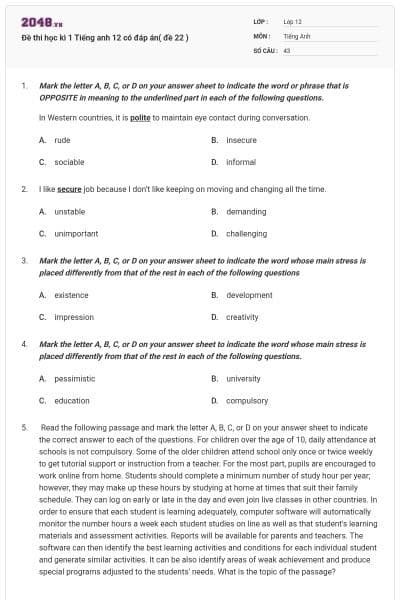
Mark the letter A, B, C, or D on your answer sheet to indicate the word or phrase that is OPPOSITE in meaning to the underlined part in each of the following questions.
In Western countries, it is polite to maintain eye contact during conversation.
rude
insecure
sociable
informal
Kiến thức: từ vựng
Giải thích: polite (a): lịch sự
A. rude (a): thô lỗ B. insecure (a): không an toàn
C. sociable (a): hòa đồng D. informal (a): không chính thức
=> rude >< polite
Tạm dịch: Ở các nước phương Tây, tương tác bằng mắt suốt cuộc giao tiếp được coi là lịch sự.
Đáp án: A
unstable
demanding
unimportant
challenging
Kiến thức: từ vựng
Giải thích: secure (a): ổn định, an toàn
A. unstable (a): không ổn định B. demanding (a): đòi hỏi nhiều kỹ năng, kinh nghiệm
C. unimportant (a): không quan trọng D. challenging (a): thách thức
=> unstable >< secure
Tạm dịch: Tôi thích công việc ổn định vì tôi không thích lúc nào cũng phải di chuyển và thay đổi.
Đáp án: A
existence
development
impression
creativity
Kiến thức: từ vựng
Giải thích:
A. existence /ɪɡˈzɪstəns/ B. development /ɪɡˈzɪstəns/
C. impression /ɪmˈpreʃn/ D. creativity /ˌkriːeɪˈtɪvəti/
Trọng âm ở câu D rơi vào âm 3, còn lại rơi vào âm 2.
Đáp án: D
Mark the letter A, B, C, or D on your answer sheet to indicate the word whose main stress is placed differently from that of the rest in each of the following questions.
pessimistic
university
education
compulsory
Kiến thức: từ vựng
Giải thích:
A. pessimistic /ˌpesɪˈmɪstɪk/ B. university /ˌjuːnɪˈvɜːsəti/
C. education /ˌedʒuˈkeɪʃn/ D. compulsory /kəmˈpʌlsəri/
Trọng âm ở câu D rơi vào âm 2, còn lại rơi vào âm 3.
Đáp án: D
What is the topic of the passage?
Computer software will make sure students learn at home
The effect of information technology on education
Students don't have to go to school any more
Students can know about their weak aspects to focus
Kiến thức: đọc hiểu
Tạm dịch: Chủ đề của đoạn văn này là gì?
A. Phần mềm máy tính sẽ đảm bảo học sinh học ở nhà
B. Ảnh hưởng của công nghệ thông tin trong giáo dục
C. Học sinh không phải đi học nữa
D. Học sinh có thể biết về các điểm yếu của mình để tập trung
Thông tin: For children over the age of 10, daily attendance at schools is not compulsory. Some of the older children attend school only once or twice weekly to get tutorial support or instruction from a teacher. For the most part, pupils are encouraged to work online from home.
Đáp án: B
How many times are children who are older than 10 required to go to school weekly?
Three
No time
Once or twice
Four
Kiến thức: đọc hiểu
Tạm dịch: Trẻ em trên 10 tuổi phải đi học bao nhiêu lần một tuần?
A. 3 B. Không phải đi học lần nào
C. 1 hoặc 2 D. 4
Thông tin: Some of the older children attend school only once or twice weekly to get tutorial support or instruction from a teacher.
Đáp án: C
Who/what counts the number of hours per week that students spend learning?
Teacher
Parents
Virtual reality
Computers
Kiến thức: đọc hiểu
Tạm dịch: Ai/ Cái gì đếm số giờ mỗi tuần mà sinh viên dành để học tập?
A. Giáo viên B. Bố mẹ
C. Thực tế ảo D. Máy tính
Thông tin: In order to ensure that each student is learning adequately, computer software will automatically monitor the number hours a week each student studies on line as well as that student's learning materials and assessment activities.
Đáp án: D
What can't the software do?
Find out the best activities for the students
Design materials for the students
Identify weaknesses of the students
Monitor the time the students learn
Kiến thức: đọc hiểu
Tạm dịch: Phần mềm không thể làm gì?
A. Tìm ra các hoạt động tốt nhất cho học sinh B. Thiết kế tư liệu cho sinh viên
C. Xác định điểm yếu của học sinh D. Theo dõi thời gian học sinh học
Thông tin: In order to ensure that each student is learning adequately, computer software will automatically monitor the number hours a week each student studies on line as well as that student's learning materials and assessment activities….The software can then identify the best learning activities and conditions for each individual student and generate similar activities. It can be also identify areas of week achievement and produce special programs adjusted to the students' needs.
Đáp án: B
What is NOT MENTIONED as a benefit of information technology to the students?
Students can learn at times that suit their schedule
Students can stay at home to learn
Students' weak achievement can be identified.
Students' learning time won't be monitored
Kiến thức: đọc hiểu
Tạm dịch: Những gì không được đề cập là một lợi ích của công nghệ thông tin cho học sinh?
A. Học sinh có thể học vào những thời điểm phù hợp với lịch trình của mình
B. Học sinh có thể ở nhà để học
C. Thành tích yếu của học sinh có thể được xác định.
D. Thời gian học của học sinh sẽ không được theo dõi
Thông tin: In order to ensure that each student is learning adequately, computer software will automatically monitor the number hours a week each student studies on line as well as that student's learning materials and assessment activities.
Đáp án: D
Dịch bài đọc:
Đối với trẻ em trên 10 tuổi, việc đi học hàng ngày tại trường học là không bắt buộc. Một số trẻ lớn hơn chỉ đi học một hoặc hai lần một tuần để được giáo viên hỗ trợ hoặc hướng dẫn. Đối với hầu hết các phần, học sinh được khuyến khích học trực tuyến tại nhà. Học sinh phải hoàn thành số giờ học tối thiểu mỗi năm; tuy nhiên, họ có thể học đủ số giờ này bằng cách học tại nhà vào những thời điểm phù hợp với lịch trình gia đình của họ. Họ có thể đăng nhập vào đầu hoặc cuối ngày và thậm chí tham gia các lớp học trực tuyến ở các nước khác. Để đảm bảo rằng mỗi học sinh học tập đầy đủ, phần mềm máy tính sẽ tự động theo dõi số giờ một tuần mỗi học sinh học trên mạng cũng như các tài liệu học tập và hoạt động đánh giá của học sinh đó. Phụ huynh và giáo viên được xem các báo cáo đó. Sau đó, phần mềm có thể xác định các hoạt động và điều kiện học tập tốt nhất cho từng cá nhân học sinh và tạo ra các hoạt động tương tự. Nó cũng có thể xác định các khu vực của thành tích còn yếu và sản xuất các chương trình đặc biệt được điều chỉnh theo nhu cầu của học sinh.
Mark the letter A, B, C, or D on your answer sheet to show the word whose underlined part is pronounced differently from that of the others in the same group
interviewed
travelled
concentrated
considered
Kiến thức: phát âm
Giải thích:
A. interviewed /ˈɪntəvjuːd/ B. travelled /ˈtrævld/
C. concentrated /ˈkɒnsntreɪtɪd/ D. considered /kənˈsɪdə(r)d/
Phần được gạch chân ở câu C đọc là /id/, còn lại đọc là /d/.
Đáp án: C
attacks
wipes
threatens
contributes
Kiến thức: phát âm
Giải thích:
A. attacks /əˈtæks/ B. wipes /waɪps/
C. threatens /ˈθretns/ D. contributes /kənˈtrɪbjuːts/
Phần được gạch chân ở câu C đọc là /s/, còn lại đọc là /z/.
Đáp án: C
optimist
predictions
positive
impact
Kiến thức: từ vựng, từ loại
Giải thích:
optimist (n): người lạc quan
optimistic (a): lạc quan
optimist => optimistic
Tạm dịch: Nhiều người lạc quan đã đưa ra dự đoán về tác động tích cực của việc cơ giới hóa ngày càng tăng lên đối với cuộc sống con người.
Đáp án: A
whom
him
the bus-stop
isn’t it
Kiến thức: mệnh đề quan hệ
Giải thích:
Ở đây, đại từ quan hệ “whom” thay thế cho danh từ “man”, đóng vai trò tân ngữ trong mệnh đề quan hệ => thừa tân ngữ “him”.
him => Ø
Tạm dịch: Đây là người đàn ông trẻ mà chúng ta đã gặp ở trạm xe buýt tuần trước đúng không?
Đáp án: B
The influence of the nation’s literature, art, and science have captured widespread attention.
nation’s
science
have
widespread
Kiến thức: sự hòa hợp giữa chủ ngữ và động từ
Giải thích:
Chủ ngữ “influence” là danh từ số ít => động từ chia ở dạng số ít “has”.
have => has
Tạm dịch: Ảnh hưởng của văn học, nghệ thuật và khoa học của đất nước đã thu hút sự chú ý rộng rãi.
Đáp án: C
took
at least
learning
to pronounce
Kiến thức: cấu trúc mất bao nhiêu thời gian làm việc
Giải thích:
Cấu trúc: It + take + O + time + to V.inf + …
learning => to learn
Tạm dịch: Họ mất ít nhất hai tháng học cách phát âm những từ này.
Đáp án: C
Many people dream (16) _______ living in a foreign country.
up
in
of
on
Kiến thức: từ vựng
Giải thích:
dream of something: mơ về điều gì
Đáp án: C
Although
Moreover
Therefore
However
Kiến thức: từ vựng
Giải thích:
although: mặc dù moreover: hơn thế nữa
therefore: vì vậy however: tuy nhiên
Đáp án: D
too
quite
very
so
Kiến thức: cấu trúc “so…that”
Giải thích:
Cấu trúc: S + tobe/V + so + adj/adv + that + clause
Đáp án: D
get
that gets
to get
getting
Kiến thức: cấu trúc với “make”
Giải thích:
Cấu trúc: make + it + adj + to V.inf: làm cho việc gì đó trở nên ….
Đáp án: C
accept (20) ________ differences.
one’s
their
our
its
Kiến thức: từ vựng, từ loại
Giải thích:
Ở đây, tính từ sở hữu được dùng để thay thế cho danh từ “country” => chọn “its”.
Đáp án: D
Dịch bài đọc:
CÚ SỐC VĂN HÓA
Nhiều người mơ ước được sống ở nước ngoài. Nó có thể là một trải nghiệm tuyệt vời cho những người sẵn sàng định cư ở một nơi mới. Tuy nhiên, có một vấn đề tiềm năng mà bạn nên biết: sốc văn hóa. Sốc văn hóa là một cảm giác bạn nhận được từ việc sống ở một nơi rất khác với nơi chúng ta lớn lên mà chúng ta không chắc làm thế nào để đối phó với nó. Các xã hội được tổ chức theo nhiều cách khác nhau. Tập quán và truyền thống có thể rất khác nhau và đôi khi có thể gây khó khăn cho người dân địa phương, những người có thể không chấp nhận những điều bạn làm và có thể phản đối những điều bạn nói. Bạn có thể bị cấm làm những việc ở một quốc gia khác nhưng lại hoàn toàn hợp pháp ở quốc gia của bạn. Ví dụ, ở Singapore người ta có thể bị buộc phải trả một khoản tiền phạt lớn chỉ vì xả rác. Cuối cùng, mặc dù, hầu hết những người sống ở nước ngoài yêu đất nước mà họ đến và học cách chấp nhận sự khác biệt của nó.
Without my parents' support, I _______ my overseas study.
did not complete
will not complete
had not completed
would not have completed
Kiến thức: câu điều kiện loại 3
Giải thích:
Cấu trúc: Without + N, S + would (+ not) + have + V.p.p
Tạm dịch: Nếu không có sự hỗ trợ của bố mẹ, tôi không thể hoàn thành việc du học của mình.
Đáp án: D
An economic _______ is a time when there is very little economic activity, which causes a lot of unemployment and poverty.
development
depression
mission
improvement
Kiến thức: từ vựng
Giải thích:
economic depression: suy thoái kinh tế development (n): sự phát triển
mission (n): nhiệm vụ improvement (n): sự cải thiện
Tạm dịch: Suy thoái kinh tế là thời điểm có rất ít hoạt động kinh tế, gây ra nhiều thất nghiệp và nghèo đói.
Đáp án: B
She is a friendly girl who gets _______ everyone she meets.
away from
out of
into
on with
Kiến thức: cụm động từ
Giải thích:
get away (from somebody/…): trốn khỏi ai đó get out of something: tránh trách nhiệm
get into something: mặc quần áo get on with somebody: có mối quan hệ tốt với ai
Tạm dịch: Cô ấy là một cô gái thân thiệt người mà luôn xây dựng được mối quan hệ tốt với những người mình gặp.
Đáp án: D
“It was nice of you to give me the present. Thank you” Ben said to Mary.
Ben thanked Mary ______ the presentit had been nice of her to give him
of giving him
for giving him
that she had been nice to give him
Kiến thức: cấu trúc cảm ơn
Giải thích:
thank somebody for doing something: cảm ơn ai vì điều gì
Tạm dịch: “Bạn thật tốt khi bạn tặng tôi món quà này. Cảm ơn bạn.” Ben nói với Mary.
= Ben cảm ơn Mary vì đã tặng quà cho cậu ấy.
Đáp án: C
powerfully
powered
powerful
power
Kiến thức: câu điều kiện loại 3
Giải thích:
Từ cần điền ở đây là một tính từ.
A. powerfully (adv): mạnh mẽ B. powered (a): chạy bằng điện
C. powerful (a): mạnh mẽ D. power (n): sức mạnh
Tạm dịch: Trong tương lai, số lượng máy tính nhỏ nhưng cấu hình mạnh mẽ mà bạn gặp phải mỗi ngày sẽ lên tới hàng nghìn, có thể là hàng triệu.
Đáp án: C
While she was cooking with her mother in the kitchen, her brothers _______ to the radio.
has listened
was listening
were listening
listened
Kiến thức: thì quá khứ tiếp diễn
Giải thích:
Thì quá khứ tiếp diễn diễn đạt hai hành động xảy ra đồng thời trong quá khứ.
Cấu trúc: S + was/were + V.ing + O
Tạm dịch: Khi cô ấy đang nấu ăn với mẹ trong bếp thì các anh của cô ấy đang nghe đài.
Đáp án: CNever remind me
Yes. You should do that
It’s my pleasure
With all my heart
Kiến thức: hội thoại giao tiếp
Tạm dịch: Hannah: "Cảm ơn vì sự giúp đỡ của bạn, Julia."
A. Đừng bao giờ nhắc mình B. Bạn nên làm điều đó
C. Đó là niềm hân hạnh của mình D. Với tất cả trái tim của mình
Đáp án: C
Unless were I
Were I
If were I
Suppose I am
Kiến thức: câu điều kiện loại 2
Giải thích:
Cấu trúc: If + S + V(quá khứ đơn), S + would (+ not) + V.inf + …
Đảo ngữ: Were + S + N, S + would (+ not) + V.inf + …
Tạm dịch: Nếu tôi ở nhà, tôi sẽ xem chương trình yêu thích của mình.
Đáp án: B
Ben would have studied medicine if he _______ to a medical school.
had been admitted
would be able to enter
had admitted
was admitted
Kiến thức: câu điều kiện loại 3
Giải thích:
Cấu trúc: If + S + had + V.p.p, S + would (+ not) + have + V.p.p
Bị động ở quá khứ hoàn thành: S + had + been + V.p.p (+ by O)
Tạm dịch: Ba sẽ học ngành y nếu anh ấy được nhận vào một trường y dược.
Đáp án: A
Since the global industrialization, the number of animal species _______ have become extinct or nearly extinct has increased.
which
whose
why
when
Đáp án: A
Giải thích:
Kiến thức: Đại từ quan hệ
Trong câu này, "which" là đại từ quan hệ, được sử dụng để nối mệnh đề quan hệ mô tả các loài động vật đã trở nên tuyệt chủng hoặc gần tuyệt chủng. "Which" dùng để chỉ các loài động vật, tương ứng với danh từ "species".
Các lựa chọn khác:
B. whose là đại từ sở hữu, không phù hợp trong ngữ cảnh này.
C. why dùng để chỉ lý do, không phù hợp với ngữ pháp của câu.
D. when dùng để chỉ thời gian, không thích hợp trong trường hợp này. → Chọn A. which là đúng.
Dịch: Kể từ khi toàn cầu hóa công nghiệp, số lượng các loài động vật mà đã tuyệt chủng hoặc gần tuyệt chủng đã tăng lên.
Telecommunication is bound to have a huge influence on various aspects of our lives.
impact
technique
depression
expect
Kiến thức: mệnh đề quan hệ
Giải thích: influence (n): ảnh hưởng
impact (n): ảnh hưởng techique (n): kỹ thuật
depression (n): sự suy sụp expect (v): mong đợi
=> impact = influence
Tạm dịch: Viễn thông là sẽ có một ảnh hưởng rất lớn trên các khía cạnh khác nhau trong cuộc sống của chúng ta.
Đáp án: A
The medical community continues to make progress in the fight against cancer.
speed
improvement
expectation
treatment
Đáp án: B
Giải thích:
Kiến thức: Từ vựng
progress (n): tiến triển, tiến bộ
speed (n): tốc độ
improvement (n): cải thiện, tiến bộ
expectation (n): sự mong đợi
treatment (n): điều trị
=> progress = improvement
Dịch: Cộng đồng y học tiếp tục có những tiến bộ trong cuộc chiến chống ung thư.
My friend Ann has decided to buy a motorbike. Her car was stolen last week.
My friend Ann, who was stolen her car last week, has decided to buy a motorbike.
My friend Ann, her car was stolen last week, has decided to buy a motorbike.
My friend Ann, who her car was stolen last week, has decided to buy a motorbike.
My friend Ann, whose car was stolen last week, has decided to buy a motorbike.
Kiến thức: mệnh đề quan hệ
Giải thích:
Ở đây cần một đại từ quan hệ dùng để chỉ sở hữu cho danh từ chỉ người (My friend Ann), đóng vai trò tính từ sở hữu bổ ngữ cho “car” => chọn “whose”.
Tạm dịch: Cô bạn của tôi, Ann, người có chiếc xe đã bị đánh cắp tuần trước, đã quyết định mua một chiếc xe máy.
Đáp án: D
Although Bill took a taxi, he can’t come to the concert in time.
Bill arrived late for the concert in spite of the taxi.
Bill arrived late for the concert because he takes a taxi.
Despite taking a taxi, Bill still arrived late for the concert.
Kiến thức: mệnh đề nhượng bộ
Giải thích:
In spite of / Despite + N/V.ing = Although + clause: mặc dù
Because + clause: bởi vì
Câu A, C sai về thì. Câu B sai về nghĩa.
Tạm dịch: Mặc dù đi taxi, Bill vẫn đến buổi hòa nhạc trễ.
Đáp án: D
She went to the library so that she could borrow some books.
So as to go to the library, she could borrow some books.
She went to the library so as to borrow some books.
She went to the library that she could borrow some books.
She went to the library so as to she could borrow some books
Kiến thức: mệnh đề chỉ mục đích
Giải thích:
so that + clause = so as to + V.inf: để làm gì
Tạm dịch: Cô đến thư viện để mượn một vài quyển sách.
Đáp án: B
“Who does this ball belong to?” the mother asked.
The mother asked who does that ball belong to.
The mother wanted to know who that ball belonged to.
The mother told who that ball belonged to
The mother asked who did that ball belong to
Kiến thức: câu tường thuật
Giải thích: Cấu trúc tưởng thuật dạng câu hỏi wh-question:
S + asked/wanted to know + O + wh-question + S + V(lùi thì) + …
Tạm dịch: Người mẹ muốn biết quả bóng đó thuộc về ai.
Đáp án: B
The best title for the passage could be __________.
Nineteenth - the Century of Reform
A Flight for Change
American Education in the Beginning of the 19th Century
The Beginnings of Reform in American Education
Kiến thức: Đọc hiểu
Giải thích:
Tiêu đề phù hợp nhất cho bài đọc có thể là __________.
A. Mười chín - Thế kỷ của cải cách B. Chuyến bay để thay đổi
C. Giáo dục Hoa Kỳ vào đầu thế kỷ 19 D. Sự khởi đầu của cải cách trong giáo dục ở Hoa Kỳ
Thông tin: At the beginning of the nineteenth century, the American educational system was desperately in need of reform… Horace Mann, probably the most famous of the reformers … As Superintendent of Education in the state of Massachusetts from 1837 to 1848, he initiated various changes
Tạm dịch: Vào đầu thế kỷ XIX, hệ thống giáo dục Mỹ rất cần được cải cách… Horace Mann, có lẽ là nhà cải cách nổi tiếng nhất … Massachusetts từ năm 1837 đến 1848, ông đã khởi xướng nhiều thay đổi khác nhau
Chọn D
a strong educational background
a lot of money
good grades
a high level of intelligence
Kiến thức: Đọc hiểu
Giải thích:
Đoạn văn ngụ ý rằng để đi học tại một trường tư thục, một học sinh cần phải có __________.
A. một nền tảng giáo dục vững chắc B. rất nhiều tiền
C. điểm tốt D. mức độ thông minh cao
Thông tin: Private schools existed, but only for the very rich.
Tạm dịch: Trường tư đã tồn tại, nhưng chỉ dành cho những người rất giàu.
Chọn B
American educational system was desperately in need of reform
private schools existed
children would grow up to be laborer
children should "spend" their time on education
Kiến thức: Đọc hiểu
Giải thích:
Có rất ít trường công lập vì quan điểm vững chắc là __________.
A. hệ thống giáo dục Mỹ đang rất cần cải cách B. trường tư thục tồn tại
C. trẻ em sẽ lớn lên để trở thành người lao động D. trẻ em nên "dành" thời gian cho giáo dục
Thông tin: There were very few public schools because of the strong sentiment that children who would grow up to be laborers should not "waste" their time on education but should instead prepare themselves for their life's work.
Tạm dịch: Có rất ít trường công lập vì quan điểm chắc chắn rằng những đứa trẻ lớn lên trở thành lao động không nên "lãng phí" thời gian cho giáo dục mà thay vào đó nên chuẩn bị cho công việc của mình.
Chọn C
started
finished
continued
stopped
Kiến thức: Từ đồng nghĩa
Giải thích:
Từ "initiated" (khởi xướng, bắt đầu) trong đoạn văn có nghĩa gần như là __________.
A. started (v): bắt đầu B. finished (v): hoàn thành, kết thúc
C. continued (v): tiếp tục, làm tiếp D. stopped (v): ngừng, nghỉ
=> initiated = started
Thông tin: As Superintendent of Education in the state of Massachusetts from 1837 to 1848, he initiated various changes, which were soon matched in other school districts around the country.
Tạm dịch: Với tư cách là Tổng Giám đốc Giáo dục tại bang Massachusetts từ năm 1837 đến 1848, ông đã khởi xướng nhiều thay đổi khác nhau, không lâu sau đó được bắt chước làm theo ở các khu vực có trường học trên cả nước.
Chọn A
Bạn có thích hoạt động này không?