Đề thi giữa kì 2 Tiếng Anh 11 có đáp án (Đề 3)
35 câu hỏi
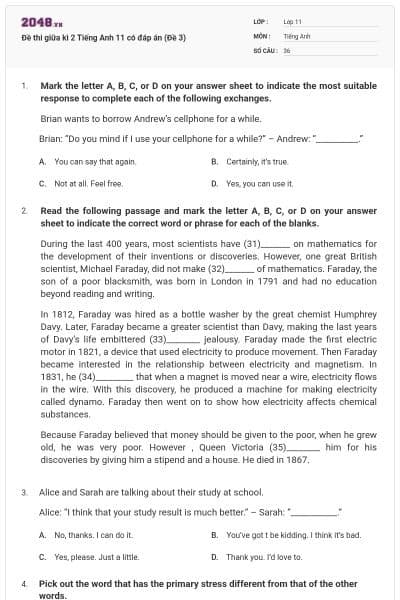
You can say that again.
Certainly, it’s true.
Not at all. Feel free.
Yes, you can use it.
Đáp án: C
No, thanks. I can do it.
You’ve got t be kidding. I think it’s bad.
Yes, please. Just a little.
Thank you. I’d love to.
Đáp án: B
determine
cultural
informal
tradition
Đáp án: B
person
signal
instance
attract
Đáp án: D
Most
travelling
packed
stay
Đáp án: D
Every
its own
some of them
for
Đáp án: C
Giải thích:
Đây là lỗi sai về mệnh đề quan hệ, cụ thể là mệnh đề rút gọn hoặc mệnh đề quan hệ không xác định.
Hai mệnh đề "Every country has its own traditions" và "some of them have existed for centuries" được nối bằng dấu phẩy không hợp ngữ pháp.
Sửa: some of them → some of which
Dịch: Mỗi quốc gia đều có truyền thống riêng của mình, một số trong số đó đã tồn tại hàng thế kỷ.
shocking
in
are
about
Đáp án: C
Set off
go about
come apart
take up
Đáp án: A
An
0
a
the
Đáp án: D


Học thông minh hơn mỗi ngày
Xem toàn bộ 35 câu hỏi và nhiều hơn nữa với tài khoản miễn phí
Has learnt
would learn
will have learnt
will learn
Đáp án: C
Giải thích:
Kiến thức: Thì của động từ
Dấu hiệu nhận biết: By the end of next year (trước cuối năm sau) => sử dụng thì tương lai hoàn thành để diễn tả một hành động xảy ra trước một thời điểm trong tương lai
Cấu trúc: S + will have Vp2
Dịch: Tính tới cuối năm sau là George sẽ học tiếng Nhật được hai tháng rồi.
On
of
at
in
Đáp án: B
Having released
To have been released
to be released
to being released
Đáp án: C
Marry
married
marrying
marriage
Đáp án: D
Giải thích:
Kiến thức: Cấu tạo từ
A. marry (v): kết hôn
B. married (adj): đã có vợ/chồng
C. marrying: động từ đuôi –ing của động từ “marry”
D. marriage (n): hôn nhân, tình trạng hôn nhân
Vị trí cần điền là một danh từ đứng song hành với các danh từ “age” và “salary”, nối với nhau bằng dấu phẩy và từ “and”, nên ta chọn D.
Dịch: Trong văn hóa Mỹ, mọi người tránh hỏi ai đó về tuổi tác, hôn nhân và mức lương vì điều này được coi là bất lịch sự.
Allergic to
tired of
keen on
preferable
Đáp án: A
Was night before
Had been the previous night
was last night
had been the last night
Đáp án: B
Giải thích:
Kiến thức: Câu gián tiếp
Câu này là câu tường thuật lại câu hỏi Wh- với động từ wanted to know. Câu trực tiếp có thể là:
"Where were you last night?" the policeman asked.
→ Khi tường thuật câu hỏi này:
Giữ nguyên từ để hỏi (where)
Lùi thì: were → had been (vì là câu hỏi về thời gian quá khứ).
Đổi cụm từ thời gian từ last night thành the previous night để phù hợp với câu tường thuật.
Dựa vào cấu trúc câu tường thuật và quy tắc lùi thì, chọn B.
Dịch: Viên cảnh sát muốn biết anh ấy đã ở đâu vào đêm hôm trước.
Expression
explusion
extinction
extension
Đáp án: C
Giải thích:
Kiến thức: Từ vựng
A. expression (n): biểu hiện
B. explusion (n): sự bùng nổ
C. extinction (n): sự tuyệt chủng
D. extension (n): sự mở rộng
Dựa vào nghĩa câu, chọn C.
Dịch: Nhiều loài thực vật và động vật hiện đang có nguy cơ tuyệt chủng.
Get down to it
get on it
get down with it
get off it
Đáp án: C
Crossed
came
spunk
passed
Đáp án: A
The most boring film
most boring films
The film more borings
the more boring films
Đáp án: A
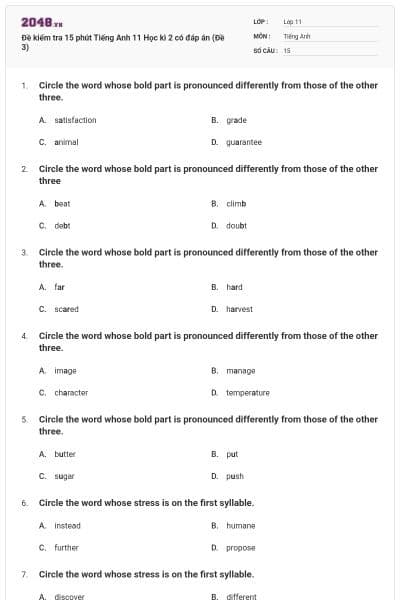
balance
bake
brave
station
Đáp án: A
booked
ended
matched
pushed
Đáp án: B
Remarks
compliments
characters
behaviours
Đáp án: A
Polluting
destroying
vanishing
damaging
Đáp án: C
Giải thích:
Kiến thức: Từ vựng – Từ đồng nghĩa
disappear (v): biến mất
Xét các đáp án:
A. pollute (v): gây ô nhiễm
B. destroy (v): phá hủy
C. vanish (v): biến mất
D. damage (v): gây hại
→ disappearing = vanishing
Dịch: Sự sống trên Trái Đất đang biến mất nhanh chóng và sẽ tiếp tục như vậy nếu không có hành động khẩn cấp.
Interested in
busy with
relexed about
free from
Đáp án: D
Meaningful
beneficial
excited
damaging
Đáp án: B
He asked me if I would like a cup of coffee.
He offered me a cup of coffee
He wondered if I would like a cup of coffee.
He wanted me to drink a cup of coffee.
Đáp án: B
Giải thích:
Kiến thức: Câu tường thuật (Reported Speech)
Câu gốc "Would you like a cup of coffee?" là một lời mời lịch sự. Khi tường thuật lại, ta dùng động từ "offer" (mời, đề nghị) để diễn đạt đúng nghĩa.
Xét các đáp án khác:
A. He asked me if I would like a cup of coffee. → Sai vì "ask" thường dùng cho câu hỏi thông tin, không phù hợp với lời mời.
C. He wondered if I would like a cup of coffee. → Sai vì "wonder" diễn tả sự thắc mắc, không phù hợp với nghĩa lời mời.
D. He wanted me to drink a cup of coffee. → Sai vì "want" diễn tả mong muốn của người nói, không đúng với nghĩa câu gốc.
Chọn B.
Dịch: "Bạn có muốn uống một tách cà phê không?" anh ấy nói.
→ Anh ấy mời tôi một tách cà phê.
If Mary hadn’t lost her ticket, she would go to the concert.
Hadn’t Mary lost her ticket, she would have gone to the concert.
If Mary had lost her ticket, she would have gone to the concert.
Had Mary not lost her ticket, she would have gone to the concert.
Đáp án: D
He shouldn’t have finished his homework last night because he spent all night playing computer games.
He needn’t have finished his homework last night because he spent all night playing computer games.
He mustn’t have finished his homework last night because he spent all night playing computer games.
He can’t have finished his homework last night because he spent all night playing computer games.
Đáp án: D
If it had a few more customers, the new restaurant would look better.
The new restaurant would have more customers if it looked better.
In order to get more business, the new restaurant should improve its appearance.
However good the new restaurant looks, it doesn’t appear to attract many customers.
Đáp án: D
As we were all surprised, she suddenly left the job.
Although she suddenly left the job, we weren’t all surprised.
She suddenly left the job in order to surprise us all.
That she suddenly left the job surprised us all.
Đáp án: D
made
consisted
relied
insisted
Đáp án: C
usage
use
utilization
advantage
Đáp án: B
from
by
discovered
created
Đáp án: D
insisted
invented
discovered
created
Đáp án: C
rewarded
supplied
prized
awarded
Đáp án: A
Bạn có thích hoạt động này không?
Hãy lưu hoặc chia sẻ nội dung này đến mọi người.
Gợi ý cho bạn

Ý tưởng của bạn, bài học của bạn
Tự thiết kế đề thi, bài giảng hoặc flashcard theo cách riêng.