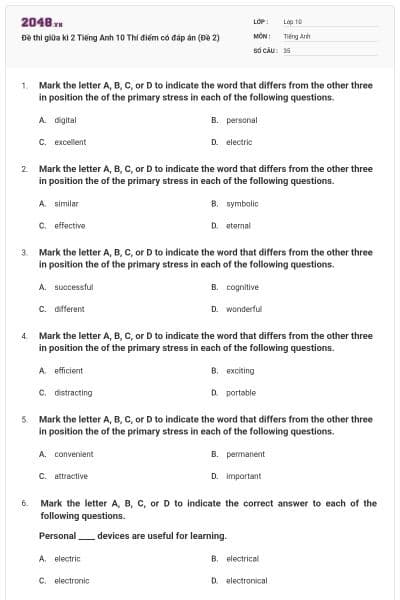
Đề thi giữa kì 2 Tiếng Anh 10 Thí điểm có đáp án (Đề 2)
35 câu hỏi
Mark the letter A, B, C, or D to indicate the word that differs from the other three in position the of the primary stress in each of the following questions.
digital
personal
excellent
electric
Đáp án: D
Đáp án D trọng âm số 2 các đáp án còn lại trọng âm số 1
Mark the letter A, B, C, or D to indicate the word that differs from the other three in position the of the primary stress in each of the following questions.
similar
symbolic
effective
eternal
Đáp án: A
Đáp án A trọng âm số 1 các đáp án còn lại trọng âm số 2
Mark the letter A, B, C, or D to indicate the word that differs from the other three in position the of the primary stress in each of the following questions.
successful
cognitive
different
wonderful
Đáp án: A
Đáp án A trọng âm số 2 các đáp án còn lại trọng âm số 1
Mark the letter A, B, C, or D to indicate the word that differs from the other three in position the of the primary stress in each of the following questions.
efficient
exciting
distracting
portable
Đáp án: D
Đáp án D trọng âm số 1 các đáp án còn lại trọng âm số 2
Mark the letter A, B, C, or D to indicate the word that differs from the other three in position the of the primary stress in each of the following questions.
convenient
permanent
attractive
important
Đáp án: B
Đáp án B trọng âm số 1 các đáp án còn lại trọng âm số 2
Mark the letter A, B, C, or D to indicate the correct answer to each of the following questions.
Personal ____ devices are useful for learning.
electric
electrical
electronic
electronical
Đáp án: C
Những thiết bị điện tử cá nhân thì có ích cho việc học
They’re excellent learning ____. You can store information, take notes, write essays and do calculations.
equipments
tools
gadgets
techniques
Đáp án: B
Dịch: Chúng quả là những công cụ học tập thông minh. Bạn có thể lưu trữ thông tin, ghi chú, viết luận và tính toán.
In English class yesterday, we had a discussion ____ different cultures.
around
about
for
from
Đáp án: C
Giải thích:
Kiến thức: Giới từ
A. around: quanh
B. about: về
C. for: cho
D. from: từ
discussion about something: cuộc thảo luận về cái gì
Dịch: Trong lớp tiếng Anh ngày hôm qua, chúng tôi đã thảo luận về các nền văn hóa khác nhau.
Mrs Dawson said that we were ____ our lesson in the library next Monday.
having
making
reading
going
Đáp án: A
Dịch: Bà Dawson nói rằng chúng tôi sẽ học tiết học tại thư viện vào thứ Hai tới
I really don’t ____ the point of taking the exam when you are not ready for it.
take
have
mind
see
Đáp án: D
Giải thích: Cụm: see the point (hiểu)
Dịch: Tôi thực sự không hiểu việc đi thi khi bạn chưa sẵn sàng.
If the examiner can’t ____ sense of your writing, you’ll get a low mark.
take
bring
make
understand
Đáp án: C
Giải thích: Make sense (có lí, hiểu)
Dịch: Nếu giám khảo không thể hiểu được bài viết của bạn, bạn sẽ bị điểm thấp.
I would prefer to go to university and do a ____ in International Studies, rather than start work.
certificate
result
degree
qualification
Đáp án: C
Giải thích: Do a degree (lấy bằng cấp)
Dịch: Tôi thích học đại học và lấy bằng Quốc tế học hơn là bắt đầu công việc.
My dad wants me to go university, but I’m in ____ minds about it.
my
two
some
different
Đáp án: B
Giải thích: be in two minds (suy nghĩ về ….)
Dịch: Bố tôi muốn tôi vào đại học, nhưng tôi đang có hai suy nghĩ về điều đó.
Most computers have enough ____ to store a vast amount of information.
database
document
memory
word processor
Đáp án: C
Dịch: Đa số máy tính có đủ bộ nhớ để lưu trữ lượng thông tin lớn.
You can’t get into the Internet unless your computer has a(an) ____.
access
terminal
web page
modem
Đáp án: D
Dịch: Bạn không thể vào mạng trừ khi máy tính bạn có một bộ modem
Mark the letter A, B, C, or D to indicate the correct answer to each of the following questions.
“Who's that over there?" - "Oh, it's our new teacher, ____ just started work today."
that
who he
which he
who
Đáp án: D
Giải thích: Vị trí trống cần đại từ quan hệ thay thế chủ ngữ
Dịch: “Ai đó?” - “Ồ, là giáo viên mới của chúng ta, người vừa bắt đầu công việc hôm nay.”
"Which CD did you get Marcus in the end?" – "I got him the one ____ said he really wanted to hear."
that
who he
whose
which he
Đáp án: D
Giải thích: Vị trí trống cần đại từ quan hệ chỉ vật và chủ ngữ
Dịch: "Cuối cùng thì bạn đã nhận được CD nào của Marcus?" - "Tôi đã lấy cho anh ấy một cái mà anh ấy nói rằng anh ấy thực sự muốn nghe."
“Who did you send a Valentine's card to?" - "I'm not telling you, but it was someone ____ name begins with “B”.”
which
who her
whose
whose her
Đáp án: C
Giải thích: Vị trí trống cần đại từ quan hệ chỉ sự sở hữu
Dịch: “Bạn đã gửi thiệp Valentine cho ai?” - “Tôi sẽ không nói với bạn, nhưng đó là một người có tên bắt đầu bằng“ B ”.”
"Have you seen Jason Green's latest film?" – "Is that the one in ____ joins the FBI?”
which he
that he
whom he
which
Đáp án: A
Giải thích: Vì đã có giới từ “in” phía trước nên ta dùng “which” chỉ vật và còn thiếu chủ ngữ nên ta dùng thêm chủ ngữ
Dịch: "Bạn đã xem bộ phim mới nhất của Jason Green chưa?" - "Đó có phải là người mà anh ta gia nhập FBI không?"
"Why do you like Tania so much?” – “Well, she's one of the few people to ____ I can really talk."
which
whom
that
who
Đáp án: B
Giải thích: Vì đã có giới từ “to” phía trước nên ta dùng “whom” chỉ người
Dịch: "Tại sao bạn thích Tania đến vậy?" - "Chà, cô ấy là một trong số ít người mà tôi thực sự có thể nói chuyện."
"Why don't we go to Lionel's for dinner tonight?” - “Is that the new restaurant ____ has just opened on the other side of town?"
which
where
that it
which it
Đáp án: A
Giải thích: Vị trí cần đại từ quan hệ thay thế chủ ngữ chỉ vật
Dịch: "Tại sao chúng ta không đến nhà Lionel ăn tối tối nay?" - “Đó có phải là nhà hàng mới mở ở phía bên kia thị trấn không?”
"Could you lend me some money?" – "I'd like you to give me one good reason ______ I should."
that
which
why
why
Đáp án: C
Dịch: "Anh có thể cho tôi mượn một ít tiền được không?" - "Tôi muốn bạn cho tôi một lý do chính đáng tại sao tôi nên làm vậy."
“What do you want to do this summer?” – “I think we should go somewhere ____ has plenty of sun and sand."
who
where
when
that
Đáp án: D
Dịch: "Bạn muốn làm gì vào mùa hè này?" - “Tôi nghĩ chúng ta nên đến một nơi nào đó có nhiều nắng và cát."
Smartphones, laptops and tablets are the modern devices ____ have changed the way we think.
what
Ø
whose
that
Đáp án: D
Giải thích: Vị trí cần đại từ quan hệ thay thế chủ ngữ chỉ vật
Dịch: Điện thoại thông minh, máy tính xách tay và máy tính bảng là những thiết bị hiện đại đã thay đổi cách chúng ta nghĩ.
Students use smartphones to record their phone calls, ___ they later share with the class.
Ø
that
which
whose
Đáp án: C
Dịch: Học sinh sử dụng điện thoại thông minh để ghi lại các cuộc gọi điện thoại của họ và sau đó chia sẻ với cả lớp.
Mark the letter A, B, C, or D to indicate the correct response to each of the following exchanges.
“____ ” _ “It means go very quickly.”
How can you explain "rush”?
How do you spell “rush”?
What does "rush” mean?
What is the equivalent of “rush”?
Đáp án: C
Dịch: "Rush" có nghĩa là gì? – “Nó có nghĩa là đi rất nhanh.”
“____” – “For” answers the question "How long” and “Since” answers the question “When".
What are the meanings of “for” and “since”?
What's the difference between “for” and “since”?
How to see the difference between “for” and “since”?
How similar are “for” and “since”?
Đáp án: B
Dịch: “Điểm khác nhau giữa “for” và “since” là gì?” - “Đối với” trả lời câu hỏi “Bao lâu” và “Kể từ khi” trả lời câu hỏi “Khi nào”.
“So, Sven, you've been learning English for ten years. That's a long time.”-“____”
Yes, so what? I want to keep learning until I can hold a conversation like a native speaker.
It's none of your business! I want to keep learning until I can hold a conversation like a native speaker.
I suppose it is, but I want to keep learning until I can hold a conversation like a native speaker.
Well, look at yourself first. I want to keep learning until I can hold a conversation like a native speaker
Đáp án: C
Dịch: “Vậy, Sven, bạn đã học tiếng Anh được mười năm rồi. Đó là một thời gian dài."- "Tôi cho là vậy, nhưng tôi muốn tiếp tục học cho đến khi tôi có thể trò chuyện như người bản xứ.”
“____" - "I think you must have the wrong number. There's no one of that name here."
Could I speak to Donald, please?
Hi, who is that?
Hello. Is Martin speaking, please?
A and C are correct
Đáp án: D
Dịch:
A. Tôi có thể nói chuyện với Donald không?
C. Xin chào, có phải Martin đang nói không?
“Tôi nghĩ bạn phải có số sai. Không có ai trong số tên đó ở đây”
“Do you mind if I make a phone call?” –“____”
Yes, of course. The phone's in the hall.
No, of course not. The phone's in the hall.
It's my pleasure. The phone's in the hall
Never mind. The phone's in the hall.
Đáp án: B
Dịch: “Bạn có phiền không nếu tôi gọi điện thoại?” – “Không, tất nhiên là không. Điện thoại ở phòng ăn.”
Read the following passage and mark the letter A, B, C, or D to indicate the correct answer to each of the questions.
WHAT IS YOUR LEARNING STYLE?
If you find yourself learn better by making notes during the lecture, or when the teacher uses a new word, you want to see it written immediately, then you are very likely to be a more visual learner. You prefer to see the written words. You learn by reading and writing. Visual learners often think in pictures. If you find a particular task or text difficult, look for sources that will suit your learning style, e.g. sources with illustrations, charts, tables, or videos.
If you prefer recording the lecture and listening again to taking notes, or you memorize something by repeating it aloud instead of writing it out several times, you are probably a more auditory learner. You prefer to learn by listening and speaking. Auditory learners often learn best from lectures, discussions, by reading aloud, and by listening to audio material.
However, it is probably that you, like most people, learn through a mixture of styles. Sometimes you may prefer to learn by reading, at other time by listening. Ask yourself which is the best style for the particular task you are doing.
Question: Which of the following is probably NOT preferred by a visual learner?
reading aloud
sources with illustrations
sources with videos
making notes
Đáp án: A
Giải thích: Dựa vào câu: If you find yourself learn better by making notes during the lecture, or when the teacher uses a new word, you want to see it written immediately, then you are very likely to be a more visual learner. (đoạn 1)
Dịch: “Nếu bạn thấy mình học tốt hơn bằng cách ghi chú trong bài giảng, hoặc khi giáo viên sử dụng một từ mới, bạn muốn xem nó được viết ngay lập tức, thì bạn rất có thể là người học trực quan hơn.”
Read the following passage and mark the letter A, B, C, or D to indicate the correct answer to each of the questions.
WHAT IS YOUR LEARNING STYLE?
If you find yourself learn better by making notes during the lecture, or when the teacher uses a new word, you want to see it written immediately, then you are very likely to be a more visual learner. You prefer to see the written words. You learn by reading and writing. Visual learners often think in pictures. If you find a particular task or text difficult, look for sources that will suit your learning style, e.g. sources with illustrations, charts, tables, or videos.
If you prefer recording the lecture and listening again to taking notes, or you memorize something by repeating it aloud instead of writing it out several times, you are probably a more auditory learner. You prefer to learn by listening and speaking. Auditory learners often learn best from lectures, discussions, by reading aloud, and by listening to audio material.
However, it is probably that you, like most people, learn through a mixture of styles. Sometimes you may prefer to learn by reading, at other time by listening. Ask yourself which is the best style for the particular task you are doing.
Question: What does the word "it" in paragraph 1 refer to?
the lecture
the new word
the note
the written word
Đáp án: B
Giải thích: Dựa vào câu: Dựa vào câu: If you find yourself learn better by making notes during the lecture, or when the teacher uses a new word, you want to see it written immediately, then you are very likely to be a more visual learner. (đoạn 1)
Dịch: “Nếu bạn thấy mình học tốt hơn bằng cách ghi chú trong bài giảng, hoặc khi giáo viên sử dụng một từ mới, bạn muốn xem nó được viết ngay lập tức, thì bạn rất có thể là người học trực quan hơn.”
Read the following passage and mark the letter A, B, C, or D to indicate the correct answer to each of the questions.
WHAT IS YOUR LEARNING STYLE?
If you find yourself learn better by making notes during the lecture, or when the teacher uses a new word, you want to see it written immediately, then you are very likely to be a more visual learner. You prefer to see the written words. You learn by reading and writing. Visual learners often think in pictures. If you find a particular task or text difficult, look for sources that will suit your learning style, e.g. sources with illustrations, charts, tables, or videos.
If you prefer recording the lecture and listening again to taking notes, or you memorize something by repeating it aloud instead of writing it out several times, you are probably a more auditory learner. You prefer to learn by listening and speaking. Auditory learners often learn best from lectures, discussions, by reading aloud, and by listening to audio material.
However, it is probably that you, like most people, learn through a mixture of styles. Sometimes you may prefer to learn by reading, at other time by listening. Ask yourself which is the best style for the particular task you are doing.
Question: The word “visual” in paragraph 1 is closest in meaning to ____.
picturesque
written
illustrative
seeable
Đáp án: D
Visual = seeable (về mặt thị giác)
Read the following passage and mark the letter A, B, C, or D to indicate the correct answer to each of the questions.
WHAT IS YOUR LEARNING STYLE?
If you find yourself learn better by making notes during the lecture, or when the teacher uses a new word, you want to see it written immediately, then you are very likely to be a more visual learner. You prefer to see the written words. You learn by reading and writing. Visual learners often think in pictures. If you find a particular task or text difficult, look for sources that will suit your learning style, e.g. sources with illustrations, charts, tables, or videos.
If you prefer recording the lecture and listening again to taking notes, or you memorize something by repeating it aloud instead of writing it out several times, you are probably a more auditory learner. You prefer to learn by listening and speaking. Auditory learners often learn best from lectures, discussions, by reading aloud, and by listening to audio material.
However, it is probably that you, like most people, learn through a mixture of styles. Sometimes you may prefer to learn by reading, at other time by listening. Ask yourself which is the best style for the particular task you are doing.
Question: Which of the following statement is TRUE?
Auditory learners hate taking notes.
Auditory learners prefer listening to speaking.
Most people are auditory learners.
When learning something by heart, an auditory learner prefers reading it out loud.
Đáp án: D
Giải thích: Dựa vào câu: If you prefer recording the lecture and listening again to taking notes, or you memorize something by repeating it aloud instead of writing it out several times, you are probably a more auditory learner. (đoạn 2)
Dịch: Nếu bạn thích ghi âm bài giảng và nghe lại để ghi chép, hoặc bạn ghi nhớ điều gì đó bằng cách lặp lại nó lớn tiếng thay vì viết ra nhiều lần, bạn có thể là người học thính giác hơn.
Read the following passage and mark the letter A, B, C, or D to indicate the correct answer to each of the questions.
WHAT IS YOUR LEARNING STYLE?
If you find yourself learn better by making notes during the lecture, or when the teacher uses a new word, you want to see it written immediately, then you are very likely to be a more visual learner. You prefer to see the written words. You learn by reading and writing. Visual learners often think in pictures. If you find a particular task or text difficult, look for sources that will suit your learning style, e.g. sources with illustrations, charts, tables, or videos.
If you prefer recording the lecture and listening again to taking notes, or you memorize something by repeating it aloud instead of writing it out several times, you are probably a more auditory learner. You prefer to learn by listening and speaking. Auditory learners often learn best from lectures, discussions, by reading aloud, and by listening to audio material.
However, it is probably that you, like most people, learn through a mixture of styles. Sometimes you may prefer to learn by reading, at other time by listening. Ask yourself which is the best style for the particular task you are doing.
Question: The word "auditory” in paragraph 2 can be best replaced by ____.
discussive
noisy
audible
recordable
Đáp án: C
Auditory = audible (về mặt thính giác)