Đề thi giữa kì 2 Tiếng Anh 10 Thí điểm có đáp án (Đề 4)
35 câu hỏi
Mark the letter A, B, C, or D to indicate the word that differs from the other three in position the of the primary stress in each of the following questions.
disposal
animal
energy
poverty
Đáp án: A
Đáp án A trọng âm số 2, các đáp án còn lại trọng âm số 1
Mark the letter A, B, C, or D to indicate the word that differs from the other three in position the of the primary stress in each of the following questions.
awareness
solution
importance
happiness
Đáp án: D
Đáp án D trọng âm số 1, các đáp án còn lại trọng âm số 2
Mark the letter A, B, C, or D to indicate the word that differs from the other three in position the of the primary stress in each of the following questions.
origin
dependence
harmony
factory
Đáp án: B
Đáp án B trọng âm số 2, các đáp án còn lại trọng âm số 1
Mark the letter A, B, C, or D to indicate the word that differs from the other three in position the of the primary stress in each of the following questions.
replacement
pollutant
resident
depletion
Đáp án: C
Đáp án C trọng âm số 1, các đáp án còn lại trọng âm số 2
Mark the letter A, B, C, or D to indicate the word that differs from the other three in position the of the primary stress in each of the following questions.
instrument
engineer
newsletter
family
Đáp án: B
Đáp án B trọng âm số 3, các đáp án còn lại trọng âm số 1
Mark the letter A, B, C, or D to indicate the correct answer to each of the following questions.
If you ask me, ____ waste is a much bigger problem than ordinary household waste.
industrial
business
working
manufacturing
Đáp án: A
Dịch: Nếu bạn hỏi tôi, rác thải công nghiệp là một vấn đề lớn hơn nhiều so với rác thải sinh hoạt thông thường.
Do you know what CFC ____?
sets in
does up
stands for
gets down
Đáp án: C
Giải thích:
A. đặt trong
B. cài, thắt
C. là viết tắt của
D. xuống
Dịch: Bạn có biết CFC là viết tắt của gì không?
There’s been a ____ in Germany and a village was completely destroyed.
flood
drizzle
shower
smog
Đáp án: A
Giải thích:
A. cơn bão
B. mưa phùn
C. mưa rào
D. khói bụi
Đã có một trận lụt ở Đức và một ngôi làng bị phá hủy hoàn toàn.
Dinosaurs have been ____ for millions of years.
endangered
extinct
threatened
disappeared
Đáp án: B
Giải thích:
A. gặp nguy hiểm
B. tuyệt chủng
C. bị đe dọa
D. biến mất
Dịch: Khủng long đã bị tuyệt chủng hàng triệu năm.
As town grow, they tend to destroy the surrounding ____ areas.
urban
commercial
land
rural
Đáp án: D
Giải thích:
A. urban (thành thị)
B. commerical (thương mại)
C. land (đất)
D. rural (nông thôn)
Dịch: Khi thị trấn phát triển, chúng có xu hướng phá hủy các vùng nông thôn xung quanh.
During the last hundred years we have done great ____ to the environment.
injury
pollution
damage
hurt
Đáp án: C
Dịch: Trong hàng trăm năm qua, chúng ta đã gây ra nhiều thiệt hại cho môi trường.
There are lots of things we can all do to ____ the environment.
enhance
protect
make
build
Đáp án: B
Dịch: Tất cả chúng ta có thể làm rất nhiều điều để bảo vệ môi trường.
Environmentalists are furious with the American Government for delaying measures which will reduce greenhouse gas ____.
exhaust fumes
smokes
wastes
emissions
Đáp án: D
Farmers contribute to environmental damage by spraying ____ with ____, which stay in the soil for years
agriculture – pesticides
agriculture - fertilizers
crops – fertilizers
crops - pesticides
Đáp án: D
Dịch: Nông dân góp phần hủy hoại môi trường bằng cách phun thuốc trừ sâu cho cây trồng, chất này tồn tại trong đất nhiều năm
The government is introducing strict new rules on the dumping of ____ by industry.
pesticides
exhaust fumes
toxic waste
emissions
Đáp án: C
Dịch: Chính phủ đang đưa ra các quy định mới nghiêm ngặt về việc đổ chất thải độc hại của ngành công nghiệp.
Mark the letter A, B, C, or D to indicate the correct answer to each of the following questions.
"I'm a big fan of U23.” Derek said.
Derek said he ____ a big fan of U23.
was
has been
were
had been
Đáp án: A
Giải thích: Câu gián tiếp cần lùi thì (HTĐ sang QKĐ)
Dịch: Derek nói rằng cậu ấy là một fan hâm mộ lớn của U23.
"We're watching TV," said the twins.
The twins said they ____ TV.
watched
were watching
have been watching
had watched
Đáp án: B
Giải thích: Câu gián tiếp cần lùi thì (HTTD sang QKTD)
Dịch: Cặp song sinh nói rằng họ đang xem TV.
“You've been annoying me all day!" my mum said.
My mum said I ____ her all day.
annoyed
was annoying
have been annoying
had been annoying
Đáp án: D
Giải thích: Câu gián tiếp cần lùi thì (HTHTTD sang QKHTTD)
Dịch: “Con đã làm phiền mẹ cả ngày rồi!” Mẹ tôi nói.
"The dog ate my homework!” said Ivan.
Ivan said the dog ___________ his homework.
was eating
has eaten
ate
had eaten
Đáp án: D
Giải thích: Câu gián tiếp cần lùi thì (QKĐ sang QKHT)
Dịch: Ivan nói rằng con chó đã ăn bài tập của cậu ấy
"At one o'clock, I was having lunch," said Molly.
Molly said she ____ lunch at one o'clock.
had been having
has had
is having
has been having
Đáp án: A
Giải thích: Câu gián tiếp cần lùi thì (QKTD sang QKHTTD)
Dịch: Molly nói: “Lúc một giờ trưa, tôi đang ăn trưa.”
"You'll get wet without an umbrella," Dad said.
Dad said I ____ wet without an umbrella.
will be getting
got
would be getting
would get
Đáp án: D
Giải thích: Câu gián tiếp cần lùi thì (will thành would)
Dịch: "Con sẽ bị ướt nếu không có ô," bố nói.
"He can juggle five balls!" said Angie.
Angie said he ____ five balls.
juggled
had juggled
would juggle
could juggle
Đáp án: D
Giải thích: Câu gián tiếp cần lùi thì (can thành could)
Dịch: "Anh ấy có thể tung ra năm quả bóng!" Angie nói.
“You must give me your essays," Mrs Vine said.
Mrs Vine said we ____ give her our essays.
were having to
would have to
had to
must
Đáp án: C
Giải thích: Câu gián tiếp cần lùi thì (must thành had to)
Dịch: “Bạn phải đưa cho tôi bài luận của bạn,” bà Vine nói.
“Could you pass me the salt, please?" I asked the man next to me.
I asked the man next to me ____ me the salt.
pass
if he passes
to pass
if he would pass
Đáp án: C
Giải thích:
ask/tell/request… somebody to do something: bảo/yêu cầu ai làm gì
Dịch: “Anh có thể đưa cho tôi lọ muối được không?” Tôi hỏi người đàn ông bên cạnh.
Tôi yêu cầu người đàn ông bên cạnh đưa cho tôi lọ muối.
"Would you mind waiting for a moment?" the shop assistant asked the woman.
The shop assistant asked the woman ____ for a moment.
to wait
waiting
if she waits
if she minds waiting
Đáp án: A
Giải thích: Câu gián tiếp dạng cầu khiến ta dùng to V trong vị trí trống
Dịch: "Bạn có phiền chờ một chút không?" trợ lý cửa hàng hỏi người phụ nữ.
Mark the letter A, B, C, or D to indicate the correct response to each of the following exchanges.
"Why don't we have a look at some websites for more information about the environment?" – “____”
Yes, thanks
Yes, why not?
It's my pleasure.
Do we?
Đáp án: B
Dịch: "Tại sao chúng ta không xem một số trang web để biết thêm thông tin về môi trường?" –“Đúng, tại sao không?”
"____" - "By bus."
What did you take to get there?
Did you get there by motorbike?
How long did it take you to get there?
How did you get there?
Đáp án: D
Dịch: “Bạn đã đến đó bằng cách nào?” – “Bằng xe buýt.”
"Hi, Jack. ____" - "Not bad. And you?"
How's everything?
What's everything?
What do you do?
How do you do?
Đáp án: A
Dịch: “Chào Jack. Mọi chuyện thế nào?” – “Không tệ, cậu thì sao?”
" ____" - "That's a good idea."
What about recycling water for gardening?
Sorry, can I say something?
Glad to work with you.
Excuse me, I want to add something.
Đáp án: A
Dịch: “Điều gì về tái chế nước để làm vườn?” – “Ý tưởng hay!”
"Shall I empty the dustbin?" – “____”
Make yourself at home
Nice to meet you!
It's very nice of you to do so.
Long time no see.
Đáp án: C
Dịch: "Tôi có nên đổ thùng rác không?" – “Bạn thật tốt bụng.”
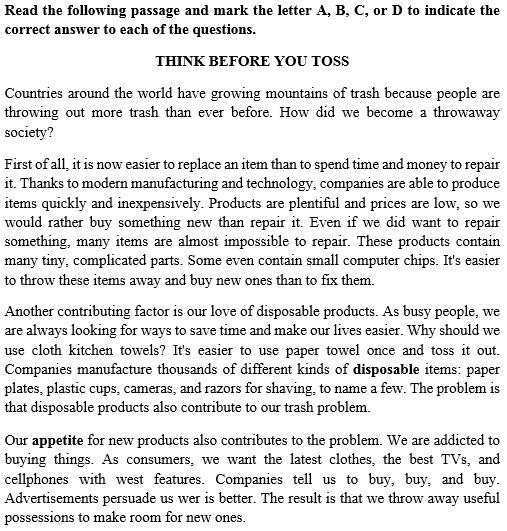
Question: Which of the following is NOT a reason for people to replace a broken item?
Products are now mass produced at affordable prices.
It takes almost no time to fix broken items.
Many items are too complicated to repair.
Some products contain tiny, complicated chips.
Đáp án: B
Dựa vào đoạn văn số 2
Question: All of the following are disposable products, EXCEPT ____.
cloth kitchen towels
paper plates
plastic cups
razors for shaving
Đáp án: A
Dựa vào đoạn văn số 3
Question: The word “disposable" in paragraph 3 is closest in meaning to
convenient
inexpensive
throwaway
single-use
Đáp án: D
Disposable = single-use (adj) dùng một lần
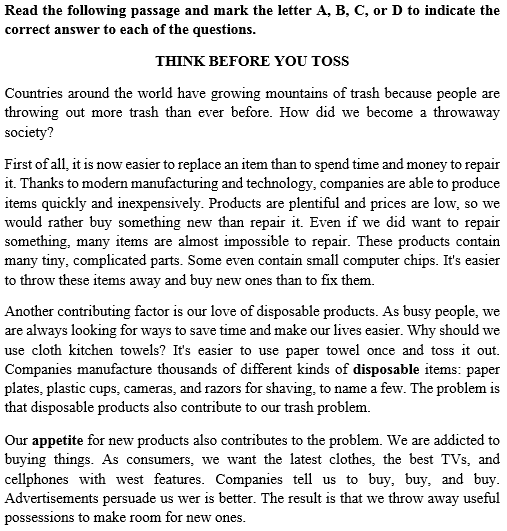
Question: Why are we hooked on buying new things?
We throw the old items to make room for the new ones.
We have more money than ever before.
We want to own as many things as possible.
We are made to believe that the new is the better.
Đáp án: D
Dựa vào đoạn văn cuối
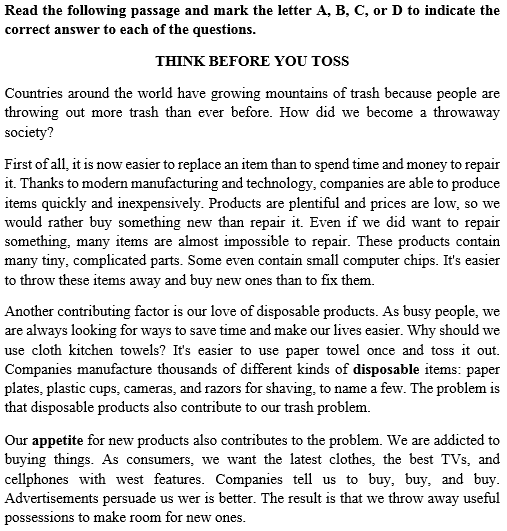
Question: The word “appetite” in the last paragraph can be best replaced by ____.
need
demand
desire
taste
Đáp án: C
Appetite = desire (n) lòng thèm muốn