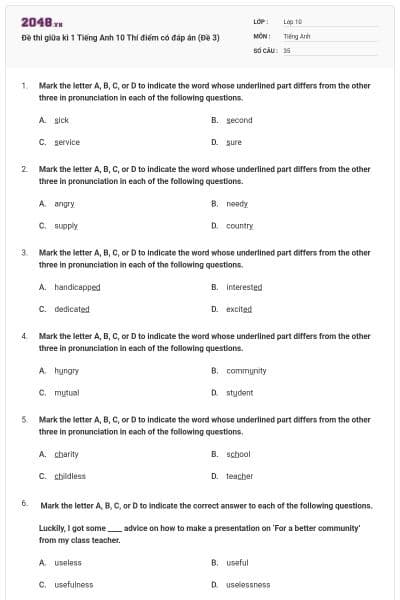
Đề thi giữa kì 1 Tiếng Anh 10 Thí điểm có đáp án (Đề 3)
35 câu hỏi
Mark the letter A, B, C, or D to indicate the word whose underlined part differs from the other three in pronunciation in each of the following questions.
sick
second
service
sure
Đáp án: D
Đáp án D phát âm là /ʃ/ các đáp án còn lại phát âm là /s/.
Mark the letter A, B, C, or D to indicate the word whose underlined part differs from the other three in pronunciation in each of the following questions.
angry
needy
supply
country
Đáp án: C
Đáp án C phát âm là /ai/ các đáp án còn lại phát âm là /i/
Mark the letter A, B, C, or D to indicate the word whose underlined part differs from the other three in pronunciation in each of the following questions.
handicapped
interested
dedicated
excited
Đáp án: A
Đáp án A phát âm là /t/ các đáp án còn lại phát âm là /id/
Mark the letter A, B, C, or D to indicate the word whose underlined part differs from the other three in pronunciation in each of the following questions.
hungry
community
mutual
student
Đáp án: A
Đáp án A phát âm là /ʌ/ các đáp án còn lại phát âm là /ju/
Mark the letter A, B, C, or D to indicate the word whose underlined part differs from the other three in pronunciation in each of the following questions.
charity
school
childless
teacher
Đáp án: B
Đáp án B phát âm là /k/ các đáp án còn lại phát âm là /tʃ/
Mark the letter A, B, C, or D to indicate the correct answer to each of the following questions.
Luckily, I got some ____ advice on how to make a presentation on ‘For a better community’ from my class teacher.
useless
useful
usefulness
uselessness
Đáp án: B
Giải thích: Ô trống cần tính từ, dựa vào nghĩa ta chọn B
Dịch: May mắn thay, tôi đã nhận được một số lời khuyên hữu ích về cách thuyết trình về ‘Vì một cộng đồng tốt đẹp hơn’ từ giáo viên lớp của tôi.
These ____ children encounter many problems and really need our help.
disadvantaged
advantaged
disadvantage
advantage
Đáp án: A
Giải thích: Ô trống cần tính từ
Dịch: Những đứa trẻ thiệt thòi này gặp rất nhiều khó khăn và rất cần sự giúp đỡ của chúng tôi.
Fundraising for charity is a ____ thing for everyone to do to help the community.
meant
meaningful
meaningless
meaning
Đáp án: B
Giải thích: Ô trống cần tính từ, dựa vào nghĩa ta chọn B
Dịch: Gây quỹ từ thiện là việc làm ý nghĩa mỗi người nên làm để giúp đỡ cộng đồng.
They were so ____ about joining the local volunteer group that they couldn’t sleep last night.
excite
excitement
exciting
excited
Đáp án: D
Giải thích: Ô trống cần tính từ, tuy nhiên câu mang nghĩa bị động nên ta chọn D
Dịch: Họ hào hứng tham gia nhóm tình nguyện viên địa phương đến nỗi đêm qua họ không thể ngủ được.
It is ____ that all the students in class 1OA choose to do a project on ‘Helping the needy’.
surprising
surprised
surprise
surprisingly
Đáp án: A
Giải thích: Ô trống cần tính từ, tuy nhiên câu mang nghĩa chủ động nên ta chọn A
Dịch: Điều đáng ngạc nhiên là tất cả các học sinh trong lớp 1OA đều chọn làm một dự án về ‘Giúp đỡ những người khốn khó’.
Volunteers become well ____ of the problems facing the world.
aware
concerned
helpful
interested
Đáp án: A
Giải thích: Be aware of (nhận thức được)
Dịch: Các tình nguyện viên nhận thức rõ về các vấn đề mà thế giới đang đối mặt.
English teaching is considered a good example of a volunteer job which often turns ____ a career.
off
up
on
into
Đáp án: D
Dịch: Giảng dạy tiếng Anh được coi là một ví dụ điển hình về một công việc tình nguyện thường biến thành một nghề nghiệp.
Mahatma Gandhi fought for the rights of coloured people in general and the Indians ____.
in time
in particular
in contrast
in fact
Đáp án: B
Giải thích:
A. in time: kịp giờ
B. in particular: nói riêng
C. in contrast: đối lập
D. in fact: sự thật là
Dịch: Mahatma Gandhi đấu tranh cho quyền của người da màu nói chung và người da đỏ nói riêng
A/an ____ is a person who needs others to take care of him/her, because of illness that he/she had for a long time.
patient
martyr
invalid
addict
Đáp án: C
Dịch: Người tàn tật là người cần người khác chăm sóc vì bệnh tật đã lâu.
Mr. Chen is more _____ because he has finally agreed to allow his daughter to join an overseas volunteer organisation in Africa.
single-minded
narrow-minded
absent-minded
open-minded
Đáp án: D
Dịch: Ông Chen thì cởi mở hơn vì cuối cùng ông đã đồng ý cho con gái mình tham gia một tổ chức tình nguyện ở nước ngoài ở châu Phi.
Mark the letter A, B, C, or D to indicate the correct answer to each of the following questions.
Last Sunday, our volunteer team ____ a lot of food packages to homeless people in the flood-hit region.
were bringing
brought
have brought
had brought
Đáp án: B
Giải thích: Câu cần dùng thì quá khứ đơn (last Sunday)
Dịch: Chủ nhật vừa rồi, nhóm tình nguyện viên của chúng tôi đã mang rất nhiều gói thực phẩm đến những người vô gia cư ở vùng lũ lụt.
I ____ Maria for the first time at the Heart-to-Heart Charity Office.
saw
was seeing
was seen
has seen
Đáp án: A
Giải thích: Câu cần dùng thì quá khứ đơn
Dịch: Tôi đã nhìn thấy Maria lần đầu tiên tại Văn phòng Từ thiện Trái tim đến Trái tim.
We ____ the roof for Mrs. Smith, an elderly childless woman, when it ____ with rain.
were mending - was pouring
mended - poured
mended - was pouring
were mending - poured
Đáp án: D
Giải thích: Một hành động đang xảy ra (QKTD) thì hành động khác xen vào (QKĐ)
Dịch: Chúng tôi đang sửa mái nhà cho bà Smith, một phụ nữ lớn tuổi không con, thì trời đổ mưa.
When we were on a voluntary tour, we ___ to public places to collect rubbish every day.
were going
went
have gone
had gone
Đáp án: B
Dịch: Khi đi du lịch tình nguyện, ngày nào chúng tôi cũng đến các điểm công cộng để thu gom rác.
The phone was engaged when I called. Who ____ to?
were you talking
were you talked
did you talk
have you talked
Đáp án: A
Giải thích: Một hành động đang xảy ra (QKTD) thì hành động khác xen vào (QKĐ)
Dịch: Điện thoại đã được báo khi tôi gọi. Bạn đang nói chuyện với ai?
We ____ in silence when he suddenly ____ me to help him.
were walking - was asking
were walking - asked
walked – asked
walked - was asking
Đáp án: B
Giải thích: Một hành động đang xảy ra (QKTD) thì hành động khác xen vào (QKĐ)
Dịch: Chúng tôi đang đi bộ trong im lặng thì anh ấy đột nhiên bảo tôi giúp
I ____ my report when my boss ____ the hall.
made - was entering
made - entered
was making - was entering
was making - entered
Đáp án: D
Giải thích: Một hành động đang xảy ra (QKTD) thì hành động khác xen vào (QKĐ)
Dịch: Tôi đang làm báo cáo của tôi thì sếp đi vào sảnh
I ____ near the fence when suddenly I ____ the voices.
stood – heard
stood - was hearing
was standing – heard
was standing - was hearing golf
Đáp án: C
Giải thích: Một hành động đang xảy ra (QKTD) thì hành động khác xen vào (QKĐ)
Dịch: Tôi đang đứng gần hàng rào thì tôi nghe thấy tiếng nói.
Jim ____ his leg when he ____ golf.
broke - was playing
broke - played
was breaking - was playing
was breaking - broke
Đáp án: A
Giải thích: Một hành động đang xảy ra (QKTD) thì hành động khác xen vào (QKĐ)
Dịch: Anh ấy đã làm gãy chân mình khi đang chơi gôn
While I ____ for him to call up, he ____ a good time in the bar.
waited - was having
was waiting - was having
was waiting – had
was waited - was waiting
Đáp án: B
Giải thích: Một hành động đang xảy ra (QKTD) thì hành động khác xen vào (QKĐ)
Dịch: Trong khi tôi đang đợi anh ta gọi lại thì anh ta đang hưởng thụ ở bar.
Mark the letter A, B, C, or D to indicate the correct response to each of the following exchanges.
“Why don’t we visit the Happy Mind Charity Centre this weekend?” – “____”
Because it is so useful.
That’s a good idea!
I’ll tell you about this centre.
Until next time.
Đáp án: B
Dịch: “Tại sao chúng ta không đến thăm Trung tâm từ thiện Happy Mind vào cuối tuần này?” – “Đó là một ý kiến hay!”
“Hello, I’m Minh, the leader of Dream Sky volunteer team.” - “ ____”
Nice to meet you. I’m John, from Volunteer Bolivia.
It's nice of you so say so, I'm John, from Volunteer Bolivia.
Fine, see you again soon, Minh.
Don’t mention it. I'm John, from Volunteer Bolivia.
Đáp án: A
Dịch: “Xin chào, tôi là Minh, trưởng nhóm tình nguyện Dream Sky.” – “Rất vui được gặp bạn. Tôi là John, đến từ Tình nguyện viên Bolivia.”
“Thank you very much for helping the disadvantaged children here!” - “____”
What a pity!
It’s our pleasure.
Sorry, we don’t know.
That's nice of you!
Đáp án: B
Dịch: “Cảm ơn rất nhiều vì đã giúp đỡ những trẻ em có hoàn cảnh khó khăn ở đây!” – “Đó là niềm vui của chúng tôi.”
“Take care! Have a safe trip back!” - “____”
Thanks for coming.
Sounds good.
Thanks, bye.
Good luck next time.
Đáp án: C
Dịch: “Bảo trọng nhé. Chúc bạn đi về an toàn.” – “Cảm ơn bạn, tạm biệt.”
“Well, I think volunteering will bring some useful experience for our future job.” – “____”
That’s also what I think
I'm sorry, but I have to agree
I don’t think so, either.
That’s unbelievable!
Đáp án: A
Dịch : “Chà, tôi nghĩ hoạt động tình nguyện sẽ mang lại một số kinh nghiệm hữu ích cho công việc tương lai của chúng tôi.” – “Đó cũng là điều tôi nghĩ”
Read the following passage and mark the letter A, B, C, or D to indicate the correct answer to each of the questions.
I didn’t even notice him. It was a chilly November evening in New York City, and my daughter and I were walking up Broadway. I was thinking, “Milk, dry cleaners, home”. Was I supposed to notice a guy sitting inside a cardboard box next to a newsstand? No, but Nora did. She wasn't even four, but she pulled at my coat sleeve and said. “That man’s cold, Daddy. Can we take him home?"
don't remember my reply - probably something like, “That wouldn't really be helping him”. Maybe I made her feel better by giving her an apple. I don't know. But I do remember a sudden heavy feeling inside me. I had always been delighted at how much my daughter noticed in her world, whether it was birds in flight or children playing. But now she was noticing suffering and poverty.
A few days later, I saw an article in the newspaper about volunteers who delivered meals to elderly people. The volunteers went to a nearby school on a Sunday morning, picked up a food package, and delivered it to an elderly person. It was quick and easy. I signed us up. Nora was excited about it. She could understand the importance of food, so she could easily see how valuable our job was. When Sunday came, she was ready, but I had to push myself to leave the house. On the way to the school. I fought an urge to turn back. The Sunday paper and my coffee were waiting at home. Why do this? Still, we picked up the package and phoned the elderly person we'd been assigned. She invited us right over. And that day Nora and I paid a visit to her depressing flat. After saying goodbye, I walked home in tears.
Professionals call such a visit a “volunteer opportunity". Indeed, the proverty my daughter and I helped lessen that Sunday afternoon was not the old woman's alone it was in our lives, too. Nora and I regularly serve meals to needy people and collect clothes lor the homeless. Yet, as I've watched her grow over these past four years. I still wonder which of us has benefited more?
Which of the following can be the best title of the passage?
A Lesson in Caring
Volunteer Opportunities
An International Voluntary Organisation
A Beautiful Sunday
Đáp án: A
Read the following passage and mark the letter A, B, C, or D to indicate the correct answer to each of the questions.
I didn’t even notice him. It was a chilly November evening in New York City, and my daughter and I were walking up Broadway. I was thinking, “Milk, dry cleaners, home”. Was I supposed to notice a guy sitting inside a cardboard box next to a newsstand? No, but Nora did. She wasn't even four, but she pulled at my coat sleeve and said. “That man’s cold, Daddy. Can we take him home?"
don't remember my reply - probably something like, “That wouldn't really be helping him”. Maybe I made her feel better by giving her an apple. I don't know. But I do remember a sudden heavy feeling inside me. I had always been delighted at how much my daughter noticed in her world, whether it was birds in flight or children playing. But now she was noticing suffering and poverty.
A few days later, I saw an article in the newspaper about volunteers who delivered meals to elderly people. The volunteers went to a nearby school on a Sunday morning, picked up a food package, and delivered it to an elderly person. It was quick and easy. I signed us up. Nora was excited about it. She could understand the importance of food, so she could easily see how valuable our job was. When Sunday came, she was ready, but I had to push myself to leave the house. On the way to the school. I fought an urge to turn back. The Sunday paper and my coffee were waiting at home. Why do this? Still, we picked up the package and phoned the elderly person we'd been assigned. She invited us right over. And that day Nora and I paid a visit to her depressing flat. After saying goodbye, I walked home in tears.
Professionals call such a visit a “volunteer opportunity". Indeed, the proverty my daughter and I helped lessen that Sunday afternoon was not the old woman's alone it was in our lives, too. Nora and I regularly serve meals to needy people and collect clothes lor the homeless. Yet, as I've watched her grow over these past four years. I still wonder which of us has benefited more?
The phrase “delighted at" in the passage is closet in meaning to ____.
very bored with
very pleased at
very disappointed with
very surprised at
Đáp án: B
Read the following passage and mark the letter A, B, C, or D to indicate the correct answer to each of the questions.
I didn’t even notice him. It was a chilly November evening in New York City, and my daughter and I were walking up Broadway. I was thinking, “Milk, dry cleaners, home”. Was I supposed to notice a guy sitting inside a cardboard box next to a newsstand? No, but Nora did. She wasn't even four, but she pulled at my coat sleeve and said. “That man’s cold, Daddy. Can we take him home?"
don't remember my reply - probably something like, “That wouldn't really be helping him”. Maybe I made her feel better by giving her an apple. I don't know. But I do remember a sudden heavy feeling inside me. I had always been delighted at how much my daughter noticed in her world, whether it was birds in flight or children playing. But now she was noticing suffering and poverty.
A few days later, I saw an article in the newspaper about volunteers who delivered meals to elderly people. The volunteers went to a nearby school on a Sunday morning, picked up a food package, and delivered it to an elderly person. It was quick and easy. I signed us up. Nora was excited about it. She could understand the importance of food, so she could easily see how valuable our job was. When Sunday came, she was ready, but I had to push myself to leave the house. On the way to the school. I fought an urge to turn back. The Sunday paper and my coffee were waiting at home. Why do this? Still, we picked up the package and phoned the elderly person we'd been assigned. She invited us right over. And that day Nora and I paid a visit to her depressing flat. After saying goodbye, I walked home in tears.
Professionals call such a visit a “volunteer opportunity". Indeed, the proverty my daughter and I helped lessen that Sunday afternoon was not the old woman's alone it was in our lives, too. Nora and I regularly serve meals to needy people and collect clothes lor the homeless. Yet, as I've watched her grow over these past four years. I still wonder which of us has benefited more?
Which of the following is true about Nora, the author’s daughter?
She was a naughty schoolgirl.
She didn't care for anyone around her.
She was not interested in doing charity.
She is ov er four years old now.
Đáp án: D
Read the following passage and mark the letter A, B, C, or D to indicate the correct answer to each of the questions.
I didn’t even notice him. It was a chilly November evening in New York City, and my daughter and I were walking up Broadway. I was thinking, “Milk, dry cleaners, home”. Was I supposed to notice a guy sitting inside a cardboard box next to a newsstand? No, but Nora did. She wasn't even four, but she pulled at my coat sleeve and said. “That man’s cold, Daddy. Can we take him home?"
don't remember my reply - probably something like, “That wouldn't really be helping him”. Maybe I made her feel better by giving her an apple. I don't know. But I do remember a sudden heavy feeling inside me. I had always been delighted at how much my daughter noticed in her world, whether it was birds in flight or children playing. But now she was noticing suffering and poverty.
A few days later, I saw an article in the newspaper about volunteers who delivered meals to elderly people. The volunteers went to a nearby school on a Sunday morning, picked up a food package, and delivered it to an elderly person. It was quick and easy. I signed us up. Nora was excited about it. She could understand the importance of food, so she could easily see how valuable our job was. When Sunday came, she was ready, but I had to push myself to leave the house. On the way to the school. I fought an urge to turn back. The Sunday paper and my coffee were waiting at home. Why do this? Still, we picked up the package and phoned the elderly person we'd been assigned. She invited us right over. And that day Nora and I paid a visit to her depressing flat. After saying goodbye, I walked home in tears.
Professionals call such a visit a “volunteer opportunity". Indeed, the proverty my daughter and I helped lessen that Sunday afternoon was not the old woman's alone it was in our lives, too. Nora and I regularly serve meals to needy people and collect clothes lor the homeless. Yet, as I've watched her grow over these past four years. I still wonder which of us has benefited more?
After reading the newspaper article about volunteers who helped the elderly, the writer ____.
paid no attention
went to work
signed him and his daughter up
took his daughter to school
Đáp án: C
Read the following passage and mark the letter A, B, C, or D to indicate the correct answer to each of the questions.
I didn’t even notice him. It was a chilly November evening in New York City, and my daughter and I were walking up Broadway. I was thinking, “Milk, dry cleaners, home”. Was I supposed to notice a guy sitting inside a cardboard box next to a newsstand? No, but Nora did. She wasn't even four, but she pulled at my coat sleeve and said. “That man’s cold, Daddy. Can we take him home?"
don't remember my reply - probably something like, “That wouldn't really be helping him”. Maybe I made her feel better by giving her an apple. I don't know. But I do remember a sudden heavy feeling inside me. I had always been delighted at how much my daughter noticed in her world, whether it was birds in flight or children playing. But now she was noticing suffering and poverty.
A few days later, I saw an article in the newspaper about volunteers who delivered meals to elderly people. The volunteers went to a nearby school on a Sunday morning, picked up a food package, and delivered it to an elderly person. It was quick and easy. I signed us up. Nora was excited about it. She could understand the importance of food, so she could easily see how valuable our job was. When Sunday came, she was ready, but I had to push myself to leave the house. On the way to the school. I fought an urge to turn back. The Sunday paper and my coffee were waiting at home. Why do this? Still, we picked up the package and phoned the elderly person we'd been assigned. She invited us right over. And that day Nora and I paid a visit to her depressing flat. After saying goodbye, I walked home in tears.
Professionals call such a visit a “volunteer opportunity". Indeed, the proverty my daughter and I helped lessen that Sunday afternoon was not the old woman's alone it was in our lives, too. Nora and I regularly serve meals to needy people and collect clothes lor the homeless. Yet, as I've watched her grow over these past four years. I still wonder which of us has benefited more?
The word “us" in the passage refers to ____.
the writer and his daughter
the writer and the elderly person
the volunteers
the writer, his daughter and the elderly person
Đáp án: A