Đề thi giữa học kì 2 Tiếng Anh lớp 12 Global Success có đáp án (Đề 8)
40 câu hỏi
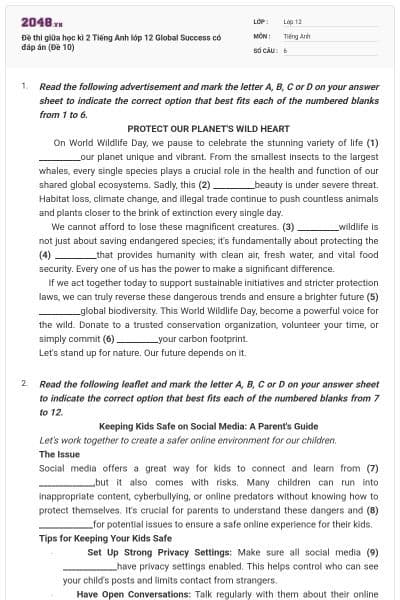
Read the following advertisement and mark the letter A, B, C or D on your answer sheet to indicate the correct option that best fits each of the numbered blanks from 1 to 6.
DISCOVER WILDLIFE CONSERVATION EXHIBITION!
Date: Saturday, March 15th
Time: 8:00 AM to 6:00 PM
Location: Wildlife Conservation Center, Ha Noi
Immerse yourself in the (1) __________world of wildlife conservation at our upcoming exhibition! Explore captivating exhibits (2) __________endangered species, their habitats, and conservation efforts.
Activities:
– Engage (3) __________hands-on workshops led by conservationists, where you’ll learn about wildlife tracking, habitat restoration, and sustainable practices.
– Join informative presentations by renowned experts on topics like (4) __________and marine conservation.
– (5) __________memories with your favorite animals atour interactive wildlife photo booth.
– Enjoy delicious refreshments and browse eco-friendly products at our conservation marketplace.
Contact Information: For inquiries, email us at info@wildlifeexpo.com or call 023-456-7899.
Come together with fellow wildlife enthusiasts to support conservation efforts and (6) __________our planet’s precious biodiversity! Admission is free for all ages.
fascinating
fascinate
fascinatingly
fascination
A
A. fascinating (adj): hấp dẫn, lôi cuốn (mô tả tính chất của sự vật)
B. fascinate (v): làm mê hoặc
C. fascinatingly (adv): một cách hấp dẫn
D. fascination (n): sự quyến rũ, sự mê hoặc
Vị trí từ loại: cần một tính từ đứng trước danh từ “world” để bổ nghĩa. Trong ngữ cảnh này, thế giới bảo tồn là đối tượng gây ra sự hứng thú, nên ta dùng tính từ đuôi -ing.
Chọn A. fascinating
→ Immerse yourself in the fascinating world of wildlife conservation at our upcoming exhibition!
Dịch nghĩa: Hãy đắm mình trong thế giới hấp dẫn của việc bảo tồn động vật hoang dã tại triển lãm sắp tới của chúng tôi!
Explore captivating exhibits (2) __________endangered species, their habitats, and conservation efforts.
featuring
which features
featured
are featuring
A
A. featuring (V-ing): trình bày, bao gồm (dạng rút gọn chủ động)
B. which features (sai hòa hợp số ít/số nhiều)
C. featured (V-ed): được trình bày (dạng bị động)
D. are featuring (sai cấu trúc câu)
Ngữ pháp: Đây là cấu trúc rút gọn mệnh đề quan hệ dạng chủ động. “Exhibits which feature...” được rút gọn thành “Exhibits featuring...”. Lưu ý ở phương án B, “exhibits” là số nhiều nên nếu dùng “which” thì động từ phải là “feature” (không có “s”).
Chọn A. featuring
→ Explore captivating exhibits featuring endangered species, their habitats, and conservation efforts.
Dịch nghĩa: Khám phá các khu trưng bày hấp dẫn giới thiệu các loài đang gặp nguy hiểm, môi trường sống của chúng và các nỗ lực bảo tồn.
– Engage (3) __________hands-on workshops led by conservationists, where you’ll learn about wildlife tracking, habitat restoration, and sustainable practices.
up
for
in
on
C
Cụm từ cố định (Collocation): engage in something: tham gia vào một hoạt động nào đó.
Chọn C. in
→ Engage in hands-on workshops led by conservationists...
Dịch nghĩa: Tham gia vào các buổi hội thảo thực hành do các nhà bảo tồn dẫn dắt...
– Join informative presentations by renowned experts on topics like (4) __________and marine conservation.
endangered species protection
endangered protection species
protection endangered species
species endangered protection
A
Cấu trúc cụm danh từ: adj + N-bổ nghĩa + N-chính
endangered (adj): có nguy cơ tuyệt chủng
species (N-bổ nghĩa): các loài
protection (N-chính): việc bảo vệ
→ endangered species protection: việc bảo vệ các loài có nguy cơ tuyệt chủng
Chọn A. endangered species protection
→ Join informative presentations by renowned experts on topics like (4)endangered species protection and marine conservation.
Dịch nghĩa: Tham gia các buổi thuyết trình đầy thông tin của các chuyên gia nổi tiếng về các chủ đề như bảo vệ loài nguy cấp và bảo tồn biển.
– (5) __________memories with your favorite animals atour interactive wildlife photo booth.
Capture
Receive
Produce
Obtain
A
A. Capture (v): ghi lại, lưu giữ (khoảnh khắc)
B. Receive (v): nhận
C. Produce (v): sản xuất
D. Obtain (v): đạt được
Cụm từ cố định (Collocation): capture memories: lưu giữ những kỷ niệm (thường thông qua việc chụp ảnh).
Chọn A. Capture
→ Capture memories with your favorite animals at our interactive wildlife photo booth.
Dịch nghĩa: Lưu giữ những kỷ niệm với những loài động vật yêu thích của bạn tại quầy chụp ảnh động vật hoang dã tương tác của chúng tôi.
Come together with fellow wildlife enthusiasts to support conservation efforts and (6) __________our planet’s precious biodiversity! Admission is free for all ages.
to protect
protected
protecting
protect
D
Cấu trúc song hành (Parallel Structure): Câu có cấu trúc “to support... and (6) protect...”. Sau “to” là các động từ nguyên mẫu nối với nhau bằng liên từ “and” để chỉ mục đích.
Chọn D. protect
→ Come together with fellow wildlife enthusiasts to support conservation efforts and protect our planet’s precious biodiversity!
Dịch nghĩa: Hãy cùng những người cùng đam mê động vật hoang dã ủng hộ các nỗ lực bảo tồn và bảo vệ đa dạng sinh học quý giá của hành tinh chúng ta!
Bài đọc hoàn chỉnh | Dịch bài đọc |
DISCOVER WILDLIFE CONSERVATION EXHIBITION! Date: Saturday, March 15th Time: 8:00 AM to 6:00 PM Location: Wildlife Conservation Center, Ha Noi Immerse yourself in the fascinating world of wildlife conservation at our upcoming exhibition! Explore captivating exhibits featuring endangered species, their habitats, and conservation efforts. Activities: – Engage in hands-on workshops led by conservationists, where you’ll learn about wildlife tracking, habitat restoration, and sustainable practices. – Join informative presentations by renowned experts on topics like endangered species protection and marine conservation. – Capture memories with your favorite animals at our interactive wildlife photo booth. – Enjoy delicious refreshments and browse eco-friendly products at our conservation marketplace. Contact Information: For inquiries, email us at info@wildlifeexpo.com or call 023-456-7899. Come together with fellow wildlife enthusiasts to support conservation efforts and protect our planet’s precious biodiversity! Admission is free for all ages. | KHÁM PHÁ TRIỂN LÃM BẢO TỒN ĐỘNG VẬT HOANG DÃ! Ngày: Thứ Bảy, ngày 15 tháng 3 Thời gian: 8:00 sáng đến 6:00 chiều Địa điểm: Trung tâm Bảo tồn Động vật Hoang dã, Hà Nội Hãy đắm mình trong thế giới hấp dẫn của việc bảo tồn động vật hoang dã tại triển lãm sắp tới của chúng tôi! Khám phá các khu trưng bày đầy lôi cuốn giới thiệu các loài đang gặp nguy hiểm, môi trường sống của chúng và các nỗ lực bảo tồn. Các hoạt động: – Tham gia vào các buổi hội thảo thực hành do các nhà bảo tồn dẫn dắt, nơi bạn sẽ được học về cách theo dấu động vật hoang dã, phục hồi môi trường sống và các thực hành bền vững. – Tham gia các buổi thuyết trình đầy thông tin của các chuyên gia nổi tiếng về các chủ đề như bảo vệ loài nguy cấp và bảo tồn biển. – Lưu giữ những kỷ niệm với các loài động vật yêu thích tại quầy chụp ảnh động vật hoang dã tương tác của chúng tôi. – Thưởng thức các món giải khát ngon miệng và tham quan các sản phẩm thân thiện với môi trường tại khu chợ bảo tồn. Thông tin liên hệ: Nếu có thắc mắc, hãy gửi email cho chúng tôi tại info@wildlifeexpo.com hoặc gọi 023-456-7899. Hãy cùng những người đam mê động vật hoang dã ủng hộ các nỗ lực bảo tồn và bảo vệ sự đa dạng sinh học quý giá của hành tinh chúng ta! Vào cửa miễn phí cho mọi lứa tuổi. |
Read the following leaflet and mark the letter A, B, C or D on your answer sheet to indicate the correct option that best fits each of the numbered blanks 7 to 12.
BEWARE OF AI SCAMS USING CELEBRITY VOICES IN COSMETIC REVIEWS!
Seen a video of your favorite celebrity praising a cosmetic product? Think twice!
Scammers now use deepfake AI to create fake promotions, making it hard to tell real (7) ___________from scams.
How This Scam Works
AI creates fake celebrity reviews by using others' personal data without permission. Social media makes them seem more (8) ___________, tricking people into buying bad or dangerous products.
Why Be Cautious?
Unlike (9) ___________real reviews, AI fakes lack real experience. A little research helps spot fake ads, preventing victims from losing a significant (10) ___________of money due to false claims. Some products may even cause serious skin issues instead of benefits.
How to Stay Safe
Don’t automatically trust viral videos. (11) ___________checking official pages to find out whether a celebrity truly supports the product, always (12) ___________ads that seem too good to be true, and report fake content to help others.
AI is powerful, but some people use it in the wrong way. Stay alert and don’t be easily tricked.
Scammers now use deepfake AI to create fake promotions, making it hard to tell real (7) ___________from scams.
suggestions
reviews
experiences
commercials
B
A. suggestions (n): những gợi ý
B. reviews (n): những đánh giá/nhận xét
C. experiences (n): những trải nghiệm
D. commercials (n): các đoạn phim quảng cáo
Ngữ cảnh: “tell real reviews from scams” (phân biệt các đánh giá thật với trò lừa đảo). Toàn bộ bài đọc nói về việc kẻ lừa đảo tạo ra các video “reviews” giả từ người nổi tiếng để lôi kéo người dùng mua mỹ phẩm.
Chọn B. reviews
→ Scammers now use deepfake AI to create fake promotions, making it hard to tell real reviews from scams.
Dịch nghĩa: Kẻ lừa đảo hiện đang sử dụng công nghệ deepfake AI để tạo ra các chương trình khuyến mãi giả, khiến việc phân biệt giữa các đánh giá thật và các trò lừa đảo trở nên khó khăn.
interesting
real
attractive
trustworthy
D
A. interesting (adj): thú vị
B. real (adj): thật
C. attractive (adj): hấp dẫn, thu hút
D. trustworthy (adj): đáng tin cậy
Dựa vào nghĩa, chọn D. trustworthy
→ Social media makes them seem more trustworthy, tricking people into buying bad or dangerous products.
Dịch nghĩa: Mạng xã hội làm cho chúng có vẻ đáng tin cậy hơn, đánh lừa mọi người mua phải những sản phẩm kém chất lượng hoặc nguy hiểm.
the other
another
other
others
C
A. the other + N-số nhiều: những cái còn lại cuối cùng (trong một nhóm đã xác định)
B. another + N-số ít: một cái khác (không xác định)
C. other + N-số nhiều: những cái khác (nói chung, không xác định)
D. others: những cái khác (đóng vai trò đại từ, không có danh từ theo sau)
Ngữ pháp: Phía sau chỗ trống là danh từ số nhiều “real reviews”. “Other” là từ phù hợp nhất để chỉ các đánh giá thật khác nói chung.
Chọn C. other
→ Unlike other real reviews, AI fakes lack real experience.
Dịch nghĩa: Không giống như các đánh giá thật khác, các video giả mạo từ AI thiếu đi trải nghiệm thực tế.
piece
quantity
amount
number
C
A. piece: một mẩu, một miếng
B. quantity: lượng (thường dùng cho vật thể, hàng hóa cân đong được)
C. amount: lượng (thường đi với danh từ không đếm được như money)
D. number: số lượng (đi với danh từ đếm được số nhiều)
Cụm từ cố định (Collocation): a significant amount of money: một lượng tiền lớn/đáng kể.
Chọn C. amount
→ A little research helps spot fake ads, preventing victims from losing a significant amount of money due to false claims.
Dịch nghĩa: Một chút nghiên cứu sẽ giúp phát hiện các quảng cáo giả mạo, ngăn nạn nhân khỏi việc mất một lượng tiền lớn do những tuyên bố sai sự thật.
Except for
Addition to
For all
Apart from
D
A. Except for: ngoại trừ
B. Addition to: (sai cấu trúc, phải là “In addition to”)
C. For all: mặc dù, bất chấp
D. Apart from: ngoài... ra / bên cạnh việc...
Ngữ pháp: Cụm “Apart from + V-ing” được dùng để liệt kê thêm một hành động khác. Ở đây, bên cạnh việc kiểm tra trang chính thức, người dùng cần làm thêm các bước an toàn khác.
Chọn D. apart from
→ Apart from checking official pages to find out whether a celebrity truly supports the product
Dịch nghĩa: Ngoài việc kiểm tra các trang chính thức để tìm hiểu xem người nổi tiếng đó có thực sự ủng hộ sản phẩm hay không
Don’t automatically trust viral videos. (11) ___________checking official pages to find out whether a celebrity truly supports the product, always (12) ___________ads that seem too good to be true, and report fake content to help others.
take part in
be careful with
put up with
fall for
B
A. take part in (phr.v): tham gia vào
B. be careful with (adj phrase): cẩn thận với
C. put up with (phr.v): chịu đựng
D. fall for (phr.v): bị lừa bởi, tin vào (một trò lừa)
Dựa vào nghĩa, đây là lời khuyên về an toàn, chọn B. be careful with
→ ...always be careful with ads that seem too good to be true, and report fake content to help others.
Dịch nghĩa: ...hãy luôn cẩn thận với những quảng cáo có vẻ quá tốt so với thực tế, và báo cáo nội dung giả mạo để giúp đỡ người khác.
Bài đọc hoàn chỉnh | Dịch bài đọc |
BEWARE OF AI SCAMS USING CELEBRITY VOICES IN COSMETIC REVIEWS! Seen a video of your favorite celebrity praising a cosmetic product? Think twice! Scammers now use deepfake AI to create fake promotions, making it hard to tell real reviews from scams. How This Scam Works AI creates fake celebrity reviews by using others' personal data without permission. Social media makes them seem more trustworthy, tricking people into buying bad or dangerous products. Why Be Cautious? Unlike other real reviews, AI fakes lack real experience. A little research helps spot fake ads, preventing victims from losing a significant amount of money due to false claims. Some products may even cause serious skin issues instead of benefits. How to Stay Safe Don’t automatically trust viral videos. Apart from checking official pages to find out whether a celebrity truly supports the product, always be careful with ads that seem too good to be true, and report fake content to help others. AI is powerful, but some people use it in the wrong way. Stay alert and don’t be easily tricked. | CẨN THẬN VỚI CÁC TRÒ LỪA ĐẢO AI SỬ DỤNG GIỌNG NÓI NGƯỜI NỔI TIẾNG TRONG ĐÁNH GIÁ MỸ PHẨM! Bạn thấy một video về người nổi tiếng yêu thích của mình đang khen ngợi một sản phẩm mỹ phẩm? Hãy suy nghĩ kỹ! Những kẻ lừa đảo hiện đang sử dụng công nghệ deepfake AI để tạo ra các video quảng cáo giả, khiến việc phân biệt các đánh giá thật và các trò lừa đảo trở nên khó khăn. Trò lừa đảo này hoạt động như thế nào? AI tạo ra các đánh giá giả mạo của người nổi tiếng bằng cách sử dụng dữ liệu cá nhân của người khác mà không được phép. Mạng xã hội khiến chúng có vẻ đáng tin cậy hơn, lừa mọi người mua phải những sản phẩm kém chất lượng hoặc gây nguy hiểm. Tại sao cần phải thận trọng? Không giống như các đánh giá thật khác, các video giả mạo AI thiếu đi trải nghiệm thực tế. Chỉ cần tìm hiểu một chút sẽ giúp bạn phát hiện các quảng cáo giả mạo, ngăn chặn nạn nhân khỏi việc mất một khoản tiền lớn do những lời quảng cáo sai sự thật. Một số sản phẩm thậm chí có thể gây ra các vấn đề nghiêm trọng về da thay vì mang lại lợi ích. Cách để giữ an toàn Đừng tự động tin vào các video lan truyền trên mạng. Ngoài việc kiểm tra các trang chính thức để tìm hiểu xem người nổi tiếng đó có thực sự ủng hộ sản phẩm hay không, hãy luôn cẩn thận với những quảng cáo có vẻ quá tốt để có thể là sự thật, và báo cáo nội dung giả mạo để giúp đỡ người khác. AI rất mạnh mẽ, nhưng một số người lại sử dụng nó sai cách. Hãy cảnh giác và đừng để bị lừa một cách dễ dàng. |
Read the following passage and mark the letter A, B, C or D on your answer sheet to indicate the option that best fits each of the numbered blanks from 13 to 17.
Short-form content on TikTok has become incredibly popular among young people, (13) _____________. These short videos are usually quick, fun, and easy to watch, keeping viewers engaged for hours. However, (14) _____________ – the chemical that makes us feel good.
Flooded with these instant dopamine hits, (15) _____________,and it struggles to focus on longer tasks. This makes it hard for some users to concentrate on activities like reading, studying, or even having real-life conversations. (16) _____________, which is a challenge for building patience.
As the effects of constant scrolling (17) _____________, more people are starting to realize the importance of balancing screen time with other activities. While TikTok can be entertaining, taking regular breaks or setting limits is important to protect mental focus and concentration. By making a few small changes, users can still enjoy TikTok without letting it take over their attention.
whose attention spans are often influenced by constant scrolling
often have their attention spans influenced by constant scrolling
that often have their attention spans influenced by constant scrolling
of which attention spans are often influenced by constant scrolling
A
Sau dấu phẩy cần một mệnh đề quan hệ không xác định để bổ nghĩa cho danh từ chỉ người “young people”.
Dịch nghĩa:
A. những người mà khoảng thời gian chú ý thường bị ảnh hưởng bởi việc lướt liên tục
B. thường có khoảng thời gian chú ý bị ảnh hưởng bởi việc lướt liên tục
C. những người thường có khoảng thời gian chú ý bị ảnh hưởng bởi việc lướt liên tục
D. cái mà khoảng thời gian chú ý thường bị ảnh hưởng bởi việc lướt liên tục
Phân tích:
A. đúng cấu trúc mệnh đề quan hệ sở hữu.
B. thiếu đại từ quan hệ để nối câu.
C. sai ngữ pháp (không dùng “that” sau dấu phẩy trong mệnh đề quan hệ không xác định).
D. “of which” dùng cho vật, không dùng cho “young people”.
Chọn A.
→ Short-form content on TikTok has become incredibly popular among young people, whose attention spans are often influenced by constant scrolling.
Dịch nghĩa: Nội dung dạng ngắn trên TikTok đã trở nên cực kỳ phổ biến đối với giới trẻ, những người mà khả năng tập trung thường bị ảnh hưởng bởi việc lướt điện thoại liên tục.
However, (14) _____________ – the chemical that makes us feel good.
by focusing on TikTok, students can manage their study time better and feel less stressed about school
watching more short videos leads young viewers to learn more from each other and develop new skills
many students feel motivated to make their own videos, believing it will make them more popular
spending much time watching these videos can affect the brain by giving it small bursts of dopamine
D
Cấu trúc: Dấu gạch ngang “–” dùng để giải thích cho danh từ đứng ngay trước nó.
Cụm từ sau dấu gạch ngang là “the chemical that makes us feel good” (chất hóa học khiến chúng ta cảm thấy hưng phấn), đây là định nghĩa của dopamine. Do đó, vế trước phải đề cập đến dopamine.
Dịch nghĩa:
A. bằng cách tập trung vào TikTok, học sinh có thể quản lý thời gian học tốt hơn
B. xem nhiều video ngắn giúp người xem trẻ học hỏi lẫn nhau và phát triển kỹ năng mới
C. nhiều học sinh cảm thấy có động lực tự làm video, tin rằng nó giúp họ nổi tiếng hơn
D. dành nhiều thời gian xem những video này có thể ảnh hưởng đến bộ não bằng cách tạo ra những đợt bùng phát dopamine nhỏ
Phân tích:
A. ý tích cực, không liên quan dopamine
B. không liên quan não bộ
C. không liên quan dopamine
D. đúng logic vì nhắc đến “dopamine” để khớp với phần giải thích sau dấu gạch ngang.
Chọn D.
→ However, spending much time watching these videos can affect the brain by giving it small bursts of dopamine – the chemical that makes us feel good.
Dịch nghĩa: Tuy nhiên, việc dành nhiều thời gian xem các video này có thể ảnh hưởng đến bộ não bằng cách tạo ra những đợt bùng phát dopamine nhỏ – chất hóa học khiến chúng ta cảm thấy hưng phấn.
more and more short content are being craved by the brain
the brain can start to crave more and more short content
cravings for more and more short content have been shown
short content has been increasingly craved by the brain
B
Câu bắt đầu bằng phân từ “Flooded with...” (Bị ngập tràn bởi...). Đây là cấu trúc rút gọn mệnh đề trạng ngữ, vì vậy chủ ngữ của mệnh đề sau dấu phẩy phải là đối tượng chịu tác động (bộ não).
Vế sau có đại từ “it” (it struggles...), đại từ này phải thay thế cho một danh từ số ít ở vế trước.
Dịch nghĩa:
A. ngày càng nhiều nội dung ngắn đang được bộ não khao khát
B. bộ não có thể bắt đầu khao khát ngày càng nhiều nội dung ngắn hơn
C. những sự thèm khát nội dung ngắn đã được chứng minh
D. nội dung ngắn ngày càng được bộ não khao khát
Phân tích:
A, C, D. chủ ngữ không phải là “the brain”, dẫn đến việc đại từ “it” ở vế sau không có đối tượng thay thế hợp lý hoặc sai logic cấu trúc rút gọn.
B. đúng chủ ngữ “the brain” để khớp với “it” và cấu trúc rút gọn đầu câu.
Chọn B.
→ Flooded with these instant dopamine hits, the brain can start to crave more and more short content, and it struggles to focus on longer tasks.
Dịch nghĩa: Bị ngập tràn bởi những đợt hưng phấn dopamine tức thời này, bộ não có thể bắt đầu khao khát ngày càng nhiều nội dung ngắn, và nó sẽ gặp khó khăn khi tập trung vào các nhiệm vụ dài hơn.
(16) _____________, which is a challenge for building patience.
By seeing short content every day, viewers often discover new ideas and try to be more productive
Accustomed to quick hits of dopamine, the brain may feel bored by anything that isn't instantly exciting
If users limit their time on TikTok, they will feel more energized and creative in everyday activities
Watching short videos each day makes it easy for students to finish their homework without distractions
B
Chỗ trống đứng đầu câu, cần một nội dung dẫn dắt đến kết luận “điều này là thử thách cho việc xây dựng lòng kiên nhẫn”.
Vì bộ não đã quen với sự hưng phấn tức thì, nó sẽ thấy những thứ chậm rãi là nhàm chán.
Dịch nghĩa:
A. Bằng cách xem nội dung ngắn mỗi ngày, người xem thường khám phá ra ý tưởng mới
B. Đã quen với những đợt bùng phát dopamine nhanh chóng, bộ não có thể cảm thấy chán nản với bất cứ thứ gì không gây phấn khích ngay lập tức
C. Nếu người dùng hạn chế thời gian trên TikTok, họ sẽ cảm thấy tràn đầy năng lượng hơn
D. Xem video ngắn mỗi ngày giúp học sinh dễ dàng hoàn thành bài tập về nhà
Phân tích:
A, C, D. không giải thích được tại sao lại là “thử thách cho lòng kiên nhẫn”.
B. đúng logic hệ quả: thích cái nhanh → chán cái chậm → thiếu kiên nhẫn.
Chọn B.
→ Accustomed to quick hits of dopamine, the brain may feel bored by anything that isn't instantly exciting, which is a challenge for building patience.
Dịch nghĩa: Do đã quen với những đợt dopamine nhanh chóng, bộ não có thể cảm thấy nhàm chán với bất cứ điều gì không mang lại sự phấn khích ngay lập tức, điều này chính là một thử thách đối với việc xây dựng lòng kiên nhẫn.
of which observations from researchers
have been observed by researchers
that have been observed by researchers
having been observed by researchers
B
Cấu trúc: Mệnh đề bắt đầu bằng liên từ “As” (Khi/Vì). Cấu trúc: As + S + V.
Chủ ngữ là “the effects of constant scrolling” (số nhiều), nên động từ chính cần được chia ở dạng số nhiều.
Dịch nghĩa:
A. của những quan sát từ các nhà nghiên cứu
B. đã được các nhà nghiên cứu quan sát thấy
C. cái mà đã được các nhà nghiên cứu quan sát thấy
D. sau khi đã được các nhà nghiên cứu quan sát thấy
Phân tích:
A. sai cấu trúc vì thiếu động từ chính cho mệnh đề “As”.
C. tạo thành mệnh đề quan hệ, khiến mệnh đề “As” bị thiếu động từ chính.
D. dạng phân từ rút gọn, không phù hợp làm động từ chính sau chủ ngữ trong mệnh đề “As”.
B. đúng cấu trúc (động từ chính chia ở thể bị động).
Chọn B.
→ As the effects of constant scrolling have been observed by researchers, more people are starting to realize the importance of balancing screen time.
Dịch nghĩa: Khi những tác động của việc lướt điện thoại liên tục được các nhà nghiên cứu quan sát thấy, nhiều người bắt đầu nhận ra tầm quan trọng của việc cân bằng thời gian sử dụng thiết bị.
Bài đọc hoàn chỉnh | Dịch bài đọc |
Short-form content on TikTok has become incredibly popular among young people, whose attention spans are often influenced by constant scrolling. These short videos are usually quick, fun, and easy to watch, keeping viewers engaged for hours. However, spending much time watching these videos can affect the brain by giving it small bursts of dopamine – the chemical that makes us feel good. Flooded with these instant dopamine hits, the brain can start to crave more and more short content, and it struggles to focus on longer tasks. This makes it hard for some users to concentrate on activities like reading, studying, or even having real-life conversations. Accustomed to quick hits of dopamine, the brain may feel bored by anything that isn't instantly exciting, which is a challenge for building patience. As the effects of constant scrolling have been observed by researchers, more people are starting to realize the importance of balancing screen time with other activities. While TikTok can be entertaining, taking regular breaks or setting limits is important to protect mental focus and concentration. By making a few small changes, users can still enjoy TikTok without letting it take over their attention. | Nội dung dạng ngắn trên TikTok đã trở nên cực kỳ phổ biến đối với giới trẻ, những người mà khoảng thời gian chú ý thường bị ảnh hưởng bởi việc lướt điện thoại liên tục. Những video ngắn này thường nhanh, vui nhộn và dễ xem, khiến người xem bị cuốn hút hàng giờ liền. Tuy nhiên, việc dành nhiều thời gian xem những video này có thể ảnh hưởng đến bộ não bằng cách tạo ra những đợt bùng phát dopamine nhỏ – chất hóa học khiến chúng ta cảm thấy hưng phấn. Bị ngập tràn bởi những đợt dopamine tức thời này, bộ não có thể bắt đầu khao khát ngày càng nhiều nội dung ngắn, và nó sẽ gặp khó khăn khi tập trung vào các nhiệm vụ dài hơn. Điều này khiến một số người dùng khó tập trung vào các hoạt động như đọc sách, học tập hay thậm chí là trò chuyện ngoài đời thực. Do đã quen với những đợt bùng phát dopamine nhanh chóng, bộ não có thể cảm thấy nhàm chán với bất cứ điều gì không mang lại sự phấn khích ngay lập tức, điều này chính là một thử thách đối với việc xây dựng lòng kiên nhẫn. Khi những tác động của việc lướt điện thoại liên tục được các nhà nghiên cứu quan sát thấy, nhiều người bắt đầu nhận ra tầm quan trọng của việc cân bằng thời gian sử dụng thiết bị với các hoạt động khác. Mặc dù TikTok có thể mang tính giải trí, nhưng việc nghỉ ngơi thường xuyên hoặc đặt ra các giới hạn là rất quan trọng để bảo vệ sự tập trung và khả năng tư duy của trí não. Bằng cách thực hiện một vài thay đổi nhỏ, người dùng vẫn có thể tận hưởng TikTok mà không để nó chiếm lĩnh toàn bộ sự chú ý của mình. |
Mark the letter A, B, C or D on your answer sheet to indicate the best arrangement of utterances or sentences to make a meaningful exchange or text in each of the following questions.
a. Sofia: Really? That sounds amazing. Does it also help you improve grammar and vocabulary?
b. Lucy: Yes, it points out mistakes and suggests better words. It’s like having a personal tutor, but on your phone.
c. Lucy: I’ve been using an AI-powered learning app that gives feedback on my writing.
b – c– a
c – a – b
c – b –a
a –c – b
B
Thứ tự sắp xếp đúng: B. c – a – b
c. Lucy: I’ve been using an AI-powered learning app that gives feedback on my writing.
a. Sofia: Really? That sounds amazing. Does it also help you improve grammar and vocabulary?
b. Lucy: Yes, it points out mistakes and suggests better words. It’s like having a personal tutor, but on your phone.
Dịch nghĩa:
c. Lucy: Tớ vừa sử dụng một ứng dụng học tập được hỗ trợ bởi AI, nó đưa ra phản hồi về bài viết của tớ.
a. Sofia: Thật sao? Nghe có vẻ tuyệt vời đấy. Nó có giúp cậu cải thiện ngữ pháp và từ vựng không?
b. Lucy: Có, nó chỉ ra các lỗi sai và gợi ý những từ ngữ tốt hơn. Nó giống như có một giáo viên hướng dẫn cá nhân ngay trên điện thoại vậy.
Chọn B.
a. Sophia: African savannah elephants face threats from poachers and forest clearance, which endangers their survival.
b. Liam: I read they even involve local communities to educate them on the importance of conservation and biodiversity.
c. Sophia: They also promote habitat restoration and corridors so elephants can move safely between protected areas.
d. Sophia: Yes, these combined efforts contribute to preserving elephants and reducing human-wildlife conflict dramatically.
e. Liam: True, wildlife organizations now use drones to monitor herds and ensure early rescue if an elephant is injured.
c – a – e – d – b
c – e – a – b – d
a – e – c – b – d
a – b – c – e – d
C
Thứ tự sắp xếp đúng: C. a – e – c – b – d
a. Sophia: African savannah elephants face threats from poachers and forest clearance, which endangers their survival.
e. Liam: True, wildlife organizations now use drones to monitor herds and ensure early rescue if an elephant is injured.
c. Sophia: They also promote habitat restoration and corridors so elephants can move safely between protected areas.
b. Liam: I read they even involve local communities to educate them on the importance of conservation and biodiversity.
d. Sophia: Yes, these combined efforts contribute to preserving elephants and reducing human-wildlife conflict dramatically.
Dịch nghĩa:
a. Sophia: Voi đồng cỏ châu Phi đang đối mặt với các mối đe dọa từ những kẻ săn trộm và việc phá rừng, điều này gây nguy hiểm cho sự sinh tồn của chúng.
e. Liam: Đúng vậy, các tổ chức động vật hoang dã hiện đang sử dụng máy bay không người lái để giám sát đàn và đảm bảo cứu hộ kịp thời nếu một con voi bị thương.
c. Sophia: Họ cũng thúc đẩy phục hồi môi trường sống và các hành lang để voi có thể di chuyển an toàn giữa các khu bảo tồn.
b. Liam: Tớ đọc thấy họ thậm chí còn lôi kéo các cộng đồng địa phương tham gia để giáo dục họ về tầm quan trọng của việc bảo tồn và đa dạng sinh học.
d. Sophia: Đúng vậy, những nỗ lực kết hợp này góp phần bảo tồn loài voi và giảm thiểu đáng kể xung đột giữa con người và động vật hoang dã.
Chọn C.
a. Artificial intelligence (AI) is transforming various industries, from healthcare to finance, by automating processes and improving efficiency in ways previously unimaginable.
b. AI technologies are now being used to diagnose diseases accurately, manage complex datasets, and even make predictive analyses in fields like epidemiology and economics.
c. Furthermore, advanced AI systems help automate repetitive tasks, which can save time, reduce costs, and allow human employees to focus on more creative and strategic work.
d. As the field of AI continues to advance, the role it plays in our lives will undoubtedly grow, impacting both personal and professional domains.
e. As a result, the demand for skilled AI professionals who can develop, maintain, and regulate these technologies is on the rise across industries.
a – b – c – e – d
a – c – b – e – d
b – a – c – e – d
a – b – e – c – d
A
Thứ tự sắp xếp đúng: A. a – b – c – e – d
a. Artificial intelligence (AI) is transforming various industries, from healthcare to finance, by automating processes and improving efficiency in ways previously unimaginable.
b. AI technologies are now being used to diagnose diseases accurately, manage complex datasets, and even make predictive analyses in fields like epidemiology and economics.
c. Furthermore, advanced AI systems help automate repetitive tasks, which can save time, reduce costs, and allow human employees to focus on more creative and strategic work.
e. As a result, the demand for skilled AI professionals who can develop, maintain, and regulate these technologies is on the rise across industries.
d. As the field of AI continues to advance, the role it plays in our lives will undoubtedly grow, impacting both personal and professional domains.
Dịch nghĩa:
a. Trí tuệ nhân tạo (AI) đang làm thay đổi nhiều ngành công nghiệp khác nhau, từ y tế đến tài chính, bằng cách tự động hóa các quy trình và cải thiện hiệu quả theo những cách mà trước đây không thể tưởng tượng được.
b. Các công nghệ AI hiện đang được sử dụng để chẩn đoán bệnh chính xác, quản lý các tập dữ liệu phức tạp và thậm chí đưa ra các phân tích dự đoán trong các lĩnh vực như dịch tễ học và kinh tế.
c. Hơn nữa, các hệ thống AI tiên tiến giúp tự động hóa các nhiệm vụ lặp đi lặp lại, điều này có thể tiết kiệm thời gian, giảm chi phí và cho phép nhân viên là con người tập trung vào các công việc sáng tạo và chiến lược hơn.
e. Kết quả là, nhu cầu về các chuyên gia AI lành nghề, những người có thể phát triển, duy trì và điều chỉnh các công nghệ này đang gia tăng trong mọi ngành công nghiệp.
d. Khi lĩnh vực AI tiếp tục tiến bộ, vai trò của nó trong cuộc sống của chúng ta chắc chắn sẽ lớn mạnh, tác động đến cả lĩnh vực cá nhân và nghề nghiệp.
Chọn A.
a. When advertisements depict products as if they can instantly solve all problems, people may believe they need them to improve their lives.
b. Ultimately, consumer behavior is heavily influenced by media messages, and people tend to act in a manner that mirrors the trends and lifestyles promoted by these platforms.
c. Through social media, companies present goods in a way that makes consumers feel they are missing out if they don’t act quickly.
d. In today’s world, advertising has become one of the most influential factors in shaping consumer behavior.
e. As companies present their products in a way that highlights their benefits, consumers are often drawn to make purchases they hadn’t initially planned.
c – b – e – d – a
a – c – d – e – b
d – e – b – a – c
d – e – a – c – b
D
Thứ tự sắp xếp đúng: D. d – e – a – c – b
d. In today’s world, advertising has become one of the most influential factors in shaping consumer behavior.
e. As companies present their products in a way that highlights their benefits, consumers are often drawn to make purchases they hadn’t initially planned.
a. When advertisements depict products as if they can instantly solve all problems, people may believe they need them to improve their lives.
c. Through social media, companies present goods in a way that makes consumers feel they are missing out if they don’t act quickly.
b. Ultimately, consumer behavior is heavily influenced by media messages, and people tend to act in a manner that mirrors the trends and lifestyles promoted by these platforms.
Dịch nghĩa:
d. Trong thế giới ngày nay, quảng cáo đã trở thành một trong những yếu tố có ảnh hưởng nhất trong việc định hình hành vi người tiêu dùng.
e. Khi các công ty trình bày sản phẩm của họ theo cách làm nổi bật lợi ích, người tiêu dùng thường bị thu hút để thực hiện các giao dịch mua sắm mà ban đầu họ không có kế hoạch.
a. Khi các quảng cáo mô tả sản phẩm như thể chúng có thể giải quyết tức thì mọi vấn đề, mọi người có thể tin rằng họ cần chúng để cải thiện cuộc sống.
c. Thông qua mạng xã hội, các công ty giới thiệu hàng hóa theo cách khiến người tiêu dùng cảm thấy họ đang bỏ lỡ cơ hội nếu không hành động nhanh chóng.
b. Cuối cùng, hành vi người tiêu dùng bị ảnh hưởng mạnh mẽ bởi các thông điệp truyền thông, và mọi người có xu hướng hành động theo cách phản chiếu các xu hướng và lối sống được thúc đẩy bởi các nền tảng này.
Chọn D.
Dear Professor Smith,
a. When we understand why people love or fear wildlife, we can create better ways to protect them, even if some animals seem scary.
b. Could you visit our school when you have time, because I think my friends would love to hear how their thoughts can make a difference for wildlife?
c. I noticed that children who spend time in nature care more about animals, which is why I started a small club at school.
d. I am writing because I learned about how our minds can help save animals, which made me think about nature differently.
e. Although many people in cities don't see wild animals often, they still need to feel connected to nature so they will want to protect it.
Sincerely,
Huy
c – a – e – d – b
e – d – c – a – b
a – b – e – c – d
d – a – c – e – b
D
Thứ tự sắp xếp đúng: D. d – a – c – e – b
Dear Professor Smith,
d. I am writing because I learned about how our minds can help save animals, which made me think about nature differently.
a. When we understand why people love or fear wildlife, we can create better ways to protect them, even if some animals seem scary.
c. I noticed that children who spend time in nature care more about animals, which is why I started a small club at school.
e. Although many people in cities don't see wild animals often, they still need to feel connected to nature so they will want to protect it.
b. Could you visit our school when you have time, because I think my friends would love to hear how their thoughts can make a difference for wildlife?
Sincerely,
Huy
Dịch nghĩa:
Kính gửi Giáo sư Smith,
d. Em viết thư này vì em đã học được cách tâm trí của chúng ta có thể giúp cứu động vật, điều này đã khiến em suy nghĩ khác đi về thiên nhiên.
a. Khi chúng ta hiểu lý do tại sao mọi người yêu hay sợ động vật hoang dã, chúng ta có thể tạo ra những cách tốt hơn để bảo vệ chúng, ngay cả khi một số loài trông có vẻ đáng sợ.
c. Em nhận thấy rằng những trẻ em dành thời gian hòa mình vào thiên nhiên sẽ quan tâm đến động vật nhiều hơn, đó là lý do tại sao em đã thành lập một câu lạc bộ nhỏ tại trường.
e. Mặc dù nhiều người ở các thành phố không thường xuyên nhìn thấy động vật hoang dã, họ vẫn cần cảm thấy được kết nối với thiên nhiên để họ muốn bảo vệ nó.
b. Giáo sư có thể ghé thăm trường chúng em khi có thời gian không ạ, vì em nghĩ các bạn của em sẽ rất muốn nghe về việc suy nghĩ của họ có thể tạo ra sự khác biệt cho động vật hoang dã như thế nào?
Chọn D.
Read the following passage and mark the letter A, B, C, or D on your answer sheet to indicate the best answer to each of the following questions from 23 to 30.
The Dark Side of Social Media Shopping
In recent years, social media platforms like Facebook, Instagram, and TikTok have become more than just places to connect with friends—they have also turned into popular shopping destinations. Many users are drawn to these platforms because of the convenience, affordable prices, and free shipping options. The ability to shop quickly through links or livestreams, often recommended by influencers or KOLs (Key Opinion Leaders), has made online buying more attractive than ever. However, this trend has also led to a growing number of scams and misleading advertisements.
One of the main reasons behind the rise of fake products and false advertising on social media is the lack of strict regulations. Many sellers do not need to provide business licenses or verify the quality of their products. As a result, some individuals take advantage of customers’ trust and sell low-quality or counterfeit items. Additionally, some KOLs promote these products without checking their authenticity, motivated by the money they earn from advertising deals.
This situation has caused many problems for consumers. Customers who order products online may receive items that look very different from what was shown in the advertisements, or they may not receive anything at all. Many people have lost money and become afraid to shop online. The reputation of influencers who promote fake goods is also damaged, which makes people doubt other trustworthy sellers. Overall, these dishonest practices have made the online shopping environment less safe and more confusing.
To solve this issue, both customers and platforms must take action. Social media companies should create stricter rules for sellers and ask influencers to clearly label paid advertisements. Customers should be careful when buying products online, especially from unknown brands or sellers without reviews. Governments can also help by introducing new laws to protect consumers and punish those who break the rules. With cooperation from all sides, social media can become a safer place to shop.
According to the passage all of the following are reasons why people enjoy shopping on social media platforms EXCEPT _____________.
Low product costs
Simple purchasing process
Discounts on delivery fees
Trusted payment methods
D
Theo đoạn văn, tất cả các điều sau đây là lý do tại sao mọi người thích mua sắm trên các nền tảng mạng xã hội NGOẠI TRỪ _______.
A. Low product costs: Chi phí sản phẩm thấp
B. Simple purchasing process: Quy trình mua hàng đơn giản
C. Discounts on delivery fees: Giảm phí giao hàng
D. Trusted payment methods: Phương thức thanh toán đáng tin cậy
Thông tin: Many users are drawn to these platforms because of the convenience, affordable prices, and free shipping options. The ability to shop quickly through links or livestreams... (Nhiều người dùng bị thu hút bởi các nền tảng này vì sự tiện lợi, giá cả phải chăng và các lựa chọn miễn phí vận chuyển.Khả năng mua sắm nhanh chóng thông qua các liên kết hoặc phát trực tiếp...)
→ Bài đọc nhắc đến sự tiện lợi, giá rẻ và miễn phí vận chuyển nhưng không hề khẳng định phương thức thanh toán là đáng tin cậy.
Chọn D.
Which of the following best paraphrases the underlined sentence in paragraph 2?
Some people use fake identities to build customer trust and offer poor service.
Certain sellers deceive buyers by abusing their trust and selling substandard or fake goods.
A number of businesses borrow trust from famous influencers to sell popular products.
Some individuals build trust by giving discounts, then ask customers to pay more later.
B
Câu nào diễn giải đúng nhất câu gạch chân ở đoạn 2?
As a result, some individuals take advantage of customers’ trust and sell low-quality or counterfeit items.
(Kết quả là, một số cá nhân lợi dụng lòng tin của khách hàng và bán các mặt hàng kém chất lượng hoặc hàng giả.)
A. Một số người sử dụng danh tính giả để xây dựng lòng tin của khách hàng và cung cấp dịch vụ kém.
→ Sai ý “danh tính giả”
B. Một số người bán lừa dối người mua bằng cách lạm dụng lòng tin của họ và bán hàng kém tiêu chuẩn hoặc hàng giả.
→ Đúng, phản ánh chính xác nhất: “take advantage of” = “deceive... by abusing”, “low-quality or counterfeit” = “substandard or fake”.
C. Một số doanh nghiệp mượn lòng tin từ những người có ảnh hưởng nổi tiếng để bán các sản phẩm phổ biến.
→ Chưa đủ ý tiêu cực
D. Một số cá nhân xây dựng lòng tin bằng cách giảm giá, sau đó yêu cầu khách hàng trả thêm tiền sau đó.
→ build trust bằng giảm giá → không đúng nội dung
Chọn B.
originality
genuineness
falseness
reliability
C
Từ “authenticity” ở đoạn 2 TRÁI NGHĨA với _______.
authenticity (n): tính xác thực, sự thật, hàng thật.
A. originality (n): tính nguyên bản (Đồng nghĩa)
B. genuineness (n): tính chân thực (Đồng nghĩa)
C. falseness (n): sự giả tạo, tính chất giả
D. reliability (n): sự đáng tin cậy
→ authenticity (thật) >< falseness (giả).
Thông tin: Additionally, some KOLs promote these products without checking their authenticity... (Ngoài ra, một số KOL quảng bá các sản phẩm này mà không kiểm tra tính xác thực của chúng...)
Chọn C.
the advertisements
online products
customers
influencers
C
Từ “they” ở đoạn 3 chỉ _______.
A. the advertisements: các quảng cáo
B. online products: các sản phẩm trực tuyến
C. customers: khách hàng
D. influencers: những người có ảnh hưởng
Thông tin: Customers who order products online may receive items that look very different from what was shown in the advertisements, or they may not receive anything at all.
(Khách hàng đặt mua sản phẩm trực tuyến có thể nhận được những mặt hàng trông rất khác so với hình ảnh quảng cáo, hoặc thậm chí không nhận được gì cả.)
Chọn C.
Which of the following is TRUE according to the passage?
Social media shopping is decreasing in popularity due to recent scandals.
KOLs always verify the quality of products before advertising them.
Government actions are considered unnecessary in solving the issue.
The lack of strict control has contributed to the spread of fake goods online.
D
Theo bài đọc, câu nào sau đây là ĐÚNG?
A. Mua sắm qua mạng xã hội đang giảm độ phổ biến do các vụ bê bối gần đây.
→ Sai, nó vẫn là một “trend” đang phát triển (Đoạn 1)
B. Các KOL luôn kiểm tra chất lượng sản phẩm trước khi quảng cáo.
→ Sai: Đoạn 2: some KOLs promote without checking
C. Các hành động của chính phủ được coi là không cần thiết trong việc giải quyết vấn đề.
→ Sai: Đoạn 4: Governments can also help...
D. Việc thiếu sự kiểm soát chặt chẽ đã góp phần làm lan rải hàng giả trực tuyến.
Thông tin (Đoạn 2): One of the main reasons behind the rise of fake products and false advertising on social media is the lack of strict regulations. (Một trong những nguyên nhân chính dẫn đến sự gia tăng hàng giả và quảng cáo sai sự thật trên mạng xã hội là do thiếu các quy định chặt chẽ.)
Chọn D.
clearer
harsher
shorter
newer
B
Từ “stricter” ở đoạn 4 có thể được thay thế tốt nhất bởi _______.
stricter (adj): nghiêm ngặt hơn, khắt khe hơn.
A. clearer: rõ ràng hơn
B. harsher: khắc nghiệt hơn, nghiêm khắc hơn
C. shorter: ngắn hơn
D. newer: mới hơn
→ stricter ≈ harsher (trong văn cảnh về luật lệ/quy tắc).
Thông tin: Social media companies should create stricter rules for sellers...
(Các công ty mạng xã hội nên tạo ra các quy tắc nghiêm ngặt hơn cho người bán...)
Chọn B.
Paragraph 1
Paragraph 2
Paragraph 3
Paragraph 4
B
Tác giả sử dụng mối quan hệ nguyên nhân - kết quả ở đoạn nào?
A. Đoạn 1
B. Đoạn 2
C. Đoạn 3
D. Đoạn 4
→ Đoạn 2 giải thích lý do (reasons) tại sao hàng giả gia tăng và dùng các từ nối như “As a result” để chỉ kết quả.
Thông tin (Đoạn 2): One of the main reasons behind the rise of fake products... is the lack of strict regulations... As a result, some individuals...
(Một trong những nguyên nhân chính dẫn đến sự gia tăng hàng giả... là do thiếu các quy định nghiêm ngặt... Kết quả là, một số cá nhân...)
Chọn B.
Paragraph 1
Paragraph 2
Paragraph 3
Paragraph 4
D
Tác giả đề cập đến trách nhiệm của các bên khác nhau trong việc làm cho mua sắm trên mạng xã hội an toàn hơn ở đoạn nào?
A. Đoạn 1
B. Đoạn 2
C. Đoạn 3
D. Đoạn 4
Thông tin (Đoạn 4): To solve this issue, both customers and platforms must take action... Governments can also help...
(Để giải quyết vấn đề này, cả khách hàng và các nền tảng đều phải hành động... Chính phủ cũng có thể giúp đỡ...)
Chọn D.
Dịch bài đọc:
MẶT TỐI CỦA MUA SẮM TRÊN MẠNG XÃ HỘI
Trong những năm gần đây, các nền tảng mạng xã hội như Facebook, Instagram và TikTok đã trở thành một thứ gì đó không chỉ đơn thuần là nơi để kết nối với bạn bè — chúng còn biến thành những địa điểm mua sắm phổ biến. Nhiều người dùng bị thu hút bởi các nền tảng này vì sự tiện lợi, giá cả phải chăng và các lựa chọn miễn phí vận chuyển. Khả năng mua hàng nhanh chóng thông qua các liên kết hoặc các buổi phát trực tiếp (livestreams), thường được gợi ý bởi những người có ảnh hưởng hoặc các KOL (Người dẫn dắt dư luận chính), đã khiến việc mua hàng trực tuyến trở nên hấp dẫn hơn bao giờ hết. Tuy nhiên, xu hướng này cũng dẫn đến số lượng các vụ lừa đảo và quảng cáo gây hiểu lầm ngày càng tăng.
Một trong những lý do chính đằng sau sự gia tăng của các sản phẩm giả và quảng cáo sai sự thật trên mạng xã hội là sự thiếu hụt các quy định nghiêm ngặt. Nhiều người bán không cần cung cấp giấy phép kinh doanh hoặc xác minh chất lượng sản phẩm của họ. Kết quả là, một số cá nhân lợi dụng lòng tin của khách hàng và bán các mặt hàng kém chất lượng hoặc hàng giả. Ngoài ra, một số KOL quảng bá các sản phẩm này mà không kiểm tra tính xác thực của chúng, được thúc đẩy bởi số tiền họ kiếm được từ các thỏa thuận quảng cáo.
Tình trạng này đã gây ra nhiều vấn đề cho người tiêu dùng. Những khách hàng đặt mua sản phẩm trực tuyến có thể nhận được những món đồ trông rất khác so với những gì được hiển thị trong quảng cáo, hoặc họ có thể không nhận được bất cứ thứ gì cả. Nhiều người đã mất tiền và trở nên e sợ khi mua sắm trực tuyến. Danh tiếng của những người có ảnh hưởng quảng bá hàng giả cũng bị tổn hại, điều này khiến mọi người nghi ngờ cả những người bán hàng đáng tin cậy khác. Nhìn chung, những hành vi không trung thực này đã khiến môi trường mua sắm trực tuyến trở nên kém an toàn và gây bối rối hơn.
Để giải quyết vấn đề này, cả khách hàng và các nền tảng đều phải hành động. Các công ty mạng xã hội nên tạo ra các quy tắc nghiêm ngặt hơn cho người bán và yêu cầu những người có ảnh hưởng phải dán nhãn rõ ràng cho các quảng cáo trả phí. Khách hàng nên cẩn thận khi mua sản phẩm trực tuyến, đặc biệt là từ các thương hiệu chưa được biết đến hoặc những người bán không có đánh giá. Chính phủ cũng có thể giúp đỡ bằng cách đưa ra các luật mới để bảo vệ người tiêu dùng và trừng phạt những người vi phạm quy tắc. Với sự hợp tác từ tất cả các bên, mạng xã hội có thể trở thành một nơi mua sắm an toàn hơn.
Read the following passage and mark the letter A, B, C, or D on your answer sheet to indicate the best answer to each of the following questions from 31 to 40.
Artificial intelligence (AI) is transforming industries, from healthcare to education. However, as AI technologies advance, the risk of AI abuse also increases. AI abuse refers to the misuse of AI systems to harm individuals or manipulate society. Common forms include deep fake videos, where faces and voices are digitally altered to create fake content, and data manipulation, which involves AI algorithms influencing public opinion through misleading information. AI abuse is a growing concern as these systems become more accessible, raising ethical and safety issues for individuals and societies alike.
[I] One example of AI abuse is in social media, where AI-driven bots spread false information. [II] These bots, designed to imitate real users, can post, comment, and interact with others, making it difficult to distinguish between genuine and fake content. [III] As a result, they can change opinions on political and social issues, sometimes with harmful consequences. The speed at which these bots operate allows misinformation to spread rapidly, posing challenges for fact-checkers and social media platforms in controlling false narratives. [IV]
Another area where AI abuse has gained attention is privacy invasion. Facial recognition technology, for example, is often used by authorities for security. However, some private organisations use it without consent, tracking individuals in public spaces and selling the information to advertisers. This practice violates personal privacy and has sparked a debate about the ethical use of AI.
To combat AI abuse, experts suggest stricter regulations and improved awareness. Laws need to address emerging technologies and prevent the misuse of AI systems. Additionally, educating the public on identifying AI-generated content can empower individuals to navigate the digital world safely. As AI continues to evolve, establishing clear ethical guidelines will be essential to prevent its harmful uses and to ensure that AI remains a tool for positive change.
Which of the following best paraphrases the underlined sentence in paragraph 1?
AI abuse is decreasing as these systems become more accessible, leading to fewer concerns about ethics and safety.
AI systems are now more advanced, making them completely safe and free from ethical problems.
As AI becomes more available, its misuse is becoming a bigger issue, leading to ethical and safety concerns for people and communities.
The increasing use of AI has eliminated many ethical and safety issues for individuals and society.
C
Câu nào diễn giải đúng nhất câu gạch chân ở đoạn 1?
AI abuse is a growing concern as these systems become more accessible, raising ethical and safety issues for individuals and societies alike.
(Sự lạm dụng AI là một mối lo ngại ngày càng tăng khi các hệ thống này trở nên dễ tiếp cận hơn, gây ra các vấn đề về đạo đức và an toàn cho cả cá nhân và xã hội.)
A. Việc lạm dụng AI đang giảm dần khi các hệ thống này trở nên dễ tiếp cận hơn, dẫn đến ít lo ngại hơn về đạo đức và an toàn.
→ decreasing concern trái nghĩa
B. Các hệ thống AI hiện nay tiên tiến hơn, khiến chúng hoàn toàn an toàn và không còn vướng mắc vấn đề đạo đức.
→ completely safe sai nội dung
C. Khi AI trở nên phổ biến hơn, việc lạm dụng nó đang trở thành một vấn đề lớn hơn, dẫn đến những lo ngại về đạo đức và an toàn cho cá nhân và cộng đồng.
→ Đúng, accessible = available (dễ tiếp cận/có sẵn); growing concern = bigger issue (mối lo ngại ngày càng tăng).
D. Việc sử dụng AI ngày càng tăng đã loại bỏ nhiều vấn đề về đạo đức và an toàn cho cá nhân và xã hội.
→ eliminated issues sai nội dung
Chọn C.
Where in paragraph 2 does the following sentence best fit?
In other words, their ability to closely mimic human behaviour makes them highly effective at blending into online discussions.
[II]
[IV]
[I]
[III]
D
Câu sau đây phù hợp nhất với vị trí nào ở đoạn 2?
In other words, their ability to closely mimic human behaviour makes them highly effective at blending into online discussions.
(Nói cách khác, khả năng bắt chước sát sao hành vi của con người giúp chúng cực kỳ hiệu quả trong việc trà trộn vào các cuộc thảo luận trực tuyến.)
Câu cần chèn nên đứng sau thông tin về việc bots bắt chước con người.
Vị trí [III] là hợp lý nhất vì nó đứng sau câu giải thích về việc các bot được thiết kế để bắt chước người dùng thật (imitate real users) và đứng trước kết quả của việc trà trộn này là thay đổi ý kiến người dùng (change opinions).
Chọn D.
real users
bots
political issues
opinions
B
Từ “they” ở đoạn 2 chỉ _______.
A. real users: người dùng thật
B. bots: các robot (tự động)
C. political issues: các vấn đề chính trị
D. opinions: các ý kiến
Thông tin: These bots, designed to imitate real users, can post, comment, and interact with others, making it difficult to distinguish between genuine and fake content. As a result, they can change opinions on political and social issues, sometimes with harmful consequences.
(Những bot này, được thiết kế để bắt chước người dùng thật, có thể đăng bài, bình luận và tương tác với người khác, khiến việc phân biệt giữa nội dung thật và giả trở nên khó khăn. Kết quả là, chúng có thể làm thay đổi quan điểm về các vấn đề chính trị và xã hội, đôi khi dẫn đến những hậu quả tai hại.)
→ they = bots.
Chọn B.
settled disagreement over
started a discussion on
put an end to an argument on
avoided controversy about
B
Cụm từ “sparked a debate about” ở đoạn 3 có thể được thay thế tốt nhất bởi _______.
spark (v): khơi mào, gây ra; debate (n): cuộc tranh luận.
spark a debate about: gây ra tranh luận về
A. settled disagreement over: giải quyết mâu thuẫn về
B. started a discussion on: bắt đầu một cuộc thảo luận về
C. put an end to an argument on: chấm dứt một cuộc tranh cãi về
D. avoided controversy about: tránh tranh cãi về
→ sparked a debate = started a discussion.
Thông tin: This practice violates personal privacy and has sparked a debate about the ethical use of AI. (Hành vi này vi phạm quyền riêng tư cá nhân và đã gây ra một cuộc tranh luận về việc sử dụng trí tuệ nhân tạo một cách có đạo đức.)
Chọn B.
According to the passage, which of the following is NOT mentioned as a use of facial recognition technology?
Gaining attention towards the application of AI
Selling the users’ personal data to advertisers
Assisting law enforcement in maintaining security
Monitoring people at public places without consent
A
Theo bài đọc, điều nào sau đây KHÔNG được nhắc đến như là một cách sử dụng công nghệ nhận diện khuôn mặt?
A. Thu hút sự chú ý đối với việc ứng dụng AI.
B. Bán dữ liệu cá nhân của người dùng cho các nhà quảng cáo.
C. Hỗ trợ lực lượng thực thi pháp luật trong việc duy trì an ninh.
D. Giám sát mọi người tại các nơi công cộng mà không có sự đồng ý.
Thông tin: Another area where AI abuse has gained attention is privacy invasion. Facial recognition technology, for example, is often used by authorities for security. However, some private organisations use it without consent, tracking individuals in public spaces and selling the information to advertisers.
(Một lĩnh vực khác mà việc lạm dụng AI đang thu hút sự chú ý là xâm phạm quyền riêng tư. Ví dụ, công nghệ nhận diện khuôn mặt thường được các cơ quan chức năng sử dụng vì mục đích an ninh. Tuy nhiên, một số tổ chức tư nhân lại sử dụng nó mà không có sự đồng ý, theo dõi cá nhân ở nơi công cộng và bán thông tin cho các nhà quảng cáo.)
→ Việc “thu hút sự chú ý” (gaining attention) không được nhắc đến như một công năng/mục đích sử dụng của công nghệ này.
Chọn A.
Which of the following best summarises paragraph 3?
Laws are in place to control AI abuse effectively
AI can be used responsibly to benefit society
AI misuse in the private sectors raises privacy concerns
AI abuse only affects specific industries
C
Câu nào tóm tắt tốt nhất đoạn 3?
A. Luật pháp đã được thực thi để kiểm soát lạm dụng AI hiệu quả.
→ Sai, đoạn cuối mới nhắc đến việc “cần” luật
B. AI có thể được sử dụng có trách nhiệm để mang lại lợi ích cho xã hội.
→ Sai nội dung đoạn 3
C. Việc lạm dụng AI trong các lĩnh vực tư nhân làm dấy lên những lo ngại về quyền riêng tư.
→ Đúng
D. Lạm dụng AI chỉ ảnh hưởng đến các ngành công nghiệp cụ thể. → Sai nghĩa
→ Đoạn 3 tập trung vào việc các tổ chức tư nhân (private organisations) lạm dụng nhận diện khuôn mặt để xâm phạm quyền riêng tư (privacy invasion).
Chọn C.
encourage
restrict
permit
force
B
Từ “empower” ở đoạn 4 TRÁI NGHĨA với _______.
empower (v): trao quyền, cho phép, giúp (ai đó) có khả năng làm gì.
A. encourage (v): khuyến khích (Gần nghĩa)
B. restrict (v): hạn chế, ngăn cản
C. permit (v): cho phép (Đồng nghĩa)
D. force (v): bắt buộc
→ empower (trao quyền/giúp sức) >< restrict (hạn chế/ngăn cản).
Chọn B.
Facial recognition technology is only used by authorities for security.
Some private organisations use facial recognition technology without consent.
Educating the public can help them recognise AI-generated content.
Social media bots can spread misinformation quickly.
A
Điều nào sau đây KHÔNG đúng theo bài đọc?
A. Công nghệ nhận diện khuôn mặt chỉ được sử dụng bởi các cơ quan chức năng cho mục đích an ninh.
B. Một số tổ chức tư nhân sử dụng công nghệ nhận diện khuôn mặt mà không có sự đồng ý.
C. Giáo dục công chúng có thể giúp họ nhận diện nội dung do AI tạo ra.
D. Các bot mạng xã hội có thể lan truyền thông tin sai lệch một cách nhanh chóng.
Thông tin:
- B: Đoạn 3: some private organisations use it without consent (Một số tổ chức tư nhân sử dụng nó mà không có sự đồng ý)
- C: Đoạn 4: educating the public on identifying AI-generated content can empower individuals (Giáo dục công chúng về cách nhận diện nội dung do AI tạo ra có thể trao quyền cho cá nhân)
- D: Đoạn 2: these bots operate allows misinformation to spread rapidly (Các bot này hoạt động cho phép thông tin sai lệch lan truyền nhanh chóng)
→ Câu A sai vì từ “only” (chỉ). Bài đọc nói ngoài cơ quan chức năng, các tổ chức tư nhân cũng dùng công nghệ này.
Chọn A.
Which of the following can be inferred from the passage?
Facial recognition is only a concern when used in public spaces.
AI bots are rarely able to impact political discussions.
Not all uses of AI are harmful, but misuse can lead to serious issues.
Regulating AI will completely stop AI abuse.
C
Điều nào sau đây có thể được suy ra từ bài đọc?
A. Nhận diện khuôn mặt chỉ là một mối lo ngại khi được sử dụng ở không gian công cộng.
→ Sai vì sự xâm phạm nằm ở việc dùng dữ liệu không phép
B. Các AI bot hiếm khi có khả năng tác động đến các cuộc thảo luận chính trị.
→ Sai, bài nói chúng rất hiệu quả
C. Không phải mọi cách sử dụng AI đều có hại, nhưng sự lạm dụng có thể dẫn đến những vấn đề nghiêm trọng.
→ Đúng. Bài đọc mở đầu bằng việc AI biến đổi các ngành công nghiệp theo hướng tích cực, sau đó mới nêu ra các mặt trái của việc lạm dụng.
D. Việc quy định AI sẽ chấm dứt hoàn toàn việc lạm dụng AI.
→ Sai, từ “completely” là quá tuyệt đối
Chọn C.
Which of the following best summarises the passage?
Social media bots and facial recognition technology are two common forms of AI abuse with serious consequences.
AI offers many benefits, but its misuse in spreading false information and violating privacy raises concerns.
The rapid advancement of AI makes it harder to regulate, increasing the risk of misuse in society.
AI abuse, including misinformation and privacy invasion, is a growing issue but can be reduced through regulations and awareness.
D
Câu nào sau đây tóm tắt tốt nhất bài đọc?
A. Các bot mạng xã hội và công nghệ nhận diện khuôn mặt là hai hình thức lạm dụng AI phổ biến với hậu quả nghiêm trọng.
→ Chưa đủ ý giải pháp
B. AI mang lại nhiều lợi ích, nhưng việc lạm dụng nó trong việc lan truyền thông tin sai lệch và vi phạm quyền riêng tư gây ra nhiều lo ngại.
→ Chưa đủ ý giải pháp
C. Sự phát triển nhanh chóng của AI làm cho việc quản lý trở nên khó khăn hơn, làm tăng nguy cơ lạm dụng trong xã hội.
→ Chưa bao quát hết bài
D. Lạm dụng AI, bao gồm thông tin sai lệch và xâm phạm quyền riêng tư, là một vấn đề đang gia tăng nhưng có thể được giảm thiểu thông qua các quy định và nhận thức.
→ Bao quát đầy đủ nhất: nêu vấn đề (AI abuse), các ví dụ (misinformation, privacy) và hướng giải quyết (regulations, awareness).
Chọn D.
Dịch bài đọc:
Trí tuệ nhân tạo (AI) đang làm thay đổi các ngành công nghiệp, từ y tế đến giáo dục. Tuy nhiên, khi công nghệ AI tiến bộ, nguy cơ lạm dụng AI cũng tăng theo. Lạm dụng AI đề cập đến việc sử dụng sai trái các hệ thống AI để gây hại cho cá nhân hoặc thao túng xã hội. Các hình thức phổ biến bao gồm video deep fake, nơi khuôn mặt và giọng nói được thay đổi kỹ thuật số để tạo nội dung giả, và thao túng dữ liệu, liên quan đến việc các thuật toán AI gây ảnh hưởng đến dư luận thông qua thông tin sai lệch. Lạm dụng AI là một mối quan ngại ngày càng tăng khi các hệ thống này trở nên dễ tiếp cận hơn, làm nảy sinh các vấn đề về đạo đức và an toàn cho cả cá nhân và xã hội.
Một ví dụ về lạm dụng AI là trên mạng xã hội, nơi các bot điều khiển bởi AI lan truyền thông tin sai lệch. Những bot này, được thiết kế để bắt chước người dùng thật, có thể đăng bài, bình luận và tương tác với người khác, khiến việc phân biệt giữa nội dung thật và giả trở nên khó khăn. Kết quả là, chúng có thể thay đổi quan điểm về các vấn đề chính trị và xã hội, đôi khi dẫn đến những hậu quả có hại. Tốc độ vận hành của các bot này cho phép thông tin sai lệch lan truyền nhanh chóng, gây ra những thách thức cho những người kiểm chứng sự thật và các nền tảng mạng xã hội trong việc kiểm soát các câu chuyện sai sự thật.
Một lĩnh vực khác mà việc lạm dụng AI đã thu hút sự chú ý là xâm phạm quyền riêng tư. Ví dụ, công nghệ nhận diện khuôn mặt thường được các cơ quan chức năng sử dụng cho mục đích an ninh. Tuy nhiên, một số tổ chức tư nhân sử dụng nó mà không có sự đồng ý, theo dõi các cá nhân trong không gian công cộng và bán thông tin cho các nhà quảng cáo. Hành vi này vi phạm quyền riêng tư cá nhân và đã làm nảy sinh một cuộc tranh luận về việc sử dụng AI một cách có đạo đức.
Để chống lại việc lạm dụng AI, các chuyên gia đề xuất các quy định nghiêm ngặt hơn và nâng cao nhận thức. Luật pháp cần giải quyết các công nghệ mới nổi và ngăn chặn việc lạm dụng các hệ thống AI. Ngoài ra, việc giáo dục công chúng về cách nhận diện nội dung do AI tạo ra có thể giúp các cá nhân định hướng trong thế giới kỹ thuật số một cách an toàn. Khi AI tiếp tục phát triển, việc thiết lập các hướng dẫn đạo đức rõ ràng sẽ là điều thiết yếu để ngăn chặn những mục đích sử dụng có hại và đảm bảo rằng AI vẫn là một công cụ cho sự thay đổi tích cực.