Đề kiểm tra cuối kì I Tiếng Anh 12 (Mới nhất) - Đề 9
50 câu hỏi
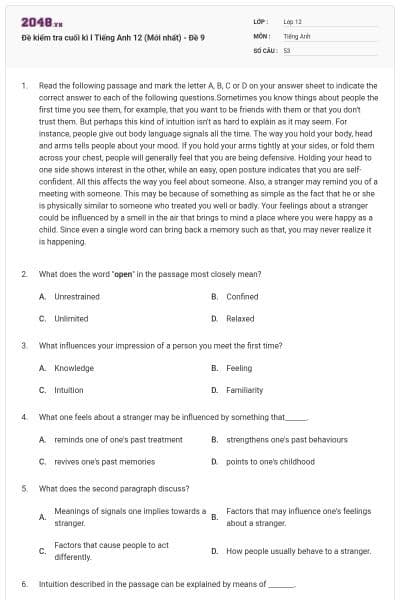
What does the word "open" in the passage most closely mean?
Unrestrained
Confined
Unlimited
Relaxed
Đáp án đúng là: D
Giải thích:
Dựa vào câu: Holding your head to one side shows interest in the other, while an easy, open posture indicates that you are self-confident.
Dịch: Ngửa đầu sang một bên thể hiện sự quan tâm đến đối phương, trong khi tư thế thoải mái, thư giãn cho thấy bạn là người tự tin.
What influences your impression of a person you meet the first time?
Knowledge
Feeling
Intuition
Familiarity
Đáp án đúng là: C
Giải thích:
Dựa vào câu: Sometimes you know things about people the first time you see them, for example, that you want to be friends with them or that you don't trust them. But perhaps this kind of intuition isn't as hard to explàin as it may seem.
Dịch: Đôi khi bạn biết những điều về mọi người ngay lần đầu tiên gặp họ, chẳng hạn như bạn muốn làm bạn với họ hay bạn không tin tưởng họ. Nhưng có lẽ loại trực giác này không khó khám phá như người ta tưởng.
What one feels about a stranger may be influenced by something that .
reminds one of one's past treatment
strengthens one's past behaviours
revives one's past memories
points to one's childhood
Đáp án đúng là: C
Giải thích:
Dựa vào câu: Also, a stranger may remind you of a meeting with someone.
Dịch: Ngoài ra, một người lạ có thể nhắc bạn về cuộc gặp với ai đó.
What does the second paragraph discuss?
Meanings of signals one implies towards a stranger.
Factors that may influence one's feelings about a stranger.
Factors that cause people to act differently.
How people usually behave to a stranger.
Đáp án đúng là: B
Giải thích: nội dung đoạn văn thứ 2 nói về những yếu tố ảnh hưởng đến cảm xúc của một người về 1 người lạ
Intuition described in the passage can be explained by means of .
styles
languages
patterns
behaviour
Đáp án đúng là: D
Giải thích: intuition (n) trực giác ~ behaviour (n) cách cư xử
Mark the letter A, B, C, or D on your answer sheet to indicate the word or phrase that is CLOSEST in meaning to the underlined part in each of the following questions.
He didn’t care for her friends who were always taking part in cyberbullying.
didn’t like
didn’t join
didn’t object
didn’t look after
Đáp án đúng là: D
Giải thích: care for (v) quan tâm, chăm sóc = look after
Dịch: Anh ta không quan tâm đến bạn bè của cô, những người luôn tham gia vào các vụ bắt nạt trên mạng.
Mark the letter A, B, C, or D on your answer sheet to indicate the word or phrase that is CLOSEST in meaning to the underlined part in each of the following questions.
Even if you are rich, you should save some money for a rainy day.
for a time when the weather is bad
for a time when you need it
for a time when you are wealthy
for a time when it is rainy
Đáp án đúng là: B
Giải thích: save money for a raniny day (v) tiết kiệm để khi cần trong tương lài
Dịch: Thậm chí nếu bạn giàu, bạn nên tiết kiệm tiền cho sau này khi bạn cần tiền.
Mark the letter A, B, C, or D on your answer sheet to indicate the underlined part that needs correction in each of the following questions.
Doctors insist that all children are immunized against polio and tuberculosis.
Doctors
that
are immunized
against
Đáp án đúng là: C
Giải thích: insist that + S + (should) + V/ be Vp2 (bị động)
Dịch: Các bác sĩ nhấn mạnh rằng tất cả trẻ em đều được tiêm chủng ngừa bệnh bại liệt và bệnh lào.
Later he specialized at war photography for magazines such as Life, Time, and Newsweek, winning a number of awards.
such as
at
a
Later
Đáp án đúng là: B
Giải thích: specialize in (v) chuyên gia về cái gì
Dịch: Sau đó, anh chuyên chụp ảnh chiến tranh cho các tạp chí như Life, Time và Newsweek, giành được một số giải thưởng.
In generally, social networking sites are good for our society because they help to connect people.
to connect
In generally
because
for
Đáp án đúng là: B
Giải thích: Generally (adv) nói chung
Dịch: Nói chung, các trang mạng xã hội rất tốt cho xã hội của chúng ta vì chúng giúp kết nối mọi người.
Mark the letter A, B, C or D on the answer sheet to indicate the word whose underlined part differs from the other three in pronunciation in each of the following sentences.
downloaded
copied
provided
distributed
Đáp án đúng là: B
Giải thích: đáp án B phần gạch chân đọc là /d/, các đáp án còn lại đọc là /id/
Mark the letter A, B, C or D on the answer sheet to indicate the word whose underlined part differs from the other three in pronunciation in each of the following sentences.
cultural
community
custom
social
Đáp án đúng là: D
Giải thích: đáp án D phần gạch chân đọc là /ʃ/, các đáp án còn lại đọc là /k/
Read the following passage and mark the letter A, B, C or D on your answer sheet to indicate the correct answer to each of the following questions.
Different cultures follow their own special customs when a child's baby teeth fall out. In Korea, for example, they have the custom of throwing lost teeth up on the roof of a house. According to tradition, a magpie will come and take the tooth. Làter, the magpie will return with a new tooth for the child. In other Asian countries, such as Japan and Vietnam, children follow a similar tradition of throwing their lost teeth onto the roofs of houses. Birds aren't the only animals thought to take lost teeth. In Mexico and Spain, tradition says a mouse takes a lost tooth and leaves some money. However, in Mongolia, dogs are responsible for taking teeth away. Dogs are highly respected in Mongolian culture and are considered guardian angels of the people. Tradition says that the new tooth will grow good and strong if the baby tooth is fed to a guardian angel. Accordingly, parents in Mongolia will put their child's lost tooth in a piece of meat and feed it to a dog. The idea of giving lost teeth to an angel or fairy is also a tradition in the West. Many children in Western countries count on the Tooth Fairy to leave money or presents in exchange for a tooth. The exact origins of the Tooth Fairy are a mystery, although the story probably began in England or Ireland centuries ago. According to tradition, a child puts a lost tooth under his or her pillow before going to bed. In the wee hours, while the child is sleeping, the Tooth Fairy takes the tooth and leaves something else under the pillow. In France, the Tooth Fairy leaves a small gift. In the United States, however, the Tooth Fairy usually leaves money. These days, the rate is $1 to $5 per tooth, adding up to a lot of money from the Tooth Fairy!
What is the passage mainly about?
Presents for young children's lost teeth
Traditions concerning children's lost teeth
Customs concerning children's new teeth
Animals eating children's lost teeth
Đáp án đúng là: B
Giải thích: nội dung bài văn nói về những truyền thống liên quan đến chiếc răng bị mất của trẻ em
The word "their" in paragraph 1 refers to .
countries'
roofs'
houses'
children's
Đáp án đúng là: D
Giải thích:
Dựa vào câu: In other Asian countries, such as Japan and Vietnam, children follow a similar tradition of throwing their lost teeth onto the roofs of houses.
Dịch: Ở các nước châu Á khác, chẳng hạn như Nhật Bản và Việt Nam, trẻ em cũng theo truyền thống tương tự là ném chiếc răng đã mất của mình lên nóc nhà.
According to the passage, where is a child's lost tooth thought to be taken away by a mouse?
In Mongolia
In Japan and Vietnam
In Mexico and Spain
In Korea
Đáp án đúng là: C
Giải thích:
Dựa vào câu: In Mexico and Spain, tradition says a mouse takes a lost tooth and leaves some money.
Dịch: Ở Mexico và Tây Ban Nha, truyền thống nói rằng một con chuột sẽ lấy một chiếc răng bị mất và để lại một số tiền.
According to paragraph 2, parents in Mongolia feed their child's lost tooth to a dog because .
they know that dogs are very responsible animals
they believe that this will make their child's new tooth good and strong
they think dogs like eating children's teeth
they hope that their child will get some gifts for his or her tooth
Đáp án đúng là: B
Giải thích:
Dựa vào câu: Tradition says that the new tooth will grow good and strong if the baby tooth is fed to a guardian angel. Accordingly, parents in Mongolia will put their child's lost tooth in a piece of meat and feed it to a dog.
Dịch: Truyền thống nói rằng chiếc răng mới sẽ mọc tốt và chắc khỏe nếu chiếc răng sữa đó được thiên thần hộ mệnh cho ăn. Theo đó, các bậc cha mẹ ở Mông Cổ sẽ nhét chiếc răng đã mất của con mình vào một miếng thịt và cho chó ăn.
The word "origins" in paragraph 3 is closest in meaning to .
beginnings
stories
countries
families
Đáp án đúng là: A
Giải thích: origin (n) ban đầu = beginning
Dịch: Nguồn gốc chính xác của Tiên răng là một bí ẩn, mặc dù câu chuyện có lẽ bắt đầu ở Anh hoặc Ireland từ nhiều thế kỷ trước.
According to the passage, which of the following is NOT true about the tradition of tooth giving in the West?
Children give money to the Tooth Fairy.
Children hope to get money or gifts from the Tooth Fairy.
Lost teeth are traditionally given to an angel or fairy.
Children put their lost teeth under their pillows.
Đáp án đúng là: A
Giải thích:
Dựa vào câu: Many children in Western countries count on the Tooth Fairy to leave money or presents in exchange for a tooth.
Dịch: Nhiều trẻ em ở các nước phương Tây tin tưởng Cô Tiên Răng để lại tiền hoặc quà để đổi lấy một chiếc răng.
The phrase "the wee hours" in paragraph 3 probably refers to the period of time .
soon after midnight
long before bedtime
làte in the morning
early in the evening
Đáp án đúng là: A
Giải thích:
Dựa vào câu: In the wee hours, while the child is sleeping, the Tooth Fairy takes the tooth and leaves something else under the pillow.
Dịch: Vào lúc nửa đêm, trong khi đứa trẻ đang ngủ, Tiên Răng lấy chiếc răng và để một thứ khác dưới gối.
Mark the letter A, B, C, or D on your answer sheet to indicate the word or phrase that is OPPOSITE in meaning to the underlined part in each of the questions.
Insects emerge in the spring and start multiplying rapidly.
disappear
appear
rise
sleep
Đáp án đúng là: A
Giải thích: emerge (v) nổi lên, xuất hiện >< disappear (v) biến mất
Dịch: Côn trùng xuất hiện vào mùa xuân và bắt đầu sinh sôi nhanh chóng.
Mark the letter A, B, C, or D on your answer sheet to indicate the word or phrase that is OPPOSITE in meaning to the underlined part in each of the questions.
Only a minority of people support these new laws so they will not be passed.
shortage
lack
majority
redundancy
Đáp án đúng là: C
Giải thích: minority (n) thiểu số >< majority (n) đa số
Dịch: Chỉ có thiểu số người dân ủng hộ những luật mới này nên chúng sẽ không được thông qua.
Mark the letter A, B, C, or D on your answer sheet to indicate the sentence that is CLOSEST in meaning to the sentence given in each of the following questions.
“Why don’t you take a break and finish it later?” said Jenny to Alan.
Jenny suggested that Alan should take a break and finish it later.
Jenny suggested that Alan had better take a break and finish it later.
Jenny suggested that Alan takes a break and finish it later.
Jenny suggested that Alan must take a break and finish it later.
Đáp án đúng là: A
Giải thích: suggest that + S + should V: khuyến khích ai đó làm gì
Dịch: "Tại sao bạn không nghỉ ngơi và hoàn thành nó sau?" Jenny nói với Alan.
The last time I went swimming was when we were in Spain.
I haven’t gone swimming since we were in Spain.
I only went swimming when we were in Spain.
I hadn’t swum before we were in Spain.
I swam a lot when we were in Spain.
Đáp án đúng là: A
Giải thích: câu trả lời thích hợp nhất (thì hiện tại hoàn thành)
Dịch: Lần cuối cùng tôi đi bơi là khi chúng tôi ở Tây Ban Nha.
The man wanted to get some fresh air so he opened the window.
The man wanted to get some fresh air but he opened the window.
The man opened the window in order to get some fresh air.
Though he man wanted to get some fresh air, he opened the window.
The man opened the window so that he wanted to get some fresh air.
Đáp án đúng là: B
Giải thích: in order to + V :để làm gì
Dịch: Người đàn ông muốn hít thở không khí trong lành nên đã mở cửa sổ.
Emma and Olivia are talking about the presentation that they have made.
Emma: We haven’t done very well, have we?
Olivia: .
What’s wrong with you?
Never mind. At least we tried.
You’re welcome.
I will stand by you.
Đáp án đúng là: B
Giải thích: câu trả lời thích hợp nhất
Dịch: Emma và Olivia đang nói về bài thuyết trình mà họ đã thực hiện.
Emma: Chúng ta làm chưa tốt lắm phải không?
Olivia: Không sao đâu. Ít nhất thì chúng ta đã cố gắng.
On the bus.
Addison: Do you have the time please?
Lilly: _______________
Yes, I have some time for you.
I’m busy right now. I’m afraid.
I’m very sorry. I am already làte.
I’m sorry I don’t have a watch here.
Đáp án: D
Giải thích:
Câu “Do you have the time, please?” nghĩa là hỏi giờ.
Câu trả lời hợp lý nhất là D. I’m sorry I don’t have a watch here (Xin lỗi, tôi không có đồng hồ ở đây).
Các đáp án khác:
A. Yes, I have some time for you → hiểu sai, nghĩa là "tôi có thời gian cho bạn" (hỏi về thời gian rảnh chứ không phải hỏi giờ).
B. I’m busy right now. I’m afraid → nói đang bận, không phù hợp.
C. I’m very sorry. I am already late → than phiền về việc đến muộn, không trả lời đúng câu hỏi.
Chọn D.
Dịch: Trên xe buýt.
Addison: Bạn có biết mấy giờ rồi không?
Lilly: Xin lỗi, tôi không có đồng hồ ở đây.
The are sources of information and news such as newspapers, magazines, radio and television, that reach and influence làrge numbers of people.
social media
mass media
social networking
instant messaging
Đáp án đúng là: B
Giải thích: mass media (n) phương tiện thông tin đại chúng
Dịch: Các phương tiện thông tin đại chúng là các nguồn thông tin và tin tức như báo, tạp chí, đài phát thanh và truyền hình, có thể tiếp cận và ảnh hưởng đến một số lượng lớn người dân.
We take having an endless supply of clean water , and may suffer from that sooner or làter.
at granted
for granting
for granted
at granting
Đáp án đúng là: C
Giải thích: take for granted (v) coi là đương nhiên
Dịch: Chúng ta coi việc có nguồn cung cấp nước sạch vô tận là điều hiển nhiên, và sớm muộn gì cũng có thể bị như vậy.
Immigrants faced , and were paid considerably less than their white colleagues.
discrimination
community
experience
integration
Đáp án đúng là: A
Giải thích: discrimination (n) sự phân biệt đối xử
Dịch: Những người nhập cư phải đối mặt với sự phân biệt đối xử và được trả lương thấp hơn đáng kể so với các đồng nghiệp da trắng của họ.
Moving to London was a bit of a after ten years of living in his country
culture shock
cultural practice
custom
tradition
Đáp án đúng là: A
Giải thích: culture shock (n) sốc văn hóa
Dịch: Chuyển đến London là một cú sốc văn hóa sau mười năm sống ở đất nước của anh ấy
The temperature dropped suddenly last night, means that the shoots emerging from the soil will be killed by the frost.
which
why
that
who
Đáp án đúng là: A
Giải thích: đại từ quan hệ thay thế cả 1 mệnh đề
Dịch: Nhiệt độ giảm đột ngột vào đêm qua, có nghĩa là những chồi non trồi lên khỏi đất sẽ bị chết bởi sương giá.
kangaroos are large marsupials that are found only in Australia.
An
A
No article
The
Đáp án đúng là: C
Giải thích: danh từ nói chung không xác định
Dịch: Chuột túi là loài thú có túi lớn chỉ được tìm thấy ở Úc.
Yesterday, Mark tired because he to work.
is/ had walked
is/ has walked
was/ has walked
was/ had walked
Đáp án đúng là: D
Giải thích: “yesterday” đi với thì quá khứ
Dịch: Hôm qua anh ấy rất mệt vì phải đi bộ đi làm.
Many minority groups are struggling to maintain their cultural .
identifying
identity
identification
identify
Đáp án: B
Giải thích:
Kiến thức: Từ vựng – Từ loại
A. identifying (V-ing): nhận dạng
B. identity (n): danh tính, bản sắc riêng
C. identification (n): nhận dạng
D. identify (v): nhận dạng
Vị trí cần điền là một danh từ đứng sau tính từ sở hữu “their” và được bổ nghĩa bởi tính từ “cultural”.
Ta có: cultural identity: bản sắc văn hóa
Dịch: Nhiều nhóm thiểu số đang phải đấu tranh để duy trì bản sắc văn hóa của mình.
You shouldn’t expect immigrants to into a new culture immediately.
connect
maintain
update
assimilate
Đáp án đúng là: D
Giải thích: assimilate into (v) đồng hóa thành
Dịch: Bạn không nên mong đợi những người nhập cư sẽ hòa nhập vào một nền văn hóa mới ngay lập tức.
companies are offering flexible schedules to employees.
More than
More and more
More or less
Less and less
Đáp án đúng là: B
Giải thích: more and more + N: càng ngày càng nhiều
Dịch: Ngày càng có nhiều công ty đưa ra lịch trình linh hoạt cho nhân viên
She needn't rely any more Rico - or her brothers, she could be entirely independent
at
on
to
against
Đáp án đúng là: B
Giải thích: rely on (v) dựa dẫm, phụ thuộc vào ai đó
Dịch: Cô ấy không cần phải dựa vào Rico nữa - hoặc các anh trai của cô ấy, cô ấy có thể hoàn toàn tự lập
Until recently, mass media forms were classified six categories, each of which has its own characteristic content types, creative artists and business models.
from
into
by
to
Đáp án đúng là: B
Giải thích: classify into (v) phân loại thành
Dịch: Cho đến gần đây, các hình thức truyền thông đại chúng được phân thành sáu loại, mỗi loại có loại nội dung đặc trưng, nghệ sĩ sáng tạo và mô hình kinh doanh.
He in the library for three hours and he needs a rest.
had studied
has been studying
has studied
is studying
Đáp án đúng là: B
Giải thích: “for + khoảng thời gian” đi với thì hiện tại hoàn thành
Dịch: Anh ấy học ở thư viện 3 tiếng rồi và anh aasycaafn nghỉ ngơi.
foods are produced through farming practices that only use natural substances. This means avoiding all artificial chemicals, hormones, antibiotics, and GMOs.
Inorganic
Inorganically
Organic
Organically
Đáp án đúng là: C
Giải thích: organic food (n) thực phẩm hữu cơ
Dịch: Thực phẩm hữu cơ được sản xuất thông qua thực hành canh tác chỉ sử dụng các chất tự nhiên. Điều này có nghĩa là tránh tất cả các hóa chất nhân tạo, hormone, kháng sinh và GMO.
she joined the company only a year ago, she's already been promoted twice.
So
Although
Because
However
Đáp án đúng là: B
Giải thích: nối 2 mệnh đề đối lập
Dịch: Mặc dù mới gia nhập công ty một năm trước nhưng cô ấy đã được thăng chức hai lần.
Mark the letter A, B, C, or D on your answer sheet to indicate the word that differs from the other three in the position of primary stress in each of the following questions.
identity
presentation
hypertension
dedication
Đáp án đúng là: A
Giải thích: đáp án A trọng âm rơi vào âm tiết thứ 2, các đáp án còn lại trọng âm rơi vào âm tiết thứ 3
Mark the letter A, B, C, or D on your answer sheet to indicate the word that differs from the other three in the position of primary stress in each of the following questions.
maintain
media
accept
protect
Đáp án đúng là: B
Giải thích: đáp án B trọng âm rơi vào âm tiết thứ 1, các đáp án còn lại trọng âm rơi vào âm tiết thứ 2
Mark the letter A, B, C, or D on your answer sheet to indicate the sentence that best combines each pair of sentences in the following sentences.
Some kinds of fish live in fresh water. Others live in sea water.
Some kinds of fish live in fresh water, for others live in sea water.
Some kinds of fish live in fresh water, or others live in sea water.
Some kinds of fish live in fresh water, and others live in sea water.
Some kinds of fish live in fresh water, so others live in sea water.
Đáp án: C
Giải thích:
Kiến thức: Liên từ kết hợp (Coordinating conjunctions)
Câu gốc gồm hai mệnh đề thể hiện hai sự thật song song:
Một số loài cá sống ở nước ngọt.
Một số loài khác sống ở nước mặn.
Khi nối hai mệnh đề cùng tồn tại, bổ sung thông tin, ta dùng liên từ "and".
Xét các đáp án khác:
A. for: mang nghĩa "bởi vì" → sai vì không có quan hệ nguyên nhân – kết quả.
B. or: mang nghĩa "hoặc" → sai vì đây không phải sự lựa chọn.
D. so: mang nghĩa "vì vậy" → sai vì không có kết quả kéo theo.
Dựa vào quan hệ bổ sung, chọn C.
Dịch: Một số loài cá sống ở nước ngọt, và những loài khác sống ở nước mặn.
She tried very hard to pass the driving test. She could hardly pass it.
No matter how hard she tried, she could hardly pass the driving test.
She tried very hard, so she passed the driving test satisfactorily.
Although she didn’t try hard to pass the driving test, she could pass it.
Despite being able to pass the driving test, she didn’t pass it.
Đáp án đúng là: A
Giải thích: câu trả lời thích hợp nhất
Dịch: Cô ấy đã rất cố gắng để vượt qua kỳ thi sát hạch lái xe. Cô khó có thể vượt qua nó.
In the United States and Canada, it is very important to (46) a person directly in the eyes when you are having a conversation with him or her.
look
talk
get
notice
Đáp án đúng là: A
Giải thích: look somebody in the eyes (v) nhìn ai đó
Dịch: Ở Hoa Kỳ và Canada, điều rất quan trọng là bạn phải nhìn thẳng vào mắt một người khi bạn trò chuyện với họ.
that person will think that you are not interested in (47) he or she is saying.
what
where
which
that
Đáp án đúng là: A
Giải thích: đại từ quan hệ
Dịch: Nếu bạn nhìn xuống hoặc sang một bên khi người kia đang nói, người đó sẽ nghĩ rằng bạn không quan tâm đến những gì họ đang nói.
This,(48) , is not polite. If you look down or to the side when you are talking, it might seem that you are not honest.
although
yet
in addition
of course
Đáp án đúng là: D
Giải thích: câu trả lời thích hợp nhất
Dịch: Vâng, như vậy đương nhiên là không lịch sự
However, people who are speaking will sometimes look away for a few seconds when they are thinking or (49) to find the right word.
achieving
trying
managing
looking
Đáp án đúng là: B
Giải thích: try to V (v) cố gắng làm gì đó
Dịch: Tuy nhiên, những người đang nói đôi khi sẽ nhìn đi chỗ khác trong vài giây khi họ đang suy nghĩ hoặc cố gắng tìm từ thích hợp.
These social "rules" are (50) for two men, two women, a man and a woman, or an adult and a child.
likely
like
such as
the same
Đáp án đúng là: D
Giải thích: câu trả lời thích hợp nhất
Dịch: Những “quy tắc” xã hội này đều giống nhau đối với hai nam, hai nữ, một nam và một nữ, hoặc người lớn và trẻ em.
Bạn có thích hoạt động này không?