Đề kiểm tra cuối kì I Tiếng Anh 12 (Mới nhất) - Đề 17
50 câu hỏi
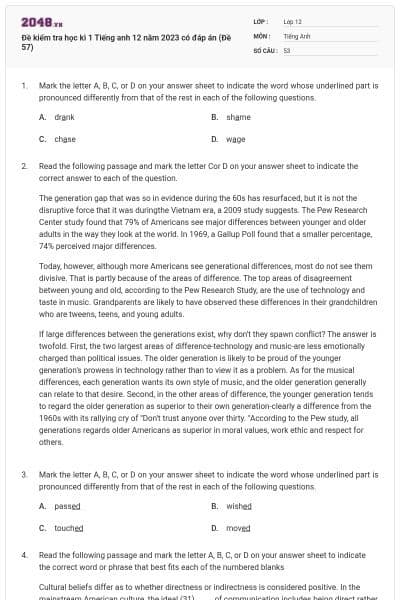
Mark the letter A, B, C, or D on your answer sheet to indicate the word whose underlined part is pronounced differently from that of the rest in each of the following questions.
drank
shame
chase
wage
Đáp án đúng là: A
Giải thích: đáp án A phần gạch chân phát âm là /ei/, các đáp án còn lại phát âm là /a/
Mark the letter A, B, C, or D on your answer sheet to indicate the word whose underlined part is pronounced differently from that of the rest in each of the following questions.
passed
wished
touched
moved
Đáp án đúng là: D
Giải thích: đáp án D phần gạch chân phát âm là /d/, các đáp án còn lại phát âm là /t/
Mark the letter A, B, C, or D on you answer sheet to indicate the word that differs from position of the main stress in each of the following questions.
appear
settle
obtain
employ
Đáp án đúng là: B
Giải thích: đáp án B có trọng âm rơi vào âm tiết thứ 1, các từ còn lại trọng âm rơi vào âm tiết thứ 2
Mark the letter A, B, C, or D on you answer sheet to indicate the word that differs from position of the main stress in each of the following questions.
A. difference
comedy
character
importance
Đáp án đúng là: D
Giải thích: đáp án D có trọng âm rơi vào âm tiết thứ 2, các từ còn lại trọng âm rơi vào âm tiết thứ 1
Your sister informed them of her health situation,_____?
did she
did they
didn’t they
didn't she
Đáp án đúng là: D
Giải thích: câu hỏi đuôi chủ ngữ là “she”, vế trước là khẳng định nên câu hỏi đuôi là phủ định
Dịch: Em gái bạn đã thông báo cho họ về tình hình sức khỏe của cô ấy phải không?
Most children enjoy_____ with their parents and siblings.
play
to play
playing
played
Đáp án đúng là: C
Giải thích: enjoy + Ving (v) thích làm gì
Dịch: Hầu hết trẻ em thích chơi với bố mẹ và anh chị của chúng.
I do not mind your using my bike____you take care of it.
although
for the fear that
provided that
unless
Đáp án: C
Giải thích:
A. although: mặc dù
B. for the fear that: vì sợ rằng
C. provided that: miễn là
D. unless: trừ khi, nếu không
Dựa vào nghĩa, chọn C.
Dịch: Tôi không phiền nếu bạn sử dụng xe đạp của tôi miễn là bạn bảo quản nó cẩn thận.
He fell down when he____towards the church.
ran
runs
was running
had run
Đáp án đúng là: C
Giải thích: diễn tả hành động này đang diễn ra thì hành động khác bất chợt xen vào
Dịch: Anh ấy bị ngã khi đang chạy tới nhà thờ.
I will call and tell you something interesting____.
before I came home after work
when I come home after work
while I was coming home after work
after I had come home after work
Đáp án đúng là: B
Giải thích: “will là thì tương lai đơn nên trong các đáp án chỉ có đáp án B là thì hiện tại đơn là đúng
Dịch: Mình sẽ gọi điện và kể cho cậu nghe 1 điều rất thú vị khi mình về nhà sau khi xong việc.
My uncle lives a happy life _____his disability.
in spite of
because
because of
though
Đáp án đúng là: A
Giải thích: in spite of + N/Ving: mặc dù
Dịch: Chú tôi sống một cuộc sống hạnh phúc mặc dù chú bị khuyết tật.
They were all surprised______her amazing performance yesterday.
from
at
in
on
Đáp án đúng là: B
Giải thích: be surprised at/by something (v) ngạc nhiên về …
Dịch: Tất cả đều ngạc nhiên về màn trình diễn tuyệt vời của cô ấy ngày hôm qua.
My favorite hobby is watching the work_______by Shakespeare.
writing
wrote
written
which is written
Đáp án đúng là: C
Giải thích: mệnh đề quan hệ rút gọn dạng bị động Vp2
Dịch: Sở thích của tôi là xem các tác phẩm được viết bởi Shakespeare.
Mark enjoys having fun by causing trouble. He's a very_____boy.
strong-willed
mischievous
obedient
well-behaved
Đáp án đúng là: B
Giải thích: mischievious (adj) hư, nghịch ngợm
Dịch: Mark thích tìm niềm vui bằng cách gây rắc rối. Câu ấy là một cậu bé rất nghịch ngợm.
The jobs give you lots of chances to travel abroad; it's certainly a very _____offer.
attraction
attracted
attractive
attractively
Đáp án đúng là: C
Giải thích: mạo từ + adj + N, “offer” là danh từ nên cần tính từ đứng trước
Dịch: Các công việc mang đến cho bạn nhiều cơ hội đi du lịch nước ngoài; đó chắc chắn là một đề nghị rất hấp dẫn.
He spent the entire night thinking and in the end ______a brilliant idea.
came up to
came up with
catch up with
get through to
Đáp án đúng là: B
Giải thích: come up with (v) nảy ra ý tưởng
Dịch: Anh ấy dành cả đêm nghĩ ngợi và cuối cùng cũng nảy ra một ý tưởng xuất sắc.
He refused to ________to the local customs, which caused him a lot of troubles.
conform
resist
hinder
obey
Đáp án đúng là: A
Giải thích: conform (v): làm theo, tuân theo
Dịch: Anh ấy đã từ chối tuân theo phong tục địa phương, và điều đó đã gây cho anh ta nhiều rắc rối.
The bank will insist you produce a driving _____or passport as a form of ID.
certificate
degree
licence
diploma
Đáp án đúng là: C
Giải thích: licence (n) giấy phép / driving licence (n) giấy phép lái xe
Dịch: Ngân hàng sẽ yêu cầu bạn xuất trình giấy phép lái xe hoặc hộ chiếu dưới dạng ID.
Nobody took any _____of the warning and they went swimming in the contaminated water
information
attention
sight
notice
Đáp án đúng là: D
Giải thích: take notice (v) nhận thông báo
Dịch: Không ai nhận được bất kỳ thông báo nào về cảnh báo và họ đã đi bơi trong vùng nước bị ô nhiễm.
My mother doesn't________eye to eye with my father sometimes.
glance
see
look
agree
Đáp án đúng là: B
Giải thích: See eye to eye with some one (v) đồng quan điểm với ai.
Dịch: Mẹ tôi thỉnh thoảng không cùng quan điểm với ba tôi.
Mark the letter A, B, C, or D to indicate the word or phrase that is CLOSEST in meaning to the underlined part in each of the following questions.
My husband always gives me a hand with repairing the broken things in my house.
assists me by
asks me to help with
pleases me by
serves me with
Đáp án đúng là:
Giải thích: gives someone a hand (v) = assist someone (v) giúp đỡ, hỗ trợ ai
Dịch: Chồng tôi luôn giúp tôi sửa chữa những thứ hỏng hóc trong nhà.
Mark the letter A, B, C, or D to indicate the word or phrase that is CLOSEST in meaning to the underlined part in each of the following questions.
It took me a very long time to recover from the shock of her death.
turn off
take on
get over
keep up with
Đáp án đúng là: C
Giải thích: recover from (v) = get over (v) vượt qua
Dịch: Tôi mất rất nhiều thời gian để vượt qua cái chết của cô ấy
Mark the letter A, B, C, or D on your answer sheet to indicate the word(s) OPPOSITE in meaning to the underlined word(s) in each of the following questions.
My cousin tends to look on the bright side in any circumstance.
be optimistic
be pessimistic
be confident
be smart
Đáp án đúng là: B
Giải thích: look on the bright side (v) lạc quan >< be pessimistic (v) bi quan
Dịch: Anh họ của tôi thường lạc quan trong mọi hoàn cảnh.
Mark the letter A, B, C, or D on your answer sheet to indicate the word(s) OPPOSITE in meaning to the underlined word(s) in each of the following questions.
In some countries, the disease burden could be prevented through environmental improvements.
something to stiffer
something enjoyable
something sad
something to entertain
Đáp án đúng là: B
Giải thích: burden (n): gánh nặng >< something enjoyable (n) cái gì đó thú vị
Dịch: Ở một vài nước, gánh nặng bệnh tật có thể được ngăn chặn nhờ cải thiện môi trường.
Mark the letter A, B, C or D on your answer sheet to indicate the most suitable response to complete each of the following exchanges.
Two friends Mai and Nam are talking about Nam's new cell phone.
- Mai: "Wow, I've never seen such a nice cell phone, Nam."
-Nam: “_________”
Thank you. I'm glad you like it.
I agree with you.
You're welcome.
Oh, i don’t know.
Đáp án đúng là: A
Giải thích: đáp lại lời khen
Dịch: Mai và Nam đang nói về điện thoại di động mà Nam vừa mua.
Mai: “Wow, tớ chưa từng thấy chiếc điện thoại nào đẹp như vậy đó Nam.”
Nam: “Cảm ơn. Mình rất vui khi bạn thích nó.”
Sue and Mike are talking about the use of mobile phone in class.
- Sue: "Students should not be allowed to use mobile phones in class."
- Mike: " ______. This will distract them from studying"
No way! It's useful.
Not really
I couldn't agree more.
I'm of the opposite opinion.
Đáp án đúng là: C
Giải thích: đồng tình với quan điểm
Dịch: Sue và Mira đang nói về việc sử dụng điện thoại trong lớp học.
Sue: “Sinh viên không nên được cho phép sử dụng điện thoại đi động trong lớp.”
Mira: “Tôi đồng tình với bạn. Điều này sẽ khiến học sinh bị sao nhãng.”
Which of the following could be the main idea of the passage?
Different points of view are the main problem between generations in America.
Generation gap doesn't cause a big problem in American families.
The areas of difference in generation gap have changed over the years.
The generation gap in the past was different from that in the modern time.
Đáp án đúng là: B
Giải thích: Nội dung đoạn văn nói về khoảng cách thế hệ không gây ra các vấn đề chính trong gia đình Mỹ
The word "them" in second paragraph refers to_______.
adults
Americans
differences
areas
Đáp án đúng là: C
Giải thích:
Dựa vào câu: Today, however, although more Americans see generational differences, most do not see them divisive.
Dịch: Tuy nhiên, ngày nay, mặc dù nhiều người Mỹ nhìn thấy sự khác biệt thế hệ hơn, nhưng hầu hết không thấy chúng gây chia rẽ.
The word "prowess" in the third paragraph is closest in meaning to______.
skill
enrichment
creation
awareness
Đáp án đúng là: A
Giải thích:
Dựa vào câu: The older generation is likely to be proud of the younger generation's prowess in technology rather than to view it as a problem.
Dịch: Thế hệ trước có khả năng tự hào về sức mạnh công nghệ của thế hệ trẻ hơn là coi đó là một vấn đề.
According to paragraph 3, what are the two reasons why large differences between generations don't cause disagreement?
The generosity of the elder generation and the attitude of the younger generation.
The different styles of music and the knowledge of the elder generation.
The pride of the elder generation and the obedience of the younger one
The major areas of difference between generations and the respect for the elder generation.
Đáp án đúng là: D
Giải thích:
Dựa vào câu: First, the two largest areas of difference-technology and music-are less emotionally charged than political issues.
Second, in the other areas of difference, the younger generation tends to regard the older generation as superior to their own generation-clearly a difference from the 1960s with its rallying cry of "Don't trust anyone over thirty. "
Dịch: Thứ nhất, hai lĩnh vực lớn nhất của sự khác biệt-công nghệ và âm nhạc-ít mang tính cảm xúc hơn các vấn đề chính trị.
Thứ hai, trong các lĩnh vực khác biệt khác, thế hệ trẻ có xu hướng coi thế hệ già hơn là vượt trội so với thế hệ của họ - một sự khác biệt rõ ràng so với những năm 1960 với lời kêu gọi sôi nổi "Đừng tin ai trên ba mươi tuổi".
According to the passage, which is NOT true?
Grandparents feel uncomfortable with their grandchildren because of their better technology skills.
The majority of Americans agree that there are major differences in generations' viewpoints.
The elderly in America are admired in moral values, work ethics and respect for others.
Technology is one of the two biggest areas creating the gap between the old and the young
Đáp án đúng là: A
Giải thích:
Dựa vào câu: According to the Pew study, all generations regards older Americans as superior in moral values, work ethic and respect for others.
First, the two largest areas of difference-technology and music-are less emotionally charged than political issues.
The older generation is likely to be proud of the younger generation's prowess in technology rather than to view it as a problem.
Dịch: Theo nghiên cứu Pew, tất cả các thế hệ coi người Mỹ lớn tuổi là người vượt trội về giá trị đạo đức, tinh thần làm việc và tôn trọng người khác.
Thứ nhất, hai lĩnh vực lớn nhất của sự khác biệt-công nghệ và âm nhạc-ít mang tính cảm xúc hơn các vấn đề chính trị.
Thế hệ trước có khả năng tự hào về sức mạnh công nghệ của thế hệ trẻ hơn là coi đó là một vấn đề.
In the mainstream American culture, the ideal (31) _____of communication includes being direct rather than indirect ( "ideal" here means that the culture values this style, although not everyone speaks directly).
phrase
form
shape
word
Đáp án đúng là: B
Giải thích: form of communication (n) hình thức giao tiếp
Dịch: Trong văn hóa chính thống của Mỹ, hình thức giao tiếp lý tưởng bao gồm giao tiếp trực tiếp và giao tiếp gián tiếp.
There are several expressions in English (32)______ emphasize the importance of being direct: "Get to the point!
when
what
who
which
Đáp án đúng là: D
Giải thích: đại từ quan hệ
Dịch: Có một số cụm từ tiếng Anh mà nhấn mạnh tầm quan trọng của giao tiếp trực tiếp
(33) _____, in some countries, there are different ways to disagreement.
Frankly
Differently
Similarly
Honestly
Đáp án đúng là: C
Giải thích: Similarly (adv) một cách tương tự
Dịch: Ở Nhật Bản, có ít nhất mười lăm cách nói "Không" mà không thực sự nói ra từ đó. Tương tự, ở một số quốc gia, có những cách khác nhau để gây bất đồng.
(34) ____Americans believe that "honesty is the best policy" and their communication style reflects this.
A lot
Each
Many
Every
Đáp án đúng là: C
Giải thích: many + N số nhiều
Dịch: Nhiều người Mỹ tin rằng "trung thực là chính sách tốt nhất" và phong cách giao tiếp của họ phản ánh điều này.
Honesty and directness in communication are strongly related. It is not a(n)(35)_______
anger
surprise
disappointment
interest
Đáp án đúng là: B
Giải thích: surprise (n) sự ngạc nhiên
Dịch: Do đó, không có gì ngạc nhiên khi phát hiện ra rằng các nhóm văn hóa đánh giá sai về nhau dựa trên những niềm tin khác nhau về sự thẳng thắn và trung thực trong giao tiếp.
Read the following passage and mark the letter A, B, C, or D on your answer sheet to indicate the correct answer to each of the following questions.
The word "robot" first appeared in a 1921 stage play by Czech writer Karel Capek. In the play, a man makes a machine that can think, which he calls a robot and which ends up killing its owner. In the 1940s, the American science fiction writer, Isaac Asimov, wrote a series of stories about robots and invented the term "robotics", the science of robots. Meanwhile, in the real world, the first robots were developed by an engineer, Joseph F.Engelberger, and an inventor, George C. Devol. Together they started Unimation, a manufacturing company that produced the first real robot in 1961, called the Unimate. Robots of this type were installed at a General Motors automobile plant and proved to be a success. They worked reliably and saved money for General Motors, so other companies were soon acquiring robots as well. These industrial robots were nothing like the terrifying creatures that can often be seen in science fiction films. In fact, these robots looked and behaved nothing like humans. They were simply pieces of computer-controlled machines, with metal "arms" or "hands". Since they were made of metal, they could perform certain jobs that were difficult or dangerous for humans, particularly jobs that involve high heat. And since robots were tireless and never got hungry, sleepy, or distracted, they were useful for tasks that would be tiring or boring for humans. Industrial robots have been improved over the years, and today they are used in many factories around the world. Though the use of robots has meant the loss of some jobs, at the same time other jobs have been created in the design, development, and production of the robots. Outside of industry, robots have also been developed and put into use by governments and scientists in situations where humans might be in danger. For example, they can be sent in to investigate an unexploded bomb or an accident at a nuclear power plant. Researchers also use robots to collect samples of hot rocks or gases in active volcanoes. In space exploration, robots have performed many key tasks where humans could not be present, such as on the surface of Mars. In 2004, two robotic Rovers, small six-wheeled computerized cars,were sent to Mars.
When did the word "robot" appear?
before the 1920s
in the early 1920s
in the mid-1920s
in the late 1920s
Đáp án đúng là: A
Giải thích:
Dựa vào câu: The word “robot” first appeared in a 1921 stage play by Czech writer Karel Capek
Dịch: Từ Robot xuất hiện lần đầu tiên trong một vở kịch năm 1921 của nhà văn người Séc Karel Capek
Which of these statements is TRUE about Karel Capek?
He was famous American playwright.
He was the first to create the word "robot".
He invented a machine that can think like humans.
He made a robot kill a person.
Đáp án đúng là: B
Giải thích:
Dựa vào câu: The word “robot” first appeared in a 1921 stage play by Czech writer Karel Capek
Dịch: Từ Robot xuất hiện lần đầu tiên trong một vở kịch năm 1921 của nhà văn người Séc Karel Capek
What does the word “they” in paragraph 2 refer to?
terrifying creatures
humans
science fiction films
industrial robots
Đáp án đúng là: D
Giải thích:
Dựa vào câu: These industrial robots were nothing like the terrifying creatures that can often be seen in science fiction films. In fact, these robots looked and behaved nothing like humans. They were simply pieces of computer-controlled machinery, with metal “arms” or “hands”.
Dịch: Những robot công nghiệp này không giống những sinh vật đáng sợ thường thấy trong các bộ phim khoa học viễn tưởng. Trên thực tế, những robot này nhìn và cư xử không giống con người. Chúng chỉ đơn giản là những mảnh máy móc được điều khiển bằng máy tính, với những cánh tay kim loại, hay tay cầm kim loại.
What are industrial robots like?
Theyare computer-controlled machines.
They are built with metal arms and legs.
They behave like humans.
They can think like humans
Đáp án đúng là: A
Giải thích:
Dựa vào câu: They were simply pieces of computer-controlled machinery, with metal “arms” or “hands”.
Dịch: Chúng chỉ đơn giản là những mảnh máy móc được điều khiển bằng máy tính, với những cánh tay kim loại, hay tay cầm kim loại.
Which of the following is NOT mentioned as a characteristic of robots?
They never need food to survive.
They can survive without any sleep.
They are tired like humans.
They can do jobs involving intense heat.
Đáp án đúng là: C
Giải thích:
Dựa vào câu: And since robots were tireless and never got hungry, sleepy, or distracted, they were useful for tasks that would be tiring or boring for humans.
Dịch: Và vì robot không mệt mỏi và không bao giờ bị đói, buồn ngủ hoặc mất tập trung, chúng rất hữu ích cho các nhiệm vụ sẽ gây nhàm chán hoặc nhàm chán cho con người.
What can be inferred from the passage about robots?
Their appearance negatively affects the job market.
They can stop active volcanoes from erupting.
They help humans travel to the outer space.
They take away some jobs but offer some in return.
Đáp án đúng là: D
Giải thích:
Dựa vào câu: Though the use of robots has meant the loss of some jobs, at the same time other jobs have been created in the design, development, and production of the robots.
Dịch: Thông qua việc sử dụng robot có nghĩa là mất một số công việc, nhưng đồng thời các công việc khác đã được tạo ra trong việc thiết kế, phát triển và sản xuất robot.
Which of the following best paraphrases the sentence in bold in the first paragraph?
Because they were reliable and economical to General Motors, other companies started to use robots.
Other companies started to produce reliable and efficient robots for General Motors.
Every other company made use of robots because they were time-consuming and safe.
Robots worked well for General Motors, but caused certain trouble to others.
Đáp án đúng là: A
Giải thích:
Dựa vào câu: Robots of this type were installed at a General Motors automobile plant and proved to be a success. They worked reliably and saved money for General Motors, so other companies were soon acquiring robots as well.
Dịch: loại robot này đã được lắp đặt tại một nhà máy ô tô của General Motors và được chứng minh là thành công. Họ đã làm việc đáng tin cậy và tiết kiệm tiền cho General Motors, vì vậy các công ty khác cũng sớm mua lại robot.
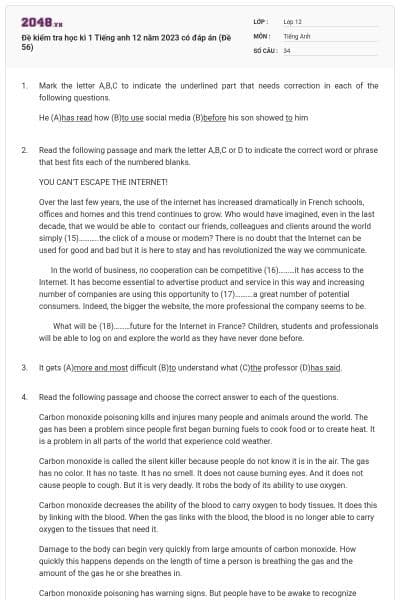
Mark the letter A, B, C or D on your answer sheet to indicate the underlined part that need to be corrected in each of the following questions.
Wood is an excellent resource for heating homes, cooking food and build houses.
an excellent.
for
homes
build
Đáp án đúng là: D
Giải thích: for + Ving
Dịch: Gỗ là một nguồn tài nguyên tuyệt vời để sưởi ấm nhà, nấu thức ăn và xây nhà.
Two thirds of the victims in the tsunami has remained missing.
thirds
in
has remained
missing
Đáp án đúng là: C
Giải thích: thì quá khứ đơn
Dịch: 2/3 nạn nhân trong vụ sóng thần vẫn chưa được tìm thấy.
Nutritious disorders can affect any system in the body and the senses of sight, taste and smell.
Nutritious
affect
senses
smell
Đáp án đúng là: A
Giải thích: disorders là danh từ, cần tính từ đứng trước.
Nutritious có nghĩa là bổ dưỡng hay lành mạnh để ăn.
Nutritional liên quan đến quá trình dinh dưỡng - có nghĩa là, sử dụng thực phẩm để hỗ trợ cuộc sống và duy trì sức khỏe.
Dịch: Rối loạn dinh dưỡng có thể ảnh hưởng đến bất kỳ hệ thống nào trong cơ thể và các giác quan về thị giác, vị giác và khứu giác.
Mark the letter A, B, C, or D on your answer sheet to indicate the sentence that is closest in meaning to each of the following questions.
It's optional for students to learn French in this school.
Students needn't learn French in this school.
Students mustn't learn French in this school.
Students might learn French in this school.
Students must learn French in this school.
Đáp án đúng là: A
Giải thích: be optional to V: không bắt buộc phải làm gì = needn’t V
Dịch: Không bắt buộc học sinh học tiếng Pháp trong trường này.
"You'd better stay at home during this time", he said to Lam
He thanked Ann for staying at home during that time.
He ordered Ann to stay at home during that time.
He warned Ann against staying at home during that time.
He advised Ann to stay at home during that time.
Đáp án: D
Giải thích:
had better V-nguyên thể: nên làm gì = advise sb to V: khuyên ai làm gì
thank sb for V-ing: cảm ơn ai vì …
order sb to V: yêu cầu, ra lệnh cho ai làm gì
warn sb against V-ing: cảnh báo ai không làm gì
Dịch: “Cậu nên ở nhà trong thời gian này,” anh nói với Lâm.
A. Anh ấy cảm ơn Lâm vì đã ở nhà trong thời gian đó. → sai nghĩa
B. Anh ta ra lệnh cho Lâm ở nhà trong thời gian đó. → sai nghĩa
C. Anh ấy đã cảnh báo Lâm không nên ở nhà trong thời gian đó. → sai nghĩa
D. Anh ấy khuyên Lâm nên ở nhà trong thời gian đó.
Chọn D.
Joe is more hard-working than his brother.
Joe is not as hard-working as his brother.
Joe's brother is not as hard-working as he is.
Joe is less hard-working than his brother.
Joe's brother is more hard-working than he is.
Đáp án đúng là: B
Giải thích: so sánh ngang bằng: as + adj/adv + as
Dịch: Joe thì chăm chỉ hơn em trai của anh ấy
Mark the letter A, B, C, or D on your answer sheet to indicate the sentence that best combines of each pair of sentences in the following questions.
His parents are away on holiday. He really needs their help now.
As long as his parents are at home, they will be able to help him.
He wishes his parents were at home and could help him now.
If his parents are at home, they can help him now.
If only his parents had been at home and could have helped him.
Đáp án đúng là: B
Giải thích: Câu ước ở hiện tại
Dịch: Bố mẹ anh ấy đi nghỉ. Anh ấy thực sự cần sự giúp đỡ của họ lúc này.
He finally contracted the disease. He was aware of the importance of preventive measures only then.
But for his awareness of the importance of preventive measures, he could have contracted the disease.
Hardly had he been aware that preventive measures were essential when he contracted the disease.
Not until he was aware of the importance of preventive measures did he contract the disease.
Only after he had contracted the disease was he aware that preventive measures were essential.
Đáp án đúng là: D
Giải thích: đảo ngữ Only after + N/Ving/mệnh đề + trợ động từ + S +V
Dịch: Cuối cùng anh ấy cũng mắc bệnh. Khi đó anh mới nhận thức được tầm quan trọng của các biện pháp phòng ngừa.
Bạn có thích hoạt động này không?