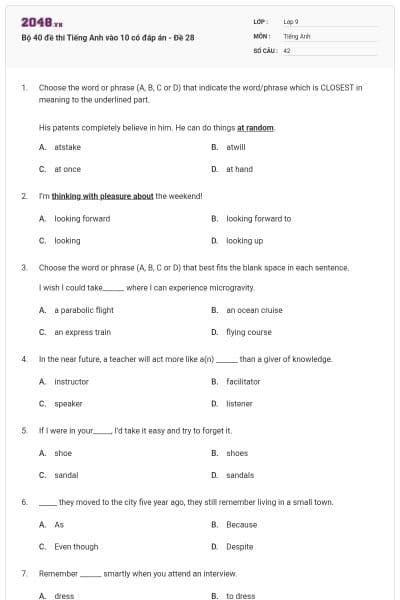
Bộ 40 đề thi Tiếng Anh vào 10 có đáp án - Đề 28
40 câu hỏi
Choose the word or phrase (A, B, C or D) that indicate the word/phrase which is CLOSEST in meaning to the underlined part.
His patents completely believe in him. He can do things at random.
atstake
atwill
at once
at hand
Đáp án B
looking forward
looking forward to
looking
looking up
Đáp án B
Choose the word or phrase (A, B, C or D) that best fits the blank space in each sentence.
a parabolic flight
an ocean cruise
an express train
flying course
Đáp án A
instructor
facilitator
speaker
listener
Đáp án B
shoe
shoes
sandal
sandals
Đáp án B
As
Because
Even though
Despite
Đáp án C
dress
to dress
dressing
dressed
Đáp án B
has it
does it
hasn’t it
dosen’t it
Đáp án A
first
second
most
one
Đáp án B
Good luck!
Congratulation
It’s nice of you to say so
That’s a good idea
Đáp án B
Choose one word (A, B, C or D) whose stress pattern is different from the others.
bilingual
contribute
guarantee
admission
Đáp án C
Choose one word (A, B, C or D) whose stress pattern is different from the others.
translate
pronounce
persuade
borrow
Đáp án A
Choose the word (A, B, C or D) whose underlined part is pronounced differently from that of the others.
sector
financial
punctual
aircraft
Đáp án B
Choose the word (A, B, C or D) whose underlined part is pronounced differently from that of the others.
wandered
embroidered
preserved
embarrassed
Đáp án D
Choose the underlined word or phrase (A, B, C or D) that needs correcting.
to having
time
grandparents
was
Đáp án A
can go
wonders
have
recognised
Đáp án A
suggested
should
more water
took
Đáp án D
Choose the word or phrase (A, B, C or D) that indicate the word/phrase which is OPPOSITE in meaning to the underlined part.
In remote communities, it's important to replenish stocks before the winter sets in.
remake
empty
refill
repeat
Đáp án B
clear
obvious
thin
insignificant
Đáp án D
is
was
came
would be
Đáp án D
career
work
job
task
Đáp án C
Will
Shall
May
Must
Đáp án: A
Giải thích:
Dùng “Will you V…?” để diễn tả sự xin phép
Dịch: Bạn có thể cho tôi chụp ảnh bạn được không?
Read the following passage, then choose the correct answer to questions
Today, supermarkets are found in almost every large city in the world. But the first supermarket (23)_________opened only fifty years ago. It was opened in New York by a man named Michael Cullen.
A supermarket is different (24)___________other types of stores in several ways. In supermarkets, goods are placed on open shelves. The (25)__________ choose what they want and take them to the checkout counter. This means that fewer shop assistants are needed than in other stores. The way products are displayed is another difference between supermarkets and many other types of stores; (26)__________ example, in supermarkets, there is usually a display of small inexpensive items just in front of the checkout counter: candies, chocolates, magazines, cheap foods and so on.
Most customers (27)__________go to a supermarket buy goods from a shopping list. They know exactly what they need to buy. They do the shopping according to a plan.
But the first supermarket (23)_________opened only fifty years ago.
is
has been
was
were
Đáp án C
in
from
of
with
Đáp án B
customers
managers
assistants
sellers
Đáp án A
in
for
of
by
Đáp án B
who
what
which
whom
Đáp án A
Read the following passage, then choose the correct answer to questions
Devastating floodsalong the coast have left many people homeless. People are asked to help by donating food, clothes, furniture, and other supplies to the Assistance Fund. Donations of bottled water are especially needed, since the floods have disrupted the local water supply. In addition, volunteers are needed to travel to the flooded area to help distribute the donations.
Help for flood victims
Safety precaution
Dangerous roads
Warning about weather
Đáp án A
Furniture
Clothing
Food
Medicine
Đáp án D
Volunteers
New bridges
Places to stay
Teacher
Đáp án A
happen suddenly
are very short
last for a long time
cause a lot of damage
Đáp án D
selling
buying
giving
taking
Đáp án C
Finish the second sentence so that it has a similar meaning to the first one, beginning with the given words
Neither she or I have been there before
Neither she nor I have been there before
Neither she nor I has been there before
Either she nor I have been there before
Đáp án B
The weather is so good that we went swimming
The weather was too good that we went swimming
The weather was so good that we went swimming
The weather was so good than we went swimming
Đáp án: C
Giải thích:
It + be + such + (a/an) + adj + n + that + S + V: quả là… đến mức mà
S + V + so + adj/adv + that + S + V: quá… đến mức mà
S + V + too + adj/adv + (for somebody) to do something: quá… (cho ai) làm gì
Loại B và D vì sai cấu trúc.
Loại A vì câu gốc ở thì quá khứ đơn, câu này ở thì hiện tại đơn.
Đáp án C đúng cấu trúc và thì.
Dịch: Thời tiết đẹp quá nên chúng tôi đi bơi.
→ Thời tiết tốt đến nỗi chúng tôi có thể đi bơi.
I can’t see that far.
It is too far for me to see
It is so far for me to see
It is too far for me to seeing
It is too far for me to see it
Đáp án A
It is a first time I have been to the ballet
It is the first time I have never been to the ballet
It is the first time I have been to the ballet before
It is the first time I have been to the ballet
Đáp án D
Complete the second sentence so that it has a similar meaning to the first one using the word in brackets. Do not change the given words in any ways
You can’t believe that John always speaks the truth
You can’t believe that John always speak the truth
You can’t believe that John never speaks the truth
You can believe that John always speaks the truth
Đáp án: A
Giải thích:
Dịch: Tôi e là John không phải lúc nào cũng nói sự thật.
Xét các đáp án:
A. Bạn không thể tin rằng John luôn nói sự thật.
→ Đúng nghĩa, đúng ngữ pháp
B. Sai ngữ pháp: chủ ngữ “John” là ngôi thứ ba số ít, động từ “speak” cần chia thêm “s”.
C. Bạn không thể tin rằng John không bao giờ nói sự thật.
→ Sai nghĩa
D. Bạn có thể tin rằng John luôn nói sự thật.
→ Sai nghĩa
He suggested I should put my luggage under the seat
He suggested I should putting my luggage under the seat
He suggested I should put my luggage under the seat
He suggested I putting my luggage under the seat
Đáp án: C
Giải thích:
Kiến thức: Câu gián tiếp với động từ suggest
Cấu trúc thông dụng với suggest khi tường thuật lời khuyên:
Suggest + V-ing: Diễn tả lời đề nghị chung.
Suggest + that + S + (should) + V: Diễn tả lời đề nghị cụ thể cho ai đó.
Chọn A.
Dịch: Anh ấy gợi ý rằng tôi nên đặt hành lý dưới ghế.
It is so a dirty restaurant that no one wants to eat there
It is such an dirty restaurant that no one wants to eat there
It is too dirty restaurant that no one wants to eat there
It is such a dirty restaurant that no one wants to eat there
Đáp án: D
Giải thích:
Cấu trúc:
S + V + so + adj/adv + that + S + V: quá… đến mức mà…
= It + be + such + (a/an) adj + noun + that + S + V
Loại A và D vì sai cấu trúc.
Loại B vì “dirty” bắt đầu phụ âm, do đó dùng “a”.
Dịch: Nhà hàng bẩn đến mức không ai muốn ăn ở đó.
→ Đây là một nhà hàng bẩn đến mức không ai muốn ăn ở đó.
Facing a lot of people always makes me nervously
Facing a lot of people always makes me nervous
Facing a lot of people always make me nervous
Facing a lot of people always make me nervously
Đáp án B
Bạn có thích hoạt động này không?