Bộ 40 đề thi Tiếng Anh vào 10 có đáp án - Đề 24
40 câu hỏi
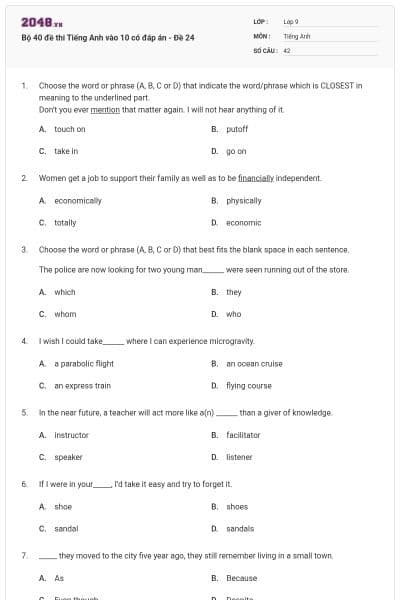
Choose the word or phrase (A, B, C or D) that indicate the word/phrase which is CLOSEST in meaning to the underlined part.
Don’t you ever mention that matter again. I will not hear anything of it.
touch on
putoff
take in
go on
Đáp án A
economically
physically
totally
economic
Đáp án A
Choose the word or phrase (A, B, C or D) that best fits the blank space in each sentence.
which
they
whom
who
Đáp án D
a parabolic flight
an ocean cruise
an express train
flying course
Đáp án A
instructor
facilitator
speaker
listener
Đáp án B
shoe
shoes
sandal
sandals
Đáp án B
As
Because
Even though
Despite
Đáp án C
dress
to dress
dressing
dressed
Đáp án B
whom
which
who
whose
Đáp án D
has it
does it
hasn’t it
doesn’t it
Đáp án A
first
second
most
one
Đáp án B
Good luck!
Congratulation
It’s nice of you to say so
That’s a good idea
Đáp án B
Yes, let’s.
Yes. Here it is.
Not at all.
Great.
Đáp án C
Choose one word (A, B, C or D) whose stress pattern is different from the others .
bilingual
magnificent
inacessible
promote
Đáp án C
Choose one word (A, B, C or D) whose stress pattern is different from the others .
touchdown
package
sightseeing
hotel
Đáp án D
Choose the word (A, B, C or D) whose underlined part is pronounced differently from that of the others.
saved
helped
looked
reduced
Đáp án A
Choose the word (A, B, C or D) whose underlined part is pronounced differently from that of the others.
question
accomodation
information
nation
Đáp án A
Choose the underlined word or phrase (A, B, C or D) that needs correcting.
to having
time
grandparents
was
Đáp án A
not
the breakfast
it’s
most important
Đáp án B
put
much
bunches
enough
Đáp án C
Choose the word or phrase (A, B, C or D) that indicate the word/phrase which is OPPOSITE in meaning to the underlined part.
touchdown
checkout
pile-up
check- in
Đáp án A
lazy
busy
lazily
early
Đáp án: C
Giải thích:
Kiến thức: Từ vựng – Từ trái nghĩa
hard (adj): khó, cứng
hard (adv): một cách vất vả, chăm chỉ
Ở câu này, “hard” là trạng từ để bổ nghĩa cho động từ thường “worked”.
Xét các đáp án:
A. lazy (adj): lười biếng
B. busy (adj): bận rộn
C. lazily (adv): một cách lười biếng
D. early (adj/adv): sớm
→ hard >< lazily
Dịch: Anh ấy đã vượt qua kỳ thi vì anh ấy đã học tập rất chăm chỉ.
Read the text carefully, then choose the most suitable answers (A, B, C or D).
Son Doong Cave has become more famous after the American Broadcasting Company (ABC) aired a live programme featuring its magnificence on ‘Good Morning America’ in May 2015.
Located in Quang Binh Province, Son Doong Cave was discovered by a local man named Ho Khanh in 1991, and became known internationally in 2009 thanks to British cavers, led by Howard Limbert. The cave was formed about 2 to 5 million years ago by river water eroding away the limestone underneath the mountain. It contains some of the tallest known stalagmites in the world - up to 70 metres tall. The cave is more than 200 metres wide, 150 metres high, and nearly 9 kilometres long, with caverns big enough to fit an entire street inside them. Son Doong Cave is recognised as the largest cave in the world by BCRA (British Cave Research Association) and selected as one of the most beautiful on earth by the BBC (British Broadcasting Corporation).
In August 2013, the first tourist group explored the cave on a guided tour. Permits are now required to access the cave and are made available on a limited basis. Only 500 permits were issued for the 2015 season, which runs from February to August. After August, heavy rains cause river levels to rise and make the cave largely inaccessible.
What happened to Son Doong Cave in May 2015?
It was discovered by a local man named Ho Khanh.
A live programme featuring its magnificence was broadcast on ‘Good Morning America’ by the American Broadcasting Company (ABC).
It became known internationally thanks to British cavers, led by Howard Limbert.
It was explored by the first tourist group.
Đáp án B
Tourists can explore Son Doong Cave daily throughout the year
The cave was formed about 2 to 5 million years ago
It was formed by river water eroding away the limestone underneath the mountain
Some of the stalagmites in Son Doong Cave are about 70 metres tall
Đáp án B
British cavers
stalagmites
kilometers
caverns
Đáp án A
should not be accessed
need to be careful
cannot be reached
may be flooded
Đáp án C
there is a street inside Son Doong Cave
the cave is always covered with rain water
few tourists want to come to the cave
tourists need permission to explore the cave
Đáp án D
Read the following passage, then choose the correct answer to questions
I went to Australia on a student program last year and I like to (28)_______you about it. I was very (29)_______when I knew I was going to Australia because I had never been there before. I didn’t think about the problems of speaking English (30)_______I met my host family. At first I couldn’t communicate with them because my English was so bad. All the five years I had been learning English wasn’t much used at all (31)_______we didn’t have real practice at school. Even though my grammar was good, my pronunciation wasn’t. My problem is (32)_______ “l” and “r”. For example, Australian people often asked “What do you eat in Vietnam?” I wanted to tell them that we eat rice, but they didn’t understand when I said “We eat lice”…
I went to Australia on a student program last year and I like to (28)_______you about it.
say
tell
talk
speak
Đáp án B
exciting
excites
excited
excite
Đáp án A
after
until
when
while
Đáp án B
although
even
because
so
Đáp án C
pronouncing
speaking
reading
telling
Đáp án A
Mr. Brown who's team has lost the game looks very sad.
Mr. Brown whose team has lost the game looks very sad.
Mr. Brown whose team lost the game looks very sad.
Mr. Brown whose team has lost the game look very sad.
Đáp án B
You know the man who sat next to me at Nam’s birthday party last night, don’t you?
You know the man which sat next to me at Nam’s birthday party last night, don’t you?
You know the man who sat next to me at Nam’s birthday party last night, do you?
You knew the man who sat next to me at Nam’s birthday party last night, don’t you?
Đáp án A
Minh spends 2 hours do his homework every day.
Minh spends 2 hours to do his homework every day.
Minh spends 2 hours doing his homework every day.
Minh spends 2 hours to doing his homework every day.
Đáp án: C
Giải thích:
spend time doing something: mất/dành thời gian làm gì
Dịch: Minh dành 2 tiếng để làm bài tập về nhà mỗi ngày.
Because it rained heavy, we were late for school.
Because of it rained heavily, we were late for chool.
Because it rained heavily, we were late for school.
Because it rains heavily, we were late for school.
Đáp án C
Complete the second sentence so that it has a similar meaning to the first one using the word in brackets. Do not change the given words in any ways.
We used to be made clean the house by my mother.
We used to made to clean the house by my mother.
We used to be made to cleaned the house by my mother.
We used to be made to clean the house by my mother.
Đáp án D
She said that she was working in a restaurant and didn’t care much for it.
She said that she were working in a restaurant and didn’t care much for it.
She said that she was worked in a restaurant and didn’t care much for it.
She said that she was working in a restaurant and wasn’t care much for it.
Đáp án A
I haven’t spoken to her since two years.
I haven’t spoken to her for two years.
I haven’t spoken to her for two years ago.
I haven’t spoke to her for two years.
Đáp án: B
Giải thích:
Xét các đáp án:
A. Loại vì: since + mốc thời gian: kể từ khi nào
“two years” là khoảng thời gian nên không dùng “since”
B. Đúng ngữ pháp
for + khoảng thời gian: đã được bao lâu
C. Thừa “ago”
khoảng thời gian + ago: cách đây bao lâu (dùng trong thì quá khứ đơn)
D. Sai cấu trúc thì hiện tại hoàn thành: have/has (not ) + VpII
speak → spoke → spoken
“spoke” là quá khứ đơn của “speak”
Dịch: Đã hai năm trôi qua kể từ lần cuối tôi nói chuyện với cô ấy.
→ Tôi không nói chuyện với cô ấy được hai năm rồi.
It is interested to go swimming in the river in the summer.
It is interesting go swimming in the river in the summer.
It interesting to go swimming in the river in the summer.
It is interesting to go swimming in the river in the summer.
Đáp án: D
Giải thích:
Phân biệt tính từ đuôi –ing và –ed:
- Tính từ đuôi –ing dùng để diễn tả tính chất, đặc điểm của người, vật
- Tính từ đuôi –ed dùng để diễn tả cảm xúc, trạng thái của người, vật
Loại A vì ở đây cần tính từ diễn tả tính chất, đặc điểm của việc đi bơi, dùng –ing
Cấu trúc với chủ ngữ giả “It”:
It + be + adj + to V: làm cái gì thì như nào
Chọn D đúng ngữ pháp.
Dịch: Thật thú vị khi được đi bơi ở sông vào mùa hè.
Bạn có thích hoạt động này không?