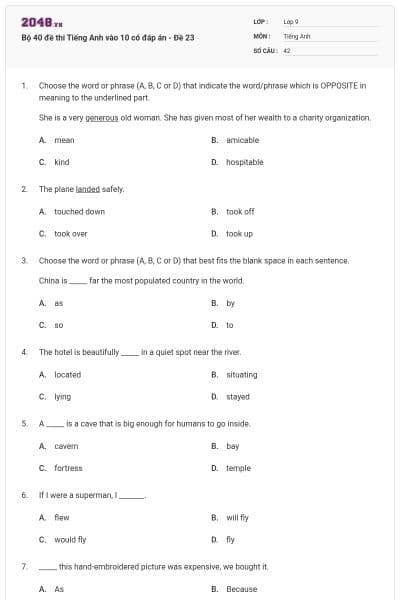
Bộ 40 đề thi Tiếng Anh vào 10 có đáp án - Đề 23
40 câu hỏi
Choose the word or phrase (A, B, C or D) that indicate the word/phrase which is OPPOSITE in meaning to the underlined part.
mean
amicable
kind
hospitable
Đáp án A
touched down
took off
took over
took up
Đáp án B
Choose the word or phrase (A, B, C or D) that best fits the blank space in each sentence.
as
by
so
to
Đáp án: B
Giải thích:
Cụm cố định: "by far + so sánh nhất" → nhấn mạnh mức độ vượt trội.
"by far the most populated" = vượt trội nhất về dân số
Dịch: Trung Quốc là quốc gia đông dân nhất thế giới một cách vượt trội.
located
situating
lying
stayed
Đáp án A
cavern
bay
fortress
temple
Đáp án A
If I were a superman, I _______.
flew
will fly
would fly
fly
Đáp án C
As
Because
Even though
Despite
Đáp án: C
Giải thích:
- As/Because + mệnh đề: vì
- Even though/ Though/ Although + mệnh đề : mặc dù
- Despite + danh từ/ cụm danh từ/ Ving: mặc dù
Phía sau chỗ cần điền là 1 mệnh đề, đồng thời xét về nghĩa của câu → chọn đáp án C
Dịch: Mặc dù bức tranh thêu tay rất đắt nhưng chúng tôi vẫn mua nó.
am having
was having
had
have had
Đáp án B
whom
which
who
whose
Đáp án D
the larger than
the largest
the larger
the most large
Đáp án B
to raise
raising
raised
raise
Đáp án B
Good way!
You are right.
Oh, hard luck!
Good job!
Đáp án: D
Giải thích:
Kiến thức: Tình huống giao tiếp
Câu trả lời cần là một lời khen phù hợp với việc đạt điểm cao trong bài kiểm tra TOEFL.
A. Good way! – Sai vì không phải là cách chúc mừng phổ biến.
B. You are right. – Sai vì không liên quan đến lời khen.
C. Oh, hard luck! – Sai vì cụm này dùng để an ủi khi ai đó gặp điều không may, không phù hợp với ngữ cảnh.
D. Good job! – Đúng vì đây là cách khen phổ biến khi ai đó đạt thành tích tốt.
Dịch:
– "Mẹ ơi, con đạt 600 điểm trong bài kiểm tra TOEFL!"
– "Làm tốt lắm!"
I came here last night
I came here by train
The train is so crowded
Is it far from here?
Đáp án: B
Giải thích:
Dịch:
Tom: “Bạn đến đây bằng cách nào?”
- John: “__________”
A. Tàu đông quá.
B. Tôi đến đây bằng tàu hỏa.
C. Tôi đến đây tối qua.
D. Có xa đây không?
Dựa vào nghĩa, chọn B.
Choose one word (A, B, C or D) whose stress pattern is different from the others .
adolescence
multicultural
metropolitan
limestone
Đáp án D
Choose one word (A, B, C or D) whose stress pattern is different from the others .
factor
event
complex
tunnel
Đáp án B
Choose the word (A, B, C or D) whose underlined part is pronounced differently from that of the others.
fabulous
administrative
paradise
urban
Đáp án A
Choose the word (A, B, C or D) whose underlined part is pronounced differently from that of the others.
bilingual
dialect
simmer
pile-up
Đáp án C
Choose the word or phrase (A, B, C or D) that indicate the word/phrase which is CLOSEST in meaning to the underlined part.
looked after
taken after
gone off
got over
Đáp án D
widely
secretly
alone
overseas
Đáp án D
Read the passage and do the exercises that follow by choosing the corresponding letter (A,B,C or D) of the correct answers.
Cigarettes contain toxic substances like tar and nicitine. That is why we often hear people telling us that smoking is harmful to our bodies. Smoking weakens our lungs as well as other parts of our body. We will not be as active as before and will need more effort to move about.
Smoking affects our environment too. When we puff, we pollute the environment with smoke. This makes our surroundings unpleasant and unclean. Since Smoking does not do any good to us, we should always say no to cigarettes. We should advise our loved ones to take sweet instead whenever they feel like taking toxic puff.
Which word in the passage means” harmful to our body”?
toxic
pollute
unpleasant
effort
Đáp án A
makes us more active
wastes our more
weakens our body
makes us move about difficulty
Đáp án C
Hearing problem
Hair loss
Loss of sense of smell
Lung cancer
Đáp án D
Cigarettes contain a lot of smoke
Smoking can kill us immediately
We can help smokers quit smoking easily
Smoking causes more harm than good to us
Đáp án D
Give him more money
Ask him to suck on sweets to replace smoking
Hide away his cigarettes so that he can not smoke
Tell him to stop smoking every day
Đáp án B
Mark the letter A,B,C, or D to show the underlined part that needs correction
father
repeated
poem
times
Đáp án B
to having
time
grandparents
was
Đáp án: A
Giải thích:
used to V: từng/thường làm gì trong quá khứ (giờ không còn làm)
Sửa: to having → to have
Dịch: Khi còn nhỏ, tôi thường có khoảng thời gian rất vui vẻ với ông bà.
Even though
ill
went
last Monday
Đáp án A
Choose the correct answer A, B, C or D for each gap in the passage
Homelessness is a problem in many big cities in the world. It occurs when a part of the population does not have any (28) ______ place to call home. Hundreds of millions of people in the world spend at least some time of the year homeless. This is an issue that the authorities are trying to (29) ______. However, there are (30) ______ things that each person can do to help those people. One of the things that you can do to help the homeless is to volunteer your time. If you have a lot of free time, you might go on an extended trip to help (31) ______ homes or improve an impoverished area. Even with just a few hours a week, it is possible to make an impact in your own city. You can also sign up to help at a (32) ______ soup kitchen: most cities have a mission of some kind serving food to the homeless and offering temporary shelter
It occurs when a part of the population does not have any (28) ______ place to call home.
common
regular
unusual
fixed
Đáp án B
deal with
get over
look through
look through
Đáp án A
little
less
more
fewer
Đáp án C
care for
show around
set up
pull down
Đáp án C
urban
central
capital
local
Đáp án D
Finish the second sentence so that it has a similar meaning to the first one, beginning with the given words
If you doesn't have a visa you can’t visit the USA.
If you don’t have a visa you can’t visit the USA.
If you don’t have a visa you can visit the USA.
If you don’t has a visa you can’t visit the USA.
Đáp án: B
Giải thích:
Dịch: Bạn không thể đến Hoa Kỳ nếu không có thị thực.
A. Sai ngữ pháp
Chủ ngữ “you” đi với trợ động từ “don’t”
B. Nếu bạn không có thị thực, bạn không thể đến Hoa Kỳ.
→ Đúng nghĩa
C. Nếu bạn không có thị thực, bạn có thể đến thăm Hoa Kỳ.
→ Sai nghĩa
D. Sai ngữ pháp
Khi đã có trợ động từ phủ định “don’t”, động từ chính “have” không cần chia nữa.
Peter asked if he could borrow Janet typewriter
Peter asked if he could borrows Janet’s typewriter
Peter ask if he could borrow Janet’s typewriter
Peter asked if he could borrow Janet’s typewriter
Đáp án D
She has been working as a secretary for 5 years.
She has been working as a secretary for 5 years.
She have be working as a secretary for 5 years.
She has been working as a secretary since 5 years.
Đáp án A
I don’t know so much about its as she does.
I don’t know so much about it as she do.
I don’t know so much about it as she does.
I don’t know so many about it as she does.
Đáp án: C
Giải thích:
Kiến thức: Câu so sánh không ngang bằng
Đáp án A sai từ “its”
Đáp án B sai từ “do”
Đáp án D sai từ “many” (không phải đếm một danh từ đếm được, nên không dùng “many”)
Dịch: Cô ấy biết nhiều về nó hơn tôi.
→ Tôi không biết nhiều về nó như cô ấy.
Complete the second sentence so that it has a similar meaning to the first one. Do not change the given words in any ways
My French friend isn’t used driving on the left.
My French friend isn’t used to driving on the left.
My French friend isn’t use to driving on the left.
My French friends isn’t used to driving on the left.
Đáp án B
The owner off the house is thought to be abroad.
The owner of the house is though to be abroad.
The owner of the house are thought to be abroad.
The owner of the house is thought to be abroad.
Đáp án: D
Giải thích:
Kiến thức: Câu bị động với động từ tường thuật (Passive with reporting verbs)
Câu chủ động: "They think the owner of the house is abroad."
→ Khi chuyển sang bị động với động từ "think", ta dùng cấu trúc:
S + be + thought + to V (nếu động từ ở hiện tại)
S + be + thought + to have P2 (nếu động từ ở quá khứ)
Ở đây, "the owner of the house is abroad" → dùng "to be abroad".
Xét các đáp án khác:
A. The owner off the house is thought to be abroad. → Sai vì "off" phải là "of".
B. The owner of the house is though to be abroad. → Sai vì "though" phải là "thought".
C. The owner of the house are thought to be abroad. → Sai vì "owner" là số ít, phải dùng "is" thay vì "are".
Chọn D.
Dịch: Chủ ngôi nhà được cho là đang ở nước ngoài.
If we had enough money we would have gone for holiday.
If we had enough money we would have gone on holiday.
If we have enough money we would have gone on holiday.
If we had enough money we would have go on holiday
Đáp án B
The sea was too rough for the children to go swimming.
The sea were too rough for the children to go swimming
The sea was too rough for the childrens to go swimming
The sea was too rough for the children go swimming
Đáp án: A
Giải thích:
Cấu trúc "too + adj + for somebody to do something" là đúng khi muốn diễn đạt một điều gì đó quá mức đối với ai đó để làm một việc gì đó.
"The sea was too rough" đúng với thì quá khứ và tính từ "rough".
"Children" là danh từ số nhiều và không cần thêm "s" như trong câu C.
Câu D thiếu "to" sau "children," điều này làm câu trở nên sai ngữ pháp.
Dựa vào cấu trúc ngữ pháp và nghĩa, chọn A.
Dịch: Biển quá sóng dữ để những đứa trẻ có thể đi bơi.
Bạn có thích hoạt động này không?