BỘ 30 ĐỀ THI VÀO LỚP 10 MÔN TIẾNG ANH CÓ ĐÁP ÁN - ĐỀ 04
50 câu hỏi
Read the following passage and choose the item A,B,C or D that best answer each question about it. Nick Johnson lives with his parents, and his sister. They live in Wembley, in north London. Nick‘s mum is called Sue. She works in a supermarket. His dad is called Jim and he works in a bank. Nick‘s sister is called Tracy. She is nine years old. There is also a dog in the family. His name‘s Fred.
Where does Nick‘ family live?
America
England
Scotland
Australia
ĐÁP ÁN B
Which does the word ―his‖ in line 4 refer to?
Nick‘s mother
Nick‘s sister
Nisk‘s cousin
Nick‘s dog
ĐÁP ÁN D
What‘s Nick‘s sister‘s name?
Sue
Jim
Tracy
Fred
ĐÁP ÁN C
Who is Jim?
Nick‘s father
Nick‘s mother
Nick‘s cousin
Nick‘s sister
ĐÁP ÁN A
Which of the following is not TRUE?
Nick‘s family live in London.
Nick‘s father works in a bank.
Nick‘s mother works in a supermarket.
Nick‘s sister is five years old.
ĐÁP ÁN D
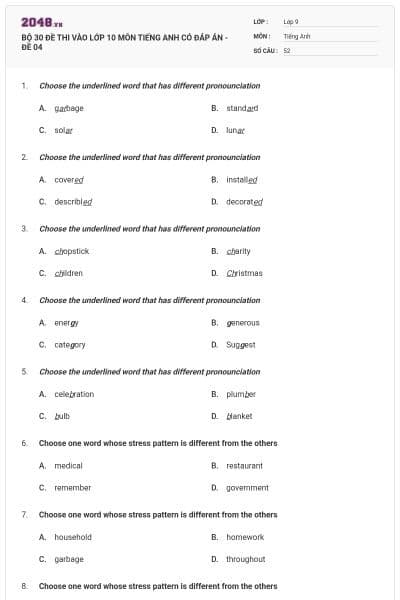
Choose the underlined word that has different pronounciation
garbage
standard
solar
lunar
ĐÁP ÁN A
Read the passage and answer the following questions
Jeans are the most popular kind of clothing in the world . They are popular almost eveywhere, in France, in China, Italy and Vietnam. Most of people love to wear Jeans . Rich people, poor people , young people and even some old people wear them . In the United States , they are the only kind of traditional clothes. In other countries, young people wear them because they want to look modern . Jeans are the sign of young people . Everyone wants to be modern, young and independent.
Are jeans the most popular kind of clothing in the world?
Yes, they are
Where are jeans popular?
They are popular almost everywhere, (in France, in China,Italy and viet nam)
Do rich people love to wear jeans?
Yes, they do
What are the only kind of traditional clothes in the United States?
They are jeans
Why do young people in other countries wear them?
Because they want to look modern
Choose the underlined word that has different pronounciation
covered
installed
describled
decorated
ĐÁP ÁN D
Choose the underlined word that has different pronounciation
chopstick
charity
children
Christmas
ĐÁP ÁN D
Choose the underlined word that has different pronounciation
energy
generous
category
Suggest
ĐÁP ÁN C
Choose the underlined word that has different pronounciation
celebration
plumber
bulb
blanket
ĐÁP ÁN B
Choose one word whose stress pattern is different from the others
medical
restaurant
remember
government
ĐÁP ÁN C
Choose one word whose stress pattern is different from the others
household
homework
garbage
throughout
ĐÁP ÁN D
Choose one word whose stress pattern is different from the others
electrical
interesting
necessary
beautifully
ĐÁP ÁN A
Choose one word whose stress pattern is different from the others
celebrate
consider
expression
criteria
ĐÁP ÁN A
Choose one word whose stress pattern is different from the others
partner
between
visit
program
ĐÁP ÁN B
___ the traffic was bad, we arrived on time.(Although/ In spite of/ Even/ Despiteof)
Although
I‘ll show you around the city when you ___ .(come/ are coming/ willcome/ came)
come
If energy ___ inexpensive and unlimited, many things in the world would be different. (is/ will be/ were/ would be)
were
___ energy can be cheap and clean.(Sun/ Sunny/ Solar/ Solarize).
Solar
I am writing this to tell you ___ you are missed and loved.(how many/ how much/ how long/ how far)
how much
We should learn about keeping the environment ___ .(pollute/ polluting/ polluted/ unpolluted)
unpolluted
The pencil ___ I write is made in Japan.(who/ whom/ which/ where)
which
We don‘t want ___ like that.(talking/ being talked/ talked/ to be talked)
to be talked
They ___ in Ha Noi since last Monday.(have been/ were/ are/ will be).
have been
Let‘s go shopping, ___ ? (shall we/ can we/ do we/ should we).
shall we
There are many .................. in our country of a year. (CELEBRATE)
celebrations
We celebrate our .................. Day on September 2nd. (DEPEND)
Đáp án: Independence
Ta có: Independence Day: Ngày Quốc Khánh
Dịch: Chúng tôi kỷ niệm Ngày Quốc Khánh vào mùng 2 tháng 9.
You must be .................. when you open that door. (CARE)
careful
We can save ................. resources by using solar energy (NATURE)
natural
We can‘t clean up our ....................... rivers and seas over night. (POLLUTE)
Polluted
I‘m sorry. I ( not finish ) ………………………… this work yet.
haven‘t finished
Poems as well as plays ( write ) ……………………… by Shakespeare
were writed
She is having an examination. She wishes she (spend )……………………… a day off on a farm now
spent
We hate ( watch ) ………………………the advertising program on TV
watching
I had a phone call while I ( surf ) ……………………… the web
was surfing
They ( live ) ………………………in that house since it was rebuilt
have lived
I suggest (burn)………………………coal to heat the house
burning
If we (not save)…………………… energy, there (be) ……………… great shortage in the next century
Đáp án: do not save (don’t save)/ will be
Giải thích:
Kiến thức: Câu điều kiện loại 1
Dựa vào nghĩa, ta thấy đây là điều kiện và kết quả có thể xảy ra trong tương lai, dùng câu điều kiện loại 1.
Cấu trúc câu điều kiện loại 1:
If + mệnh đề hiện tại đơn, mệnh đề tương lai đơn.
Dịch: Nếu chúng ta không tiết kiệm năng lượng thì sẽ thiếu hụt năng lượng trong thế kỷ tới.
Do you have any difficulty in ( solve ) ……………………… this problem.
solving
Mary always went swimming after school last year.
---> Mary used to………………………………………………………………...
Mary used to go swimming after school last year.
My daughter has studied English for two years.
---> My daughter started ………………………………………………………...
My daughter started studying English two years ago.
She wants to buy that villa but it‘s too far expensive for her.
---> She wishes ………………………………………………………………….
She wishes that villa were cheap / weren‘t expensive
It took Nam two days to have a trip to the countryside last week.
---> Nam spent …………………………………………………………………..
Nam spent two days having a trip to the countryside last week
They have changed the date of the meeting.
---> The date …………………………………………………………………….
Đáp án: The date of the meeting has been changed.
Giải thích:
Câu bị động
Cấu trúc bị động thì hiện tại hoàn thành: have/has been VpII
Dịch: Họ đã thay đổi ngày họp.
→ Ngày họp đã được thay đổi.
Finding an apartment in a big city is not easy.
---> It is not ……………………………………………………………………..
It is not easy to find an apartment in a big city
Giải thích: It is + adj + to V: như thế nào khi làm gì
Dịch: Không dễ để kiếm căn hộ ở thành phố lớn.