Bộ 25 Đề kiểm tra cuối học kì 2 Tiếng anh 11 có đáp án (Mới nhất) (Đề 6)
31 câu hỏi
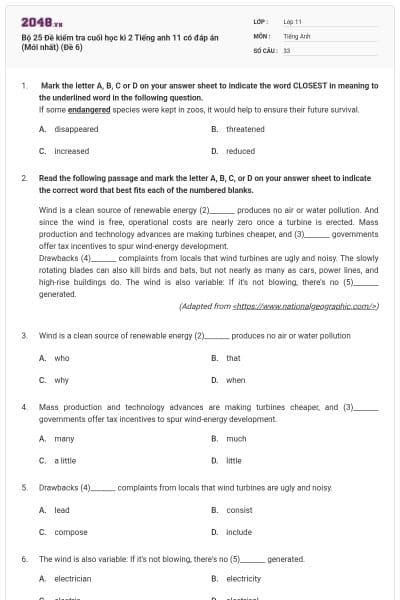
Mark the letter A, B, C or D on your answer sheet to indicate the word CLOSEST in meaning to the underlined word in the following question.
If some endangered species were kept in zoos, it would help to ensure their future survival.
disappeared
threatened
increased
reduced
Đáp án đúng: B
Giải thích: endangered = threatened: nguy cấp, bị đe dọa
Dịch: Nếu một số loài nguy cấp được giữ trong vườn thú, nó sẽ giúp đảm bảo sự sống còn của chúng trong tương lai.
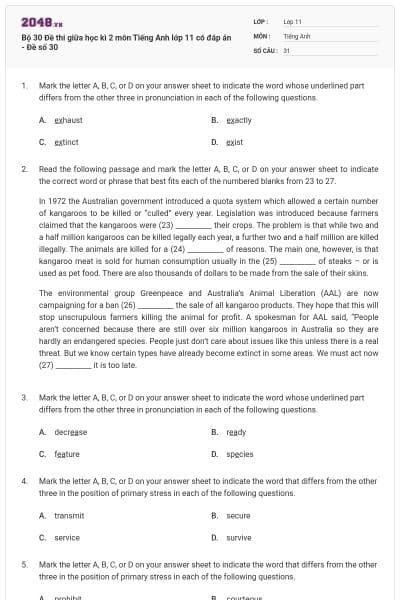
Wind is a clean source of renewable energy (2)_______ produces no air or water pollution. And since the wind is free, operational costs are nearly zero once a turbine is erected. Mass production and technology advances are making turbines cheaper, and (3)_______ governments offer tax incentives to spur wind-energy development.
Drawbacks (4)_______ complaints from locals that wind turbines are ugly and noisy. The slowly rotating blades can also kill birds and bats, but not nearly as many as cars, power lines, and high-rise buildings do. The wind is also variable: If it's not blowing, there's no (5)_______ generated.
(Adapted from <https://www.nationalgeographic.com/>)
who
that
why
when
Đáp án đúng: B
Giải thích: Đại từ quan hệ “that” thay thế cho danh từ chỉ vật đứng trước.
Dịch: Gió là một nguồn năng lượng tái tạo sạch không tạo ra ô nhiễm không khí hoặc nước.
Mass production and technology advances are making turbines cheaper, and (3)_______ governments offer tax incentives to spur wind-energy development.
many
much
a little
little
Đáp án đúng: A
Giải thích: many: nhiều (dùng cho danh từ đếm được)
Dịch: Sản xuất hàng loạt và tiến bộ công nghệ đang làm cho tuabin rẻ hơn và nhiều chính phủ đưa ra các ưu đãi về thuế để thúc đẩy phát triển năng lượng gió.
lead
consist
compose
include
Đáp án đúng: D
Giải thích: include = consist of: bao gồm
Dịch: Những mặt hạn chế bao gồm những lời phàn nàn từ người dân địa phương rằng các tuabin gió xấu và ồn ào.
The wind is also variable: If it's not blowing, there's no (5)_______ generated.
electrician
electricity
electric
electrical
Đáp án đúng: B
Giải thích: Đáp án phù hợp.
Dịch: Gió cũng có thể thay đổi: Nếu nó không thổi, thì không có điện tạo ra.
Mark the letter A, B, C, or D on your answer sheet to indicate the most suitable response to complete each of the following questions.
A student is asking the librarian to help her to fax a report.
- Student: “Could you help me to fax this report?” - Librarian: “________”
It’s very kind of you to say so.
Sorry, I have no idea.
Certainly, what’s the fax number?
What rubbish! I don’t think it’s helpful.
Đáp án đúng: C
Giải thích: Trong tình huống nhờ giúp đỡ, câu trả lời đúng thường rơi vào một trong hai trường hợp:
- Đồng ý giúp ( Of course/ Certainly/ Ok/ That’s fine/ Alright...)
- Không đồng ý giúp (Sorry/ I’m afraid/ I’m busy right now...)
Dịch: Một sinh viên đang nhờ người trông giữ thư viện giúp cô ấy fax đi một bản báo cáo.
- Sinh viên: “Cô có thể giúp cháu gửi fax bản báo cáo này được không ạ?”
- Người trông giữ thư viện: “Chắc chắn rồi. Số fax là gì vậy?”
Anna and Jack are talking about the measures to protect the environment.
Anna: I think decreasing the use of fertilizers for farming should be encouraged.
Jack: "__________"
It’s my pleasure to protect the environment.
I can't agree with you more.
I don’t like fertilizers.
Well, that's very surprising.
Đáp án đúng: B
Giải thích: I can’t agree with you more: Tôi hoàn toàn đồng ý với bạn (Tôi không thể đồng ý hơn được nữa).
Dịch: Anna: Tôi nghĩ rằng việc giảm sử dụng phân bón cho nông nghiệp nên được khuyến khích.
Jack: Tôi hoàn toàn đồng ý với bạn.
Read the following passage and mark the letter A, B, C, or D on your answer sheet to indicate the correct answer to each of the questions.
WORTH COLLECTING
Would you be worried if your classmate told you that he was a philatelist? Would you call a doctor or call the police? Actually, there is no reason to be concerned. A philatelist is just a person who collects stamps!
Stamp collecting has been around for well over 150 years. People began collecting stamps soon after adhesive postage stamps (stamps with glue on the back) were introduced in London in 1840. Today, according to Boy’s Life magazine, stamp collecting is the most practiced hobby in the world.
Some people collect stamps just for fun. These people may just want to collect stamps with animals or famous people on them. Or maybe they want to collect all the stamps issued by one particular country. Other people collect stamps that they think will be valuable down the road. Such collectors ask three questions to determine if a stamp is worth collecting and what its value might be.
First, how many of a particular stamp were made? Next, how popular is the stamp? Finally, what is the condition of the stamp? If a stamp has a low print run, a popular picture or design, and is in excellent condition, this stamp may be worth a lot of money. In 1980, a one-cent British Guinea stamp issued in 1856 went for $935,000!
(Source: Reading Challenge 1)
Collecting stamps
Writing letters
Determining the value of things
Introducing new stamps
Đáp án đúng: A
Giải thích: Dựa vào thông tin: “A philatelist is just a person who collects stamps!”
Dịch: Một người chơi tem chỉ là một người sưu tập tem!
According to the reading, which of the following is TRUE?
People in the 1800s collected stamps.
The first stamps were made in America.
Most people collect stamps with people on them.
Boys’ Life is a magazine for philatelists.
Đáp án đúng: A
Giải thích: Dựa vào thông tin: “People began collecting stamps soon after adhesive postage stamps (stamps with glue on the back) were introduced in London in 1840”.
Dịch: Mọi người bắt đầu sưu tập tem ngay sau khi tem bưu chính dính (tem có keo ở mặt sau) được giới thiệu ở London vào năm 1840.
Quantity
Quantity, popularity and condition
Popularity and condition
Quantity and condition
Đáp án đúng: B
Giải thích: Dựa vào thông tin: “Other people collect stamps that they think will be valuable down the road. Such collectors ask three questions to determine if a stamp is worth collecting and what its value might be. First, how many of a particular stamp were made? Next, how popular is the stamp? Finally, what is the condition of the stamp?”
Dịch: Những người khác sưu tập tem mà họ nghĩ sẽ có giá trị. Những người sưu tập như vậy đặt ra ba câu hỏi để xác định xem một con tem có đáng để sưu tập hay không và giá trị của nó có thể là bao nhiêu. Đầu tiên, có bao nhiêu con tem cụ thể được tạo ra? Tiếp theo, mức độ phổ biến của tem? Cuối cùng, điều kiện của con tem là gì?
It was made by Boys’ Life magazine.
Not many were made.
It is in excellent condition.
It has a picture of an animal on it.
Đáp án đúng: B
Giải thích: a low print run: not many were made.
Dịch: Nếu một con tem không được in nhiều, hình ảnh hoặc thiết kế phổ biến và ở trong tình trạng tuyệt vời, con tem này có thể đáng giá rất nhiều tiền.
Mark the letter A, B, C, or D on your answer sheet to indicate the word whose underlined part differs from the other three in pronunciation in the following questions.
sword
swallow
swear
swing
Đáp án đúng: A
Giải thích: Đáp án A được phát âm là /sɔ/, các từ còn lại được phát âm là /sw /
Mark the letter A, B, C, or D on your answer sheet to indicate the word whose underlined part differs from the other three in pronunciation in the following questions.
enthusiasm
smooth
smart
small
Đáp án đúng: A
Giải thích: Đáp án A được phát âm là / z.əm /, các từ còn lại, đuôi ed được phát âm là
/ sm /
Mark the letter A, B, C or D on your answer sheet to indicate the correct answer to each of the following questions.
who come
coming
come
to come
Đáp án đúng: D
Giải thích: The first/last N + to V
Dịch: Tôi là người cuối cùng đến bữa tiệc đêm qua.
Many people believe that fossil fuels will be __________ within a relatively short time.
worn on
exhausted
damaged
used out
Đáp án đúng: B
Giải thích: exhausted: cạn kiệt
Dịch: Nhiều người cho rằng nhiên liệu hóa thạch sẽ cạn kiệt trong một thời gian tương đối ngắn.
accomplished
played
accompanied
occupied
Đáp án đúng: C
Giải thích: accompany (v): kèm theo, đệm theo ( âm nhạc)
Dịch: Ca sĩ này đã được đệm nhạc bằng piano bởi chị gái cô ấy.
that
who
whose
whom
Đáp án đúng: B
Giải thích: who: đại từ quan hệ thay thế cho danh từ chỉ người.
Dịch: Dane, người mà sống bên cạnh, sẽ tổ chức bữa tiệc vào tối nay.I usually give __________ the common stamps to my friends.
away
off
on
up
Đáp án đúng: A
Giải thích: give away: cho, tặng
Dịch: Tôi thường tặng những con tem chung cho bạn bè của mình.
whom
in which
that
whose
Đáp án đúng: C
Giải thích: Đại từ quan hệ that thay thế cho danh từ chỉ vật.
Dịch: Đó là Hội Chữ thập đỏ được thành lập vào năm 1864.
The film __________ on television last night wasn’t very interesting.
I saw it
that I saw it
which I saw it
I saw
Đáp án đúng: D
Giải thích: Đáp án phù hợp
Dịch: Bộ phim tôi đã xem trên truyền hình tối qua không thú vị lắm
If we do not take steps to protect the world’s wild life, many species of birds and animals are likely to __________ completely.
die from
die out
die away
die down
Đáp án đúng: B
Giải thích: die out: biến mất, tuyệt chủng
Dịch: Nếu chúng ta không thực hiện các bước để bảo vệ cuộc sống hoang dã của thế giới, nhiều loài chim và động vật có thể bị tuyệt chủng hoàn toàn.
whose
that
who
whom
Đáp án đúng: D
Giải thích: Đại từ quan hệ whom thay thế cho tân ngữ (the man).
Dịch: Tôi phải cảm ơn người đàn ông mà từ đó tôi có được món quà.
to sponsor
sponsored
sponsor
sponsoring
Đáp án đúng: B
Giải thích: Giản lược mệnh đề quan hệ dạng bị động (which is sponsored = sponsored)
Dịch: Họ làm việc trong một bệnh viện được tài trợ bởi chính phủ
How many __________ took part in the race?
competitive
compete
competitors
competition
Đáp án đúng: C
Giải thích: competitors: người dự thi
Dịch: Có bao nhiêu đối thủ đã tham gia cuộc đua?
Question 25: Albert has decided to buy a motorbike. His car was stolen last week. (use whose)
→____________________________________________________________________.
Đáp án đúng: Albert, whose car was stolen last week, has decided to buy a motorbike
Giải thích: Whose là đại từ quan hệ chỉ sự sở hữu. Whose đứng sau danh từ chỉ người hoặc vật, thường được ngăn cách bởi dấu phẩy; dùng để thay thế cho tính từ sở hữu trước danh từ.
N1, whose N2+ V1, V2: cái N2 của N1 .
Dịch: Albert, người đã bị mất cắp xe tuần trước, đã quyết định mua một chiếc xe máy.
The headmistress has had to retire because of her old age. We all admire her. (begin with: The headmistress we …)
→____________________________________________________________________.Hướng dẫn giải
Đáp án đúng: The headmistress we all admire has had to retire because of her old age.
Giải thích: Đáp án phù hợp.
Dịch: Bà hiệu trưởng mà tất cả chúng ta ngưỡng mộ đã phải nghỉ hưu vì tuổi già.
I talked to the man last night. He was very kind. (use to whom)
→____________________________________________________________________.
Đáp án đúng: The man to whom I talked last night was very kind.
Giải thích: whom: thay thế cho danh từ chỉ người đóng vai trò làm tân ngữ “the man” (có thể đứng sau giới từ)
Dịch: Người đàn ông mà tôi đã nói chuyện đêm qua rất tốt bụng.
For questions from 28 to 31, finish each sentence as instructed in such a way that it means the same as the sentence printed before it.
Peter was the only student that was chosen to get the scholarship to study abroad.
The only student to ______________________________________________________ .
Đáp án đúng: The only student to be chosen to get the scholarship to study abroad was Peter.
Giải thích: The first/only/last N + to V
Dịch: Học sinh duy nhất được chọn để nhận học bổng du học là Peter.
My brother started working for that company in 2006.
It was in 2006___________________________________________________________.Đáp án đúng: It was in 2006 that my brother started working for that company.
Giải thích: S + started/began V-ing…
= It was…….
Dịch: Vào năm 2006, anh trai tôi bắt đầu làm việc cho công ty đó.
The fence surrounding our house is made of wood.
The fence which ________________________________________________________.
Đáp án đúng: The fence which surrounds our house is made of wood.
Giải thích: Động từ trong câu ở dạng chủ động, từ câu rút gọn mệnh đề ta dùng which.
Dịch: Hàng rào bao quanh ngôi nhà của chúng tôi được làm bằng gỗ.
We suggested a lot of things, which were all rejected.
Everything we __________________________________________________________.
Đáp án đúng: Everything we suggested was rejected.
Giải thích:
We suggested a lot of things, which were all rejected.
= Everything (that) we suggested was all rejected.
Dịch: Mọi thứ mà chúng tôi gợi ý đều bị bác bỏ.