Bài tập trắc nghiệm Unit 9 - Đề kiểm tra có đáp án
45 câu hỏi
comprise
sandy
circle
northern
sandy /ˈsændi/
circle /ˈsɜːkl/
northern /ˈnɔːðən/
Câu A trọng âm rơi vào âm tiết 2, còn lại rơi vào âm tiết 1.
Đáp án cần chọn là: A
Choose the word which is stressed differently from the rest
aborigines
expedition
kilometer
scientific
expedition /ˌekspəˈdɪʃn/
kilometer /ˈkɪləmiːtə(r)/
scientific /ˌsaɪənˈtɪfɪk/
Câu C trọng âm rơi vào âm tiết 1, còn lại rơi vào âm tiết 3.
Đáp án cần chọn là: C
Choose the word which is stressed differently from the rest
corridor
enormous
mystery
separate
enormous /ɪˈnɔːməs/
mystery /ˈmɪstri/
separate /ˈseprət/
Câu B trọng âm rơi vào âm tiết 2, còn lại rơi vào âm tiết 1.
Đáp án cần chọn là: B
Choose the word which is stressed differently from the rest
remain
hummock
explore
between
hummock /ˈhʌmək/
explore /ɪkˈsplɔː(r)/
between /bɪˈtwiːn/
Câu B trọng âm rơi vào âm tiết 1, còn lại rơi vào âm tiết 2.
Đáp án cần chọn là: B
Choose the word which is stressed differently from the rest
territory
Australia
geography
society
Australia /ɒˈstreɪliə/
geography /dʒiˈɒɡrəfi/
society /səˈsaɪəti/
Câu A trọng âm rơi vào âm tiết 1, còn lại rơi vào âm tiết 2.
Đáp án cần chọn là: A
three
south
southern
both
south/saʊθ/
southern /ˈsʌðən/
both/bəʊθ/
Câu C âm "th" được phát âm thành /ð/ , còn lại phát âm thành /θ/
Đáp án cần chọn là: C
remained
explored
separated
travelled
explored /ɪkˈsplɔː(r)d/
separated/ˈsepəreɪtɪd/
travelled/ˈtrævld/
Câu C âm "ed" được phát âm thành /id/ , còn lại phát âm thành /d/
Đáp án cần chọn là: C
loose
smooth
food
flood
smooth /smuːð/
food /fuːd/
flood /flʌd/
Câu D âm "oo" được phát âm thành /ʌ/ , còn lại phát âm thành /uː/
Đáp án cần chọn là: D
enormous
rough
enough
double
rough /rʌf/
enough /ɪˈnʌf/
double /ˈdʌbl/
Câu A âm "ou" được phát âm thành /ə/ , còn lại phát âm thành /ʌ/
Đáp án cần chọn là: A
society
geography
dry
sandy
geography/dʒiˈɒɡrəfi/
dry/draɪ/
sandy/ˈsændi/
Câu C âm "y" được phát âm thành /i/ , còn lại phát âm thành /aɪ/
Đáp án cần chọn là: C
Scientific ________ help to explore some places and discover more and more remote parts of the world.
surveys
leads
research
expedition
leads (n): dẫn đầu
research (n): nghiên cứu
expeditions (n): cuộc thám hiểm
=>Scientific expeditions help to explore some places and discover more and more remote parts of the world.
Tạm dịch: Các cuộc thám hiểm khoa học giúp thăm dò những miền đất mới và khám phá ngày càng nhiều những vùng hẻo lánh trên thế giới.
The Simpson Desert was named _______ Mr. Simpson, President of the South Australian Branch of the Royal Geographical Society of Australia.
with
at
after
for
=>The Simpson Desert was named after Mr. Simpson, President of the South Australian Branch of the Royal Geographical Society of Australia.
Tạm dịch: Sa mạc Simpson được đặt tên theo Ông Simpson, Chủ tịch của Hiệp hội Địa lý Hoàng gia Úc Chi nhánh Nam Úc.
To ________ a desert is a dangerous activity which requires careful preparation for risks.
comprise
circle
remain
explore
circle (v): khoanh tròn
remain (v): duy trì
explore (v): thám hiểm
=>To explore a desert is a dangerous activity which requires careful preparation for risks.
Tạm dịch: Thám hiểm sa mạc là 1 hành động rất nguy hiểm đòi hỏi sự chuẩn bị kỹ càng trước những rủi ro.
________ is the process by which a piece of land becomes dry, empty, and unsuitable for growing trees or crops on.
desert
deserted
desertify
desertification
deserted (adj): hiu quạnh
desertify (v): sa mạc hóa
desertification (n): sự sa mạc hóa
=>Desertification is the process by which a piece of land becomes dry, empty, and unsuitable for growing trees or crops on.
Tạm dịch: Sa mạc hóa là quá trình mà một mảnh đất trở nên khô hạn, không có người ở và không phù hợp để trồng cây hoặc mùa màng.
A ________ is a large animal that lives in deserts and is used for carrying goods and people.
slope
dune
spinifex
camel
dune (n): đống, đụn
spinifex (n): một loại cỏ có tên spinifex
camel(n): lạc đà
=>A camel is a large animal that lives in deserts and is used for carrying goods and people.
Tạm dịch: Lạc đà là loài động vật sống ở sa mạc và được dùng để chở thức ăn và người.
The ________ of a cliff, or mountain, is a vertical surface or side of it
face
border
crest
lake
border (n): đường biên
crest (n): đỉnh, ngọn
lake (n): hồ
=>The faceof a cliff, or mountain, is a vertical surface or side.
Tạm dịch: Bề mặt của một vách đá, hoặc ngọn núi, là mặt thẳng đứng hoặc phía bên của nó.
Most deserts are enormous sandy areas.
mysterious
narrow
immense
aerial
narrow (adj): hẹp
immense (adj): mênh mông
aerial (adj): trên không
=>enormous = immense
Tạm dịch: Hầu hết sa mạc là những bãi cát trải dài mênh mông.
Camels were often used _______ transportation by people of the desert.
as
with
to
about
=>Camels were often used as transportation by people of the desert.
Tạm dịch: Lạc đà được sử dụng như là phương tiện giao thông trên sa mạc.
Camels have one or two humps used ________ storing water and food.
to
for
over
at
=> Camels have one or two humps used for storing water and food.
Tạm dịch: Lạc đà có 1 hoặc 2 cái bướu được sử dụng cho việc giữ nước và thức ăn.
Many tall and wide mountain ranges do not let much rain get ________ the desert.
into
away
out
from
get out: ra khỏi
get away: trốn thoát
không tồn tại cụm động từ "get from"
=>Many tall and wide mountain ranges do not let much rain get into the desert.
Tạm dịch: Nhiều dãy núi cao và rộng ngăn cho mưa không rơi được nhiều vào sa mạc.
Cold deserts can be covered in ________ snow or ice and frozen water is unavailable to plant life.
a
an
the
Ø
"snow" và "ice" được dùng để chỉ "tuyết", "băng" mang nghĩa chung chung, không chỉ cụ thể nên không chọn "the"
=>Cold deserts can be covered in snow or ice and frozen water is unavailable to plant life.
Tạm dịch: Các sa mạc lạnh có thể được bao phủ trong tuyết hoặc băng và nước bị đóng băng nên không thể tồn tại sự sống.
________ Sahara of ________ Africa is the world's largest desert.
Ø / the
The / Ø
A / an
The / an
Trước tên riêng chỉ châu lục không dùng mạo từ.
=>TheSahara of Africa is the world's largest desert.
Tạm dịch: Sa mạc Sahara của châu Phi là sa mạc lớn nhất trên thế giới.
Mrs. Lindon has ________ that she is unable to get a job.
but not enough education
so little education
however little education
such little education
S+ V + so much/many/little/few + N that + S + V: quá nhiều/ít.... đến nỗi mà.....
=>Mrs. Lindon has so little education that she is unable to get a job.
Tạm dịch: Bà Lindon được học ít đến nỗi mà bà ấy không thể xin được 1 công việc.
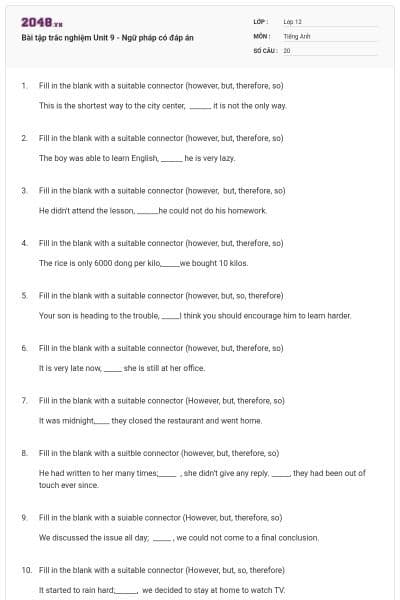
___ hard I have tried, I could not keep pace with Tony.
But
However
Therefore
Whatever
but: nhưng
therefore: do đó
whatever: bất cứ cái gì
=>However hard I have tried, I could not keep pace with Tony.
Tạm dịch: Cho dù tôi cố gắng thế nào đi nữa, tôi cũng không thể theo kịp Tony.
I am afraid that the company is in deep trouble. ________, we are going to make some people redundant.
Therefore
However
But
And
However: tuy nhiên
But: nhưng
And: và
Từ cần điền mang nghĩa chỉ kết quả nên cần chọn "Therefore":
=>I am afraid that the company is in deep trouble. Therefore, we are going to make some people redundant.
Tạm dịch: Tôi e rằng công ty đang gặp khó khăn. Do đó, chúng tôi dự định cho sa thải 1 số nhân viên.
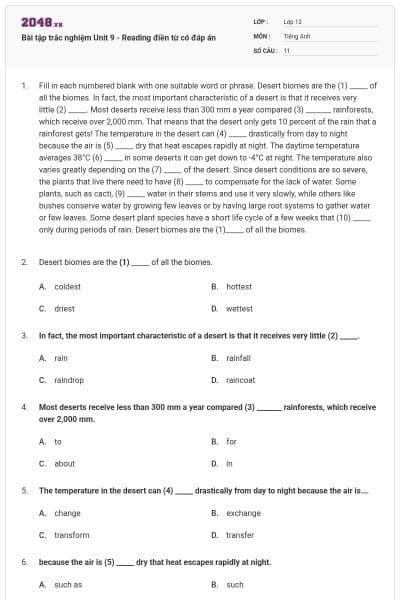
Desert air (26)____ little moisture, so few clouds form over the land.
contains
comprises
consists
includes
comprises (v): bao gồm
consists +of/in (v): gồm có
includes (v): bao gồm
=>Desert air containslittle moisture, so few clouds form over the land.
Tạm dịch: Không khí sa mạc chứa độ ẩm thấp, vì vậy ít mây hình thành trên vùng này.
Đáp án cần chọn là: A
Without clouds to block the sun, temperatures may reach as (27) ____ as 125°F during the day.
much
far
long
high
far (adj): xa
long (adj): dài
high (adj): cao
=>Without clouds to block the sun, temperatures may reach as high as 125°Fduring the day.
Tạm dịch: Nếu không có đám mây để chặn ánh nắng mặt trời, nhiệt độ có thể đạt cao như 125° F trong ngày.
Đáp án cần chọn là: D
Extreme temperatures (28) ____ with little rainfall make desert life difficult for people, plants, and animals.
located
combined
explored
separated
combined (v-ed) (+with): kết hợp (với)
explored (v-ed): được thăm dò, thám hiểm
separated (v-ed) (+by): phân chia (bởi)
=>Extreme temperatures combined with little rainfall make desert life difficult for people, plants, and animals.
Tạm dịch: Nhiệt độ cực cao kết hợp với lượng mưa ít làm cho cuộc sống sa mạc khó khăn cho con người, thực vật và động vật.
Đáp án cần chọn là: B
(29) ______, some life forms have adapted to even…
Therefore
So
However
But
So (adv): Vì vậy
However (adv): Tuy nhiên
But (adv): Nhưng
Ở câu trước "...make desert life difficult..." (làm cho cuộc sống ở sa mạc khó khăn)
Ở câu sau "...some life forms have adapted to even…" (một số đã thích nghi được)
=>Câu sau nghĩa tương phản câu trước =>chọn "However" (không chọn "but" vì từ cần điền đứng đầu câu, trước dấu ",")
=>However, some life forms have adapted to…
Tạm dịch: Tuy nhiên, một số đã thích nghi được với…
Đáp án cần chọn là: C
..., some life forms have adapted to even the most severe desert (30) _______, …
environment
place
society
atmosphere
place (n): địa điểm
society (n): xã hội
atmosphere (n): không khí
=>However, some life forms have adapted to even the most severe desert environment, …
Tạm dịch: Tuy nhiên, một số đã thích nghi được với môi trường sa mạc khắc nghiệt nhất, …
Đáp án cần chọn là: A
Many desert plants have long, shallow (31) ______ systems.
leaf
bark
root
branch
bark (n): vỏ cây
root (n): rễ cây
branch (n): cành cây
Many desert plants have long, shallow root systems.
Tạm dịch: Nhiều loài thực vật sa mạc có rễ dài và nông.
Đáp án cần chọn là: C
Taproots grow very deep (32) ______ they can tap sources of underground water.
as
because
but
so
because: bởi vì
but: nhưng
so: vì vậy, để mà
=>Taproots grow very deep so they can tap sources of underground water.
Tạm dịch: Hệ thống rễ phát triển rất sâu để chúng có thể khai thác các nguồn nước ngầm.
Đáp án cần chọn là: D
This is (33)_____deserts are often described as barren, or lifeless.
what
why
how
when
why: lý do, tại sao
how: thế nào
when: khi nào
=>This is why deserts are often described as barren, or lifeless.
Tạm dịch: Đây là lý do tại sao sa mạc thường được mô tả là cằn cỗi, hoặc không có sự sống.
Đáp án cần chọn là: B
Most of the land of the Middle East and North Africa is hot, dry desert land, (34) _____some deserts look very different.
since
as
so
but
as bởi vì/ vì
so: vì vậy/ để mà
but: nhưng
Tạm dịch: Hầu hết vùng đất của Trung Đông và Bắc Phi là đất đai sa mạc nóng, khô, ___ một số sa mạc thì rất khác.
2 vế của câu chỉ sự tương phản (Hầu hết...là..., một số...thì...) nên từ cần điền là "but"
=>Most of the land of the Middle East and North Africa is hot, dry desert land, but some deserts look very different.
Đáp án cần chọn là: D
Most of Antarctica is a desert but there is no sand on the continent and the climate of Antarctica is (35)_____ coldest on earth.
a
an
the
Ø
=>Most of Antarctica is a desert but there is no sand on the continent and the climate of Antarctica is the coldest on earth.
Tạm dịch: Hầu hết nam cực là sa mạc nhưng không có cát và khí hậu ở đó lạnh nhất trên trái đất.
Đáp án cần chọn là: C
The text is about ________.
troubles that human beings have to face in a desert
desert storms and desert inhabitants
hot deserts and cold deserts in the United States
desert hospitality and environment
A. những rắc rối mà con người phải đối mặt trên sa mạc.
B. bão sa mạc và cư dân sa mạc.
C. sa mạc nóng và sa mạc lạnh ở Hoa Kỳ.
D. lợi ích của sa mạc và môi trường.
Thông tin: A desert is a hostile, potentially deadly environment for unprepared humans.
Tạm dịch: Sa mạc là một môi trường khắc nghiệt, có thể gây chết người đối với những ai không có sự chuẩn bị.
Đáp án cần chọn là: A
Which is not a problem for an unprepared man in a hot desert?
Harmed respiratory systems and eyes
loss of water
irrigation
heatstroke
A. hệ hô hấp và mắt bị tổn hại
B. mất nước
C. sự tưới tiêu
D. say nắng
Thông tin: In hot deserts, high temperatures cause rapid loss of water due to sweating and the absence of water sources with which to replenish it can result in dehydration and death within a few days. In addition, unprotected humans are also at risk from heatstroke. Humans may also have to adapt to sandstorms in some deserts, not just in their adverse effects on respiratory systems and eyes, but also in their potentially harmful effects on equipment such as filters, vehicles, and communication equipment.
Tạm dịch: Trên sa mạc nóng, nhiệt độ cao gây ra mất nướcnhanh chóng do đổ mồ hôi, và không bổ sung nước kịp thời có thể dẫn đến tình trạng mất nước và tử vong trong vòng vài ngày. Ngoài ra, những người không được chuẩn bị trước cũng có nguy cơ bị say nắng. Họ có thể phải thích nghi với bão cát trên sa mạc, không chỉ là thích nghi với nhữngảnh hưởng nghiêm trọng của nó đến hệ hô hấp và mắtmà còn những ảnh hưởng có hại đến thiết bị như bộ lọc, phương tiện di chuyển và thiết bị liên lạc.
Đáp án cần chọn là: C
Sandstorms ________.
do no harm to machinery
have effects only on the eyes
never lasts more than one hour
have bad effects on both human beings and machinery
A. không gây hại cho máy móc.
B. có ảnh hưởng đến mắt.
C. không bao giờ kéo dài hơn 1 giờ.
D. có tác động xấu đến cả con người và máy móc.
Thông tin: Humans may also have to adapt to sandstorms in some deserts, not just in their adverse effects on respiratory systems and eyes, but also in their potentially harmful effects on equipment such as filters, vehicles, and communication equipment. Sandstorms can last for hours, sometimes even days.
Tạm dịch: Con người cũng có thể phải thích nghi với bão cát trên sa mạc, không chỉ phải thích nghi với ảnh hưởng nghiêm trọng của nó đến hệ hô hấp và mắt mà còn ảnh hưởng có hại đến các thiết bị máy móc như bộ lọc, phương tiện di chuyển và thiết bị liên lạc. Bão cát có thể kéo dài trong vòng vài giờ, thậm chí có khi tính bằng ngày.
Đáp án cần chọn là: D
Which sentence is true?
No one can survive in both hot and cold deserts.
Modern technology makes deserts more hospitable.
In the United States, all deserts are quite uninhabited.
There are no deserts in Israel.
A. Không có ai có thể sống sót cả ở sa mạc nóng và sa mạc lạnh.
B. Công nghệ hiện đại làm cho sa mạc có ích lợi hơn.
C. Tại Hoa Kỳ, tất cả sa mạc đều không có người ở.
D. Không có sa mạc ở Israel.
Thông tin: Modern technology, including advanced irrigation systems, desalinization, and air conditioning, has made deserts much more hospitable, In the United States and Israel for example, desert farming has found extensive use.
Tạm dịch: Công nghệ hiện đại, bao gồm hệ thống tưới tiêu tiên tiến, khử mặn và điều hòa không khí, đã làm cho sa mạc trở nên có ích lợi hơn, ví dụ như ở Hoa Kỳ và Israel, nông nghiệp sa mạc đã được sử dụng rộng rãi.
Đáp án cần chọn là: B
Which is not a problem in cold deserts?
Thirst
Hypothermia
Frost bite
High body heat
A. Khát nước.
B. Hạ thân nhiệt.
C. Tê cóng vì sương giá.
D. Thân nhiệt cao
Thông tin: In cold deserts, hypothermia and frostbite are the chief hazards, as well asdehydration in the absence of a source of heat to melt ice for drinking.
Tạm dịch: Trên sa mạc lạnh, hạ thân nhiệt và tê cóng là những mối nguy hiểm chính, cùng với đó là sự mất nước khi không có nguồn nhiệt để làm tan băng để uống.
Đáp án cần chọn là: D
Desert is a(A) large area of land that(B) has very littlewater, however(C) very few plants grow (D) on it.
a
that
however
grow
“However” (tuy nhiên) không phù hợp trong câu vì 2 vế không mang nghĩa tương phản nhau.
however =>and
Đáp án cần chọn là: C
Rain falls(A) occasionally in deserts, so(B) desertstorms are(C) often violent.(D
falls
so
are
violent
2 mệnh đề trong câu có chứa cặp trạng từ tương phản "ocasionally (thỉnh thoảng) >< often (thường xuyên) nên dùng "so" (vì vậy) không phù hợp
so=>but
Đáp án cần chọn là: B
The Nile River, the Colorado River, but(A) the Yellow Riverflow through(B) deserts to deliver(C) their sediments to the sea.(D)
but
through
to deliver
to the sea
“but” (nhưng) không phù hợp vì câu mang tính chất liệt kê.
but =>and
Đáp án cần chọn là: A
Deserts may have(A) underground springs, rivers, orreservoirs they(B) lie close to the surface,(C) or deep underground. (D)
may have
they
the surface,
underground
Dùng đại từ quan hệ “which/ that” để thay thế cho danh từ “springs, rivers, or reservoirs” đóng vai trò là chủ ngữ trong vế sau thì không còn đại từ “they”
Tạm dịch: Sa mạc có những con sông, suối hay hồ chứa dưới mặt đất mà nằm gần với bề mặt hoặc ngầm sâu.
they =>which/ that
Đáp án cần chọn là: B
Most(A) plants in deserts have adapted(B) to sporadic rainfalls(C) inan environments.
Most
have adapted
rainfalls
environments
Tuy nhiên trong đề bài có "environments"
=>Sửa: environments =>environment
Tạm dịch: Hầu hết thực vật ở sa mạc đã thích nghi được với lượng mưa ít ỏi trong môi trường sống của nó.
Đáp án cần chọn là: D
Bạn có thích hoạt động này không?