Bài tập trắc nghiệm Unit 4 - Ngữ pháp có đáp án
21 câu hỏi
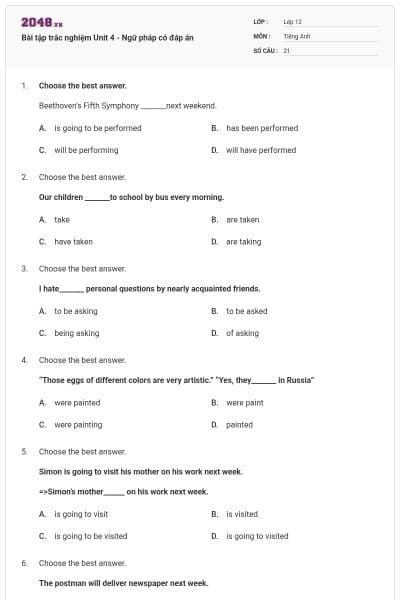
Choose the best answer.
Beethoven’s Fifth Symphony _______next weekend.
is going to be performed
has been performed
will be performing
will have performed
Đáp án: A
Giải thích:
Chủ ngữ là “Beethoven’s Fifth Symphony” (bản giao hưởng số 5 của Beethoven) thì phải được tác động vào chứ không thể tự gây ra hành động “perform” được nên sử dụng câu bị động → loại C, D vì sai cấu trúc bị động
Next weekend: sử dụng thì tương lai nên loại B (thì hiện tại hoàn thành)
Xét đáp án A: Câu bị động thời tương lai gần: S + is/am/are going to be + V-inf (by O)
→ Beethoven’s Fifth Symphony is going to be performed next weekend.
Dịch: Bản giao hưởng số 5 của Beethoven sẽ được trình diễn cuối tuần sau.
Choose the best answer.
Our children _______to school by bus every morning.
take
are taken
have taken
are taking
by bus: bằng xe buýt. Vậy thì lũ trẻ được đưa đến trường bằng xe buýt =>sử dụng câu bị động
=>Our children are takento school by bus every morning.
(Bọn trẻ nhà tôi được đưa đến trường bằng xe buýt mỗi sáng)
Đáp án cần chọn là: B
Choose the best answer.
I hate_______ personal questions by nearly acquainted friends.
to be asking
to be asked
being asking
of asking
Đáp án: B
Giải thích:
hate to V: ghét làm gì
Bị động: hate to be VpII: ghét bị làm gì
Dịch: Tôi ghét bị hỏi những câu hỏi riêng tư bởi những người bạn không quen lắm.
Choose the best answer.
“Those eggs of different colors are very artistic.” “Yes, they_______ in Russia”
were painted
were paint
were painting
painted
- paint (v): sơn, tô, vẽ mà they là “those eggs” nên phải sử dụng dạng bị động vì chúng không thể tự làm được mà phải do bên ngoài tác động
Cấu trúc câu bị động ở thì quá khứ đơn: S + was/were + Vp2
Chủ ngữ là they nên sử dụng were
=>“Those eggs of different colors are very artistic.” “Yes, they were paintedin Russia”
Tạm dịch: Những quả trứng nhiều màu sắc này thật là nghệ thuật. “Đúng vậy, chúng được tô màu ở Nga”
Đáp án cần chọn là: A
Choose the best answer.
Simon is going to visit his mother on his work next week.
=>Simon’s mother______ on his work next week.
is going to visit
is visited
is going to be visited
is going to visited
Động từ “is going to visit” chuyển thành =>is/am/are + being +V ed/V3
Tạm dịch: Simon sẽ thăm mẹ anh ấy trong chuyến đi công tác vào tuần tới.
=>Simon’s mother is going to be visited on his work next week.
(Mẹ của Simon sẽ được thăm trong chuyến đi công tác vào tuần tới.)
Đáp án cần chọn là: C
Choose the best answer.
The postman will deliver newspaper next week.
=>Newspaper _______ by thepostman next week.
will be delivered
will delivered
will be delivering
is delivered
Động từ “will deliver” chuyển thành =>will + be +V ed/V3
Tạm dịch: Người đưa thư sẽ phân phát báo cho anh ấy vào tuần tới.
=>Newspaper will be delivered to him next week.
(Báo sẽ được phân phát cho anh ấy vào tuần tới.)
Đáp án cần chọn là: A
Choose the best answer.
Jim was painting her picture with his patience at 8pm last night.
=>Jim’s picture_______ with her patience at 8pm last night.
was painted
was been painted
was been painting
was being painted
Động từ “was painting ” chuyển thành =>was/were+being +V ed/V3
Tạm dịch: Jim đang vẽ tranh với sự kiên nhẫn của mình lúc 8 giờ tối qua.
=>Jim’s picture was being painted with her patience at 8pm last night.
(Bức tranh của Jim đang được vẽ với sự kiên nhẫn của cô ấy lúc 8 giờ tối qua.)
Đáp án cần chọn là: D
Choose the best answer.
They chose him as the best actor of the year.
He was chosen as the best actor of the year.
He is chosen as the best actor of the year by them.
The best actor of the year was chosen by him.
He was chose as the best actor of the year.
Động từ “chose” chuyển thành =>was chosen
Tạm dịch: Họ chọn anh ấy là diễn viên xuất sắc nhất năm.
=>He was chosen as the best actor of the year.
(Anh ấy được chọn là diễn viên xuất sắc nhất năm.)
Đáp án cần chọn là: A
Choose the best answer.
Someone will pay you in ten days.
You are paid in ten days.
You will be pay in ten days.
You will be paid by someone.
You will be paid in ten days.
Động từ “will pay” chuyển thành =>will + be +paid
by someone có thể lược bỏ
A.sai thì
B.sai động từ pay=>paid
C.câu chưa đầy đủ, còn thiếu thời gian
D.Đúng
Tạm dịch: Ai đó sẽ trả tiền cho bạn trong 10 ngày tới.
=>Bạn sẽ được trả tiền trong 10 ngày tới.
Đáp án: You will be paid in ten days.
Đáp án cần chọn là: D
Choose the best answer.
The teacher always advises us to study harder on the second term.
We are always advise to study harder on the second term.
We study harder on the second term because of the teacher.
We are always advised to study harder on the second term by the teacher.
We are studied harder on the second term.
Động từ “advises” chuyển thành =>are advised
Chủ ngữ “the teacher” chuyển xuống sau “by”
Tạm dịch: Cô giáo luôn khuyên chúng tôi học tập chăm chỉ hơn trong học kỳ 2.
=>We are always advised to study harder on the second term by the teacher.
(Chúng tôi luôn được khuyên học tập chăm chỉ hơn trong học kỳ 2.)
Đáp án cần chọn là: C
Choose the best answer.
The cat has broken many bowls and dishes.
The cat has many broken bowls and dishes.
Many bowls and dishes has been broken by the cat.
Many bowls and dishes have been broken by the cat.
Many bowls and dishes broke the cat.
Động từ “has broken” chuyển thành =>have been broken.
A.sai (vì con mèo không thể có những chiếc bát đĩa được
B.sai (many + Ns là số nhiều nên không thể dùng has.
C.đúng
D.Sai dạng câu bị động
Tạm dịch: Con mèo đã làm vỡ nhiều bát và đĩa.
A.Con mèo có nhiều bát đĩa vỡ
B.(Sai cấu trúc)
C.Nhiều bát và đĩa đã bị con mèo làm vỡ.
D.Nhiều bát đĩa làm vỡ con mèo
=>Many bowls and dishes have been broken by the cat.
Đáp án cần chọn là: C
Choose the best answer.
A new museum _____ in this land before we came to live in Vietnam in 1999.
was opened
had been opened
has been opened
opened
Ở đây việc a new museum được mở ra xảy ra trước việc we came to live nên vế sau chia theo thì quá khứ đơn còn vế trước phải chia theo quá khứ hoàn thành.
=>A new museum had been opened in this land before we came to live in Vietnam in 1999.
( Một bảo tàng mới đã được mở ở khu này trước khi chúng tôi đến sống ở Việt Nam năm 1999. )
Đáp án cần chọn là: B
Choose the best answer.
They_______ time and money doing such a thing.
were advising not to waste
were advising not to be wasted
were advised not to be wasted
were advised not to waste
Cấu trúc: be + Vp2 to V hoặc phủ định: be + Vp2 + not to V
waste (v): phung phí
mà chủ ngữ là they tức là chủ thể gây ra hành động =>nên động từ waste chia theo chủ động
=>They were advised not to wastetime and money doing such a thing.
Tạm dịch: Họ được khuyên là không phung phí tiền bạc và thời gian vào những việc như vậy.
Đáp án cần chọn là: D
Choose the best answer.
These students _______so much that they feel very tired and bored.
are made to study
are made study
are made studying
are made to be studied
be made to V: bị bắt làm gì
study (v): học mà chủ thể gây ra hành động (student) được đặt là chủ ngữ nên động từ study không chia bị động
=>These students are made to studyso much that they feel very tired and bored.
Tạm dịch: Những học sinh này bị bắt học quá nhiều đến nỗi họ cảm thấy mệt mỏi và nhàm chán.
Đáp án cần chọn là: A
Choose the best answer.
The waiter brings me this dish.
Cách 1: This dish ________ by the waiter.
Cách 2: I _________ by the waiter.
is brought for me/am brought this dish
is brought to me/was brought this dish
is brought to me/am brought this dish
brought to me/am brought this dish
Cách 2: Lấy tân ngữ gián tiếp “me” lên làm chủ ngữ =>đổi thành “I”
Động từ “brings” chuyển thành =>is/am/are+V ed/V3
Chủ ngữ “the waiter” chuyển xuống sau “by”
Tạm dịch: Phục vụ mang cho tôi món ăn này.
=>Món ăn này được mang cho tôi bởi người phục vụ.
=>Tôi được mang món ăn này bởi người phục vụ.
Cách 1: This dish is brought to me by the waiter.
Cách 2: I am brought this dish by the waiter.
Đáp án cần chọn là: C
Choose the best answer.
Our friends send these postcards to us.
Cách 1: These postcards _____ by ourfriends.
Cách 2: We _______by our friends.
are sent to us/ are sent these postcard
were sent for us/ are sent with these postcard
are sent us/ are sent with these postcard
are sent us/ are sent to these postcard
Cách 2: Lấy tân ngữ gián tiếp “us” lên làm chủ ngữ =>đổi thành “we”
Động từ “send” chuyển thành =>is/am/are+V ed/V3
Chủ ngữ “our friends” chuyển xuống sau “by”
Tạm dịch: Bạn của chúng tôi đã gửi những tấm bưu thiếp này đến chúng tôi.
Cách 1: These postcards are sent to us by our friends. (Những tấm bưu thiếp này được gửi đến chúng tôi bởi bạn chúng tôi.)
Cách 2: We are sent these postcard by our friends.( Chúng tôi được gửi những tấm bưu thiếp này bởi bạn chúng tôi.)
Đáp án cần chọn là: A
Choose the best answer.
You didn’t show me the special cameras.
Cách 1: This special camera_________ .
Cách 2: I _______this special camera.
wasn’t showed me/ wasn’t showed
wasn’t showed to me/ wasn’t showed
didn’t be showed to me/ wasn’t showed
wasn’t showed to me/ was not showed with
Đáp án: B
Giải thích:
Kiến thức: Câu bị động
Câu có 2 tân ngữ, nên có thể viết lại theo 2 cách:
Cách 1: Đưa tân ngữ là vật lên làm chủ ngữ:
Something be showed to somebody: cái gì được đưa cho ai xem
→ This special camera wasn’t showed to me.
Cách 2: Đưa tân ngữ là người lên làm chủ ngữ:
Somebody be showed something: ai được cho xem cái gì
→ I wasn’t showed this special camera.
Dựa vào ngữ cảnh, ta thấy câu diễn tả một hành động trong tương lai, được quyết định tại thời điểm nói, dùng thì tương lai đơn.
Dịch: Bạn không cho tôi xem máy ảnh đặc biệt.
Cách 1: Chiếc máy ảnh đặc biệt này đã không được đưa cho tôi.
Cách 2: Tôi đã không được đưa cho chiếc máy ảnh đặc biệt này.
Choose the best answer.
I ________ by my nephew last week.
had painted the gate
had the gate painting
had the gate painted
had the gate paint
=>I had the gate painted by my nephew last week.
(Cổng đã được cháu tôi sơn tuần trước.)
Đáp án cần chọn là: C
Choose the best answer.
People believe that 13 is an unlucky number.
=>13 _______ an unlucky number.
believes to be
is believed to be
is believed being
is believed that being
Động từ V2 ở thì hiện tại đơn nên phải chuyển thành “to be”
Lấy chủ ngữ S2 “13” lên làm chủ ngữ trong câu bị động
Tạm dịch: Mọi người tin rằng số 13 là con số không may mắn.
=>13 is believed to be an unlucky number.
(Số 13 được cho là số không may mắn.)
Đáp án cần chọn là: B
Choose the best answer.
He wants _________ by his students.
to be done all the difficult exercises
all the difficult exercises to be done
all the difficult exercises be done
to all the difficult exercises done
Tạm dịch: Anh ấy muốn học sinh của mình làm tất cả những bài tập khó.
=>He wants all the difficult exercises to be done by his students.
(Anh ấy muốn tất cả những bài tập khó được làm bởi học sinh anh ấy.)
Đáp án cần chọn là: B
Find one error in each of the following sentences (A, B, C or D)
New sources of energyhave been lookingfor as the numberof fossil fuelscontinuesto decrease.
sources of energy
continues
been looking
number
Dấu hiệu: “New sources of energy” (Các nguồn năng lượng mới) chịu tác động của hành động “looking for” (tìm kiếm)
Câu bị động thì hiện tại hoàn thành: S + have/ has + been Ved/ V3.
Sửa: been looking =>been looked
Tạm dịch: Các nguồn năng lượng mới đã được tìm kiếm khi số lượng nhiên liệu hóa thạch tiếp tục giảm.
Đáp án cần chọn là: C
READING: SCHOOL EDUCATION SYSTEM (DẠNG ĐIỀN TỪ)
Fill in each numbered blank with one suitable word or phrase.
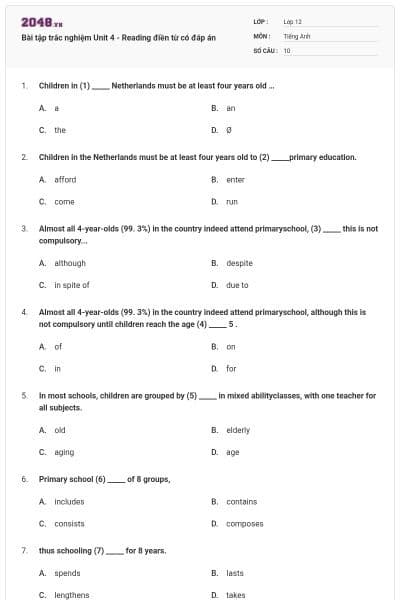
Children in (1) _____ Netherlands must be at least four years old to (2) _____ primary education. Almost all 4-year-olds (99. 3%) in the country indeed attend primary school, (3) _____ this is not compulsory until children reach the age (4) _____5 . Primary school is free of charge. In most schools, children are grouped by (5) _____ in mixed ability classes, with one teacher for all subjects. Primary school (6) _____ of 8 groups, thus schooling (7) _____ for 8 years. During the first two years, which (8) _____ kindergarten, children receive an average of 22 hours of (9) _____, during the last 6 years children receive an average of 25 hours per week. Schools are open 5 days a week, but children are free on Wednesday afternoon. At the end of primary school, or in group 8, schools advice on secondary school choice. Most schools use a national test to support this advice, for instance the 'Citotoets', a test (10) ____ by the Central Institute for Test development.
Bạn có thích hoạt động này không?