Bài tập trắc nghiệm Unit 3 - Đề kiểm tra có đáp án
50 câu hỏi
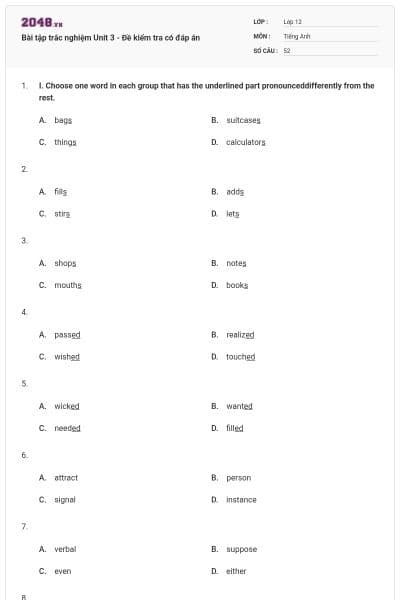
I. Choose one word in each group that has the underlined part pronounceddifferently from the rest.
bags
suitcases
things
calculators
suitcases /'sju:tkeisiz/
things /θiɳz/
calculators /'kælkjuleitəz/
Câu B đuôi “s” phát âm là /iz/, còn lại là /z/
Đáp án cần chọn là: B
fills
adds
stirs
lets
adds /ædz/
stirs /stə:z/
lets /lets/
Câu D đuôi “s” phát âm là /s/, còn lại là /z/
Đáp án cần chọn là: D
shops
notes
mouths
books
notes /nəʊts/
mouths /maʊðz/
books /bʊks/
Câu C đuôi “s” phát âm là /z/, còn lại là /s/
Đáp án cần chọn là: C
passed
realized
wished
touched
realized /ˈriːəlaɪzd/
wished /wɪʃt/
touched /tʌtʃt/
Câu B đuôi “ed” phát âm là /d/, còn lại là /t/
Đáp án cần chọn là: B
wicked
wanted
needed
filled
wanted /ˈwɑːntɪd/
needed /niːdid/
filled /fɪld/
Câu D đuôi “ed” phát âm là /d/, còn lại là /id/
Đáp án cần chọn là: D
II. Choose the word which is stresses differently from the rest.
attract
person
signal
instance
person /ˈpɜːsən/
signal /ˈsɪɡnəl/
instance /ˈɪn.stəns/
Câu A trọng âm rơi vào âm tiết thứ 2, còn lại âm tiết 1
Đáp án cần chọn là: A
verbal
suppose
even
either
suppose /səˈpəʊz/
even /ˈiːvn/
either /ˈiːðə(r)/
Câu B trọng âm rơi vào âm tiết thứ 2, còn lại âm tiết 1
Đáp án cần chọn là: B
example
consider
several
attention
consider /kənˈsɪdə(r)/
several /ˈsevrəl/
attention /əˈtenʃn/
Câu C trọng âm rơi vào âm tiết thứ 1, còn lại âm tiết 2
Đáp án cần chọn là: C
situation
appropriate
informality
entertainment
appropriate /əˈprəʊpriət/
informality /ˌɪnfɔːˈmæləti/
entertainment /ˌentəˈteɪnmənt/
Câu B trọng âm rơi vào âm tiết thứ 2, còn lại âm tiết 3
Đáp án cần chọn là: B
Choose one word in each group that has the underlined part pronounceddifferently from the rest.
across
simply
common
brother
simply /ˈsɪmpli/
common /ˈkɒmən/
brother /ˈbrʌðə(r)/
Câu A trọng âm rơi vào âm tiết thứ 2, còn lại âm tiết 1
Đáp án cần chọn là: A
Mrs. Pike was so angry that she made a _______ gesture at the driver.
rude
rudeness
rudely
rudest
rude (adj): thô lỗ
rudeness (n): sự thô lỗ
rudely (adv): 1 cách thô lỗ
rudest (adj): thô lỗ nhất
=>Mrs. Pike was so angry that she made a rude gesture at the driver.
Tạm dịch:Mrs. Pike tức giận đến nỗi cô ấy đã có cử chỉ thô lỗ với tài xế.
Đáp án cần chọn là: A
_______ nonverbal language is _______ important aspect of interpersonalcommunication.
The / Ø
A / the
The / a
Ø /an
important aspect: khía cạnh quan trọng =>cần mạo từ “an”
=>Ø nonverbal language is animportant aspect of interpersonal communication.
Tạm dịch:Ngôn ngữ phi ngôn ngữ là một khía cạnh quan trọng của giao tiếp giữa cá nhân với nhau.
Đáp án cần chọn là: D
A whistle is the _______ for the football players to begin the match.
communication
instance
attention
signal
instance (n): tình huống
attention (n): sự chú ý
signal (n): dấu hiệu
=>A whistle is the signal for the football players to begin the match.
Tạm dịch:Huýt sáo là dấu hiệu cho cầu thủ bóng đá để bắt đầu trận đấu.
Đáp án cần chọn là: D
It is often considered to be impolite to _______ at someone.
look
smile
point
raise
smile (v): cười
point (v): chỉ
raise (v): giơ lên
=>It is often considered to be impolite to point at someone.
Tạm dịch:Đó thường xuyên được cân nhắc rằng thật bất lịch sự để chỉ tay vào ai đó.
Đáp án cần chọn là: C
He is not really friendly and makes no attempt to be _______.
society
social
socialize
sociable
Đáp án: D
Giải thích:
Kiến thức: Từ vựng – Từ loại
A. society (n): xã hội
B. social (adj): thuộc về, liên quan tới xã hội
C. socialize (v): hòa đồng
D. sociable (adj): hòa đồng
Vị trí cần điền là tính từ đứng sau “to be”, dựa vào nghĩa chọn D.
Dịch: Anh ta không thực sự thân thiện và không hề cố gắng hòa đồng.
She sent me a _______ letter thanking me for my invitation.
polite
politely
politeness
impoliteness
politely (adv): 1 cách lịch sự
politeness (n): phẩm chất lễ phép
impoliteness (n): phẩm chất bất lịch sự
=>She sent me a polite letter thanking me for my invitation.
Tạm dịch:Cô ấy gửi cho tôi 1 lá thư cảm ơn lịch sự cho lời mời của tôi.
Đáp án cần chọn là: A
I waved _______ him from the window but he didn't see me.
through
for
up
to
=>I waved to him from the window but he didn't see me.
Tạm dịch:Cô ấy gửi cho tôi 1 lá thư lịch sự để cảm ơn lời mời của tôi.
Đáp án cần chọn là: D
“How well you are playing” - “________.”
Say it again. I like to hear your words.
I think so. I am proud of myself.
Thank you too much.
Many thanks. That is a nice compliment.
A. Đồng ý. Tôi thích nghe bạn nói.
B. Tôi nghĩ vậy. Tôi tự hào về chính bản thân tôi.
C. Cảm ơn bạn nhiều.
D. Cảm ơn bạn. Đó là 1 lời khen hay.
=>Many thanks. That is a nice compliment.
Đáp án cần chọn là: D
When you catch someone’s_______ you should do something to attracthis attention so that you can talk to him.
ear
eye
head
hand
eye (n): mắt
head (n): đầu
hand (n): tay
Cụm từ: catch someone’s eye: lọt vào mắt ai
=>When you catch someone’s eye you should do something to attract his attention so that you can talk to him.
Tạm dịch:Khi bạn lọt vào mắt ai đó, bạn nên làm 1 cái gì đó để thu hút sự chú ý của anh ta để bạn có thể nói chuyện với anh ấy.
Đáp án cần chọn là: B
When the play finished, the audience stood up and _____ their handsloudly.
shook
clapped
nodded
held
clapped (v): vỗ tay
nodded (v): gật đầu
held (v): nắm giữ
=>When the play finished, the audience stood up and clapped their hands loudly.
Tạm dịch:Khi vở kịch kết thúc, khán giả đứng lên và vỗ tay rất lớn.
Đáp án cần chọn là: B
_______ you wanted to ask your teacher a question during his lecture,what would you do?
As
As if
Even of
Suppose
As if: như thể là
Even of: thậm chí
Suppose: giả sử
=>Suppose you wanted to ask your teacher a question during his lecture, what would you do?
Tạm dịch:Giả sử bạn muốn hỏi cô giáo 1 câu hỏi trong suốt bài giảng, bạn sẽ làm gì?
Đáp án cần chọn là: D
John asked me ________ in English.
what does this word mean
what that word means
what did this word mean
what that word meant
Công thức: S + asked + O + what + S +Ved/V2
=>John asked me what that word meantin English.
Tạm dịch:John hỏi tôi từ kia nghĩa là gì trong tiếng anh.
Đáp án cần chọn là: D
I told him _________ the word to Jane somehow that I_______ to reachher during the early hours.
passing/will try
he will pass/tried
to pass/would be trying
he passed/ have tried
=>I told him to passthe word to Jane somehow that I would be trying to reach her during the early hours.
Tạm dịch:Tôi đã nói với anh ta chuyển lời tới Jane là bằng cách nào đó tôi sẽ cố gắng đến gặp cô ấy trong đầu giờ.
Đáp án cần chọn là: C
I______ you everything I am doing, and you have to do the same.
will tell
would tell
told
was telling
Công thức: S + will-V
=>I will tell you everything I am doing, and you have to do the same.
Tạm dịch:Tôi sẽ nói cho bạn về những gì tôi đang làm và bạn sẽ phải làm tương tự.
Đáp án cần chọn là: A
Laura said she had worked on the assignment since ______.
yesterday
two days ago
the day before
the next day
Đáp án: C
Giải thích:
Trong câu gián tiếp (có động từ tường thuật “said”), trạng từ chỉ thời gian “yesterday” chuyển thành “the day before”.
Dịch: Laura nói cô ấy đã làm bài tập kể từ ngày hôm trước đó.
In the western customs (26) _____ hands is the customary form of greeting
taking
shaking
grasping
hugging
shaking (v): bắt tay
grasping (v): nắm chặt
hugging (v): ôm
=>In the western customs shaking hands is the customary form of greeting,
Tạm dịch:Trong phong tục phương Tây, bắt tay là hình thức thông thường của chào hỏi,
Đáp án cần chọn là: B
but in China a nod of the head or (27) _____ bow is sufficient.
small
bit
slight
light
bit (n): 1 chút
slight (adj): nhẹ nhàng, qua loa
light (adj): nhẹ (cân nặng)
=>but in China a nod of the head or slight bow is sufficient.
Tạm dịch:nhưng ở Trung Quốc một cái gật đầu hay một cái cúi đầu nhẹ là đủ.
Đáp án cần chọn là: C
Business cards are often (28) _____ and yours should be printed in yourown language and in Chinese.
exchanged
changed
transferred
converted
change (v): thay đổi
transferr (v): chuyển, dời
convert (v): đổi, biến đổi
=>Business cards are often exchanged and yours should be printed in your own language and in Chinese.
Tạm dịch:Danh thiếp được trao đổi thường xuyên và danh thiếp của bạn nên được in bằng ngôn ngữ nước bạn và tiếng Trung Quốc.
Đáp án cần chọn là: A
The Chinese are (30) _____ applauders.
enthusiast
enthusiastic
enthusiasm
enthusiastically
enthusiastic (adj): nhiệt tình
enthusiasm (n): sự nhiệt tình
enthusiastically (adv): 1 cách nhiệt tình
=>The Chinese are enthusiastic applauders.
Tạm dịch:Người Trung Quốc là những người nhiệt tình khen ngợi.
Đáp án cần chọn là: B
When walking in public places, direct eye (31) _____ and staring is
uncommon in the larger cities, especially in those areas accustomed to foreignvisitors.
contact
look
stare
watch
look (v): nhìn
stare (v): nhìn chằm chằm
watch (v): xem
=>When walking in public places, direct eye contactand staring is uncommon in the larger cities, especially in those areas accustomed to foreign visitors.
Tạm dịch:Khi đi bộ ở nơi công cộng, giao tiếp bằng ánh mắt nhìn chằm chằm trực tiếp rất hiếm ở các thành phố lớn hơn, đặc biệt là trong các khu vực có du khách nước ngoài.
Đáp án cần chọn là: A
(32) _____, in smaller communities, visitors may be the subject of muchcuriosity and therefore you may notice some stares.
Moreover
Furthermore
However
Whatever
Furthermore: hơn nữa
However: tuy nhiên
Whatever: bất kỳ cái gì
=>However, in smaller communities, visitors may be the subject of much curiosity and therefore you may notice some stares.
Tạm dịch:Tuy nhiên, trong cộng đồng nhỏ hơn, du khách có thể là chủ đề của những sự tò mò và do đó bạn có thể nhận ra một số ánh nhìn.
Đáp án cần chọn là: C
(33) _____ speaking, the Chinese are not a touch-oriented society,especially true for visitors.
Generally
Successfully
Fortunately
Expectedly
Successfully (adv): 1 cách thành công
Fortunately (adv): may mắn
Expectedly (adv): mong chờ
=>Generally speaking, the Chinese are not a touch-oriented society, especially true for visitors.
Tạm dịch:Nói chung, người Trung Quốc không theo sự giao thiệp có định hướng va chạm, đặc biệt đối với du khách.
Đáp án cần chọn là: A
So, avoid (34) _____ or any prolonged form of body contact.
touch
to touch
touched
touching
=>So, avoid touching or any prolonged form of body contact.
Tạm dịch:Vì vậy, hãy tránh va chạm hay bất kỳ hình thức giao tiếp cơ thể nào.
Đáp án cần chọn là: D
In this case, (35) _____ are neither offered or expected.
Contacts
Apologies
Gestures
Saying goodbye
Apologies (n): lời xin lỗi
Gestures (n): cử chỉ
Saying goodbye (n): chào tạm biệt
=>In this case, apologies are neither offered or expected.
Tạm dịch: Trong trường hợp này, lời xin lỗi không được đề nghị hay mong đợi.
Đáp án cần chọn là: B
Which part of body is not used to send body message?
faces
legs
hands
stomachs
Tạm dịch: Những chuyển động và biểu cảm bằng bàn tay, cánh tay, chân và các bộ phận khác của cơ thể là những loại phổ biến nhất của truyền thông điệp phi ngôn ngữ.
=>các bộ phận bề ngoài cơ thể sẽ dùng để truyền thông điệp
Bộ phận nào trên cơ thể không được sử dụng để truyền thông điệp qua cơ thể?
A. khuôn mặt
B. chân
C. tay
D. dạ dày
=>stomachs
Đáp án cần chọn là: D
Face gestures ________.
can help us control our feelings
are the most difficult to control
cannot express our feelings
do not include eye brow moments.
A. có thể giúp điều khiển cảm xúc của chúng ta
B. là thông điệp khó khăn nhất để kiểm soát.
C. không thể diễn tả được cảm xúc của chúng ta
D. không bao gồm chuyển động của lông mày.
Thông tin:Movements and gestures by the hands, arms, legs, and other parts of the body and face are the most pervasive types of nonverbal messages and the most difficult to control.
Tạm dịch:Sự chuyển động và cử chỉ của bàn tay, cánh tay, chân, các bộ phận khác của cơ thể và khuôn mặt là những loại phổ biến nhất của thông điệp phi ngôn ngữ cũng là thông điệp khó khăn nhất để kiểm soát.
=>Face gestures are the most difficult to control
Đáp án cần chọn là: B
Body communication is ________.
visual
verbal
very few
uncommon
A. có thể nhìn thấy
B. lời nói
C. rất ít
D. bất thường
Thông tin:Body movements express true messages about feelings that cannot be masked. Because such avenues of communication are visual
Tạm dịch:Chuyển động cơ thể truyền đạt những thông điệp chính xác về những cảm xúc không thể che giấu. Bởi vì những cách thức giao tiếp như vậy có thể nhìn thấy
=>Body communication is visual
Đáp án cần chọn là: A
According to the text, body movements cannot express ________.
feelings
status
attitudes
desires
A. cảm xúc
B. trạng thái
C. thái độ
D. mong muốn
Thông tin:Body movements express true messages about feelings that cannot be masked...We tend to be more relaxed with friends or when addressing those of lower status. Body orientation also indicates status or liking of the other individual. More direct orientation is related to a more positive attitude.
Tạm dịch:Chuyển động cơ thể truyền đạt những thông điệp chính xác về những cảm xúc không thể che giấu…..
Chúng ta có xu hướng thoải mái hơn với bạn bè hoặc khi xưng hô với những người ở địa vị thấp hơn. Định hướng của cơ thể cũng cho biết tình trạng hay ý thích của các cá nhân khác. Càng nhiều hướng thể hiện trực tiếp càng liên quan tới thái độ tích cực hơn.
=>According to the text, body movements cannot express desires
Đáp án cần chọn là: D
Nonverbal communication ________.
may be interrupted by noise
has no relation to verbal communication
dominates words
is less common than verbal communication
A. có thể bị gián đoạn bởi tiếng ồn
B. không có mối quan hệ với giao tiếp lời nói
C. thống trị từ ngữ
D. ít phổ biến hơn giao tiếp lời nói
Thông tin:If these two means of communication are dichotomized and contradict each other, some result will be a disordered image and most often the nonverbal will dominate.
Tạm dịch:Nếu hai phương tiện giao tiếp này bị chia rẽ và mâu thuẫn với nhau, kết quả sẽ là một hình ảnh không theo trật tự, và thường thì phi ngôn ngữ sẽ chiếm ưu thế.
=>Nonverbal communication has no relation to verbal communication
Đáp án cần chọn là: B
VI. Choose the word or phrase that needs correcting
According to(A)Mehrabian in 1971, only 7%(B)of the information we communicate to others(C)depends upon the words saying(D); 93% of that depends on nonverbal communication.
According to
only 7%
to others
saying
Từ “saying” rút gọn sai vì “the words” (từ ngữ) không thể thực hiện được hành động nói
saying =>we say
=>According to Mehrabian in 1971, only 7% of the information we communicate to others depends upon the words we say; 93% of that depends on nonverbal communication.
Tạm dịch: Theo như Mehrabian vào năm 1971, chỉ 7% thông tin mà chúng ta giao tiếp với người khác phụ thuộc vào từ ngữ mà chúng ta nói, 93% còn lại phụ thuộc vào giao tiếp phi ngôn ngữ.
Đáp án cần chọn là: D
Body language (A)is quiet and secret(B), but most(C) powerful language of all(D).
Body language
and secret
most
of all
Đáp án: C
Giải thích:
So sánh nhất phải có mạo từ “the”.
Sửa: most → the most
Dịch: Ngôn ngữ cơ thể là ngôn ngữ trầm lặng và bí mật, nhưng mạnh mẽ nhất trong tất cả.
Our bodies send out(A)messages(B) constantly and sometimes we do not recognize(C)that we are using many(D)nonverbal language.
send out
messages
do not recognize
many
Sau “many” phải là danh từ đếm được ở dạng số nhiều.
"nonverbal language" (ngôn ngữ phi ngôn ngữ) luôn ở dạng số ít
many =>a lot of
Our bodies send out messages constantly and sometimes we do not recognize that we are using a lot of nonverbal language.
Tạm dịch:Cơ thể chúng ta gửi ra ngoài những thông điệp 1 cách thường xuyên và thỉnh thoảng chúng ta không nhận ra rằng chúng ta đang sử dụng rất nhiều ngôn ngữ phi ngôn ngữ.
Đáp án cần chọn là: D
Our understanding(A)and use of nonverbal cues in facial expression (B)and gestures are familiar (C)to us nearly in (D) birth.
Our understanding
in facial expression
are familiar
in
Tạm dịch: Sự hiểu biết và sử dụng ám hiệu trong việc biểu cảm khuôn mặt và cử chỉ đã quen với chúng ta từ khi sinh ra.
in =>from
Đáp án cần chọn là: D
(A) A person's body postures, movements (B) but positions more often tell us (C) exactly (D) what they mean.
A person’s
but
exactly
what
Đáp án: B
Giải thích:
Ở đây ta cần 1 liên từ để nối 3 cụm từ tương đồng với nhau về mặt ngữ pháp lại với nhau.
Sửa: but (nhưng) → and (và)
Dịch: Dáng điệu, chuyển động cơ thể và tư thế của một người thường nói cho chúng ta biết chính xác họ có ý gì.
“How beautiful is the dress you have just bought!” Peter said to Mary.
Peter promised to buy Mary a beautiful dress.
Peter said thanks to Mary for her beautiful dress.
Peter complimented Mary on her beautiful dress.
Peter asked Mary how she had just bought her beautiful dress.
A. Peter hứa mua cho Mary 1 cái váy đẹp.
B. Peter nói cảm ơn tới Mary về cái váy đẹp của cô ấy.
C. Peter khen Mary về cái váy đẹp.
D. Peter hỏi Mary rằng cô ấy mua cái váy đẹp ấy như thế nào.
“How beautiful is the dress you have just bought!” Peter said to Mary.
=>Peter complimented Mary on her beautiful dress.
Đáp án cần chọn là: C
She raised her hand high so that she could attract her teacher's attention.
Because her teacher attracted her , she raised her hand high.
To attract her teacher’s attention, she raised her hand high.
Though she raised her hand high, she could not attract her teacher’s attention.
She had such a high raising of hand that she failed to attract her teacher’s attention.
Mệnh đề chỉ lý do: Because + S + V: bởi vì
Mệnh đề chỉ sự nhượng bộ: Though S + V(mặc dù)
Mệnh đề chỉ kết quả: S + V + such + noun phrase that + S + V ( quá ... đến nỗi mà...)
Cô ấy giơ tay cao để thu hút sự chú ý của cô giáo.
A. Bởi vì cô giáo thu hút cô ấy, cô ấy đã giơ tay cao. =>sai về nghĩa
B. Để thu hút sự chú ý của cô giáo, cô ấy đã giơ tay cao.
C. Mặc dù cô ấy giơ tay cao, cô ấy cũng không thể thu hút sự chú ý của cô giáo. =>sai về nghĩa
D. Cô ấy giơ tay cao đến nỗi cô ấy thất bại trong việc thu hút sự chú ý của cô giáo. =>sai về nghĩa
She raised her hand high so that she could attract her teacher's attention.
=>To attract her teacher’s attention, she raised her hand high.
Đáp án cần chọn là: B
“Hello Mary!” Peter said.
Peter said to hello Mary.
Peter said Mary hello.
Peter told Mary hello.
Peter greeted Mary.
A. sai vì không có dạng “said to-V”
B. sai vì không có dạng “said +sb”
C. sai vì “told + O + to-V”
D. đúng vì greet (v): chào hỏi
“Hello Mary!” Peter said.
=>Peter greeted Mary.
Đáp án cần chọn là: D
Julie and Anne had not met each other before the party.
Julie and Anne got acquainted when they were at the party.
The party prevented Julie and Anne from meeting each other.
The party was the place where Julie and Anne could not meet each other.
Julie and Anne used to meet each other for the party.
A. Julie và Anne làm quen với nhau khi họ ở bữa tiệc.
B. Bữa tiệc ngăn cản Julie và Anne gặp nhau. =>sai về nghĩa
C. Bữa tiệc là nơi mà Julie và Anne không thể gặp nhau. =>sai về nghĩa
D. Julie và Anne thường gặp nhau ở bữa tiệc. =>sai về nghĩa
Julie and Anne had not met each other before the party.
=>Julie and Anne got acquainted when they were at the party.
Đáp án cần chọn là: A
“Why don’t you ask the teacher for help?” Peter asked me.
Peter advised me to ask the teacher for help.
Peter recommended me not to ask the teacher for help.
Peter told me the reason why I did not ask the teacher for help.
Peter suggested that he should ask the teacher for help.
A. Peter khuyên tôi hỏi hỏi giáo viên để được giúp đỡ.
B. Peter gợi ý tôi không nên hỏi hỏi giáo viên để được giúp đỡ.
C. Peter nói cho tôi về lý do tại sao tôi hỏi hỏi giáo viên để được giúp đỡ.
D. Peter đề nghị rằng anh ấy nên hỏi hỏi giáo viên để được giúp đỡ.
“Why don’t you ask the teacher for help?” Peter asked me.
=>Peter advised me to ask the teacher for help.
Đáp án cần chọn là: A
Also, it is more respectful to present your card or a gift or any otherarticle using (29) _____ hands.
pair
couple
double
both
couple (n): đôi, cặp
double (n): gấp đôi
both (n): cả hai
a, b, c cần phải đi trong 1 cụm từ a ... of + N: 1 đôi
=>Also, it is more respectful to present your card or a gift or any other article using both hands.
Tạm dịch:Ngoài ra, sẽ tôn trọng hơn khi đưa danh thiếp hay món quà hoặc bất kỳ vật phẩm nào mà sử dụng cả hai tay.
Đáp án cần chọn là: D
Bạn có thích hoạt động này không?