60 Bài tập Tiếng Anh lớp 10 Unit 2 có đáp án
60 câu hỏi
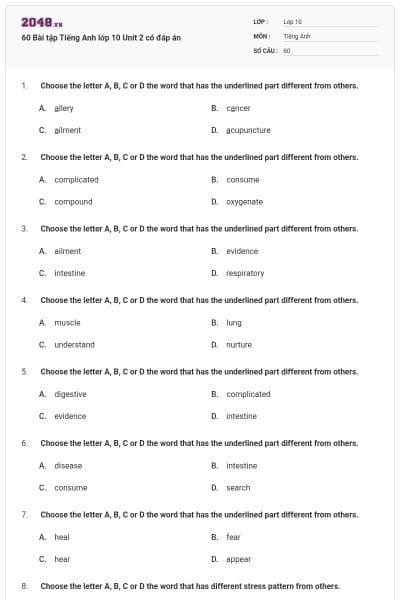
Choose the letter A, B, C or D the word that has the underlined part different from others.
allery
cancer
ailment
acupuncture
Đáp án C
Giải thích: Đáp án C phát âm là /ei/ các đáp án còn lại phát âm là /æ/
Choose the letter A, B, C or D the word that has the underlined part different from others.
complicated
consume
compound
oxygenate
Đáp án B
Giải thích: Đáp án B phát âm là /ə/ các đáp án còn lại phát âm là /ɒ/
Choose the letter A, B, C or D the word that has the underlined part different from others.
ailment
evidence
intestine
respiratory
Đáp án A
Giải thích: Đáp án A phát âm là /ə/ các đáp án còn lại phát âm là /e/
Choose the letter A, B, C or D the word that has the underlined part different from others.
muscle
lung
understand
nurture
Đáp án D
Giải thích: Đáp án D phát âm là /ʌ/ các đáp án còn lại phát âm là /ə/
Choose the letter A, B, C or D the word that has the underlined part different from others.
digestive
complicated
evidence
intestine
Đáp án A
Giải thích: Đáp án A phát âm là /ai/ các đáp án còn lại phát âm là /i/
Choose the letter A, B, C or D the word that has the underlined part different from others.
disease
intestine
consume
search
Đáp án A
Giải thích: Đáp án A phát âm là /z/ các đáp án còn lại phát âm là /s/
Choose the letter A, B, C or D the word that has the underlined part different from others.
heal
fear
hear
appear
Đáp án A
Giải thích: Đáp án A phát âm là /i:/ các đáp án còn lại phát âm là /iə/
Choose the letter A, B, C or D the word that has different stress pattern from others.
compound
poultry
inspire
muscle
Đáp án C
Giải thích: Đáp án C trọng âm thứ 2, các đáp án còn lại trọng âm thứ 1
Choose the letter A, B, C or D the word that has different stress pattern from others.
consume
ailment
disease
compound
Đáp án A
Giải thích: Đáp án A trọng âm thứ 2, các đáp án còn lại trọng âm thứ 1
Choose the letter A, B, C or D the word that has different stress pattern from others.
evidence
digestive
inspiring
consumer
Đáp án A
Giải thích: Đáp án A trọng âm thứ 1, các đáp án còn lại trọng âm thứ 2
Choose the letter A, B, C or D the word that has different stress pattern from others.
complicate
allergy
evidence
intestine
Đáp án D
Giải thích: Đáp án D trọng âm thứ 2, các đáp án còn lại trọng âm thứ 1
Choose the letter A, B, C or D the word that has different stress pattern from others.
oxygenate
complicated
interviewee
acupuncture
Đáp án C
Giải thích: Đáp án C trọng âm thứ 3, các đáp án còn lại trọng âm thứ 1
Choose the letter A, B, C or D the word that has different stress pattern from others.
circulatory
respiratory
photography
biology
Đáp án A
Giải thích: Đáp án A trọng âm thứ 3, các đáp án còn lại trọng âm thứ 2
Choose the letter A, B, C or D the word that has different stress pattern from others.
cancer
needle
consume
poultry
Đáp án C
Giải thích: Đáp án C trọng âm thứ 2, các đáp án còn lại trọng âm thứ 1
Choose the letter A, B, C or D the word that has different stress pattern from others.
inspire
consume
digest
muscle
Đáp án D
Giải thích: Đáp án D trọng âm thứ 1, các đáp án còn lại trọng âm thứ 2
Choose the letter A, B, C or D to complete the sentences
___________it was late, we decided to take a taxi home.
Because
Since
Because of
Although
Đáp án A
Giải thích: because + mệnh đề: bởi vì
Dịch: Bởi vì đã muộn, chúng tôi quyết định bắt taxi về nhà.
Choose the letter A, B, C or D to complete the sentences
___________ problems in sailing in tropical seas is the coral reefs.
One of the biggest
The biggest one
Of the biggest one
There are the biggest
Đáp án A
Giải thích: one of the + Ns: một trong những...
Dịch: Một trong những vấn đề trong việc đi thuyền ngoài biển nhiệt đới là những rặng san hô.
Choose the letter A, B, C or D to complete the sentences
Would you mind _______ more clearly, please?
speak
speaking
to speak
spoke
Đáp án B
Giải thích: sau mind + Ving: phiền, ngại làm gì
Dịch: Phiền bạn nói rõ hơn được không?
Choose the letter A, B, C or D to complete the sentences
Every day, we ________ a great deal of food from poultry.
consume
consumes
consuming
consumed
Đáp án A
Giải thích: consume: tiêu thụ
Dịch: Mỗi ngày chúng ta tiêu thụ rất nhiều đồ ăn làm từ gia cầm.
Choose the letter A, B, C or D to complete the sentences
________ he comes to the theater with me, I shall go alone.
Because of
Because
Unless
When
Đáp án C
Giải thích Unless = If...not..., câu điều kiện loại 1
Dịch: Trừ khi anh ta đến rạp chiếu phim với tôi, không thì tôi sẽ đi một mình.
Choose the letter A, B, C or D to complete the sentences
_______ of your brothers and sisters do you feel closer to?
Who
What
Whose
Which
Đáp án D
Giải thích: trong các từ trên chỉ có which đi được với “of”. Which of + Ns: ai/ cái nào trong số...
Dịch: Ai trong số những người anh chị em của bạn mà bạn thấy gần gũi nhất?
Choose the letter A, B, C or D to complete the sentences
He coughs a lot. Has he got any __________ diseases so far?
respiratory
inspiring
muscles
circulatory
Đáp án A
Giải thích: respiratory disease: bệnh đường hô hấp
Dịch: Anh ấy ho nhiều quá. Trước đây anh ấy có tiền sử bệnh hô hấp không?
Choose the letter A, B, C or D to complete the sentences
- “I _______ you at 9 tomorrow morning. Will that be OK?”
- “At 9? No, I _______ shopping with my mother.”
phone-will go
am phoning- have gone
will phone-will be going
have phoned-am going
Đáp án C
Giải thích: ở ô trống thứ nhất ta có mốc thời gian “tomorrrow morning” nên động từ chia thời tương lai đơn will V. Ta dùng will be Ving để diễn tả hành động sẽ đang diễn ra tại một thời điểm xác định trong tương lai.
Dịch:
- “Tôi sẽ gọi cho anh vào 9 giờ sáng mai. Được chứ?"
- "Lúc 9 giờ? Không, tôi sẽ đang đi mua sắm với mẹ tôi ”.
Choose the letter A, B, C or D to complete the sentences
He kept ________ the evidence again and again.
repeat
to repeat
repeat to
repeating
Đáp án D
Giải thích: cấu trúc keep Ving: cứ liên tục làm gì
Dịch: Anh ta cứ liên tục nhắc đi nhắc lại bằng chứng nhiều lần.
Choose the letter A, B, C or D to complete the sentences
I like most sports but tennis is my first _______.
love
lover
lovely
loveless
Đáp án A
Giải thích: first love: tình yêu đầu
Dịch: Tôi thích hầu hết môn thể thao nhưng tennis là môn đầu tiên tôi thích.
Choose the letter A, B, C or D to complete the sentences
My mother always tells me to look _________ my younger brother.
for
at
after
before
Đáp án C
Giải thích: look after: chăm sóc
Dịch: Mẹ tôi luôn bảo tôi phải chăm sóc em trai.
Choose the letter A, B, C or D to complete the sentences
Ask me again tomorrow. I'll have to give it some _______.
think
thought
thoughtful
thoughtless
Đáp án B
Giải thích: some + N
Give st some thought: suy tính kĩ, cân nhắc
Dịch: Hỏi tôi lần nữa vào ngày mai. Tôi sẽ cân nhắc.
Choose the letter A, B, C or D to complete the sentences
Diet plays an important role in the _______ of heart disease.
manage
manager
management
manageable
Đáp án C
Giải thích: sau mạo từ the là danh từ
Dịch: Chế độ ăn đóng vai trò quan trọng trong sự khống chế bệnh tim.
Choose the letter A, B, C or D to complete the sentences
She gives her children everything ..................... they want.
that
who
whom
what
Đáp án A
Giải thích: trong mệnh đề quan hệ, everything đi với đại từ quan hệ “that”.
Dịch: Cô ấy cho lũ trẻ mọi thứ chúng cần.
Choose the letter A, B, C or D to complete the sentences
As the drug took ………., the patient became unconscious.
effect
force
influence
action
Đáp án A
Giải thích: cấu trúc “take effect” có tác dụng, có hiệu lực.
Dịch: Khi thuốc ngấm, bệnh nhân trở nên bất tỉnh.
Read the passage below and decide whether the statements are TRUE or FALSE?
The overgrowth of cells leads to the development of tumors and the harmful effects of cancer. In lung cancer, this pattern of cell overgrowth occurs in the lungs, which are vital organs for breathing and gas exchange. Doctors typically diagnose two lung cancer types, small cell and non-small cell, depending on how they appear under a microscope. A person is more likely to have non-small cell lung cancer than small cell.
While anyone can develop lung cancer, cigarette smoking and exposure to smoke can increase the likelihood that a person will experience the condition. Lung cancer can develop if a person has a history of exposure to inhaled chemicals or other toxins. Even if this exposure to chemicals and other toxins was a long time ago, it could cause changes in lung cells that lead to cancer.
If a doctor identifies a suspicious lesion on an imaging study, they may recommend taking a sample of lung tissue to test for potentially cancerous cells. There are different ways to take a tissue sample, and the method often depends on the location of the lesion. One example is when a doctor performs a bronchoscopy, which involves inserting a special thin, lighted scope with a camera on the end. This helps the doctor to see the lesion and then to obtain samples. Less accessible lesions in the lungs may require a more invasive surgical procedure to remove lung tissue, such as thoracoscopy or video-assisted thoracic surgery.
Question: The effect of cancer is the result of the overgrowth of cells.
True
False
Đáp án A
Giải thích: Dựa vào câu: “The overgrowth of cells leads to the development of tumors and the harmful effects of cancer.”.
Dịch: Sự phát triển quá nhanh của các tế bào dẫn đến sự phát triển của khối u, và tác hại nghiêm trọng của ung thư.
Read the passage below and decide whether the statements are TRUE or FALSE?
The overgrowth of cells leads to the development of tumors and the harmful effects of cancer. In lung cancer, this pattern of cell overgrowth occurs in the lungs, which are vital organs for breathing and gas exchange. Doctors typically diagnose two lung cancer types, small cell and non-small cell, depending on how they appear under a microscope. A person is more likely to have non-small cell lung cancer than small cell.
While anyone can develop lung cancer, cigarette smoking and exposure to smoke can increase the likelihood that a person will experience the condition. Lung cancer can develop if a person has a history of exposure to inhaled chemicals or other toxins. Even if this exposure to chemicals and other toxins was a long time ago, it could cause changes in lung cells that lead to cancer.
If a doctor identifies a suspicious lesion on an imaging study, they may recommend taking a sample of lung tissue to test for potentially cancerous cells. There are different ways to take a tissue sample, and the method often depends on the location of the lesion. One example is when a doctor performs a bronchoscopy, which involves inserting a special thin, lighted scope with a camera on the end. This helps the doctor to see the lesion and then to obtain samples. Less accessible lesions in the lungs may require a more invasive surgical procedure to remove lung tissue, such as thoracoscopy or video-assisted thoracic surgery.
Question: There are four lung cancer cells
True
False
Đáp án B
Giải thích: Dựa vào câu: “Doctors typically diagnose two lung cancer types, small cell and non-small cell…”.
Dịch: Các bác sĩ nhìn chung chuẩn đoán được 2 loại tế bào ung thư phổi: tế bào nhỏ, và tế bào lớn.
Read the passage below and decide whether the statements are TRUE or FALSE?
The overgrowth of cells leads to the development of tumors and the harmful effects of cancer. In lung cancer, this pattern of cell overgrowth occurs in the lungs, which are vital organs for breathing and gas exchange. Doctors typically diagnose two lung cancer types, small cell and non-small cell, depending on how they appear under a microscope. A person is more likely to have non-small cell lung cancer than small cell.
While anyone can develop lung cancer, cigarette smoking and exposure to smoke can increase the likelihood that a person will experience the condition. Lung cancer can develop if a person has a history of exposure to inhaled chemicals or other toxins. Even if this exposure to chemicals and other toxins was a long time ago, it could cause changes in lung cells that lead to cancer.
If a doctor identifies a suspicious lesion on an imaging study, they may recommend taking a sample of lung tissue to test for potentially cancerous cells. There are different ways to take a tissue sample, and the method often depends on the location of the lesion. One example is when a doctor performs a bronchoscopy, which involves inserting a special thin, lighted scope with a camera on the end. This helps the doctor to see the lesion and then to obtain samples. Less accessible lesions in the lungs may require a more invasive surgical procedure to remove lung tissue, such as thoracoscopy or video-assisted thoracic surgery.
Question: People smoking or exposing to cigarettes are more likely to have lung cancer.
True
False
Đáp án B
Giải thích: Dựa vào câu: “While anyone can develop lung cancer, cigarette smoking and exposure to smoke can increase the likelihood that a person will experience the condition.”.
Dịch: Trong khi bất kì ai cũng có thể bị ung thư phổi, hút thuốc và tiếp xúc với khói thuốc có thể làm tăng khả năng 1 người có thể phải trải qua tình cảnh đó.
Read the passage below and decide whether the statements are TRUE or FALSE?
The overgrowth of cells leads to the development of tumors and the harmful effects of cancer. In lung cancer, this pattern of cell overgrowth occurs in the lungs, which are vital organs for breathing and gas exchange. Doctors typically diagnose two lung cancer types, small cell and non-small cell, depending on how they appear under a microscope. A person is more likely to have non-small cell lung cancer than small cell.
While anyone can develop lung cancer, cigarette smoking and exposure to smoke can increase the likelihood that a person will experience the condition. Lung cancer can develop if a person has a history of exposure to inhaled chemicals or other toxins. Even if this exposure to chemicals and other toxins was a long time ago, it could cause changes in lung cells that lead to cancer.
If a doctor identifies a suspicious lesion on an imaging study, they may recommend taking a sample of lung tissue to test for potentially cancerous cells. There are different ways to take a tissue sample, and the method often depends on the location of the lesion. One example is when a doctor performs a bronchoscopy, which involves inserting a special thin, lighted scope with a camera on the end. This helps the doctor to see the lesion and then to obtain samples. Less accessible lesions in the lungs may require a more invasive surgical procedure to remove lung tissue, such as thoracoscopy or video-assisted thoracic surgery.
Question: Samples of lung tissue are not important in testing.
True
False
Đáp án A
Giải thích: Dựa vào câu: “If a doctor identifies a suspicious lesion on an imaging study, they may recommend taking a sample of lung tissue to test for potentially cancerous cells.”.
Dịch: Nếu bác sĩ phát hiện ra một thương tổn khả nghi trong hình chẩn đoán, họ có thể sẽ gợi ý việc lấy mẫu thử từ tế bào phổi để kiểm tra tế bào ung thư tiềm năng.
Read the passage below and decide whether the statements are TRUE or FALSE?
The overgrowth of cells leads to the development of tumors and the harmful effects of cancer. In lung cancer, this pattern of cell overgrowth occurs in the lungs, which are vital organs for breathing and gas exchange. Doctors typically diagnose two lung cancer types, small cell and non-small cell, depending on how they appear under a microscope. A person is more likely to have non-small cell lung cancer than small cell.
While anyone can develop lung cancer, cigarette smoking and exposure to smoke can increase the likelihood that a person will experience the condition. Lung cancer can develop if a person has a history of exposure to inhaled chemicals or other toxins. Even if this exposure to chemicals and other toxins was a long time ago, it could cause changes in lung cells that lead to cancer.
If a doctor identifies a suspicious lesion on an imaging study, they may recommend taking a sample of lung tissue to test for potentially cancerous cells. There are different ways to take a tissue sample, and the method often depends on the location of the lesion. One example is when a doctor performs a bronchoscopy, which involves inserting a special thin, lighted scope with a camera on the end. This helps the doctor to see the lesion and then to obtain samples. Less accessible lesions in the lungs may require a more invasive surgical procedure to remove lung tissue, such as thoracoscopy or video-assisted thoracic surgery.
Question: ‘Thoracoscopy’ involves inserting a special thin, lighted scope with a camera on the end.”.
True
False
Đáp án B
Giải thích: Dựa vào câu: “One example is when a doctor performs a bronchoscopy, which involves inserting a special thin, lighted scope with a camera on the end.”.
Dịch: Một ví dụ điển hình là khi bác sĩ làm nội so phế quản, mà trong đó bác sĩ sẽ đưa vào phế quản 1 máy nội soi cực nhỏ, có thắp sáng và camera ở đầu.
Choose the letter A, B, C or D to complete the passage below
An allergy is an immune system response __________ (6) a foreign substance that’s not typically harmful to your body. These foreign substances are called allergens. They can __________ (7) certain foods, pollen, or pet dander.
Your immune system’s job is to keep you healthy by fighting harmful pathogens. It does this by attacking anything it thinks could put your body in danger. Depending on the allergen, this response may involve inflammation, sneezing, or a host of __________ (8) symptoms.
Your immune __________ (9) normally adjusts to your environment. For __________ (10), when your body encounters something like pet dander, it should realize it’s harmless. In people with dander allergies, the immune system perceives it as an outside invader threatening the body and attacks it. Allergies are common. Several treatments can help you avoid your symptoms.
Question 6:
to
for
of
in
Đáp án A
Giải thích: response to st: câu trả lời cho cái gì
Dịch: Dị ứng là một phản ứng từ hệ miễn dịch đến hợp chất từ bên ngoài mà không phải là có hại với sức khoẻ con người.
Choose the letter A, B, C or D to complete the passage below
An allergy is an immune system response __________ (6) a foreign substance that’s not typically harmful to your body. These foreign substances are called allergens. They can __________ (7) certain foods, pollen, or pet dander.
Your immune system’s job is to keep you healthy by fighting harmful pathogens. It does this by attacking anything it thinks could put your body in danger. Depending on the allergen, this response may involve inflammation, sneezing, or a host of __________ (8) symptoms.
Your immune __________ (9) normally adjusts to your environment. For __________ (10), when your body encounters something like pet dander, it should realize it’s harmless. In people with dander allergies, the immune system perceives it as an outside invader threatening the body and attacks it. Allergies are common. Several treatments can help you avoid your symptoms.
Question 7:
including
includes
include
to include
Đáp án C
Giải thích: can + V nguyên thể: có thể làm gì
Dịch: Tác nhân gây dị ứng có thể bao gồm một số loại thức ăn, phấn hoa, và lông động vật.
Choose the letter A, B, C or D to complete the passage below
An allergy is an immune system response __________ (6) a foreign substance that’s not typically harmful to your body. These foreign substances are called allergens. They can __________ (7) certain foods, pollen, or pet dander.
Your immune system’s job is to keep you healthy by fighting harmful pathogens. It does this by attacking anything it thinks could put your body in danger. Depending on the allergen, this response may involve inflammation, sneezing, or a host of __________ (8) symptoms.
Your immune __________ (9) normally adjusts to your environment. For __________ (10), when your body encounters something like pet dander, it should realize it’s harmless. In people with dander allergies, the immune system perceives it as an outside invader threatening the body and attacks it. Allergies are common. Several treatments can help you avoid your symptoms.
Question 8:
the other
another
other
others
Đáp án C
Giải thích: other + Ns: khác
Dịch: Phụ thuộc vào tác nhân gây dị ứng, phản ứng này có thể bao gồm việc phát ban, hắt hơi, hoặc nhiều các triệu chứng khác.
Choose the letter A, B, C or D to complete the passage below
An allergy is an immune system response __________ (6) a foreign substance that’s not typically harmful to your body. These foreign substances are called allergens. They can __________ (7) certain foods, pollen, or pet dander.
Your immune system’s job is to keep you healthy by fighting harmful pathogens. It does this by attacking anything it thinks could put your body in danger. Depending on the allergen, this response may involve inflammation, sneezing, or a host of __________ (8) symptoms.
Your immune __________ (9) normally adjusts to your environment. For __________ (10), when your body encounters something like pet dander, it should realize it’s harmless. In people with dander allergies, the immune system perceives it as an outside invader threatening the body and attacks it. Allergies are common. Several treatments can help you avoid your symptoms.
Question 9:
system
disease
cancer
muscle
Đáp án A
Giải thích: immune system: hệ miễn dịch
Dịch: Hệ miễn dịch của bạn thông thường sẽ điều chỉnh theo môi trường.
Choose the letter A, B, C or D to complete the passage below
An allergy is an immune system response __________ (6) a foreign substance that’s not typically harmful to your body. These foreign substances are called allergens. They can __________ (7) certain foods, pollen, or pet dander.
Your immune system’s job is to keep you healthy by fighting harmful pathogens. It does this by attacking anything it thinks could put your body in danger. Depending on the allergen, this response may involve inflammation, sneezing, or a host of __________ (8) symptoms.
Your immune __________ (9) normally adjusts to your environment. For __________ (10), when your body encounters something like pet dander, it should realize it’s harmless. In people with dander allergies, the immune system perceives it as an outside invader threatening the body and attacks it. Allergies are common. Several treatments can help you avoid your symptoms.
Question 10:
although
intestine
lung
example
Đáp án D
Giải thích: for example: ví dụ như
Dịch: Ví dụ như, nếu cơ thể bạn tiếp xúc với gì đó như da động vật, nó nên nhận ra cái đó vô hại.
Choose the letter A, B, C or D to answer these following questions
Chronic respiratory diseases (CRDs) are diseases of the airways and other structures of the lung. Some of the most common are chronic obstructive pulmonary disease (COPD), asthma, occupational lung diseases and pulmonary hypertension. In addition to tobacco smoke, other risk factors include air pollution, occupational chemicals and dusts, and frequent lower respiratory infections during childhood. CRDs are not curable, however, various forms of treatment that help dilate major air passages and improve shortness of breath can help control symptoms and increase the quality of life for people with the disease. The WHO Global Alliance against CRDs (GARD) has a vision of a world in which all people breathe freely, and focuses in particular on the needs of people with CRDs in low-income and middle-income countries.
Question : What are diseases of the airways and other structures of the lung?
chronic respiratory diseases
lung disorder
lung cancers
digestive diseases
Đáp án A
Giải thích: Dựa vào câu: “Chronic respiratory diseases (CRDs) are diseases of the airways and other structures of the lung.”.
Dịch: Bệnh đường hô hấp mãn tính là nhưng bệnh của ống dẫn khí và nhưng cấu trúc khác của phổi.
Choose the letter A, B, C or D to answer these following questions
Chronic respiratory diseases (CRDs) are diseases of the airways and other structures of the lung. Some of the most common are chronic obstructive pulmonary disease (COPD), asthma, occupational lung diseases and pulmonary hypertension. In addition to tobacco smoke, other risk factors include air pollution, occupational chemicals and dusts, and frequent lower respiratory infections during childhood. CRDs are not curable, however, various forms of treatment that help dilate major air passages and improve shortness of breath can help control symptoms and increase the quality of life for people with the disease. The WHO Global Alliance against CRDs (GARD) has a vision of a world in which all people breathe freely, and focuses in particular on the needs of people with CRDs in low-income and middle-income countries.
Question : What is NOT the cause of chronic respiratory disease?
tobacco smoke
unhealthy food
air pollution
respiratory infections
Đáp án B
Giải thích: Dựa vào câu: “In addition to tobacco smoke, other risk factors include air pollution, occupational chemicals and dusts, and frequent lower respiratory infections during childhood.”.
Dịch: Bên cạnh hút thuốc, những nguy cơ khác bao gồm ô nhiễm không khí, bụi và hoá chất đặc thù nghề nghiệp, và những phôi nhiễm hô hấp thấp hơn khi còn nhỏ.
Choose the letter A, B, C or D to answer these following questions
Chronic respiratory diseases (CRDs) are diseases of the airways and other structures of the lung. Some of the most common are chronic obstructive pulmonary disease (COPD), asthma, occupational lung diseases and pulmonary hypertension. In addition to tobacco smoke, other risk factors include air pollution, occupational chemicals and dusts, and frequent lower respiratory infections during childhood. CRDs are not curable, however, various forms of treatment that help dilate major air passages and improve shortness of breath can help control symptoms and increase the quality of life for people with the disease. The WHO Global Alliance against CRDs (GARD) has a vision of a world in which all people breathe freely, and focuses in particular on the needs of people with CRDs in low-income and middle-income countries.
Question : Can we cure chronic respiratory disease?
Yes, we can
No, we can’t
Đáp án B
Giải thích: Dựa vào câu: “CRDs are not curable”.
Dịch: Bệnh đường hô hấp mãn tính không chữa được.
Choose the letter A, B, C or D to answer these following questions
Chronic respiratory diseases (CRDs) are diseases of the airways and other structures of the lung. Some of the most common are chronic obstructive pulmonary disease (COPD), asthma, occupational lung diseases and pulmonary hypertension. In addition to tobacco smoke, other risk factors include air pollution, occupational chemicals and dusts, and frequent lower respiratory infections during childhood. CRDs are not curable, however, various forms of treatment that help dilate major air passages and improve shortness of breath can help control symptoms and increase the quality of life for people with the disease. The WHO Global Alliance against CRDs (GARD) has a vision of a world in which all people breathe freely, and focuses in particular on the needs of people with CRDs in low-income and middle-income countries.
Question: How do various forms of treatment help to decrease the symptoms of CRDs?
Đáp án D
Giải thích: Dựa vào câu: “CRDs are not curable, however, various forms of treatment that help dilate major air passages and improve shortness of breath can help control symptoms and increase the quality of life for people with the disease.”.
Dịch: Bệnh đường hô hấp mãn tính không chữa khỏi được, tuy nhiên có nhiều cách chữa mà giúp làm giãn nở đường dẫn khí và cải thiện việc thở gấp có thể giúp điều chỉnh các triệu chứng và tăng chất lượng cuộc sống cho người bệnh.
Choose the letter A, B, C or D to answer these following questions
Chronic respiratory diseases (CRDs) are diseases of the airways and other structures of the lung. Some of the most common are chronic obstructive pulmonary disease (COPD), asthma, occupational lung diseases and pulmonary hypertension. In addition to tobacco smoke, other risk factors include air pollution, occupational chemicals and dusts, and frequent lower respiratory infections during childhood. CRDs are not curable, however, various forms of treatment that help dilate major air passages and improve shortness of breath can help control symptoms and increase the quality of life for people with the disease. The WHO Global Alliance against CRDs (GARD) has a vision of a world in which all people breathe freely, and focuses in particular on the needs of people with CRDs in low-income and middle-income countries.
Question: What does the WHO Global Alliance against CRDs focus particularly on?
developed countries
developing countries
Đáp án B
Giải thích: Dựa vào câu: “The WHO Global Alliance against CRDs (GARD) has a vision of a world in which all people breathe freely, and focuses in particular on the needs of people with CRDs in low-income and middle-income countries.”.
Dịch: Liên minh toàn cầu chống lại bệnh đường hô hấp của WHO đã mong về 1 thế giới không bệnh đường hô hấp, và tập trung đặc biệt vào người bệnh ở các nước thu nhập tầm trung và thấp.
Choose the letter A, B, C or D to complete the sentences with given words
I/ accept/ that job/ although/ it/ be/ not suitable/ my major.
I accept that job although it is not suitable with my major.
I accept that job although it was not suitable for my major.
I’ll accept that job although it was not suitable for my major.
I’ll accept that job although it is not suitable with my major.
Đáp án D
Giải thích: cấu trúc be suitable with st: phù hợp với cái gì, tương tích với cái gì
Dịch: Tôi sẽ nhận công việc dù nó không phải chuyên môn của tôi.
Choose the letter A, B, C or D to complete the sentences with given words
If/ it/ fine/ tomorrow, we/ go/ the/ dentist.
If it be fine tomorrow, we will go to the dentist.
If it is fine tomorrow, we will go to the dentist.
If it is fine tomorrow, we will goes to the dentist.
If it will be fine tomorrow, we go to the dentist.
Đáp án B
Giải thích: câu điều kiện loại 1 “If + S + V(s/es), S + will + V”
Dịch: Nếu trời đẹp vào ngày mai, chúng tôi sẽ đi nha khoa.
Choose the letter A, B, C or D to complete the sentences with given words
The children/ spend/ afternoon/ play/ in the garden.
The children spent the afternoon playing in the garden.
The children spent the afternoon play in the garden.
The children spent the afternoon to playing in the garden.
The children spent the afternoon to play in the garden.
Đáp án A
Giải thích: cấu trúc spend + thời gian + Ving: dành thời gian làm gì
Dịch: Bọn trẻ dành buổi chiều chơi ở vườn.
Choose the letter A, B, C or D to complete the sentences with given words
The restaurant/ turn/ out/ be/ surprisingly cheap.
The restaurant turn out to be surprisingly cheap.
The restaurant turn out be surprisingly cheap.
The restaurant turned out be surprisingly cheap.
The restaurant turned out to be surprisingly cheap.
Đáp án D
Giải thích: turn out to V: hoá ra lại…
Dịch: Nhà hàng hoá ra lại rẻ.
Choose the letter A, B, C or D to complete the sentences with given words
In order/ not/ have/ any/ digestive disease, you/ should/ eat/ healthily.
In order not to have any digestive disease, you should eat healthily.
In order not have any digestive disease, you should to eat healthily.
In order not have any digestive disease, you should eat healthily
In order not to have any digestive disease, you should to eat healthily
Đáp án A
Giải thích: cấu trúc in order not to V: để không phải làm gì
Should + V nguyên thể: nên làm gì
Dịch: Để không bị bất kì căn bệnh đường tiêu hoá nào, bạn nên ăn uống lành mạnh.
Rearrange the sentences to make meaningful sentences
Acupuncture/ thin/ is/ treatment/ needles/ are/ for/ when/ positioned/ at/ a/ special/ illness/ body’s points.
Acupuncture is a treatment for illness when thin needles are positioned at special body’s points.
Acupuncture is a illness for treatment when thin needles are positioned at special body’s points.
Acupuncture is when a treatment for illness thin needles are positioned at special body’s points.
Acupuncture is a treatment at illness when thin needles are positioned for special body’s points.
Đáp án A
Giải thích: treatment for st: phương pháp chữa trị cho cái gì
Dịch: Châm cứu là phương pháp chữa trị cho bệnh mà khi đó người ta đặt cây kim cực mỏng ở những điểm huyệt của cơ thể.
Rearrange the sentences to make meaningful sentences
To/ ailment/ stay/ from/ away, regularly/ you/ exercise/ should.
To stay away from ailments, you should exercise regularly.
To stay from ailments away, you should exercise regularly.
To stay away from ailments, you regularly should exercise.
To ailments stay away from, you should exercise regularly
Đáp án A
Giải thích: to V chỉ mục đích
Stay away from: tránh xa khỏi
Dịch: Để tránh xa khỏi bệnh tật, bạn nên tập thể dục thường xuyên.
Rearrange the sentences to make meaningful sentences
The/ caught/ fish/ was/ in/ by/ longest/ Thelma River/ the contest.
The longest fish by the contest was caught in Thelma River.
The longest fish in the contest was caught by Thelma River.
The longest contest in the fish was caught by Thelma River.
The longest fish in the contest caught was by Thelma River.
Đáp án B
Giải thích: câu bị động thời quá khứ đơn
Dịch: Con cá dài nhất trong cuộc thi được bắt bởi Thelma Rivers
Rearrange the sentences to make meaningful sentences
We/ stay/ to/ at/ afternoon/ decided/ this/ home.
We decided to stay at home this afternoon.
We decided home to stay at this afternoon.
We decided stay to home at this afternoon.
We decided this afternoon to stay at home.
Đáp án A
Giải thích: cấu trúc decide to V: quyết định làm gì
Stay at home: ở nhà
Dịch: Chúng tôi quyết định ở nhà vào chiều hôm nay.
Rearrange the sentences to make meaningful sentences
They/ were/ advised /not to/ waste/ time /and/ money.
They were advised not time and money to waste.
They were advised not time and money to waste.
They were advised not to waste time and money.
They were not to waste advised time and money.
Đáp án C
Giải thích: câu bị động thời hiện tại đơn
Cấu trúc advise sb to V ⇒ be advised to V: khuyên ai làm gì
Dịch: Họ được khuyên đừng lãng phí thời gian vào những việc đó.
Rewrite sentences without changing the meaning
These students are made to study so much by their parents.
Their parents make these students to study so much.
Their parents make these students study so much
Their parents made these students study so much.
Their parents made these students to study so much.
Đáp án B
Giải thích: cấu trúc chỉ sự bắt buộc: make sb V => sb to made to V
Dịch: Những em học sinh này bị ép học quá nhiều bởi bố mẹ của chúng.
Rewrite sentences without changing the meaning
I’m going to stay with my uncle for about 3 weeks.
I’m going to spend 3 weeks staying in my uncle’s house
I’m going to take 3 weeks staying in my uncle’s house.
I’m going to have 3 weeks staying in my uncle’s house.
I’m going to set 3 weeks staying in my uncle’s house.
Đáp án A
Giải thích: cấu trúc spend + thời gian + Ving: dành thời gian làm gì
Dịch: Tôi sẽ dành 3 tuần để ở nhà bác.
Rewrite sentences without changing the meaning
Stress and tiredness often leads to lack of concentration.
Stress and tiredness often cause to lack of concentration
Stress and tiredness often results in lack of concentration.
Stress and tiredness often leads lack of concentration
Stress and tiredness often comes to lack of concentration..
Đáp án B
Giải thích: result in = lead to = cause: gây ra
Dịch: Căng thẳng mà mệt mỏi có thể dẫn đến mất tập trung.
Rewrite sentences without changing the meaning
The burglar cut the telephone wires for fear that I’ll call the police.
The burglar cut the telephone wires so that I’ll call the police.
The burglar cut the telephone wires so that I’ll call the police.
The burglar cut the telephone wires such that I’ll call the police
The burglar cut the telephone wires such that I can’t call the police.
Đáp án A
Giải thích: cấu trúc for fear that: vì sợ rằng...
Dịch: Tên trộm cắt đường dây điện vì sợ rằng tôi gọi cảnh sát.
Rewrite sentences without changing the meaning
My younger sister will be ten on her next birthday.
My younger sister will reach ten years old on her next birthday.
There will be ten guests on her next birthday.
My younger sister is unhappy on her next birthday.
My younger sister wants some pens on her next birthday
Đáp án A
Giải thích: ta thấy cuối câu có từ “next” nên câu chia thời tương lai đơn
Dịch: Em gái tôi sẽ 10 tuổi vào sinh nhật tới.