500 câu trắc nghiệm tổng hợp Ngữ âm - âm vị học có đáp án - Phần 6
30 câu hỏi
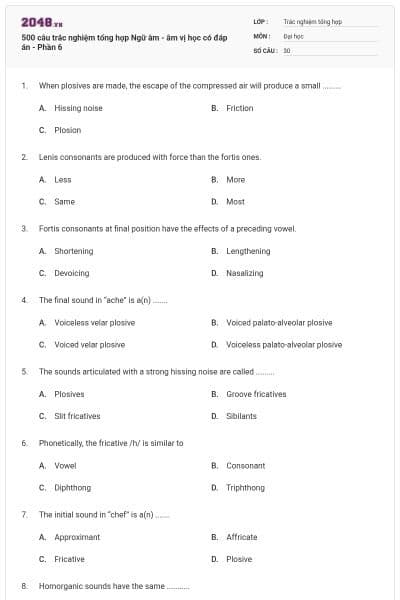
When plosives are made, the escape of the compressed air will produce a small .........
Hissing noise
Friction
Plosion
Chọn đáp án C
Lenis consonants are produced with force than the fortis ones.
Less
More
Same
Most
Chọn đáp án A
Fortis consonants at final position have the effects of a preceding vowel.
Shortening
Lengthening
Devoicing
Nasalizing
Chọn đáp án A
The final sound in “ache” is a(n) .......
Voiceless velar plosive
Voiced palato-alveolar plosive
Voiced velar plosive
Voiceless palato-alveolar plosive
Chọn đáp án A
The sounds articulated with a strong hissing noise are called .........
Plosives
Groove fricatives
Slit fricatives
Sibilants
Chọn đáp án D
Phonetically, the fricative /h/ is similar to
Vowel
Consonant
Diphthong
Triphthong
Chọn đáp án A
The initial sound in “chef” is a(n) .......
Approximant
Affricate
Fricative
Plosive
Chọn đáp án C

Học thông minh hơn mỗi ngày
Xem toàn bộ 30 câu hỏi và nhiều hơn nữa với tài khoản miễn phí
Homorganic sounds have the same ...........
Organ of articulation
Manner
Voicing
Sound
Chọn đáp án A
In speech, the is raised so that the air cannot escape through the nose.
Palate
Uvula
Velum
Tongue
Chọn đáp án C
The final sound of “laugh” is a(n) .........
Labio-dental
Dental
Glottal
Velar
Chọn đáp án A
When fricatives are made, the escape of the air through a small passage produces a(n) ......
Plosion
Loud hissing noise
Soft hissing noise
Friction noise
Chọn đáp án D
To be an affricate, the two component sounds must ............
Be hamorganic
Have the same voice
Have the same manner
Chọn đáp án A
The fricatives articulated with a strong hissing noise are also called .......
Groove fricatives
Sibilants
Slit fricatives
Plosives
Chọn đáp án B
Phonologically, the fricative /h/ is similar to .......
Consonant
Vowel
Diphthong
Triphthong
Chọn đáp án A
is not a type of consonant classified according to the place of articulation
Plosive
Palatal
Velar
Dental
Chọn đáp án A
are pronounced with the air flow escaping through a narrow passage
Fricatives
Approximants
Affricates
Plosives
Chọn đáp án A
By distribution, the fricative /h/ is similar to .................
Consonant
Vowel
Diphthong
Triphthong
Chọn đáp án A
The initial sound in “chief” is a(n) ............
Plosive
Approximant
Fricative
Affricate
Chọn đáp án D
Which of the following statements is true?
Hissing noise is one of the characteristics of fricatives.
Nasals are not continuant sounds.
Plosives are produced with the total or partial obstruction of the air stream.
The fortis fricatives and plosives at initial position often shorten the vowel following them.
Chọn đáp án A
Phonemically, the fricative /h/ is similar to ..........
Vowel
Consonant
Diphthong
Triphthong
Chọn đáp án B
The initial sound of “jam” is a(n) .........
Affricate
Approximant
Fricative
Plosive
Chọn đáp án A
/ŋ/ never occurs at
Initial position
Medial position
Final position
Chọn đáp án A
The sound /l/ when occuring after a vowel is called .........
Devoiced
Clear
Dark
Syllabic
Chọn đáp án C
To let the air escape through the nose, the velum must be ........
Lowered
Raised
Pushed forwards
Drawn back
Chọn đáp án A
The sound /l/ when following an initial fortis plosive is called .........
Devoiced
Dark
Clear
Syllabic
Chọn đáp án A
The sounds that never occur in final position are
/w, j, h/
/m, n, l, g/
/r, w, h, k/
/h, w, j, p/Đáp án
The sound /l/ when preceding a vowel is called ........
Dark
clear
devoiced
syllabic
Chọn đáp án B
to prevent the air from escaping through the nose, the soft palate must be:
closed
lowered
raised
A & C
Chọn đáp án C
In British English, the approximant sound in “card” is ........
non-rhotic
rhotic
devoiced
shortened
Chọn đáp án A
The main difference between /b/ & /m/ is ..........
Manner of articulation
Voicing
Place of articulation
Chọn đáp án A
Bạn có thích hoạt động này không?
Ý kiến của bạn sẽ giúp chúng tôi đề xuất nội dung phù hợp hơn.
Gợi ý cho bạn
![[Năm 2022] Đề thi thử môn Vật lí THPT Quốc gia có lời giải - Đề số 21](/_next/image?url=https%3A%2F%2Fvideo.vietjack.com%2Fupload%2Fimages%2Fvj-image%2Fimage-3izficdefgfoel0s9j8s-1786772791.jpg&w=3840&q=75)
![[Năm 2022] Đề thi thử môn Vật lí THPT Quốc gia có lời giải - Đề số 20](/_next/image?url=https%3A%2F%2Fvideo.vietjack.com%2Fupload%2Fimages%2Fvj-image%2Fimage-emy0gtcksawvorajezvv-1786772460.jpg&w=3840&q=75)
Tài liệu phổ biến Trắc nghiệm tổng hợp
Tài liệu phổ biến Đại học