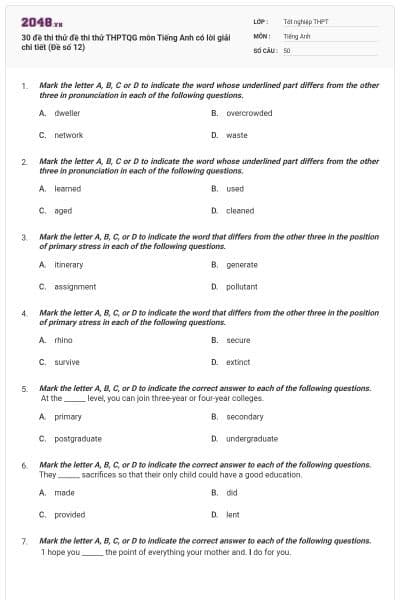
30 đề thi thử đề thi thử THPTQG môn Tiếng Anh có lời giải chi tiết (Đề số 12)
50 câu hỏi
Mark the letter A, B, C or D to indicate the word whose underlined part differs from the other three in pronunciation in each of the following questions.
dweller
overcrowded
network
waste
Đáp án B
Kiến thức về phát âm của phụ âm
A. dweller /‘dwələr/ C. overcrowded /,əʊvə'kraʊdɪd/
C. network /'netwɜ:k/ D. waste /weɪst/
Mark the letter A, B, C or D to indicate the word whose underlined part differs from the other three in pronunciation in each of the following questions.
learned
used
aged
cleaned
Đáp án B
Kiến thức về phát âm của đuôi -ed
A. learned /lɜ:nid/ (a): có học thức, thông thái, uyên bác
learned /lɜ:nd /(Vpast): học
B. used /ju:st/
C. aged /eidʒid/ (a): cao tuổi, lớn tuổi
aged /eidʒd/ (Vpast): trở nên già, làm cho già cỗi
D. cleaned /kli:nd/
Mark the letter A, B, C, or D to indicate the word that differs from the other three in the position of primary stress in each of the following questions.
itinerary
generate
assignment
pollutant
Đáp án B
Kiến thức về trọng âm
A. itinerary /aɪ'tɪnərəri/: từ này có trọng âm rơi vào âm tiết thứ hai. Vì theo quy tắc đuôi -y làm trọng âm dịch chuyển ba âm tính từ cuối lên và trọng âm không rơi vào âm /ə/.
B. generate /'dʒenəreɪt/: từ này có trọng âm rơi vào âm tiết thứ nhất. Vì theo quy tắc đuôi -ate làm trọng âm dịch chuyển ba âm tính từ cuối lên.
C. assignment /ə'saɪnmənt/: từ này có trọng âm rơi vào âm tiết thứ hai. Vì theo quy tắc hậu tố -ment không ảnh hưởng đến trọng âm của từ và trọng âm ưu tiên rơi vào nguyên âm đôi /ai/.
D. pollutant /pə'lu:tənt/: từ này có trọng âm rơi vào âm tiết thứ hai. Vì theo quy tắc hậu tố -ant không ảnh hưởng đến trọng âm của từ và trọng âm ưu tiên rơi vào nguyên âm dài /u:/.
=> Phương án B trọng âm rơi vào âm tiết đầu, các phương án còn lại trọng âm rơi vào âm tiết thứ hai.
Mark the letter A, B, C, or D to indicate the word that differs from the other three in the position of primary stress in each of the following questions.
rhino
secure
survive
extinct
Đáp án A
Kiến thức về trọng âm
A. rhino /’raɪnəʊ/: từ này có trọng âm rơi vào âm tiết thứ nhất. Vì theo quy tắc trọng âm không rơi vào âm /əʊ/.
B. secure /sɪ’kjʊər/: từ này có trọng âm rơi vào âm tiết thứ hai. Vì theo quy tắc trọng âm ưu tiên rơi vào nguyên âm đôi /ʊə/.
C. survive /sə’vaɪv/: từ này có trọng âm rơi vào âm tiết thứ hai. Vì theo quy tắc trọng âm ưu tiên rơi vào nguyên âm đôi /ai/.
D. extinct /ɪk’stɪηkt/: từ này có trọng âm rơi vào âm tiết thứ hai. Vì theo quy tắc trọng âm rơi vào âm cuối nếu âm cuối kết thúc với từ hai phụ âm trở lên.
=> Phương án A trọng âm rơi vào âm tiết thứ nhất, các phương án còn lại trọng âm rơi vào âm tiết thứ hai.
Mark the letter A, B, C, or D to indicate the correct answer to each of the following questions.
At the ______ level, you can join three-year or four-year colleges.
primary
secondary
postgraduate
undergraduate
Đáp án D
Kiến thức về từ vựng
A. primary /’praiməri/ (a): sơ đẳng, sơ cấp, tiểu học
B. secondary /’sekəndəri/ (a): trung học
C. postgraduate /,pəʊst'grædʒuət/ (a/n): sau khi tốt nghiệp đại học, sau đại học/ nghiên cứu sinh
D. undergraduate /,ʌndə'grædʒuət/ (n): sinh viên chưa tốt nghiệp
Tạm dịch: Ở cấp đại học, bạn có thể tham gia các trường cao đẳng ba năm hoặc bốn năm.
Mark the letter A, B, C, or D to indicate the correct answer to each of the following questions.
They ______ sacrifices so that their only child could have a good education.
made
did
provided
lent
Đáp án A
Kiến thức về cụm từ cố định
Make sacrifices: hy sinh
Tạm dịch: Họ đã hy sinh để đứa con độc nhất của họ có thể có một nền giáo dục tốt.
Các cấu trúc khác:
So that /in order that + clause = so as to/in order to/to + V (bare): để mà
So as/in order for sb to do st: để mà cho ai lam gì
Mark the letter A, B, C, or D to indicate the correct answer to each of the following questions.
1 hope you ______ the point of everything your mother and. I do for you.
annoy
have
see
take
Đáp án C
Kiến thức về cụm từ cố định
See the point of sit/doing st: hiểu quan điểm, mục đích, ý nghĩa, tầm quan trọng hay lý do của một việc gì
Tạm dịch: Bố hy vọng con sẽ hiểu được tất cả mọi thứ mẹ con và bố làm cho con.

Học thông minh hơn mỗi ngày
Xem toàn bộ 50 câu hỏi và nhiều hơn nữa với tài khoản miễn phí
Mark the letter A, B, C, or D to indicate the correct answer to each of the following questions.
The local residents suspected the authorities ______ having kept the pollution level secret from the local people.
about
on
of
for
Đáp án C
Kiến thức về giới từ
Suspect sh of doing st: nghi ngờ ai làm gì
Tạm dịch: Người dân địa phương nghi ngờ chính quyền đã giữ bí mật mức độ ô nhiễm từ người dân địa phương.
Mark the letter A, B, C, or D to indicate the correct answer to each of the following questions.
Vietnamese athletes compete regionally and internationally and ______ high ranks in many sports.
hold
keep
mark
score
Đáp án A
Kiến thức về từ loại
A. hold /həʊld/ (v): nắm, giữ B. keep /ki:p/ (v): giữ, giữ lại
C. mark /mɑ:k/ (v): cho điểm (người thi), ghi dấu
D. score /skɔ:/ (v): cho điểm (người thi đấu…)
Tạm dịch: Các vận động viên Việt Nam thi đấu trong khu vực và quốc tế và giữ thứ hạng cao trong nhiều môn thể thao.
Mark the letter A, B, C, or D to indicate the correct answer to each of the following questions.
Everyone can help the needy by making a ______ to a charity organisation.
donate
donation
donor
donating
Đáp án B
A. donate /dəʊ'neɪt/ (v): cho, biếu; quyên góp, ủng hộ
B. donation /dəʊ'neɪ∫ən/ (v): sự biếu, sự quyên góp
C. donor /'dəʊnər/ (n): người ủng hộ, người quyên góp
Căn cứ vào mạo từ “a” nên vị trí trống phải cần một danh từ nên ta loại phương án A, D.
Tạm dịch: Mọi người có thể giúp đỡ người nghèo bằng cách quyên góp cho một tổ chức từ thiện.
Căn cứ vào nghĩa của câu ta chọn đáp án B.
Cấu trúc khác:
Make a donation to sb: quyên góp, ủng hộ cho ai
Mark the letter A, B, C, or D to indicate the correct answer to each of the following questions.
The Real Life Super Hero Project is a gathering of men and women who ______forces to better their community.
have joined
are joining
will join
are joined
Đáp án A
Kiến thức về thì động từ
Tạm dịch: Dự án Siêu anh hùng Real Life là một tập hợp những người đàn ông và phụ nữ đã tham gia lực lượng để cải thiện công đồng của họ.
Dựa vào nghĩa của câu ta chọn đáp án A (thì hiện tại hoàn thành diễn tả hành động xảy ra trong quá khứ, kéo dài tới hiện tại và vẫn còn có khả năng sẽ tiếp diễn trong tương lai.)
Mark the letter A, B, C, or D to indicate the correct answer to each of the following questions.
Not until we ______ the school for children with disabilities ______ how they overcome difficulties.
had visited/did we know
visited/had we known
visited/did we know
have visited/did we know
Đáp án C
Kiến thức về đảo ngữ
Cấu trúc:
Not untii + time/time clause + did + S + V(bare): mãi cho tới tận khi ….thì.…
Tạm dịch: Mãi cho đến khi chúng tôi đến thăm trường dành cho trẻ em khuyết tật, chúng tôi mới biết chúng đã vượt qua khó khăn như thế nào.
Mark the letter A, B, C, or D to indicate the correct answer to each of the following questions.
______ communication skill plays an important role in career success
Personal
Individual
Interpersonal
Interactive
Đáp án C
Kiến thức về từ vựng
A. Personal /'pɜ:sənəl/ (a): cá nhân, tư, riêng
B. Individual (individdʒuəl/ (a): riêng lẻ, tách biệt
C. lnterpersọnạl /,ɪntə’pɜrsənl/ (a): giữa cá nhân với nhau
D. Interactive /,inter'æktiv/ (a): tác động với nhau, tương tác
Tạm dịch: Kỹ năng giao tiếp giữa các cá nhân đóng một vai trò quan trọng trong sự thành công trong sự nghiệp.
=> Đáp án là C
Mark the letter A, B, C, or D to indicate the correct answer to each of the following questions.
I feel very proud________ an important part of the English club.
to be
of be
being
is
Đáp án A
Kiến thức về cấu trúc
To be proud of st/doing st: tự hào về cái gì/làm gì
Take pride in st: tự hào, hãnh diện về cái gì
Feel proud to do st: cảm thấy hãnh diện khi làm gì
Tạm dịch: Tôi cảm thấy rất tự hào khi là một phần quan trọng của câu lạc bộ tiếng Anh.
Mark the letter A, B, C, or D to indicate the correct answer to each of the following questions.
______ Gordons is a very interesting family. They like to travel around world.
A - the
The - the
A - a
A
Đáp án B
Kiến thức về mạo từ
Ta dùng “the” trước danh từ (chỉ tên người) ở dạng số nhiều để chỉ cả gia đình nhà họ.
“Travel around the world": đi du lịch khắp thế giới
Tạm dịch: Gordons là một gia đình rất thú vị. Họ thích đi du lịch khắp thế giới.
Mark the letter A, B, C, or D to indicate the correct answer to each of the following questions.
The more invaluable world heritages are to humanity, __________.
the more protected and preserving they are
the more they are protected and preserved
the more they have people protect and preserve
the more people make them protect and preserve
Đáp án B
Kiến thức về so sánh
The + adj(so sánh hơn) + (N) + S + V, the + adj(so sánh hơn) + (N) + S + V
Tạm dịch: Các di sản thế giới càng vô giá đối với nhân loại, chúng càng được bảo vệ và bảo tồn.
Mark the letter A, B, C, or D to indicate the correct answer to each of the following questions.
Education is the process ______ we discover that learning adds quality to our lives. Learning must be experienced.
which
in which
that
by which
Đáp án B
Kiến thức về đại từ quan hệ
Tạm dịch: Giáo dục là quá trình chúng ta khám phá ra rằng học tập làm tăng thêm chất lượng cho cuộc sống của chúng ta.
Ta chọn đáp án B (in which = in the process)
Mark the letter A, B, C, or D to indicate the correct answer to each of the following questions.
If he had not spent his youth not learning anything, he ______ himself for his lack of knowledge now.
will not blame
would not blame
would not have blamed
would blame
Đáp án B
Kiến thức về câu điều kiện
Tạm dịch: Nếu anh ta không dành cả tuổi thanh xuân không học hành gì, anh ta sẽ không phải tự trách mình vì sự thiếu hiểu biết của anh ta bây giờ.
Căn cứ vào động từ của mệnh đề điều kiện “had not spent” điều kiện loại 3 và trạng từ thời gian “now” nên mệnh đề chính phải chia ở điều kiện loại 2. Do đó, đáp án là B
Các cấu trúc khác:
Blame sb for st/doing st: đổ lỗi cho ai vì cái gì/vì đã làm gì
Blame oneselffor st/cloing st: tự trách móc mình vì cái gì/vìđã làm gì
Spend time doing st: dành thời gian làm gì
Mark the letter A, B, C, or D to indicate the underlined part that needs correction in each of the following questions.
The minister is called for mandatory prison sentences for people who assault police officers.
The minister
is called for
for
who
Đáp án B
Kiến thức về chủ động - bị động
Call for: gọi, cần, đòi hỏi, mong muốn
Tạm dịch: Bộ trưởng đang đòi thi hành án tù bắt buộc đối với những người hành hung cảnh sát.
Theo nghĩa của câu thì động từ của câu này cần chia ở thể chủ động.
=> Đáp án là B (is called for is calling for)
Mark the letter A, B, C, or D to indicate the underlined part that needs correction in each of the following questions.
The annual increase in the world's population has peaked at about 88 million in the late 1980s.
The annual increase
world's population
has peaked
about 88 million
Đáp án C
Kiến thức về thì động từ
Căn cứ vào trạng từ thời gian “in the late 19805" nên động từ trong câu này phải chia ở thì quá khứ đơn.
=> Đáp án là C (has peaked peaked)
Tạm dịch: Sự gia tăng hàng năm của dân 56 thế giới đã đạt đỉnh vào khoảng 88 triệu vào cuối những năm 1980.
Mark the letter A, B, C, or D to indicate the correct answer to each of the following questions.
The whole matter is farther complicated by the fact that Amanda and Jo refuse to speak to each other.
The whole
farther
the fact that
to each
Đáp án B
Kiến thức về từ vựng
Cả “farther” và “further” đều là dạng so sánh hơn của từ “far”. Tuy nhiên, chúng có sự khác nhau như sau:
+ Farther: xa hơn (về khoảng cách địa lí)
+ Further: xa hơn, sâu hơn (về mức độ, tính chất)
Tạm dịch: Toàn bộ vấn đề phức tạp hơn bởi thực tế là Amanda và Jo từ chối nói chuyện với nhau.
=> Đáp án là B (farther further)
Cấu trúc khác:
Refuse to do st: từ chối làm gì
Mark the letter A, B, C, or D to indicate the word(s) CLOSEST in meaning to the underlined word (s) in each of the following questions.
You should drink a glass of water before a workout and then pause regularly to drink more.
break up
break down
break off
break in
Đáp án C
Từ đồng nghĩa - kiến thức về từ vựng và cụm động từ
Tạm dịch: Bạn nên uống một ly nước trước khi tập luyện và sau đó tạm dừng để uống nhiều hơn.
=> pause (v): tạm dừng
Xét nghĩa của các đáp án:
A. break up: chia tay B. break down: hỏng hóc, ngất xỉu
C. break off: rời ra, lìa ra, long ra, bị gãy rời ra, đột nhiên ngừng lại, cắt đứt quan hệ, tuyệt giao
D. break in: xông vào
=> Đáp án là C (pause = break Off)
Mark the letter A, B, C, or D to indicate the word(s) CLOSEST in meaning to the underlined word (s) in each of the following questions.
People who hold optimistic view believe that cities of the future will increase the general well-being of individuals and societies.
health state
quality of life
level of development
growth rate
Đáp án B
Từ đồng nghĩa - kiến thức về từ vựng
Tạm dịch: Những người có quan điểm lạc quan tin rằng các thành phố của tương lai sẽ làm tăng phúc lợi chung của các cá nhân và xă hội.
=> well-being: phúc lợi
Xét các đáp án:
A. health state: tìh trạng sức khỏe B. quality oflife: chất lượng cuộc sống
C. level ofdevelopment: mức độ phát triển
D. growth rate: tỉ lệ tăng trưởng
=> Đáp tin là B(wei1- being = quality of life)
Mark the letter A, B, C, or D to indicate the word(s) OPPOSITE in meaning to the underlined word(s) in each of the following questions.
Though built almost five hundred years ago, the church remained practically intact.
in perfection
in ruins
in chaos
in completion
Đáp án B
Từ trái nghĩa – kiến thức về cụm từ cố định
Tạm dịch: Mặc dù được xây dựng gần năm trăm năm trước, nhà thờ vẫn còn nguyên vẹn.
=> intact /In'taekt/ (a) >< in ruins: trong tình trạng hư hại, trong tình trạng đổ nát nghiêm trọng
Mark the letter A, B, C, or D to indicate the word(s) OPPOSITE in meaning to the underlined word(s) in each of the following questions.
She was like a cat on hot bricks before her driving t est.
nervous
comfortable
depressed
relaxing
Đáp án B
Từ trái nghĩa - kiến thức về thành ngữ
Tạm dịch: Cô ấy rất lo âu trước khi thi lái xe.
=> like a cat on hot bricks: khắc khoải lo âu
Xét các đáp án:
A. nervous /'nɜ:.vəs/ (a): lo lắng
B. comfortable /'kʌmfətəbəl/ (a): thoải mái
C. depressed /di'prest/ (a): chán nản, thất vọng
D. relaxing /rɪ'læksɪη/ (a): lam giảm đi, làm bớt căng thẳng
Mark the letter A, B, C, or D to indicate the sentence that best completes each of the following exchanges.
Nam: “What do you personally do to keep fit?”
Lan: “ __________.”
I think keeping fit is necessary for everyone.
As far as I know, more and more people exercise to keep fit.
Fitness centres are mushrooming.
I just do morning exercise and maintain a balanced diet.
Đáp án D
Tình huống giao tiếp
Nam: “Cá nhân bạn làm gì để giữ dáng?”
Lan: “___________.”
A. Tôi nghĩ giữ dáng là cần thiết cho mọi người.
B. Theo tôi biết, ngày càng có nhiều người tập thể dục để giữ dáng.
C. Trung tâm thể hình đang mọc lên như nấm.
D. Tôi chỉ tập thể dục buổi sáng và duy trì chế độ ăn uống cân bằng.
Mark the letter A, B, C, or D to indicate the sentence that best completes each of the following exchanges.
Lan: “What can government do to punish factories that violate environmental law?”
Nam: “_________.”
So many of them are polluting the environment.
Yes, I think a big fine would be relevant.
They may force those factories to close down.
There are no factories in this region.
Đáp án C
Tình huống giao tiếp
Lan: “Chính phủ có thể làm gì để trừng phạt các nhà máy vi phạm luật môi trường?"
Nam: “_________.”
A. Vì vậy, nhiều người trong số họ đang gây ô nhiễm môi trường.
B. Vâng, tôi nghĩ rằng một khoản tiền phạt lớn sẽ là thích đáng.
C. Họ có thể buộc các nhà máy đó đóng cửa.
D. Không có nhà máy trong khu vực này.
Mark the letter A, B, C, or D to indicate the sentence that is closest in meaning to each of the following questions.
They believe a single gunman carried out the attack
The attack's is believed to have carried but a single gunman.
A single gunman is believed to have carried out the attack.
It is believed to be carried out the attack by a single gunman.
It is believed that the attack has been carried out by a single gunman.
Đáp án B
Kiến thức về bị động đặc biệt
Đề bài: Họ tin rằng một tay súng duy nhất thực hiện vụ tấn công.
=> Đáp án là B (Một tay súng duy nhất được cho là đã thực hiện vụ tấn công.)
Cấu trúc:
S1 + V1 + that + S2 + V2 = It + V1(bịđộng) + that + S2+ V2
= S2 + V1(bị động) + to + V2(bare)/ have + V2(p2)
Mark the letter A, B, C, or D to indicate the correct answer to each of the following questions.
"I'm sorry. I didn't do the homework." said the boy.
The boy admitted not doing the homework.
The boy said that he was sorry and he wouldn't do the homework.
The boy denied not doing the homework.
The boy refused to do the homework.
Đáp án A
Kiến thức về câu tường thuật
Đề bài: “Em xin lỗi. Em đã không làm bài tập về nhà.” cậu bé nói.
Cấu trúc:
Admit doing st: thừa nhận làm gì
Deny doing st: phủ nhận làm gì
Refuse to do st: từ chối làm gì
=> Đáp án là A (Cậu bé thừa nhận không làm bài tập về nhà.)
Mark the letter A, B, C, or D to indicate the sentence that is closest in meaning to each of the following questions.
You can stay in the flat for free as long as you pay the bills.
Whether you pay the bills or stay in the flat, it is free.
Without the bills paid, you can stay in the free flat.
Unless the flat is free of bills, you cannot stay in it.
Provided you pay the bills, you can stay in the flat for free.
30: Đáp án D
Kiến thức về liên từ
Đề bài: Bạn có thể ở trong căn hộ miễn phí miễn là bạn trả các hóa đơn.
A. Cho dù bạn trả các hóa đơn hay ở trong căn hộ, nó đều miễn phí.
B. Nếu không có hóa đơn thanh toán, bạn có thể ở trong căn hộ miễn phí.
C. Trừ khi căn hộ miễn phí hóa đơn, bạn không thể ở trong đó.
D. Với điều kiện bạn phải trả các hóa đơn, bạn có thể ở trong căn hộ miễn phí.
Các cấu trúc khác:
As long as = provided (that) = providing: với điều kiện là
Whether ....or (not): có hay là không
Without + N: mà không, nếu không
Mark the letter A, B, C, or D to indicate the sentence that best combines each pair of sentences in the following questions.
She was the first woman in the Philippines. She was elected as the president of the country.
She was the first woman being elected as the president of the Philippines.
She was the first woman who is elected as the president of the Philippines.
She was the first woman to be elected as the president of the Philippines.
She was the first woman elected as the president of the Philippines.
Đáp án C
Kiến thức về mệnh đề quan hệ
Đề bài: Bà là người phụ nữ đầu tiên ở Philippines. Bà được bầu làm chủ tịch nước.
Người ta có thể rút gọn mệnh đề quan hệ bằng 3 cách sau:
1. Dùng Ving nếu đại từ quan hệ đóng vai trò làm chủ ngữ của mệnh đề quan hệ và động từ của mệnh đề đó ở thể chủ động.
2. Dùng Vp2 nếu đại từ quan hệ đóng vai trò làm chủ ngữ của mệnh đề quan hệ và động từ của mệnh đề đó ở thể bị động.
3. Dùng to V nếu đại từ quan hệ thay thế cho danh từ có chứa số thứ tự (first/ second/ third...) tính từ so sánh hơn nhất hoặc từ “only”
=> Đáp án là C (Bà là người phụ nữ đầu tiên được bầu làm tổng thống Philippines.)
Mark the letter A, B, C, or D to indicate the sentence that best combines each pair of sentences in the following questions.
Linda's final exam is important. She realizes little of it
Under no circumstances does Linda realize how important her final exam is.
Rarely does Linda realize how important her final exam is.
Little does Linda realize how important her final exam is.
Never does Linda realize how important her final exam is.
Đáp án C
Kiến thức về đảo ngữ
Cấu trúc:
Under no circumstances/rarely/little/never + mệnh đề đảo ngữ
Mệnh đề đảo ngữ = trợ động tir/tobe/ động từ khuyết thiếu/ have/has + S + V
Đề bài: Bài kiểm tra cuối khóa của Linda rất quan trọng. Cô ấy gần như không hiểu được điều đó.
= C. Hầu như Linda không nhận ra được kỳ thi cuối cùng của cô quan trọng như thế nào.
Read the following passage and mark the letter A, B, C, or D to indicate the correct answer to each of the question.
There are three basic types of classroom learning styles: visual, auditory, and kinesthetic. These learning styles describe the most common ways that people learn. Individuals tend to instinctively prefer one style over the others; thus each person has a learning style that is dominant even though he or she may also rely somewhat on the other approaches at different times and in different circumstances.
Visual learners prefer to sit somewhere in the classroom where no obstructions hinder their view of the lesson. They rely on the teacher's facial expressions and body language to aid their learning. They learn best from a blend of visual displays and presentations such as colorful videos, diagrams, and flip-charts. Often, these learners think in pictures and may even close their eyes to visualize or remember something. When they are bored, they look around for something to watch. Many visual learners lack confidence in their auditory memory skills and so may take detailed notes during classroom discussions and lectures. Auditory learners sit where they can hear well. They enjoy listening and talking, so discussions and verbal lectures stimulate them. Listening to what others have to say and then talking the subject through helps them process new information. These learners may be heard reading to themselves out loud because they can absorb written information better in this way. Sounding out spelling words, reciting mathematical theories, or talking their way across a map are examples of the types of activities that improve their understanding.
Kinesthetic learners may find it difficult to sit still in a conventional classroom. They need to be physically active and take frequent breaks. When they are bored, they fidget in their seats. They prefer to sit someplace where there is room to move about. They benefit from manipulating materials and learn best when classroom subjects such as math, science, and reading are processed through hands-on experiences. Incorporating arts-and-crafts activities, building projects, and sports into lessons helps kinesthetic learners process new information. Physical expressions of encouragement, such as a pat on the back, are often appreciated.
In addition to these traditional ways of describing learning styles, educators have identified other ways some students prefer to learn. Verbal learners, for example, enjoy using words, both written and spoken. Logical learners are strong in the areas of logic and reasoning, Social learners do best when working in groups, whereas solitary learners prefer to work alone. Research shows that each of these learning styles, as well as the visual, auditory, and kinesthetic styles, uses different parts of the brain. Students may prefer to focus on just one style, but practicing other styles involves more of the brain's potential and therefore helps students remember more of what they learn.
(Adapted from Essential words for the JELTS by Dr. Lin Lougheed)
What topic does the passage mainly discuss?
Fundamental kinds of learning approaches
Different classrooms for different learner groups
The most common way to learn
Basic classrooms for individuals
Đáp án A
Chủ đề EDUCATION
Đoạn văn chủ yếu thảo luận về chủ đề gì?
A. Các thể loại của phương pháp học tập cơ bản
B. Các lớp học khác nhau cho các nhóm người học khác nhau
C. Cách thông dụng nhất để học
D. Các lớp học cơ bản cho mỗi cá nhân
Căn cứ vào thông tin đoạn 1:
“There are three basic types of classroom learning styles: visual, auditory, and kinesthetic. These learning styles describe the most common ways that people learn.” (Có 3 thể loại phong cách học tập cơ bản trong lớp: bằng thị giác, thính giác và cảm giác vận động. Những phương pháp học tập này mô tả những cách thông dụng nhất mà mọi người sử dụng để học).
Read the following passage and mark the letter A, B, C, or D to indicate the correct answer to each of the question.
There are three basic types of classroom learning styles: visual, auditory, and kinesthetic. These learning styles describe the most common ways that people learn. Individuals tend to instinctively prefer one style over the others; thus each person has a learning style that is dominant even though he or she may also rely somewhat on the other approaches at different times and in different circumstances.
Visual learners prefer to sit somewhere in the classroom where no obstructions hinder their view of the lesson. They rely on the teacher's facial expressions and body language to aid their learning. They learn best from a blend of visual displays and presentations such as colorful videos, diagrams, and flip-charts. Often, these learners think in pictures and may even close their eyes to visualize or remember something. When they are bored, they look around for something to watch. Many visual learners lack confidence in their auditory memory skills and so may take detailed notes during classroom discussions and lectures. Auditory learners sit where they can hear well. They enjoy listening and talking, so discussions and verbal lectures stimulate them. Listening to what others have to say and then talking the subject through helps them process new information. These learners may be heard reading to themselves out loud because they can absorb written information better in this way. Sounding out spelling words, reciting mathematical theories, or talking their way across a map are examples of the types of activities that improve their understanding.
Kinesthetic learners may find it difficult to sit still in a conventional classroom. They need to be physically active and take frequent breaks. When they are bored, they fidget in their seats. They prefer to sit someplace where there is room to move about. They benefit from manipulating materials and learn best when classroom subjects such as math, science, and reading are processed through hands-on experiences. Incorporating arts-and-crafts activities, building projects, and sports into lessons helps kinesthetic learners process new information. Physical expressions of encouragement, such as a pat on the back, are often appreciated.
In addition to these traditional ways of describing learning styles, educators have identified other ways some students prefer to learn. Verbal learners, for example, enjoy using words, both written and spoken. Logical learners are strong in the areas of logic and reasoning, Social learners do best when working in groups, whereas solitary learners prefer to work alone. Research shows that each of these learning styles, as well as the visual, auditory, and kinesthetic styles, uses different parts of the brain. Students may prefer to focus on just one style, but practicing other styles involves more of the brain's potential and therefore helps students remember more of what they learn.
(Adapted from Essential words for the JELTS by Dr. Lin Lougheed)
The word “dominant” in the first paragraph is closest in meaning to ______.
successful
foremost
familiar
distinctive
Đáp án B
Từ “dominant” trong đoạn đầu gần nghĩa nhất với từ _________.
A. thành công B. có ưu thế, tốt nhất
C. tương tự D. khác nhau
Từ đồng nghĩa: dominant (có ưu thế, vượt trội) = foremost
“Individuals tend to instinctively prefer one style over the others; thus each person has a learning style that is dominant even though he or she may also rely somewhat on the other approaches at different times and in different circumstances.” (Mỗi cá nhân theo bản năng của mình thì có khuynh hướng thích một phong cách học tập hơn những phong cách khác; vì vậy mỗi người có một phong cách học chiếm ưu thế mặc dù người đó cũng có thể dựa vào các phương pháp học tập khác vào những thời điểm khác nhau và trong những hoàn cảnh khác nhau.)
Read the following passage and mark the letter A, B, C, or D to indicate the correct answer to each of the question.
There are three basic types of classroom learning styles: visual, auditory, and kinesthetic. These learning styles describe the most common ways that people learn. Individuals tend to instinctively prefer one style over the others; thus each person has a learning style that is dominant even though he or she may also rely somewhat on the other approaches at different times and in different circumstances.
Visual learners prefer to sit somewhere in the classroom where no obstructions hinder their view of the lesson. They rely on the teacher's facial expressions and body language to aid their learning. They learn best from a blend of visual displays and presentations such as colorful videos, diagrams, and flip-charts. Often, these learners think in pictures and may even close their eyes to visualize or remember something. When they are bored, they look around for something to watch. Many visual learners lack confidence in their auditory memory skills and so may take detailed notes during classroom discussions and lectures. Auditory learners sit where they can hear well. They enjoy listening and talking, so discussions and verbal lectures stimulate them. Listening to what others have to say and then talking the subject through helps them process new information. These learners may be heard reading to themselves out loud because they can absorb written information better in this way. Sounding out spelling words, reciting mathematical theories, or talking their way across a map are examples of the types of activities that improve their understanding.
Kinesthetic learners may find it difficult to sit still in a conventional classroom. They need to be physically active and take frequent breaks. When they are bored, they fidget in their seats. They prefer to sit someplace where there is room to move about. They benefit from manipulating materials and learn best when classroom subjects such as math, science, and reading are processed through hands-on experiences. Incorporating arts-and-crafts activities, building projects, and sports into lessons helps kinesthetic learners process new information. Physical expressions of encouragement, such as a pat on the back, are often appreciated.
In addition to these traditional ways of describing learning styles, educators have identified other ways some students prefer to learn. Verbal learners, for example, enjoy using words, both written and spoken. Logical learners are strong in the areas of logic and reasoning, Social learners do best when working in groups, whereas solitary learners prefer to work alone. Research shows that each of these learning styles, as well as the visual, auditory, and kinesthetic styles, uses different parts of the brain. Students may prefer to focus on just one style, but practicing other styles involves more of the brain's potential and therefore helps students remember more of what they learn.
(Adapted from Essential words for the JELTS by Dr. Lin Lougheed)
According to the second paragraph, visual learners ______.
have a preference for sitting at the backs of the classrooms,
must keep an eye on the pictures to memorize the content of the lessons.
are easy to get fed up with the lessons.
are not confident in remembering what they have listened.
Đáp án D
Theo đoạn văn số 2, những người học qua thị giác ________.
A. thích ngồi ở dãy cuối phòng học hơn.
B. phải chủ ý vào bức tranh để ghi nhớ nội dung bài học.
C. dễ dàng cảm thấy chán nản với bài học.
D. không tự tin trong việc ghi nhớ những gì mà họ nghe được.
Từ khóa: visual learners
"Visual learners prefer to sit somewhere in the classroom where no obstructions hinder their View of the lesson. They rely on the teacher's facial expressions and body language to aid their learning. They learn best from a blend of visual displays and presentations such as colorful videos, diagrams, and flip-charts. Often, these learners think in pictures and may even close their eyes to visualize or remember something. When they are bored, they look around for something to watch. Many visual learners lack confidence in their auditory memory skills and so may take detailed notes during classroom discussions and lectures." (Những người học bằng thị giác thích ngồi ở những vị trí trong lớp học nơi mà không vật cản trờ che khuất tầm nhìn của họ vào bài học. Họ dựa vào các biểu hiện trên mặt và ngôn ngữ hình thể của giáo viên để giúp cho việc học của mình. Họ học tốt nhất khi có sự kết hợp giữa các thiết bị hiển thị và bản trình bày trực quan như các video có màu sắc, sơ đồ và biểu đồ lật. Thông thường, những người học này suy nghĩ bằng hình ảnh và thậm chí có thể nhắm mắt để hình dung hoặc ghi nhớ điều gì đó. Khi họ thấy chán, họ nhìn quanh tìm kiếm cái gì đó để xem. Nhiều người học qua thị giác thiếu tự tin trong kĩ năng ghi nhớ bằng thính giác và vì vậy họ thường phải ghi chép chi tiết những thảo luận trong hớp học và bài giảng).
Read the following passage and mark the letter A, B, C, or D to indicate the correct answer to each of the question.
There are three basic types of classroom learning styles: visual, auditory, and kinesthetic. These learning styles describe the most common ways that people learn. Individuals tend to instinctively prefer one style over the others; thus each person has a learning style that is dominant even though he or she may also rely somewhat on the other approaches at different times and in different circumstances.
Visual learners prefer to sit somewhere in the classroom where no obstructions hinder their view of the lesson. They rely on the teacher's facial expressions and body language to aid their learning. They learn best from a blend of visual displays and presentations such as colorful videos, diagrams, and flip-charts. Often, these learners think in pictures and may even close their eyes to visualize or remember something. When they are bored, they look around for something to watch. Many visual learners lack confidence in their auditory memory skills and so may take detailed notes during classroom discussions and lectures. Auditory learners sit where they can hear well. They enjoy listening and talking, so discussions and verbal lectures stimulate them. Listening to what others have to say and then talking the subject through helps them process new information. These learners may be heard reading to themselves out loud because they can absorb written information better in this way. Sounding out spelling words, reciting mathematical theories, or talking their way across a map are examples of the types of activities that improve their understanding.
Kinesthetic learners may find it difficult to sit still in a conventional classroom. They need to be physically active and take frequent breaks. When they are bored, they fidget in their seats. They prefer to sit someplace where there is room to move about. They benefit from manipulating materials and learn best when classroom subjects such as math, science, and reading are processed through hands-on experiences. Incorporating arts-and-crafts activities, building projects, and sports into lessons helps kinesthetic learners process new information. Physical expressions of encouragement, such as a pat on the back, are often appreciated.
In addition to these traditional ways of describing learning styles, educators have identified other ways some students prefer to learn. Verbal learners, for example, enjoy using words, both written and spoken. Logical learners are strong in the areas of logic and reasoning, Social learners do best when working in groups, whereas solitary learners prefer to work alone. Research shows that each of these learning styles, as well as the visual, auditory, and kinesthetic styles, uses different parts of the brain. Students may prefer to focus on just one style, but practicing other styles involves more of the brain's potential and therefore helps students remember more of what they learn.
(Adapted from Essential words for the JELTS by Dr. Lin Lougheed)
The word “blend” in paragraph 2 could be best replaced by ______.
division
list
mixture
separation
Đáp án C
Từ “blend” trang đoạn 2 có thể được thay thế bởi từ ____.
A. sự phân chia B. danh sách
C. sự pha trộn, kết hợp D. sự tách ra
Từ đồng nghĩa: blend (sự pha trộn, kết hợp) = mixture
“They learn best from a blend ofvisual displays and presentations such as colorful videos, diagrams, and flip-charts." (Họ học tốt nhất khi có sự kết hợp giữa các thiết bị hiển thị và bản trình bày trực quan như các video có màu sắc, sơ đồ và biểu đồ lật).
Read the following passage and mark the letter A, B, C, or D to indicate the correct answer to each of the question.
There are three basic types of classroom learning styles: visual, auditory, and kinesthetic. These learning styles describe the most common ways that people learn. Individuals tend to instinctively prefer one style over the others; thus each person has a learning style that is dominant even though he or she may also rely somewhat on the other approaches at different times and in different circumstances.
Visual learners prefer to sit somewhere in the classroom where no obstructions hinder their view of the lesson. They rely on the teacher's facial expressions and body language to aid their learning. They learn best from a blend of visual displays and presentations such as colorful videos, diagrams, and flip-charts. Often, these learners think in pictures and may even close their eyes to visualize or remember something. When they are bored, they look around for something to watch. Many visual learners lack confidence in their auditory memory skills and so may take detailed notes during classroom discussions and lectures. Auditory learners sit where they can hear well. They enjoy listening and talking, so discussions and verbal lectures stimulate them. Listening to what others have to say and then talking the subject through helps them process new information. These learners may be heard reading to themselves out loud because they can absorb written information better in this way. Sounding out spelling words, reciting mathematical theories, or talking their way across a map are examples of the types of activities that improve their understanding.
Kinesthetic learners may find it difficult to sit still in a conventional classroom. They need to be physically active and take frequent breaks. When they are bored, they fidget in their seats. They prefer to sit someplace where there is room to move about. They benefit from manipulating materials and learn best when classroom subjects such as math, science, and reading are processed through hands-on experiences. Incorporating arts-and-crafts activities, building projects, and sports into lessons helps kinesthetic learners process new information. Physical expressions of encouragement, such as a pat on the back, are often appreciated.
In addition to these traditional ways of describing learning styles, educators have identified other ways some students prefer to learn. Verbal learners, for example, enjoy using words, both written and spoken. Logical learners are strong in the areas of logic and reasoning, Social learners do best when working in groups, whereas solitary learners prefer to work alone. Research shows that each of these learning styles, as well as the visual, auditory, and kinesthetic styles, uses different parts of the brain. Students may prefer to focus on just one style, but practicing other styles involves more of the brain's potential and therefore helps students remember more of what they learn.
(Adapted from Essential words for the JELTS by Dr. Lin Lougheed)
What does the word "them" in paragraph 3 refer to?
auditory learners
discussions
verbal lectures
others
Đáp án A
Từ “them” trong đoạn 3 để cập đến từ nào?
A. những người học bằng thính giác B. những cuộc thảo luận
C. những bài giảng bằng lời nói D. những người khác
Căn cứ vào thông tin đoạn 3:
“Auditory learners sit where they can hear well. They enjoy listening and talking, so discussions and verbal lectures stimulate them. Listening to what others have to say and then talking the subject through helps them process new information.” (Những người học bằng thính giác thường ngồi ở những vị trí mà họ có thể nghe rõ. Họ thích nghe và nói, vì vậy những cuộc thảo luận và các bài giảng bằng lời gây hứng thú cho họ. Lắng nghe những gì mà người khác nói sau đó thảo luận về các chủ đề giúp họ tiếp thu bài học mới).
Read the following passage and mark the letter A, B, C, or D to indicate the correct answer to each of the question.
There are three basic types of classroom learning styles: visual, auditory, and kinesthetic. These learning styles describe the most common ways that people learn. Individuals tend to instinctively prefer one style over the others; thus each person has a learning style that is dominant even though he or she may also rely somewhat on the other approaches at different times and in different circumstances.
Visual learners prefer to sit somewhere in the classroom where no obstructions hinder their view of the lesson. They rely on the teacher's facial expressions and body language to aid their learning. They learn best from a blend of visual displays and presentations such as colorful videos, diagrams, and flip-charts. Often, these learners think in pictures and may even close their eyes to visualize or remember something. When they are bored, they look around for something to watch. Many visual learners lack confidence in their auditory memory skills and so may take detailed notes during classroom discussions and lectures. Auditory learners sit where they can hear well. They enjoy listening and talking, so discussions and verbal lectures stimulate them. Listening to what others have to say and then talking the subject through helps them process new information. These learners may be heard reading to themselves out loud because they can absorb written information better in this way. Sounding out spelling words, reciting mathematical theories, or talking their way across a map are examples of the types of activities that improve their understanding.
Kinesthetic learners may find it difficult to sit still in a conventional classroom. They need to be physically active and take frequent breaks. When they are bored, they fidget in their seats. They prefer to sit someplace where there is room to move about. They benefit from manipulating materials and learn best when classroom subjects such as math, science, and reading are processed through hands-on experiences. Incorporating arts-and-crafts activities, building projects, and sports into lessons helps kinesthetic learners process new information. Physical expressions of encouragement, such as a pat on the back, are often appreciated.
In addition to these traditional ways of describing learning styles, educators have identified other ways some students prefer to learn. Verbal learners, for example, enjoy using words, both written and spoken. Logical learners are strong in the areas of logic and reasoning, Social learners do best when working in groups, whereas solitary learners prefer to work alone. Research shows that each of these learning styles, as well as the visual, auditory, and kinesthetic styles, uses different parts of the brain. Students may prefer to focus on just one style, but practicing other styles involves more of the brain's potential and therefore helps students remember more of what they learn.
(Adapted from Essential words for the JELTS by Dr. Lin Lougheed)
Which of the following is NOT true about auditory learners?
They get information and the content of the lecturers aurally and orally.
Reciting the lessons aloud is an effective way to understand the subjects.
They always fidget when they are indifferent to the lectures.
They merely learn well when they are able to listen to the lessons clearly.
Đáp án C
Câu nào sau đây là không đúng về người học bằng thính giác?
A. Họ thường tiếp thu thông tin và nội dung bài học bằng tai và bằng lời nói.
B. Đọc to bài học là một cách rất hiệu quả để hiểu về môn học đó.
C. Họ luôn không thể ngồi yên khi họ thờ ơ với bài giảng.
D. Họ chỉ học tốt khi họ có thể lắng nghe bài giảng một cách rõ ràng.
Từ khóa: not true/ auditory learners
Read the following passage and mark the letter A, B, C, or D to indicate the correct answer to each of the question.
There are three basic types of classroom learning styles: visual, auditory, and kinesthetic. These learning styles describe the most common ways that people learn. Individuals tend to instinctively prefer one style over the others; thus each person has a learning style that is dominant even though he or she may also rely somewhat on the other approaches at different times and in different circumstances.
Visual learners prefer to sit somewhere in the classroom where no obstructions hinder their view of the lesson. They rely on the teacher's facial expressions and body language to aid their learning. They learn best from a blend of visual displays and presentations such as colorful videos, diagrams, and flip-charts. Often, these learners think in pictures and may even close their eyes to visualize or remember something. When they are bored, they look around for something to watch. Many visual learners lack confidence in their auditory memory skills and so may take detailed notes during classroom discussions and lectures. Auditory learners sit where they can hear well. They enjoy listening and talking, so discussions and verbal lectures stimulate them. Listening to what others have to say and then talking the subject through helps them process new information. These learners may be heard reading to themselves out loud because they can absorb written information better in this way. Sounding out spelling words, reciting mathematical theories, or talking their way across a map are examples of the types of activities that improve their understanding.
Kinesthetic learners may find it difficult to sit still in a conventional classroom. They need to be physically active and take frequent breaks. When they are bored, they fidget in their seats. They prefer to sit someplace where there is room to move about. They benefit from manipulating materials and learn best when classroom subjects such as math, science, and reading are processed through hands-on experiences. Incorporating arts-and-crafts activities, building projects, and sports into lessons helps kinesthetic learners process new information. Physical expressions of encouragement, such as a pat on the back, are often appreciated.
In addition to these traditional ways of describing learning styles, educators have identified other ways some students prefer to learn. Verbal learners, for example, enjoy using words, both written and spoken. Logical learners are strong in the areas of logic and reasoning, Social learners do best when working in groups, whereas solitary learners prefer to work alone. Research shows that each of these learning styles, as well as the visual, auditory, and kinesthetic styles, uses different parts of the brain. Students may prefer to focus on just one style, but practicing other styles involves more of the brain's potential and therefore helps students remember more of what they learn.
(Adapted from Essential words for the JELTS by Dr. Lin Lougheed)
The following are suggested methods to attract kinesthetic learners, EXCEPT ______.
merging arts-and-crafts activities
integrating projects and sports into the lessons
stimulating them by physical expressions
isolating them in a customary classroom
Đáp án D
Những phương pháp dưới đây là các gợi ý để thu hút người học qua cảm giác vận động, ngoại trừ _____.
A. kết hợp các hoạt động nghệ thuật và thủ công
B. lồng ghép các dự án và thể thao vào trong bài học
C. khuyến khích họ bằng các biểu hiện về thể chất
D. tách họ khỏi 1 lớp học thông thường
Từ khóa: methods to attract kinesthetic learners/ except
Căn cứ vào thông tin đoạn 4:
“Incorporating artsHand-cralts activities, building projects, and sports into lessons helps kinesthetic learners process new information. Physical expressions of encouragement, such as a pat on the back, are often appreciated.” (Kết hợp các hoạt động nghệ thuật và thủ công, xây dụng các dự án và thể thao vào trong bài học giúp cho người học bằng cảm giác vận động tiếp thu các nội dung mới. Các biểu hiện khích lệ về thể chất, như là một cái vỗ nhẹ vào lưng, thường được đánh giá cao).
Read the following passage and mark the letter A, B, C, or D to indicate the correct answer to each of the question.
There are three basic types of classroom learning styles: visual, auditory, and kinesthetic. These learning styles describe the most common ways that people learn. Individuals tend to instinctively prefer one style over the others; thus each person has a learning style that is dominant even though he or she may also rely somewhat on the other approaches at different times and in different circumstances.
Visual learners prefer to sit somewhere in the classroom where no obstructions hinder their view of the lesson. They rely on the teacher's facial expressions and body language to aid their learning. They learn best from a blend of visual displays and presentations such as colorful videos, diagrams, and flip-charts. Often, these learners think in pictures and may even close their eyes to visualize or remember something. When they are bored, they look around for something to watch. Many visual learners lack confidence in their auditory memory skills and so may take detailed notes during classroom discussions and lectures. Auditory learners sit where they can hear well. They enjoy listening and talking, so discussions and verbal lectures stimulate them. Listening to what others have to say and then talking the subject through helps them process new information. These learners may be heard reading to themselves out loud because they can absorb written information better in this way. Sounding out spelling words, reciting mathematical theories, or talking their way across a map are examples of the types of activities that improve their understanding.
Kinesthetic learners may find it difficult to sit still in a conventional classroom. They need to be physically active and take frequent breaks. When they are bored, they fidget in their seats. They prefer to sit someplace where there is room to move about. They benefit from manipulating materials and learn best when classroom subjects such as math, science, and reading are processed through hands-on experiences. Incorporating arts-and-crafts activities, building projects, and sports into lessons helps kinesthetic learners process new information. Physical expressions of encouragement, such as a pat on the back, are often appreciated.
In addition to these traditional ways of describing learning styles, educators have identified other ways some students prefer to learn. Verbal learners, for example, enjoy using words, both written and spoken. Logical learners are strong in the areas of logic and reasoning, Social learners do best when working in groups, whereas solitary learners prefer to work alone. Research shows that each of these learning styles, as well as the visual, auditory, and kinesthetic styles, uses different parts of the brain. Students may prefer to focus on just one style, but practicing other styles involves more of the brain's potential and therefore helps students remember more of what they learn.
(Adapted from Essential words for the JELTS by Dr. Lin Lougheed)
What did the author suggest learners in order to keep in their mind what they learnt in the last paragraph?
Practicing merely one style of learning to make the brain work more effectively.
Using variety of learning methods to increase the potential of their brain.
Using both written and spoken words to improve their logical thoughts.
Identifying the most suitable learning style themselves.
Đáp án B
Tác giả đã đề nghị những người học làm gì để ghi nhớ những gì họ đã học trong đoạn cuối?
A. Luyện tập duy nhất một phong cách học tập để bộ não làm việc hiệu quả hơn.
B. Sử dụng đa dạng các phương pháp học tập để làm tăng tiềm năng của bộ não.
C. Sử dụng cả ngôn ngữ nói và viết để cải thiện suy nghĩ logic của họ.
D. Tìm ra một phong cách học tập phù hợp nhất cho họ.
Từ khóa: suggest/ keep in their mind what they learnt
Căn cứ thông tin đoạn cuối:
“Students may prefer to focus on just one style, but practicing other styles involves more of the brain's potential and therefore helps students remember more of what they learn." (Học sinh có thể thích tập trung vào một phong cách riêng, nhưng luyện tập cả những phong cách khác sẽ làm tăng tiềm năng của bộ não hơn, và vì vậy có thể giúp người học ghi nhớ những gì họ đã học hơn).
Read the following passage and mark the letter A, B, C, or D to indicate the correct answer to each of the question.
David Beckham is an English footballer who has played for Manchester United and Real Madrid, as well as representing his country 100 times. He moved to the Los Angeles Galaxy in 2007 to increase the profile of football in America. He married Spice Girl Victoria Beckham and has become a worldwide celebrity, an advertising brand and a fashion icon. Beckham was born in London in 1975. His parents were fanatical Manchester United supporters. His talent was obvious from an early age and he signed with Manchester United on his fourteenth birthday. He helped the youth team win several trophies and made his first team debut in 1995. He helped his team achieve considerable success in his eleven seasons with them.
Beckham has been runner-up twice as world football's best player. He won many trophies with Manchester United, including the Champions League, and won a league title with Real Madrid. He also captained his club and country. He was famously sent off in a match against Argentina in the 1998 World Cup. In 2003, Beckham received an honour for services to football from Britain's Queen.
Beckham has many interests off the soccer pitch and is rarely out of the headlines, especially concerning his marriage and children. He has established football academies in Los Angeles and London. In 2006 he was named a judge for the British Book Awards. He lives near Tom Cruise and the two are best buddies. Beckham is also a United Nations Goodwill Ambassador.
(Source: haps://www.famouspeoplelessons.corn)
What is the main idea of the passage?
The life and career of David Beckham
Beckham's family background
Beckham's life before and after getting married
Beckham's marriage with a Spice Girl's member
Đáp án A
Chủ đề LIFE STORIES
Ý chính của đoạn văn là gì?
A. Cuộc đời và sự nghiệp của David Beckham
B. Gia đình Beckham
C. Cuộc sống của Beckham trước và sau khi kết hôn
D. Cuộc hôn nhân của Beckham với một thành viên của Spice Girl
Read the following passage and mark the letter A, B, C, or D to indicate the correct answer to each of the question.
David Beckham is an English footballer who has played for Manchester United and Real Madrid, as well as representing his country 100 times. He moved to the Los Angeles Galaxy in 2007 to increase the profile of football in America. He married Spice Girl Victoria Beckham and has become a worldwide celebrity, an advertising brand and a fashion icon. Beckham was born in London in 1975. His parents were fanatical Manchester United supporters. His talent was obvious from an early age and he signed with Manchester United on his fourteenth birthday. He helped the youth team win several trophies and made his first team debut in 1995. He helped his team achieve considerable success in his eleven seasons with them.
Beckham has been runner-up twice as world football's best player. He won many trophies with Manchester United, including the Champions League, and won a league title with Real Madrid. He also captained his club and country. He was famously sent off in a match against Argentina in the 1998 World Cup. In 2003, Beckham received an honour for services to football from Britain's Queen.
Beckham has many interests off the soccer pitch and is rarely out of the headlines, especially concerning his marriage and children. He has established football academies in Los Angeles and London. In 2006 he was named a judge for the British Book Awards. He lives near Tom Cruise and the two are best buddies. Beckham is also a United Nations Goodwill Ambassador.
(Source: haps://www.famouspeoplelessons.corn)
According to the passage, Beckham has played 100 times for ______.
Real Madrid
Manchester United
the national team of America
The national team of England
Đáp án D
Theo đoạn văn, Beckham đã chơi 100 lần cho _____.
A. Real Madrid B. Manchester United
C. đội tuyển quốc gia của Mỹ D. đội tuyển quốc gia Anh
Căn cứ vào thông tin sau trong đoạn văn 1:
“David Beckham is an English footballer who has played for Manchester United and Real Madrid, as well as representing his country 100 times."
(David Beckham là một cầu thủ bóng đá người Anh đã chơi cho Manchester United và Reai Madrid, cũng như đại diện cho đất nước của anh ấy 100 lần.)
Read the following passage and mark the letter A, B, C, or D to indicate the correct answer to each of the question.
David Beckham is an English footballer who has played for Manchester United and Real Madrid, as well as representing his country 100 times. He moved to the Los Angeles Galaxy in 2007 to increase the profile of football in America. He married Spice Girl Victoria Beckham and has become a worldwide celebrity, an advertising brand and a fashion icon. Beckham was born in London in 1975. His parents were fanatical Manchester United supporters. His talent was obvious from an early age and he signed with Manchester United on his fourteenth birthday. He helped the youth team win several trophies and made his first team debut in 1995. He helped his team achieve considerable success in his eleven seasons with them.
Beckham has been runner-up twice as world football's best player. He won many trophies with Manchester United, including the Champions League, and won a league title with Real Madrid. He also captained his club and country. He was famously sent off in a match against Argentina in the 1998 World Cup. In 2003, Beckham received an honour for services to football from Britain's Queen.
Beckham has many interests off the soccer pitch and is rarely out of the headlines, especially concerning his marriage and children. He has established football academies in Los Angeles and London. In 2006 he was named a judge for the British Book Awards. He lives near Tom Cruise and the two are best buddies. Beckham is also a United Nations Goodwill Ambassador.
(Source: haps://www.famouspeoplelessons.corn)
The word 'fanatical" is closest in meaning to ______.
inspired
enthusiastic
realistic
idealistic
Đáp án B
Từ 'Tanaticai" có nghĩa gần nhất với _________.
A. inspired /ɪn'spaɪərd/ (a): đầy cảm hứng
B. enthusiastic /ɪn,θu:zi'æstik/ (a): hăng hái, nhiệt tình; say mê, cuồng nhiệt
C. realistic / ri:o'listik/ [a]: có óc thực tế
D. idealistic /ai,diə'listik/ (a): duy tâm
Căn cứ vào ngữ cảnh của câu sau: “His parents were fanatical Manchester United supporters.” (Cha mẹ anh là những người Ủng hộ Manchester United cuồng nhiệt.)
=> fanatical = enthusiastic
Read the following passage and mark the letter A, B, C, or D to indicate the correct answer to each of the question.
David Beckham is an English footballer who has played for Manchester United and Real Madrid, as well as representing his country 100 times. He moved to the Los Angeles Galaxy in 2007 to increase the profile of football in America. He married Spice Girl Victoria Beckham and has become a worldwide celebrity, an advertising brand and a fashion icon. Beckham was born in London in 1975. His parents were fanatical Manchester United supporters. His talent was obvious from an early age and he signed with Manchester United on his fourteenth birthday. He helped the youth team win several trophies and made his first team debut in 1995. He helped his team achieve considerable success in his eleven seasons with them.
Beckham has been runner-up twice as world football's best player. He won many trophies with Manchester United, including the Champions League, and won a league title with Real Madrid. He also captained his club and country. He was famously sent off in a match against Argentina in the 1998 World Cup. In 2003, Beckham received an honour for services to football from Britain's Queen.
Beckham has many interests off the soccer pitch and is rarely out of the headlines, especially concerning his marriage and children. He has established football academies in Los Angeles and London. In 2006 he was named a judge for the British Book Awards. He lives near Tom Cruise and the two are best buddies. Beckham is also a United Nations Goodwill Ambassador.
(Source: haps://www.famouspeoplelessons.corn)
When did Beckham receive the royal award for his contribution to football?
In 1995
In 1998
In 2003
In 2006
Đáp án C
Khi nào Beckham nhận được giải thưởng hoàng gia cho những đóng góp của anh ấy cho bóng đá?
A. năm 1995 B. năm 1998 C. năm 2003 D. năm 2006
Căn từ vào thông tin trong câu sau:
“In 2003, Beckham received an honour for services to football from Britain's Queen.” (Năm 2003, Beckham được vinh danh về những đóng góp cho bóng đá từ Nữ hoàng Anh.)
Read the following passage and mark the letter A, B, C, or D to indicate the correct answer to each of the question.
David Beckham is an English footballer who has played for Manchester United and Real Madrid, as well as representing his country 100 times. He moved to the Los Angeles Galaxy in 2007 to increase the profile of football in America. He married Spice Girl Victoria Beckham and has become a worldwide celebrity, an advertising brand and a fashion icon. Beckham was born in London in 1975. His parents were fanatical Manchester United supporters. His talent was obvious from an early age and he signed with Manchester United on his fourteenth birthday. He helped the youth team win several trophies and made his first team debut in 1995. He helped his team achieve considerable success in his eleven seasons with them.
Beckham has been runner-up twice as world football's best player. He won many trophies with Manchester United, including the Champions League, and won a league title with Real Madrid. He also captained his club and country. He was famously sent off in a match against Argentina in the 1998 World Cup. In 2003, Beckham received an honour for services to football from Britain's Queen.
Beckham has many interests off the soccer pitch and is rarely out of the headlines, especially concerning his marriage and children. He has established football academies in Los Angeles and London. In 2006 he was named a judge for the British Book Awards. He lives near Tom Cruise and the two are best buddies. Beckham is also a United Nations Goodwill Ambassador.
(Source: haps://www.famouspeoplelessons.corn)
Which of the following is NOT mentioned about Beckham?
He contributed to the success of the youth team of the Manchester United.
He made England lose the match against Argentina in the 1998 World Cup.
He was voted one of the best football players of the world more than once,
Some of BecAam's interests are not related to football.
Đáp án B
Điều nào sau đây KHÔNG được để cập về Beckham?
A. Anh góp phần vào thành công của đội trẻ Manchester United.
B. Anh khiến đội tuyển Anh thua trận đầu với Argentina ở World Cup 1998.
C. Hơn một lần anh được bầu chọn là một trong những cầu thủ bóng đã giỏi nhất thế giới.
D. Một số sở thích của Beckham không liên quan đến bóng đá.
Căn cứ vào thông tin sau trong đoạn văn:
- “His talent was obvious from an early age and he signed with Manchester United on his fourteenth birthday. He helped the youth team win several trophies and made his first team debut in 1995. He helped his team achieve considerable success in his eleven seasons with them." (Tài năng của anh ấy lộ rõ từ khi còn nhỏ và anh ấy đã ký hợp đồng với Manchester United vào sinh nhật thứ mười bốn của mình. Anh ấy đã giúp đội tuyển trẻ giành được nhiều danh hiệu và ra mắt đội đầu tiên vào năm 1995. Anh ấy đã giúp đội của anh ấy đạt được thành công đáng kể trong mười một mùa giải của anh ấy với họ.)
=> Loại phương án A
- “Beckharn has been runner-up twice as world football's best player. “
(Beckham đã trở thành á quân hai lần với tư cách là cầu thủ hay nhất của bóng đá thế giới.)
=> Loại phương án C
- “Beckham has many interests off the soccer pitch and is rarely out of the headlines, especially concerning his marriage and children.” (Beckham có nhiều sở thích ngoài sân bóng và hiếm khi ra khỏ tiêu đề, đặc biệt là liên quan đến hôn nhân và con cái của anh ấy)
=> Loại phương án D
Read the following passage and mark the letter A, B, C, or II to indicate the correct word or phrase that best fits each of the numbered blanks.
Some animals hibernate or go into a deep sleep as an adaptation to the cold months of winter. Hibernation is different from normal sleep. During hibernation, an animal seems to be dead. Its metabolism slows down and its body temperature (46) ______. Its heartbeat slows to only two or three beats a minute. Since its bodily processes are so slow, it needs very little food to stay (47) ______. Some animals which hibernate are toads, skunks, ground squirrels, bees, and bats. Bears sleep during the winter, but they are not (48) ______ hibernators. They wake up when they hear loud noises. Some animals estivate, or go into a deep sleep as an adaptation (49) ______ the hot, dry months of summer. During estivation, an animal's heartbeat and breathing slow down. During estivation, an animal does not glow or move, It does not need to eat because it is not using much energy. Some animals burrow underground, (50) ______ it is cooler, before they begin to estivate. Some aniriials which estivate are reptiles, bees, hedgehogs, frogs, toads, and earthworms.
(Source: https://englishforeveryone.org)
Điền vào số: 46
reduces
cuts
drop
discounts
Đáp án C
Chủ đề SCIENCE
Kiên thức về từ vựng
A. reduce /rɪ'dʒu:s/ (v): giảm B. cut /kʌt/ (v): cắt, giảm
C. drop /drɒp/ (v): chảy, rơi, giảm
D. discount /'dɪskaʊnt/ (v): giảm giá, bớt giá, chiết khấu (do trả tiền ngay, hoặc mua số lượng nhiều)
Ta thấy cả 4 phương án đầu có nghĩa là “giảm”. Tuy nhiên, vị trí trống cần điền một nội động từ nên đáp án là C.
Tạm dịch: "Some animals hibernate or go into a deep sleep as an adaptation to the cold months of winter. Hibernation is different from normal sleep. During hibernation, an animal seems to be dead. [ts metabolism slows down and its body temperature (46)______.” (Một số động vật ngủ đông hoặc đi vào trạng thái ngủ sâu như một sự thích nghi với những tháng lạnh của mùa đông. Ngủ đông khác với giấc ngủ bình thường. Trong thời gian ngủ đông, một con vật dường như đã chết. Sự trao đổi chất của nó chậm lại và nhiệt độ cơ thể của nó (46) ______.)
Read the following passage and mark the letter A, B, C, or II to indicate the correct word or phrase that best fits each of the numbered blanks.
Some animals hibernate or go into a deep sleep as an adaptation to the cold months of winter. Hibernation is different from normal sleep. During hibernation, an animal seems to be dead. Its metabolism slows down and its body temperature (46) ______. Its heartbeat slows to only two or three beats a minute. Since its bodily processes are so slow, it needs very little food to stay (47) ______. Some animals which hibernate are toads, skunks, ground squirrels, bees, and bats. Bears sleep during the winter, but they are not (48) ______ hibernators. They wake up when they hear loud noises. Some animals estivate, or go into a deep sleep as an adaptation (49) ______ the hot, dry months of summer. During estivation, an animal's heartbeat and breathing slow down. During estivation, an animal does not glow or move, It does not need to eat because it is not using much energy. Some animals burrow underground, (50) ______ it is cooler, before they begin to estivate. Some aniriials which estivate are reptiles, bees, hedgehogs, frogs, toads, and earthworms.
(Source: https://englishforeveryone.org)
Điền vào số: 47
lively
alive
live
living
Đáp án B
Kiến th ức về từ loại
A. lively /'laivli/ (a): sinh động, sống động
B. alive /ə'laɪv/ (a): còn sống
C. life /laɪf/ (n): cuộc sống
D. living /'liviη/ (a): đang sống, đang tồn tại
Căn cứ vào động từ "stay" ta loai phương án C. Vì sau stay + adj.
Cụm từ stay alive: còn sống.
Read the following passage and mark the letter A, B, C, or II to indicate the correct word or phrase that best fits each of the numbered blanks.
Some animals hibernate or go into a deep sleep as an adaptation to the cold months of winter. Hibernation is different from normal sleep. During hibernation, an animal seems to be dead. Its metabolism slows down and its body temperature (46) ______. Its heartbeat slows to only two or three beats a minute. Since its bodily processes are so slow, it needs very little food to stay (47) ______. Some animals which hibernate are toads, skunks, ground squirrels, bees, and bats. Bears sleep during the winter, but they are not (48) ______ hibernators. They wake up when they hear loud noises. Some animals estivate, or go into a deep sleep as an adaptation (49) ______ the hot, dry months of summer. During estivation, an animal's heartbeat and breathing slow down. During estivation, an animal does not glow or move, It does not need to eat because it is not using much energy. Some animals burrow underground, (50) ______ it is cooler, before they begin to estivate. Some aniriials which estivate are reptiles, bees, hedgehogs, frogs, toads, and earthworms.
(Source: https://englishforeveryone.org)
Điền vào số: 48
factual
rightly
authentic
true
Đáp án D
Kiến thức về từ vựng
A. factual /'fæktjuəl/ (a): thực sự, căn cứ theo sự thực
B. rightly /’raitli/ (adv): đúng, phải, đúng đắn, có lý, chính đáng, công bằng
C. authentic /ɔ'θentɪk/ (a): đích thực; xác thực
D. true /tru:/ (a): đúng, thật sự
Căn cứ vào danh từ “hibernators” nên vị trí trống cần một tính từ (trước danh từ là tính từ. Ta loại phương án B.
Căn cứ vào nghĩa của câu: “Bears sleep during the winter, but they are not (48)______ hibernators.”(Gấu ngủ trong suốt mùa đông, nhưng chúng không thật sự là động vật ngủ đông.)
Read the following passage and mark the letter A, B, C, or II to indicate the correct word or phrase that best fits each of the numbered blanks.
Some animals hibernate or go into a deep sleep as an adaptation to the cold months of winter. Hibernation is different from normal sleep. During hibernation, an animal seems to be dead. Its metabolism slows down and its body temperature (46) ______. Its heartbeat slows to only two or three beats a minute. Since its bodily processes are so slow, it needs very little food to stay (47) ______. Some animals which hibernate are toads, skunks, ground squirrels, bees, and bats. Bears sleep during the winter, but they are not (48) ______ hibernators. They wake up when they hear loud noises. Some animals estivate, or go into a deep sleep as an adaptation (49) ______ the hot, dry months of summer. During estivation, an animal's heartbeat and breathing slow down. During estivation, an animal does not glow or move, It does not need to eat because it is not using much energy. Some animals burrow underground, (50) ______ it is cooler, before they begin to estivate. Some aniriials which estivate are reptiles, bees, hedgehogs, frogs, toads, and earthworms.
(Source: https://englishforeveryone.org)
Điền vào số:49
with
at
to
on
Đáp án C
Kiến thức về giới từ
Adaptation to st: thích nghi với cái gì
Tạm dịch: “Some animals estivate, or go into a deep sleep as an adaptation (49) _____ the hot, dry months of summer.” (Một số động vật ngủ hè, hoặc đi vào giấc ngủ sâu như một sự thích nghi (49) _____ những tháng nóng và khô của mùa hè.)
Read the following passage and mark the letter A, B, C, or II to indicate the correct word or phrase that best fits each of the numbered blanks.
Some animals hibernate or go into a deep sleep as an adaptation to the cold months of winter. Hibernation is different from normal sleep. During hibernation, an animal seems to be dead. Its metabolism slows down and its body temperature (46) ______. Its heartbeat slows to only two or three beats a minute. Since its bodily processes are so slow, it needs very little food to stay (47) ______. Some animals which hibernate are toads, skunks, ground squirrels, bees, and bats. Bears sleep during the winter, but they are not (48) ______ hibernators. They wake up when they hear loud noises. Some animals estivate, or go into a deep sleep as an adaptation (49) ______ the hot, dry months of summer. During estivation, an animal's heartbeat and breathing slow down. During estivation, an animal does not glow or move, It does not need to eat because it is not using much energy. Some animals burrow underground, (50) ______ it is cooler, before they begin to estivate. Some aniriials which estivate are reptiles, bees, hedgehogs, frogs, toads, and earthworms.
(Source: https://englishforeveryone.org)
Điền vào số: 50
that
which
where
what
Đáp án C
Kiến thức về trạng từ quan hệ
- Where là trạng từ quan hệ, thay thế cho trạng ngữ chỉ nơi chốn
- When là trạng từ quan hệ, thay thế cho trạng ngữ chỉ thời gian
- Why là trạng từ quan hệ, thay thế cho trạng ngữ chỉ lí do
Căn cứ vào dấu phẩy (,) ta loại phương án A (that không dùng sau dấu phẩy)
Căn cứ vào nghĩa của câu: “Some animals burrow underground, (50) ____ it is cooler, before they begin to estivate. Some animals which estivate are reptiles, bees, hedgehogs, frogs, toads, and earthworms.”
(Một số động vật đào hang dưới lòng đất, (50) _____ trời mát hơn, trước khi chúng bắt đầu ngủ hè. Một số động vật ngủ hè là bò sát, ong, nhím, ếch, cóc và giun đất.)
Do đó, ta dùng “where” thay thế cho “underground” nên đáp án là C.
Bạn có thích hoạt động này không?
Ý kiến của bạn sẽ giúp chúng tôi đề xuất nội dung phù hợp hơn.
Gợi ý cho bạn
![[Năm 2022] Đề thi thử môn Vật lí THPT Quốc gia có lời giải - Đề số 21](/_next/image?url=https%3A%2F%2Fvideo.vietjack.com%2Fupload%2Fimages%2Fvj-image%2Fimage-3izficdefgfoel0s9j8s-1786772791.jpg&w=3840&q=75)
![[Năm 2022] Đề thi thử môn Vật lí THPT Quốc gia có lời giải - Đề số 20](/_next/image?url=https%3A%2F%2Fvideo.vietjack.com%2Fupload%2Fimages%2Fvj-image%2Fimage-emy0gtcksawvorajezvv-1786772460.jpg&w=3840&q=75)
Tài liệu phổ biến Tốt nghiệp THPT
Tài liệu phổ biến Tiếng Anh