30 đề thi thử đề thi thử THPTQG môn Tiếng Anh có lời giải chi tiết (Đề số 10)
51 câu hỏi
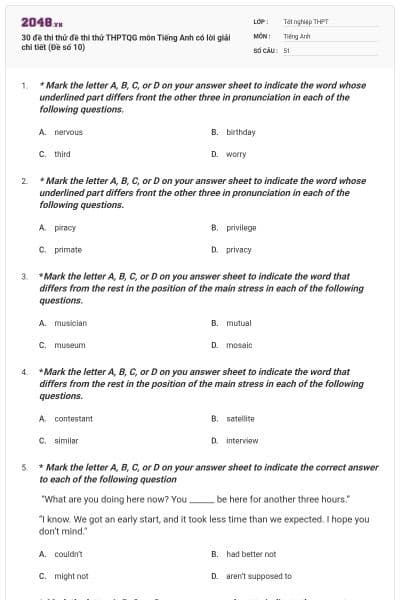
* Mark the letter A, B, C, or D on your answer sheet to indicate the word whose underlined part differs front the other three in pronunciation in each of the following questions.
nervous
birthday
third
worry
Chọn D Đọc là âm [ʌ], còn lại đọc là âm [ɜ:].
* Mark the letter A, B, C, or D on your answer sheet to indicate the word whose underlined part differs front the other three in pronunciation in each of the following questions.
piracy
privilege
primate
privacy
Chọn B Đọc là âm [i], còn lại đọc là âm [ai].
*Mark the letter A, B, C, or D on you answer sheet to indicate the word that differs from the rest in the position of the main stress in each of the following questions.
musician
mutual
museum
mosaic
Chọn B Trọng âm nhấn âm số 1, còn lại nhấn âm số 2.
A. /myu'ziʃən/ B. /'myutʃuəl/
C. /myu'ziəm/ D./mə'zeiik/
*Mark the letter A, B, C, or D on you answer sheet to indicate the word that differs from the rest in the position of the main stress in each of the following questions.
contestant
satellite
similar
interview
Chọn A Trọng âm nhấn âm số 2, còn lại nhấn âm số 1.
A. /kən'tεstənt/ B. /'sætl.ait/
C. /'simələr/ D. /'intər.vyu/
* Mark the letter A, B, C, or D on your answer sheet to indicate the correct answer to each of the following question
“What are you doing here now? You ______ be here for another three hours.”
“I know. We got an early start, and it took less time than we expected. I hope you don’t mind."
couldn’t
had better not
might not
aren’t supposed to
Chọn D Câu đề bài: “Bạn đang làm việc gì ở đây vậy? Bạn __________ ở đây thêm 3 tiếng nữa.”
“Tôi biết. Chúng tôi đã bắt đầu sớm, và mất ít thời gian hơn dự kiến. Tôi mong rằng anh không thấy phiền.”
Đáp án D. aren’t supposed to
To be supposed to do sth = to be expected to do sth: được kì vọng, mong đợi làm điều gì.
Các đáp án còn lại:
A. couldn’t: không thể B. had better not: không nên
C. might not: có thể không
* Mark the letter A, B, C, or D on your answer sheet to indicate the correct answer to each of the following questions.
How much he tries to convince you, please don’t____________.
give up
give in
lay out
bring to
Câu đề bài: Anh ấy đã cố thuyết phục bạn bao nhiêu, xin đừng_____________ .
Đáp án B: đầu hàng
Các đáp án còn lại:
A. từ bỏ B. sắp đặt D. mang tới
To give up (doing sth): từ bỏ làm việc gì;
To give in to sb/sth: đầu hàng trước ai/ cái gì.
* Mark the letter A, B, C, or D on your answer sheet to indicate the correct answer to each of the following questions.
So much effort and talent will go to_______if we are forced to drop the film.
waste
bargage
loss
failure
Câu đề bài: Thật nhiều nỗ lực và tài năng sẽ bị ___________ nếu chúng tôi buộc phải bỏ bộ phim.
Đáp án A: lãng phí
To go to waste: be unused/ expended to no purpose: không được sử dụng/ hao phí chẳng vì mục đích gì.
Các đáp án còn lại:
B. rác rưởi C. đánh mất D. thất bại

Học thông minh hơn mỗi ngày
Xem toàn bộ 51 câu hỏi và nhiều hơn nữa với tài khoản miễn phí
* Mark the letter A, B, C, or D on your answer sheet to indicate the correct answer to each of the following questions.
_________this book by the time it is due back to the library?
Will you read
Will you have read
Will you be reading
Have you read
Câu đề bài: Liệu bạn có hoàn thành xong việc đọc cuốn sách này vào thời hạn phải mang nó trả lại thư viện không?
Đáp án B. Will you have read
—» Ở đây ta cần phải dùng thì tương lai hoàn thành bởi vì thời gian là ở tương lai (chưa mang cuốn sách trả lại), việc đọc ở đây cần phải hoàn thành trước khi mang cuốn sách trả lại nên nó phải ở dạng hoàn thành.
“By the time" cũng là cụm từ chỉ thời gian thường được dùng trong thì này.
* Mark the letter A, B, C, or D on your answer sheet to indicate the correct answer to each of the following questions.
The government must take_______action against environmental pollution.
important
unstable
decisive
soft
Câu đề bài: Chính phủ phải thực hiện hành động ________ chống lại ô nhiễm môi trường.
Đáp án C. decisive (adj.): kiên quyết;
To take an action: thực hiện một hành động nào đó.
Các đáp án còn lại:
A. important (adj.): quan trọng; B. unstable (adj.): không bền vững;
D. soft (adj.): nhẹ nhàng.
* Mark the letter A, B, C, or D on your answer sheet to indicate the correct answer to each of the following questions.
She made a promise to be committed to her husband no matter what________.
It can be better or worse
Better than worse
Either better or worse
For better or for worse
Câu đề bài: Cô ấy đã hứa luôn ở bên cạnh chồng mình, dù cho điều gì xảy ra,_________.
Đáp án D. For better or for worse.
For better or (for) worse —» to accept bad results of the action as well as the good ones.
—» Bất chấp hậu quả ra sao.
* Mark the letter A, B, C, or D on your answer sheet to indicate the correct answer to each of the following questions.
One member of the project group_______the boss and was fired immediately.
came up against
came up with
talked back to
put up with
Câu đề bài: Một thành viên của nhóm kế hoạch đã cãi lại sếp và bị đuổi việc ngay lập tức.
Đáp án C. talked back to
To talk back to sb = to answer sb in a rude way: nói chuyện thô lỗ,
Các đáp án còn lại:
A. come up against a problem: vấp phải 1 vấn đề;
B. come up with an idea: nảy ra một ý tưởng;
D. put up with sb/sth: chịu đựng ai/cái gì.
* Mark the letter A, B, C, or D on your answer sheet to indicate the correct answer to each of the following questions.
Not until we________ the school for children with disabilities________how they overcome difficulties.
had visited/ did we know
visited/ had we known
visited/ did we know
have visited/ did we know
Chọn C Câu đề bài: Mãi cho đến khi chúng tôi đên thăm trường dành cho trẻ khiêm khuyết chúng tôi mới hay về cách chúng đã vượt qua được khó khăn của chính mình.
Đáp án C. visited/ did we know
Not until sb did sth + đảo ngữ: mãi cho đến khi ai làm gì rồi mới...
* Mark the letter A, B, C, or D on your answer sheet to indicate the correct answer to each of the following questions.
We need to take ________ measure to solve the drug problem in our city.
prospering
cautious
Valuable
Effective
Câu đề bài: Chúng, ta cần phải thực hiện những hành động ___________để giải quyết vấn đề thuốc phiện trong thành phố.
Đáp án D. effective (adj.): hiệu quả;
Các đáp án còn lại:
A. prospering (adj.): phát đạt, thành công;
B. cautious (adj.): cẩn thận;
C. valuable (adj.): có giá tri.
To take a measure: thực thi một biện pháp nào đó.
Mark the letter A, B, C, or D on your answer sheet to indicate the correct answer to each of the following questions.
Congress has decreed that the gasoline tax__________.
abolish
abolished
be abolished
been abolished
Đáp án: C
Giải thích:
Cấu trúc câu giả định: S + decree/suggest/demand + that S + V nguyên mẫu + O
→ ra quyết định/đề nghị/yêu cầu rằng ...
Ở đây thuế xăng dầu “được” loại bỏ nên là phải chia dạng bị động: be Vp2
Dịch: Quốc hội đã ra lệnh bãi bỏ thuế xăng dầu.
* Mark the letter A, B, C, or D on your answer sheet to indicate the correct answer to each of the following questions.
________I ask him for the money he owes me, he says he will bring it in a few days, but I don’t think he has got it all.
Whatever
However
Whenever
Wherever
Chọn C Câu đề bài: __________ tôi báo anh ta trả lại so tiền mà anh ta nợ tôi, anh ta nói rằng vài ngày sau sẽ mang trả nhưng tôi không hề nghĩ anh ta có nó.
Đáp án C. Whenever: Bất cứ khi nào
Các đáp án còn lại:
A. Whatever: Bất cứ cái gì; B. However: Bất cứ cách nào;
D. Wherever: Bất cứ nơi đâu.
* Mark the letter A, B, C, or D on your answer sheet to indicate the correct answer to each of the following questions.
“Some body forgot this hat. I wonder_________.”
whose is this hat
whose hat is
whose hat this is
is this whose hat
Câu đề bài: "Ai đó bỏ quên chiếc mũ này rồi. Tôi tự hỏi đây là mũ của ai. ”
Đáp án C. whose hat this is.
Mũ của ai thì phải là whose hat, đây là câu khẳng định về một nghi vấn chứ không phải một câu hỏi nên ta phải đảo this lên trước is chứ không phải là “whose hat is this”.
* Mark the letter A, B, C, or O on your answer sheet to indicate the most suitable response to complete each of the following exchanges.
Lan: Can we meet this Sunday to discuss our plan for the wildlife protection project?
Nam: __________
Yes, we did that.
Sunday is the weekend.
Sunday suits me fine.
Sunday is a great day.
C Câu đề bài: Lan: Chúng ta có thể gặp Chủ nhật này để thảo luận về kế hoạch của chúng ta về dự án bảo vệ đời sống hoang dã không?
Nam:____________
Đáp án C. Sunday suits me fine: Chủ nhật với tôi thì được.
Các đáp án còn lại:
A. Đúng vậy, chúng tôi đã làm như vậy.
B. Chủ nhật là ngày cuối tuần.
D. Chủ nhật là một ngày tuyệt vời.
* Mark the letter A, B, C, or O on your answer sheet to indicate the most suitable response to complete each of the following exchanges.
“Huy hasn’t finished his assignment, has he
Yes, he has. He hasn’t finished it yet.
Yes, he hasn’t. He’s too lazy.
No, he has in spite of being a good student.
No, he hasn’t because of his illness.
Câu đề bài: “Huy vẫn chưa hoàn thành bài tập cùa mình có đúng không? ” –
“__________”
Đáp án D. Chưa, anh ta vẫn chưa xong bởi vì bị bệnh.
Các đáp án còn lại:
A. Đúng vậy, anh ta vẫn chưa hoàn thành nó.
B. Đúng vậy, anh ta quá lười.
C. Không, anh ta đã dù là một học sinh chăm chỉ.
Ở đây ta trả lời câu hỏi yes/no theo câu hỏi phía sau. tức là câu hỏi đuôi, nếu là “yes, he has” là rồi, còn “no, he hasn’t” tức là chưa.
* Mark the letter A, B, C, or D on your answer sheet to indicate the sentence that best combines each pair of sentences in the following questions.
Now our parents are still alive. We should be grateful to them and thank them for what they have done for us.
Now our parents are still alive to be grateful to and to be thanked for what they have done for us.
If our parents are not alive, we will not need to be grateful to them and thank them for what they have done for us.
We should be grateful to our parents when they are still alive and thank them for what they have done for us.
Our parents will live longer if we are grateful to them and thank them for what they have done for us.
Câu đề bài: Giờ cha mẹ chúng ta đều còn sống. Chúng ta nên biết ơn họ và hiếu thuận với họ vì những gì mà họ đã làm cho chúng ta.
Đáp án C. Chúng ta nên biết ơn cha mẹ khi họ vẫn còn sống và biết ơn họ vì những gì họ đã làm cho chúng ta.
Các đáp án còn lại:
A. Giờ cha mẹ chúng ta vẫn còn sống để chúng ta biết ơn và hiếu thuận với họ vì những gì họ đã làm cho chúng ta.
B. Nếu như cha mẹ chúng ta không còn sống, chúng ta sẽ không cần phải biết ơn họ hay hiếu thuận họ vì những gì họ đã làm cho chúng ta.
D. Cha mẹ chúng ta sẽ sống lâu hơn nếu như chúng ta biết ơn họ và hiếu thuận với họ vì những gì họ đã làm cho chúng ta.
* Mark the letter A, B, C, or O on your answer sheet to indicate the most suitable response to complete each of the following exchanges.
You need to study your vocabulary words. You can do well on the quiz.
You need to study your vocabulary words, so that you can do well on the quiz.
You need to study your vocabulary words, because you can do well on the quiz.
You can do well on the quiz before you need to study your vocabulary words.
Doing well on the quiz, you have a good chance to study your vocabulary words.
Câu đề bài: Bạn cần phải học bài học từ vựng của mình. Bạn có thể làm bài thi đố tốt.
Đáp án A. Bạn cần phải học bài học từ vựng của mình. Bạn có thế làm bài thi đố tốt.
Các đáp án còn lại:
B. Bạn cần phải học bài học từ vựng của mình, bởi vì bạn có thể làm bài thi đố tốt.
C. Bạn có thể làm tốt bài thi đố trước khi bạn cần phải học bài học từ vựng của mình.
D. Làm tốt bài thi đố, bạn có cơ hội tốt để học bài học từ vựng của mình.
Ở đây học từ vựng —» làm bài thi tốt nên đáp án A là phù hợp nhất.
* Mark the letter A, B, C, or D on your answer sheet to indicate the sentence that is closest in meaning to each of the following questions.
Our grandmother might have phoned while we were out.
Our grandmother ought to have phoned while we were out.
Possibly our grandmother phoned while we were out.
Unfortunately we were out when our grandmother phoned.
We were sure our grandmother had phoned while we were out.
Câu đề bài: Có lẽ bà chúng tôi đã gọi điện khi chúng tôi ở ngoài.
Đáp án B: Có thể là bà đã gọi điện khi chúng tôi ở ngoài.
Các đáp án còn lại:
A. Bà của chúng tôi đã nên gọi điện khi chúng tôi ở bên ngoài,
C. Thật không may mắn là chúng tôi ở ngoài khi bà gọi điện.
D. Chúng tôi chắc chắn rằng bà đã gọi điện khi chúng tôi ở ngoài.
* Mark the letter A, B, C, or O on your answer sheet to indicate the most suitable response to complete each of the following exchanges.
No one expect the graduate assistant understood the results of the experiments.
All the graduate assistant understood the experiments.
The experiments were not understood by any of them.
Only the graduate assistant understood the experiments.
All but one of the graduate assistant understood the experiments.
Câu đề bài: Không ai ngoại trừ trợ lí tốt nghiệp hiểu được kết quả của các thí nghiệm.
Đáp án C. Chỉ có trợ lí tốt nghiệp hiểu được các thí nghiệm.
Các đáp án còn lại:
A. Tất cả các trợ lí tốt nghiệp đều hiểu được các thí nghiệm.
B. Các thí nghiệm đã không được hiểu bởi bất cứ ai trong bọn họ.
D. Tất cả mọi người trừ một trong những trợ lí tốt nghiệp hiểu được các thí
nghiệm.
* Mark the letter A, B, C, or O on your answer sheet to indicate the most suitable response to complete each of the following exchanges.
It’s just not possible for the cat to have opened the fridge.
The cat must not possible have opened the fridge.
The cat was supposed to possibly have opened the fridge.
The cat cannot possibly have opened the fridge.
The cat need not possibly have opened the fridge.
Câu đề bài: Con mèo đơn giản là đã không thể nào mở được cái tủ lạnh.
Đáp án C. Con mèo đã không thể nào có thể mở được cái tủ lạnh.
Các đáp án còn lại:
A. Con mèo chắc chắn đã không thể nào mở được cửa tủ lạnh.
B. Con mèo đã phải có thể mở được cửa tủ lạnh.
D. Con mèo đã không nhất thiết phải mở được cửa tủ lạnh.
Cannot have done stlr. Chắc chắn đã không làm gì.
* Read the following passage and mark the letter A, B, C, or D on your answer sheet to indicate the correct answer to each of the questions from 24 to 30.
MEGACITY: A NEW KIND OF CITY
A term 'megalopolis' (or megacity) was first used by French geographer Jean Gottman to describe the north-eastern United States in 1961. The term is used more widely now and is defined as an urban area of more than 10 million inhabitants dominated by a low-density housing. In 1995 there were 14 megacities. By 2020 there could be 30.
Megacities are the result of the process of urbanization. After cities grew into crowded urban centres, people who could afford to move into suburbs at the edge of the city. When the suburbs in turn became crowded, people moved into villages and dormitory towns outside the city, but within commuting distance. In this way, for the first time since industrialisation, the countryside began to gain population, whereas cities lost their inhabitants. In the 1980s St Louis and Detroit in the America lost between 35 and 47 per cent of their populations and London lost 15 per cent in the 20 years to 1971.
However, this movement away from cities does not mean that the city is dying. In fact it is spreading. From the old city develops a metropolitan area with many low-level urban developments. When these metropolitan areas merge together, they form megacities which contain over 10 million people. The largest of these is in America, called Boswash - a region over 300 miles long from Boston in the north to Washington, DC in the south with more than 44 million people. There are emerging megalopolises in Britain centred around London and the south-east, in Germany in the industrial region of the Ruhr and Japan in the Tokyo-Osaka-Kyoto region.
(adaptedfrom Archive IELTS (2013), Louis Harrison et al., Cengage Learning)
A megacity is characterised by___________.
number of centres
high-rise apartment buildings
those who move from villages
low-level urban developments
Chọn D Câu đề bài: Một siêu đô thi được đặc trưng bởi _______.
A. số lượng trung tâm
B. các tòa nhà chung cư chọc trời
C. những người chuyển từ quê lên
D. các phát triển đô thị bậc thấp
Thông tin trong bài:
However, this movement away from cities does not mean that the city is dying. In fact it is spreading. From the old city develops a metropolitan area with many low-level urban developments.
—» Tuy nhiên, sự dịch chuyển khỏi các thành phố này không có nghĩa là thành phố đang lụi tàn. Thực tế thì nó vẫn đang sinh sôi mở rộng. Từ thành phố cũ mọc lên một khu vực đô thị với nhiều sự phát triển đô thị bậc thấp.
* Read the following passage and mark the letter A, B, C, or D on your answer sheet to indicate the correct answer to each of the questions from 24 to 30.
MEGACITY: A NEW KIND OF CITY
A term 'megalopolis' (or megacity) was first used by French geographer Jean Gottman to describe the north-eastern United States in 1961. The term is used more widely now and is defined as an urban area of more than 10 million inhabitants dominated by a low-density housing. In 1995 there were 14 megacities. By 2020 there could be 30.
Megacities are the result of the process of urbanization. After cities grew into crowded urban centres, people who could afford to move into suburbs at the edge of the city. When the suburbs in turn became crowded, people moved into villages and dormitory towns outside the city, but within commuting distance. In this way, for the first time since industrialisation, the countryside began to gain population, whereas cities lost their inhabitants. In the 1980s St Louis and Detroit in the America lost between 35 and 47 per cent of their populations and London lost 15 per cent in the 20 years to 1971.
However, this movement away from cities does not mean that the city is dying. In fact it is spreading. From the old city develops a metropolitan area with many low-level urban developments. When these metropolitan areas merge together, they form megacities which contain over 10 million people. The largest of these is in America, called Boswash - a region over 300 miles long from Boston in the north to Washington, DC in the south with more than 44 million people. There are emerging megalopolises in Britain centred around London and the south-east, in Germany in the industrial region of the Ruhr and Japan in the Tokyo-Osaka-Kyoto region.
(adaptedfrom Archive IELTS (2013), Louis Harrison et al., Cengage Learning)
Movement away from cities creates________.
urbanization
dormitory towns
metropolitan areas
industrialisation
Chọn C Câu đề bài: Sự dịch chuyển khỏi các thành phố tạo nên_____________.
A. sự đô thị hóa B. các thị trấn vùng ngoại ô
C. những khu vực đô thị D. sự công nghiệp hóa
Thông tin trông bài:
However, this movement away from cities does not mean that the city is dying. In fact it is spreading. From the old city develops a metropolitan area with many low-level urban developments. When these metropolitan areas merge together, they form megacities which contain over 10 million people.
—» Tuy nhiên, sự dịch chuyển khỏi các thành phố này không có nghĩa là thành phố đang lụi tàn. Thực tế là nó vẫn đang mở rộng. Từ thành phố cũ mọc lên một khu vực đô thị với nhiều sự phát triển đô thị bậc thấp. Khi những khu vực thành thị này sát nhập lại, chúng tạo nên những siêu đô thị với dân số trên 10 triệu người.
* Read the following passage and mark the letter A, B, C, or D on your answer sheet to indicate the correct answer to each of the questions from 24 to 30.
MEGACITY: A NEW KIND OF CITY
A term 'megalopolis' (or megacity) was first used by French geographer Jean Gottman to describe the north-eastern United States in 1961. The term is used more widely now and is defined as an urban area of more than 10 million inhabitants dominated by a low-density housing. In 1995 there were 14 megacities. By 2020 there could be 30.
Megacities are the result of the process of urbanization. After cities grew into crowded urban centres, people who could afford to move into suburbs at the edge of the city. When the suburbs in turn became crowded, people moved into villages and dormitory towns outside the city, but within commuting distance. In this way, for the first time since industrialisation, the countryside began to gain population, whereas cities lost their inhabitants. In the 1980s St Louis and Detroit in the America lost between 35 and 47 per cent of their populations and London lost 15 per cent in the 20 years to 1971.
However, this movement away from cities does not mean that the city is dying. In fact it is spreading. From the old city develops a metropolitan area with many low-level urban developments. When these metropolitan areas merge together, they form megacities which contain over 10 million people. The largest of these is in America, called Boswash - a region over 300 miles long from Boston in the north to Washington, DC in the south with more than 44 million people. There are emerging megalopolises in Britain centred around London and the south-east, in Germany in the industrial region of the Ruhr and Japan in the Tokyo-Osaka-Kyoto region.
(adaptedfrom Archive IELTS (2013), Louis Harrison et al., Cengage Learning)
Areas merging together form __________.
city spread
megacity
suburb movement
village movement
Chọn B Câu đề bài: Các khu vực sát nhập vào nhau tạo nên _____________.
A. sự trải rộng thành phố B. siêu đô thị
C. sự dịch chuyển vùng ngoại ô D. sự dịch chuyển ở làng quê
Thông tin trong bài:
From the old city develops a metropolitan area with many low-level urban developments. When these metropolitan areas merge together, they form megacities which contain over 10 million people.
—» Từ thành phố cũ mọc lên một khu vực đô thị với nhiều sự phát triển đô thị bậc thấp. Khi những khu vực thành thị này sát nhập lại, chúng tạo nên những siêu đô thị với dân số trên 10 triệu người.
* Read the following passage and mark the letter A, B, C, or D on your answer sheet to indicate the correct answer to each of the questions from 24 to 30.
MEGACITY: A NEW KIND OF CITY
A term 'megalopolis' (or megacity) was first used by French geographer Jean Gottman to describe the north-eastern United States in 1961. The term is used more widely now and is defined as an urban area of more than 10 million inhabitants dominated by a low-density housing. In 1995 there were 14 megacities. By 2020 there could be 30.
Megacities are the result of the process of urbanization. After cities grew into crowded urban centres, people who could afford to move into suburbs at the edge of the city. When the suburbs in turn became crowded, people moved into villages and dormitory towns outside the city, but within commuting distance. In this way, for the first time since industrialisation, the countryside began to gain population, whereas cities lost their inhabitants. In the 1980s St Louis and Detroit in the America lost between 35 and 47 per cent of their populations and London lost 15 per cent in the 20 years to 1971.
However, this movement away from cities does not mean that the city is dying. In fact it is spreading. From the old city develops a metropolitan area with many low-level urban developments. When these metropolitan areas merge together, they form megacities which contain over 10 million people. The largest of these is in America, called Boswash - a region over 300 miles long from Boston in the north to Washington, DC in the south with more than 44 million people. There are emerging megalopolises in Britain centred around London and the south-east, in Germany in the industrial region of the Ruhr and Japan in the Tokyo-Osaka-Kyoto region.
(adaptedfrom Archive IELTS (2013), Louis Harrison et al., Cengage Learning)
Which is the best title for paragraph 3?
Megacities around the world
What is a megacity?
The formation of megacities
Cities lose their people
ChọnD Câu đề bài: Đâu là tiêu đề phù hợp nhất cho đoạn 3?
A. Các siêu đô thị trên khắp thế giới
B. Một siêu đô thị là gì?
C. Sự hình thành các siêu đô thị
D. Các thành phố mất đi dân cư của mình
Thông tin trong bài: Bài đọc nói nhiều đến việc các thành phố khi trở nên đông đúc quá mức thì dân cư sẽ chuyển ra xung quanh, các thành phố mất đi dân cư nhưng lại hình thành các siêu đô thị do các khu vực cũng dần trở nên đông đúc và các khu vực này sát nhập lại với nhau.
* Read the following passage and mark the letter A, B, C, or D on your answer sheet to indicate the correct answer to each of the questions from 24 to 30.
MEGACITY: A NEW KIND OF CITY
A term 'megalopolis' (or megacity) was first used by French geographer Jean Gottman to describe the north-eastern United States in 1961. The term is used more widely now and is defined as an urban area of more than 10 million inhabitants dominated by a low-density housing. In 1995 there were 14 megacities. By 2020 there could be 30.
Megacities are the result of the process of urbanization. After cities grew into crowded urban centres, people who could afford to move into suburbs at the edge of the city. When the suburbs in turn became crowded, people moved into villages and dormitory towns outside the city, but within commuting distance. In this way, for the first time since industrialisation, the countryside began to gain population, whereas cities lost their inhabitants. In the 1980s St Louis and Detroit in the America lost between 35 and 47 per cent of their populations and London lost 15 per cent in the 20 years to 1971.
However, this movement away from cities does not mean that the city is dying. In fact it is spreading. From the old city develops a metropolitan area with many low-level urban developments. When these metropolitan areas merge together, they form megacities which contain over 10 million people. The largest of these is in America, called Boswash - a region over 300 miles long from Boston in the north to Washington, DC in the south with more than 44 million people. There are emerging megalopolises in Britain centred around London and the south-east, in Germany in the industrial region of the Ruhr and Japan in the Tokyo-Osaka-Kyoto region.
(adaptedfrom Archive IELTS (2013), Louis Harrison et al., Cengage Learning)
Which of the following is NOT true?
London is an example of emerging megalopolis.
People moving out of the cities live in the area within travelling distance.
The loss of city population can reach nearly 50%.
Megacities must have overall 10 million inhabitant.
Chọn D Câu đề bài: Câu nào dưới đây là KHÔNG đúng?
A. London là một thí dụ của một siêu đô thị mới nổi.
B. Những người chuyển ra khỏi các thành phố sống ở khu vực nằm trong khoảng cách đi lại được.
C. Sự mất đi dân số thành thị có thể đạt đến gần 50%.
D. Các siêu đô thị phải có dân số khoảng 10 triệu.
Thông tin trong bài:
A. There are emerging megalopolises in Britain centred around London and the south-east, in Germany in the industrial region of the Ruhr and Japan in the Tokyo-Osaka-Kyoto region.
Có những siêu đô thị mới nổi lên ở Anh tập trung xung quanh London và về phía đông nam, ở Đức thi ở khu vực công nghiệp Ruhr và ở Nhật thì là khu vực Tokyo-Osaka-Kyoto,
B. After cities grew into crowded urban centres, people who could afford to move into suhurhs at the edge of the city. When the suburbs in turn became crowded, people moved into villages and dormitory towns outside the city, but within commuting distance.
—» Sau khi các thành phố phát triển thành những trung tâm đô thị đông đúc, những người mà có thể đã chuyển ra ngoài vùng ngoại ô ở rìa thành phố. Khi các vùng ngoại ô cũng trở nên đông đúc, người ta lại chuyển đến các làng quê và các thị trấn ngoại ô ngoài thành phố, nhưng vẫn nằm trong khoảng cách có thể đi đến nơi làm việc ở thành phố.
C. In the 1980s St Louis and Detroit in the America lost between 35 and 47percent of their populalions and London lost 15 percent in the 20 years to 1971.
—» Vào những năm 1980 phố Louis và Detroit ở Mĩ đã mất từ 35 đến 47% dân số và London đã mất 15% dân số trong vòng 20 năm đến năm 1971.
—» Có thể mất đến 50% dân số.
* Read the following passage and mark the letter A, B, C, or D on your answer sheet to indicate the correct answer to each of the questions from 24 to 30.
MEGACITY: A NEW KIND OF CITY
A term 'megalopolis' (or megacity) was first used by French geographer Jean Gottman to describe the north-eastern United States in 1961. The term is used more widely now and is defined as an urban area of more than 10 million inhabitants dominated by a low-density housing. In 1995 there were 14 megacities. By 2020 there could be 30.
Megacities are the result of the process of urbanization. After cities grew into crowded urban centres, people who could afford to move into suburbs at the edge of the city. When the suburbs in turn became crowded, people moved into villages and dormitory towns outside the city, but within commuting distance. In this way, for the first time since industrialisation, the countryside began to gain population, whereas cities lost their inhabitants. In the 1980s St Louis and Detroit in the America lost between 35 and 47 per cent of their populations and London lost 15 per cent in the 20 years to 1971.
However, this movement away from cities does not mean that the city is dying. In fact it is spreading. From the old city develops a metropolitan area with many low-level urban developments. When these metropolitan areas merge together, they form megacities which contain over 10 million people. The largest of these is in America, called Boswash - a region over 300 miles long from Boston in the north to Washington, DC in the south with more than 44 million people. There are emerging megalopolises in Britain centred around London and the south-east, in Germany in the industrial region of the Ruhr and Japan in the Tokyo-Osaka-Kyoto region.
(adaptedfrom Archive IELTS (2013), Louis Harrison et al., Cengage Learning)
The word "spreading" in paragraph 3 is closest in meaning to______.
lessening
shrinking
decreasing
expanding
Chọn D Từ “spreading = trải rộng, mở rộng” ở đoạn 3 gần nghĩa nhất với
A. giảm đi B. thu hẹp lại
C. giảm, nhỏ lại D. mở rộng
Thông tin trong bài:
However, this movement away from cities does not mean that the city is dying. In fact it is spreading. From the old city develops a metropolitan area with many low-ỉevel urban developments.
—» Tuy nhiên, sự dịch chuyển khỏi các thành phố này không có nghĩa là thành phố đang lụi tàn. Thực tế là nó vẫn đang mở rộng. Từ thành phố cũ mọc lên một khu vực đô thị với nhiều sự phát triển đô thị bậc thấp.
* Read the following passage and mark the letter A, B, C, or D on your answer sheet to indicate the correct answer to each of the questions from 24 to 30.
MEGACITY: A NEW KIND OF CITY
A term 'megalopolis' (or megacity) was first used by French geographer Jean Gottman to describe the north-eastern United States in 1961. The term is used more widely now and is defined as an urban area of more than 10 million inhabitants dominated by a low-density housing. In 1995 there were 14 megacities. By 2020 there could be 30.
Megacities are the result of the process of urbanization. After cities grew into crowded urban centres, people who could afford to move into suburbs at the edge of the city. When the suburbs in turn became crowded, people moved into villages and dormitory towns outside the city, but within commuting distance. In this way, for the first time since industrialisation, the countryside began to gain population, whereas cities lost their inhabitants. In the 1980s St Louis and Detroit in the America lost between 35 and 47 per cent of their populations and London lost 15 per cent in the 20 years to 1971.
However, this movement away from cities does not mean that the city is dying. In fact it is spreading. From the old city develops a metropolitan area with many low-level urban developments. When these metropolitan areas merge together, they form megacities which contain over 10 million people. The largest of these is in America, called Boswash - a region over 300 miles long from Boston in the north to Washington, DC in the south with more than 44 million people. There are emerging megalopolises in Britain centred around London and the south-east, in Germany in the industrial region of the Ruhr and Japan in the Tokyo-Osaka-Kyoto region.
(adaptedfrom Archive IELTS (2013), Louis Harrison et al., Cengage Learning)
The highlighted word "these" in the passage refers to_________.
megacities
people
regions
developments
Chọn A Từ “these ” được đánh dấu trong đoạn văn nói đến
A. các siêu đô thị B. con người
C. các khu vực D. những sự phát triển
Thông tin trong bài:
When these metropolitan areas merge together, they form megacities which contain over 10 million people. The largest of these is in America, called Boswash - a region over 300 miles long from Boston in the north to Washington. DC in the south with more than 44 million people.
—» Khi những khu vực thành thị này sát nhập lại với nhau, chúng tạo nên các siêu đô thị bao gồm hơn 10 triệu người. Mà thành phố lớn nhất trong số này lại chính là ở Mĩ với tên gọi là Boswash - một khu vực khoảng 300 dặm từ Boston về phía Bắc đến thủ đô Washinton ở phía nam với hơn 44 triệu người.
—» these = megacities.
*Read the following passage and mark the letter A, B, C or D on your answer sheet to indicate the correct word or phrase that best fits each of the numbered blanks from 31 to 35.
Bacteria are the smallest known living things with a cellular structure. These colorless, one-celled micro-organisms exist (31)________organic matter is found: in soil, in water and in the air. Since most of them have no chlorophyll, they cannot use light energy to synthesize their food, (32)_________green plants do.They must get their food in other ways. In this, bacteria resemble animals. However, since they are enclosed in a cell wall, they can only (33)_________dissolved food like plants do. Although most bacteria do not contain chlorophyll, some of them can make their own organic food from simple inorganic (34)________. They do not, however, use light energy for this purpose. Others get ready-made food from dead plants and animals. Still others are parasites. Parasites are (35)________to enter other living organisms and take food from them. In doing so, they often cause diseases or the death of their hosts.
(http://www. englishdaily626.com)
Điền vào số 31
however
whatever
wherever
whenever
Đáp án C. wherever: bất cứ nơi đâu
Các đáp án còn lại:
A. However: tuy nhiên/ bất cứ cách nào;
B. whalever: bất cứ cái gì;
D. whenever: bất cứ khi nào.
Thông tin trong bài:
These colorless, one-celled micro-organisms exist wherever organic matter is found: in soil, in water and in the air.
—» Những vi sinh vật không màu đơn bào này tồn tại ở bất cứ nơi đâu có vật chất hữu cơ: ở trong đất, trong nước hay trong không khí.
*Read the following passage and mark the letter A, B, C or D on your answer sheet to indicate the correct word or phrase that best fits each of the numbered blanks from 31 to 35.
Bacteria are the smallest known living things with a cellular structure. These colorless, one-celled micro-organisms exist (31)________organic matter is found: in soil, in water and in the air. Since most of them have no chlorophyll, they cannot use light energy to synthesize their food, (32)_________green plants do.They must get their food in other ways. In this, bacteria resemble animals. However, since they are enclosed in a cell wall, they can only (33)_________dissolved food like plants do. Although most bacteria do not contain chlorophyll, some of them can make their own organic food from simple inorganic (34)________. They do not, however, use light energy for this purpose. Others get ready-made food from dead plants and animals. Still others are parasites. Parasites are (35)________to enter other living organisms and take food from them. In doing so, they often cause diseases or the death of their hosts.
(http://www. englishdaily626.com)
Điền vào số 32
since
so
if
as
Đáp án D. as: như
Các đáp án còn lại:
A. since: bởi vì; B. so: nên; C. if: nếu.
Thông tin trong bài:
Since most of them have no chlorophyll, they cannot use light energy to synthesize their food, as green plants do. They must get their food in other ways.
—» Bởi vì hầu hết bọn chúng đều không có chất diệp lục, chúng không thể sử dụng ánh sáng để tổng họp dưỡng chất giống như thực vật. Chúng phải tự kiếm thức ãn theo các cách khác.
*Read the following passage and mark the letter A, B, C or D on your answer sheet to indicate the correct word or phrase that best fits each of the numbered blanks from 31 to 35.
Bacteria are the smallest known living things with a cellular structure. These colorless, one-celled micro-organisms exist (31)________organic matter is found: in soil, in water and in the air. Since most of them have no chlorophyll, they cannot use light energy to synthesize their food, (32)_________green plants do.They must get their food in other ways. In this, bacteria resemble animals. However, since they are enclosed in a cell wall, they can only (33)_________dissolved food like plants do. Although most bacteria do not contain chlorophyll, some of them can make their own organic food from simple inorganic (34)________. They do not, however, use light energy for this purpose. Others get ready-made food from dead plants and animals. Still others are parasites. Parasites are (35)________to enter other living organisms and take food from them. In doing so, they often cause diseases or the death of their hosts.
(http://www. englishdaily626.com)
Điền vào số 33
absorb
consume
attract
eat
A Đáp án A. absorb (v.): hấp thụ
Các đáp án còn lại:
B. consume (v.): tiêu thụ; C. attract (v.): thu hút;
D. eat (v.): ăn.
Thông tin trong bài:
In this, bacteria resemble animals. However, since they are enclosed in a cell wall, they can only absorb dissolved food like plants do.
—» Ở đây, vi khuẩn tương tự như động vật. Tuy nhiên, bởi vì chúng bị bao quanh trong một bức tường tế bào, chúng chỉ có thể hấp thụ dưỡng chất giống như cách của thực vật.
*Read the following passage and mark the letter A, B, C or D on your answer sheet to indicate the correct word or phrase that best fits each of the numbered blanks from 31 to 35.
Bacteria are the smallest known living things with a cellular structure. These colorless, one-celled micro-organisms exist (31)________organic matter is found: in soil, in water and in the air. Since most of them have no chlorophyll, they cannot use light energy to synthesize their food, (32)_________green plants do.They must get their food in other ways. In this, bacteria resemble animals. However, since they are enclosed in a cell wall, they can only (33)_________dissolved food like plants do. Although most bacteria do not contain chlorophyll, some of them can make their own organic food from simple inorganic (34)________. They do not, however, use light energy for this purpose. Others get ready-made food from dead plants and animals. Still others are parasites. Parasites are (35)________to enter other living organisms and take food from them. In doing so, they often cause diseases or the death of their hosts.
(http://www. englishdaily626.com)
Điền vào số 34
materials
foodstuffs
supplies
resources
Đáp án A. materials (n.): vật chất, nguyên liệu
Các đáp án còn lại:
B. foodstuffs (n.): thực phẩm; C. supplies (n.); nguồn cung cấp;
D. resources (n.): tài nguyên.
Thông tin trong bùi:
Although most bacteria do not contain chlorophyll, some ọf them can make their own organic food from simple inorganic materials. They do not, however, use light energy for this purpose.
—» Mặc dù hầu hết vi khuẩn không chứa chất diệp lục trong mình, một vài trong số chúng có thể tự tổng hợp dưỡng chất hữu cơ cho mình từ những vật chất vô cơ đơn giản. Tuy nhiên, chúng không sử dụng năng lượng ánh sáng cho mục đích này.
*Read the following passage and mark the letter A, B, C or D on your answer sheet to indicate the correct word or phrase that best fits each of the numbered blanks from 31 to 35.
Bacteria are the smallest known living things with a cellular structure. These colorless, one-celled micro-organisms exist (31)________organic matter is found: in soil, in water and in the air. Since most of them have no chlorophyll, they cannot use light energy to synthesize their food, (32)_________green plants do.They must get their food in other ways. In this, bacteria resemble animals. However, since they are enclosed in a cell wall, they can only (33)_________dissolved food like plants do. Although most bacteria do not contain chlorophyll, some of them can make their own organic food from simple inorganic (34)________. They do not, however, use light energy for this purpose. Others get ready-made food from dead plants and animals. Still others are parasites. Parasites are (35)________to enter other living organisms and take food from them. In doing so, they often cause diseases or the death of their hosts.
(http://www. englishdaily626.com)
Điền vào số 35
competent
effective
able
skilled
Đáp án C. able (adj.): có khả năng;
To be able to do sth: có khả năng làm gì;
Các đáp án còn lại:
A. competent (adj.): có đủ khả năng, trình độ;
B. effective (adj.): hiệu quả;
D. skilled (adj.): có kĩ năng.
Thông tin trong bài:
Parasites are able to enter other living organisms and take food from them. In doing so, they often cause diseases or the death of their hosts.
—» Kí sinh trùng có khả năng thâm nhập vào trong cơ thể các sinh vật sống và cướp đi thức ăn của chúng. Bằng việc làm vậy, chúng thường gây ra các căn bệnh hay cái chết cho vật chủ.
* Mark the letter A, B, C, or D on your answer sheet to indicate the word(s) CLOSEST in meaning to the underlined word(s) in each of the following question.
This is the third successive time the firm receives this award.
continuous
successful
enventual
high
Chọn A Câu đề bài: Đây là lần thứ ba liên tiếp mà công ti nhận được giải thưởng này.
Successive (adj.): liên tiếp, liên tục.
= continuous (adj.): nối tiếp, không ngừng;
Các đáp án còn lại:
B. successful (adj.): thành công;
C. eventual (adj.): cuối cùng;
D. high (adj.): cao.
* Mark the letter A, B, C, or D on your answer sheet to indicate the word(s) CLOSEST in meaning to the underlined word(s) in each of the following question.
More complex animals gradually evolved from these very simple creatures.
resolved
involved
revolted
developed
Chọn D Câu đề bài: Ngày càng nhiều động vật bậc cao tiến hóa từ những sinh vật vô cùng đơn giản này.
To evolve (v.): tiến hóa, phát triển = develop (v.): phát triển, mở mang;
Các đáp án còn lại:
A. resolve (v.): kiên quyết, quyết định;
B. involve (v.): bao gồm;
C. revolt (v.): nổi loạn, làm cho ghê tởm.
*Mark the letter A, B, C, or I) on your answer sheet to indicate the wordfs) OPPOSITE in meaning to the underlined word(s) in each of the following questions.
Feel free to bring along your significant other to the party.
dear
foe
mate
spouse
Đáp án B
Giải thích:
Significant othe: nửa còn lại quan trọng.
>< foe (n.): kẻ thù.
To bring sb along: mang theo/ đưa ai đó theo.
Các đáp án còn lại:
A. dear (n.): người yêu dấu;
C. mate (n.): bạn;
D. spouse (n.): chồng/ vợ.
Dịch: Hãy thoải mái mang theo người ấy của bạn đến bữa tiệc.
*Mark the letter A, B, C, or I) on your answer sheet to indicate the wordfs) OPPOSITE in meaning to the underlined word(s) in each of the following questions.
I’d go mad if I had to do a dead-end job like working on a supermarket checkout.
boring
monotonous
fascinating
demanding
Chọn C Câu đề bài: Tôi sẽ điên mất nếu như tôi phải làm một công việc bế tắc như là làm việc ở một quầy thu tiền ở siêu thị.
Dead-end (adj.): nhàm chán, bế tắc.
>>< fascinating (adj.): thú vị, hấp dẫn.
Các đáp án còn lại:
A. boring (adj.): nhàm chán;
B. monotonous (adj.): đều đều, đơn điệu;
D. demanding (adj.): đòi hòi, khắt khe.
* Mark the letter A, B, C, or D on your answer sheet to show the underlined part that needs correction in each of the following questions.
President Andrew Jackson had an official cabinet, but him preferred the advice of his informal advisors, the Kitchen Cabinet.
an official
him
preferred
his
Chọn B Câu đề bài: Tổng thống Andrew Jackson có một hội đồng nội các chính thức, nhưng ông lại ưu ái hơn việc nhận lời khuyên từ các nhà tư vấn không chính thức của mình, hội đồng Nhà bếp.
Đáp án B. him
Ở đây ta cần một chủ ngữ cho động từ “prefer” (thích hơn) nên him là đại từ làm tân ngữ là không đúng mà ta cần một đại từ nhân xưng.
Thay bằng: he.
* Mark the letter A, B, C, or D on your answer sheet to show the underlined part that needs correction in each of the following questions.
Before the newspaper became widespread, a town crier has walked throughout a village or town singing out the news.
widespread
crier
has
singing out
Câu đề bài: Trước khi báo giấy trở nên phổ biến, một người rao tin tức của phố đã đi bộ khắp làng hay khắp phố để thông báo tin tức.
Đáp án C. has.
Việc người rao tin tức đi bộ khắp làng phố để rao tin tức là một việc hoàn toàn trong quá khứ và đã kết thúc hoàn toàn ở hiện tại, thời gian của nó cũng rõ ràng (trước khi báo giấy trở nên phổ biến) nên ta dùng thì quá khứ đơn chứ không dùng thì hiện tại hoàn thành.
Sửa: bỏ has đi.
* Mark the letter A, B, C, or D on your answer sheet to show the underlined part that needs correction in each of the following questions.
The Dean demanded thorough research, complete investigate, and well-written report.
thorough
investigate
and
well-written report
Chọn B Câu đề bài: Chủ nhiệm khoa đã yêu cầu nghiên cứu kĩ lưỡng, rà soát toàn diện, và một bản báo cáo viết cẩn thận.
Ở đây ta cần cấu trúc song song do to demand sth: yêu cầu một thứ gì đó. Ta đã có research, report rồi nên không thể để investigate là động từ ở vị trí đó được.
Thay bằng: investigation.
* Read the following passage and mark the letter A, B, C, or D on your answer sheet to indicate the correct answer to each of the questions from 43 to 50.
Political and economic reforms launched in 1986 have transformed the country from one of the poorest in the world, with per capita income around US $100, to lower middle income status within a quarter of a century with per capita income of around US $2,100 by the end of 2015.
Vietnam’s per capita GDP growth since 1990 has been among the fastest in the world, averaging 5.5 percent a year since 1990, and 6.4 percent per year in the 2000s. Vietnam’s economy continued to strengthen in 2015, with estimated GDP growth rate of 6.7 percent for the whole year.
The Vietnamese population is also better educated and has a higher life expectancy than most countries with a similar per capita income. The maternal mortality ratio has dropped below the upper-middle-income country average, while under-five mortality rate has fallen by half, to a rate slightly above that average. Access to basic infrastructure has also improved substantially. Electricity is now available to almost all households, up from less than half in 1993. Access to clean water and modem sanitation has risen from less than 50 percent of all households to more than 75 percent.
Vietnam’s Socio-Economic Development Strategy (SEDS) 2011-2020 gives attention to structural reforms, environmental sustainability, social equity, and emerging issues of macroeconomic stability. It defines three "breakthrough areas": promoting human resources/skills development (particularly skills for modem industry and innovation), improving market institutions, and infrastructure development.
In addition, the five-year Socio-Economic Development Plan 2011-2015 focused on three critical restructuring areas - the banking sector, state-owned enterprises and public investment - that are needed to achieve these objectives. The recent draft of the SEDP 2016-2020 acknowledges the slow progress of the reform priorities of the SEDP 2011-2015.
With agriculture still accounting for almost half the labour force, and with significantly lower labour productivity than in the industry and services sectors, future gains from structural transformation could be substantial. The transformation from state to private ownership of the economy is even less advanced. The state also wields too much influence in allocating land and capital, giving rise to heavy economy wide inefficiencies. So, adjusting the role of the state to support a competitive private sector-led market economy remains a major opportunity. This will be important for enhancing productivity growth which has been stagnating for a long time.
(Adapted from http://ida. world bank, org/results/country/vietnam)
It took Vietnam about_______years to move from the poorest to the middle income status?
20
15
10
25
Câu đề bài: Việt Nam mất khoảng ________ năm để vươn lên từ vị tri nghèo nhất lên vị trí có thu nhập trung bình.
—» Đáp án D. 25
Thông tin trong bài:
Political and economic reforms launched in 1986 have transformed the country from one of the poorest in the world. with per capita income around US
$100, to lower middle income status within a quarter of a century with percapita income of around ƯS $2.100 by the end of 2015.
—» Những cải cách kinh tế và chính trị được bắt đầu năm 1986 đã làm biến đổi đất nước từ một trong những nước nghèo nhất trên thế giới, với thu nhập bình quân đầu người chỉ khoảng 100 đô la Mĩ, đến vị trí có thu nhập gần trung bình chỉ trong vòng một phần tư thế kỉ với thu nhập bình quân đầu người khoảng 2100 đô la Mĩ vào cuối năm 2015.
—» Mất khoảng 25 năm.
* Read the following passage and mark the letter A, B, C, or D on your answer sheet to indicate the correct answer to each of the questions from 43 to 50.
Political and economic reforms launched in 1986 have transformed the country from one of the poorest in the world, with per capita income around US $100, to lower middle income status within a quarter of a century with per capita income of around US $2,100 by the end of 2015.
Vietnam’s per capita GDP growth since 1990 has been among the fastest in the world, averaging 5.5 percent a year since 1990, and 6.4 percent per year in the 2000s. Vietnam’s economy continued to strengthen in 2015, with estimated GDP growth rate of 6.7 percent for the whole year.
The Vietnamese population is also better educated and has a higher life expectancy than most countries with a similar per capita income. The maternal mortality ratio has dropped below the upper-middle-income country average, while under-five mortality rate has fallen by half, to a rate slightly above that average. Access to basic infrastructure has also improved substantially. Electricity is now available to almost all households, up from less than half in 1993. Access to clean water and modem sanitation has risen from less than 50 percent of all households to more than 75 percent.
Vietnam’s Socio-Economic Development Strategy (SEDS) 2011-2020 gives attention to structural reforms, environmental sustainability, social equity, and emerging issues of macroeconomic stability. It defines three "breakthrough areas": promoting human resources/skills development (particularly skills for modem industry and innovation), improving market institutions, and infrastructure development.
In addition, the five-year Socio-Economic Development Plan 2011-2015 focused on three critical restructuring areas - the banking sector, state-owned enterprises and public investment - that are needed to achieve these objectives. The recent draft of the SEDP 2016-2020 acknowledges the slow progress of the reform priorities of the SEDP 2011-2015.
With agriculture still accounting for almost half the labour force, and with significantly lower labour productivity than in the industry and services sectors, future gains from structural transformation could be substantial. The transformation from state to private ownership of the economy is even less advanced. The state also wields too much influence in allocating land and capital, giving rise to heavy economy wide inefficiencies. So, adjusting the role of the state to support a competitive private sector-led market economy remains a major opportunity. This will be important for enhancing productivity growth which has been stagnating for a long time.
(Adapted from http://ida. world bank, org/results/country/vietnam)
What was Vietnam’s per capita GDP growth rate in 2015?
6.7%
6.4%
5.5%
7.5%
Câu đề bài: Tỉ lệ tăng trưởng GDP bình quân đầu người của Việt Nam năm 2015 là bao nhiêu?
Đáp án A. 6,7%
Thông tin trong bài:
Vietnam's economy continued to strengthen in 2015, with estimated GDP growth rate of 6.7 percent for the whole year.
—» Nền kinh tế của Việt Nam tiếp tục tăng trưởng vào năm 2015, với tỉ lệ tăng trưởng GDP được ước tính là 6.7% cả năm.
* Read the following passage and mark the letter A, B, C, or D on your answer sheet to indicate the correct answer to each of the questions from 43 to 50.
Political and economic reforms launched in 1986 have transformed the country from one of the poorest in the world, with per capita income around US $100, to lower middle income status within a quarter of a century with per capita income of around US $2,100 by the end of 2015.
Vietnam’s per capita GDP growth since 1990 has been among the fastest in the world, averaging 5.5 percent a year since 1990, and 6.4 percent per year in the 2000s. Vietnam’s economy continued to strengthen in 2015, with estimated GDP growth rate of 6.7 percent for the whole year.
The Vietnamese population is also better educated and has a higher life expectancy than most countries with a similar per capita income. The maternal mortality ratio has dropped below the upper-middle-income country average, while under-five mortality rate has fallen by half, to a rate slightly above that average. Access to basic infrastructure has also improved substantially. Electricity is now available to almost all households, up from less than half in 1993. Access to clean water and modem sanitation has risen from less than 50 percent of all households to more than 75 percent.
Vietnam’s Socio-Economic Development Strategy (SEDS) 2011-2020 gives attention to structural reforms, environmental sustainability, social equity, and emerging issues of macroeconomic stability. It defines three "breakthrough areas": promoting human resources/skills development (particularly skills for modem industry and innovation), improving market institutions, and infrastructure development.
In addition, the five-year Socio-Economic Development Plan 2011-2015 focused on three critical restructuring areas - the banking sector, state-owned enterprises and public investment - that are needed to achieve these objectives. The recent draft of the SEDP 2016-2020 acknowledges the slow progress of the reform priorities of the SEDP 2011-2015.
With agriculture still accounting for almost half the labour force, and with significantly lower labour productivity than in the industry and services sectors, future gains from structural transformation could be substantial. The transformation from state to private ownership of the economy is even less advanced. The state also wields too much influence in allocating land and capital, giving rise to heavy economy wide inefficiencies. So, adjusting the role of the state to support a competitive private sector-led market economy remains a major opportunity. This will be important for enhancing productivity growth which has been stagnating for a long time.
(Adapted from http://ida. world bank, org/results/country/vietnam)
Which of the followings is NOT mentioned as an example of development in Vietnam?
The small number of people dead after birth
The larger number of people educated abroad
The improved access to cleanliness
The wide availability of electricity
Chọn B Câu đề bài: Đáp án nào, dưới đây không được coi là một thí dụ của sự tăng trưởng ở Việt Nam?
A. Số lượng trẻ mới sinh mất sớm nhỏ.
B. Số lượng người được giáo dục ở nước ngoài tăng.
C. Sự tiếp cận nguồn nước sạch tốt hơn
D. Nguồn cung cấp điện dồi dào
Thông tin trong bài:
The Vietnamese population is also better educated and has a higher life expectancy than most countries with a similar per capita income. The maternal mortality ratio has dropped below the upper-middle-income country average, while under-five mortality rate has fallen by half, to a rate slightly above that average. Access to basic infrastructure has also improved suhstantially. Electricity is now available to almost all households, up from less than half in 1993. Access to clean water and modern sanitation has risen from ỉess than 50 percent of all households to more than 75 percent.
—» Người dân Việt Nam giờ cũng đã có được giáo dục tốt hơn và có tuổi thọ cao hơn hầu hết các nước có thu nhập bình quân đầu người tương đương. Tỉ lệ người mẹ tử vong khi sinh đã giảm xuống thấp hơn trung bình của các nước có thu nhập trên trung bình trong khi tỉ lệ tử vong của trẻ dưới 5 tuổi đã giảm đến một nửa, đến một tỉ lệ chỉ cao hơn trung bình một chút. Sự tiếp cận đến các cơ sở vật chất cơ bản cũng đã cải thiện đáng kể. Điện giờ đây đã đến với hầu hết các hộ gia đình, tăng lên từ mức một nửa của nó vào năm 1993 trước đó. Sự tiếp cận nước sạch và vệ sinh hiện đại đã tăng từ ít hôm 50% các hộ gia đình lên đến hôm 75%.
* Read the following passage and mark the letter A, B, C, or D on your answer sheet to indicate the correct answer to each of the questions from 43 to 50.
Political and economic reforms launched in 1986 have transformed the country from one of the poorest in the world, with per capita income around US $100, to lower middle income status within a quarter of a century with per capita income of around US $2,100 by the end of 2015.
Vietnam’s per capita GDP growth since 1990 has been among the fastest in the world, averaging 5.5 percent a year since 1990, and 6.4 percent per year in the 2000s. Vietnam’s economy continued to strengthen in 2015, with estimated GDP growth rate of 6.7 percent for the whole year.
The Vietnamese population is also better educated and has a higher life expectancy than most countries with a similar per capita income. The maternal mortality ratio has dropped below the upper-middle-income country average, while under-five mortality rate has fallen by half, to a rate slightly above that average. Access to basic infrastructure has also improved substantially. Electricity is now available to almost all households, up from less than half in 1993. Access to clean water and modem sanitation has risen from less than 50 percent of all households to more than 75 percent.
Vietnam’s Socio-Economic Development Strategy (SEDS) 2011-2020 gives attention to structural reforms, environmental sustainability, social equity, and emerging issues of macroeconomic stability. It defines three "breakthrough areas": promoting human resources/skills development (particularly skills for modem industry and innovation), improving market institutions, and infrastructure development.
In addition, the five-year Socio-Economic Development Plan 2011-2015 focused on three critical restructuring areas - the banking sector, state-owned enterprises and public investment - that are needed to achieve these objectives. The recent draft of the SEDP 2016-2020 acknowledges the slow progress of the reform priorities of the SEDP 2011-2015.
With agriculture still accounting for almost half the labour force, and with significantly lower labour productivity than in the industry and services sectors, future gains from structural transformation could be substantial. The transformation from state to private ownership of the economy is even less advanced. The state also wields too much influence in allocating land and capital, giving rise to heavy economy wide inefficiencies. So, adjusting the role of the state to support a competitive private sector-led market economy remains a major opportunity. This will be important for enhancing productivity growth which has been stagnating for a long time.
(Adapted from http://ida. world bank, org/results/country/vietnam)
According to the passage, nearly_____of the households did NOT get access to clean water in 2015.
three-fourths
two-thirds
one-fourth
a half
Chọn C Câu đề bài: Theo bài đọc thì gần như các hộ gia đình đã không được tiếp cận nguồn nước sạch vào năm 2015.
A. 3 phần 4 B. 2 phần 3 C. 1 phần 4 D. 1 nửa
Thông tin trong bài:
... Access to clean water and modern sanitation has risen from less than 50 percent of all households to more than 75 percent.
—» Sự tiếp cận nước sạch và vệ sinh hiện đại đã tăng từ ít hơn 50% các hộ gia đình lên đến hơn 75%.
—» vẫn còn gần 25% các hộ gia đình chưa có nước sạch vào năm 2015. = 1/4.
* Read the following passage and mark the letter A, B, C, or D on your answer sheet to indicate the correct answer to each of the questions from 43 to 50.
Political and economic reforms launched in 1986 have transformed the country from one of the poorest in the world, with per capita income around US $100, to lower middle income status within a quarter of a century with per capita income of around US $2,100 by the end of 2015.
Vietnam’s per capita GDP growth since 1990 has been among the fastest in the world, averaging 5.5 percent a year since 1990, and 6.4 percent per year in the 2000s. Vietnam’s economy continued to strengthen in 2015, with estimated GDP growth rate of 6.7 percent for the whole year.
The Vietnamese population is also better educated and has a higher life expectancy than most countries with a similar per capita income. The maternal mortality ratio has dropped below the upper-middle-income country average, while under-five mortality rate has fallen by half, to a rate slightly above that average. Access to basic infrastructure has also improved substantially. Electricity is now available to almost all households, up from less than half in 1993. Access to clean water and modem sanitation has risen from less than 50 percent of all households to more than 75 percent.
Vietnam’s Socio-Economic Development Strategy (SEDS) 2011-2020 gives attention to structural reforms, environmental sustainability, social equity, and emerging issues of macroeconomic stability. It defines three "breakthrough areas": promoting human resources/skills development (particularly skills for modem industry and innovation), improving market institutions, and infrastructure development.
In addition, the five-year Socio-Economic Development Plan 2011-2015 focused on three critical restructuring areas - the banking sector, state-owned enterprises and public investment - that are needed to achieve these objectives. The recent draft of the SEDP 2016-2020 acknowledges the slow progress of the reform priorities of the SEDP 2011-2015.
With agriculture still accounting for almost half the labour force, and with significantly lower labour productivity than in the industry and services sectors, future gains from structural transformation could be substantial. The transformation from state to private ownership of the economy is even less advanced. The state also wields too much influence in allocating land and capital, giving rise to heavy economy wide inefficiencies. So, adjusting the role of the state to support a competitive private sector-led market economy remains a major opportunity. This will be important for enhancing productivity growth which has been stagnating for a long time.
(Adapted from http://ida. world bank, org/results/country/vietnam)
According to the passage, what is NOT an example of “breakthrough areas”?
Toad markets
Transport
Power supplies
Job training
Chọn A Câu đề bài: Theo bài đọc, đâu không là một thí dụ của “những lĩnh vực đột phá”?
A. Thị trường cóc B. Vận chuyển
C. Nguồn cung cấp năng lượng D. Đào tạo nghề
Thông tin trong bài:
Vietnam’s Socio-Economic Development Strategy (SEDS) 2011-2020 gives attention to structural reforms, environmental sustainability, social equity, and emerging issues of macroeconomic stability. It defmes three “breakthrough ireas”: promoting human resources/skills development (particularly skills for modern industry and innovation), improving market institutions; and ỉnfrastructure development
—» Chiến lược Phát triển Kinh tế - Xã hội của Việt Nam (SEDS) 2011-2020 tập trung vào những cải cách cơ cấu, khả năng chống đỡ của môi trường, công bằng xã hội, và những vấn đề đang nổi lên của sự ổn định nền kinh tế vĩ mô. Nó vạch rõ ba “lĩnh vực đột phá”: đẩy mạnh phát triển nguồn nhân lực/ kỹ năng (đặc biệt những kĩ năng cho nền công nghiệp hiện đại và những cải cách), cải thiện các thể chế thị trường, và phát triển cơ sở hạ tầng.
* Read the following passage and mark the letter A, B, C, or D on your answer sheet to indicate the correct answer to each of the questions from 43 to 50.
Political and economic reforms launched in 1986 have transformed the country from one of the poorest in the world, with per capita income around US $100, to lower middle income status within a quarter of a century with per capita income of around US $2,100 by the end of 2015.
Vietnam’s per capita GDP growth since 1990 has been among the fastest in the world, averaging 5.5 percent a year since 1990, and 6.4 percent per year in the 2000s. Vietnam’s economy continued to strengthen in 2015, with estimated GDP growth rate of 6.7 percent for the whole year.
The Vietnamese population is also better educated and has a higher life expectancy than most countries with a similar per capita income. The maternal mortality ratio has dropped below the upper-middle-income country average, while under-five mortality rate has fallen by half, to a rate slightly above that average. Access to basic infrastructure has also improved substantially. Electricity is now available to almost all households, up from less than half in 1993. Access to clean water and modem sanitation has risen from less than 50 percent of all households to more than 75 percent.
Vietnam’s Socio-Economic Development Strategy (SEDS) 2011-2020 gives attention to structural reforms, environmental sustainability, social equity, and emerging issues of macroeconomic stability. It defines three "breakthrough areas": promoting human resources/skills development (particularly skills for modem industry and innovation), improving market institutions, and infrastructure development.
In addition, the five-year Socio-Economic Development Plan 2011-2015 focused on three critical restructuring areas - the banking sector, state-owned enterprises and public investment - that are needed to achieve these objectives. The recent draft of the SEDP 2016-2020 acknowledges the slow progress of the reform priorities of the SEDP 2011-2015.
With agriculture still accounting for almost half the labour force, and with significantly lower labour productivity than in the industry and services sectors, future gains from structural transformation could be substantial. The transformation from state to private ownership of the economy is even less advanced. The state also wields too much influence in allocating land and capital, giving rise to heavy economy wide inefficiencies. So, adjusting the role of the state to support a competitive private sector-led market economy remains a major opportunity. This will be important for enhancing productivity growth which has been stagnating for a long time.
(Adapted from http://ida. world bank, org/results/country/vietnam)
What is NOT a focus of the Socio-Economic Development Plan 2011-2015?
Spending money on education and health
Reforming the government’s companies
Changing the sum charged for use of money
Investing in profitable private businesses
Chọn A Câu đề bài: Đâu không là một trọng tâm của Kế hoạch phát triển Kinh tế - Xã hội 2011-2015?
A. Dành tiền cho giáo dục và chăm sóc sức khỏe
B. Cải cách các công ti của Chính phủ
C. Thay đổi ngân sách và cách chi tiêu
D. Đầu tư vào những doanh nghiệp tư nhân có lời
Thông tin trong bài:
In addition, the five-year Socio-Economic Development Plan 2011-2015 focused on three critical restructuring areas - the bankỉng sector, state- owned enterprises and public investment - that are needed to achieve these objectives. The recent draft of the SEDP 2016-2020 acknowledges the slow progress of the reform priorities of the SEDP 2011-2015.
—» Bên cạnh đó, Kế hoạch Phát triển Kinh tế - Xã hội 2011 - 2015 cũng đã tập trung vào 3 lĩnh vực tái cơ cấu quan trọng đó là khu vực ngân hàng, các doanh nghiệp nhà nước và các đầu tư tư nhân - cần thiết đề đạt được những mục tiêu trên. Bản phác thảo Kế hoạch Phát triển Kinh tế - Xã hội gần đây nhất đã thừa nhận sự tăng trưởng còn chậm của các ưu tiên cải cách trong Kế hoạch năm 2011 - 2015.
* Read the following passage and mark the letter A, B, C, or D on your answer sheet to indicate the correct answer to each of the questions from 43 to 50.
Political and economic reforms launched in 1986 have transformed the country from one of the poorest in the world, with per capita income around US $100, to lower middle income status within a quarter of a century with per capita income of around US $2,100 by the end of 2015.
Vietnam’s per capita GDP growth since 1990 has been among the fastest in the world, averaging 5.5 percent a year since 1990, and 6.4 percent per year in the 2000s. Vietnam’s economy continued to strengthen in 2015, with estimated GDP growth rate of 6.7 percent for the whole year.
The Vietnamese population is also better educated and has a higher life expectancy than most countries with a similar per capita income. The maternal mortality ratio has dropped below the upper-middle-income country average, while under-five mortality rate has fallen by half, to a rate slightly above that average. Access to basic infrastructure has also improved substantially. Electricity is now available to almost all households, up from less than half in 1993. Access to clean water and modem sanitation has risen from less than 50 percent of all households to more than 75 percent.
Vietnam’s Socio-Economic Development Strategy (SEDS) 2011-2020 gives attention to structural reforms, environmental sustainability, social equity, and emerging issues of macroeconomic stability. It defines three "breakthrough areas": promoting human resources/skills development (particularly skills for modem industry and innovation), improving market institutions, and infrastructure development.
In addition, the five-year Socio-Economic Development Plan 2011-2015 focused on three critical restructuring areas - the banking sector, state-owned enterprises and public investment - that are needed to achieve these objectives. The recent draft of the SEDP 2016-2020 acknowledges the slow progress of the reform priorities of the SEDP 2011-2015.
With agriculture still accounting for almost half the labour force, and with significantly lower labour productivity than in the industry and services sectors, future gains from structural transformation could be substantial. The transformation from state to private ownership of the economy is even less advanced. The state also wields too much influence in allocating land and capital, giving rise to heavy economy wide inefficiencies. So, adjusting the role of the state to support a competitive private sector-led market economy remains a major opportunity. This will be important for enhancing productivity growth which has been stagnating for a long time.
(Adapted from http://ida. world bank, org/results/country/vietnam)
What does the word “stagnating” in the last paragraph mean?
Stopping developing
Making progress
Missing opportunities
Strengthening competitiveness
Chọn A Câu đề bài: Từ "stagnating = đình trệ, làm ứ đọng” ở đoạn cuối cỏ nghĩa là gì?
A. Ngừng phát triển B. Đang tiến triển
C. Lỡ mất cơ hội D. Củng cố sức cạnh tranh
Thông tin trong bài:
This will be important for enhancing productivity growth which has been stagnating for a long time.
—» Điều này sẽ là quan trọng cho việc nâng cao tăng trưởng hiệu suất mà đã bị đình trệ trong suốt một thời gian dài.
* Read the following passage and mark the letter A, B, C, or D on your answer sheet to indicate the correct answer to each of the questions from 43 to 50.
Political and economic reforms launched in 1986 have transformed the country from one of the poorest in the world, with per capita income around US $100, to lower middle income status within a quarter of a century with per capita income of around US $2,100 by the end of 2015.
Vietnam’s per capita GDP growth since 1990 has been among the fastest in the world, averaging 5.5 percent a year since 1990, and 6.4 percent per year in the 2000s. Vietnam’s economy continued to strengthen in 2015, with estimated GDP growth rate of 6.7 percent for the whole year.
The Vietnamese population is also better educated and has a higher life expectancy than most countries with a similar per capita income. The maternal mortality ratio has dropped below the upper-middle-income country average, while under-five mortality rate has fallen by half, to a rate slightly above that average. Access to basic infrastructure has also improved substantially. Electricity is now available to almost all households, up from less than half in 1993. Access to clean water and modem sanitation has risen from less than 50 percent of all households to more than 75 percent.
Vietnam’s Socio-Economic Development Strategy (SEDS) 2011-2020 gives attention to structural reforms, environmental sustainability, social equity, and emerging issues of macroeconomic stability. It defines three "breakthrough areas": promoting human resources/skills development (particularly skills for modem industry and innovation), improving market institutions, and infrastructure development.
In addition, the five-year Socio-Economic Development Plan 2011-2015 focused on three critical restructuring areas - the banking sector, state-owned enterprises and public investment - that are needed to achieve these objectives. The recent draft of the SEDP 2016-2020 acknowledges the slow progress of the reform priorities of the SEDP 2011-2015.
With agriculture still accounting for almost half the labour force, and with significantly lower labour productivity than in the industry and services sectors, future gains from structural transformation could be substantial. The transformation from state to private ownership of the economy is even less advanced. The state also wields too much influence in allocating land and capital, giving rise to heavy economy wide inefficiencies. So, adjusting the role of the state to support a competitive private sector-led market economy remains a major opportunity. This will be important for enhancing productivity growth which has been stagnating for a long time.
(Adapted from http://ida. world bank, org/results/country/vietnam)
What does the word “stagnating” in the last paragraph mean?
Stopping developing
Making progress
Missing opportunities
Strengthening competitiveness
Chọn A Câu đề bài: Từ "stagnating = đình trệ, làm ứ đọng” ở đoạn cuối cỏ nghĩa là gì?
A. Ngừng phát triển B. Đang tiến triển
C. Lỡ mất cơ hội D. Củng cố sức cạnh tranh
Thông tin trong bài:
This will be important for enhancing productivity growth which has been stagnating for a long time.
—» Điều này sẽ là quan trọng cho việc nâng cao tăng trưởng hiệu suất mà đã bị đình trệ trong suốt một thời gian dài.
* Read the following passage and mark the letter A, B, C, or D on your answer sheet to indicate the correct answer to each of the questions from 43 to 50.
Political and economic reforms launched in 1986 have transformed the country from one of the poorest in the world, with per capita income around US $100, to lower middle income status within a quarter of a century with per capita income of around US $2,100 by the end of 2015.
Vietnam’s per capita GDP growth since 1990 has been among the fastest in the world, averaging 5.5 percent a year since 1990, and 6.4 percent per year in the 2000s. Vietnam’s economy continued to strengthen in 2015, with estimated GDP growth rate of 6.7 percent for the whole year.
The Vietnamese population is also better educated and has a higher life expectancy than most countries with a similar per capita income. The maternal mortality ratio has dropped below the upper-middle-income country average, while under-five mortality rate has fallen by half, to a rate slightly above that average. Access to basic infrastructure has also improved substantially. Electricity is now available to almost all households, up from less than half in 1993. Access to clean water and modem sanitation has risen from less than 50 percent of all households to more than 75 percent.
Vietnam’s Socio-Economic Development Strategy (SEDS) 2011-2020 gives attention to structural reforms, environmental sustainability, social equity, and emerging issues of macroeconomic stability. It defines three "breakthrough areas": promoting human resources/skills development (particularly skills for modem industry and innovation), improving market institutions, and infrastructure development.
In addition, the five-year Socio-Economic Development Plan 2011-2015 focused on three critical restructuring areas - the banking sector, state-owned enterprises and public investment - that are needed to achieve these objectives. The recent draft of the SEDP 2016-2020 acknowledges the slow progress of the reform priorities of the SEDP 2011-2015.
With agriculture still accounting for almost half the labour force, and with significantly lower labour productivity than in the industry and services sectors, future gains from structural transformation could be substantial. The transformation from state to private ownership of the economy is even less advanced. The state also wields too much influence in allocating land and capital, giving rise to heavy economy wide inefficiencies. So, adjusting the role of the state to support a competitive private sector-led market economy remains a major opportunity. This will be important for enhancing productivity growth which has been stagnating for a long time.
(Adapted from http://ida. world bank, org/results/country/vietnam)
What is likely to be over-controlled by the government?
Agriculture
Private companies
Services sectors
Heavy industries
Chọn B Câu đề bài: Điều gì có vẻ như bị kiếm soát quá mức bởi Chính phủ?
A. Nông nghiệp B. Các công ty tư nhân
C. Các khu vực dịch vụ D. Các nền công nghiệp nặng
Thông tin trong bài:
The transformation from state to private ownership of the economy is even less advanced. The state also wields too much influence in allocating land and Capital, giving rise to heavy economy wide ineffìciencies.
—» Sự chuyển biến từ sở hữu nhà nước sang tư nhân của nền kinh tế thậm chí còn kém nâng cao hơn. Nhà nước cũng can thiệp quá nhiều vào việc phân bổ đất đai và nguồn vốn, làm gia tăng những sự không hiệu quả rất lớn trong nền kinh tế nặng.
Bạn có thích hoạt động này không?
Ý kiến của bạn sẽ giúp chúng tôi đề xuất nội dung phù hợp hơn.
Gợi ý cho bạn
![[Năm 2022] Đề thi thử môn Vật lí THPT Quốc gia có lời giải - Đề số 21](/_next/image?url=https%3A%2F%2Fvideo.vietjack.com%2Fupload%2Fimages%2Fvj-image%2Fimage-3izficdefgfoel0s9j8s-1786772791.jpg&w=3840&q=75)


![[Năm 2022] Đề thi thử môn Vật lí THPT Quốc gia có lời giải - Đề số 20](/_next/image?url=https%3A%2F%2Fvideo.vietjack.com%2Fupload%2Fimages%2Fvj-image%2Fimage-emy0gtcksawvorajezvv-1786772460.jpg&w=3840&q=75)
Tài liệu phổ biến Tốt nghiệp THPT


Tài liệu phổ biến Tiếng Anh