(2024) Đề thi thử THPT môn Tiếng anh khảo sát định kì tháng 12 có đáp án
50 câu hỏi
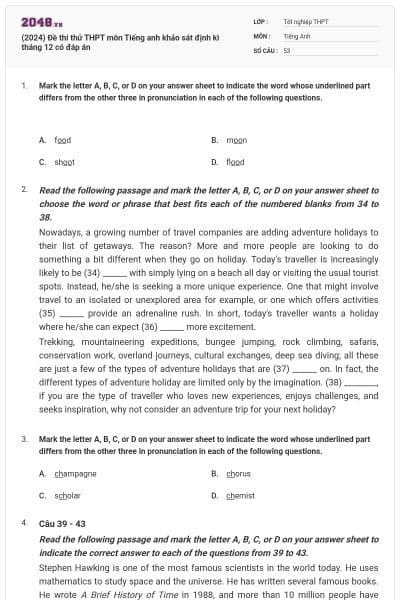
Mark the letter A, B, C, or D on your answer sheet to indicate the word whose underlined part differs from the other three in pronunciation in each of the following questions.
food
moon
shoot
flood
Giải thích:
A. food /fuːd/ (n): thức ăn
B. moon /muːn/ (n): mặt trăng
C. shoot /ʃuːt/ (n): cú đá
D. flood /flʌd/ (n): lũ lụt
Đáp án D có “oo” phát âm là /ʌ/, còn lại phát âm là /uː/.
→ Chọn đáp án D
champagne
chorus
scholar
chemist
Giải thích:
A. champagne /ʃæmˈpeɪn/ (n): sâm panh
B. chorus /ˈkɔːrəs/ (n): điệp khúc
C. scholar /ˈskɒlə/ (n): học giả
D. chemist /ˈkemɪst/ (n): nhà hóa học
Đáp án A có “ch” phát âm là /ʃ/, còn lại phát âm là /k/.
→ Chọn đáp án A
Mark the letter A, B, C, or D on your answer sheet to indicate the word that differs from the other three in the position of the primary stress in each of the following questions
manner
degree
custom
habit
Giải thích:
A. manner /ˈmænə/ (n): cách, lối, kiểu
B. degree /dɪˈɡriː/ (n): mức độ; bằng cấp
C. custom /ˈkʌstəm/ (n): phong tục
D. habit /ˈhæbɪt/ (n): thói quen
Đáp án B có trọng âm rơi vào âm tiết thứ 2, các đáp án còn lại trọng âm rơi vào âm tiết thứ nhất.
→ Chọn đáp án B
colourful
interesting
important
dangerous
Giải thích:
A. colourful /ˈkʌləfᵊl/ (adj): sặc sỡ
B. interesting /ˈɪntrəstɪŋ/ (adj): thú vị
C. important /ɪmˈpɔːtᵊnt/ (adj): quan trọng
D. dangerous /ˈdeɪnʤᵊrəs/ (adj): nguy hiểm
Đáp án C có trọng âm rơi vào âm tiết thứ 2, các đáp án còn lại trọng âm rơi vào âm tiết thứ nhất.
→ Chọn đáp án C
Mark the letter A, B, C, or D on your answer sheet to indicate the correct answer to each of the following questions.
The security officers continually denied the reporters ________ to the scene.
access
accessing
to access
to accessing
Giải thích:
Cấu trúc:
deny somebody something: ngăn không cho ai làm gì
Ta không thể dùng ‘accessing’ vì khi đó ‘access’ là động từ (không đi với to).
Danh từ ‘access’ đi với ‘to’ mang nghĩa sự tiếp cận với cái gì.
Tạm dịch: Các nhân viên an ninh liên tục ngăn các phóng viên tiếp cận hiện trường.
→ Chọn đáp án A
The regional economy _________ since the open door policy was implemented.
improves
was improving
is improving
has improved
Giải thích:
Kiến thức về thì:
Ta có: HTHT since QKĐ
Tạm dịch: Nền kinh tế khu vực đã được cải thiện kể từ khi chính sách mở cửa được thực hiện.
→ Chọn đáp án D
Many buildings in the Gaza Strip _______ due to constant bombardment.
collapses
were collapsed
be collapsed
collapsed
Giải thích:
Kiến thức về thì:
Danh từ số nhiều ‘buildings’ nên ta loại A.
Động từ ‘collapse’ ở đây là nội động từ nên được dùng ở dạng chủ động.
Tạm dịch: Nhiều tòa nhà ở Gaza sụp đổ do bị bắn phá liên tục.
→ Chọn đáp án D
He held the delicate teacup ________ for fear of breaking it.
careful
carefulness
care
carefully
Giải thích:
Kiến thức từ loại:
- careful (adj): cẩn thận
- carefulness (n): sự cẩn thận
- care (v): quan tâm
- carefully (adv): cẩn thận
Chỗ trống cần điền một trạng từ bổ nghĩa cho động từ ‘held’
Tạm dịch: Anh cẩn thận cầm tách trà mỏng manh vì sợ làm vỡ nó.
→ Chọn đáp án D
_______ with rage, she grabbed the letter and stormed out of the room.
Depleted
Consumed
Digested
Absorbed
Giải thích:
Cấu trúc:
- deplete (v): làm cạn kiệt
- consume (v): tiêu thụ be → consumed with something: ngập tràn cảm xúc gì
- digest (v): tiêu hoá, hiểu thông tin
- absorb (v): hấp thụ, thu hút
Tạm dịch: Quá tức giận, cô chộp lấy lá thư và lao ra khỏi phòng.
→ Chọn đáp án B
Hoa will change her hairstyle ________.
before Tet holiday approached
after Tet holiday approached
as Tet holiday approaches
while Tet holiday was approaching
Giải thích:
Mệnh đề chính đang chia ở thì tương lai (will change) => Loại tất cả các đáp án chia quá khứ => Loại A, B và D.
Tạm dịch: Hoa sẽ thay đổi kiểu tóc khi Tết đến gần.
→ Chọn đáp án C
Red roses ________ on the grave withered under the scorching heat.
lain
laying
laid
to lie
Giải thích:
Kiến thức rút gọn mệnh đề quan hệ:
- lain (quá khứ phân từ của lie - nội động từ): nằm
- laying (v-ing của lay): đặt, để
- laid (quá khứ của lay): đặt, để
- to lie (to V của lie): nằm
Câu gốc: Red roses which were laid on the grave withered under the scorching heat.
Tạm dịch: Những bông hồng đỏ được đặt trên mộ đã héo rũ dưới cái nóng thiêu đốt.
→ Chọn đáp án C
Dr. Parker was late, but he still spared us some of his ______ time to answer our questions.
valuable
beneficial
costly
worthwhile
Giải thích:
Kiến thức từ vựng:
- valuable (adj): quý giá, quý báu
- beneficial (adj): có ích, mang lại lợi ích tích cực
- costly (adj): đắt đỏ, tốn kém.
- worthwhile (adj): đáng giá, xứng đáng
Tạm dịch: Tiến sĩ Parker tới muộn nhưng ông vẫn dành ra một chút thời gian quý báu để trả lời các câu hỏi của chúng tôi.
→ Chọn đáp án A
It was very kind _______ Tony to give me a lift to the office.
at
to
of
for
Giải thích:
Cấu trúc:
It + be + very kind of sb + to V: Ai thật tử tế khi làm gì
Tạm dịch: Tony thật tử tế khi chở tôi đến văn phòng.
→ Chọn đáp án C
The cheaper a restaurant is, ___________.
the most crowded it gets
the more crowded it gets
the most it gets crowded
the more it gets crowded
Giải thích:
Cấu trúc so sánh kép:
The + so sánh hơn + S + V, the + so sánh hơn + S + V: càng... càng
Tạm dịch: Nhà hàng càng rẻ thì càng đông.
→ Chọn đáp án B
The word ‘flex’ which means ‘show that you are proud of your achievement’ has ________ among Vietnamese young people.
taken over
caught on
stood for
held on
Giải thích:
Kiến thức phrasal verb:
- take over: tiếp quản
- catch on: trở nên phổ biến
- stand for: đại diện cho, biểu tượng cho
- hold on: giữ máy, sống sót trong tình huống khó khăn, nguy hiểm
Tạm dịch: Từ 'flex' có nghĩa là 'thể hiện rằng bạn tự hào về thành tích của mình' đã được giới trẻ Việt Nam ưa chuộng.
→ Chọn đáp án B
He was confident ______ he had prepared for the exam.
because
because of
even though
in spite of
Giải thích:
Liên từ:
- because S + V: bởi vì
- because + N/Ving: bởi vì
- even though S + V: mặc dù
- in spite of + N/Ving: mặc dù
Phía sau là một mệnh đề ◊ loại B, D. Dựa vào nghĩa, chọn A.
Tạm dịch: Anh ấy tự tin vì đã chuẩn bị cho kỳ thi.
→ Chọn đáp án A
The scenery was spectacular, ________?
isn’t it
hadn’t it
didn’t it
wasn’t it
Giải thích:
Câu hỏi đuôi:
Mệnh đề chính khẳng định → câu hỏi đuôi phủ định.
Mệnh đề chính dùng to be ‘was’ với chủ ngữ ‘the scenery’ → câu hỏi đuôi dùng “was” và đại từ “it”.
Tạm dịch: Cảnh tuyệt đẹp, phải không?
→ Chọn đáp án D
Her wedding ceremony _______ place on a sunny day.
made
held
went
took
Giải thích:
Collocation:
take place: diễn ra, xảy ra
Tạm dịch: Lễ cưới của cô diễn ra vào một ngày nắng đẹp.
→ Chọn đáp án D
Many parents often tread a ______ line between being caring and being overprotective.
pure
slight
mild
fine
Giải thích:
Idiom:
tread a fine line: trong tình thế khó xử mà ta có thể dễ dàng mắc lỗi
Tạm dịch: Nhiều bậc cha mẹ thường trong tình thế khó xử giữa việc quan tâm con và bảo vệ con quá mức.
→ Chọn đáp án D
Mark the letter A, B, C, or D on your answer sheet to indicate the word(s) CLOSEST in meaning to the underlined word(s) in each of the following questions.
The food wasn’t good, but in general that was a pleasurable trip.
terrible
enjoyable
normal
expensive
Giải thích:
A. terrible (adj): kinh khủng
B. enjoyable (adj): thú vị
C. normal (adj): bình thường
D. expensive (adj): đắt
pleasurable (adj): đem lại niềm vui, sự hứng thú hoặc thoả mãn = enjoyable
Tạm dịch: Đồ ăn không ngon nhưng nhìn chung đó là một chuyến đi thú vị.
→ Chọn đáp án B
His face turned red with embarrassment when they called his name.
became
stopped
shared
built
Giải thích:
A. become (v): trở nên
B. stop (v): dừng
C. share (v): chia sẻ, có chung
D. build (v): xây dựng
turn (v): chuyển sang, chuyển thành = become
Tạm dịch: Mặt anh đỏ bừng xấu hổ khi được gọi tên.
→ Chọn đáp án A
Mark the letter A, B, C, or D on your answer sheet to indicate the word(s) OPPOSITE in meaning to the underlined bold word(s) in each of the following questions.
A lot of students waited for the final results to be announced with bated breath.
with shortness of breath
with a sharp intake of breath
in an anxious way
in a calm manner
Giải thích:
A. khó thở
B. với một hơi thở mạnh
C. một cách lo lắng
D. một cách bình tĩnh
with bated breath: hồi hộp, lo lắng >< in a calm manner
Tạm dịch: Rất nhiều học sinh hồi hộp chờ đợi kết quả cuối cùng được công bố.
→ Chọn đáp án D
It was the helpful and courteous sales person that helped me find the shoes.
serious
polite
creative
rude
Giải thích:
A. serious (adj): nghiêm túc, nghiêm trọng
B. polite (adj): lịch sự
C. creative (adj): sáng tạo
D. rude (adj): thô lỗ
courteous (adj): lịch sự >< rude
Tạm dịch: Chính người bán hàng nhiệt tình và lịch sự đã giúp tôi tìm được đôi giày.
→ Chọn đáp án D
Mark the letter A, B, C, or D on your answer sheet to indicate the most suitable response to complete each of the following exchanges.
Tom is talking to Joey after class.
- Tom: “Would you like to join us for the party tonight?”
- Joey: “_________”
Not at all.
Yes, I’d love to.
No, I will come.
Yes, I’m afraid I can’t come.
Giải thích:
A. Không hề.
B. Có, tôi rất muốn.
C. Không, tôi sẽ đến.
D. Có, tôi e là tôi không thể đến được.
Tạm dịch: Tom đang nói chuyện với Joey sau giờ học.
- Tom: “Cậu có muốn tham gia bữa tiệc tối nay cùng chúng tớ không?”
- Joey: “Có, tớ rất muốn.”
→ Chọn đáp án B
Phillips and Trang are talking about online shopping.
- Phillips: “I believe that online shopping is beneficial to our lives.”
- Trang: “_________. We can buy a variety of products from the comfort of our home.”
I couldn’t agree with you more
It’s worrying
I don’t share your opinion
You must say that again
Giải thích:
A. Tôi hoàn toàn đồng ý với bạn
B. Thật đáng lo ngại
C. Tôi không cùng ý kiến của bạn
D. Bạn phải nói lại điều đó
Tạm dịch: Phillips và Trang đang nói chuyện về mua sắm trực tuyến.
- Phillips: “Tớ tin rằng mua sắm trực tuyến có lợi cho cuộc sống của chúng ta.”
- Trang: “Tớ hoàn toàn đồng ý với cậu. Chúng ta có thể mua nhiều loại sản phẩm ngay tại nhà.”
→ Chọn đáp án A
Mark the letter A, B, C, or D on your answer sheet to indicate the underlined part that needs correction in each of the following questions.
The extinction of a small species seems to be consequent, but it can have a ripple effect on the food chain in the long run.
species
consequent
ripple
long run
Giải thích:
Kiến thức từ vựng:
- consequent (adj): là hậu quả, kết quả
- inconsequential (adj): không quan trọng, vụn vặt, tầm thường
Sửa: consequent → inconsequential
Tạm dịch: Sự tuyệt chủng của một loài nhỏ có vẻ như không quan trọng, nhưng nó có thể tạo ra một phản ứng dây chuyền trên chuỗi thức ăn trong thời gian dài.
→ Chọn đáp án B
The tailor made some changes to the shirt and sold them at a cheaper price.
some
to
them
a
Giải thích:
Danh từ số ít ‘shirt’ →cần dùng đại từ ‘it’ để quy chiếu
Sửa: them → it
Tạm dịch: Người thợ may đã chỉnh sửa lại chiếc áo và bán nó với giá rẻ hơn.
→ Chọn đáp án C
Children can become bad-tempered, independent and privacy when they reach puberty.
become
independent
privacy
reach
Giải thích:
Liên từ ‘and’ được sử dụng để liên kết các cụm từ hoặc mệnh đề có chức năng tương đương nhau về mặt ngữ pháp. Ta thấy ‘bad-tempered’ và ‘independent’ đều là các tính từ, vậy ‘privacy’ cũng cần chuyển sang dạng tính từ.
Sửa: privacy → private
Tạm dịch: Trẻ có thể trở nên dễ nổi nóng, tự lập và ít chia sẻ hơn khi đến tuổi dậy thì.
→ Chọn đáp án C
Mark the letter A, B, C, or D on your answer sheet to indicate the sentence that best combines each pair of sentences in the following questions.
The president fell ill. The meeting was cancelled.
Unless the president doesn’t fall ill, the meeting won’t be cancelled.
Supposing the president hadn’t fallen ill, the meeting wouldn’t have been cancelled.
If the president had fallen ill, the meeting would have been cancelled.
If the president didn’t fall ill, the meeting wouldn’t be cancelled.
Giải thích:
Chủ tịch đổ bệnh. Cuộc họp đã bị hủy bỏ.
A. Sai vì câu gốc ở thì quá khứ đơn, khi chuyển sang câu điều kiện, cần dùng câu điều kiện loại 3.
B. Giả sử chủ tịch không bị ốm thì cuộc họp sẽ không bị hủy bỏ.
C. Nếu chủ tịch bị ốm, cuộc họp sẽ bị hủy bỏ. → Sai vì khi viết lại với câu điều kiện, ta cần viết sao cho trái ngược với tình huống đã cho.
D. Sai vì câu gốc ở thì quá khứ đơn, khi chuyển sang câu điều kiện, cần dùng câu điều kiện loại 3.
→ Chọn đáp án B
He will become obese if he continues eating too much fast food. He isn’t aware of that much.
Not until he had become obese did he stop eating too much fast food.
Not only does he become obese but he also continues eating too much fast food.
Were he not to stop eating too much fast food, he wouldn’t become obese.
Little does he realise that he will become obese if he keeps eating too much fast food.
Giải thích:
Anh ta sẽ trở nên béo phì nếu tiếp tục ăn quá nhiều đồ ăn nhanh. Anh ấy không nhận thức được điều đó.
A. Mãi cho đến khi anh ấy trở nên béo phì, anh ấy mới ngừng ăn quá nhiều đồ ăn nhanh.
B. Anh ấy không chỉ béo phì mà còn tiếp tục ăn quá nhiều đồ ăn nhanh.
C. Nếu anh ấy không ngừng ăn quá nhiều đồ ăn nhanh, anh ấy sẽ không bị béo phì.
D. Anh ấy không nhận ra rằng mình sẽ trở nên béo phì nếu tiếp tục ăn quá nhiều đồ ăn nhanh.
→ Chọn đáp án D
Mark the letter A, B, C, or D on your answer sheet to indicate the sentence that is closest in meaning to each of the following questions.
His father asked why he had gone home late the night before.
His father asked why had he gone home late the night before.
His father asked why he had gone home late last night.
His father asked why had he gone home late last night.
Giải thích:
“Sao tối qua con về nhà muộn vậy?” Cha anh hỏi.
A. Bố anh ấy hỏi tại sao tối hôm trước anh ấy lại về nhà muộn.
B. Sai ngữ pháp, phải đưa trợ động từ về sau chủ ngữ.
C. Sai ngữ pháp (chưa chuyển ‘last night’ thành ‘the night before’)
D. Sai ngữ pháp, phải đưa trợ động từ về sau chủ ngữ và chuyển đổi last night.
→ Chọn đáp án A
Passengers aren’t permitted to bring pets on the train.
Passengers needn’t bring pets on the train.
Passengers mustn’t bring pets on the train.
Passengers don’t have to bring pets on the train.
Passengers shouldn’t bring pets on the train.
Giải thích:
Hành khách không được phép mang theo thú cưng lên tàu.
A. Hành khách không cần mang theo thú cưng lên tàu.
B. Hành khách không được mang theo thú cưng lên tàu.
C. Hành khách không phải mang theo thú cưng lên tàu.
D. Hành khách không nên mang theo thú cưng lên tàu.
→ Chọn đáp án B
This is my first visit to Nha Trang.
I have visited Nha Trang many times before.
The last time I visited Nha Trang was last year.
I haven’t visited Nha Trang for many years.
I have never visited Nha Trang before.
Giải thích:
Đây là lần đầu tiên tôi đến Nha Trang.
A. Tôi đã đến Nha Trang nhiều lần rồi.
B. Lần cuối cùng tôi đến Nha Trang là vào năm ngoái.
C. Tôi đã không đến thăm Nha Trang nhiều năm rồi.
D. Tôi chưa bao giờ đến thăm Nha Trang trước đây.
→ Chọn đáp án D
Read the following passage and mark the letter A, B, C, or D on your answer sheet to choose the word or phrase that best fits each of the numbered blanks from 34 to 38.
Nowadays, a growing number of travel companies are adding adventure holidays to their list of getaways. The reason? More and more people are looking to do something a bit different when they go on holiday. Today's traveller is increasingly likely to be (34) ______ with simply lying on a beach all day or visiting the usual tourist spots. Instead, he/she is seeking a more unique experience. One that might involve travel to an isolated or unexplored area for example, or one which offers activities (35) ______ provide an adrenaline rush. In short, today's traveller wants a holiday where he/she can expect (36) ______ more excitement.
Trekking, mountaineering expeditions, bungee jumping, rock climbing, safaris, conservation work, overland journeys, cultural exchanges, deep sea diving; all these are just a few of the types of adventure holidays that are (37) ______ on. In fact, the different types of adventure holiday are limited only by the imagination. (38) ________, if you are the type of traveller who loves new experiences, enjoys challenges, and seeks inspiration, why not consider an adventure trip for your next holiday?
Today's traveller is increasingly likely to be (34) ______ with simply lying on a beach all day or visiting the usual tourist spots.
content
cautious
unsatisfied
disqualified
Giải thích:
A. content (adj): vui, hài lòng
B. cautious (adj): cẩn trọng
C. unsatisfied (adj): không hài lòng, không thỏa mãn
D. disqualified (adj): không đủ điều kiện
Tạm dịch:
Today's traveller is increasingly likely to be unsatisfied with simply lying on a beach all day or visiting the usual tourist spots. (Người đi du lịch ngày nay ngày càng có vẻ không hài lòng với việc chỉ đơn giản là nằm trên bãi biển cả ngày hoặc ghé thăm những điểm du lịch thông thường.)
→ Chọn đáp án C
One that might involve travel to an isolated or unexplored area for example, or one which offers activities (35) ______ provide an adrenaline rush.
where
that
what
whose
Giải thích:
Mệnh đề quan hệ (Relative clause):
Dùng đại từ “that” làm chủ ngữ thay thế cho danh từ chỉ vật ‘activities’ đứng trước.
Tạm dịch:
One that might involve travel to an isolated or unexplored area for example, or one which offers activities that provide an adrenaline rush. (Ví dụ, những trải nghiệm có thể bao gồm di chuyển đến một khu vực tách biệt hoặc chưa được khai phá, hay trải nghiệm cung cấp các hoạt động mang lại cảm giác vô cùng phấn khích.)
→ Chọn đáp án B
In short, today's traveller wants a holiday where he/she can expect (36) ______ more excitement.
a few
many
another
a little
Giải thích:
A. a few + N (số nhiều): một vài
B. many + N (số nhiều): nhiều
C. another + N (số ít): một cái khác
D. a little + N (không đếm được): một ít
excitement là danh từ không đếm được, nên ta dùng a little.
Tạm dịch:
In short, today's traveller wants a holiday where he/she can expect a little more excitement. (Nói ngắn gọn, du khách ngày nay muốn có một kỳ nghỉ mà tại đó, họ có thể mong đợi một chút phấn khích hơn.)
→ Chọn đáp án D
all these are just a few of the types of adventure holidays that are (37) ______ on.
growing
fitting
picking
catching
Giải thích:
Kiến thức cụm động từ (Phrasal verbs):
- grow on somebody: làm ai đó dần thích
- pick on somebody: bắt nạt ai
- catch on: thịnh hành, phổ biến
Tạm dịch:
Trekking, mountaineering expeditions, bungee jumping, rock climbing, safaris, conservation work, overland journeys, cultural exchanges, deep sea diving; all these are just a few of the types of adventure holidays that are catching on. (Đi bộ đường dài, các chuyến leo núi thám hiểm, nhảy bungee, leo núi đá, đi săn, đi làm ở khu bảo tồn, các hành trình đường bộ, trao đổi văn hóa, lặn sâu ở biển; tất cả những việc này chỉ là một vài trong số các loại kỳ nghỉ phiêu lưu đang trở nên thịnh hành.)
→ Chọn đáp án D
(38) ________, if you are the type of traveller who loves new experiences, enjoys challenges, and seeks inspiration, why not consider an adventure trip for your next holiday?
But
Though
So
Or
Giải thích:
A. But: nhưng
B. Though: mặc dù
C. So: vì thế
D. Or: hoặc
Tạm dịch:
So, if you are the type of traveller who loves new experiences, enjoys challenges, and seeks inspiration, why not consider an adventure trip for your next holiday? (Vì thế, nếu bạn là kiểu du khách yêu thích những trải nghiệm mới lạ, thích mạo hiểm, và tìm kiếm nguồn cảm hứng, sao lại không cân nhắc về một chuyến đi phiêu lưu vào kỳ nghỉ tiếp theo?)
→ Chọn đáp án C
Câu 39 - 43
Read the following passage and mark the letter A, B, C, or D on your answer sheet to indicate the correct answer to each of the questions from 39 to 43.
Stephen Hawking is one of the most famous scientists in the world today. He uses mathematics to study space and the universe. He has written several famous books. He wrote A Brief History of Time in 1988, and more than 10 million people have bought this book. Other scientists have called Hawking the greatest scientist in the world.
Hawking has faced terrible problems in his life. When he was 21, he got a serious disease called ALS. It quickly got worse, and soon he couldn't walk or speak. Now he can move only his left hanD. He uses a wheelchair with a motor to get around. He "talks" by typing words into a computer. The computer pronounces the words for him.
But for Hawking, his work is more important than his problems. Now he is interested in the beginning of the universe. He teaches at Cambridge University in England, and he gives lectures at other universities. He has written many important scientific papers and has won many prizes for his work. He has appeared in several movies and has been on TV many times. He has traveled in countries around the world, and he has even traveled in space! In 2007, he went up on a special zero- gravity plane.
Which can be the best title for the passage?
Studying Programmes for Disabled Scientists
An Unknown Researcher
Amazing Achievements of a Scientist
A Man with a Skillful Hand
Giải thích:
Đâu có thể là tiêu đề hay nhất cho đoạn văn?
A. Các chương trình nghiên cứu dành cho các nhà khoa học khuyết tật
B. Một nhà nghiên cứu vô danh
C. Những thành tựu đáng kinh ngạc của một nhà khoa học
D. Một người có bàn tay khéo léo
Tóm tắt: Đoạn văn đã đưa ra thông tin sơ lược về cuộc đời và những thành tựu của nhà khoa học Stephen Hawking.
→ Chọn đáp án C
According to paragraph 1, Stephen Hawking _________.
has been interested in space since childhood
is the author of some famous books
started to write books about the universe in 1988
has been recently keen on studying space
Giải thích:
Theo đoạn 1, Stephen Hawking _________.
A. quan tâm đến không gian từ khi còn nhỏ
B. là tác giả của một số cuốn sách nổi tiếng
C. bắt đầu viết sách về vũ trụ vào năm 1988
D. gần đây rất thích nghiên cứu không gian
Thông tin:
+ He has written several famous books. (Ông đã viết một số cuốn sách nổi tiếng.)
→ Chọn đáp án B
The word terrible in paragraph 2 is closest in meaning to _______.
awful
clear
typical
light
Giải thích:
Từ “powerful” ở đoạn 1 gần nghĩa nhất với từ ________
A. awful (adj): tồi tệ
B. clear (adj): rõ ràng
C. typical (adj): tiêu biểu
D. light (adj): nhẹ
Kiến thức từ vựng:
terrible (adj): tồi tệ = awful
→ Chọn đáp án A
The word It in paragraph 2 refers to ________.
computer
life
hand
ALS
Giải thích:
Từ “It” trong đoạn 2 đề cập đến _____.
A. máy tính
B. cuộc sống
C. bàn tay
D. bệnh ALS
Thông tin:
When he was 21, he got a serious disease called ALS. Itquickly got worse, and soon he couldn't walk or speak. (Năm 21 tuổi, ông mắc phải căn bệnh hiểm nghèo mang tên ALS. Nó nhanh chóng trở nên tệ hơn, và không lâu sau đó ông không thể đi lại hay nói được.)
→ Chọn đáp án D
Which of the following is NOT true about Hawking according to the passage?
He only lectures at Cambridge University in England.
He moves around by using a wheelchair with a motor.
He cannot express his ideas to others by himself.
He travelled on a special zero- gravity plane.
Giải thích:
Thông tin nào sau đây KHÔNG đúng về Hawking theo đoạn văn?
A. Ông chỉ thuyết giảng tại Đại học Cambridge ở Anh.
B. Ông di chuyển xung quanh bằng cách sử dụng xe lăn có động cơ.
C. Ông không thể tự mình bày tỏ ý tưởng với người khác.
D. Ông đã đi trên một chiếc máy bay không trọng lực đặc biệt.
Thông tin:
+ He uses a wheelchair with a motor to get around. (Ông sử dụng xe lăn có động cơ để đi lại.)
→ B đúng
+ It quickly got worse, and soon he couldn't walk or speak… He "talks" by typing words into a computer. The computer pronounces the words for him. (Nó nhanh chóng trở nên tệ hơn, và ngay sau đó ông không thể đi lại hay nói được… Ông “nói chuyện” bằng cách gõ từ vào máy tính. Máy tính phát âm các từ cho ông.)
→ C đúng
+ In 2007, he went up on a special zero- gravity plane. (Năm 2007, ông đã đi trên một chiếc máy bay không trọng lực đặc biệt.)
→ D đúng
+ He teaches at Cambridge University in England, and he gives lectures at other universities. (Ông giảng dạy tại Đại học Cambridge ở Anh, và cũng giảng dạy tại các trường đại học khác nữa.)
→ A sai
→ Chọn đáp án A
Read the following passage and mark the letter A, B, C, or D on your answer sheet to indicate the correct answer to each of the questions from 44 to 50.
Is there a right way to bring up children? Some parents read guides to find an answer, many just follow their instinct. Whatever they do, a doubt always remains: could I have done a better job?
A recent contribution to the subject is Amy Chua's controversial book Battle Hymn of the Tiger Mother, which describes the approach to child-rearing of an ambitious Chinese parent living in the west. According to Chua, western mothers are far too soft on their children. She says they are always praising their children for every effort theymake, even if the result is coming last in a race or playing a piano piece badly. These are the kind of parents who will give in to their children's demands to go out and play rather than do their homework, if they protest loud enough.
The tiger mother method is very different and the key is total control. Tiger mothers will accept nothing less than 'A' grades in every subject - failure to achieve these is just proof that they have not worked hard enough. They will encourage not with praise and reward, but by punishing and shaming. Chua told her own daughter that she would take her doll's house to a charity shop if she failed to master a difficult piano piece. She even rejected a homemade birthday card from her daughter Sophia because she had drawn it in a hurry.
But that highlights another difference, says Chua, which is directness and honesty. A tiger mother will not hesitate to tell their child that they are lazy, whereas western parents are always telling their children not to worry, that they will do better next time, even if they think they have been lazy. The constant nagging of the tiger mother, the banning of TV and computer games seems harsh, but perhaps it works. Chua's children have not rebelled, and they don't resent their strict upbringing. They regularly get the top grades at school and are proficient at violin and piano - stereotypical symbols of success, critics would say. By contrast, children with more freedom and more laid-back parents will often lack self-discipline and will fail to push themselves to achieve more.
Which best serves as the title for the passage?
Tiger Mothers to Gain Prominence in the West
Strict Upbringing Does more Harm than Good
Cruel to Be Kind
Children Need Love and Affection
Giải thích:
Đâu là tiêu đề phù hợp nhất cho đoạn văn?
A. Những bà mẹ hổ trở nên phổ biến ở phương Tây
B. Việc nuôi dạy nghiêm khắc là lợi bất cập hại
C. Tàn nhẫn để trở nên tử tế
D. Trẻ em cần tình yêu thương
Tóm tắt:
Đoạn văn nói về phương pháp nuôi dạy con cái có tên bà mẹ hổ - một cách nuôi dạy nghiêm khắc để giúp con cái trở thành những người thành công.
==> Tàn nhẫn để con cái trở nên tử tế
→ Chọn đáp án C
Which of the following is mentioned in paragraph 2 as a way of bringing up children adopted by Western mothers?
They spend a large amount of money for their children’s piano classes.
They don’t make their children do homework at all.
They are the first to accept their children’s offer.
They are not very strict with their children.
Giải thích:
Điều nào sau đây được nhắc đến trong đoạn 2 như là một cách để nuôi dạy con cái được các bà mẹ phương Tây áp dụng?
A. Họ dành phần lớn tiền bạc cho các lớp học piano của con mình.
B. Họ không hề bắt con cái làm bài tập về nhà.
C. Họ là người đầu tiên chấp nhận lời đề nghị của con mình.
D. Họ không quá nghiêm khắc với con cái.
Thông tin:
According to Chua, western mothers are far too soft on their children. (Theo Chua, các bà mẹ phương Tây quá mềm mỏng với con cái.)
→ Chọn đáp án D
The word ‘they’ in paragraph 2 refers to ________.
demands
mothers
children
parents
Giải thích:
Từ “they” trong đoạn 2 đề cập đến ______.
A. các đòi hỏi
B. các bà mẹ
C. con cái
D. các bậc phụ huynh
Thông tin:
She says they are always praising their children for every effort they make, even if the result is coming last in a race or playing a piano piece badly. (Cô nói rằng họ luôn khen ngợi con với mỗi nỗ lực mà chúng thực hiện, thậm chí nếu kết quả là việc đứng cuối trong một cuộc đua hoặc chơi một bản piano tệ hại.)
→ Chọn đáp án C
The word ‘master’ in paragraph 3 mostly means ________
learn
experience
enjoy
face
Giải thích:
Từ “master” trong đoạn 3 đồng nghĩa với từ _______.
A. learn (n): học được
B. experience (v): trải nghiệm
C. enjoy (v): thích
D. face (v): đối mặt
master (v): thành thạo = learn
→ Chọn đáp án A
The word ‘resent’ in paragraph 4 is closest in meaning to ________.
become interested in
feel angry about
feel excited about
seem disappointed at
Giải thích:
Từ “resent” trong đoạn 4 đồng nghĩa với từ _______.
A. trở nên có hứng thú
B. cảm thấy tức giận
C. cảm thấy phấn khích
D. dường như thấy thất vọng
resent (v): không bằng lòng, oán giận = feel angry
→ Chọn đáp án B
Which of the following is NOT true, according to the passage?
Some parents depend on their way of thinking when they educate their children.
Amy Chua’s book causes a lot of angry public discussion in terms of strict upbringing.
The method to raise children suggested by Amy Chua is not new.
The tiger mother method involves pushing children to get better results.
Giải thích:
Điều nào sau đây không đúng, theo đoạn văn?
A. Một số bố mẹ phụ thuộc vào lối suy nghĩ của bản thân khi giáo dục con cái.
B. Sách của Amy Chua gây ra nhiều tranh cãi về việc nuôi dạy con cái nghiêm khắc.
C. Phương pháp nuôi dạy con cái được Amy Chua đề xuất là không hề mới mẻ.
D. Phương pháp mẹ hổ liên quan đến việc thúc đẩy để con đạt được kết quả tốt hơn.
Thông tin:
+ Is there a right way to bring up children? Some parents read guides to find an answer, many just follow their instinct. (Liệu có một cách đúng đắn nào để nuôi dạy con cái hay không? Một số bố mẹ đọc các hướng dẫn để tìm câu trả lời, nhiều người lại chỉ làm theo bản năng.)
→ A đúng
+ A recent contribution to the subject is Amy Chua's controversial book Battle Hymn of the Tiger Mother, which describes the approach to child-rearing of an ambitious Chinese parent living in the west. (Một đóng góp gần đây cho chủ đề này chính là quyển sách gây tranh cãi Battle Hymn of the Tiger Mother của Chua, trong đó mô tả cách nuôi dạy con của một bố mẹ đầy tham vọng người Trung Quốc sống ở phương Tây.)
→ B đúng
+ Tiger mothers will accept nothing less than 'A' grades in every subject - failure to achieve these is just proof that they have not worked hard enough. They will encourage not with praise and reward, but by punishing and shaming. (Mẹ hổ sẽ không chấp nhận gì ngoài điểm A ở mọi môn học - sự thất bại là bằng chứng cho thấy chúng đã không học tập đủ chăm chỉ. Chúng sẽ được động viên không phải bằng lời khen và phần thưởng, mà là bằng hình phạt và việc làm cho xấu hổ.)
→ D đúng
+ The tiger mother method is very different and the key is total control. (Phương pháp mẹ hổ rất khác biệt và mấu chốt là sự hoàn toàn kiểm soát.)
→ C sai
→ Chọn đáp án C
Which of the following can be inferred from the passage?
The tiger mother approach inevitably puts invisible pressure on Amy Chua’s children.
Many people share a belief that success is linked to excellent academic performance.
There is absolutely no necessity for children to enjoy enough freedom.
Western children usually refuse to obey their parents’ instructions.
Giải thích:
Điều nào sau đây có thể được suy ra từ đoạn văn?
A. Phương pháp mẹ hổ chắc chắn gây áp lực vô hình cho con cái của Amy Chua.
B. Nhiều người có chung niềm tin rằng thành công có liên quan đến kết quả học tập xuất sắc.
C. Trẻ em hoàn toàn không cần được hưởng sự tự do đầy đủ.
D. Con cái phương Tây luôn luôn từ chối nghe lời chỉ dẫn của bố mẹ mình.
Thông tin:
+ Chua's children have not rebelled, and they don't resent their strict upbringing.
(Con của Chua không hề nổi loạn và chúng cũng không lấy làm tức giận trước việc nuôi dạy đầy nghiêm khắc.)
→ A sai. Ta chưa thể khẳng định liệu có áp lực vô hình nào hay không.
+ They regularly get the top grades at school and are proficient at violin and piano - stereotypical symbols of success, critics would say. (Chúng thường đạt điểm cao nhất ở trường và thông thạo vĩ cầm và piano - những biểu tượng khuôn mẫu của sự thành công, các nhà phê bình nói.)
→ B đúng, con người ta luôn gắn sự thành công với thành tích tốt ở trường.
+ C không được nhắc tới trong bài → C sai
+ According to Chua, western mothers are far too soft on their children. She says they are always praising their children for every effort they make, even if the result is coming last in a race or playing a piano piece badly. These are the kind of parents who will give in to their children's demands to go out and play rather than do their homework, if they protest loud enough. (Theo Chua, các bà mẹ phương Tây quá mềm mỏng với con cái. Cô nói rằng họ luôn khen ngợi con với mỗi nỗ lực mà chúng thực hiện, thậm chí nếu kết quả là việc đứng cuối trong một cuộc đua hoặc chơi một bản piano tệ hại. Những kiểu bố mẹ này là người sẽ nhượng bộ với đòi hỏi được ra ngoài chơi hơn là làm bài tập của con cái, nếu chúng phản đối đủ lớn tiếng.)
→ D sai vì không có nói tới mức độ ‘luôn luôn’ của con trẻ phương Tây trong việc phản đối lời cha mẹ.
→ Chọn đáp án B