(2023) Đề thi thử Tiếng anh THPT Vạn Xuân- Hoài Đức, Hà Nội có đáp án
50 câu hỏi
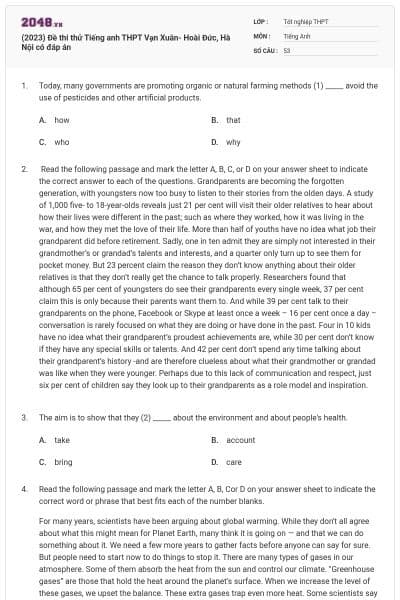
Today, many governments are promoting organic or natural farming methods (1) _____ avoid the use of pesticides and other artificial products.
how
that
who
why
Đại từ quan hệ:
Ta dùng đại từ quan hệ ‘that’ thay cho danh từ chỉ vật ‘methods’ và ở vị trí chủ ngữ trong mệnh đề quan hệ.
Tạm dịch: Today, many governments are promoting organic or natural farming methods that avoid the use of pesticides and other artificial products.
(Ngày nay, nhiều chính phủ đang thúc đẩy các phương pháp canh tác hữu cơ hoặc tự nhiên để tránh sử dụng thuốc trừ sâu và các sản phẩm nhân tạo khác.)
→ Chọn đáp án B
take
account
bring
care
- care about something: quan tâm, để ý đến
Tạm dịch: The aim is to show that they care about the environment and about people's health. But is this the right approach?
(Mục đích là để chứng tỏ rằng họ quan tâm đến môi trường và sức khỏe của mọi người. Nhưng đây có phải là cách tiếp cận đúng hay không?)
→ Chọn đáp án D
site
market
place
basis
A. site (n): trang web
B. market (n): thị trường
C. place (n): địa điểm
D. basis (n): cơ sở
Tạm dịch: Europe is now the biggest market for organic food in the world, expanding by 25 percent a year over the past 10 years.
(Châu Âu hiện là thị trường thực phẩm hữu cơ lớn nhất thế giới, tăng trưởng 25% mỗi năm trong 10 năm qua.)
→ Chọn đáp án B
each
one
other
every
- each + N số ít: mỗi
- one + N số ít: một
- other + N số nhiều/N không đếm được: những người/vật khác
- every + N số ít: mọi
Tạm dịch: Eating organic is one way of defining oneself as natural, good, caring different from the junk-food-scoffing masses.
(Ăn uống hữu cơ là một cách để xác định bản thân là người tự nhiên, tốt bụng, quan tâm khác với số đông ăn thực phẩm rác.)
→ Chọn đáp án B
(5) _____, for its ineffective use of land and labour, there are severe limits to how much food can be produced.
Although
However
Because
Moreover
Kiến thức liên từ:
- although + S + V: mặc dù
- however: tuy nhiên
- because + S + V: bởi vì
- moreover: hơn nữa
Tạm dịch: However, for its ineffective use of land and labour, there are severe limits to how much food can be produced.
(Tuy nhiên, do sử dụng đất đai và lao động không hiệu quả nên có những hạn chế nghiêm trọng về lượng lương thực có thể sản xuất được.)
→ Chọn đáp án B
Mark the letter A, B, C, or D on your answer sheet to indicate the sentence that is closest in meaning to each of the following questions.
I will invite you to my birthday party tomorrow." Lena said
Lena said that she had invited me to her birthday party the following day.
Lena said that she would invite me to her birthday party tomorrow.
Lena said that she would invite me to her birthday party the following day.
Lena said that she invited me to her birthday party the following day.
Tạm dịch: "Tôi sẽ mời bạn đến bữa tiệc sinh nhật của tôi vào ngày mai." Lena nói
A. Sai ngữ pháp (had invited would invite)
B. Sai ngữ pháp (tomorrow the following day)
C. Lena nói rằng cô ấy sẽ mời tôi đến bữa tiệc sinh nhật của cô ấy vào ngày hôm sau.
D. Sai ngữ pháp (invited would invite)
→ Chọn đáp án C
I haven't met my grandparents for five years.
I often met my grandparents five years ago.
I have met my grandparents for five years.
I last met my grandparents five years ago.
I didn't meet my grandparents five years ago.
Tạm dịch: Tôi đã không gặp ông bà của tôi được năm năm rồi.
A. Tôi thường gặp ông bà của tôi năm năm trước.
B. Tôi đã gặp ông bà của tôi trong năm năm.
C. Tôi gặp ông bà lần cuối cách đây 5 năm
D. Tôi đã không gặp ông bà của tôi năm năm trước
Cấu trúc: S + last + V2/V-ed + time + ago = S + have/has not + V3/V-ed + for (time)
→ Chọn đáp án C
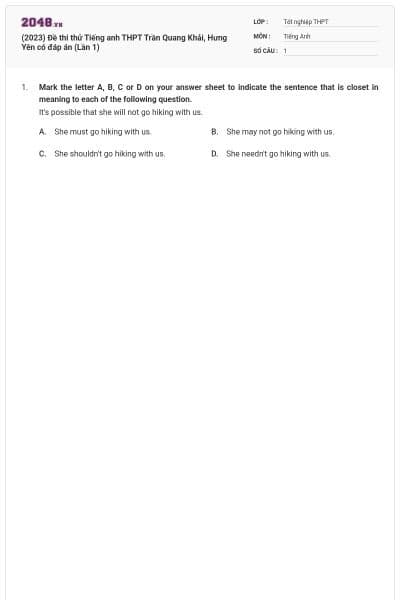
She is not allowed to meet her children until the operation has finished.
She needn't meet her children until the operation has finished.
She may not meet her children until the operation has finished.
She shouldn't meet her children until the operation has finished.
She mustn't meet her children until the operation has finished.
Tạm dịch: Cô ấy không được cho phép gặp con cho đến khi ca phẫu thuật kết thúc.
A. Cô ấy không cần gặp con cho đến khi cuộc phẫu thuật kết thúc.
B. Cô ấy có thể không gặp con của mình cho đến khi cuộc phẫu thuật kết thúc.
C. Cô ấy không nên gặp con cho đến khi ca phẫu thuật kết thúc
D. Cô ấy không được phép gặp con cho đến khi ca phẫu thuật kết thúc.
→ Chọn đáp án D
Which of the following could be the main idea of the passage?
Young people's disinterest in their grandparents' stories
Young people's tendency to neglect their grandparents
Grandparents' loneliness in their old age
Grandparents' attitudes towards youngsters
Đoạn văn chủ yếu nói về vấn đề gì?
A. Giới trẻ không quan tâm đến câu chuyện của ông bà
B. Giới trẻ có xu hướng thờ ơ với ông bà
C. Nỗi cô đơn tuổi già của ông bà
D. Thái độ của ông bà đối với con cháu
Thông tin: Cả đoạn văn nói về việc tỉ lệ người trẻ, thế hệ con cháu dành thời gian để quan tâm, lắng nghe và tìm hiểu về ông bà của mình là không cao. Dường như người trẻ cảm thấy không hứng thú khi nghe những câu chuyện về lịch sử, quá khứ hay thời đại nghèo khổ của ông bà mình.
→ Chọn đáp án A
According to the study in paragraph 2, which information is NOT true?
Most of youths visit their grandparents to ask for pocket money.
Over 50% of the young don't know about their older relatives’ past professions.
Nearby a quarter of young people don't have suitable opportunities to talk to older relatives.
Merely one fifth of people in the survey keep asking about the bygone time of their grandparents.
Theo bản nghiên cứu ở đoạn văn số 2, thông tin nào sau đây là không đúng?
A. Hầu hết thanh niên đến thăm ông bà chỉ để xin tiền.
B. Hơn 50% những người trẻ không biết về nghề nghiệp của ông bà.
C. Gần ¼ thanh niên không có dịp phù hợp để nói chuyện với ông bà mình.
D. Chỉ hơn 1/5 những người tham gia cuộc khảo sát vẫn tiếp tục hỏi về quãng thời gian trong quá khứ của ông bà họ.
Thông tin:
+ More than half of youths have no idea what job their grandparent did before retirement.
(Hơn một nửa số thanh niên không biết ông bà của họ đã làm công việc gì trước khi nghỉ hưu.)
B đúng
+ But 23 percent claim the reason they don’t know anything about their older relatives is that they don’t really get the chance to talk properly.
(Nhưng 23% cho rằng lý do họ không biết gì về người thân lớn tuổi của mình là vì họ không thực sự có cơ hội nói chuyện đàng hoàng.)
C đúng
+ A study of 1,000 five- to 18-year-olds reveals just 21 per cent will visit their older relatives to hear about how their lives were different in the past; such as where they worked, how it was living in the war, and how they met the love of their life.
(Một nghiên cứu trên 1.000 trẻ em từ 5 đến 18 tuổi cho thấy chỉ 21% sẽ đến thăm người thân lớn tuổi hơn để nghe về cuộc sống của họ trong quá khứ khác nhau như thế nào; chẳng hạn như nơi họ làm việc, cuộc sống trong chiến tranh như thế nào và cách họ gặp được tình yêu của đời mình.)
D đúng
+ Sadly, one in ten admit they are simply not interested in their grandmother’s or grandad’s talents and interests, and a quarter only turn up to see them for pocket money.
(Đáng buồn thay, cứ mười người thì có một người thừa nhận rằng họ chỉ đơn giản là không quan tâm đến tài năng và sở thích của ông bà mình, và một phần tư chỉ đến gặp họ vì tiền tiêu vặt.)
A sai
→ Chọn đáp án A
According to the last paragraph, the proportion of the young voluntarily visiting their older family members every week is _______.
65%
28%
39%
27%
Theo đoạn cuối, tỷ lệ thanh niên tự nguyện đến thăm các thành viên lớn tuổi trong gia đình họ hàng tuần là _______.
A. 65%
B. 28%
C. 39%
D. 27%
Thông tin:
+ Researchers found that although 65 per cent of youngsters do see their grandparents every single week, 37 per cent claim this is only because their parents want them to.
(Các nhà nghiên cứu phát hiện ra rằng mặc dù 65% trẻ em gặp ông bà của chúng mỗi tuần, nhưng 37% cho rằng điều này chỉ là do cha mẹ chúng muốn.)
65%-37% = 28%
→ Chọn đáp án B
The word ‘admit’ in paragraph 2 is closest in meaning to ______.
confess
conceal
refuse
dissent
Từ “admit” trong đoạn 2 đồng nghĩa với từ _____.
A. thú nhận
B. che giấu
C. từ chối
D. bất đồng quan điểm
admit (v): thừa nhận, chấp nhận = confess
→ Chọn đáp án A
The word ‘them’ in paragraph 2 refers to ______.
talents
relatives
grandparents
youngsters
Từ “them” trong đoạn 2 đề cập đến _____.
A. tài năng
B. họ hàng
C. ông bà
D. người trẻ
Thông tin: Sadly, one in ten admit they are simply not interested in their grandmother’s or grandad’s talents and interests, and a quarter only turn up to see them for pocket money. (Đáng buồn thay, cứ mười người thì có một người thừa nhận rằng họ chỉ đơn giản là không quan tâm đến tài năng và sở thích của ông bà mình, và một phần tư chỉ đến gặp họ vì tiền tiêu vặt.)
→ Chọn đáp án C
The phrase ‘look up to’ in paragraph 3 is closest in meaning to?
ignore
respect
overlook
dread
Từ “look up to” trong đoạn 3 đồng nghĩa với từ _____.
A. bỏ qua
B. tôn trọng
C. bỏ qua
D. sợ
look up to (phrasal verb): tôn trọng, kính trọng = respect
→ Chọn đáp án B
Which of the following can be inferred from the last paragraph?
Most young people use modern technology to keep in touch with their older generation.
Children's lack of communication with grandparents leads to mutual misunderstanding.
Youngsters nowadays are too indifferent to their grandparents' lives in the past.
Grandchildren never care for their elderly relatives' special skills and talents.
Điều nào sau đây có thể được suy ra từ đoạn văn cuối?
A. Hầu hết những người trẻ tuổi sử dụng công nghệ để giữ liên lạc với ông bà của họ.
B. Trẻ em ít giao tiếp với ông bà dẫn đến hiểu lầm lẫn nhau.
C. Lớp trẻ ngày nay quá thờ ơ với cuộc sống của ông bà ngày xưa.
D. Con cháu không bao giờ quan tâm đến những kỹ năng và tài năng đặc biệt của người thân lớn tuổi của họ.
And while 39 per cent talk to their grandparents on the phone, Facebook or Skype at least once a week – 16 per cent once a day – conversation is rarely focused on what they are doing or have done in the past. Four in 10 kids have no idea what their grandparent’s proudest achievements are, while 30 per cent don’t know if they have any special skills or talents. And 42 per cent don’t spend any time talking about their grandparent’s history -and are therefore clueless about what their grandmother or grandad was like when they were younger. (Và trong khi 39% nói chuyện với ông bà qua điện thoại, Facebook hoặc Skype ít nhất một lần một tuần – 16% một lần một ngày – cuộc trò chuyện hiếm khi tập trung vào những gì họ đang làm hoặc đã làm trong quá khứ. 4 trong số 10 đứa trẻ không biết thành tích đáng tự hào nhất của ông bà chúng là gì, trong khi 30% không biết họ có tài năng hay kỹ năng đặc biệt nào không. Và 42% không dành thời gian để nói về chuyện quá khứ của ông bà của họ - và do đó không biết gì về bà hoặc ông của họ như thế nào khi họ còn trẻ.)
→ Chọn đáp án C
Read the following passage and mark the letter A, B, Cor D on your answer sheet to indicate the correct word or phrase that best fits each of the number blanks.
For many years, scientists have been arguing about global warming. While they don't all agree about what this might mean for Planet Earth, many think it is going on — and that we can do something about it. We need a few more years to gather facts before anyone can say for sure. But people need to start now to do things to stop it. There are many types of gases in our atmosphere. Some of them absorb the heat from the sun and control our climate. "Greenhouse gases” are those that hold the heat around the planet's surface. When we increase the level of these gases, we upset the balance. These extra gases trap even more heat. Some scientists say global warming has already started to change the environment. The Earth's temperature has risen one degree Fahrenheit this century. Many scientists believe it could rise from two to eight degrees Fahrenheit in the next hundred years. This would be the fastest rise in 10,000 years. Sea levels could rise. Ice sheets could melt and add to the water level. Many places near the coast would be in danger of flooding. If the climate change is too large and too fast, some plants and animals could really suffer. They could even die out. Weather could become more violent and extreme. In some places there would be more forest fires. But in other areas there would be more rain and snow, storms and floods. (Adapted from nytimes.com/article/climate-change-global-warming-fag.html)
What is the passage mainly about?
Global warming and its advantages.
Global warming and its negative effects.
Global warming and suggested solutions.
Global warming and forest fires.
Đoạn văn chủ yếu nói về vấn đề gì?
A. Sự nóng lên toàn cầu và những lợi thế của nó.
B. Sự nóng lên toàn cầu và những tác động tiêu cực của nó.
C. Sự nóng lên toàn cầu và các giải pháp đề xuất
D. Trái đất nóng lên và cháy rừng.
Thông tin: Cả đoạn văn nói về những tác động tiêu cực mà nóng lên toàn cầu gây ra.
→ Chọn đáp án B
According to the passage, gases control our climate by ______.
absorbing the heat
increasing its level
changing the environment
upsetting the balance
Theo đoạn văn, khí kiểm soát khí hậu của chúng ta bằng ______.
A. hấp thụ nhiệt
B. tăng mức độ của nó
C. làm thay đổi môi trường
D. làm mất cân bằng
Thông tin:
+ Some of them absorb the heat from the sun and control our climate. (Một trong số đó hấp thụ nhiệt từ mặt trời và kiểm soát khí hậu của chúng ta.)
→ Chọn đáp án A
The word "it" in paragraph 3 refers to ______.
environment
century
temperature
global warming
Từ “it” trong đoạn 3 đề cập đến _____.
A. môi trường
B. thế kỷ
C. nhiệt độ
D. sự nóng lên toàn cầu
Thông tin:
+ The Earth's temperature has risen one degree Fahrenheit this century. Many scientists believe it could rise from two to eight degrees Fahrenheit in the next hundred years. (Nhiệt độ Trái đất đã tăng một độ F trong thế kỷ này. Nhiều nhà khoa học tin rằng nó có thể tăng từ 2 đến 8 độ F trong một trăm năm tới.)
→ Chọn đáp án C
The word "extreme" in paragraph 4 is closest in meaning to _______.
gentle
quiet
peaceful
severe
Từ “extreme” trong đoạn 4 đồng nghĩa với từ _____.
A. nhẹ nhàng
B. yên tĩnh
C. bình yên
D. nghiêm trọng
extreme (adj): khắc nghiệt = severe
→ Chọn đáp án D
Which of the following is TRUE according to the passage?
Scientists have all agreed about global warming.
Scientists say that global warming can never change the environment.
The gases we increase trap even more heat.
Climate change would cause forest fires everywhere.
Điều gì sau đây là ĐÚNG theo đoạn văn?
A. Các nhà khoa học đều đồng ý về sự nóng lên toàn cầu.
B. Các nhà khoa học nói rằng sự nóng lên toàn cầu không bao giờ có thể thay đổi môi trường.
C. Các chất khí càng tăng càng hấp thụ nhiều nhiệt.
D. Biến đổi khí hậu sẽ gây cháy rừng khắp nơi.
Thông tin:
+ For many years, scientists have been arguing about global warming.
(Trong nhiều năm, các nhà khoa học đã tranh luận về sự nóng lên toàn cầu.)
A sai
+ Some scientists say global warming has already started to change the environment.
(Một số nhà khoa học nói rằng sự nóng lên toàn cầu đã bắt đầu thay đổi môi trường.)
B sai
+ In some places there would be more forest fires. (Ở một số nơi sẽ có nhiều vụ cháy rừng hơn.)
D sai
+ When we increase the level of these gases, we upset the balance. These extra gases trap even more heat.
(Khi chúng ta tăng mức độ của những khí này, chúng ta sẽ làm đảo lộn sự cân bằng. Những khí thừa này thậm chí còn giữ nhiệt nhiều hơn.)
C đúng
→ Chọn đáp án C
Mark the letter A, B, C, or D on your answer sheet to indicate the underlined part that needs correction in each of the following questions.
The frustrated customer wanted to exchange the article, obtaining a refund, or speak to the manager.
or
the article
obtaining
frustrated
Cấu trúc song song:
Những từ/cụm từ có cùng chức năng và cùng vị trí trong câu, được nối với nhau bởi các liên từ thì phải cùng dạng/thì.
“…exchange (Vo) the article, obtain (Vo) a refund, or speak (Vo) to the manager.”
Sửa: obtaining → obtain
Tạm dịch: Khách hàng thất vọng muốn đổi bài báo, lấy lại tiền hoặc nói chuyện với người quản lý.
→ Chọn đáp án C
Van Clibur studies piano from 1951 to 1954 and won multiple awards between 1958 and 1960.
from
between
won
studies
Chia thì: “from 1951 to 1954” → dấu hiệu nhận biết của thì quá khứ đơn
Sửa: studies → studied
Tạm dịch: Van Clibur học piano từ năm 1951 đến năm 1954 và giành được nhiều giải thưởng từ năm 1958 đến năm 1960.
→ Chọn đáp án D
The students who always pay attention in the classroom is often more successful.
pay
who
is
the
Đáp án: C
Giải thích:
Kiến thức: Sự hòa hợp giữa chủ ngữ và động từ
Chủ ngữ “The students” là danh từ số nhiều, nên cần chia to be số nhiều là “are”.
Sửa: is → are
Dịch: Những sinh viên luôn chú ý trong lớp học thường thành công hơn.
Mark the letter A, B, C, or D on your answer sheet to indicate the word that differs from the other three in the position of primary stress in each of the following questions.
decisive
commercial
electric
powerful
A. decisive /dɪˈsaɪsɪv/ (adj): quyết đoán
B. commercial /kəˈmɜːʃl/ (adj): thương mại
C. electric /ɪˈlektrɪk/ (adj): điện
D. powerful /ˈpaʊəfl/ (adj): mạnh mẽ
Đáp án D có trọng âm rơi vào âm tiết thứ nhất, các đáp án còn lại trọng âm rơi vào âm tiết thứ hai.
→ Chọn đáp án D
Mark the letter A, B, C, or D on your answer sheet to indicate the word that differs from the other three in the position of primary stress in each of the following questions.
believe
happen
maintain
attract
A. believe /bɪˈliːv/ (v): tin
B. happen /ˈhæpən/ (v): xảy ra
C. maintain /meɪnˈteɪn/ (v): duy trì
D. attract /əˈtrækt/ (v): thu hút
Đáp án B có trọng âm rơi vào âm tiết thứ nhất, các đáp án còn lại trọng âm rơi vào âm tiết thứ hai.
→ Chọn đáp án B
Mark the letter A,B,C or D or D on your answer sheer to indicate the correct answer to each of the following questions.
He was late so I decided to_________time by window shopping.
waste
spend
miss
kill
Kiến thức thành ngữ:
- kill time: giết thời gian
Tạm dịch: Anh ấy đến muộn nên tôi quyết định giết thời gian bằng cách dạo xung quanh mấy cửa hàng.
→ Chọn đáp án D
Nam wanted to know what time ________.
did the movie begin
does the movie begin
the movie begins
the movie began
Câu gián tiếp:
Với động từ wanted chia ở quá khứ thì vế sau phải lùi thì.
Cấu trúc câu gián tiếp: S + asked/wanted to know + wh-question + S + V (lùi thì).
Tạm dịch: Nam muốn biết mấy giờ bộ phim bắt đầu.
→ Chọn đáp án D
Participating in teamwork activities helps students develop their _____ skills.
socialise
society
social
socially
Kiến thức từ vựng:
- socialise (v): xã hội hóa
- society (n): xã hội
- social (adj): thuộc về xã hội
- socially (adv): về mặt xã hội, mang tính cộng đồng
Ta cần tính từ trước danh từ ‘skills’.
Tạm dịch: Tham gia các hoạt động làm việc nhóm giúp học sinh phát triển các kỹ năng xã hội.
→ Chọn đáp án C
I saw him hiding something in a _____ bag.
small black plastic
plastic small black
black small plastic
small plastic black
Trật tự tính từ:
Opinion – Size – Age – Shape – Color – Origin – Material – Purpose
Size – small
Color – black
Material – plastic
Tạm dịch: Tôi thấy anh ấy giấu thứ gì đó trong một chiếc túi nhựa nhỏ màu đen.
→ Chọn đáp án A
Let's wait here for her, I'm sure she'll _____.
turn off
tum over
tum down
turn up
Kiến thức cụm động từ:
- turn off: tắt đi
- turn over: lật mình
- turn down: từ chối
- turn up: xuất hiện, đến
Tạm dịch: Hãy đợi cô ấy ở đây, tôi chắc chắn cô ấy sẽ xuất hiện.
→ Chọn đáp án D
By the time you _____ this letter, I will have left for the USA.
will receive
received
are receiving
receive
Sự phối thì:
By the time + HTD, TLHT.
Tạm dịch: Trước thời điểm bạn nhận được bức thư này, tôi sẽ đi Hoa Kỳ rồi.
→ Chọn đáp án D
I will wait for you _____ the airport tomorrow.
on
in
at
from
Kiến thức giới từ:
- at the airport: ở sân bay
Tạm dịch: Tôi sẽ đợi bạn ở sân bay vào ngày mai.
→ Chọn đáp án C
_____ there all my life, I knew how to move around the city.
Having lived
Being lived
To have lived
Lived
Kiến thức về sự kết hợp của thì:
- Khi hai mệnh đề cùng chủ ngữ, mệnh đề trạng ngữ ở thể chủ động, ta rút gọn bằng cách bỏ chủ ngữ, chuyển V thành V-ing/Having PII.
Tạm dịch: Sau khi sống ở đó rất lâu, tôi đã biết cách di chuyển quanh thành phố.
→ Chọn đáp án A
_____ not having written about the required topic, I was given a low mark.
as
because
although
because of
Kiến thức liên từ:
- as + S + V: bởi vì, khi
- because + S + V: bởi vì
- although + S + V: mặc dù
- because of + N.P/Ving: bởi vì
Tạm dịch: Vì viết không đúng chủ đề yêu cầu nên tôi bị điểm thấp.
→ Chọn đáp án D
It's was very kind of Peter to _____ me a favor. Had it not been for his help, I would not have finished my cleaning.
make
take
work
do
Kiến thức thành ngữ:
- do sb a favor: giúp ai
Tạm dịch: Peter thật tốt bụng khi giúp đỡ tôi. Nếu không có sự giúp đỡ của anh ấy, tôi sẽ không hoàn thành việc dọn dẹp của mình.
→ Chọn đáp án D
Mary _____ to catch the bus when she slipped and fell down.
has been running
was running
has run
run
Sự kết hợp thì:
QKTD when QKD: diễn tả hành động đang xảy ra thì có hành động khác xen vào.
Tạm dịch: Mary đang chạy để bắt xe buýt thì cô ấy bị trượt chân và ngã xuống.
→ Chọn đáp án B
My uncle’s company made a very good profit in______1990s.
the
an
a
Ø
Kiến thức từ vựng:
- in the 1990s: trong những năm 1990
Tạm dịch: Công ty của chú tôi đã kiếm được rất nhiều lợi nhuận vào những năm 1990.
→ Chọn đáp án A
How many houses _____ by the storm last night?
are destroyed
have been destroyed
were destroyed
are being destroyed
Câu bị động:
“last night” → dấu hiệu nhận biết của thì quá khứ đơn
Câu mang nghĩa bị động, nên ta dùng bị động của QKD là was/were + PII.
Tạm dịch: Có bao nhiêu ngôi nhà đã bị phá hủy bởi cơn bão đêm qua?
→ Chọn đáp án C
- I think the main problem in this area is the lack of a good bus service.
- You're right. You've hit the _____ on the head.
nail
wall
lips
hand
Kiến thức thành ngữ:
- hit the nail on the head: nói một điều gì cực kỳ chính xác
Tạm dịch:
- Tôi nghĩ vấn đề chính trong lĩnh vực này là thiếu một dịch vụ xe buýt tốt.
- Bạn đúng. Bạn nói rất chính xác.
→ Chọn đáp án A
Many people and organizations have been making every possible effort in order to save _____ species.
fearful
threatening
endangered
dangerous
Kiến thức từ vựng:
- fearful (adj): đáng sợ
- threatening (adj): mang tính đe dọa
- endangered (adj): gặp nguy hiểm
- dangerous (adj): nguy hiểm
Tạm dịch: Nhiều người và tổ chức đã và đang thực hiện mọi nỗ lực có thể để cứu các loài có nguy cơ tuyệt chủng.
→ Chọn đáp án C
Mark the letter A, B, C or D on your answer sheet to indicate the word whose underlined part differs from the other three in pronunciation in each of the following questions.
duck
luck
pub
nurse
A. duck /dʌk/ (n): con vịt
B. luck /lʌk/ (n): may mắn
C. pub /pʌb/ (n): quán rượu
D. nurse /nɜːs/ (n): y tá
Đáp án D có âm “u” phát âm là /ɜː/, các đáp án còn lại phát âm là /ʌ/.
→ Chọn đáp án D
Mark the letter A, B, C or D on your answer sheet to indicate the word whose underlined part differs from the other three in pronunciation in each of the following questions.
subscribed
inspired
welcomed
invented
A. subscribed /səbˈskraɪbd/ (v): đăng ký
B. inspired /ɪnˈspaɪə(r)d/ (v): truyền cảm hứng
C. welcomed /ˈwelkəmd/ (v): hoan nghênh, chào đón
D. invented /ɪnˈventɪd/ (v): phát minh
Đáp án D có âm “ed” phát âm là /ɪd/, các đáp án còn lại phát âm là /d/.
→ Chọn đáp án D
Mark the letter A, B, C, or D on your answer sheet to indicate the sentence that best completes each of the following exchanges.
Lisa is having a discussion with Peter about their plan.
- Lisa: “Let's go to the theatre.”
- Peter: “_______. The number of people infected with the coronavirus (COVID-19) is increasing day by day.
Just bring yourself
Oh, I don't think it's a good idea
Yes, let's do that
No problem
A. Bạn không cần mang theo gì đâu
B. Ồ, tôi không nghĩ đó là một ý kiến hay
C. Vâng, chúng ta hãy làm điều đó
D. Không vấn đề gì
Tạm dịch: Lisa đang thảo luận với Peter về kế hoạch của họ.
- Lisa: “Đi tới rạp hát đi.”
- Peter: “Ồ, tôi không nghĩ đó là một ý kiến hay. Số người bị nhiễm vi-rút corona (COVID-19) đang tăng lên từng ngày.”
→ Chọn đáp án B
Tung: "Your shoes are terrific, Tuan. The colour quite suits you."
Tuan: “_____.”
Really?
I'm glad you like them
You must be kidding. My shirt is nice, isn't it?
Do you like them?
A. Thật sao?
B. Tôi rất vui vì bạn thích chúng
C. Chắc bạn đang đùa. Áo của tôi nhỉ?
D. Bạn có thích chúng không?
Tạm dịch:
Tùng: "Giày của anh đẹp lắm Tuấn. Màu rất hợp với anh."
Tuấn: “Mình rất vui khi cậu thích chúng.”
→ Chọn đáp án B
Mark the letter A, B, C, or D on your answer sheet to indicate the word(s) CLOSEST in meaning to the underlined word(s) in each of the following questions.
School uniform is mandatory in most of Vietnamese schools. Students in the same school have to wear the same set of clothes at school.
compulsory
depended
paid
divided
A. compulsory (adj): bắt buộc
B. depend on (v): phụ thuộc vào
C. paid (PII): đã thanh toán
D. divided (PII): được chia ra
mandatory (adj): bắt buộc = compulsory
Tạm dịch: Đồng phục học sinh là bắt buộc ở hầu hết các trường học Việt Nam. Học sinh cùng trường phải mặc đồng phục khi đến trường.
→ Chọn đáp án A
John has sent five letters to his friend but he has not received any reply.
postscript
answer
information
letter
A. postscript (n): tái bút
B. answer (n): câu trả lời
C. information (n): thông tin
D. letter (n): bức thư
reply (n): trả lời, hồi âm = answer
Tạm dịch: John đã gửi năm lá thư cho bạn mình nhưng anh ta không nhận được hồi âm nào.
→ Chọn đáp án B
Mark the letter A, B, C or D on your answer sheet to indicate the word(s) OPPOSITE in meaning to the underlined wordi(s) in each of the following questions.
It is widely known that the excessive use of pesticides is producing a detrimental effect on the local groundwater.
harmless
fundamental
useless
damaging
Đáp án: A
Giải thích:
Kiến thức: Từ trái nghĩa
detrimental (adj): bất lợi, có hại
Xét các đáp án:
A. harmless (adj): vô hại
B. fundamental (adj): cơ bản
C. useless (adj): vô dụng
D. damaging (adj): gây hại
→ detrimental >< harmless
Dịch: Ai cũng biết rằng việc sử dụng quá nhiều thuốc trừ sâu đang tạo ra tác động bất lợi đối với nguồn nước ngầm địa phương.
Sorry, I can't come to your party. I am snowed under with work at the moment.
free from
interested in
relaxed about
busy with
A. free from: rảnh rỗi
B. interested in: quan tâm đến, thích
C. thoải mái với
D. busy with: bận rộn với
be snowed under with: có quá nhiều thứ để làm, bận rộn với >< free from
Tạm dịch: Xin lỗi, tôi không thể đến bữa tiệc của bạn. Tôi đang ngập đầu trong công việc vào lúc này.
→ Chọn đáp án A
Mark the letter A,B,C or D on your answer sheet to indicate the sentence that best combines each pair of sentences in the following questions.
He didn't write his letter of application earlier. He regretted that.
He regretted writing his letter of application earlier
He wishes he had written his letter of application earlier
He wishes he hadn't written letter of application earlier
He regretted to write his letter of application earlier
Tạm dịch: Anh ấy đã không viết đơn xin việc sớm hơn. Anh hối hận vì điều đó.
A. Anh ấy hối hận vì đã viết đơn xin việc sớm hơn.
B. Anh ấy ước gì mình đã viết đơn xin việc sớm hơn.
C. Anh ấy ước mình đã không viết đơn xin việc sớm hơn.
D. Anh ấy hối hận khi đã phải viết đơn xin việc sớm hơn.
→ Chọn đáp án B
We had reached the top. Then we realized how far we had come.
Not until we had reached the top did we realize how far we had come.
Having realized how far we had come, we reached the top.
Only after we realized how far we had come had we reached the top.
We had reached the top until we realized how far we had come.
Tạm dịch: Chúng tôi đã lên đến đỉnh. Sau đó, chúng tôi nhận ra chúng tôi đã đi được bao xa.
A. Mãi cho đến khi lên đến đỉnh, chúng tôi mới nhận ra mình đã đi được bao xa.
B. Sau khi nhận ra mình đã đi được bao xa, chúng tôi đã lên đến đỉnh.
C. Sai ngữ pháp: Only after QKHT + đảo ngữ thì QKD.
D. Chúng tôi lên đến đỉnh mãi tới khi chúng tôi nhận ra mình đã đi được bao xa.
→ Chọn đáp án A