(2023) Đề thi thử Tiếng anh THPT theo đề minh họa Bộ giáo dục có đáp án (Đề 68)
50 câu hỏi
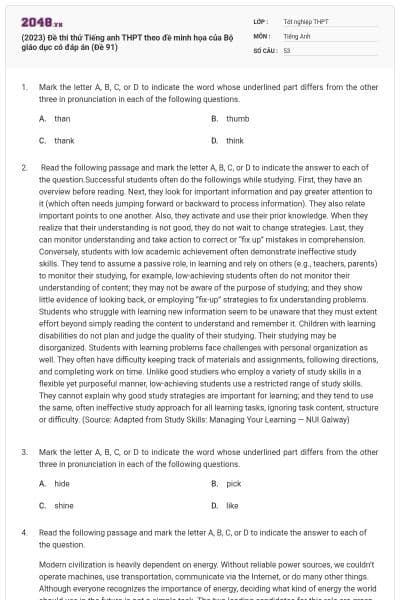
Mark the letter A, B, C, or D on your answer sheet to indicate the word whose underlined part differs from the other three in pronunciation in each of the following questions.
than
thumb
thank
think
Đáp án A
A. than /ðæn/
B. thumb /θʌm/
C. thank /θæŋk/
D. think /θɪŋk/
Mark the letter A, B, C, or D on your answer sheet to indicate the word whose underlined part differs from the other three in pronunciation in each of the following questions.
habitat
campfire
survive
wildlife
Đáp án A
A. habitat /ˈhæbɪtæt/
B. campfire /ˈkæmpfaɪə(r)/
C. survive /səˈvaɪv/
D. wildlife /ˈwaɪldlaɪf/
Mark the letter A, B, C, or D on your answer sheet to indicate the word that differs from the other three in the position of primary stress in each of the following questions.
hacker
evolve
software
marvel
Đáp án B
A. hacker /ˈhækə/
B. evolve /ɪˈvɒlv/
C. software /ˈsɒftweə/
D. marvel /ˈmɑːvəl/
Mark the letter A, B, C, or D on your answer sheet to indicate the word that differs from the other three in the position of primary stress in each of the following questions.
economics
philosophy
experiment
biology
Đáp án A
A. economics /ˌiːkəˈnɒmɪks/
B. philosophy /fɪˈlɒsəfi/
C. experiment /ɪksˈpɛrɪmənt/
D. biology / baɪˈɒləʤi/
Mark the letter A, B, C, or D on your answer sheet to indicate the correct answer to each of the following questions.
The movie __________ by the producer will be released next month.
produces
producing
produced
is producing
Đáp án C
Rút gọn mệnh đề quan hệ V3/ed vì mang nghĩa bị động
Tạm dịch: Phim do nhà sản xuất sản xuất sẽ ra mắt vào tháng sau.
Learning a new language is _______ than learning a new skill on the computer.
difficult
most difficult
the most difficult
more difficult
Đáp án D
“than” dấu hiệu của so sánh hơn.
So sánh hơn tính từ dài: MORE + ADJ
Tạm dịch: Học một ngôn ngữ mới khó hơn học một kỹ năng mới trên máy tính.
_______, we will leave for the conference at the City Hall.
As soon as it stops raining
Once it stopped raining
When it had stopped raining
While it was stopping raining
Đáp án A
Câu hỏi trên để chia thì tương lai đơn nên loại các đáp án chia thì quá khứ.
AS SOON AS + S + Vs/es, S + will + Vo
Tạm dịch: Ngay sau khi trời ngừng mưa, chúng tôi sẽ rời khỏi hội nghị tại Tòa thị chính.
He was amazed ______ the beauty of the sunset.
in
by
with
of
Đáp án B
amazed by: ngạc nhiên về/ bởi
Tạm dịch: Anh ấy ngạc nhiên bởi vẻ đẹp của hoàng hôn.
Michael returned to his hometown last summer, _______?
won't he
doesn't he
didn't he
hasn't he
Đáp án C
Vế trước câu hỏi đuôi dạng khẳng định => câu hỏi đuôi dạng phủ định.
Vế trước dùng thì QKĐ với động từ thường returned => câu hỏi đuôi dùng trợ động từ didn't
Tạm dịch: Michael đã trở về quê nhà vào mùa hè năm ngoái phải không?
I bought ___ new shirt yesterday. It was very nice.
Ø (no article)
an
the
a
Đáp án D
Danh từ “shirt” là danh từ đếm được, được nhắc lần đầu chưa xác định nên dùng mạo từ “a”
Tạm dịch: Tôi mua cái áo sơ mi mới hôm qua, nó đẹp lắm.
You’ll get a better _______ of exchange at another bank.
worth
value
rate
charge
Đáp án C
rate of exchange: tỷ giá hối đoái
A. worth (n): giá trị, tính hữu ích
B. value (n): giá trị
D. charge (n): tiền phải trả
Tạm dịch: Bạn sẽ nhận được một tỷ giá hối đoái cao hơn ở một ngân hàng khác.
I could not _______ the lecture at all. It was too difficult for me.
hold on
take in
make off
get along
Đáp án B
A. hold on: giữ máy điện thoại
B. take in = understand: hiểu
C. make off: tẩu thoát
D. get along: rời đi
Tạm dịch: Tôi không hiểu chút gì về bài giảng cả. Nó quá khó đối với tôi.
Sarah said she would like _________ Paris someday to see the Eiffel Tower.
visit
to visit
visiting
visited
Đáp án B
would like + to Vo = muốn
Tạm dịch: Sarah nói cô ấy muốn tham quan Paris một ngày nào đó để ngắm tháp Eiffel.
I always get _____ in my stomach before visiting the dentist. This is really hard for me.
worms
mosquitoes
crabs
butterflies
Đáp án D
get butterflies in one’s stomach: cảm thấy bồn chồn
Tạm dịch: Tôi luôn cảm thấy hơi lo trước mỗi lần đi nha sĩ. Điều này thực sự khó khăn với tôi.
He_________ into the house to steal things, he was bitten by a dog.
broke
breaking
was breaking
has broken
Đáp án C
While + thì tiếp diễn
Hai hành động xảy ra trong quá khứ
+ Đang diễn ra: S + was/were + Ving
+ Làm gián đoạn, chen ngang: S + Ved/2
Tạm dịch: Trong lúc anh ta đang đột nhập vào nhà để ăn cắp đồ, anh ta đã bị chó cắn.
It is important to ________ in mind that these financial consequences have remained largely hidden
know
give
hold
bear
Đáp án D
bear in mind something: suy nghĩ, xem xét, trăn trở về điều gì.
Tạm dịch: Điều quan trọng cần xem xét là những hậu quả tài chính này phần lớn vẫn được che giấu.
My close friend ________ a new tablet on her birthday last week
was given
was giving
gives
has given
Đáp án A
Cấu trúc bị động của thì quá khứ: S + was/ were + Ved/3
Tạm dịch: Bạn thân của tôi đã được tặng một chiếc máy tính bảng mới vào ngày sinh nhật của cô ấy vào tuần trước.
Her ________ has declined since her return from exile two years ago.
popularity
popularly
popularize
popular
Đáp án A
Tính từ sở hữu + danh từ, -ty là hậu tố danh từ.
Tạm dịch: Sự nổi tiếng của cô đã giảm sút kể từ khi cô trở về sau cuộc sống lưu vong cách đây hai năm.
There is a ________ mood everywhere in in the world on New Year's Day.
optimistic
constant
popular
festive
Đáp án D
festive mood: không khí lễ hội
Tạm dịch: Có một không khi lễ hội đang tràn về khắp nơi vào những ngày năm mới.
Mark the letter A, B, C, or D on your answer sheet to indicate the sentence that best completes each of the following exchanges.
Minh is talking to Thomas after his test.
- Minh: “My first English test was not as good as I expected.”
- Thomas: “__________ ”
Good Heavens!
Never mind, better job next time!
That's brilliant enough!
It's okay. Don't worry.
Đáp án B
Tình huống giao tiếp: Minh đang nói chuyện với Thomas sau bài kiểm tra.
- Minh: “Bài kiểm tra tiếng Anh đầu tiên không tốt như tớ mong đợi.”
- Thomas: “____________.”
A. Ôi trời!
B. Không sao đâu, cố gắng lần sau nhé.
C. Giỏi quá!
D. Ôn rồi. Đừng lo lắng!
Ann and John is talking about social network.
- Ann: “Today social network plays an important role in communication.”
- John: “________”
It's rubbish
I'm afraid I don't know
I don't agree with you
I agree with you
Đáp án D
Tình huống giao tiếp: Ann và John đang nói về mạng xã hội.
- Ann: “Ngày nay mạng xã hội đóng một vai trò quan trọng trong giao tiếp”.
- John: “__________.”
A. Đó là rác rưởi
B. Tôi sợ tôi không biết
C. Tôi không đồng ý với bạn
D. Tôi đồng ý với bạn
Mark the letter A, B, C, or D on your answer sheet to indicate the word(s) OPPOSITE in meaning to the underlined word(s) in each of the following questions.
There is growing concern about the way man has destroyed the environment.
consideration
worry
ease
speculation
Đáp án C
A. sự cân nhắc
B. sự lo lắng
C. sự giảm bớt
D. sự suy đoán
=> concern (n) sự quan tâm >< ease
Tạm dịch: Mối quan tâm ngày càng tăng về cách con người đã phá hủy môi trường.
My brother has become a bit of couch potato since he stopped playing football.
a nice person
a kind person
a live wire
a lazy person
Đáp án C
couch potato: kẻ lười biếng
A. người tốt đẹp
B. người tốt
C. người năng động
D. kẻ lười biếng
=> couch potato >< a live wire
Tạm dịch: Anh trai của tôi trở nên lười biếng kể từ anh ấy ngừng chơi bóng đá.
Mark the letter A, B, C, or D on your answer sheet to indicate the word CLOSEST in meaning to the underlined word in each of the following questions.
Children brought up in a caring environment tend to grow more sympathetic towards others.
dishonest
healthy
loving
hateful
Đáp án C
A. dishonest (adj): không trung thực
B. healthy (adj): khỏe mạnh
C. loving (adj): âu yếm
D. hateful (adj): căm hon
=> caring (adj) chăm sóc, quan tâm = loving
Tạm dịch: Trẻ em được nuôi dưỡng trong môi trường được yêu thương có xu hướng trở nên thông cảm hơn với người khác.
According to the officials of the MOET, reopening schools is inevitable since the vaccine rate is high now.
unlikely
doubtful
unavoidable
dispensable
Đáp án C
inevitable (adj): không thể tránh được, chắc chắn xảy ra
A. unlikely (adj): không có khả năng
B. doubtful (adj): nghi ngờ, ngờ vực
C. unavoidable (adj): không thể tránh được; tất yếu
D. dispensable (adj): có thể bỏ đi, không tất yếu
=> inevitable = unavoidable
Tạm dịch: Theo các quan chức của Bộ GD&ĐT, việc mở lại trường học là không thể tránh khỏi vì tỷ lệ vắc-xin hiện nay rất cao.
Mark the letter A, B, C, or D on your answer sheet to indicate the sentence that is closest in meaning to each of the following questions.
She started driving to work one month ago.
She has driven to work since one month.
It is one month when she started driving to work.
She has driven to work for one month.
It was one month after she started driving to work.
Đáp án C
S + began/ started Ving + thời gian + ago
=> S + have/ has + Ved/3 + for + khoảng thời gian
It’s important that you pay attention to the lecture.
You must pay attention to the lecture.
You shouldn’t pay attention to the lecture.
You can pay attention to the lecture.
You needn’t pay attention to the lecture.
Đáp án A
Câu đề bài: Điều quan trọng là bạn phải chú ý đến bài giảng.
= A. Bạn phải chú ý đến bài giảng.
B. Bạn không nên chú ý đến bài giảng.
C. Bạn có thể chú ý đến bài giảng.
D. Bạn không cần phải chú ý đến bài giảng.
“I had lunch with my friends last month,” Jean said.
Jean said that she had had lunch with her friends the previous month.
Jean said that I had had lunch with my friends the previous month.
Jean said that I had lunch with her friends last month.
Jean said that she would have lunch with her friends last month.
Đáp án A
Khi chuyển đổi từ câu trực tiếp sang câu gián tiếp:
- Đổi chủ ngữ: I => she
- Lùi thì: had => had had
- Đổi trạng ngữ chỉ thời gian: last month => the previous month
Mark the letter A, B, C, or D on your answer sheet to indicate the underlined part that needs correction in each of the following questions.
The main cause of the strike was the management’s refusal to give further consideration to the question of pay differences.
was
refusal
to
differences
Đáp án D
difference (n): sự khác nhau
differential (n): sự chênh lệch
Sửa lỗi: differences => differentials
Tạm dịch: Nguyên nhân chính của cuộc đình công đó chính là sự từ chối của ban giám đốc về việc xem xét kĩ hơn câu hỏi về sự chênh lệch tiền công.
from
other
their
own
Đáp án C
Chủ ngữ ở đây là a turtle (số ít) nên ta phải dùng its.
Sửa lỗi: their => its
Tạm dịch: Một con rùa khác với các loài bò sát khác ở chỗ thân của nó được bọc trong một vỏ bảo vệ của riêng mình.
Last Sunday is so beautiful a day that we took a drive in the country.
Last
is
a day
took a drive
Đáp án B
Last Sunday dấu hiệu thì quá khứ đơn
Sửa lỗi: is => was
Tạm dịch: Chủ nhật tuần trước là một ngày đẹp trời đến nỗi chúng tôi đã lái xe về vùng quê.
Mark the letter A, B, C, or D on your answer sheet to indicate the sentence that best combines each pair of sentences in the following questions.
She tested positive for Covid-19. She isolated herself to protect other people in her community.
Had she tested positive for Covid-19, she would have isolated herself to protect other people in her community,
Not only did she test positive for Covid-19 but she also isolated herself to protect other people in her community.
Only when had she tested positive for Covid-19, she isolated herself to protect other people in her community.
No sooner had she tested positive for Covid-19 than she isolated herself to protect other people in her community.
Đáp án D
Câu đề bài: Cô ấy cỏ kết quả dương tính với Covid-19. Cô tự cô lập mình để bảo vệ những người khác trong cộng đồng của mình.
A. Nếu cô ấy có kết quả xét nghiệm dương tính với Covid-19, cô ấy sẽ tự cô lập mình để bảo vệ những người khác trong cộng đồng của mình, => Không phù hợp nghĩa
B. Cô ấy không chỉ có kết quả dương tính với Covid-19 mà còn tự cô lập mình để bảo vệ những người khác trong cộng đồng của mình. => Không phù hợp nghĩa
C. Chỉ khi có kết quả xét nghiệm dương tính với Covid-19, cô ấy đã tự cô lập mình để bảo vệ những người khác trong tình trạng bình thường của mình => Sai cấu trúc: Only when + clause +TĐT+S+V
D. Ngay sau khi Cô ấy đã có kết quả xét nghiệm dương tỉnh với Covid-19 thì cô ấy tự cô lập mình để bảo vệ những người khác trong cộng đồng của mình.
My father wants to help me with the assignments. He doesn't have time.
If my father had had time, he could help me with the assignments.
Provided my father has time, he cannot help me with the assignments.
My father wishes he had time so that he could help me with the assignments.
If only my father had time, he couldn't help me with the assignments.
Đáp án C
Câu đề bài: Cha tôi muốn giúp tôi làm các bài tập. Ông ấy không có thời gian.
A. Nếu bố tôi có thời gian, ông ấy có thể giúp tôi làm bài tập. => Sai cấu trúc câu điều kiện, dùng câu điều kiện loại 2 diễn tả điều không có thật ở quá khứ.
B. Miễn là bố tôi có thời gian, ông ấy không thể giúp tôi làm bài tập. => Sai cấu trúc câu điều kiện, dùng câu điều kiện loại 2 diễn tả điều không có thật ở quá khứ.
C. Bố tôi mong ông có thời gian để có thể giúp tôi làm bài tập.
D. Giá như bố tôi có thời gian, ông ấy không thể giúp tôi làm bài tập. => Không phù hợp nghĩa
The outbreak of COVID-19 is an unprecedented public health crisis, touching nearly all countries and (34) ________ across the world.
basics
communities
backgrounds
contexts
Đáp án B
A. những điều cơ bản
B. cộng đồng
C. nền
D. ngữ cảnh
Thông tin: The outbreak of COVID-19 is an unprecedented public health crisis, touching nearly all countries and communities across the world.
Tạm dịch: Sự bùng phát của COVID-19 là một cuộc khủng hoảng sức khỏe cộng đồng lớn chưa từng có, lây lan đến hầu hết tất cả các quốc gia và cộng đồng trên toàn thế giới.
why
who
when
which
Đáp án D
Trong mệnh đề quan hệ:
- that: thay thế cho danh từ chỉ người và vật, không đứng sau dấu phẩy
- who: thay thế cho danh từ chỉ người
- when: khi nào
- which: thay thế cho danh từ chỉ người, hoặc cả mệnh đề đứng trước nó.
Cần điền đại từ quan hệ thay cho cụm danh từ chỉ vật “important school feeding programmes”, có thể đứng sau dấu phẩy => chỉ có thể là “which”.
Thông tin: Over 365 million children are missing out on important school feeding programmes, which keep them healthy and motivated to learn.
Tạm dịch: Hơn 365 triệu trẻ em đang bỏ lỡ các chương trình nuôi dưỡng quan trọng ở trường, những chương trình giúp chúng luôn khỏe mạnh và có động lực học tập.
Moreover, families may be pushed to (36) ________ to negative coping mechanisms to meet their needs, including child labour or reducing the number and quality of meals at a time when staying healthy and keeping a strong immune system is particularly important.
mitigate
resort
offer
worry
Đáp án B
A. giảm nhẹ
B. nhờ đến, dùng đến
C. đề nghị
D. lo lắng
Thông tin: Moreover, families may be pushed to resort to negative coping mechanisms to meet their needs, including child labour or reducing the number and quality of meals at a time when staying healthy and keeping a strong immune system is particularly important.
Tạm dịch: Hơn nữa, các gia đình có thể bị thúc ép sử dụng các cơ chế đối phó tiêu cực để đáp ứng nhu cầu của họ, bao gồm lao động trẻ em hoặc giảm số lượng và chất lượng bữa ăn vào thời điểm khỏe mạnh và duy trì hệ thống miễn dịch tốt là đặc biệt quan trọng.
Every
Others
Much
Many
Đáp án D
A. every + N(số ít đếm được): mọi
B. others: những cái khác
C. much + N(không đếm được): nhiều
D. many + N(đếm được): nhiều
Dấu hiệu: “means” (các phương tiện) là danh từ số nhiều => dùng “other” ở trước.
Thông tin: Many children are suffering from anxiety, living without access to the internet or other means required to benefit from distance learning.
Tạm dịch: Nhiều trẻ em đang phải chịu đựng sự lo lắng như việc không có internet hoặc các phương tiện khác để tiếp cận với lợi ích của việc học từ xa.
Some older children are stressed about missing months of education (38) ________ they have to care for younger children in the home while parents and caregivers are working.
although
however
because
therefore
Đáp án C
A. although S + V: mặc dù
B. however: tuy nhiên
C. because: bởi vì
D. therefore: do dó
Thông tin: Some older children are stressed about missing months of education because they have to care for younger children in the home while parents and caregivers are working.
Tạm dịch: Một số trẻ lớn hơn bị căng thẳng về việc bỏ lỡ các tháng học vì chúng phải ở nhà trông em trong khi bố mẹ và người chăm sóc của chúng đang làm việc.
Which best serves as the title for the passage?
A story about Australia
Australian culture shock
Things to do in Australia
Australian culture
Đáp án D
Câu nào làm tiêu đề hay nhất cho đoạn văn?
A. Câu chuyện về nước Úc
B. Cú sốc văn hóa Úc
C. Những điều cần làm ở Úc
D. Văn hóa Úc
Bài đọc nói về nhiều khía cạnh liên quan đến văn hóa - chủ yếu xoay quanh con người - ở Úc.
The word “them” in paragraph 1 refers to _______.
circumstances
Australians
options
students
Đáp án D
Từ “them” trong đoạn 1 đề cập đến __________. .
A. circumstances: hoàn cảnh
B. Australians: người Úc
C. options: lựa chọn
D. students: học sinh
Thông tin: This means that a teacher or course tutor will not tell students what to do, but will give them a number of options and suggest they work out which one is the best in their circumstances.
Tạm dịch: Điều này có nghĩa là một giáo viên hoặc trợ giảng khóa học sẽ không nói cho học sinh biết phải làm gì, nhưng sẽ đưa ra cho họ một số lựa chọn và gợi ý họ tìm ra cách nào là tốt nhất trong hoàn cảnh của họ.
In paragraph 3, most adult Australians call each other by their first names because ____.
Australians are difficult to remember people's surnames
Australians restrict class discrimination
Australians get on well with each other
Calling each other by their first names makes them friendlier
Đáp án B
Trong đoạn 3, hầu hết người Úc trưởng thành gọi nhau bằng tên của họ bởi vì __________.
A. Người Úc rất khó nhớ họ của mọi người.
B. Người Úc hạn chế sự phân biệt giai cấp.
C. Người Úc hỏa thuận với nhau.
D. Gọi nhau bằng tên khiến họ thân thiện hơn.
Thông tin: Australians are uncomfortable with differences in status and hence idealise the idea of treating everyone equally. An illustration of this is that most adult Australians call each other by their first names.
Tạm dịch: Người Úc không thoải mái với sự khác biệt về địa vị và do đó lý tưởng hóa ý tưởng đối xử bình đẳng với tất cả mọi người. Một minh họa cho điều này là hầu hết người Úc trưởng thành gọi nhau bằng tên của họ.
The word “critical” in paragraph 4 is closest in meaning to _______.
faultfinding
grateful
complimentary
appreciative
Đáp án A
Từ “critical” trong đoạn 4 gần nghĩa nhất với __________. .
A. faultfinding (adj): bình phẩm, chỉ trích
B. grateful (adj): biết ơn
C. complimentary (adj): khen ngợi
D. appreciative (adj): biết ơn
=> critical (adj): chỉ trích = faultfinding
Thông tin: As a consequence, some students may be critical of others who they perceive as doing nothing but study.
Tạm dịch: Kết quả là, một số học sinh có thể chỉ trích những người mà họ thấy là không làm gì khác ngoài việc học.
Which of the following is NOT true, according to the passage?
Asking someone what they earn is considered fairly polite.
Australians are prepared to accept a range of opinions.
Students in Australia will be expected to form their own opinions.
A teacher or course tutor will not tell students what to do.
Đáp án A
Điều nào sau đây KHÔNG đúng, theo bài đọc?
A. Hỏi ai đó những gì họ kiếm được được coi là khá lịch sự.
B. Người Úc luôn sẵn sàng chấp nhận nhiều ý kiến khác nhau.
C. Học sinh ở Úc sẽ được mong chờ đưa ra ý kiến của riêng mình.
D. Một giáo viên hoặc người dạy kèm khóa học sẽ không nói cho học sinh biết phải làm gì.
Thông tin: While people may volunteer such information, they may resent someone actually asking them unless the friendship is firmly established. Even then, it is considered very impolite to ask someone what they earn.
Tạm dịch: Trong khi mọi người có thể tình nguyện cung cấp thông tin như vậy, họ có thể bực bội khi ai đó thực sự hỏi họ trừ khi họ rất thân nhau. Ngay cả khi đó, việc hỏi ai đó họ kiếm được gì cũng bị coi là rất bất lịch sự.
Read the following passage and mark the letter A, B, C, or D on your answer sheet to indicate the correct answer to each of the questions from 44 to 50.
There have been many famous detectives in literature. But one of the first-and certainly the most famous is Sherlock Holmes. Holmes was created by the British writer Sir Arthur Conan Doyle in the late nineteenth century. Sherlock Holmes made his first appearance in the work A Study in Scarlet, which was published in 1887. Holmes instantly became a popular literary figure with the general populace, who demanded that Doyle write more stories involving him. Doyle compiled and eventually wound up writing fifty-six short stories and four novels that featured Holmes. While he took a break of several years from creating stories about Holmes, Doyle continued to write Holmes stories until 1927. Among the most famous of all the works featuring Holmes are The Hound of the Baskervilles, The Blue Carbuncle, and A Scandal in Bohemia One of the reasons that Sherlock Holmes was so popular concerns the method he employs to solve his cases: logic. Together with his partner, Dr. Watson, Holmes uses his powers of observation to detect clues that can help him solve the cases he accepts. Holmes has an incredibly sharp mind that enables him to determine who the guilty party is or what the problem is. Holmes also is a master of disguise, which he proves many times, and he is skilled at boxing as well as sword fighting. While Holmes often solves cases that are unrelated to one another, he has a nemesis with whom he comes into both direct and indirect conflict in several stories. That person is Professor Moriarty, the leader of a crime ring in London. In one of the stories, The Final Problem, Holmes and Moriarty fight one another and fall to their deaths by plunging down a steep cliff near a waterfall. When he wrote that story, Doyle had tired of Holmes and wanted to kill off the character. He then refrained from writing about Holmes for many years but public demand for more detective stories induced him to bring Holmes back from the dead and to continue writing. (Adapted from Reading Intermediate)
What is the best title for the passage?
Sir Arthur Conan Doyle: The Creator of Sherlock Holmes
The Most Famous Detectives in the World
Sherlock Holmes and Dr. Watson
A Brief Biography of Sherlock Holmes
Đáp án D
Tiêu đề hay nhất cho đoạn văn là gì?
A. Sis Arthur Conan Doyle: Người sáng tạo của Sherlock Holmes
B. Các nhà thám tử nổi tiếng nhất thế giới
C. Sherlock Holmes và Tiến sĩ Watson.
D. Một tiểu sử ngắn của Sherlock Holmes
Thông tin:
- Sherlock Holmes made his first appearance in the work A Study in Scarlet, which was published in 1887. Holmes instantly became a popular literary figure with the general populace, who demanded that Doyle write more stories involving him.
- One of the reasons that Sherlock Holmes was so popular concerns the method he employs to solve his cases: logic.
Tạm dịch:
- Sherlock Holmes xuất hiện lần đầu tiên trong tác phẩm A Study in Scarlet, được xuất bản năm 1887. Holmes ngay lập tức trở thành một nhân vật văn học nổi tiếng với dân chúng, người đã yêu cầu Doyle viết thêm những câu chuyện liên quan đến anh ta.
- Một trong những lý do mà Sherlock Holmes được yêu thích đến vậy là liên quan đến phương pháp mà ông sử dụng để giải quyết các vụ án của mình: logic.
The word “him” in paragraph 2 refers to ________.
Sherlock Holmes
criminal
children
populace
Đáp án A
Từ "anh ấy" trong đoạn 2 đề cập đến __________.
A. Sherlock Holmes
B. tội phạm
C. trẻ em
D. quần chúng
Thông tin: Holmes instantly became a popular literary figure with the general populace, who demanded that Doyle write more stories involving him.
Tạm dịch: Holmes ngay lập tức trở thành một nhân vật văn học nổi tiếng với dân chúng nói chung, người đã yêu cầu Doyle viết thêm những câu chuyện liên quan đến anh ta.
In paragraph 4, the word “nemesis” is closest in meaning to ________.
competitor
rival
peer
partner
Đáp án B
Trong đoạn 4, từ "nemesis" gần nghĩa nhất với __________.
A. đối thủ cạnh tranh
B. đối thủ mạnh
C. người cùng địa vị
D. đối tác
nemesis (n) những đối thủ khó đánh bại
rival: những người cạnh tranh với nhau, ghét đối thủ và muốn hơn thua
competitor: những người cạnh tranh với nhau, nhưng không ghét nhau
=> nemesis = rival
Thông tin: While Holmes often solves cases that are unrelated to one another, he has a nemesis with whom he comes into both direct and indirect conflict in several stories.
Tạm dịch: Trong khi Holmes thưởng giải quyết các vụ án không liên quan đến nhau, anh ta có một kẻ thù không đội trời chung với người mà anh ta có xung đột cả trực tiếp và gián tiếp trong một số câu chuyện.
According to the passage, which is NOT TRUE about Sherlock Holmes?
He was fluent in several foreign languages.
He often resorted to fighting during his investigations.
He relied upon logic to solve various mysteries.
He discouraged Dr. Watson to become more observant.
Đáp án D
Theo đoạn văn, điều nào KHÔNG ĐÚNG về Sherlock Holmes?
A. Anh ấy thông thạo một số ngoại ngữ.
B. Anh ta thường dùng đến chiến đấu trong các cuộc điều tra của mình.
C. Ông đã dựa vào logic để giải quyết các bí ẩn khác nhau.
D. Anh ta không khuyến khích bác sĩ Watson trở nên tinh ý hơn.
Thông tin: Together with his partner, Dr. Watson, Holmes uses his powers of observation to detect clues that can help him solve the cases he accepts.
Tạm dịch: Cùng với đối tác của mình, Tiến sĩ Watson, Holmes sử dụng khả năng quan sát của mình để phát hiện ra manh mối có thể giúp anh ta giải quyết các vụ án mà anh ta chấp nhận.
In paragraph 4, the phrase “refrained from” is closest in meaning to ________
continued
resumed
postponed
stopped
Đáp án C
Trong đoạn 4, cụm từ "refrained from" từ gần nghĩa nhất với __________.
A. tiếp tục
B. tiếp tục
C. hoãn lại
D. dừng lại
=> refrain (v) kìm lại = postponed
Thông tin: He then refrained from writing about Holmes for many years but public demand for more detective stories induced him to bring Holmes back from the dead and to continue writing.
Tạm dịch: Sau đó, anh đã hạn chế viết về Holmes trong nhiều năm nhưng nhu cầu của công chúng về những câu chuyện trinh thám nhiều hơn đã khiến anh đưa Holmes trở về từ cõi chết và tiếp tục viết.
What does the author imply about Professor Moriarty?
There is an unknown reason why he engaged in a life of crime.
Critics consider him to be the greatest literary villain in history,
Sherlock Holmes and he are related to one another.
He fails to encounter Holmes in some stories he is involved in.
Đáp án C
Tác giả có ý gì về Giáo sư Moriarty?
A. Có một lý do không rõ tại sao ông lại đi vào cuộc đời tội phạm.
B. Các nhà phê bình xem ông ta là nhân vật phản diện văn chương vĩ đại nhất trong lịch sử.
C. Sherlock Holmes và ông ta có liên quan với nhau.
D. Ông đã không gặp được Holmes trong một số câu chuyện mà ông ta tham gia.
Thông tin: While Holmes often solves cases that are unrelated to one another, he has a nemesis with whom he comes into both direct and indirect conflict in several stories. That person is Professor Moriarty, the leader of a crime ring in London. In one of the stories, The Final Problem, Holmes and Moriarty fight one another and fall to their deaths by plunging down a steep cliff near a waterfall.
Tạm dịch: Trong khi Holmes thưởng giải quyết các vụ án không liên quan đến nhau, anh ta có một kẻ thù không đội trời chung với người mà anh ta có xung đột cả trực tiếp và gián tiếp trong một số câu chuyện. Người đó là Giáo sư Moriarty, người đứng đầu một vòng tội phạm ở London. Trong một trong những câu chuyện, Vấn đề cuối cùng, Holmes và Moriarty chiến đấu với nhau và rơi xuống cái chết của họ khi lao xuống một vách đá dựng đứng gần một thác nước.
Why did Doyle kill Sherlock Holmes in one of his stories?
He had no desire to write about Holmes anymore.
Killing Holmes would help Doyle increase his sales.
It was too difficult for him to come up with new storylines.
His fans demanded that Holmes be killed off.
Đáp án A
Tại sao Doyle giết Sherlock Holmes trong một câu chuyện của mình?
A. Ông không còn hứng thú viết truyện về Holmes nữa.
B. Giết Holmes sẽ giúp Doyle tăng doanh thu của mình.
C. Quá khó cho ông ta để tạo ra cốt truyện mới.
D. Người hâm mộ yêu cầu Holmes bị giết.
Thông tin: When he wrote that story, Doyle had tired of Holmes and wanted to kill off the character.
Tạm dịch: Khi viết câu chuyện đó, Doyle mệt mỏi vì Homes và muốn giết chết nhân vật.