(2023) Đề thi thử Tiếng anh THPT theo bộ đề minh họa của Bộ giáo dục (Đề 86)
50 câu hỏi
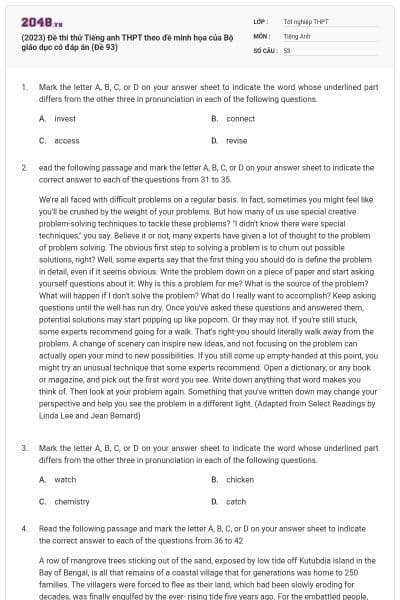
Mark the letter A, B, C or D on your answer sheet to indicate the word whose underlined part differs from the other three in pronunciation in each of the following questions.
watch
chicken
chemistry
catch
C
Giải thích:
A. watch /wɒtʃ/ B. chicken /ˈtʃɪk.ɪn/
C. chemistry /ˈkem.ɪ.stri/ D. catch /kætʃ/
-> Phần gạch chân ở đáp án C được phát âm là /k/, còn lại được phát âm là /tʃ/.
Do đó đáp án là C.
Mark the letter A, B, C or D on your answer sheet to indicate the word whose underlined part differs from the other three in pronunciation in each of the following questions.
achieve
amend
answer
awake
C
Giải thích:
A. achieve /əˈtʃiːv/
B. amend /əˈmend/
C. answer /ˈænsər/
D. awake /əˈweɪk/
→ Chữ “a” trong đáp án C phát âm là /æ/, trong các đáp án còn lại phát âm là /ə/
→ Chọn đáp án C
Mark the letter A, B, C, or D on your answer sheet to indicate the word that differs from the other three in the position of the primary stress in each of the following questions.
major
native
exposed
friendly
C
Giải thích:
A. major /ˈmeɪdʒər/
B. native /ˈneɪtɪv/
C. exposed /ɪkˈspəʊzd/
D. friendly /ˈfrendli/
Trọng âm của đáp án C rơi vào âm 2, trọng âm của các đáp án còn lại rơi vào âm 1
→ Chọn đáp án C
reconstruct
volunteer
understand
refurbish
D
Giải thích:
A. reconstruct /ˌriːkənˈstrʌkt/
B. volunteer /ˌvɑːlənˈtɪr/
C. understand /ˌʌndərˈstænd/
D. refurbish /ˌriːˈfɜːrbɪʃ/
Trọng âm của đáp án D rơi vào âm 2, trọng âm của các đáp án còn lại rơi vào âm 3
→ Chọn đáp án D
Mark the letter A, B, C, or D on your answer sheet to indicate the correct answer to each of the following questions.
The patients _______ with the new drug showed better signs of recovery than those receiving conventional medicine.
treated
having treated
treating
who treated
A
Tạm dịch: Những bệnh nhân được điều trị bằng loại thuốc mới có dấu hiệu hồi phục tốt hơn so với những bệnh nhân được dùng thuốc thông thường.
+ Nhận thấy trong câu có động từ "showed" -> ta dùng dạng rút gọn mệnh đề.
- Căn cứ vào phía trước là “the patients” nên cần một đại từ quan hệ thay thế cho danh từ chỉ vật và đóng vai trò làm chủ ngữ.
- Hơn nữa, động từ ở đây là “treat” mang nghĩa bị động.
- Do đó, ta có thể lược bỏ đại từ quan hệ, rút gọn bằng Vpp.
- Lưu ý: dùng Vpp rút gọn mệnh đề quan hệ khi đại từ quan hệ đóng vai trò làm chủ ngữ và động từ trong mệnh đề quan hệ ở thể bị động.
=> Đáp án A.
Notes:
+ patient /ˈpeɪ.ʃənt/ (n): bệnh nhân, người bệnh.
+ recovery /rɪˈkʌv.ər.i/ (n): sự bình phục, sự khỏi bệnh.
+ conventional /kənˈven.ʃən.əl/ (a): theo tập quán, theo tục lệ, thông thường.
+ medicine /ˈmed.ɪ.sən/ (n): y học, y khoa, thuốc.
+ sign of something: dấu hiệu của cái gì.
Cotton shirts feel _______ than polyester ones.
much softer
more softly
far more softer
far more softly
A
Giải thích
Kiến thức về so sánh
+ Vì sau liên động từ “feel” là tính từ, do đó ta loại đáp án B và D.
+ Vì “soft” là tính từ ngắn nên khi so sánh hơn, ta chia ở dạng “adj ngắn + -er”. Ta dùng “much/ far” để nhấn mạnh.
=> Dựa vào công thức ta chọn đáp án A.
Tạm dịch: Áo sơ mi bằng vải cotton sờ vào thấy mềm hơn áo chất liệu polyester rất nhiều.
The apprentice will send a present to her boss _______ .
until he came back from his business trip
as soon as he comes back from his business trip
by the time he comes back from his business trip
while he was coming back from his business trip
B
Giải thích:
Kiến thức về mệnh đề trạng ngữ chỉ thời gian
Mệnh đề đã cho chia ở thì Tương lai đơn “will send” – diễn tả sự việc chưa xảy ra, sẽ xảy ra trong tương lai nên không thể chia động từ ở thì QKĐ, QKHT, QKTD
→ Loại A,D
+ By the time là một liên từ chỉ thời gian mang ý nghĩa là: vào lúc...; vào khoảng thời gian...; khi mà;...; vào thời điểm;
By the time + mệnh đề chia ở thì HTĐ, Mệnh đề chia thì TLHT
Tạm dịch: Người học việc sẽ gửi một món quà cho sếp của cô ấy ngay khi ông ấy trở lại sau chuyến công tác
*Notes:
- apprentice /əˈprentɪs/: người học việc
→ Chọn đáp án B
With greatly increased workloads, everyone is _______ pressure now.
under
out of
above
upon
A
Giải thích:
Kiến thức về cụm giới từ
*Xét các đáp án:
A. under (prep.) bên dưới
B. out of (prep.) ra khỏi
C. above (prep.) vị trí cao hơn một cái gì đó
D. upon (prep.) trên, có một cái gì đó - A đang ở vị trí trên của cái gì đó khác – B (A và B có tiếp xúc với nhau).
*Ta có:
- under pressure: áp lực, căng thẳng . Do đó, A là đáp án phù hợp
Tạm dịch: Với khối lượng công việc tăng lên rất nhiều, mọi người hiện đang chịu nhiều áp lực.
*Note:
- greatly /´greitli/ (adv) rất, lắm
- workload /´wə:k¸loud/ (n) khối lượng công việc
Mary didn't go to school yesterday, _______ ?
was she
did she
she do
didn’t she
B
Kiến thức về câu hỏi đuôi
+ Động từ chính là “didn't go”, chủ ngữ là “Tam” nên ta sẽ có câu hỏi đuôi ở dạng khẳng định là “did she”.
Tạm dịch: Hôm qua Tâm không đi học, phải không?
There are billions of stars in _______ space.
a
an
Ø
the
C
Giải thích
Kiến thức về mạo từ
Ta có cụm từ: in space: trong vũ trụ.
=> Đáp án C.
Tạm dịch: Có hàng tỉ vì sao trong không gia.
The country has vaccinated 70% of its population since the first vaccines _______ .
had been produced
have been produced
were produced
are produced
C
Giải thích:
Kiến thức về sự phối thì
Cấu trúc với since: HTHT since QKĐ, hoặc Since QKĐ, HTHT.
Tạm dịch: Cả nước đã tiêm vắc xin cho 70% dân số kể từ khi lô vắc-xin đầu tiên được sản xuất.
→ Chọn đáp án C
They're _______ free buses to and from the concert.
cheating on
laying on
relying on
counting on
B
Giải thích
Kiến thức về cụm động từ
A. cheating on– cheat on (prv): lừa dối, phản bội, ngoại tình
B. laying on– lay on (prv): cung cấp một cái gì đó cho một nhóm người, nói với ai đó điều gì đó mà họ không biết
C. relying on– rely on (prv): phụ thuộc, trông cậy vào = count on = depend on
D. counting on– count on (prv): phụ thuộc, trông cậy vào
=>Dựa vào nghĩa, ta chọn đáp án B
Tạm dịch: Họ cung cấp xe buýt miễn phí đến và đi khỏi buổi hòa nhạc.
*Note:
+ concert /ˈkɒnsət/ (n): buổi hòa nhạc
They encouraged the employees _______ the conference.
to attend
attending
attend
being attended
A
Giải thích
Kiến thức danh động từ và động từ nguyên mẫu
Tạm dịch: Họ khuyến khích nhân viên tham gia hội nghị.
Ta có cấu trúc: encourage somebody to do something: khuyến khích ai đó làm điều gì.
=> Đáp án A.
Notes:
+ employee /ɪmˈplɔɪ.iː/ (n): người lao động, người làm công.
+ attend /əˈtend/ (v): dự, có mặt, tham gia.
+ conference /ˈkɒn.fər.əns/ (n): hội nghị, sự bàn bạc, sự hội ý.
Meredith sat at her desk _______ , carefully planning how to word her thesis proposal.
in the dark
in a brown study
on the dot
at the push of a button
B
Kiến thức về thành ngữ
A. in the dark: không biết, không tỏ, không có tài liệu, tin tức gì
B. in a brown study: chìm đắm vào suy nghĩ, trầm ngâm suy nghĩ
C. on the dot: ngay đúng thời điểm, chính xác thời điểm, đúng giờ
D. at the push of a button: rất dễ dàng
=> Căn cứ vào dịch nghĩa, đáp án B đúng.
Tạm dịch: Meredith ngồi vào bàn làm việc trầm ngâm suy nghĩ, cẩn thận lên kế hoạch làm thế nào để trình bày đề xuất luận án của mình.
Note:
sit /sit/ (v): ngồi
desk /desk/ (n): bàn viết, bàn làm việc, bàn học sinh carefully /'keəfəli/ (adv): (một cách) cẩn thận, cần cù, tỉ mỉ plan /plæn/ (v): lên kế hoạch
word /wɜ:d/ (v): diễn đạt bằng lời, trình bày thesis /'θi:sis/ (n): luận án
proposal /prə'pəʊzl/ (n): sự đề nghị
When I came to the birthday party, all the guests _______ .
had already left
already left
leave
have left
A
Kiến thức về sự phối thì
+ Dựa vào động từ phía trước chia ở thì quá khứ đơn, do đó đây là sự việc đã xảy ra trong quá khứ
+ Ta có công thức với “when” dùng để diễn tả một hành động xảy ra xong trước một hành động khác trong quá khứ:
“When + S + V(quá khứ đơn), S + V (quá khứ hoàn thành)”
=> Chỉ có đáp án A đúng cấu trúc
Tạm dịch: Khi tôi đến dự tiệc sinh nhật, tất cả khách mời đã về hết.
*Note:
+ birthday / ́bə:θ dei / (n): ngày sinh; lễ sinh nhật
+ party / ˈpɑrti / (n): tiệc, buổi liên hoan
+ guest / gest / (n): khách, khách mời
+ leave /liːv/ – left /left/ – left /left/ (v): rời đi, bỏ quên, bỏ đi
His dream to become an interpreter was at last _______ .
caused
fulfilled
made
haunted
B
Giải thích:
Kiến thức về collocation
A. caused – cause: gây ra
B. fulfilled – fulfill: hoàn thành, thực hiện
C. made – make: làm
D. haunted – haunt: ám ảnh
- to fulfil your dream: đạt được mơ ước
Tạm dịch: Ước mơ trở thành một thông dịch viên của anh ấy vào cuối cùng đã thành hiện thực.
→ Chọn đáp án B
Baseball _______ with nine players on the team.
is played
have been played
are played
has been played
A
Giải thích
+ Nhận thấy trong câu không có dấu hiệu của thì.
+ Dựa vào nghĩa của câu, ta thấy câu diễn tả một sự thật hiển nhiên -> ta dùng thì hiện tại đơn.
+ Dựa vào ngữ nghĩa của câu -> ta dùng nghĩa bị động.
+ Baseball là danh từ số ít -> động từ chia số ít.
+ Ta có cấu trúc:
Chủ động: S + V (s/es)
Bị động: S + am/ is/ are + Vpp
=> Đáp án A.
Tạm dịch: Bóng chày được chơi với chín cầu thủ trong đội.
Acting is very _______ - you've got to really push yourself if you want to succeed.
compete
competitively
competitive
competition
C
Tạm dịch: Diễn xuất rất cạnh tranh - bạn phải thực sự thúc đẩy bản thân nếu bạn muốn thành công.
+ Nhận thấy phía trước có động từ "to be" và trạng từ “very” nên chỗ trống ta cần một tính từ.
*Xét các đáp án:
A. compete /kəmˈpiːt/ (v): đua tranh, ganh đua, cạnh tranh.
B. competitively /kəmˈpet.ɪ.tɪv.li/ (adv): đủ khả năng cạnh tranh.
C. competitive /kəmˈpet.ɪ.tɪv/ (a): cạnh tranh, đua tranh.
D. competition /ˌkɒm.pəˈtɪʃ.ən/ (n): sự cạnh tranh, sự tranh giành.
=> Đáp án C.
He handed over a brown envelope ________ a hundred dollar bills.
consisting
comprising
containing
including
C
Giải thích
Kiến thức về từ vựng Xét các đáp án:
A. consist /kənˈsɪst/ (v) (+in) cốt ở, có một cái gì đó là chính hoặc một phần hoặc tính năng duy nhất, (+of) bao gồm (được hình thành từ những người hoặc những thứ được đề cập)
B. comprise /kəmˈpraɪz/ (v) có ai đó / cái gì đó như các bộ phận hoặc thành viên
C. contain /kənˈteɪn/ (v) chứa đựng, kiểm soát/ kiềm chế cảm xúc, ngăn điều gì đó có hại lây lan hoặc trở nên tồi tệ hơn
D. include /ɪnˈkluːd/ (v) bao gồm, chứa một cái gì đó như một phần của một cái gì đó khác, hoặc để làm cho một cái gì đó trở thành một phần của một cái gì đó khác
Do đó, C là đáp án hợp lý
Tạm dịch: Anh ta đưa cho một phong bì màu nâu chứa một trăm đô la.
*Note:
- envelope /ˈen.və.ləʊp/ (n) phong bì
Mark the letter A, B, C, or D on your answer sheet to indicate the word(s) CLOSEST in meaning to the underlined bold word(s) in each of the following questions.
With more and more investors pouring money into the tourism industry, the local economy was revitalized.
weakened
unchanged
strengthened
avoided
C
Giải thích:
Tạm dịch: Với ngày càng nhiều nhà đầu tư đổ tiền vào ngành du lịch, nền kinh tế địa phương được hồi sinh.
=> Revitalised – revitalise /ˌriːˈvaɪtəlaɪz/: phục hồi ~ strengthened
A. weakened: làm yếu
B. unchanged: không thay đổi
C. strengthened: củng cố
D. avoided: tránh
→ Chọn đáp án C
Older people are especially vulnerable to cold temperatures even inside their homes.
healthy
feeble
favorable
robust
B
Giải thích:
Kiến thức về từ vựng:
Tạm dịch: Người lớn tuổi đặc biệt dễ bị ảnh hưởng bởi nhiệt độ lạnh ngay cả trong nhà của họ.
=> vulnerable /ˈvʌlnərəbəl/ (adj) có thể bị tổn thương, có thể bị làm hại, có thể bị xúc phạm
*Xét các đáp án:
A. healthy /'helθi/ (adj) khoẻ mạnh
B. feeble /fi:bl/ (adj) yếu đuối, nhu nhược
C. favorable /ˈfeɪvrəbəl/ (adj) thuận tiện
D. robust /ˈroʊbʌst/ (adj) tráng kiện, cường tráng; có sức khoẻ
=> vulnerable ~ feeble Do đó, B là đáp án hợp lý.
Mark the letter A, B, C, or D on your answer sheet to indicate the word(s) OPPOSITE in meaning to the underlined word(s) in each of the following questions.
She was truly a benevolent old lady; she even didn’t hurt an ant.
angry
kind
calm
cruel
D
Giải thích:
Tạm dịch: Bà đúng là một bà lão nhân hậu; bà ấy thậm chí không làm tổn hại đến 1 con kiến.
=> Benevolent /bəˈnevələnt/: nhân từ, lương thiện >< cruel
A. angry: giận dữ
B. kind: tốt bụng
C. calm: bình tĩnh
D. cruel: độc ác
→ Chọn đáp án D
After the team leader had left, Ruth took up the baton as a musical director for school productions.
accepted the duty
removed the title
refused the responsibility
hit with the baton
C
Giải thích:
Tạm dịch: Sau khi trưởng nhóm rời đi, Ruth đảm nhận vị trí đạo diễn âm nhạc cho các tác phẩm ở trường.
=> take up the baton: chấp nhận nhiệm vụ/trách nhiệm gì >< refused the responsibility Baton /bəˈtɑːn/: gậy chỉ huy
A. nhận nhiệm vụ
B. xóa chức danh
C. từ chối trách nhiệm
D. đánh bằng gậy
→ Chọn đáp án C
Mark the letter A, B, C, or D on your answer sheet to indicate the most suitable response to complete each of the following exchanges.
Geroge and Linda are talking about the use of mobile phones.
George: “I think it is a good idea to allow students to use their phones in class.”
Linda: “ _______ . They tend to be distracted and can’t focus on lessons.”
Surely you’re right.
I don’t quite agree.
I couldn’t agree with you more.
I’m fine.
B
Giải thích:
Tạm dịch: Geroge và Linda đang nói về việc sử dụng điện thoại di động.
George: “Tôi nghĩ rằng việc cho phép học sinh sử dụng điện thoại trong lớp là một ý kiến hay.”
Linda: “__________. Chúng dễ bị phân tâm và không thể tập trung vào bài học ”.
A. Chắc chắn là bạn đúng.
B. Tôi không hoàn toàn đồng ý.
C. Tôi hoàn toàn đồng ý
D. Tôi ổn.
Dựa vào vế sau trong câu trả lời của Linda → Linda không đồng ý với ý kiến của George
→ Chọn đáp án B
Peter and Mark are at the school’s canteen.
Peter: “ _______ ”
Mark: “No, thanks. I’m full.”
Would you like another bite?
Give me your plate.
How about going to the theatre?
Are you sick?
A
Giải thích:
Tạm dịch: Peter và Mark đang ở căng tin của trường.
Peter: “_____________”
Mark: “Không, cảm ơn. Tôi no rồi. ”
A. Bạn có muốn ăn nữa không?
B. Đưa cho tôi đĩa của bạn.
C. Hay là đi tới rạp chiếu phim đi?
D. Bạn bị ốm à?
→ Chọn đáp án A
Some were located in or near villages as public spaces for the community; (26) _______ were positioned beside roads as resting places for travellers
the other
most of
much
others
D
The other + danh từ s: một (cái) còn lại cuối cùng, được sử dụng như tính từ .theo sau là danh từ số ít
Most of the + danh từ: hầu hết
Much + danh từ không đếm được: nhiều
Others: những thứ khác nữa, đứng 1 mình = other + Ns
Tạm dịch: Some were located in or near villages as public spaces for the community; others were positioned beside roads as resting places for travellers.
(Một số được đặt trong hoặc gần các làng làm không gian công cộng cho cộng đồng; những cái khác được đặt bên cạnh những con đường làm nơi dừng chân cho du khách.)
→ Chọn đáp án D
Down the centuries, thousands of wells were constructed throughout northwestern India, but the majority have now fallen into (27) _______ ; many are derelict and dry, as groundwater has been diverted for industrial use and the wells no longer reach the water table. (28) _______ , some important sites in Gujarat have recently undergone major restoration.
disinterest
disuse
disadvantage
disability
B
Giải thích:
A. disinterest: không hứng thú
B. disuse: không còn sử dụng
C. disadvantage: bất lợi
D. disability: sự khuyết tật
Come/fall into disuse: bỏ đi, không dùng đến
Tạm dịch: Down the centuries, thousands of wells were constructed throughout northwestern India, but the majority have now fallen into disuse
(Trong nhiều thế kỷ, hàng ngàn giếng đã được xây dựng trên khắp vùng Tây Bắc Ấn Độ, nhưng phần lớn hiện đã không còn được sử dụng)
→ Chọn đáp án B
(28) _______ , some important sites in Gujarat have recently undergone major restoration.
Therefore
For instance
Furthermore
However
Giải thích:
A. Therefore: bởi vậy
B. For instance: ví dụ
C. Furthermore: hơn nữa
D. However: tuy nhiên (thường đứng trước dấu “,” và sau dấu “.”)
Tạm dịch: as groundwater has been diverted for industrial use and the wells no longer reach the water table. However, some important sites in Gujarat have recently undergone major restoration.
(vì nước ngầm đã được chuyển hướng cho mục đích sử dụng công nghiệp và các giếng không còn chạm tới mực nước ngầm. Tuy nhiên, một số địa điểm quan trọng ở Gujarat gần đây đã được trùng tu laị.)
→ Chọn đáp án D
which
that
who
where
A
Giải thích:
Kiến thức về đại từ quan hệ
Trước chỗ trống là danh từ chỉ vật “the Archaeological Survey of India” → dùng which/that
Trước chỗ trống là dấu phẩy → loại “That”
Tạm dịch: Today, following years of neglect, many stepwells have been saved by the Archaeological Survey of India, which has recognised the importance of preserving them as part of the country's rich history.
(Ngày nay, sau nhiều năm bị lãng quên, nhiều giếng bậc thềm đã được Cơ quan Khảo sát Khảo cổ học Ấn Độ cứu vãn, nơi đây đã nhận ra tầm quan trọng của việc bảo tồn chúng như một phần lịch sử phong phú của đất nước.)
→ Chọn đáp án A
Tourists flock to wells in far-flung corners of northwestern India to gaze in wonder at these architectural marvels from hundreds of years ago, which serve as a(n) (30) _______ of both the ingenuity and artistry of ancient civilisations and of the value of water to human existence.
sign
alert
reminder
possibility
C
Giải thích:
A. sign: dấu hiệu
B. alert: cảnh báo
C. reminder: lời nhắc nhở
D. possibility: khả năng
Tạm dịch: Tourists flock to wells in far-flung corners of northwestern India to gaze in wonder at these architectural marvels from hundreds of years ago, which serve as a(n) reminder of both the ingenuity and artistry of ancient civilisations and of the value of water to human existence.
(Khách du lịch đổ xô đến các giếng ở những góc xa xôi của Tây Bắc Ấn Độ để chiêm ngưỡng những tuyệt tác kiến trúc từ hàng trăm năm trước, chúng như một lời nhắc nhở về cả sự khéo léo và nghệ thuật của các nền văn minh cổ đại và giá trị của nước đối với sự tồn tại của con người.)
→ Chọn đáp án C
DỊCH TOÀN BÀI: Duy nhất ở khu vực này, các giếng bậc thang thường phức tạp về mặt kiến trúc và rất khác nhau về kích thước và hình dạng. Ở thời kỳ hoàng kim, chúng là nơi tụ tập, giải trí, thư giãn và thờ cúng của dân làng, trừ những tầng lớp thấp nhất. Một số được đặt trong hoặc gần các làng làm không gian công cộng cho cộng đồng; những cái khác được đặt bên cạnh những con đường làm nơi dừng chân cho du khách. Trong nhiều thế kỷ, hàng nghìn giếng đã được xây dựng trên khắp vùng Tây Bắc Ấn Độ, nhưng phần lớn hiện đã không còn được sử dụng; nhiều nơi vô chủ và khô cạn, vì nước ngầm đã được chuyển hướng cho mục đích sử dụng công nghiệp và các giếng không còn chạm tới mực nước ngầm.
Tuy nhiên, một số địa điểm quan trọng ở Gujarat gần đây đã được trùng tu lại. Ngày nay, sau nhiều năm bị lãng quên, nhiều giếng bậc thang đã được Cơ quan Khảo sát Khảo cổ học Ấn Độ cứu vãn, nơi đây đã nhận ra tầm quan trọng của việc bảo tồn chúng như một phần lịch sử phong phú của đất nước. Khách du lịch đổ xô đến các giếng ở những góc xa xôi của Tây Bắc Ấn Độ để chiêm ngưỡng những tuyệt tác kiến trúc từ hàng trăm năm trước, chúng như một lời nhắc nhở về cả sự khéo léo và nghệ thuật của các nền văn minh cổ đại và giá trị của nước đối với sự tồn tại của con người.
Read the following passage and mark the letter A, B, C, or D on your answer sheet to indicate the correct answer to each of the questions from 31 to 35.
Have you ever wondered where museums get the works and relics that they put on display? If the museum is sponsored by the government, then the relics were probably collected under special laws that protect historical treasures related to that country. However, not all museums are sponsored by the government. Sometimes a private collector decides to set up a museum so that the public can view the works or relics in his or her collection. Since the 1990s, more and more of these museums set up by private collectors have sprung up in China. Typically, these private museums are small, but they give visitors the chance to see works and relics not found anywhere else. Songtang Li is one such collector who has put part of his private collection on display for the public. In 2001, Li opened his museum in an old 18th century house in Beijing. The museum displays some of the best examples of Chinese folk art he has collected over his lifetime. Li began collecting folk art sculptures when he was young. Thus began Li’s lifetime hobby of visiting demolition sites and collecting pieces of sculpture or decorative architecture. Anything that he was allowed to take away would end up in his collection. In the late 1970s, China underwent major economic reforms. At that time, Beijing started widespread demolition and rebuilding across the city. According to Li, more than ninety percent of the old houses and temples in Beijing have since been torn down and replaced with modern buildings. Luckily, all of old Beijing’s architectural folk art has not been lost. Visitors to the Songtangzhai Folk Sculpture Museum can view some of the best relics Li rescued over the years. (Adapted from Reading Challenge 3 by Casey Malarcher and Andrea Janzen)
Which could be the best title for the passage?
China refused to change the face of museums.
From a childhood hobby to a career: Fail in the end.
Rescuing Relics.
All things have to be lost.
Chọn C
The word “they” in paragraph 1 refers to _______
treasures
private museums
collectors
relics
Chọn B
According to paragraph 2, what could be said about the museum Li opened?
It only displayed sculptures.
It was sponsored by the local government.
Some of the best traditional artworks were available to the public.
It showed only some paintings Li collected as a child.
Chọn C
The word “demolition” in paragraph 3 is closest in meaning to _______
reform
construction
destruction
relocation
Chọn C
Which of the following is NOT mentioned, according to the passage?
The vast majority of temples in Beijing were destroyed in the 1970s.
Allowing citizens to collect pieces of sculpture from old sites was considered unacceptable.
Only some museums in China were subsidized by the government.
There were many private museums in China.
Chọn B
Read the following passage and mark the letter A, B, C, or D on your answer sheet to indicate the correct answer to each of the questions from 36 to 42.
World leaders love to present trees as the answer to our climate change woes. Earth has room for another 0.9 billion hectares of them, which could buy us an extra 20 years to decarbonise our societies by locking up emitted carbon. But many countries are terrible at even holding onto their existing carbon-rich trees. However, this problem isn’t caused solely by lower-income countries, as a recent study published in Nature Ecology & Evolution made clear by linking deforestation to international trade. High-income countries, like the UK, Japan and Germany, are driving deforestation abroad with their demand for beef, soya, palm oil and other goods. Last year’s increase in tree cover loss, which includes deforestation as well as natural losses, such as through fire, is especially galling because 2020 was the deadline a host of countries and businesses set for halving deforestation from 2014 levels. The timing also poses a headache for the United Nations and those hoping for a good outcome at this year’s COP26 climate summit in November. Alarming deforestation trends in Brazil under President Jair Bolsonaro saw Norway and Germany halt funds to Brazil for protecting the Amazon rain forest in 2019. The situation is no better today, with Brazil losing 1.7 million hectares in 2020, three times that of the country with the next biggest losses, the Democratic Republic of the Congo. Moreover, Brazil’s increase in loss was more than twice the global average, at 25 per cent. Boosting climate aid to Brazil in that context poses a tricky conundrum for high income countries. These rates of tree cover loss have a huge climate impact. Mikaela Weisse at the WRI and her colleagues estimate last year’s loss released about 2.6 billion tonnes of carbon dioxide, roughly on a par with India, the world’s fourth biggest emitter. Continuing with such colossal emissions will wipe out the amount of CO2 that tree planting is expected to absorb. It is time for world leaders to get a grip. If we are to stand any chance of meeting the world’s climate goals, governments must take deforestation as seriously as they do transforming their energy systems. Politics can make stopping deforestation hard. The European Commission and UK government are considering using trade deals and regulations to apply pressure on countries such as Brazil to curb deforestation. However, this may not be viewed well by Brazil. Globally, there is hope. Forest loss fell in Indonesia and Malaysia last year – signs that government policies to curb deforestation can work. (Adapted from newscientist.com)
Which best serves as the title for the passage?
Floundering on forests.
Deforestation: It’s too late to be solved!
The climate summit witnesses drastic changes from world leaders.
Forest loss: Climate change is to blame!
Chọn A
The word “them” in paragraph 1 refers to _______ .
leaders
trees
hectares
countries
Chọn B
According to the passage, what could be said about the deforestation trend?
Forest loss can only be attributable to low-income countries.
Two nations have extended funds to Brazil for preservation of the Amazon Rainforest.
Trading between different countries partly has made deforestation become worse.
Brazil’s tree loss was only double the global average in 2020.
Chọn C
The word “galling” in paragraph 2 is closest in meaning to _______ .
confusing
intriguing
annoying
comforting
Chọn C
The word “conundrum” in paragraph 3 mostly means _______ .
proponent
problem
solution
outcome
Chọn B
Which of the following is NOT true, according to the passage?
Many countries are still struggling to maintain their CO2 levels.
Brazil found itself in a worse situation after being cut funds for the protection of Amazon.
Countries acting as a climate aid donor to Brazil may find themselves in a dilemma.
India emitted no more than 2.6 billion tonnes of carbon dioxide in 2020.
Chọn D
Which of the following can be inferred from the passage?
Politicians ought to increase their level of activity to circumvent deforestation.
Deforestation is taken seriously by most politicians.
Most countries do not face challenges in safeguarding trees.
The European Commission has successfully applied trade regulations on Brazil.
Chọn A
Mark the letter A, B, C, or D on your answer sheet to indicate the underlined part that needs correction in each of the following questions.
Many distinguishable scholars agreed that the strategic decision the government had made to help curb the spread of the virus was unreasonable.
distinguishable
strategic
curb
unreasonable
Chọn A
Already 360 US papers – including most of the biggest and best – have built paywalls around its products.
including
most of
have built
its
D
Giải thích:
Cần tính từ sở hữu thay thế cho danh từ số nhiều “360 US papers”
Sửa: its → their
Tạm dịch: Đã có 360 tờ báo của Hoa Kỳ - bao gồm hầu hết các tờ báo lớn nhất và tốt nhất - đã xây dựng tường phí cho các sản phẩm của mình.
Paywall (*), thuật ngữ mới thể hiện xu hướng thu phí để xem nội dung báo điện tử
→ Chọn đáp án D
Traditionally in some Asian countries, a child's grandfather or a fortune-teller had chosen the child's name.
some
a
or
had chosen
D
Giải thích:
Ta không thể sử dụng thì QKHT ở đây, vì nó không thể hiện hành động xảy ra và hoàn tất trước 1 hành động nào cả. Ta chỉ đơn thuần dùng thì HTĐ thể hiện sự thật hiển nhiên.
Sửa: had chosen → choose.
Tạm dịch: Theo truyền thống ở một số nước châu Á, ông của đứa trẻ hoặc một thầy bói chọn tên cho đứa trẻ.
→ Chọn đáp án D
Mark the letter A, B, C, or D on your answer sheet to indicate the sentence that is closest in meaning to each of the following questions.
I last had an outdoor barbecue 2 months ago.
The last time I have an outdoor barbecue was 2 months ago.
I haven’t had an outdoor barbecue for 2 months.
I have had an outdoor barbecue since 2 months ago.
It is the first time in 2 years I had an outdoor barbecue.
B
Giải thích:
Tạm dịch: Lần cuối cùng tôi tổ chức tiệc nướng ngoài trời cách đây 2 tháng.
A. Sai ở động từ “’have”. (“have” → “had”)
B. Tôi đã không tổ chức tiệc nướng ngoài trời trong 2 tháng.
C. Tôi đã có một bữa tiệc nướng ngoài trời từ 2 tháng trước. → khác về nghĩa với câu gốc. Và có “since “ thì không có “ago”
D. Đây là lần đầu tiên sau 2 năm tôi tổ chức tiệc nướng ngoài trời. → khác về nghĩa với câu gốc.
Notes:
Một số cấu trúc đồng nghĩa:
S + last + Ved + O + khoảng thời gian + ago
= It’s + khoảng thời gian + since + S + last + Ved
= S + haven’t/hasn’t + Ved/Pii + O + for + khoảng thời gian
= The last time + S + V(ed) + was + khoảng thời gian +ago
→ Chọn đáp án B
“Why don’t you go with me to the Italian restaurant after work?” said Tim to Falla.
Tim warned Falla not to go with him to the Italian restaurant after work.
Tim asked Falla to go with him to the Italian restaurant after work.
Tim suggested that Falla go with him to the Italian restaurant after work.
Tim invited Falla not to go with him to the Italian restaurant after work.
C
Giải thích:
Tạm dịch: "Tại sao bạn không đi cùng tôi đến nhà hàng Ý sau giờ làm việc?" Tim nói với Falla.
A. Tim cảnh báo Falla không nên đi cùng anh ta đến nhà hàng Ý sau giờ làm việc.
B. Tim rủ Falla đi cùng anh ta đến nhà hàng Ý sau giờ làm việc.
C. Tim đề nghị Falla đi cùng anh ta đến nhà hàng Ý sau giờ làm việc.
D. Tim mời Falla không đi cùng anh ta đến nhà hàng Ý sau giờ làm việc.
Cấu trúc với động từ “suggest”:
Suggest that + S + Vinf/should Vinf: đề nghị rằng ai đó nên làm gì
→ Chọn đáp án C
It’s necessary for all of the students to finish their assignments before 3 p.m.
All of the students can finish their assignments before 3 p.m.
All of the students need to finish their assignments before 3 p.m.
All of the students must finish their assignments before 3 p.m.
All of the students may finish their assignments before 3 p.m.
B
Giải thích:
Tạm dịch: Tất cả học sinh phải hoàn thành bài tập của mình trước 3 giờ chiều.
A. Tất cả học sinh có thể hoàn thành bài tập của mình trước 3 giờ chiều.
B. Tất cả học sinh cần hoàn thành bài tập của mình trước 3 giờ chiều.
C. Tất cả học sinh phải hoàn thành bài tập của mình trước 3 giờ chiều.
D. Tất cả học sinh có thể hoàn thành bài tập của mình trước 3 giờ chiều. Cấu trúc cần lưu ý:
Need to do sth: cần phải làm gì
→ Chọn đáp án B
Mark the letter A, B, C, or D on your answer sheet to indicate the sentence that best combines each pair of sentences in the following questions.
He doesn’t have any money left. He can’t buy lunch.
Unless he has any money left, he can buy lunch.
If he had some money left, he couldn’t buy lunch.
He wishes he had some money left and he could buy lunch.
He can buy lunch as long as he doesn’t have any money left.
C
Giải thích:
Tạm dịch: Anh ấy không còn tiền. Anh ấy không thể mua bữa trưa.
A. Trừ khi anh ấy còn tiền, anh ấy có thể mua bữa trưa.
B. Nếu anh ấy còn một ít tiền, anh ấy không thể mua bữa trưa.
C. Anh ấy ước anh ấy còn một ít tiền và anh ấy có thể mua bữa trưa.
D. Anh ấy có thể mua bữa trưa miễn là anh ấy không còn tiền. Cấu trúc Wish ở hiện tại
Cấu trúc wish có thể được sử dụng để thể hiện mong ước một điều gì đó không có thật ở hiện tại hoặc giả định một điều trái ngược so với thực tế.
Công thức:
S + wish(es) + (that) + S + V-ed
Cấu trúc If only: If only + (that) + S + (not) + V-ed
→ Chọn đáp án C, các đáp án còn lại khác nghĩa với câu gốc
Jack did poorly on his final test. He was aware of the importance of hard work.
Not until Jack did poorly on his final test he was aware of the importance of hard work.
Only after Jack did poorly on his final test was he aware of the importance of hard work.
Poorly though Jack did on his final test, he was aware of the importance of hard work.
Hardly had Jack done poorly on his final test when he was aware of the importance of hard work.
B
Giải thích:
Tạm dịch: Jack đã làm bài kém trong bài kiểm tra cuối cùng của mình. Anh ấy nhận thức được tầm quan trọng của việc học chăm chỉ.
A. Sai cấu trúc.
Cấu trúc với “not until”:
Not until + mệnh đề + mệnh đề đảo ngữ: mãi cho tới khi
B. Chỉ sau khi Jack làm bài kém trong bài kiểm tra cuối cùng thì anh ấy mới nhận thức được tầm quan trọng của việc học chăm chỉ.
C. Mặc dù Jack đã làm không tốt trong bài kiểm tra cuối cùng của mình, anh ấy nhận thức được tầm quan trọng của việc làm việc chăm chỉ.
D. Chẳng bao lâu sau khi Jack hoàn thành không tốt trong bài kiểm tra cuối cùng của mình khi anh ấy nhận thức được tầm quan trọng của việc làm việc chăm chỉ.
Cấu trúc cần lưu ý:
Khi một câu bắt đầu bằng Only When, Only after, Only by,. . .thì ta sử dụng đảo ngữ cho vế chính. Trong câu này, dịch nghĩa ra, khi mà thế này thì sẽ thế kia, ta dùng thì tương lai cho vế chính và đảo ngữ ta được cấu trúc will S V.
Cấu trúc: Only + when/after + S + V + trợ động từ + S + V
→ Chọn đáp án B