(2023) Đề thi thử Tiếng anh THPT Phù Cừ, Hưng Yên có đáp án
50 câu hỏi
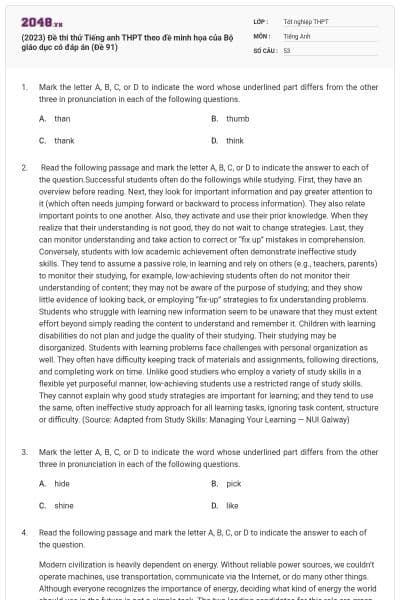
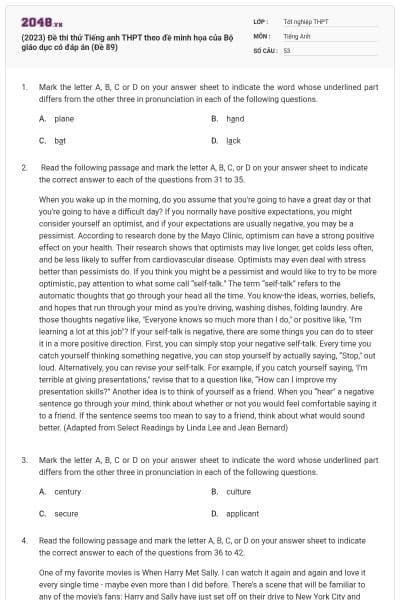
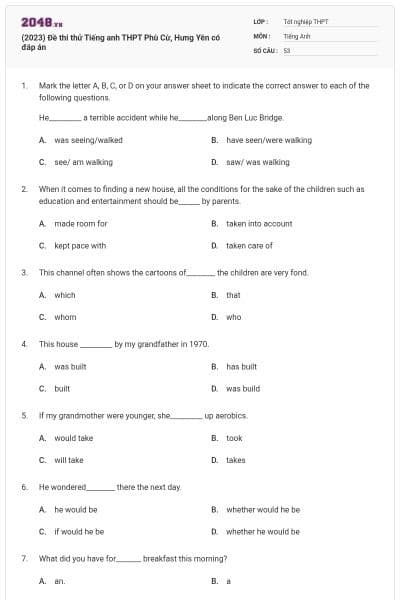
Mark the letter A, B, C, or D on your answer sheet to indicate the correct answer to each of the following questions.
He_________ a terrible accident while he________along Ben Luc Bridge.
was seeing/walked
have seen/were walking
see/ am walking
saw/ was walking
Sự kết hợp thì và động từ:
QKD while QKTD: Diễn tả hành động đang xảy ra thì có hành động khác xen vào.
Tạm dịch: Anh ấy đã nhìn thấy một tai nạn khủng khiếp khi đang đi dọc cầu Bến Lức.
→ Chọn đáp án D
When it comes to finding a new house, all the conditions for the sake of the children such as education and entertainment should be______ by parents.
made room for
taken into account
kept pace with
taken care of
Kiến thức từ vựng:
- make room for: chừa chỗ trống cho thứ gì
- take something into account: cân nhắc, xem xét
- keep pace with somebody/something: đuổi kịp ai/cái gì
- take care of: chăm sóc
Tạm dịch: Khi nói đến việc tìm một ngôi nhà mới, tất cả các điều kiện vì lợi ích của trẻ em như giáo dục và giải trí nên được cha mẹ tính đến.
→ Chọn đáp án B
This channel often shows the cartoons of________ the children are very fond.
which
that
whom
who
Đại từ quan hệ:
Ta dùng đại từ quan hệ ‘which’ thay cho danh từ ‘the cartoons’.
Tạm dịch: Kênh này thường chiếu những bộ phim hoạt hình mà trẻ em rất thích.
→ Chọn đáp án A
This house _________ by my grandfather in 1970.
was built
has built
built
was build
Câu bị động (Passive voice):
Câu mang nghĩa bị động thì QKD: was/were + PII.
Tạm dịch: Ngôi nhà này được ông tôi xây dựng vào năm 1970.
→ Chọn đáp án A
If my grandmother were younger, she_________ up aerobics.
would take
took
will take
takes
Kiến thức câu điều kiện loại 2:
If QKD (to be chia là were), S would V.
Tạm dịch: Nếu bà tôi còn trẻ, bà sẽ tập thể dục nhịp điệu.
→ Chọn đáp án A
He wondered________ there the next day.
he would be
whether would he be
if would he be
whether he would be
Kiến thức câu gián tiếp:
S + wondered/wanted to know whether/if + S + V (lùi thì)
Tạm dịch: Anh tự hỏi liệu anh có ở đó vào ngày hôm sau không.
→ Chọn đáp án D
What did you have for_______ breakfast this morning?
an.
a
X
the
Kiến thức mạo từ:
- Không dùng mạo từ với các bữa ăn.
Tạm dịch: Sáng nay bạn ăn gì?
→ Chọn đáp án C
My brother is studying very hard because he is now_________ his attempt to win a place at university.
of
at
on
in
Kiến thức từ vựng:
- in an attempt to do something: nỗ lực làm gì
Tạm dịch: Anh trai tôi đang học tập rất chăm chỉ vì anh ấy đang nỗ lực để giành được một suất vào đại học.
→ Chọn đáp án D
She will send me the design of my new house_________.
as soon as she has finished it
while she was finishing it
before she finished it
after she had finished it
Hòa hợp thì:
- TLD + as soon as + HTD/HTHT
Tạm dịch: Cô ấy sẽ gửi cho tôi bản thiết kế ngôi nhà mới của tôi ngay sau khi cô ấy hoàn thành nó.
→ Chọn đáp án A
Fifty years ago, many people________ from tuberculosis eventually died.
to suffer
who suffering
suffered
suffering
Kiến thức rút gọn mệnh đề quan hệ:
- Câu đầy đủ ‘Fifty years ago, many people who suffered from Tuberculosis eventually died.’
Mệnh đề quan hệ chủ động, nên ta chuyển động từ về V-ing.
Tạm dịch: Năm mươi năm trước, nhiều người mắc bệnh lao cuối cùng đã chết.
→ Chọn đáp án D
We went for a walk after we_______ dinner.
had had
have had
were having
has
Chia thì:
After QKHT, QKD.
Tạm dịch: Chúng tôi đi dạo sau khi ăn tối.
→ Chọn đáp án A
The course was so difficult that I didn't__________ any progress at all.
create
do
produce
make
Kiến thức collocation:
- make progress: tiến bộ, cải thiện
Tạm dịch: Khóa học quá khó đến nỗi tôi không tiến bộ chút nào.
→ Chọn đáp án D
You're putting the cart before the_______ of your work on Project A because the former is a sequel to the latter.
ox
dog
buffalo
horse
Kiến thức thành ngữ:
- put the cart before the horse: làm sai thứ tự
Tạm dịch: Bạn đang làm việc sai trình tự khi bạn làm Dự án A vì dự án trước là phần tiếp theo của dự án sau.
→ Chọn đáp án D
She has lived with her aunt since her parents______ 8 years ago.
switched off
put off
passed away
brought up
Kiến thức cụm động từ:
- switch off: tắt
- put off: hủy, trì hoãn
- pass away: qua đời
- bring up: nuôi nấng
Tạm dịch: Cô đã sống với dì của mình kể từ khi bố mẹ cô qua đời 8 năm trước.
→ Chọn đáp án C
In many Western societies, good eye________ is often highly appreciated.
looking
contact
catching
attention
Kiến thức collocation:
- eye contact: giao tiếp bằng mắt
Tạm dịch: Ở nhiều xã hội phương Tây, giao tiếp bằng mắt tốt thường được đánh giá cao.
→ Chọn đáp án B
Mark the letter A, B, C, or D on your answer sheet to indicate the most suitable response to complete each of the following exchanges.
Daisy wants to invite her classmate, Joe, to her birthday party.
- Daisy: "Listen, I am having a birthday party next Friday. Do you want to come?"
- Joe: '___________ What time does it start?"
Sorry. I'm busy then.
I like a party.
Sure, I'd love to
You must be kidding
A. Xin lỗi. Tôi bận rồi.
B. Tôi thích tiệc tùng.
C. Chắc chắn rồi, tôi rất thích
D. Chắc bạn đang đùa
Tạm dịch: Daisy muốn mời bạn cùng lớp của cô ấy, Joe, đến bữa tiệc sinh nhật của cô ấy.
- Daisy: “Nghe này, thứ sáu tới tôi có tiệc sinh nhật. Bạn có muốn đến không?”
- Joe: “Chắc chắn, tôi rất thích. Mấy giờ bắt đầu?”
→ Chọn đáp án C
Laura and Tom are talking about their school curriculum.
- Laura: "I think Art should be a compulsory subject.
- Tom: "_________. Art helps develop creativity. "
I don't think that's a good idea
I'm of the opposite opinion
I quite agree
I can't agree with you.
A. Tôi không nghĩ đó là một ý kiến hay.
B. Tôi có quan điểm ngược lại
C. Tôi đồng ý
D. Tôi không thể đồng ý với bạn.
Tạm dịch: Laura và Tom đang nói về chương trình giảng dạy ở trường của họ.
- Laura: “Tôi nghĩ Mỹ thuật nên là một môn học bắt buộc.
- Tom: "Tôi hoàn toàn đồng ý. Mỹ thuật giúp phát triển óc sáng tạo."
→ Chọn đáp án C
Mark the letter A, B, C or D on your answer sheet to indicate the sentence that best combines each pair of sentences in each of the following questions.
You don't understand the lesson. You keep talking in the class.
As long as you didn't pay attention in the class, you would understand the lesson.
I wish you pay attention in the class, you will understand the lesson.
Unless you paid attention in the class, you won't understand the lesson.
If only you paid attention in the class, you would understand the lesson.
Tạm dịch: Bạn không hiểu bài. Bạn cứ nói chuyện trong lớp.
A. Miễn là bạn không chú ý trong lớp, bạn sẽ hiểu bài. → Sai nghĩa
B. Sai vì phải lùi về thì quá khứ.
C. Sai vì phải dùng câu điều kiện loại 2.
D. Giá mà bạn chú ý trong lớp, bạn sẽ hiểu bài.
→ Chọn đáp án D
Most of the classmates couldn't come. He invited them to the birthday party
Most of the classmates that he invited them to the birthday party couldn't come.
Most of the classmates he was invited to the birthday party couldn't come.
Most of the classmates which he invited to the birthday party couldn't come.
Most of the classmates he invited to the birthday party couldn't come.
Tạm dịch: Hầu hết các bạn cùng lớp không thể đến. Anh ấy mời họ đến bữa tiệc sinh nhật.
A. Sai ngữ pháp vì thừa chữ ‘them’
B. Sai ngữ pháp vì thừa chữ ‘was’
C. Sai ngữ pháp vì đại từ quan hệ ‘which’ phải chuyển thành ‘who’
D. Hầu hết các bạn cùng lớp mà anh ấy mời đến bữa tiệc sinh nhật đều không thể đến.
→ Chọn đáp án D
Mark the letter A, B, C, or D on your answer sheet to indicate the word(s) OPPOSITE in meaning to the underlined word(s) in each of the following questions.
With the final examinations coming very soon his anxiety was rising to almost unbearable limits.
boredom
apprehension
joy
confidence
A. boredom (n): sự buồn chán
B. apprehension (n): e ngại
C. joy (n): niềm vui
D. confidence (n): sự tự tin
→ anxiety (n): sự lo lắng >< confidence
Tạm dịch: Với kỳ thi cuối kỳ sắp đến rất nhanh, sự lo lắng của anh ấy đã tăng lên đến giới hạn gần như không thể chịu đựng được.
→ Chọn đáp án D
One day, out of the blue, she announced that she was leaving.
expectedly
surprisingly
happily
suddenly
A. expectedly (adv): được báo trước, được tính toán trước
B. surprisingly (adv): đáng ngạc nhiên
C. happily (adv): một cách vui vẻ
D. suddenly (adv): đột nhiên
→ out of blue (idiom): đột nhiệt, bất ngờ >< expectedly
Tạm dịch: Một ngày nọ, đột nhiên, cô ấy thông báo rằng cô ấy sẽ rời đi.
→ Chọn đáp án A
Which of the following could be the main idea of the passage?
The origin of Homeschooling.
A new form of school: Homeschooling
Homeschool option: a common form of education all over the world.
The reasons why children should be educated at home.
Điều nào sau đây có thể là ý chính của đoạn văn?
A. Nguồn gốc của Giáo Dục Tại Nhà.
B. Một hình thức trường học mới: Giáo dục tại nhà
C. Phương án homeschool: hình thức giáo dục phổ biến trên toàn thế giới.
D. Những lý do tại sao nên giáo dục trẻ em ở nhà.
Thông tin: Cả đoạn văn nói về việc giáo dục tại nhà đã có mặt từ lâu ở các quốc gia và hiện nay số lượng học sinh được giáo dục tại nhà ngày càng tăng lên trên toàn thế giới.
→ Chọn đáp án C
The word "widespread" in paragraph 2 mostly means______.
uncommon
prevalent
customary
exceptional
Từ “widespread” trong đoạn 2 đồng nghĩa với từ _____.
A. không phổ biến
B. phổ biến
C. theo tục lệ
D. đặc biệt
→ widespread (adj): phổ biến = prevalent
→ Chọn đáp án B
As mentioned in the last paragraph, children in rural areas,________.
prefer to improve their extraordinary interests.
are not contented with the philosophy of the schools available.
have no choice but to stay at home to learn.
believe that their needs to study is more than what a normal school can provide.
Như đã đề cập trong đoạn cuối, trẻ em ở vùng nông thôn, ______.
A. thích cải thiện sở thích phi thường của họ.
B. không hài lòng với triết lý của các trường có sẵn.
C. không còn cách nào khác ngoài ở nhà học.
D. tin rằng nhu cầu học tập của họ nhiều hơn những gì một trường học bình thường có thể cung cấp.
Thông tin:
+ For people who live in remote areas, such as the Australian outback or the Alaskan Wilderness, homeschooling may be their only option.
(Đối với những người sống ở vùng sâu vùng xa, chẳng hạn như vùng hẻo lánh của Úc hoặc vùng hoang dã Alaska, giáo dục tại nhà có thể là lựa chọn duy nhất của họ.)
→ Chọn đáp án C
The word "adequately" in paragraph 3 is closest in meaning to______
applicably
sufficiently
inappropriately
correctly
Từ “adequately” trong đoạn 3 đồng nghĩa với từ _____.
A. áp dụng được
B. đủ
C. không phù hợp
D. đúng, chính xác
→ adequately (adv): một cách đầy đủ = sufficiently
→ Chọn đáp án B
It can be inferred from the last paragraph that_______.
parents' satisfaction plays an important role in the number of students attending class.
some schools are unable to provide a safe environment for their students.
not many children in modern society are allowed to be educated at home.
teachers' qualification may be one of the reasons why students come to class.
Có thể suy ra từ đoạn cuối rằng_______.
A. sự hài lòng của phụ huynh đóng vai trò quan trọng đối với số học sinh tham gia lớp học.
B. một số trường học không thể cung cấp một môi trường an toàn cho học sinh.
C. không nhiều trẻ em trong xã hội hiện đại được phép giáo dục tại nhà.
D. trình độ của giáo viên có thể là một trong những lý do khiến học sinh đến lớp.
Thông tin:
+ They may have a differing educational philosophy, they may be concerned about the safety of the school environment, or they may feel that the local schools cannot adequately address their children's educational needs.
(Họ có thể có một triết lý giáo dục khác, họ có thể lo lắng về sự an toàn của môi trường học đường, hoặc họ có thể cảm thấy rằng các trường học địa phương không thể giải quyết thỏa đáng nhu cầu giáo dục của con cái họ.)
→ B đúng
→ Chọn đáp án B
According to the passage, the following are true about the Homeschooling, EXCEPT_______.
People got familiar with school attendance before choosing to learn at home.
Before modern times, most students did not attend the school.
Many families in both developed and developing countries choose to educate their children at home.
Parents or tutors were the ones who taught the children necessary skills in society.
Theo đoạn văn, những điều sau đây đúng về giáo dục tại nhà, NGOẠI TRỪ_______.
A. Mọi người đã quen với việc đi học trước khi chọn cách học ở nhà.
B. Trước thời hiện đại, hầu hết học sinh không đến trường.
C. Nhiều gia đình ở cả các nước phát triển và đang phát triển chọn cách giáo dục con cái tại nhà.
D. Cha mẹ hoặc gia sư là người đã dạy cho trẻ những kỹ năng cần thiết trong xã hội.
Thông tin:
+ Homeschooling is not a novel idea. In fact, the idea of sending children to spend most of their day away from home at a formal school is a relatively new custom. In the United States, for example, it was not until the latter part of the nineteenth century that state governments began making school attendance compulsory. Before that, the concept of formal education was not so widespread.
(Giáo dục tại nhà không phải là một ý tưởng mới lạ. Trên thực tế, ý tưởng gửi con cái dành phần lớn thời gian trong ngày của chúng ở trường học chính thức là một phong tục tương đối mới. Ví dụ, ở Hoa Kỳ, phải đến cuối thế kỷ 19, chính quyền các bang mới bắt đầu bắt buộc việc đi học. Trước đó, khái niệm về giáo dục chính quy không quá phổ biến.)
→ B đúng
+ The homeschooling movement is popular in the United States, where close to one million Children are educated at home. In Canada, 1 percent of school-age children are homeschooled, and the idea also enjoys growing popularity in Australia, where 20, 000 families homeschool their children.
(Phong trào giáo dục tại nhà rất phổ biến ở Hoa Kỳ, nơi có gần một triệu trẻ em được giáo dục tại nhà. Ở Canada, 1% trẻ em trong độ tuổi đi học được học tại nhà và ý tưởng này cũng ngày càng phổ biến ở Úc, nơi có 20.000 gia đình cho con học tại nhà.)
→ C đúng
+ Children learned the skills they would need for adult life at home from tutors or their parents, through formal instruction or by working side by side with the adults of the family.
(Trẻ em học các kỹ năng cần thiết cho cuộc sống trưởng thành ở nhà từ gia sư hoặc cha mẹ chúng, thông qua hướng dẫn chính thức hoặc bằng cách làm việc cùng với những người lớn trong gia đình.)
→ D đúng
→ Chọn đáp án A
What does the word "that" in paragraph 2 refer to?
the second half of the 19th century
the former part of the 19th century
the end of the 19th century
the beginning of the 19th century
Từ “that” trong đoạn 2 đề cập đến _____.
A. nửa sau thế kỉ 19
B. nửa trước thế kỉ 19
C. cuối thế kỉ 19
D. đầu thế kỉ 19
Thông tin: In the United States, for example, it was not until the latter part of the nineteenth century that state governments began making school attendance compulsory. Before that, the concept of a formal education was not so widespread.
(Ví dụ, ở Hoa Kỳ, phải đến cuối thế kỷ 19, chính quyền các bang mới bắt đầu bắt buộc việc đi học. Trước đó, khái niệm về giáo dục chính quy không quá phổ biến.)
→ Chọn đáp án A
Mark the letter A, B, C or D on your answer sheet to indicate the word whose main stress is placed differently from the others in each group.
advice
culture
urban
rural
A. advice /ədˈvaɪs/ (n): lời khuyên
B. culture /ˈkʌltʃə(r)/ (n): văn hóa
C. urban /ˈɜːbən/ (adj): thành thị
D. rural /ˈrʊərəl/ (adj): nông thôn
Đáp án A có trọng âm rơi vào âm tiết thứ hai, các đáp án còn lại trọng âm rơi vào âm tiết thứ nhất.
→ Chọn đáp án A
Mark the letter A, B, C or D on your answer sheet to indicate the word whose main stress is placed differently from the others in each group.
decision
different
summary
physical
A. decision /dɪˈsɪʒn/ (n): quyết định
B. different /ˈdɪfrənt/ (adj): khác nhau
C. summary /ˈsʌməri/ (n): tóm tắt
D. physical /ˈfɪzɪkl/ (adj): vật lý
Đáp án A có trọng âm rơi vào âm tiết thứ hai, các đáp án còn lại trọng âm rơi vào âm tiết thứ nhất.
→ Chọn đáp án A
Mark the letter A, B, C or D on your answer sheet to indicate the sentence whose meaning is similar to the given one.
John has played the guitar since he was twelve.
John began to play the guitar when he was twelve.
It has been twelve years since John played the guitar.
The last time John played the guitar was at the age-twelve
John has started to play the guitar since he was twelve.
Tạm dịch: John đã chơi guitar từ khi anh ấy mười hai tuổi.
A. John bắt đầu chơi ghi-ta khi anh ấy mười hai tuổi.
B. Đã mười hai năm kể từ khi John chơi ghi-ta.
C. Lần cuối cùng John chơi guitar là vào năm 12 tuổi.
D. Sai ngữ pháp; ta dùng ‘start’ để diễn tả việc bắt đầu hành động gì trong quá khứ.
→ Chọn đáp án A
Don't forget to submit your assignments by Thursday," said the teacher to the students.
The teacher reminded the students to submit their assignments by Thursday.
The teacher encouraged the students to submit their assignments by Thursday.
The teacher allowed the students to submit their assignments by Thursday.
The teacher ordered the students to submit their assignments by Thursday.
Tạm dịch: "Đừng quên nộp bài tập của bạn trước thứ Năm," giáo viên nói với học sinh.
A. Giáo viên nhắc học sinh nộp bài trước thứ Năm.
B. Giáo viên khuyến khích học sinh nộp bài trước thứ Năm.
C. Giáo viên cho phép học sinh nộp bài tập trước thứ Năm.
D. Giáo viên yêu cầu học sinh nộp bài tập trước thứ Năm.
→ Chọn đáp án A
They believe that the thieves got in through the kitchen window.
The thieves are believed to get in through the kitchen window.
They believed the thieves got in through the kitchen window.
The thieves are believed to have got in through the kitchen window.
They believe the thieves have got in through the kitchen window.
Đáp án: C
Giải thích:
Kiến thức: Bị động kép
Cấu trúc: S + be + believed/told/announced/reported/… to V/to have VpII
Dùng to V nếu không có sự chênh lệch về thì
Dùng to have VpII nếu có sự chênh lệch về thì, hành động đã xảy ra.
Đáp án C đúng cấu trúc.
Loại A vì cần đưa về dạng “to have VpII”
Loại B vì không thay đổi thì của động từ “believe”
Loại D vì không thay đổi thì của mệnh đề sau “believe”
Dịch: Họ tin rằng những tên trộm đã vào qua cửa sổ nhà bếp.
→ Những tên trộm được cho là đã đột nhập qua cửa sổ nhà bếp.
Mark the letter A, B, C, or D on your answer sheet to indicate the underlined part that needs correction in each of the following questions.
They have carried out exhausting research into the effects of smartphones on schoolchildren's behaviour and their academic performance.
behaviour
into
exhausting
academic performance
Kiến thức từ vựng:
- exhausting (adj): gây mệt mỏi
- exhaustive (adj): đầy đủ, toàn diện
Sửa: exhausting → exhaustive
Tạm dịch: Họ đã tiến hành nghiên cứu toàn diện về tác động của điện thoại thông minh đối với hành vi và kết quả học tập của học sinh.
→ Chọn đáp án C
If Lucia had been here now, she would find out the truth about her uncle's accident.
would find out
about
uncle's
had been
Chia thì trong câu điều kiện loại 2: If + S + V2/V-ed, S + would + Vo…
Sửa: had been → were
Tạm dịch: Nếu Lucia ở đây bây giờ, cô ấy sẽ tìm ra sự thật về tai nạn của chú mình.
→ Chọn đáp án D
She has decided to take a same class as you next semester hoping you will help her.
hoping
a same
next
has
Cách dùng từ:
Đối với same, ta dùng the, chứ không dùng a.
Sửa: a same → the same
Tạm dịch: Cô ấy đã quyết định học cùng lớp với bạn trong học kỳ tới, hy vọng bạn sẽ giúp cô ấy.
→ Chọn đáp án B
Read the following passage and mark the letter A, B, C, or D on your answer sheet to indicate the correct answer to each of the questions.
In Africa, people celebrate with joy the birth of a new baby. The Pygmies would sing a birth-song to the child. In Kenya, the mother takes the baby strapped to her back into the thorn enclosure where the cattle are kept. There, her husband and the village elders wait to give the child his or her name. In West Africa, after the baby is eight days old, the mother takes the baby for its first walk in the big, wide world, and friends and family are invited to meet the new baby. In various African nations, they hold initiation ceremonies for groups of children instead of birthdays. When children reach a certain designated age, they learn the laws, beliefs, customs, songs and dances of their tribes. Some African tribes consider that children from nine to twelve are ready to be initiated into the grown-up world. They may have to carry out several tests. Maasai boys around thirteen years old to seventeen undergo a two-stage initiation. The first stage lasts about three months. The boys leave their parents' homes, paint their bodies white, and are taught how to become young warriors. At the end of this stage, they have their heads shaved and they are also circumcised. At the second stage, the young warriors grow their hair long and live in a camp called a "manyatta" where they practice hunting the wild animals that might attack the Maasai herds. This stage may last a few years. When they are ready, they will marry and become owners of large cattle herds like their fathers. The girls are initiated when they are fourteen or fifteen. They are taught by the older women about the duties of marriage and how to care for babies. Soon after that they are married and lead a life similar to that of their mothers.
The word "undergo" in paragraph 3 is closest in meaning to_______.
participate in
commence
experience
explore
Từ “undergo” trong đoạn 3 đồng nghĩa với từ _____.
A. tham gia
B. bắt đầu
C. trải qua
D. khám phá
→ undergo (v): trải qua = experience
→ Chọn đáp án C
What does the passage mainly discuss?
Traditions of Maasai people when having a new baby.
Birthday ceremonies for children in Africa.
Activities in a birth celebration.
Celebrations in Africa.
Đoạn văn chủ yếu nói về vấn đề gì?
A. Truyền thống của người Maasai khi mới sinh con.
B. Lễ sinh nhật cho trẻ em ở Châu Phi.
C. Các hoạt động trong một lễ kỷ niệm ngày sinh.
D. Lễ kỷ niệm ở Châu Phi.
Thông tin: Cả đoạn văn nói về cách thức tổ chức các buổi lễ sinh nhật cho trẻ em ở vùng châu Phi, các hoạt động diễn ra từ lúc những em bé ra đời cho đến lúc trở thành thiếu niên và những hoạt động theo gót của cha ông từ đời xưa.
→ Chọn đáp án B
What does the word "they" in paragraph 3 refer to?
the wild animals
the Maasai herds
the young warriors
the cattle owners
Từ “they” trong đoạn 3 đề cập đến _____.
A. các loài động vật hoang dã
B. các đàn Maasai
C. những chiến binh trẻ
D. những người chủ gia súc
Thông tin: At the second stage, the young warriors grow their hair long and live in a camp called a "manyatta" where they practice hunting the wild animals that might attack the Maasai herds. This stage may last a few years. When they are ready, they will marry and become owners of large cattle herds like their fathers.
(Ở giai đoạn thứ hai, các chiến binh trẻ để tóc dài và sống trong một trại gọi là "manyatta", nơi họ tập săn những con thú hoang có thể tấn công đàn Maasai. Giai đoạn này có thể kéo dài vài năm. Khi sẵn sàng, họ sẽ kết hôn và trở thành chủ nhân của đàn gia súc lớn giống như cha mình.)
→ Chọn đáp án C
Which of the following is NOT mentioned in paragraph 2?
Children are initiated for a mature life in the presence of their friends and family.
Children have to overcome a few trials to enter the grown-up world.
An eight-day-old child will be taken for the first walk by his or her mother.
Children have to learn their tribes' cultures and traditions when they are old enough.
Điều nào sau đây KHÔNG được đề cập trong đoạn 2?
A. Trẻ em được bắt đầu cho một cuộc sống trưởng thành với sự có mặt của bạn bè và gia đình.
B. Trẻ em phải vượt qua một số thử thách để bước vào thế giới người lớn.
C. Đứa trẻ tám ngày tuổi được mẹ dắt đi bước đầu tiên.
D. Trẻ em phải học các văn hóa và truyền thống của bộ lạc khi chúng đủ lớn.
Thông tin:
+ Some African tribes consider that children from nine to twelve are ready to be initiated into the grown-up world. They may have to carry out several tests.
(Một số bộ lạc châu Phi cho rằng trẻ em từ chín đến mười hai tuổi đã sẵn sàng để bước vào thế giới người lớn. Chúng có thể phải thực hiện một số bài kiểm tra.)
→ B được đề cập
+ In West Africa, after the baby is eight days old, the mother takes the baby for its first walk in the big, wide world, and friends and family are invited to meet the new baby.
(Ở Tây Phi, sau khi em bé được tám ngày tuổi, người mẹ đưa em bé đi dạo lần đầu tiên trong thế giới rộng lớn, bạn bè và gia đình được mời đến gặp em bé mới sinh.)
→ C được đề cập
+ When children reach a certain designated age, they learn the laws, beliefs, customs, songs and dances of their tribes.
(Khi trẻ em đến một độ tuổi nhất định, chúng sẽ học luật, tín ngưỡng, phong tục, bài hát và điệu nhảy của bộ tộc mình.)
→ D được đề cập
→ A không được đề cập
→ Chọn đáp án A
Where do people in Kenya give the name to the child?
at their house
near the thorn fence
on the cattle farm
at the village church
Mọi người ở Kenya đặt tên cho đứa trẻ ở đâu?
A. tại nhà của họ
B. gần hàng rào gai
C. tại trang trại gia súc
D. tại nhà thờ làng
Thông tin:
+ In Kenya, the mother takes the baby strapped to her back into the thorn enclosure where the cattle are kept. There, her husband and the village elders wait to give the child his or her name.
(Ở Kenya, người mẹ địu con vào chuồng gai nơi gia súc được nhốt. Ở đó, chồng cô và các già làng chờ đợi để đặt tên cho đứa trẻ.)
→ Chọn đáp án C
Mark the letter A, B, C, or D on your answer sheet to indicate the word(s) CLOSEST in meaning to the underlined word(s) in each of the following questions.
This product is hazardous to the eyes and should be kept out of reach of children.
interesting
safe
dangerous
useful
A. interesting (adj): thú vị
B. safe (adj): an toàn
C. dangerous (adj): nguy hiểm
D. useful (adj): hữu ích
→ hazardous (adj): nguy hiểm = dangerous
Tạm dịch: Sản phẩm này nguy hiểm cho mắt và nên để xa tầm tay trẻ em.
→ Chọn đáp án C
Changes in attitudes, family values, and generational status can occur in both the majority and minority cultures as the two interact; however, typically one culture dominates.
normally
rarely
uncommonly
specially
A. normally (adv): bình thường
B. rarely (adv): hiếm khi
C. uncommonly (adv): không phổ biến
D. specially (adv): đặc biệt
→ typically (adv): thông thường = normally
Tạm dịch: Những thay đổi về thái độ, giá trị gia đình và tình trạng thế hệ có thể xảy ra ở cả nền văn hóa đa số và thiểu số khi cả hai tương tác với nhau; tuy nhiên, thông thường một nền văn hóa chiếm ưu thế.
→ Chọn đáp án A
Mark the letter A, B, C or D on your answer sheet to indicate the word whose underlined part is pronounced differently from the others.
installs
conserves
supports
records
A. installs /ɪnˈstɔːlz/ (v): cài đặt
B. conserves /kənˈsɜːvz/ (v): bảo tồn
C. supports /səˈpɔːts/ (v): ủng hộ
D. records /rɪˈkɔːdz/ (v): ghi chép
Đáp án C có âm “s” phát âm là /s/, các đáp án còn lại phát âm là /z/.
→ Chọn đáp án C
Mark the letter A, B, C or D on your answer sheet to indicate the word whose underlined part is pronounced differently from the others.
medal
gesture
express
severe
A. medal /ˈmedl/ (n): huy chương
B. gesture /ˈdʒestʃə(r)/ (n): cử chỉ
C. express /ɪkˈspres/ (v): thể hiện
D. severe /sɪˈvɪə(r)/ (adj): nghiêm trọng
Đáp án D có âm “e” phát âm là /ɪ/, các đáp án còn lại phát âm là /e/.
→ Chọn đáp án D
Millions of immigrants from all over the globe have journeyed to America (96)________ the Europeans discovered and generalized the land back in the 17th and 18th centuries.
since
because
for
as
Kiến thức liên từ:
HTHT since QKD
Tạm dịch: Millions of immigrants from all over the globe have journeyed to America since the Europeans discovered and generalized the land back in the 17th and 18th centuries.
(Hàng triệu người nhập cư từ khắp nơi trên thế giới đã đến Mỹ kể từ khi người châu Âu khám phá và khai hóa vùng đất này vào thế kỷ 17 và 18.)
→ Chọn đáp án A
backgrounds
reference
expression
importance
A. background (n): nguồn gốc, nền tảng
B. reference (n): tài liệu tham khảo
C. expression (n): sự biểu hiện
D. importance (n): sự quan trọng
Tạm dịch: The blending of cultural backgrounds and ethnicities in America led to the country becoming known as a “melting pot.”
(Sự pha trộn giữa các nền văn hóa và sắc tộc ở Mỹ đã khiến đất nước này được biết đến như một xã hội đa văn hóa.)
→ Chọn đáp án A
revenue
unions
patterns
chapter
A. revenue (n): doanh thu
B. union (n): hiệp hội
C. pattern (n): mô hình, kiểu
D. chapter (n): chương
Tạm dịch: These subcultures are often geographical as a result of settlement patterns by non-natives as well as regional weather and landscape differences.
(Những nền văn hóa phụ này thường mang tính địa lý do kết quả của mô hình định cư của những người không phải là người bản địa cũng như sự khác biệt về thời tiết và cảnh quan trong khu vực.)
→ Chọn đáp án C
another
all
other
each
Kiến thức lượng từ:
- another + N số ít: khác, nữa
- all + N không đếm được/N số nhiều: tất cả
- other + N số nhiều/N không đếm được: những người/cái khác
- each + N số ít: mỗi, một
Tạm dịch: People from each region may have different lifestyles, cultural values, business practices, and dialects.
(Người đến từ mỗi khu vực có thể có lối sống, giá trị văn hóa, tập quán kinh doanh và phương ngữ khác nhau.)
→ Chọn đáp án D
While there are qualities and values (100)______most Americans commonly share, it is important not to generalize or assume that all Americans think or act the same way.
when
that
who
why
Đại từ quan hệ:
Ta dùng đại từ quan hệ ‘that’ thay cho danh từ ‘qualities and values’.
Tạm dịch: While there are qualities and values that most Americans commonly share, it is important not to generalize or assume that all Americans think or act the same way.
(Mặc dù có những phẩm chất và giá trị mà hầu hết người Mỹ thường giống nhau, nhưng điều quan trọng là không nên khai quát hóa hoặc cho rằng tất cả người Mỹ đều suy nghĩ hoặc hành động giống nhau.)
→ Chọn đáp án B