(2023) Đề thi thử Tiếng anh Sở giáo dục và đào tạo Thanh Hóa có đáp án
50 câu hỏi
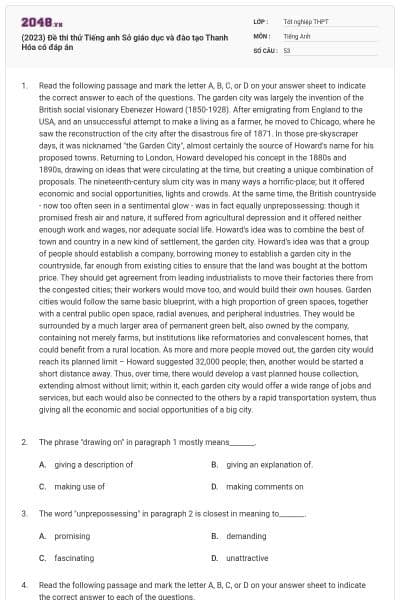
The phrase "drawing on" in paragraph 1 mostly means_______.
giving a description of
giving an explanation of.
making use of
making comments on
Cụm “drawing on” trong đoạn 1 có nghĩa là ____.
A. đưa ra mô tả
B. đưa ra lời giải thích
C. tận dụng
D. bình luận
draw on something: dựa vào cái gì = make use of something
→ Chọn đáp án C
The word "unprepossessing" in paragraph 2 is closest in meaning to_______.
promising
demanding
fascinating
unattractive
Từ “unprepossessing” trong đoạn 2 đồng nghĩa với từ _____.
A. promising (adj): hứa hẹn
B. demanding (adj): đòi hỏi (thời gian, công sức,…)
C. fascinating (adj): lôi cuốn
D. unattractive (adj): không thu hút
unprepossessing (adj): không hấp dẫn = unattractive
→ Chọn đáp án D
The word "They" in paragraph 3 refers to_______.
industries
avenues
green spaces
garden cities
Từ “They” trong đoạn 3 đề cập đến ____.
A. các ngành công nghiệp
B. các đại lộ
C. các không gian xanh
D. các thành phố vườn
Thông tin:
Garden cities would follow the same basic blueprint, with a high proportion of green spaces, together with a central public open space, radial avenues, and peripheral industries. They would be surrounded by a much larger area of permanent green belt, also owned by the company, containing not merely farms, but institutions like reformatories and convalescent homes, that could benefit from a rural location. (Thành phố vườn sẽ tuân theo bản thiết kế cơ bản, với các không gian xanh chiếm tỷ lệ cao, cùng với một không gian mở công cộng ở trung tâm, các đại lộ xuyên tâm, và các khu công nghiệp ở ngoại biên. Chúng sẽ được bao quanh bởi một vành đai xanh lớn, cũng do công ty sở hữu, không chỉ bao gồm các nông trại, mà còn cả các tổ chức như trường giáo dưỡng và nhà dưỡng bệnh, những nơi này có thể hưởng lợi từ vị trí nông thôn.)
→ Chọn đáp án D
Which of the following is NOT true according to the passage?
Howard's idea was the combination of the best of town and city in a new kind of settlement.
Each garden city would offer a wide variety of jobs and services.
Howard got the name for his building plan of garden cities by using the nickname of Chicago.
Howard's concept of garden cities was not influenced by other people's ideas.
Điều nào sau đây không đúng theo đoạn văn?
A. Ý tưởng của Howard là sự kết hợp giữa những gì tốt nhất của thị trấn và thành phố theo một kiểu chỗ ở mới.
B. Mỗi thành phố vườn sẽ cung cấp nhiều việc làm và dịch vụ.
C. Howard lấy tên cho kế hoạch xây dựng thành phố vườn bằng cách sử dụng biệt danh của Chicago.
D. Ý tưởng về thành phố vườn của Howard không bị ảnh hưởng bởi ý tưởng của những người kháC.
Thông tin:
+ Howard's idea was to combine the best of town and country in a new kind of settlement, the garden city. (Ý tưởng của Howard là kết hợp những gì tốt nhất của thành phố và vùng nông thôn theo một kiểu chỗ ở mới, thành phố vườn.)
→ A đúng
+ Thus, over time, there would develop a vast planned house collection, extending almost without limit; within it, each garden city would offer a wide range of jobs and services, but each would also be connected to the others by a rapid transportation system, thus giving all the economic and social opportunities of a big city. (Do đó, qua thời gian, chúng ta sẽ phát triển một tập hợp nhà rộng lớn, trải dài không giới hạn; trong đó, mỗi thành phố vườn sẽ cung cấp vô số việc làm và dịch vụ, nhưng mỗi nơi sẽ được kết nối với các nơi khác bằng một hệ thống giao thông nhanh chóng, từ đó mang đến toàn bộ cơ hội về kinh tế và xã hội của một thành phố lớn.)
→ B đúng
+ In those pre-skyscraper days, it was nicknamed "the Garden City", almost certainly the source of Howard's name for his proposed towns. (Vào thời kỳ chưa có những tòa nhà chọc trời, nó có biệt danh là “Thành phố vườn”, gần như chắc chắn là nguồn gốc của cái tên mà Howard đã đặt cho những thành phố mình đề xuất.)
→ C đúng
+ Returning to London, Howard developed his concept in the 1880s and 1890s, drawing on ideas that were circulating at the time, but creating a unique combination of proposals. (Quay trở về London, Howard đã phát triển ý tưởng của mình vào những năm 1880 và 1890, dựa trên những ý tưởng đang thịnh hành vào thời điểm đó, nhưng tạo ra một sự kết hợp độc đáo của các đề xuất.)
→ D sai
→ Chọn đáp án D
Which best serves as the title for the passage?
Garden City Movement
The Invention of the Garden City
City and Countryside?
A new city in Chicago
Đâu là tiêu đề phù hợp nhất cho đoạn văn?
A. Phong trào thành phố vườn
B. Sự phát minh thành phố vườn
C. Thành phố và nông thôn?
D. Một thành phố mới ở Chicago
Tóm tắt:
Đoạn văn nói về ý tưởng xây dựng thành phố vườn của Ebenezer Howard
==> Sự phát minh thành phố vườn
→ Chọn đáp án B
According to paragraph 3, garden cities were planned________.
to be similar to each other in layout
to integrate institutions within the city area
to keep industrial activity to a minimum
to provide buildings for public gatherings
Theo đoạn 3, các thành phố vườn được quy hoạch ______.
A. giống nhau về bố cục
B. tích hợp các tổ chức trong khu vực thành phố
C. giữ hoạt động công nghiệp ở mức tối thiểu
D. cung cấp các tòa nhà cho các cuộc tụ họp công chúng
Thông tin:
Garden cities would follow the same basic blueprint, with a high proportion of green spaces, together with a central public open space, radial avenues, and peripheral industries. (Thành phố vườn sẽ tuân theo bản thiết kế cơ bản giống nhau, với các không gian xanh chiếm tỷ lệ cao, cùng với một không gian mở công cộng ở trung tâm, các đại lộ xuyên tâm, và các khu công nghiệp ở ngoại biên.)
→ Chọn đáp án A
What can be inferred about garden cities from the last paragraph?
Each one would contain a certain type of business.
Residents would live and work in the same place.
Their number would continue to rise.
Each one would continue to become larger.
Điều gì có thể suy ra về các thành phố vườn từ đoạn cuối?
A. Mỗi thành phố sẽ có một loại công ty cụ thể.
B. Người dân sẽ sinh sống và làm việc ở cùng một địa điểm.
C. Số lượng các thành phố sẽ tiếp tục tăng.
D. Mỗi thành phố sẽ tiếp tục rộng lớn hơn.
Thông tin:
As more and more people moved out, the garden city would reach its planned limit – Howard suggested 32,000 people; then, another would be started a short distance away. (Vì ngày càng có nhiều người chuyển đi, thành phố vườn sẽ đạt giới hạn quy hoạch - Howard đã đề xuất 32,000 người; sau đó, một thành phố khác sẽ được xây dựng cách đó không xa.)
→ Chọn đáp án C
Mark the letter A, B, C, on your answer sheet to indicate the word CLOSEST in meaning to the underlined word in each of the following questions.
The new college is intended to improve the life chances of children in the inner city.
communities
questions
productions
opportunities
A. cộng đồng
B. câu hỏi
C. sản lượng
D. cơ hội
chance (n): cơ hội = opportunity
Tạm dịch: Trường đại học mới dự định cải thiện cơ hội trong cuộc sống của những đứa trẻ nội thành.
→ Chọn đáp án D
The fire ruined the forest completely; all habitats were totally in the flames.
decreased
destroyed
improved
impacted
A. giảm
B. phá hủy
C. cải thiện
D. tác động
ruin (v): phá hủy, hủy hoại = destroy
Tạm dịch: Trận cháy đã phá hủy hoàn toàn khu rừng; tất cả môi trường sống của động vật hoàn toàn chìm trong lửa.
→ Chọn đáp án B
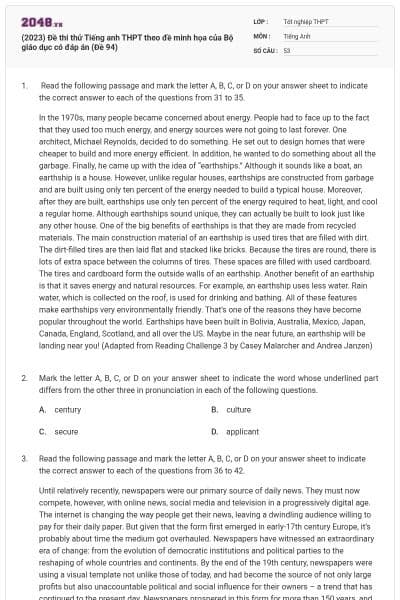
Read the following passage and mark the letter A, B, C, or D on your answer sheet to indicate the correct answer to each of the questions.
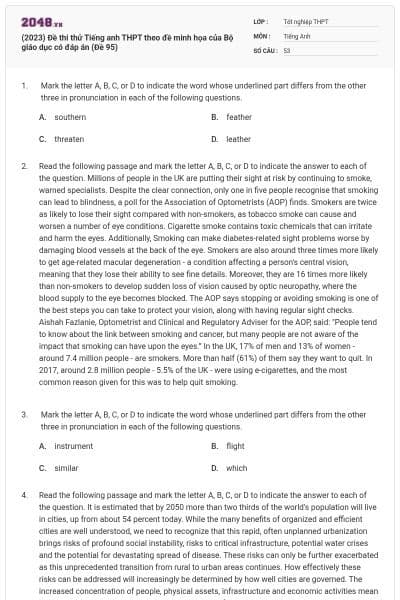
Sylvia Earle is an underwater explorer and marine biologist who was born in the USA in 1935. She became interested in the world's oceans from an early age. As a child, she liked to stand on the beach for hours and look at the sea, wondering what it must be like under the surface. When she was 16, she finally got a chance to make her first dive. It was this dive that inspired her to become an underwater explorer. Since then, she has spent more than 6,500 hours under water, and has led more than seventy expeditions worldwide. She has also made the deepest dive ever, reaching a record-breaking depth of 381 meters. In 1970, she became famous around the world when she became the captain of the first all-female team to live under water. The team spent two weeks in an underwater "house". The research they carried out showed the damage that pollution was causing to marine life, and especially to coral reefs. Since then she has written several books and magazine articles in which she suggests ways of reducing the damage that is being done to the world's oceans. One way, she believes, is to rely on fish farms for seafood, and reduce the amount of fishing that is done out at sea. (Adapted from Workbook Complete IELTS by Rawdon Wyatt)
The word "they" in paragraph 2 refers to______.
reefs
the team
farms
articles
Từ “they” trong đoạn 2 đề cập đến _____.
A. các đá ngầm
B. nhóm
C. các trang trại
D. các bài báo
Thông tin:
The team spent two weeks in an underwater "house". The research they carried out showed the damage that pollution was causing to marine life, and especially to coral reefs. (Nhóm đã dành 2 tuần trong một “căn nhà” dưới nước. Nghiên cứu mà họ tiến hành đã cho thấy thiệt hại mà ô nhiễm đang gây ra cho đời sống biển, và nhất là đối với các rạn san hô.)
→ Chọn đáp án B
Which of the following is NOT true, according to the passage?
Sylvia Earle believes that we should cut down on fishing at sea.
The team of all-female divers led by Sylvia Earle spent 14 days underwater.
Sylvia Earle set a record for the deepest dive.
It was not until Sylvia Earle made her first dive that she was interested in the world's oceans.
Điều nào sau đây không đúng, theo đoạn văn?
A. Sylvia Earle tin rằng chúng ta nên cắt giảm việc đánh bắt cá ở biển.
B. Nhóm toàn nữ thợ lặn được Sylvia Earle dẫn dắt đã dành 14 ngày dưới nước.
C. Sylvia Earle đã lập kỷ lục lặn sâu nhất.
D. Mãi đến khi Sylvia Earle lặn lần đầu tiên thì bà mới hứng thú với các đại dương trên thế giới.
Thông tin:
+ One way, she believes, is to rely on fish farms for seafood, and reduce the amount of fishing that is done out at sea. (Bà tin rằng, một cách chính là phụ thuộc vào các trang trại cá để lấy hải sản, và giảm sản lượng đánh bắt cá ở biển.)
→ A đúng
+ In 1970, she became famous around the world when she became the captain of the first all-female team to live under water. The team spent two weeks in an underwater "house". (Năm 1970, bà đã nổi tiếng khắp thế giới khi trở thành đội trưởng đội toàn nữ sống dưới nước. Nhóm đã dành 2 tuần trong một “căn nhà” dưới nước.)
→ B đúng
+ She has also made the deepest dive ever, reaching a record-breaking depth of 381 meters. (Bà cũng đã thực hiện chuyến lặn sâu nhất, đạt độ sâu kỷ lục 381 mét.)
→ C đúng
+ She became interested in the world's oceans from an early age. As a child, she liked to stand on the beach for hours and look at the sea, wondering what it must be like under the surface. When she was 16, she finally got a chance to make her first dive. (Bà hứng thú với các đại dương trên thế giới từ khi còn nhỏ. Hồi còn bé, bà thích đứng trên biển hàng giờ và nhìn ra biển, tự hỏi dưới mặt nước sẽ ra sao. Khi bà 16 tuổi, bà cuối cùng cũng có cơ hội đi lặn lần đầu tiên.)
→ D sai
→ Chọn đáp án D
Which best serves as the title for the passage?
Sylvia Earle, an underwater hero.
Ways to reduce the damage to oceans.
Sylvia Earle's first dive.
The first all-female divers.
Đâu là tiêu đề phù hợp nhất cho đoạn văn?
A. Sylvia Earle, một anh hùng dưới nước
B. Các cách để giảm thiệt hại cho đại dương
C. Chuyến lặn đầu tiên của Sylvia Earle
D. Những thợ lặn toàn nữ đầu tiên
Tóm tắt:
Đoạn văn nói về nhà thám hiểm dưới nước Sylvia Earle
==> Sylvia Earle, một anh hùng dưới nước
→ Chọn đáp án A
According to paragraph 1, Sylvia Earle_______.
was keen on the world's oceans when young
relocated to the US in 1935
made her first voyage from an early age.
often looked at the sea with her friends
Theo đoạn 1, Sylvia Earle _____.
A. thích các đại dương trên thế giới khi còn nhỏ
B. di cư đến Mỹ vào năm 1935
C. thực hiện chuyến đi đầu tiên từ khi còn nhỏ
D. thường nhìn ra biển cùng với bạn bè mình
Thông tin:
She became interested in the world's oceans from an early age. (Bà đã trở nên hứng thú với các đại dương trên thế giới từ khi còn nhỏ.)
→ Chọn đáp án A
The word "inspired" in paragraph 1 is closest in meaning to______.
disappointed
encouraged
forced
prevented
Từ “inspired” trong đoạn 1 đồng nghĩa với từ _____.
A. làm thất vọng
B. khuyến khích
C. bắt buộc
D. ngăn cản
inspire (v): truyền cảm hứng = encourage
→ Chọn đáp án B
Mark the letter A, B, C, or D on your answer sheet to indicate the correct answer to each of the following questions.
They have_______ some measures to control traffic jam at rush hours.
done
carried
made
taken
Cụm từ (Collocations):
take a measure: tiến hành biện pháp
Tạm dịch: Họ đã tiến hành một số biện pháp nhằm kiểm soát vấn nạn kẹt xe vào giờ cao điểm.
→ Chọn đáp án D
It's so busy in my office. I don't get the chance to________ my breath after my long journey into the office. I have to get down to work as soon as I get in.
trap
catch
grab
keep
Thành ngữ (Idioms):
catch your breath: lấy hơi, nghỉ xả hơi
Tạm dịch: Văn phòng tôi quá bận rộn. Tôi còn không có cơ hội để thở sau chuyến đi dài đến văn phòng. Tôi phải bắt tay vào làm việc ngay khi đến nơi.
→ Chọn đáp án B
We arranged to meet at 7.30, but she didn't______.
take off
turn down
take up
turn up
Kiến thức cụm động từ (Phrasal verbs):
- take off something: cởi cái gì ra (quần áo, phụ kiện,…)
- turn down something: từ chối cái gì
- take up something: theo đuổi cái gì (thể thao, sở thích, thói quen,…)
- turn up: xuất hiện
Tạm dịch: Chúng tôi đã hẹn gặp vào lúc 7.30, nhưng cô ấy đã không xuất hiện.
→ Chọn đáp án D
Alice took great photos of butterflies while she_______ in the forest.
hiked
had hiked
was hiking
taken
Hòa hợp thì:
QKĐ + while + QKTD: diễn tả 1 hành động đang xảy ra trong quá khứ thì có 1 hành động khác chen vào
Tạm dịch: Alice chụp những tấm ảnh bướm rất đẹp trong khi đi bộ đường dài trong rừng.
→ Chọn đáp án C
Many ethnic groups find it difficult to_________ their culture.
preservation
preservative
preserve
preservatory
Kiến thức từ vựng:
- preservation (n): sự bảo tồn
- preservative (n): chất bảo quản
- preserve (v): bảo tồn, bảo quản, giữ gìn
Chỗ trống đứng sau “to” → cần động từ
Tạm dịch: Nhiều nhóm dân tộc cảm thấy khó để bảo tồn văn hóa của mình.
→ Chọn đáp án C
The letter_________ me of the theft hadn't been signed.
to accuse
that accuses
accused
accusing
Rút gọn mệnh đề quan hệ:
Mệnh đề quan hệ dạng chủ động rút gọn bằng cách lược bỏ đại từ và chuyển V sang V-ing.
Tạm dịch: Bức thư cáo buộc tôi là kẻ trộm chưa được ký.
→ Chọn đáp án D
Juliette leads a quiet life_______ a small town.
in
at
on
from
Giới từ:
Trước danh từ chỉ khu vực địa lý rộng lớn (town) → dùng giới từ “in”
Tạm dịch: Juliette sống một cuộc đời bình lặng ở một thị trấn nhỏ.
→ Chọn đáp án A
I love the________ car that is always parked at the end of the street.
Germen nice big
big nice German
nice big German
big German nice
OSASCOMP: Opinion - Size - Age - Shape - Color - Origin – Material – Purpose
opinion → nice
size → big
origin → German
Tạm dịch: Tôi rất thích chiếc xe ô tô cỡ lớn tuyệt đẹp của Đức mà luôn đỗ ở cuối con đường.
→ Chọn đáp án C
She was still worried_______ having prepared carefully for the job interview.
because of
although
because
despite
Liên từ/Trạng từ:
- because of + N/V-ing: vì
- although + clause: mặc dù
- because + clause: vì
- despite + N/V-ing: mặc dù
Phía sau chỗ cần điền là V-ing, nên ta chỉ dùng A hoặc D. Hợp nghĩa chọn D.
Tạm dịch: Cô ấy vẫn lo lắng mặc dù đã chuẩn bị kỹ lưỡng cho buổi phỏng vấn xin việc.
→ Chọn đáp án D
Vietnamese soldiers and medical workers_______ to Turkey for earthquake relief.
were sent
have sent
send
had sent
Câu bị động (Passive voice):
Câu bị động ở thì QKĐ: was/were + V3/V-ed
Tạm dịch: Binh lính Việt Nam và các nhân viên y tế đã được cử đến Thổ Nhĩ Kỳ để cứu trợ động đất.
→ Chọn đáp án A
If Hoa's brother had listened to her advice, he wouldn't have bought a_______ in a poke. She can't believe he wasted so much money on such rubbish.
mouse
pig
cat
bird
Thành ngữ (Idioms):
buy a pig in a poke: mua thứ gì mà không cân nhắc
Tạm dịch: Nếu em của Hoa nghe theo lời khuyên của cô, thì cậu ấy đã không mua đồ mà không cân nhắc. Cô ấy không thể tin được cậu ấy đã lãng phí quá nhiều tiền vào thứ vớ vẩn như thế.
→ Chọn đáp án B
Although I like the dress very much, the_______ cost of it is what really puts me off.
expensive
extraordinary
cheap
sheer
Kiến thức từ vựng:
- expensive (adj): đắt tiền
- extraordinary (adj): khác thường
- cheap (adj): rẻ tiền
- sheer (adj): dùng để nhấn mạnh mức độ to lớn của thứ gì. → sheer cost (n): chi phí đắt đỏ
Tạm dịch: Mặc dù tôi rất thích bộ đầm, nhưng sự đắt tiền của nó đã thật sự làm tôi chùn lòng.
→ Chọn đáp án D
Students often use their calculators to solve tricky questions,_______?
don't they
do they
do we
don’t we
Câu hỏi đuôi (Tag questions):
Mệnh đề chính khẳng định → câu hỏi đuôi phủ định
Mệnh đề chính dùng động từ thường ở HTĐ với chủ ngữ số nhiều ‘students’ → câu hỏi đuôi dùng “do” và đại từ ‘they’
==> Câu hỏi đuôi dùng “don’t they”
Tạm dịch: Học sinh thường sử dụng máy tính để giải những câu hỏi khó, có đúng không?
→ Chọn đáp án A
The more I concentrate,________ my answers are.
the accurate
the more accurate
the most accurate
more accurate
Cấu trúc so sánh kép:
The + so sánh hơn + S + V, the + so sánh hơn + S + V: càng…càng
Tạm dịch: Tôi càng tập trung, thì những đáp án tôi đưa ra càng chính xác.
→ Chọn đáp án B
John will look for a job_______.
before he passed his exams
while he was passing his exams
after he had passed his exams
as soon as he passes his exams
Hòa hợp thì:
TLĐ + liên từ + HTĐ
Tạm dịch: John sẽ tìm việc làm ngay khi vượt qua các kỳ thi.
→ Chọn đáp án D
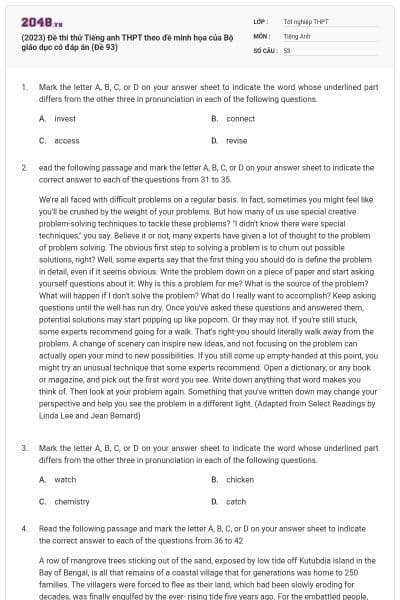
Mark the letter A, B, C or D on your answer sheet to indicate the word whose underlined part differs from the other three in pronunciation in each of the following.
cleaned
stopped
picked
watched
A. cleaned /kliːnd/: làm sạch
B. stopped /stɒpt/: ngừng
C. picked /pɪkt/: nhặt, cầm
D. watched /wɒtʃt/: xem
Đáp án A có âm “ed” phát âm là /d/, các đáp án còn lại phát âm là /t/.
→ Chọn đáp án A
Mark the letter A, B, C or D on your answer sheet to indicate the word whose underlined part differs from the other three in pronunciation in each of the following.
wear
heat
meat
seat
A. wear /weər/ (n): quần áo, sờn, mòn
B. heat /hiːt/ (n): sức nóng
C. meat /miːt/ (n): thịt
D. seat /siːt/ (n): chỗ ngồi, ghế ngồi
Đáp án A có âm “ea” phát âm là /eə/, các đáp án còn lại phát âm là /iː/.
→ Chọn đáp án A
Mark the letter A, B B, C, or on your answer sheet to indicate the sentence that best combines each pair of sentences in the following questions.
She read all the instructions of the exam. She started to do it.
Only by reading all the instructions of the exam did she start to do it.
Hardly had she read all the instructions of the exam when she started to do it.
Not until she started to do the exam did she read all of its instructions.
Only after reading all the instructions of the exam that she started to do it.
Cô ấy đọc tất cả những yêu cầu của bài kiểm tra. Cô ấy bắt đầu làm.
A. Chỉ bằng việc đọc tất cả những yêu cầu của bài kiểm tra thì cô ấy mới bắt đầu làm.
B. Ngay khi cô ấy đọc tất cả những yêu cầu của bài kiểm tra thì cô ấy đã bắt đầu làm.
C. Mãi đến khi cô ấy bắt đầu làm bài thi thì cô ấy mới đọc tất cả những yêu cầu của nó.
D. Sai ngữ pháp, Only after + QKHT + đảo ngữ QKD.
→ Chọn đáp án B
They are too busy with their work. They really want to go for a picnic.
Provided that they aren't busy with their work, they can't go for a picnic.
If they hadn't been busy with their work, they couldn't have gone for a picnic.
They wish they weren't busy with their work so that they could go for a picnic.
If only they hadn't been busy with their work, they couldn't have gone for a picnic.
Họ quá bận rộn với công việc. Họ thật sự muốn đi dã ngoại.
A. Sai vì phải dùng câu điều kiện loại 2.
B. Sai vì phải dùng câu điều kiện loại 2.
C. Họ ước mình không bận rộn với công việc để có thể đi dã ngoại.
D. Sai vì phải dùng câu điều kiện loại 2.
→ Chọn đáp án C
Mark the letter A, B, C,or D on your answer sheet to indicate the sentence that best completes each of the following exchanges.
Mary is at Daisy's birthday party.
Mary: "What a beautiful dress you are wearing today, Daisy!"
Daisy: “_____________”
Don't mention it.
I'm sorry to hear that.
Thanks, it's nice of you to say so.
Thanks for your gift!
A. Không có gì. (đáp lại lời cảm ơn)
B. Mình rất tiếc khi nghe điều đó.
C. Cảm ơn nhé, bạn thật tốt khi nói thế.
D. Cảm ơn món quà của bạn.
Tạm dịch: Mary đang ở tiệc sinh nhật của Daisy.
- Mary: “Bộ váy bạn đang mặc hôm nay trông thật tuyệt, Daisy!”
- Daisy: “Cảm ơn nhé, bạn thật tốt khi nói thế.”
→ Chọn đáp án C
Linda and Peter are talking about safe driving.
Linda: "I think drink-driving should be severely punished."
Peter: "______________. It may cause accidents or even deaths."
You must be kidding.
I don't understand what you mean.
I absolutely agree with you.
I don't think so.
A. Bạn hẳn là đang nói đùa.
B. Mình không hiểu ý bạn.
C. Mình rất đồng tình với bạn.
D. Mình không nghĩ thế.
Tạm dịch: Linda và Peter đang nói chuyện về việc lái xe an toàn.
- Linda: “Mình nghĩ việc uống rượu lái xe nên bị phạt nghiêm khắc.”
- Peter: “Mình rất đồng tình với bạn. Nó có thể gây tai nạn hoặc thậm chí gây chết người.”
→ Chọn đáp án C
The researchers have found that there are three key personality traits that can make (36)_____ people more accident-prone than others.
each
every
any
some
A. each + N (số ít): mỗi
B. every + N (số ít): mọi
C. any + N (đếm được/không đếm được): bất kỳ
D. some + N (đếm được/không đếm được): một số
Tạm dịch:
The researchers have found that there are three key personality traits that can make some people more accident-prone than others. (Các nhà nghiên cứu đã cho thấy rằng có 3 đặc điểm tính cách chủ yếu có thể khiến một số người dễ gặp tai nạn hơn những người khác.)
→ Chọn đáp án D
put
make
carry
bring
Thành ngữ (Idioms):
put somebody/something at risk: khiến ai/cái gì gặp nguy hiểm
Tạm dịch:
Firstly, high levels of aggressiveness or selfishness may put people more at risk of having accidents as individuals with these characteristics are often highly competitive and therefore more likely not to follow instructions and to ignore rules. (Đầu tiên, mức độ hung hăng hoặc ích kỷ có thể đặt mọi người vào tình huống dễ gặp tai nạn hơn vì các cá nhân có những tính cách này thường có tính cạnh tranh cao và do đó có khả năng không tuân theo chỉ dẫn và phớt lờ các luật lệ.)
→ Chọn đáp án A
which
whom
who
what
Mệnh đề quan hệ (Relative clause):
Dùng đại từ “who” làm chủ ngữ thay thế cho đại từ ‘those’ chỉ người phía trước,
Tạm dịch:
It also seems that those who have very open personalities may also have more accidents as these kinds of people can be dreamy and lack concentration. (Dường như những ai có tính cách cởi mở cũng có thể dễ gặp tai nạn vì những người này có thể mơ mộng và thiếu tập trung.)
→ Chọn đáp án C
moreover
however
although
therefore
A. moreover: hơn nữa
B. however: tuy nhiên
C. although: mặc dù
D. therefore: do đó
Tạm dịch:
Not everyone, however, agrees with the study's findings. (Tuy nhiên, không phải ai cũng đồng ý với những kết quả thu được từ nghiên cứu.)
→ Chọn đáp án B
A spokesperson for an accident prevention organization said: "We must (40) ________responsibility for our actions and educate people to prevent accidents instead of blaming our personalities."
receive
accept
draw
make
A. receive (v): nhận
B. accept (v): chấp nhận → accept/take responsibility for something: chịu trách nhiệm cho cái gì
C. draw (v): vẽ
D. make (v): làm
Tạm dịch:
A spokesperson for an accident prevention organization said: "We must accept responsibility for our actions and educate people to prevent accidents instead of blaming our personalities." (Một phát ngôn viên cho một tổ chức phòng ngừa tai nạn đã nói: “Chúng ta phải chịu trách nhiệm cho hành động của chúng ta và giáo dục mọi người ngăn ngừa các tai nạn thay vì đổ lỗi cho tính cách của mình.”)
→ Chọn đáp án B
Mark the letter A, B, C, or D on your answer sheet to indicate the underlined part that needs to be corrected on each of the following questions.
Millions of students took part in the entrance examination at university every year.
examination
in
students
took
Chia thì:
“every year” → dấu hiệu nhận biết thì HTĐ
Sửa: took → take
Tạm dịch: Hàng triệu học sinh tham gia vào kỳ thi tuyển sinh đại học hàng năm.
→ Chọn đáp án D
Peacocks are among the most exotic birds in nature; its long tail feathers fan out to reveal a profusion of vivid colors.
most exotic
among
fan out
its
Chủ ngữ số nhiều (peacocks) → dùng tính từ sở hữu their để quy chiếu
Sửa: its → their
Tạm dịch: Chim công thuộc nhóm những loài chim lạ nhất trong tự nhiên; chiếc lông đuôi dài của nó xòe ra để lộ vô số màu sắc sống động.
→ Chọn đáp án D
Alice broke the school rules so many times that the headmistress finally had no alternation but to expel her.
school rules
expel her
alternation
so many
Đáp án: C
Giải thích:
Kiến thức:Từ vựng
alternation (n): sự đan xen, xen kẽ
alternative (n): lựa chọn thay thế
Sửa: alternation → alternative
Dịch: Alice đã vi phạm quy định trường học nhiều lần đến nỗi hiệu trưởng cuối cùng cũng không còn lựa chọn nào khác ngoài đuổi học cô.
Mark the letter A, B, C or D on your answer sheet to indicate the word that differs from the other three in the position of the primary stress in each of the following questions.
depend
derive
master
provide
A. depend /dɪˈpend/ (v): phụ thuộc
B. derive /dɪˈraɪv/ (v): bắt nguồn từ
C. master /ˈmɑː.stər/ (v): thông thạo
D. provide /prəˈvaɪd/ (v): cung cấp
Đáp án C có trọng âm rơi vào âm tiết thứ nhất, các đáp án còn lại trọng âm rơi vào âm tiết thứ 2.
→ Chọn đáp án C
Mark the letter A, B, C or D on your answer sheet to indicate the word that differs from the other three in the position of the primary stress in each of the following questions.
chemical
emotion
activate
benefit
A. chemical /ˈkem.ɪ.kəl/ (n): chất hóa học
B. emotion /ɪˈməʊ.ʃən/ (n): cảm xúc
C. activate /ˈæk.tɪ.veɪt/ (v): kích hoạt
D. benefit /ˈben.ɪ.fɪt/ (n): lợi ích
Đáp án B có trọng âm rơi vào âm tiết thứ 2, các đáp án còn lại trọng âm rơi vào âm tiết thứ nhất.
→ Chọn đáp án B
Mark the letter A, B, C, or D on your answer sheet to indicate the word(s) OPPOSITE in meaning to the underlined word(s) in each of the following questions.
Hoai An was on edge all day about the important presentation she had to give to the group of local citizens.
aggressive
nervous
calm and relaxed
depressed
A. aggressive (adj): hung hăng
B. nervous (adj): lo lắng
C. calm and relaxed: bình tĩnh và thoải mái
D. depressed (adj): suy sụp, trầm cảm
be on edge: lo lắng, đứng ngồi không yên >< calm and relaxed
Tạm dịch: Hoài An đã lo lắng cả ngày về bài thuyết trình quan trọng mà cô ấy phải trình bày trước nhóm người dân địa phương.
→ Chọn đáp án C
Most of the female football players will be jobless when the Games are over.
unemployed
employed
highly-paid
busy
A. unemployed (adj): thất nghiệp
B. employed (adj): có việc làm
C. highly-paid (adj): được trả lương cao
D. busy (adj): bận rộn
jobless (adj): thất nghiệp >< employed
Tạm dịch: Đa số những cầu thủ bóng đá nữ sẽ bị thất nghiệp khi giải đấu kết thúc.
→ Chọn đáp án B
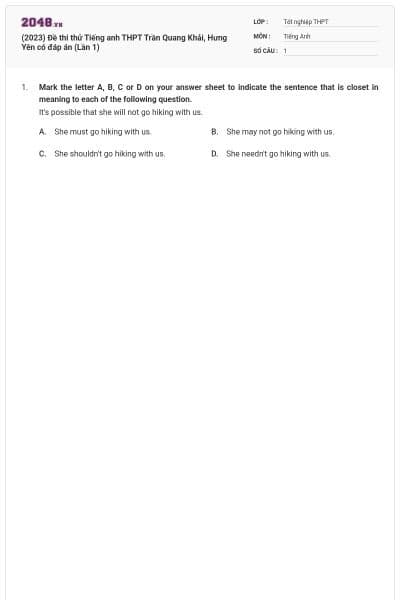
Mark the letter A, B, C or D on your answer sheet to indicate the sentence that is closest in meaning to each of the following questions.
It's very likely that the company will accept his application.
The company might accept his application.
The company need accept his application.
The company must accept his application.
The company should accept his application.
Rất có khả năng là công ty sẽ chấp nhận đơn xin việc của anh ấy.
A. Công ty có lẽ sẽ chấp nhận đơn xin việc của anh ấy.
B. Công ty cần chấp nhận đơn xin việc của anh ấy.
C. Công ty phải chấp nhận đơn xin việc của anh ấy.
D. Công ty nên chấp nhận đơn xin việc của anh ấy.
→ Chọn đáp án A
"I met my old friend yesterday." Anna said
Anna said that she would meet her old friend the previous day.
Anna said that she had met my old friend the previous day.
Anna said that she had met her old friend the previous day.
Anna said that she met her old friend the previous day.
“Tôi đã gặp người bạn cũ của tôi vào hôm qua.”, Anna đã nói.
A. Sai ngữ pháp
B. Anna đã nói rằng cô ấy đã gặp người bạn cũ của tôi vào ngày hôm trước.
C. Anna đã nói rằng cô ấy đã gặp người bạn cũ của cô ấy vào ngày hôm trước.
D. Sai ngữ pháp
Câu tường thuật (Reported speech):
Động từ tường thuật ở thì quá khứ (said), mệnh đề được tường thuật phải lùi thì: met → had met
Thay đổi trạng từ chỉ thời gian, nơi chốn khi chuyển sang câu gián tiếp: yesterday → the previous day
→ Chọn đáp án C
He hasn't changed his Facebook avatar for 3 years.
The last time he changed his Facebook avatar was 3 years ago.
He has changed his Facebook avatar 3 times.
He had 3 years to change his Facebook avatar.
He didn't change his Facebook avatar 3 years ago.
Anh ấy đã không thay ảnh đại diện Facebook được 3 năm.
A. Lần cuối anh ấy đổi ảnh đại diện Facebook là vào 3 năm trước.
B. Anh ấy đã đổi ảnh đại diện Facebook 3 lần.
C. Anh ấy có 3 năm để đổi ảnh đại diện Facebook.
D. Anh ấy đã không đổi ảnh đại diện Facebook vào 3 năm trước.
Cấu trúc:
S + have/has not + V3/V-ed + for (time) = The last time + S + V2/V-ed + was (time) ago
→ Chọn đáp án A