20 Đề thi thử THPTQG môn Tiếng Anh cực hay có đáp án (Đề số 19)
50 câu hỏi
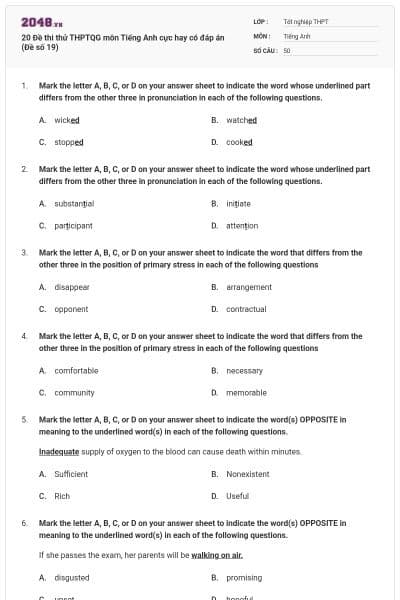
Mark the letter A, B, C, or D on your answer sheet to indicate the word whose underlined part differs from the other three in pronunciation in each of the following questions.
wicked
watched
stopped
cooked
Chọn đáp án A
- wicked /'wɪk.ɪd/ (adj): xấu xa, độc ác
- watched /wɒtʃt/ (v-ed): xem
- stopped /stɒpt/ (v-ed): dừng, ngừng lại
cooked /kʊkt (v-ed): nấu
Mark the letter A, B, C, or D on your answer sheet to indicate the word whose underlined part differs from the other three in pronunciation in each of the following questions.
substantial
initiate
participant
attention
Chọn đáp án C
- substantial /səb'stæn.jəl/ (adj): lớn lao, quan trọng, có giá trị lớn
- initiate /ɪ'nɪ.i.eɪt (v): khởi đầu, bắt đầu
- participant /pɑ:'tɪs.ɪ.pənt/ (n): người tham gia, người tham dự
attention /ə'ten.ʃən/ (n): sự chú ý
Mark the letter A, B, C, or D on your answer sheet to indicate the word that differs from the other three in the position of primary stress in each of the following questions
disappear
arrangement
opponent
contractual
Chọn đáp án A
- disappear /,dɪs.a'pɪər/(v): biến mất
- arrangement /ə’reɪndʒ.mənt/ (n): sự sắp xếp
- opponent /ə'pəʊ.nənt/ (n): đối thù, kẻ thù
contractual /kən'træk.tʃu.əl/ (adj): bằng hợp đồng
Mark the letter A, B, C, or D on your answer sheet to indicate the word that differs from the other three in the position of primary stress in each of the following questions
comfortable
necessary
community
memorable
Chọn đáp án C
- comfortable /'kʌm.fə.tə.bəl/ (adj): thoải mái
- necessary /'nes.ə.ser.i/ (adj): cần thiết
- community /kə'mju:.nə.ti/ (n): cộng đồng
memorable /'mem.ər.ə.bəl/ (adj): đáng ghi nhớ
Mark the letter A, B, C, or D on your answer sheet to indicate the word(s) OPPOSITE in meaning to the underlined word(s) in each of the following questions.
Inadequate supply of oxygen to the blood can cause death within minutes.
Sufficient
Nonexistent
Rich
Useful
Chọn đáp án A
- sufficient (adj): đủ
- nonexistent (adj): not existing; not real: không tồn tại
- rich (adj): giàu
- useful (adj): có ích
- inadequate (adj): not enough: không đủ, thiếu
Dịch: Việc cung cấp không đủ khí oxi cho máu có thể gây ra cái chết trong vòng vài phút.
Do đó: inadequate khác suf ficient
Mark the letter A, B, C, or D on your answer sheet to indicate the word(s) OPPOSITE in meaning to the underlined word(s) in each of the following questions.
If she passes the exam, her parents will be walking on air.
disgusted
promising
upset
hopeful
Chọn đáp án C
- disgusted (adj): ghê tởm
- promising (adj): đầy hứa hẹn, triển vọng
- upset (adj): buồn; thất vọng
- hopeful (adj): đầy hi vọng
- walk on air: feel very happy: cảm thấy vô cùng vui sướng, rất hạnh phúc
Dịch: Nếu cô ấy thi đỗ thì bố mẹ cô ấy sẽ cảm thấy rất hạnh phúc.
Mark the letter A, B, C, or D on your answer sheet to indicate the word(s) CLOSEST in meaning to the underlined word(s) in each of the following questions.
Tom is the black sheen of the family, so he is never welcomed there.
a beloved member
a bad and embarrassing member
the only child
the eldest child
Chọn đáp án B
- a beloved member: thành viên được yêu quý
- a bad and embarrassing member: thành viên được xem là sự xấu hổ với gia đình
- the only child: con một
- the eldest child: con cả
- the black sheep of the family (con cừu đen trong gia đình): chỉ một người khác biệt với những người khác trong gia đình (theo hướng xấu); thường được xem là nỗi nhục nhã hoặc sự xấu hổ cho gia đình.
Do đó: the black sheep ~ a bad and embarrassing member

Học thông minh hơn mỗi ngày
Xem toàn bộ 50 câu hỏi và nhiều hơn nữa với tài khoản miễn phí
Mark the letter A, B, C, or D on your answer sheet to indicate the word(s) CLOSEST in meaning to the underlined word(s) in each of the following questions.
He was brought up in a well-off family. He can’t understand the problems we are facing.
poor
broke
wealthy
kind
Chọn đáp án C
- poor (adj): nghèo
- broke (adj): túng tiền
- wealthy (adj): giàu có
- kind (adj): tử tế, tốt bụng
- well-off (adj): giàu có, sung túc
Do đó: well-off ~ wealthy
Dich: Anh ấy được nuôi dưỡng trong một gia đình giàu có. Anh ấy không thể hiểu được những vấn đề mà chúng ta đang đối mặt.
- Waitress: “Hi, may I take your order, madam?”
- Mrs. Brown: “_________.”
I don’t want to do anything. I’ve really had enough.
OK, here is my bill
Yes, I’d like some fish and chips
Sure, it’s delicious
Chọn đáp án C
Nữ phục vụ: Xin chào, quý khách gọi món gì chưa ạ?
Bà Brown: _________.
A. Tôi không muốn làm bất cứ việc gì. Tôi thực sự đã dùng đủ rồi.
B. OK, đây là hóa đơn của tôi
C. Vâng, tôi muốn một ít cá và khoai tây chiên.
D. Chắc chắn rồi, món ăn rất ngon.
- Mai: “Oops! I’m sorry for stepping on your foot” - Hoa: “ _________.”
Never mind
You don’t mind
You’re welcome
That’s fine
Chọn đáp án A
Mai: “Ối! Tớ xin lỗi vì đã dẫm lên chân cậu nhé!” Hoa: “_________.”
A. Không sao cả đâu
B. Cậu không phiền
C. Không có gì (đáp lại lời cảm ơn)
D. Điều đó ổn mà
If you put your money in a bank now, you may get 8% _________ annually.
interest
profit
money
income
Chọn đáp án A
- interest (n): tiền lãi
+ interest rate (n.p): lãi suất
- profit (n): lợi nhuận
- money (n): tiền
- income (n): thu nhập
Dịch: Nếu bạn gửi tiền vào ngân hàng bây giờ thì bạn sẽ nhận được lãi suất 8% một năm.
Many animal species are now on the _________ of extinction.
danger
border
verge
margin
Chọn đáp án C
- on the verge of sth/ doing sth: sắp/ suýt/ gần làm gì đó, trên bờ vực ...
- in danger (of sth): lâm vào cảnh nguy hiểm
- by a margin of: tỉ số là, với cách biệt
E.g: He beat the other runners by a margin of five seconds.
Dịch: Nhiều loài động vật bây giờ sắp tuyệt chủng.
_________, he received a big applause.
Finishing his presentation
His presentation has been finished
After he finishes his presentation
When finished his speech
Chọn đáp án A
Đây là cách rút gọn mệnh đề trạng ngữ ở chủ động khi chủ ngữ 2 vế giống nhau (dùng V-ing)
Ta thấy: When/ After he finished/ had finished his presentation, he received a big applause. => When/ After finishing his presentation, he received a big applause. Hoặc Finishing his presentation, he received a big applause. (rút gọn mệnh đề trạng ngữ ở chủ động)
Do đó: B, C sai thì động từ; D sai ngữ pháp (finished => finishing)
Dịch: Sau khi kết thúc bài thuyết trình của mình, anh ấy đã nhận được một tràng vỗ tay to.
I gave the waitress a $50 note and waited for my _________.
change
supply
cash
cost
Chọn đáp án A
- change (n): tiền lẻ, tiền thừa
- supply (n): sự cung cấp
- cash (n): tiền mặt
- cost (n): chi phí
Dịch: Tôi đã đưa cho bạn nữ phục vụ 50 đô và chờ lấy lại tiền thừa.
They are always on good _________with their next-door neighbors.
will
friendship
terms
relations
Chọn đáp án C
- will (n): ý chí, nguyện vọng
- friendship (n): tình bạn
- terms (n.pl): quan hệ
- relations (n.pl): mối quan hệ, sự liên hệ
+ be on good terms with sb ~ have a good relationship with sb: có mối quan hệ tốt với ai đó
Dịch: Họ luôn có mối quan hệ tốt với hàng xóm bên cạnh của mình.
In the end, he lost his _________and started gabbling incoherently.
head
mind
brain
intelligence
Chọn đáp án A
- head (n): đầu
- mind (n): tâm trí, trí tuệ
- brain (n): não
- intelligence (n): sự thông minh
+ lose one’s head: become unable to act in a calm or sensible way: mất bình tĩnh
+ lose one’s mind: become mentally ill: mất trí, trở nên điên rồ
Dịch: Cuối cùng, anh ấy mất bình tĩnh và bắt đầu nói lắp bắp không rõ ràng.
Governments should _________ some international laws against terrorism.
bring up
bring about
bring in
bring back
Chọn đáp án C
- bring up (ph.v): nuôi dưỡng
- bring about (ph.v): làm xảy ra, dẫn đến
- bring in (ph.v): introduce a new law: giới thiệu/ công khai luật mới nào đó
- bring back (ph.v): mang trả lại, làm nhớ lại
Dịch: Các chính phủ nên ban hành một số luật quốc tế để chống lại khủng bố.
Students can _________lots of information by attending lectures regularly.
absorb
provide
read
transmit
Chọn đáp án A
- absorb (v): hấp thụ, tiếp thu
+ absorb information: tiếp thu thông tin
- provide (v): cung cấp
- read (v): đọc
- transmit (v): truyền
Dịch: Học sinh có thể tiếp thu được nhiều thông tin bằng việc tham gia nghe giảng đều đặn.
The size and shape of a nail depend primarily on the function _________intended.
which it is
for which it is
which it is for
for which is
Chọn đáp án B
- intend + for: định dùng, ý định cho
- giới từ có thể được đảo lên trước đại từ quan hệ
- Trong câu này, “which” thay thế cho danh từ “the function”
Do đó: The size and shape of a nail depend primarily on the function for which it is intended. = The size and shape of a nail depend primarily on the function which it is intended for.
Dịch: Kích cỡ và hình dạng của cái đinh phụ thuộc chủ yếu vào chức năng mà nó định dùng.
__________________ we have!
What awful weather
How awful is the weather
How awful the weather
What an awful weather
Chọn đáp án A
Cấu trúc: - Câu cảm thán với how và what:
* What + a/an + adj + N (đếm được số ít) (+ S + V)!/ What + adj + N (không đếm được) (+ S + V)!/ What + adj + N (đếm được số nhiều) + (S + V)!
E.g: What a lovely house you have!
* How + adj/adv + S + V!
E.g: How beautiful she is!
Do đó, B và C sai cấu trúc; D sai vì "weather" là danh từ không đếm được nên không có mạo từ “a/an” phía trước.
I think that married couples should be financially independent _________their parents.
to
of
with
on
Chọn đáp án B
- independent of sb/ sth: độc lập, không phụ thuộc vào
E.g: Students should aim to become more independent of their teachers.
Dịch: Tôi nghĩ rằng các cặp đôi đã kết hôn không nên phụ thuộc tài chính vào bố mẹ mình.
Many ambulances took _________ injured to a nearby hospital.
an
a
the
Chọn đáp án C
- the injured (n.pl): the people injured in an accident, a battle, etc: những người bị thương
Dịch: Nhiều xe cứu thương đã chở những người bị thương tới bệnh viện gần đó.
Read the following passage and mark the letter A, B, C, or D on your answer sheet to indicate the correct word or phrase that best fits each of the numbered blanks from 23 to 27.
The use of computers has meant that students can study language programmes (23) _________ their own speed when and for how long they want. What’s more, in the virtual classrooms of the future the student will put on their headset, and be transported into an imaginary school, choose their class, take the books they need off the shelf and hold conversations with other computerised students. They might instead choose to pay a visit to the supermarket or the train station, the bank or the restaurant. At the (24) _________ of a button they would be transported to (25) _________ realistic settings where they could practice their English, maybe getting a hand from a virtual English companion. All this perhaps, at the computer, from the comfort of their home: no (26) _________to catch the bus to college, or a plane to England. Exciting? Certainly, and it’s an interesting alternative to traditional classroom lessons. But would it ever (27)_________the classroom? Hopefully not. Surely the need to relate to real people talking about real issues and generally learning a little more about others will always lead language learners to uzcx be exc eg at least a little of their time with real people.
Điền vào số (23)
on
in
at
of
Chọn đáp án C
- do sth at one’s own speed: làm việc gì theo nhịp độ mà mình thích/ muốn
“The use of computers has meant that students can study language programmes at their own speed when and for how long they want” (Việc sử dụng máy tính nghĩa là học sinh có thể học các chương trình ngoại ngữ tùy theo nhịp độ mà họ muốn học lúc nào và trong bao lâu)
Read the following passage and mark the letter A, B, C, or D on your answer sheet to indicate the correct word or phrase that best fits each of the numbered blanks from 23 to 27.
The use of computers has meant that students can study language programmes (23) _________ their own speed when and for how long they want. What’s more, in the virtual classrooms of the future the student will put on their headset, and be transported into an imaginary school, choose their class, take the books they need off the shelf and hold conversations with other computerised students. They might instead choose to pay a visit to the supermarket or the train station, the bank or the restaurant. At the (24) _________ of a button they would be transported to (25) _________ realistic settings where they could practice their English, maybe getting a hand from a virtual English companion. All this perhaps, at the computer, from the comfort of their home: no (26) _________to catch the bus to college, or a plane to England. Exciting? Certainly, and it’s an interesting alternative to traditional classroom lessons. But would it ever (27)_________the classroom? Hopefully not. Surely the need to relate to real people talking about real issues and generally learning a little more about others will always lead language learners to uzcx be exc eg at least a little of their time with real people.
Điền vào số (24)
force
hit
depress
push
Chọn đáp án D
- force (n): sức, lực
- hit (n): đòn, cú đánh trúng
- depress (v): ấn xuống, nén xuống
- push (n): sự xô, cú đẩy, ...
+ At the push of a button: very easily: rất dễ dàng
E.g: He could get everything he needs at the push of a button.
Read the following passage and mark the letter A, B, C, or D on your answer sheet to indicate the correct word or phrase that best fits each of the numbered blanks from 23 to 27.
The use of computers has meant that students can study language programmes (23) _________ their own speed when and for how long they want. What’s more, in the virtual classrooms of the future the student will put on their headset, and be transported into an imaginary school, choose their class, take the books they need off the shelf and hold conversations with other computerised students. They might instead choose to pay a visit to the supermarket or the train station, the bank or the restaurant. At the (24) _________ of a button they would be transported to (25) _________ realistic settings where they could practice their English, maybe getting a hand from a virtual English companion. All this perhaps, at the computer, from the comfort of their home: no (26) _________to catch the bus to college, or a plane to England. Exciting? Certainly, and it’s an interesting alternative to traditional classroom lessons. But would it ever (27)_________the classroom? Hopefully not. Surely the need to relate to real people talking about real issues and generally learning a little more about others will always lead language learners to uzcx be exc eg at least a little of their time with real people.
Đền vào số (25)
so
such
like
alike
Chọn đáp án B
- so (adv): quá, rất
+ so + adj/ adv (+ that clause); quá ... (đến nỗi mà)
- such (deter): như vậy, như thế
+ such (+a/an+ adj) + N ...như vậy
- like (v, adj, prep): thích, giống như, như
- alike (adj, adv); giống nhau
“At the push of a button they would be transported to such realistic settings where they could practice their English” (Rất dễ dàng, họ sẽ được chuyển đến môi trường học thực tế như vậy, nơi mà họ có thể luyện tập tiếng Anh của mình)
Read the following passage and mark the letter A, B, C, or D on your answer sheet to indicate the correct word or phrase that best fits each of the numbered blanks from 23 to 27.
The use of computers has meant that students can study language programmes (23) _________ their own speed when and for how long they want. What’s more, in the virtual classrooms of the future the student will put on their headset, and be transported into an imaginary school, choose their class, take the books they need off the shelf and hold conversations with other computerised students. They might instead choose to pay a visit to the supermarket or the train station, the bank or the restaurant. At the (24) _________ of a button they would be transported to (25) _________ realistic settings where they could practice their English, maybe getting a hand from a virtual English companion. All this perhaps, at the computer, from the comfort of their home: no (26) _________to catch the bus to college, or a plane to England. Exciting? Certainly, and it’s an interesting alternative to traditional classroom lessons. But would it ever (27)_________the classroom? Hopefully not. Surely the need to relate to real people talking about real issues and generally learning a little more about others will always lead language learners to uzcx be exc eg at least a little of their time with real people.
Điền vào số (26)
role
duty
obligation
need
Chọn đáp án D
- role (v): vai trò
- duty (n): nhiệm vụ
- obligation (n): nghĩa vụ, bổn phận
- need (n): nhu cầu
+ no need to do sth: không cần làm gì
E.g: There’s no need to buy more food.
Read the following passage and mark the letter A, B, C, or D on your answer sheet to indicate the correct word or phrase that best fits each of the numbered blanks from 23 to 27.
The use of computers has meant that students can study language programmes (23) _________ their own speed when and for how long they want. What’s more, in the virtual classrooms of the future the student will put on their headset, and be transported into an imaginary school, choose their class, take the books they need off the shelf and hold conversations with other computerised students. They might instead choose to pay a visit to the supermarket or the train station, the bank or the restaurant. At the (24) _________ of a button they would be transported to (25) _________ realistic settings where they could practice their English, maybe getting a hand from a virtual English companion. All this perhaps, at the computer, from the comfort of their home: no (26) _________to catch the bus to college, or a plane to England. Exciting? Certainly, and it’s an interesting alternative to traditional classroom lessons. But would it ever (27)_________the classroom? Hopefully not. Surely the need to relate to real people talking about real issues and generally learning a little more about others will always lead language learners to uzcx be exc eg at least a little of their time with real people.
Điền vào số (27)
replace
restore
succeed
recover
Chọn đáp án A
- replace (v): thay thế
- restore (v): khôi phục lại, phục hồi lại
- succeed (v): thành công
- recover (v): khôi phục lại, sửa lại, bình phục
“Exciting? Certainly, and it’s an interesting alternative to traditional classroom lessons. But would it ever replace the classroom? (Hấp dẫn ư? Chắc chắn rồi và đó là một lựa chọn thú vị so với các bài học ở lớp học truyền thống. Nhưng nó sẽ thay thế lớp học chăng?)
Read the following passage and mark the letter A, B, C, or D on your answer sheet to indicate the correct answer to each of the questions from 28 to 34.
The main difference between urban growth in Europe and in the American colonies was the slow evolution of cities in the former and their rapid growth in the latter. In Europe they grew over a period of centuries from town economies to their present urban structure. In North America, they started as wilderness communities and developed to mature urbanism’s in little more than a century.
In the early colonial day in North America, small cities sprang up along the Atlantic Coastline, mostly in what are now New America, small cities sprang up along the Atlantic United States and in the lower Saint Lawrence valley in Canada. This was natural because these areas were nearest England and France, particularly England, from which most capital goods (assets such as equipment) and many consumer goods were imported Merchandising establishments were, accordingly, advantageously located in port cities from which goods could be readily distributed to interior settlements. Here, too, were the favored locations for processing raw materials prior to export. Boston, Philadelphia, New York, Montreal, and other cities flourished, and, as the colonies grew, these cities increased in importance.
This was less true in the colonial South, where life centered around large farms, known as plantations, rather than around towns, as was the case in the areas further north along the Atlantic coastline. The local isolation and the economic self-sufficiency of the plantations were antagonistic to the development of the towns. The plantations maintained their independence because they were located on navigable streams and each had a wharf accessible to the small shipping of that day. In fact, one of the strongest factors in the selection of plantation land was the desire to have it front on a water highway.
When the United States became an independent nation in 1776, it did not have a single city as large as 50,000 inhabitants, but by 1820 it had a city of more than 10,000 people, and by 1880 it had recorded a city of over one million. It was not until after 1823, after the mechanization of the spinning and weaving industries, that cities started drawing young people away from farms. Such migration was particularly rapid following the Civil War (1861-1865).
What does the passage mainly discuss?
Factors that slowed the growth of cities in Europe.
The evolution of cities in America
Trade between North American and European cities
The effects of the United Sates’ independence on urban growth in New England.
Chọn đáp án B
Bài đọc chủ yếu thảo luận về điều gì?
A. Các yếu tố làm chậm sự phát triển của các thành phố ở Châu Âu
B. Sự phát triển của các thành phố ở Mỹ
C. Thương mại giữa các thành phố Châu Âu và Bắc Mỹ
D. Những ảnh hưởng của nền độc lập nước Mỹ vào sự phát triển đô thị ở New England
Dẫn chứng: - The main difference between urban growth in Europe and in the American colonies was the slow evolution of cities in the former and their rapid growth in the latter. ()
- In the early colonial day in North America, small cities sprang up along the Atlantic Coastline, mostly in what are now New America, small cities sprang up along the Atlantic United States and in the lower Saint Lawrence valley in Canada.
- This was less true in the colonial South, where life centered around large farms, known as plantations,
rather than around towns, as was the case in the areas further north along the Atlantic coastline.
Bài đọc nói về sự phát triển của các thành phố ở nước Mỹ sau khi giành được độc lập
Dịch: - Sự khác biệt chính giữa tăng trưởng đô thị ở châu Âu và ở các thuộc địa Mỹ là sư phát triển chậm của các thành phố trong quá khứ và sự tăng trưởng nhanh chóng của chúng ở thời gian sau.
- Vào đầu thời kỳ thuộc địa ở Bắc Mỹ, các thành phố nhỏ mọc lên dọc theo bờ biển Đại Tây Dương, phần lớn là ở New America, các thành phố nhỏ mọc dọc theo Đại Tây Dương Hoa Kỳ và ở thung lũng Saint Lawrence thấp hơn ở Canada
Điều này không đúng ở miền Nam thuộc địa, nơi cuộc sống tập trung quanh các trang trại lớn được gọi là đồn điền, chứ không phải quanh các thị trấn, như trường hợp ở các khu vực xa hơn về phía bắc dọc theo bờ biển Đại Tây Dương
Read the following passage and mark the letter A, B, C, or D on your answer sheet to indicate the correct answer to each of the questions from 28 to 34.
The main difference between urban growth in Europe and in the American colonies was the slow evolution of cities in the former and their rapid growth in the latter. In Europe they grew over a period of centuries from town economies to their present urban structure. In North America, they started as wilderness communities and developed to mature urbanism’s in little more than a century.
In the early colonial day in North America, small cities sprang up along the Atlantic Coastline, mostly in what are now New America, small cities sprang up along the Atlantic United States and in the lower Saint Lawrence valley in Canada. This was natural because these areas were nearest England and France, particularly England, from which most capital goods (assets such as equipment) and many consumer goods were imported Merchandising establishments were, accordingly, advantageously located in port cities from which goods could be readily distributed to interior settlements. Here, too, were the favored locations for processing raw materials prior to export. Boston, Philadelphia, New York, Montreal, and other cities flourished, and, as the colonies grew, these cities increased in importance.
This was less true in the colonial South, where life centered around large farms, known as plantations, rather than around towns, as was the case in the areas further north along the Atlantic coastline. The local isolation and the economic self-sufficiency of the plantations were antagonistic to the development of the towns. The plantations maintained their independence because they were located on navigable streams and each had a wharf accessible to the small shipping of that day. In fact, one of the strongest factors in the selection of plantation land was the desire to have it front on a water highway.
When the United States became an independent nation in 1776, it did not have a single city as large as 50,000 inhabitants, but by 1820 it had a city of more than 10,000 people, and by 1880 it had recorded a city of over one million. It was not until after 1823, after the mechanization of the spinning and weaving industries, that cities started drawing young people away from farms. Such migration was particularly rapid following the Civil War (1861-1865).
The word “they” in paragraph 1 refers to _________ .
North American colonies
cities
centuries
town economies
Chọn đáp án B
“The main difference between urban growth in Europe and in the American colonies was the slow evolution of cities in the former and their rapid growth in the latter. In Europe they grew over a period of centuries from town economies to their present urban structure. In North America, they started as wilderness communities and developed to mature urbanism’s in little more than a century.” (Sự khác biệt chính giữa sự phát triển đô thị ở Châu Âu và ở các thuộc địa ở Mỹ là sự phát triển chậm của các thành phố ở châu Âu và sự phát triển nhanh của các thành phố ở thuộc địa tại châu Mỹ. Ở Châu Âu, chúng đã phát triển qua hàng thế kỉ từ các kinh tế đô thị đến cấu trúc đô thị hiện tại. Ở Bắc Mỹ, chúng (các thành phố) ngay từ ban đầu như các vùng hoang dã và đã phát triển thành các đô thị lớn mạnh chỉ hơn một thế kỉ.)
Do đó: they = cities
Read the following passage and mark the letter A, B, C, or D on your answer sheet to indicate the correct answer to each of the questions from 28 to 34.
The main difference between urban growth in Europe and in the American colonies was the slow evolution of cities in the former and their rapid growth in the latter. In Europe they grew over a period of centuries from town economies to their present urban structure. In North America, they started as wilderness communities and developed to mature urbanism’s in little more than a century.
In the early colonial day in North America, small cities sprang up along the Atlantic Coastline, mostly in what are now New America, small cities sprang up along the Atlantic United States and in the lower Saint Lawrence valley in Canada. This was natural because these areas were nearest England and France, particularly England, from which most capital goods (assets such as equipment) and many consumer goods were imported Merchandising establishments were, accordingly, advantageously located in port cities from which goods could be readily distributed to interior settlements. Here, too, were the favored locations for processing raw materials prior to export. Boston, Philadelphia, New York, Montreal, and other cities flourished, and, as the colonies grew, these cities increased in importance.
This was less true in the colonial South, where life centered around large farms, known as plantations, rather than around towns, as was the case in the areas further north along the Atlantic coastline. The local isolation and the economic self-sufficiency of the plantations were antagonistic to the development of the towns. The plantations maintained their independence because they were located on navigable streams and each had a wharf accessible to the small shipping of that day. In fact, one of the strongest factors in the selection of plantation land was the desire to have it front on a water highway.
When the United States became an independent nation in 1776, it did not have a single city as large as 50,000 inhabitants, but by 1820 it had a city of more than 10,000 people, and by 1880 it had recorded a city of over one million. It was not until after 1823, after the mechanization of the spinning and weaving industries, that cities started drawing young people away from farms. Such migration was particularly rapid following the Civil War (1861-1865).
According to the passage, early colonial cities were established along the Atlantic coastline of North America due to
an abundance of natural resources
financial support from colonial governments
proximity to parts of Europe
a favorable climate
Chọn đáp án C
Theo bài đọc, những thành phố thuộc địa ban đầu được thành lập dọc theo bờ biển Đại Tây Dương của Bắc Mỹ vì _________.
A. sự phong phú về tải nguyên thiên nhiên
B. hỗ trợ tài chính từ chính quyền thuộc địa
C. gần với các vùng của châu Âu
D. khí hậu thuận lợi
Dẫn chứng: In the early colonial day in North America, small cities sprang up along the Atlantic Coastline... This was natural because these areas were nearest England and France, particularly England...” (Vào đầu thời kỳ thuộc địa ở Bắc Mỹ, các thành phố nhỏ mọc lên dọc theo bờ biển Đại Tây Dương... Điều này là tự nhiên bởi vì những khu vực này gần Anh và Pháp, đặc biệt là nước Anh...
Read the following passage and mark the letter A, B, C, or D on your answer sheet to indicate the correct answer to each of the questions from 28 to 34.
The main difference between urban growth in Europe and in the American colonies was the slow evolution of cities in the former and their rapid growth in the latter. In Europe they grew over a period of centuries from town economies to their present urban structure. In North America, they started as wilderness communities and developed to mature urbanism’s in little more than a century.
In the early colonial day in North America, small cities sprang up along the Atlantic Coastline, mostly in what are now New America, small cities sprang up along the Atlantic United States and in the lower Saint Lawrence valley in Canada. This was natural because these areas were nearest England and France, particularly England, from which most capital goods (assets such as equipment) and many consumer goods were imported Merchandising establishments were, accordingly, advantageously located in port cities from which goods could be readily distributed to interior settlements. Here, too, were the favored locations for processing raw materials prior to export. Boston, Philadelphia, New York, Montreal, and other cities flourished, and, as the colonies grew, these cities increased in importance.
This was less true in the colonial South, where life centered around large farms, known as plantations, rather than around towns, as was the case in the areas further north along the Atlantic coastline. The local isolation and the economic self-sufficiency of the plantations were antagonistic to the development of the towns. The plantations maintained their independence because they were located on navigable streams and each had a wharf accessible to the small shipping of that day. In fact, one of the strongest factors in the selection of plantation land was the desire to have it front on a water highway.
When the United States became an independent nation in 1776, it did not have a single city as large as 50,000 inhabitants, but by 1820 it had a city of more than 10,000 people, and by 1880 it had recorded a city of over one million. It was not until after 1823, after the mechanization of the spinning and weaving industries, that cities started drawing young people away from farms. Such migration was particularly rapid following the Civil War (1861-1865).
Which of the following did the Atlantic coastline cities prepare for shipment to Europe during colonial times?
Manufacturing equipment
Capital goods
Consumer goods
Raw materials
Chọn đáp án D
Các thành phố dọc bờ biển Đại Tây Dương chuẩn bị mặt hàng nào để nhập sang châu Âu suốt thời kì thuộc địa?
Dẫn chứng: Here, too, were the favored locations for processing raw materials prior to export. Boston, Philadelphia, New York, Montreal, and other cities flourished, and, as the colonies grew, these cities increased in importance. (Đây cũng là các địa điểm thuận lợi cho việc chế biến nguyên liệu thô trước khi xuất khẩu. Boston, Philadelphia, New York, Montreal, và các thành phố khác đều phát triển thịnh vượng; và khi các thuộc địa phát triển thì tầm quan trọng của những thành phố cũng tăng lên.
Read the following passage and mark the letter A, B, C, or D on your answer sheet to indicate the correct answer to each of the questions from 28 to 34.
The main difference between urban growth in Europe and in the American colonies was the slow evolution of cities in the former and their rapid growth in the latter. In Europe they grew over a period of centuries from town economies to their present urban structure. In North America, they started as wilderness communities and developed to mature urbanism’s in little more than a century.
In the early colonial day in North America, small cities sprang up along the Atlantic Coastline, mostly in what are now New America, small cities sprang up along the Atlantic United States and in the lower Saint Lawrence valley in Canada. This was natural because these areas were nearest England and France, particularly England, from which most capital goods (assets such as equipment) and many consumer goods were imported Merchandising establishments were, accordingly, advantageously located in port cities from which goods could be readily distributed to interior settlements. Here, too, were the favored locations for processing raw materials prior to export. Boston, Philadelphia, New York, Montreal, and other cities flourished, and, as the colonies grew, these cities increased in importance.
This was less true in the colonial South, where life centered around large farms, known as plantations, rather than around towns, as was the case in the areas further north along the Atlantic coastline. The local isolation and the economic self-sufficiency of the plantations were antagonistic to the development of the towns. The plantations maintained their independence because they were located on navigable streams and each had a wharf accessible to the small shipping of that day. In fact, one of the strongest factors in the selection of plantation land was the desire to have it front on a water highway.
When the United States became an independent nation in 1776, it did not have a single city as large as 50,000 inhabitants, but by 1820 it had a city of more than 10,000 people, and by 1880 it had recorded a city of over one million. It was not until after 1823, after the mechanization of the spinning and weaving industries, that cities started drawing young people away from farms. Such migration was particularly rapid following the Civil War (1861-1865).
According to the passage, all of the following aspects of the plantation system influenced the growth of southern cities EXCEPT the _________.
location of the plantations
access of plantation owners to shipping
relationships between plantation residents and city residents
economic self-sufficiency of the plantation
Chọn đáp án C
Theo bài đọc, tất cả những khía cạnh sau của hệ thống đồn điền ảnh hưởng đến sự phát triển của các thành phố phía Nam NGOẠI TRỪ _________.
Dẫn chứng: The local isolation and the economic self-sufficiency of the plantations were antagonistic to the development of the towns. The plantations maintained their independence because they were located on navigable streams and each had a wharf accessible to the small shipping of that day. (Các địa phương bị cô lập và sự tự cung tự cấp về kinh tế của các đồn điền là đối lập với sự phát triển của các thị trấn. Các đồn điền duy trì sự độc lập của chúng bởi vì chúng nằm trong vùng luân chuyển và từng có một cầu nối có thể tiếp cận với vận chuyển trong ngày.)
Read the following passage and mark the letter A, B, C, or D on your answer sheet to indicate the correct answer to each of the questions from 28 to 34.
The main difference between urban growth in Europe and in the American colonies was the slow evolution of cities in the former and their rapid growth in the latter. In Europe they grew over a period of centuries from town economies to their present urban structure. In North America, they started as wilderness communities and developed to mature urbanism’s in little more than a century.
In the early colonial day in North America, small cities sprang up along the Atlantic Coastline, mostly in what are now New America, small cities sprang up along the Atlantic United States and in the lower Saint Lawrence valley in Canada. This was natural because these areas were nearest England and France, particularly England, from which most capital goods (assets such as equipment) and many consumer goods were imported Merchandising establishments were, accordingly, advantageously located in port cities from which goods could be readily distributed to interior settlements. Here, too, were the favored locations for processing raw materials prior to export. Boston, Philadelphia, New York, Montreal, and other cities flourished, and, as the colonies grew, these cities increased in importance.
This was less true in the colonial South, where life centered around large farms, known as plantations, rather than around towns, as was the case in the areas further north along the Atlantic coastline. The local isolation and the economic self-sufficiency of the plantations were antagonistic to the development of the towns. The plantations maintained their independence because they were located on navigable streams and each had a wharf accessible to the small shipping of that day. In fact, one of the strongest factors in the selection of plantation land was the desire to have it front on a water highway.
When the United States became an independent nation in 1776, it did not have a single city as large as 50,000 inhabitants, but by 1820 it had a city of more than 10,000 people, and by 1880 it had recorded a city of over one million. It was not until after 1823, after the mechanization of the spinning and weaving industries, that cities started drawing young people away from farms. Such migration was particularly rapid following the Civil War (1861-1865).
It can be inferred from the passage that, in comparison with northern, cities, most southern cities were _________.
more prosperous
smaller
less self-sufficient
stronger
Chọn đáp án B
Chúng ta có thể suy ra từ bài đọc rằng so với các thành phố phía Bắc thì đa số các thành phố phía Nam _________ .
Dẫn chứng: - Boston, Philadelphia, New York, Montreal, and other cities flourished, and, as the colonies grew, these cities increased in importance. (Boston, Philadelphia, New York, Montreal, và các thành phố khác đều phát triển thịnh vượng; và khi các thuộc địa phát triển thì tầm quan trọng của những thành phố cũng tăng lên).
- This was less true in the colonial South, where life centered around large farms, known as plantations, rather than around towns, as was the case in the areas further north along the Atlantic coastline. (Điều này ít đúng hơn với các vùng thuộc địa phía Nam, nơi mà cuộc sống tập trung quanh các trang trại lớn, được biết đến là các đồn điền, thay vì tập trung ở các thành phố như ở cac vùng phía Bắc dọc bờ biển Đại Tây Dương.)
Read the following passage and mark the letter A, B, C, or D on your answer sheet to indicate the correct answer to each of the questions from 28 to 34.
The main difference between urban growth in Europe and in the American colonies was the slow evolution of cities in the former and their rapid growth in the latter. In Europe they grew over a period of centuries from town economies to their present urban structure. In North America, they started as wilderness communities and developed to mature urbanism’s in little more than a century.
In the early colonial day in North America, small cities sprang up along the Atlantic Coastline, mostly in what are now New America, small cities sprang up along the Atlantic United States and in the lower Saint Lawrence valley in Canada. This was natural because these areas were nearest England and France, particularly England, from which most capital goods (assets such as equipment) and many consumer goods were imported Merchandising establishments were, accordingly, advantageously located in port cities from which goods could be readily distributed to interior settlements. Here, too, were the favored locations for processing raw materials prior to export. Boston, Philadelphia, New York, Montreal, and other cities flourished, and, as the colonies grew, these cities increased in importance.
This was less true in the colonial South, where life centered around large farms, known as plantations, rather than around towns, as was the case in the areas further north along the Atlantic coastline. The local isolation and the economic self-sufficiency of the plantations were antagonistic to the development of the towns. The plantations maintained their independence because they were located on navigable streams and each had a wharf accessible to the small shipping of that day. In fact, one of the strongest factors in the selection of plantation land was the desire to have it front on a water highway.
When the United States became an independent nation in 1776, it did not have a single city as large as 50,000 inhabitants, but by 1820 it had a city of more than 10,000 people, and by 1880 it had recorded a city of over one million. It was not until after 1823, after the mechanization of the spinning and weaving industries, that cities started drawing young people away from farms. Such migration was particularly rapid following the Civil War (1861-1865).
The word “drawing” in the last paragraph is closest in meaning to _________.
attracting
employing
instructing
representing
Chọn đáp án A
“It was not until after 1823, after the mechanization of the spinning and weaving industries, that cities started drawing young people away from farms. Such migration was particularly rapid following the Civil War (1861-1865).” (Mãi cho đến sau năm 1823, sau khi cơ giới hóa các ngành công nghiệp kéo sợi và dệt vải, các thành phố bắt đầu thu hút những người trẻ rời khỏi trang trại. Sự di cư như vậy đặc biệt nhanh chóng sau Nội Chiến (1861 - 1865).)
Do đó: drawing ~ attracting
Read the following passage and mark the letter A, B, C, or D on your answer sheet to indicate the correct answer to each of the questions from 35 to 42.
Most desert animals will drink water if confronted with it, but many of them never have any opportunity. All living things must have water, or they will expire. The herbivores find it in desert plants. The carnivores slake their thirst with the flesh and blood of living prey. One of the most remarkable adjustments, however, has been made by the tiny kangaroo rat, who not only lives without drinking but subsists on a diet of dry seeds containing about 5% free water. Like other animals, he has the ability to manufacture water in his body by a metabolic conversion of carbohydrates. But he is notable for the parsimony with which he conserves his small supply by every possible means, expending only minuscule amounts in his excreta and through evaporation from his respiratory tract.
Investigation into how the kangaroo rat can live without drinking water has involved various experiments with these small animals. Could kangaroo rats somehow store water in their bodies and slowly utilize these resources in the long periods when no free water is available from dew or rain? The simplest way to settle this question was to determine the total water content in the animals to see if it decreases as they are kept for long periods on a dry diet. If they slowly use up their water, the body should become increasingly dehydrated, and if they begin with a store of water, this should be evident from an initial high water content. Results of such experiments with kangaroo rats on dry diets for more than 7 weeks showed that the rats maintained their body weight. There was no trend toward a decrease in water content during the long period of water deprivation. When the kangaroo rats were given free access to water, they did not drink water. They did nibble on small pieces of watermelon, but this did not change appreciably the water itent in their bodies, which remained at 66.3 % to 67.2 % during this period.
This is very close to the water content of dry-fed animals (66.5 %), and the availability of free water, therefore, did not lead to any “storage” that could be meaningful as a water reserve. This makes it reasonable to conclude that physiological storage of water is not a factor in the kangaroo rat’s ability to live on dry food.
What is the topic of this passage?
Kangaroo rats
Water in the desert
Desert life
Physiological experiments
Chọn đáp án A
Chủ đề cùa bài đọc là gì?
A. loài chuột túi
B. nước ở sa mạc
C. đời sống sa mạc
D. thí nghiệm sinh lý
Dẫn chứng: - One of the most remarkable adjustments, however, has been made by the tiny kangaroo rat, who not only lives without drinking but subsists on a diet of dry seeds containing about 5% free water... (Tuy nhiên, một trong những điều chỉnh đáng chú ý nhất, đã được thực hiện bởi chuột kangaroo nhỏ, chúng không chỉ sống mà không uống nhưng trong chế độ ăn uống của chúng những hạt khô chứa khoảng 5% nước trong đó)
- Investigation into how the kangaroo rat can live without drinking water has involved various experiments with these small animals...
Cả bài đọc này chủ yếu thảo luận về loài chuột túi.
Read the following passage and mark the letter A, B, C, or D on your answer sheet to indicate the correct answer to each of the questions from 35 to 42.
Most desert animals will drink water if confronted with it, but many of them never have any opportunity. All living things must have water, or they will expire. The herbivores find it in desert plants. The carnivores slake their thirst with the flesh and blood of living prey. One of the most remarkable adjustments, however, has been made by the tiny kangaroo rat, who not only lives without drinking but subsists on a diet of dry seeds containing about 5% free water. Like other animals, he has the ability to manufacture water in his body by a metabolic conversion of carbohydrates. But he is notable for the parsimony with which he conserves his small supply by every possible means, expending only minuscule amounts in his excreta and through evaporation from his respiratory tract.
Investigation into how the kangaroo rat can live without drinking water has involved various experiments with these small animals. Could kangaroo rats somehow store water in their bodies and slowly utilize these resources in the long periods when no free water is available from dew or rain? The simplest way to settle this question was to determine the total water content in the animals to see if it decreases as they are kept for long periods on a dry diet. If they slowly use up their water, the body should become increasingly dehydrated, and if they begin with a store of water, this should be evident from an initial high water content. Results of such experiments with kangaroo rats on dry diets for more than 7 weeks showed that the rats maintained their body weight. There was no trend toward a decrease in water content during the long period of water deprivation. When the kangaroo rats were given free access to water, they did not drink water. They did nibble on small pieces of watermelon, but this did not change appreciably the water itent in their bodies, which remained at 66.3 % to 67.2 % during this period.
This is very close to the water content of dry-fed animals (66.5 %), and the availability of free water, therefore, did not lead to any “storage” that could be meaningful as a water reserve. This makes it reasonable to conclude that physiological storage of water is not a factor in the kangaroo rat’s ability to live on dry food.
The word “expire” in paragraph 2 is closest in meaning to _________.
become ill
die
shrink
dehydrate
Chọn đáp án B
- become ill: trở nên ốm yếu
- die: chết
- shrink: co lại, rút lại
- dehydrate: hút nước, khử nước
“Most desert animals will drink water if confronted with it, but many of them never have any opportunity. All living things must have water, or they will expire”. (Hầu hết các loài động vật trên sa mạc sẽ uống nước nếu gặp được nước, nhưng nhiều loài chưa bao giờ có cơ hội. Tất cả các sinh vật sống phải có nước hoặc chúng sẽ chết.)
Do đó: expire ~ die
Read the following passage and mark the letter A, B, C, or D on your answer sheet to indicate the correct answer to each of the questions from 35 to 42.
Most desert animals will drink water if confronted with it, but many of them never have any opportunity. All living things must have water, or they will expire. The herbivores find it in desert plants. The carnivores slake their thirst with the flesh and blood of living prey. One of the most remarkable adjustments, however, has been made by the tiny kangaroo rat, who not only lives without drinking but subsists on a diet of dry seeds containing about 5% free water. Like other animals, he has the ability to manufacture water in his body by a metabolic conversion of carbohydrates. But he is notable for the parsimony with which he conserves his small supply by every possible means, expending only minuscule amounts in his excreta and through evaporation from his respiratory tract.
Investigation into how the kangaroo rat can live without drinking water has involved various experiments with these small animals. Could kangaroo rats somehow store water in their bodies and slowly utilize these resources in the long periods when no free water is available from dew or rain? The simplest way to settle this question was to determine the total water content in the animals to see if it decreases as they are kept for long periods on a dry diet. If they slowly use up their water, the body should become increasingly dehydrated, and if they begin with a store of water, this should be evident from an initial high water content. Results of such experiments with kangaroo rats on dry diets for more than 7 weeks showed that the rats maintained their body weight. There was no trend toward a decrease in water content during the long period of water deprivation. When the kangaroo rats were given free access to water, they did not drink water. They did nibble on small pieces of watermelon, but this did not change appreciably the water itent in their bodies, which remained at 66.3 % to 67.2 % during this period.
This is very close to the water content of dry-fed animals (66.5 %), and the availability of free water, therefore, did not lead to any “storage” that could be meaningful as a water reserve. This makes it reasonable to conclude that physiological storage of water is not a factor in the kangaroo rat’s ability to live on dry food.
Which of the following is NOT a source of water for the desert animals?
Desert plants
Metabolic conversion of carbohydrates in the body
The blood of other animals
Streams
Chọn đáp án D
Cái nào sau đây KHÔNG phải là nguồn nước cho các động vật ở sa mạc?
A. thực vật sa mạc
B. quá trình trao đổi carbohydrates trong cơ thể
C. máu của động vật khác
D. suối
Dẫn chứng: The herbivores find it in desert plants. The carnivores slake their thirst with the flesh and blood of living prey. One of the most remarkable adjustments, however, has been made by the tiny kangaroo rat, who not only lives without drinking but subsists on a diet of dry seeds containing about 5% free water. Like other animals, he has the ability to manufacture water in his body by a metabolic conversion of carbohydrates. (Động vật ăn cỏ tìm thấy nước từ trong thực vật của sa mạc. Loài ăn thịt thỏa mãn cơn khát của chúng bằng máu thịt của con mồi. Tuy nhiên, một trong những sự thích nghi đáng chú ý nhất nằm ở loài chuột túi nhỏ bé. Chúng không chỉ sống mà không cần uống nước. Chúng tồn tại bằng chế độ ăn với hạt khô chứa khoảng 5% nước. Giống như các loài động vật khác, chúng có khả năng sản sinh nước trong cơ thể bằng cách chuyển hóa carbohydrates.)
Read the following passage and mark the letter A, B, C, or D on your answer sheet to indicate the correct answer to each of the questions from 35 to 42.
Most desert animals will drink water if confronted with it, but many of them never have any opportunity. All living things must have water, or they will expire. The herbivores find it in desert plants. The carnivores slake their thirst with the flesh and blood of living prey. One of the most remarkable adjustments, however, has been made by the tiny kangaroo rat, who not only lives without drinking but subsists on a diet of dry seeds containing about 5% free water. Like other animals, he has the ability to manufacture water in his body by a metabolic conversion of carbohydrates. But he is notable for the parsimony with which he conserves his small supply by every possible means, expending only minuscule amounts in his excreta and through evaporation from his respiratory tract.
Investigation into how the kangaroo rat can live without drinking water has involved various experiments with these small animals. Could kangaroo rats somehow store water in their bodies and slowly utilize these resources in the long periods when no free water is available from dew or rain? The simplest way to settle this question was to determine the total water content in the animals to see if it decreases as they are kept for long periods on a dry diet. If they slowly use up their water, the body should become increasingly dehydrated, and if they begin with a store of water, this should be evident from an initial high water content. Results of such experiments with kangaroo rats on dry diets for more than 7 weeks showed that the rats maintained their body weight. There was no trend toward a decrease in water content during the long period of water deprivation. When the kangaroo rats were given free access to water, they did not drink water. They did nibble on small pieces of watermelon, but this did not change appreciably the water itent in their bodies, which remained at 66.3 % to 67.2 % during this period.
This is very close to the water content of dry-fed animals (66.5 %), and the availability of free water, therefore, did not lead to any “storage” that could be meaningful as a water reserve. This makes it reasonable to conclude that physiological storage of water is not a factor in the kangaroo rat’s ability to live on dry food.
The author states that the kangaroo rat is known for all of the following EXCEPT _________.
the economy with which it uses available water.
living without drinking water.
breathing slowly and infrequently.
manufacturing water internally.
Chọn đáp án C
Tác giả nói rằng chuột túi được biết đến với tất cả các đặc điểm sau NGOẠI TRỪ _________.
A. cách tiết kiệm nước có sẵn
B. sống mà không cần uống nước
C. thở chậm và không thường xuyên
D. tạo nước từ trong cơ thể
Dẫn chứng: One of the most remarkable adjustments, however, has been made by the tiny kangaroo rat, who not only fives without drinking but subsists on a diet of dry seeds containing about 5% free water. Like other animals, he has the ability to manufacture water in his body by a metabolic conversion of carbohydrates. But he is notable for the parsimony with which he congerveshis small supply bv every possible means, expending only minuscule amounts in his excreta and through evaporation from his respiratory tract.
Read the following passage and mark the letter A, B, C, or D on your answer sheet to indicate the correct answer to each of the questions from 35 to 42.
Most desert animals will drink water if confronted with it, but many of them never have any opportunity. All living things must have water, or they will expire. The herbivores find it in desert plants. The carnivores slake their thirst with the flesh and blood of living prey. One of the most remarkable adjustments, however, has been made by the tiny kangaroo rat, who not only lives without drinking but subsists on a diet of dry seeds containing about 5% free water. Like other animals, he has the ability to manufacture water in his body by a metabolic conversion of carbohydrates. But he is notable for the parsimony with which he conserves his small supply by every possible means, expending only minuscule amounts in his excreta and through evaporation from his respiratory tract.
Investigation into how the kangaroo rat can live without drinking water has involved various experiments with these small animals. Could kangaroo rats somehow store water in their bodies and slowly utilize these resources in the long periods when no free water is available from dew or rain? The simplest way to settle this question was to determine the total water content in the animals to see if it decreases as they are kept for long periods on a dry diet. If they slowly use up their water, the body should become increasingly dehydrated, and if they begin with a store of water, this should be evident from an initial high water content. Results of such experiments with kangaroo rats on dry diets for more than 7 weeks showed that the rats maintained their body weight. There was no trend toward a decrease in water content during the long period of water deprivation. When the kangaroo rats were given free access to water, they did not drink water. They did nibble on small pieces of watermelon, but this did not change appreciably the water itent in their bodies, which remained at 66.3 % to 67.2 % during this period.
This is very close to the water content of dry-fed animals (66.5 %), and the availability of free water, therefore, did not lead to any “storage” that could be meaningful as a water reserve. This makes it reasonable to conclude that physiological storage of water is not a factor in the kangaroo rat’s ability to live on dry food.
The word “parsimony” in paragraph 1 is closest in meaning to _________.
intelligence
desire
frugality
skill
Chọn đáp án C
- intelligence (n): sự thông minh
- desire (n): sự mong muốn, khát khao
- frugality (n): tính tiết kiệm
- skill (n): kĩ năng
“But he is notable for the parsimony with which he conserves his small supply by every possible means, expending only minuscule amounts in his excreta and through evaporation from his respiratory tract.” (Nhưng nó nổi tiếng với tính tiết kiệm qua việc bảo tồn nguồn cung cấp nhỏ bé của mình bằng mọi cách có thể, chỉ dùng hết lượng rất nhỏ trong chất bài tiết và qua quá trình bay hơi từ đường hô hấp)
Do đó: parsimony ~ frugality
Read the following passage and mark the letter A, B, C, or D on your answer sheet to indicate the correct answer to each of the questions from 35 to 42.
Most desert animals will drink water if confronted with it, but many of them never have any opportunity. All living things must have water, or they will expire. The herbivores find it in desert plants. The carnivores slake their thirst with the flesh and blood of living prey. One of the most remarkable adjustments, however, has been made by the tiny kangaroo rat, who not only lives without drinking but subsists on a diet of dry seeds containing about 5% free water. Like other animals, he has the ability to manufacture water in his body by a metabolic conversion of carbohydrates. But he is notable for the parsimony with which he conserves his small supply by every possible means, expending only minuscule amounts in his excreta and through evaporation from his respiratory tract.
Investigation into how the kangaroo rat can live without drinking water has involved various experiments with these small animals. Could kangaroo rats somehow store water in their bodies and slowly utilize these resources in the long periods when no free water is available from dew or rain? The simplest way to settle this question was to determine the total water content in the animals to see if it decreases as they are kept for long periods on a dry diet. If they slowly use up their water, the body should become increasingly dehydrated, and if they begin with a store of water, this should be evident from an initial high water content. Results of such experiments with kangaroo rats on dry diets for more than 7 weeks showed that the rats maintained their body weight. There was no trend toward a decrease in water content during the long period of water deprivation. When the kangaroo rats were given free access to water, they did not drink water. They did nibble on small pieces of watermelon, but this did not change appreciably the water itent in their bodies, which remained at 66.3 % to 67.2 % during this period.
This is very close to the water content of dry-fed animals (66.5 %), and the availability of free water, therefore, did not lead to any “storage” that could be meaningful as a water reserve. This makes it reasonable to conclude that physiological storage of water is not a factor in the kangaroo rat’s ability to live on dry food.
It is implied by the author that desert animals can exist with little or no water because of _________ .
less need for water than other animals
many opportunities for them to find water
their ability to eat plants
their ability to adjust to the desert environment
Chọn đáp án D
Tác giả ngụ ý rằng động vật sa mạc có thể tồn tại với rất ít hoặc không cần nước bởi vì _________.
A. ít có nhu cầu nước hơn các động vật khác
B. chúng có nhiều cơ hội tìm nước
C. khả năng ăn thực vật
D. khả năng thích nghi với môi trường sa mạc
Dẫn chứng: The herbivores find it in desert plants. The carnivores slake their thirst with the flesh and blood of living prey. One of the most remarkable adjustments, however, has been made by the tiny kangaroo rat who not only lives without drinking but subsists on a diet of dry seeds containing about 5% free water. Like other animals, he has the ability to manufacture water in his body by a metabolic conversion of carbohydrates.
Read the following passage and mark the letter A, B, C, or D on your answer sheet to indicate the correct answer to each of the questions from 35 to 42.
Most desert animals will drink water if confronted with it, but many of them never have any opportunity. All living things must have water, or they will expire. The herbivores find it in desert plants. The carnivores slake their thirst with the flesh and blood of living prey. One of the most remarkable adjustments, however, has been made by the tiny kangaroo rat, who not only lives without drinking but subsists on a diet of dry seeds containing about 5% free water. Like other animals, he has the ability to manufacture water in his body by a metabolic conversion of carbohydrates. But he is notable for the parsimony with which he conserves his small supply by every possible means, expending only minuscule amounts in his excreta and through evaporation from his respiratory tract.
Investigation into how the kangaroo rat can live without drinking water has involved various experiments with these small animals. Could kangaroo rats somehow store water in their bodies and slowly utilize these resources in the long periods when no free water is available from dew or rain? The simplest way to settle this question was to determine the total water content in the animals to see if it decreases as they are kept for long periods on a dry diet. If they slowly use up their water, the body should become increasingly dehydrated, and if they begin with a store of water, this should be evident from an initial high water content. Results of such experiments with kangaroo rats on dry diets for more than 7 weeks showed that the rats maintained their body weight. There was no trend toward a decrease in water content during the long period of water deprivation. When the kangaroo rats were given free access to water, they did not drink water. They did nibble on small pieces of watermelon, but this did not change appreciably the water itent in their bodies, which remained at 66.3 % to 67.2 % during this period.
This is very close to the water content of dry-fed animals (66.5 %), and the availability of free water, therefore, did not lead to any “storage” that could be meaningful as a water reserve. This makes it reasonable to conclude that physiological storage of water is not a factor in the kangaroo rat’s ability to live on dry food.
The word “deprivation” in paragraph 2 is closest in meaning to _________.
preservation
renewal
examination
loss
Chọn đáp án D
- preservation (n): sự bảo tồn, sự bảo quản
- renewal (n): sự làm mới, sự phục hồi
- examination (n): sự kiểm tra, sự nghiên cứu
- loss (n): sự mất
“There was no trend toward a decrease in water content during the long period of water deprivation.” (Không có xu hướng giảm lượng nước trong suốt thời kì dài mất nước.)
Do đó: deprivation ~ loss
Read the following passage and mark the letter A, B, C, or D on your answer sheet to indicate the correct answer to each of the questions from 35 to 42.
Most desert animals will drink water if confronted with it, but many of them never have any opportunity. All living things must have water, or they will expire. The herbivores find it in desert plants. The carnivores slake their thirst with the flesh and blood of living prey. One of the most remarkable adjustments, however, has been made by the tiny kangaroo rat, who not only lives without drinking but subsists on a diet of dry seeds containing about 5% free water. Like other animals, he has the ability to manufacture water in his body by a metabolic conversion of carbohydrates. But he is notable for the parsimony with which he conserves his small supply by every possible means, expending only minuscule amounts in his excreta and through evaporation from his respiratory tract.
Investigation into how the kangaroo rat can live without drinking water has involved various experiments with these small animals. Could kangaroo rats somehow store water in their bodies and slowly utilize these resources in the long periods when no free water is available from dew or rain? The simplest way to settle this question was to determine the total water content in the animals to see if it decreases as they are kept for long periods on a dry diet. If they slowly use up their water, the body should become increasingly dehydrated, and if they begin with a store of water, this should be evident from an initial high water content. Results of such experiments with kangaroo rats on dry diets for more than 7 weeks showed that the rats maintained their body weight. There was no trend toward a decrease in water content during the long period of water deprivation. When the kangaroo rats were given free access to water, they did not drink water. They did nibble on small pieces of watermelon, but this did not change appreciably the water itent in their bodies, which remained at 66.3 % to 67.2 % during this period.
This is very close to the water content of dry-fed animals (66.5 %), and the availability of free water, therefore, did not lead to any “storage” that could be meaningful as a water reserve. This makes it reasonable to conclude that physiological storage of water is not a factor in the kangaroo rat’s ability to live on dry food.
According to the passage, the results of the experiments with kangaroo rats showed that
kangaroo rats store water for use during dry periods
kangaroo rats took advantage of free access to water
there was no significant change in body weight due to lack of water or accessibility to water
a dry diet seems detrimental to the kangaroo rat’s health
Chọn đáp án C
Theo bài đọc, kết quả của các thí nghiệm với chuột túi chỉ ra rằng _________.
A. chuột túi dự trữ nước để sử dụng suốt thời kì khô hạn
B. chuột túi tận dụng việc tự do tiếp cận nguồn nước
C. không có sự thay đổi đáng kể về trọng lượng cơ thể do thiếu nước hay việc tiếp cận đến nguồn nước.
D. một chế độ ăn khô có vẻ có hại cho sức khỏe của chuột túi
Dẫn chứng: Results of such experiments with kangaroo rats on dry diets for more than 7 weeks showed that the rats maintained their body weight. There was no trend toward a decrease in water content during the long period of water deprivation. When the kangaroo rats were given free access to water, they did not drink water. They did nibble on small pieces of watermelon, but this did not change appreciably the water content in their bodies, which remained at 66.3 % to 67.2 % during this period..."(Kết quả của các thí nghiệm với chuột kangaroo trong chế độ ăn khô trong hơn 7 tuần cho thấy rằng những con chuột vẫn duy trì trọng lượng cơ thể của chúng. Không có xu hướng giảm hàm lượng nước trong thời gian dài bị thiếu nước. Khi chúng được cho phép uống nước tự do, chúng đã không uống. Chúng đã ăn vài miếng dưa hấu nhỏ, nhưng điều này không thay đổi đáng kể hàm lượng nước trong cơ thể chúng, mà vẫn ở mức 66,3% đến 67,2% trong thời kỳ này...”)
Mark the letter A, B, C, or D on your answer sheet to indicate the sentence that is closest in meaning to each of the following questions.
Our parents join hands to give us a nice house and a happy home.
Our parents take us by the hand and lead us into a nice house and a happy home.
Our parents hold our hands when they give usa nice house and a happy home.
Our parents work together to give us a nice house and a happy home.
Our parents shake hands when they give usa nice house and a happy home.
Chọn đáp án C
Câu ban đầu: Bố mẹ chúng ta cùng chung tay làm việc để cho chúng ta một ngôi nhà đẹp và một gia đình hạnh phúc.”
- join hands (with sb): work together in doing sth: cùng nhau làm gì
A. Bố mẹ chúng ta nắm tay chúng ta và dẫn chúng ta vào một ngôi nhà đẹp và một gia đình hạnh phúc.
B. Bố mẹ chúng ta nắm tay chúng ta khi họ cho chúng ta một ngôi nhà đẹp và một gia đình hạnh phúc.
C. Bố mẹ chúng ta cùng nhau làm việc để cho chúng ta một ngôi nhà đẹp và một gia đình hạnh phúc.
D. Bố mẹ chúng ta bắt tay khi họ cho chúng ta một ngôi nhà đẹp và một gia đình hạnh phúc.
Mark the letter A, B, C, or D on your answer sheet to indicate the sentence that is closest in meaning to each of the following questions.
My son shows a desire to put aside the status of the school child.
The status of the school child makes my son happy
My son is determined to put up with the other school children.
My son decides to play down the status of the school child
My son doesn't want to be a school child any more
Chọn đáp án D
Câu ban đầu: Con trai tôi muốn gạt đi việc là một đứa học sinh.
- put aside: gạt sang một bên, dẹp bỏ; để dành
A. Làm một học sinh khiến con trai tôi vui.
B. Con trai tôi quyết tâm chịu đựng những học sinh khác ở trường (put up with: chịu đựng)
C. Con trai tôi quyết định đánh giá thấp địa vị của đứa học sinh. (play down ~ underestimate: tầm thường hóa, đánh giá thấp)
D. Con trai tôi không muốn làm một đứa học sinh nữa.
Mark the letter A, B, C, or D on your answer sheet to indicate the sentence that is closest in meaning to each of the following questions.
You should take regular exercises instead of sitting in front of the computer screen all day.
Taking regular exercises is better than sitting in front of the computer screen all day.
Sitting in front of the computer screen all day helps you take regular exercises.
Sitting in front of the computer screen all day and taking exercises are advisable.
Don’t take regular exercises, and sit in front of the computer screen all day.
Chọn đáp án A
Câu ban đầu: Bạn nên tập thể dục thường xuyên thay vì ngồi trước màn hình mảy tính cả ngày.
A. Tập thể dục thường xuyên tốt hơn việc ngồi trước màn hình máy tính cả ngày.
B. Ngồi trước màn hình máy tính cả ngày giúp bạn tập thể dục thường xuyên.
C. Ngồi trước màn hình máy tính cả ngày và tập thể dục là hợp lý.
D. Đừng tập thể dục thường xuyên và hãy ngồi trước màn hình máy tính cả ngày.
Mark the letter A, B, C, or D on your answer sheet to indicate the underlined part that needs correction in each of the following questions.
(A) Sleeping, resting, and (B) to drink fruit (C) juice are the (D) best wavs to care for a cold.
Sleeping
to drink
juice
best ways
Chọn đáp án B
Cấu trúc song song:
- Khi thông tin trong một câu được đưa ra dưới dạng liệt kê thì các thành phần được liệt kê phải tương ứng với nhau về mặt từ loại (N - N, V - V, adj – adj...)
E.g: I like playing football, listening to music and watching TV.
Trong câu này, các động từ nối với nhau bằng dấu phẩy và liên từ and phải cùng dạng với nhau (V-ing). Do đó: to drink => drinking
Dịch: Ngủ, nghỉ ngơi và uống nước hoa quả là những cách tốt nhất để điều trị cảm cúm.
Mark the letter A, B, C, or D on your answer sheet to indicate the underlined part that needs correction in each of the following questions.
It is (A) vitally important (B) that he (C) takes this (D) medication night and morning.
vitally
that
takes
medication
Chọn đáp án C
Tính từ “important” dùng trong cấu trúc giả định nên động từ ở mệnh đề phía sau ở dạng nguyên thể.
Cấu trúc: - S + be + adj (important, necessary, essential, imperative,...) + that + S + V-nguyên thể/ should V- nguyên thể .... (thể giả định)
Do đó: takes => take/ should take
Dịch: Rất quan trọng là anh ấy uống thuốc vào ban đêm và buổi sáng
Mark the letter A, B, C, or D on your answer sheet to indicate the underlined part that needs correction in each of the following questions.
His application (A) for a visa was turned (B) up not only because it was (C) incompletely and incorrectly filled out but also because it was written in (D) pencil.
for a visa
up
incompletely
pencil
Chọn đáp án B
- turn up (ph.v): đến
- tum down (ph.v): từ chối
- Do đó: up => down
Dịch: Đơn xin visa của anh ấy bị từ chối không chỉ vì nó được điền không đúng và đầy đủ mà còn vì nó được viết bằng bút chì.
Mark the letter A, B, C, or D on your answer sheet to indicate the sentence that best combines each pair of sentences in the following questions.
He wasn’t wearing a seat-belt. He was injured.
If he hadn’t been wearing a seat-belt, he wouldn’t have been injured.
If he had been wearing a seat-belt, he would have been injured.
If he had been wearing a seat-belt, he wouldn’t be injured.
If he had been wearing a seat-belt, he wouldn’t have been injured.
Chọn đáp án D
“Anh ấy không đeo dây an toàn. Anh ấy đã bị thương.”
Đây là sự việc đã xảy ra trong quá khứ nên ta dùng câu điều kiện loại 3 để diễn tả sự việc trái ngược với thực tế ở quá khứ.
Cấu trúc: If + S + had + Vpp..., S + would/ could + have + Vpp... (câu điều kiện loại 3)
A, B sai nghĩa; C sai cấu trúc câu điều kiện
Dịch: Nếu anh ấy đã đeo dây an toàn thì anh ấy đã không bị thương.
Mark the letter A, B, C, or D on your answer sheet to indicate the sentence that best combines each pair of sentences in the following questions.
Mary was not here yesterday. Perhaps she was ill.
Mary needn’t be here yesterday because she was ill.
Because of her illness, Mary shouldn’t have been here yesterday.
Mary might have been ill yesterday, so she was not here.
Mary must have been ill yesterday, so she was not here.
Chọn đáp án C
- shouldn’t have Vpp: lẽ ra đã không nên làm gì
- might + have Vpp: có lẽ, có thể đã làm gì
- must + have Vpp: chắc hẳn đã làm gì (suy đoán có căn cứ ở quá khứ)
“Mary đã không ở đây vào hôm qua. Có lẽ cô ấy bị ốm.”
A. Mary không cần ở đây vào hôm qua vì cô ấy đã bị ốm.
B. Bởi vì bị ốm nên cô ấy lẽ ra không nên ở đây vào hôm qua.
C. Có lẽ hôm qua Mary bị ốm nên cô ấy không ở đây.
D. Chắc hẳn hôm qua Mary bị ốm nên cô ấy không ở đây.
Bạn có thích hoạt động này không?
Ý kiến của bạn sẽ giúp chúng tôi đề xuất nội dung phù hợp hơn.
Gợi ý cho bạn
![[Năm 2022] Đề thi thử môn Vật lí THPT Quốc gia có lời giải - Đề số 21](/_next/image?url=https%3A%2F%2Fvideo.vietjack.com%2Fupload%2Fimages%2Fvj-image%2Fimage-3izficdefgfoel0s9j8s-1786772791.jpg&w=3840&q=75)
![[Năm 2022] Đề thi thử môn Vật lí THPT Quốc gia có lời giải - Đề số 20](/_next/image?url=https%3A%2F%2Fvideo.vietjack.com%2Fupload%2Fimages%2Fvj-image%2Fimage-emy0gtcksawvorajezvv-1786772460.jpg&w=3840&q=75)
Tài liệu phổ biến Tốt nghiệp THPT
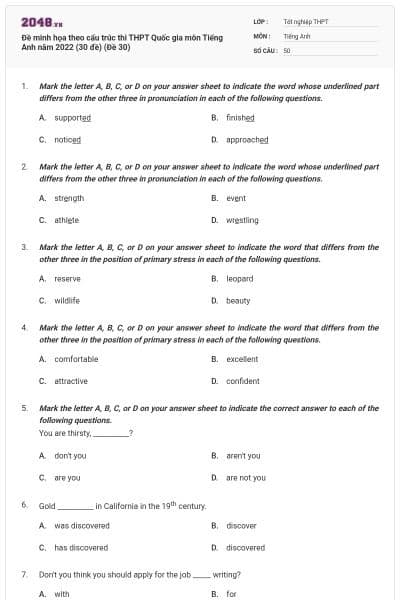

Tài liệu phổ biến Tiếng Anh