20 Đề thi thử THPTQG môn Tiếng Anh cực hay có đáp án (Đề số 10)
50 câu hỏi
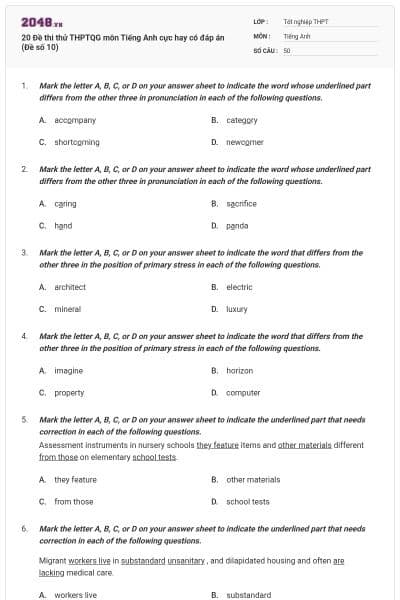
Mark the letter A, B, C, or D on your answer sheet to indicate the word whose underlined part differs from the other three in pronunciation in each of the following questions.
accompany
category
shortcoming
newcomer
Đáp án B
‘o’ của từ “category” phát âm là âm câm, các từ còn lại /ʌ/
Category: /ˈkæt.ə.ɡri/
Accompany: /əˈkʌm.pə.ni/, shortcoming: /ˈʃɔːtˌkʌm.ɪŋ/, newcomer: /ˈnjuːˌkʌm.ər/
Mark the letter A, B, C, or D on your answer sheet to indicate the word whose underlined part differs from the other three in pronunciation in each of the following questions.
caring
sacrifice
hand
panda
Đáp án A
‘a” của từ “caring” phát âm là /e/, các từ còn lại /æ/
Caring: /ˈker.ɪŋ/
Sacrifice: /ˈsæk.rɪ.faɪs/, hand: /hænd/, panda: /ˈpæn.də/
Mark the letter A, B, C, or D on your answer sheet to indicate the word that differs from the other three in the position of primary stress in each of the following questions.
architect
electric
mineral
luxury
Đáp án B
Trọng âm của từ " electric " rơi vào âm tiết thứ hai. Trọng âm của các từ còn lại rơi vào âm tiết thứ nhất. (A:/ ˈɑːkɪtekt /; B:/ ɪˈlektrɪk /; C:/ ˈmɪnərəl /; D:/ ˈlʌkʃəri /)
Mark the letter A, B, C, or D on your answer sheet to indicate the word that differs from the other three in the position of primary stress in each of the following questions.
imagine
horizon
property
computer
Đáp án C
Trọng âm của từ " property " rơi vào âm tiết đầu. Trọng âm của các từ còn lại rơi vào âm tiết thứ hai. (A:/ ɪˈmædʒɪn /; B:/ həˈraɪzn /; C:/ ˈprɒpəti /; D:/ kəmˈpjuːtə(r) /)
Mark the letter A, B, C, or D on your answer sheet to indicate the underlined part that needs correction in each of the following questions.
Assessment instruments in nursery schools they feature items and other materials different from those on elementary school tests.
they feature
other materials
from those
school tests
Đáp án A
Sửa they feature -> feature, bỏ “they”
Mark the letter A, B, C, or D on your answer sheet to indicate the underlined part that needs correction in each of the following questions.
Migrant workers live in substandard unsanitary , and dilapidated housing and often are lacking medical care.
workers live
substandard
unsanitary
are lacking
Đáp án D
Sửa are lacking -> lack
Mark the letter A, B, C, or D on your answer sheet to indicate the underlined part that needs correction in each of the following questions.
For thousands of years, man has created sweet-smelling substances from wood, herbs, and flowers and using them for perfume or medicine.
man
sweet-smelling
using them
or
Đáp án C
Sửa using them -> used them

Học thông minh hơn mỗi ngày
Xem toàn bộ 50 câu hỏi và nhiều hơn nữa với tài khoản miễn phí
- “I’m going out now.”
- “_____ you happen to pass a chemist’s, would you get me more some aspirins?”
Should
Had
Were
Did
Đáp án A
Cấu trúc đảo ngữ trong câu điều kiện:
Loại 1: If + S + V(hiện tại)…, S + will/ may/ can + V = Should + S + V…, main clause
Loại 2: If + S + V(quá khứ)…, S + would/ could + V = Were + S + to V…, S + would/ could + V
Loại 3: If + S + had + Vpp/_ed…, S + would/ could + have + Vpp/_ed
= Had + S + Vpp/_ed…, S + would/ could + have + Vpp/_ed
Tuy nhiên trong câu này: “would you get me more some aspirins?” => nghĩa là nhờ 1 cách lịch sự => không phải câu điều kiện loại 2, nó là câu điều kiện loại 1 dựa vào ngữ cảnh.
Tạm dịch: - “Bây giờ tôi đang đi ra ngoài.”
- “Nếu bạn đi ngang qua tiệm thuốc thì bạn có thể giúp tôi lấy một ít thuốc không?”
By the year 2050, many people currently employed _____ their jobs.
have lost
will be losing
will have lost
are losing
Đáp án C
Dấu hiệu nhận biết thì tương lai hoàn thành: “by the year 2050”: cho tới năm 2050
Simple sails were make from canvas _____ over a frame.
was stretched
a stretch
it was stretched
stretched
Đáp án D
Dạng câu rút gọn mệnh đề: động từ chủ động -> V_ing
động từ bị động -> V_ed
Câu đầy đủ: Simple sails were make from canvas which was stretched over a frame.
=> Rút gọn: Simple sails were make from canvas stretched over a frame.
A cooperative program between China and Germany on building Yangshow, a famous ancient city, into a(n) _____ city has proceeded smoothly since it started in September last year.
ecological-friendly
friendly ecology
ecology-friendly
friendly-ecological
Đáp án C
Cách tạo tính từ ghép: N + adj -> adj
Tạm dịch: Một chương trình hợp tác giữa Trung Quốc và Đức về việc xây dựng Yangzhow, một thành phố cổ đại nổi tiếng một thành phố thân thiện với môi trường đã tiến hành suôn sẻ từ khi nó bắt đầu vào tháng 9 năm ngoái
I know you didn’t see me yesterday because I was in Hanoi. You _____ me.
may not have seen
mustn’t have seen
shouldn’t have seen
can’t have seen
Đáp án D
Cấu trúc dự đoán trong quá khứ thể phủ định: can’t have + PII
Governments should _____ international laws against terrorism.
bring up
bring about
bring in
bring back
Đáp án C
bring in: (v) đưa vào, giới thiệu 1 luật mới
She had just enough time to _____ the report before the meeting.
dip into
go into
turn around
get through
Đáp án A
dip into: (v) đọc lướt qua, xem qua
Tạm dịch: Cô ấy chỉ có đủ thời gian để xem qua bài báo cáo trước cuộc họp.
Students can___ a lot of information just by attending class and taking good notes of the lectures.
absorb
provide
read
transmit
Đáp án: A
Giải thích:
Kiến thức: Từ vựng
Giải thích:
A. absorb (v): hấp thụ, tiếp thu
B. provide (v): cung cấp
C. read (v): đọc
D. transmit (v): truyền
Dựa vào nghĩa, chọn A.
Dịch: Các học sinh có thể tiếp thu rất nhiều thông tin chỉ qua việc lên lớp và ghi chép bài giảng tốt.
“Have you _____ this contract yet?” – “Not yet. I’ll try to read it this weekend.”
looked over
looked out
looked up
looked into
Đáp án A
- look over: xem xét, kiểm tra, đọc, nghiên cứu
- look out: coi chừng, cẩn thận, tìm ra
- look up: tra từ (từ điển)
- look into: điều tra, khám xét = investigate
Tạm dịch: “Bạn đã xem hợp đồng này chưa?”
“Chưa, mình sẽ cố gắng đọc nó cuối tuần này.
He left the country _____ arrest if he returned.
in fear of
under threat of
with fear of
with threat of
Đáp án B
- under threat of: đang bị đe dọa
- for fear of st/ for fear that: để đề phòng, vì sợ rằng
He was a natural singer with a voice that was as clear as _____.
a bell
a mirror
a waterfall
a lake
Đáp án A
Tạm dịch: Anh ấy là một ca sĩ bẩm sinh với một chất giọng rất dễ nghe.
We never expected that we would come up _______ so many problems at the very start of our business.
with
against
for
to
Đáp án B
come up against: đương đầu, gặp phải .. dịch: chúng tôi chưa từng hi vọng rằng chúng tôi sẽ gặp phải muôn vàn thách thức ngay khi bắt đầu lập nghiệp nên B đúng
_____ Mr. John Smith is old, he still goes jogging everyday.
So that
Although
In spite of
Because
Đáp án B
Cấu trúc: Although + Mệnh đề = despite/in spite of + cụm danh từ: Mặc dù … tuy nhiên
So that + mệnh đề: để…
Because + mệnh đề: bởi vì
Tạm dịch: Mặc dù ông John Smith già rồi nhưng ông vẫn tập thể dục đi bộ mỗi ngày
She didn’t tell me why she _____ to school the day before.
didn’t come
doesn’t come
hadn’t come
hasn’t come
Đáp án C
Sử dụng thì Quá khứ hoàn thành để nói về sự việc đã diễn ra và hoàn tất trước 1 thời điểm khác trong quá khứ.
Tạm dịch: Cô ấy đã không nói tại sao cô ấy đã không đến trường ngày hôm trước
– “What do you do for a living?”
– “_____”
I work in a bank.
I want to be a doctor, I guess.
It’s hard work, you know.
I get a high salary, you know.
Đáp án A
Cấu trúc: do for a living: làm nghề gì để kiếm sống
Tạm dịch: “Bạn làm nghề gì để kiếm sống vậy?”
“Tôi làm ở ngân hàng.”
– “Excuse me. I’m your new neighbor. I just moved in.”
– “_____”
Sorry, I don’t know.
I’m afraid not.
Where to, sir?
Oh, I don’t think so.
Đáp án A
Tạm dịch: “Xin lỗi bạn. Mình là hàng xóm mới. Mình mới chuyển đến đây.”
“Xin lỗi. Mình không biết.”
Mark the letter A, B, C, or D on your answer sheet to indicate the word(s) CLOSEST in meaning to the underlined word(s) in each of the following questions.
Mr. Young, general manager of the emergency response division of AMSA, said that the debris was spotted along a busy shipping route and could be containers that had fallen off cargo vessels.
seen
collected
shot
analyzed
Đáp án A
- spot (Vpp: spotted): nhận ra, phát hiện ra = see (Vpp: seen): nhìn thấy, nhận ra
Tạm dịch: Ông Young, giám đốc bộ phận phản ứng khẩn cấp của AMSA đã nói rằng các vật thể được phát hiện dọc theo một tuyến đường hàng hải đông đúc và có thể là các công-ten-nơ đã không ăn theo tay lái những tàu chở hàng hóa.
Mark the letter A, B, C, or D on your answer sheet to indicate the word(s) CLOSEST in meaning to the underlined word(s) in each of the following questions.
Ten years ago the Republic of Ireland became the first country in the world to lay down a workplace smoking ban.
expose
suggest
introduce
purpose
Đáp án C
- lay down: đề ra, giới thiệu, tuyên bố = introduce: giới thiệu, đề ra
Tạm dịch: Cách đây 10 năm nước Cộng hòa Ai-len đã trở thành nước đầu tiên trên thế giới đề ra việc ngăn cấm hút thuốc nơi công sở.
Mark the letter A, B, C, or D on your answer sheet to indicate the word(s) OPPOSITE in meaning to the underlined word(s) in each of the following questions.
He was so insubordinate that he lost his job within a week.
fresh
disobedient
obedient
understanding
Đáp án C
- insubordinate: (a) không chịu phục tùng, không chịu vâng lời
>< obedient: (a) vâng lời
Mark the letter A, B, C, or D on your answer sheet to indicate the word(s) OPPOSITE in meaning to the underlined word(s) in each of the following questions.
I am afraid haven’t allowed him enough initiative, said Father Payne; that’s a bad habit of mine.
determination
encouragement
beginning
cowardice
Đáp án D
- initiative: (n) dũng khí, sức mạnh để làm gì
>< cowardice: (n) tính nhút nhát, sự nhát gan
Mark the letter A, B, C, or D on your answer sheet to indicate the sentence that is closest in meaning to each of the following questions.
My cousin shows a desire to put aside the status of the school child.
The status of the school child makes my cousin happy.
My cousin is determined to put up with the other school children.
My cousin decides to play down the status of the school child.
My cousin doesn’t want to be a school child any more.
Đáp án D
Cháu của tôi mong muốn không phải là học sinh nữa
Mark the letter A, B, C, or D on your answer sheet to indicate the sentence that is closest in meaning to each of the following questions.
It appears that the harvest workers think they were maltreated.
The harvest workers seem to think they were maltreated.
The harvest workers claim to have been maltreated
It is thought that the harvest workers were maltreated.
It appears that the harvest workers think of being maltreated
Đáp án A
Dường như các bác công nhân nghĩ họ bị ngược đãi
Mark the letter A, B, C, or D on your answer sheet to indicate the sentence that is closest in meaning to each of the following questions.
A simplified edition is easier to read than the original: it’s shorter.
A simplified edition which is shorter than the original is easier to read.
A simplified edition, which is shorter than the original, is easier to read
The original, which is shorter, is easier to read than a simplified edition.
The original is longer than a simplified edition, and it is difficult to read.
Đáp án B
Một bản được đơn giản hoá thì dễ để đọc hơn là bản gốc: nó thì ngắn hơn
Sử dụng đại từ quan hệ không giới hạn để nối hai câ
Mark the letter A, B, C, or D on your answer sheet to indicate the sentence that best combines each pair of sentences in the following questions.
The flood may rise higher. We have to move upstairs.
We’ll have to move upstairs soon if the flood rises any higher.
Unless the flood rises any higher we won’t have to move upstairs.
If we don’t move upstairs, the flood may rise higher.
We have to move upstairs in case the flood rises any higher.
Đáp án D
Nước lũ có thể dâng cao hơn. Chúng ta cần phải di chuyển lên cao
Mark the letter A, B, C, or D on your answer sheet to indicate the sentence that best combines each pair of sentences in the following questions.
People live together in one place. They form a community.
When people form a community, they live together in one place.
In order to live together in one place, people form a community.
People form a community when living together in one place.
Forming a community, people live together in one place.
Đáp án D
Mọi người sống cùng nhau ở một nơi. Họ tạo thành một cộng đồng
Read the following passage and mark the letter A, B, C, or D on your answer sheet to indicate the correct word or phrase that best fits each of the numbered blanks from 33 to 37.
The (33) _____ of the earth is caused by exhaust gas from automobile engines, factories and power stations. Carbon dioxide goes up into the atmosphere, and it forms a kind of factories that keeps or rather allows the sunshine in but stop the earth’s heart (34) _____ getting out. It works like a greenhouse, that’s why we call it the Greenhouse Effect.
Because of this effect, the earth is getting warmer all the time. This (35) _____ in temperature will cause big changes to the world's climate. The sea level will rise, the ice covering the poles will melt and cause the sea level to rise.
The second problem is the (36) _____ of the ozone layer. Certain chemicals float up to the sky and react with the ozone layer, and they make holes in it. Because of these holes the ultraviolet rays can shine directly to the earth. Many people are now starting to suffer from skin cancer.
The sulfurous smoke from factories and power stations mixes with rain clouds and gets blown by the wind and then falls as acid rain (37) _____ destroys lakes and forests.
These three problems threaten our environment at the end of the twentieth century. Unless we do something about them quickly, we, human race, may disappear from the face of the earth.
Điền vào số (33)
heating
warming
poisoning
harming
Đáp án B
“The warming of the Earth”: sự nóng lên của trái đất
Read the following passage and mark the letter A, B, C, or D on your answer sheet to indicate the correct word or phrase that best fits each of the numbered blanks from 33 to 37.
The (33) _____ of the earth is caused by exhaust gas from automobile engines, factories and power stations. Carbon dioxide goes up into the atmosphere, and it forms a kind of factories that keeps or rather allows the sunshine in but stop the earth’s heart (34) _____ getting out. It works like a greenhouse, that’s why we call it the Greenhouse Effect.
Because of this effect, the earth is getting warmer all the time. This (35) _____ in temperature will cause big changes to the world's climate. The sea level will rise, the ice covering the poles will melt and cause the sea level to rise.
The second problem is the (36) _____ of the ozone layer. Certain chemicals float up to the sky and react with the ozone layer, and they make holes in it. Because of these holes the ultraviolet rays can shine directly to the earth. Many people are now starting to suffer from skin cancer.
The sulfurous smoke from factories and power stations mixes with rain clouds and gets blown by the wind and then falls as acid rain (37) _____ destroys lakes and forests.
These three problems threaten our environment at the end of the twentieth century. Unless we do something about them quickly, we, human race, may disappear from the face of the earth.
Điền vào số (34)
against
up
from
away
Đáp án C
“stop the earth’s heart from getting out”: ngăn cản không cho sức nóng của trái đất thoát ra.
Read the following passage and mark the letter A, B, C, or D on your answer sheet to indicate the correct word or phrase that best fits each of the numbered blanks from 33 to 37.
The (33) _____ of the earth is caused by exhaust gas from automobile engines, factories and power stations. Carbon dioxide goes up into the atmosphere, and it forms a kind of factories that keeps or rather allows the sunshine in but stop the earth’s heart (34) _____ getting out. It works like a greenhouse, that’s why we call it the Greenhouse Effect.
Because of this effect, the earth is getting warmer all the time. This (35) _____ in temperature will cause big changes to the world's climate. The sea level will rise, the ice covering the poles will melt and cause the sea level to rise.
The second problem is the (36) _____ of the ozone layer. Certain chemicals float up to the sky and react with the ozone layer, and they make holes in it. Because of these holes the ultraviolet rays can shine directly to the earth. Many people are now starting to suffer from skin cancer.
The sulfurous smoke from factories and power stations mixes with rain clouds and gets blown by the wind and then falls as acid rain (37) _____ destroys lakes and forests.
These three problems threaten our environment at the end of the twentieth century. Unless we do something about them quickly, we, human race, may disappear from the face of the earth.
Điền vào số (35)
rise
raise
fall
drop
Đáp án A
“This rise in temperature will cause big changes to the world’s climate”: sự tăng nhiệt độ sẽ gây ra những thay đổi lớn đối với khí hậu thế giới.
Read the following passage and mark the letter A, B, C, or D on your answer sheet to indicate the correct word or phrase that best fits each of the numbered blanks from 33 to 37.
The (33) _____ of the earth is caused by exhaust gas from automobile engines, factories and power stations. Carbon dioxide goes up into the atmosphere, and it forms a kind of factories that keeps or rather allows the sunshine in but stop the earth’s heart (34) _____ getting out. It works like a greenhouse, that’s why we call it the Greenhouse Effect.
Because of this effect, the earth is getting warmer all the time. This (35) _____ in temperature will cause big changes to the world's climate. The sea level will rise, the ice covering the poles will melt and cause the sea level to rise.
The second problem is the (36) _____ of the ozone layer. Certain chemicals float up to the sky and react with the ozone layer, and they make holes in it. Because of these holes the ultraviolet rays can shine directly to the earth. Many people are now starting to suffer from skin cancer.
The sulfurous smoke from factories and power stations mixes with rain clouds and gets blown by the wind and then falls as acid rain (37) _____ destroys lakes and forests.
These three problems threaten our environment at the end of the twentieth century. Unless we do something about them quickly, we, human race, may disappear from the face of the earth.
Điền vào số (36)
loss
lose
losing
lost
Đáp án A
“The loss of ozone layer”: Mất đi tầng ozone
Read the following passage and mark the letter A, B, C, or D on your answer sheet to indicate the correct word or phrase that best fits each of the numbered blanks from 33 to 37.
The (33) _____ of the earth is caused by exhaust gas from automobile engines, factories and power stations. Carbon dioxide goes up into the atmosphere, and it forms a kind of factories that keeps or rather allows the sunshine in but stop the earth’s heart (34) _____ getting out. It works like a greenhouse, that’s why we call it the Greenhouse Effect.
Because of this effect, the earth is getting warmer all the time. This (35) _____ in temperature will cause big changes to the world's climate. The sea level will rise, the ice covering the poles will melt and cause the sea level to rise.
The second problem is the (36) _____ of the ozone layer. Certain chemicals float up to the sky and react with the ozone layer, and they make holes in it. Because of these holes the ultraviolet rays can shine directly to the earth. Many people are now starting to suffer from skin cancer.
The sulfurous smoke from factories and power stations mixes with rain clouds and gets blown by the wind and then falls as acid rain (37) _____ destroys lakes and forests.
These three problems threaten our environment at the end of the twentieth century. Unless we do something about them quickly, we, human race, may disappear from the face of the earth.
Điền vào số (37)
it
which
what
they
Đáp án B
Dùng đại từ quan hệ “which” để thay thế cho danh từ chỉ hiện tượng “acid rain” trước nó
“as acid rain which destroys lakes and forests”: mưa axit, hiện tượng phá hủy ao hồ và rừng
Read the following passage and mark the letter A, B, C, or D on your answer sheet to indicate the correct answer to each of the questions from 38 to 42.
The election of Andrew Jackson to the presidency in 1928 marked the political ascendancy of the “common man” in American politics. Whereas all previous presidents had been Easterners from well-todo families, Jackson was a self-made man of modest wealth from the West. Born in 1767, Jackson fought in the American Revolution, in which many of his relatives died. Afterwards, he studied law and moved to the Western District of North California. When that territory became the state of Tennessee, Jackson was elected the state’s first congressman. His name became a household word during the war of 1812, when, as a U.S Army major general, he led troops against the Creek Indians in the Mississippi Territory and later defeated the British at New Orleans.
After his presidential inauguration, Jackson rode on horseback to the White House to attend a private party. Crowds of well-wishers suddenly appeared at the reception and nearly destroyed the White House as they tried to glimpse the new president. The common man had made a dramatic entrance onto the national political scene.
Jackson’s two terms moved American society toward truer democracy. Many states abandoned property requirements for voting. Elected officials began to act more truly as representatives of the people than as their leaders. As president of the common man, Jackson waged a war against the Bank of the United States, vetoing the bill that re-chartered the institution, declaring it a dangerous monopoly that profited the wealthy few.
Although he had built his reputation as an Indian fighter during the War of 1812, Jackson was not an Indian hater. He adopted what was at the time considered an enlightened solution to the Indian problem-removal. Many tribes submitted peacefully to being moved to the West. Others were marched by force to the Indian Territory, under brutal conditions, along what the Cherokees called the Trail of Tears.
One of Andrew Jackson’s most enduring legacies was the Democratic Party, which under him became a highly organized political party. In opposition to the Democrats were the Whigs, a party that attracted supporters of the Bank of the United States and opposed the tyranny of the man called “King Andrew”. A less specific but more basic legacy is the populist philosophy of politics that still bears the name “Jacksonian Democracy.”
The author’s perspective toward Andrew Jackson could be best described as _____.
critical
emotional
personal
historical
Đáp án D
Historical: về mặt lịch sử
Read the following passage and mark the letter A, B, C, or D on your answer sheet to indicate the correct answer to each of the questions from 38 to 42.
The election of Andrew Jackson to the presidency in 1928 marked the political ascendancy of the “common man” in American politics. Whereas all previous presidents had been Easterners from well-todo families, Jackson was a self-made man of modest wealth from the West. Born in 1767, Jackson fought in the American Revolution, in which many of his relatives died. Afterwards, he studied law and moved to the Western District of North California. When that territory became the state of Tennessee, Jackson was elected the state’s first congressman. His name became a household word during the war of 1812, when, as a U.S Army major general, he led troops against the Creek Indians in the Mississippi Territory and later defeated the British at New Orleans.
After his presidential inauguration, Jackson rode on horseback to the White House to attend a private party. Crowds of well-wishers suddenly appeared at the reception and nearly destroyed the White House as they tried to glimpse the new president. The common man had made a dramatic entrance onto the national political scene.
Jackson’s two terms moved American society toward truer democracy. Many states abandoned property requirements for voting. Elected officials began to act more truly as representatives of the people than as their leaders. As president of the common man, Jackson waged a war against the Bank of the United States, vetoing the bill that re-chartered the institution, declaring it a dangerous monopoly that profited the wealthy few.
Although he had built his reputation as an Indian fighter during the War of 1812, Jackson was not an Indian hater. He adopted what was at the time considered an enlightened solution to the Indian problem-removal. Many tribes submitted peacefully to being moved to the West. Others were marched by force to the Indian Territory, under brutal conditions, along what the Cherokees called the Trail of Tears.
One of Andrew Jackson’s most enduring legacies was the Democratic Party, which under him became a highly organized political party. In opposition to the Democrats were the Whigs, a party that attracted supporters of the Bank of the United States and opposed the tyranny of the man called “King Andrew”. A less specific but more basic legacy is the populist philosophy of politics that still bears the name “Jacksonian Democracy.”
The author suggests that Jackson’s election and inauguration _____.
destroyed the White House.
brought a new style to the presidency.
made a lot of common people angry.
put a military man in the White House for the first time.
Đáp án C
Thông tin trong đoạn: The election of Andrew Jackson to the presidency in 1928 marked the political ascendancy of the “common man” in American politics. Whereas all previous presidents had been Easterners from well-to-do families, Jackson was a self-made man of modest wealth from the West.
Read the following passage and mark the letter A, B, C, or D on your answer sheet to indicate the correct answer to each of the questions from 38 to 42.
The election of Andrew Jackson to the presidency in 1928 marked the political ascendancy of the “common man” in American politics. Whereas all previous presidents had been Easterners from well-todo families, Jackson was a self-made man of modest wealth from the West. Born in 1767, Jackson fought in the American Revolution, in which many of his relatives died. Afterwards, he studied law and moved to the Western District of North California. When that territory became the state of Tennessee, Jackson was elected the state’s first congressman. His name became a household word during the war of 1812, when, as a U.S Army major general, he led troops against the Creek Indians in the Mississippi Territory and later defeated the British at New Orleans.
After his presidential inauguration, Jackson rode on horseback to the White House to attend a private party. Crowds of well-wishers suddenly appeared at the reception and nearly destroyed the White House as they tried to glimpse the new president. The common man had made a dramatic entrance onto the national political scene.
Jackson’s two terms moved American society toward truer democracy. Many states abandoned property requirements for voting. Elected officials began to act more truly as representatives of the people than as their leaders. As president of the common man, Jackson waged a war against the Bank of the United States, vetoing the bill that re-chartered the institution, declaring it a dangerous monopoly that profited the wealthy few.
Although he had built his reputation as an Indian fighter during the War of 1812, Jackson was not an Indian hater. He adopted what was at the time considered an enlightened solution to the Indian problem-removal. Many tribes submitted peacefully to being moved to the West. Others were marched by force to the Indian Territory, under brutal conditions, along what the Cherokees called the Trail of Tears.
One of Andrew Jackson’s most enduring legacies was the Democratic Party, which under him became a highly organized political party. In opposition to the Democrats were the Whigs, a party that attracted supporters of the Bank of the United States and opposed the tyranny of the man called “King Andrew”. A less specific but more basic legacy is the populist philosophy of politics that still bears the name “Jacksonian Democracy.”
The word “institution” in paragraph 3 refers to _____.
the presidency of the United States
American society
The Bank of the United States
democracy
Đáp án C
As president of the common man, Jackson waged a war against the Bank of the United States, vetoing the bill that re-chartered the institution, declaring it a dangerous monopoly that profited the wealthy few
Read the following passage and mark the letter A, B, C, or D on your answer sheet to indicate the correct answer to each of the questions from 38 to 42.
The election of Andrew Jackson to the presidency in 1928 marked the political ascendancy of the “common man” in American politics. Whereas all previous presidents had been Easterners from well-todo families, Jackson was a self-made man of modest wealth from the West. Born in 1767, Jackson fought in the American Revolution, in which many of his relatives died. Afterwards, he studied law and moved to the Western District of North California. When that territory became the state of Tennessee, Jackson was elected the state’s first congressman. His name became a household word during the war of 1812, when, as a U.S Army major general, he led troops against the Creek Indians in the Mississippi Territory and later defeated the British at New Orleans.
After his presidential inauguration, Jackson rode on horseback to the White House to attend a private party. Crowds of well-wishers suddenly appeared at the reception and nearly destroyed the White House as they tried to glimpse the new president. The common man had made a dramatic entrance onto the national political scene.
Jackson’s two terms moved American society toward truer democracy. Many states abandoned property requirements for voting. Elected officials began to act more truly as representatives of the people than as their leaders. As president of the common man, Jackson waged a war against the Bank of the United States, vetoing the bill that re-chartered the institution, declaring it a dangerous monopoly that profited the wealthy few.
Although he had built his reputation as an Indian fighter during the War of 1812, Jackson was not an Indian hater. He adopted what was at the time considered an enlightened solution to the Indian problem-removal. Many tribes submitted peacefully to being moved to the West. Others were marched by force to the Indian Territory, under brutal conditions, along what the Cherokees called the Trail of Tears.
One of Andrew Jackson’s most enduring legacies was the Democratic Party, which under him became a highly organized political party. In opposition to the Democrats were the Whigs, a party that attracted supporters of the Bank of the United States and opposed the tyranny of the man called “King Andrew”. A less specific but more basic legacy is the populist philosophy of politics that still bears the name “Jacksonian Democracy.”
According to the passage, why did Jackson oppose the Bank of the United States?
He thought it benefited only rich people.
It started a war.
It opposed electing him “King Andrew”.
It opposed giving common people the right to vote.
Đáp án A
He thought it benefited only rich people
Thông tin trong câu trên: declaring it a dangerous monopoly that profited the wealthy few
Read the following passage and mark the letter A, B, C, or D on your answer sheet to indicate the correct answer to each of the questions from 38 to 42.
The election of Andrew Jackson to the presidency in 1928 marked the political ascendancy of the “common man” in American politics. Whereas all previous presidents had been Easterners from well-todo families, Jackson was a self-made man of modest wealth from the West. Born in 1767, Jackson fought in the American Revolution, in which many of his relatives died. Afterwards, he studied law and moved to the Western District of North California. When that territory became the state of Tennessee, Jackson was elected the state’s first congressman. His name became a household word during the war of 1812, when, as a U.S Army major general, he led troops against the Creek Indians in the Mississippi Territory and later defeated the British at New Orleans.
After his presidential inauguration, Jackson rode on horseback to the White House to attend a private party. Crowds of well-wishers suddenly appeared at the reception and nearly destroyed the White House as they tried to glimpse the new president. The common man had made a dramatic entrance onto the national political scene.
Jackson’s two terms moved American society toward truer democracy. Many states abandoned property requirements for voting. Elected officials began to act more truly as representatives of the people than as their leaders. As president of the common man, Jackson waged a war against the Bank of the United States, vetoing the bill that re-chartered the institution, declaring it a dangerous monopoly that profited the wealthy few.
Although he had built his reputation as an Indian fighter during the War of 1812, Jackson was not an Indian hater. He adopted what was at the time considered an enlightened solution to the Indian problem-removal. Many tribes submitted peacefully to being moved to the West. Others were marched by force to the Indian Territory, under brutal conditions, along what the Cherokees called the Trail of Tears.
One of Andrew Jackson’s most enduring legacies was the Democratic Party, which under him became a highly organized political party. In opposition to the Democrats were the Whigs, a party that attracted supporters of the Bank of the United States and opposed the tyranny of the man called “King Andrew”. A less specific but more basic legacy is the populist philosophy of politics that still bears the name “Jacksonian Democracy.”
According to the passage, Jackson’s policy toward American Indians was _____.
developed during the War of 1812
forceful and cruel
considered his greatest achievement
considered progressive at the time
Đáp án D
considered progressive at the time: được coi là tiến bộ thông tin trong đoạn: He adopted what was at the time considered an enlightened solution to the Indian problem-removal
Read the following passage on transport, and mark the letter A, B, C, or D on your answer sheet to
indicate the correct answer to each of the questions from 43 to 50.
The work of women has been economically vital since prehistory, although their contributions have varied according to the structure, needs, customs, and attitudes of society.
In prehistoric times, women and men participated almost equally in hunting and gathering activities to obtain food. With the development of agricultural communities, women’s work revolved more around the home. As urban centres developed, women sold or traded goods in the marketplace.
From ancient to modern times, four generalizations can be made about women's paid work. Women have worked because of economic necessity; poor women in particular worked outside the home whether they were unmarried or married, and especially if their husbands were unable to sustain the family solely through their own work. Women’s indentured work has often been similar to their work at home. Women have maintained the primary responsibility for raising children, regardless of their paid work. Women have historically been paid less than men and have been allocated lower-status work.
Some major changes are now occurring in industrial nations, including the steadily increasing proportion of women in the labor force; decreasing family responsibilities (due to both smaller family size and technological innovation in the home); higher levels of education for women; and more middle and upper-income women working for pay or for job satisfaction. Statistically, they have not yet achieved parity of pay or senior appointments in the workplace in any nation
Artisans working in their own homes not infrequently used the labor of their families. This custom was so prevalent during the Middle Ages, craft guilds of the period, including some that otherwise excluded women, often admitted to membership the widows of guild members, providing they met professional requirements. Dressmaking and lacemaking guilds were composed exclusively of women.
Gradually, the guilds were replaced by the putting-out system, whereby tools and materials were distributed to workers by merchants; the workers then produced articles on a piecework basis in their homes.
During the 18th and early 19th centuries, as the Industrial Revolution developed, the putting-out system slowly declined. Goods that had been produced by hand in the home were manufactured by machine under the factory system. Women competed more with men for some jobs, but were concentrated primarily in textile mills and clothing factories. Manufacturers often favored women employees because of relevant skills and lower wages, and also because early trade union organization tended to occur first among men. Employees in sweatshops were also preponderantly women. The result was to institutionalize systems of low pay, poor working conditions, long hours, and other abuses, which along with child labor presented some of the worst examples of worker exploitation in early industrial capitalism. Minimum wage legislation and other protective laws, when introduced, concentrated particularly on the alleviation of these abuses of working women.
Women workers in business and the professions, the so-called white-collar occupations, suffered less from poor conditions of work and exploitative labor, but were denied equality of pay and opportunity. The growing use of the typewriter and the telephone after the 1870s created two new employment niches for women, as typists and telephonists, but in both fields the result was again to institutionalize a permanent category of low-paid, low-status women’s work.
When the the farming communities developed, women worked _____.
less at home
more at home
more outside
in groups
Đáp án B
Thông tin nằm ở đoạn 2: “With the development of agricultural communities, women’s work revolved more around the home.”
Read the following passage on transport, and mark the letter A, B, C, or D on your answer sheet to
indicate the correct answer to each of the questions from 43 to 50.
The work of women has been economically vital since prehistory, although their contributions have varied according to the structure, needs, customs, and attitudes of society.
In prehistoric times, women and men participated almost equally in hunting and gathering activities to obtain food. With the development of agricultural communities, women’s work revolved more around the home. As urban centres developed, women sold or traded goods in the marketplace.
From ancient to modern times, four generalizations can be made about women's paid work. Women have worked because of economic necessity; poor women in particular worked outside the home whether they were unmarried or married, and especially if their husbands were unable to sustain the family solely through their own work. Women’s indentured work has often been similar to their work at home. Women have maintained the primary responsibility for raising children, regardless of their paid work. Women have historically been paid less than men and have been allocated lower-status work.
Some major changes are now occurring in industrial nations, including the steadily increasing proportion of women in the labor force; decreasing family responsibilities (due to both smaller family size and technological innovation in the home); higher levels of education for women; and more middle and upper-income women working for pay or for job satisfaction. Statistically, they have not yet achieved parity of pay or senior appointments in the workplace in any nation
Artisans working in their own homes not infrequently used the labor of their families. This custom was so prevalent during the Middle Ages, craft guilds of the period, including some that otherwise excluded women, often admitted to membership the widows of guild members, providing they met professional requirements. Dressmaking and lacemaking guilds were composed exclusively of women.
Gradually, the guilds were replaced by the putting-out system, whereby tools and materials were distributed to workers by merchants; the workers then produced articles on a piecework basis in their homes.
During the 18th and early 19th centuries, as the Industrial Revolution developed, the putting-out system slowly declined. Goods that had been produced by hand in the home were manufactured by machine under the factory system. Women competed more with men for some jobs, but were concentrated primarily in textile mills and clothing factories. Manufacturers often favored women employees because of relevant skills and lower wages, and also because early trade union organization tended to occur first among men. Employees in sweatshops were also preponderantly women. The result was to institutionalize systems of low pay, poor working conditions, long hours, and other abuses, which along with child labor presented some of the worst examples of worker exploitation in early industrial capitalism. Minimum wage legislation and other protective laws, when introduced, concentrated particularly on the alleviation of these abuses of working women.
Women workers in business and the professions, the so-called white-collar occupations, suffered less from poor conditions of work and exploitative labor, but were denied equality of pay and opportunity. The growing use of the typewriter and the telephone after the 1870s created two new employment niches for women, as typists and telephonists, but in both fields the result was again to institutionalize a permanent category of low-paid, low-status women’s work.
With the development of urban centres, women ____.
traded cattle in the marketplace
stayed at home to take care of their children
worked more in the marketplace
sold cloth in the marketplace
Đáp án C
Thông tin nằm ở câu cuối đoạn 2: “As urban centres developed, women sold or traded goods in the marketplace.” (bán hoặc trao đổi hàng hóa ở chợ)
Read the following passage on transport, and mark the letter A, B, C, or D on your answer sheet to
indicate the correct answer to each of the questions from 43 to 50.
The work of women has been economically vital since prehistory, although their contributions have varied according to the structure, needs, customs, and attitudes of society.
In prehistoric times, women and men participated almost equally in hunting and gathering activities to obtain food. With the development of agricultural communities, women’s work revolved more around the home. As urban centres developed, women sold or traded goods in the marketplace.
From ancient to modern times, four generalizations can be made about women's paid work. Women have worked because of economic necessity; poor women in particular worked outside the home whether they were unmarried or married, and especially if their husbands were unable to sustain the family solely through their own work. Women’s indentured work has often been similar to their work at home. Women have maintained the primary responsibility for raising children, regardless of their paid work. Women have historically been paid less than men and have been allocated lower-status work.
Some major changes are now occurring in industrial nations, including the steadily increasing proportion of women in the labor force; decreasing family responsibilities (due to both smaller family size and technological innovation in the home); higher levels of education for women; and more middle and upper-income women working for pay or for job satisfaction. Statistically, they have not yet achieved parity of pay or senior appointments in the workplace in any nation
Artisans working in their own homes not infrequently used the labor of their families. This custom was so prevalent during the Middle Ages, craft guilds of the period, including some that otherwise excluded women, often admitted to membership the widows of guild members, providing they met professional requirements. Dressmaking and lacemaking guilds were composed exclusively of women.
Gradually, the guilds were replaced by the putting-out system, whereby tools and materials were distributed to workers by merchants; the workers then produced articles on a piecework basis in their homes.
During the 18th and early 19th centuries, as the Industrial Revolution developed, the putting-out system slowly declined. Goods that had been produced by hand in the home were manufactured by machine under the factory system. Women competed more with men for some jobs, but were concentrated primarily in textile mills and clothing factories. Manufacturers often favored women employees because of relevant skills and lower wages, and also because early trade union organization tended to occur first among men. Employees in sweatshops were also preponderantly women. The result was to institutionalize systems of low pay, poor working conditions, long hours, and other abuses, which along with child labor presented some of the worst examples of worker exploitation in early industrial capitalism. Minimum wage legislation and other protective laws, when introduced, concentrated particularly on the alleviation of these abuses of working women.
Women workers in business and the professions, the so-called white-collar occupations, suffered less from poor conditions of work and exploitative labor, but were denied equality of pay and opportunity. The growing use of the typewriter and the telephone after the 1870s created two new employment niches for women, as typists and telephonists, but in both fields the result was again to institutionalize a permanent category of low-paid, low-status women’s work.
The word “indentured” in this context may mostly means _____.
outside the home
in the kitchen
outside the kitchen
inside the home
Đáp án A
Thông tin nằm ở đoạn 3: “Women’s indentured work has often been similar to their work at home.”
- indentured work = work outside the home
Read the following passage on transport, and mark the letter A, B, C, or D on your answer sheet to
indicate the correct answer to each of the questions from 43 to 50.
The work of women has been economically vital since prehistory, although their contributions have varied according to the structure, needs, customs, and attitudes of society.
In prehistoric times, women and men participated almost equally in hunting and gathering activities to obtain food. With the development of agricultural communities, women’s work revolved more around the home. As urban centres developed, women sold or traded goods in the marketplace.
From ancient to modern times, four generalizations can be made about women's paid work. Women have worked because of economic necessity; poor women in particular worked outside the home whether they were unmarried or married, and especially if their husbands were unable to sustain the family solely through their own work. Women’s indentured work has often been similar to their work at home. Women have maintained the primary responsibility for raising children, regardless of their paid work. Women have historically been paid less than men and have been allocated lower-status work.
Some major changes are now occurring in industrial nations, including the steadily increasing proportion of women in the labor force; decreasing family responsibilities (due to both smaller family size and technological innovation in the home); higher levels of education for women; and more middle and upper-income women working for pay or for job satisfaction. Statistically, they have not yet achieved parity of pay or senior appointments in the workplace in any nation
Artisans working in their own homes not infrequently used the labor of their families. This custom was so prevalent during the Middle Ages, craft guilds of the period, including some that otherwise excluded women, often admitted to membership the widows of guild members, providing they met professional requirements. Dressmaking and lacemaking guilds were composed exclusively of women.
Gradually, the guilds were replaced by the putting-out system, whereby tools and materials were distributed to workers by merchants; the workers then produced articles on a piecework basis in their homes.
During the 18th and early 19th centuries, as the Industrial Revolution developed, the putting-out system slowly declined. Goods that had been produced by hand in the home were manufactured by machine under the factory system. Women competed more with men for some jobs, but were concentrated primarily in textile mills and clothing factories. Manufacturers often favored women employees because of relevant skills and lower wages, and also because early trade union organization tended to occur first among men. Employees in sweatshops were also preponderantly women. The result was to institutionalize systems of low pay, poor working conditions, long hours, and other abuses, which along with child labor presented some of the worst examples of worker exploitation in early industrial capitalism. Minimum wage legislation and other protective laws, when introduced, concentrated particularly on the alleviation of these abuses of working women.
Women workers in business and the professions, the so-called white-collar occupations, suffered less from poor conditions of work and exploitative labor, but were denied equality of pay and opportunity. The growing use of the typewriter and the telephone after the 1870s created two new employment niches for women, as typists and telephonists, but in both fields the result was again to institutionalize a permanent category of low-paid, low-status women’s work.
With better education and less family burden, women _____.
have been respected at home and in the workplace
have enjoyed equal status in the workplace
have not yet achieved high status in the workplace
have become more influential in their companies
Đáp án C
Thông tin nằm ở đoạn 4: “Some major changes are now occurring in industrial nations,…; decreasing family responsibilities (due to both smaller family size and technological innovation in the home); higher levels of education for women; and more middle and upper-income women working for pay or for job satisfaction. Statistically, they have not yet achieved parity of pay or senior appointments in the workplace in any nation.”
- dù giảm trách nhiệm với gia đình và nâng cao về giáo dục,… họ vẫn chưa nhận được sự ngang bằng hay những vị trí công việc cao hơn ở nơi làm việc.
Read the following passage on transport, and mark the letter A, B, C, or D on your answer sheet to
indicate the correct answer to each of the questions from 43 to 50.
The work of women has been economically vital since prehistory, although their contributions have varied according to the structure, needs, customs, and attitudes of society.
In prehistoric times, women and men participated almost equally in hunting and gathering activities to obtain food. With the development of agricultural communities, women’s work revolved more around the home. As urban centres developed, women sold or traded goods in the marketplace.
From ancient to modern times, four generalizations can be made about women's paid work. Women have worked because of economic necessity; poor women in particular worked outside the home whether they were unmarried or married, and especially if their husbands were unable to sustain the family solely through their own work. Women’s indentured work has often been similar to their work at home. Women have maintained the primary responsibility for raising children, regardless of their paid work. Women have historically been paid less than men and have been allocated lower-status work.
Some major changes are now occurring in industrial nations, including the steadily increasing proportion of women in the labor force; decreasing family responsibilities (due to both smaller family size and technological innovation in the home); higher levels of education for women; and more middle and upper-income women working for pay or for job satisfaction. Statistically, they have not yet achieved parity of pay or senior appointments in the workplace in any nation
Artisans working in their own homes not infrequently used the labor of their families. This custom was so prevalent during the Middle Ages, craft guilds of the period, including some that otherwise excluded women, often admitted to membership the widows of guild members, providing they met professional requirements. Dressmaking and lacemaking guilds were composed exclusively of women.
Gradually, the guilds were replaced by the putting-out system, whereby tools and materials were distributed to workers by merchants; the workers then produced articles on a piecework basis in their homes.
During the 18th and early 19th centuries, as the Industrial Revolution developed, the putting-out system slowly declined. Goods that had been produced by hand in the home were manufactured by machine under the factory system. Women competed more with men for some jobs, but were concentrated primarily in textile mills and clothing factories. Manufacturers often favored women employees because of relevant skills and lower wages, and also because early trade union organization tended to occur first among men. Employees in sweatshops were also preponderantly women. The result was to institutionalize systems of low pay, poor working conditions, long hours, and other abuses, which along with child labor presented some of the worst examples of worker exploitation in early industrial capitalism. Minimum wage legislation and other protective laws, when introduced, concentrated particularly on the alleviation of these abuses of working women.
Women workers in business and the professions, the so-called white-collar occupations, suffered less from poor conditions of work and exploitative labor, but were denied equality of pay and opportunity. The growing use of the typewriter and the telephone after the 1870s created two new employment niches for women, as typists and telephonists, but in both fields the result was again to institutionalize a permanent category of low-paid, low-status women’s work.
Although women cannot avoid the task of bringing up children, _____.
they have to work to feed their men
they have to amuse their men
are the mainstay of their families
they can be breadwinners as men
Đáp án D
Thông tin nằm ở đoạn 3: “Women have worked because of economic necessity; poor women in particular worked outside the home whether they were unmarried or married, and especially if their husbands were unable to sustain the family solely through their own work.” – phụ nữ phải làm vì sự cần thiết về kinh tế, nếu như chồng của họ không thể 1 mình làm trụ cột gia đình.
Read the following passage on transport, and mark the letter A, B, C, or D on your answer sheet to
indicate the correct answer to each of the questions from 43 to 50.
The work of women has been economically vital since prehistory, although their contributions have varied according to the structure, needs, customs, and attitudes of society.
In prehistoric times, women and men participated almost equally in hunting and gathering activities to obtain food. With the development of agricultural communities, women’s work revolved more around the home. As urban centres developed, women sold or traded goods in the marketplace.
From ancient to modern times, four generalizations can be made about women's paid work. Women have worked because of economic necessity; poor women in particular worked outside the home whether they were unmarried or married, and especially if their husbands were unable to sustain the family solely through their own work. Women’s indentured work has often been similar to their work at home. Women have maintained the primary responsibility for raising children, regardless of their paid work. Women have historically been paid less than men and have been allocated lower-status work.
Some major changes are now occurring in industrial nations, including the steadily increasing proportion of women in the labor force; decreasing family responsibilities (due to both smaller family size and technological innovation in the home); higher levels of education for women; and more middle and upper-income women working for pay or for job satisfaction. Statistically, they have not yet achieved parity of pay or senior appointments in the workplace in any nation
Artisans working in their own homes not infrequently used the labor of their families. This custom was so prevalent during the Middle Ages, craft guilds of the period, including some that otherwise excluded women, often admitted to membership the widows of guild members, providing they met professional requirements. Dressmaking and lacemaking guilds were composed exclusively of women.
Gradually, the guilds were replaced by the putting-out system, whereby tools and materials were distributed to workers by merchants; the workers then produced articles on a piecework basis in their homes.
During the 18th and early 19th centuries, as the Industrial Revolution developed, the putting-out system slowly declined. Goods that had been produced by hand in the home were manufactured by machine under the factory system. Women competed more with men for some jobs, but were concentrated primarily in textile mills and clothing factories. Manufacturers often favored women employees because of relevant skills and lower wages, and also because early trade union organization tended to occur first among men. Employees in sweatshops were also preponderantly women. The result was to institutionalize systems of low pay, poor working conditions, long hours, and other abuses, which along with child labor presented some of the worst examples of worker exploitation in early industrial capitalism. Minimum wage legislation and other protective laws, when introduced, concentrated particularly on the alleviation of these abuses of working women.
Women workers in business and the professions, the so-called white-collar occupations, suffered less from poor conditions of work and exploitative labor, but were denied equality of pay and opportunity. The growing use of the typewriter and the telephone after the 1870s created two new employment niches for women, as typists and telephonists, but in both fields the result was again to institutionalize a permanent category of low-paid, low-status women’s work.
The word “sweatshops” suggests _____.
workshop
factory work
hard work
harmful work
Đáp án C
sweatshops: xí nghiệp bóc lột công nhân tàn tệ
Read the following passage on transport, and mark the letter A, B, C, or D on your answer sheet to
indicate the correct answer to each of the questions from 43 to 50.
The work of women has been economically vital since prehistory, although their contributions have varied according to the structure, needs, customs, and attitudes of society.
In prehistoric times, women and men participated almost equally in hunting and gathering activities to obtain food. With the development of agricultural communities, women’s work revolved more around the home. As urban centres developed, women sold or traded goods in the marketplace.
From ancient to modern times, four generalizations can be made about women's paid work. Women have worked because of economic necessity; poor women in particular worked outside the home whether they were unmarried or married, and especially if their husbands were unable to sustain the family solely through their own work. Women’s indentured work has often been similar to their work at home. Women have maintained the primary responsibility for raising children, regardless of their paid work. Women have historically been paid less than men and have been allocated lower-status work.
Some major changes are now occurring in industrial nations, including the steadily increasing proportion of women in the labor force; decreasing family responsibilities (due to both smaller family size and technological innovation in the home); higher levels of education for women; and more middle and upper-income women working for pay or for job satisfaction. Statistically, they have not yet achieved parity of pay or senior appointments in the workplace in any nation
Artisans working in their own homes not infrequently used the labor of their families. This custom was so prevalent during the Middle Ages, craft guilds of the period, including some that otherwise excluded women, often admitted to membership the widows of guild members, providing they met professional requirements. Dressmaking and lacemaking guilds were composed exclusively of women.
Gradually, the guilds were replaced by the putting-out system, whereby tools and materials were distributed to workers by merchants; the workers then produced articles on a piecework basis in their homes.
During the 18th and early 19th centuries, as the Industrial Revolution developed, the putting-out system slowly declined. Goods that had been produced by hand in the home were manufactured by machine under the factory system. Women competed more with men for some jobs, but were concentrated primarily in textile mills and clothing factories. Manufacturers often favored women employees because of relevant skills and lower wages, and also because early trade union organization tended to occur first among men. Employees in sweatshops were also preponderantly women. The result was to institutionalize systems of low pay, poor working conditions, long hours, and other abuses, which along with child labor presented some of the worst examples of worker exploitation in early industrial capitalism. Minimum wage legislation and other protective laws, when introduced, concentrated particularly on the alleviation of these abuses of working women.
Women workers in business and the professions, the so-called white-collar occupations, suffered less from poor conditions of work and exploitative labor, but were denied equality of pay and opportunity. The growing use of the typewriter and the telephone after the 1870s created two new employment niches for women, as typists and telephonists, but in both fields the result was again to institutionalize a permanent category of low-paid, low-status women’s work.
During the time of Industrial Revolution, women were dominant in _____.
sex industry
Broidery
textile industry
bakery
Đáp án C
Thông tin nằm ở đoạn 7: “…the Industrial Revolution developed, the putting-out system slowly declined. Goods that had been produced by hand in the home were manufactured by machine under the factory system. Women competed more with men for some jobs, but were concentrated primarily in textile mills and clothing factories.”
Read the following passage on transport, and mark the letter A, B, C, or D on your answer sheet to
indicate the correct answer to each of the questions from 43 to 50.
The work of women has been economically vital since prehistory, although their contributions have varied according to the structure, needs, customs, and attitudes of society.
In prehistoric times, women and men participated almost equally in hunting and gathering activities to obtain food. With the development of agricultural communities, women’s work revolved more around the home. As urban centres developed, women sold or traded goods in the marketplace.
From ancient to modern times, four generalizations can be made about women's paid work. Women have worked because of economic necessity; poor women in particular worked outside the home whether they were unmarried or married, and especially if their husbands were unable to sustain the family solely through their own work. Women’s indentured work has often been similar to their work at home. Women have maintained the primary responsibility for raising children, regardless of their paid work. Women have historically been paid less than men and have been allocated lower-status work.
Some major changes are now occurring in industrial nations, including the steadily increasing proportion of women in the labor force; decreasing family responsibilities (due to both smaller family size and technological innovation in the home); higher levels of education for women; and more middle and upper-income women working for pay or for job satisfaction. Statistically, they have not yet achieved parity of pay or senior appointments in the workplace in any nation
Artisans working in their own homes not infrequently used the labor of their families. This custom was so prevalent during the Middle Ages, craft guilds of the period, including some that otherwise excluded women, often admitted to membership the widows of guild members, providing they met professional requirements. Dressmaking and lacemaking guilds were composed exclusively of women.
Gradually, the guilds were replaced by the putting-out system, whereby tools and materials were distributed to workers by merchants; the workers then produced articles on a piecework basis in their homes.
During the 18th and early 19th centuries, as the Industrial Revolution developed, the putting-out system slowly declined. Goods that had been produced by hand in the home were manufactured by machine under the factory system. Women competed more with men for some jobs, but were concentrated primarily in textile mills and clothing factories. Manufacturers often favored women employees because of relevant skills and lower wages, and also because early trade union organization tended to occur first among men. Employees in sweatshops were also preponderantly women. The result was to institutionalize systems of low pay, poor working conditions, long hours, and other abuses, which along with child labor presented some of the worst examples of worker exploitation in early industrial capitalism. Minimum wage legislation and other protective laws, when introduced, concentrated particularly on the alleviation of these abuses of working women.
Women workers in business and the professions, the so-called white-collar occupations, suffered less from poor conditions of work and exploitative labor, but were denied equality of pay and opportunity. The growing use of the typewriter and the telephone after the 1870s created two new employment niches for women, as typists and telephonists, but in both fields the result was again to institutionalize a permanent category of low-paid, low-status women’s work.
What women have done for the economic development have changed over time due to ___.
their role in the home
their marital status and their husbands
the different factors of the society
the Industrial Revolution
Đáp án C
Thông tin nằm ở đoạn 1: “The work of women has been economically vital since prehistory, although their contributions have varied according to the structure, needs, customs, and attitudes of society.”
Bạn có thích hoạt động này không?
Ý kiến của bạn sẽ giúp chúng tôi đề xuất nội dung phù hợp hơn.
Gợi ý cho bạn
![[Năm 2022] Đề thi thử môn Vật lí THPT Quốc gia có lời giải - Đề số 21](/_next/image?url=https%3A%2F%2Fvideo.vietjack.com%2Fupload%2Fimages%2Fvj-image%2Fimage-3izficdefgfoel0s9j8s-1786772791.jpg&w=3840&q=75)

![[Năm 2022] Đề thi thử môn Vật lí THPT Quốc gia có lời giải - Đề số 20](/_next/image?url=https%3A%2F%2Fvideo.vietjack.com%2Fupload%2Fimages%2Fvj-image%2Fimage-emy0gtcksawvorajezvv-1786772460.jpg&w=3840&q=75)

Tài liệu phổ biến Tốt nghiệp THPT
Tài liệu phổ biến Tiếng Anh