Tuyển tập đề thi thử Tiếng Anh cực hay có lời giải (Đề số 27)
50 câu hỏi
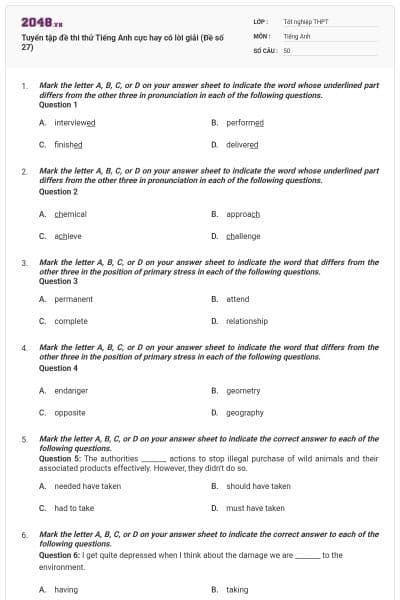
Mark the letter A, B, C, or D on your answer sheet to indicate the word whose underlined part differs from the other three in pronunciation in each of the following questions.
Question 1
interviewed
performed
finished
delivered
Đáp án C
Kiến thức về phát âm
A. interviewed /'ɪn.tə.vju:d/ : phỏng vấn B. performed /pə'fɔ:md/: trình diễn
C. finished / 'fin.ɪ∫t/: kết thúc D. delivered /dɪ'lɪv.ərd/ (v): phân phát
Quy tắc phát âm đuôi -ed
- Với các từ có phiên âm kết thúc bằng /p, k, f, s, ∫,t∫ / thì khi thêm ‘ed’ ta phát âm là /t/
- Với các từ có phiên âm kết thúc bằng /t,d/ thì khi thêm ‘ed’ ta phát âm là /ɪd/
- Các trường hợp còn lại, khi thêm ‘ed’ ta phát âm là /d/
=> Câu C "ed" được phát âm là /t/, còn lại được phát âm là /d/.
Mark the letter A, B, C, or D on your answer sheet to indicate the word whose underlined part differs from the other three in pronunciation in each of the following questions.
Question 2
chemical
approach
achieve
challenge
Đáp án A
Kiến thức về phát âm
A. chemical /'kem.ɪ.kl/ (adj): thuộc về hóa học
B. approach /ə'prəʊt∫/ (n): cách tiếp cận
C. achieve /ə't∫i:v/ (v): đạt được
D. challenge /‘t∫æ.ɪndʒ/ (n): thử thách
=> Câu A “ch” được phát âm là /k/, còn lại được phát âm là /t∫/.
Mark the letter A, B, C, or D on your answer sheet to indicate the word that differs from the other three in the position of primary stress in each of the following questions.
Question 3
permanent
attend
complete
relationship
Đáp án A
Kiến thức về trọng âm
A. permanent /'pɜ:mənənt/ (a) vĩnh cửu => từ này trọng âm rơi vào âm tiết thứ nhất. Vì theo quy tắc trọng âm không bao giờ rơi vào âm /ə/ và trọng âm rơi vào nguyên âm dài.
B. attend /ə‘tend/ (v): tham gia => từ này trọng âm rơi vào âm tiết thứ 2. Vì theo quy tắc trọng âm không bao giờ rơi vào âm /ə/.
C. complete /kəm'pli:t/ (v) hoàn thành => từ này trọng âm rơi vào âm tiết thứ hai. Vì theo quy tắc trọng âm không bao giờ rơi vào âm /ə/ và trọng âm rơi vào nguyên âm dài.
D. relationship /ri'leɪ∫n∫ɪp/ (n) mối quan hệ => từ này trọng âm rơi vào âm tiết đầu. Vì theo quy tắc đuôi -ship không ảnh hưởng đến trọng âm của từ, đuôi –ion làm trọng âm rơi vào trước âm đó.
=> Câu A trọng âm rơi vào âm tiết thứ nhất, các đáp án còn lại rơi vào âm tiết thứ hai.
Mark the letter A, B, C, or D on your answer sheet to indicate the word that differs from the other three in the position of primary stress in each of the following questions.
Question 4
endanger
geometry
opposite
geography
Đáp án C
Kiến thức về trọng âm
A. endanger /ɪn'deɪndʒə(r)/ (v) trong huy hiếm, gặp nguy cơ bị đe dọa => từ này trọng âm rơi vào âm tiết thứ 2 vì tiền tố en- và hậu tố -er đầu không ảnh hưởng đến trọng âm của từ.
B. geometry /dʒi'ɒmətri/ (n) hình học => từ này trọng âm rơi vào âm tiết thứ 2. Vì theo quy tắc đuôi -y làm trọng âm dịch chuyển ba âm tính từ cuối lên.
C. opposite /'ɒpəzɪt/ (adj) đối diện => từ này trọng âm rơi vào âm tiết đầu. Vì theo quy tắc tất cả các âm mà ngắn hết thì trọng âm rơi vào âm tiết đầu.
D. geography /dʒi'ɒgrəfi/ (n) địa lí => từ này trọng âm rơi vào âm tiết thứ 2. Vì theo quy tắc đuôi -y làm trọng âm dịch chuyển ba âm tính từ cuối lên.
=> Câu C trọng âm rơi vào âm tiết thứ nhất, các đáp án còn lại rơi vào âm tiết thứ hai.
Mark the letter A, B, C, or D on your answer sheet to indicate the correct answer to each of the following questions.
Question 5: The authorities _______ actions to stop illegal purchase of wild animals and their associated products effectively. However, they didn't do so.
needed have taken
should have taken
had to take
must have taken
Đáp án B
Kiến thức về động từ khuyết thiếu
Tạm dịch: Chính quyền đáng lẽ ra nên hành động để chấm dứt việc mua bán trái phép động vật hoang dã và những sản phẩm liên quan tới chúng một cách hiệu quả.
Mặc dù vậy, họ đã không làm.
=> Đáp án B (should + have + VPII): đáng lẽ ra nên làm trong quá khứ nhưng thực tế đã không làm.
Mark the letter A, B, C, or D on your answer sheet to indicate the correct answer to each of the following questions.
Question 6: I get quite depressed when I think about the damage we are _______ to the environment.
having
taking
making
causing
Đáp án D
Kiến thức về cụm từ cố định
cause the damage: gây thiệt hại.
Tạm dịch: Tôi rất thất vọng mỗi khi nghĩ về những thiệt hại mà chúng ta đã gây ra cho môi trường.
Mark the letter A, B, C, or D on your answer sheet to indicate the correct answer to each of the following questions.
Question 7: Beavers have been known to use logs, branches, rocks, and mud to build darns that are more than a thousand_______.
lengthy feet
feetlong
long feet
foot in length
Đáp án B
Kiến thức về lượng từ
Ta có: số đo + thước đo (m, kg, feet...) + adj
Hoặc: số đo + thước đo (m, kg, feet...) + in + N
Tạm dịch: Hải ly được biết đến trong việc sử dụng khúc gỗ, nhảnh cây, đã và bùn để xây đập dài hơn một nghìn feet

Học thông minh hơn mỗi ngày
Xem toàn bộ 50 câu hỏi và nhiều hơn nữa với tài khoản miễn phí
Mark the letter A, B, C, or D on your answer sheet to indicate the correct answer to each of the following questions.
Question 8:_______ are poised to change the face of the construction industry in the coming year.
Designing buildings environmentally
Building environmentally designing
Environmentally designed buildings
Designed environmental building
Đáp án C
Kiến thức về từ vựng
Ở đây cần một cụm danh từ làm chủ ngữ cho câu.
environmentally (adv): liên quan đến môi trường
designed (a): được thiết kế
building (n): tòa nhà
Tạm dịch: Các tòa nhà được thiết kế phù hợp với môi trường sẵn sàng thay đổi bộ mặt của ngành xây dụng trong năm tới.
Mark the letter A, B, C, or D on your answer sheet to indicate the correct answer to each of the following questions.
Question 9: The scientists _______ on this project try to find the solutions to air pollution.
working
worked
are working
who working
Đáp án A
Kiến thức rút gọn mệnh đề quan hệ
Rút gọn mệnh đề quan hệ bằng cách bỏ đại từ quan hệ, động từ to be (nếu có), và chuyển động từ về dạng:
- Ving nếu ở thể chủ động
- V.ed nếu ở thể bị động
Tạm dịch: Các nhà khoa học làm việc trong dự án này cố gắng tìm ra giải pháp cho ô nhiễm không khí.
Mark the letter A, B, C, or D on your answer sheet to indicate the correct answer to each of the following questions.
Question 10: if some endangered species ______ in zoos, it would help to ensure their future survival.
will be kept
are kept
had been kept
were kept
Đáp án D
Kiến thức câu điều kiện
Ta dùng cầu điều kiện loại 2 để diễn tả một hành động không có thật ở hiện tại.
Cấu trúc câu điều kiện loại 2:
If + mệnh đề quá khứ đơn, S + would/could... + V +...
Tạm dịch: Nếu một số loài nguy cấp được giữ trong vườn thú, nó sẽ giúp đảm bảo sự sống còn của chúng trong tương lai.
Mark the letter A, B, C, or D on your answer sheet to indicate the correct answer to each of the following questions.
Question 11: Susan rarely stays up late,______?
is she
isn't she
does she
doesn't she
Đáp án B
Kiến thức câu hỏi đuôi
Trong vế câu chính nếu có các trạng từ mang tính phủ định như “rare1y” thì câu hỏi đuôi ở dạng khẳng định.
Vế chính dùng động từ, nên câu hỏi đuôi ta dùng trợ động từ.
Tạm dịch: Susan hiếm khi thức khuya, đúng không?
Mark the letter A, B, C, or D on your answer sheet to indicate the correct answer to each of the following questions.
Question 12: Hearing about people who mistreat animals makes me go hot under the _____.
chin
collar
sleeves
vest
Đáp án B
Kiến thức về thành ngữ
Ta có thành ngữ: “to be hot under the collar”: điên tiết, cáu tiết
Tạm dịch: Nghe về những người đối xử không tốt với động vật khiến tôi điên tiết.
Mark the letter A, B, C, or D on your answer sheet to indicate the correct answer to each of the following questions.
Question 13: It is vital that everyone ______ aware of the protection of the environment.
is
be
are
were
Đáp án B
Kiến thức câu giả định (subiunctive)
Cấu trúc câu giả định với tỉnh từ đứng trước mệnh đề: it + be + adjective + [that] + S + V (inf) +...
Tạm dịch: Điều quan trọng là mọi người phải nhận thức được sự bảo vệ môi trường.
Mark the letter A, B, C, or D on your answer sheet to indicate the correct answer to each of the following questions.
Question 14: This is the second time you ______ your door key.
are losing
lose
lost
have lost
Đáp án D
Kiến thức về thì trong tiếng anh
Cấu trúc “This is the first/second/last... time + S + have/has + VPP” – đây là lần đầu tiên/thứ hai/cuối củng...làm gì. Đây cũng là một dấu hiệu thường gặp trong thì hiện tại hoàn thành.
Tạm dịch: Đây là lần thứ hai cậu làm mất chìa khoá nhà rồi.
Mark the letter A, B, C, or D on your answer sheet to indicate the correct answer to each of the following questions.
Question 15: Not until 1856 ____ across the Mississippi River.
the first bridge was built
was the first bridge built
the first bridge built
did the first bridge build
Đáp án B
Kiến thức về đảo ngữ và bị động
Đảo ngữ với “Not until”: Not until + time/time clause + mệnh đề đảo ngữ (đảo to be/trợ động từ lên trước danh từ)
Chủ ngữ trong câu là vật (bridge) nên ta dùng dạng bị động
Tạm dịch: Cho đến năm 1856 cây cầu đầu tiên được xây dựng qua sông Mississippi.
Mark the letter A, B, C, or D on your answer sheet to indicate the correct answer to each of the following questions.
Question 16: The British and the American share the same language, but in other aspects they are as different as _______.
cats and dogs
chalk and cheese
salt and pepper
here and there
Đáp án B
Kiến thức về thành ngữ
A. Cụm cats and clogs thường được dùng để chỉ cơn mưa to (rain cats and dogs = rain heavily)
B. Chalk and cheese: khác biệt hoàn toàn
They're like Chalk and cheese = They're completely different.
C. Salt and pepper: màu muối tiêu: hai màu được trộn với nhau, thường là một màu sáng và một màu tối. (tính từ, thường dùng để miêu tả màu tóc)
D. Here and there: khắp mọi nơi
Papers were scattered here and there = Papers were scattered everywhere.
Mark the letter A, B, C, or D on your answer sheet to indicate the word(s) CLOSEST in meaning to the underlined word (s) in each of the following questions.
Question 17: The maintenance of these old castles must cost a lot of money.
building
foundation
destruction
preservation
Đáp án D
Từ đồng nghĩa
Tạm dịch: Việc bảo tồn những lâu đài cổ này phải tốn rất nhiều tiền.
=> maintenance (n): sự giữ, sự duy trì, sự bảo tồn
A. building (n): sự xây dựng, tòa nhà
B. foundation (n): sự thành lập, sự sáng lập
C. destruction (n): sự phá hoại, sự phá huỷ
D. preservation (n): sự giữ, sự bảo tồn
=> Đáp án D (maintenance = preservation)
Mark the letter A, B, C, or D on your answer sheet to indicate the word(s) CLOSEST in meaning to the underlined word (s) in each of the following questions.
Question 18: People in the mountainous areas are still in the habit of destroying forests for cultivation.
planting
farming
industry
wood
Đáp án B
Từ đồng nghĩa
Tạm dịch: Người dân vùng núi vẫn có thói quen phá rừng để trồng trọt
=> cultivation (n): sự canh tác, sự trồng trọt
A. planting (n): sự trồng cây B. farming (n): nông nghiệp, canh tác
C. industry (n): công nghiệp D. wood (n): gỗ
=> Đáp án B (cultivation = farming)
Mark the letter A, B, C, or D on your answer sheet to indicate the word(s) OPPOSITE in meaning to the underlined word(s) in each of the following questions.
Question 19: Wendy is on the horns of a dilemma: she just wonders whether to go for a picnic with her friends or to stay at home with her family.
unwilling to make a decision
able to make a choice
eager to make a plan
unready to make up her mind
Đáp án B
Từ trái nghĩa
Tạm dịch: Wendy đang trong thế tiến thoái lưỡng nan: cô tự hỏi nên đi dã ngoại với bạn bè hay ở nhà với gia đình.
=> on the horns of a dilemma: tiến thoái lưỡng nan
A. unwilling to make a decision: không muốn đưa ra quyết định
B. able to make a choice: có thể lựa chọn
C. eager to make a plan: háo hức thực hiện một kế hoạch
D. unready to make up her mind: chưa sẵn sàng để quyết định
=> Đáp án B (on the horns of a dilemma >< able to make a choice)
Mark the letter A, B, C, or D on your answer sheet to indicate the word(s) OPPOSITE in meaning to the underlined word(s) in each of the following questions.
Question 20: Hazardous waste is waste that has substantial or potential threats to public health or the environment.
vivid
risky
dangerous
secure
Đáp án D
Từ trái nghĩa
Tạm dịch: Chất thải nguy hại là chất thải có những mối đe dọa dang kế hoặc tiềm ẩn đổi với sức khoẻ cộng đồng hoặc môi trường.
=> hazardous (a): nguy hiểm
A. vivid (a): tươi sang, sống động B. risky (a): đầy rủi ro nguy hiểm
C. dangerous (a): nguy hiểm D. secure (a): bảo đảm, an toàn
=> Đáp án D (hazardous >< secure)
Mark the letter A, B, C, or D on your answer sheet to indicate the sentence that best completes each of the following exchanges.
Question 21: John: “You're already leaving? The ball is only starting.”
Mary: “But it is very late, so _____.”
it's great fun
take care
goodbye for now
have a good day
Đáp án C
Tình huống giao tiếp
John: “Cậu rời đi à? Bữa tiệc chỉ mới bắt đầu thôi mà.”
Mary: "Nhưng hơi muộn rồi, cho nên _______.”
A. thật tuyệt vời. B .bảo trọng nhé (dùng khi tiễn ai đó đi xa)
C. tạm biệt nhé. D. chúc một ngày tốt lành.
Chỉ có đáp án C là phù hợp.
Mark the letter A, B, C, or D on your answer sheet to indicate the sentence that best completes each of the following exchanges.
Question 22: Daisy: “_____?”
Mary: “No, that's about it for now.”
Nothing to declare
When can we stop
Anything else
What's on your mind
Đáp án C
Tình huống giao tiếp
Daisy: “ _____?”
Mary: “Không, hết rồi/ chỉ thế thôi”.
Thành ngữ: that’s about it for now: Used to say that you have finished telling somebody about st and there is nothing to add.
A. Chẳng có gì để công bố. B. Khi nào chúng ta có thể dừng lại.
C. Còn gì nữa không? D. Cậu đang nghĩ gì vậy?
Chỉ có đáp án C là phù hợp.
Read the following passage and mark the letter A, B, C, or D on your answer sheet to indicate the correct word or phrase that best fits each of the numbered blanks from 23 to 27.
Coincident with concerns (23) ______ the accelerating loss of species and habitats has been a growing appreciation of the importance of biological diversity, the number of species in a particular ecosystem, to the health of the Earth and human well-being. Much has been written about the diversity of terrestrial organisms, particularly the exceptionally rich life associated tropical rainforest habitats. Relatively little has been said, (24) _____, about diversity of life in the sea even though coral reef systems are comparable to rain forests in terms of richness of life.
An alien exploring Earth would probably (25) ______ priority to the planet's dominants - most distinctive feature - the ocean. Humans have a bias toward land (26) _____ sometimes gets in the way of truly examining global issues. Seen from far away, it is easy to realize that landmasses occupy only one-third of the Earth's surface. Given that two thirds of the Earth's surface is water and that marine life lives at all levels of the ocean, the total three-dimensional living space of the ocean is perhaps 100 times (27) _____ than that of land and contains more than 90 percent of all life on Earth even though the ocean has fewer distinct species.
Question 23
about
on
at
for
Đáp án A
CHỦ ĐỀ VE ENVIRONMENT
Kiến thức về giới từ
Concern about: mối lo ngại về
Read the following passage and mark the letter A, B, C, or D on your answer sheet to indicate the correct word or phrase that best fits each of the numbered blanks from 23 to 27.
Coincident with concerns (23) ______ the accelerating loss of species and habitats has been a growing appreciation of the importance of biological diversity, the number of species in a particular ecosystem, to the health of the Earth and human well-being. Much has been written about the diversity of terrestrial organisms, particularly the exceptionally rich life associated tropical rainforest habitats. Relatively little has been said, (24) _____, about diversity of life in the sea even though coral reef systems are comparable to rain forests in terms of richness of life.
An alien exploring Earth would probably (25) ______ priority to the planet's dominants - most distinctive feature - the ocean. Humans have a bias toward land (26) _____ sometimes gets in the way of truly examining global issues. Seen from far away, it is easy to realize that landmasses occupy only one-third of the Earth's surface. Given that two thirds of the Earth's surface is water and that marine life lives at all levels of the ocean, the total three-dimensional living space of the ocean is perhaps 100 times (27) _____ than that of land and contains more than 90 percent of all life on Earth even though the ocean has fewer distinct species.
Question 24
therefore
thus
however
instead
Đáp án C
Kiến thức về liên từ
A. therefore = B. thus: do đó, do vậy
C. however: tuy nhiên D. instead: thay vì đó
Tạm dịch:
“Much has been written about the diversity of terrestrial organisms, particularly the exceptionally rich life associated tropical rain-forest habitats. Relatively little has been said, (24)_____, about diversity of life in the sea even though coral reef systems are comparable to rain forests in terms of richness of life.” (Phần lớn đã được viết về sự đa dạng của các sinh vật trên cạn, đặc biệt là các sinh cảnh rừng nhiệt đới. Tuy nhiên, tương đối ít nói về sự đa dạng của sự sống dưới biển mặc dù các hệ thống san hô có thể so sánh với rừng nhiệt đới về sự phong phú của sinh vật sống.)
Read the following passage and mark the letter A, B, C, or D on your answer sheet to indicate the correct word or phrase that best fits each of the numbered blanks from 23 to 27.
Coincident with concerns (23) ______ the accelerating loss of species and habitats has been a growing appreciation of the importance of biological diversity, the number of species in a particular ecosystem, to the health of the Earth and human well-being. Much has been written about the diversity of terrestrial organisms, particularly the exceptionally rich life associated tropical rainforest habitats. Relatively little has been said, (24) _____, about diversity of life in the sea even though coral reef systems are comparable to rain forests in terms of richness of life.
An alien exploring Earth would probably (25) ______ priority to the planet's dominants - most distinctive feature - the ocean. Humans have a bias toward land (26) _____ sometimes gets in the way of truly examining global issues. Seen from far away, it is easy to realize that landmasses occupy only one-third of the Earth's surface. Given that two thirds of the Earth's surface is water and that marine life lives at all levels of the ocean, the total three-dimensional living space of the ocean is perhaps 100 times (27) _____ than that of land and contains more than 90 percent of all life on Earth even though the ocean has fewer distinct species.
Question 25
make
have
give
bring
Đáp án C
Kiến thức về cụm từ cố định
Give priority to st: ưu tiên cho cái gì
Take priority over = Have priority over: ưu tiên hơn
Read the following passage and mark the letter A, B, C, or D on your answer sheet to indicate the correct word or phrase that best fits each of the numbered blanks from 23 to 27.
Coincident with concerns (23) ______ the accelerating loss of species and habitats has been a growing appreciation of the importance of biological diversity, the number of species in a particular ecosystem, to the health of the Earth and human well-being. Much has been written about the diversity of terrestrial organisms, particularly the exceptionally rich life associated tropical rainforest habitats. Relatively little has been said, (24) _____, about diversity of life in the sea even though coral reef systems are comparable to rain forests in terms of richness of life.
An alien exploring Earth would probably (25) ______ priority to the planet's dominants - most distinctive feature - the ocean. Humans have a bias toward land (26) _____ sometimes gets in the way of truly examining global issues. Seen from far away, it is easy to realize that landmasses occupy only one-third of the Earth's surface. Given that two thirds of the Earth's surface is water and that marine life lives at all levels of the ocean, the total three-dimensional living space of the ocean is perhaps 100 times (27) _____ than that of land and contains more than 90 percent of all life on Earth even though the ocean has fewer distinct species.
Question 26
who
when
that
whose
Đáp án C
Kiến thức về đại từ quan hệ
“a bias toward land” là cụm danh từ chỉ vật nên ta phải dùng đại từ quan hệ “that”
Read the following passage and mark the letter A, B, C, or D on your answer sheet to indicate the correct word or phrase that best fits each of the numbered blanks from 23 to 27.
Coincident with concerns (23) ______ the accelerating loss of species and habitats has been a growing appreciation of the importance of biological diversity, the number of species in a particular ecosystem, to the health of the Earth and human well-being. Much has been written about the diversity of terrestrial organisms, particularly the exceptionally rich life associated tropical rainforest habitats. Relatively little has been said, (24) _____, about diversity of life in the sea even though coral reef systems are comparable to rain forests in terms of richness of life.
An alien exploring Earth would probably (25) ______ priority to the planet's dominants - most distinctive feature - the ocean. Humans have a bias toward land (26) _____ sometimes gets in the way of truly examining global issues. Seen from far away, it is easy to realize that landmasses occupy only one-third of the Earth's surface. Given that two thirds of the Earth's surface is water and that marine life lives at all levels of the ocean, the total three-dimensional living space of the ocean is perhaps 100 times (27) _____ than that of land and contains more than 90 percent of all life on Earth even though the ocean has fewer distinct species.
Question 27
higher
bigger
greater
larger
Đáp án C
Kiến thức về so sánh
So sánh gấp bội :
số gia hội (twice/three/four ...+ as many/much + N + as..../times + greater than +,...)
Read the following passage and mark the letter A, B, C, or D on your answer sheet to indicate the correct answer to each of the questions from 28 to 35.
Plastic bags are used by everybody. From a vegetable vendor to a designer store, everyone seems to use them. Even though they are one of the modern conveniences that we seem to be unable to do without, they are responsible for causing pollution, killing wildlife, and using up the
precious resources of the Earth. But, most of us are blissfully unaware of the repercussions that are occurring and will take place in the future because of the plastic bags.
Every once in a while, the government passes out an order banning store owners from providing plastic bags to customers for carrying their purchases, with little lasting effect. Plastic bags are very popular with both retailers as well as consumers because they are cheap, strong, lightweight, functional, as well as a hygienic means of carrying food as well as other goods. About a hundred billion plastic bags are used every year in the U.S. alone. And then, when one considers the huge economies and populations of India, China, Europe, and other parts of the world, the numbers can be staggering. The problem is further exacerbated by the developed countries shipping off their plastic waste to developing countries like India.
Once they are used, most bags go into landfills. Each year, more and more bags are ending up littering the environment. Once they become litter, plastic bags find their way into our waterways, parks, beaches, and streets. And, if they are burned, they infuse the air with toxic fumes. About 100,000 animals, such as dolphins, turtles, whales, penguins are killed every year due to these bags. Many animals ingest plastic bags, mistaking them for food, and therefore, die. And worse, the ingested plastic bag remains intact even after the death and decomposition of the animal. Thus, it lies around in the landscape where another victim may ingest it. One of the worst environmental effects is that they are non-biodegradable. The decomposition takes about 400 years. No one will live so long to witness the decomposition of plastic! Thus, save the environment for the future generations as well as animals.
Petroleum products are diminishing and getting more expensive by the day, since we have used this non-renewable resource increasingly. And to make plastic, about 60-100 million barrels of oil are needed every year around the world. Surely, this precious resource should not be wasted on producing plastic bags, should it? Petroleum is vital for our modern way of life. It is necessary for our energy requirements - for our factories, transportation, heating, lighting, and so on. Without viable alternative sources of energy yet on the horizon, if the supply of petroleum were to be turned off, it would lead to practically the entire world grinding to a halt.
So, what can be done? A tote bag can make a good substitute for carrying groceries and the shopping. You can keep the bag with the cashier, and then put your purchases into it instead of the usual plastic bag. Recycling the bags you already have is another good idea. These can come into use for various purposes, like holding your garbage, instead of purchasing new ones. While governments may be working out ways to lessen the impact of plastic bags on the environment; however, each of us should shoulder some of the responsibility for this problem, which ultimately harms us. Plastics are not only non-biodegradable, but are one of the major pollutants of the sea. For a clean and green environment, try to use alternatives to plastic whenever and wherever possible. Cut down your use of plastic, and do your bit to save our planet.
Question 28: Which of the following could be the best tittle of the passage?
Plastic pollution - Problems and solutions.
Harmful effects of plastic bags on the environment.
Plastic pollution - What should we do?
Plastic bags - New threat for the environment
Đáp án A
CHỦ ĐỀ VỀ NATURE IN DANGER
Câu nào trong các câu sau có thể là tiêu đề phù hợp nhất cho đoạn văn?
A. Ô nhiễm nhựa – Vấn đề và giải pháp.
B. Những tác hại của túi nhựa lên môi trường.
C. Ô nhiễm nhựa - Chúng ta nên làm gì?
D. Túi nhựa - mối đe doạ mới cho môi trường.
Căn cứ vào ý chính của từng đoạn:
Tác giả cung cấp cho chúng ta thực trạng về vấn đề ô nhiễm nhựa, hậu quả và các giải pháp để làm giảm mức độ ô nhiễm. Vì vậy, đáp án A sẽ là tiêu đề phù hợp nhất.
Read the following passage and mark the letter A, B, C, or D on your answer sheet to indicate the correct answer to each of the questions from 28 to 35.
Plastic bags are used by everybody. From a vegetable vendor to a designer store, everyone seems to use them. Even though they are one of the modern conveniences that we seem to be unable to do without, they are responsible for causing pollution, killing wildlife, and using up the
precious resources of the Earth. But, most of us are blissfully unaware of the repercussions that are occurring and will take place in the future because of the plastic bags.
Every once in a while, the government passes out an order banning store owners from providing plastic bags to customers for carrying their purchases, with little lasting effect. Plastic bags are very popular with both retailers as well as consumers because they are cheap, strong, lightweight, functional, as well as a hygienic means of carrying food as well as other goods. About a hundred billion plastic bags are used every year in the U.S. alone. And then, when one considers the huge economies and populations of India, China, Europe, and other parts of the world, the numbers can be staggering. The problem is further exacerbated by the developed countries shipping off their plastic waste to developing countries like India.
Once they are used, most bags go into landfills. Each year, more and more bags are ending up littering the environment. Once they become litter, plastic bags find their way into our waterways, parks, beaches, and streets. And, if they are burned, they infuse the air with toxic fumes. About 100,000 animals, such as dolphins, turtles, whales, penguins are killed every year due to these bags. Many animals ingest plastic bags, mistaking them for food, and therefore, die. And worse, the ingested plastic bag remains intact even after the death and decomposition of the animal. Thus, it lies around in the landscape where another victim may ingest it. One of the worst environmental effects is that they are non-biodegradable. The decomposition takes about 400 years. No one will live so long to witness the decomposition of plastic! Thus, save the environment for the future generations as well as animals.
Petroleum products are diminishing and getting more expensive by the day, since we have used this non-renewable resource increasingly. And to make plastic, about 60-100 million barrels of oil are needed every year around the world. Surely, this precious resource should not be wasted on producing plastic bags, should it? Petroleum is vital for our modern way of life. It is necessary for our energy requirements - for our factories, transportation, heating, lighting, and so on. Without viable alternative sources of energy yet on the horizon, if the supply of petroleum were to be turned off, it would lead to practically the entire world grinding to a halt.
So, what can be done? A tote bag can make a good substitute for carrying groceries and the shopping. You can keep the bag with the cashier, and then put your purchases into it instead of the usual plastic bag. Recycling the bags you already have is another good idea. These can come into use for various purposes, like holding your garbage, instead of purchasing new ones. While governments may be working out ways to lessen the impact of plastic bags on the environment; however, each of us should shoulder some of the responsibility for this problem, which ultimately harms us. Plastics are not only non-biodegradable, but are one of the major pollutants of the sea. For a clean and green environment, try to use alternatives to plastic whenever and wherever possible. Cut down your use of plastic, and do your bit to save our planet.
Question 29: What is the synonym of the word "repercussions" in the first paragraph?
situation
interference
contamination
consequence
Đáp án D
Từ đồng nghĩa của từ "repercussions” trong đoạn 1 là từ nào?
A. tình huống B. sự can thiệp
C. sự ô nhiễm D. hậu quả
Từ đồng nghĩa: repercussions (hậu quả) = consequence
But, most of us are blissfully unaware of the repercussions that are occurring and will take place in the future because of the plastic bags. (Tuy nhiên, hầu hết chúng ta không biết gì về hậu quả đang xảy ra và sẽ diễn ra trong tương lai vì các túi nhựa này.)
Read the following passage and mark the letter A, B, C, or D on your answer sheet to indicate the correct answer to each of the questions from 28 to 35.
Plastic bags are used by everybody. From a vegetable vendor to a designer store, everyone seems to use them. Even though they are one of the modern conveniences that we seem to be unable to do without, they are responsible for causing pollution, killing wildlife, and using up the
precious resources of the Earth. But, most of us are blissfully unaware of the repercussions that are occurring and will take place in the future because of the plastic bags.
Every once in a while, the government passes out an order banning store owners from providing plastic bags to customers for carrying their purchases, with little lasting effect. Plastic bags are very popular with both retailers as well as consumers because they are cheap, strong, lightweight, functional, as well as a hygienic means of carrying food as well as other goods. About a hundred billion plastic bags are used every year in the U.S. alone. And then, when one considers the huge economies and populations of India, China, Europe, and other parts of the world, the numbers can be staggering. The problem is further exacerbated by the developed countries shipping off their plastic waste to developing countries like India.
Once they are used, most bags go into landfills. Each year, more and more bags are ending up littering the environment. Once they become litter, plastic bags find their way into our waterways, parks, beaches, and streets. And, if they are burned, they infuse the air with toxic fumes. About 100,000 animals, such as dolphins, turtles, whales, penguins are killed every year due to these bags. Many animals ingest plastic bags, mistaking them for food, and therefore, die. And worse, the ingested plastic bag remains intact even after the death and decomposition of the animal. Thus, it lies around in the landscape where another victim may ingest it. One of the worst environmental effects is that they are non-biodegradable. The decomposition takes about 400 years. No one will live so long to witness the decomposition of plastic! Thus, save the environment for the future generations as well as animals.
Petroleum products are diminishing and getting more expensive by the day, since we have used this non-renewable resource increasingly. And to make plastic, about 60-100 million barrels of oil are needed every year around the world. Surely, this precious resource should not be wasted on producing plastic bags, should it? Petroleum is vital for our modern way of life. It is necessary for our energy requirements - for our factories, transportation, heating, lighting, and so on. Without viable alternative sources of energy yet on the horizon, if the supply of petroleum were to be turned off, it would lead to practically the entire world grinding to a halt.
So, what can be done? A tote bag can make a good substitute for carrying groceries and the shopping. You can keep the bag with the cashier, and then put your purchases into it instead of the usual plastic bag. Recycling the bags you already have is another good idea. These can come into use for various purposes, like holding your garbage, instead of purchasing new ones. While governments may be working out ways to lessen the impact of plastic bags on the environment; however, each of us should shoulder some of the responsibility for this problem, which ultimately harms us. Plastics are not only non-biodegradable, but are one of the major pollutants of the sea. For a clean and green environment, try to use alternatives to plastic whenever and wherever possible. Cut down your use of plastic, and do your bit to save our planet.
Question 30: According to the second paragraph, what is NOT true about the reality of plastic bags?
The more population a country has, the more complicated the plastic pollution is.
Plastic bags are often used because of their convenience.
Importing plastic waste from developed countries makes the problem more sophisticated.
The governments do not prohibit the use of plastic bags at the stores.
Đáp án D
Theo đoạn 2, câu nào là không đúng về thực trạng của túi nhựa?
A. Đất nước càng đông dân thì ô nhiễm nhựa càng nghiêm trọng.
B. Túi nhựa thường được dùng vì sự tiện lợi của chúng.
C. Việc nhập khẩu rác thải nhựa từ các nước phát triển làm cho vấn đề nghiêm trọng hơn.
D. Chính phủ không nghiêm cấm sử dụng túi nhựa ở các cửa hàng.
Căn cứ thông tin đoạn 2:
Every once in a while, the government passes out an order banning store owners from providing plastic bags to customers for carrying their purchases, with little lasting effect. Plastic bags are very popular with both retailers as well as consumers because they are cheap, strong, lightweight, functional, as well as a hygienic means of carrying food as well as other goods. About a hundred billion plastic bags are used every year in the U.S. alone. And then, when one considers the huge economies and populations of India, China, Europe, and other parts of the world, the numbers can be staggering. The problem is further exacerbated by the developed countries shipping off their plastic waste to developing countries like India.
(Thỉnh thoảng, Chính phủ ra lệnh cấm các chủ cửa hàng cung cấp túi nhựa cho khách hàng để thực hiện việc chứa đựng hàng hoá của họ, với ít hiệu quả lâu dài. Túi nhựa rất phổ biến với cả các nhà bán lẻ cũng như với người tiêu dùng bởi vì chúng rẻ, chắc, nhẹ, chức năng, cũng như các phương tiện vệ sinh để mang thực phẩm cũng như các hàng hóa khác. Khoảng một trăm tỷ túi ni-lông được sử dụng hàng năm chỉ riêng tại Hoa Kỳ. Và rồi, khi ta xem xét các nền kinh tế và dân số khổng lồ của Ấn Độ, Trung Quốc, châu Âu và các nước khác trên thế giới, những con số có thể đáng kinh ngạc. Vấn đề càng trở nên trầm trọng hơn bởi các nước phát triển vận chuyển chất thải nhựa của họ đến các nước đang phát triển như Ấn Độ.)
Read the following passage and mark the letter A, B, C, or D on your answer sheet to indicate the correct answer to each of the questions from 28 to 35.
Plastic bags are used by everybody. From a vegetable vendor to a designer store, everyone seems to use them. Even though they are one of the modern conveniences that we seem to be unable to do without, they are responsible for causing pollution, killing wildlife, and using up the
precious resources of the Earth. But, most of us are blissfully unaware of the repercussions that are occurring and will take place in the future because of the plastic bags.
Every once in a while, the government passes out an order banning store owners from providing plastic bags to customers for carrying their purchases, with little lasting effect. Plastic bags are very popular with both retailers as well as consumers because they are cheap, strong, lightweight, functional, as well as a hygienic means of carrying food as well as other goods. About a hundred billion plastic bags are used every year in the U.S. alone. And then, when one considers the huge economies and populations of India, China, Europe, and other parts of the world, the numbers can be staggering. The problem is further exacerbated by the developed countries shipping off their plastic waste to developing countries like India.
Once they are used, most bags go into landfills. Each year, more and more bags are ending up littering the environment. Once they become litter, plastic bags find their way into our waterways, parks, beaches, and streets. And, if they are burned, they infuse the air with toxic fumes. About 100,000 animals, such as dolphins, turtles, whales, penguins are killed every year due to these bags. Many animals ingest plastic bags, mistaking them for food, and therefore, die. And worse, the ingested plastic bag remains intact even after the death and decomposition of the animal. Thus, it lies around in the landscape where another victim may ingest it. One of the worst environmental effects is that they are non-biodegradable. The decomposition takes about 400 years. No one will live so long to witness the decomposition of plastic! Thus, save the environment for the future generations as well as animals.
Petroleum products are diminishing and getting more expensive by the day, since we have used this non-renewable resource increasingly. And to make plastic, about 60-100 million barrels of oil are needed every year around the world. Surely, this precious resource should not be wasted on producing plastic bags, should it? Petroleum is vital for our modern way of life. It is necessary for our energy requirements - for our factories, transportation, heating, lighting, and so on. Without viable alternative sources of energy yet on the horizon, if the supply of petroleum were to be turned off, it would lead to practically the entire world grinding to a halt.
So, what can be done? A tote bag can make a good substitute for carrying groceries and the shopping. You can keep the bag with the cashier, and then put your purchases into it instead of the usual plastic bag. Recycling the bags you already have is another good idea. These can come into use for various purposes, like holding your garbage, instead of purchasing new ones. While governments may be working out ways to lessen the impact of plastic bags on the environment; however, each of us should shoulder some of the responsibility for this problem, which ultimately harms us. Plastics are not only non-biodegradable, but are one of the major pollutants of the sea. For a clean and green environment, try to use alternatives to plastic whenever and wherever possible. Cut down your use of plastic, and do your bit to save our planet.
Question 31: The following are the negative effects of plastic bags on the environment, EXCEPT _________.
They make water, soil and air polluted.
Marine animals may die because of eating plastic bags.
It takes plastic bags a very long time to be biodegraded.
People do not live long enough to check whether plastic bags are decomposed or not.
Đáp án D
Những câu sau đây là tác hại của túi nhựa lên môi trường, ngoại trừ _______.
A. Chúng làm cho đất, nước và không khí bị ô nhiễm.
B. Các động vật dưới nước có thể chết vì ăn nhầm túi nhựa.
C. Phải mất rất nhiều thời gian thì các túi nhựa mới bị phân huỷ.
D. Con người không sống đủ lâu để kiểm tra liệu túi nhựa có bị phân huỷ hay không.
Căn cứ thông tin đoạn 3:
Once they are used, most bags go into landfills. Each year, more and more bags are ending up littering the environment. Once they become litter, plastic bags find their way into our waterways, parks, beaches, and streets. And, if they are burned, they infuse the air with toxic fumes. About 100,000 animals, such as dolphins, turtles, whales, penguins are killed every year due to these bags. Many animals ingest plastic bags, mistaking them for food, and therefore, die. And worse, the ingested plastic bag remains intact even after the death and decomposition of the animal. Thus, it lies around in the landscape where another victim may ingest it. One of the worst environmental effects is that they are non-biodegradable. The decomposition takes about 400 years. No one will live so long to witness the decomposition of plastic!
(Một khi chúng được sử dụng, hầu hết các túi sẽ đi vào bãi rác. Mỗi năm, ngày càng có nhiều túi được kết thúc bằng việc xả rác môi trường. Một khi chúng trở thành rác rưởi, túi ny-lon tìm đường vào các tuyến đường thủy, công viên, bãi biển và đường phố của chúng ta. Và, nếu chúng bị đốt cháy, chúng sẽ truyền vào không khí với khói độc. Khoảng 100.000 động vật, chẳng hạn như cá heo, rùa, cá voi, chim cánh cut bị giết mỗi năm do các túi này. Nhiều loài động vật ăn phải túi nhựa, nhầm chúng với thức ăn, và do đó, bị chết. Và tệ hơn, túi nhựa ăn vào vẫn còn nguyên vẹn ngay cả sau cái chết và sự phân hủy của con vật. Vì vậy, nó nằm xung quanh trong cảnh quan nơi một nạn nhân khác có thể ăn nó. Một trong những tác động môi trường tồi tệ nhất là chúng không thể phân hủy sinh học. Quá trình phân hủy mất khoảng 400 năm. Không ai sống quá lâu như vậy để chứng kiến sự phân hủy của nhựa.)
Như vậy, việc con người không sống đủ lâu để chứng kiến túi nhựa bị phân huỷ không phải là tác hại của chúng lên môi trường.
Read the following passage and mark the letter A, B, C, or D on your answer sheet to indicate the correct answer to each of the questions from 28 to 35.
Plastic bags are used by everybody. From a vegetable vendor to a designer store, everyone seems to use them. Even though they are one of the modern conveniences that we seem to be unable to do without, they are responsible for causing pollution, killing wildlife, and using up the
precious resources of the Earth. But, most of us are blissfully unaware of the repercussions that are occurring and will take place in the future because of the plastic bags.
Every once in a while, the government passes out an order banning store owners from providing plastic bags to customers for carrying their purchases, with little lasting effect. Plastic bags are very popular with both retailers as well as consumers because they are cheap, strong, lightweight, functional, as well as a hygienic means of carrying food as well as other goods. About a hundred billion plastic bags are used every year in the U.S. alone. And then, when one considers the huge economies and populations of India, China, Europe, and other parts of the world, the numbers can be staggering. The problem is further exacerbated by the developed countries shipping off their plastic waste to developing countries like India.
Once they are used, most bags go into landfills. Each year, more and more bags are ending up littering the environment. Once they become litter, plastic bags find their way into our waterways, parks, beaches, and streets. And, if they are burned, they infuse the air with toxic fumes. About 100,000 animals, such as dolphins, turtles, whales, penguins are killed every year due to these bags. Many animals ingest plastic bags, mistaking them for food, and therefore, die. And worse, the ingested plastic bag remains intact even after the death and decomposition of the animal. Thus, it lies around in the landscape where another victim may ingest it. One of the worst environmental effects is that they are non-biodegradable. The decomposition takes about 400 years. No one will live so long to witness the decomposition of plastic! Thus, save the environment for the future generations as well as animals.
Petroleum products are diminishing and getting more expensive by the day, since we have used this non-renewable resource increasingly. And to make plastic, about 60-100 million barrels of oil are needed every year around the world. Surely, this precious resource should not be wasted on producing plastic bags, should it? Petroleum is vital for our modern way of life. It is necessary for our energy requirements - for our factories, transportation, heating, lighting, and so on. Without viable alternative sources of energy yet on the horizon, if the supply of petroleum were to be turned off, it would lead to practically the entire world grinding to a halt.
So, what can be done? A tote bag can make a good substitute for carrying groceries and the shopping. You can keep the bag with the cashier, and then put your purchases into it instead of the usual plastic bag. Recycling the bags you already have is another good idea. These can come into use for various purposes, like holding your garbage, instead of purchasing new ones. While governments may be working out ways to lessen the impact of plastic bags on the environment; however, each of us should shoulder some of the responsibility for this problem, which ultimately harms us. Plastics are not only non-biodegradable, but are one of the major pollutants of the sea. For a clean and green environment, try to use alternatives to plastic whenever and wherever possible. Cut down your use of plastic, and do your bit to save our planet.
Question 32: The word "intact" in paragraph 3 is closest in meaning to ________.
undamaged
broken
harmful
dangerous
Đáp án A
Từ “intact” trong đoạn 3 gần nghĩa nhất với từ nào?
A. nguyên vẹn, không bị phá huỷ B. phá vỡ
C. gây hại D. nguy hiểm
Từ đồng nghĩa: intact (nguyên vẹn) = undamaged
And worse, the ingested plastic bag remains intact even after the death and decomposition of the animal. (Và tệ hơn, túi nhựa ăn vào vẫn còn nguyên vẹn ngay cả sau cái chết và sự phân hủy của con vật)
Read the following passage and mark the letter A, B, C, or D on your answer sheet to indicate the correct answer to each of the questions from 28 to 35.
Plastic bags are used by everybody. From a vegetable vendor to a designer store, everyone seems to use them. Even though they are one of the modern conveniences that we seem to be unable to do without, they are responsible for causing pollution, killing wildlife, and using up the
precious resources of the Earth. But, most of us are blissfully unaware of the repercussions that are occurring and will take place in the future because of the plastic bags.
Every once in a while, the government passes out an order banning store owners from providing plastic bags to customers for carrying their purchases, with little lasting effect. Plastic bags are very popular with both retailers as well as consumers because they are cheap, strong, lightweight, functional, as well as a hygienic means of carrying food as well as other goods. About a hundred billion plastic bags are used every year in the U.S. alone. And then, when one considers the huge economies and populations of India, China, Europe, and other parts of the world, the numbers can be staggering. The problem is further exacerbated by the developed countries shipping off their plastic waste to developing countries like India.
Once they are used, most bags go into landfills. Each year, more and more bags are ending up littering the environment. Once they become litter, plastic bags find their way into our waterways, parks, beaches, and streets. And, if they are burned, they infuse the air with toxic fumes. About 100,000 animals, such as dolphins, turtles, whales, penguins are killed every year due to these bags. Many animals ingest plastic bags, mistaking them for food, and therefore, die. And worse, the ingested plastic bag remains intact even after the death and decomposition of the animal. Thus, it lies around in the landscape where another victim may ingest it. One of the worst environmental effects is that they are non-biodegradable. The decomposition takes about 400 years. No one will live so long to witness the decomposition of plastic! Thus, save the environment for the future generations as well as animals.
Petroleum products are diminishing and getting more expensive by the day, since we have used this non-renewable resource increasingly. And to make plastic, about 60-100 million barrels of oil are needed every year around the world. Surely, this precious resource should not be wasted on producing plastic bags, should it? Petroleum is vital for our modern way of life. It is necessary for our energy requirements - for our factories, transportation, heating, lighting, and so on. Without viable alternative sources of energy yet on the horizon, if the supply of petroleum were to be turned off, it would lead to practically the entire world grinding to a halt.
So, what can be done? A tote bag can make a good substitute for carrying groceries and the shopping. You can keep the bag with the cashier, and then put your purchases into it instead of the usual plastic bag. Recycling the bags you already have is another good idea. These can come into use for various purposes, like holding your garbage, instead of purchasing new ones. While governments may be working out ways to lessen the impact of plastic bags on the environment; however, each of us should shoulder some of the responsibility for this problem, which ultimately harms us. Plastics are not only non-biodegradable, but are one of the major pollutants of the sea. For a clean and green environment, try to use alternatives to plastic whenever and wherever possible. Cut down your use of plastic, and do your bit to save our planet.
Question 33: According to the passage, petroleum is described as a resource that ______.
increases the cost of products.
is wasted on many energy demands of life.
is indispensable in almost all activities of the modern world.
is replaced by other alternatives in producing plastic bags.
Đáp án C
Theo như đoạn văn, dầu mỏ được mô tả là 1 nguồn tài nguyên mà _______.
A. làm tăng giá của sản phẩm.
B. bị lãng phí vào các nhu cầu năng lượng của cuộc sống.
C. không thể thiếu trong hầu hết các hoạt động của thế giới hiện đại.
D. được thay thế bởi các nguồn năng lượng thay thế khác trong sản xuất túi nhựa.
Căn cứ thông tin đoạn 4:
Petroleum products are diminishing and getting more expensive by the day, since we have used this non-renewable resource increasingly. And to make plastic, about 60-100 million barrels of oil are needed every year around the world. Surely, this precious resource should not be wasted on producing plastic bags. should it? Petroleum is vital for our modern way of life. It is necessary for our energy requirements - for our factories, transportation, heating, lighting, and so on. Without viable alternative sources of energy yet on the horizon, if the supply of petroleum were to be turned off, it would lead to practically the entire world grinding to a halt.
(Các sản phẩm dầu mỏ đang giảm dần và ngày càng đẳt đỏ hơn vì chúng ta đã sử dụng nguồn tài nguyên không tái tạo này ngày càng tăng. Và để sản xuất nhựa, cần khoảng 60 -100 triệu thùng dầu mỗi năm trên khắp thế giới. Chắc chắn, nguồn tài nguyên quý giá này không nên lãng phí vào sản xuất túi nhựa, phải không? Dầu khí rất quan trọng cho lối sống hiện đại của chúng ta. Nó là cần thiết cho các yêu cầu năng lượng - cho các nhà máy, giao thông vận tải, sưởi ấm, ánh sáng, và những thứ như thế. Nếu không có nguồn năng lượng thay thế khả thi nào trên thế giới, nếu việc cung cấp xăng dầu bị cạn kiệt, nó sẽ dẫn đến thực tế toàn bộ thế giới sẽ dừng lại.)
Read the following passage and mark the letter A, B, C, or D on your answer sheet to indicate the correct answer to each of the questions from 28 to 35.
Plastic bags are used by everybody. From a vegetable vendor to a designer store, everyone seems to use them. Even though they are one of the modern conveniences that we seem to be unable to do without, they are responsible for causing pollution, killing wildlife, and using up the
precious resources of the Earth. But, most of us are blissfully unaware of the repercussions that are occurring and will take place in the future because of the plastic bags.
Every once in a while, the government passes out an order banning store owners from providing plastic bags to customers for carrying their purchases, with little lasting effect. Plastic bags are very popular with both retailers as well as consumers because they are cheap, strong, lightweight, functional, as well as a hygienic means of carrying food as well as other goods. About a hundred billion plastic bags are used every year in the U.S. alone. And then, when one considers the huge economies and populations of India, China, Europe, and other parts of the world, the numbers can be staggering. The problem is further exacerbated by the developed countries shipping off their plastic waste to developing countries like India.
Once they are used, most bags go into landfills. Each year, more and more bags are ending up littering the environment. Once they become litter, plastic bags find their way into our waterways, parks, beaches, and streets. And, if they are burned, they infuse the air with toxic fumes. About 100,000 animals, such as dolphins, turtles, whales, penguins are killed every year due to these bags. Many animals ingest plastic bags, mistaking them for food, and therefore, die. And worse, the ingested plastic bag remains intact even after the death and decomposition of the animal. Thus, it lies around in the landscape where another victim may ingest it. One of the worst environmental effects is that they are non-biodegradable. The decomposition takes about 400 years. No one will live so long to witness the decomposition of plastic! Thus, save the environment for the future generations as well as animals.
Petroleum products are diminishing and getting more expensive by the day, since we have used this non-renewable resource increasingly. And to make plastic, about 60-100 million barrels of oil are needed every year around the world. Surely, this precious resource should not be wasted on producing plastic bags, should it? Petroleum is vital for our modern way of life. It is necessary for our energy requirements - for our factories, transportation, heating, lighting, and so on. Without viable alternative sources of energy yet on the horizon, if the supply of petroleum were to be turned off, it would lead to practically the entire world grinding to a halt.
So, what can be done? A tote bag can make a good substitute for carrying groceries and the shopping. You can keep the bag with the cashier, and then put your purchases into it instead of the usual plastic bag. Recycling the bags you already have is another good idea. These can come into use for various purposes, like holding your garbage, instead of purchasing new ones. While governments may be working out ways to lessen the impact of plastic bags on the environment; however, each of us should shoulder some of the responsibility for this problem, which ultimately harms us. Plastics are not only non-biodegradable, but are one of the major pollutants of the sea. For a clean and green environment, try to use alternatives to plastic whenever and wherever possible. Cut down your use of plastic, and do your bit to save our planet.
Question 34: What does the word "it" in the last paragraph refer to?
the cashier
the bag
the shopping
a good substitute
Đáp án B
Từ “it” trong đoạn cuối đề cập đến danh từ nào?
A. người thu tiền B. cái túi C. việc mua sắm D. một vật thay thế tốt
Căn cứ thông tin đoạn cuối:
Từ “it" thay thế cho danh từ the bag.
A tote bag can make a good substitute for carrying groceries and the shopping. You can keep the bag with the cashier, and then put your purchases into it instead of the usual plastic bag. (Một cái túi đi chợ có thể là một thay thể tốt để mang hàng hóa và đồ mua sắm. Bạn có thể để cái túi chỗ người tính tiền, và sau đó đặt hàng hoá của bạn vào nó thay vì túi nhựa thông thường)
Read the following passage and mark the letter A, B, C, or D on your answer sheet to indicate the correct answer to each of the questions from 28 to 35.
Plastic bags are used by everybody. From a vegetable vendor to a designer store, everyone seems to use them. Even though they are one of the modern conveniences that we seem to be unable to do without, they are responsible for causing pollution, killing wildlife, and using up the
precious resources of the Earth. But, most of us are blissfully unaware of the repercussions that are occurring and will take place in the future because of the plastic bags.
Every once in a while, the government passes out an order banning store owners from providing plastic bags to customers for carrying their purchases, with little lasting effect. Plastic bags are very popular with both retailers as well as consumers because they are cheap, strong, lightweight, functional, as well as a hygienic means of carrying food as well as other goods. About a hundred billion plastic bags are used every year in the U.S. alone. And then, when one considers the huge economies and populations of India, China, Europe, and other parts of the world, the numbers can be staggering. The problem is further exacerbated by the developed countries shipping off their plastic waste to developing countries like India.
Once they are used, most bags go into landfills. Each year, more and more bags are ending up littering the environment. Once they become litter, plastic bags find their way into our waterways, parks, beaches, and streets. And, if they are burned, they infuse the air with toxic fumes. About 100,000 animals, such as dolphins, turtles, whales, penguins are killed every year due to these bags. Many animals ingest plastic bags, mistaking them for food, and therefore, die. And worse, the ingested plastic bag remains intact even after the death and decomposition of the animal. Thus, it lies around in the landscape where another victim may ingest it. One of the worst environmental effects is that they are non-biodegradable. The decomposition takes about 400 years. No one will live so long to witness the decomposition of plastic! Thus, save the environment for the future generations as well as animals.
Petroleum products are diminishing and getting more expensive by the day, since we have used this non-renewable resource increasingly. And to make plastic, about 60-100 million barrels of oil are needed every year around the world. Surely, this precious resource should not be wasted on producing plastic bags, should it? Petroleum is vital for our modern way of life. It is necessary for our energy requirements - for our factories, transportation, heating, lighting, and so on. Without viable alternative sources of energy yet on the horizon, if the supply of petroleum were to be turned off, it would lead to practically the entire world grinding to a halt.
So, what can be done? A tote bag can make a good substitute for carrying groceries and the shopping. You can keep the bag with the cashier, and then put your purchases into it instead of the usual plastic bag. Recycling the bags you already have is another good idea. These can come into use for various purposes, like holding your garbage, instead of purchasing new ones. While governments may be working out ways to lessen the impact of plastic bags on the environment; however, each of us should shoulder some of the responsibility for this problem, which ultimately harms us. Plastics are not only non-biodegradable, but are one of the major pollutants of the sea. For a clean and green environment, try to use alternatives to plastic whenever and wherever possible. Cut down your use of plastic, and do your bit to save our planet.
Question 35: What does the author suggest in the last paragraph?
Plastic bags should be limited as much as possible to save the Earth from their harmful impacts.
Each individual should reuse their plastic bags to save money for other purchases.
The governments should cooperate with every citizen in cleaning the plastic bags in the polluted oceans.
Itis easier to keep the environment clean at first than to save it after it is polluted.
Đáp án A
Tác giả để xuất gì trong đoạn cuối?
A. Túi nhựa nên bị hạn chế nhiều nhất có thể để bảo vệ Trái Đất khỏi những tác hại của chúng.
B. Mỗi cá nhân nên tái sử dụng túi nhựa của họ để tiết kiệm tiền mua hàng hoá.
C. Chính phủ nên hợp tác với mọi công dân trong việc dọn sạch túi nhựa trong các đại dương bị ô nhiễm.
D. Giữ cho môi trường trong sạch ngay lúc đầu dễ hơn là bảo vệ nó sau khi đã bị ô nhiễm.
Căn cứ thông tin đoạn cuối:
A tote bag can make a good substitute for carrying groceries and the shopping. You can keep the bag with the cashier, and then put your purchases into it instead of the usual plastic bag. Recycling the bags you already have is another good idea. These can come into use for various purposes, like holding your garbage, instead of purchasing new ones. While governments may be working out ways to lessen the
impact of plastic bags on the environment: however, each of us should shoulder some of the responsibility for this problem, which ultimately harms us. Plastics are not only non-biodegradable, but are one of the major pollutants of the sea. For a clean and green environment, try to use alternatives to plastic whenever and wherever possible. Cut down your use of plastic, and do your bit to save our planet.
(Một cái túi đi chợ có thể là một thay thế tốt để mang hàng hoá và đồ mua Sắm. Bạn có thể để cái túi chỗ người tính tiền, và sau đó đặt hàng hóa của bạn vào nó thay vì túi nhựa thông thường. Tái chế chiếc túi bạn đã có là một ý tưởng hay. Những chiếc túi này có thể được sử dụng cho các mục đích khác nhau, như đựng rác thải, thay vì mua những cái mới. Trong khi các chính phủ có thể đang tìm cách giảm thiểu tác động của túi nilon lên môi trường; tuy nhiên, mỗi người chúng ta phải gánh vác trách nhiệm đối với vấn đề này, cái mà cuối cùng cũng sẽ gây hại cho chúng ta. Nhựa không chỉ không phân hủy sinh học mà còn là một trong những chất ô nhiễm chính của biển. Để môi trường xanh và sạch, hãy thử sử dụng các giải pháp thay thế cho nhựa bất cứ khi nào và bất cứ nơi nào có thể. Cắt giảm việc sử dụng nhựa của bạn, và đóng góp một chút công sức để cứu hành tinh của chúng ta.)
Read the following passage and mark the letter A, 8, C, or D on your answer sheet to indicate the correct answer to each of the questions from 36 to 42.
Many ants forage across the countryside in large numbers and undertake mass migrations; these activities proceed because one ant lays a trail on the ground for the others to follow. As a worker ant returns home after finding a source of food, it marks the route by intermittently touching its stinger to the ground and depositing a tiny amount of trail pheromone - a mixture of chemicals that delivers diverse messages as the context changes. These trails incorporate no directional information and may be followed by other ants in either direction.
Unlike some other messages, such as the one arising from a dead ant, a food trail has to be kept secret from members of other species. It is not surprising then that ant species use a wide variety of compounds as trail pheromones. Ants can be extremely sensitive to these signals. Investigators working with the trail pheromone of the leafcutter ant Atta texana calculated that one milligram of this substance would suffice to lead a column of ants three times around Earth.
The vapor of the evaporating pheromone over the trail guides an ant along the way, and the ant detects this signal with receptors in its antennae. A trail pheromone will evaporate to furnish the highest concentration of vapor right over the trail, in what is called a vapor space. In following the trail, the ant moves to the right and left, oscillating from side to side across the line of the trail itself, bringing first one and then the other antenna into the vapor space. As the ant moves to the right, its left antenna arrives in the vapor space.
The signal it receives causes it to swing to the left, and the ant then pursues this new course until its right antenna reaches the vapor space. It then swings back to the right, and so weaves back and forth down the trail.
Question 36: What does the passage mainly discuss?
Theinformation contained in pheromones
The mass migration of ants
How ants mark and follow a chemical trail
Different species of ants around the world
Đáp án C
CHỦ ĐỀ ANIMALS
Đoạn văn chủ yếu thảo luận gì ?
A. Thông tin chứa trong pheromones
B. Sự di cư rất đông của kiến
C. Làm thế nào kiến đánh dấu và đi theo một dấu vết hóa học
D. Các loài kiến khác nhau trên thế giới
Read the following passage and mark the letter A, 8, C, or D on your answer sheet to indicate the correct answer to each of the questions from 36 to 42.
Many ants forage across the countryside in large numbers and undertake mass migrations; these activities proceed because one ant lays a trail on the ground for the others to follow. As a worker ant returns home after finding a source of food, it marks the route by intermittently touching its stinger to the ground and depositing a tiny amount of trail pheromone - a mixture of chemicals that delivers diverse messages as the context changes. These trails incorporate no directional information and may be followed by other ants in either direction.
Unlike some other messages, such as the one arising from a dead ant, a food trail has to be kept secret from members of other species. It is not surprising then that ant species use a wide variety of compounds as trail pheromones. Ants can be extremely sensitive to these signals. Investigators working with the trail pheromone of the leafcutter ant Atta texana calculated that one milligram of this substance would suffice to lead a column of ants three times around Earth.
The vapor of the evaporating pheromone over the trail guides an ant along the way, and the ant detects this signal with receptors in its antennae. A trail pheromone will evaporate to furnish the highest concentration of vapor right over the trail, in what is called a vapor space. In following the trail, the ant moves to the right and left, oscillating from side to side across the line of the trail itself, bringing first one and then the other antenna into the vapor space. As the ant moves to the right, its left antenna arrives in the vapor space.
The signal it receives causes it to swing to the left, and the ant then pursues this new course until its right antenna reaches the vapor space. It then swings back to the right, and so weaves back and forth down the trail.
Question 37: The word "intermittently" in paragraph 1 is closest in meaning to _____.
roughly
incorrectly
rapidly
periodically
Đáp án D
Từ “in termittenfly” ở đoạn 1 có ý nghĩa gần nhất với ________.
A. roughly (adv): thô B. incorrectly (adv): không đúng
C. rapidly (adv): nhanh D. periodically (adv): định kỳ
Căn cứ vào ngữ cảnh của câu:
“As a worker ant returns home after finding a source of food, it marks the route by intermittently touching its stinger to the ground and depositing a tiny amount of trail pheromone - a mixture of chemicals that delivers diverse messages as the context changes." (Khi một con kiến thợ trở về nhà sau khi tìm ra nguồn thức ăn, nó đánh dấu đường đi bằng chạm ngòi của nó ngắt quãng trên mặt đất và để một lượng pheromone nhỏ - một hỗn hợp các chất hóa học cung ứng các thông điệp đa dạng khi bối cảnh thay đổi)
=> “intermittently” ~ periodically: ngắt quãng, định kỳ
Read the following passage and mark the letter A, 8, C, or D on your answer sheet to indicate the correct answer to each of the questions from 36 to 42.
Many ants forage across the countryside in large numbers and undertake mass migrations; these activities proceed because one ant lays a trail on the ground for the others to follow. As a worker ant returns home after finding a source of food, it marks the route by intermittently touching its stinger to the ground and depositing a tiny amount of trail pheromone - a mixture of chemicals that delivers diverse messages as the context changes. These trails incorporate no directional information and may be followed by other ants in either direction.
Unlike some other messages, such as the one arising from a dead ant, a food trail has to be kept secret from members of other species. It is not surprising then that ant species use a wide variety of compounds as trail pheromones. Ants can be extremely sensitive to these signals. Investigators working with the trail pheromone of the leafcutter ant Atta texana calculated that one milligram of this substance would suffice to lead a column of ants three times around Earth.
The vapor of the evaporating pheromone over the trail guides an ant along the way, and the ant detects this signal with receptors in its antennae. A trail pheromone will evaporate to furnish the highest concentration of vapor right over the trail, in what is called a vapor space. In following the trail, the ant moves to the right and left, oscillating from side to side across the line of the trail itself, bringing first one and then the other antenna into the vapor space. As the ant moves to the right, its left antenna arrives in the vapor space.
The signal it receives causes it to swing to the left, and the ant then pursues this new course until its right antenna reaches the vapor space. It then swings back to the right, and so weaves back and forth down the trail.
Question 38: The phrase "the one" in paragraph 2 refers to a single ______.
message
food trail
dead ant
species
Đáp án A
Cụm từ “the one” để cập đến một _________.
A. message: thông điệp B. food trail: throng kiếm ăn
C. dead ant: con kiến chết D. species: loài
Căn cứ vào thông tin trong câu sau:
“Unlike some other messages, such as the one arising from a dead ant, a food trail has to be kept secret from members of other species.”(Không giống như một số thông điệp khác, chẳng hạn như một thông điệp phát sinh từ một con kiến chết, một con đường kiếm ăn phải được giữ bí mật khỏi các loài khác)
=> “the one" nhắc đến “message”: Unlike some other messages, such as the one arising from a dead ant
Read the following passage and mark the letter A, 8, C, or D on your answer sheet to indicate the correct answer to each of the questions from 36 to 42.
Many ants forage across the countryside in large numbers and undertake mass migrations; these activities proceed because one ant lays a trail on the ground for the others to follow. As a worker ant returns home after finding a source of food, it marks the route by intermittently touching its stinger to the ground and depositing a tiny amount of trail pheromone - a mixture of chemicals that delivers diverse messages as the context changes. These trails incorporate no directional information and may be followed by other ants in either direction.
Unlike some other messages, such as the one arising from a dead ant, a food trail has to be kept secret from members of other species. It is not surprising then that ant species use a wide variety of compounds as trail pheromones. Ants can be extremely sensitive to these signals. Investigators working with the trail pheromone of the leafcutter ant Atta texana calculated that one milligram of this substance would suffice to lead a column of ants three times around Earth.
The vapor of the evaporating pheromone over the trail guides an ant along the way, and the ant detects this signal with receptors in its antennae. A trail pheromone will evaporate to furnish the highest concentration of vapor right over the trail, in what is called a vapor space. In following the trail, the ant moves to the right and left, oscillating from side to side across the line of the trail itself, bringing first one and then the other antenna into the vapor space. As the ant moves to the right, its left antenna arrives in the vapor space.
The signal it receives causes it to swing to the left, and the ant then pursues this new course until its right antenna reaches the vapor space. It then swings back to the right, and so weaves back and forth down the trail.
Question 39: According to the passage, why do ants use different compounds a trail pheromones?
To reduce their sensitivity to some chemicals
To indicate how far away the food is
To attract different types of ants
To protect their trail from other species
Đáp án D
Theo đoạn văn này, tại sao kiến lại sử dụng các hợp chất khác nhau như dấu vết pheromones?
A. Để giảm độ nhạy cảm của chúng đối với một số hóa chất
B. Để chỉ ra cách thức ăn bao xa
C. Thu hút các loại kiến khác nhau
D. Để bảo vệ dấu vết của chúng khỏi các loài khác
Thông tin: a food trail has to be kept secret from members of other species.
Read the following passage and mark the letter A, 8, C, or D on your answer sheet to indicate the correct answer to each of the questions from 36 to 42.
Many ants forage across the countryside in large numbers and undertake mass migrations; these activities proceed because one ant lays a trail on the ground for the others to follow. As a worker ant returns home after finding a source of food, it marks the route by intermittently touching its stinger to the ground and depositing a tiny amount of trail pheromone - a mixture of chemicals that delivers diverse messages as the context changes. These trails incorporate no directional information and may be followed by other ants in either direction.
Unlike some other messages, such as the one arising from a dead ant, a food trail has to be kept secret from members of other species. It is not surprising then that ant species use a wide variety of compounds as trail pheromones. Ants can be extremely sensitive to these signals. Investigators working with the trail pheromone of the leafcutter ant Atta texana calculated that one milligram of this substance would suffice to lead a column of ants three times around Earth.
The vapor of the evaporating pheromone over the trail guides an ant along the way, and the ant detects this signal with receptors in its antennae. A trail pheromone will evaporate to furnish the highest concentration of vapor right over the trail, in what is called a vapor space. In following the trail, the ant moves to the right and left, oscillating from side to side across the line of the trail itself, bringing first one and then the other antenna into the vapor space. As the ant moves to the right, its left antenna arrives in the vapor space.
The signal it receives causes it to swing to the left, and the ant then pursues this new course until its right antenna reaches the vapor space. It then swings back to the right, and so weaves back and forth down the trail.
Question 40: The author mentions the trail pheromone of the leafcutter ant in paragraph 2 to point out ______.
a type of ant that is common in many parts of the world
how little pheromone is needed to mark a trail
the different types of pheromones ants can produce
that certain ants can produce up to one milligram of pheromone
Đáp án B
Tác giả đề cập đến dấu vết pheromone của kiến cắn lá ở đoạn 2 để chỉ ra ______.
A. Một loại kiến phổ biến ở nhiều nơi trên thế giới
B. Cần rất ít Pheromone để đánh dấu một dấu vết
C. Các loại pheromones khác nhau ma kiến có thể sản sinh
D. Một số kiến có thể sản sinh đến một miligarn pheromone
Căn cứ vào thông tin trong câu sau:
“Investigators working with the trail pheromone of the leafcutter ant Atta texana calculated that one milligram of this substance would suffice to lead a column of ants three times around Earth.” (Các nhà điều tra làm việc với dấu vết pheromone của loài kiến cắn lá Atto texono tính toán rằng một miiigarn của chất này sẽ đủ để dẫn một dãy kiến đi ba lần vòng quanh Trái đất.)
Read the following passage and mark the letter A, 8, C, or D on your answer sheet to indicate the correct answer to each of the questions from 36 to 42.
Many ants forage across the countryside in large numbers and undertake mass migrations; these activities proceed because one ant lays a trail on the ground for the others to follow. As a worker ant returns home after finding a source of food, it marks the route by intermittently touching its stinger to the ground and depositing a tiny amount of trail pheromone - a mixture of chemicals that delivers diverse messages as the context changes. These trails incorporate no directional information and may be followed by other ants in either direction.
Unlike some other messages, such as the one arising from a dead ant, a food trail has to be kept secret from members of other species. It is not surprising then that ant species use a wide variety of compounds as trail pheromones. Ants can be extremely sensitive to these signals. Investigators working with the trail pheromone of the leafcutter ant Atta texana calculated that one milligram of this substance would suffice to lead a column of ants three times around Earth.
The vapor of the evaporating pheromone over the trail guides an ant along the way, and the ant detects this signal with receptors in its antennae. A trail pheromone will evaporate to furnish the highest concentration of vapor right over the trail, in what is called a vapor space. In following the trail, the ant moves to the right and left, oscillating from side to side across the line of the trail itself, bringing first one and then the other antenna into the vapor space. As the ant moves to the right, its left antenna arrives in the vapor space.
The signal it receives causes it to swing to the left, and the ant then pursues this new course until its right antenna reaches the vapor space. It then swings back to the right, and so weaves back and forth down the trail.
Question 41: According to the passage, how are ants guided by trail pheromones?
They sense the vapor through their antennae.
They avoid the vapor spaces by moving in a straight line.
They concentrate on the smell of food.
They follow an ant who is familiar with the trail
Đáp án A
Theo đoạn văn, kiến được hướng dẫn bằng pheromone như thế nào?
A. Chúng có thể cảm nhận hơi qua ăngten của chúng.
B. Chúng tránh không gian hơi bằng cách di chuyển theo một đường thẳng.
C. Chúng tập trung vào mùi thức ăn.
D. Chúng đi theo một con kiến quen thuộc với dấu vết.
Căn cứ vào thông tin trong câu sau:
“The vapor of the evaporating pheromone over the trail guides an ant along the way, and the ant detects this signal with receptors in its antennae.” (Hơi của pheromone bay hơi trên dấu vết sẽ đến một con kiến dọc theo con đường, và con kiến phát hiện ra tín hiệu này với các thụ thể trong ăngten của nó.)
Read the following passage and mark the letter A, 8, C, or D on your answer sheet to indicate the correct answer to each of the questions from 36 to 42.
Many ants forage across the countryside in large numbers and undertake mass migrations; these activities proceed because one ant lays a trail on the ground for the others to follow. As a worker ant returns home after finding a source of food, it marks the route by intermittently touching its stinger to the ground and depositing a tiny amount of trail pheromone - a mixture of chemicals that delivers diverse messages as the context changes. These trails incorporate no directional information and may be followed by other ants in either direction.
Unlike some other messages, such as the one arising from a dead ant, a food trail has to be kept secret from members of other species. It is not surprising then that ant species use a wide variety of compounds as trail pheromones. Ants can be extremely sensitive to these signals. Investigators working with the trail pheromone of the leafcutter ant Atta texana calculated that one milligram of this substance would suffice to lead a column of ants three times around Earth.
The vapor of the evaporating pheromone over the trail guides an ant along the way, and the ant detects this signal with receptors in its antennae. A trail pheromone will evaporate to furnish the highest concentration of vapor right over the trail, in what is called a vapor space. In following the trail, the ant moves to the right and left, oscillating from side to side across the line of the trail itself, bringing first one and then the other antenna into the vapor space. As the ant moves to the right, its left antenna arrives in the vapor space.
The signal it receives causes it to swing to the left, and the ant then pursues this new course until its right antenna reaches the vapor space. It then swings back to the right, and so weaves back and forth down the trail.
Question 42: According to the passage, the highest amount of pheromone vapor is found
in the source of food
in the receptors of the ants
under the soil along the trail
just above the trail
Đáp án D
Theo đoạn văn, lượng pheromone cao nhất được tìm thấy_________.
A. trong nguồn thức ăn B. trong các thụ thể của kiến
C. dưới đất dọc theo dấu vết D. ngay phía trên dấu vết
Căn cứ vào thông tin trong câu sau:
“A trail pheromone will evaporate to furnish the highest concentration of vapor right over the trail,” (Một dấu vết pheromone sẽ bay hơi để cung ứng nồng đó hơi cao nhất trên dấu vết.)
Mark the letter A, B, C, or D on your answer sheet to indicate the underlined part that needs correction in each of the following questions.
Question 43: The world is becoming more industrialized and the number of animal species that have becoming extinct have increased.
industrialized
species
extinct
have
Đáp án D
Sự hòa hợp giữa chủ ngữ và động từ
Cấu trúc: The number of + plural noun + singular verb... => Đáp án D (have => has)
Tạm dịch: Thế giới ngày càng trở nên công nghiệp hóa và số lượng các loài động vật bị tuyệt chủng ngày càng tăng lên
Mark the letter A, B, C, or D on your answer sheet to indicate the underlined part that needs correction in each of the following questions.
Question 44: Dams are used to control flooding, provide water for irrigation, and generating electricity for the surrounding area.
to control flooding
irrigation
generating
surrounding area
Đáp án C
Cấu trúc song hành
Ở đây cấu trúc song hành của cả câu là: dams are used to do something, do something, and do something...
=> Đáp án C (generating => generate)
Tạm dịch: Đập được sử dụng để kiểm soát ngập lụt, cung cấp nước cho thủy lợi và phát điện cho khu vực xung quanh.
Mark the letter A, B, C, or D on your answer sheet to indicate the underlined part that needs correction in each of the following questions.
Question 45: Never in the history of humanity has there been more people living on this relatively small planet.
humanity
has
living
relatively
Đáp án B
Kiến thức về cấu trúc với “there be”
Phía sau là danh từ số nhiều (people) nên ta không thể dùng "has" mà phải dùng "have"
=> Đáp án B (has => have)
Tạm dịch: Chưa bao giờ trong lịch sử nhân loại có nhiều người hơn thế này sống trên hành tinh tương đối nhỏ này.
Mark the letter A, B, C, or D on your answer sheet to indicate the sentence that is closest in meaning to each of the following questions.
Question 46: I would rather you wore something more formal to work.
I'dprefer you wearing something more formal to work
I'dprefer you should wear something more formal to work.
I'd prefer you to wear something more formal to work.
I'd prefer you wear something more formal to work.
Đáp án C
Kiến thức về cấu trúc ngữ pháp
Cấu trúc: S + would rather + sb + V (past) = S + would prefer + sb + to V
Tạm dịch: Tôi muốn bạn mặc thứ gì đó lịch sự hơn để đi làm.
Mark the letter A, B, C, or D on your answer sheet to indicate the sentence that is closest in meaning to each of the following questions.
Question 47: "You're always making terrible mistakes", said the teacher.
The teacher asked his students why they always made terrible mistakes.
The teacher complained about his student making terrible mistakes.
The teacher realized that his students always made terrible mistakes.
The teacher made his students not always make terrible mistakes.
Đáp án B
Kiến thức về cấu trúc ngữ pháp
- tobe + always + Ving ~ complain about st/doing st: ca thán, phàn nàn về điều gì
- make mistakes: mắc lỗi
Dịch đề: “Em luôn mắc những lỗi sai nghiêm trọng", thầy giáo nói.
Dựa vào nghĩa dùng động từ "complain" phù hợp nhất
Tạm dịch: Thầy giáo phàn nàn về cậu học sinh của ông ấy luôn mắc những lỗi sai nghiêm trọng.
Mark the letter A, B, C, or D on your answer sheet to indicate the sentence that is closest in meaning to each of the following questions.
Question 48: Refusal to give a breath sample to the police could lead to your arrest.
If you refused to be arrested, you have to give a breath sample.
You could be arrested for not giving a breath sample to the police.
Ifa breath sample is not given, the police will refuse to arrest you.
The police could cause you to give a breath sample to decide whether to arrest you or not.
Đáp án B
Đề bài: Từ chối cung cấp mẫu hơi thở cho cảnh sát có thể dẫn đến việc bạn bị bắt giữ.
B. Ban có thể bị bắt giữ vì không cung cấp mẫu hơi thở cho cảnh sát.
Đáp án còn lại:
A. Nếu bạn từ chối việc bị bắt giữ, bạn phải cung cấp mẫu hơi thở.
C. Nếu mẫu hơi thở không được đưa ra, cảnh sát sẽ từ chối việc bắt giữ bạn.
D. Cảnh sát có thể bắt bạn cung cấp mẫu hơi thở để quyết định có bắt giữ bạn hay không.
Mark the letter A, B, C, or D on your answer sheet to indicate the sentence that best combines each pair of sentences in the following questions.
Question 49: He behaved in a very strange way. That surprised me a lot.
What almost surprised me was the strange way hebehaved.
He behaved very strangely, which surprised me very much.
His behavior was a very strange thing, that surprised me most.
I was almost not surprised by his strange behavior.
Đáp án B
Đề bài: Anh ấy đã cư xử một cách rất lạ lùng. Điều đó làm tôi ngạc nhiên.
A. Cái làm tôi hầu như ngạc nhiên là cách cư xử lạ lùng của anh ấy
B. Anh ấy đã cư xử một cách rất lạ lùng và điều này làm tôi rất ngạc nhiên.
C. Hành xử của anh ấy rất lạ lùng, điều đó làm tôi ngạc nhiên
D. Tôi hầu như không ngạc nhiên bởi cách cư xử lạ lùng của anh ấy.
Mark the letter A, B, C, or D on your answer sheet to indicate the sentence that best combines each pair of sentences in the following questions.
Question 50: Smoking is an extremely harmful habit. You should give it up immediately.
When you give up smoking immediately, you will affect your health with this harmful habit.
Stop your smoking immediately so itwill become one of your extremely harmful habits.
You should give up smoking immediately and you will fall into an extremely harmful habit.
Assmoking is an extremely harmful habit, you should give it up immediately.
Đáp án D
Đề bài: Hút thuốc lá là thói quen cực kỳ có hại. Bạn nên từ bỏ nó ngay lập tức.
A. Dừng hút thuốc lá ngay, vì thế nó sẽ trở thành một trong những thói quen cực kỳ có hại của bạn.
B. Khi bạn từ bỏ hút thuốc ngay lập tức, sức khoẻ của bạn sẽ ảnh hưởng bởi thói quen có hại này.
C. Bạn nên từ bỏ hút thuốc lá ngay lập tức và bạn sẽ rơi vào một thói quen cực kỳ có hại.
D. Vì hút thuốc là thói quen cực kỳ có hại nên bạn nên từ bỏ nó ngay lập tức.
Bạn có thích hoạt động này không?
Ý kiến của bạn sẽ giúp chúng tôi đề xuất nội dung phù hợp hơn.
Gợi ý cho bạn
![[Năm 2022] Đề thi thử môn Vật lí THPT Quốc gia có lời giải - Đề số 21](/_next/image?url=https%3A%2F%2Fvideo.vietjack.com%2Fupload%2Fimages%2Fvj-image%2Fimage-3izficdefgfoel0s9j8s-1786772791.jpg&w=3840&q=75)
![[Năm 2022] Đề thi thử môn Vật lí THPT Quốc gia có lời giải - Đề số 20](/_next/image?url=https%3A%2F%2Fvideo.vietjack.com%2Fupload%2Fimages%2Fvj-image%2Fimage-emy0gtcksawvorajezvv-1786772460.jpg&w=3840&q=75)
Tài liệu phổ biến Tốt nghiệp THPT
Tài liệu phổ biến Tiếng Anh