Tuyển tập đề thi thử Tiếng Anh cực hay có lời giải (Đề số 2)
50 câu hỏi
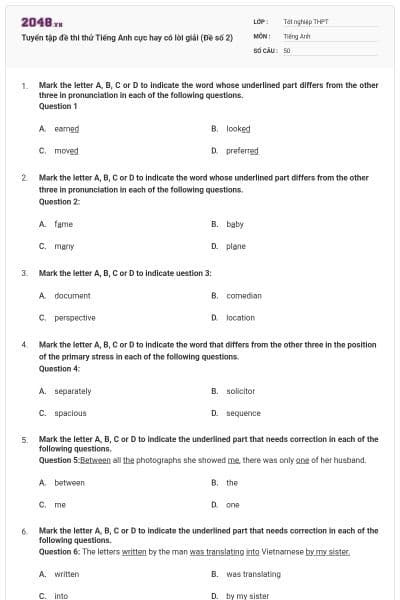
Mark the letter A, B, C or D to indicate the word whose underlined part differs from the other three in pronunciation in each of the following questions.
Question 1
earned
looked
moved
preferred
Đáp án B. looked, phát âm là /t/, con lại phát âm là /d/
A. earned /ɜ:rnd/ (v) kiếm tiền
B. looked /lʊkt/ (v) nhìn
C. moved /mu:vd/ (v) di chuyển
D. preferred /prɪ'fɜ:rd/ (v) thích hơn
Mark the letter A, B, C or D to indicate the word whose underlined part differs from the other three in pronunciation in each of the following questions.
Question 2:
fame
baby
many
plane
Đáp án C. many, phát âm là /e/, còn lại phát âm là /eɪ/
A. fame /feɪm/ (n) danh vọng
B. baby /'beɪbi/ (n) trẻ nhỏ
C. many / 'meni/ (v) nhiều
D. plane /pleɪn/ (n) máy bay
Mark the letter A, B, C or D to indicate the word whose underlined part differs from the other three in pronunciation in each of the following questions.
Mark the letter A, B, C or D to indicate uestion 3:
document
comedian
perspective
location
Đáp án A. document, trọng âm rơi vào âm tiết thứ nhất, còn lại rơi vào âm tiết thứ hai.
A. document / 'dɑ:kjumənt/ (n) tài liệu
B. comedian /kə'mi:diən/ (n) diễn viên hài
C. perspective /pər'spekɪtv/ (n) quan điểm
D. location /loʊ'keɪ∫n/ (n) địa điểm
Mark the letter A, B, C or D to indicate the word that differs from the other three in the position of the primary stress in each of the following questions.
Question 4:
separately
solicitor
spacious
sequence
Đáp án B. solicitor, trọng âm rơi vào âm tiết thứ hai, còn lại rơi vào âm tiết thứ nhất.
A. separately /'seprətli/ (adv) tách biệt
B. solicitor /sə'lɪsɪtər/ (n) cố vấn pháp luật
C. spacious /'speɪ∫əs/ (adj) rộng rãi
D. sequence /'si:kwəns/ (n) hậu quả
Mark, the letter A, B C or D on your answer sheet to indicate the underlined part that needs correction in each of the following questions.
Mark the letter A, B, C or D to indicate the underlined part that needs correction in each of the following questions.
Question 5:Between all the photographs she showed me, there was only one of her husband.
between
the
me
one
Đáp án A. between => Among
Giải thích: Chỉ dùng between giữa hai đối tượng, khi từ ba đối tượng trở lên ta dùng từ among.
Dịch nghĩa. Trong số tất cả các bức ảnh mà cô ấy cho tôi xem, chỉ có một bức là của chồng cô ấy.
Mark the letter A, B, C or D to indicate the underlined part that needs correction in each of the following questions.
Question 6: The letters written by the man was translating into Vietnamese by my sister.
written
was translating
into
by my sister
Đáp án, B was translating => was translated
Giải thích: Những lá thư được dịch sang tiếng Việt - dùng bị động to be Vpp mới đúng.
Dịch nghĩa. Những là thư viết bởi người đàn ông đó được dịch sang tiếng Việt bởi chị của tôi.
Mark the letter A, B, C or D to indicate the underlined part that needs correction in each of the following questions.
Question 7: Some bacteria are extremely harmful, but others are regular used in producing foods.
Some bacteria
extremely harmful
regular used
producing foods
Đáp án: C
Giải thích:
Ta dùng trạng từ để bổ sung nghĩa cho động từ.
Sửa: regular used → regularly used
Dịch: Một số vi khuẩn cực kì độc hại, nhưng một số thì được sử dụng thường xuyên trong việc chế biến thức ăn.

Học thông minh hơn mỗi ngày
Xem toàn bộ 50 câu hỏi và nhiều hơn nữa với tài khoản miễn phí
Mark the letter A, B, C or D to indicate the correct answer to each of the following questions.
Question 8: Garderners transplant bushes and flowers by moving them from one place to _______.
other
others
another
each other
Đáp án C
Giải thích:
other luôn đi kèm một danh từ phía sau, mang nghĩa là “cái khác”
others = other + danh từ số nhiều: những cái khác
another: một cái khác (có thể đi kèm danh từ hay không cũng được)
each other: lẫn nhau
Vì đằng sau không có danh từ nên ta không thể dùng other. Về nghĩa, ta chỉ có thể chuyển từ một chỗ đến một chỗ khác, không thể chuyển từ một chỗ đến “lẫn nhau” hay chuyển từ một chỗ đến “những chỗ khác” được.
Dịch nghĩa. Những người làm vườn cấy ghép cây bụi với hoa bằng cách chuyển chúng từ chỗ này đến chỗ khác.
Mark the letter A, B, C or D to indicate the correct answer to each of the following questions.
Question 9: Dolphins and whales are mammals that _______ lives in water.
spend their entire
their entire
spend there entirely
spending their entire
Đáp án A
Giải thích: Mệnh để quan hệ còn thiếu động từ (nên loại B) và trong mệnh đề quan hệ, động từ vẫn chia bình thường như ở câu trần thuật (nên loại D). Nếu dùng D là mệnh đề quan hệ rút gọn thì không có that trong câu gốc nữa. Giữa A và C. their - của họ, there - ở đó, thì ta dùng their entire time - toàn bộ thời gian của họ, còn there cho vào đó không có nghĩa mà lại thiếu tính từ sở hữu đứng trước danh từ time.
Dịch nghĩa. Cá voi và cá heo là những loài động vật có vú sống cả cuộc đời ở dưới nước.
Mark the letter A, B, C or D to indicate the correct answer to each of the following questions.
Question 10: To bake fish, _________ butter and place it in a generously greased ________ rectangular pan.
it brushes with
with its brushes
brushing it with
brush it with
Đáp án D
Giải thích: Để đưa ra chỉ dẫn, dùng động từ nguyên thể giống như “Stand up”. A và B sai trật tự từ nên sai nghĩa của câu.
Dịch nghĩa. Đế nướng cá, phết bơ lên và đặt nó vào một cái chảo hình chữ nhật có nhiều mỡ.
Mark the letter A, B, C or D to indicate the correct answer to each of the following questions.
Question 11: The risks of developing cancer can _______ by not smoking and by drinking in moderation.
be significantly reduced
to be significantly reduced
significantly reduce
to reduce significantly
Đáp án A
Giải thích: reduce the risks, khi đó the risk là tân ngữ nên khi đảo lên làm chủ ngữ ta phải dùng nó ở dạng bị động - C và D thiếu to be bị loại. Sau can ta dùng động từ nguyên thể nên chọn A.
Dịch nghĩa. Nguy cơ phát triển ung thư có thể được giảm thiểu đáng kế bằng cách không hút thuốc và ăn uống điều độ.
Mark the letter A, B, C or D to indicate the correct answer to each of the following questions.
Question 12: The mass of the sun is about 750 times ________ that of all the planets combined.
the greatest
as great as
greatly
greater
Đáp án B
Giải thích: So sánh gấp bao nhiêu lần ta dùng số lần (twice, three times, 100 times...) + as much/
many/greatl... as
Dịch nghĩa. Khối lượng của mặt trời lớn gấp 750 lần so với tổng tất cả các hành tinh cộng lại.
Mark the letter A, B, C or D to indicate the correct answer to each of the following questions.
Question 13: ____________, let me know.
Do you hear anything
Hear anything
Should you hear anything
Hearing anything
Đáp án C
Giải thích:
Dùng câu điều kiện loại 1 để đưa yêu cầu. Vế if trong câu điều kiện loại I có thể đảo ngữ thành
Should S V.
Phương án A là câu hỏi, không dùng để đưa yêu cầu được.
Phương án B là dạng V nguyên thể, có thể dùng để ra yêu cầu, nhưng dùng B thì cụt lủn và hơi không lịch sự.
Phương án D dạng V_ing có thể coi là một danh từ, không có ý nghĩa gì trong câu này.
Dịch nghĩa. Nếu bạn nghe được gì, cho tôi biết với.
Mark the letter A, B, C or D to indicate the correct answer to each of the following questions.
Question 14: Those flowers are _______ everywhere is a sign of spring.
going over
taking over
coming out
breaking out
Đáp án: C
Giải thích:
Kiến thức: Cụm động từ
go over: kiểm tra kĩ lưỡng
take over: thay thế, đảm đương thay
come out: nở hoa
break out: bùng phát (dịch)
Dựa vào nghĩa, chọn C.
Dịch: Những bông hoa nở khắp nơi là dấu hiệu của mùa xuân.
Mark the letter A, B, C or D to indicate the correct answer to each of the following questions.
Question 15: “All right, it's true I was nervous”.
The leading actor _________ that he had been nervous.
apologized
confessed
agreed
thought
Đáp án B
Giải thích:
A. apologize : xin lỗi
B. confess: thú nhận
C. agree: đồng ý
D. think: nghĩ ngợi, cho rằng
“Được rồi, đúng là tôi đã lo lắng” => câu này chính là sự thú nhận.
Dịch nghĩa. “Được rồi, đúng là tôi đã lo lắng” - Diễn viên chính thú nhận rằng anh ta đã lo lắng
Mark the letter A, B, C or D to indicate the correct answer to each of the following questions.
Question 16: A nuclear power plant emits less radiation than a granite structure of similar proportion, such as the Lincoln Memorial. “Emits” means __________.
gives off
concentrates
repels
confines
Đáp án A
Giải thích:
emit = give of (v) tỏa ra
concentrate on (v) tập trung
repel (v) đẩy lùi
confine (v) giam hãm
Dịch nghĩa. Những nhà máy năng lượng nguyên tử tỏa ra một lượng phóng xạ ít hơn một khối đá granite có tỉ lệ tương đương, giống như tượng đài Lincoln.
Mark the letter A, B, C or D to indicate the correct answer to each of the following questions.
Question 17: The United State turns out 16.5 billion hot dog each year. “Turns out” means _______.
produces
controls
returns
delivers
Đáp án.A
Giải thích:
Turn out: sản xuất, hóa ra là
A. produce: sản xuất
B. control: điều khiển
C. return: quay lại
D. deliver: phân phối, vận chuyển
Dịch nghĩa. Nước Mỹ sản xuất ra khoảng 16,5 tỉ cái bánh mì kẹp xúc xích mỗi ngày.
Mark the letter A, B, C or D to indicate the correct answer to each of the following questions.
Question 18: The International Red Cross helps people in need without any discrimination based on ______, race, religion, class or political opinions.
nation
national
nationality
native
Đáp án: C
Giải thích:
Kiến thức: Từ vựng – Từ loại
A. nation (n): quốc gia
B. national (adj): thuộc về quốc gia
C. nationality (n): quốc tịch
D. native (adj): bản ngữ
Đằng sau vị trí cần điền là một loạt danh từ nên ta cũng diễn một danh từ để tạo thành cấu trúc song song, tuy nhiên về nghĩa thì danh từ “nation” không hợp lí nên ta chọn C.
Dịch: Hội chữ thập đỏ thế giới giúp đỡ mọi người có hoàn cảnh khó khăn mà không phân biệt quốc tịch, tôn giáo, tầng lớp và tư tưởng chính trị.
Mark the letter A, B, C or D to indicate the correct answer to each of the following questions.
Question 19: Don't use the milk I bought last month. It's _______ date now.
out of
in for
into
over
Đáp án A
Giải thích: to be out of date: hết hạn
Dịch nghĩa. Đừng dùng sữa mà tôi mua từ tháng trước. Nó hết hạn rồi.
Mark the letter A, B, C or D to indicate the most suitable response to complete each of the
following exchanges.
Mark the letter A, B, C or D to indicate the most suitable response to complete each of the following exchanges.
Question 20: Jane: “Are you interested in scuba diving?” - Janet: “ __________”.
Very. Undersea life is being strongly contaminated
Very. Undersea life is fascinating
Not any. Undersea life is too expensive
Well, things are much different, now
Đáp án B
Giải thích:
A. Rất thích. Cuộc sống dưới đại dương cực bẩn.
B. Rất thích. Cuộc sống dưới đại dương rất thú vị.
C. Không hề. Cuộc sống dưới đại dương rất đắt đỏ.
D. Ồ, bây giờ mọi thứ đã khác rồi.
Câu A không thống nhất nghĩa, nói rất thích lặn và cuộc sống đại dương rất bẩn - không hợp lí.
Câu C. Đúng ra ta dùng Not at all trong trường hợp này, not any chỉ dùng khi câu hỏi hỏi về số lượng
Câu D không liên quan.
Mark the letter A, B, C or D to indicate the most suitable response to complete each of the following exchanges.
Question 21: Cindy wanted to drive her best friend to have dinner at an Italian restaurant but her car couldn't start. Therefore, she had to borrow one from Nancy. Choose the most suitable response to fill in the blank in the following exchange.
Cindy: “Would you mind lending me your car?” - Nancy: “ ____________.”
Yes. Here it is
Yes, let's
No, not at all
Great
Đáp án C
Giải thich:
Would/ do you mind – Bạn có phiền không - dung để xin phép. Để đồng ý cho người đó làm, ta sẽ trả lời “không phiền”, chẳng hạn như no, not at alll go ahead/ I don’t mind.
Còn nếu không đồng ý, nghĩa là bạn có phiền, thì sẽ trả lời bằng cách đưa ra các lí do từ chối, thỉnh thoảng cũng sử dụng yes, I would, nhưng không phổ biến vì hơi mất lịch sự.
Dịch nghĩa. Bạn có phiền cho tôi mượn xe được không? - Không, không phiền tý nào.
Mark the letter A, B, C or D to indicate the word(s) CLOSET in meaning to the underlined word(s) in each of the following questions.
Mark the letter A, B, C or D to indicate the word/phrases SIMILAR in meaning to the underlined word(s) in each of the following questions.
Question 22: People in Korea gave books to schools in Indonesia, and Indonesians taught Koreans a traditional dance. This exchange helped them learn about each other's culture.
giving and receiving things at the same time
trying many different things at the same time
the process of changing an amount of one currency
an arrangement for two people/parties to me
Đáp án A
Giải thích:
A. Cho đi và nhận về cùng một lúc
B. Thử nhiều thứ cùng một lúc
c. Quá trình thay đổi một lượng tiền tệ
D. Sự sắp xếp hai người/ hai bữa tiệc với tôi
Exchange (v) trao đổi
Dịch nghĩa. Người ở Hàn tặng sách cho các trường học ở Indonesia, và người Indonesia dạy người Hàn điệu múa truyền thống. Sự trao đổi này giúp họ học hỏi văn hóa lẫn nhau.
Mark the letter A, B, C or D to indicate the word/phrases SIMILAR in meaning to the underlined word(s) in each of the following questions.
Question 23: Mobile libraries bring books to children in many small communities. These libraries travel from towns to towns in cars, vans, or trucks.
staying in one place
moving from place to place
can be bent easily and quickly
changing shape or expression easily and often
Đáp án B
Giải thích:
A. Ở một chỗ
B. Di chuyển từ chỗ này qua chỗ kia
C. Có thể bị bẻ cong một cách nhanh chóng, dễ dàng
D. Thay đổi hình dáng và biểu cảm dễ dàng và thường xuyên.
Mobile (n, adj) di động, có tính di động
Dịch nghĩa. Những thư viện di động mang sách để cho trẻ em ở nhiều cộng đồng nhỏ. Những thư
viện này đi từ thị trấn này đến thị trấn khác trong những xe ô tô, hoặc xe tải.
Mark the letter A, B, C or D to indicate the word or phrase that is OPPOSITE in meaning to the underlined part in each of the following questions.
O Mark the letter A, B, C or D to indicate the word or phrase that is OPPOSITE in meaning
to the underlined part in each of the following questions.
Question 24: The Red Cross is an international humanitarian agency dedicated to reducing the sufferings of wounded soldiers, civilians and prisoners of war.
happiness
pain and sorrow
worry and sadness
loss
Đáp án A
Sufferings: tổn thất, sự chịu đựng
A. happiness: niềm vui
B. pain and sorrow: nỗi đau và đau khổ
C. worry and sadness: lo lắng và buồn rầu
D. loss: sự mất mát
Dịch nghĩa. Hội Chữ thập đỏ là một tổ chức nhân đạo quốc tế, tận tâm giảm thiểu tổn thương của những thương bình, dân thường và tù nhân chiến tranh.
O Mark the letter A, B, C or D to indicate the word or phrase that is OPPOSITE in meaning to the underlined part in each of the following questions.
Question 25: Unless the two signatures are identical, the bank won't allow you to withdraw your money.
genuine
different
fake
similar
Đáp án B
Identical (adj) giống nhau
A. genuine: thật
B. different: khác biệt
C. fake: giả
D. similar: tương tự
Dịch nghĩa. Nếu hai chữ kí không giống hệt nhau, ngân hàng sẽ không cho bạn rút tiền.
Mark the letter A, B, C or D to ỉndỉcate the sentence that is closest in meaning to each of the
following questions.
Markthe letter A, B, C or D to indicate the sentence that is closest in meaning to each of the following questions.
Question 26: Far from rejecting my offer, he accepted it gladly.
I expected him to reject my offer, but he accepted it gladly.
He gladly accepted my offer as I had expected.
He had accepted gladly my offer but he rejected my expectations.
I had expected him to reject my offer, but he accepted it gladly.
Đáp án D
Dịch nghĩa. Không những không từ chối lời đề nghị của tôi, anh ấy còn vui vẻ đồng ý nữa.
A. Tôi hi vọng anh ấy từ chối lời đề nghị của tôi, nhưng anh ấy chấp nhận nó một cách vui vẻ.
B. Anh ấy vui vẻ chấp nhận lời đề nghị của tôi như cách mà tôi đã nghĩ.
C. Anh ấy chấp nhận lời đề nghị của tôi nhưng anh ta từ chối hi vọng của tôi.
D. Tôi đã nghĩ là anh ta sẽ từ chối lời đề nghị của tôi, nhưng anh ta vui vẻ chấp nhận.
Nên dùng quá khứ hoàn thành cho sự việc xảy ra trước một sự kiện khác trong quá khứ.
Markthe letter A, B, C or D to indicate the sentence that is closest in meaning to each of the following questions.
Question 27: But for his father's early retirement, Peter would not have taken over the family business.
His father retired early, but Peter still ran the family business.
Peter's father didn't want him to take over the family business despite his retirement.
Peter only took over the family business because his father decided to retire early.
Peter didn't take over the family business because his father didn't retire.
Đáp án C
Dịch nghĩa. Nếu bố anh ta không nghỉ hưu sớm thì Peter đã không kế nhiệm chuyện kinh doanh của gia đình.
A. Bố của anh ta nghỉ hưu sớm, nhưng Peter vẫn điều hành doanh nghiệp của gia đình.
B. Bố của Peter không muốn anh ấy tiếp quản chuyện kinh doanh của gia đình dù ông ý đã nghỉ hưu.
C. Peter chỉ tiếp quản công việc kinh doanh của gia đình vì lí do bố anh ấy quyết định nghỉ hưu sớm.
D. Peter đã không tiếp quản việc kinh doanh của gia đình vì bố anh ấy không nghỉ hưu.
Markthe letter A, B, C or D to indicate the sentence that is closest in meaning to each of the following questions.
Question 28: I don't agree with prohibiting smoking in bars.
I'm not in favor of prohibiting smoking in bars.
I'm not in favor to prohibiting smoking in bars.
I'm not favor with prohibiting smoking in bars.
I'm not doing a favor to prohibiting smoking in bars.
Đáp án A
Dịch nghĩa. Tôi không đồng ý với việc cấm hút thuốc ở trong quán bar.
A. Tôi không đồng ý với việc cấm hút thuốc ở trong quán bar.
B, C, D sai cấu trúc to be in favor of something: thích, đồng tình với cái gì
Mark the letter A, B, C or D to indicate the sentence that best combines each pair of sentences in the following questions.
Mark the letter A, B, C or D to indicate the sentence that best combines each pair of sentences in the following questions.
Question 29: Everyone was watching the little dog. They were greatly amused at it.
Everyone felt great and amused when the little dog was watching them.
The little dog was watching everyone with great amusement.
Everyone was greatly amused at the little dog they were watching.
The little dog was greatly amused by the way everyone was watching it.
Đáp án C
Dịch nghĩa. Mọi người đang nhìn chú chó nhỏ. Họ cực kì hứng thú về nó.
A. Mọi người đều thấy tuyệt vời và hứng thú khi chú chó nhỏ nhìn họ.
B. Chú chó nhỏ đang nhìn mọi người với vẻ hứng thú.
C. Mọi người rất hứng thú với chú chó nhỏ mà họ đang nhìn.
D. Chú chó nhỏ cực kì hứng thú bởi cách mà mọi người nhìn nó.
Mark the letter A, B, C or D to indicate the sentence that best combines each pair of sentences in the following questions.
Question 30: Ann always keeps up with the latest fashions. She works for a famous fashion house.
Ann always keeps up with the latest fashions so as not to work for a famous fashion house.
Ann works for a famous fashion house, so she always keeps up with the latest fashions.
Not working for a famous fashion house, Ann always keeps up with the latest fashions.
Despite working for a famous fashion house, Ann hardly keeps up with the latest fashions.
Đáp án B
Dịch nghĩa. Ann luôn cập nhật những xu hướng thời trang mới nhất. Cô ấy làm việc cho một hãng thời trang rất nổi tiếng.
A. Ann luôn cập nhật những xu hướng thời trang mới nhất để không làm việc cho một hãng thời trang rất nổi tiếng.
B. Ann làm việc cho một hãng thời trang rất nổi tiếng, nên cô ấy luôn cập nhật những xu hướng thời trang mới nhất.
C. Không làm việc cho một hãng thời trang nổi tiếng, Ann luôn cập nhật những xu hướng thời trang mới nhất.
D. Mặc dù làm việc cho một hãng thời trang nổi tiếng, Ann hiếm khi cập nhật xu hướng thời trang mới.
Read the following passage and mark the letter A, B, C or D to indicate the correct word or phrase that best fits each of the numbered blanks from 31 to 35.
The latest addiction to trap thousands of people is Internet, which has been (31) ______ for broken
relationships, job losses, financial ruin and even one suicide. Psychologists now recognize Internet Addiction Syndrome (IAS) as a new illness that could (32) ______ serious problems and ruin many lives. Special help groups have been set up to offer sufferers help and support.
IAS is similar to (33) ______ problems like gambling, smoking and drinking: addicts have dreams about Internet; they need to use it first thing in the morning; they lie to their partners about how much time they spend online; they wish they could cut down, but are unable to do so. A recent study found that many users spend up to 40 hours a week on the Internet; although they felt guilty, they became depressed if they were (34) ______ to stop using it.
Almost anyone can be at risk. Some of the addicts are teenagers who are already hooked on Computer games and who (35) ______ it very difficult to resist the games on the Internet. Surprisingly, however, psychologists say that most victims are middle-aged housewives who have never used a computer before.
Question 31
accused
mistaken
blamed
faulted
Đáp án C
Giải thích:
Blame something/somebody for: khiển trách
To be blamed for something: là nguyên nhân gây ra, chịu trách nhiệm cho việc gì
Read the following passage and mark the letter A, B, C or D to indicate the correct word or phrase that best fits each of the numbered blanks from 31 to 35.
The latest addiction to trap thousands of people is Internet, which has been (31) ______ for broken
relationships, job losses, financial ruin and even one suicide. Psychologists now recognize Internet Addiction Syndrome (IAS) as a new illness that could (32) ______ serious problems and ruin many lives. Special help groups have been set up to offer sufferers help and support.
IAS is similar to (33) ______ problems like gambling, smoking and drinking: addicts have dreams about Internet; they need to use it first thing in the morning; they lie to their partners about how much time they spend online; they wish they could cut down, but are unable to do so. A recent study found that many users spend up to 40 hours a week on the Internet; although they felt guilty, they became depressed if they were (34) ______ to stop using it.
Almost anyone can be at risk. Some of the addicts are teenagers who are already hooked on Computer games and who (35) ______ it very difficult to resist the games on the Internet. Surprisingly, however, psychologists say that most victims are middle-aged housewives who have never used a computer before.
Question 32
others
another
the other
other
Đáp án B
Giải thích:
A. take: chiếm
B. cause something: gây ra việc gì
C. affect something: ảnh hưởng đến cái gì
D. lead to something: dẫn đến việc gì
Phương án C dễ gây nhầm lẫn, nếu dùng C thì sẽ là nó ảnh hưởng đến sức khỏe, ảnh hưởng đến cuộc sống chứ không nói là “ảnh hưởng đến những vấn đề”, thay vào đó, ta dùng “gây ra những vấn đề”. Phương án D thiếu to.
Read the following passage and mark the letter A, B, C or D to indicate the correct word or phrase that best fits each of the numbered blanks from 31 to 35.
The latest addiction to trap thousands of people is Internet, which has been (31) ______ for broken
relationships, job losses, financial ruin and even one suicide. Psychologists now recognize Internet Addiction Syndrome (IAS) as a new illness that could (32) ______ serious problems and ruin many lives. Special help groups have been set up to offer sufferers help and support.
IAS is similar to (33) ______ problems like gambling, smoking and drinking: addicts have dreams about Internet; they need to use it first thing in the morning; they lie to their partners about how much time they spend online; they wish they could cut down, but are unable to do so. A recent study found that many users spend up to 40 hours a week on the Internet; although they felt guilty, they became depressed if they were (34) ______ to stop using it.
Almost anyone can be at risk. Some of the addicts are teenagers who are already hooked on Computer games and who (35) ______ it very difficult to resist the games on the Internet. Surprisingly, however, psychologists say that most victims are middle-aged housewives who have never used a computer before.
Question 33
others
another
the other
other
Đáp án D
Giải thích:
the other + danh từ số ít: cái còn lại trong hai cái
others = the other + danh từ số nhiều: những cái khác trong một nhóm đã biết trước
another + danh từ số ít: một cái khác
other + danh từ số nhiều: những cái khác
Chỉ dùng the khi danh từ được nhắc đến đã xác định, chẳng hạn trước đó đã nói về 1 nhóm học sinh thích lựa chọn A, số còn lại trong nhóm đó thích lựa chọn B thì ta sẽ dùng the. Nếu nói học sinh chung chung thì không có the.
Ở đây, vì đằng sau là danh từ số nhiều, và tác giả so sánh IAS với những vấn đề khác chung chung, không nằm trong một nhóm nào đã được nói ở trước nên ta chỉ dùng other mà không có the.
Read the following passage and mark the letter A, B, C or D to indicate the correct word or phrase that best fits each of the numbered blanks from 31 to 35.
The latest addiction to trap thousands of people is Internet, which has been (31) ______ for broken
relationships, job losses, financial ruin and even one suicide. Psychologists now recognize Internet Addiction Syndrome (IAS) as a new illness that could (32) ______ serious problems and ruin many lives. Special help groups have been set up to offer sufferers help and support.
IAS is similar to (33) ______ problems like gambling, smoking and drinking: addicts have dreams about Internet; they need to use it first thing in the morning; they lie to their partners about how much time they spend online; they wish they could cut down, but are unable to do so. A recent study found that many users spend up to 40 hours a week on the Internet; although they felt guilty, they became depressed if they were (34) ______ to stop using it.
Almost anyone can be at risk. Some of the addicts are teenagers who are already hooked on Computer games and who (35) ______ it very difficult to resist the games on the Internet. Surprisingly, however, psychologists say that most victims are middle-aged housewives who have never used a computer before.
Question 34
made
allowed
let
had
Đáp án A
Giải thích:
A. make sb V: bắt/khiến ai làm gì
B. allow sb to V: cho phép ai làm gì
C. let sb V: cho phép ai làm gì
D. have sb V: nhờ ai/ thuê ai làm gì
Khi chuyển sang bị động chỉ có make có thay đổi: to be made to V: bị bắt làm gì
Còn B, C, D khi chuyển bị động vẫn tuân theo quy tắc chuyển bị động bình thường mà không bị biến thành to V.
Read the following passage and mark the letter A, B, C or D to indicate the correct word or phrase that best fits each of the numbered blanks from 31 to 35.
The latest addiction to trap thousands of people is Internet, which has been (31) ______ for broken
relationships, job losses, financial ruin and even one suicide. Psychologists now recognize Internet Addiction Syndrome (IAS) as a new illness that could (32) ______ serious problems and ruin many lives. Special help groups have been set up to offer sufferers help and support.
IAS is similar to (33) ______ problems like gambling, smoking and drinking: addicts have dreams about Internet; they need to use it first thing in the morning; they lie to their partners about how much time they spend online; they wish they could cut down, but are unable to do so. A recent study found that many users spend up to 40 hours a week on the Internet; although they felt guilty, they became depressed if they were (34) ______ to stop using it.
Almost anyone can be at risk. Some of the addicts are teenagers who are already hooked on Computer games and who (35) ______ it very difficult to resist the games on the Internet. Surprisingly, however, psychologists say that most victims are middle-aged housewives who have never used a computer before.
Question 35
have
find
feel
say
Đáp án B
Giải thích:
Find it adj to V: cảm thấy làm gì như thế nào
Read the following passage and mark the letter A, B, C or D to indicate the correct answer to each of the questions from 36 to 42.
The Battle of Gettysburg
One of the most important battles of the American Civil War occurred around the small town of Gettysburg, Pennsylvania, from July 1 to July 3, 1863. What began as a search for shoes by the Confederate Army quickly escalated into a major battle. As the Confederate soldiers sought new shoes, they unexpectedly encountered Union cavalry stationed west of the town at Willoughby Run, and the battle began. After much fighting and heavy casualties on both sides, the Confederates pushed the Union forces back through the town of Gettysburg, where they regrouped south of the town along the high ground near a cemetery.
Confederate General Robert E. Lee ordered General R.S. Ewell to seize the high ground from the
battle - weary Union soldiers "if practical." Ewell hesitated in the attack, giving the Union troops a chance to establish a stronghold along Cemetery Ridge and then bring in reinforcements with artillery. By the time Lee realized Ewell had not attacked, the opportunity had vanished. Other failures by the Confederates included the generals' opposition to the attack plans and a lack of information about Union defense. This combination of errors allowed the Union forces to win a critical victory in the Civil War. By the end, a total of 160,000 men were involved in this fierce and bloody battle.
Question 36: What is the main idea of the passage?
Shoes were an important factor in the Battle of Gettysburg.
Mistakes by Confederate forces led to a critical victory for the Union at Gettysburg.
The Battle of Gettysburg began accidentally and involved heavy casualties on both sides.
General Ewell hesitated in the attack on the high ground.
Đáp án B
Dịch nghĩa. Đâu là chủ để chính của bài viết?
A. Giày là một nhân tố quan trọng trong cuộc chiến ở Gettysburg
B. Sai lầm của lực lượng miền Nam dẫn đến một chiến thắng quan trọng của Liên minh tại Gettysburg.
C. Trận Gettysburg bắt đầu một cách vô tình và dẫn đến thương vong nặng nề cho cả hai bên.
D. Tướng Ewell do dự trong các cuộc tấn công trên vùng đất cao.
Giải thích: Chủ đề của bài đương nhiên không thể là A hay D vì nó chỉ là 1 ý rất nhỏ trong bài.
Phương án C để gây nhầm lẫn, nhưng không chọn C do ý đầu “bắt đầu một cách vô tình” thì đúng nhưng “gây thương vong nhiều” thì chỉ là một thông tin thêm cho vào, không phải là nội dung chính của đoạn 2.
Mặc dù B chỉ khái quát ý chính của đoạn 2, nhưng đoạn 2 mới là đoạn thông tin chính của cả bài và đoạn 1 chỉ là phần thông tin giới thiệu qua về cuộc chiến để người đọc có cái nhìn bao quát trước về nguyên nhân của trận chiến và dẫn dắt vào bài.
Read the following passage and mark the letter A, B, C or D to indicate the correct answer to each of the questions from 36 to 42.
The Battle of Gettysburg
One of the most important battles of the American Civil War occurred around the small town of Gettysburg, Pennsylvania, from July 1 to July 3, 1863. What began as a search for shoes by the Confederate Army quickly escalated into a major battle. As the Confederate soldiers sought new shoes, they unexpectedly encountered Union cavalry stationed west of the town at Willoughby Run, and the battle began. After much fighting and heavy casualties on both sides, the Confederates pushed the Union forces back through the town of Gettysburg, where they regrouped south of the town along the high ground near a cemetery.
Confederate General Robert E. Lee ordered General R.S. Ewell to seize the high ground from the
battle - weary Union soldiers "if practical." Ewell hesitated in the attack, giving the Union troops a chance to establish a stronghold along Cemetery Ridge and then bring in reinforcements with artillery. By the time Lee realized Ewell had not attacked, the opportunity had vanished. Other failures by the Confederates included the generals' opposition to the attack plans and a lack of information about Union defense. This combination of errors allowed the Union forces to win a critical victory in the Civil War. By the end, a total of 160,000 men were involved in this fierce and bloody battle.
Question 37: Why does the author mention that "Ewell hesitated to attack"?
to explain an important mistake by the Confederates
to show that the Confederates were afraid
to show that Ewell was against the war
none of the answers
Đáp án A
Dịch nghĩa. Tại sao tác giả đề cập “Ewell lưỡng lự không tấn công”?
A. Để giải thích một sai lầm quan trọng của quân miền Nam
B. Để thể hiện là quân miền Nam sợ sệt
C. Để thể hiện rằng Ewell phản đối chiến tranh
D. Tất cả đều sai
Giải thích: Như đã nói ở câu 36, nội dung chính của bài là bàn về sai lầm của quân đội miền Nam khiến quân Liên Minh thắng lợi, và tác giả để cập một sai lầm đó là “lưỡng lự trong tấn công”.
Không có thông tin gì liên quan đến quân đội sợ sệt hay Ewell không muốn chiến tranh được nói trong bài.
Read the following passage and mark the letter A, B, C or D to indicate the correct answer to each of the questions from 36 to 42.
The Battle of Gettysburg
One of the most important battles of the American Civil War occurred around the small town of Gettysburg, Pennsylvania, from July 1 to July 3, 1863. What began as a search for shoes by the Confederate Army quickly escalated into a major battle. As the Confederate soldiers sought new shoes, they unexpectedly encountered Union cavalry stationed west of the town at Willoughby Run, and the battle began. After much fighting and heavy casualties on both sides, the Confederates pushed the Union forces back through the town of Gettysburg, where they regrouped south of the town along the high ground near a cemetery.
Confederate General Robert E. Lee ordered General R.S. Ewell to seize the high ground from the
battle - weary Union soldiers "if practical." Ewell hesitated in the attack, giving the Union troops a chance to establish a stronghold along Cemetery Ridge and then bring in reinforcements with artillery. By the time Lee realized Ewell had not attacked, the opportunity had vanished. Other failures by the Confederates included the generals' opposition to the attack plans and a lack of information about Union defense. This combination of errors allowed the Union forces to win a critical victory in the Civil War. By the end, a total of 160,000 men were involved in this fierce and bloody battle.
Question 38: Which of the following best describes how the Battle of Gettysburg began?
an accidental meeting
an expected fight
a carefully planned surprise attack
a misunderstanding
Đáp án A
Dịch nghĩa. Đâu là câu miêu tả đúng nhất cách mà trận đấu ở Gettysburg bắt đầu?
A. một cuộc gặp tình cờ B.một trận đánh có dự tính trước
C. một cuộc tấn công có chuẩn bị kĩ lưỡng D. một sự hiểu nhầm
Giải thích: Thông tin nằm ở “As the Confederate soldiers sought new shoes, they unexpectedly encountered Union cavalry stationed west of the town at Willoughby Run, and the battle began”
Read the following passage and mark the letter A, B, C or D to indicate the correct answer to each of the questions from 36 to 42.
The Battle of Gettysburg
One of the most important battles of the American Civil War occurred around the small town of Gettysburg, Pennsylvania, from July 1 to July 3, 1863. What began as a search for shoes by the Confederate Army quickly escalated into a major battle. As the Confederate soldiers sought new shoes, they unexpectedly encountered Union cavalry stationed west of the town at Willoughby Run, and the battle began. After much fighting and heavy casualties on both sides, the Confederates pushed the Union forces back through the town of Gettysburg, where they regrouped south of the town along the high ground near a cemetery.
Confederate General Robert E. Lee ordered General R.S. Ewell to seize the high ground from the
battle - weary Union soldiers "if practical." Ewell hesitated in the attack, giving the Union troops a chance to establish a stronghold along Cemetery Ridge and then bring in reinforcements with artillery. By the time Lee realized Ewell had not attacked, the opportunity had vanished. Other failures by the Confederates included the generals' opposition to the attack plans and a lack of information about Union defense. This combination of errors allowed the Union forces to win a critical victory in the Civil War. By the end, a total of 160,000 men were involved in this fierce and bloody battle.
Question 39: According to the passage, which of the following is assumed in the Battle of Gettysburg?
160.000 men were killed.
It was a major victory for General Lee.
The Union soldiers were led by General Ewell.
Both sides had many casualties.
Đáp án D
Dịch nghĩa. Theo bài văn, điều gì có thể suy ra trong trận Gettysburg?
A. 160,000 người bị giết
B. Đó là chiến thắng lớn cho tướng Lee
C. Quân đồng minh được chỉ huy bởi tướng Ewell.
D. Cả hai đều có thương vong.
Giải thích: Thông tin nằm ở “By the end, a total of 160,000 men were involved in this fierce and bloody battle.” – Chỉ nói có 160,000 người bị kéo vào vòng chiến tranh, không hề nói cả 160,000 người đó bị giết chết. Thực tế thì quân của tướng Lee thua nên không phải B và không thể từ việc do dự tấn công mà suy ra tướng Ewell là cầm quân đồng minh được.
Read the following passage and mark the letter A, B, C or D to indicate the correct answer to each of the questions from 36 to 42.
The Battle of Gettysburg
One of the most important battles of the American Civil War occurred around the small town of Gettysburg, Pennsylvania, from July 1 to July 3, 1863. What began as a search for shoes by the Confederate Army quickly escalated into a major battle. As the Confederate soldiers sought new shoes, they unexpectedly encountered Union cavalry stationed west of the town at Willoughby Run, and the battle began. After much fighting and heavy casualties on both sides, the Confederates pushed the Union forces back through the town of Gettysburg, where they regrouped south of the town along the high ground near a cemetery.
Confederate General Robert E. Lee ordered General R.S. Ewell to seize the high ground from the
battle - weary Union soldiers "if practical." Ewell hesitated in the attack, giving the Union troops a chance to establish a stronghold along Cemetery Ridge and then bring in reinforcements with artillery. By the time Lee realized Ewell had not attacked, the opportunity had vanished. Other failures by the Confederates included the generals' opposition to the attack plans and a lack of information about Union defense. This combination of errors allowed the Union forces to win a critical victory in the Civil War. By the end, a total of 160,000 men were involved in this fierce and bloody battle.
Question 40: The word “escalated” in paragraph 1 could best be replaced by __________.
failed
ended
grew
continued
Đáp án C
Dịch nghĩa. Từ “escalated”- tăng cao, leo thang ở đoạn 1 có thể được thay thể tốt nhất bởi __________?
A. thất bại B. chấm dứt C. mọc, phát triển D. tiếp tục
Giải thích: Từ “escalated” trong chiến tranh có nghĩa là “phát triển leo thang”. Do đó, ta không thể dùng “failed - thất bại”, “ended - chấm dứt”, hay “continued - tiếp tục” nhưng không chỉ rõ tính chất. Trong trường hợp này “grew” là phương án phù hợp nhất.
Read the following passage and mark the letter A, B, C or D to indicate the correct answer to each of the questions from 36 to 42.
The Battle of Gettysburg
One of the most important battles of the American Civil War occurred around the small town of Gettysburg, Pennsylvania, from July 1 to July 3, 1863. What began as a search for shoes by the Confederate Army quickly escalated into a major battle. As the Confederate soldiers sought new shoes, they unexpectedly encountered Union cavalry stationed west of the town at Willoughby Run, and the battle began. After much fighting and heavy casualties on both sides, the Confederates pushed the Union forces back through the town of Gettysburg, where they regrouped south of the town along the high ground near a cemetery.
Confederate General Robert E. Lee ordered General R.S. Ewell to seize the high ground from the
battle - weary Union soldiers "if practical." Ewell hesitated in the attack, giving the Union troops a chance to establish a stronghold along Cemetery Ridge and then bring in reinforcements with artillery. By the time Lee realized Ewell had not attacked, the opportunity had vanished. Other failures by the Confederates included the generals' opposition to the attack plans and a lack of information about Union defense. This combination of errors allowed the Union forces to win a critical victory in the Civil War. By the end, a total of 160,000 men were involved in this fierce and bloody battle.
Question 41: The word “they” in paragraph 1 refers to __________.
soldiers
shoes
battles
Army
Đáp án A
A. quân lính B. giày C. trận chiến D. quân đội
Giải thích: Thông tin nằm ở “As the Confederate soldiers sought new shoes, they unexpectedly encountered Union” - Khi những người lính miền Nam tìm giày mới, họ bất ngờ gặp Liên minh kỵ binh. Như Vậy, họ ở đây là thay thế cho the Confederate soldiers - những người lính miền Nam.
Read the following passage and mark the letter A, B, C or D to indicate the correct answer to each of the questions from 36 to 42.
The Battle of Gettysburg
One of the most important battles of the American Civil War occurred around the small town of Gettysburg, Pennsylvania, from July 1 to July 3, 1863. What began as a search for shoes by the Confederate Army quickly escalated into a major battle. As the Confederate soldiers sought new shoes, they unexpectedly encountered Union cavalry stationed west of the town at Willoughby Run, and the battle began. After much fighting and heavy casualties on both sides, the Confederates pushed the Union forces back through the town of Gettysburg, where they regrouped south of the town along the high ground near a cemetery.
Confederate General Robert E. Lee ordered General R.S. Ewell to seize the high ground from the
battle - weary Union soldiers "if practical." Ewell hesitated in the attack, giving the Union troops a chance to establish a stronghold along Cemetery Ridge and then bring in reinforcements with artillery. By the time Lee realized Ewell had not attacked, the opportunity had vanished. Other failures by the Confederates included the generals' opposition to the attack plans and a lack of information about Union defense. This combination of errors allowed the Union forces to win a critical victory in the Civil War. By the end, a total of 160,000 men were involved in this fierce and bloody battle.
Question 42: Complete the summary by choosing one sentence (A, B, C or D) that is among the most important information to fill in the blank.
SUMMARY: This passage discusses the Battle of Gettysburg. The battle began when Confederate and Federal soldiers met by accident near Gettysburg.__________. Failures by the Confederate forces in planning and intelligence allowed the Union army to win the battle.
When Lee realized that Ewell had not attacked, the opportunity was gone.
Confederate General Ewell hesitated to attack, which allowed the Union forces time to prepare.
The Confederate soldiers regrouped south of Gettysburg on high ground.
A total of 160,000 men were involved in the battle.
Đáp án B
Dịch nghĩa. Hoàn thành bài tóm tắt bằng cách chọn 1 câu (A, B, C hay D) là thông tin quan trọng nhất để điền vào chỗ trống.
Tóm tắt: Bài văn bàn luận về trận chiến Gettysburg. Trận chiến xảy ra khi quân miền Nam và quân liên bang tình cờ gặp nhau ở gần Gettysburg. _________. Thất bại của các lực lượng của quân miền Nam trong việc lập kế hoạch và trí thông minh cho phép quân đội Liên minh để giành chiến thắng trong trận chiến.
A. Khi Lee nhận ra rằng tướng Ewell vẫn chưa tấn công thì cơ hội đã qua đi.
B. Tướng Ewell của quân miền Nam do dự tấn công, tạo cho quân đồng minh có thời gian để chuẩn bị.
C. Binh lính quân miền Nam hợp lại ở phía Nam Gettysburg ở vùng đất cao.
D. Tổng cộng 160,000 người bị liên đới trong trận chiến.
Giải thích: Bài văn nói về sai lầm của quân miền Nam dẫn đến chiến thắng của quân đồng minh, nên thông tin quan trọng cần đề cập là những sai lầm đó. A và C là chi tiết không quan trọng và không liên kết với câu sau. D là kết quả cuối cùng thì nên cho vào sau để tổng kết, cho vào giữa không phù hợp, chưa kể đây là thông tin thêm không phải nội dung chính của bài.
Read the following passage and mark the letter A, B, C or D to indicate the correct answer to each of the questions from 43 to 50.
You can usually tell when your friends are happy or angry by the looks on their faces or by their actions. This is useful because reading their emotional expressions helps you to know how to respond to them. Emotions have evolved to help us respond to important situations and to convey our intentions to others. But does raising the eyebrows and rounding the mouth say the same thing in Minneapolis as it does in Madagascar? Much research on emotional expressions has centered on such questions.
According to Paul Ekman, the leading researcher in this area, people speak and understand substantially the same "facial language". Studies by Ekman's group have demonstrated that humans share a set of universal emotional expressions that testify to the common biological heritage of the human species. Smiles, for example, signal happiness and frowns indicate sadness on the faces of people in such far- flung places as Argentina, Japan, Spain, Hungary, Poland, Sumatra, the United States, Vietnam, the jungles of New Guinea, and the Eskimo villages north of Artic Circle. Ekman and his colleagues claim that people everywhere can recognize at least seven basic emotions: sadness, fear, anger, disgust, contempt, happiness, and surprise. There are, however, huge differences across cultures in both the context and intensity of emotional displays - the so called display rules. In many Asian cultures, for example, children are taught to control emotional responses - especially negative ones- while many American children are encouraged to express their feelings more openly. Regardless of culture, however, emotions usually show themselves, to some degree, in people's behavior. From their first days of life, babies produce facial expressions that communicate their feelings.
The ability to read facial expressions develops early, too. Very young children pay close attention to facial expressions, and by age five, they nearly equal adults in their skill at reading emotions on people>s faces. This evidence all points to a biological underpinning for our abilities to express and interpret a basic set of human emotions. Moreover, as Charles Darwin pointed out over a century ago, some emotional expressions seem to appear across species boundaries. Cross - cultural psychologists tell us that certain emotional responses carry different meanings in different cultures. For example, what emotion do you suppose might be conveyed by sticking out your tongue? For Americans, this might indicate disgust, while in China it can signify surprise. Likewise, a grin on an American face may indicate joy, while on a Japanese face it may just as easily mean embarrassment. Clearly, culture influences emotional expressions.
Question 43: Unlike American children, Asian children are encouraged to ______.
display their emotions openly
conceal their positive emotions
control their emotions
change their behaviour
Đáp án C
Dịch nghĩa. Không giống như những đứa trẻ Mỹ, trẻ con châu Á được khuyến khích __________.
A. thế hiện cảm xúc công khai B. che giấu những cảm xúc tiêu cực
C. điều khiển cảm xúc D. thay đổi hành vi
Giải thích: Thông tin nằm ở đoạn 2 “In many Asian cultures, for example, children are taught to control emotional responses - especially negative ones - While many American children are encouraged to express their feelings more openly”
Read the following passage and mark the letter A, B, C or D to indicate the correct answer to each of the questions from 43 to 50.
You can usually tell when your friends are happy or angry by the looks on their faces or by their actions. This is useful because reading their emotional expressions helps you to know how to respond to them. Emotions have evolved to help us respond to important situations and to convey our intentions to others. But does raising the eyebrows and rounding the mouth say the same thing in Minneapolis as it does in Madagascar? Much research on emotional expressions has centered on such questions.
According to Paul Ekman, the leading researcher in this area, people speak and understand substantially the same "facial language". Studies by Ekman's group have demonstrated that humans share a set of universal emotional expressions that testify to the common biological heritage of the human species. Smiles, for example, signal happiness and frowns indicate sadness on the faces of people in such far- flung places as Argentina, Japan, Spain, Hungary, Poland, Sumatra, the United States, Vietnam, the jungles of New Guinea, and the Eskimo villages north of Artic Circle. Ekman and his colleagues claim that people everywhere can recognize at least seven basic emotions: sadness, fear, anger, disgust, contempt, happiness, and surprise. There are, however, huge differences across cultures in both the context and intensity of emotional displays - the so called display rules. In many Asian cultures, for example, children are taught to control emotional responses - especially negative ones- while many American children are encouraged to express their feelings more openly. Regardless of culture, however, emotions usually show themselves, to some degree, in people's behavior. From their first days of life, babies produce facial expressions that communicate their feelings.
The ability to read facial expressions develops early, too. Very young children pay close attention to facial expressions, and by age five, they nearly equal adults in their skill at reading emotions on people>s faces. This evidence all points to a biological underpinning for our abilities to express and interpret a basic set of human emotions. Moreover, as Charles Darwin pointed out over a century ago, some emotional expressions seem to appear across species boundaries. Cross - cultural psychologists tell us that certain emotional responses carry different meanings in different cultures. For example, what emotion do you suppose might be conveyed by sticking out your tongue? For Americans, this might indicate disgust, while in China it can signify surprise. Likewise, a grin on an American face may indicate joy, while on a Japanese face it may just as easily mean embarrassment. Clearly, culture influences emotional expressions.
Question 44: The word "evolved" is closest in meaning to ________.
increased
reduced
developed
simplified
Đáp án C
Dịch nghĩa. Từ “evolved” - tiến hóa gần nghĩa nhất với __________.
A. tăng B. giảm C. phát triển D. đơn giản hóa
Read the following passage and mark the letter A, B, C or D to indicate the correct answer to each of the questions from 43 to 50.
You can usually tell when your friends are happy or angry by the looks on their faces or by their actions. This is useful because reading their emotional expressions helps you to know how to respond to them. Emotions have evolved to help us respond to important situations and to convey our intentions to others. But does raising the eyebrows and rounding the mouth say the same thing in Minneapolis as it does in Madagascar? Much research on emotional expressions has centered on such questions.
According to Paul Ekman, the leading researcher in this area, people speak and understand substantially the same "facial language". Studies by Ekman's group have demonstrated that humans share a set of universal emotional expressions that testify to the common biological heritage of the human species. Smiles, for example, signal happiness and frowns indicate sadness on the faces of people in such far- flung places as Argentina, Japan, Spain, Hungary, Poland, Sumatra, the United States, Vietnam, the jungles of New Guinea, and the Eskimo villages north of Artic Circle. Ekman and his colleagues claim that people everywhere can recognize at least seven basic emotions: sadness, fear, anger, disgust, contempt, happiness, and surprise. There are, however, huge differences across cultures in both the context and intensity of emotional displays - the so called display rules. In many Asian cultures, for example, children are taught to control emotional responses - especially negative ones- while many American children are encouraged to express their feelings more openly. Regardless of culture, however, emotions usually show themselves, to some degree, in people's behavior. From their first days of life, babies produce facial expressions that communicate their feelings.
The ability to read facial expressions develops early, too. Very young children pay close attention to facial expressions, and by age five, they nearly equal adults in their skill at reading emotions on people>s faces. This evidence all points to a biological underpinning for our abilities to express and interpret a basic set of human emotions. Moreover, as Charles Darwin pointed out over a century ago, some emotional expressions seem to appear across species boundaries. Cross - cultural psychologists tell us that certain emotional responses carry different meanings in different cultures. For example, what emotion do you suppose might be conveyed by sticking out your tongue? For Americans, this might indicate disgust, while in China it can signify surprise. Likewise, a grin on an American face may indicate joy, while on a Japanese face it may just as easily mean embarrassment. Clearly, culture influences emotional expressions.
Question 45: The phrase "this evidence" refers to ________.
human facial expressions
the fact that children can control their feelings
a biological underpinning for humans to express emotions
the fact that children are good at recognizing others' emotions
Đáp án D
Dịch nghĩa. Cụm từ “this evidence” – bằng chứng này - nhắc đến __________.
A. biểu cảm gương mặt con người
B. thực tế là trẻ con có thể điều khiển được cảm xúc
C. một nền tảng sinh học cho với con người để thể hiện cảm xúc
D. thực tế là trẻ con giỏi nhận dạng cảm xúc người khác
Giải thích: Thông tin nằm ở đoạn 2 “Very young children pay close attention to facial expressions, and by age five, they nearly equal adults in their skill at reading emotions on people’s faces. This evidence all points to a biological underpinning for our abilities to express and interpret a basic set of human emotions” Trẻ nhỏ rất chú ý tới nét mặt, và đến khi năm tuổi, chúng gần như bằng người lớn trong kỹ năng đọc cảm xúc trên khuôn mặt của người khác. Tất cả bằng chứng này dẫn đến một nền tảng sinh học để chúng ta có thể bày tỏ và thấu hiểu một cơ số những cảm xúc con người.
Như vậy this evidence là thay thế cho việc trẻ em nhận dạng cảm xúc.
Read the following passage and mark the letter A, B, C or D to indicate the correct answer to each of the questions from 43 to 50.
You can usually tell when your friends are happy or angry by the looks on their faces or by their actions. This is useful because reading their emotional expressions helps you to know how to respond to them. Emotions have evolved to help us respond to important situations and to convey our intentions to others. But does raising the eyebrows and rounding the mouth say the same thing in Minneapolis as it does in Madagascar? Much research on emotional expressions has centered on such questions.
According to Paul Ekman, the leading researcher in this area, people speak and understand substantially the same "facial language". Studies by Ekman's group have demonstrated that humans share a set of universal emotional expressions that testify to the common biological heritage of the human species. Smiles, for example, signal happiness and frowns indicate sadness on the faces of people in such far- flung places as Argentina, Japan, Spain, Hungary, Poland, Sumatra, the United States, Vietnam, the jungles of New Guinea, and the Eskimo villages north of Artic Circle. Ekman and his colleagues claim that people everywhere can recognize at least seven basic emotions: sadness, fear, anger, disgust, contempt, happiness, and surprise. There are, however, huge differences across cultures in both the context and intensity of emotional displays - the so called display rules. In many Asian cultures, for example, children are taught to control emotional responses - especially negative ones- while many American children are encouraged to express their feelings more openly. Regardless of culture, however, emotions usually show themselves, to some degree, in people's behavior. From their first days of life, babies produce facial expressions that communicate their feelings.
The ability to read facial expressions develops early, too. Very young children pay close attention to facial expressions, and by age five, they nearly equal adults in their skill at reading emotions on people>s faces. This evidence all points to a biological underpinning for our abilities to express and interpret a basic set of human emotions. Moreover, as Charles Darwin pointed out over a century ago, some emotional expressions seem to appear across species boundaries. Cross - cultural psychologists tell us that certain emotional responses carry different meanings in different cultures. For example, what emotion do you suppose might be conveyed by sticking out your tongue? For Americans, this might indicate disgust, while in China it can signify surprise. Likewise, a grin on an American face may indicate joy, while on a Japanese face it may just as easily mean embarrassment. Clearly, culture influences emotional expressions.
Question 46: Young children _______.
make amazing progress in controlling their emotions
take time to control their facial expressions
are sensitive towards others' emotions
spend a long time learning to read others' emotions
Đáp án C
Dịch nghĩa. Trẻ nhỏ ___________.
A. tiến bộ rất nhanh trong việc điều khiển cảm xúc
B. cần thời gian để điều khiển biểu cảm gương mặt
C. nhạy cảm với cảm xúc của con người
D. dành thời gian dài học đọc cảm xúc người khác
Giải thích: Thông tin nằm ở đoạn 2 “The ability to read facial expressions develops early, too. Very young children pay close attention to facial expressions”
Read the following passage and mark the letter A, B, C or D to indicate the correct answer to each of the questions from 43 to 50.
You can usually tell when your friends are happy or angry by the looks on their faces or by their actions. This is useful because reading their emotional expressions helps you to know how to respond to them. Emotions have evolved to help us respond to important situations and to convey our intentions to others. But does raising the eyebrows and rounding the mouth say the same thing in Minneapolis as it does in Madagascar? Much research on emotional expressions has centered on such questions.
According to Paul Ekman, the leading researcher in this area, people speak and understand substantially the same "facial language". Studies by Ekman's group have demonstrated that humans share a set of universal emotional expressions that testify to the common biological heritage of the human species. Smiles, for example, signal happiness and frowns indicate sadness on the faces of people in such far- flung places as Argentina, Japan, Spain, Hungary, Poland, Sumatra, the United States, Vietnam, the jungles of New Guinea, and the Eskimo villages north of Artic Circle. Ekman and his colleagues claim that people everywhere can recognize at least seven basic emotions: sadness, fear, anger, disgust, contempt, happiness, and surprise. There are, however, huge differences across cultures in both the context and intensity of emotional displays - the so called display rules. In many Asian cultures, for example, children are taught to control emotional responses - especially negative ones- while many American children are encouraged to express their feelings more openly. Regardless of culture, however, emotions usually show themselves, to some degree, in people's behavior. From their first days of life, babies produce facial expressions that communicate their feelings.
The ability to read facial expressions develops early, too. Very young children pay close attention to facial expressions, and by age five, they nearly equal adults in their skill at reading emotions on people>s faces. This evidence all points to a biological underpinning for our abilities to express and interpret a basic set of human emotions. Moreover, as Charles Darwin pointed out over a century ago, some emotional expressions seem to appear across species boundaries. Cross - cultural psychologists tell us that certain emotional responses carry different meanings in different cultures. For example, what emotion do you suppose might be conveyed by sticking out your tongue? For Americans, this might indicate disgust, while in China it can signify surprise. Likewise, a grin on an American face may indicate joy, while on a Japanese face it may just as easily mean embarrassment. Clearly, culture influences emotional expressions.
Question 47: The biggest difference lies in ________.
how often positive emotions are shown
how emotional responses are controlled
how intensive emotions are expressed
how long negative emotions are displayed
Đáp án C
Dịch nghĩa. Khác biệt lớn nhất nằm ở ______________.
A. biểu cảm tích cực được thế hiện như thế nào
B. sự đáp lại bằng cảm xúc được điều khiển thế nào
C. cảm xúc mãnh liệt được thể hiện như thế nào
D. những cảm xúc tiêu cực được thể hiện trong bao lâu
Giải thích: Thông tin nằm ở đoạn 2 “There are, however, huge differences across cultures in both the context and intensity of emotional displays - the so called display rules”
Read the following passage and mark the letter A, B, C or D to indicate the correct answer to each of the questions from 43 to 50.
You can usually tell when your friends are happy or angry by the looks on their faces or by their actions. This is useful because reading their emotional expressions helps you to know how to respond to them. Emotions have evolved to help us respond to important situations and to convey our intentions to others. But does raising the eyebrows and rounding the mouth say the same thing in Minneapolis as it does in Madagascar? Much research on emotional expressions has centered on such questions.
According to Paul Ekman, the leading researcher in this area, people speak and understand substantially the same "facial language". Studies by Ekman's group have demonstrated that humans share a set of universal emotional expressions that testify to the common biological heritage of the human species. Smiles, for example, signal happiness and frowns indicate sadness on the faces of people in such far- flung places as Argentina, Japan, Spain, Hungary, Poland, Sumatra, the United States, Vietnam, the jungles of New Guinea, and the Eskimo villages north of Artic Circle. Ekman and his colleagues claim that people everywhere can recognize at least seven basic emotions: sadness, fear, anger, disgust, contempt, happiness, and surprise. There are, however, huge differences across cultures in both the context and intensity of emotional displays - the so called display rules. In many Asian cultures, for example, children are taught to control emotional responses - especially negative ones- while many American children are encouraged to express their feelings more openly. Regardless of culture, however, emotions usually show themselves, to some degree, in people's behavior. From their first days of life, babies produce facial expressions that communicate their feelings.
The ability to read facial expressions develops early, too. Very young children pay close attention to facial expressions, and by age five, they nearly equal adults in their skill at reading emotions on people>s faces. This evidence all points to a biological underpinning for our abilities to express and interpret a basic set of human emotions. Moreover, as Charles Darwin pointed out over a century ago, some emotional expressions seem to appear across species boundaries. Cross - cultural psychologists tell us that certain emotional responses carry different meanings in different cultures. For example, what emotion do you suppose might be conveyed by sticking out your tongue? For Americans, this might indicate disgust, while in China it can signify surprise. Likewise, a grin on an American face may indicate joy, while on a Japanese face it may just as easily mean embarrassment. Clearly, culture influences emotional expressions.
Question 48: Paul Ekman is mentioned in the passage as an example of _______.
investigatorson universal emotional expressions
researchers on universal language
researchers who can speak and understand many languages
lacked many main ingredients
Đáp án A
Dịch nghĩa. Paul Ekman được nhắc đến trong bài văn như là một ví dụ của ___________.
A. nhà nghiên cứu về biểu cảm chung
B. nhà nghiên cứu về ngôn ngữ toàn cầu
C. nhà nghiên cứu có thể nói và hiểu nhiều thứ tiếng
D. thiếu nhiều nguyên liệu chính
Giải thích: Thông tin nằm ở đoạn 1 và 2 “Much research on emotional expressions has centered on such questions. According to Paul Ekman, the leading researcher in this area...” This area chính là chỉ lĩnh vực nghiên cứu về biểu cảm.
Read the following passage and mark the letter A, B, C or D to indicate the correct answer to each of the questions from 43 to 50.
You can usually tell when your friends are happy or angry by the looks on their faces or by their actions. This is useful because reading their emotional expressions helps you to know how to respond to them. Emotions have evolved to help us respond to important situations and to convey our intentions to others. But does raising the eyebrows and rounding the mouth say the same thing in Minneapolis as it does in Madagascar? Much research on emotional expressions has centered on such questions.
According to Paul Ekman, the leading researcher in this area, people speak and understand substantially the same "facial language". Studies by Ekman's group have demonstrated that humans share a set of universal emotional expressions that testify to the common biological heritage of the human species. Smiles, for example, signal happiness and frowns indicate sadness on the faces of people in such far- flung places as Argentina, Japan, Spain, Hungary, Poland, Sumatra, the United States, Vietnam, the jungles of New Guinea, and the Eskimo villages north of Artic Circle. Ekman and his colleagues claim that people everywhere can recognize at least seven basic emotions: sadness, fear, anger, disgust, contempt, happiness, and surprise. There are, however, huge differences across cultures in both the context and intensity of emotional displays - the so called display rules. In many Asian cultures, for example, children are taught to control emotional responses - especially negative ones- while many American children are encouraged to express their feelings more openly. Regardless of culture, however, emotions usually show themselves, to some degree, in people's behavior. From their first days of life, babies produce facial expressions that communicate their feelings.
The ability to read facial expressions develops early, too. Very young children pay close attention to facial expressions, and by age five, they nearly equal adults in their skill at reading emotions on people>s faces. This evidence all points to a biological underpinning for our abilities to express and interpret a basic set of human emotions. Moreover, as Charles Darwin pointed out over a century ago, some emotional expressions seem to appear across species boundaries. Cross - cultural psychologists tell us that certain emotional responses carry different meanings in different cultures. For example, what emotion do you suppose might be conveyed by sticking out your tongue? For Americans, this might indicate disgust, while in China it can signify surprise. Likewise, a grin on an American face may indicate joy, while on a Japanese face it may just as easily mean embarrassment. Clearly, culture influences emotional expressions.
Question 49: The best title for the passage is ___________.
ways to control emotional expressions
cultural universals in emotional expressions
Human habit of displaying emotions
review of research on emotional expressions
Đáp án B
Dịch nghĩa. Nhan để phù hợp nhất cho bài viết là ___________.
A. Các cách để điều khiển cảm xúc
B. những điểm chung giữa các nền văn hóa về biểu cảm
C. Thói quen của con người khi thể hiện cảm xúc
D. nhận xét về cách bài nghiên cứu biểu cảm
Giải thích: Bài viết tập trung nói về biểu cảm (ngay từ đoạn 1 tác giả đã giới thiệu về việc nghiên cứu xem liệu những biểu cảm có thể hiện những ý nghĩa giống nhau ở các địa điểm khác nhau không. Sau đó đi sâu chi tiết trong đoạn 2 và 3) Các phương án khác thì hoàn toàn không được nói trong bài.
Read the following passage and mark the letter A, B, C or D to indicate the correct answer to each of the questions from 43 to 50.
You can usually tell when your friends are happy or angry by the looks on their faces or by their actions. This is useful because reading their emotional expressions helps you to know how to respond to them. Emotions have evolved to help us respond to important situations and to convey our intentions to others. But does raising the eyebrows and rounding the mouth say the same thing in Minneapolis as it does in Madagascar? Much research on emotional expressions has centered on such questions.
According to Paul Ekman, the leading researcher in this area, people speak and understand substantially the same "facial language". Studies by Ekman's group have demonstrated that humans share a set of universal emotional expressions that testify to the common biological heritage of the human species. Smiles, for example, signal happiness and frowns indicate sadness on the faces of people in such far- flung places as Argentina, Japan, Spain, Hungary, Poland, Sumatra, the United States, Vietnam, the jungles of New Guinea, and the Eskimo villages north of Artic Circle. Ekman and his colleagues claim that people everywhere can recognize at least seven basic emotions: sadness, fear, anger, disgust, contempt, happiness, and surprise. There are, however, huge differences across cultures in both the context and intensity of emotional displays - the so called display rules. In many Asian cultures, for example, children are taught to control emotional responses - especially negative ones- while many American children are encouraged to express their feelings more openly. Regardless of culture, however, emotions usually show themselves, to some degree, in people's behavior. From their first days of life, babies produce facial expressions that communicate their feelings.
The ability to read facial expressions develops early, too. Very young children pay close attention to facial expressions, and by age five, they nearly equal adults in their skill at reading emotions on people>s faces. This evidence all points to a biological underpinning for our abilities to express and interpret a basic set of human emotions. Moreover, as Charles Darwin pointed out over a century ago, some emotional expressions seem to appear across species boundaries. Cross - cultural psychologists tell us that certain emotional responses carry different meanings in different cultures. For example, what emotion do you suppose might be conveyed by sticking out your tongue? For Americans, this might indicate disgust, while in China it can signify surprise. Likewise, a grin on an American face may indicate joy, while on a Japanese face it may just as easily mean embarrassment. Clearly, culture influences emotional expressions.
Question 50: Many studies on emotional expressions try to answer whether _________.
eyebrow raising means the same in Minneapolis and Madagascar.
different cultures have similar emotional expressions.
rounding the mouth has the same meaning in Minneapolis and Madagascar.
raising the eyebrows has similar meaning to rounding the mouth.
Đáp án B
Dịch nghĩa. Nhiều nghiên cứu về biểu cảm cố gắng trả lời câu hỏi liệu __________.
A. nhướn mày có ý nghĩa như nhau ở cả Minneapolis và Madagascar.
B. những nền văn hóa khác nhau có những cách biểu cảm khác nhau
C. tròn miệng có ý nghĩa giống nhau ở Minneapolis và Madagascar.
D. nhướn lông mày có ý nghĩa giống với tròn miệng.
Giải thích: Thông tin nằm ở đoạn 1 “But does raising the eyebrows and rounding the mouth say the same thing in Minneapolis as it does in Madagascar? Much research on emotional expressions has centered on such questions.” – Tập trung vào những câu hỏi như thế, những câu hỏi xem liệu các biểu cảm có giống nhau không, chứ không chỉ nói về 1 vấn để nhướn mày hay tròn miệng.
Bạn có thích hoạt động này không?
Ý kiến của bạn sẽ giúp chúng tôi đề xuất nội dung phù hợp hơn.
Gợi ý cho bạn
![[Năm 2022] Đề thi thử môn Vật lí THPT Quốc gia có lời giải - Đề số 21](/_next/image?url=https%3A%2F%2Fvideo.vietjack.com%2Fupload%2Fimages%2Fvj-image%2Fimage-3izficdefgfoel0s9j8s-1786772791.jpg&w=3840&q=75)
![[Năm 2022] Đề thi thử môn Vật lí THPT Quốc gia có lời giải - Đề số 20](/_next/image?url=https%3A%2F%2Fvideo.vietjack.com%2Fupload%2Fimages%2Fvj-image%2Fimage-emy0gtcksawvorajezvv-1786772460.jpg&w=3840&q=75)
Tài liệu phổ biến Tốt nghiệp THPT
Tài liệu phổ biến Tiếng Anh