Tuyển tập đề thi thử Tiếng Anh cực hay có lời giải (Đề số 16)
50 câu hỏi
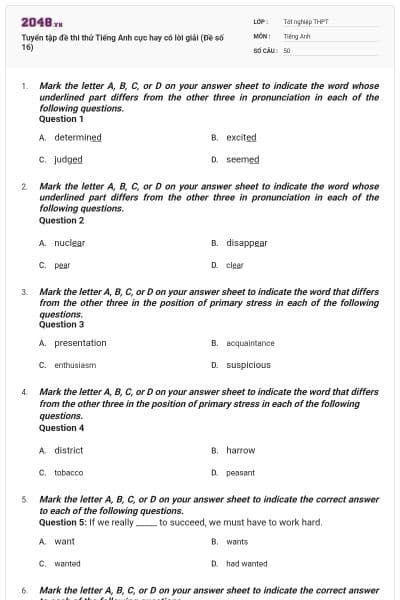
Mark the letter A, B, C, or D on your answer sheet to indicate the word whose underlined part differs from the other three in pronunciation in each of the following questions.
Question 1
determined
excited
judged
seemed
Đáp án B
Kiến thức về phát âm
“-ed” được phát âm là:
+ /t/: khi âm tận cùng trước nó là /s/, /tʃ/, /ʃ/, /k/, /p/, /f/
+ /id/: khi trước –ed là /t/ và /d/
+ /d/: khi âm tận cùng trước –ed là nguyên âm và các phụ âm còn lại
=> Đáp án B
Mark the letter A, B, C, or D on your answer sheet to indicate the word whose underlined part differs from the other three in pronunciation in each of the following questions.
Question 2
nuclear
disappear
pear
clear
Đáp án C
Kiến thức về phát âm
A. nuclear /nju:kliə/
B. disappear /disəpiə/
C. pear /peə/
D. clear /kliər/
=> Đáp án C (phần gạch chân được phát âm là /eə/, các phương án còn lại được phát âm là / iə/)
Mark the letter A, B, C, or D on your answer sheet to indicate the word that differs from the other three in the position of primary stress in each of the following questions.
Question 3
presentation
acquaintance
enthusiasm
suspicious
Đáp án A
Kiến thức về trọng âm
A. presentation /,prezenteiʃn/: từ này có trọng âm rơi vào âm tiết thứ ba. Vì theo quy tắc đuôi –tion làm trọng âm rơi vào trước âm đó.
B. acquaintance /əkweintəns/: từ này có trọng âm rơi vào âm tiết thứ hai. Vì theo quy tắc đuôi –ance không ảnh hưởng đến trọng âm của từ và trọng âm không rơi vào âm /ə/.
C. enthusiasm /enɵuzi,æzəm/: từ này có trọng âm rơi vào âm tiết thứ hai. Vì theo quy tắc trọng âm rơi vào nguyên âm dài /u:/.
D. suspicious /sə’spiʃəs/: từ này có trọng âm rơi vào âm tiết thứ hai. Vì theo quy tắc đuôi –ious làm trọng âm rơi vào trước âm đó.
=> Đáp án A trọng âm rơi vào âm tiết thứ ba, các phương án còn lại trọng âm rơi vào âm tiết thứ hai.
Mark the letter A, B, C, or D on your answer sheet to indicate the word that differs from the other three in the position of primary stress in each of the following questions.
Question 4
district
harrow
tobacco
peasant
Đáp án C
Kiến thức trọng âm
A. district /’distrikt/: từ này có trọng âm rơi vào âm tiết thứ nhất. Vì theo quy tắc nếu tất cả các âm mà ngắn hết thì trọng âm rơi vào âm tiết đầu.
B. harrow /’hærəʊ/: từ này có trọng âm rơi vào âm tiết thứ nhất. Vì theo quy tắc trọng âm không rơi vào âm /əʊ/.
C. tobacco /tə’bækəʊ/: từ này có trọng âm rơi vào âm tiết thứ hai. Vì theo quy tắc trọng âm không rơi vào âm /ə/ hoặc âm /əʊ/.
D. peasant /’pez ənt/: từ này có trọng âm rơi vào âm tiết thứ nhất. Vì theo quy tắc trọng âm không rơi vào âm /ə/.
=> Phương án C trọng âm rơi vào âm tiết thứ ba, các phương án còn lại trọng âm rơi vào âm tiết thứ nhất.
Mark the letter A, B, C, or D on your answer sheet to indicate the correct answer to each of the following questions.
Question 5: If we really _____ to succeed, we must have to work hard.
want
wants
wanted
had wanted
Đáp án A
Kiến thức về câu điều kiện
Căn cứ vào “if” mà “must have” thì câu này là câu điều kiện loại 1.
Câu điều kiện loại 1 có công thức như sau:
If + S +V (hiện tại đơn), S + will/can/must… + V
Chủ ngữ của mệnh đề điều kiện là “we” nên động từ phải chia ở dạng số nhiều.
=> Đáp án A
Tạm dịch: Nếu chúng ta thực sự muốn thành công, chúng ta phải làm việc chăm chỉ.
Mark the letter A, B, C, or D on your answer sheet to indicate the correct answer to each of the following questions.
Question 6: My responsibility is to wash the dishes and take ______ the garbage every day.
up
in
on
out
Đáp án D
Kiến thức về cụm động từ
A. take up: tiếp tục (một công việc bỏ dở…); chọn (một nghề, sở thích ); đảm nhiệm , gánh vác (một công việc)
B. take in: hiểu/ lừa gạt
C. take on: đảm nhiệm, thuê mướn
D. take out: nhổ (răng, cây), đổ (rác)
=> Đáp án D
Tạm dịch: Nhiệm vụ của tôi là rửa bát và đổ rác hàng ngày.
Mark the letter A, B, C, or D on your answer sheet to indicate the correct answer to each of the following questions.
Question 7: The problems of the past few months have _______ their toll on her health and there are shadows under her eyes.
taken
effected
had
changed
Đáp án A
Kiến thức về cụm từ cố định
To take one’s toll on sb/st = to have a bad effect on someone or something, especially over a long period of time: gây ảnh hưởng nghiệm trọng/ lâu dài cho ai/ cái gì
=> Đáp án A
Tạm dịch: Những vấn đề của vài tháng trước đã có ảnh hưởng nghiêm trọng tới sức khỏe của cô ấy và để lại những quầng mắt.

Học thông minh hơn mỗi ngày
Xem toàn bộ 50 câu hỏi và nhiều hơn nữa với tài khoản miễn phí
Mark the letter A, B, C, or D on your answer sheet to indicate the correct answer to each of the following questions.
Question 8: There is no truth in the _______ that Margaret has lost her job.
rumor
news
coverage
gossip
Đáp án A
Kiến thức về từ vựng
A. rumor /’ru:mə/ (n): đồn đại
B. news /nju:z/ (n): tin tức
C. coverage /’kʌv(ə)ridʒ/ (n): việc đưa tin về những sự kiện
D. gossip /’ gɒsip/ (n): chuyện ngồi lê đôi mách, chuyện tầm phào, tin đồn nhảm
Tạm dịch: Không có tí sự thật nào trong lời đồn đại rằng Margaret đã mất việc.
Mark the letter A, B, C, or D on your answer sheet to indicate the correct answer to each of the following questions.
Question 9: I've got lots of _______, but only a few are really good friends.
acquainted
acquaint
acquaintance
acquaintances
Đáp án D
Kiến thức về từ vựng
A. acquainted /ə’kweitid/ (a) + with: quen biết, quen thuộc
B. acquaint /ə’kweint/ (v): làm quen
C. acquaintance / ə’kweintəns/ (n): sự quen, người quen
D. acquaintances là danh từ số nhiều
Sau a lot of/ lots of +N (không đếm được)/ N (đếm được ở dạng số nhiều)
=> Đáp án D
Tạm dịch: Tôi có rất nhiều người quen nhưng thực sự chỉ có một vài người bạn tốt.
Mark the letter A, B, C, or D on your answer sheet to indicate the correct answer to each of the following questions.
Question 10: Most children enjoy _______ with their parents and s iblirigs.
play
to play
playing
played
Đáp án C
Kiến thức về cấu trúc
Enjoy + Ving: thích làm gì
Tạm dịch: Hầu hết trẻ con thích chơi với bố mẹ và anh em trong nhà.
Mark the letter A, B, C, or D on your answer sheet to indicate the correct answer to each of the following questions.
Question 11: At this time last night She ________and he _______ the newspaper.
is cooking / is reading
was cooking / was reading
has cooked / is reading
was cooking /read
Đáp án B
Kiến thức về thì động từ
Dấu hiệu nhận biết “at this time last night”. Ta có quy tắc:
+ at this time + trạng từ của quá khứ quá khứ tiếp diễn
Quá khứ tiếp diễn: S + was/were + Ving
=> Đáp án B
Tạm dịch: Vào thời điểm này tối qua cô ấy đang nấu ăn còn anh ấy thì đang đọc báo.
Mark the letter A, B, C, or D on your answer sheet to indicate the correct answer to each of the following questions.
Question 12: The party, ______ I was the guest of honor, was extremely enjoyable.
at that
at which
to that
to which
Đáp án: B
Giải thích:
Kiến thức: Mệnh đề quan hệ
“that” không bao giờ đi với giới từ trong mệnh đề quan hệ nên ta loại ngay A và C.
Ta dùng giới từ “at” đi với “which” do “at which” là thay thế cho “at the party” (tại bữa tiệc), không dùng “to the party” (tới bữa tiệc) vì không phù hợp về nghĩa.
Dịch: Bữa tiệc đó, nơi mà tôi là khách mời danh dự, cực kì thú vị.
Mark the letter A, B, C, or D on your answer sheet to indicate the correct answer to each of the following questions.
Question 13: You always share everything with Lan, so she _______ your best friend.
must be
must have been
may be
might have been
Đáp án A
Kiến thức về động từ khuyết thiếu
A. must be (chắc là, có lẽ là): dùng để diễn tả những suy luận ở hiện tại.
B. must have been (chắc là đã, có lẽ đã): dùng để diễn tả những suy luận ở quá khứ.
C. may be (có thể): dùng để diễn tả những khả năng có thể xảy ra ở hiện tại nhưng không chắc chắn.
D. might have been (có thể đã): dùng để diễn tả những khả năng có thể xảy ra ở quá khứ nhưng không chắc chắn.
Căn cứ vào động từ “share” đang ở thì hiện tại đơn nên ta loại đáp án B/D
Tạm dịch: Cậu luôn chia sẻ mọi thứ với Lan, vì vậy chắc hẳn cô ấy là bạn thân nhất của cậu.
Đáp án A
Mark the letter A, B, C, or D on your answer sheet to indicate the correct answer to each of the following questions.
Question 14: People believe that men make build the house and women make it home, ______ ?
do they
don't they
will they
will you
Đáp án B
Kiến thức về câu hỏi đuôi
Câu có các động từ sau: think, belive, suppose, figure, assume, fancy, imgine, reckon, expect, seem, feel that + mệnh đề phụ:
- Lấy mệnh đề phụ làm câu hỏi đuôi nếu chủ ngữ của mệnh đề đầu là “I”.
Ví dụ:
I think he will come here, won’t he? (Tôi nghĩ là anh ấy sẽ đến phải vậy không?)
Lưu ý: mệnh đề chính có “not” thì vẫn tính như ở mệnh đề phụ
Ví dụ: I don’t believe Mary can do it, can she?
- Cùng mẫu này nhưng nếu chủ từ không phải là “I” thì lại dùng mệnh đề đầu làm câu hỏi đuôi.
Ví dụ: She thinks he will come, doesn’t she?
Do đó: People believe that men make build the house and women make it home, ___?
Chủ ngữ của mệnh đề đầu là “people” nên ta hỏi đuôi theo mệnh đề đầu.
Đáp án B
Tạm dịch: Nhiều người tin rằng đàn ông xây nhà, đàn bà xây tổ ấm phải không?
Mark the letter A, B, C, or D on your answer sheet to indicate the correct answer to each of the following questions.
Question 15: The President expressed his deep ______ over the bombing deaths.
grief
sorrow
sadness
all are correct
Đáp án B
Kiến thức về từ vựng
A. grief /gri:f/ = B. sorrow /’sɒroʊ/ = C. sadness /’sædnis/: nỗi buồn
Sorrow + at/for/over: sự đau khổ, sự buồn phiền; nỗi đau buồn (do mất mát…)
Đáp án B
Tạm dịch: Ngài tổng thống bày tỏ nỗi buồn sâu sắc về những người chết trong vụ ném bom.
Mark the letter A, B, C, or D on your answer sheet to indicate the correct answer to each of the following questions.
Question 16: It is parents' duty and responsibility to ______ hands to take care of their children and give them a happy home.
give
hold
join
shake
Đáp án C
Kiến thức về cụm từ cố định
A. give/ lend sb a hand = do sb a favor = help sb: giúp ai
B. hold hands: nắm tay
C. join hands = work together: chung tay, cùng nhau
D. shake hands: bắt tay
Tạm dịch: Bổn phận và trách nhiệm của cha mẹ là cùng nhau chăm sóc con cái và cho chúng một gia đình hạnh phúc.
Đáp án C
Mark the letter A, B, C, or Don your answer sheet to indicate the word(s) CLOSEST in meaning to the underlined word (s) in each of the following questions.
Question 17: Whenever problems come up, we discuss them frankly and find solutions quickly.
honestly
constantly
loyally
unselfishly
Đáp án A
Từ đồng nghĩa
A. honestly /’ɔnistli/ (adv): chân thật, thẳng thắn
B. constantly /’kɔnstəntli/ (adv): liên miên, kiên định
C. loyally /’lɔiəli/ (adv): trung thành
D. unselfishly /ʌn’selfi∫(ə)li/ (adv): không ích kỉ, không màng đến lợi ích cá nhân
Tạm dịch: Bất cứ khi nào có vấn đề gì xảy ra chúng tôi đều trao đổi thẳng thắn và nhanh chóng tìm ra hướng giải quyết.
Đáp án A (frankly = honestly)
Mark the letter A, B, C, or Don your answer sheet to indicate the word(s) CLOSEST in meaning to the underlined word (s) in each of the following questions.
Question 18: Unselfishness is the very essence of friendship.
necessary part
important part
difficult part
interesting part
Đáp án B
Giải thích:
essence = important part ( phần quan trọng)
Dịch: Không ích kỉ là một phần hết sức quan trọng của tình bạn
Mark the letter A, B, C, or D on your answer sheet to indicate the word(s) OPPOSITE in meaning to the underlined word(s) in each of the following questions.
Question 19: John is the black sleep of the family. He is currently serving 5 years in jail for stealing a car.
a member of a family who is regarded as a disgrace and an embarrassment.
a member of a family who supports family by raising sheep.
a member of a family who confers prestige on his family.
abreadwinner.
Đáp án C
Từ trái nghĩa
A. a member of a family who is regarded as a disgrace and an embarrassment (một thành viên trong một gia đình, người mà được coi như một điều ô nhục và đáng hổ thẹn)
B. a member a family who supports family by raising sheep (một thành viên trong một gia đình, người mà nuôi sống gia đình bằng việc nuôi cừu)
C. a member of a family who confers prestige on his family (một thành viên trong một gia đình người mà mang lại thanh thế cho gia đình mình)
D. a breadwinner (một trụ cột gia đình)
Tạm dịch: John là một đứa con phá gia chi tử trong gia đình. Nó hiện tại đang thụ án 5 năm tù vì tội ăn trộm xe hơi.
Đáp án C (the black sheep of the family >< a member of a family who confers prestige on his family)
Mark the letter A, B, C, or D on your answer sheet to indicate the word(s) OPPOSITE in meaning to the underlined word(s) in each of the following questions.
Question 20: There must be a mutual trust between friends.
reliance
belief
defendant
suspicion
Đáp án D
Từ trái nghĩa
A. reliance /ri’laiəns/ (n): sự tin cậy, sự tín nhiệm
B. belief /bi’li:f/ (n): lòng tin, sự tin tưởng
C. defendant /di’fendənt/ (n): bị cáo
D. suspicion /səs’pi∫n/ (n): sự nghi ngờ
Tạm dịch: Cần phải có sự tin tưởng lẫn nhau giữa những người bạn.
Đáp án D (trust >< suspicion)
Mark the letter A, B, C, or D on your answer sheet to indicate the sentence that best completes each of the following exchanges.
Question 21: Ann and Mary are studying in their classroom.
Ann: "Can I borrow you dictionary?"
Mary: "______"
I'm afraid I can't.
Here you are!
I think so.
It doesn't matter.
Đáp án B
Tình huống giao tiếp
Ann và Mary đang học trong lớp.
Ann: Tớ có thể mượn từ điển của bạn được không?
Mary:__________________.
A. I’m afraid I can’t: tôi e rằng tôi không thể B. Here you are!: đây này bạn!
C. I think so: tôi nghĩ vậy D. It doesn’t matter: không sao
Mark the letter A, B, C, or D on your answer sheet to indicate the sentence that best completes each of the following exchanges.
Question 22: Lan and Ba are discussing a question of their teacher.
Lan: I think it is a good idea to have three or four generations living under one roof
Ba:____________________________________.
I can't agree with you any more. There will be lots of understanding.
No, I don't think so. They can help each other a lot.
That's a good idea. Many old-aged parents like to live in a nursing home.
You can say that again.
Đáp án D
Tình huống giao tiếp
Lan và Ba đang thảo luận một câu hỏi của giáo viên.
Lan: Tớ nghĩ việc ba hay bốn thế hệ sống chung dưới một mái nhà là một ý kiến hay.
Ba: _________________________________________.
A. I can’t agree with you any more. There will be lost of understanding. (Tớ hoàn toàn đồng ý. Sẽ có rất nhiều hiểu nhầm)
B. No, I don’t think so. They can help each other a lot. (Không. Tớ không nghĩ vậy. Họ có thể giúp đỡ nhau nhiều)
C. That’s a good idea. Many old-aged parents like to live in a nursing home. (Đó là một ý kiến hay. Nhiều cha mẹ già thích sống trong viện dưỡng lão)
D. You can say that again. (Tớ đồng ý với cậu)
Read the following passage and mark the letter A, B, C, or D on your answer sheet to indicate the correct word or phrase that best fits each of the numbered blanks from 23 to 27.
Years ago, in their private family role, women quite often dominate the male members of the household. Women were quite (23)____ to their families. However, the public role of women has
changed (24)______since the beginning of World War II. During the war, men were away from
home to the battle. As a (25)_____women were in complete control of the home. They found
themselves doing double and sometimes triple duty. They began to take over the work of their
absent husbands and to work outside. They accounted for 73% of the industrial labor force.
Women were forced by economic realities to work in the factories. The women (26)______ worked there were paid low wages, lived in crowded and small dormitories. (27)______they found
themselves a place as active members of society.
(Source: haps://goo.91/aeawF4)
Question 23
fascinated
worried
dedicated
interested
Đáp án C
ĐỌC ĐIỀN – Chủ đề: Home life
Kiến thức về từ vựng
A. fascinated /fæsi,neitid/ (a): bị mê hoặc, quyến rũ
B. worried /’wʌrid/ (a): lo lắng
C. dedicated /’dedikeitid/ (a): tận tụy, tận tâm
D. interested /’intristid/ (a): thích thú, quan tâm
Ta có cấu trúc:
- To be fascinated by st: bị mê hoặc, lôi cuốn bởi cái gì
- To be worried about st: lo lắng về cái gì
- To be dedicated to st: tận tụy/ hi sinh cho cái gì
- To be interested in st: quan tâm tới cái gì
Căn cứ vào “to their families”
Read the following passage and mark the letter A, B, C, or D on your answer sheet to indicate the correct word or phrase that best fits each of the numbered blanks from 23 to 27.
Years ago, in their private family role, women quite often dominate the male members of the household. Women were quite (23)____ to their families. However, the public role of women has
changed (24)______since the beginning of World War II. During the war, men were away from
home to the battle. As a (25)_____women were in complete control of the home. They found
themselves doing double and sometimes triple duty. They began to take over the work of their
absent husbands and to work outside. They accounted for 73% of the industrial labor force.
Women were forced by economic realities to work in the factories. The women (26)______ worked there were paid low wages, lived in crowded and small dormitories. (27)______they found
themselves a place as active members of society.
(Source: haps://goo.91/aeawF4)
Question 24
unfortunately
approximately
nearly
dramatically
Đáp án D
Kiến thức về từ vựng
A. unfortunately /ʌn’fɔ:t∫ənətli/ (adv): một cách đáng tiếc, không may
B. approximately /ə’prɒksimətli/ (adv): khoảng chừng, xấp xỉ
C. nearly /’niəli/ (adv): gần, suýt
D. dramatically /drə’mætikəli/ (adv): đột ngột
Căn cứ vào nghĩa của câu:
“However, the public role of women has changed (24) _____ since the beginning of World War II.” (Tuy nhiên, vai trò của người phụ nữ đã đột ngột thay đổi từ khi bắt đầu Chiến tranh Thế giới thứ 2.)
Read the following passage and mark the letter A, B, C, or D on your answer sheet to indicate the correct word or phrase that best fits each of the numbered blanks from 23 to 27.
Years ago, in their private family role, women quite often dominate the male members of the household. Women were quite (23)____ to their families. However, the public role of women has
changed (24)______since the beginning of World War II. During the war, men were away from
home to the battle. As a (25)_____women were in complete control of the home. They found
themselves doing double and sometimes triple duty. They began to take over the work of their
absent husbands and to work outside. They accounted for 73% of the industrial labor force.
Women were forced by economic realities to work in the factories. The women (26)______ worked there were paid low wages, lived in crowded and small dormitories. (27)______they found
themselves a place as active members of society.
(Source: haps://goo.91/aeawF4)
Question 25
change
result
success
opportunity
Đáp án B
Kiến thức về cụm từ cố định
A. change /t∫ein(d)ʒ/ (n): sự thay đổi B. result /ri’zʌlt/ (n): kết quả
C. success /sək’ses/ (n): thành công D. opportunity /ɑpə’tju:niti/ (n): cơ hội
Cụm từ cố định:
As a result = therefore = hence = consequently: do đó, do vậy, kết quả là
Read the following passage and mark the letter A, B, C, or D on your answer sheet to indicate the correct word or phrase that best fits each of the numbered blanks from 23 to 27.
Years ago, in their private family role, women quite often dominate the male members of the household. Women were quite (23)____ to their families. However, the public role of women has
changed (24)______since the beginning of World War II. During the war, men were away from
home to the battle. As a (25)_____women were in complete control of the home. They found
themselves doing double and sometimes triple duty. They began to take over the work of their
absent husbands and to work outside. They accounted for 73% of the industrial labor force.
Women were forced by economic realities to work in the factories. The women (26)______ worked there were paid low wages, lived in crowded and small dormitories. (27)______they found
themselves a place as active members of society.
(Source: haps://goo.91/aeawF4)
Question 26
who
whom
whose
that
Đáp án A
Kiến thức về đại từ quan hệ
Căn cứ vào “the women” là danh từ chỉ người và động từ “work” nên vị trí trống cần một đại từ quan hệ chỉ người, đóng vai trò làm chủ ngữ của mệnh đề nên đáp án là A.
Read the following passage and mark the letter A, B, C, or D on your answer sheet to indicate the correct word or phrase that best fits each of the numbered blanks from 23 to 27.
Years ago, in their private family role, women quite often dominate the male members of the household. Women were quite (23)____ to their families. However, the public role of women has
changed (24)______since the beginning of World War II. During the war, men were away from
home to the battle. As a (25)_____women were in complete control of the home. They found
themselves doing double and sometimes triple duty. They began to take over the work of their
absent husbands and to work outside. They accounted for 73% of the industrial labor force.
Women were forced by economic realities to work in the factories. The women (26)______ worked there were paid low wages, lived in crowded and small dormitories. (27)______they found
themselves a place as active members of society.
(Source: haps://goo.91/aeawF4)
Question 27
Because
Therefore
However
So
Đáp án C
Kiến thức về liên từ
A. because: bởi vì B. Therefore: do đó, do vậy
C. However: tuy nhiên D. So: vì vậy
Ta có, “so” không dùng đứng sau dấu chấm (.), không đứng đầu mệnh đề nên ta loại D.
Căn cứ vào nghĩa của câu ta chọn C.
“The women who worked there were paid low wages, lived in crowded and small dormitories. (27) ____, they found themselves a place as active members of society.”
(Người phụ nữ người mà được trả lương thấp phải sống trong những khu nhà chật hẹp. Tuy nhiên, họ thấy mình có vai trò tích cực với tư cách là thành viên của xã hội)
Read the following passage and mark the letter A, B, C, or D on your answer sheet to indicate the correct answer to each of the questions from 28 to 35.
Do you feel like your teenager is spending most of the day glued to a phone screen? You're not too far off. A new survey from the Pew Research Center reveals the surprising ways that technology intersects with teen friendships — and the results show that 57 percent of teens have made at least one new friend online. Even more surprisingly, only 20 percent of those digital friends ever meet in person.
While teens do connect with their friends face-to-face outside of school, they spend 55 percent of their day texting with friends, and only 25 percent of teens are spending actual time with their friends on a daily basis (outside of school hallways). These new forms of communication are key in maintaining friendships day-to-day — 27 percent of teens instant message their friends every day, 23 percent connect through social media every day, and 7 percent even video chat daily. Text messaging remains the main form of communication — almost half of survey respondents say it's their chosen method of communication with their closest friend.
While girls are more likely to text with their close friends, boys are meeting new friends (and maintaining friendships) in the gaming world-89 percent play with friends they know, and 54 percent play with online-only friends. Whether they're close with their teammates or not, online garners say that playing makes them feel "more connected" to friends they know, or garners they've never met.
When making new friends, social media has also become a major part of the teenage identity-62 percent of teens are quick to share their social media usernames when connecting with a new friend (although 80 percent still consider their phone number the best method of contact). Despite the negative consequences-21 percent of teenage users feel worse about their lives because of posts they see on social media — teens also have found support and connection through various platforms. In fact, 68 percent of teens received support during a challenging time in their lives via social media platforms.
Just as technology has become a gateway for new friendships, or a channel to stay connected with current friends, it can also make a friendship breakup more public. The study reveals that girls are more likely to block or unfriend former allies, and 68 percent of all teenage users report experiencing "drama among their friends on social media."
Question 28: What is the main idea of the passage?
Social media affects friendship too much.
Teenagers are making and keeping friends in a surprising way.
The difference of making new friends between girls and boys.
Social media connects friendship.
Đáp án B
CHỦ ĐỀ FRIENDSHIP
Ý chính của đoạn văn này là gì?
A. Phương tiện truyền thông mạng xã hội ảnh hưởng quá nhiều đến tình bạn.
B. Giới trẻ đang kết bạn và giữ tình bạn theo một cách rất đáng ngạc nhiên.
C. Sự khác nhau về cách kết bạn giữa nam và nữ.
D. Phương tiện truyền thông mạng xã hội kết nối tình bạn.
Căn cứ vào thông tin đoạn đầu tiên:
A new survey from the Pew Research Center reveals the surprising ways that technology intersects with teen friendships – and the results show that 57 percent of teens have made at least one new friend online. Even more surprisingly, only 20 percent of those digital friends ever meet in person.
(Một cuộc khảo sát mới do trung tâm nghiên cứu Pew thực hiện cho thấy những cách đáng ngạc nhiên mà công nghệ can thiệp vào tình bạn và kết quả chỉ ra rằng 57% thanh thiếu niên đã kết bạn với ít nhất một người bạn trực tuyến. Thậm chí đáng ngạc nhiên hơn, chỉ có 20% số người bạn trực tuyến đó đã từng gặp mặt ngoài đời)
Read the following passage and mark the letter A, B, C, or D on your answer sheet to indicate the correct answer to each of the questions from 28 to 35.
Do you feel like your teenager is spending most of the day glued to a phone screen? You're not too far off. A new survey from the Pew Research Center reveals the surprising ways that technology intersects with teen friendships — and the results show that 57 percent of teens have made at least one new friend online. Even more surprisingly, only 20 percent of those digital friends ever meet in person.
While teens do connect with their friends face-to-face outside of school, they spend 55 percent of their day texting with friends, and only 25 percent of teens are spending actual time with their friends on a daily basis (outside of school hallways). These new forms of communication are key in maintaining friendships day-to-day — 27 percent of teens instant message their friends every day, 23 percent connect through social media every day, and 7 percent even video chat daily. Text messaging remains the main form of communication — almost half of survey respondents say it's their chosen method of communication with their closest friend.
While girls are more likely to text with their close friends, boys are meeting new friends (and maintaining friendships) in the gaming world-89 percent play with friends they know, and 54 percent play with online-only friends. Whether they're close with their teammates or not, online garners say that playing makes them feel "more connected" to friends they know, or garners they've never met.
When making new friends, social media has also become a major part of the teenage identity-62 percent of teens are quick to share their social media usernames when connecting with a new friend (although 80 percent still consider their phone number the best method of contact). Despite the negative consequences-21 percent of teenage users feel worse about their lives because of posts they see on social media — teens also have found support and connection through various platforms. In fact, 68 percent of teens received support during a challenging time in their lives via social media platforms.
Just as technology has become a gateway for new friendships, or a channel to stay connected with current friends, it can also make a friendship breakup more public. The study reveals that girls are more likely to block or unfriend former allies, and 68 percent of all teenage users report experiencing "drama among their friends on social media."
Question 29: The word "digital" in the first paragraph is closest in meaning to _______.
analogue
numeracy
numerous
online
Đáp án D
Từ “digital” trong đoạn 1 gần nhất với từ _______.
A. vật tương tự B. sự giỏi toán C. nhiều D. trực tuyến
Xét nghĩa trong bài: digital friends (những người bạn kĩ thuật số) = online friends (những người bạn trực tuyến)
Read the following passage and mark the letter A, B, C, or D on your answer sheet to indicate the correct answer to each of the questions from 28 to 35.
Do you feel like your teenager is spending most of the day glued to a phone screen? You're not too far off. A new survey from the Pew Research Center reveals the surprising ways that technology intersects with teen friendships — and the results show that 57 percent of teens have made at least one new friend online. Even more surprisingly, only 20 percent of those digital friends ever meet in person.
While teens do connect with their friends face-to-face outside of school, they spend 55 percent of their day texting with friends, and only 25 percent of teens are spending actual time with their friends on a daily basis (outside of school hallways). These new forms of communication are key in maintaining friendships day-to-day — 27 percent of teens instant message their friends every day, 23 percent connect through social media every day, and 7 percent even video chat daily. Text messaging remains the main form of communication — almost half of survey respondents say it's their chosen method of communication with their closest friend.
While girls are more likely to text with their close friends, boys are meeting new friends (and maintaining friendships) in the gaming world-89 percent play with friends they know, and 54 percent play with online-only friends. Whether they're close with their teammates or not, online garners say that playing makes them feel "more connected" to friends they know, or garners they've never met.
When making new friends, social media has also become a major part of the teenage identity-62 percent of teens are quick to share their social media usernames when connecting with a new friend (although 80 percent still consider their phone number the best method of contact). Despite the negative consequences-21 percent of teenage users feel worse about their lives because of posts they see on social media — teens also have found support and connection through various platforms. In fact, 68 percent of teens received support during a challenging time in their lives via social media platforms.
Just as technology has become a gateway for new friendships, or a channel to stay connected with current friends, it can also make a friendship breakup more public. The study reveals that girls are more likely to block or unfriend former allies, and 68 percent of all teenage users report experiencing "drama among their friends on social media."
Question 30: According to the passage, what percentage of teens spend actual time with their friends?
25%
55%
27%
23%
Đáp án A
Theo bài đọc, tỉ lệ thanh thiếu niên thực sự dành thời gian cho bạn bè mình là bao nhiêu?
A. 25% B. 55% C. 27% D. 23%
Căn cứ thông tin đoạn 2:
While teens do connet with their friends face-to-face outside of school, they spend 55 percent of their day texting with friends, and only 25 percent of teens are spending actual time with their friends on a daily basis (outside of school hallways). (Mặc dù giới trẻ thực sự có kết nối trực tuyến với bạn bè của họ bên ngoài trường học, nhưng họ dành 55% thời gian trong ngày để nhắn tin với bạn bè và chỉ có 25% thanh thiếu niên thực sự dành thời gian cho bạn bè mình hàng ngày (ngoài hành lang trường học)).
Read the following passage and mark the letter A, B, C, or D on your answer sheet to indicate the correct answer to each of the questions from 28 to 35.
Do you feel like your teenager is spending most of the day glued to a phone screen? You're not too far off. A new survey from the Pew Research Center reveals the surprising ways that technology intersects with teen friendships — and the results show that 57 percent of teens have made at least one new friend online. Even more surprisingly, only 20 percent of those digital friends ever meet in person.
While teens do connect with their friends face-to-face outside of school, they spend 55 percent of their day texting with friends, and only 25 percent of teens are spending actual time with their friends on a daily basis (outside of school hallways). These new forms of communication are key in maintaining friendships day-to-day — 27 percent of teens instant message their friends every day, 23 percent connect through social media every day, and 7 percent even video chat daily. Text messaging remains the main form of communication — almost half of survey respondents say it's their chosen method of communication with their closest friend.
While girls are more likely to text with their close friends, boys are meeting new friends (and maintaining friendships) in the gaming world-89 percent play with friends they know, and 54 percent play with online-only friends. Whether they're close with their teammates or not, online garners say that playing makes them feel "more connected" to friends they know, or garners they've never met.
When making new friends, social media has also become a major part of the teenage identity-62 percent of teens are quick to share their social media usernames when connecting with a new friend (although 80 percent still consider their phone number the best method of contact). Despite the negative consequences-21 percent of teenage users feel worse about their lives because of posts they see on social media — teens also have found support and connection through various platforms. In fact, 68 percent of teens received support during a challenging time in their lives via social media platforms.
Just as technology has become a gateway for new friendships, or a channel to stay connected with current friends, it can also make a friendship breakup more public. The study reveals that girls are more likely to block or unfriend former allies, and 68 percent of all teenage users report experiencing "drama among their friends on social media."
Question 31: The following sentences are true, EXCEPT ___________.
According to the survey, more than half of teens have ever made new friends online.
Teens only meet face-to-face one fifth of online friends they have made.
Most teenagers use video chat to maintain relationship with friends.
New forms of communication play an important role in keeping friendships.
Đáp án C
Những câu sau đây là đúng, ngoại trừ ______.
A. Theo khảo sát, hơn một nửa thanh thiếu niên đã từng kết bạn trực tuyến.
B. Giới trẻ chỉ gặp mặt 1/5 người bạn trực tuyến mà họ đã làm quen.
C. Hầu hết thanh thiếu niên sử dụng video chat để duy trì tình bạn.
D. Những loại hình giao tiếp mới đóng một vai trò quan trọng trong việc giữ gìn tình bạn.
Căn cứ thông tin đoạn 2:
(…) and 7 percent even video chat daily. (và 7% giới trẻ sử dụng video chat hằng ngày)
- Câu A đúng vì căn cứ thông tin: the results show that 57 percent of teens have made at least one new friend online. (kết quả chỉ ra rằng 57% thanh thiếu niên đã kết bạn với ít nhất một người bạn trực tuyến)
- Câu B đúng vì căn cứ thông tin: only 20 percent of those digital friends ever meet in person. (chỉ có 20% số người bạn trực tuyến đó đã từng gặp mặt ngoài đời)
- Câu D đúng vì căn cứ thông tin: These new forms of communication are key in maintaining friendships day-to-day (những loại hình giao tiếp mới này là chìa khóa để duy trì tình bạn hằng ngày)
Read the following passage and mark the letter A, B, C, or D on your answer sheet to indicate the correct answer to each of the questions from 28 to 35.
Do you feel like your teenager is spending most of the day glued to a phone screen? You're not too far off. A new survey from the Pew Research Center reveals the surprising ways that technology intersects with teen friendships — and the results show that 57 percent of teens have made at least one new friend online. Even more surprisingly, only 20 percent of those digital friends ever meet in person.
While teens do connect with their friends face-to-face outside of school, they spend 55 percent of their day texting with friends, and only 25 percent of teens are spending actual time with their friends on a daily basis (outside of school hallways). These new forms of communication are key in maintaining friendships day-to-day — 27 percent of teens instant message their friends every day, 23 percent connect through social media every day, and 7 percent even video chat daily. Text messaging remains the main form of communication — almost half of survey respondents say it's their chosen method of communication with their closest friend.
While girls are more likely to text with their close friends, boys are meeting new friends (and maintaining friendships) in the gaming world-89 percent play with friends they know, and 54 percent play with online-only friends. Whether they're close with their teammates or not, online garners say that playing makes them feel "more connected" to friends they know, or garners they've never met.
When making new friends, social media has also become a major part of the teenage identity-62 percent of teens are quick to share their social media usernames when connecting with a new friend (although 80 percent still consider their phone number the best method of contact). Despite the negative consequences-21 percent of teenage users feel worse about their lives because of posts they see on social media — teens also have found support and connection through various platforms. In fact, 68 percent of teens received support during a challenging time in their lives via social media platforms.
Just as technology has become a gateway for new friendships, or a channel to stay connected with current friends, it can also make a friendship breakup more public. The study reveals that girls are more likely to block or unfriend former allies, and 68 percent of all teenage users report experiencing "drama among their friends on social media."
Question 32: The word "they" in paragraph 3 refers to ________.
friends
online garners
their teammates
online-only friends
Đáp án B
Từ “they” trong đoạn 3 đề cập đến _____.
A. những người bạn B. những game thủ trực tuyến
C. thành viên cùng đội của họ D. chỉ những người bạn trực tuyến
Từ “they” thay thế cho cụm từ “những game thủ trực tuyến” trong câu phía trước.
Whether they’re close with their teammates or not, online gamers say that playing makes them feel “more connected” to friends they know, or gamers they’ve never met. (Cho dù họ có gần gũi với đồng đội hay không, thì các game thủ trực tuyến cũng nói rằng việc chơi game khiến họ cảm thấy “kết nối nhiều hơn” với bạn bè họ biết hay những game thủ mà họ chưa từng gặp.)
Read the following passage and mark the letter A, B, C, or D on your answer sheet to indicate the correct answer to each of the questions from 28 to 35.
Do you feel like your teenager is spending most of the day glued to a phone screen? You're not too far off. A new survey from the Pew Research Center reveals the surprising ways that technology intersects with teen friendships — and the results show that 57 percent of teens have made at least one new friend online. Even more surprisingly, only 20 percent of those digital friends ever meet in person.
While teens do connect with their friends face-to-face outside of school, they spend 55 percent of their day texting with friends, and only 25 percent of teens are spending actual time with their friends on a daily basis (outside of school hallways). These new forms of communication are key in maintaining friendships day-to-day — 27 percent of teens instant message their friends every day, 23 percent connect through social media every day, and 7 percent even video chat daily. Text messaging remains the main form of communication — almost half of survey respondents say it's their chosen method of communication with their closest friend.
While girls are more likely to text with their close friends, boys are meeting new friends (and maintaining friendships) in the gaming world-89 percent play with friends they know, and 54 percent play with online-only friends. Whether they're close with their teammates or not, online garners say that playing makes them feel "more connected" to friends they know, or garners they've never met.
When making new friends, social media has also become a major part of the teenage identity-62 percent of teens are quick to share their social media usernames when connecting with a new friend (although 80 percent still consider their phone number the best method of contact). Despite the negative consequences-21 percent of teenage users feel worse about their lives because of posts they see on social media — teens also have found support and connection through various platforms. In fact, 68 percent of teens received support during a challenging time in their lives via social media platforms.
Just as technology has become a gateway for new friendships, or a channel to stay connected with current friends, it can also make a friendship breakup more public. The study reveals that girls are more likely to block or unfriend former allies, and 68 percent of all teenage users report experiencing "drama among their friends on social media."
Question 33: What can be inferred from the passage?
Boys are more likely to meet new friends than girls.
Most teens are not easy to give others their usernames when making new friends.
The majority of teenage users agree that social media has negative consequences in their lives.
Thanks to social media, more than two thirds of teens are supported when they face with challenges in their lives.
Đáp án D
Có thể suy ra điều gì từ đoạn văn?
A. Con trai thì dễ kết bạn mới hơn con gái.
B. Hầu hết thanh thiếu niên không dễ dàng cho người khác tên người dùng của họ khi kết bạn mới.
C. Đa sổ người dùng thanh thiếu niên đồng ý rằng phương tiện truyền thông mạng xã hội có ảnh hưởng tiêu cực đến cuộc sống của họ.
D. Nhờ vào phương tiện truyền thông mạng xã hội, có hơn 2/3 giới trẻ được hỗ trợ khi họ gặp khó khăn trong cuộc sống.
Căn cứ vào thông tin đoạn 4:
In fact, 68 percent of teens received support during a challenging time in their lives via social media platforms. (5ự thật, 68% giới trẻ được nhận hỗ trợ trong thời gian khó khăn của cuộc sống thông qua các phương tiện truyền thông mạng xã hội.)
Read the following passage and mark the letter A, B, C, or D on your answer sheet to indicate the correct answer to each of the questions from 28 to 35.
Do you feel like your teenager is spending most of the day glued to a phone screen? You're not too far off. A new survey from the Pew Research Center reveals the surprising ways that technology intersects with teen friendships — and the results show that 57 percent of teens have made at least one new friend online. Even more surprisingly, only 20 percent of those digital friends ever meet in person.
While teens do connect with their friends face-to-face outside of school, they spend 55 percent of their day texting with friends, and only 25 percent of teens are spending actual time with their friends on a daily basis (outside of school hallways). These new forms of communication are key in maintaining friendships day-to-day — 27 percent of teens instant message their friends every day, 23 percent connect through social media every day, and 7 percent even video chat daily. Text messaging remains the main form of communication — almost half of survey respondents say it's their chosen method of communication with their closest friend.
While girls are more likely to text with their close friends, boys are meeting new friends (and maintaining friendships) in the gaming world-89 percent play with friends they know, and 54 percent play with online-only friends. Whether they're close with their teammates or not, online garners say that playing makes them feel "more connected" to friends they know, or garners they've never met.
When making new friends, social media has also become a major part of the teenage identity-62 percent of teens are quick to share their social media usernames when connecting with a new friend (although 80 percent still consider their phone number the best method of contact). Despite the negative consequences-21 percent of teenage users feel worse about their lives because of posts they see on social media — teens also have found support and connection through various platforms. In fact, 68 percent of teens received support during a challenging time in their lives via social media platforms.
Just as technology has become a gateway for new friendships, or a channel to stay connected with current friends, it can also make a friendship breakup more public. The study reveals that girls are more likely to block or unfriend former allies, and 68 percent of all teenage users report experiencing "drama among their friends on social media."
Question 34: What is the synonym of the word "breakup" in the last paragraph?
termination
divorce
commencing
popularity
Đáp án A
Từ đồng nghĩa của "breakup" trong đoạn cuối là gì?
A. sự đổ vỡ, chấm dứt B. sự chia ly
C. sự bắt đầu D. tính phổ biến
Từ đồng nghĩa: breakup (sự tan vỡ) = termination
Read the following passage and mark the letter A, B, C, or D on your answer sheet to indicate the correct answer to each of the questions from 28 to 35.
Do you feel like your teenager is spending most of the day glued to a phone screen? You're not too far off. A new survey from the Pew Research Center reveals the surprising ways that technology intersects with teen friendships — and the results show that 57 percent of teens have made at least one new friend online. Even more surprisingly, only 20 percent of those digital friends ever meet in person.
While teens do connect with their friends face-to-face outside of school, they spend 55 percent of their day texting with friends, and only 25 percent of teens are spending actual time with their friends on a daily basis (outside of school hallways). These new forms of communication are key in maintaining friendships day-to-day — 27 percent of teens instant message their friends every day, 23 percent connect through social media every day, and 7 percent even video chat daily. Text messaging remains the main form of communication — almost half of survey respondents say it's their chosen method of communication with their closest friend.
While girls are more likely to text with their close friends, boys are meeting new friends (and maintaining friendships) in the gaming world-89 percent play with friends they know, and 54 percent play with online-only friends. Whether they're close with their teammates or not, online garners say that playing makes them feel "more connected" to friends they know, or garners they've never met.
When making new friends, social media has also become a major part of the teenage identity-62 percent of teens are quick to share their social media usernames when connecting with a new friend (although 80 percent still consider their phone number the best method of contact). Despite the negative consequences-21 percent of teenage users feel worse about their lives because of posts they see on social media — teens also have found support and connection through various platforms. In fact, 68 percent of teens received support during a challenging time in their lives via social media platforms.
Just as technology has become a gateway for new friendships, or a channel to stay connected with current friends, it can also make a friendship breakup more public. The study reveals that girls are more likely to block or unfriend former allies, and 68 percent of all teenage users report experiencing "drama among their friends on social media."
Question 35: What does the writer mean when saying "68 percent of all teenage users report experiencing "drama among their friends on social media"?
Most teenagers take part in drama on social media.
Most friends on social media of teens are reported in drama.
Most teenagers use their experience in drama with their friends on social media.
Most teenagers have ever had conflicts with friends on social media.
Đáp án D
Tác giả có ý gì khi nói "68% những người dùng thanh thiếu niên cho biết từng có kinh nghiệm kịch tính với bạn bè trên phương tiện truyền thông mạng xã hội"?
A. Hầu hết thanh thiếu niên tham gia vào các vở kịch trên phương tiện truyền thông mạng xã hội.
B. Hầu hết bạn bè trên phương tiện truyền thông mạng xã hội được báo cáo trong vở kịch, c. Hầu hết thanh thiếu niên sử dụng kinh nghiệm của họ trong các vở kịch với bạn bè trên phương tiện truyền thông mạng xã hội.
D. Hầu hết thanh thiếu niên từng có mâu thuẫn với bạn bè trên phương tiện truyền thông mạng xã hội.
Căn cứ vào thông tin đoạn cuối:
Just as technology has become a gateway for new friendships, or a channel to stay connected with current friends, it can also make a friendship breakup more public. The study reveals that girls are more likely to block or unfriend former allies, and 68 percent of all teenage users report experiencing "drama among their friends on social media. (Công nghệ cũng đã trở thành 1 cánh cổng cho những tình bạn mới hoặc là 1 kênh để kết nối bạn bè hiện tại, nó cũng có thể làm cho việc chia tay tình bạn trở nên công khai hơn. Nghiên cứu chỉ ra rằng các cô gái thường dễ chặn hay huỷ kết bạn với những người bạn cũ hơn và 68% những người dùng thanh thiếu niên cho biết từng trải qua xích mích với bạn bè trên phương tiện truyền thông mạng xã hộí)
Read the following passage and mark the letter A, B, C, or D on your answer sheet to indicate the correct answer to each of the questions from 36 to 43.
The difference between the nuclear family and the extended family is that a nuclear family refers to a single basic family unit of parents and their children, whereas the extended family refers to their relatives such as grandparents, in-laws, aunts and uncles, etc. In many cultures, and particularly indigenous societies, the latter is the most common basic form of social organization.
A nuclear family is limited, according to Kristy Jackson of Colorado State University, to one or two parents (e.g. a father and mother) and their own child, or children, living together in a single house or other dwellings. In anthropology, they only must be related in this fashion; there is no upper or lower limit on the number of children in a nuclear family.
The extended family is a much more nebulous term, but in essence refers to kin or relations not covered by the above definition. In historical Europe and Asia as well as in Middle Eastern, African, and South American Aboriginal cultures, extended family groups were typically the most basic unit of social organization, The term can differ in specific cultural settings, but generally includes people related in age or by lineage.
Anthropologically, the term "extended family" refers to such a group living together in a household, often with three generations living together (grandparents, parents, and children) and headed in patriarchal societies by the eldest man or by some other chosen leadership figure. However, in common parlance, the term "extended family" is often used by people simply to refer to their cousins, aunts, uncles, and so on, even though they are not living together in a single group.
Question 36: What is the passage mainly about?
The dominance of nuclear families over extended ones
The dominance of extended families over nuclear ones
A distinction between nuclear families and extended ones
The changes of family types over times
Đáp án C
CHỦ ĐỀ FAMILY
Ý chính của bài là gì?
A. Sự vượt trội của các gia đình hạt nhân so với các gia đình mở rộng.
B. Sự vượt trội của các gia đình mở rộng đối với các gia đình hạt nhân.
C. Sự khác biệt giữa các gia đình hạt nhân và các gia đình mở rộng.
D. Sự thay đổi của các loại gia đình theo thời gian.
Thông tin:
Đoạn 1: The difference between the nuclear family and the extended family is that...
Đoạn 2: A nuclear family is limited...
Đoạn 3: The extended family is...
Đoạn 4: Historically, most people in the world have lived in extended family groupings rather than in nuclear families.
Read the following passage and mark the letter A, B, C, or D on your answer sheet to indicate the correct answer to each of the questions from 36 to 43.
The difference between the nuclear family and the extended family is that a nuclear family refers to a single basic family unit of parents and their children, whereas the extended family refers to their relatives such as grandparents, in-laws, aunts and uncles, etc. In many cultures, and particularly indigenous societies, the latter is the most common basic form of social organization.
A nuclear family is limited, according to Kristy Jackson of Colorado State University, to one or two parents (e.g. a father and mother) and their own child, or children, living together in a single house or other dwellings. In anthropology, they only must be related in this fashion; there is no upper or lower limit on the number of children in a nuclear family.
The extended family is a much more nebulous term, but in essence refers to kin or relations not covered by the above definition. In historical Europe and Asia as well as in Middle Eastern, African, and South American Aboriginal cultures, extended family groups were typically the most basic unit of social organization, The term can differ in specific cultural settings, but generally includes people related in age or by lineage.
Anthropologically, the term "extended family" refers to such a group living together in a household, often with three generations living together (grandparents, parents, and children) and headed in patriarchal societies by the eldest man or by some other chosen leadership figure. However, in common parlance, the term "extended family" is often used by people simply to refer to their cousins, aunts, uncles, and so on, even though they are not living together in a single group.
Question 37: The word "the latter" in paragraph 1 refers to ______.
family unit
relatives
the nuclear family
the extended family
Đáp án D
Cum từ "ithe latter" chỉ
A. đơn vị gia đình B. họ hàng
C. gia đình hạt nhân D. gia đình mở rộng
Giải thích: the latter: cái thứ hai, cái được nhắc đến sau
Thông tin: The difference between the nuclear family and the extended family is that a nuclear familv refers to a sinale basic familv unit of parents and their children, whereas the extended familv refers to their relatives such as arandparents. in-laws, aunts and uncles."
Read the following passage and mark the letter A, B, C, or D on your answer sheet to indicate the correct answer to each of the questions from 36 to 43.
The difference between the nuclear family and the extended family is that a nuclear family refers to a single basic family unit of parents and their children, whereas the extended family refers to their relatives such as grandparents, in-laws, aunts and uncles, etc. In many cultures, and particularly indigenous societies, the latter is the most common basic form of social organization.
A nuclear family is limited, according to Kristy Jackson of Colorado State University, to one or two parents (e.g. a father and mother) and their own child, or children, living together in a single house or other dwellings. In anthropology, they only must be related in this fashion; there is no upper or lower limit on the number of children in a nuclear family.
The extended family is a much more nebulous term, but in essence refers to kin or relations not covered by the above definition. In historical Europe and Asia as well as in Middle Eastern, African, and South American Aboriginal cultures, extended family groups were typically the most basic unit of social organization, The term can differ in specific cultural settings, but generally includes people related in age or by lineage.
Anthropologically, the term "extended family" refers to such a group living together in a household, often with three generations living together (grandparents, parents, and children) and headed in patriarchal societies by the eldest man or by some other chosen leadership figure. However, in common parlance, the term "extended family" is often used by people simply to refer to their cousins, aunts, uncles, and so on, even though they are not living together in a single group.
Question 38: The word "nebulous" in passage 3 is closest in meaning to ___________.
ambiguous
featured
difficult
incomprehensive
Đáp án A
Từ "nehuỉaus" trong đoạn văn 3 gần nghĩa nhất với
A. ambiguous /aem'bigjuas/(a): mơ hồ, không rõ ràng
B. featured/'fì:tjbd/(a): có đường nét
C. difficult /’difikəlt/ (a): khó khăn
D. incomprehensive /in,kɔmpri’hensiv/ (a): chậm hiểu
“The extended family is a much more nebulous term, but in essence refers to kin or relations not covered by the above definition.” (Gia đình mở rộng là một thuật ngữ mơ hồ hơn nhiều, nhưng về bản chất đề cập đến thân nhân hoặc quan hệ không bao gồm định nghĩa ở trên)
Read the following passage and mark the letter A, B, C, or D on your answer sheet to indicate the correct answer to each of the questions from 36 to 43.
The difference between the nuclear family and the extended family is that a nuclear family refers to a single basic family unit of parents and their children, whereas the extended family refers to their relatives such as grandparents, in-laws, aunts and uncles, etc. In many cultures, and particularly indigenous societies, the latter is the most common basic form of social organization.
A nuclear family is limited, according to Kristy Jackson of Colorado State University, to one or two parents (e.g. a father and mother) and their own child, or children, living together in a single house or other dwellings. In anthropology, they only must be related in this fashion; there is no upper or lower limit on the number of children in a nuclear family.
The extended family is a much more nebulous term, but in essence refers to kin or relations not covered by the above definition. In historical Europe and Asia as well as in Middle Eastern, African, and South American Aboriginal cultures, extended family groups were typically the most basic unit of social organization, The term can differ in specific cultural settings, but generally includes people related in age or by lineage.
Anthropologically, the term "extended family" refers to such a group living together in a household, often with three generations living together (grandparents, parents, and children) and headed in patriarchal societies by the eldest man or by some other chosen leadership figure. However, in common parlance, the term "extended family" is often used by people simply to refer to their cousins, aunts, uncles, and so on, even though they are not living together in a single group.
Question 39: Historically, extended families were the most basic unit of social organization in all of the following places EXCEPT _______.
The Middle East
Asia
North America
Europe
Đáp án C
Về lịch sử, những gia đình mở rộng là đơn vị cơ bản nhất cấu thành nên tổ chức xã hội ở tất cả các nơi nêu dưới đây trừ __________.
A. Trung Đông B. Châu Á
C. Bắc Mỹ D. Châu Âu
Thông tin: In historical Europe and Asia as well as in Middle Eastern, African, and South American Aboriginal cultures, extended family groups were typically the most basic unit of social organization.
Read the following passage and mark the letter A, B, C, or D on your answer sheet to indicate the correct answer to each of the questions from 36 to 43.
The difference between the nuclear family and the extended family is that a nuclear family refers to a single basic family unit of parents and their children, whereas the extended family refers to their relatives such as grandparents, in-laws, aunts and uncles, etc. In many cultures, and particularly indigenous societies, the latter is the most common basic form of social organization.
A nuclear family is limited, according to Kristy Jackson of Colorado State University, to one or two parents (e.g. a father and mother) and their own child, or children, living together in a single house or other dwellings. In anthropology, they only must be related in this fashion; there is no upper or lower limit on the number of children in a nuclear family.
The extended family is a much more nebulous term, but in essence refers to kin or relations not covered by the above definition. In historical Europe and Asia as well as in Middle Eastern, African, and South American Aboriginal cultures, extended family groups were typically the most basic unit of social organization, The term can differ in specific cultural settings, but generally includes people related in age or by lineage.
Anthropologically, the term "extended family" refers to such a group living together in a household, often with three generations living together (grandparents, parents, and children) and headed in patriarchal societies by the eldest man or by some other chosen leadership figure. However, in common parlance, the term "extended family" is often used by people simply to refer to their cousins, aunts, uncles, and so on, even though they are not living together in a single group.
Question 40: The word "patriarchal" in paragraph 4 is closest in meaning to _____.
ruled or controlled by men
equal for both men and women
simple with no rules and laws
modern with advanced facilities
Đáp án A
Từ “patriarchal” trong đoạn văn 4 gần nghĩa nhất với ___________.
Patriarchal (a): (thuộc về) gia trưởng
A. cai trị hoặc kiểm soát bởi nam giới B. bình đẳng cho cả nam và nữ
C. đơn giản mà không có quy tắc và luật lệ D. hiện đại với tiện nghi cao cấp
Read the following passage and mark the letter A, B, C, or D on your answer sheet to indicate the correct answer to each of the questions from 36 to 43.
The difference between the nuclear family and the extended family is that a nuclear family refers to a single basic family unit of parents and their children, whereas the extended family refers to their relatives such as grandparents, in-laws, aunts and uncles, etc. In many cultures, and particularly indigenous societies, the latter is the most common basic form of social organization.
A nuclear family is limited, according to Kristy Jackson of Colorado State University, to one or two parents (e.g. a father and mother) and their own child, or children, living together in a single house or other dwellings. In anthropology, they only must be related in this fashion; there is no upper or lower limit on the number of children in a nuclear family.
The extended family is a much more nebulous term, but in essence refers to kin or relations not covered by the above definition. In historical Europe and Asia as well as in Middle Eastern, African, and South American Aboriginal cultures, extended family groups were typically the most basic unit of social organization, The term can differ in specific cultural settings, but generally includes people related in age or by lineage.
Anthropologically, the term "extended family" refers to such a group living together in a household, often with three generations living together (grandparents, parents, and children) and headed in patriarchal societies by the eldest man or by some other chosen leadership figure. However, in common parlance, the term "extended family" is often used by people simply to refer to their cousins, aunts, uncles, and so on, even though they are not living together in a single group.
Question 41: Which of the following is TRUE according to the passage?
Since the 20th century, more and more American couples have lived in extended families because of the financial burdens.
Nuclear families are the most basic form of social organization all over the world.
The popularity of nuclear families in western countries helps to stabilize family arrangement.
Traditional nuclear families have changed a lot over times.
Đáp án D
Câu nào dưới đây là Đúng theo đoạn văn?
A. Kể từ thế kỷ 20, ngày càng có nhiều cặp vợ chồng Mỹ sống trong các gia đình mở rộng vì gánh nặng tài chính.
B. Gia đình hạt nhân là hình thức cơ bản nhất của tổ chức xã hội trên toàn thế giới.
C. Sự phổ biến của các gia đình hạt nhân ở các nước phương Tây giúp ổn định sự sắp xếp gia đình.
D. Các gia đình hạt nhân truyền thống đã thay đổi rất nhiều theo thời gian.
Thông tin: The rapid growth in single-parent households, for instance, also represents a substantial change in the traditional nuclear family.
Read the following passage and mark the letter A, B, C, or D on your answer sheet to indicate the correct answer to each of the questions from 36 to 43.
The difference between the nuclear family and the extended family is that a nuclear family refers to a single basic family unit of parents and their children, whereas the extended family refers to their relatives such as grandparents, in-laws, aunts and uncles, etc. In many cultures, and particularly indigenous societies, the latter is the most common basic form of social organization.
A nuclear family is limited, according to Kristy Jackson of Colorado State University, to one or two parents (e.g. a father and mother) and their own child, or children, living together in a single house or other dwellings. In anthropology, they only must be related in this fashion; there is no upper or lower limit on the number of children in a nuclear family.
The extended family is a much more nebulous term, but in essence refers to kin or relations not covered by the above definition. In historical Europe and Asia as well as in Middle Eastern, African, and South American Aboriginal cultures, extended family groups were typically the most basic unit of social organization, The term can differ in specific cultural settings, but generally includes people related in age or by lineage.
Anthropologically, the term "extended family" refers to such a group living together in a household, often with three generations living together (grandparents, parents, and children) and headed in patriarchal societies by the eldest man or by some other chosen leadership figure. However, in common parlance, the term "extended family" is often used by people simply to refer to their cousins, aunts, uncles, and so on, even though they are not living together in a single group.
Question 42: What can be inferred from the reading passage?
Indigenous communities have been completely eradicated all over the world.
In the future, all extended families will be replaced by nuclear ones.
Anthropology is a science concerning human race and its development.
Couples with no children can't be defined as families.
Đáp án C
Có thể suy ra điều gì từ đoạn văn trên?
A. Các cộng đồng thổ dân đã được loại trừ hoàn toàn trên toàn thế giới.
B. Trong tương lai, tất cả các gia đình mở rộng sẽ được thay thế bằng các gia đình hạt nhân.
C. Nhân chủng học là một khoa học liên quan đến nhân loại và sự phát triển của nó.
D. Không thể định nghĩa cặp vợ chồng không có con là gia đình.
Thông tin: Anthropologically, the term “extended family” refers to such a group living together in a household, often with three generations living together (grandparents, parents, and children) and headed in patriarchal societies by the eldest man or by some other chosen leadership figure.
Mark the letter A, B, C, or D on your answer sheet to indicate the underlined part that needs correction in each of the following questions.
Question. 43: Meal time is a great time for family members to talk about that is going on in their lives.
is
talk about
that
on in
Đáp án C
Giải thích:
Trong câu mệnh đề quan hệ, that không đứng sau giới từ
Dịch: Bữa ăn là khoảng thời gian tuyệt vời cho các thành viên của gia đình nói chuyện về những điều đang diễn ra trong cuộc sống của họ.
Mark the letter A, B, C, or D on your answer sheet to indicate the underlined part that needs correction in each of the following questions.
Question 44: Playing games together is teachable moments to share lessons about sportsmanship, teamwork, perseverance, and to be tolerant of others.
is
about
to be
others
Đáp án: C
Giải thích:
Cấu trúc song hành
Quy tắc: Khi có “and” thì hai vế phải cùng chức năng từ loại, ngữ pháp và ngữ nghĩa.
Phía trước là các danh từ “sportsmanship”, “teamwork”, “perseverance”, do đó đưa về dạng danh động từ “being”.
Sửa: to be → being
Dịch: Chơi trò chơi cùng nhau là khoảng thời gian học tập để cùng nhau chia sẻ các bài học về tinh thần thể thao, tinh thần đồng đội, tính kiên nhẫn và sự khoan dung.
Mark the letter A, B, C, or D on your answer sheet to indicate the underlined part that needs correction in each of the following questions.
Question 45: The school officials are considering a comprehensive planning to alleviate the problem of overcrowding in the dormitories.
are
planning
alleviate
overcrowding
Đáp án B
Kiến thức về từ loại
Vị trí này ta cần một danh từ, vì phía trước có mạo từ “a” và tính từ “comprehensive”
Tạm dịch: Các cán bộ trong trường học đang xem xét một kế hoạch toàn diện để làm giảm bớt vấn đề quá tải trong ký túc xá.
Mark the letter A, B, C, or D on your answer sheet to indicate the sentence that is closest in meaning to each of the following questions.
Question 46: There won't be peace in the conflict if both sides do not really desire it
It is only if both sides actually want the conflict to end peacefully that it will happen.
As both sides in the conflict apparently desire peace, it is likely that there will be peace soon.
The main problem in the conflict seems to be that neither side really desires peace.
There has been a lot of fighting in the conflict because both sides seem to want it that way.
Đáp án A
Tạm dịch: Sẽ không có hòa bình trong cuộc xung đột nếu cả hai bên không thực sự mong muốn điều đó.
A. Chỉ khi cả hai bên thực sự muốn xung đột kết thúc một cách hòa bình thì điều đó sẽ xảy ra.
B. Vì cả hai bên trong xung đột dường như mong muốn hòa bình, rất có thể sẽ sớm có hòa bình.
C. Vấn đề chính trong cuộc xung đột dường như là cả hai bên thực sự mong muốn hòa bình.
D. Có rất nhiều cuộc đấu tranh trong xung đột vì hai bên dường như muốn như vậy.
Mark the letter A, B, C, or D on your answer sheet to indicate the sentence that is closest in meaning to each of the following questions.
Question 47: The accident happened as a result of the driver's not paying attention to the road.
If the driver would have paid attention to the road, the accident hadn't happened.
Had the driver been paid attention to the road, the accident wouldn't have happened.
If the driver had been paying attention to the road, the accident wouldn't have happened.
Had the accident not happened, the driver would not have had to pay attention to the road.
Đáp án C
Kiến thức về câu điều kiện
Cấu trúc:
- as a result of = because of = owning to = due to = on account of + Ving/cụm danh từ (bởi vì)
- pay attention to: chú ý tới
Tạm dịch: Tai nạn xảy ra do lái xe không chú ý đến đường.
Căn cứ vào “happened” thì câu này phải viết lại bằng câu điều kiện loại 3
Công thức của câu điều kiện loại 3:
If + S + V(quá khứ hoàn thành), S + would/could + have + Vp2
= Had + S + Vp2, S + would/could + have + Vp2
A. Sai cấu trúc câu điều kiện loại 3.
B. Sai vì hành động “pay attention” – chú ý chia bị động
D. Nếu tai nạn không xảy ra, người lái xe không phải chú ý đến đường. (sai về nghĩa)
C. Nếu người lái xe chú ý đến đường thì tai nạn sẽ không xảy ra.
Mark the letter A, B, C, or D on your answer sheet to indicate the sentence that is closest in meaning to each of the following questions.
Question 48: "Shall I help you do the dishes, Carlo?" said Robert.
Robert suggested helping Carlo with the dishes.
Robert suggested to help Carlo do the dishes.
Robert offered Carlo to help do the dishes.
Robert offered to help Carlo do the dishes.
Đáp án D
Kiến thức về câu tường thuật
Cấu trúc:
- Shall I +V(bare): đề nghị giúp ai
- Suggest + Ving: gợi ý, đề xuất làm gì
- Offer + to V: đề nghị làm gì
Loại phương án B/C vì sai cấu trúc
Tạm dịch: “Tôi sẽ giúp bạn làm các món ăn nhé Carlo?” Robert nói.
Mark the letter A, B, C, or D on your answer sheet to indicate the sentence that best combines each of sentences in the following questions.
Question 49: I started training to be an accountant one year ago. I had more months to go and then I had to take exams.
By the time I've taken my exam, I will have started training to be an accountant for a year.
By the time Itake my exam, I will have been in training to be an accountant for a year.
By the time I took my exam, I had been trained to be an accountant for a year.
By the time I've taken my exam, I will be training for a year.
Đáp án C
Kiến thức về sự hòa hợp về thì
Ta có quy tắc:
By the time + S +V(hiện tại đơn), S + V(tương lai hoàn thành)
By the time + S + V(quá khứ đơn), S + V(quá khứ hoàn thành)
Mark the letter A, B, C, or D on your answer sheet to indicate the sentence that best combines each of sentences in the following questions.
Question 50: I didn't know that you were at home. I didn't drop in.
Not knowing that you were at home, but I still dropped in.
I didn't know you were at home although I didn't drop in.
Not knowing that you were at home, Ididn't drop in.
If Iknew that you were at home, Iwould drop in.
Đáp án C
Kiến thức về hiện tại phân từ
Tạm dịch: Tôi đã không biết bạn có ở nhà. Tôi đã không ghé thăm.
C. Không biết bạn đã có ở nhà, tôi đã không ghé thăm.
Hiện tại phân từ sử dụng V-ing làm chủ ngữ trong câu có 2 mệnh đề có cùng chủ ngữ, dùng để miêu tả 2 hành động xảy ra đồng thời hoặc để chỉ mối tương quan nguyên nhân – kết quả. Trong câu này là chỉ mối quan hệ nguyên nhân – kết quả.
Các đáp án còn lại:
A. Không biết bạn đã có ở nhà, nhưng tôi vẫn ghé thăm.
B. Tôi không biết bạn đã có ở nhà mặc dù tôi đã không ghé qua.
D. Nếu tôi biết bạn ở nhà thì tôi sẽ ghé thăm.
Câu điều kiện loại 2: If + S + V-ed, S + would + V dùng để chỉ 1 giả định không có thật ở hiện tại. Nhưng bản chất hành động trong câu là xảy ra trong quá khứ, nên ta không chọn D.
Bạn có thích hoạt động này không?
Ý kiến của bạn sẽ giúp chúng tôi đề xuất nội dung phù hợp hơn.
Gợi ý cho bạn
![[Năm 2022] Đề thi thử môn Vật lí THPT Quốc gia có lời giải - Đề số 21](/_next/image?url=https%3A%2F%2Fvideo.vietjack.com%2Fupload%2Fimages%2Fvj-image%2Fimage-3izficdefgfoel0s9j8s-1786772791.jpg&w=3840&q=75)
![[Năm 2022] Đề thi thử môn Vật lí THPT Quốc gia có lời giải - Đề số 20](/_next/image?url=https%3A%2F%2Fvideo.vietjack.com%2Fupload%2Fimages%2Fvj-image%2Fimage-emy0gtcksawvorajezvv-1786772460.jpg&w=3840&q=75)
Tài liệu phổ biến Tốt nghiệp THPT
Tài liệu phổ biến Tiếng Anh