Tuyển tập 30 đề thi THPT quốc gia môn Tiếng anh năm 2022 (Đề số 14)
50 câu hỏi
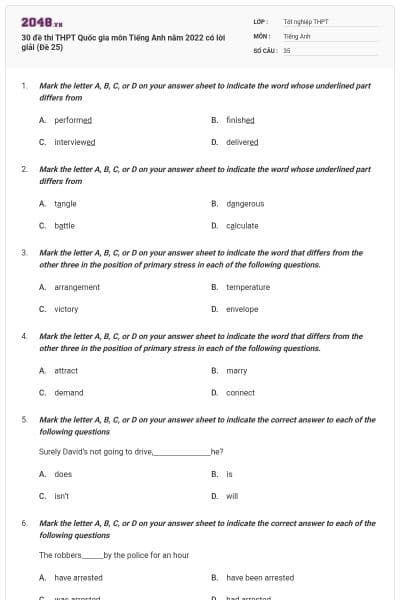
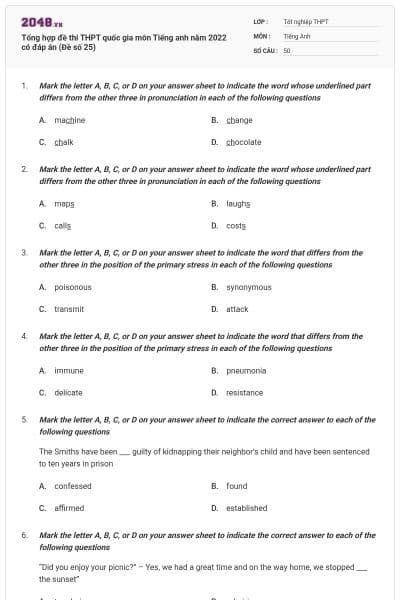
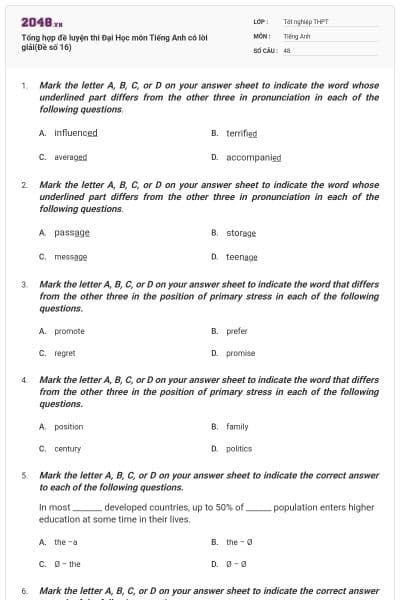
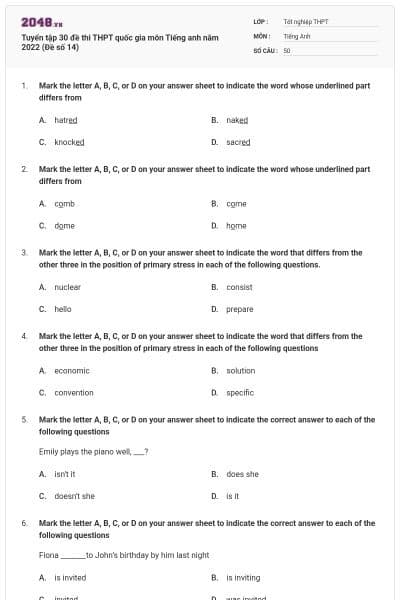
Mark the letter A, B, C, or D on your answer sheet to indicate the word whose underlined part differs from
hatred
naked
knocked
sacred
Đáp án C đúng phần gạch chân của đáp án C được đọc là âm /t/. Các phương án còn lại có phần gạch chân được đọc là âm /ɪd/
A. hatred /ˈheɪtrɪd/ (n): sự thù ghét
B. naked /ˈneɪkɪd/ (a): trần truồng
C. knocked /nɒkt/ (v): gõ cửa, đánh, gây ồn
D. sacred /ˈseɪkrɪd/ (a): linh thiêng
Đáp án C
Mark the letter A, B, C, or D on your answer sheet to indicate the word whose underlined part differs from
comb
come
dome
home
Phần gạch chân của đáp án B đọc là /ʌ/ còn phần gạch chân của các phương án còn lại đọc là âm /əʊ/
A. comb /kəʊm/ (n/v): cái lược/chải đầu
B. come /kʌm/ (v): đi đến, đi tới
C. dome /dəʊm/ (n): mái vòm
D. home /həʊm/ (n): nhà
Lưu ý: Khi tra từ điển bạn thấy /əʊ/ hay /oʊ/ thì đều là một âm và cách đọc giống nhau.
Đáp án B
Mark the letter A, B, C, or D on your answer sheet to indicate the word that differs from the other three in the position of primary stress in each of the following questions.
nuclear
consist
hello
prepare
Đáp án A đúng vì đáp án A trọng âm rơi vào âm tiết thứ nhất còn ba đáp án còn lại trong âm rơi vào âm tiết thứ hai.
A. nuclear /’nju:klia/ (a):thuộc hạt nhân
B. consist /kan’sist/ (v): bao gồm
C. hello /hơTou/ (n): xin chào
D. prepare /pri’pco/ (v): chuẩn bị
Đáp án A
Mark the letter A, B, C, or D on your answer sheet to indicate the word that differs from the other three in the position of primary stress in each of the following questions
economic
solution
convention
specific
Đáp án A đúng vì đáp án A trọng âm rơi vào âm tiết thứ ba, còn các đáp án còn lại trọng âm rơi vào âm tiết thứ hai.
A. economic /ˌiːkəˈnɒmɪk/ (a): kinh tế
B. solution /səˈluːʃn/ (n): giải pháp
C. convention /kənˈvenʃn/ (n): công ước
D. specific /spəˈsɪfɪk/ (a): đặc trưng
Đáp án A
Mark the letter A, B, C, or D on your answer sheet to indicate the correct answer to each of the following questions
Emily plays the piano well, ___?
isn't it
does she
doesn't she
is it
Kiến thức: Câu hỏi đuôi
Giải thích:
Câu hỏi đuôi của thì Hiện tại đơn . Phần tường thuật thể khẳng định, ngôi thứ 3 số ít => đuôi câu hỏi thể phủ định.
Công thức: S + V (s, es), doesn’t + S?
Tạm dịch: Emily chơi đàn piano giỏi, có phải không?
Đáp án : C
Mark the letter A, B, C, or D on your answer sheet to indicate the correct answer to each of the following questions
Fiona _______to John’s birthday by him last night
is invited
is inviting
invited
was invited
Phương pháp giải:
Kiến thức: Câu bị động:
Giải chi tiết: Câu bị động thì Quá khứ đơn. Trạng từ chỉ thời gian last night nên chọn Quá khứ đơn. Hành động được nhấn mạnh là Fiona được mời đi dự tiệc sinh nhật.
S + động từ tobe + V-ed/V3
Tạm dịch : Fiona được John mời đi dự tiệc sinh nhật của anh ấy tối hôm qua.
Đáp án : D
Mark the letter A, B, C, or D on your answer sheet to indicate the correct answer to each of the following questions
You are always asking me________the money. Ask somebody else_______a change
to/ at
of/ for
for/ for
on/in
quick at st: nhanh về cái gì
Dịch: Học sinh nhanh chóng hiểu những gì giáo viên giải thích.
Đáp án: B
Mark the letter A, B, C, or D on your answer sheet to indicate the correct answer to each of the following questions
It is necessary for parents these days to be ______ in dealing with their children
patient and patient
more and more patient
more patient and more
more patient and more patient
Cấu trúc so sánh kép: So sánh đồng tiến: (càng……thì càng)
S+ V+ more+ and +more + long adj/ adv |
Tạm dịch: Điều cần thiết với với cha mẹ thời nay là càng ngày càng phải kiên nhẫn khi tiếp xúc với con cái
Đáp án: B
Mark the letter A, B, C, or D on your answer sheet to indicate the correct answer to each of the following questions
He bought a______house as a gift for his new wife
big pink beautiful
beautiful pink big
big beautiful pink
beautiful big pink
Giải thích:
Trật tự tính từ: Ghi nhớ cụm OpSASCOMP: Opinion ý kiến/ đánh giá cá nhân - Size kích cỡ - Age cũ/mới
- Shape hình dáng - Color màu sắc - Origin nguồn gốc - Material chất liệu - Purpose mục đích sử dụng.
Đối chiếu các từ đã cho ta sắp xếp được:
Opinion ý kiến/ đánh giá cá nhân (beautiful)- Size kích cỡ (big)- Color màu sắc (pink)
Dịch nghĩa: Anh ấy đã mua một căn nhà lớn xinh đẹp màu hồng để làm quà tặng vợ..
Đáp án D
Mark the letter A, B, C, or D on your answer sheet to indicate the correct answer to each of the following questions
She hurt herself while she________hide-and-seek with her friends.
is playing
had played
played
was playing
Kiến thức: Sự phối hợp về thì của động từ
Giải thích: Thì quá khứ đơn và quá khứ tiếp diễn kết hợp trong câu: Diễn tả hành động đang xảy ra trong quá khứ thì một hành động khác xen vào, hành động đang xảy ra chi thì quá khứ tiếp diễn, hành động xen vào chia thì quá khứ đơn
Cấu trúc: + S + Ved/bqt while S + was/ were + V_ing
Tạm dịch: Cô ấy tự làm mình bị thương khi đang chơi trò trốn tìm với các bạn.
Mark the letter A, B, C, or D on your answer sheet to indicate the correct answer to each of the following questions
We didn’t go anywhere yesterday ________ the rain
because
in spite of
because of
though
Kiến thức: Từ vựng
▪️ Because + clause: bởi vì
▪️ In spite of + V-ing/ N: mặc dù
▪️ Because of + Ving/ N: bởi vì
▪️ Though + clause: mặc dù
Tạm dịch: Chúng tôi đã không đi đâu cả ngày hôm qua bởi vì trời mưa.
→ Chọn đáp án C
Mark the letter A, B, C, or D on your answer sheet to indicate the correct answer to each of the following questions
……., I will complete every exercise in my textbook
When I master English
The moment I mastered English
As soon as I had mastered English
Before I am mastered English
Kiến thức: Mệnh đề chỉ thời gian / Sự hòa hợp thì trong mệnh đề
Giải thích:
Mệnh đề chính chia thì tương lai => động từ trong mệnh đề chỉ thời gian chia thì hiện tại (hiện tại đơn, hiện tại hoàn thành).
Loại luôn được các phương án B, C, D do sai thì.
when: khi
the moment: vào lúc
as soon as: ngay khi
before: trước khi
Tạm dịch: Khi tôi thành thạo tiếng Anh, Tôi sẽ hoàn thành mọi bài tập trong sách giáo khoa của mình.
A.Khi tôi thành thạo tiếng Anh
B. Khoảnh khắc tôi thành thạo tiếng Anh
C. Ngay sau khi tôi đã thành thạo tiếng Anh
D. Trước khi tôi thành thạo tiếng Anh.
Mark the letter A, B, C, or D on your answer sheet to indicate the correct answer to each of the following questions
……the report to the manager, she decided to take a rest
Having handed in
Handed in
Being handed in
To hand in
Kiến thức: Mệnh đề phân tử / Rút gọn mệnh đề đồng ngữ
Giải thích:
Khi 2 mệnh đề có cùng chủ ngữ (she) thì có thể rút gọn 1 trong 2 mệnh đề về dạng:
- V-ing / Having P2: nếu mệnh đề được rút gọn mang nghĩa chủ động
- P2 (quá khứ phân từ): nếu mệnh đề được rút gọn mang nghĩa bị động
Chủ ngữ “she” có thể làm chủ (tự thực hiện hành động “hand in” (nộp) => nghĩa chủ động.
Tạm dịch: Nộp xong báo cáo cho giám đốc, cô quyết định đi nghỉ.
Mark the letter A, B, C, or D on your answer sheet to indicate the correct answer to each of the following questions
In the movie, he plays a concerned and _______ father trying to bring up two teenage children on his own
Sense
sensitive
sensible
senseless
Kiến thức về từ loại
A. sense (n): bộ óc
B. sensitive (a): nhạy cảm
C. sensible (a): biết điều, hiểu được
D. senseless (a): vô nghĩa, bất tỉnh.
Ta cần 1 adj mang nghĩa tương đồng với "concerned" (lo lắng, lo âu), nên "sensitive" là đáp án đúng
Tạm dịch : Trong bộ phim, anh đóng vai một ông bố lo âu và nhạy cảm cố gắng nuôi lớn 2 đứa con tuổi
thiếu niên một mình.
=> Chọn đáp án C
Mark the letter A, B, C, or D on your answer sheet to indicate the correct answer to each of the following questions
Everybody in the house woke up when the burglar alarm
went out
went off
came about
rang off
Went out = quá khứ của to go out: đi ra ngoài, đi chơi
Went off = quá khứ của to go off: chuông reo ầm ĩ
Came about = quá khứ của to come about: xảy ra
Rang = quá khứ của to ring: chuông reo (không dùng với off)
Đáp án chính xác là đáp án B
Tạm dịch: Mọi người trong nhà tỉnh dậy khi chuông chống trộm reo ầm ĩ.
Mark the letter A, B, C, or D on your answer sheet to indicate the correct answer to each of the following questions
This director has _______ some famous films but I think this one is the best
done
composed
made
conducted
Kiến thức về cụm từ cố định
Make a film: làm phim
Dịch: Đạo diễn này đã làm một số bộ phim nổi tiếng nhưng tôi nghĩ bộ này là hay nhất.
=> Chọn đáp án C
Mark the letter A, B, C, or D on your answer sheet to indicate the correct answer to each of the following questions
The biggest fear is that humans might ________ control over robots.
lose
take
keep
gain
Kiến thức: Từ vựng
A. lose: đánh mất
B. take: lấy được
C. keep: giữ
D. gain: có được
▪️ Lose control over sb/sth: đánh mất quyền kiểm soát
Tạm dịch: Nỗi sợ lớn nhất đó là con người có thể bị đánh mất quyển kiểm soát do robot
→ Chọn đáp án A
Mark the letter A, B, C, or D on your answer sheet to indicate the correct answer to each of the following questions
I won't buy that car because it has too much on it.
ups and downs
odds and ends
wear and tear
white lie
Kiến thức về thành ngữ
A. ups and downs: thăng trầm
B. odds and ends: đồ vật linh tinh, đầu thừa đuôi thẹo
C. wear and tear: hao mòn sau quá trình sử dụng
D. white lie: lời nói dối vô hại
Tạm dịch: Tôi sẽ không mua cái xe đó bởi vì nó có quá nhiều hao mòn
Mark the letter A, B, C, or D on your answer sheet to indicate the correct answer to each of the following questions
________ of the financial crisis, all they could do was hold on and hope that things would improve
At the bottom
At the height
On the top
In the end
Kiến thức về cụm từ cố định
- At the height of the financial crisis: ở thời kì đỉnh cao của khủng hoảng tài chính
+ Kiến thức về giới từ:
At the bottom of: ở đáy của
On the top of: ở đỉnh của
In the end: cuối cùng
At the end of: cuối của cái gì
Tạm dịch: Ở thời kì đỉnh điểm của khủng hoảng tài chính, tất cả chúng ta chỉ có thể giữ vững tâm lí và hi vọng rằng những điều đó sẽ cải thiện
Mark the letter A, B, C or D to indicate the word(s) CLOSEST in meaning to the underlined word(s) in each of the following questions
All the students were all ears when the teacher started talking about the changes in the next exam
attentive
restless
silent
smiling
Đáp án A
- attentive (adj): lắng nghe chăm chú
- restless (adj): không yên, bồn chồn
- silent (adj): im lặng
- smiling (adj): mỉm cười
- be all ears: lắng nghe chăm chú, cẩn thận; dỏng tai lên nghe
Dịch: Tất cả học sinh lắng nghe chăm chú khi giáo viên bắt đầu nói về những thay đổi trong kì thi sắp tới
Mark the letter A, B, C or D to indicate the word(s) CLOSEST in meaning to the underlined word(s) in each of the following questions
Recognised as a World Heritage Site in 1983, the Taj Mahal Complex, including the tomb, mosque, guest house, and main gate, has preserved the original qualities of the buildings
initial
ancient
unique
perfect
Đáp án A: original = initial
Ancient (adj) cổ kính
Unique(adj) độc nhất
Perfect (adj): hoàn hảo
Initial (adj): ban đầu,đầu tiên
Được công nhận là Di sản Thế giới vào năm 1983, Khu phức hợp Taj Mahal, bao gồm lăng mộ, nhà thờ Hồi giáo, nhà khách và cổng chính, đã bảo tồn những phẩm chất ban đầu của các tòa nhà
Mark the letter A, B, C or D to indicate the word(s) OPPOSITE in meaning to the underlined word(s) in each of the following questions
Unemployment will be a dominant issue at the next meeting of the city council
clever
time-consuming
vague
minor
Đáp án D
Nghĩa của từ dominant: trội, có ưu thế hơn; có ảnh hưởng lớn, chi phối
clever: thông minh, khéo léo
time-consuming (a) tốn thời gian
vague (a) mập mờ
minor (a) nhỏ, bé
Mark the letter A, B, C or D to indicate the word(s) OPPOSITE in meaning to the underlined word(s) in each of the following questions
She was unhappy that she lost contact with a lot of her old friends when she went abroad to study
made room for
put in charge of
lost control of
got in touch with
Đáp án D
Make room for: nhường chỗ cho
Put in charge of: chịu trách nhiệm
Lose control of: mất kiểm soát
get in touch with: liên lạc với
lose contact with: mất liên lạc với
Mark the letter A, B, C, or D on your answer sheet to indicate the sentence that best completes each of the following exchanges
Lan And Hoa are talking about taking part in non- profit organization this summer.
Mai: - “I like to work part-time for a non-profit organization this summer.”
Hoa : - “_____________________.”
Me too. I'm thinking of applying for 'Hope'
I do, but I don't have enough time for studying
That's great. You have been coming of age
Is that all? How about using time wisely?
Đáp án A
Tình huống giao tiếp
Lan và Hoa đang nói chuyện với nhau về việc tham gia vào tổ chức phi lợi nhuận mùa hè này
Tạm dịch: Lan: “Tôi thích làm việc bán thời gian cho một tổ chức phi lợi nhuận trong mùa hè này.”
Hoa : -“_______________________.”
A. Tôi cũng vậy. Tôi đang có kế hoạch xin ứng tuyển vào tổ chức “Hope”.
B. Tôi cũng làm, nhưng tôi không có đủ thời gian cho việc học.
C. Điều đó thật tuyệt. Bạn đang dần trưởng thành hơn rồi đấy.
D. Tất cả là vậy ư? Thế về việc sử dụng thời gian khôn ngoan thì sao?
Cấu trúc khác cần lưu ý:
+ Have enough + N + for doing sth: có đủ…..để làm gì
+ Coming of age (n): ai đó đủ tuổi hợp pháp để trở thành người lớn hoặc đủ tuổi để đi bầu cử; giai đoạn ai đó trưởng thành, lớn lên về mặt cảm xúc; giai đoạn cái gì bắt đầu trở nên thành công
+ How about + Ving = Suggest + Ving: gợi ý, đề xuất làm gì
+ Apply for sth/doing sth: xin ứng cử vào làm gì hay vị trí nào
Mark the letter A, B, C, or D on your answer sheet to indicate the sentence that best completes each of the following exchanges
Peter is talking to Laura about her house.
Peter : “What a lovely house you have!”
Laura: _____________________________________
Of course not, it’s not costly
Thank you. Hope you will drop in
I think so
No problem
Đáp án B
Peter đang nói chuyện với Laura về ngôi nhà của cố ấy
Peter “What a lovely house you have!” - Bạn có một cái nhà thật đẹp! - đây là một lời khen.
Laura: ______________________________
Đối với những lời khen hay chúc mừng, câu trả lời thường là cám ơn, theo mẫu sau: Thank you/ Thanks + lời mời/ lời nói khách sáo.
Xét 4 đáp án, chọn đáp án B là phù hợp nhất.
A. Dĩ nhiên là không rồi, nó không có đắt đâu.
B. Cám ơn bạn. Mong bạn ghé chơi.
C. Tớ cũng nghĩ thế.
D. Không thành vấn đề
Nico: May mà tôi không bận như anh
Read the passage and mark the letter A, B, C or D to complete the passage.
Some doctors think that you should drink a glass of water each morning. You should drink this water first thing before doing anything else. The (26) ______ of the water should be similar to body temperature; (27) ______ too hot nor too cold. Why should you drink this water? Water helps your body in many ways. It helps clean out your kidneys. It prepares your stomach for (28) ______, Water can also help your intestines work better. After drinking water, the intestines can more easily take out nutrients from our food. Water also helps us go to the bathroom more easily,
Scientists suggest that people (29) ______ 1,600 milliliters of water each day. But don't drink all of that water in one sitting. If you do, your kidneys will have to work much harder to eliminate it. It's better to drink some in the morning and some in the afternoon. Some people think it's better to drink between meals and not during meals. They think water dilutes the juices produced in our stomachs, (30) ______ can interfere with normal digestion. Are you drinking enough water every day? Check the color of your urine. If it is light yellow, you are probably drinking enough. If your urine is very dark yellow, you probably need to drink more water. A little more water each day could make you much healthier!
moisture
heat
coolness
temperature
Đáp án D
Chủ đề Your body and you
Kiến thức về từ vựng
A. moisture /ˈmɔɪs.tʃər/ (n): độ ẩm
B. heat /hi:t/ (n): sự nóng
C. coolness /'ku:l.nəs/ (n): sự mát
D. temperature /ˈtem.prə.tʃər/ (n): nhiệt độ
Tạm dịch: “The temperature of the water should be similar to body temperature” (Nhiệt độ của nước nên bằng với nhiệt độ cơ thể.)
Read the passage and mark the letter A, B, C or D to complete the passage.
Some doctors think that you should drink a glass of water each morning. You should drink this water first thing before doing anything else. The (26) ______ of the water should be similar to body temperature; (27) ______ too hot nor too cold. Why should you drink this water? Water helps your body in many ways. It helps clean out your kidneys. It prepares your stomach for (28) ______, Water can also help your intestines work better. After drinking water, the intestines can more easily take out nutrients from our food. Water also helps us go to the bathroom more easily,
Scientists suggest that people (29) ______ 1,600 milliliters of water each day. But don't drink all of that water in one sitting. If you do, your kidneys will have to work much harder to eliminate it. It's better to drink some in the morning and some in the afternoon. Some people think it's better to drink between meals and not during meals. They think water dilutes the juices produced in our stomachs, (30) ______ can interfere with normal digestion. Are you drinking enough water every day? Check the color of your urine. If it is light yellow, you are probably drinking enough. If your urine is very dark yellow, you probably need to drink more water. A little more water each day could make you much healthier!
either
both
neither
but
Đáp án C
Kiến thức về liên từ
Giải thích: chúng ta có cấu trúc: “Neither..... nor ....”: Không ....cũng không
Tạm dịch: “The temperature of the water should be similar to body temperature; neither too hot nor too cold.” (Nhiệt độ của nước nên bằng với nhiệt độ cơ thể không quá nóng cũng không quá lạnh.)
Read the passage and mark the letter A, B, C or D to complete the passage.
Some doctors think that you should drink a glass of water each morning. You should drink this water first thing before doing anything else. The (26) ______ of the water should be similar to body temperature; (27) ______ too hot nor too cold. Why should you drink this water? Water helps your body in many ways. It helps clean out your kidneys. It prepares your stomach for (28) ______, Water can also help your intestines work better. After drinking water, the intestines can more easily take out nutrients from our food. Water also helps us go to the bathroom more easily,
Scientists suggest that people (29) ______ 1,600 milliliters of water each day. But don't drink all of that water in one sitting. If you do, your kidneys will have to work much harder to eliminate it. It's better to drink some in the morning and some in the afternoon. Some people think it's better to drink between meals and not during meals. They think water dilutes the juices produced in our stomachs, (30) ______ can interfere with normal digestion. Are you drinking enough water every day? Check the color of your urine. If it is light yellow, you are probably drinking enough. If your urine is very dark yellow, you probably need to drink more water. A little more water each day could make you much healthier!
digestion
digestive
digestible
digest
Đáp án A
Kiến thức về từ loại
A. digestion /dai'dʒest∫ən/ (n): sự tiêu hóa
B. digestive /di’dʒestiv/ (adj): thuộc về tiêu hóa
C. digestible /dai’dʒestibl/ (adj): dễ tiêu
D. digest /dai'dʒest/ (v): tiêu hóa
Căn cứ vào từ “for”, đáp án cần điền là một danh từ. Từ đó ta loại được phương án B, C, D.
Tạm dịch: “Water helps your body in many ways. It helps clean out your kidneys. It prepares your stomach for digestion.” (Nước giúp cơ thể bạn theo nhiều cách. Nó giúp làm sạch thận của bạn. Nó chuẩn bị cho dạ dày của bạn cho việc tiêu hóa.)
Read the passage and mark the letter A, B, C or D to complete the passage.
Some doctors think that you should drink a glass of water each morning. You should drink this water first thing before doing anything else. The (26) ______ of the water should be similar to body temperature; (27) ______ too hot nor too cold. Why should you drink this water? Water helps your body in many ways. It helps clean out your kidneys. It prepares your stomach for (28) ______, Water can also help your intestines work better. After drinking water, the intestines can more easily take out nutrients from our food. Water also helps us go to the bathroom more easily,
Scientists suggest that people (29) ______ 1,600 milliliters of water each day. But don't drink all of that water in one sitting. If you do, your kidneys will have to work much harder to eliminate it. It's better to drink some in the morning and some in the afternoon. Some people think it's better to drink between meals and not during meals. They think water dilutes the juices produced in our stomachs, (30) ______ can interfere with normal digestion. Are you drinking enough water every day? Check the color of your urine. If it is light yellow, you are probably drinking enough. If your urine is very dark yellow, you probably need to drink more water. A little more water each day could make you much healthier!
take out
take up
take in
take off
Đáp án C
Kiến thức về cụm động từ
A. take out: lấy ra, rút ra
B. take up st: bắt đầu (một sở thích), bắt tay (vào làm gì)
C. take in: hấp thụ, lấy vào
D. take off: cất cánh, cởi bỏ
Tạm dịch: "Scientists suggest that people take in 1,6002 milliliters of water each day.” (Các nhà khoa học khuyên rằng mọi người nên uống 1.600 ml nước mỗi ngày.)
Read the passage and mark the letter A, B, C or D to complete the passage.
Some doctors think that you should drink a glass of water each morning. You should drink this water first thing before doing anything else. The (26) ______ of the water should be similar to body temperature; (27) ______ too hot nor too cold. Why should you drink this water? Water helps your body in many ways. It helps clean out your kidneys. It prepares your stomach for (28) ______, Water can also help your intestines work better. After drinking water, the intestines can more easily take out nutrients from our food. Water also helps us go to the bathroom more easily,
Scientists suggest that people (29) ______ 1,600 milliliters of water each day. But don't drink all of that water in one sitting. If you do, your kidneys will have to work much harder to eliminate it. It's better to drink some in the morning and some in the afternoon. Some people think it's better to drink between meals and not during meals. They think water dilutes the juices produced in our stomachs, (30) ______ can interfere with normal digestion. Are you drinking enough water every day? Check the color of your urine. If it is light yellow, you are probably drinking enough. If your urine is very dark yellow, you probably need to drink more water. A little more water each day could make you much healthier!
that
which
who
whom
Đáp án B
Kiến thức về đại từ quan hệ
Tạm dịch: “They think water dilutes the juices produced in our stomaths, which can interfere with normal digestion. (Họ nghĩ rằng nước làm loãng chất dịch trong dạ dày của chúng ta, điều này có thể cản trở việc tiêu hóa bình thường)
=> Do đó đáp án là B. Đây là trường hợp đại từ quan hệ “Which” thay thế cho cả mệnh đề phía trước, với nghĩa điều này hoặc việc này. Không sử dụng “That” vì có dấu phẩy đứng trước. Không dùng “Who” vì không có đại từ chỉ người đứng trước đó để thay thế
Read the following passage and mark the letter A, B, C, or D to indicate the answer to each of the question.
Accidents do not occur at random. People, eighty-five years of age and older, are twenty-two times likely to die accidentally than are children five to nine years old. The risk for native Americans is four times that for Asian-Americans and twice that for white Americans or African-Americans. Males suffer accidents at more than twice the rate of females, in part because they are more prone to risky behavior. Alaskans are more than three times as likely as Rhode Islanders to die in an accident. Texans are twenty-one times more likely than New Jerseyites to die in a natural disaster. Among the one hundred most populous counties, Kern County, California (Bakersfield), has an accident fatality rate three times greater than Summit County, Ohio (Akron).
Accidents happen more often to poor people. Those living in poverty receive inferior medical care, are more apt to reside in houses with faulty heating and electrical systems, drive older cars with fewer safety features, and are less likely to use safety belts. People in rural areas have more accidents than city or suburban dwellers because farming is much riskier than working in a factory or office and because emergency medical services are less readily available. These two factors - low income and rural residence - may explain why the south has a higher accident rate than the north
Which of the following is true according to the passage?
Children aged five to nine face the greatest accident risk
All people face an equal risk of having an accident
One in every 22 people aged 85 and over will die in an accident
The risk of having an accident is greater among certain groups of people
Kiến thức : Đọc hiểu
Giải thích:
Thông in nào dưới đây là đúng theo bài đọc?
A. Trẻ em độ tuổi từ 5 đến 9 đối mặt với nguy cơ tai nạn cao nhất.
B. Tất cả mọi người có nguy cơ tai nạn như nhau.
C. Một trong 22 người ở độ tuổi 85 và hơn sẽ chết trong một vụ tai nạn.
D. Nguy cơ tai nạn cao hơn trong các nhóm người cố định.
Theo nội dung toàn bài, chọn D
Read the following passage and mark the letter A, B, C, or D to indicate the answer to each of the question.
Accidents do not occur at random. People, eighty-five years of age and older, are twenty-two times likely to die accidentally than are children five to nine years old. The risk for native Americans is four times that for Asian-Americans and twice that for white Americans or African-Americans. Males suffer accidents at more than twice the rate of females, in part because they are more prone to risky behavior. Alaskans are more than three times as likely as Rhode Islanders to die in an accident. Texans are twenty-one times more likely than New Jerseyites to die in a natural disaster. Among the one hundred most populous counties, Kern County, California (Bakersfield), has an accident fatality rate three times greater than Summit County, Ohio (Akron).
Accidents happen more often to poor people. Those living in poverty receive inferior medical care, are more apt to reside in houses with faulty heating and electrical systems, drive older cars with fewer safety features, and are less likely to use safety belts. People in rural areas have more accidents than city or suburban dwellers because farming is much riskier than working in a factory or office and because emergency medical services are less readily available. These two factors - low income and rural residence - may explain why the south has a higher accident rate than the north
The word “accidentally” in the passage is closest in meaning to _______.
in an accident
by chance
by mistake
without a plan
Kiến thức : Đọc hiểu
Giải thích:
Từ “accidentally” trong bài đọc đồng nghĩa với ______.
in an accident: trong một tai nạn
by chance: tình cờ
by mistake: nhầm lẫn
without a plan: không có kế hoạch
Bài viết nói về tỉ lệ gặp tai nạn giữa những nhóm khác nhau, như vậy, từ "accidentally" không còn nghĩa "vô tình, tình cờ" như người ta hay sử dụng, mà có nghĩa: "in an accident" – Chọn A.
Read the following passage and mark the letter A, B, C, or D to indicate the answer to each of the question.
Accidents do not occur at random. People, eighty-five years of age and older, are twenty-two times likely to die accidentally than are children five to nine years old. The risk for native Americans is four times that for Asian-Americans and twice that for white Americans or African-Americans. Males suffer accidents at more than twice the rate of females, in part because they are more prone to risky behavior. Alaskans are more than three times as likely as Rhode Islanders to die in an accident. Texans are twenty-one times more likely than New Jerseyites to die in a natural disaster. Among the one hundred most populous counties, Kern County, California (Bakersfield), has an accident fatality rate three times greater than Summit County, Ohio (Akron).
Accidents happen more often to poor people. Those living in poverty receive inferior medical care, are more apt to reside in houses with faulty heating and electrical systems, drive older cars with fewer safety features, and are less likely to use safety belts. People in rural areas have more accidents than city or suburban dwellers because farming is much riskier than working in a factory or office and because emergency medical services are less readily available. These two factors - low income and rural residence - may explain why the south has a higher accident rate than the north
According to the passage, which of the following groups of people in America face the highest risk of having an accident?
Native Americans
Asian-Americans
White Americans
African-Americans
Kiến thức : Đọc hiểu
Giải thích:
Theo bài đọc, nhóm người nào dưới đây ở Mỹ đối mặt với nguy cơ tai nạn cao nhất?
A. Native Americans: người Mỹ bản xứ
B. Asian-Americans: người Mỹ gốc Á
C. White Americans: người Mỹ da trắng
D. African-Americans: người Mỹ gốc Phi
Thông tin: Câu 3 đoạn 2 "The risk for native Americans is four times that for Asian-Americans and twice that for white Americans or African-Americans. " . Vậy Native Americans là nhóm có tỉ lệ tai nạn cao nhất.
Tạm dịch: Nguy cơ cho người Mĩ bản địa gấp 4 lần người Mĩ gốc Á và 2 lần người Mĩ da trắng hoặc gốc Phi
Read the following passage and mark the letter A, B, C, or D to indicate the answer to each of the question.
Accidents do not occur at random. People, eighty-five years of age and older, are twenty-two times likely to die accidentally than are children five to nine years old. The risk for native Americans is four times that for Asian-Americans and twice that for white Americans or African-Americans. Males suffer accidents at more than twice the rate of females, in part because they are more prone to risky behavior. Alaskans are more than three times as likely as Rhode Islanders to die in an accident. Texans are twenty-one times more likely than New Jerseyites to die in a natural disaster. Among the one hundred most populous counties, Kern County, California (Bakersfield), has an accident fatality rate three times greater than Summit County, Ohio (Akron).
Accidents happen more often to poor people. Those living in poverty receive inferior medical care, are more apt to reside in houses with faulty heating and electrical systems, drive older cars with fewer safety features, and are less likely to use safety belts. People in rural areas have more accidents than city or suburban dwellers because farming is much riskier than working in a factory or office and because emergency medical services are less readily available. These two factors - low income and rural residence - may explain why the south has a higher accident rate than the nort
What does the word “that” in the passage refer to _______?
males
native Americans
the risk
African-Americans
Đáp án: C
Kiến thức : Đọc hiểu
Giải thích:
Từ “that” trong bài đọc nói tới vấn đề gì?
A. males: đàn ông
B. native Americans: người Mỹ bản xứ
C. the risk: nguy cơ
D. African-Americans: người Mỹ gốc Phi
Thông tin: Câu 3 đoạn 1 “The risk for native Americans is four times that for Asian-Americans and twice that for white Americans or African-Americans.”
Tạm dịch: Nguy cơ cho người Mĩ bản địa gấp 4 lần người Mĩ gốc Á và 2 lần người Mĩ da trắng hoặc gốc Phi.
Read the following passage and mark the letter A, B, C, or D to indicate the answer to each of the question.
Accidents do not occur at random. People, eighty-five years of age and older, are twenty-two times likely to die accidentally than are children five to nine years old. The risk for native Americans is four times that for Asian-Americans and twice that for white Americans or African-Americans. Males suffer accidents at more than twice the rate of females, in part because they are more prone to risky behavior. Alaskans are more than three times as likely as Rhode Islanders to die in an accident. Texans are twenty-one times more likely than New Jerseyites to die in a natural disaster. Among the one hundred most populous counties, Kern County, California (Bakersfield), has an accident fatality rate three times greater than Summit County, Ohio (Akron).
Accidents happen more often to poor people. Those living in poverty receive inferior medical care, are more apt to reside in houses with faulty heating and electrical systems, drive older cars with fewer safety features, and are less likely to use safety belts. People in rural areas have more accidents than city or suburban dwellers because farming is much riskier than working in a factory or office and because emergency medical services are less readily available. These two factors - low income and rural residence - may explain why the south has a higher accident rate than the north
Which of the following is NOT mentioned as a reason for a higher accident rate among the poor?
Little knowledge about safety
Inadequate medical services
Poor housing and working conditions
Use of cars which incorporate fewer safety features
Đáp án: A
Kiến thức : Đọc hiểu
Giải thích:
Thông tin nào dưới đây KHÔNG được đề cập như là lí do cho tỷ lệ tai nạn cao hơn trong người nghèo?
A. Little knowledge about safety. (Có ít kiến thức về an toàn)
B. Inadequate medical services. (Không đủ dịch vụ y tế)
C. Poor housing and working conditions. (Điều kiện làm việc và chỗ ở nghèo nàn)
D. Use of cars which incorporate fewer safety features. (Dùng ô tô có ít tính năng an toàn hơn.)
Thông tin: Câu 2 đoạn 2 “Those living in poverty receive inferior medical care, are more apt to reside in houses with faulty heating and electrical systems, drive older cars with fewer safety features, and are less likely to use safety belts.” - Vậy đáp án: A
Read the following passage and mark the letter A, B, C, or D to indicate the answer to each of the question.
Hibernation is typically linked to seasonal changes that limit food supplies. It is identified by metabolic suppression, a drop in body temperature and torpor- a sleep- like state- interspersed with brief bouts of wakefulness. Though certain species of fish, amphibians, birds and reptiles are known to lie dormant during cold winter months, hibernation is generally associated with mammals, according to Don Wilson, a curator emeritus of vertebrate zoology at the Smithsonian National Museum of Natural History.
Endothermic mammals- “warm- blooded” animals that generate body heat internally- need a constant energy source to keep their engines running, Wilson told Live Science. And when that energy source becomes difficult to find, hibernation can help them weather harsh conditions.
“During times of the year when that energy source is missing- especially in northern climates- one coping mechanism is to just shut down,” he said. “They’ll feed heavily during the few months when food is plentiful and build up fat, then go to sleep and live off their fat reserves”.
A special type of fat called “brown fat” accumulates in hibernating mammals, Wilson said. Bats that hibernate develop brown fat on their backs between their shoulder blades, but mammals can also store brown fat in their bellies and elsewhere in their bodies, Wilson said.
Brown fat goes a long way because the hibernating animal draws on it very slowly, reducing their metabolism to as little as 2 percent of their normal rate, according to a 2007 study published in the Journal of Neurochemistry.
Their core body temperature is also greatly reduced. It generally hovers close to the air temperature in the animal’s den but can sometimes fall as low as 27 degrees Fahrenheit (minus 3 degrees Celcius) in Arctic ground squirrels, according to Kelly Drew, a neurochemist and professor with the Institute of Artic Biology at the University of Alaska Fairbanks.
Arctic ground squirrels’ bouts or torpor last about two or three weeks, Drew told Live Science, and the animals rouse “ pretty consistently” for about 12 to 24 hours, before resuming their winter sleep. They repeat this process for up to eight months.
But even though Arctic squirrels maintain a lower body temperature than any other hibernating mammal, the changes in their bodies overall aren’t that different from those that occur in other hibernating mammals, Drew said.
“The quality of mammalian hibernation is similar from bears to hamsters to ground squirrels,” Drew said. “The distinguishing feature is how cold they get”.
The word “weather” in the second paragraph is closest in meaning to ______.
rely on
adapt to
involve in
suffer from
Kiến thức : Đọc hiểu
Giải thích:
Từ “weather” trong đoạn 2 đồng nghĩa với ______.
A. rely on: dựa vào
B. adapt to: thíc nghi
C. involve in: tham gia vào
D. suffer from: chịu đựng
Thông tin: Câu 2 đoạn 2: “And when that energy source becomes difficult to find, hibernation can help them weather harsh conditions.”
Tạm dịch: Và khi nguồn năng lượng trở nên khó tìm, ngủ đông cáo thể giúp chúng thích nghi với điều kiện khắc nghiệt.
Vậy: weather = adapt to
Read the following passage and mark the letter A, B, C, or D to indicate the answer to each of the question.
Hibernation is typically linked to seasonal changes that limit food supplies. It is identified by metabolic suppression, a drop in body temperature and torpor- a sleep- like state- interspersed with brief bouts of wakefulness. Though certain species of fish, amphibians, birds and reptiles are known to lie dormant during cold winter months, hibernation is generally associated with mammals, according to Don Wilson, a curator emeritus of vertebrate zoology at the Smithsonian National Museum of Natural History.
Endothermic mammals- “warm- blooded” animals that generate body heat internally- need a constant energy source to keep their engines running, Wilson told Live Science. And when that energy source becomes difficult to find, hibernation can help them weather harsh conditions.
“During times of the year when that energy source is missing- especially in northern climates- one coping mechanism is to just shut down,” he said. “They’ll feed heavily during the few months when food is plentiful and build up fat, then go to sleep and live off their fat reserves”.
A special type of fat called “brown fat” accumulates in hibernating mammals, Wilson said. Bats that hibernate develop brown fat on their backs between their shoulder blades, but mammals can also store brown fat in their bellies and elsewhere in their bodies, Wilson said.
Brown fat goes a long way because the hibernating animal draws on it very slowly, reducing their metabolism to as little as 2 percent of their normal rate, according to a 2007 study published in the Journal of Neurochemistry.
Their core body temperature is also greatly reduced. It generally hovers close to the air temperature in the animal’s den but can sometimes fall as low as 27 degrees Fahrenheit (minus 3 degrees Celcius) in Arctic ground squirrels, according to Kelly Drew, a neurochemist and professor with the Institute of Artic Biology at the University of Alaska Fairbanks.
Arctic ground squirrels’ bouts or torpor last about two or three weeks, Drew told Live Science, and the animals rouse “ pretty consistently” for about 12 to 24 hours, before resuming their winter sleep. They repeat this process for up to eight months.
But even though Arctic squirrels maintain a lower body temperature than any other hibernating mammal, the changes in their bodies overall aren’t that different from those that occur in other hibernating mammals, Drew said.
“The quality of mammalian hibernation is similar from bears to hamsters to ground squirrels,” Drew said. “The distinguishing feature is how cold they get”.
What is the main idea of the passage?
The change in body temperature during hibernation
Why hibernation is not popular among mammals
How hibernation works in mammals
The process of hibernation in Artic ground squirrels
Đáp án: C
Kiến thức : Đọc hiểu
Giải thích:
Ý chính của đọan văn là gì?
A. Sự thay đổi nhiệt độ cơ thể trong quá trình ngủ đông.
B. Tại sao ngủ đông không phổ biến trong các loài động vật có vú.
C. Ngủ đông hoạt động như thế nào trong các loài động vật có vú.
D. Quá trình ngủ đông loài sóc Bắc Cực.
Thông tin: Câu 3 – đoạn 1: “Though certain species of fish, amphibians, birds and reptiles are known to lie DORMANT during cold winter months, hibernation is generally associated with mammals, according to Don Wilson, a curator emeritus (giáo sư danh dự/ người phụ trách) of vertebrate (xương sống) zoology (động vật học) at the Smithsonian National Museum of Natural History.”
Tạm dịch: Mặc dù người ta biết một vài loài cá, động vật lưỡng cư, chim và loài bò sát nằm bất động trong suốt những tháng đông lạnh, theo ông Don Wilson, giáo sư danh dự phụ trách mảng động vật có xương sống tại bảo tàng quốc gia Smithsonian về lịch sử tự nhiên, ngủ động nói chung có liên quan đến động vật có vú.
Read the following passage and mark the letter A, B, C, or D to indicate the answer to each of the question.
Hibernation is typically linked to seasonal changes that limit food supplies. It is identified by metabolic suppression, a drop in body temperature and torpor- a sleep- like state- interspersed with brief bouts of wakefulness. Though certain species of fish, amphibians, birds and reptiles are known to lie dormant during cold winter months, hibernation is generally associated with mammals, according to Don Wilson, a curator emeritus of vertebrate zoology at the Smithsonian National Museum of Natural History.
Endothermic mammals- “warm- blooded” animals that generate body heat internally- need a constant energy source to keep their engines running, Wilson told Live Science. And when that energy source becomes difficult to find, hibernation can help them weather harsh conditions.
“During times of the year when that energy source is missing- especially in northern climates- one coping mechanism is to just shut down,” he said. “They’ll feed heavily during the few months when food is plentiful and build up fat, then go to sleep and live off their fat reserves”.
A special type of fat called “brown fat” accumulates in hibernating mammals, Wilson said. Bats that hibernate develop brown fat on their backs between their shoulder blades, but mammals can also store brown fat in their bellies and elsewhere in their bodies, Wilson said.
Brown fat goes a long way because the hibernating animal draws on it very slowly, reducing their metabolism to as little as 2 percent of their normal rate, according to a 2007 study published in the Journal of Neurochemistry.
Their core body temperature is also greatly reduced. It generally hovers close to the air temperature in the animal’s den but can sometimes fall as low as 27 degrees Fahrenheit (minus 3 degrees Celcius) in Arctic ground squirrels, according to Kelly Drew, a neurochemist and professor with the Institute of Artic Biology at the University of Alaska Fairbanks.
Arctic ground squirrels’ bouts or torpor last about two or three weeks, Drew told Live Science, and the animals rouse “ pretty consistently” for about 12 to 24 hours, before resuming their winter sleep. They repeat this process for up to eight months.
But even though Arctic squirrels maintain a lower body temperature than any other hibernating mammal, the changes in their bodies overall aren’t that different from those that occur in other hibernating mammals, Drew said.
“The quality of mammalian hibernation is similar from bears to hamsters to ground squirrels,” Drew said. “The distinguishing feature is how cold they get”.
Where on the hibernating bat’s body is brown fat mostly likely to be found?
shoulders
bellies
blades
backs
Đáp án: D
Kiến thức : Đọc hiểu
Giải thích:
Ở đâu trên cơ thể của loài dơi ngủ đông mỡ nâu có thể được tìm thấy?
A. shoulders (n) vai
B. bellies (n): bụng
C. blades (n): xương dẹt
D. backs (n) lưng
Thông tin: Câu 2 – đoạn 4: “Bats that hibernate develop brown fat on their backs between their shoulder blades”
Tạm dịch: Dơi loài mà ngủ đông tích lũy mỡ nâu trên lưng của chúng giữa vai và xương dẹt.
Read the following passage and mark the letter A, B, C, or D to indicate the answer to each of the question.
Hibernation is typically linked to seasonal changes that limit food supplies. It is identified by metabolic suppression, a drop in body temperature and torpor- a sleep- like state- interspersed with brief bouts of wakefulness. Though certain species of fish, amphibians, birds and reptiles are known to lie dormant during cold winter months, hibernation is generally associated with mammals, according to Don Wilson, a curator emeritus of vertebrate zoology at the Smithsonian National Museum of Natural History.
Endothermic mammals- “warm- blooded” animals that generate body heat internally- need a constant energy source to keep their engines running, Wilson told Live Science. And when that energy source becomes difficult to find, hibernation can help them weather harsh conditions.
“During times of the year when that energy source is missing- especially in northern climates- one coping mechanism is to just shut down,” he said. “They’ll feed heavily during the few months when food is plentiful and build up fat, then go to sleep and live off their fat reserves”.
A special type of fat called “brown fat” accumulates in hibernating mammals, Wilson said. Bats that hibernate develop brown fat on their backs between their shoulder blades, but mammals can also store brown fat in their bellies and elsewhere in their bodies, Wilson said.
Brown fat goes a long way because the hibernating animal draws on it very slowly, reducing their metabolism to as little as 2 percent of their normal rate, according to a 2007 study published in the Journal of Neurochemistry.
Their core body temperature is also greatly reduced. It generally hovers close to the air temperature in the animal’s den but can sometimes fall as low as 27 degrees Fahrenheit (minus 3 degrees Celcius) in Arctic ground squirrels, according to Kelly Drew, a neurochemist and professor with the Institute of Artic Biology at the University of Alaska Fairbanks.
Arctic ground squirrels’ bouts or torpor last about two or three weeks, Drew told Live Science, and the animals rouse “ pretty consistently” for about 12 to 24 hours, before resuming their winter sleep. They repeat this process for up to eight months.
But even though Arctic squirrels maintain a lower body temperature than any other hibernating mammal, the changes in their bodies overall aren’t that different from those that occur in other hibernating mammals, Drew said.
“The quality of mammalian hibernation is similar from bears to hamsters to ground squirrels,” Drew said. “The distinguishing feature is how cold they get”.
According to the passage, the metabolism in hibernating animals is reduced by ______.
2% of the normal rate
half of the normal rate
20% of the normal rate
98% of the normal rate
Đáp án: D
Kiến thức : Đọc hiểu
Giải thích:
Theo bài đọc, cơ chế trao đổi chất ở các loài động vật ngủ đông giảm ______.
A. 2% tỷ lệ bình thường
B. nửa tỷ lệ bình thường
C. 20% tỷ lệ bình thường
D. 98% tỷ lệ bình thường
Thông tin: Đoạn 5: “Brown fat goes a long way because the hibernating animal draws on it very slowly, reducing their metabolism (sự trao đổi chất) to as little as 2 percent of their normal rate, according to a 2007 study published in the Journal of Neurochemistry”
Tạm dịch: Mỡ nâu đi một chặng đường dài bởi vì loài động vật ngủ đông sử dụng nó rất chậm, giảm quá trình trao đổi chất xuống đến 2% tỷ lệ bình thường, theo một nghiên cứu phát hành trên tạp chí hóa học thần kinh.
Read the following passage and mark the letter A, B, C, or D to indicate the answer to each of the question.
Hibernation is typically linked to seasonal changes that limit food supplies. It is identified by metabolic suppression, a drop in body temperature and torpor- a sleep- like state- interspersed with brief bouts of wakefulness. Though certain species of fish, amphibians, birds and reptiles are known to lie dormant during cold winter months, hibernation is generally associated with mammals, according to Don Wilson, a curator emeritus of vertebrate zoology at the Smithsonian National Museum of Natural History.
Endothermic mammals- “warm- blooded” animals that generate body heat internally- need a constant energy source to keep their engines running, Wilson told Live Science. And when that energy source becomes difficult to find, hibernation can help them weather harsh conditions.
“During times of the year when that energy source is missing- especially in northern climates- one coping mechanism is to just shut down,” he said. “They’ll feed heavily during the few months when food is plentiful and build up fat, then go to sleep and live off their fat reserves”.
A special type of fat called “brown fat” accumulates in hibernating mammals, Wilson said. Bats that hibernate develop brown fat on their backs between their shoulder blades, but mammals can also store brown fat in their bellies and elsewhere in their bodies, Wilson said.
Brown fat goes a long way because the hibernating animal draws on it very slowly, reducing their metabolism to as little as 2 percent of their normal rate, according to a 2007 study published in the Journal of Neurochemistry.
Their core body temperature is also greatly reduced. It generally hovers close to the air temperature in the animal’s den but can sometimes fall as low as 27 degrees Fahrenheit (minus 3 degrees Celcius) in Arctic ground squirrels, according to Kelly Drew, a neurochemist and professor with the Institute of Artic Biology at the University of Alaska Fairbanks.
Arctic ground squirrels’ bouts or torpor last about two or three weeks, Drew told Live Science, and the animals rouse “ pretty consistently” for about 12 to 24 hours, before resuming their winter sleep. They repeat this process for up to eight months.
But even though Arctic squirrels maintain a lower body temperature than any other hibernating mammal, the changes in their bodies overall aren’t that different from those that occur in other hibernating mammals, Drew said.
“The quality of mammalian hibernation is similar from bears to hamsters to ground squirrels,” Drew said. “The distinguishing feature is how cold they get”.
What does the word “their” in paragraph 4 refer to _______?
bats
mammals
backs
blades
Đáp án: B
Kiến thức : Đọc hiểu
Giải thích: Từ “their” ở đoạn 4 có nghĩa liên quan đến cái gì?
A. bats (n): con dơi
B. mammals (n) động vật có vú
C. backs (n) lưng
D. blades (n) xương dẹt
Thông tin: Câu 2 – đoạn 4: Bats that hibernate develop brown fat on their backs between their shoulder blades, but mammals can also store brown fat in their bellies and elsewhere in their bodies, Wilson said.
Tạm dịch: Dơi loài mà ngủ đông tích lũy mỡ nâu trên lưng của chúng giữa vai và xương dẹt, nhưng động vật có vú cũng tích trữ mỡ nâu ở bụng hoặc chỗ nào khác trên cơ thể, Ông Wilson nói
Read the following passage and mark the letter A, B, C, or D to indicate the answer to each of the question.
Hibernation is typically linked to seasonal changes that limit food supplies. It is identified by metabolic suppression, a drop in body temperature and torpor- a sleep- like state- interspersed with brief bouts of wakefulness. Though certain species of fish, amphibians, birds and reptiles are known to lie dormant during cold winter months, hibernation is generally associated with mammals, according to Don Wilson, a curator emeritus of vertebrate zoology at the Smithsonian National Museum of Natural History.
Endothermic mammals- “warm- blooded” animals that generate body heat internally- need a constant energy source to keep their engines running, Wilson told Live Science. And when that energy source becomes difficult to find, hibernation can help them weather harsh conditions.
“During times of the year when that energy source is missing- especially in northern climates- one coping mechanism is to just shut down,” he said. “They’ll feed heavily during the few months when food is plentiful and build up fat, then go to sleep and live off their fat reserves”.
A special type of fat called “brown fat” accumulates in hibernating mammals, Wilson said. Bats that hibernate develop brown fat on their backs between their shoulder blades, but mammals can also store brown fat in their bellies and elsewhere in their bodies, Wilson said.
Brown fat goes a long way because the hibernating animal draws on it very slowly, reducing their metabolism to as little as 2 percent of their normal rate, according to a 2007 study published in the Journal of Neurochemistry.
Their core body temperature is also greatly reduced. It generally hovers close to the air temperature in the animal’s den but can sometimes fall as low as 27 degrees Fahrenheit (minus 3 degrees Celcius) in Arctic ground squirrels, according to Kelly Drew, a neurochemist and professor with the Institute of Artic Biology at the University of Alaska Fairbanks.
Arctic ground squirrels’ bouts or torpor last about two or three weeks, Drew told Live Science, and the animals rouse “ pretty consistently” for about 12 to 24 hours, before resuming their winter sleep. They repeat this process for up to eight months.
But even though Arctic squirrels maintain a lower body temperature than any other hibernating mammal, the changes in their bodies overall aren’t that different from those that occur in other hibernating mammals, Drew said.
“The quality of mammalian hibernation is similar from bears to hamsters to ground squirrels,” Drew said. “The distinguishing feature is how cold they get”.
The word “dormant” in the first paragraph is closest in meaning to ______.
busy
inactive
active
awake
Đáp án: B
Kiến thức : Đọc hiểu
Giải thích:
Từ “dormant” ở đoạn đầu đồng nghĩa với _____.
A. busy (a) bận rộn
B. inactive (a) không hoạt động
C. active (a) hoạt động
D. awake (a) tỉnh
Dormant (a) nằm im lìm/ không hoạt động = inactive
Read the following passage and mark the letter A, B, C, or D to indicate the answer to each of the question.
Hibernation is typically linked to seasonal changes that limit food supplies. It is identified by metabolic suppression, a drop in body temperature and torpor- a sleep- like state- interspersed with brief bouts of wakefulness. Though certain species of fish, amphibians, birds and reptiles are known to lie dormant during cold winter months, hibernation is generally associated with mammals, according to Don Wilson, a curator emeritus of vertebrate zoology at the Smithsonian National Museum of Natural History.
Endothermic mammals- “warm- blooded” animals that generate body heat internally- need a constant energy source to keep their engines running, Wilson told Live Science. And when that energy source becomes difficult to find, hibernation can help them weather harsh conditions.
“During times of the year when that energy source is missing- especially in northern climates- one coping mechanism is to just shut down,” he said. “They’ll feed heavily during the few months when food is plentiful and build up fat, then go to sleep and live off their fat reserves”.
A special type of fat called “brown fat” accumulates in hibernating mammals, Wilson said. Bats that hibernate develop brown fat on their backs between their shoulder blades, but mammals can also store brown fat in their bellies and elsewhere in their bodies, Wilson said.
Brown fat goes a long way because the hibernating animal draws on it very slowly, reducing their metabolism to as little as 2 percent of their normal rate, according to a 2007 study published in the Journal of Neurochemistry.
Their core body temperature is also greatly reduced. It generally hovers close to the air temperature in the animal’s den but can sometimes fall as low as 27 degrees Fahrenheit (minus 3 degrees Celcius) in Arctic ground squirrels, according to Kelly Drew, a neurochemist and professor with the Institute of Artic Biology at the University of Alaska Fairbanks.
Arctic ground squirrels’ bouts or torpor last about two or three weeks, Drew told Live Science, and the animals rouse “ pretty consistently” for about 12 to 24 hours, before resuming their winter sleep. They repeat this process for up to eight months.
But even though Arctic squirrels maintain a lower body temperature than any other hibernating mammal, the changes in their bodies overall aren’t that different from those that occur in other hibernating mammals, Drew said.
“The quality of mammalian hibernation is similar from bears to hamsters to ground squirrels,” Drew said. “The distinguishing feature is how cold they get”.
How much can the Artic ground squirrel’s body temperature reduce to?
Always as low as -3 degree Celsius
Almost the same as their den’s temperature
Always as low as 3 degree Celsius
Never lower than the polar bear’s temperature.
Đáp án: B
Kiến thức : Đọc hiểu
Giải thích:
Nhiệt độ cơ thể của loài sóc Bắc Cực có thể giảm xuống bao nhiêu?
A. Always as low as -3 degree Celsius: Luôn thấp bằng âm 3 độ.
B. Almost the same as their den’s temperature: Gần bằng nhiệt độ của hang chúng ở.
C. Always as low as 3 degree Celsius: Luôn thấp bằng 3 độ.
D. Never lower than the polar bear’s temperature: Không bao giờ thấp hơn nhiệt độ của gấu Bắc Cực.
Thông tin: Đoạn 6: “Their core body temperature is also greatly reduced. It generally hovers close to the air temperature in the animal’s den but can sometimes fall as low as 27 degrees Fahrenheit (minus 3 degrees Celcius) in Arctic ground squirrels, according to Kelly Drew, a neurochemist and professor with the Institute of Artic Biology at the University of Alaska Fairbanks.”
Tạm dịch: Nhiệt độ cơ thể chúng cũng giảm mạnh. Nó thường dao động gần với nhiệt độ hang của chúng nhưng thỉnh thoảng cũng có thể rơi xuống dưới 27oF (âm 3oC) in loài sóc Bắc Cực, theo ông Kelly Drew, nhà hóa học thần kinh và giáo sư với viện sinh học Bắc Cực tại trường đại học Alaska Fairbanks.
Mark the letter A, B, C, or D on your answer sheet to indicate the underlined part that needs correction in each of the following questions
I see the doctor tomorrow morning because my headaches haven’t gone away
see
doctor
because
haven’t gone
Đáp án: A. “see”.
Trong câu đã cho “I see the doctor tomorrow morning because my headaches haven’t gone away”, “see” không đúng vì không thích hợp với ngữ cảnh – “tomorrow morning”. Trong trường hợp này, “see” phải được sửa lại là “am seeing” hoặc “am going to see” (thì hiện tại tiếp diễn và ‘to be going to do something’ đều được dùng để diễn đạt một hành động chắc chắn sẽ xảy ra theo kế hoạch của cá nhân)
Mark the letter A, B, C, or D on your answer sheet to indicate the underlined part that needs correction in each of the following questions
Food prices have risen so rapidly in the past few months that some families have been forced to alter her eating habits
risen so rapidly
that
forced
her
Kiến thức: sự hoà hợp giữa chủ ngữ và tính từ sở hữu cách
Vì vậy: her thành their
Dịch: Giá thực phẩm đã tăng nhanh chóng trong vài tháng qua đến mức mà một số gia đình đã buộc phải thay đổi thói quen ăn uống của họ
Mark the letter A, B, C, or D on your answer sheet to indicate the underlined part that needs correction in each of the following questions
Anyone who gambles on the stock exchange has to be prepared to loose money
Anyone who
on
has to be
to loose money
Kiến thức về lỗi dùng từ
Tạm dịch: Bất cứ ai đánh cược trên sàn giao dịch chứng khoán đều phải chấp nhận mất tiền.
=> Đáp án là D (to loose money => to lose money)
Mark the letter A, B, C, or D on your answer sheet to indicate the sentence that is closest in meaning to each of the following questions
This is the first time I have played basketball
I have played basketball three times
I haven’t played basketball before
I played basketball first
I never played basketball
Đáp án: B “I haven’t played basketball before.”
- Câu đã cho tạm dịch là: “Đây là lần đầu tiên tôi chơi bóng rổ.” (câu dùng thì hiện tại hoàn thành). Câu gốc này tương đương nghĩa với câu “I haven’t played basketball before.”
- Câu “I have played basketball three times.”: khác nghĩa với câu gốc (for three times ><the first time)
- Câu “I played basketball first.” dùng thì quá khứ đơn chỉ hành động đã xảy ra và hoàn tất trong quá khứ; “first” trong câu có nghĩa là “trước tiên” à không cận nghĩa với câu gốc.
- Câu “I never played basketball.” khác nghĩa với câu gốc (never ><first time)
Mark the letter A, B, C, or D on your answer sheet to indicate the sentence that is closest in meaning to each of the following questions
‘No, no, you really must stay a bit longer!’ said the boys
The boys denied my staying a bit longer
The boys refused to let me stay a bit longer
The boys didn't agree to let stay a bit longer
The boys insisted on my staying a bit longer
Kiến thức về câu tường thuật
Các phương án
‘No, no, you really must stay a bit longer!’ said the boys.
A. The boys denied my staying a bit longer
B. The boys refused to let me stay a bit longer.
C. The boys didn't agree to let stay a bit longer.
D. The boys insisted on my staying a bit longer.
Giải thích
‘No, no, you really must stay …” diễn tả sự nhất quyết, khăng khăng
Thuật lại bằng từ” insist “ là phù hợp nghĩa
Tạm dịch
“Không, không, bạn thực sự phải ở lại lâu hơn một chút!” Các chàng trai nói.
A. Các chàng trai từ chối tôi ở lại lâu hơn một chút
B. Các chàng trai từ chối để tôi ở lại lâu hơn một chút.
C. Các chàng trai không đồng ý để ở lại lâu hơn một chút.
D. Các chàng trai khăng khăng tôi ở lại lâu hơn một chút.
Mark the letter A, B, C, or D on your answer sheet to indicate the sentence that is closest in meaning to each of the following questions
It was a mistake of Tony to buy that house
Tony couldn’t have bought that house
Tony can’t have bought that house
Tony needn’t have bought that house
Tony shouldn’t have bought that house
Kiến thức về khiếm khuyết động từ
Các phương án
A. Tony couldn’t have bought that house.
B. Tony can’t have bought that house.
C. Tony needn’t have bought that house.
D. Tony shouldn’t have bought that house.
Giải thích
couldn’t have Ved-3 : đã không thể làm gì
can’t have Ved-3: Chắc đã không làm gì
needn’t have Ved-3: Đã không cần
shouldn’t have Ved-3: Lẽ ra đã không nên làm gì
Đó là lỗi của Tony khi mua căn nhà đó, diễn tả sự hối tiếc đã mua căn nhà
§ Tạm dịch
Đó là lỗi của Tony khi mua căn nhà đó.
-Tony lẽ ra đã nên không mua căn nhà đó
Mark the letter A, B, C, or D on your answer sheet to indicate the sentence that best combines each pair of sentences in the following questions
He was so rude to them last night. Now he feels regretful
He regrets to have been so rude to them last night
He regrets having so rude to them last night
He wishes he hadn’t been so rude to them last night
He wishes he wasn’t so rude to them last night
Câu cho sẵn có nghĩa: Anh ấy rất thô lỗ với họ đêm qua. Anh cảm thấy hối hận như thế nào. = Anh ước
anh không quá thô lỗ với họ tối qua. Các lựa chọn khác:
A. sai ở to have been: sau regret là Ving
B. sai ở having: thiếu been
D. sai ở wasn’t: câu ước ở quá khứ phải là quá khứ hoàn thành
Mark the letter A, B, C, or D on your answer sheet to indicate the sentence that best combines each pair of sentences in the following questions
Harry had packed his luggage. After that, he loaded it into the car and set off for the airport
Packing his luggage, Harry loaded it into the car and set off for the airport
Only after Harry had packed his luggage, did he load it into the car and set off for the airport
No sooner had Harry packed his luggage when he loaded it into the car and set off for the airport
Not until had Harry packed his luggage did he load it into the car and set off for the airport
Đáp án A:
*Khi hai vế đồng chủ ngữ, ta có thể giản lược mệnh đề theo hai cách sau:
[Liên từ] S1 + V1 + ……, S1 + V2 + …….
+ Nếu V1 mang nghĩa chủ động: bỏ S1 ở vế đầu và đưa V1 về dạng Ving
+ Nếu V1 mang nghĩa bị động: bỏ S1 ở vế đầu và đưa V1 về dạng Vp2
*Xét câu đề bài, vì hai vế đồng chủ ngữ, động từ vế đầu mang nghĩa chủ động nên theo cấu trúc ta đưa về dạng Ving. Tuy nhiên, vì để nhấn mạnh hành động vế đầu xảy ra trước hành động vế sau trong quá khứ nên ta dùng “having Vp2”. => Đáp án A dùng Ving => sai
B. Theo cấu trúc: “Only after + clause + [hình thức đảo ngữ] => đúng
C. Sai, vì theo cấu trúc: “No sooner + had Vp2 …..+ than + S + V (quá khứ đơn) = Hardly + had Vp2 …... + when + S + V (quá khứ đơn): ngay khi ….. thì ……”
D. Sai cấu trúc, với cấu trúc: “Not until + clause + [hình thức đảo ngữ]: mãi đến khi …. thì ……”