Trắc nghiệm Tiếng Anh 11 Global Success Unit 4 Reading (có đáp án)
20 câu hỏi
Read the text carefully then answer the following questions.
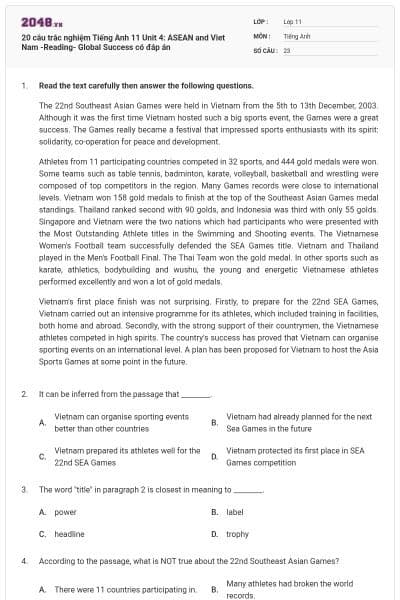
The 22nd Southeast Asian Games were held in Vietnam from the 5th to 13th December, 2003. Although it was the first time Vietnam hosted such a big sports event, the Games were a great success. The Games really became a festival that impressed sports enthusiasts with its spirit: solidarity, co-operation for peace and development.
Athletes from 11 participating countries competed in 32 sports, and 444 gold medals were won. Some teams such as table tennis, badminton, karate, volleyball, basketball and wrestling were composed of top competitors in the region. Many Games records were close to international levels. Vietnam won 158 gold medals to finish at the top of the Southeast Asian Games medal standings. Thailand ranked second with 90 golds, and Indonesia was third with only 55 golds. Singapore and Vietnam were the two nations which had participants who were presented with the Most Outstanding Athlete titles in the Swimming and Shooting events. The Vietnamese Women's Football team successfully defended the SEA Games title. Vietnam and Thailand played in the Men's Football Final. The Thai Team won the gold medal. In other sports such as karate, athletics, bodybuilding and wushu, the young and energetic Vietnamese athletes performed excellently and won a lot of gold medals.
Vietnam's first place finish was not surprising. Firstly, to prepare for the 22nd SEA Games, Vietnam carried out an intensive programme for its athletes, which included training in facilities, both home and abroad. Secondly, with the strong support of their countrymen, the Vietnamese athletes competed in high spirits. The country's success has proved that Vietnam can organise sporting events on an international level. A plan has been proposed for Vietnam to host the Asia Sports Games at some point in the future.
It can be inferred from the passage that ________.
Vietnam can organise sporting events better than other countries
Vietnam had already planned for the next Sea Games in the future
Vietnam prepared its athletes well for the 22nd SEA Games
Vietnam protected its first place in SEA Games competition
Đáp án đúng: C
Giải thích:
Dựa vào câu: “Vietnam carried out an intensive programme for its athletes, which included training … both home and abroad.” (“Việt Nam đã thực hiện một chương trình chuyên sâu cho các vận động viên của mình, bao gồm cả đào tạo… cả trong và ngoài nước.”)
→ chứng tỏ Việt Nam đã chuẩn bị kỹ cho SEA Games.
The word "title" in paragraph 2 is closest in meaning to ________.
power
label
headline
trophy
Đáp án đúng: D
Giải thích:
Từ “title” ở đây gần nghĩa nhất với “trophy” (cúp, giải thưởng).
According to the passage, what is NOT true about the 22nd Southeast Asian Games?
There were 11 countries participating in.
Many athletes had broken the world records.
Indonesia ranked higher than Singapore.
Vietnamese Women's Football team won gold medal.
Đáp án đúng: B
Giải thích:
Dựa vào câu: “Many Games records were close to international levels” (Nhiều kỷ lục của Thế vận hội gần đạt đến trình độ quốc tế )
→ không có vận động viên nào phá kỷ lục thế giới.
The word "intensive” in paragraph 3 has OPPOSITE meaning to ________.
delicate
flexible
sensitive
vigorous
Đáp án đúng: B
Giải thích: intensive (tập trung, cường độ cao) >< flexible (linh hoạt, không quá căng).
What is the writer's main purpose in writing this passage?
To explain the reasons why 22nd Sea Games was organised in Vietnam.
To express the writer's love and how much he is proud of the country's success.
To introduce top competitors in the region and their ranking in the Games.
To show Vietnamese's ability in organising international sporting events.
Đáp án đúng: D
Giải thích:
Dựa vào câu: “The country's success has proved that Vietnam can organise sporting events on an international level.” (Thành công của đất nước đã chứng minh rằng Việt Nam có thể tổ chức các sự kiện thể thao ở cấp độ quốc tế )
→ mục đích chính là chứng minh năng lực tổ chức của VN.
Dịch bài đọc:
Đại hội Thể thao Đông Nam Á lần thứ 22 được tổ chức tại Việt Nam từ ngày 5 đến ngày 13 tháng 12 năm 2003. Mặc dù lần đầu tiên Việt Nam đăng cai một sự kiện thể thao lớn như vậy, nhưng Đại hội đã thành công tốt đẹp. Đại hội thực sự đã trở thành một ngày hội gây ấn tượng mạnh mẽ với những người yêu thể thao bởi tinh thần đoàn kết, hợp tác vì hòa bình và phát triển.
Các vận động viên đến từ 11 quốc gia tham dự đã tranh tài ở 32 môn thể thao và giành được 444 huy chương vàng. Một số đội tuyển như bóng bàn, cầu lông, karate, bóng chuyền, bóng rổ và đấu vật quy tụ những vận động viên hàng đầu khu vực. Nhiều kỷ lục của Đại hội đã tiệm cận đẳng cấp quốc tế. Việt Nam đã giành được 158 huy chương vàng, dẫn đầu bảng xếp hạng huy chương Đại hội Thể thao Đông Nam Á. Thái Lan xếp thứ hai với 90 huy chương vàng, Indonesia xếp thứ ba với chỉ 55 huy chương vàng. Singapore và Việt Nam là hai quốc gia có vận động viên được trao danh hiệu Vận động viên xuất sắc nhất ở các môn Bơi lội và Bắn súng. Đội tuyển bóng đá nữ Việt Nam đã bảo vệ thành công chức vô địch SEA Games. Việt Nam và Thái Lan đã vào chung kết môn bóng đá nam. Đội tuyển Thái Lan đã giành huy chương vàng. Ở các môn thể thao khác như karate, điền kinh, thể hình và wushu, các vận động viên trẻ và năng động của Việt Nam đã thể hiện xuất sắc và giành được nhiều huy chương vàng. Việc Việt Nam giành vị trí nhất bảng không phải là điều bất ngờ. Thứ nhất, để chuẩn bị cho SEA Games 22, Việt Nam đã triển khai một chương trình tập luyện chuyên sâu cho các vận động viên, bao gồm cả tập luyện tại các cơ sở vật chất trong và ngoài nước. Thứ hai, với sự ủng hộ mạnh mẽ của đồng bào, các vận động viên Việt Nam đã thi đấu với tinh thần cao. Thành công của Việt Nam đã chứng minh rằng Việt Nam có thể tổ chức các sự kiện thể thao ở tầm quốc tế. Một kế hoạch đã được đề xuất để Việt Nam đăng cai Đại hội Thể thao Châu Á vào một thời điểm nào đó trong tương lai.
Read the passage, and then decide whether the statements are true (T) or false (F).
Although there is disagreement on the origins of batik, most agree the colorful cloth reached Java in Indonesia by the 7th century. Its production technique spread throughout the island, then over the centuries batik spread to Sumatra and north into Malaysia’s coastal areas and southern Thailand.
Javanese batik displays the peoples’ view of the universe. Three traditional, easy-to-obtain colours are used - indigo, brown, and white - which represent the three major Hindu Gods: Brahma, Vishnu and Siva. Nobility have special patterns, with wider stripes or wavy lines indicating a higher rank.
Sumatra’s batik dates to the 13th century. Sumatra’s ethnic groups have their own styles of batik, which use clay for the dye. Other Indonesian islands have batik similar to those found in Java and Sumatra.
The first introduction of Malaysian batik is in the 17th century. Today, tourists can find Malaysian batik on the east coast in Johor, Kelantan, Terengganu and Pahang. Motifs tend to be of plants but geometric shapes as human and animal images are taboo.
Batik finally made its way to southern Thailand, and locals still wear it as their daily clothes or as uniforms at work. Themes vary from the islands landscape and important parts of island culture such as coconut shells, palm trees, tropical flowers, and fishing boats.
Batik, has made a significant contribution to Singapore’s arts scene, with traditional and contemporary presentations.
So critical is batik to the Javanese and all of Indonesia that in 2009, UNESCO designated Indonesian batik as a Masterpiece of Oral and Intangible Heritage of Humanity.
People don’t know exactly the origins of batik.
True
False
Đáp án đúng: A
Giải thích:
Dựa vào câu: “Although there is disagreement on the origins of batik, most agree the colorful cloth reached Java in Indonesia by the 7th century.” (Mặc dù có nhiều ý kiến bất đồng về nguồn gốc của vải batik, nhưng hầu hết đều đồng ý rằng loại vải đầy màu sắc này đã du nhập vào Java ở Indonesia vào thế kỷ thứ 7.)
Batik has got its way to several countries in Southeast Asia.
True
False
Đáp án đúng: A
Giải thích:
Văn bản nói batik từ Java lan sang Sumatra, Malaysia, Thái Lan và cả Singapore suy ra Batik đã lan tới nhiều quốc gia Đông Nam Á.
Designs of batik may express the religious views.
True
False
Đáp án đúng: A
Giải thích:
Dựa vào câu: “Javanese batik displays the peoples’ view of the universe… three colours … represent the three major Hindu Gods.” (“Vải batik của người Java thể hiện quan điểm của người dân về vũ trụ… ba màu sắc… tượng trưng cho ba vị thần chính của đạo Hindu.”)
People have used the dyes that are available in their region.
True
False
Đáp án đúng: A
Giải thích:
Dựa vào câu: “Three traditional, easy-to-obtain colours are used…”; “which use clay for the dye.” (“Ba màu truyền thống, dễ kiếm được sử dụng…”; “sử dụng đất sét để nhuộm.”)
Based on the colours of batik, people can guess how senior the person is in Indonesia.
True
False
Đáp án đúng: B
Giải thích:
Cấp bậc không dựa vào màu sắc, mà dựa vào hoa văn (wider stripes or wavy lines indicate a higher rank).
Sumatra’s ethnic groups have their own styles of batik, and use the same material for the dye as people in Java.
True
False
Đáp án đúng: B
Giải thích:
Java dùng indigo/brown/white; Sumatra dùng clay for the dye. → không giống nhau.
Today batik is very popular throughout Malaysia.
True
False
Đáp án đúng: B
Giải thích:
Dựa vào câu: “Today, tourists can find Malaysian batik on the east coast in Johor, Kelantan, Terengganu and Pahang.” (Ngày nay, du khách có thể tìm thấy vải batik Malaysia ở bờ biển phía đông tại Johor, Kelantan, Terengganu và Pahang.)
Designs for batik tend to be human and animal images in Malaysia or Thailand.
True
False
Đáp án đúng: B
Giải thích:
Dựa vào câu: “Motifs tend to be of plants but geometric shapes as human and animal images are taboo.” (Họa tiết thường là thực vật nhưng hình dạng hình học như hình ảnh con người và động vật lại là điều cấm kỵ.)
Local people in southern Thailand still wear batik in their daily life.
True
False
Đáp án đúng: A
Giải thích:
Dựa vào câu: “Batik finally made its way to southern Thailand, and locals still wear it as their daily clothes or as uniforms at work.” (Vải batik cuối cùng đã du nhập vào miền nam Thái Lan và người dân địa phương vẫn mặc nó như trang phục thường ngày hoặc đồng phục khi đi làm.)
Batik is of great importance to Indonesia and its people.
True
False
Đáp án đúng: A
Giải thích:
Dựa vào câu: “So critical is batik to the Javanese and all of Indonesia that in 2009, UNESCO designated Indonesian batik as a Masterpiece of Oral and Intangible Heritage of Humanity.” (Vải batik quan trọng với người Java và toàn thể người Indonesia đến nỗi vào năm 2009, UNESCO đã công nhận vải batik của Indonesia là Kiệt tác truyền khẩu và di sản phi vật thể của nhân loại.)
Dịch bài đọc:
Mặc dù có nhiều bất đồng về nguồn gốc của vải batik, nhưng hầu hết đều đồng ý rằng loại vải đầy màu sắc này đã du nhập vào Java, Indonesia vào thế kỷ thứ 7. Kỹ thuật sản xuất vải batik lan rộng khắp hòn đảo, sau đó qua nhiều thế kỷ, batik lan rộng đến Sumatra và phía bắc đến các vùng ven biển Malaysia và miền nam Thái Lan.
Vải batik Java thể hiện quan điểm của người dân về vũ trụ. Ba màu truyền thống, dễ kiếm được sử dụng - chàm, nâu và trắng - tượng trưng cho ba vị thần chính của Ấn Độ giáo: Brahma, Vishnu và Siva. Giới quý tộc có những họa tiết đặc biệt, với các sọc rộng hơn hoặc các đường lượn sóng biểu thị cấp bậc cao hơn.
Vải batik Sumatra có niên đại từ thế kỷ 13. Các nhóm dân tộc trên đảo Sumatra có phong cách batik riêng, sử dụng đất sét để nhuộm. Các đảo khác của Indonesia cũng có vải batik tương tự như vải batik được tìm thấy ở Java và Sumatra.
Vải batik Malaysia lần đầu tiên được du nhập vào thế kỷ 17. Ngày nay, du khách có thể tìm thấy vải batik Malaysia ở bờ biển phía đông tại Johor, Kelantan, Terengganu và Pahang. Họa tiết thường là cây cối, nhưng hình khối như hình người và động vật lại bị cấm kỵ.
Batik cuối cùng đã du nhập vào miền Nam Thái Lan, và người dân địa phương vẫn mặc nó như trang phục thường ngày hoặc đồng phục khi đi làm. Chủ đề đa dạng từ cảnh quan đảo đến những nét văn hóa đặc trưng như vỏ dừa, cây cọ, hoa nhiệt đới và thuyền đánh cá.
Batik đã đóng góp đáng kể cho nền nghệ thuật Singapore, với những tác phẩm truyền thống và đương đại.
Batik quan trọng đối với người Java và toàn bộ Indonesia đến mức vào năm 2009, UNESCO đã công nhận batik Indonesia là Kiệt tác Di sản Truyền khẩu và Phi vật thể của Nhân loại.
Read the text carefully then answer the following questions.
Singapore was one of the five original member countries that founded ASEAN in 1967. Since its independence in 1965, Singapore has become one of the world’s most prosperous countries, with per capita GDP equalling that of the leading nations of Western Europe. Singapore is highly ranked for its economic competitiveness, and it was the world’s most competitive country from 1997 to 1999 as ranked by the World Economic Forum.
Singapore’s strategic location at the entrance to the Strait of Malacca has helped it to become one of the most important shipping centres in Asia. The Port of Singapore, the world’s busiest in terms of shipping tonnage, is a key component of Singapore’s prosperity and economic health. Singapore is a leader in manufacturing of computer components, petroleum refining, and business services.
Singapore has made an impressive recovery after the Asian financial crisis of 1997-1998. The government is currently restructuring the economy by promoting higher-value-added activities in line with a “knowledge-based” economy, and by opening up protected sectors such as financial services to increase overall efficiency. Various bilateral free-trade agreements are also being negotiated to improve market access and encourage foreign investment inflows.
Since when has Singapore become one of the world’s most prosperous countries?
1965
1967
1997
1999
Đáp án đúng: A
Giải thích:
Dựa vào câu: “Since its independence in 1965, Singapore has become one of the world’s most prosperous countries, with per capita GDP equalling that of the leading nations of Western Europe.” (Kể từ khi giành được độc lập vào năm 1965, Singapore đã trở thành một trong những quốc gia thịnh vượng nhất thế giới, với GDP bình quân đầu người ngang bằng với các quốc gia hàng đầu Tây Âu.)
What does the word “it” in the first paragraph refer to?
ASEAN
GDP
Singapore
the World Economic Forum
Đáp án đúng: C
Giải thích:
Dựa vào câu: “Since its independence in 1965, Singapore has become one of the world’s most prosperous countries, with per capita GDP equalling that of the leading nations of Western Europe.” (Kể từ khi giành được độc lập vào năm 1965, Singapore đã trở thành một trong những quốc gia thịnh vượng nhất thế giới, với GDP bình quân đầu người ngang bằng với các quốc gia hàng đầu Tây Âu.)
What is the important component of Singapore’s prosperity and economic health?
Singapore’s strategic location
the Strait of Malacca
Singapore’s shipping
the Port of Singapore
Đáp án đúng: D
Giải thích:
Dựa vào câu: “The Port of Singapore, the world’s busiest in terms of shipping tonnage, is a key component of Singapore’s prosperity and economic health.” (Cảng Singapore, cảng bận rộn nhất thế giới xét về khối lượng vận chuyển, là thành phần quan trọng cho sự thịnh vượng và sức khỏe kinh tế của Singapore.)
In what areas is Singapore leading?
manufacturing of computer components
petroleum refining
business services
A, B, and C
Đáp án đúng: D
Giải thích:
Dựa vào câu: “Singapore is a leader in manufacturing of computer components, petroleum refining, and business services.” (Singapore là quốc gia đi đầu trong sản xuất linh kiện máy tính, lọc dầu và dịch vụ kinh doanh.)
What happened in the period of 1997-1998?
Singapore made an impressive recovery.
The Asian financial crisis took place.
The Singaporean government promoted higher-value-added activities.
The Singaporean government opened up financial services.
Đáp án đúng: B
Giải thích:
Dựa vào câu: “Singapore has made an impressive recovery after the Asian financial crisis of 1997-1998.” (Singapore đã có sự phục hồi ấn tượng sau cuộc khủng hoảng tài chính châu Á năm 1997-1998.)
Dịch bài đọc:
Singapore là một trong năm quốc gia thành viên đầu tiên thành lập ASEAN vào năm 1967. Kể từ khi giành độc lập vào năm 1965, Singapore đã trở thành một trong những quốc gia thịnh vượng nhất thế giới, với GDP bình quân đầu người ngang bằng với các quốc gia hàng đầu Tây Âu. Singapore được xếp hạng cao về năng lực cạnh tranh kinh tế, và là quốc gia cạnh tranh nhất thế giới từ năm 1997 đến năm 1999 theo xếp hạng của Diễn đàn Kinh tế Thế giới.
Vị trí chiến lược của Singapore tại cửa ngõ Eo biển Malacca đã giúp nơi đây trở thành một trong những trung tâm vận tải biển quan trọng nhất châu Á. Cảng Singapore, cảng biển nhộn nhịp nhất thế giới về trọng tải vận chuyển, là một thành phần quan trọng trong sự thịnh vượng và sức khỏe kinh tế của Singapore. Singapore là quốc gia dẫn đầu về sản xuất linh kiện máy tính, lọc dầu và dịch vụ kinh doanh.
Singapore đã có sự phục hồi ấn tượng sau cuộc khủng hoảng tài chính châu Á 1997-1998. Chính phủ hiện đang tái cấu trúc nền kinh tế bằng cách thúc đẩy các hoạt động có giá trị gia tăng cao hơn theo nền kinh tế "dựa trên tri thức", và bằng cách mở cửa các lĩnh vực được bảo hộ như dịch vụ tài chính để tăng hiệu quả tổng thể. Nhiều hiệp định thương mại tự do song phương cũng đang được đàm phán để cải thiện khả năng tiếp cận thị trường và khuyến khích dòng vốn đầu tư nước ngoài.