Tổng hợp đề thi Tiếng Anh có lời giải (Đề số 5)
64 câu hỏi
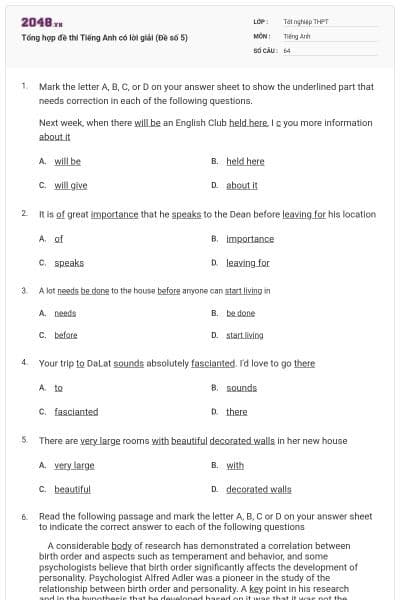
Mark the letter A, B, C, or D on your answer sheet to show the underlined part that needs correction in each of the following questions.
Next week, when there will be an English Club held here, I c you more information about it
will be
held here
will give
about it
Đáp án là A. will be => is
It is of great importance that he speaks to the Dean before leaving for his location
of
importance
speaks
leaving for
Đáp án là C. speaks to => speak to
A lot needs be done to the house before anyone can start living in
needs
be done
before
start living
Đáp án là B.
Giải thích:
Câu bị động với động từ “need”: need to be done = need doing
Sửa: be done → to be done/ doing
Dịch: Nhiều thứ cần được thực hiện đối với ngôi nhà trước khi bất cứ ai có thể bắt đầu sống ở đó.
Your trip to DaLat sounds absolutely fascianted. I'd love to go there
to
sounds
fascianted
there
Đáp án là C. fascinated => fascinating
There are very large rooms with beautiful decorated walls in her new house
very large
with
beautiful
decorated walls
Đáp án là C. beautiful => beautifully
Read the following passage and mark the letter A, B, C or D on your answer sheet to indicate the correct answer to each of the following questions
A considerable body of research has demonstrated a correlation between birth order and aspects such as temperament and behavior, and some psychologists believe that birth order significantly affects the development of personality. Psychologist Alfred Adler was a pioneer in the study of the relationship between birth order and personality. A key point in his research and in the hypothesis that he developed based on it was that it was not the actual numerical birth position that affected personality; instead, it was the similar responses in large numbers of families to children in specific birth order positions that had an effect. For example, first-borns, who have their parents to themselves initially and do not have to deal with siblings in the first part of their lives, tend to have their first socialization experiences with adults and therefore tend to find the process of peer socialization more difficult. In contrast, later-born children have to deal with siblings from the first moment of their lives and therefore tend to have stronger socialization skills.
Numerous studies since Adler’s have been conducted on the effect of birth order and personality. These studies have tended to classify birth order types into four different categories: first-born, second-born and/or middle, last, and only child.
Studies have consistently shown that first-born children tend to exhibit similar, positive and negative personality traits. First-borns have consistently been linked with academic achievement in various studies; in one study, the number of National Merit scholarship winners who are first-borns was found to be equal to the number of second-and third-borns combined. First-borns have been found to be more responsible and assertive than those born in other birth-order positions and tend to rise to positions of leadership more often than others; more first-borns have served in the U.S. Congress and as U.S. presidents than have those born in other birth-order positions. However, studies have shown that first-borns tend to be more subject to stress and were considered problem children more often than later-borns.
Second-born and/or middle children demonstrate markedly different tendencies from first-borns. They tend to feel inferior to the older child or children because it is difficult for them to comprehend that their lower level of achievement is a function of age rather than ability, and they often try to succeed in areas other than those in which their older sibling or siblings excel. They tend to be more trusting, accepting and focused on others than the more self-centered first-borns, and they tend to have a comparatively higher level of success in team sports than do first-borns or only children, who more often excel in individual sports.
The last-born child is the one who tends to be the eternal baby of the family and thus often exhibits a strong sense of security. Last-borns collectively achieve the highest degree of social success and demonstrate the highest levels of self-esteem of all the birth-order positions. They often exhibit less competitiveness than older brothers and sisters and are more likely to take part in less competitive group games or in social organizations such as sororities and fraternities.
Only children tend to exhibit some of the main characteristics of first-borns and some of the characteristics of last-borns. Only children tend to exhibit the strong sense of security and self-esteem exhibited by last-borns while, like first-borns, they are more achievement oriented and more likely than middle-or last-borns to achieve academic success. However, only children tend to have the most problems establishing close relationships and exhibit a lower need for affiliation than other children
The word body in paragraph 1 could best be replaced by x
corpse
amount
organization
skeleton
Đáp án là B. body = amount: Khối; số lượng lớn; nhiều
Read the following passage and mark the letter A, B, C or D on your answer sheet to indicate the correct answer to each of the following questions
A considerable body of research has demonstrated a correlation between birth order and aspects such as temperament and behavior, and some psychologists believe that birth order significantly affects the development of personality. Psychologist Alfred Adler was a pioneer in the study of the relationship between birth order and personality. A key point in his research and in the hypothesis that he developed based on it was that it was not the actual numerical birth position that affected personality; instead, it was the similar responses in large numbers of families to children in specific birth order positions that had an effect. For example, first-borns, who have their parents to themselves initially and do not have to deal with siblings in the first part of their lives, tend to have their first socialization experiences with adults and therefore tend to find the process of peer socialization more difficult. In contrast, later-born children have to deal with siblings from the first moment of their lives and therefore tend to have stronger socialization skills.
Numerous studies since Adler’s have been conducted on the effect of birth order and personality. These studies have tended to classify birth order types into four different categories: first-born, second-born and/or middle, last, and only child.
Studies have consistently shown that first-born children tend to exhibit similar, positive and negative personality traits. First-borns have consistently been linked with academic achievement in various studies; in one study, the number of National Merit scholarship winners who are first-borns was found to be equal to the number of second-and third-borns combined. First-borns have been found to be more responsible and assertive than those born in other birth-order positions and tend to rise to positions of leadership more often than others; more first-borns have served in the U.S. Congress and as U.S. presidents than have those born in other birth-order positions. However, studies have shown that first-borns tend to be more subject to stress and were considered problem children more often than later-borns.
Second-born and/or middle children demonstrate markedly different tendencies from first-borns. They tend to feel inferior to the older child or children because it is difficult for them to comprehend that their lower level of achievement is a function of age rather than ability, and they often try to succeed in areas other than those in which their older sibling or siblings excel. They tend to be more trusting, accepting and focused on others than the more self-centered first-borns, and they tend to have a comparatively higher level of success in team sports than do first-borns or only children, who more often excel in individual sports.
The last-born child is the one who tends to be the eternal baby of the family and thus often exhibits a strong sense of security. Last-borns collectively achieve the highest degree of social success and demonstrate the highest levels of self-esteem of all the birth-order positions. They often exhibit less competitiveness than older brothers and sisters and are more likely to take part in less competitive group games or in social organizations such as sororities and fraternities.
Only children tend to exhibit some of the main characteristics of first-borns and some of the characteristics of last-borns. Only children tend to exhibit the strong sense of security and self-esteem exhibited by last-borns while, like first-borns, they are more achievement oriented and more likely than middle-or last-borns to achieve academic success. However, only children tend to have the most problems establishing close relationships and exhibit a lower need for affiliation than other children
The word key in paragraph 1 could best be replaced by x
locked
secret
studied
significant
Đáp án là D. key = significant: quan trọng; ý nghĩa
Read the following passage and mark the letter A, B, C or D on your answer sheet to indicate the correct answer to each of the following questions
A considerable body of research has demonstrated a correlation between birth order and aspects such as temperament and behavior, and some psychologists believe that birth order significantly affects the development of personality. Psychologist Alfred Adler was a pioneer in the study of the relationship between birth order and personality. A key point in his research and in the hypothesis that he developed based on it was that it was not the actual numerical birth position that affected personality; instead, it was the similar responses in large numbers of families to children in specific birth order positions that had an effect. For example, first-borns, who have their parents to themselves initially and do not have to deal with siblings in the first part of their lives, tend to have their first socialization experiences with adults and therefore tend to find the process of peer socialization more difficult. In contrast, later-born children have to deal with siblings from the first moment of their lives and therefore tend to have stronger socialization skills.
Numerous studies since Adler’s have been conducted on the effect of birth order and personality. These studies have tended to classify birth order types into four different categories: first-born, second-born and/or middle, last, and only child.
Studies have consistently shown that first-born children tend to exhibit similar, positive and negative personality traits. First-borns have consistently been linked with academic achievement in various studies; in one study, the number of National Merit scholarship winners who are first-borns was found to be equal to the number of second-and third-borns combined. First-borns have been found to be more responsible and assertive than those born in other birth-order positions and tend to rise to positions of leadership more often than others; more first-borns have served in the U.S. Congress and as U.S. presidents than have those born in other birth-order positions. However, studies have shown that first-borns tend to be more subject to stress and were considered problem children more often than later-borns.
Second-born and/or middle children demonstrate markedly different tendencies from first-borns. They tend to feel inferior to the older child or children because it is difficult for them to comprehend that their lower level of achievement is a function of age rather than ability, and they often try to succeed in areas other than those in which their older sibling or siblings excel. They tend to be more trusting, accepting and focused on others than the more self-centered first-borns, and they tend to have a comparatively higher level of success in team sports than do first-borns or only children, who more often excel in individual sports.
The last-born child is the one who tends to be the eternal baby of the family and thus often exhibits a strong sense of security. Last-borns collectively achieve the highest degree of social success and demonstrate the highest levels of self-esteem of all the birth-order positions. They often exhibit less competitiveness than older brothers and sisters and are more likely to take part in less competitive group games or in social organizations such as sororities and fraternities.
Only children tend to exhibit some of the main characteristics of first-borns and some of the characteristics of last-borns. Only children tend to exhibit the strong sense of security and self-esteem exhibited by last-borns while, like first-borns, they are more achievement oriented and more likely than middle-or last-borns to achieve academic success. However, only children tend to have the most problems establishing close relationships and exhibit a lower need for affiliation than other children
The word it in paragraph 1 refers to x
personality
component
research
hypothesis
Đáp án là C. Ý trong bài: A key point in his research and in the hypothesis that he developed based on it
was that it was not the actual numerical birth position
Read the following passage and mark the letter A, B, C or D on your answer sheet to indicate the correct answer to each of the following questions
A considerable body of research has demonstrated a correlation between birth order and aspects such as temperament and behavior, and some psychologists believe that birth order significantly affects the development of personality. Psychologist Alfred Adler was a pioneer in the study of the relationship between birth order and personality. A key point in his research and in the hypothesis that he developed based on it was that it was not the actual numerical birth position that affected personality; instead, it was the similar responses in large numbers of families to children in specific birth order positions that had an effect. For example, first-borns, who have their parents to themselves initially and do not have to deal with siblings in the first part of their lives, tend to have their first socialization experiences with adults and therefore tend to find the process of peer socialization more difficult. In contrast, later-born children have to deal with siblings from the first moment of their lives and therefore tend to have stronger socialization skills.
Numerous studies since Adler’s have been conducted on the effect of birth order and personality. These studies have tended to classify birth order types into four different categories: first-born, second-born and/or middle, last, and only child.
Studies have consistently shown that first-born children tend to exhibit similar, positive and negative personality traits. First-borns have consistently been linked with academic achievement in various studies; in one study, the number of National Merit scholarship winners who are first-borns was found to be equal to the number of second-and third-borns combined. First-borns have been found to be more responsible and assertive than those born in other birth-order positions and tend to rise to positions of leadership more often than others; more first-borns have served in the U.S. Congress and as U.S. presidents than have those born in other birth-order positions. However, studies have shown that first-borns tend to be more subject to stress and were considered problem children more often than later-borns.
Second-born and/or middle children demonstrate markedly different tendencies from first-borns. They tend to feel inferior to the older child or children because it is difficult for them to comprehend that their lower level of achievement is a function of age rather than ability, and they often try to succeed in areas other than those in which their older sibling or siblings excel. They tend to be more trusting, accepting and focused on others than the more self-centered first-borns, and they tend to have a comparatively higher level of success in team sports than do first-borns or only children, who more often excel in individual sports.
The last-born child is the one who tends to be the eternal baby of the family and thus often exhibits a strong sense of security. Last-borns collectively achieve the highest degree of social success and demonstrate the highest levels of self-esteem of all the birth-order positions. They often exhibit less competitiveness than older brothers and sisters and are more likely to take part in less competitive group games or in social organizations such as sororities and fraternities.
Only children tend to exhibit some of the main characteristics of first-borns and some of the characteristics of last-borns. Only children tend to exhibit the strong sense of security and self-esteem exhibited by last-borns while, like first-borns, they are more achievement oriented and more likely than middle-or last-borns to achieve academic success. However, only children tend to have the most problems establishing close relationships and exhibit a lower need for affiliation than other children
What is stated in paragraph 1 about Adler?
He was one of the first to study the effect of birth order on personality
He believed that it was the actual birth order that affected personality
He had found that the responses by family members had little to do with personality
He was the only one to study birth order
Đáp án là A. Ý trong bài: Psychologist Alfred Adler was a pioneer ( người tiên phong ) in the study of the relationship between birth order and personality.
Read the following passage and mark the letter A, B, C or D on your answer sheet to indicate the correct answer to each of the following questions
A considerable body of research has demonstrated a correlation between birth order and aspects such as temperament and behavior, and some psychologists believe that birth order significantly affects the development of personality. Psychologist Alfred Adler was a pioneer in the study of the relationship between birth order and personality. A key point in his research and in the hypothesis that he developed based on it was that it was not the actual numerical birth position that affected personality; instead, it was the similar responses in large numbers of families to children in specific birth order positions that had an effect. For example, first-borns, who have their parents to themselves initially and do not have to deal with siblings in the first part of their lives, tend to have their first socialization experiences with adults and therefore tend to find the process of peer socialization more difficult. In contrast, later-born children have to deal with siblings from the first moment of their lives and therefore tend to have stronger socialization skills.
Numerous studies since Adler’s have been conducted on the effect of birth order and personality. These studies have tended to classify birth order types into four different categories: first-born, second-born and/or middle, last, and only child.
Studies have consistently shown that first-born children tend to exhibit similar, positive and negative personality traits. First-borns have consistently been linked with academic achievement in various studies; in one study, the number of National Merit scholarship winners who are first-borns was found to be equal to the number of second-and third-borns combined. First-borns have been found to be more responsible and assertive than those born in other birth-order positions and tend to rise to positions of leadership more often than others; more first-borns have served in the U.S. Congress and as U.S. presidents than have those born in other birth-order positions. However, studies have shown that first-borns tend to be more subject to stress and were considered problem children more often than later-borns.
Second-born and/or middle children demonstrate markedly different tendencies from first-borns. They tend to feel inferior to the older child or children because it is difficult for them to comprehend that their lower level of achievement is a function of age rather than ability, and they often try to succeed in areas other than those in which their older sibling or siblings excel. They tend to be more trusting, accepting and focused on others than the more self-centered first-borns, and they tend to have a comparatively higher level of success in team sports than do first-borns or only children, who more often excel in individual sports.
The last-born child is the one who tends to be the eternal baby of the family and thus often exhibits a strong sense of security. Last-borns collectively achieve the highest degree of social success and demonstrate the highest levels of self-esteem of all the birth-order positions. They often exhibit less competitiveness than older brothers and sisters and are more likely to take part in less competitive group games or in social organizations such as sororities and fraternities.
Only children tend to exhibit some of the main characteristics of first-borns and some of the characteristics of last-borns. Only children tend to exhibit the strong sense of security and self-esteem exhibited by last-borns while, like first-borns, they are more achievement oriented and more likely than middle-or last-borns to achieve academic success. However, only children tend to have the most problems establishing close relationships and exhibit a lower need for affiliation than other children
The word traits in paragraph 3 is closest in meaning to x
stresses
Marks
characteristics
fears
Đáp án là C. traits = characteristics: nét tiêu biểu, đặc điểm
Read the following passage and mark the letter A, B, C or D on your answer sheet to indicate the correct answer to each of the following questions
A considerable body of research has demonstrated a correlation between birth order and aspects such as temperament and behavior, and some psychologists believe that birth order significantly affects the development of personality. Psychologist Alfred Adler was a pioneer in the study of the relationship between birth order and personality. A key point in his research and in the hypothesis that he developed based on it was that it was not the actual numerical birth position that affected personality; instead, it was the similar responses in large numbers of families to children in specific birth order positions that had an effect. For example, first-borns, who have their parents to themselves initially and do not have to deal with siblings in the first part of their lives, tend to have their first socialization experiences with adults and therefore tend to find the process of peer socialization more difficult. In contrast, later-born children have to deal with siblings from the first moment of their lives and therefore tend to have stronger socialization skills.
Numerous studies since Adler’s have been conducted on the effect of birth order and personality. These studies have tended to classify birth order types into four different categories: first-born, second-born and/or middle, last, and only child.
Studies have consistently shown that first-born children tend to exhibit similar, positive and negative personality traits. First-borns have consistently been linked with academic achievement in various studies; in one study, the number of National Merit scholarship winners who are first-borns was found to be equal to the number of second-and third-borns combined. First-borns have been found to be more responsible and assertive than those born in other birth-order positions and tend to rise to positions of leadership more often than others; more first-borns have served in the U.S. Congress and as U.S. presidents than have those born in other birth-order positions. However, studies have shown that first-borns tend to be more subject to stress and were considered problem children more often than later-borns.
Second-born and/or middle children demonstrate markedly different tendencies from first-borns. They tend to feel inferior to the older child or children because it is difficult for them to comprehend that their lower level of achievement is a function of age rather than ability, and they often try to succeed in areas other than those in which their older sibling or siblings excel. They tend to be more trusting, accepting and focused on others than the more self-centered first-borns, and they tend to have a comparatively higher level of success in team sports than do first-borns or only children, who more often excel in individual sports.
The last-born child is the one who tends to be the eternal baby of the family and thus often exhibits a strong sense of security. Last-borns collectively achieve the highest degree of social success and demonstrate the highest levels of self-esteem of all the birth-order positions. They often exhibit less competitiveness than older brothers and sisters and are more likely to take part in less competitive group games or in social organizations such as sororities and fraternities.
Only children tend to exhibit some of the main characteristics of first-borns and some of the characteristics of last-borns. Only children tend to exhibit the strong sense of security and self-esteem exhibited by last-borns while, like first-borns, they are more achievement oriented and more likely than middle-or last-borns to achieve academic success. However, only children tend to have the most problems establishing close relationships and exhibit a lower need for affiliation than other children
Which of the sentences below expresses the essential information in the italic sentence in paragraph 3? Incorrect choices change the meaning in important ways or leave out essential information
In spite of certain characteristics that first-borns possess, many of them become leaders
An interesting fact that is difficult to explain is that many first-borns have served in high government positions.
Because first-borns tend to be very assertive, they are uncomfortable serving in government positions
Several examples support the idea that first-borns have characteristics that make them leaders
Đáp án là D. Several examples support the idea that first-borns have characteristics that make them leaders. - Một vài ví dụ ủng hộ ý kiến rằng trẻ sơ sinh đầu lòng có những đặc tính mà làm cho họ trở thành lãnh đạo.
Read the following passage and mark the letter A, B, C or D on your answer sheet to indicate the correct answer to each of the following questions
A considerable body of research has demonstrated a correlation between birth order and aspects such as temperament and behavior, and some psychologists believe that birth order significantly affects the development of personality. Psychologist Alfred Adler was a pioneer in the study of the relationship between birth order and personality. A key point in his research and in the hypothesis that he developed based on it was that it was not the actual numerical birth position that affected personality; instead, it was the similar responses in large numbers of families to children in specific birth order positions that had an effect. For example, first-borns, who have their parents to themselves initially and do not have to deal with siblings in the first part of their lives, tend to have their first socialization experiences with adults and therefore tend to find the process of peer socialization more difficult. In contrast, later-born children have to deal with siblings from the first moment of their lives and therefore tend to have stronger socialization skills.
Numerous studies since Adler’s have been conducted on the effect of birth order and personality. These studies have tended to classify birth order types into four different categories: first-born, second-born and/or middle, last, and only child.
Studies have consistently shown that first-born children tend to exhibit similar, positive and negative personality traits. First-borns have consistently been linked with academic achievement in various studies; in one study, the number of National Merit scholarship winners who are first-borns was found to be equal to the number of second-and third-borns combined. First-borns have been found to be more responsible and assertive than those born in other birth-order positions and tend to rise to positions of leadership more often than others; more first-borns have served in the U.S. Congress and as U.S. presidents than have those born in other birth-order positions. However, studies have shown that first-borns tend to be more subject to stress and were considered problem children more often than later-borns.
Second-born and/or middle children demonstrate markedly different tendencies from first-borns. They tend to feel inferior to the older child or children because it is difficult for them to comprehend that their lower level of achievement is a function of age rather than ability, and they often try to succeed in areas other than those in which their older sibling or siblings excel. They tend to be more trusting, accepting and focused on others than the more self-centered first-borns, and they tend to have a comparatively higher level of success in team sports than do first-borns or only children, who more often excel in individual sports.
The last-born child is the one who tends to be the eternal baby of the family and thus often exhibits a strong sense of security. Last-borns collectively achieve the highest degree of social success and demonstrate the highest levels of self-esteem of all the birth-order positions. They often exhibit less competitiveness than older brothers and sisters and are more likely to take part in less competitive group games or in social organizations such as sororities and fraternities.
Only children tend to exhibit some of the main characteristics of first-borns and some of the characteristics of last-borns. Only children tend to exhibit the strong sense of security and self-esteem exhibited by last-borns while, like first-borns, they are more achievement oriented and more likely than middle-or last-borns to achieve academic success. However, only children tend to have the most problems establishing close relationships and exhibit a lower need for affiliation than other children
The word accepting in paragraph 4 is closest in meaning to x
tolerant
affectionate
admissible
respectable
accepting: có thể chấp nhận được => Đáp án là A. tolerant
Các từ còn lại: affectionate: trìu mến, respectable: đáng kính; admissible: thừa nhận
Read the following passage and mark the letter A, B, C or D on your answer sheet to indicate the correct answer to each of the following questions
A considerable body of research has demonstrated a correlation between birth order and aspects such as temperament and behavior, and some psychologists believe that birth order significantly affects the development of personality. Psychologist Alfred Adler was a pioneer in the study of the relationship between birth order and personality. A key point in his research and in the hypothesis that he developed based on it was that it was not the actual numerical birth position that affected personality; instead, it was the similar responses in large numbers of families to children in specific birth order positions that had an effect. For example, first-borns, who have their parents to themselves initially and do not have to deal with siblings in the first part of their lives, tend to have their first socialization experiences with adults and therefore tend to find the process of peer socialization more difficult. In contrast, later-born children have to deal with siblings from the first moment of their lives and therefore tend to have stronger socialization skills.
Numerous studies since Adler’s have been conducted on the effect of birth order and personality. These studies have tended to classify birth order types into four different categories: first-born, second-born and/or middle, last, and only child.
Studies have consistently shown that first-born children tend to exhibit similar, positive and negative personality traits. First-borns have consistently been linked with academic achievement in various studies; in one study, the number of National Merit scholarship winners who are first-borns was found to be equal to the number of second-and third-borns combined. First-borns have been found to be more responsible and assertive than those born in other birth-order positions and tend to rise to positions of leadership more often than others; more first-borns have served in the U.S. Congress and as U.S. presidents than have those born in other birth-order positions. However, studies have shown that first-borns tend to be more subject to stress and were considered problem children more often than later-borns.
Second-born and/or middle children demonstrate markedly different tendencies from first-borns. They tend to feel inferior to the older child or children because it is difficult for them to comprehend that their lower level of achievement is a function of age rather than ability, and they often try to succeed in areas other than those in which their older sibling or siblings excel. They tend to be more trusting, accepting and focused on others than the more self-centered first-borns, and they tend to have a comparatively higher level of success in team sports than do first-borns or only children, who more often excel in individual sports.
The last-born child is the one who tends to be the eternal baby of the family and thus often exhibits a strong sense of security. Last-borns collectively achieve the highest degree of social success and demonstrate the highest levels of self-esteem of all the birth-order positions. They often exhibit less competitiveness than older brothers and sisters and are more likely to take part in less competitive group games or in social organizations such as sororities and fraternities.
Only children tend to exhibit some of the main characteristics of first-borns and some of the characteristics of last-borns. Only children tend to exhibit the strong sense of security and self-esteem exhibited by last-borns while, like first-borns, they are more achievement oriented and more likely than middle-or last-borns to achieve academic success. However, only children tend to have the most problems establishing close relationships and exhibit a lower need for affiliation than other children
Which of the following is NOT true?
First-borns tend to do well in individual sports
Middle children tend to have a preference for team sports
Last-borns tend to prefer games with fierce competition
Only children tend to prefer individual over team sports
Đáp án là C. Đoạn số 5 đề cập đến “Last-borns”, tuy nhiên không có chi tiết nào đề cập đến “prefer games with fierce competition”
Read the following passage and mark the letter A, B, C or D on your answer sheet to indicate the correct answer to each of the following questions
A considerable body of research has demonstrated a correlation between birth order and aspects such as temperament and behavior, and some psychologists believe that birth order significantly affects the development of personality. Psychologist Alfred Adler was a pioneer in the study of the relationship between birth order and personality. A key point in his research and in the hypothesis that he developed based on it was that it was not the actual numerical birth position that affected personality; instead, it was the similar responses in large numbers of families to children in specific birth order positions that had an effect. For example, first-borns, who have their parents to themselves initially and do not have to deal with siblings in the first part of their lives, tend to have their first socialization experiences with adults and therefore tend to find the process of peer socialization more difficult. In contrast, later-born children have to deal with siblings from the first moment of their lives and therefore tend to have stronger socialization skills.
Numerous studies since Adler’s have been conducted on the effect of birth order and personality. These studies have tended to classify birth order types into four different categories: first-born, second-born and/or middle, last, and only child.
Studies have consistently shown that first-born children tend to exhibit similar, positive and negative personality traits. First-borns have consistently been linked with academic achievement in various studies; in one study, the number of National Merit scholarship winners who are first-borns was found to be equal to the number of second-and third-borns combined. First-borns have been found to be more responsible and assertive than those born in other birth-order positions and tend to rise to positions of leadership more often than others; more first-borns have served in the U.S. Congress and as U.S. presidents than have those born in other birth-order positions. However, studies have shown that first-borns tend to be more subject to stress and were considered problem children more often than later-borns.
Second-born and/or middle children demonstrate markedly different tendencies from first-borns. They tend to feel inferior to the older child or children because it is difficult for them to comprehend that their lower level of achievement is a function of age rather than ability, and they often try to succeed in areas other than those in which their older sibling or siblings excel. They tend to be more trusting, accepting and focused on others than the more self-centered first-borns, and they tend to have a comparatively higher level of success in team sports than do first-borns or only children, who more often excel in individual sports.
The last-born child is the one who tends to be the eternal baby of the family and thus often exhibits a strong sense of security. Last-borns collectively achieve the highest degree of social success and demonstrate the highest levels of self-esteem of all the birth-order positions. They often exhibit less competitiveness than older brothers and sisters and are more likely to take part in less competitive group games or in social organizations such as sororities and fraternities.
Only children tend to exhibit some of the main characteristics of first-borns and some of the characteristics of last-borns. Only children tend to exhibit the strong sense of security and self-esteem exhibited by last-borns while, like first-borns, they are more achievement oriented and more likely than middle-or last-borns to achieve academic success. However, only children tend to have the most problems establishing close relationships and exhibit a lower need for affiliation than other children
The phrase more achievement oriented in the paragraph 6 is closest in meaning to
more directly involved
more focused on accomplishments
more skilled as leaders
more aware of surroundings
Đáp án là B. more focused on accomplishments: tập trung hơn vào những thành tích
Read the following passage and mark the letter A, B, C or D on your answer sheet to indicate the correct answer to each of the following questions
A considerable body of research has demonstrated a correlation between birth order and aspects such as temperament and behavior, and some psychologists believe that birth order significantly affects the development of personality. Psychologist Alfred Adler was a pioneer in the study of the relationship between birth order and personality. A key point in his research and in the hypothesis that he developed based on it was that it was not the actual numerical birth position that affected personality; instead, it was the similar responses in large numbers of families to children in specific birth order positions that had an effect. For example, first-borns, who have their parents to themselves initially and do not have to deal with siblings in the first part of their lives, tend to have their first socialization experiences with adults and therefore tend to find the process of peer socialization more difficult. In contrast, later-born children have to deal with siblings from the first moment of their lives and therefore tend to have stronger socialization skills.
Numerous studies since Adler’s have been conducted on the effect of birth order and personality. These studies have tended to classify birth order types into four different categories: first-born, second-born and/or middle, last, and only child.
Studies have consistently shown that first-born children tend to exhibit similar, positive and negative personality traits. First-borns have consistently been linked with academic achievement in various studies; in one study, the number of National Merit scholarship winners who are first-borns was found to be equal to the number of second-and third-borns combined. First-borns have been found to be more responsible and assertive than those born in other birth-order positions and tend to rise to positions of leadership more often than others; more first-borns have served in the U.S. Congress and as U.S. presidents than have those born in other birth-order positions. However, studies have shown that first-borns tend to be more subject to stress and were considered problem children more often than later-borns.
Second-born and/or middle children demonstrate markedly different tendencies from first-borns. They tend to feel inferior to the older child or children because it is difficult for them to comprehend that their lower level of achievement is a function of age rather than ability, and they often try to succeed in areas other than those in which their older sibling or siblings excel. They tend to be more trusting, accepting and focused on others than the more self-centered first-borns, and they tend to have a comparatively higher level of success in team sports than do first-borns or only children, who more often excel in individual sports.
The last-born child is the one who tends to be the eternal baby of the family and thus often exhibits a strong sense of security. Last-borns collectively achieve the highest degree of social success and demonstrate the highest levels of self-esteem of all the birth-order positions. They often exhibit less competitiveness than older brothers and sisters and are more likely to take part in less competitive group games or in social organizations such as sororities and fraternities.
Only children tend to exhibit some of the main characteristics of first-borns and some of the characteristics of last-borns. Only children tend to exhibit the strong sense of security and self-esteem exhibited by last-borns while, like first-borns, they are more achievement oriented and more likely than middle-or last-borns to achieve academic success. However, only children tend to have the most problems establishing close relationships and exhibit a lower need for affiliation than other children
Which of the following would be most likely to have a successful career but few close friendships?
A second-born
A middle child
A last-born
An only child
Đáp án là D. Dựa vào đoạn cuối trong bài: they are more achievement oriented to achieve academic
success. However, only children tend to have the most problems establishing close relationships and exhibit a lower need for affiliation than other children
Mark the letter A, B, C, or D on your answer sheet to indicate the correct answer to each of the following questions
It can be an amazing experience for those who have the x to leave their family and friend and live in a new place
courage
courageous
encourage
encouragement
Đáp án là A. courage ( n) : sự can đảm. Chỗ cần điền là một danh từ, sau mạo từ ‘the’
Các từ còn lại : courageous ( adj) : dũng cảm ; encourage (v) : khuyến khích ; encouragement (n) : sự khuyến
khích
Mark the letter A, B, C, or D on your answer sheet to indicate the correct answer to each of the following questions
“What was Derek’ s reaction to the accusation?”
“Well, he denied x anywhere near the house at the time.”
of being
being
be
to be
Đáp án là B. deny + V-ing: phủ nhận đã làm gì
Mark the letter A, B, C, or D on your answer sheet to indicate the correct answer to each of the following questions
Tuan, along with his friends, x on a picnic in Pu Mat National Park at the end of this month
have to go
will go
are going
is going
Đáp án: D
Giải thích:
Kiến thức: Sự hòa hợp giữa chủ ngữ và động từ
A, along with B: động từ chia theo chủ ngữ A
“Tuan” là chủ ngữ ngôi thứ ba số ít, loại A và C.
Ta thấy câu diễn tả hành động có kế hoạch nên dùng D.
Dịch: Tuấn cùng với những người bạn của mình sẽ đi dã ngoại ở Vườn quốc gia Pù Mát vào cuối tháng này.
Mark the letter A, B, C, or D on your answer sheet to indicate the correct answer to each of the following questions
People are advised to x smoking because of its harm to their health
cut down
cut off
cut in
cut down on
Đáp án là D. cut down on: cắt giảm
Các từ còn lại: cut in: nói xen vào; cut off: chặt phăng ra, cắt đứt; cut down: chặt, đốn (cây); gặt (lúa)
Mark the letter A, B, C, or D on your answer sheet to indicate the correct answer to each of the following questions
_______________ get older, the games they play become increasingly complex
Although children
For children to
Children, when
As children
Đáp án: D
Giải thích:
A. Để trẻ con lớn lên, những trò chơi mà chúng chơi ngày càng phức tạp. → không phù hợp về nghĩa
B. Sai ngữ pháp: “when” không đi với động từ nguyên thể → When children get older
C. Mặc dù trẻ con lớn lên nhưng những trò chơi mà chúng chơi ngày càng phức tạp. → không phù hợp về nghĩa
D. Khi trẻ con lớn lên, những trò chơi mà chúng chơi ngày càng phức tạp. → đúng
Cấu trúc: As = When + S + V: khi…
Dịch: Khi trẻ con lớn lên, những trò chơi mà chúng chơi ngày càng phức tạp.
Mark the letter A, B, C, or D on your answer sheet to indicate the correct answer to each of the following questions
x TV for the last four hours? Turn it off and get some exercise
Do you watch
Are you watching
Did you watch
Have you been watching
Đáp án: D
Giải thích:
Kiến thức: Thì của động từ
Dấu hiệu nhận biết thì hiện tại hoàn thành tiếp diễn: for + khoảng thời gian: đã được bao lâu
Cấu trúc thì hiện tại hoàn thành tiếp diễn:
S + have/has + been + V-ing
Dịch: Con đã xem TV trong bốn giờ qua? Tắt đi và tập thể dục đi.
Mark the letter A, B, C, or D on your answer sheet to indicate the correct answer to each of the following questions
Mary invited her friend, Sarah, to have dinner out that night and Sarah accepted.Mary: “Shall we eat out tonight ?” - Sarah: “ x .”
A- That’s _ a great idea
That’s accePtable
You are very welcome
It’s kind of you to invite
Shall we eat out tonight ? - Chúng ta sẽ ra ngoài ăn vào tối nay chứ? - lời đề nghị, gợi ý Đáp án là A. That’s a great idea. - Hay đấy. - Chỉ sự đồng tình.
Các đáp án khác không hợp ngữ cảnh:
Điều đó được chấp thuận.
Câu này dùng để đáp lại lời cám ơn của ai đó.
Bạn thật tốt bụng khi mời
Mark the letter A, B, C, or D on your answer sheet to indicate the correct answer to each of the following questions
Make sure you x your assignment before you go to bed
have
do
take
make
Đáp án: B
Giải thích:
Do assignment: làm bài về nhà
Dịch: Hãy chắc chắn là con làm bài tập của mình trước khi đi ngủ nhé.
Mark the letter A, B, C, or D on your answer sheet to indicate the correct answer to each of the following questions
Mr. Simkins is the big x in the company as he has just been promoted to the position of Managing Director
bread
meat
cheese
apple
Đáp án: C
Giải thích:
big cheese (từ Mỹ,nghĩa Mỹ), (từ lóng): quan to, chóp bu, nhân vật quan trọng
Dịch: Ông Simkins là ông lớn trong công ty khi ông vừa được đề bạt vào vị trí Giám đốc điều hành.
Mark the letter A, B, C, or D on your answer sheet to indicate the correct answer to each of the following questions
x to the South in the winter is a popular fact
Where birds migrate
Bird migratings
When birds migrate
That birds migrate
Câu thiếu thành phần chủ ngữ cho động từ “is” => Đáp án là D. That + clause-mênh đề danh ngữ. đóng vai trò như một danh từ, có thể đứng đầu câu làm chủ ngữ và động từ theo sau chia ở dạng số ít.
Mark the letter A, B, C, or D on your answer sheet to indicate the correct answer to each of the following questions
The Red Cross all over the world has carried out a lot of x
responsibilities
jobs
works
missions
Đáp án là D. missions: nhiệm vụ
Dịch: Hội Chữ thập đỏ khắp nơi trên thế giới đã thực hiện nhiều nhiệm vụ.
Các từ còn lại: responsibility: trách nhiệm; job: công việc; work(s): ( các ) tác phẩm
Mark the letter A, B, C, or D on your answer sheet to indicate the correct answer to each of the following questions
My teeth were a little yellow so I x by the dentist
had cleaned them
I have them cleaned
had them cleaned
was cleaned
Đáp án là C Cấu trúc bị động “ nhờ ai đó làm gì “ : have something done by someone
Mark the letter A, B, C, or D on your answer sheet to indicate the correct answer to each of the following questions
The song x by our listeners as their favorite of the week is “Goodbye Baby” by the Tunesmiths
is chosen
having chosen
chosen
was chosen
Đáp án là C. Rút gọn đại từ quan hệ trong câu chủ động: V-ed. Câu đầy đủ: The song which is chosen
Mark the letter A, B, C, or D on your answer sheet to indicate the correct answer to each of the following questions
“You haven’t been to the bank today, have you?” - “ x .”
Yes, I haven’t. I am busy
No, I haven’t any money
No, I have. I got some money
No, I haven’t. I’m about to
You haven’t been to the bank today, have you? - Hôm nay bạn không đến ngân hàng được hay có? => Đáp án là D. Không. Tôi sắp đi
Các đáp án còn lạ
A. Vâng. Tôi không đi, Tôi đang bận
B. Không, Tôi không có tiền.
Không. Tôi có. Tôi có ít tiền.
Mark the letter A, B, C, or D on your answer sheet to indicate the correct answer to each of the following questions
The flower girl wore a x dress at the wedding ceremony last night
silk, pretty, white
white, pretty, silk
pretty, white, silk
pretty, silk, white
Đáp án: C
Kiến thức: Trật tự tính từ trong cụm danh từ
Khi có nhiều tính từ cùng đứng trước 1 danh từ, sắp xếp chúng theo thứ tự: OSASCOMP + N. Trong đó:
O – opinion: quan điểm
S – size: kích thước
A – age: độ tuổi (mới, cũ, trẻ, già,...)
S – shape: hình dạng
C – color: màu sắc
O – origin: nguồn gốc
M - material: chất liệu
P - purpose: mục đích
Ta có:
pretty (adj): xinh xắn, đẹp đẽ => chỉ quan điểm
white (adj): màu trắng => chỉ màu sắc
silk (n): lụa => chỉ chất liệu
Vậy thứ tự đúng sẽ là “pretty white silk”. Chọn C.
Dịch: Nàng phù dâu mặc chiếc váy lụa trắng xinh xắn trong lễ cưới tối qua.
Mark the letter A, B, C, or D on your answer sheet to indicate the correct answer to each of the following questions
If it x a trouble, I’d love to have a cup of coffee
hadn’t been
isn’t
wasn’t
weren’t
Đáp án là B. Đây là câu điều kiện loại zero
Mark the letter A, B, C, or D on your answer sheet to indicate the correct answer to each of the following questions
Some crimes seem to be x in this country than in others
less common enough
much less common
the least common
very less common
Đáp án là B. So sánh hơn với từ “than”. “Much đứng trước các tính từ/trạng từ để nhấn mạnh mức độ “ ... hơn nhiều”
Mark the letter A, B, C, or D on your answer sheet to indicate the correct answer to each of the following questions
I shouldn’t x so much coffee last night. I was wide awake till four in the morning.
drink
have drunk
have drank
drank
Đáp án là B. Ta dùng shouldn’t have done: để diễn tả sự việc, hành động đáng lẽ không nên xảy ra trong quá khứ ( nhưng thực tế nó đã xảy ra )
Mark the letter A, B, C, or D on your answer sheet to indicate the correct answer to each of the following questions
Of course an encyclopedia is not a book you read x
from the start to the stop
from cover to cover
from the top to the end
from page by page
Đáp án là B. Read something from cover to cover = read it all = đọc từ đầu đến cuối;
Mark the letter A, B, C, or D on your answer sheet to indicate the correct answer to each of the following questions
It took Ted a long time to get x the breakup of his marriage
over
across
along with
through
Đáp án là A. get over: vượt qua
Các cụm còn lại: get across: đi ngang qua, cho (ai...) đi ngang qua; get through: đi qua, làm trôi qua (thời gian); get along with : hòa hợp ( với ai )
Read the following passage and mark the letter A, B, C or D on your answer sheet to indicate the correct answer to each of the following questions
In Science, a theory is a reasonable explanation of observed events that are related. A theory often involves an imaginary model that helps scientists picture the way an observed event could be produced. A good example of this is found in the kinetic molecular theory, in which gases are pictured as being made up of many small particles that are in constant motion.
A useful theory, in addition to explaining past observation, helps to predict events that have not as yet been observed. After a theory has been publicized, scientists design experiments to test the theory. If observations confirm the scientists' predictions, the theory is supported. If observations do not confirm the predictions, the scientists must search further. There may be a fault in the experiment, or the theory may have to be revised or rejected.
Science involves imagination and creative thinking as well as collecting information and performing experiments. Facts by themselves are not science. As the mathematician Jules Henri Poincare said: "Science is built with facts just as a house is built with bricks, but a collection of facts cannot be called science any more than a pile of bricks can be called a house."
Most scientists start an investigation by finding out what other scientists have learned about a particular problem. After known facts have been gathered, the scientist comes to the part of the investigation that requires considerable imagination. Possible solutions to the problem are formulated. These possible solutions are called hypotheses. In a way, any hyphthesis is a leap into the unknown.It extends the scientist's thinking beyond the known facts. The scientist plans experiments, performs calculations, and makes observations to test hypotheses. For without hypotheses, further investigation lacks purpose and direction. When hypotheses are confirmed, they are incorporated into theories.Which of the following is the main subject of the passage?
The importance of models in scientific theories
The sorts of facts that scientists find most interesting
The ways that scientists perform different types of experiments
The place of theory and hypothesis in scientific investigation
Đáp án là D. The place of theory and hypothesis in scientiíic investigation: Vị trí của lý thuyết và giả thuyết trong nghiên cứu khoa học.
Read the following passage and mark the letter A, B, C or D on your answer sheet to indicate the correct answer to each of the following questions
In Science, a theory is a reasonable explanation of observed events that are related. A theory often involves an imaginary model that helps scientists picture the way an observed event could be produced. A good example of this is found in the kinetic molecular theory, in which gases are pictured as being made up of many small particles that are in constant motion.
A useful theory, in addition to explaining past observation, helps to predict events that have not as yet been observed. After a theory has been publicized, scientists design experiments to test the theory. If observations confirm the scientists' predictions, the theory is supported. If observations do not confirm the predictions, the scientists must search further. There may be a fault in the experiment, or the theory may have to be revised or rejected.
Science involves imagination and creative thinking as well as collecting information and performing experiments. Facts by themselves are not science. As the mathematician Jules Henri Poincare said: "Science is built with facts just as a house is built with bricks, but a collection of facts cannot be called science any more than a pile of bricks can be called a house."
Most scientists start an investigation by finding out what other scientists have learned about a particular problem. After known facts have been gathered, the scientist comes to the part of the investigation that requires considerable imagination. Possible solutions to the problem are formulated. These possible solutions are called hypotheses. In a way, any hyphthesis is a leap into the unknown.It extends the scientist's thinking beyond the known facts. The scientist plans experiments, performs calculations, and makes observations to test hypotheses. For without hypotheses, further investigation lacks purpose and direction. When hypotheses are confirmed, they are incorporated into theories.
The word "related" in paragraph 1 is closest in meaning to x
Described
Identified
connected
completed
related: được liên quan đến => Đáp án là C. connected: được liên hệ
Các từ còn lại: described: được miêu tả; identified: được xác định ; completed: được hoàn thành
Read the following passage and mark the letter A, B, C or D on your answer sheet to indicate the correct answer to each of the following questions
In Science, a theory is a reasonable explanation of observed events that are related. A theory often involves an imaginary model that helps scientists picture the way an observed event could be produced. A good example of this is found in the kinetic molecular theory, in which gases are pictured as being made up of many small particles that are in constant motion.
A useful theory, in addition to explaining past observation, helps to predict events that have not as yet been observed. After a theory has been publicized, scientists design experiments to test the theory. If observations confirm the scientists' predictions, the theory is supported. If observations do not confirm the predictions, the scientists must search further. There may be a fault in the experiment, or the theory may have to be revised or rejected.
Science involves imagination and creative thinking as well as collecting information and performing experiments. Facts by themselves are not science. As the mathematician Jules Henri Poincare said: "Science is built with facts just as a house is built with bricks, but a collection of facts cannot be called science any more than a pile of bricks can be called a house."
Most scientists start an investigation by finding out what other scientists have learned about a particular problem. After known facts have been gathered, the scientist comes to the part of the investigation that requires considerable imagination. Possible solutions to the problem are formulated. These possible solutions are called hypotheses. In a way, any hyphthesis is a leap into the unknown.It extends the scientist's thinking beyond the known facts. The scientist plans experiments, performs calculations, and makes observations to test hypotheses. For without hypotheses, further investigation lacks purpose and direction. When hypotheses are confirmed, they are incorporated into theories.
The word "this" in paragraph 1 refers to x
the kinetic molecular theory
a good example
an observed event
an imaginary model
Đáp án là D. Dựa vào câu trước: A theory often involves an imaginary model that helps scientists picture the way an observed event could be produced.
Read the following passage and mark the letter A, B, C or D on your answer sheet to indicate the correct answer to each of the following questions
In Science, a theory is a reasonable explanation of observed events that are related. A theory often involves an imaginary model that helps scientists picture the way an observed event could be produced. A good example of this is found in the kinetic molecular theory, in which gases are pictured as being made up of many small particles that are in constant motion.
A useful theory, in addition to explaining past observation, helps to predict events that have not as yet been observed. After a theory has been publicized, scientists design experiments to test the theory. If observations confirm the scientists' predictions, the theory is supported. If observations do not confirm the predictions, the scientists must search further. There may be a fault in the experiment, or the theory may have to be revised or rejected.
Science involves imagination and creative thinking as well as collecting information and performing experiments. Facts by themselves are not science. As the mathematician Jules Henri Poincare said: "Science is built with facts just as a house is built with bricks, but a collection of facts cannot be called science any more than a pile of bricks can be called a house."
Most scientists start an investigation by finding out what other scientists have learned about a particular problem. After known facts have been gathered, the scientist comes to the part of the investigation that requires considerable imagination. Possible solutions to the problem are formulated. These possible solutions are called hypotheses. In a way, any hyphthesis is a leap into the unknown.It extends the scientist's thinking beyond the known facts. The scientist plans experiments, performs calculations, and makes observations to test hypotheses. For without hypotheses, further investigation lacks purpose and direction. When hypotheses are confirmed, they are incorporated into theories.
Read the following passage and mark the letter A, B, C or D on your answer sheet to indicate the correct answer to each of the following questions
In Science, a theory is a reasonable explanation of observed events that are related. A theory often involves an imaginary model that helps scientists picture the way an observed event could be produced. A good example of this is found in the kinetic molecular theory, in which gases are pictured as being made up of many small particles that are in constant motion.
A useful theory, in addition to explaining past observation, helps to predict events that have not as yet been observed. After a theory has been publicized, scientists design experiments to test the theory. If observations confirm the scientists' predictions, the theory is supported. If observations do not confirm the predictions, the scientists must search further. There may be a fault in the experiment, or the theory may have to be revised or rejected.
Science involves imagination and creative thinking as well as collecting information and performing experiments. Facts by themselves are not science. As the mathematician Jules Henri Poincare said: "Science is built with facts just as a house is built with bricks, but a collection of facts cannot be called science any more than a pile of bricks can be called a house."
Most scientists start an investigation by finding out what other scientists have learned about a particular problem. After known facts have been gathered, the scientist comes to the part of the investigation that requires considerable imagination. Possible solutions to the problem are formulated. These possible solutions are called hypotheses. In a way, any hyphthesis is a leap into the unknown.It extends the scientist's thinking beyond the known facts. The scientist plans experiments, performs calculations, and makes observations to test hypotheses. For without hypotheses, further investigation lacks purpose and direction. When hypotheses are confirmed, they are incorporated into theories.
According to the second paragraph, a useful theory is one that helps scientists to x
observe events
publicize new findings
make predictions
find errors in past experiments
Đáp án là C. Ý trong bài: If observations confirm the scientists' predictions, the theory is supported.
Read the following passage and mark the letter A, B, C or D on your answer sheet to indicate the correct answer to each of the following questions
In Science, a theory is a reasonable explanation of observed events that are related. A theory often involves an imaginary model that helps scientists picture the way an observed event could be produced. A good example of this is found in the kinetic molecular theory, in which gases are pictured as being made up of many small particles that are in constant motion.
A useful theory, in addition to explaining past observation, helps to predict events that have not as yet been observed. After a theory has been publicized, scientists design experiments to test the theory. If observations confirm the scientists' predictions, the theory is supported. If observations do not confirm the predictions, the scientists must search further. There may be a fault in the experiment, or the theory may have to be revised or rejected.
Science involves imagination and creative thinking as well as collecting information and performing experiments. Facts by themselves are not science. As the mathematician Jules Henri Poincare said: "Science is built with facts just as a house is built with bricks, but a collection of facts cannot be called science any more than a pile of bricks can be called a house."
Most scientists start an investigation by finding out what other scientists have learned about a particular problem. After known facts have been gathered, the scientist comes to the part of the investigation that requires considerable imagination. Possible solutions to the problem are formulated. These possible solutions are called hypotheses. In a way, any hyphthesis is a leap into the unknown.It extends the scientist's thinking beyond the known facts. The scientist plans experiments, performs calculations, and makes observations to test hypotheses. For without hypotheses, further investigation lacks purpose and direction. When hypotheses are confirmed, they are incorporated into theories.
Read the following passage and mark the letter A, B, C or D on your answer sheet to indicate the correct answer to each of the following questions
In Science, a theory is a reasonable explanation of observed events that are related. A theory often involves an imaginary model that helps scientists picture the way an observed event could be produced. A good example of this is found in the kinetic molecular theory, in which gases are pictured as being made up of many small particles that are in constant motion.
A useful theory, in addition to explaining past observation, helps to predict events that have not as yet been observed. After a theory has been publicized, scientists design experiments to test the theory. If observations confirm the scientists' predictions, the theory is supported. If observations do not confirm the predictions, the scientists must search further. There may be a fault in the experiment, or the theory may have to be revised or rejected.
Science involves imagination and creative thinking as well as collecting information and performing experiments. Facts by themselves are not science. As the mathematician Jules Henri Poincare said: "Science is built with facts just as a house is built with bricks, but a collection of facts cannot be called science any more than a pile of bricks can be called a house."
Most scientists start an investigation by finding out what other scientists have learned about a particular problem. After known facts have been gathered, the scientist comes to the part of the investigation that requires considerable imagination. Possible solutions to the problem are formulated. These possible solutions are called hypotheses. In a way, any hyphthesis is a leap into the unknown.It extends the scientist's thinking beyond the known facts. The scientist plans experiments, performs calculations, and makes observations to test hypotheses. For without hypotheses, further investigation lacks purpose and direction. When hypotheses are confirmed, they are incorporated into theories.
The word "supported" in paragraph 2 is closest in meaning to x
upheld
finished
adjusted
investigated
supported: được ủng hộ => upheld: được bảo tồn, giữ gìn
Các từ còn lại: finished: được kết thúc; adjusted: được điều chỉnh; investigated: được khảo sát
Read the following passage and mark the letter A, B, C or D on your answer sheet to indicate the correct answer to each of the following questions
In Science, a theory is a reasonable explanation of observed events that are related. A theory often involves an imaginary model that helps scientists picture the way an observed event could be produced. A good example of this is found in the kinetic molecular theory, in which gases are pictured as being made up of many small particles that are in constant motion.
A useful theory, in addition to explaining past observation, helps to predict events that have not as yet been observed. After a theory has been publicized, scientists design experiments to test the theory. If observations confirm the scientists' predictions, the theory is supported. If observations do not confirm the predictions, the scientists must search further. There may be a fault in the experiment, or the theory may have to be revised or rejected.
Science involves imagination and creative thinking as well as collecting information and performing experiments. Facts by themselves are not science. As the mathematician Jules Henri Poincare said: "Science is built with facts just as a house is built with bricks, but a collection of facts cannot be called science any more than a pile of bricks can be called a house."
Most scientists start an investigation by finding out what other scientists have learned about a particular problem. After known facts have been gathered, the scientist comes to the part of the investigation that requires considerable imagination. Possible solutions to the problem are formulated. These possible solutions are called hypotheses. In a way, any hyphthesis is a leap into the unknown.It extends the scientist's thinking beyond the known facts. The scientist plans experiments, performs calculations, and makes observations to test hypotheses. For without hypotheses, further investigation lacks purpose and direction. When hypotheses are confirmed, they are incorporated into theories.
Read the following passage and mark the letter A, B, C or D on your answer sheet to indicate the correct answer to each of the following questions
In Science, a theory is a reasonable explanation of observed events that are related. A theory often involves an imaginary model that helps scientists picture the way an observed event could be produced. A good example of this is found in the kinetic molecular theory, in which gases are pictured as being made up of many small particles that are in constant motion.
A useful theory, in addition to explaining past observation, helps to predict events that have not as yet been observed. After a theory has been publicized, scientists design experiments to test the theory. If observations confirm the scientists' predictions, the theory is supported. If observations do not confirm the predictions, the scientists must search further. There may be a fault in the experiment, or the theory may have to be revised or rejected.
Science involves imagination and creative thinking as well as collecting information and performing experiments. Facts by themselves are not science. As the mathematician Jules Henri Poincare said: "Science is built with facts just as a house is built with bricks, but a collection of facts cannot be called science any more than a pile of bricks can be called a house."
Most scientists start an investigation by finding out what other scientists have learned about a particular problem. After known facts have been gathered, the scientist comes to the part of the investigation that requires considerable imagination. Possible solutions to the problem are formulated. These possible solutions are called hypotheses. In a way, any hyphthesis is a leap into the unknown.It extends the scientist's thinking beyond the known facts. The scientist plans experiments, performs calculations, and makes observations to test hypotheses. For without hypotheses, further investigation lacks purpose and direction. When hypotheses are confirmed, they are incorporated into theories.
“Bricks” are mentioned in paragraph 3 to indicate how x
science is more than a collection of facts
scientific experiments have led to improved technology
mathematicians approach science
building a house is like performing experiments
Đáp án là A. "Science is built with facts just as a house is built with bricks, but a collection of facts cannot be called Science any more than a pile of bricks can be called a house
Read the following passage and mark the letter A, B, C or D on your answer sheet to indicate the correct answer to each of the following questions
In Science, a theory is a reasonable explanation of observed events that are related. A theory often involves an imaginary model that helps scientists picture the way an observed event could be produced. A good example of this is found in the kinetic molecular theory, in which gases are pictured as being made up of many small particles that are in constant motion.
A useful theory, in addition to explaining past observation, helps to predict events that have not as yet been observed. After a theory has been publicized, scientists design experiments to test the theory. If observations confirm the scientists' predictions, the theory is supported. If observations do not confirm the predictions, the scientists must search further. There may be a fault in the experiment, or the theory may have to be revised or rejected.
Science involves imagination and creative thinking as well as collecting information and performing experiments. Facts by themselves are not science. As the mathematician Jules Henri Poincare said: "Science is built with facts just as a house is built with bricks, but a collection of facts cannot be called science any more than a pile of bricks can be called a house."
Most scientists start an investigation by finding out what other scientists have learned about a particular problem. After known facts have been gathered, the scientist comes to the part of the investigation that requires considerable imagination. Possible solutions to the problem are formulated. These possible solutions are called hypotheses. In a way, any hyphthesis is a leap into the unknown.It extends the scientist's thinking beyond the known facts. The scientist plans experiments, performs calculations, and makes observations to test hypotheses. For without hypotheses, further investigation lacks purpose and direction. When hypotheses are confirmed, they are incorporated into theories.
Read the following passage and mark the letter A, B, C or D on your answer sheet to indicate the correct answer to each of the following questions
In Science, a theory is a reasonable explanation of observed events that are related. A theory often involves an imaginary model that helps scientists picture the way an observed event could be produced. A good example of this is found in the kinetic molecular theory, in which gases are pictured as being made up of many small particles that are in constant motion.
A useful theory, in addition to explaining past observation, helps to predict events that have not as yet been observed. After a theory has been publicized, scientists design experiments to test the theory. If observations confirm the scientists' predictions, the theory is supported. If observations do not confirm the predictions, the scientists must search further. There may be a fault in the experiment, or the theory may have to be revised or rejected.
Science involves imagination and creative thinking as well as collecting information and performing experiments. Facts by themselves are not science. As the mathematician Jules Henri Poincare said: "Science is built with facts just as a house is built with bricks, but a collection of facts cannot be called science any more than a pile of bricks can be called a house."
Most scientists start an investigation by finding out what other scientists have learned about a particular problem. After known facts have been gathered, the scientist comes to the part of the investigation that requires considerable imagination. Possible solutions to the problem are formulated. These possible solutions are called hypotheses. In a way, any hyphthesis is a leap into the unknown.It extends the scientist's thinking beyond the known facts. The scientist plans experiments, performs calculations, and makes observations to test hypotheses. For without hypotheses, further investigation lacks purpose and direction. When hypotheses are confirmed, they are incorporated into theories.
In the fourth paragraph, the author implies that imagination is most important to scientists when they x
formulate possible solutions to a problem
evaluate previous work on a problem
close an investigation
gather known facts
Đáp án là A. Ý trong bài: After known facts have been gathered, the scientist comes to the part of the investigation that requires considerable imagination. Possible solutions to the problem are formulated
Read the following passage and mark the letter A, B, C or D on your answer sheet to indicate the correct answer to each of the following questions
In Science, a theory is a reasonable explanation of observed events that are related. A theory often involves an imaginary model that helps scientists picture the way an observed event could be produced. A good example of this is found in the kinetic molecular theory, in which gases are pictured as being made up of many small particles that are in constant motion.
A useful theory, in addition to explaining past observation, helps to predict events that have not as yet been observed. After a theory has been publicized, scientists design experiments to test the theory. If observations confirm the scientists' predictions, the theory is supported. If observations do not confirm the predictions, the scientists must search further. There may be a fault in the experiment, or the theory may have to be revised or rejected.
Science involves imagination and creative thinking as well as collecting information and performing experiments. Facts by themselves are not science. As the mathematician Jules Henri Poincare said: "Science is built with facts just as a house is built with bricks, but a collection of facts cannot be called science any more than a pile of bricks can be called a house."
Most scientists start an investigation by finding out what other scientists have learned about a particular problem. After known facts have been gathered, the scientist comes to the part of the investigation that requires considerable imagination. Possible solutions to the problem are formulated. These possible solutions are called hypotheses. In a way, any hyphthesis is a leap into the unknown.It extends the scientist's thinking beyond the known facts. The scientist plans experiments, performs calculations, and makes observations to test hypotheses. For without hypotheses, further investigation lacks purpose and direction. When hypotheses are confirmed, they are incorporated into theories.
Read the following passage and mark the letter A, B, C or D on your answer sheet to indicate the correct answer to each of the following questions
In Science, a theory is a reasonable explanation of observed events that are related. A theory often involves an imaginary model that helps scientists picture the way an observed event could be produced. A good example of this is found in the kinetic molecular theory, in which gases are pictured as being made up of many small particles that are in constant motion.
A useful theory, in addition to explaining past observation, helps to predict events that have not as yet been observed. After a theory has been publicized, scientists design experiments to test the theory. If observations confirm the scientists' predictions, the theory is supported. If observations do not confirm the predictions, the scientists must search further. There may be a fault in the experiment, or the theory may have to be revised or rejected.
Science involves imagination and creative thinking as well as collecting information and performing experiments. Facts by themselves are not science. As the mathematician Jules Henri Poincare said: "Science is built with facts just as a house is built with bricks, but a collection of facts cannot be called science any more than a pile of bricks can be called a house."
Most scientists start an investigation by finding out what other scientists have learned about a particular problem. After known facts have been gathered, the scientist comes to the part of the investigation that requires considerable imagination. Possible solutions to the problem are formulated. These possible solutions are called hypotheses. In a way, any hyphthesis is a leap into the unknown.It extends the scientist's thinking beyond the known facts. The scientist plans experiments, performs calculations, and makes observations to test hypotheses. For without hypotheses, further investigation lacks purpose and direction. When hypotheses are confirmed, they are incorporated into theories.
In paragraph 4, the author refers to a hypothesis as "a leap into the unknown” in order to show that hypotheses x
require effort to formulate
can lead to dangerous results
go beyond available facts
are sometimes ill-conceived
a leap- một bước nhảu vọt => Đáp án là C. go beyond available facts: đi xa hơn thực tế có sẵn
Read the following passage and mark the letter A, B, C or D on your answer sheet to indicate the correct answer to each of the following questions
In Science, a theory is a reasonable explanation of observed events that are related. A theory often involves an imaginary model that helps scientists picture the way an observed event could be produced. A good example of this is found in the kinetic molecular theory, in which gases are pictured as being made up of many small particles that are in constant motion.
A useful theory, in addition to explaining past observation, helps to predict events that have not as yet been observed. After a theory has been publicized, scientists design experiments to test the theory. If observations confirm the scientists' predictions, the theory is supported. If observations do not confirm the predictions, the scientists must search further. There may be a fault in the experiment, or the theory may have to be revised or rejected.
Science involves imagination and creative thinking as well as collecting information and performing experiments. Facts by themselves are not science. As the mathematician Jules Henri Poincare said: "Science is built with facts just as a house is built with bricks, but a collection of facts cannot be called science any more than a pile of bricks can be called a house."
Most scientists start an investigation by finding out what other scientists have learned about a particular problem. After known facts have been gathered, the scientist comes to the part of the investigation that requires considerable imagination. Possible solutions to the problem are formulated. These possible solutions are called hypotheses. In a way, any hyphthesis is a leap into the unknown.It extends the scientist's thinking beyond the known facts. The scientist plans experiments, performs calculations, and makes observations to test hypotheses. For without hypotheses, further investigation lacks purpose and direction. When hypotheses are confirmed, they are incorporated into theories.
Read the following passage and mark the letter A, B, C or D on your answer sheet to indicate the correct answer to each of the following questions
In Science, a theory is a reasonable explanation of observed events that are related. A theory often involves an imaginary model that helps scientists picture the way an observed event could be produced. A good example of this is found in the kinetic molecular theory, in which gases are pictured as being made up of many small particles that are in constant motion.
A useful theory, in addition to explaining past observation, helps to predict events that have not as yet been observed. After a theory has been publicized, scientists design experiments to test the theory. If observations confirm the scientists' predictions, the theory is supported. If observations do not confirm the predictions, the scientists must search further. There may be a fault in the experiment, or the theory may have to be revised or rejected.
Science involves imagination and creative thinking as well as collecting information and performing experiments. Facts by themselves are not science. As the mathematician Jules Henri Poincare said: "Science is built with facts just as a house is built with bricks, but a collection of facts cannot be called science any more than a pile of bricks can be called a house."
Most scientists start an investigation by finding out what other scientists have learned about a particular problem. After known facts have been gathered, the scientist comes to the part of the investigation that requires considerable imagination. Possible solutions to the problem are formulated. These possible solutions are called hypotheses. In a way, any hyphthesis is a leap into the unknown.It extends the scientist's thinking beyond the known facts. The scientist plans experiments, performs calculations, and makes observations to test hypotheses. For without hypotheses, further investigation lacks purpose and direction. When hypotheses are confirmed, they are incorporated into theories.
In the last paragraph, what does the author imply is a major function of hypotheses ?
Linking together different theories
Communicating a scientist's thoughts to others
Providing direction for scientific research
Sifting through known facts
Đáp án là C. Providing direction for scientific research: Việc chỉ đạo nghiên cứu khoa học
Read the following passage and mark the letter A, B, C or D on your answer sheet to indicate the correct answer to each of the following questions
In Science, a theory is a reasonable explanation of observed events that are related. A theory often involves an imaginary model that helps scientists picture the way an observed event could be produced. A good example of this is found in the kinetic molecular theory, in which gases are pictured as being made up of many small particles that are in constant motion.
A useful theory, in addition to explaining past observation, helps to predict events that have not as yet been observed. After a theory has been publicized, scientists design experiments to test the theory. If observations confirm the scientists' predictions, the theory is supported. If observations do not confirm the predictions, the scientists must search further. There may be a fault in the experiment, or the theory may have to be revised or rejected.
Science involves imagination and creative thinking as well as collecting information and performing experiments. Facts by themselves are not science. As the mathematician Jules Henri Poincare said: "Science is built with facts just as a house is built with bricks, but a collection of facts cannot be called science any more than a pile of bricks can be called a house."
Most scientists start an investigation by finding out what other scientists have learned about a particular problem. After known facts have been gathered, the scientist comes to the part of the investigation that requires considerable imagination. Possible solutions to the problem are formulated. These possible solutions are called hypotheses. In a way, any hyphthesis is a leap into the unknown.It extends the scientist's thinking beyond the known facts. The scientist plans experiments, performs calculations, and makes observations to test hypotheses. For without hypotheses, further investigation lacks purpose and direction. When hypotheses are confirmed, they are incorporated into theories.
Read the following passage and mark the letter A, B, C or D on your answer sheet to indicate the correct answer to each of the following questions
In Science, a theory is a reasonable explanation of observed events that are related. A theory often involves an imaginary model that helps scientists picture the way an observed event could be produced. A good example of this is found in the kinetic molecular theory, in which gases are pictured as being made up of many small particles that are in constant motion.
A useful theory, in addition to explaining past observation, helps to predict events that have not as yet been observed. After a theory has been publicized, scientists design experiments to test the theory. If observations confirm the scientists' predictions, the theory is supported. If observations do not confirm the predictions, the scientists must search further. There may be a fault in the experiment, or the theory may have to be revised or rejected.
Science involves imagination and creative thinking as well as collecting information and performing experiments. Facts by themselves are not science. As the mathematician Jules Henri Poincare said: "Science is built with facts just as a house is built with bricks, but a collection of facts cannot be called science any more than a pile of bricks can be called a house."
Most scientists start an investigation by finding out what other scientists have learned about a particular problem. After known facts have been gathered, the scientist comes to the part of the investigation that requires considerable imagination. Possible solutions to the problem are formulated. These possible solutions are called hypotheses. In a way, any hyphthesis is a leap into the unknown.It extends the scientist's thinking beyond the known facts. The scientist plans experiments, performs calculations, and makes observations to test hypotheses. For without hypotheses, further investigation lacks purpose and direction. When hypotheses are confirmed, they are incorporated into theories.
Read the following passage and mark the letter A, B, C or D on your answer sheet to indicate the correct answer to each of the following questions
In Science, a theory is a reasonable explanation of observed events that are related. A theory often involves an imaginary model that helps scientists picture the way an observed event could be produced. A good example of this is found in the kinetic molecular theory, in which gases are pictured as being made up of many small particles that are in constant motion.
A useful theory, in addition to explaining past observation, helps to predict events that have not as yet been observed. After a theory has been publicized, scientists design experiments to test the theory. If observations confirm the scientists' predictions, the theory is supported. If observations do not confirm the predictions, the scientists must search further. There may be a fault in the experiment, or the theory may have to be revised or rejected.
Science involves imagination and creative thinking as well as collecting information and performing experiments. Facts by themselves are not science. As the mathematician Jules Henri Poincare said: "Science is built with facts just as a house is built with bricks, but a collection of facts cannot be called science any more than a pile of bricks can be called a house."
Most scientists start an investigation by finding out what other scientists have learned about a particular problem. After known facts have been gathered, the scientist comes to the part of the investigation that requires considerable imagination. Possible solutions to the problem are formulated. These possible solutions are called hypotheses. In a way, any hyphthesis is a leap into the unknown.It extends the scientist's thinking beyond the known facts. The scientist plans experiments, performs calculations, and makes observations to test hypotheses. For without hypotheses, further investigation lacks purpose and direction. When hypotheses are confirmed, they are incorporated into theories.
Read the following passage and mark the letter A, B, C or D on your answer sheet to indicate the correct answer to each of the following questions
In Science, a theory is a reasonable explanation of observed events that are related. A theory often involves an imaginary model that helps scientists picture the way an observed event could be produced. A good example of this is found in the kinetic molecular theory, in which gases are pictured as being made up of many small particles that are in constant motion.
A useful theory, in addition to explaining past observation, helps to predict events that have not as yet been observed. After a theory has been publicized, scientists design experiments to test the theory. If observations confirm the scientists' predictions, the theory is supported. If observations do not confirm the predictions, the scientists must search further. There may be a fault in the experiment, or the theory may have to be revised or rejected.
Science involves imagination and creative thinking as well as collecting information and performing experiments. Facts by themselves are not science. As the mathematician Jules Henri Poincare said: "Science is built with facts just as a house is built with bricks, but a collection of facts cannot be called science any more than a pile of bricks can be called a house."
Most scientists start an investigation by finding out what other scientists have learned about a particular problem. After known facts have been gathered, the scientist comes to the part of the investigation that requires considerable imagination. Possible solutions to the problem are formulated. These possible solutions are called hypotheses. In a way, any hyphthesis is a leap into the unknown.It extends the scientist's thinking beyond the known facts. The scientist plans experiments, performs calculations, and makes observations to test hypotheses. For without hypotheses, further investigation lacks purpose and direction. When hypotheses are confirmed, they are incorporated into theories.
In the last paragraph, what does the author imply is a major function of hypotheses ?
Theories are simply imaginary models of past events
A scientist's most difficult task is testing hypotheses
A good scientist needs to be creative.
A good scientist needs to be creative.
Đáp án là C. A good scientist needs to be creative. Một nhà khoa học tốt cần phải có tính sáng tạo.
Ý trong bài: Science involves imagination and creative thinking as well as collecting information and performing experiments.
Read the following passage and mark the letter A, B, C, or D on your answer sheet to indicate the correct word(s) for each of the following blanks.
Stress
Stress is important. We all need a certain amount of it in order to (46) x fulfilling lives. However, if we have too much of it, it can have the opposite effect. Some people can tolerate greater (47) x of stress than others, but most of us will (48) x at some time in our lives. It is, (49) x , a good idea to learn a few stress management techniques. Identifying the cause of the problem we have, so that we can (50) x it more effectively, is one of the first step towards reducing stress.
The second is talking to a person you can trust, who will listen and, if necessary, give you some positive
advice. Not only are smoking and drinking (51) x to our health, they actually increase stress (52) x than reduce it. So, next time you want to relax, instead of reaching for that glass of wine or a cigarette, have a warm bath or go for a walk. Walking has more than health (53) x . It helps you think more clearly, (54) x . Pets have calming influences on us, unless they make noise which irritates us. In fact, unwanted noises should be avoided as far as possible. On the other hand, laughter is one of the best ways to make yourself feel (55) x better.Question 46
guide
lead
carry
spend
Đáp án là B. Lead: trải qua, kéo dài (cuộc sống...)
Các từ còn lại: guide: hướng dẫn; carry:mang; spend: dành, sử dụng
Read the following passage and mark the letter A, B, C, or D on your answer sheet to indicate the correct word(s) for each of the following blanks.
Stress
Stress is important. We all need a certain amount of it in order to (46) x fulfilling lives. However, if we have too much of it, it can have the opposite effect. Some people can tolerate greater (47) x of stress than others, but most of us will (48) x at some time in our lives. It is, (49) x , a good idea to learn a few stress management techniques. Identifying the cause of the problem we have, so that we can (50) x it more effectively, is one of the first step towards reducing stress.
The second is talking to a person you can trust, who will listen and, if necessary, give you some positive
advice. Not only are smoking and drinking (51) x to our health, they actually increase stress (52) x than reduce it. So, next time you want to relax, instead of reaching for that glass of wine or a cigarette, have a warm bath or go for a walk. Walking has more than health (53) x . It helps you think more clearly, (54) x . Pets have calming influences on us, unless they make noise which irritates us. In fact, unwanted noises should be avoided as far as possible. On the other hand, laughter is one of the best ways to make yourself feel (55) x better.Question 47
levels
proportion
an amount
limit
Đáp án là A. level: mức độ
Các từ còn lại: proportion: tỷ lệ; limit: giới hạn; an amount: nhiều( tuy nhiên có tính từ “greater” đứng trước nên không chọn đáp án này)
Read the following passage and mark the letter A, B, C, or D on your answer sheet to indicate the correct word(s) for each of the following blanks.
Stress
Stress is important. We all need a certain amount of it in order to (46) x fulfilling lives. However, if we have too much of it, it can have the opposite effect. Some people can tolerate greater (47) x of stress than others, but most of us will (48) x at some time in our lives. It is, (49) x , a good idea to learn a few stress management techniques. Identifying the cause of the problem we have, so that we can (50) x it more effectively, is one of the first step towards reducing stress.
The second is talking to a person you can trust, who will listen and, if necessary, give you some positive
advice. Not only are smoking and drinking (51) x to our health, they actually increase stress (52) x than reduce it. So, next time you want to relax, instead of reaching for that glass of wine or a cigarette, have a warm bath or go for a walk. Walking has more than health (53) x . It helps you think more clearly, (54) x . Pets have calming influences on us, unless they make noise which irritates us. In fact, unwanted noises should be avoided as far as possible. On the other hand, laughter is one of the best ways to make yourself feel (55) x better.Question 48
undergo
suffer
tolerate
torture
Đáp án là B. suffer: chịu đựng, trải qua
Các từ còn lại: undergo: trải nghiệm; tolerate: tha thứ; torture: tra tấn
Read the following passage and mark the letter A, B, C, or D on your answer sheet to indicate the correct word(s) for each of the following blanks.
Stress
Stress is important. We all need a certain amount of it in order to (46) x fulfilling lives. However, if we have too much of it, it can have the opposite effect. Some people can tolerate greater (47) x of stress than others, but most of us will (48) x at some time in our lives. It is, (49) x , a good idea to learn a few stress management techniques. Identifying the cause of the problem we have, so that we can (50) x it more effectively, is one of the first step towards reducing stress.
The second is talking to a person you can trust, who will listen and, if necessary, give you some positive
advice. Not only are smoking and drinking (51) x to our health, they actually increase stress (52) x than reduce it. So, next time you want to relax, instead of reaching for that glass of wine or a cigarette, have a warm bath or go for a walk. Walking has more than health (53) x . It helps you think more clearly, (54) x . Pets have calming influences on us, unless they make noise which irritates us. In fact, unwanted noises should be avoided as far as possible. On the other hand, laughter is one of the best ways to make yourself feel (55) x better.Question 49
nevertheless
so
however
therefore
Đáp án là D. therefore: vì vậy ( liên từ chỉ kết quả ) - có thể đứng đầu câu trước dấu phẩy, hoặc đứng giữa hai dấu phẩy, ngăn cách thánh phần chủ ngữ và vị ngữ
Các từ còn lại: nevertheless = however: tuy nhiên - hai từ này cũng có thể đứng đầu câu trước dấu phẩy, hoặc đứng giữa hai dấu phẩy, ngăn cách thánh phần chủ ngữ và vị ngữ So: vì vậy - thường đứng sau dấu phẩy
Read the following passage and mark the letter A, B, C, or D on your answer sheet to indicate the correct word(s) for each of the following blanks.
Stress
Stress is important. We all need a certain amount of it in order to (46) x fulfilling lives. However, if we have too much of it, it can have the opposite effect. Some people can tolerate greater (47) x of stress than others, but most of us will (48) x at some time in our lives. It is, (49) x , a good idea to learn a few stress management techniques. Identifying the cause of the problem we have, so that we can (50) x it more effectively, is one of the first step towards reducing stress.
The second is talking to a person you can trust, who will listen and, if necessary, give you some positive
advice. Not only are smoking and drinking (51) x to our health, they actually increase stress (52) x than reduce it. So, next time you want to relax, instead of reaching for that glass of wine or a cigarette, have a warm bath or go for a walk. Walking has more than health (53) x . It helps you think more clearly, (54) x . Pets have calming influences on us, unless they make noise which irritates us. In fact, unwanted noises should be avoided as far as possible. On the other hand, laughter is one of the best ways to make yourself feel (55) x better.Question 50
make
solve
do
cope
Đáp án là B. solve: giải quyết
Các từ còn lại: make: làm; do: làm; cope (with): đương đầu
Read the following passage and mark the letter A, B, C, or D on your answer sheet to indicate the correct word(s) for each of the following blanks.
Stress
Stress is important. We all need a certain amount of it in order to (46) x fulfilling lives. However, if we have too much of it, it can have the opposite effect. Some people can tolerate greater (47) x of stress than others, but most of us will (48) x at some time in our lives. It is, (49) x , a good idea to learn a few stress management techniques. Identifying the cause of the problem we have, so that we can (50) x it more effectively, is one of the first step towards reducing stress.
The second is talking to a person you can trust, who will listen and, if necessary, give you some positive
advice. Not only are smoking and drinking (51) x to our health, they actually increase stress (52) x than reduce it. So, next time you want to relax, instead of reaching for that glass of wine or a cigarette, have a warm bath or go for a walk. Walking has more than health (53) x . It helps you think more clearly, (54) x . Pets have calming influences on us, unless they make noise which irritates us. In fact, unwanted noises should be avoided as far as possible. On the other hand, laughter is one of the best ways to make yourself feel (55) x better.Question 51
negative
destructive
harmful
bad
Đáp án là C. harmful: có hại
Các từ còn lại: negative: tiêu cực,destructive: phá hoại,bad: xấu
Read the following passage and mark the letter A, B, C, or D on your answer sheet to indicate the correct word(s) for each of the following blanks.
Stress
Stress is important. We all need a certain amount of it in order to (46) x fulfilling lives. However, if we have too much of it, it can have the opposite effect. Some people can tolerate greater (47) x of stress than others, but most of us will (48) x at some time in our lives. It is, (49) x , a good idea to learn a few stress management techniques. Identifying the cause of the problem we have, so that we can (50) x it more effectively, is one of the first step towards reducing stress.
The second is talking to a person you can trust, who will listen and, if necessary, give you some positive
advice. Not only are smoking and drinking (51) x to our health, they actually increase stress (52) x than reduce it. So, next time you want to relax, instead of reaching for that glass of wine or a cigarette, have a warm bath or go for a walk. Walking has more than health (53) x . It helps you think more clearly, (54) x . Pets have calming influences on us, unless they make noise which irritates us. In fact, unwanted noises should be avoided as far as possible. On the other hand, laughter is one of the best ways to make yourself feel (55) x better.Question 52
more
rather
other
better
Đáp án là B. rather than : hơn là
Read the following passage and mark the letter A, B, C, or D on your answer sheet to indicate the correct word(s) for each of the following blanks.
Stress
Stress is important. We all need a certain amount of it in order to (46) x fulfilling lives. However, if we have too much of it, it can have the opposite effect. Some people can tolerate greater (47) x of stress than others, but most of us will (48) x at some time in our lives. It is, (49) x , a good idea to learn a few stress management techniques. Identifying the cause of the problem we have, so that we can (50) x it more effectively, is one of the first step towards reducing stress.
The second is talking to a person you can trust, who will listen and, if necessary, give you some positive
advice. Not only are smoking and drinking (51) x to our health, they actually increase stress (52) x than reduce it. So, next time you want to relax, instead of reaching for that glass of wine or a cigarette, have a warm bath or go for a walk. Walking has more than health (53) x . It helps you think more clearly, (54) x . Pets have calming influences on us, unless they make noise which irritates us. In fact, unwanted noises should be avoided as far as possible. On the other hand, laughter is one of the best ways to make yourself feel (55) x better.Question 53
goods
convenience
advantage
benefits
Đáp án là D. benefits: những lợi ích
Các từ còn lại: goods: hàng hóa; convenience: sự tiện lợi; advantage: lợi ích ( nhưng chỗ trống cần một danh từ dạng số nhiều, vì trước không có mạo từ a/an )
Read the following passage and mark the letter A, B, C, or D on your answer sheet to indicate the correct word(s) for each of the following blanks.
Stress
Stress is important. We all need a certain amount of it in order to (46) x fulfilling lives. However, if we have too much of it, it can have the opposite effect. Some people can tolerate greater (47) x of stress than others, but most of us will (48) x at some time in our lives. It is, (49) x , a good idea to learn a few stress management techniques. Identifying the cause of the problem we have, so that we can (50) x it more effectively, is one of the first step towards reducing stress.
The second is talking to a person you can trust, who will listen and, if necessary, give you some positive
advice. Not only are smoking and drinking (51) x to our health, they actually increase stress (52) x than reduce it. So, next time you want to relax, instead of reaching for that glass of wine or a cigarette, have a warm bath or go for a walk. Walking has more than health (53) x . It helps you think more clearly, (54) x . Pets have calming influences on us, unless they make noise which irritates us. In fact, unwanted noises should be avoided as far as possible. On the other hand, laughter is one of the best ways to make yourself feel (55) x better.Question 54
too
either
yet
likewise
Đáp án là A. too đứng ở cuối câu sau dấu phẩy mang nghĩa là “cũng”
Read the following passage and mark the letter A, B, C, or D on your answer sheet to indicate the correct word(s) for each of the following blanks.
Stress
Stress is important. We all need a certain amount of it in order to (46) x fulfilling lives. However, if we have too much of it, it can have the opposite effect. Some people can tolerate greater (47) x of stress than others, but most of us will (48) x at some time in our lives. It is, (49) x , a good idea to learn a few stress management techniques. Identifying the cause of the problem we have, so that we can (50) x it more effectively, is one of the first step towards reducing stress.
The second is talking to a person you can trust, who will listen and, if necessary, give you some positive
advice. Not only are smoking and drinking (51) x to our health, they actually increase stress (52) x than reduce it. So, next time you want to relax, instead of reaching for that glass of wine or a cigarette, have a warm bath or go for a walk. Walking has more than health (53) x . It helps you think more clearly, (54) x . Pets have calming influences on us, unless they make noise which irritates us. In fact, unwanted noises should be avoided as far as possible. On the other hand, laughter is one of the best ways to make yourself feel (55) x better.Question 55
consider
considerate
considerable
considerably
Đáp án là D. considerably: một cách đáng kể
Trước tính từ “better” ta cần một trạng từ chỉ thể cách để bổ sung mức độ, ý nghĩa.
Mark the letter A, B, C, or D on your answer sheet to indicate the word whose underlined part is pronounced differently from that of the rest in each of the following questions.
Pacific
admirable
balance
Atlantic
Đáp án là A. Từ Pacific có phần gạch chân được phát âm là /ə/, các từ còn lại có phần gạch chân được phát âm là /æ/
Mark the letter A, B, C, or D on your answer sheet to indicate the word whose underlined part is pronounced differently from that of the rest in each of the following questions.
missed
aged
laughed
stopped
Đáp án là B. Từ aged có phần gạch chân được phát âm là /d/, các từ còn lại có phần gạch chân được phát âm là /t/
Mark the letter A, B, C, or D on your answer sheet to indicate the word or phrase that is CLOSEST in meaning to the underlined part in each of the following questions..
Although they had never met before the party, Jim and Jane felt strong affinity to each other
enthusiasm
attraction
moved
interest
affinity: sức hút, sức hấp dẫn => Đáp án là B. attraction
Các từ còn lại: enthusiasm: lòng hăng hái; moved: dời đổi; interest: sự quan tâm
Mark the letter A, B, C, or D on your answer sheet to indicate the word or phrase that is CLOSEST in meaning to the underlined part in each of the following questions..
English as we know today emerged around 1350, after having incorporated many elements of French that were introduced following the Norman invasion of 1030
started
appeared
developed
vanished
emerge: xuất hiện => Đáp án là B. appear
Các từ còn lại: start: bắt đầu; develop: phát triển; vanish: biến mất
Mark the letter A, B, C, or D on your answer sheet to indicate the word or phrase that is CLOSEST in meaning to the underlined part in each of the following questions..
People are busy buying gifts, cleaningand decorating the house and cooking traditional foods to welcome Tet holiday now
favorite
important
customary
national
traditional : thuộc về truyền thống => Đáp án là C. customary: thuộc phong tục Các từ còn lại: favorite: yêu thích; important: quan trọng; national: thuộc quốc gia
Mark the letter A, B, C, or D on your answer sheet to indicate the word or phrase that is CLOSEST in meaning to the underlined part in each of the following questions..
The preservation of the dead body was accomplished through a process of mummification. The ancient left no written accounts as to the execution of this process
carried
achieved
reproduced
performed
accomplished: đã được thực hiện => Đáp án là D. performed
Các từ còn lại: A. carried: được mang; achieved: được đạt; reproduced: được sản xuất lại
Mark the letter A, B, C, or D on you answer sheet to indicate the word that differs from the rest in the position of the main stress in each of the following questions.
twenty
hundred
thirteen
fifty
Đáp án là C. Từ thirteen có trọng âm rơi vào âm tiết thứ hai,các từ còn lại có trọng âm rơi vào âm tiết thứ nhất.
Mark the letter A, B, C, or D on you answer sheet to indicate the word that differs from the rest in the position of the main stress in each of the following questions.
infer
answer
refer
deter
Mark the letter A, B, C, or D on you answer sheet to indicate the word that differs from the rest in the position of the main stress in each of the following questions.
exception
linguistics
paragraph
specific
Đáp án là C. Từ paragraph có trọng âm rơi vào âm tiết thứ nhất ,các từ còn lại có trọng âm rơi vào âm tiết thứ hai