Tổng hợp đề thi Tiếng Anh có lời giải (Đề số 28)
64 câu hỏi
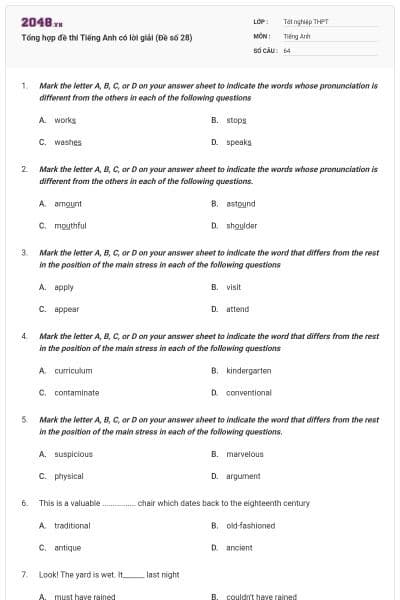
Mark the letter A, B, C, or D on your answer sheet to indicate the words whose pronunciation is different from the others in each of the following questions
works
stops
washes
speaks
Đáp án C “es” sau đuôi /∫/ phát âm là /iz/, sau các đuôi /k,p/ phát âm là /s/
Mark the letter A, B, C, or D on your answer sheet to indicate the words whose pronunciation is different from the others in each of the following questions.
amount
astound
mouthful
shoulder
Đáp án D “ou” trong “shoulder” phát âm là /əʊ/, các từ còn lại phát âm là /aʊ/
Mark the letter A, B, C, or D on your answer sheet to indicate the word that differs from the rest in the position of the main stress in each of the following questions
apply
visit
appear
attend
Đáp án B Trọng âm của từ này rơi vào âm tiết thứ 1, các từ còn lại rơi vào âm tiết thứ 2
Mark the letter A, B, C, or D on your answer sheet to indicate the word that differs from the rest in the position of the main stress in each of the following questions
curriculum
kindergarten
contaminate
conventional
Đáp án B Trọng âm của từ này rơi vào âm tiết thứ 1, các từ còn lại rơi vào âm tiết thứ 2
Mark the letter A, B, C, or D on your answer sheet to indicate the word that differs from the rest in the position of the main stress in each of the following questions.
suspicious
marvelous
physical
argument
Đáp án A Trọng âm của từ này rơi vào âm tiết thứ 2, các từ còn lại rơi vào âm tiết thứ 1
This is a valuable ................ chair which dates back to the eighteenth century
traditional
old-fashioned
antique
ancient
Đáp án C Antique = cổ (đồ cổ); traditional = truyền thống; old-fashioned = lạc hậu; ancient = cổ đại
Look! The yard is wet. It______ last night
must have rained
couldn't have rained
must rain
should have rained
Đáp án A Must have + past participle : dự đoán chắc chắn đã xảy ra trong quá khứ dựa trên cơ sở rõ ràng (sân ướt là cơ sở cho phỏng đoán)
Last year she earned _______ her brother
twice as much as
twice more than
twice as many as
twice as more as
Đáp án A Gấp bao nhiêu lần dùng: số lần + as + adj + as +N. Cô ấy kiếm nhiều tiền gấp đôi anh trai. Danh từ tiền không đếm được, nên ta dùng “much”
The girls and flowers ______ he painted were vivid
whose
that
which
who
Đáp án B Đại từ chỉ người làm túc từ cho mệnh đề quan hệ nên dùng “that”. Whose chỉ sự sở hữu của người. Which chỉ vật. Who bổ nghĩa cho người, thường làm chủ ngữ trong mệnh đề quan hệ
When his alarm went off, he shut it off and slept for ________15 minutes
other
others
another
the others
Đáp án C Another + N = thêm một cái khác nữa. other (adj) = khác. Others = những đối tượng khác. The others = những đối tượng còn lại
Is it necessary that I _____ here tomorrow?
am being
were
be
would be
Đáp án C Cấu trúc giả định: It is + tính từ thể hiện sự quan trọng (necessary/important/essential…) + S + (should) + V
I saw him hiding something in a_______ bag
small plastic black
black small plastic
small black plastic
plastic small black
Đáp án C Quy tắc sắp xếp các tính từ: OPSACOM: Opinion– Price – Shape/size (small) – Age– Color (black) – Original – Material (plastic) => small black plastic
This is the __________spot on which the first pilgrims landed in America
historic
historical
history
historicity
Đáp án A Historic = mang tính bước ngoặt quan trọng, mang tính lịch sử; historical = thuộc về lịch sử, liên quan đến sự kiện lịch sử
She earned a degree in Physics and went on _________ another degree in Mathematics
taking
to take
taken
being taken
Đáp án B Go on + Ving = tiếp tục làm gì
Those trousers are far too big. Why don’t you have them___?
taken on
taken in
taken over
taken out
Đáp án B Have something + past participle = thu xếp để đồ gì của mình được ai tác động. Take something in = chỉnh sửa, thu nhỏ quần áo
So little_______about mathematics that the lecture was completely beyond me
I have known
I knew
do I know
did I know
Đáp án D Câu đảo ngữ “so” với trạng từ: So + adv + trợ động từ + S + V (không chia) + that + mệnh đề = quá …đến mức mà
I gave the waiter a $50 note and waited for my _________
change
supply
cash
cost
Đáp án A Change (n) = tiền lẻ, tiền thừa trả lại
I read the contract again and again _________ avoiding making spelling mistakes
in terms of
by means of
with a view to
in view of
Đáp án C With a view to + Ving = với mục đích làm gì
Van Gogh suffered from depression ______ by overwork and ill-health
brought on
coming about
taken up
pull through
Đáp án A
Bring something on = gây ra cái gì
He had spent ____________ time writing an essay on his childhood
a few
a large number of
a great deal of
many
Đáp án C A great deal of + N (không đếm được) = nhiều. A large number of = Many + N đếm được số nhiều = nhiều. A few + N số nhiều = một ít
________he study harder, he will do better in the exam
Should
If
When
Unless
Đáp án A Đảo ngữ câu điều kiện loại 1: Should + S + V = If + S + V(s/es)
When there are small children around, it is better to put breakable ornaments out of _________.
reach
hand
place
hold
Đáp án A Out of reach = ngoài tầm với
Harry:" ______________" Kate: "Yes. I'd like to buy a computer."
Do you look for something?
Good morning. Can I help you?
Excuse me. Do you want to buy it?
Can you help me buy something?
Đáp án B Do you look for something ? = bạn đang muốn tìm kiếm thứ gì à? ( -> câu hỏi khách đang chọn mua hàng)
Tom: “ Sorry, I forgot to phone you last night.” -Mary: “________”
I have nothing to tell you
Oh. Poor me
Never mind!
You was absent - minded
Đáp án C Never mind! = không có gì (đáp lại câu xin lỗi)
Mark the letter A, B, C, or D on your answer sheet to indicate the word(s) CLOSEST in meaning to the underlined word(s) in each of the following questions
Whenever Susan invites us to dinner, she customarily prepares a lot of delicious food.
naturally
necessarily
usually
certainly
Đáp án C Customarily = theo thường lệ
Mark the letter A, B, C, or D on your answer sheet to indicate the word(s) CLOSEST in meaning to the underlined word(s) in each of the following questions
It is hoped that illiteracy will soon be eradicated in our country as more and more people are struggling against it
evolving
plunging
starting
striving
Đáp án D Struggle against something = chiến đấu chống lại cái gì. Strive against something = nỗ lực ngăn cái gì
Mark the letter A, B, C, or D on your answer sheet to indicate the word(s) CLOSEST in meaning to the underlined word(s) in each of the following questions
His new yatch is certainly an ostentatious display of his wealth
beautiful
showy
large
expensive
Đáp án B Ostentatious = phô trương; khoe ra. Showy = phô trương
Mark the letter A, B, C, or D on your answer sheet to indicate the underlined part that needs correction in each of the following questions
After writing it, the essay must be duplicated by the student himself and handed in to the department secretary before the end of the month
After writing it
be
in to
the end
Đáp án A Ving đứng đầu câu là hình thức rút gọn chủ động, phải do chủ ngữ của câu thực hiện. Bài luận (essay) không thể chủ động viết, mà được viết ra -> chuyển thành quá khứ phân từ (để rút gọn mệnh đề bị động) -> written
Mark the letter A, B, C, or D on your answer sheet to indicate the underlined part that needs correction in each of the following questions
All of the cities in Texas, San Antonio is probably the most picturesque
All of
in Texas
is probably
most picturesque
Đáp án A All of N số nhiều = tất cả. Hai cụm danh từ đứng cạnh nhau -> không hợp nghĩa. Sửa: Among all (trong số tất cả các thành phố ở Texas)
Mark the letter A, B, C, or D on your answer sheet to indicate the underlined part that needs correction in each of the following questions
My cousin composes not only the music, but also sings the songs for the maior Broadway musicals
composes not only
but
the songs
maior
Đáp án A Sau “not only” và “but also” phải cùng loại từ. Sau “but also” là động từ, từ sau “not only” cũng là động từ. Sửa: not only composes
Mark the letter A, B, C, or D on your answer sheet to indicate the underlined part that needs correction in each of the following questions
The Indians of the southwestern United States are famous for their beautiful art work, especially handmade jewelry cast from silver, carved from stones, or decorations with beads and feathers.
are
work
especially
decorations
Đáp án D Sửa: decorated. Trước “or” là quá khứ phân từ (carved) – rút gọn cho mệnh đề quan hệ; sau nó cũng phải là mệnh đề quan hệ. “cast from silver, carved from stones, or decorations with beads and feathers.” = được đúc từ bạc, khắc từ đá, hoặc được trang trí với các chuỗi hạt và lông vũ
Mark the letter A, B, C, or D on your answer sheet to indicate the underlined part that needs correction in each of the following questions
Although no country has exactly the same folk music as those of any other, it is significant that similar songs exist among widely separated people
no country
as those
exist
widely
Đáp án B Đối tượng được so sánh ở đây là “folk music” – danh từ số ít -> dùng “as that” thay vì “as those”
Read the following passage and mark the letter A, B, C, or D on your answer sheet to indicate the correct word or phrase that best fits each of the numbered blanks from 33 to 42.
Environmental Concerns
Earth is the only place we know of in the universe that can support human life. (33) ______ human activities are making the planet less fit to live on. As the western world carries on consuming (34)_______ of the world's resources while half of the world's population do so just to stay (35)_______ we are rapidly destroying the only resource we have (36)________ which all people can survive and prosper. Everywhere fertile soil is (37)______ built on or washed into the sea. Renewable resources are exploited so much that they will never be able to recover (38)______. We discharge pollutants into the atmosphere without any thought of the consequences. As a (39)______, the planet's ability to support people is being reduced at the very time when rising human numbers and consumption are making increasingly heavy demands on it.
The Earth's (40)______ resources are there for us to use. We need food, water, air, energy, medicines, warmth, shelter and minerals to (41)______ us fed, comfortable, healthy and active. If we are sensible in how we use the resources they will last indefinitely. But if we use them wastefully and excessively they will soon (42)_______ and everyone will suffer.Question 33
Still
Despite
Yet
Although
Đáp án C Yet = thế nhưng = But. Still = vẫn. Despite = Although = dù
Read the following passage and mark the letter A, B, C, or D on your answer sheet to indicate the correct word or phrase that best fits each of the numbered blanks from 33 to 42.
Environmental Concerns
Earth is the only place we know of in the universe that can support human life. (33) ______ human activities are making the planet less fit to live on. As the western world carries on consuming (34)_______ of the world's resources while half of the world's population do so just to stay (35)_______ we are rapidly destroying the only resource we have (36)________ which all people can survive and prosper. Everywhere fertile soil is (37)______ built on or washed into the sea. Renewable resources are exploited so much that they will never be able to recover (38)______. We discharge pollutants into the atmosphere without any thought of the consequences. As a (39)______, the planet's ability to support people is being reduced at the very time when rising human numbers and consumption are making increasingly heavy demands on it.
The Earth's (40)______ resources are there for us to use. We need food, water, air, energy, medicines, warmth, shelter and minerals to (41)______ us fed, comfortable, healthy and active. If we are sensible in how we use the resources they will last indefinitely. But if we use them wastefully and excessively they will soon (42)_______ and everyone will suffer.Question 34
two-thirds
two- third
two-three
two-threes
Đáp án A Cách viết phân số: Tử số là số đếm; mẫu số là số thứ tự. Khi tử số lớn hơn một thì phải thêm “s” vào sau mẫu số
Read the following passage and mark the letter A, B, C, or D on your answer sheet to indicate the correct word or phrase that best fits each of the numbered blanks from 33 to 42.
Environmental Concerns
Earth is the only place we know of in the universe that can support human life. (33) ______ human activities are making the planet less fit to live on. As the western world carries on consuming (34)_______ of the world's resources while half of the world's population do so just to stay (35)_______ we are rapidly destroying the only resource we have (36)________ which all people can survive and prosper. Everywhere fertile soil is (37)______ built on or washed into the sea. Renewable resources are exploited so much that they will never be able to recover (38)______. We discharge pollutants into the atmosphere without any thought of the consequences. As a (39)______, the planet's ability to support people is being reduced at the very time when rising human numbers and consumption are making increasingly heavy demands on it.
The Earth's (40)______ resources are there for us to use. We need food, water, air, energy, medicines, warmth, shelter and minerals to (41)______ us fed, comfortable, healthy and active. If we are sensible in how we use the resources they will last indefinitely. But if we use them wastefully and excessively they will soon (42)_______ and everyone will suffer.Question 35
survival
alive
existent
live
Đáp án B Stay + adj = sống; duy trì ở tình trạng nào. Alive (adj) = còn sống
Read the following passage and mark the letter A, B, C, or D on your answer sheet to indicate the correct word or phrase that best fits each of the numbered blanks from 33 to 42.
Environmental Concerns
Earth is the only place we know of in the universe that can support human life. (33) ______ human activities are making the planet less fit to live on. As the western world carries on consuming (34)_______ of the world's resources while half of the world's population do so just to stay (35)_______ we are rapidly destroying the only resource we have (36)________ which all people can survive and prosper. Everywhere fertile soil is (37)______ built on or washed into the sea. Renewable resources are exploited so much that they will never be able to recover (38)______. We discharge pollutants into the atmosphere without any thought of the consequences. As a (39)______, the planet's ability to support people is being reduced at the very time when rising human numbers and consumption are making increasingly heavy demands on it.
The Earth's (40)______ resources are there for us to use. We need food, water, air, energy, medicines, warmth, shelter and minerals to (41)______ us fed, comfortable, healthy and active. If we are sensible in how we use the resources they will last indefinitely. But if we use them wastefully and excessively they will soon (42)_______ and everyone will suffer.Question 36
on
at
in
by
Đáp án D By = bằng cách nào
Read the following passage and mark the letter A, B, C, or D on your answer sheet to indicate the correct word or phrase that best fits each of the numbered blanks from 33 to 42.
Environmental Concerns
Earth is the only place we know of in the universe that can support human life. (33) ______ human activities are making the planet less fit to live on. As the western world carries on consuming (34)_______ of the world's resources while half of the world's population do so just to stay (35)_______ we are rapidly destroying the only resource we have (36)________ which all people can survive and prosper. Everywhere fertile soil is (37)______ built on or washed into the sea. Renewable resources are exploited so much that they will never be able to recover (38)______. We discharge pollutants into the atmosphere without any thought of the consequences. As a (39)______, the planet's ability to support people is being reduced at the very time when rising human numbers and consumption are making increasingly heavy demands on it.
The Earth's (40)______ resources are there for us to use. We need food, water, air, energy, medicines, warmth, shelter and minerals to (41)______ us fed, comfortable, healthy and active. If we are sensible in how we use the resources they will last indefinitely. But if we use them wastefully and excessively they will soon (42)_______ and everyone will suffer.Question 37
sooner
rather
either
neither
Đáp án C Either … or… = …hoặc là…
Read the following passage and mark the letter A, B, C, or D on your answer sheet to indicate the correct word or phrase that best fits each of the numbered blanks from 33 to 42.
Environmental Concerns
Earth is the only place we know of in the universe that can support human life. (33) ______ human activities are making the planet less fit to live on. As the western world carries on consuming (34)_______ of the world's resources while half of the world's population do so just to stay (35)_______ we are rapidly destroying the only resource we have (36)________ which all people can survive and prosper. Everywhere fertile soil is (37)______ built on or washed into the sea. Renewable resources are exploited so much that they will never be able to recover (38)______. We discharge pollutants into the atmosphere without any thought of the consequences. As a (39)______, the planet's ability to support people is being reduced at the very time when rising human numbers and consumption are making increasingly heavy demands on it.
The Earth's (40)______ resources are there for us to use. We need food, water, air, energy, medicines, warmth, shelter and minerals to (41)______ us fed, comfortable, healthy and active. If we are sensible in how we use the resources they will last indefinitely. But if we use them wastefully and excessively they will soon (42)_______ and everyone will suffer.Question 38
completely
quite
greatly
utterly
Đáp án A Recover = hồi phục. Completely = hoàn toàn. Quite = khá. Greatly = lớn, nhiều. Utterly = cực kì, hoàn toàn
Read the following passage and mark the letter A, B, C, or D on your answer sheet to indicate the correct word or phrase that best fits each of the numbered blanks from 33 to 42.
Environmental Concerns
Earth is the only place we know of in the universe that can support human life. (33) ______ human activities are making the planet less fit to live on. As the western world carries on consuming (34)_______ of the world's resources while half of the world's population do so just to stay (35)_______ we are rapidly destroying the only resource we have (36)________ which all people can survive and prosper. Everywhere fertile soil is (37)______ built on or washed into the sea. Renewable resources are exploited so much that they will never be able to recover (38)______. We discharge pollutants into the atmosphere without any thought of the consequences. As a (39)______, the planet's ability to support people is being reduced at the very time when rising human numbers and consumption are making increasingly heavy demands on it.
The Earth's (40)______ resources are there for us to use. We need food, water, air, energy, medicines, warmth, shelter and minerals to (41)______ us fed, comfortable, healthy and active. If we are sensible in how we use the resources they will last indefinitely. But if we use them wastefully and excessively they will soon (42)_______ and everyone will suffer.Question 39
result
product
development
reaction
Đáp án A As a result, mệnh đề = Kết quả là,…
Read the following passage and mark the letter A, B, C, or D on your answer sheet to indicate the correct word or phrase that best fits each of the numbered blanks from 33 to 42.
Environmental Concerns
Earth is the only place we know of in the universe that can support human life. (33) ______ human activities are making the planet less fit to live on. As the western world carries on consuming (34)_______ of the world's resources while half of the world's population do so just to stay (35)_______ we are rapidly destroying the only resource we have (36)________ which all people can survive and prosper. Everywhere fertile soil is (37)______ built on or washed into the sea. Renewable resources are exploited so much that they will never be able to recover (38)______. We discharge pollutants into the atmosphere without any thought of the consequences. As a (39)______, the planet's ability to support people is being reduced at the very time when rising human numbers and consumption are making increasingly heavy demands on it.
The Earth's (40)______ resources are there for us to use. We need food, water, air, energy, medicines, warmth, shelter and minerals to (41)______ us fed, comfortable, healthy and active. If we are sensible in how we use the resources they will last indefinitely. But if we use them wastefully and excessively they will soon (42)_______ and everyone will suffer.Question 40
natural
real
living
genuine
Đáp án A Natural resources = các nguồn tài nguyên thiên nhiên
Read the following passage and mark the letter A, B, C, or D on your answer sheet to indicate the correct word or phrase that best fits each of the numbered blanks from 33 to 42.
Environmental Concerns
Earth is the only place we know of in the universe that can support human life. (33) ______ human activities are making the planet less fit to live on. As the western world carries on consuming (34)_______ of the world's resources while half of the world's population do so just to stay (35)_______ we are rapidly destroying the only resource we have (36)________ which all people can survive and prosper. Everywhere fertile soil is (37)______ built on or washed into the sea. Renewable resources are exploited so much that they will never be able to recover (38)______. We discharge pollutants into the atmosphere without any thought of the consequences. As a (39)______, the planet's ability to support people is being reduced at the very time when rising human numbers and consumption are making increasingly heavy demands on it.
The Earth's (40)______ resources are there for us to use. We need food, water, air, energy, medicines, warmth, shelter and minerals to (41)______ us fed, comfortable, healthy and active. If we are sensible in how we use the resources they will last indefinitely. But if we use them wastefully and excessively they will soon (42)_______ and everyone will suffer.Question 41
stay
keep
maintain
hold
Đáp án B Keep somebody + adj/Ved = duy trì ai ở tình trạng nào
Read the following passage and mark the letter A, B, C, or D on your answer sheet to indicate the correct word or phrase that best fits each of the numbered blanks from 33 to 42.
Environmental ConcernsEarth is the only place we know of in the universe that can support human life. (33) ______ human activities are making the planet less fit to live on. As the western world carries on consuming (34)_______ of the world's resources while half of the world's population do so just to stay (35)_______ we are rapidly destroying the only resource we have (36)________ which all people can survive and prosper. Everywhere fertile soil is (37)______ built on or washed into the sea. Renewable resources are exploited so much that they will never be able to recover (38)______. We discharge pollutants into the atmosphere without any thought of the consequences. As a (39)______, the planet's ability to support people is being reduced at the very time when rising human numbers and consumption are making increasingly heavy demands on it.
The Earth's (40)______ resources are there for us to use. We need food, water, air, energy, medicines, warmth, shelter and minerals to (41)______ us fed, comfortable, healthy and active. If we are sensible in how we use the resources they will last indefinitely. But if we use them wastefully and excessively they will soon (42)_______ and everyone will suffer.Question 42
run out
run away
run up
run off
Đáp án A Run out = hết, cạn kiêt
Mark the letter A, B, C, or D on your answer sheet to indicate the word(s) OPPOSITE in meaning to the underlined word(s) in each of the following questions
The aircraft carrier is indispensable in naval operations against sea or shore based enemies
unique
novel
unnecessary
exotic
Đáp án C Indispensable = không thể bỏ qua; unnecessary = không cần thiết
Mark the letter A, B, C, or D on your answer sheet to indicate the word(s) OPPOSITE in meaning to the underlined word(s) in each of the following questions
This shouldn’t be too taxing for you
comfortable
demanding
easy
relaxing
Đáp án C Taxing = khó khăn, vất vả
Read the following passage and mark the letter A, B, C, or D on your answer sheet to indicate the correct answer to each of the questions from 45 to 54.
Basic to any understanding of Canada in the 20 years after the Second World War is the country’s impressive population growth. For every three Canadians in 1945, there were over five in 1966. In September 1966 Canada’s population passed the 20 million mark. Most of his surging growth came from natural increase. The depression of the 1930’s and the war had held back marriages, and the catching-up process began after 1945. The baby boom continued through the decade of the 1950’s, producing a population increase of nearly fifteen percent in the five years from 1951 to 1956. This rate of increase had been exceeded only once before settle. Undoubtedly, the good economic conditions of the 1950’s supported a growth in the population, but the expansion also derived from a trend toward earlier marriages and an increase in the average size of families. In 1957 the Canadian birth rate stood at 28 per thousand, one of the highest in the world.
After the peak year of 1957, the birth rate in Canada began to decline. It continued falling until in 1966 it stood at the lowest level in 25 years. Partly this decline reflected the low level of births during the depression and the war, but it was also caused by changes in Canadian society. Young people were staying at school longer; more women were working; young married couples were buying automobiles or houses before starting families; rising living standards were cutting down the size of families.It appeared that Canada was once more falling in step with the trend toward smaller families that had occurred all through the Western world since the time of the Industrial Revolution.
Although the growth in Canada’s population had slowed down by 1966 (the increase in the first half of the 1960’s was only nine percent), another large population wave was coming over the horizon. It would be composed of the children who were born during the period of the high birth rate prior to 1957
What does the passage mainly discuss?
Educational changes in Canadian society
Canada during the Second World War
Population trends in postwar Canada
Standards of living in Canada
Đáp án C Bài văn nói về tình trạng dân số của Canada thời hậu chiến. Ngay từ đầu: Basic to any understanding of Canada in the 20 years after the Second World War is the country’s impressive population growth
Read the following passage and mark the letter A, B, C, or D on your answer sheet to indicate the correct answer to each of the questions from 45 to 54.
Basic to any understanding of Canada in the 20 years after the Second World War is the country’s impressive population growth. For every three Canadians in 1945, there were over five in 1966. In September 1966 Canada’s population passed the 20 million mark. Most of his surging growth came from natural increase. The depression of the 1930’s and the war had held back marriages, and the catching-up process began after 1945. The baby boom continued through the decade of the 1950’s, producing a population increase of nearly fifteen percent in the five years from 1951 to 1956. This rate of increase had been exceeded only once before settle. Undoubtedly, the good economic conditions of the 1950’s supported a growth in the population, but the expansion also derived from a trend toward earlier marriages and an increase in the average size of families. In 1957 the Canadian birth rate stood at 28 per thousand, one of the highest in the world.
After the peak year of 1957, the birth rate in Canada began to decline. It continued falling until in 1966 it stood at the lowest level in 25 years. Partly this decline reflected the low level of births during the depression and the war, but it was also caused by changes in Canadian society. Young people were staying at school longer; more women were working; young married couples were buying automobiles or houses before starting families; rising living standards were cutting down the size of families.It appeared that Canada was once more falling in step with the trend toward smaller families that had occurred all through the Western world since the time of the Industrial Revolution.
Although the growth in Canada’s population had slowed down by 1966 (the increase in the first half of the 1960’s was only nine percent), another large population wave was coming over the horizon. It would be composed of the children who were born during the period of the high birth rate prior to 1957
According to the passage, when did Canada’s baby boom begin?
In the decade after 1911
After 1945
During the depression of the 1930’s
In 1966
Đáp án B Dòng 2: For every three Canadians in 1945, there were over five in 1966 -> cứ có 3 người Canada năm 1945 thì lại có 5 người năm 1966 -> dân số bắt đầu tăng từ sau 1945
Read the following passage and mark the letter A, B, C, or D on your answer sheet to indicate the correct answer to each of the questions from 45 to 54.
Basic to any understanding of Canada in the 20 years after the Second World War is the country’s impressive population growth. For every three Canadians in 1945, there were over five in 1966. In September 1966 Canada’s population passed the 20 million mark. Most of his surging growth came from natural increase. The depression of the 1930’s and the war had held back marriages, and the catching-up process began after 1945. The baby boom continued through the decade of the 1950’s, producing a population increase of nearly fifteen percent in the five years from 1951 to 1956. This rate of increase had been exceeded only once before settle. Undoubtedly, the good economic conditions of the 1950’s supported a growth in the population, but the expansion also derived from a trend toward earlier marriages and an increase in the average size of families. In 1957 the Canadian birth rate stood at 28 per thousand, one of the highest in the world.
After the peak year of 1957, the birth rate in Canada began to decline. It continued falling until in 1966 it stood at the lowest level in 25 years. Partly this decline reflected the low level of births during the depression and the war, but it was also caused by changes in Canadian society. Young people were staying at school longer; more women were working; young married couples were buying automobiles or houses before starting families; rising living standards were cutting down the size of families.It appeared that Canada was once more falling in step with the trend toward smaller families that had occurred all through the Western world since the time of the Industrial Revolution.
Although the growth in Canada’s population had slowed down by 1966 (the increase in the first half of the 1960’s was only nine percent), another large population wave was coming over the horizon. It would be composed of the children who were born during the period of the high birth rate prior to 1957
The word “five” in line 2 refers to__________
Canadians
years
decades
marriages
Đáp án A Five chỉ 5 sự vật/ đối tượng đếm được nhắc đến ở trước đó; trước đó chỉ nhắc tới “three Canadians” là danh từ đếm được số nhiều
Read the following passage and mark the letter A, B, C, or D on your answer sheet to indicate the correct answer to each of the questions from 45 to 54.
Basic to any understanding of Canada in the 20 years after the Second World War is the country’s impressive population growth. For every three Canadians in 1945, there were over five in 1966. In September 1966 Canada’s population passed the 20 million mark. Most of his surging growth came from natural increase. The depression of the 1930’s and the war had held back marriages, and the catching-up process began after 1945. The baby boom continued through the decade of the 1950’s, producing a population increase of nearly fifteen percent in the five years from 1951 to 1956. This rate of increase had been exceeded only once before settle. Undoubtedly, the good economic conditions of the 1950’s supported a growth in the population, but the expansion also derived from a trend toward earlier marriages and an increase in the average size of families. In 1957 the Canadian birth rate stood at 28 per thousand, one of the highest in the world.
After the peak year of 1957, the birth rate in Canada began to decline. It continued falling until in 1966 it stood at the lowest level in 25 years. Partly this decline reflected the low level of births during the depression and the war, but it was also caused by changes in Canadian society. Young people were staying at school longer; more women were working; young married couples were buying automobiles or houses before starting families; rising living standards were cutting down the size of families.It appeared that Canada was once more falling in step with the trend toward smaller families that had occurred all through the Western world since the time of the Industrial Revolution.
Although the growth in Canada’s population had slowed down by 1966 (the increase in the first half of the 1960’s was only nine percent), another large population wave was coming over the horizon. It would be composed of the children who were born during the period of the high birth rate prior to 1957
The word “surging” in line 3 is closest in meaning to__________
new
extra
accelerating
surprising
Đáp án C Surging = đang tăng vọt. Accelerating = đang leo thang
Read the following passage and mark the letter A, B, C, or D on your answer sheet to indicate the correct answer to each of the questions from 45 to 54.
Basic to any understanding of Canada in the 20 years after the Second World War is the country’s impressive population growth. For every three Canadians in 1945, there were over five in 1966. In September 1966 Canada’s population passed the 20 million mark. Most of his surging growth came from natural increase. The depression of the 1930’s and the war had held back marriages, and the catching-up process began after 1945. The baby boom continued through the decade of the 1950’s, producing a population increase of nearly fifteen percent in the five years from 1951 to 1956. This rate of increase had been exceeded only once before settle. Undoubtedly, the good economic conditions of the 1950’s supported a growth in the population, but the expansion also derived from a trend toward earlier marriages and an increase in the average size of families. In 1957 the Canadian birth rate stood at 28 per thousand, one of the highest in the world.
After the peak year of 1957, the birth rate in Canada began to decline. It continued falling until in 1966 it stood at the lowest level in 25 years. Partly this decline reflected the low level of births during the depression and the war, but it was also caused by changes in Canadian society. Young people were staying at school longer; more women were working; young married couples were buying automobiles or houses before starting families; rising living standards were cutting down the size of families.It appeared that Canada was once more falling in step with the trend toward smaller families that had occurred all through the Western world since the time of the Industrial Revolution.
Although the growth in Canada’s population had slowed down by 1966 (the increase in the first half of the 1960’s was only nine percent), another large population wave was coming over the horizon. It would be composed of the children who were born during the period of the high birth rate prior to 1957
The author suggests that in Canada during the 1950’s____
the urban population decreased rapidly
fewer people married
economic conditions were poor
the birth rate was very high
Đáp án D Từ dòng 5: The baby boom continued through the decade of the 1950’s, producing a population increase of nearly fifteen percent in the five years from 1951 to 1956. This rate of increase had been exceeded only once before settle -> sự gia tăng trẻ sơ sinh tiếp tục vào những năm 1950, khiến dân số tăng lên một nửa trong 5 năm;tốc độ gia tăng này mới được vượt ngưỡng 1 lần -> tỉ lệ sinh đẻ khá cao
Read the following passage and mark the letter A, B, C, or D on your answer sheet to indicate the correct answer to each of the questions from 45 to 54.
Basic to any understanding of Canada in the 20 years after the Second World War is the country’s impressive population growth. For every three Canadians in 1945, there were over five in 1966. In September 1966 Canada’s population passed the 20 million mark. Most of his surging growth came from natural increase. The depression of the 1930’s and the war had held back marriages, and the catching-up process began after 1945. The baby boom continued through the decade of the 1950’s, producing a population increase of nearly fifteen percent in the five years from 1951 to 1956. This rate of increase had been exceeded only once before settle. Undoubtedly, the good economic conditions of the 1950’s supported a growth in the population, but the expansion also derived from a trend toward earlier marriages and an increase in the average size of families. In 1957 the Canadian birth rate stood at 28 per thousand, one of the highest in the world.
After the peak year of 1957, the birth rate in Canada began to decline. It continued falling until in 1966 it stood at the lowest level in 25 years. Partly this decline reflected the low level of births during the depression and the war, but it was also caused by changes in Canadian society. Young people were staying at school longer; more women were working; young married couples were buying automobiles or houses before starting families; rising living standards were cutting down the size of families.It appeared that Canada was once more falling in step with the trend toward smaller families that had occurred all through the Western world since the time of the Industrial Revolution.
Although the growth in Canada’s population had slowed down by 1966 (the increase in the first half of the 1960’s was only nine percent), another large population wave was coming over the horizon. It would be composed of the children who were born during the period of the high birth rate prior to 1957
The word “trend” in line 8 is closest in meaning to_________
tendency
aim
growth
directive
Đáp án A Trend = xu hướng = tendency
Read the following passage and mark the letter A, B, C, or D on your answer sheet to indicate the correct answer to each of the questions from 45 to 54.
Basic to any understanding of Canada in the 20 years after the Second World War is the country’s impressive population growth. For every three Canadians in 1945, there were over five in 1966. In September 1966 Canada’s population passed the 20 million mark. Most of his surging growth came from natural increase. The depression of the 1930’s and the war had held back marriages, and the catching-up process began after 1945. The baby boom continued through the decade of the 1950’s, producing a population increase of nearly fifteen percent in the five years from 1951 to 1956. This rate of increase had been exceeded only once before settle. Undoubtedly, the good economic conditions of the 1950’s supported a growth in the population, but the expansion also derived from a trend toward earlier marriages and an increase in the average size of families. In 1957 the Canadian birth rate stood at 28 per thousand, one of the highest in the world.
After the peak year of 1957, the birth rate in Canada began to decline. It continued falling until in 1966 it stood at the lowest level in 25 years. Partly this decline reflected the low level of births during the depression and the war, but it was also caused by changes in Canadian society. Young people were staying at school longer; more women were working; young married couples were buying automobiles or houses before starting families; rising living standards were cutting down the size of families.It appeared that Canada was once more falling in step with the trend toward smaller families that had occurred all through the Western world since the time of the Industrial Revolution.
Although the growth in Canada’s population had slowed down by 1966 (the increase in the first half of the 1960’s was only nine percent), another large population wave was coming over the horizon. It would be composed of the children who were born during the period of the high birth rate prior to 1957
The word “peak” in line 11 is closest in meaning to___________
pointed
dismal
mountain
maximum
Đáp án D Peak = cực điểm. Maximum = mức cực đại
Read the following passage and mark the letter A, B, C, or D on your answer sheet to indicate the correct answer to each of the questions from 45 to 54.
Basic to any understanding of Canada in the 20 years after the Second World War is the country’s impressive population growth. For every three Canadians in 1945, there were over five in 1966. In September 1966 Canada’s population passed the 20 million mark. Most of his surging growth came from natural increase. The depression of the 1930’s and the war had held back marriages, and the catching-up process began after 1945. The baby boom continued through the decade of the 1950’s, producing a population increase of nearly fifteen percent in the five years from 1951 to 1956. This rate of increase had been exceeded only once before settle. Undoubtedly, the good economic conditions of the 1950’s supported a growth in the population, but the expansion also derived from a trend toward earlier marriages and an increase in the average size of families. In 1957 the Canadian birth rate stood at 28 per thousand, one of the highest in the world.
After the peak year of 1957, the birth rate in Canada began to decline. It continued falling until in 1966 it stood at the lowest level in 25 years. Partly this decline reflected the low level of births during the depression and the war, but it was also caused by changes in Canadian society. Young people were staying at school longer; more women were working; young married couples were buying automobiles or houses before starting families; rising living standards were cutting down the size of families.It appeared that Canada was once more falling in step with the trend toward smaller families that had occurred all through the Western world since the time of the Industrial Revolution.
Although the growth in Canada’s population had slowed down by 1966 (the increase in the first half of the 1960’s was only nine percent), another large population wave was coming over the horizon. It would be composed of the children who were born during the period of the high birth rate prior to 1957
When was the birth rate in Canada at its lowest postwar level?
1966
1957
1956
1951
Đáp án A 2 dòng đầu đoạn cuối: Although the growth in Canada’s population had slowed down by 1966 (the increase in the first half of the 1960’s was only nine percent), another large population wave was coming over the horizon -> sự tăng dân số chậm lại vào 1966, rồi lại có một đợt sóng tăng dân số -> tỉ lệ sinh đẻ 1966 là thấp nhất
Read the following passage and mark the letter A, B, C, or D on your answer sheet to indicate the correct answer to each of the questions from 45 to 54.
Basic to any understanding of Canada in the 20 years after the Second World War is the country’s impressive population growth. For every three Canadians in 1945, there were over five in 1966. In September 1966 Canada’s population passed the 20 million mark. Most of his surging growth came from natural increase. The depression of the 1930’s and the war had held back marriages, and the catching-up process began after 1945. The baby boom continued through the decade of the 1950’s, producing a population increase of nearly fifteen percent in the five years from 1951 to 1956. This rate of increase had been exceeded only once before settle. Undoubtedly, the good economic conditions of the 1950’s supported a growth in the population, but the expansion also derived from a trend toward earlier marriages and an increase in the average size of families. In 1957 the Canadian birth rate stood at 28 per thousand, one of the highest in the world.
After the peak year of 1957, the birth rate in Canada began to decline. It continued falling until in 1966 it stood at the lowest level in 25 years. Partly this decline reflected the low level of births during the depression and the war, but it was also caused by changes in Canadian society. Young people were staying at school longer; more women were working; young married couples were buying automobiles or houses before starting families; rising living standards were cutting down the size of families.It appeared that Canada was once more falling in step with the trend toward smaller families that had occurred all through the Western world since the time of the Industrial Revolution.
Although the growth in Canada’s population had slowed down by 1966 (the increase in the first half of the 1960’s was only nine percent), another large population wave was coming over the horizon. It would be composed of the children who were born during the period of the high birth rate prior to 1957
The author mentions all of the following as causes of declines in population growth after 1957 EXCEPT__________
people being better educated
people getting married earlier
better standards of living
couples buying houses
Đáp án B Từ dòng 3,4 đoạn 2: Young people were staying at school longer; more women were working; young married couples were buying automobiles or houses before starting families; rising living standards were cutting down the size of families. -> Chỉ có đáp án B không được đề cập
Read the following passage and mark the letter A, B, C, or D on your answer sheet to indicate the correct answer to each of the questions from 45 to 54.
Basic to any understanding of Canada in the 20 years after the Second World War is the country’s impressive population growth. For every three Canadians in 1945, there were over five in 1966. In September 1966 Canada’s population passed the 20 million mark. Most of his surging growth came from natural increase. The depression of the 1930’s and the war had held back marriages, and the catching-up process began after 1945. The baby boom continued through the decade of the 1950’s, producing a population increase of nearly fifteen percent in the five years from 1951 to 1956. This rate of increase had been exceeded only once before settle. Undoubtedly, the good economic conditions of the 1950’s supported a growth in the population, but the expansion also derived from a trend toward earlier marriages and an increase in the average size of families. In 1957 the Canadian birth rate stood at 28 per thousand, one of the highest in the world.
After the peak year of 1957, the birth rate in Canada began to decline. It continued falling until in 1966 it stood at the lowest level in 25 years. Partly this decline reflected the low level of births during the depression and the war, but it was also caused by changes in Canadian society. Young people were staying at school longer; more women were working; young married couples were buying automobiles or houses before starting families; rising living standards were cutting down the size of families.It appeared that Canada was once more falling in step with the trend toward smaller families that had occurred all through the Western world since the time of the Industrial Revolution.
Although the growth in Canada’s population had slowed down by 1966 (the increase in the first half of the 1960’s was only nine percent), another large population wave was coming over the horizon. It would be composed of the children who were born during the period of the high birth rate prior to 1957
It can be inferred from the passage that before the Industrial Revolution _________
families were larger
population statistics were unreliable
the population grew steadily
economic conditions were bad
Đáp án A
2 dòng cuối đoạn 2: It appeared that Canada was once more falling in step with the trend toward smaller families that had occurred all through the Western world since the time of the Industrial Revolution
Read the following passage and mark the letter A, B, C, or D on your answer sheet to indicate the correct answer to each of the questions from 55 to 64.
Ethology is concerned with the study of adaptive, or survival, value of behavior and its Evolutionary history. Ethological theory began to be applied to research on children in the1960’s but has become even more influential today. The origins of ethology can be traced to the work of Darwin. Its modern foundations were laid by two European zoologists, Konrad Lorenz and Niko Tinbergen.
Watching the behaviors diverse animal species in their natural habitats, Lorenz, and Tinbergen observed behavior patterns that promote survival. The most well-known of these is imprinting, the early following behavior of certain baby birds that ensures that the young will stay close to their mother and be fed and protected from danger. Imprinting takes place during an early, restricted time period of development. If the mother goose is not present during this time, but an object resembling her in important features is, young goslings may imprint on it instead . Observations of imprinting led to major concept that has been applied in child development” the critical period . It refers to a limited times span during which the child is biologically prepared to acquire certain adaptive behaviors but needs the support of suitably stimulating environment. Many researchers have conducted studies to find out whether complex cognitive and social behaviors must be learned during restricted time periods. for example, if children are deprived of adequate food or physical and social stimulation during the early years of life, will their intelligence be permanently impaired? If language is not mastered during the preschool years, is the child’s capacity to acquire it reduced?
Inspired by observations of imprinting, in 1969 the British psychoanalyst John Bowlby applied ethological theory to the understanding of the relationship between an infant and its parents. He argued that attachment behaviors of babies, such as smiling, babbling, grasping, and crying, are built-in social signals that encourage the parents to approach, care for, and interact with the baby. By keeping a parent near, these behaviors help ensure that the baby will be fed, protected from danger, and provided with the stimulation and affection necessary for healthy growth. The development of attachment in human infants is a lengthy process involving changes in psychological structures that lead to a deep affectional tie between parent and baby
What was Darwin’s contribution to ethology?
Darwin was the first person to apply ethological theory to children
Darwin’s work provided the basis for ethology
Darwin was the professor who taught Lorenz and Tinbergen
Darwin improved on the original principles of ethology
Đáp án B Từ dòng 3 đoạn 1: The origins of ethology can be traced to the work of Darwin. Its modern foundations were laid by two European zoologists, Konrad Lorenz and Niko Tinbergen
Read the following passage and mark the letter A, B, C, or D on your answer sheet to indicate the correct answer to each of the questions from 55 to 64.
Ethology is concerned with the study of adaptive, or survival, value of behavior and its Evolutionary history. Ethological theory began to be applied to research on children in the1960’s but has become even more influential today. The origins of ethology can be traced to the work of Darwin. Its modern foundations were laid by two European zoologists, Konrad Lorenz and Niko Tinbergen.
Watching the behaviors diverse animal species in their natural habitats, Lorenz, and Tinbergen observed behavior patterns that promote survival. The most well-known of these is imprinting, the early following behavior of certain baby birds that ensures that the young will stay close to their mother and be fed and protected from danger. Imprinting takes place during an early, restricted time period of development. If the mother goose is not present during this time, but an object resembling her in important features is, young goslings may imprint on it instead . Observations of imprinting led to major concept that has been applied in child development” the critical period . It refers to a limited times span during which the child is biologically prepared to acquire certain adaptive behaviors but needs the support of suitably stimulating environment. Many researchers have conducted studies to find out whether complex cognitive and social behaviors must be learned during restricted time periods. for example, if children are deprived of adequate food or physical and social stimulation during the early years of life, will their intelligence be permanently impaired? If language is not mastered during the preschool years, is the child’s capacity to acquire it reduced?
Inspired by observations of imprinting, in 1969 the British psychoanalyst John Bowlby applied ethological theory to the understanding of the relationship between an infant and its parents. He argued that attachment behaviors of babies, such as smiling, babbling, grasping, and crying, are built-in social signals that encourage the parents to approach, care for, and interact with the baby. By keeping a parent near, these behaviors help ensure that the baby will be fed, protected from danger, and provided with the stimulation and affection necessary for healthy growth. The development of attachment in human infants is a lengthy process involving changes in psychological structures that lead to a deep affectional tie between parent and baby
The word “foundations” in line 4 is closest in meaning to______
institutions
inventions
discoveries
researches
Đáp án A Foundation = sự thành lập, institution = sự thành lập, cơ quan
Read the following passage and mark the letter A, B, C, or D on your answer sheet to indicate the correct answer to each of the questions from 55 to 64.
Ethology is concerned with the study of adaptive, or survival, value of behavior and its Evolutionary history. Ethological theory began to be applied to research on children in the1960’s but has become even more influential today. The origins of ethology can be traced to the work of Darwin. Its modern foundations were laid by two European zoologists, Konrad Lorenz and Niko Tinbergen.
Watching the behaviors diverse animal species in their natural habitats, Lorenz, and Tinbergen observed behavior patterns that promote survival. The most well-known of these is imprinting, the early following behavior of certain baby birds that ensures that the young will stay close to their mother and be fed and protected from danger. Imprinting takes place during an early, restricted time period of development. If the mother goose is not present during this time, but an object resembling her in important features is, young goslings may imprint on it instead . Observations of imprinting led to major concept that has been applied in child development” the critical period . It refers to a limited times span during which the child is biologically prepared to acquire certain adaptive behaviors but needs the support of suitably stimulating environment. Many researchers have conducted studies to find out whether complex cognitive and social behaviors must be learned during restricted time periods. for example, if children are deprived of adequate food or physical and social stimulation during the early years of life, will their intelligence be permanently impaired? If language is not mastered during the preschool years, is the child’s capacity to acquire it reduced?
Inspired by observations of imprinting, in 1969 the British psychoanalyst John Bowlby applied ethological theory to the understanding of the relationship between an infant and its parents. He argued that attachment behaviors of babies, such as smiling, babbling, grasping, and crying, are built-in social signals that encourage the parents to approach, care for, and interact with the baby. By keeping a parent near, these behaviors help ensure that the baby will be fed, protected from danger, and provided with the stimulation and affection necessary for healthy growth. The development of attachment in human infants is a lengthy process involving changes in psychological structures that lead to a deep affectional tie between parent and baby
The word “ensures” in line 7 is closest in meaning to __________
assumes
guarantees
proves
teaches
Đáp án B Ensure = đảm bảo. Guarantee = bảo đảm, bảo hành
Read the following passage and mark the letter A, B, C, or D on your answer sheet to indicate the correct answer to each of the questions from 55 to 64.
Ethology is concerned with the study of adaptive, or survival, value of behavior and its Evolutionary history. Ethological theory began to be applied to research on children in the1960’s but has become even more influential today. The origins of ethology can be traced to the work of Darwin. Its modern foundations were laid by two European zoologists, Konrad Lorenz and Niko Tinbergen.
Watching the behaviors diverse animal species in their natural habitats, Lorenz, and Tinbergen observed behavior patterns that promote survival. The most well-known of these is imprinting, the early following behavior of certain baby birds that ensures that the young will stay close to their mother and be fed and protected from danger. Imprinting takes place during an early, restricted time period of development. If the mother goose is not present during this time, but an object resembling her in important features is, young goslings may imprint on it instead . Observations of imprinting led to major concept that has been applied in child development” the critical period . It refers to a limited times span during which the child is biologically prepared to acquire certain adaptive behaviors but needs the support of suitably stimulating environment. Many researchers have conducted studies to find out whether complex cognitive and social behaviors must be learned during restricted time periods. for example, if children are deprived of adequate food or physical and social stimulation during the early years of life, will their intelligence be permanently impaired? If language is not mastered during the preschool years, is the child’s capacity to acquire it reduced?
Inspired by observations of imprinting, in 1969 the British psychoanalyst John Bowlby applied ethological theory to the understanding of the relationship between an infant and its parents. He argued that attachment behaviors of babies, such as smiling, babbling, grasping, and crying, are built-in social signals that encourage the parents to approach, care for, and interact with the baby. By keeping a parent near, these behaviors help ensure that the baby will be fed, protected from danger, and provided with the stimulation and affection necessary for healthy growth. The development of attachment in human infants is a lengthy process involving changes in psychological structures that lead to a deep affectional tie between parent and baby
According to the passage, if a mother goose is not present during the time period when imprinting takes place, which of the following will most likely occur?
The mother will later imprint on the gosling
The gosling may not find a mate when it matures
The gosling will not imprint on any object
The gosling may imprint on another object
Đáp án D Từ dòng 5 đoạn 2: If the mother goose is not present during this time, but an object resembling her in important features is, young goslings may imprint on it instead
Read the following passage and mark the letter A, B, C, or D on your answer sheet to indicate the correct answer to each of the questions from 55 to 64.
Ethology is concerned with the study of adaptive, or survival, value of behavior and its Evolutionary history. Ethological theory began to be applied to research on children in the1960’s but has become even more influential today. The origins of ethology can be traced to the work of Darwin. Its modern foundations were laid by two European zoologists, Konrad Lorenz and Niko Tinbergen.
Watching the behaviors diverse animal species in their natural habitats, Lorenz, and Tinbergen observed behavior patterns that promote survival. The most well-known of these is imprinting, the early following behavior of certain baby birds that ensures that the young will stay close to their mother and be fed and protected from danger. Imprinting takes place during an early, restricted time period of development. If the mother goose is not present during this time, but an object resembling her in important features is, young goslings may imprint on it instead . Observations of imprinting led to major concept that has been applied in child development” the critical period . It refers to a limited times span during which the child is biologically prepared to acquire certain adaptive behaviors but needs the support of suitably stimulating environment. Many researchers have conducted studies to find out whether complex cognitive and social behaviors must be learned during restricted time periods. for example, if children are deprived of adequate food or physical and social stimulation during the early years of life, will their intelligence be permanently impaired? If language is not mastered during the preschool years, is the child’s capacity to acquire it reduced?
Inspired by observations of imprinting, in 1969 the British psychoanalyst John Bowlby applied ethological theory to the understanding of the relationship between an infant and its parents. He argued that attachment behaviors of babies, such as smiling, babbling, grasping, and crying, are built-in social signals that encourage the parents to approach, care for, and interact with the baby. By keeping a parent near, these behaviors help ensure that the baby will be fed, protected from danger, and provided with the stimulation and affection necessary for healthy growth. The development of attachment in human infants is a lengthy process involving changes in psychological structures that lead to a deep affectional tie between parent and baby
The word “He” in line 19 refers to __________
an infant
a psychoanalyst
parent
a baby
Đáp án B He chỉ danh từ chỉ người số ít, là nam -> chỉ có : the British psychoanalyst John Bowlby
Read the following passage and mark the letter A, B, C, or D on your answer sheet to indicate the correct answer to each of the questions from 55 to 64.
Ethology is concerned with the study of adaptive, or survival, value of behavior and its Evolutionary history. Ethological theory began to be applied to research on children in the1960’s but has become even more influential today. The origins of ethology can be traced to the work of Darwin. Its modern foundations were laid by two European zoologists, Konrad Lorenz and Niko Tinbergen.
Watching the behaviors diverse animal species in their natural habitats, Lorenz, and Tinbergen observed behavior patterns that promote survival. The most well-known of these is imprinting, the early following behavior of certain baby birds that ensures that the young will stay close to their mother and be fed and protected from danger. Imprinting takes place during an early, restricted time period of development. If the mother goose is not present during this time, but an object resembling her in important features is, young goslings may imprint on it instead . Observations of imprinting led to major concept that has been applied in child development” the critical period . It refers to a limited times span during which the child is biologically prepared to acquire certain adaptive behaviors but needs the support of suitably stimulating environment. Many researchers have conducted studies to find out whether complex cognitive and social behaviors must be learned during restricted time periods. for example, if children are deprived of adequate food or physical and social stimulation during the early years of life, will their intelligence be permanently impaired? If language is not mastered during the preschool years, is the child’s capacity to acquire it reduced?
Inspired by observations of imprinting, in 1969 the British psychoanalyst John Bowlby applied ethological theory to the understanding of the relationship between an infant and its parents. He argued that attachment behaviors of babies, such as smiling, babbling, grasping, and crying, are built-in social signals that encourage the parents to approach, care for, and interact with the baby. By keeping a parent near, these behaviors help ensure that the baby will be fed, protected from danger, and provided with the stimulation and affection necessary for healthy growth. The development of attachment in human infants is a lengthy process involving changes in psychological structures that lead to a deep affectional tie between parent and baby
The word “acquire” in line 12 is closest in meaning to __________
gain
reach
have
work
Đáp án A Acquire = đạt được; gain = đạt
Read the following passage and mark the letter A, B, C, or D on your answer sheet to indicate the correct answer to each of the questions from 55 to 64.
Ethology is concerned with the study of adaptive, or survival, value of behavior and its Evolutionary history. Ethological theory began to be applied to research on children in the1960’s but has become even more influential today. The origins of ethology can be traced to the work of Darwin. Its modern foundations were laid by two European zoologists, Konrad Lorenz and Niko Tinbergen.
Watching the behaviors diverse animal species in their natural habitats, Lorenz, and Tinbergen observed behavior patterns that promote survival. The most well-known of these is imprinting, the early following behavior of certain baby birds that ensures that the young will stay close to their mother and be fed and protected from danger. Imprinting takes place during an early, restricted time period of development. If the mother goose is not present during this time, but an object resembling her in important features is, young goslings may imprint on it instead . Observations of imprinting led to major concept that has been applied in child development” the critical period . It refers to a limited times span during which the child is biologically prepared to acquire certain adaptive behaviors but needs the support of suitably stimulating environment. Many researchers have conducted studies to find out whether complex cognitive and social behaviors must be learned during restricted time periods. for example, if children are deprived of adequate food or physical and social stimulation during the early years of life, will their intelligence be permanently impaired? If language is not mastered during the preschool years, is the child’s capacity to acquire it reduced?
Inspired by observations of imprinting, in 1969 the British psychoanalyst John Bowlby applied ethological theory to the understanding of the relationship between an infant and its parents. He argued that attachment behaviors of babies, such as smiling, babbling, grasping, and crying, are built-in social signals that encourage the parents to approach, care for, and interact with the baby. By keeping a parent near, these behaviors help ensure that the baby will be fed, protected from danger, and provided with the stimulation and affection necessary for healthy growth. The development of attachment in human infants is a lengthy process involving changes in psychological structures that lead to a deep affectional tie between parent and baby
The author mentions all of the following as attachment behaviors of human infants EXCEPT__________
smiling
crying
eating
grasping
Đáp án C Dòng 3 đoạn cuối: that attachment behaviors of babies, such as smiling, babbling, grasping, and crying,…
Read the following passage and mark the letter A, B, C, or D on your answer sheet to indicate the correct answer to each of the questions from 55 to 64.
Ethology is concerned with the study of adaptive, or survival, value of behavior and its Evolutionary history. Ethological theory began to be applied to research on children in the1960’s but has become even more influential today. The origins of ethology can be traced to the work of Darwin. Its modern foundations were laid by two European zoologists, Konrad Lorenz and Niko Tinbergen.
Watching the behaviors diverse animal species in their natural habitats, Lorenz, and Tinbergen observed behavior patterns that promote survival. The most well-known of these is imprinting, the early following behavior of certain baby birds that ensures that the young will stay close to their mother and be fed and protected from danger. Imprinting takes place during an early, restricted time period of development. If the mother goose is not present during this time, but an object resembling her in important features is, young goslings may imprint on it instead . Observations of imprinting led to major concept that has been applied in child development” the critical period . It refers to a limited times span during which the child is biologically prepared to acquire certain adaptive behaviors but needs the support of suitably stimulating environment. Many researchers have conducted studies to find out whether complex cognitive and social behaviors must be learned during restricted time periods. for example, if children are deprived of adequate food or physical and social stimulation during the early years of life, will their intelligence be permanently impaired? If language is not mastered during the preschool years, is the child’s capacity to acquire it reduced?
Inspired by observations of imprinting, in 1969 the British psychoanalyst John Bowlby applied ethological theory to the understanding of the relationship between an infant and its parents. He argued that attachment behaviors of babies, such as smiling, babbling, grasping, and crying, are built-in social signals that encourage the parents to approach, care for, and interact with the baby. By keeping a parent near, these behaviors help ensure that the baby will be fed, protected from danger, and provided with the stimulation and affection necessary for healthy growth. The development of attachment in human infants is a lengthy process involving changes in psychological structures that lead to a deep affectional tie between parent and baby
According to the passage, attachment behaviors of infants are intended to___________
prepare the infant to cope with separation
provide the infant with a means of self-stimulation
allow the infant to become imprinted on objects that resemble the parent
get the physical, emotional and social needs of the infant met
Đáp án D Dòng 5 đoạn cuối: these behaviors help ensure that the baby will be fed, protected from danger, and provided with the stimulation and affection necessary for healthy growth -> physical, emotional and social needs
Read the following passage and mark the letter A, B, C, or D on your answer sheet to indicate the correct answer to each of the questions from 55 to 64.
Ethology is concerned with the study of adaptive, or survival, value of behavior and its Evolutionary history. Ethological theory began to be applied to research on children in the1960’s but has become even more influential today. The origins of ethology can be traced to the work of Darwin. Its modern foundations were laid by two European zoologists, Konrad Lorenz and Niko Tinbergen.
Watching the behaviors diverse animal species in their natural habitats, Lorenz, and Tinbergen observed behavior patterns that promote survival. The most well-known of these is imprinting, the early following behavior of certain baby birds that ensures that the young will stay close to their mother and be fed and protected from danger. Imprinting takes place during an early, restricted time period of development. If the mother goose is not present during this time, but an object resembling her in important features is, young goslings may imprint on it instead . Observations of imprinting led to major concept that has been applied in child development” the critical period . It refers to a limited times span during which the child is biologically prepared to acquire certain adaptive behaviors but needs the support of suitably stimulating environment. Many researchers have conducted studies to find out whether complex cognitive and social behaviors must be learned during restricted time periods. for example, if children are deprived of adequate food or physical and social stimulation during the early years of life, will their intelligence be permanently impaired? If language is not mastered during the preschool years, is the child’s capacity to acquire it reduced?
Inspired by observations of imprinting, in 1969 the British psychoanalyst John Bowlby applied ethological theory to the understanding of the relationship between an infant and its parents. He argued that attachment behaviors of babies, such as smiling, babbling, grasping, and crying, are built-in social signals that encourage the parents to approach, care for, and interact with the baby. By keeping a parent near, these behaviors help ensure that the baby will be fed, protected from danger, and provided with the stimulation and affection necessary for healthy growth. The development of attachment in human infants is a lengthy process involving changes in psychological structures that lead to a deep affectional tie between parent and baby
The phrase “affectional tie” in line 24 is closest in meaning to _________
behavioral change
psychological need
cognitive development
emotional attachment
Đáp án D Affectional tie = sợi dây kết nối tình cảm. Emotional attachment = sự gắn kết tình cảm
Read the following passage and mark the letter A, B, C, or D on your answer sheet to indicate the correct answer to each of the questions from 55 to 64.
Ethology is concerned with the study of adaptive, or survival, value of behavior and its Evolutionary history. Ethological theory began to be applied to research on children in the1960’s but has become even more influential today. The origins of ethology can be traced to the work of Darwin. Its modern foundations were laid by two European zoologists, Konrad Lorenz and Niko Tinbergen.
Watching the behaviors diverse animal species in their natural habitats, Lorenz, and Tinbergen observed behavior patterns that promote survival. The most well-known of these is imprinting, the early following behavior of certain baby birds that ensures that the young will stay close to their mother and be fed and protected from danger. Imprinting takes place during an early, restricted time period of development. If the mother goose is not present during this time, but an object resembling her in important features is, young goslings may imprint on it instead . Observations of imprinting led to major concept that has been applied in child development” the critical period . It refers to a limited times span during which the child is biologically prepared to acquire certain adaptive behaviors but needs the support of suitably stimulating environment. Many researchers have conducted studies to find out whether complex cognitive and social behaviors must be learned during restricted time periods. for example, if children are deprived of adequate food or physical and social stimulation during the early years of life, will their intelligence be permanently impaired? If language is not mastered during the preschool years, is the child’s capacity to acquire it reduced?
Inspired by observations of imprinting, in 1969 the British psychoanalyst John Bowlby applied ethological theory to the understanding of the relationship between an infant and its parents. He argued that attachment behaviors of babies, such as smiling, babbling, grasping, and crying, are built-in social signals that encourage the parents to approach, care for, and interact with the baby. By keeping a parent near, these behaviors help ensure that the baby will be fed, protected from danger, and provided with the stimulation and affection necessary for healthy growth. The development of attachment in human infants is a lengthy process involving changes in psychological structures that lead to a deep affectional tie between parent and baby
It can be inferred from the passage that ethological theory assumes that __________.
failure to imprint has no influence on intelligence
to learn about human behavior only human subjects should be studied
there are similarities between animal and human behavior
the notion of critical periods applies only to animals
Đáp án C Từ dòng 6 đoạn 2: Observations of imprinting led to major concept that has been applied in child development” the critical period . Đầu đoạn cuối: Inspired by observations of imprinting, in 1969 the British psychoanalyst John Bowlby applied ethological theory to the understanding of the relationship between an infant and its parents -> những quan sát, lý thuyết tiến hóa của động vật cũng áp dụng được với trẻ sơ sinh vì có những điểm giống nhau