Tổng hợp đề thi Tiếng Anh có lời giải (Đề số 27)
64 câu hỏi
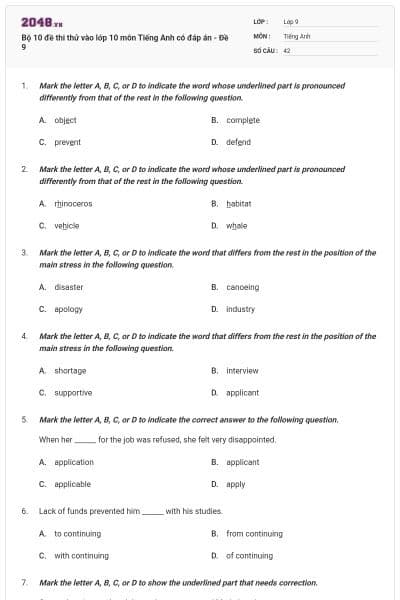
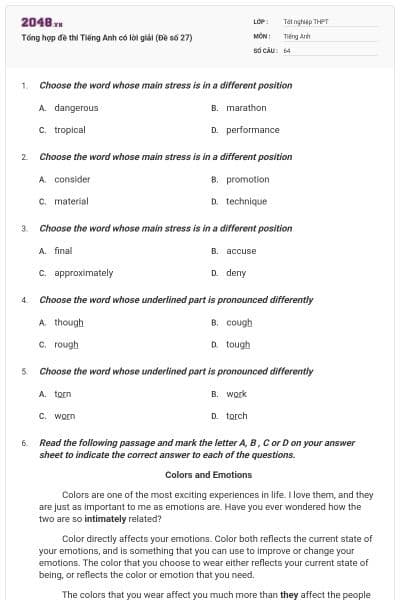
dangerous
marathon
tropical
performance
Đáp án : D
Phần D trọng âm rơi vào âm tiết thứ 2, còn lại là thứ nhất
consider
promotion
material
technique
Đáp án : D
Phần D trọng âm rơi vào âm tiết thứ nhất, còn lại là thứ 2
final
accuse
approximately
deny
Đáp án : D
Phần D trọng âm rơi vào âm tiết thứ nhất, còn lại là thứ 2
though
cough
rough
tough
Đáp án : A
A./ð/ B./ɵ/ C. /ɵ/ D. /ɵ/
torn
work
worn
torch
Đáp án : B
A./ɔ:/ B. /ə/ C. /ɔ:/ D. /ɔ:/
Colorful clothes can change your mood
Emotions and colors are closely related to each other
Colors can help you become healthy
Colors are one of the most exciting
Đáp án : B
Thông tin ở ngay đoạn đầu tiên và một số câu ở đoạn 2: “Colors are one of the most exciting experiences in life. I love them, and they are just as important to me as emotions are. Have you ever wondered how the two are so intimately related?
Color directly affects your emotions. Color both reflects the current state of your emotions, and is something that you can use to improve or change your emotions.”
Your need for thrills
your friend's feelings
your appetite
your mood
Đáp án : D
Thông tin ở đầu đoạn 2: “Color directly affects your emotions. Color both reflects the current state of your emotions, and is something that you can use to improve or change your emotions.” (mood=emotion)
The people around you are more influenced
neither A nor C
You are more influenced
Both A and C
Đáp án : C
Thông tin ở cuối đoạn 2: “The color that you choose to wear either reflects your current state of being, or reflects the color or emotion that you need.
They all affect the cells of the body
They are all forms of motion
They are all related to health
none of the above
Đáp án : D
Thông tin ở câu đầu tiên đoạn 4: “Color, sound, and emotions are all vibrations

Học thông minh hơn mỗi ngày
Xem toàn bộ 64 câu hỏi và nhiều hơn nữa với tài khoản miễn phí
wearing the color black
exposing yourself to bright colors
being open to your emotions
ignoring your emotions
Đáp án : D
Thông tin ở câu cuối của bài: “Alternately, the fastest way to create disease is to inhibit your emotions.”
clearly
closely
obviously
simply
Đáp án : B
"intimately" = “closely”: mật thiết, thân thiết
emotions
people
colors
none of the above
Đáp án : C
“they” được thay thế cho “colors” trong câu: “The colors that you wear affect you much more than they affect the people around you.”
to show how color can affect energy levels in the body
Because they both affect how we feel
to prove the relationship between emotions and color
Because vibrations make you healthy
Đáp án : A
Thông tin ở câu số 2 và số 3 đoạn cuối cùng: “Emotions are literally energy in motion; they are meant to move and flow. This is the reason that real feelings are the fastest way to get your energy in motion.
bored with
in need of
covered with
lacking in
Đáp án : C
"saturated with" = “cover with”: fill completely with something (ngập trong, được bao phủ bởi)
to persuade the reader that colors can influence emotions and give a person more energy
to show that colors are important for a healthy life
to give an objective account of how colors affect emotions
to prove the relationship between color and emotion
Đáp án : A
Thông tin ở các câu:
- Color directly affects your emotions. (đầu đoạn 2)
- Emotions are literally energy in motion; they are meant to move and flow. This is the reason that real feelings are the fastest way to get your energy in motion. (câu 2 và 3 đoạn cuối)
profess
dissolve
neglect
serve
Đáp án : D
"function" = “serve”: hoạt động, đáp ứng (nhu cầu, mục đích…)
hail
probe
extend
proceed
Đáp án : C
“range” = “extend”: xê dịch, kéo dài, mở rộng
Sufficient carbohydrates will prevent gluconeogenesis
Carbohydrates are simple sugars called glucose
Carbohydrates should make up about a quarter of a person's daily diet
Carbohydrates should be eaten in very small quantities
Đáp án : C
Thông tin ở câu thứ 4 của đoạn đầu tiên: “Nutritionists estimate that carbohydrates should make up about one-fourth to one-fifth of a person's diet.” (a quarter = one-fourth)
prevent ketosis
provide energy for the body
cause gluconeogenesis
flavor and sweeten food
Đáp án : C
Thông tin ở các câu:
- … they also function to flavor and sweeten foods.
- When the body lacks a sufficient amount of carbohydrates it must then use its protein supplies for energy
- A lack of carbohydrates can also lead to ketosis
Chỉ có “cause gluconeogenesis “ là không được nhắc đến
insufficient
unequal
outstanding
abundant
Đáp án : A
"deficient" = “insufficient”: không đủ, thiếu hụt
using protein supplies for energy
converting carbohydrates to energy
having a deficiency in carbohydrates
having an insufficient amount of protein
Đáp án : A
“this” được thay thế cho “using protein supplies for energy” trong câu phía trước: “…then use its protein supplies for energy, a process called gluconeogenesis.”
Definition and example
Specific to general
Cause and result
Comparison and contrast
Đáp án : A
Kết cấu của bài viết là đưa ra các định nghĩa, khái niệm sau đó lấy ví dụ minh chứng, cụ thể: “Carbohydrates, which are sugars, are an essential part of a healthy diet. They provide the main source of energy for the body, and they also function to flavor and sweeten foods. Carbohydrates range from simple sugars like glucose to complex sugars such as amylose and amylopectin. Nutritionists estimate that carbohydrates should make up about one-fourth to one-fifth of a person's diet. This translates to about 75-100 grams of carbohydrates per day.” Đưa ra định nghĩa về Carbohydrates trước, sau đó lấy ví dụ
sensitive
emotional
informative
regretful
Đáp án : C
Tác giả đơn thuần là đưa ra những thông tin về Carbohydrates , vì thế giọng văn mang tính cung cấp thông tin (informative)
an energy source
a protein supply
a necessity
a range of sugars
Đáp án : B
“Carbohydrates, which are sugars, are an essential part of a healthy diet.” (range of sugar, an essential part = a necessity)
Và đoạn đầu có đề cập : “They provide the main source of energy for the body”
Carbohydrates prevent a build-up of proteins
Carbohydrates are needed for good health
Carbohydrates can lead to ketosis
Carbohydrates are an expendable part of a good diet
Đáp án : B
Ngay câu đầu đã nêu lên nội dung của bài : “Carbohydrates, which are sugars, are an essential part of a healthy diet. They provide the main source of energy for the body”
necessarily
certainly
fully
nearly
Đáp án : A
“necessarily” (trạng từ): tất yếu, nhất thiết
speaking
informing
telling
saying
Đáp án : D
Khi trích yếu một đoạn văn, ta thường dùng động từ “say” (nói rằng, phát biểu rằng..)
product
result
reason
conclusion
Đáp án : B
Cụm “as a result”: kết quả, dẫn đến (từ nguyên nhân nào đó)
worked
thought
turned
carried
Đáp án : D
“carry out”: tiến hành (một cuộc thí nghiệm, điều tra,…)
make
force
push
keep
Đáp án : A
“make somebody/something do something”: khiến cho ai/cái gì làm việc gì
Đáp án : B
“notice”: nhận thấy, để ý
“realize”: nhận thức được, nhận rõ
“imagine” tưởng tượng
“solve”: giải quyết (1 vấn đề)
means
asks
brings
causes
Đáp án : A
“mean”: có nghĩa là…(Sự thật rằng…có nghĩa là…)
in order to
such as
due to
as well as
Đáp án : B
“such as”: ví dụ như
supports
helps
shows
serves
Đáp án : B
“help somebody do/ to do something”: giúp ai đó làm việc gì
giving
ending
taking
stopping
Đáp án : A
“give up”: từ bỏ, bỏ cuộc
they
work it
or
the owner
Đáp án : A
“they” -> “who”, ở đây cần một mệnh đề quan hệ để thay thế cho từ “those” (the farmers)
has been never
for
significant
potential
Đáp án : B
“has been never” -> “has never been”. Sai vị trí của trạng ngữ, “never” phải đứng giữa “has/have” và động từ
are made of
which
they
are called
Đáp án : B
“which” - > “where” . Ở đây cần một mệnh đề thay để chỉ địa điểm (bedrock)
despite
output
in the year
it is today
Đáp án : D
“it is today” - > “they are today” vì chủ ngữ là the people (số nhiều)
Like
speech
general
degree
Đáp án : C
“Like” -> “Unlike”. Đây là câu so sánh sự khác nhau của speech và address
being taken
to be taken
taking
to take
Đáp án : A
“remember +doing something”: nhớ là đã làm gì (trong quá khứ)
Ở đây ta chia dạng bị động being taken (được đưa đến)
is living
was living
had been living
has been living
Đáp án : C
Có cụm “for over 70 years” và diễn tả một hành động xảy ra trong quá khứ và kéo dài đến 1 thời điểm trong quá khứ, vì thế ta dùng thì quá khứ hoàn thành tiếp diễn
enjoy to be praised
enjoy praising
enjoy to praise
enjoy being praised
Đáp án : D
“enjoy + doing something”: thích thú làm việc gì
Ở đây dùng thì bị động, “being praised”: được khen ngợi, được tán dương,…
as a rule
as usual
out of habit
for granted
Đáp án : D
“take someone for granted”: không nhận thức đầy đủ, biết ơn những người đã giúp đỡ/quan trọng với mình
leaves
to leave
left
leaving
Đáp án : B
Cấu trúc: “The first/second/last…+something/sombedy+ to do something”
promotion
eradication
preparation
consideration
Đáp án : C
“preparation”: sự chuẩn bị
ones
things
one
none
Đáp án : A
“ones” ở đây được thay thế cho “books”
No sooner
Scarcely
Just
Never
Đáp án : B
Cấu trúc “Scarcely/ HardLy/ Barely + had S done something + when + mệnh đề quá khứ đơn”
anyone
everyone
no one
someone
Đáp án : A
“anyone” được dùng trong câu phủ định ( Tôi nghĩ không ai thích cuốn tiểu thuyết này. Nó thật chán)
I come as well
also I come
I too come
I as well come
Đáp án : A
“as well” = too, also: cũng (từ này thường đứng cuối câu)
pigs
cats
dogs
cows
Đáp án : C
Cụm “go to the dogs”: xuống dốc, sa sút (Giống với câu lên voi xuống chó của Việt Nam mình)
an hour of drive
a drive hour
an hour’s drive
a drive or an hour
Đáp án: C
Giải thích:
Cấu trúc chỉ khoảng cách thời gian sử dụng dạng sở hữu cách: [a/an + time + 's + danh từ] để nói về quãng đường hoặc khoảng thời gian cần thiết để làm gì đó.
→ an hour’s drive: quãng đường lái xe mất một giờ.
Xét các đáp án khác:
A. an hour of drive – sai cấu trúc. Không dùng "of drive" sau chỉ thời gian.
B. a drive hour – sai trật tự từ. Không nói "drive hour".
D. a drive or an hour – không phù hợp về ngữ nghĩa và cấu trúc câu.
Chọn C. an hour’s drive.
Dịch: Họ sống cách đây khoảng một giờ lái xeit difficult – drive
difficult- driving
it difficult – driving
difficult - drive
Đáp án : C
“find something + adj”: cảm thấy như thế nào về cái gì
“get used to” + doing something: quen với việc làm gì
Watching
Having watched
Be watched
To have watched
Đáp án : B
Ở đây, động từ Ving được làm chủ ngữ (Having watched) – thể hiện hành động diễn ra trong quá khứ (có thể hiểu là he had watched…)
Neither we did
So did we
We did either
Neither did we
Đáp án : D
Cấu trúc “Neither +did/was/were/would/can/could…+S”
out
up
off
down
Đáp án : B
Cụm “make up something”: dựng nên, tạo nên, bịa ra,…
So do I
Yes, I hope for it
I’ve passed it
Not yet. So busy
Đáp án : D
- Bạn đã chuẩn bị gì cho Tết chưa?
- Chưa, tớ bận quá
which was discovered
discovered
were discovered
that discovered
Đáp án : B
“discovered” có thể hiểu là “which were discovered”
Were it not for
Regardless of
Thanks to
As a result of
Đáp án : C
“thanks to”: nhờ có (mà…)
very busy
very bored
very scared
very idle
Đáp án : D
“up to one’s ears”: bận
Trái nghĩa là “very idle”: nhàn rỗi, không có gì làm
agreed
regretted
denied
confessed
Đáp án : C
“admit”: thừa nhận, trái nghĩa là “deny”: phủ nhận
going on
going up
going off
going down
Đáp án : B
“increasing” = “going up”: tăng lên, gia tăng
excitement
purpose
sponsor
result
Đáp án : B
“aim” = “purpose”: mục đích
decide
wonder
know
recognize
Đáp án : A
“make up one’s mind” = “decide”: quyết định
Bạn có thích hoạt động này không?
Hãy lưu hoặc chia sẻ nội dung này đến mọi người.
Gợi ý cho bạn

Ý tưởng của bạn, bài học của bạn
Tự thiết kế đề thi, bài giảng hoặc flashcard theo cách riêng.



Học liệu phổ biến Tốt nghiệp THPT
Tốt nghiệp THPT
Bài tập vừa sức, đúng lớp
Chọn nội dung phù hợp và tạo hoạt động cho lớp của bạn.