Tổng hợp đề thi Tiếng Anh có lời giải (Đề số 26)
64 câu hỏi
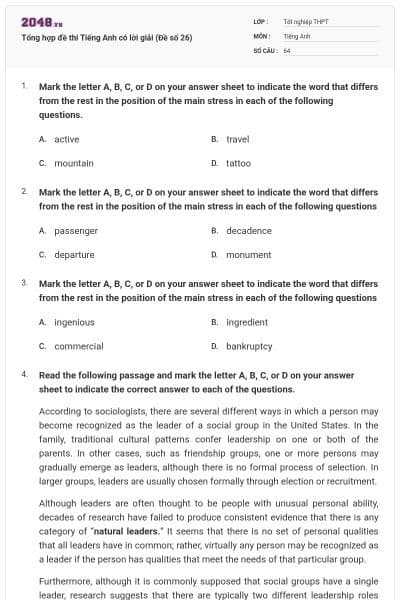
Mark the letter A, B, C, or D on your answer sheet to indicate the word that differs from the rest in the position of the main stress in each of the following questions.
active
travel
mountain
tattoo
Đáp án D
Câu D trọng âm từ rơi vào âm tiết thứ 2, các từ còn lại rơi vào âm tiết thứ 1
Mark the letter A, B, C, or D on your answer sheet to indicate the word that differs from the rest in the position of the main stress in each of the following questions
passenger
decadence
departure
monument
Đáp án C
Câu C trọng âm từ rơi vào âm tiết thứ 2, các từ còn lại rơi vào âm tiết thứ 1
Mark the letter A, B, C, or D on your answer sheet to indicate the word that differs from the rest in the position of the main stress in each of the following questions
ingenious
ingredient
commercial
bankruptcy
Đáp án D
Câu D trọng âm từ rơi vào âm tiết thứ 1, các từ còn lại rơi vào âm tiết thứ 2
Read the following passage and mark the letter A, B, C, or D on your answer sheet to indicate the correct answer to each of the questions.
According to sociologists, there are several different ways in which a person may become recognized as the leader of a social group in the United States. In the family, traditional cultural patterns confer leadership on one or both of the parents. In other cases, such as friendship groups, one or more persons may gradually emerge as leaders, although there is no formal process of selection. In larger groups, leaders are usually chosen formally through election or recruitment.
Although leaders are often thought to be people with unusual personal ability, decades of research have failed to produce consistent evidence that there is any category of “natural leaders.” It seems that there is no set of personal qualities that all leaders have in common; rather, virtually any person may be recognized as a leader if the person has qualities that meet the needs of that particular group.
Furthermore, although it is commonly supposed that social groups have a single leader, research suggests that there are typically two different leadership roles that are held by different individuals. Instrumental leadership is leadership that emphasizes the completion of tasks by a social group. Group members look into instrumental leaders to “get things done.” Expressive leadership, on the other hand, is leadership that emphasizes the collective well-being of a social group’s member. Expressive leader are less concerned with the overall goals of the group than with providing emotional support to group members and attempting to minimize tension and conflict among them. Group members expect expressive leaders to maintain stable relationships within the group and provide support to individual members.
Instrumental leaders are likely to have a rather secondary relationship to other group members. They give orders and may discipline group members who inhibit attainment of the group’s goals. Expressive leaders cultivate a more personal or primary relationship to others in the group. They offer sympathy when someone experiences difficulties or is subjected to discipline, are quick to lighten a serious moment with humor, and try to resolve issues that threaten to divide the group. As the differences in these two roles suggest, expressive leaders generally receive more personal affection from group members; instrumental leaders, if they are successful in promoting group goals, may enjoy a mote distant respect
What does the passage mainly discuss?
The role of leaders in social groups
How social groups determine who will lead them
The problems faced by leaders
How leadership differs in small and large groups
Đáp án A
Ý chính của đoạn văn tập trung vào làm rõ vai trò của người lãnh đạo trong các tổ chức, đội
nhóm xã hội
Read the following passage and mark the letter A, B, C, or D on your answer sheet to indicate the correct answer to each of the questions.
According to sociologists, there are several different ways in which a person may become recognized as the leader of a social group in the United States. In the family, traditional cultural patterns confer leadership on one or both of the parents. In other cases, such as friendship groups, one or more persons may gradually emerge as leaders, although there is no formal process of selection. In larger groups, leaders are usually chosen formally through election or recruitment.
Although leaders are often thought to be people with unusual personal ability, decades of research have failed to produce consistent evidence that there is any category of “natural leaders.” It seems that there is no set of personal qualities that all leaders have in common; rather, virtually any person may be recognized as a leader if the person has qualities that meet the needs of that particular group.
Furthermore, although it is commonly supposed that social groups have a single leader, research suggests that there are typically two different leadership roles that are held by different individuals. Instrumental leadership is leadership that emphasizes the completion of tasks by a social group. Group members look into instrumental leaders to “get things done.” Expressive leadership, on the other hand, is leadership that emphasizes the collective well-being of a social group’s member. Expressive leader are less concerned with the overall goals of the group than with providing emotional support to group members and attempting to minimize tension and conflict among them. Group members expect expressive leaders to maintain stable relationships within the group and provide support to individual members.
Instrumental leaders are likely to have a rather secondary relationship to other group members. They give orders and may discipline group members who inhibit attainment of the group’s goals. Expressive leaders cultivate a more personal or primary relationship to others in the group. They offer sympathy when someone experiences difficulties or is subjected to discipline, are quick to lighten a serious moment with humor, and try to resolve issues that threaten to divide the group. As the differences in these two roles suggest, expressive leaders generally receive more personal affection from group members; instrumental leaders, if they are successful in promoting group goals, may enjoy a mote distant respect.
The passage mentions all of the following ways by which people can become leaders EXCEPT:_________
traditional cultural patterns
specific leadership training
formal election process
recruitment
Đáp án B
Các câu còn lại có thể tìm thấy ở đoạn 1:
Câu A: “In the family, traditional cultural patterns confer leadership on one or both of the
parents.” Câu C & D: “In larger groups, leaders are usually chosen formally through election or
recruitment.”
Read the following passage and mark the letter A, B, C, or D on your answer sheet to indicate the correct answer to each of the questions.
According to sociologists, there are several different ways in which a person may become recognized as the leader of a social group in the United States. In the family, traditional cultural patterns confer leadership on one or both of the parents. In other cases, such as friendship groups, one or more persons may gradually emerge as leaders, although there is no formal process of selection. In larger groups, leaders are usually chosen formally through election or recruitment.
Although leaders are often thought to be people with unusual personal ability, decades of research have failed to produce consistent evidence that there is any category of “natural leaders.” It seems that there is no set of personal qualities that all leaders have in common; rather, virtually any person may be recognized as a leader if the person has qualities that meet the needs of that particular group.
Furthermore, although it is commonly supposed that social groups have a single leader, research suggests that there are typically two different leadership roles that are held by different individuals. Instrumental leadership is leadership that emphasizes the completion of tasks by a social group. Group members look into instrumental leaders to “get things done.” Expressive leadership, on the other hand, is leadership that emphasizes the collective well-being of a social group’s member. Expressive leader are less concerned with the overall goals of the group than with providing emotional support to group members and attempting to minimize tension and conflict among them. Group members expect expressive leaders to maintain stable relationships within the group and provide support to individual members.
Instrumental leaders are likely to have a rather secondary relationship to other group members. They give orders and may discipline group members who inhibit attainment of the group’s goals. Expressive leaders cultivate a more personal or primary relationship to others in the group. They offer sympathy when someone experiences difficulties or is subjected to discipline, are quick to lighten a serious moment with humor, and try to resolve issues that threaten to divide the group. As the differences in these two roles suggest, expressive leaders generally receive more personal affection from group members; instrumental leaders, if they are successful in promoting group goals, may enjoy a mote distant respect.
In mentioning “natural leaders” in line 7, the author is making the point that_________
“natural leaders” share a similar set of characteristics
few people qualify as “natural leaders”
there is no proof that “natural leaders” exist
“natural leaders’ are easily accepted by the members of a social group
Đáp án C
Câu đầu đoạn 2: “decades of research have failed to produce consistent evidence that there is any category of “natural leaders.”” => hàng thập kỷ nghiên cứu đã thất bại trong việc đưa ra
những bằng chứng phù hợp rằng có kiểu “nhà lãnh đạo bẩm sinh” => There is no proof that
“natural leaders” exist
Read the following passage and mark the letter A, B, C, or D on your answer sheet to indicate the correct answer to each of the questions.
According to sociologists, there are several different ways in which a person may become recognized as the leader of a social group in the United States. In the family, traditional cultural patterns confer leadership on one or both of the parents. In other cases, such as friendship groups, one or more persons may gradually emerge as leaders, although there is no formal process of selection. In larger groups, leaders are usually chosen formally through election or recruitment.
Although leaders are often thought to be people with unusual personal ability, decades of research have failed to produce consistent evidence that there is any category of “natural leaders.” It seems that there is no set of personal qualities that all leaders have in common; rather, virtually any person may be recognized as a leader if the person has qualities that meet the needs of that particular group.
Furthermore, although it is commonly supposed that social groups have a single leader, research suggests that there are typically two different leadership roles that are held by different individuals. Instrumental leadership is leadership that emphasizes the completion of tasks by a social group. Group members look into instrumental leaders to “get things done.” Expressive leadership, on the other hand, is leadership that emphasizes the collective well-being of a social group’s member. Expressive leader are less concerned with the overall goals of the group than with providing emotional support to group members and attempting to minimize tension and conflict among them. Group members expect expressive leaders to maintain stable relationships within the group and provide support to individual members.
Instrumental leaders are likely to have a rather secondary relationship to other group members. They give orders and may discipline group members who inhibit attainment of the group’s goals. Expressive leaders cultivate a more personal or primary relationship to others in the group. They offer sympathy when someone experiences difficulties or is subjected to discipline, are quick to lighten a serious moment with humor, and try to resolve issues that threaten to divide the group. As the differences in these two roles suggest, expressive leaders generally receive more personal affection from group members; instrumental leaders, if they are successful in promoting group goals, may enjoy a mote distant respect.
Which of the following statements about leadership can be inferred from paragraph 2?
A person who is an effective leader of a particular group may not be an effective leader in another group
Most people desire to be leaders but can produce little evidence of their qualifications
A person can best learn how to be an effective leader by studying research on leadership
Few people succeed in sharing a leadership role with another person
Đáp án A
Câu 2 đoạn 2: “It seems that there is no set of personal qualities that all leaders have in common; rather, virtually any person may be recognized as a leader if the person has qualities that meet the needs of that particular group.” = Có vẻ như không có một bộ phẩm chất cá nhân nào mà tất cả lãnh
đạo có chung; thay vào đó, hầu như bất kỳ ai cũng có thể được nhận định như một nhà lãnh đạo nếu
người đó có những phẩm chất đáp ứng được yêu cầu của một nhóm cụ thể => A person who is an effective leader of a particular group may not be an effective leader in another group.
Read the following passage and mark the letter A, B, C, or D on your answer sheet to indicate the correct answer to each of the questions.
According to sociologists, there are several different ways in which a person may become recognized as the leader of a social group in the United States. In the family, traditional cultural patterns confer leadership on one or both of the parents. In other cases, such as friendship groups, one or more persons may gradually emerge as leaders, although there is no formal process of selection. In larger groups, leaders are usually chosen formally through election or recruitment.
Although leaders are often thought to be people with unusual personal ability, decades of research have failed to produce consistent evidence that there is any category of “natural leaders.” It seems that there is no set of personal qualities that all leaders have in common; rather, virtually any person may be recognized as a leader if the person has qualities that meet the needs of that particular group.
Furthermore, although it is commonly supposed that social groups have a single leader, research suggests that there are typically two different leadership roles that are held by different individuals. Instrumental leadership is leadership that emphasizes the completion of tasks by a social group. Group members look into instrumental leaders to “get things done.” Expressive leadership, on the other hand, is leadership that emphasizes the collective well-being of a social group’s member. Expressive leader are less concerned with the overall goals of the group than with providing emotional support to group members and attempting to minimize tension and conflict among them. Group members expect expressive leaders to maintain stable relationships within the group and provide support to individual members.
Instrumental leaders are likely to have a rather secondary relationship to other group members. They give orders and may discipline group members who inhibit attainment of the group’s goals. Expressive leaders cultivate a more personal or primary relationship to others in the group. They offer sympathy when someone experiences difficulties or is subjected to discipline, are quick to lighten a serious moment with humor, and try to resolve issues that threaten to divide the group. As the differences in these two roles suggest, expressive leaders generally receive more personal affection from group members; instrumental leaders, if they are successful in promoting group goals, may enjoy a mote distant respect.
The passage indicates that instrumental leaders generally focus on_________
achieving a goal
identifying new leaders
ensuring harmonious relationships
sharing responsibility with group members
Đáp án A
Đoạn 3: “Instrumental leadership is leadership that emphasizes the completion of tasks by a social
group.”
Read the following passage and mark the letter A, B, C, or D on your answer sheet to indicate the correct answer to each of the questions.
According to sociologists, there are several different ways in which a person may become recognized as the leader of a social group in the United States. In the family, traditional cultural patterns confer leadership on one or both of the parents. In other cases, such as friendship groups, one or more persons may gradually emerge as leaders, although there is no formal process of selection. In larger groups, leaders are usually chosen formally through election or recruitment.
Although leaders are often thought to be people with unusual personal ability, decades of research have failed to produce consistent evidence that there is any category of “natural leaders.” It seems that there is no set of personal qualities that all leaders have in common; rather, virtually any person may be recognized as a leader if the person has qualities that meet the needs of that particular group.
Furthermore, although it is commonly supposed that social groups have a single leader, research suggests that there are typically two different leadership roles that are held by different individuals. Instrumental leadership is leadership that emphasizes the completion of tasks by a social group. Group members look into instrumental leaders to “get things done.” Expressive leadership, on the other hand, is leadership that emphasizes the collective well-being of a social group’s member. Expressive leader are less concerned with the overall goals of the group than with providing emotional support to group members and attempting to minimize tension and conflict among them. Group members expect expressive leaders to maintain stable relationships within the group and provide support to individual members.
Instrumental leaders are likely to have a rather secondary relationship to other group members. They give orders and may discipline group members who inhibit attainment of the group’s goals. Expressive leaders cultivate a more personal or primary relationship to others in the group. They offer sympathy when someone experiences difficulties or is subjected to discipline, are quick to lighten a serious moment with humor, and try to resolve issues that threaten to divide the group. As the differences in these two roles suggest, expressive leaders generally receive more personal affection from group members; instrumental leaders, if they are successful in promoting group goals, may enjoy a mote distant respect.
The word “collective” in line 15 is closest in meaning to_________.
necessary
particular
group
typical
Đáp án C
Trong cụm từ “collective well-being of a social group’s member”, “collective” mang nghĩa là
“group” = mang tính tập trung, nhóm
Read the following passage and mark the letter A, B, C, or D on your answer sheet to indicate the correct answer to each of the questions.
According to sociologists, there are several different ways in which a person may become recognized as the leader of a social group in the United States. In the family, traditional cultural patterns confer leadership on one or both of the parents. In other cases, such as friendship groups, one or more persons may gradually emerge as leaders, although there is no formal process of selection. In larger groups, leaders are usually chosen formally through election or recruitment.
Although leaders are often thought to be people with unusual personal ability, decades of research have failed to produce consistent evidence that there is any category of “natural leaders.” It seems that there is no set of personal qualities that all leaders have in common; rather, virtually any person may be recognized as a leader if the person has qualities that meet the needs of that particular group.
Furthermore, although it is commonly supposed that social groups have a single leader, research suggests that there are typically two different leadership roles that are held by different individuals. Instrumental leadership is leadership that emphasizes the completion of tasks by a social group. Group members look into instrumental leaders to “get things done.” Expressive leadership, on the other hand, is leadership that emphasizes the collective well-being of a social group’s member. Expressive leader are less concerned with the overall goals of the group than with providing emotional support to group members and attempting to minimize tension and conflict among them. Group members expect expressive leaders to maintain stable relationships within the group and provide support to individual members.
Instrumental leaders are likely to have a rather secondary relationship to other group members. They give orders and may discipline group members who inhibit attainment of the group’s goals. Expressive leaders cultivate a more personal or primary relationship to others in the group. They offer sympathy when someone experiences difficulties or is subjected to discipline, are quick to lighten a serious moment with humor, and try to resolve issues that threaten to divide the group. As the differences in these two roles suggest, expressive leaders generally receive more personal affection from group members; instrumental leaders, if they are successful in promoting group goals, may enjoy a mote distant respect.
The word “them” in line 18 refers to_________
goals of the group
tension and conflict
group members
expressive leaders
Đáp án C
Đoạn 3: “Expressive leader are less concerned with the overall goals of the group than with providing emotional support to group members and attempting to minimize tension and
conflict among them.” = Các nhà lãnh đạo biểu đạt ít quan tâm tới mục tiêu chung của nhóm
hơn so với việc cung cấp sự ủng hộ về tình cảm cho các thành viên trong nhóm và cố gắng
giảm thiểu căng thẳng và xung đột giữa họ => “them” = các thành viên trong nhóm = group members
Read the following passage and mark the letter A, B, C, or D on your answer sheet to indicate the correct answer to each of the questions.
According to sociologists, there are several different ways in which a person may become recognized as the leader of a social group in the United States. In the family, traditional cultural patterns confer leadership on one or both of the parents. In other cases, such as friendship groups, one or more persons may gradually emerge as leaders, although there is no formal process of selection. In larger groups, leaders are usually chosen formally through election or recruitment.
Although leaders are often thought to be people with unusual personal ability, decades of research have failed to produce consistent evidence that there is any category of “natural leaders.” It seems that there is no set of personal qualities that all leaders have in common; rather, virtually any person may be recognized as a leader if the person has qualities that meet the needs of that particular group.
Furthermore, although it is commonly supposed that social groups have a single leader, research suggests that there are typically two different leadership roles that are held by different individuals. Instrumental leadership is leadership that emphasizes the completion of tasks by a social group. Group members look into instrumental leaders to “get things done.” Expressive leadership, on the other hand, is leadership that emphasizes the collective well-being of a social group’s member. Expressive leader are less concerned with the overall goals of the group than with providing emotional support to group members and attempting to minimize tension and conflict among them. Group members expect expressive leaders to maintain stable relationships within the group and provide support to individual members.
Instrumental leaders are likely to have a rather secondary relationship to other group members. They give orders and may discipline group members who inhibit attainment of the group’s goals. Expressive leaders cultivate a more personal or primary relationship to others in the group. They offer sympathy when someone experiences difficulties or is subjected to discipline, are quick to lighten a serious moment with humor, and try to resolve issues that threaten to divide the group. As the differences in these two roles suggest, expressive leaders generally receive more personal affection from group members; instrumental leaders, if they are successful in promoting group goals, may enjoy a mote distant respect.
A “secondary relationship” mentioned in line 20 between a leader and the members of a group could be best characterized as_________
enthusiastic
distant
personal
unreliable
Đáp án B
Trong câu này, “secondary relationship” chỉ mối quan hệ xa cách => từ diễn tả đúng nhất:
“distant”
Read the following passage and mark the letter A, B, C, or D on your answer sheet to indicate the correct answer to each of the questions.
According to sociologists, there are several different ways in which a person may become recognized as the leader of a social group in the United States. In the family, traditional cultural patterns confer leadership on one or both of the parents. In other cases, such as friendship groups, one or more persons may gradually emerge as leaders, although there is no formal process of selection. In larger groups, leaders are usually chosen formally through election or recruitment.
Although leaders are often thought to be people with unusual personal ability, decades of research have failed to produce consistent evidence that there is any category of “natural leaders.” It seems that there is no set of personal qualities that all leaders have in common; rather, virtually any person may be recognized as a leader if the person has qualities that meet the needs of that particular group.
Furthermore, although it is commonly supposed that social groups have a single leader, research suggests that there are typically two different leadership roles that are held by different individuals. Instrumental leadership is leadership that emphasizes the completion of tasks by a social group. Group members look into instrumental leaders to “get things done.” Expressive leadership, on the other hand, is leadership that emphasizes the collective well-being of a social group’s member. Expressive leader are less concerned with the overall goals of the group than with providing emotional support to group members and attempting to minimize tension and conflict among them. Group members expect expressive leaders to maintain stable relationships within the group and provide support to individual members.
Instrumental leaders are likely to have a rather secondary relationship to other group members. They give orders and may discipline group members who inhibit attainment of the group’s goals. Expressive leaders cultivate a more personal or primary relationship to others in the group. They offer sympathy when someone experiences difficulties or is subjected to discipline, are quick to lighten a serious moment with humor, and try to resolve issues that threaten to divide the group. As the differences in these two roles suggest, expressive leaders generally receive more personal affection from group members; instrumental leaders, if they are successful in promoting group goals, may enjoy a mote distant respect.
The word “resolve” in line 24 is closest in meaning to_________
avoid repeating
talk about
find a solution for
avoid thinking about
Đáp án C
“resolve issues” = “find a solution for issues” = giải quyết, tìm ra giải pháp cho vấn đề
Read the following passage and mark the letter A, B, C, or D on your answer sheet to indicate the correct answer to each of the questions.
According to sociologists, there are several different ways in which a person may become recognized as the leader of a social group in the United States. In the family, traditional cultural patterns confer leadership on one or both of the parents. In other cases, such as friendship groups, one or more persons may gradually emerge as leaders, although there is no formal process of selection. In larger groups, leaders are usually chosen formally through election or recruitment.
Although leaders are often thought to be people with unusual personal ability, decades of research have failed to produce consistent evidence that there is any category of “natural leaders.” It seems that there is no set of personal qualities that all leaders have in common; rather, virtually any person may be recognized as a leader if the person has qualities that meet the needs of that particular group.
Furthermore, although it is commonly supposed that social groups have a single leader, research suggests that there are typically two different leadership roles that are held by different individuals. Instrumental leadership is leadership that emphasizes the completion of tasks by a social group. Group members look into instrumental leaders to “get things done.” Expressive leadership, on the other hand, is leadership that emphasizes the collective well-being of a social group’s member. Expressive leader are less concerned with the overall goals of the group than with providing emotional support to group members and attempting to minimize tension and conflict among them. Group members expect expressive leaders to maintain stable relationships within the group and provide support to individual members.
Instrumental leaders are likely to have a rather secondary relationship to other group members. They give orders and may discipline group members who inhibit attainment of the group’s goals. Expressive leaders cultivate a more personal or primary relationship to others in the group. They offer sympathy when someone experiences difficulties or is subjected to discipline, are quick to lighten a serious moment with humor, and try to resolve issues that threaten to divide the group. As the differences in these two roles suggest, expressive leaders generally receive more personal affection from group members; instrumental leaders, if they are successful in promoting group goals, may enjoy a mote distant respect.
Paragraphs 3 and 4 organize the discussion of leadership primarily in term of_________
cause and effect analysis
examples that illustrate a problem
narration of events
comparison and contrast
Đáp án D
Đoạn 3 và đoạn 4 tập trung vào so sánh và đối chiếu hai kiểu nhà lãnh đạo: “instrumental
leaders” và “expressive leaders” => comparison and contrast
Mark the letter A, B, C, or D on your answer sheet to indicate the word(s) CLOSEST in meaning to the underlined word(s) in each of the following questions
During the earthquake, a lot of buildings collapsed, which killed thousands of people.
fell down unexpectedly
went off accidentally
exploded suddenly
erupted violently
Đáp án: A
Giải thích:
A. fell down unexpectedly: sụp đổ không như mong muốn
B. went off accidentally: nổ một cách tình cờ.
C. exploded suddenly: nổ một cách đột ngột.
D. erupted violently: phun trào dữ dội (núi lửa); nổ ra dữ dội (chiến tranh).
→ collapsed (v): sụp đổ = fell down unexpectedly
Dịch: Trong trận động đất, có rất nhiều tòa nhà sụp đổ, việc này đã giết
hàng trăm người.
Mark the letter A, B, C, or D on your answer sheet to indicate the word(s) CLOSEST in meaning to the underlined word(s) in each of the following questions
The crew divided the life preservers among the twenty terrified passengers as the ship began to sink
frightened
surprised
exhausted
excited
Đáp án A Terrified = frightened = sợ hãi, bị làm cho hốt hoảng
Mark the letter A, B, C, or D on your answer sheet to indicate the word(s) CLOSEST in meaning to the underlined word(s) in each of the following questions
You must answer the police’s questions truthfully; otherwise, you will get into trouble
as trustingly as you can
in a harmful way
with a negative attitude
exactly as things really happen
Đáp án D
Truthfully = as trustingly as you can = thành thật nhất có thể
Mark the letter A, B, C, or D on your answer sheet to indicate the word(s) OPPOSITE in meaning to the underlined word(s) in each of the following questions
After five days on trial, the court found him innocent of the crime and he was released
naïve
benevolent
innovative
guilty
Đáp án D
Innocent = ngây thơ, vô tội >< guilty = tội lỗi
Mark the letter A, B, C, or D on your answer sheet to indicate the word(s) OPPOSITE in meaning to the underlined word(s) in each of the following questions
In the first two decades of its existence, the cinema developed rapidly
shortly
sluggishly
weakly
leisurely
Đáp án B
Rapidly = nhanh >< sluggishly = chậm
Mark the letter A, B, C or D on your answer sheet to show the underlined part that needs correction in each of the following questions
(A) Although they are (B) an inexpensive supplier of vitamins, minerals, and high quality protein, eggs (C) contain a high level of blood cholesterol, one of the major (D) cause of heart disease
Although
an
contain
cause
Đáp án D One of the major cause => One of the major causes
Mark the letter A, B, C or D on your answer sheet to show the underlined part that needs correction in each of the following questions
(A) Although it would take a laboratory analysis (B) to determine the exact proportions of sand, silt, clay, and organic matter in your garden soil, you can get a good idea of what (C) it is by (D) feeling the soil’s texture
Although
to determine
it is
feeling
Đáp án C
It is => they are (vì đối tượng mà nó nhắc đến là số nhiều: “proportions of sand, silt, clay, and
organic matter in your garden soil”)
Mark the letter A, B, C or D on your answer sheet to show the underlined part that needs correction in each of the following questions
Employees (A) who haven't seen the new regulations often (B) ask for unnecessary questions; (C) instead they should ask for a copy of the regulations and (D) read them
who
ask for
instead
read them
Đáp án: B
Giải thích:
Ta có: ask unnecessary questions: hỏi những câu hỏi không cần thiết.
Khi muốn nói: hỏi câu hỏi hay hỏi ai ta sử dụng “ask + (a) question(s)” hay “ask sb” mà không cần dùng giới từ theo sau.
- Ask for ...: hỏi xin, yêu cầu ...
- Ask about ...: hỏi về ...
Sửa: ask for → ask
Dịch: Nhân viên chưa xem các quy định mới thường xuyên hỏi những câu hỏi không cần thiết; thay vào đó họ nên yêu cầu một bản sao các quy định và đọc chúng.
Mark the letter A, B, C or D on your answer sheet to show the underlined part that needs correction in each of the following questions
Our nervous system has over ten (A) billions (B) nerve cells in a network covering (C) every inch of our skin and (D) organs
billions
nerve
every inch
organs
Đáp án A
Billions => billion (billions of + danh từ số nhiều / số lượng + billion + danh từ số nhiều)
Mark the letter A, B, C or D on your answer sheet to show the underlined part that needs correction in each of the following questions
A mosquito (A) is filled with blood (B) is carrying (C) twice its own body (D) weight
is filled
is carrying
twice
weight
Đáp án A
Is filled => filled ( rút gọn của mệnh đề quan hệ: “who is filled” => filled)
Read the following passage and mark the letter A, B, C, or D on your answer sheet to indicate the correct word or phrase for each of the blanks.
Feminism, collective term for systems of belief and theories that pay special (24)_________to women’s rights and women’s position in culture and society. The term tends to be used for the women’s rights movement, which began in the late 18th century and continues to campaign for complete political, social, and economic equality between women and men. This article (25)_________specifically with the development of the ideas behind that movement and their (26)_________and impact.
Feminists are united by the idea that women’s position in society is unequal to (27)_________of men, and that society is structured in such a way as to benefit men to the political, social, economic (28) _________of women. However, feminists have used different theories to explain these (29)_________and have advocated different ways of redressing inequalities, and there are marked geographic and historical variations in the nature of feminism.
Historically, feminist thought and activity can be divided into two waves. The first wave, which began in about 1800 and (30)_________until the 1930s, was largely concerned with gaining equal rights between women and men. The second wave, which began in the late 1960s, has continued to fight for (31)_________but has also developed a (32)_________of theories and approaches that stress the difference between women and men and that draw attention to the (33)_________needs of women.Question 24
attention
benefit
notice
equality
Đáp án A Pay attention to smb/smt = chú ý, tập trung vào ai/cái gì
Read the following passage and mark the letter A, B, C, or D on your answer sheet to indicate the correct word or phrase for each of the blanks.
Feminism, collective term for systems of belief and theories that pay special (24)_________to women’s rights and women’s position in culture and society. The term tends to be used for the women’s rights movement, which began in the late 18th century and continues to campaign for complete political, social, and economic equality between women and men. This article (25)_________specifically with the development of the ideas behind that movement and their (26)_________and impact.
Feminists are united by the idea that women’s position in society is unequal to (27)_________of men, and that society is structured in such a way as to benefit men to the political, social, economic (28) _________of women. However, feminists have used different theories to explain these (29)_________and have advocated different ways of redressing inequalities, and there are marked geographic and historical variations in the nature of feminism.
Historically, feminist thought and activity can be divided into two waves. The first wave, which began in about 1800 and (30)_________until the 1930s, was largely concerned with gaining equal rights between women and men. The second wave, which began in the late 1960s, has continued to fight for (31)_________but has also developed a (32)_________of theories and approaches that stress the difference between women and men and that draw attention to the (33)_________needs of women.Question 25
familiar
deals
provides
initiates
Đáp án B
Deal with smt = xử lý, quan tâm, làm việc với cái gì
Read the following passage and mark the letter A, B, C, or D on your answer sheet to indicate the correct word or phrase for each of the blanks.
Feminism, collective term for systems of belief and theories that pay special (24)_________to women’s rights and women’s position in culture and society. The term tends to be used for the women’s rights movement, which began in the late 18th century and continues to campaign for complete political, social, and economic equality between women and men. This article (25)_________specifically with the development of the ideas behind that movement and their (26)_________and impact.
Feminists are united by the idea that women’s position in society is unequal to (27)_________of men, and that society is structured in such a way as to benefit men to the political, social, economic (28) _________of women. However, feminists have used different theories to explain these (29)_________and have advocated different ways of redressing inequalities, and there are marked geographic and historical variations in the nature of feminism.
Historically, feminist thought and activity can be divided into two waves. The first wave, which began in about 1800 and (30)_________until the 1930s, was largely concerned with gaining equal rights between women and men. The second wave, which began in the late 1960s, has continued to fight for (31)_________but has also developed a (32)_________of theories and approaches that stress the difference between women and men and that draw attention to the (33)_________needs of women.Question 26
influence
variation
pressure
problem
Đáp án A
Influence = tác động, ảnh hưởng
Read the following passage and mark the letter A, B, C, or D on your answer sheet to indicate the correct word or phrase for each of the blanks.
Feminism, collective term for systems of belief and theories that pay special (24)_________to women’s rights and women’s position in culture and society. The term tends to be used for the women’s rights movement, which began in the late 18th century and continues to campaign for complete political, social, and economic equality between women and men. This article (25)_________specifically with the development of the ideas behind that movement and their (26)_________and impact.
Feminists are united by the idea that women’s position in society is unequal to (27)_________of men, and that society is structured in such a way as to benefit men to the political, social, economic (28) _________of women. However, feminists have used different theories to explain these (29)_________and have advocated different ways of redressing inequalities, and there are marked geographic and historical variations in the nature of feminism.
Historically, feminist thought and activity can be divided into two waves. The first wave, which began in about 1800 and (30)_________until the 1930s, was largely concerned with gaining equal rights between women and men. The second wave, which began in the late 1960s, has continued to fight for (31)_________but has also developed a (32)_________of theories and approaches that stress the difference between women and men and that draw attention to the (33)_________needs of women.Question 27
those
which
most
that
Đáp án D
“that of men” thay thế cho cụm “men’s position in society” ( không dùng “those” vì position
số ít)
Read the following passage and mark the letter A, B, C, or D on your answer sheet to indicate the correct word or phrase for each of the blanks.
Feminism, collective term for systems of belief and theories that pay special (24)_________to women’s rights and women’s position in culture and society. The term tends to be used for the women’s rights movement, which began in the late 18th century and continues to campaign for complete political, social, and economic equality between women and men. This article (25)_________specifically with the development of the ideas behind that movement and their (26)_________and impact.
Feminists are united by the idea that women’s position in society is unequal to (27)_________of men, and that society is structured in such a way as to benefit men to the political, social, economic (28) _________of women. However, feminists have used different theories to explain these (29)_________and have advocated different ways of redressing inequalities, and there are marked geographic and historical variations in the nature of feminism.
Historically, feminist thought and activity can be divided into two waves. The first wave, which began in about 1800 and (30)_________until the 1930s, was largely concerned with gaining equal rights between women and men. The second wave, which began in the late 1960s, has continued to fight for (31)_________but has also developed a (32)_________of theories and approaches that stress the difference between women and men and that draw attention to the (33)_________needs of women.Question 28
deviance
dismalness
diffusion
detriment
Đáp án D
Detriment = những hao tổn
Deviance = sự lệch lạc
Dismalness = nỗi buồn
Diffusion = sự truyền bá
Read the following passage and mark the letter A, B, C, or D on your answer sheet to indicate the correct word or phrase for each of the blanks.
Feminism, collective term for systems of belief and theories that pay special (24)_________to women’s rights and women’s position in culture and society. The term tends to be used for the women’s rights movement, which began in the late 18th century and continues to campaign for complete political, social, and economic equality between women and men. This article (25)_________specifically with the development of the ideas behind that movement and their (26)_________and impact.
Feminists are united by the idea that women’s position in society is unequal to (27)_________of men, and that society is structured in such a way as to benefit men to the political, social, economic (28) _________of women. However, feminists have used different theories to explain these (29)_________and have advocated different ways of redressing inequalities, and there are marked geographic and historical variations in the nature of feminism.
Historically, feminist thought and activity can be divided into two waves. The first wave, which began in about 1800 and (30)_________until the 1930s, was largely concerned with gaining equal rights between women and men. The second wave, which began in the late 1960s, has continued to fight for (31)_________but has also developed a (32)_________of theories and approaches that stress the difference between women and men and that draw attention to the (33)_________needs of women.Question 29
equalities
difference
unequalities
inequalities
Đáp án D
“feminists have used different theories to explain these inequalities” = Những người ủng hộ
nữ quyền đã dùng nhiều lý thuyết khác nhau để lý giải sự bất bình đẳng này
Equal = bình đẳng
Equality = sự bình đẳng >< inequality = sự bất bình đẳng
Read the following passage and mark the letter A, B, C, or D on your answer sheet to indicate the correct word or phrase for each of the blanks.
Feminism, collective term for systems of belief and theories that pay special (24)_________to women’s rights and women’s position in culture and society. The term tends to be used for the women’s rights movement, which began in the late 18th century and continues to campaign for complete political, social, and economic equality between women and men. This article (25)_________specifically with the development of the ideas behind that movement and their (26)_________and impact.
Feminists are united by the idea that women’s position in society is unequal to (27)_________of men, and that society is structured in such a way as to benefit men to the political, social, economic (28) _________of women. However, feminists have used different theories to explain these (29)_________and have advocated different ways of redressing inequalities, and there are marked geographic and historical variations in the nature of feminism.
Historically, feminist thought and activity can be divided into two waves. The first wave, which began in about 1800 and (30)_________until the 1930s, was largely concerned with gaining equal rights between women and men. The second wave, which began in the late 1960s, has continued to fight for (31)_________but has also developed a (32)_________of theories and approaches that stress the difference between women and men and that draw attention to the (33)_________needs of women.Question 30
spent
widened
lasted
lengthened
Đáp án C Last = kéo dài (cái gì kéo dài trong khoảng thời gian bao lâu, hoặc kéo dài đến bao giờ)
Read the following passage and mark the letter A, B, C, or D on your answer sheet to indicate the correct word or phrase for each of the blanks.
Feminism, collective term for systems of belief and theories that pay special (24)_________to women’s rights and women’s position in culture and society. The term tends to be used for the women’s rights movement, which began in the late 18th century and continues to campaign for complete political, social, and economic equality between women and men. This article (25)_________specifically with the development of the ideas behind that movement and their (26)_________and impact.
Feminists are united by the idea that women’s position in society is unequal to (27)_________of men, and that society is structured in such a way as to benefit men to the political, social, economic (28) _________of women. However, feminists have used different theories to explain these (29)_________and have advocated different ways of redressing inequalities, and there are marked geographic and historical variations in the nature of feminism.
Historically, feminist thought and activity can be divided into two waves. The first wave, which began in about 1800 and (30)_________until the 1930s, was largely concerned with gaining equal rights between women and men. The second wave, which began in the late 1960s, has continued to fight for (31)_________but has also developed a (32)_________of theories and approaches that stress the difference between women and men and that draw attention to the (33)_________needs of women.Question 31
equality
freedom
independence
tradition
Đáp án A
Fight for equality = đấu tranh cho sự bình đẳng (vì ý chính của đoạn cũng nói về sự bất bình
đẳng giữa phụ nữ và đàn ông)
Read the following passage and mark the letter A, B, C, or D on your answer sheet to indicate the correct word or phrase for each of the blanks.
Feminism, collective term for systems of belief and theories that pay special (24)_________to women’s rights and women’s position in culture and society. The term tends to be used for the women’s rights movement, which began in the late 18th century and continues to campaign for complete political, social, and economic equality between women and men. This article (25)_________specifically with the development of the ideas behind that movement and their (26)_________and impact.
Feminists are united by the idea that women’s position in society is unequal to (27)_________of men, and that society is structured in such a way as to benefit men to the political, social, economic (28) _________of women. However, feminists have used different theories to explain these (29)_________and have advocated different ways of redressing inequalities, and there are marked geographic and historical variations in the nature of feminism.
Historically, feminist thought and activity can be divided into two waves. The first wave, which began in about 1800 and (30)_________until the 1930s, was largely concerned with gaining equal rights between women and men. The second wave, which began in the late 1960s, has continued to fight for (31)_________but has also developed a (32)_________of theories and approaches that stress the difference between women and men and that draw attention to the (33)_________needs of women.Question 32
sort
range
type
kind
Đáp án B
A range of + danh từ số nhiều = một loạt cái gì
Read the following passage and mark the letter A, B, C, or D on your answer sheet to indicate the correct word or phrase for each of the blanks.
Feminism, collective term for systems of belief and theories that pay special (24)_________to women’s rights and women’s position in culture and society. The term tends to be used for the women’s rights movement, which began in the late 18th century and continues to campaign for complete political, social, and economic equality between women and men. This article (25)_________specifically with the development of the ideas behind that movement and their (26)_________and impact.
Feminists are united by the idea that women’s position in society is unequal to (27)_________of men, and that society is structured in such a way as to benefit men to the political, social, economic (28) _________of women. However, feminists have used different theories to explain these (29)_________and have advocated different ways of redressing inequalities, and there are marked geographic and historical variations in the nature of feminism.
Historically, feminist thought and activity can be divided into two waves. The first wave, which began in about 1800 and (30)_________until the 1930s, was largely concerned with gaining equal rights between women and men. The second wave, which began in the late 1960s, has continued to fight for (31)_________but has also developed a (32)_________of theories and approaches that stress the difference between women and men and that draw attention to the (33)_________needs of women.Question 33
specific
general
definite
vague
Đáp án B
A range of + danh từ số nhiều = một loạt cái gì
Read the following passage and mark the letter A, B, C, or D on your answer sheet to indicate the correct answer to each of the questions.
The response of most animals when suddenly faced with a predator is to flee. Natural selection has acted in a variety of ways in different species to enhance the efficacy of the behaviors, known as "flight behaviors" or escape behaviors that are used by prey in fleeing predators. Perhaps the most direct adaptation is enhanced light speed and agility.
Adaptations for speed, however, are likely to require sacrifices biter attributes, so we might expect only some species to adopt a simple fast flight strategy. Another way of enhancing the effectiveness of flight is to move in an erratic and unpredictable way. Many species, like ptarmigans, snipes, and various antelopes and gazelles, flee from predators in a characteristic zigzag fashion. Rapid unexpected changes in flight direction make it difficult for a predator to track prey. In some species, like the European hare, erratic zigzag flight might be more effective in the presence of predators that are faster than they are and straight flight more effective against predators that are slower. One observation that supports this suggestion is the recorded tendency for slow-flying black-beaded gulls, which are normally able to escape predators by means of direct flight, to show frequent changes in flight direction when they spot a peregrine falcon (peregrines are adept at capturing flying birds).
A quite different way of enhancing escape by flight is to use so-called "flash" behavior. Here, the alarmed prey flees for a short distance and then "freezes." Some predators are unexcited by immobile prey, and a startling flash of activity followed by immobility may confuse them. "Flash" behavior is used in particular by frogs and orthopteran insects, which make conspicuous jumps and then sit immobile. In some species, "flash" behavior is enhanced by the display of bright body markings. Good examples of insects with colorful markings are the red and yellow underwing moths. At rest, both species are a cryptic brown color. When they fly, however, brightly colored hind wings are exposed, which render the moths highly conspicuous. Similarly, some frogs and lizards have brightly colored patches or frills that may serve a “flash" function when they move quickly. Some species even appear to possess "flash" sounds. The loud buzzing and clicking noises made by some grasshoppers when they jump may serve to emphasize the movement
The word "enhance” in line 2 is closest in meaning to_________
encourage
resist
increase
reveal
Đáp án A
Nghĩa của cụm: “specific needs of women” => những nhu cầu cụ thể của phụ nữ
Read the following passage and mark the letter A, B, C, or D on your answer sheet to indicate the correct answer to each of the questions.
The response of most animals when suddenly faced with a predator is to flee. Natural selection has acted in a variety of ways in different species to enhance the efficacy of the behaviors, known as "flight behaviors" or escape behaviors that are used by prey in fleeing predators. Perhaps the most direct adaptation is enhanced light speed and agility.
Adaptations for speed, however, are likely to require sacrifices biter attributes, so we might expect only some species to adopt a simple fast flight strategy. Another way of enhancing the effectiveness of flight is to move in an erratic and unpredictable way. Many species, like ptarmigans, snipes, and various antelopes and gazelles, flee from predators in a characteristic zigzag fashion. Rapid unexpected changes in flight direction make it difficult for a predator to track prey. In some species, like the European hare, erratic zigzag flight might be more effective in the presence of predators that are faster than they are and straight flight more effective against predators that are slower. One observation that supports this suggestion is the recorded tendency for slow-flying black-beaded gulls, which are normally able to escape predators by means of direct flight, to show frequent changes in flight direction when they spot a peregrine falcon (peregrines are adept at capturing flying birds).
A quite different way of enhancing escape by flight is to use so-called "flash" behavior. Here, the alarmed prey flees for a short distance and then "freezes." Some predators are unexcited by immobile prey, and a startling flash of activity followed by immobility may confuse them. "Flash" behavior is used in particular by frogs and orthopteran insects, which make conspicuous jumps and then sit immobile. In some species, "flash" behavior is enhanced by the display of bright body markings. Good examples of insects with colorful markings are the red and yellow underwing moths. At rest, both species are a cryptic brown color. When they fly, however, brightly colored hind wings are exposed, which render the moths highly conspicuous. Similarly, some frogs and lizards have brightly colored patches or frills that may serve a “flash" function when they move quickly. Some species even appear to possess "flash" sounds. The loud buzzing and clicking noises made by some grasshoppers when they jump may serve to emphasize the movement
The description of the prey's movement as "zigzag" in line 10 suggests that the movement is_________
reliable
fast
constant
unpredictable
Đáp án D
Đoạn 2: “In some species, like the European hare, erratic zigzag flight might be more effective in the presence of predators that are faster than they are and straight flight more
effective against predators that are slower.” = Ở một số loài, như loài thỏ rừng châu Âu, cuộc
chạy trốn theo hình zigzag gián đoạn có thể hiệu quả hơn với sự xuất hiện của động vật ăn thịt
nhanh hơn chúng và chạy trốn theo đường thẳng hiệu quả hơn trước những động vật ăn thịt
chậm hơn => zigzag = unpredictable = không thể dự đoán trước
Read the following passage and mark the letter A, B, C, or D on your answer sheet to indicate the correct answer to each of the questions.
The response of most animals when suddenly faced with a predator is to flee. Natural selection has acted in a variety of ways in different species to enhance the efficacy of the behaviors, known as "flight behaviors" or escape behaviors that are used by prey in fleeing predators. Perhaps the most direct adaptation is enhanced light speed and agility.
Adaptations for speed, however, are likely to require sacrifices biter attributes, so we might expect only some species to adopt a simple fast flight strategy. Another way of enhancing the effectiveness of flight is to move in an erratic and unpredictable way. Many species, like ptarmigans, snipes, and various antelopes and gazelles, flee from predators in a characteristic zigzag fashion. Rapid unexpected changes in flight direction make it difficult for a predator to track prey. In some species, like the European hare, erratic zigzag flight might be more effective in the presence of predators that are faster than they are and straight flight more effective against predators that are slower. One observation that supports this suggestion is the recorded tendency for slow-flying black-beaded gulls, which are normally able to escape predators by means of direct flight, to show frequent changes in flight direction when they spot a peregrine falcon (peregrines are adept at capturing flying birds).
A quite different way of enhancing escape by flight is to use so-called "flash" behavior. Here, the alarmed prey flees for a short distance and then "freezes." Some predators are unexcited by immobile prey, and a startling flash of activity followed by immobility may confuse them. "Flash" behavior is used in particular by frogs and orthopteran insects, which make conspicuous jumps and then sit immobile. In some species, "flash" behavior is enhanced by the display of bright body markings. Good examples of insects with colorful markings are the red and yellow underwing moths. At rest, both species are a cryptic brown color. When they fly, however, brightly colored hind wings are exposed, which render the moths highly conspicuous. Similarly, some frogs and lizards have brightly colored patches or frills that may serve a “flash" function when they move quickly. Some species even appear to possess "flash" sounds. The loud buzzing and clicking noises made by some grasshoppers when they jump may serve to emphasize the movement
It can be inferred from the passage that the European hare_________
is faster than most of its predators
is capable of two kinds of flight
is more likely to escape using straight flight
is preyed upon by gulls and falcons
Đáp án B
Đoạn 2: “In some species, like the European hare, erratic zigzag flight might be moreeffective in the presence of predators that are faster than they are and straight flight more
effective against predators that are slower.” = Ở một số loài, như loài thỏ rừng châu Âu, cuộc
chạy trốn theo hình zigzag gián đoạn có thể hiệu quả hơn với sự xuất hiện của động vật ăn thịt
nhanh hơn chúng và chạy trốn theo đường thẳng hiệu quả hơn trước những động vật ăn thịt
chậm hơn => thỏ rừng có thể chạy trốn theo hai cách
Read the following passage and mark the letter A, B, C, or D on your answer sheet to indicate the correct answer to each of the questions.
The response of most animals when suddenly faced with a predator is to flee. Natural selection has acted in a variety of ways in different species to enhance the efficacy of the behaviors, known as "flight behaviors" or escape behaviors that are used by prey in fleeing predators. Perhaps the most direct adaptation is enhanced light speed and agility.
Adaptations for speed, however, are likely to require sacrifices biter attributes, so we might expect only some species to adopt a simple fast flight strategy. Another way of enhancing the effectiveness of flight is to move in an erratic and unpredictable way. Many species, like ptarmigans, snipes, and various antelopes and gazelles, flee from predators in a characteristic zigzag fashion. Rapid unexpected changes in flight direction make it difficult for a predator to track prey. In some species, like the European hare, erratic zigzag flight might be more effective in the presence of predators that are faster than they are and straight flight more effective against predators that are slower. One observation that supports this suggestion is the recorded tendency for slow-flying black-beaded gulls, which are normally able to escape predators by means of direct flight, to show frequent changes in flight direction when they spot a peregrine falcon (peregrines are adept at capturing flying birds).
A quite different way of enhancing escape by flight is to use so-called "flash" behavior. Here, the alarmed prey flees for a short distance and then "freezes." Some predators are unexcited by immobile prey, and a startling flash of activity followed by immobility may confuse them. "Flash" behavior is used in particular by frogs and orthopteran insects, which make conspicuous jumps and then sit immobile. In some species, "flash" behavior is enhanced by the display of bright body markings. Good examples of insects with colorful markings are the red and yellow underwing moths. At rest, both species are a cryptic brown color. When they fly, however, brightly colored hind wings are exposed, which render the moths highly conspicuous. Similarly, some frogs and lizards have brightly colored patches or frills that may serve a “flash" function when they move quickly. Some species even appear to possess "flash" sounds. The loud buzzing and clicking noises made by some grasshoppers when they jump may serve to emphasize the movement
The behaviour of black-beaded gulls is most comparable to that of________
gazelles
frogs
peregrine falcons
European hares
Đáp án D
Đoạn 2: “One observation that supports this suggestion is the recorded tendency for slow-flying blackbeaded gulls, which are normally able to escape predators by means of direct flight, to show frequent changes in flight direction when they spot a peregrine falcon.” = Một quan sát ủng hộ ý kiến này là một
xu hướng ghi nhận được về loài mòng biển đầu đen bay chậm, loài mà thường có khả năng thoát khỏi
động vật ăn thịt bằng đường bay thẳng, cũng cho thấy sự thay đổi thường xuyên trong hướng bay khi
chúng gặp một con chim ưng peregrine. => “this suggestion” là chỉ hiện tượng thay đổi đường bay
(thẳng hoặc zigzag) của loài thỏ rửng châu Âu (European hare) đã được đề cập ở trên
Read the following passage and mark the letter A, B, C, or D on your answer sheet to indicate the correct answer to each of the questions.
The response of most animals when suddenly faced with a predator is to flee. Natural selection has acted in a variety of ways in different species to enhance the efficacy of the behaviors, known as "flight behaviors" or escape behaviors that are used by prey in fleeing predators. Perhaps the most direct adaptation is enhanced light speed and agility.
Adaptations for speed, however, are likely to require sacrifices biter attributes, so we might expect only some species to adopt a simple fast flight strategy. Another way of enhancing the effectiveness of flight is to move in an erratic and unpredictable way. Many species, like ptarmigans, snipes, and various antelopes and gazelles, flee from predators in a characteristic zigzag fashion. Rapid unexpected changes in flight direction make it difficult for a predator to track prey. In some species, like the European hare, erratic zigzag flight might be more effective in the presence of predators that are faster than they are and straight flight more effective against predators that are slower. One observation that supports this suggestion is the recorded tendency for slow-flying black-beaded gulls, which are normally able to escape predators by means of direct flight, to show frequent changes in flight direction when they spot a peregrine falcon (peregrines are adept at capturing flying birds).
A quite different way of enhancing escape by flight is to use so-called "flash" behavior. Here, the alarmed prey flees for a short distance and then "freezes." Some predators are unexcited by immobile prey, and a startling flash of activity followed by immobility may confuse them. "Flash" behavior is used in particular by frogs and orthopteran insects, which make conspicuous jumps and then sit immobile. In some species, "flash" behavior is enhanced by the display of bright body markings. Good examples of insects with colorful markings are the red and yellow underwing moths. At rest, both species are a cryptic brown color. When they fly, however, brightly colored hind wings are exposed, which render the moths highly conspicuous. Similarly, some frogs and lizards have brightly colored patches or frills that may serve a “flash" function when they move quickly. Some species even appear to possess "flash" sounds. The loud buzzing and clicking noises made by some grasshoppers when they jump may serve to emphasize the movement
It can be inferred that black-beaded gulls change direction when they spot a peregrine falcon for which of the following reasons?
The falcons are faster than the gulls.
The gulls want to capture the falcons
The falcons are unpredictable
The gulls depend on the falcons for protection
Đáp án A
Đoạn 2: “In some species, like the European hare, erratic zigzag flight might be more effective in the presence of predators that are faster than they are and straight flight more
effective against predators that are slower.” = Ở một số loài, như loài thỏ rừng châu Âu, cuộc
chạy trốn theo hình zigzag gián đoạn có thể hiệu quả hơn với sự xuất hiện của động vật ăn thịt
nhanh hơn chúng và chạy trốn theo đường thẳng hiệu quả hơn trước những động vật ăn thịt
chậm hơn => Sau đó, đoạn văn lấy “black-beaded gulls” làm một minh họa cho trường hợp
tương tự như thỏ rừng châu Âu, chúng thay đổi hướng bay khi gặp “falcons” vì loài này bay
nhanh hơn
Read the following passage and mark the letter A, B, C, or D on your answer sheet to indicate the correct answer to each of the questions.
The response of most animals when suddenly faced with a predator is to flee. Natural selection has acted in a variety of ways in different species to enhance the efficacy of the behaviors, known as "flight behaviors" or escape behaviors that are used by prey in fleeing predators. Perhaps the most direct adaptation is enhanced light speed and agility.
Adaptations for speed, however, are likely to require sacrifices biter attributes, so we might expect only some species to adopt a simple fast flight strategy. Another way of enhancing the effectiveness of flight is to move in an erratic and unpredictable way. Many species, like ptarmigans, snipes, and various antelopes and gazelles, flee from predators in a characteristic zigzag fashion. Rapid unexpected changes in flight direction make it difficult for a predator to track prey. In some species, like the European hare, erratic zigzag flight might be more effective in the presence of predators that are faster than they are and straight flight more effective against predators that are slower. One observation that supports this suggestion is the recorded tendency for slow-flying black-beaded gulls, which are normally able to escape predators by means of direct flight, to show frequent changes in flight direction when they spot a peregrine falcon (peregrines are adept at capturing flying birds).
A quite different way of enhancing escape by flight is to use so-called "flash" behavior. Here, the alarmed prey flees for a short distance and then "freezes." Some predators are unexcited by immobile prey, and a startling flash of activity followed by immobility may confuse them. "Flash" behavior is used in particular by frogs and orthopteran insects, which make conspicuous jumps and then sit immobile. In some species, "flash" behavior is enhanced by the display of bright body markings. Good examples of insects with colorful markings are the red and yellow underwing moths. At rest, both species are a cryptic brown color. When they fly, however, brightly colored hind wings are exposed, which render the moths highly conspicuous. Similarly, some frogs and lizards have brightly colored patches or frills that may serve a “flash" function when they move quickly. Some species even appear to possess "flash" sounds. The loud buzzing and clicking noises made by some grasshoppers when they jump may serve to emphasize the movement
The word "alarmed" in line 17 is closest in meaning to_________
moving
selected
frightened
exhausted
Đáp án C Alarmed = frightened = sợ hãi, bị dọa sợ
Read the following passage and mark the letter A, B, C, or D on your answer sheet to indicate the correct answer to each of the questions.
The response of most animals when suddenly faced with a predator is to flee. Natural selection has acted in a variety of ways in different species to enhance the efficacy of the behaviors, known as "flight behaviors" or escape behaviors that are used by prey in fleeing predators. Perhaps the most direct adaptation is enhanced light speed and agility.
Adaptations for speed, however, are likely to require sacrifices biter attributes, so we might expect only some species to adopt a simple fast flight strategy. Another way of enhancing the effectiveness of flight is to move in an erratic and unpredictable way. Many species, like ptarmigans, snipes, and various antelopes and gazelles, flee from predators in a characteristic zigzag fashion. Rapid unexpected changes in flight direction make it difficult for a predator to track prey. In some species, like the European hare, erratic zigzag flight might be more effective in the presence of predators that are faster than they are and straight flight more effective against predators that are slower. One observation that supports this suggestion is the recorded tendency for slow-flying black-beaded gulls, which are normally able to escape predators by means of direct flight, to show frequent changes in flight direction when they spot a peregrine falcon (peregrines are adept at capturing flying birds).
A quite different way of enhancing escape by flight is to use so-called "flash" behavior. Here, the alarmed prey flees for a short distance and then "freezes." Some predators are unexcited by immobile prey, and a startling flash of activity followed by immobility may confuse them. "Flash" behavior is used in particular by frogs and orthopteran insects, which make conspicuous jumps and then sit immobile. In some species, "flash" behavior is enhanced by the display of bright body markings. Good examples of insects with colorful markings are the red and yellow underwing moths. At rest, both species are a cryptic brown color. When they fly, however, brightly colored hind wings are exposed, which render the moths highly conspicuous. Similarly, some frogs and lizards have brightly colored patches or frills that may serve a “flash" function when they move quickly. Some species even appear to possess "flash" sounds. The loud buzzing and clicking noises made by some grasshoppers when they jump may serve to emphasize the movement
All of the followings are mentioned as characteristics of "flash" behavior in line 16 EXCEPT_________
brief conspicuous activity
immobility
bright body markings
aggressive fighting
Đáp án D
Câu A & B: “Flash behavior is used in particular by frogs and orthopteran insects, which
make conspicuous jumps and then sit immobile.”
Câu C: “In some species, "flash" behavior is enhanced by the display of bright body
markings.”
Read the following passage and mark the letter A, B, C, or D on your answer sheet to indicate the correct answer to each of the questions.
The response of most animals when suddenly faced with a predator is to flee. Natural selection has acted in a variety of ways in different species to enhance the efficacy of the behaviors, known as "flight behaviors" or escape behaviors that are used by prey in fleeing predators. Perhaps the most direct adaptation is enhanced light speed and agility.
Adaptations for speed, however, are likely to require sacrifices biter attributes, so we might expect only some species to adopt a simple fast flight strategy. Another way of enhancing the effectiveness of flight is to move in an erratic and unpredictable way. Many species, like ptarmigans, snipes, and various antelopes and gazelles, flee from predators in a characteristic zigzag fashion. Rapid unexpected changes in flight direction make it difficult for a predator to track prey. In some species, like the European hare, erratic zigzag flight might be more effective in the presence of predators that are faster than they are and straight flight more effective against predators that are slower. One observation that supports this suggestion is the recorded tendency for slow-flying black-beaded gulls, which are normally able to escape predators by means of direct flight, to show frequent changes in flight direction when they spot a peregrine falcon (peregrines are adept at capturing flying birds).
A quite different way of enhancing escape by flight is to use so-called "flash" behavior. Here, the alarmed prey flees for a short distance and then "freezes." Some predators are unexcited by immobile prey, and a startling flash of activity followed by immobility may confuse them. "Flash" behavior is used in particular by frogs and orthopteran insects, which make conspicuous jumps and then sit immobile. In some species, "flash" behavior is enhanced by the display of bright body markings. Good examples of insects with colorful markings are the red and yellow underwing moths. At rest, both species are a cryptic brown color. When they fly, however, brightly colored hind wings are exposed, which render the moths highly conspicuous. Similarly, some frogs and lizards have brightly colored patches or frills that may serve a “flash" function when they move quickly. Some species even appear to possess "flash" sounds. The loud buzzing and clicking noises made by some grasshoppers when they jump may serve to emphasize the movement
The phrase "in particular" in line 19 is closest in meaning to_________
especially
with difficulty
expertly
frequently
Đáp án A
In particular = especially = đặc biệt là
Read the following passage and mark the letter A, B, C, or D on your answer sheet to indicate the correct answer to each of the questions.
The response of most animals when suddenly faced with a predator is to flee. Natural selection has acted in a variety of ways in different species to enhance the efficacy of the behaviors, known as "flight behaviors" or escape behaviors that are used by prey in fleeing predators. Perhaps the most direct adaptation is enhanced light speed and agility.
Adaptations for speed, however, are likely to require sacrifices biter attributes, so we might expect only some species to adopt a simple fast flight strategy. Another way of enhancing the effectiveness of flight is to move in an erratic and unpredictable way. Many species, like ptarmigans, snipes, and various antelopes and gazelles, flee from predators in a characteristic zigzag fashion. Rapid unexpected changes in flight direction make it difficult for a predator to track prey. In some species, like the European hare, erratic zigzag flight might be more effective in the presence of predators that are faster than they are and straight flight more effective against predators that are slower. One observation that supports this suggestion is the recorded tendency for slow-flying black-beaded gulls, which are normally able to escape predators by means of direct flight, to show frequent changes in flight direction when they spot a peregrine falcon (peregrines are adept at capturing flying birds).
A quite different way of enhancing escape by flight is to use so-called "flash" behavior. Here, the alarmed prey flees for a short distance and then "freezes." Some predators are unexcited by immobile prey, and a startling flash of activity followed by immobility may confuse them. "Flash" behavior is used in particular by frogs and orthopteran insects, which make conspicuous jumps and then sit immobile. In some species, "flash" behavior is enhanced by the display of bright body markings. Good examples of insects with colorful markings are the red and yellow underwing moths. At rest, both species are a cryptic brown color. When they fly, however, brightly colored hind wings are exposed, which render the moths highly conspicuous. Similarly, some frogs and lizards have brightly colored patches or frills that may serve a “flash" function when they move quickly. Some species even appear to possess "flash" sounds. The loud buzzing and clicking noises made by some grasshoppers when they jump may serve to emphasize the movement
The hind wings of red and yellow underwing moths function in a way that is most similar to_________
the hind wings of peregrine falcons
the zigzag flight of European hares
the colored patches on frogs
the clicking of grasshoppers
Đáp án C
Đoạn 3: “When they fly, however, brightly colored hind wings are exposed, which render the moths highly conspicuous. Similarly, some frogs and lizards have brightly colored patches
or frills that may serve a “flash" function when they move quickly.” = Khi chúng bay, dù vậy,
màu sáng ở cánh sau được lộ diện, điều này là cho bướm đêm rất dễ thấy. Tương tự như thế,
một vài loài cáo và thằn lằn có những đốm và diềm có thể làm chức năng “chớp sáng” khi
chúng di chuyển nhanh
Read the following passage and mark the letter A, B, C, or D on your answer sheet to indicate the correct answer to each of the questions.
The response of most animals when suddenly faced with a predator is to flee. Natural selection has acted in a variety of ways in different species to enhance the efficacy of the behaviors, known as "flight behaviors" or escape behaviors that are used by prey in fleeing predators. Perhaps the most direct adaptation is enhanced light speed and agility.
Adaptations for speed, however, are likely to require sacrifices biter attributes, so we might expect only some species to adopt a simple fast flight strategy. Another way of enhancing the effectiveness of flight is to move in an erratic and unpredictable way. Many species, like ptarmigans, snipes, and various antelopes and gazelles, flee from predators in a characteristic zigzag fashion. Rapid unexpected changes in flight direction make it difficult for a predator to track prey. In some species, like the European hare, erratic zigzag flight might be more effective in the presence of predators that are faster than they are and straight flight more effective against predators that are slower. One observation that supports this suggestion is the recorded tendency for slow-flying black-beaded gulls, which are normally able to escape predators by means of direct flight, to show frequent changes in flight direction when they spot a peregrine falcon (peregrines are adept at capturing flying birds).
A quite different way of enhancing escape by flight is to use so-called "flash" behavior. Here, the alarmed prey flees for a short distance and then "freezes." Some predators are unexcited by immobile prey, and a startling flash of activity followed by immobility may confuse them. "Flash" behavior is used in particular by frogs and orthopteran insects, which make conspicuous jumps and then sit immobile. In some species, "flash" behavior is enhanced by the display of bright body markings. Good examples of insects with colorful markings are the red and yellow underwing moths. At rest, both species are a cryptic brown color. When they fly, however, brightly colored hind wings are exposed, which render the moths highly conspicuous. Similarly, some frogs and lizards have brightly colored patches or frills that may serve a “flash" function when they move quickly. Some species even appear to possess "flash" sounds. The loud buzzing and clicking noises made by some grasshoppers when they jump may serve to emphasize the movement
Why does the author mention "grasshopper" in line 26?
To contrast animals that "flash" with animals that "freeze"
As an example of an animal whose "flash" behavior is a sound
To compare the jumping behavior of insects and reptiles
As an example of a predator that moths escape by using "flash" behavior
Đáp án B
Hai câu cuối đoạn: “Some species even appear to possess "flash" sounds. The loud buzzing and clicking noises made by some grasshoppers when they jump may serve to emphasize the
movement.” = Một số loài có vẻ như sở hữu âm thanh “chớp sáng”. Tiếng vo ve và ù ù của
châu chấu khi chúng nhảy có thể đóng vai trò làm nổi bật sự di chuyển. => Ví dụ cho “flash” sounds.
Mark the letter A, B, C, or D on your answer sheet to indicate the word whose underlined part is pronounced differently from that of the rest in each of the following questions.
empathize
preface
detriment
effective
Đáp án D
Câu D “e” được phát âm là /ɪ/; các từ còn lại phát âm là /e/.
Mark the letter A, B, C, or D on your answer sheet to indicate the word whose underlined part is pronounced differently from that of the rest in each of the following questions.
teacher
heat
peach
unleaded
Đáp án D
Câu D “ea” được phát âm là /e/; các từ còn lại phát âm là /i:/.
I left at 5.30,_________they were still arguing
just in time
at the time
at which time
all the time
Đáp án C
“at which time” là cụm đại từ quan hệ thay thế cho 5.30 trong câu
I left at 5.30, at which time they were still arguing = Tôi rời đi lúc 5.30, tại thời điểm đó họ
vẫn còn đang tranh luận.
________stay the night if it’s too difficult to get home
At all cost
In all
By all means
On the whole
Đáp án: C
Giải thích:
A. At all cost: Bằng bất kì giá nào
B. In all: Không có cụm này. Ta có: All in all: tóm lại
C. By all means: Cứ tự nhiên
D. On the whole: Nói chung
Dựa vào nghĩa, chọn C.
Dịch: Bạn cứ tự nhiên ở lại qua đêm nếu quá khó để về nhà.
I really must_________these trousers because I want to wear them in the morning
press
crease
smooth
flatten
Đáp án APress these trousers = là (ủi) chiếc quần
When the burglar caught sight of the policeman, he dropped the stolen jewels and_________
ran over
ran from
ran off
ran against
Đáp án C
To run off = chạy trốn
This bomb is_________of destroying an entire city
possible
feasible
able
capable
Đáp án D
To be capable of doing smt = to be able to do smt = có khả năng làm gì
It is impossible to stop racial_________simply by legislation
obsession
tendency
prejudice
seclusion
Đáp án C
Racial prejudice = thành kiến chủng tộc
The scheme sounds excellent in theory, but it’s totally_________in a country like this
impassable
inaccessible
impracticable
insoluble
Đáp án C
The scheme sounds excellent in theory, but it’s totally impracticable in a country like this. =
Chương trình nghe có vẻ xuất sắc trên lý thuyết, nhưng nó hoàn toàn không mang tính thực
tiễn ở một đất nước như này
– “If only I hadn’t said that to her.” – “_________”
Yes, you mustn’t have done like that
No worry, that’s nothing.
No, you’ve done a very good job
Because I’m so bored with it
Đáp án B
“If only I hadn’t said that to her.” = Giá như tôi đã không nói thế với cô ấy.
No worry, that’s nothing = Đừng lo, không sao đâu => Câu an ủi
Các câu còn lại không phù hợp về nghĩa
Owing to the fog, his flight from Karachi was_________
unpunctual
overdue
unscheduled
belated
Đáp án C
To be unscheduled = đột xuất
I was surprised to receive a_________puppy for my birthday
little eight-week-old cute golden retriever
cute little eight-week-old golden retriever
cute eight-week-old little golden retriever
little cute eight-week-old golden retriever
Đáp án B
Thứ tự của tính từ khi đứng trước danh từ: Opinion (nhận xét, quan điểm) => Size (kích
thước) => Age (tuổi) => Shape (hình dáng) => Colour (màu sắc) => Origin (nguồn gốc) =>
Material (chất liệu) => cute little eight-week-old golden (opinion => size => age => colour)
Down into the cave_________
did go the rescue party
went the rescue party
did the rescue party go
my rescue party goes
Đáp án B
Cấu trúc đảo ngữ với cụm chỉ nơi chốn, địa điểm ở đầu câu thì động từ giữ nguyên ở thể đã
chia và đảo lên trên chủ ngữ: Down into the cave went the rescue party. = Đội cứu hộ vào sâu
trong động
It was going to be a surprise party, until Todd let_________out of the bag
the dog
the cat
the chick
the pigeon
Đáp án B
To let the cat out of the bag = lỡ lời tiết lộ bí mật
Mr. Thomson was obliged to pay damages to his neighbours in_________for the devastations his pet dogs made in their garden
penalty
compensation
reparation
reward
Đáp án B
In compensation for smt = để đền bù cho cái gì
Tom: “Can I bring a friend to your party?”Kyle: “_________.”
The more the merrier
That’s right
Beggars can’t be choosers
Straight away
Đáp án: A
Giải thích:
Kiến thức: Tình huống giao tiếp
Dịch:
Tom: “Tôi có thể mang một người bạn đến bữa tiệc của bạn không?”
Kyle: “__________.”
A. Càng đông càng vui
B. Đúng vậy
C. Ăn xin thì không được kén chọn
D. Ngay lập tức
Dựa vào nghĩa, chọn A.
There was so much snow that our village was completely_________and food had to be brought in by helicopter
let up
gone out
broken down
cut off
Đáp án D
To be cut off = to be isolated = bị chia cắt, biệt lập
Just before closing, the barman asked the customers to drink_________
on
up
down
out
Đáp án B
Drink up = uống nốt nước trong cốc
He was happy to find the kind of job_________
for which he had trained
which they had trained him for
that he had training for
that was for his training
Đáp án A
“for which he had trained” là cụm mệnh đề quan hệ chỉ công việc mà anh ta được đào tạo;
dùng “for which” là đại từ quan hệ thay thế cho “the kind of job” vì trong mệnh đề quan hệ
vai trò của “the kind of job” là tân ngữ
Beaches were_________as police searched for canisters of toxic waste from the damaged ship
cut off
sealed off
kept out
washed up
Đáp án B
To be sealed off = bị niêm phong
_________that some areas may never recove
It was such devastating the floods
So devastating were the floods
Such devastating were the floods
So were devastating the floods
Đáp án B
Cấu trúc đảo ngữ với “So” và “Such”: So + tính từ + to be + that + mệnh đề. = Such + to be +
cụm danh từ + that + mệnh đề